Our First Wedding Anniversary (August 4, 2013)


Last Sunday, August 4th, my wife, Jasmine, and I celebrated our 1st wedding anniversary. I’m deeply grateful for Jasmine. Life has brought its share of challenges over the last year, including a business/ministry venture that didn’t work out (I plan to share more about that in an upcoming post), massive financial loss, and a great deal of injustice. Yet I praise God that our marriage, and our love for one another, has stood strong. We’re counting other blessings too.

July 2013

July 2013

In this post I’d like to share a number of photos, starting with our wedding day (August 4, 2012) and concluding with pictures taken on our anniversary a week ago. I hope you enjoy them.

Jasmine and I are both originally from Canton, Ohio, and that’s where we first met about 13 years ago. Although we currently live in St. Paul, Minnesota, we decided to get married just outside of Canton at a place (Camp Trinity) where we both served as camp counselors in the past. The weather cooperated well (it was 93 degrees and sunny), and we were able to have a nice outdoor wedding. Jasmine, by the way, made her dress and my outfit by hand!

Outdoor wedding

Outdoor wedding


Singing a duet

Singing a duet


Reciting Vows

Reciting our vows


Kiss the Bride

Kiss the bride


Just married

Just married


Newly married

Newly married


The wedding party was made up, on the guys’ side, of my four younger brothers and two friends, one from elementary school and one from high school. Jasmine’s two sisters, a cousin, and two friends made up the ladies’ side. We kept things low-budget for everyone, as the guys were able to wear any black pants, shoes, and socks that they already had, plus a $12 button-down shirt from Kohl’s (two of them already had it). The ladies bought matching sun dresses for $17 each, with the goal being that they could keep them and wear them for other occasions too.

Full Wedding party

The wedding party


The guys

The guys


The ladies

The ladies


With siblings, parents, grandparents

With siblings, parents, grandparents


The Wedding party

The Wedding party


Reception hall

Reception hall


Gratefully, we were able to keep the reception meal low-budget as well (We held the reception on the same campgrounds in their assembly hall). For $704, our 175 guests enjoyed chicken, mashed potatoes & gravy, green beans, macaroni & cheese, cole slaw, and biscuits from KFC. Other facilities we looked at not only would have charged us at least 8-10 times as much as we paid to use the camp facility, but they also would have required us to use their catering services, which were quoted 7-12 times higher than KFC’s costs. We also served sorbet instead of a wedding cake, which was fitting for such a hot day.

Tattoo rings

We got tattoo rings before the wedding.

———————————————————————————————————————–

On August 21st, less than two weeks from now, Jasmine and I will be moving to Bowling Green, Ohio, about 20 miles south of Toledo. Lord willing, Jasmine will take one year to finish a degree she started at Bowling Green State University. After that, we believe we will be in Columbus, Ohio. Both cities will have us 2.5 hours or less from where our families live, and also feature a lower cost of living and more tolerable winters.

We’ve enjoyed our time living in downtown St. Paul ever since we got married. One of the things we like about downtown is its placement just above the Mississippi River (we live one block away from the river). For our anniversary last week, after enjoying a buffet brunch with live jazz performances (Jasmine’s favorite kind of music), we boarded a 90-minute Padelford boat cruise on the Mississippi River.  Here are some pictures from that experience:

At the brunch buffet

At the brunch buffet


At the brunch buffet

At the brunch buffet


Boarding the boat

Boarding the boat


Top level of boat

Top level of boat


View of the River

View of the River


View of downtown

View of downtown


Straight ahead view

Straight ahead view


Smith Avenue High Bridge

Smith Avenue High Bridge


Downtown in the background

Downtown in the background

101 Preterist Time-Indicators


In the last two posts (here and here), we have discussed the single, rather than dual (as some have supposed), fulfillment of Jesus’ promises concerning the end of the age. We’ve seen that He foretold the end of the old covenant age, an age which only needed to end once, and an age which gave way to this present new covenant age. In telling His followers and His audience about the soon-coming end of the age, Jesus talked about His coming in great power and glory, the establishment of His kingdom, and the judgment He would bring.

Jesus repeatedly spoke of these events as being “at hand,” as needing to take place within the lifetime of His disciples (e.g. Matthew 16:27-28), before His own generation would pass away (e.g. Matthew 24:34, Mark 13:30, Luke 21:32), etc. The famous revivalist, Jonathan Edwards, picked up on this pattern and said this: “Tis evident that when Christ speaks of his coming; his being revealed; his coming in his Kingdom; or his Kingdom’s coming; He has respect to his appearing in those great works of his Power, Justice, and Grace, which should be in the Destruction of Jerusalem and other extraordinary Providences which should attend it” (Miscellany #1199).

So that’s how Jesus spoke of these things, although many don’t see it that way. What about the other writers of the New Testament? Did they speak of a far off coming of Christ, a far off establishment of His kingdom, or a far off time of world-wide judgment? David Green has compiled 101 New Testament Scriptures showing that John the Baptist, Jesus, Peter, Paul, the author of Hebrews, James, and John were all united in anticipating the fulfillment of these events in their own generation. Here’s a sampling from the writers of the epistles:

Paul: “Besides this you know the time, that the hour has come for you to wake from sleep. For salvation is nearer to us now than when we first believed. The night is far gone; the day is at hand. So then let us cast off the works of darkness and put on the armor of light” (Romans 13:11-12). “This is what I mean, brothers: the appointed time has grown very short. From now on, let those who have wives live as though they had none…and those who buy as though they had no goods, and those who deal with the world as though they had no dealings with it. For the present form of this world is passing away” (I Corinthians 7:29-31). “Now these things happened to them as an example, but they were written down for our instruction, on whom the end of the ages has come” (I Cor. 10:11). “The Lord is at hand” (Philippians 4:5).

Hebrews (author unknown): “…encouraging one another, and all the more as you see the Day drawing near” (Hebrews 10:25). “Yet a little while, and the coming One will come and will not delay…” (Heb. 10:37).

James: “Come now, you rich, weep and howl for the miseries that are coming upon you… You have laid up treasure in the last days” (James 5:1-3). “Establish your hearts, for the coming of the Lord is at hand… behold, the Judge is standing at the door” (James 5:8-9).

Peter: “The end of all things is at hand” (I Peter 4:7).

John: “Children, it is the last hour, and as you have heard that antichrist is coming, so now many antichrists have come. Therefore we know that it is the last hour” (I John 2:18).

As David Green says in his original 2002 article showing these 101 time-indicators, these passages display “the overwhelming testimony that our Lord actually fulfilled the Law and the Prophets, as He said He would. (Matt. 5:17).” He goes on to speak of “the spirit of imminence that saturates the New Testament” and the common futurist reasoning that says this “only indicates things that are soon in God’s sight.” David makes a good point, though, that “what God said was near to the Apostles, He said was not near to the earlier prophets. Perhaps the clearest illustration of this truth is found in a comparison of Dan. 8:26 and Rev. 22:10:

6th century B.C: “Seal up the vision; for it shall be for many days.” (Dan. 8:26)

1st century A.D.: “Do not seal up the words of the prophecy of this book, for the time is near.” (Rev. 22:10)

What God said was far away in Daniel’s time, He said was imminent in the Apostles’ time. The implication is inescapable: The imminence in the New Testament was real.”

Here is the complete list of 101 time indicators concerning major eschatological events:

1. “The Kingdom of Heaven is at hand.” (Matt. 3:2)

2. “Who warned you to flee from the wrath about to come?” (Matt. 3:7)

3. “The axe is already laid at the root of the trees.” (Matt. 3:10)

4. “His winnowing fork is in His hand.” (Matt. 3:12)

5. “The kingdom of heaven is at hand.” (Matt. 4:17)

6. “The kingdom of heaven is at hand.” (Matt. 10:7)

7. “You shall not finish going through the cities of Israel, until the Son of Man comes.” (Matt. 10:23)

8. “…the age about to come.” (Matt. 12:32)

9. “The Son of Man is about to come in the glory of His Father with His angels; and will then recompense every man according to his deeds.” (Matt. 16:27)

10. “There are some of those who are standing here who shall not taste death until they see the Son of Man coming in His kingdom.” (Matt. 16:28; cf. Mk. 9:1; Lk. 9:27)

11. “‘When the owner of the vineyard comes, what will he do to those vine-growers?’ ‘…He will bring those wretches to a wretched end, and will rent out the vineyard to other vine-growers, who will pay him the proceeds at the proper seasons.’ ‘…Therefore I say to you, the kingdom of God will be taken away from you, and be given to a nation producing the fruit of it.’ …When the chief priests and the Pharisees heard His parables, they understood that He was speaking about them.” (Matt. 21:40-41,43,45)

12. “This generation will not pass away until all these things take place.” (Matt. 24:34)

13. “From now on, you [Caiaphas, the chief priests, the scribes, the elders, the whole Sanhedrin] shall be seeing the Son of Man sitting at the right hand of Power, and coming on the clouds of heaven.” (Matt. 26:64; Mk. 14:62; Lk. 22:69)

14. “The kingdom of God is at hand.” (Mk. 1:15)

15. “What will the owner of the vineyard do? He will come and destroy the vine-growers, and will give the vineyard to others. …They [the chief priests, scribes and elders] understood that He spoke the parable against them.” (Mk. 12:9,12)

16. “This generation will not pass away until all these things take place.” (Mk. 13:30)

17. “Who warned you to flee from the wrath about to come?” (Lk. 3:7)

18. “The axe is already laid at the root of the trees.” (Lk. 3:9)

19. “His winnowing fork is in His hand…” (Lk. 3:17)

20. “The kingdom of God has come near to you.” (Lk. 10:9)

21. “The kingdom of God has come near.” (Lk. 10:11)

22. “What, therefore, will the owner of the vineyard do to them? He will come and destroy these vine-growers and will give the vineyard to others.” …The scribes and the chief priests…understood that He spoke this parable against them.” (Lk. 20:15-16,19)

23. “These are days of vengeance, in order that all things which are written may be fulfilled.” (Lk. 21:22)

24. “This generation will not pass away until all things take place.” (Lk. 21:32)

25. “Daughters of Jerusalem, stop weeping for Me, but weep for yourselves and for your children. For behold, the days are coming when they will say, ‘Blessed are the barren, and the wombs that never bore, and the breasts that never nursed.’ Then they will begin to say to the mountains, ‘Fall on us,’ and to the hills, ‘Cover us.'” (Lk. 23:28-30; Compare Rev. 6:14-17)

26. “We were hoping that He was the One who is about to redeem Israel.” (Lk. 24:21)

27. “I will come to you. …In that Day you shall know that I am in My Father, and you in Me, and I in you.’ …’Lord, what then has happened that You are about to disclose Yourself to us, and not to the world?'” (Jn. 14:18,20,22)

28. “If I want him to remain until I come, what is that to you?” (Jn. 21:22)

29. “This is what was spoken of through the prophet Joel: ‘And it shall be in the last days…'” (Acts 2:16-17)

30. “He has fixed a day in which He is about to judge the world in righteousness…” (Acts 17:31)

31. “There is about to be a resurrection of both the righteous and the wicked.” (Acts 24:15)

32. “As he was discussing righteousness, self-control and the judgment about to come…” (Acts 24:25)

33. “Not for [Abraham’s] sake only was it written, that [faith] was reckoned to him [as righteousness], but for our sake also, to whom it is about to be reckoned.” (Rom. 4:23-24)

34. “If you are living according to the flesh, you are about to die.” (Rom. 8:13)

35. “I consider that the sufferings of this present time are not worthy to be compared with the glory that is about to be revealed to us.” (Rom. 8:18)

36. “It is already the hour for you to awaken from sleep; for now salvation is nearer to us than when we believed. The night is almost gone, and the day is at hand.” (Rom. 13:11-12)

37. “The God of peace will soon crush Satan under your feet.” (Rom. 16:20)

38. “The time has been shortened.” (I Cor. 7:29)

39. “The form of this world is passing away.” (I Cor. 7:31)

40. “Now these things …were written for our instruction, upon whom the ends of the ages have come.” (I Cor. 10:11)

41. “We shall not all fall sleep, but we shall all be changed, in a moment, in the twinkling of an eye, at the last trumpet; for the trumpet will sound, and the dead will be raised imperishable, and we shall be changed.” (I Cor. 15:51-52)

42. “Maranatha!” [The Lord comes!] (I Cor. 16:22)

43. “…not only in this age, but also in the one about to come.” (Eph. 1:21)

44. “The Lord is near.” (Phil. 4:5)

45. “The gospel …was proclaimed in all creation under heaven.” (Col. 1:23; Compare Matt. 24:14; Rom. 10:18; 16:26; Col. 1:5-6; II Tim. 4:17; Rev. 14:6-7; cf. I Clement 5,7)

46. “…things which are a shadow of what is about to come.” (Col. 2:16-17)

47. “…we who are alive, and remain until the coming of the Lord… We who are alive and remain shall be caught up together with them in the clouds… …You, brethren, are not in darkness, that the Day should overtake you like a thief.” (I Thess. 4:15,17; 5:4)

48. “May your spirit and soul and body be preserved complete, without blame at the coming of our Lord Jesus Christ.” (I Thess. 5:23)

49. “It is only just for God to repay with affliction those who afflict you, and to give relief to you who are afflicted and to us as well when the Lord Jesus shall be revealed from heaven with His mighty angels in flaming fire.” (II Thess. 1:6-7)

50. “Godliness …holds promise for the present life and that which is about to come.” (I Tim. 4:8)

51. “I charge you …that you keep the commandment without stain or reproach until the appearing of our Lord Jesus Christ.” (I Tim. 6:14)

52. “…storing up for themselves the treasure of a good foundation for that which is about to come, so that they may take hold of that which is life indeed.” (I Tim. 6:19)

53. “In the last days difficult times will come. For men will be lovers of self… …Avoid these men. For of these are those who enter into households and captivate weak women… …These also oppose the truth… …But they will not make further progress; for their folly will be obvious to all…” (II Tim. 3:1-2,5-6,8-9)

54. “I solemnly charge you in the presence of God and of Christ Jesus, who is about to judge the living and the dead…” (II Tim. 4:1)

55. “God, after He spoke long ago to the fathers in the prophets in many portions and in many ways, in these last days has spoken to us in His Son.” (Heb. 1:1-2)

56. “Are they not all ministering spirits, sent out to render service for the sake of those who are about to inherit salvation?” (Heb. 1:14)

57. “He did not subject to angels the world about to come.” (Heb. 2:5)

58. “…and have tasted …the powers of the age about to come.” (Heb. 6:5)

59. “For ground that drinks the rain which often falls upon it and brings forth vegetation useful to those for whose sake it is also tilled, receives a blessing from God; but if it yields thorns and thistles, it is worthless and near a curse, and it’s end is for burning.” (Heb. 6:7-8)

60. “When He said, ‘A new covenant,’ He has made the first obsolete. But whatever is becoming obsolete and growing old is ready to disappear.” (Heb. 8:13)

61. “The Holy Spirit is signifying this, that the way of the [heavenly] Holy Places has not yet been revealed, while the outer tabernacle is still standing, which is a symbol for the present time. Accordingly both gifts and sacrifices are offered which cannot make the worshiper perfect in conscience, since they relate only to food and drink and various washings, regulations for the body imposed until a time of reformation.” (Heb. 9:8-10; Compare Gal. 4:19; Eph. 2:21-22; 3:17; 4:13)

62. “But when Christ appeared as a high priest of the good things about to come…” (Heb. 9:11)

63. “Now once at the consummation of the ages He has been manifested to put away sin.” (Heb. 9:26)

64. “For the Law, since it has only a shadow of the good things about to come…” (Heb. 10:1)

65. “…as you see the Day drawing near.” (Heb. 10:25)

66. “…the fury of a fire which is about to consume the adversaries.” (Heb. 10:27)

67. “For yet in a very little while, He who is coming will come, and will not delay.” (Heb. 10:37)

68. “For here we do not have a lasting city, but we are seeking the one that is about to come.” (Heb. 13:14)

69. “Speak and so act, as those who are about to be judged by the law of liberty.” (Jms. 2:12)

70. “Come now, you rich, weep and howl for your miseries which are coming upon you. …It is in the last days that you have stored up your treasure!” (Jms. 5:1,3)

71. “Be patient, therefore, brethren, until the coming of the Lord.” (Jms. 5:7)

72. “You too be patient; strengthen your hearts, for the coming of the Lord is at hand.” (Jms. 5:8)

73. “…salvation ready to be revealed in the last time.” (I Peter 1:6)

74. “He …has appeared in these last times for the sake of you.” (I Peter 1:20)

75. “They shall give account to Him who is ready to judge the living and the dead.” (I Peter 4:5)

76. “The end of all things is at hand; therefore, be of sound judgment and sober spirit for the purpose of prayer.” (I Peter 4:7)

77. “For it is time for judgment to begin with the household of God.” (I Peter 4:17)

78. “…as your fellow elder and witness of the sufferings of Christ, and a partaker also of the glory that is about to be revealed.” (I Peter 5:1)

79. “We have the prophetic word …which you do well to pay attention as to a lamp shining in a dark place, until the Day dawns and the morning star arises in your hearts.” (II Peter 1:19)

80. “Their judgment from long ago is not idle, and their destruction is not asleep.” (II Peter 2:3)

81. “In the last days mockers will come. …For this they willingly are ignorant of…” (I Peter 3:3,5)

82. “But the day of the Lord will come like a thief, in which the heavens will pass away with a roar and the elements will be destroyed with intense heat, and the earth and its works will be burned up. Since all these things are to be destroyed in this way, what sort of people ought you to be in holy conduct and godliness, looking for and hastening the coming of the day of God.” (II Peter 3:10-12)

83. “The darkness is passing away, and the true light is already shining.” (I Jn. 2:8)

84. “The world is passing away, and its desires.” (I Jn. 2:17)

85. “It is the last hour.” (I Jn. 2:18)

86. “Even now many antichrists have arisen; from this we know that it is the last hour.” (I Jn. 2:18; Compare Matt. 24:23-34)

87. “This is that of the antichrist, of which you have heard that it is coming, and now it is already in the world.” (I Jn. 4:3; Compare II Thess. 2:7)

88. “For certain persons have crept in unnoticed, those who were long beforehand marked out for this condemnation. …About these also Enoch …prophesied, saying, ‘Behold, the Lord came with many thousands of His holy ones, to execute judgment upon all, and to convict all the ungodly…'” (Jude 1:4,14-15)

89. “But you, beloved, ought to remember the words that were spoken beforehand by the apostles of our Lord Jesus Christ, that they were saying to you, ‘In the last time there shall be mockers, following after their own ungodly lusts.’ These are the ones who cause divisions…” (Jude 1:17-19)

90. “…to show to His bond-servants, the things which must shortly take place.” (Rev. 1:1)

91. “The time is near.” (Rev. 1:3)

92. “Nevertheless what you have, hold fast until I come.” (Rev. 2:25)

93. “I also will keep you from the hour of testing which is about to come upon the whole world.” (Rev. 3:10)

94. “I am coming quickly.” (Rev. 3:11)

95. “And she gave birth to a son, a male child, who is about to rule all the nations with a rod of iron.” (Rev. 12:5)

96. “And in her [the Great City Babylon] was found the blood of prophets and of saints and of all who have been slain on the earth.” (Rev. 18:24; Compare Matt. 23:35-36; Lk. 11:50-51)

97. “…to show to His bond-servants the things which must shortly take place.” (Rev. 22:6)

98. “Behold, I am coming quickly.” (Rev. 22:7)

99. “Do not seal up the words of the prophecy of this book, for the time is near.” (Rev. 22:10; Compare Dan. 8:26)

100. “Behold, I am coming quickly.” (Rev. 22:12)

101. “Yes, I am coming quickly.” (Rev. 22:20)

Were these writers deceived, mistaken, or misinformed when they clearly believed these things were about to come to pass in their day? Or were they true prophets, and did Jesus do what He said He would do within the time frame He said He would do it?


Matthew 24: Double Fulfillment Is Not Possible


In a previous post, I shared J. Stuart Russell’s argument against the idea of a dual fulfillment in the Olivet Discourse (Matthew 24-25, Mark 13, and Luke 21). Russell argued (well, in my opinion) that neither in Jesus’ own words, nor in the words of any other New Testament author, does any teaching appear which supports “a twofold reference in the predictions of Jesus concerning the end.”

An article written in 2004 by Michael Fenemore goes into even more detail on why the idea of dual fulfillment does not work when it comes to Jesus’ famous words in Matthew 24:

Some prophecy teachers, while acknowledging a fulfillment of Matthew 24 in the first century, predict a future second fulfillment, but this time, with worldwide implications… We might wonder whether those who promote the double-fulfillment theory ever took the time to test it by reading over the text even once. How could this be fulfilled twice?

This gospel of the kingdom shall be preached in the whole world as a testimony to all the nations, and then the end will come (v. 14, NASB throughout unless otherwise noted).

Will the “great commission” be fulfilled twice? Does “the end” come twice? If it does, then, the first one wasn’t the end.

A modern second fulfillment is usually presented as a worldwide catastrophe, but notice verse 20: “…pray that your flight will not be in the winter, or on a Sabbath.” What relevance would this have today? Outside modern-day Israel, relatively few people in the world keep the Sabbath. And what if they do? In ancient times, the gates of Jerusalem were shut on the Sabbath preventing escape (Neh. 13:1922Jer. 17:2124). However, this is not a problem for anyone today. Most Christians probably live out their entire lives without ever praying their “flight” will not take place on the Sabbath. Mark’s account adds this: “…be on your guard; for they will deliver you to the courts, and you will be flogged in the synagogues” (Mark 13:9). How could this be fulfilled worldwide in our time? Today’s Sanhedrin has no jurisdiction outside Israel. There are likely very few Christians in the world, if any, who worry about being “flogged in the synagogues.”

Will there be two “great” tribulations?For there will be greater anguish than at any time since the world began. And it will never be so great again” (Matt. 24:21, NLT). Since this anguish would “never be so great again,” how could it occur twice? Some might protest that such language is hyperbolic; it was not intended to be taken literally. Perhaps that is true. But then, the same people should be able to understand that the rest of Matthew 24 is replete with the same Old Testament-style hyperbole. They should not require a second fulfillment just because some events did not occur exactly as Jesus described them.

Will the “elect” be gathered twice?He will send forth His angels with a great trumpet and they will gather together His elect from the four winds, from one end of the sky to the other” (v. 31). This is referring to the “last trumpet” of 1 Cor. 15:51-52: the resurrection and the moment when the living Christians would be “caught up” and “changed.” If Matthew 24 was to be fulfilled twice, then, clearly, the resurrection must have occurred during the first fulfillment within the lifetimes of Christ’s listeners. But if all God’s people in Hades were resurrected in the first century, and now Christians go straight to heaven at death, how could any saints be resurrected from Hades in the future?

Jesus never said Matthew 24 would be fulfilled twice, and there’s no rule anywhere in the Bible saying prophecy should be interpreted this way. The double-fulfillment concept is simply an untenable fabrication created in desperation, probably deemed necessary because its adherents expect literal fulfillments of the highly figurative, cosmic predictions in Matthew 24 and other places, which of course, have never occurred (and never will). In some cases we find types and antitypes in scripture. For instance, Israelite worship under the Old Covenant was a type or “shadow” of things to come under the New Covenant (Col. 2:16-17). However, the New Covenant does not create more shadows for greater fulfillments later. Here is another example of biblical typology:

Old Testament types:

Sodom, Egypt, Babylon

New Testament antitype:

Jerusalem

Sodom, Egypt, and Babylon were probably the three most detestable place names from Israel’s past. To this day, Sodom symbolizes sexual perversion (sodomy). Egypt and Babylon represented sin and captivity. However, by the first century, the sins of God’s own people, the Jews, had become so repugnant that in Revelation, he called Jerusalem by all three names: “…the great city which mystically is called Sodom and Egypt, where also their Lord was crucified” (Rev. 11:8); “BABYLON THE GREAT, THE MOTHER OF HARLOTS AND OF THE ABOMINATIONS OF THE EARTH” (Rev. 17:5). See also Isa. 1:21. It’s possible, if not probable, Jesus intended to draw the Babylon parallel when he described Jerusalem’s destruction in Matthew 24:

the sun will be darkened, and the moon will not give its light (v. 29)

The same pronouncement was made against Old Testament Babylon:

The sun will be dark when it rises
And the moon will not shed its light. (Isa. 13:10)

Jerusalem had become the antitype of Babylon. Jerusalem’s destruction would be the antitype of Babylon’s destruction.

It’s all fulfilled. There is no third fulfillment. The destruction in Matthew 24 is not a type of something in the future; it’s the antitype of something from the past. The New Testament does not create new types requiring future antitypes. Types and antitypes might be considered double fulfillments by some, but if a double-fulfillment rule should be applied to all biblical predictions without exception, we should expect two Messiahs, two crucifixions, two judgments, two kingdoms, etc. It gets ridiculous.

Evidently, many influential Bible teachers spend little time testing the double-fulfillment idea before teaching it to trusting Christians. They routinely predict events which actually occurred long ago. For instance, some prophecies require a Roman Empire, but since it no longer exists — and hasn’t for over 1,500 years — they predict a “revived” one. However, if they would give up their literal-fulfillment requirements (stars falling from heaven, etc.) and fully accept the first and only fulfillments of New Testament prophecies, there would be no need for any such flimsy double-fulfillment theories, and credulous Christians could be spared a lot of useless speculation.

Objection

Objection: Pastor John Hagee says prophecy should be interpreted by the double-fulfillment model because of “the law of double reference” (John Hagee, From Daniel To Doomsday [Nashville: Thomas Nelson, Inc, 1999], 181).

Answer: Those who promote the law of double reference are unable to show where in the Bible this “law” is mentioned. It is a law only because they say it is, not because of any biblical directive.

J. Stuart Russell on the Single Fulfillment of Jesus’ Words


It’s a fairly popular idea today to say that Jesus’ predictions in the Olivet Discourse (Matthew 24, Mark 13, Luke 21) pointed to a dual fulfillment. In other words, some say, Jesus foretold events that took place before or during the destruction of Jerusalem at the hands of the Romans in 70 AD, but that this was only a precursor to an ultimate fulfillment of those same predictions in the far distant future. There are plenty of indications within the text of the Olivet Discourse which show that this is not possible, and Michael Fenemore points out a number of these indications in this 2004 article.

J. Stuart Russell, in his 1878 book, “Parousia,” offered yet another proof that Jesus didn’t promote a dual fulfillment: the complete absence of any such interpretation in the words of Luke, Paul, James, Peter, John, or any inspired author of the New Testament. Russell’s book was endorsed by Charles Spurgeon, who said that it “throws so much new light upon obscure portions of the Scriptures, and is accompanied with so much critical research and close reasoning, that it can be injurious to none and may be profitable for all.” This is what Russell said concerning the idea of dual fulfillment in the Olivet Discourse, particularly Matthew 24:34/Mark 13:30/Luke 21:32.

“There is not a scintilla of evidence that the apostles and primitive Christians had any suspicion of a twofold reference in the predictions of Jesus concerning the end. No hint is anywhere dropped that a primary and a partial fulfillment of His sayings was to take place in that generation, but that the complete and exhaustive fulfillment was reserved for a future and far distant period. The very contrary is the fact. What can be more comprehensive and conclusive than our Lord’s words, ‘Verily I say unto you, This generation shall not pass, till ALL these things be fulfilled’? What critical torture has been applied to these words to exhort from them some other meaning than their obvious and natural one!

How has γενεά [the Greek word for “generation”] been hunted through all its lineage and genealogy to discover that it may not mean the persons then living on the earth! But all such efforts are wholly futile. While the words remain in the text their plain and obvious sense will prevail over all the glosses and perversions of ingenious criticism. The hypothesis of a twofold fulfillment receives no countenance from the Scriptures. We have only to read the language in which the apostles speak of the approaching consummation, to be convinced that they had one, and only one, great event in view, and they thought and spoke of it as just at hand.”

(“The Parousia: The New Testament Doctrine of Our Lord’s Second Coming,” J. Stuart Russell, 1878, page 545)

Indeed, the New Testament is riddled with statements of a fast-approaching consummation of “the end-times.” Peter said that the day of Pentecost was a fulfillment of the last days prophesied by Joel (Acts 2:16-17). Hebrews 9:26 says that Jesus put away sin by the sacrifice of Himself (i.e. His work on the cross) at the end of the age. James talked about greedy people already storing up earthly treasure “in the last days” (James 5:1-3). Peter said that “the end of all things” was at hand in his own day (I Peter 4:7). John said that it was “the last hour” when he wrote one of his epistles (I John 2:18). Etc. Etc. Etc.

David Green has compiled a thought-provoking list of 101 “time-indicator” passages clearly showing that the authors of the New Testament believed this consummation was just around the corner in their own time, and that they were united in holding to this idea. Where did they get this idea? They got it from the words of Jesus.

A Revolution in the Realm of Eschatology


I belong to a Facebook group called “Charismatic Preterist Movement,” led by my friend, Maurice Perry. The purpose of the group is “bringing charismatic saints together who hold a fulfilled (preterist) eschatological position.” Yesterday Maurice highlighted the group description. I love the way it’s worded, and, for the most part, it resonated so much with my own outlook that I’ve decided to re-post it here:

Once again, it’s time for reformation in our church. For far too long, the seduction of dispensationalism and the futurist eschatological viewpoint has held the church captive in a state of fear, escapism, and lack of zeal and compassion for missions, ministry, evangelism and reaching the lost.

The Charismatic Preterist Movement (CPM) is a company of Christians that is dedicated to promoting Sola Scriptura, proper exegesis and hermeneutics in an effort to dismantle every lie and strong delusional tactic constructed by Satan to keep the corporate Body of Christ in a state of slumber, inactivity and perpetual hope deferred. CPM also believes that the same Holy Spirit that moved in power, signs and wonders through men and women in the 1st century church can, will, and desires to do the same today through yielded human vessels that have compassion for the lost and those that are bound.

What Do We Believe?

1. Everything Jesus said would happen, happened exactly as and when He said it would — within the lifetime of his contemporaries.

2. Everything every New Testament writer expected to happen, happened exactly as and when they expected it would — within their lifetime — as they were guided into all truth and told the things that were to come by the Holy Spirit (John 16:13).

3. Scholars across a broad spectrum are in general agreement that this is exactly how every NT writer and the early Church understood Jesus’ words. If they were wrong on something this important, how can we trust them to have conveyed other aspects of the faith accurately, such as the requirements for salvation?

4. No inspired NT writer, writing twenty or more years later, ever corrected their Holy Spirit-guided understanding and fulfillment expectations (John 16:13). Neither should we. Instead, they intensified their language as the “appointed time of the end” (Daniel 12:4; Habakkuk 2:3) drew near — from Jesus’ “this generation” (Matthew 24:34), to Peter’s “the end of all things is at hand” and “for it is time for judgment to begin” (1 Peter 4:7, 17), and John’s “this is the last hour . . . . it is the last hour” (1 John 2:18).

5. God is faithful (2 Pet. 3:9) and “not a man that He should lie” (Numbers 23:19). Faithfulness means not only doing what was promised, but also doing it when it was promised.

6. 1st-century fulfillment expectations were the correct ones and everything happened, right on time — no gaps, no gimmicks, no interruptions, no postponements, no delays, no exegetical gymnastics, and no changing the meaning of commonly used and normally understood words. Such manipulative devices have only given liberals and skeptics a foothold to discredit Christ’s Deity and the inerrancy of Scripture.**

7. What needs adjusting is our understanding of both the time and nature of fulfillment, and not manipulation of the time factor to conform to our popular, futuristic, and delay expectations.

8. The kingdom of God was the central teaching of our Lord Jesus Christ, is a present but greatly under-realized reality, and must again become the central teaching of His Church.

——————————————————————————————————

**As an example of point #6 above, the famous author, C.S. Lewis, taught that Jesus meant for His disciples to believe that His eschatological predictions would take place in their own time, but that He didn’t know what He was talking about:

“The apocalyptic beliefs of the first Christians have been proved to be false. It is clear from the New Testament that they all expected the Second Coming in their own lifetime. And, worse still, they had a reason, and one which you will find very embarrassing. Their Master had told them so. He shared, and indeed created, their delusion. He said in so many words, ‘this generation shall not pass till all these things be done.’ And he was wrong. He clearly knew no more about the end of the world than anyone else. This is certainly the most embarrassing verse in the Bible.” (Essay: “The World’s Last Night” (1960), found inThe Essential C.S. Lewis, p. 385.)

I appreciate a lot of C.S. Lewis’ writings, but this quote is tragic. Jesus wasn’t wrong. He told the truth. He kept His word. He did what He said He would do within the time frame He set for Himself to do it. The church is overdue for a revolution that makes it clear this is our common position.

Leviticus Required the Temple in Jerusalem to be Torn Down


Today I learned something very interesting from a portion of Gary DeMar’s book, “Last Days Madness.” Gary demonstrates from the book of Leviticus why Jesus, as our great High Priest, was qualified to pronounce the destruction of the temple in Jerusalem. This is a fascinating connection, and brings added covenantal meaning to the words Jesus used in Matthew 23 and 24:

The Jews of Jesus’ day had turned the temple into a “house of merchandise” (John 2:16) and a “robbers’ den” (Matt. 21:13). When a priest inspected a house and found it leprous, the house was to be torn down (Lev. 14:33–47). Jesus, as the High Priest, after the order of Melchizedek (Heb. 5:6), inspected the temple twice, found it leprous, and issued His priestly evaluation: “And Jesus came out from the temple” (Matt. 24:1), as the priest “shall come out from the house” (Lev. 14:38), and declared it “desolate” (Matt. 23:38), as the priest declared a leprous house to be “unclean” (Lev. 14:44).

A leprous house could be cleansed in only one way: “He shall therefore tear down the house, its stones, and its timbers, and all the plaster of the house, and he shall take them outside the city to an unclean place” (Lev. 14:45). When Jesus’ disciples pointed to the temple buildings after hearing of its desolation, Jesus answered: “Do you not see all these things? Truly I say to you, not one stone here shall be left upon another, which will not be torn down” (Matt. 24:2).

-Gary Demar, Last Days Madness, 1999, page 108

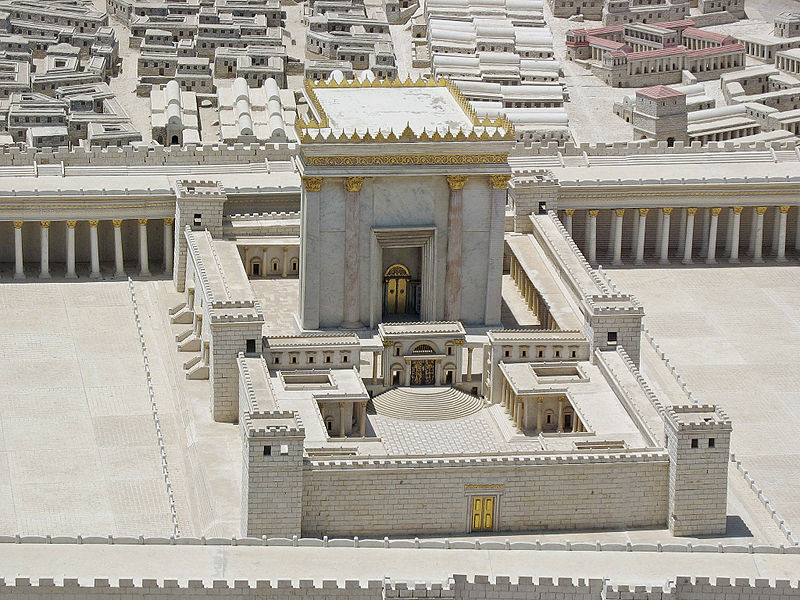
Second Temple

SOURCE

The collapse of the temple was most devastating to the Jews of that day who didn’t believe in Jesus. The Jerusalem temple was not only considered one of the great wonders of the world, but it was seen to be God’s central dwelling place. For the people of God, thankfully, God’s temple was already established in His Son, Jesus, and those who belong to Him:

Do you not know that you are God’s temple and that God’s Spirit dwells in you?” (I Corinthians 3:16)

Or do you not know that your body is a temple of the Holy Spirit within you, whom you have from God?” (I Corinthians 6:19)

For we are the temple of the living God; as God said, ‘I will make My dwelling among them and walk among them, and I will be their God, and they shall be My people.'” (II Corinthians 6:16)

Now, therefore, you are no longer strangers and foreigners, but fellow citizens with the saints and members of the household of God, having been built on the foundation of the apostles and prophets, Jesus Christ Himself being the chief cornerstone, in whom the whole building, being fitted together, grows into a holy temple in the Lord, in whom you also are being built together for a dwelling place of God in the Spirit.” (Ephesians 2:19-22)

Israel Is God’s Chosen People – What Does That Mean?


Two days ago Andrew Strom, a well-known minister from New Zealand, created a firestorm with his post, “Replacement?? – Israel & the Church.” I personally agree with about 90% of what he wrote. As expected, there have been many responses, some very emotional. There are nearly 350 comments under that post, as of last count, and they address so many different aspects of this topic (and beyond) that it can make the mind spin. I’m very interested in what some have to say, but quite baffled at what others say. I’d like to get feedback, if possible, regarding one baffling statement that appeared repeatedly in that forum, one which I’ve heard so many times before:

“Israel is God’s chosen people.”

For those who say this and believe it, what does that mean? Does it mean that all citizens of Israel are God’s chosen people? At face value, that’s what it seems they would mean. Somehow, though, I get the impression that people mean Jews only, when they say this. Did you know that there are roughly 1.6 million Arab citizens in Israel? According to this Wikipedia entry, that’s the case. Are they also among God’s chosen people, since they live in Israel?**

Others claim that all ethnic Jews are God’s chosen people, and I also completely disagree with this idea. Scripture teaches that only those who belong to Jesus are God’s chosen people. In I Peter 2:4-10, for example, those who belong to Jesus are chosen to be a royal priesthood, to receive mercy, to be a light in the darkness, etc. This is true of those who belong to Christ. It’s not true for those outside of Christ, even if they happen to be Jewish. For a deeper discussion on this topic, please see this post:

http://kloposmasm.com/2010/09/23/who-are-gods-chosen-people-and-why-are-they-chosen/

However, I’m even more baffled by the claim that the nation of Israel is God’s chosen people. It makes no sense Scripturally, and it doesn’t even make sense politically. What are your thoughts on the claim that “Israel is God’s chosen people”?

———————————————————————————————–

**I believe that some Arab citizens of Israel actually are among God’s chosen people, but only those who belong to Christ. And some of them do – praise God.

Colleges, It’s Time To Admit You Have a Problem


My wife and I concur with, and can relate to, an article that was posted earlier today on Yahoo by Iris Maria Chávez, assistant field director for The Education Trust. We both have college/university debt (together it’s quite substantial), and we’re well aware of how unreachable higher education costs are becoming. One thing I learned from Iris’ article is that college tuition and fees have increased by 538% since the 1980’s. Combine the high costs with statistics about how difficult it is for college graduates to get a full-time job, and it’s an understatement to say that this situation in the US is a real mess. Here’s Iris’ story, along with her report on a growing campaign that is calling on colleges to reduce their soaring costs:

Growing up, I did exactly what was expected of me. I worked hard through high school and was the first in my family to graduate from college, thanks to the federal Pell Grant, an academic scholarship and work-study program.

Despite that, I still walked away with massive student loans. I don’t regret my choice because my education is the one thing no one can take away from me. But, like too many of my friends, I am now buried in student debt.

By the time I pay off my loans, I’ll be in my 50s. And like many of my peers, I’m thinking differently about major life decisions, like buying a home or car or having kids, because I have too much student debt to pay off first.

My story isn’t unique. More and more, skyrocketing college costs are forcing students to take on crippling debt in order to get the education they need. Since the early 1980s, tuition and fees have increased 538 percent—that’s almost twice as fast as healthcare costs. Over two-thirds of all college students currently borrow in order to finance their education. Even so, I was shocked to learn that Americans now owe more than $1 trillion on student loans.

Far too many hardworking students are being priced out of higher education. College should be about creating opportunity, not debt. The time to make college affordable is long past due.

Higher education is critical to ensuring a bright future. Not having at least a bachelor’s degree costs the average high school graduate about $1 million in lost lifetime earnings. But every year, more than 100,000 college-qualified, low-income students don’t enroll at all, citing cost as a major barrier.

Right now, the conversation about our nation’s student debt crisis is being dominated by policymakers, researchers and college administrators—which means that it’s more about dollars and numbers than real-world implications for real-life students and their families. It’s time for this conversation to be driven by the individuals who are most directly impacted: current and aspiring college students and recent graduates.

That’s why I got involved with I AM NOT A LOAN , a new national campaign to raise the voices of young people who are fed up with soaring college costs and student debt.

As a first step, I AM NOT A LOAN is calling on colleges across the country to pledge to reduce student debt. The leaders of many of these institutions already acknowledge that college costs are growing at an unsustainable rate, but have yet to take needed action to solve the problem.

To read the rest of Iris’ article, continue here.

Jesus’ Use of “This Generation” in the Olivet Discourse Is No Different Than Anywhere Else


There is plenty of disagreement on what Jesus meant when He said, “Truly, I say to you, this generation will not pass away until all these things take place” (Matthew 24:34, Mark 13:30, Luke 21:32). He was making a reference, of course, to all that He had said prior to this statement. This included prophecies about war, earthquakes, famine, false prophets, persecution in the synagogues, the spreading of the gospel to all nations, the surrounding of Jerusalem and Judea by a foreign army, a time of unparalleled distress, His coming in the clouds with great power and glory, the arrival of His kingdom, and redemption for His people.

The careful reader will take note that Jesus was prompted to make these predictions in response to His disciples’ question about when the temple would be destroyed, and what signs would point forward to that event (Matthew 24:1-3, Mark 13:1-4, Luke 21:5-7). It was this question that led to His discourse, known as the Olivet Discourse.

Mark and Luke, in their accounts, only show the disciples asking this one question about the temple. Matthew shows them asking a three-part question or, some would say, three separate questions: [1] When will the temple fall? [2] What will be the sign of Your coming? [3] What will be the sign of the end of the age? Those who believe in fulfilled eschatology maintain that these events are synonymous, while those who regard this discourse as unfulfilled often say that the last two belong to our future.

When it comes, then, to the timing of this prophecy’s fulfillment, there is debate at both ends of the Olivet Discourse:

[1] Did Jesus set out to answer just one question? Or did He set out to answer three questions, and therefore He may have prophesied about two different time periods?

[2] When Jesus said “this generation,” did He mean His own generation? Or did He have in mind, as some are fond of saying, a future generation that would begin to see those signs take place all at once? Did He even perhaps imply a dual fulfillment, a partial fulfillment in His own generation, and an ultimate fulfillment in the far distant future?

We will set aside the first question for the rest of this article, and focus on the second question, for Jesus is shown to say precisely the same thing in all three accounts: “…this generation will not pass away until all these things take place.”

At the very beginning of the New Testament, we get a good idea of how Matthew defined the word “generation.” Consider his genealogy listing from Abraham to Jesus:

So all the generations from Abraham to David are fourteen generations, from David until the captivity in Babylon are fourteen generations, and from the captivity in Babylon until the Christ are fourteen generations” (Matthew 1:17).

We learn from Matthew that 14 generations passed from the Babylonian captivity until the time of Jesus. We also know that Babylon took Judah captive in 586 BC. Putting these two pieces together, we can calculate that each of these 14 generations was about 42 years in length (586 divided by 14). [For more details on this, see my study on Matthew 24:29-34 / Mark 13:24-30 / Luke 21:25-32.]

This being the case, let us ask if the temple was destroyed, as Jesus predicted, within one generation of that prediction, i.e. within approximately 42 years. It was! Jesus was crucified in or around 30 AD, and the temple was destroyed by the Roman armies in 70 AD, that is, 40 years later.

The Olivet Discourse was not the first time that Jesus had used the expression, “this generation.” In all His other uses of this phrase, it’s more than evident that He meant His own generation. Consider the following examples:

“To what can I compare this generation? They are like children sitting in the marketplaces and calling out to others: ‘We played the pipe for you,and you did not dance; we sang a dirge,and you did not mourn.’” (Matthew 11:16-17)

“The men of Nineveh will stand up at the judgment with this generation and condemn it; for they repented at the preaching of Jonah, and now something greater than Jonah is here. The Queen of the South will rise at the judgment with this generation and condemn it; for she came from the ends of the earth to listen to Solomon’s wisdom, and now something greater than Solomon is here.” (Matthew 12:41-42; see also Luke 11:29-32)

“Then it goes and takes with it seven other spirits more wicked than itself, and they go in and live there. And the final condition of that person is worse than the first. That is how it will be with this wicked generation.” (Matthew 12:45)

You unbelieving and perverse generation,” Jesus replied, “how long shall I stay with you? How long shall I put up with you? Bring the boy here to me.” (Matthew 17:17)

And so upon you will come all the righteous blood that has been shed on earth, from the blood of righteous Abel to the blood of Zechariah son of Berekiah, whom you murdered between the temple and the altar.Truly I tell you, all this will come on this generation.” (Matthew 23:35-36)

He sighed deeply and said, “Why does this generation ask for a sign? Truly I tell you, no sign will be given to it.” (Mark 8:12)

Jesus went on to say, “To what, then, can I compare the people of this generation? What are they like?” (Luke 7:31)

“But first He must suffer many things and be rejected by this generation.” (Luke 17:25)

Time and space limitations will not allow us to examine all the signs that Jesus predicted would take place before “this generation” would pass away, although I believe that [1] a study comparing Scripture with Scripture and [2] a study of 1st century history will show that they did take place before Jesus’ own generation passed away. As an example of the first point, Luke says that Jews “from every nation under heaven” heard the mighty works of God proclaimed in their own languages (Acts 2:5-11), and the apostle Paul was emphatic that the gospel was preached all over the (known) world in his lifetime (Romans 1:8, Romans 16:25-26, Colossians 1:5-6, and Colossians 1:23).

However, as helpful as these confirmations may be, they are not even necessary for our understanding of Jesus’ words, “…this generation will not pass away until all these things take place.” The generation that would pass away had to see, not some, but all of those things take place. There’s only one generation that witnessed the fall of the temple, and that was Jesus’ own generation. This will never happen again, and this point alone indicates that “all these things” could not possibly take place in our own generation or in the future. Remember also that the earthquakes, wars, the invasion of Judea and Jerusalem, the great distress, and all the other signs were to take place, not after the temple fell, but before the temple would fall (Matthew 24:1-3, Mark 13:1-4, Luke 21:5-7).

To the people of Jesus’ time, we who live in the 21st century would be regarded as “that generation.” To those of us living in the 21st century, the people of Jesus’ time would also be regarded as “that generation.” Jesus didn’t use that phrase, however. The people of Jesus’ time would have understood their own generation as “this generation,” just as they did when He uttered this phrase in Matthew 11:16-17; Matt. 12:41-42; Matt. 12:45; Matt. 17:17; Matt. 23:35-36; Mark 8:12; Luke 7:31; Luke 11:29-32; and Luke 17:25.

—————————————————

All of our studies on the Olivet Discourse can be seen here, including a verse-by-verse parallel study of Matthew 24-25, Mark 13, and Luke 21.

St. Paul Cultural Village


In a previous post I briefly mentioned a project that my wife, Jasmine, and I have been overseeing for much of the past year: the setting up of a multicultural marketplace and community gathering center that we’re calling St. Paul Cultural Village. This vision came out of our volunteer work with International Village, a nearby storefront ministry and resource center that is impacting the lives of Somali, Bhutanese, and Karen refugees. We saw the need for people in these communities to be given platforms where they can make a living, and display and maintain their culture. Some had previously run small businesses in their countries of origin (Somalia, Bhutan, and Myanmar), but had lost nearly everything when civil war and other tragic circumstances caused them to become refugees.

One of the reasons I haven’t posted much at this site over the last six months or so is that I’ve been very busy working on this project, while also holding down two jobs. There have been a few joyous occasions during this journey, but overall it’s been a very difficult and even painful one. It’s only by the grace of God that we’ve been able to persevere and keep pushing forward with this project in the face of many barriers, disappointments, being lied to and taken advantage of, delays (from more than one source), and local government red tape. Yet we do believe that God has called us to see this place take shape and carry on for His glory, and we’re holding on as long as we can for a real breakthrough. We’d appreciate your prayers.

I’d like to share a video from a gathering at our location 10 days ago, along with some pictures that will give a glimpse into what is taking shape at St. Paul Cultural Village. A number of us gathered together on Valentine’s Day, and we were a nice mix of Karen refugees, Bhutanese refugees, and Americans. After the Bhutanese had left, Bwet, a Karen brother from Myanmar, played his guitar and led us in the song, “Where You Go I’ll Go,” by Kim Walker (Jesus Culture):

YouTube link to the video above: Hanging out at St. Paul Cultural Village

IMG_20130214_202022 IMG_20130214_194447 IMG_20130214_194409

IMG_20130214_194626 IMG_20130214_194556 IMG_20130214_194456

IMG_20130214_203536 IMG_20130214_200653 IMG_20130214_200545

IMG_20130214_200740 IMG_20130214_203616

For the last couple weeks, we’ve been opening our doors every Monday/Tuesday/Thursday/Friday from 4:00 pm – 9:00 pm. Members of the public are free to bring in their laptops or other devices, and access the internet for free (we have plenty of outlets available). We also have Keurig-brewed coffee (and tea or apple cider) available on a “donations are welcome, but not required” basis. Some have also taken the opportunity during this time to walk through our building and see what’s happening and what’s available.

SN850878 SN850874 SN850870

The space shown in the pictures above is also available to rent for meetings, parties, discussion groups, seminars, and more. We also have 12 market stalls available for small business owners. This opportunity was initially created for people in the refugee communities, but we have found that only a few individuals are ready, and this opportunity is now open to anyone. Here are a few pictures of our market stalls (taken about a month ago):

SN850884 SN850880  SN850882

As shown here, our neighborhood is very diverse. Out of about 20,000 people surrounding our location, 34% are Asian, 30% are Caucasian, 19% are African-American or African, and 11% are Hispanic. To learn more about some of the refugee communities in this part of Minnesota, please see the videos on these pages: Karen refugees, Somali refugees, and Bhutanese refugees.

LogoColorTextBelow

www.stpaulculturalvillage.com

My wife, Jasmine, and I (August 2012)

My wife, Jasmine, and I (August 2012)