Revelation Chapter 17 (Part 1: Verses 1-6)


REVELATION 17

Adam Maarschalk: December 3, 2009

Scripture text for this study: Revelation 17

UPDATE: This post was written when I understood the scarlet beast of Revelation 17 to be the same as the sea beast of Revelation 13:1-10, the seven kings of Revelation 17:10 to be the first seven Roman emperors, and the 10 horns of Revelation 17:12-14 to be the rulers of Rome’s 10 Senatorial Provinces. I now understand the seven kings to Revelation 17:10 to be seven Zealot leaders belonging to the family dynasty of Hezekiah the Zealot, and the 10 horns to be 10 Jewish generals (named by Josephus) who were appointed around January AD 67 to oversee specific territories and to prepare for war with Rome. This post will be updated accordingly when time allows.

A. The Scarlet Woman and the Scarlet Beast (Rev. 17:1-6)

Verse 1: At this point, the seven bowl judgments have been poured out on Babylon the Great (Rev. 16:19) by seven angels. One of these angels now takes John to see her judgment. Babylon, whose identity we will soon discuss, is referred to as “the great prostitute who is seated on many waters.” Steve Gregg, in his book “Revelation: Four Views (A Parallel Commentary),” reminds us that the fall of Babylon was first announced in Rev. 14:8 (p. 400). He then adds,

Chapters 17-19 reveal the destruction of Babylon in greater detail, the precursor to the marriage of the Lamb to a new bride. Appropriately, the chaste bride is contrasted with the wicked city depicted as a great harlot (v. 1). In order to gain this insight, John is transported in vision into the wilderness (v. 3). David S. Clark points out that “sometimes he was carried away into heaven to see visions; but the thing he was about to see now had no affinity with heaven, and he could not see such a scene as this in heaven, so he was taken to a wilderness as a more appropriate place, and one more in congruity with what he was about to see.”

Verse 2: Babylon is indicted for its sexual immorality, by which “the dwellers on earth” and “the kings of the earth” were made guilty. In our study of Revelation so far, we have suggested that many of the references to “the earth” in the book of Revelation are not meant to be taken as worldwide in scope, but as dealing instead with the land of Israel/Palestine. In a 3-part study on this subject beginning with this post, I have outlined nearly 20 instances where this appears to be the case. Notice that the reference to “the kings of the earth” here is distinct from the reference to “the kings of the whole world” in Revelation 16:14, where that reference was to the provincial kings of the entire Roman Empire.

We have also noted a couple of times that at this point in John’s narrative, there is division in the preterist camp regarding who judgment is being poured out upon. Some say it’s the Roman Empire, and others say it’s Jerusalem (this is my view). Steve Gregg (pp. 402-406) summarizes J. Stuart Russell’s arguments on why Babylon is to be identified with Jerusalem, and not with Rome. He lists 13 such reasons[1], which are reproduced here:

#1: The fall of Rome [in 476 AD] does not fall within the things “which must shortly take place,” which is the stated subject matter of the Apocalypse (cf. 1:1). [The fall of Jerusalem does, as it occurred in 70 AD, in John’s own day];

#2: The Olivet Discourse, which Russell conceives as a shorter treatment of the same subject matter as Revelation, does not include a discussion of the fate of Rome (see Matthew 24; Mark 13; Luke 21);

#3: As Revelation presents a series of contrasts—a Lamb vs. a dragon; the Father’s name vs. the beast’s name on people’s foreheads; the bride vs. the harlot—so also the Apocalypse contrasts two cities, Babylon and the New Jerusalem. The latter is the church. The earthly Jerusalem is clearly in view in earlier chapters. To bring Rome into the picture at this point would introduce a third city and destroy the symmetry of the book;

#4: As a symbolic name for Jerusalem, Babylon would be as fitting as Sodom and Egypt, which were applied to Jerusalem earlier (11:8);

#5: The phrase “that great city” was used of Jerusalem earlier (11:8), as it is used repeatedly in these chapters regarding Babylon;

#6: In chapter 14, the winepress was trodden “outside the city” (14:20), which almost all understand to refer to Jerusalem, yet the only “city” named earlier in that chapter is Babylon (14:8), hence, Babylon equals Jerusalem;

#7: The division of Babylon into “three parts” in 16:19 best fits Jerusalem… (cf. Ezek. 5:1-12). [By this, Steve Gregg is also referring to the historical fact of three warring factions in Jerusalem during the siege leading up to Jerusalem’s destruction in 70 AD, which literally carved up the city into three parts. See previous post on chapter 16.];

#8: The appellation “the harlot” is an established label for Jerusalem from the Old Testament (cf. Isa. 1:21; 57:8; Jer. 2:2, 20); it could never be applied to Rome or any Gentile city, since they have never been in a covenant relationship with God. As Chilton writes: “The metaphor of harlotry is exclusively used in the Old Testament for a city or nation that has abandoned the Covenant and turned toward false gods; and with only two exceptions…[2] the term is always used for faithless Israel;

#9: Jerusalem sat upon seven hills as truly as did Rome [SEE FINAL NOTE at the end of this post];

#10: If “the kings of the earth” [verse 2] be understood to mean “the rulers of the land (Israel),” then Jerusalem, as appropriately as Rome, could be said to be “that great city” in 17:18 [more on this later];

#11: The expression “that great city which reigns over the rulers of the land” (v. 18) is fully equivalent to that which is said of Jerusalem in Lamentations 1:1—“Who was great among the nations! The princess among the provinces”;

#12: The Jews of Jerusalem were idolatrous, as was Rome;

#13: No city other than Jerusalem could be charged with the blood of the prophets and saints and apostles (see 17:6; 18:20, 24).

Verse 3: John then sees a woman sitting on a scarlet (red) beast with seven heads and ten horns. We already discussed the identity of this beast at length in Revelation 13 (See Post #1 here and Post #5 here), seeing a compelling case for its identity as Nero in the specific sense and the Roman Empire in the general sense. The woman here in verse 3 is seen as a prostitute (verse 1), and the fact that she is sitting on the beast does not mean that she is one and the same with the beast. Rather it suggests a very close relationship between the woman and the beast, who are both distinct in their identity. In my term paper on the events of 70 AD, I wrote the following regarding the significance of the woman (Jerusalem, as representing Israel) riding the beast (Rome):

In what sense might Jerusalem have sat on the beast with seven heads (mountains), the beast that would ultimately turn on her and destroy her (Rev. 17:3, 9, 16-18)? Israel had enjoyed a good relationship with Rome until the Jewish revolt began in 66 AD, and Judaism was recognized as a valid religion within the Roman Empire. Josephus wrote of this relationship, “It seems to me to be necessary here to give an account of all the honors that the Romans and their emperors paid to our nation [Israel], and of the leagues of mutual assistance they have made with it” (Antiquities, 14.10.1-2). The Jews frequently took advantage of this relationship to induce persecution against Jesus and His followers (Luke 23:2; John 18:28-31, 19:15; Acts 4:27, 16:20, 17:7, 18:12, 21:11, 24:1-9, 25:1-2). W.H.C. Frend even writes that “the promptings of orthodox Jews in the capitol had something to do with” Nero’s decision to begin persecuting Christians in 64 AD (The Rise of Christianity [Philadelphia: Fortress, 1984], 109; quoted in Kenneth Gentry, 2002, p. 63).

Kenneth Gentry suggests that the beast is seen as scarlet for any (or all) of the following reasons: [1] The robes worn by Roman emperors were red in color [2] Rome, led by Nero, was responsible for shedding much blood among God’s people [3] Nero was famous for his red beard. Regarding this last point, Gentry says, “It would seem most appropriate to expect the red color of the beast to also correspond to the person designated as the beast whose number is 666” (Before Jerusalem Fell, p. 217). In other words, this is likely one more means by which John made known to his first-century readers exactly who the beast was (in the singular sense) without saying so explicitly.

Verses 4-5: The woman is seen to be wearing purple and scarlet, and gold, jewels, and pearls. She has in her hand a golden cup “full of abominations and the impurities of her sexual immorality.” Her forehead proclaimed that she was “Babylon the great, mother of prostitutes and of earth’s abominations.” In my term paper on the events of 70 AD, I noted some observations made by Todd Dennis, the founder of the Preterist Archive:

…the description of the harlot’s attire (purple, scarlet, gold, jewels, and pearls) was nearly identical to the ephod worn by the high priest (Revelation 17:4; cf. Exodus 28:5-21). The golden cup she held was likely symbolic of the temple vessels, the greatest part of which were gold and silver, according to the Jewish historian Josephus (Wars 5.4.4). On Aaron’s forehead was the inscription “Holy to the Lord” (Exodus 28:36). The harlot’s forehead, on the other hand, bore the title “Babylon the great, mother of prostitutes and of earth’s abominations” (Rev. 17:5).

The attire of the harlot was also similar to what Josephus said was discovered “in the midst [of the inmost court], that most sacred part of the temple” when Jerusalem was captured by the Romans in 70 AD:

“The woman was arrayed in purple and scarlet, and adorned with gold and precious stones and pearls” (Revelation 17:4).

“But then this house, as it was divided into two parts, the inner part was lower than the appearance of the outer, and had golden doors of fifty-five cubits altitude, and sixteen in breadth; but before these doors there was a veil of equal largeness with the doors. It was a Babylonian curtain, embroidered with blue, and fine linen, and scarlet, and purple, and of a contexture that was truly wonderful” (Wars 5.5.4).

In Jeremiah’s day, Judah (with its capital of Jerusalem) was indicted because it had “played the whore with many lovers” and “polluted the land with…vile whoredom” (Jeremiah 3:1-2). Like Israel in John’s day, Judah prior to its fall in 586 BC had “the forehead of a whore” (verse 3).

Duncan McKenzie’s article has helped me to understand that “Babylon the Great” here was more than just a physical city in its identity. It was also a religious system full of abominations. That system, I believe, was Old Covenant temple-based Judaism. In the next chapter, we will see a command from God regarding Babylon, saying, “Come out of her, my people, lest you take part in her sins, lest you share in her plagues” (Rev. 18:4). We know from chapter 1 that John’s immediate audience did not live in Jerusalem (or Rome), but in Asia Minor. The believers in Jerusalem did flee, as we noted in chapter 7, but what did this message mean to believers already living outside of Jerusalem and Judea?

God’s message was about breaking completely free from Old Covenant temple-based Judaism. Babylon represented not only Jerusalem, but also the unfaithful community which had rejected Jesus in order to maintain corrupted Old Covenant practices. Both physical Jerusalem and temple-based Judaism were judged and destroyed in 70 AD. In Daniel 9:26-27 we see that it is on “the wing of abominations” that one comes “who makes desolate” (cf. Rev. 17:16, Matt. 23:38). This is in reference to the destruction of “the city and the sanctuary” (as related to Daniel’s own people and his holy city—Dan. 9:24). What are the abominations spoken of in both Daniel and Revelation? Regarding Daniel 9, John Calvin several centuries ago remarked:

I have no hesitation in referring this language of the angel to that profanation of the Temple which happened after the manifestation of Christ, when sacrifices ceased, and the shadows of the law were abolished. From the time, therefore, at which the sacrifice really ceased to be offered; this refers to the period at which Christ by his advent should abolish the shadows of the law, thus making all offering of sacrifices to God totally valueless… God’s wrath followed the profanation of the Temple. The Jews never anticipated the final cessation of their ceremonies, and always boasted in their peculiar external worship, and unless God had openly demonstrated it before their eyes, they would never have renounced their sacrifices and rites as mere shadowy representations. Hence Jerusalem and their Temple were exposed to the vengeance of the Gentiles.

As Russell pointed out earlier, John is being shown a contrasting picture of two women: the harlot of chapters 17 and 18, and the bride in chapter 19 clothed with “fine linen, bright and pure…the righteous deeds of the saints” (see verses 1-8). One (the harlot, representing Judaism) persecuted the other (the bride, Christ’s Church), as we will see again in the next verse. What is most fascinating is Paul’s own contrasting of two women in his epistle to the Galatians:

Tell me, you who desire to be under the law, do you not listen to the law? For it is written that Abraham had two sons,one by a slave woman andone by a free woman. But the son of the slave was born according to the flesh, whilethe son of the free woman was born through promise. Now this may be interpreted allegorically: these women are twocovenants. One is from Mount Sinai, bearing children for slavery; she is Hagar. Now Hagar is Mount Sinai in Arabia;she corresponds to the present Jerusalem, for she is in slavery with her children. But the Jerusalem above is free, and she is our mother. For it is written, “Rejoice, O barren one who does not bear; break forth and cry aloud, you who are not in labor. For the children of the desolate one will be more than those of the one who has a husband.” Now you, brothers,like Isaac, are children of promise. But just as at that time he who was born according to the flesh persecuted him who was born according to the Spirit, so also it is now. But what does the Scripture say?”Cast out the slave woman and her son, for the son of the slave woman shall not inherit with the son of the free woman.” So, brothers, we are not children of the slave butof the free woman (Galatians 4:21-31, emphasis added).

Note how the following passages contrast each other:

A. Revelation 17:1: “Then one of the seven angels who had the seven bowls came and said to me, ‘Come, I will show you the judgment of the great prostitute who is seated on many waters.’”

A. Revelation 21:9: “Then came one of the seven angels which had the seven bowls full of the seven last plagues and spoke to me, saying, ‘Come, I will show you the Bride, the wife of the Lamb.’”

B. Revelation 17:3: “And he carried me away in the Spirit into a wilderness, and I saw a woman sitting on a scarlet beast that was full of blasphemous names.”

B. Revelation 21:10: “And he carried me away in the Spirit to a great, high mountain, and showed me the holy Jerusalem coming down out of heaven from God.”

On these matters, Duncan McKenzie concludes:

Revelation is talking about the same subject as Galatians; both books are contrasting two “cities” (physical Jerusalem and heavenly Jerusalem in Galatians, Babylon and the New or heavenly Jerusalem in Revelation) that are two “wives” (Hagar and Sarah in Galatians, the widowed harlot and the bride in Revelation).  These two women of Galatians and Revelation represent two communities, those of the old and new covenants…  In the book of Revelation, as in Galatians (4:29), one woman persecutes the other (i.e. the harlot persecutes the bride, Rev. 17:6).  Similarly in Revelation, as in Galatians, one of the two women is cast out (and destroyed—Rev. 18:21) while the other woman receives her inheritance (i.e. the Lord takes her as His bride).  This explains why the very next subject in Revelation after Babylon is destroyed is the wedding of the bride (Rev. 19:1-10).  God deposes of His unfaithful old covenant wife (who irrevocably broke her covenant of marriage with God and became a widow when she had Jesus killed) and then marries His faithful new covenant bride…

Just as the New Jerusalem is not a literal city but a community of people (the bride, the new covenant community) so Babylon was not a literal city but a community of people (the harlot, the unfaithful old covenant community)… While Babylon was centered in Jerusalem, its citizens were all those of unfaithful Israel that were rejecting Jesus for the temple system.

When the earthly Jerusalem fell, God’s true people were in possession of “the city of the living God, the heavenly Jerusalem” (Hebrews 12:18-28). Upon the removal of that which could be shaken (vs. 27; cf. Hebrews 9:8-10), there remained “a kingdom that cannot be shaken” (vs. 28; cf. Daniel 7:21-22, Matthew 21:43).

Verse 6: The woman is said to be “drunk with the blood of the saints, the blood of the martyrs of Jesus.” This same charge was laid upon those of “the earth” (Rev. 16:1) in the previous chapter, where it was said that “they have shed the blood of saints and prophets (16:4-7).” In chapter 18 we will see that “in her was found the blood of prophets and of saints, and of all who have been slain on the earth” (18:24), and that the “saints and apostles and prophets” were told to rejoice over her destruction (18:20). Who was responsible for shedding all the blood of the prophets and the saints, according to Jesus, and who would receive judgment as a result? David Lowman, a Presbyterian pastor, aptly points out that the answer can be found in Matthew 23:

Woe to you, scribes and Pharisees, hypocrites! For you build the tombs of the prophets and decorate the monuments of the righteous, saying, ‘If we had lived in the days of our fathers, we would not have taken part with them in shedding the blood of the prophets’” Thus you witness against yourselves that you are sons of those who murdered the prophets. Fill up, then, the measure of your fathers. You serpents, you brood of vipers, how are you to escape being sentenced to hell? Therefore I send you prophets and wise men and scribes, some of whom you will kill and crucify, and some you will flog in your synagogues and persecute from town to town, so that on you may come all the righteous blood shed on earth, from the blood of innocent Abel to the blood of Zechariah the son of Barachiah, whom you murdered between the sanctuary and the altar. Truly, I say to you, all these things will come upon this generation. O Jerusalem, Jerusalem, the city that kills the prophets and stones those who are sent to it! How often would I have gathered your children together as a hen gathers her brood under her wings, and you would not! See, your house is left to you desolate (Matthew 23:29-38, emphasis added).

—————————————————————————————————————————————————————————

In Part 2 of our study on Revelation 17 we will see how the angel unveils to John the meaning of the prostitute (Babylon) and the beast…

All of our Revelation chapter-by-chapter studies, and any other posts related to the book of Revelation, can be found here.


[1] Kenneth Gentry, in his book Before Jerusalem Fell, lists his own set of reasons (pp. 240-241): “Briefly, the evidence for the identifying of Jerusalem as the Harlot is based on the following: (1) Both are called ‘the great city’ (Rev. 14:8; 11:8). (2) The Harlot is filled with the blood of the saints (cp. Rev. 16:6; 17:6, 18:21, 24; with Matt. 23:34-38; Luke 13:33; Acts 7:51-52). Jerusalem had previously been called by pagan names quite compatible with the designation ‘Babylon’ (cp. Rev. 14:8 and 17:5 with 11:8). (4) Rome could not fornicate against God, for only Jerusalem was God’s wife (Rev. 17:2-5, cp. Isa. 1:20; Jer. 31:31). (5) There is an obvious contrast between the Harlot and the chaste bride (cp. Rev. 17:2-5 with Rev. 21:1ff.) that suggests a contrast with the Jerusalem below and the Jerusalem above (Rev. 21:2; cp. Gal. 4:24ff.; Heb. 12:18ff.). The fact that the Harlot is seated on the seven-headed Beast (obviously representative of Rome) indicates not identity with Rome, but alliance with Rome against Christianity (cp. Matt. 23:37ff.; John 19:6-16; Acts 17:7).” SEE ALSO QUESTION #9 HERE: http://www.forerunner.com/beast/beastfaq.html.

[2] Note from Steve Gregg: “The two exceptions are Tyre (Isaiah 23:15-17) and Nineveh (Nahum 3:4). It is notable that both of these pagan cities, Tyre (See I Kings 5:1-12; 9:13; Amos 1:9) and Nineveh (Jonah 3:5-10), had at one time been in covenant with God.”

—————————————————————————————————————————————————————————————-

FINAL NOTE: Regarding J. Stuart Russell’s 13 arguments for identifying Babylon with Jerusalem, there was one that I wasn’t quite on board with earlier (i.e. I thought it shouldn’t belong to his list). That was #9, which stated, “Jerusalem sat upon seven hills as truly as did Rome.” Then today I came across this information at the site of Australian Pastor Andrew Corbett:

The City of Jerusalem as it existed in the time of Christ Jesus was widely reckoned to be the “City of Seven Hills.” This fact was well recognized in Jewish circles. In the Pirke de-Rabbi Eliezer, an eighth century midrashic narrative (section 10), the writer mentioned without commentary (showing that the understanding was well known and required no defense) that “Jerusalem is situated on seven hills” (recorded in The Book of Legends, edited by Bialik and Ravnitzky, p. 371, paragraph 111). And, so it was. Those “seven hills” are easy to identify. If one starts with the Mount of Olives just to the east of the main City of Jerusalem (but still reckoned to be located within the environs of Jerusalem), there are three summits to that Mount of Olives. The northern summit (hill) is called Scopus [Hill One], the middle summit (hill) was called Nob [Hill Two], the highest point of Olivet itself, and the southern summit (hill) was called in the Holy Scriptures the “Mount of Corruption” or “Mount of Offence” [Hill Three] (II Kings 23:13). On the middle ridge between the Kedron and the Tyropoeon Valleys there was (formerly) in the south “Mount Zion” [Hill Four] (the original “Mount Zion” and not the later southwest hill that was later called by that name), then the “Ophel Mount” [Hill Five] and then to the north of that the “Rock” around which “Fort Antonia” was built [Hill Six]. And finally, there was thesouthwest hill itself [Hill Seven] that finally became known in the time of Simon the Hasmonean as the new “Mount Zion.” This makes “Seven Hills” in all.

So, indeed, J. Stuart Russell was correct. Still, as we will see in the following post, there is another sense also in which the woman (apostate Israel) can be seen as seated on the seven mountains of Rome (if Rome is in view in Revelation 17:9).

Revelation Chapter 16


REVELATION CHAPTER 16

Rod Opferkew: November 26, 2009

Scripture text for this study:  Revelation 16

[Primary source: Revelation: Four Views – A Parallel Commentary, edited by Steve Gregg (1997); pages 352-397. Contained in this post is a consideration of the preterist viewpoint. Notes from Adam are in red font.]

First and foremost, who is the recipient of the judgments in this chapter?  The first fifteen chapters present a lot of evidence that the target of God’s wrath was Israel, or more specifically, the capital city of Jerusalem.  However, some Preterists say there may be evidence that Rome was the target.  One expositor in particular, Jay Adams, breaks up Revelation into essentially two sections. He then points out that the bowl judgments seem to parallel the trumpet judgments. He states that the trumpet judgments are meant for Israel, and the bowl judgments are meant for the Roman Empire. David Chilton, Kenneth Gentry, and others believe that first-century Israel is designated for judgment throughout the entire book, with the exception of judgment upon the beast in Rev. 13:10, 16:10, and 19:20.

Here in verse 1 we see that the seven angels are told to “pour out on the earth the seven bowls of the wrath of God.” In our study of Revelation so far, we have suggested that many of the references to “the earth” in the book of Revelation are not meant to be taken as worldwide in scope, but as dealing instead with the land of Israel/Palestine. In a 3-part study on this subject beginning with this post, I have outlined nearly 20 instances where this appears to be the case.

The trumpets and bowls do have distinct differences.  The effects of the trumpet judgments are often only partial (affecting one-third of the earth, trees, green grass, sea, ships, springs of water, the sun, moon, and stars–see Revelation 8:6-12), whereas the effects of the bowl judgments are total. The bowls are associated with the seven last plagues, as seen in Revelation 15:1.  A likely scenario is that “the trumpets depict preliminary calamities that fall upon Israel during the Jewish War, while the bowls present plagues associated with the final and utter devastation of Jerusalem” (Steve Gregg, p. 360).

First bowl (verse 2): This plague was likely symbolic, though there is evidence that literal boils and rashes were present due to the lack of proper sanitation in the besieged city (Jerusalem, especially during the final five-month siege from April-September 70 AD). Remember, there were thousands of dead bodies and streets were filled with blood and sewage, making disease rampant.  It can be seen that in verse 11, the people were still afflicted as they remained unrepentant of their sin and rejection of Christ.

It should be noted that the plagues in this first bowl judgment parallel the plagues that Moses brought down on Egypt in Exodus 9:8-12 (See Appendix 1 below for more such parallels).  Also a striking coincidence is that this is the same warning that Moses gave to the people of Israel if they were to become disobedient and unfaithful to His covenant (Deuteronomy 28:27, 35).

Second bowl (verse 3): Notice the parallel with the first plague in Egypt, i.e. the Nile turning to blood in Exodus 7: 17-21.  However, the blood is not free-flowing, it is like the blood of a corpse, “clotted, coagulated and putrefying” (Gregg, p. 360).  Judea was being compared to the sea, which has been seen elsewhere in Revelation to represent the Gentile nations (e.g. Revelation 13:1-10).  Josephus writes of a battle that took place on the Sea of Galilee in which the Romans overtook the fleeing Jews in boats and massacred them in the water (Wars, III: 10:9). I wrote the following in my term paper on Jerusalem’s destruction in 70 AD:

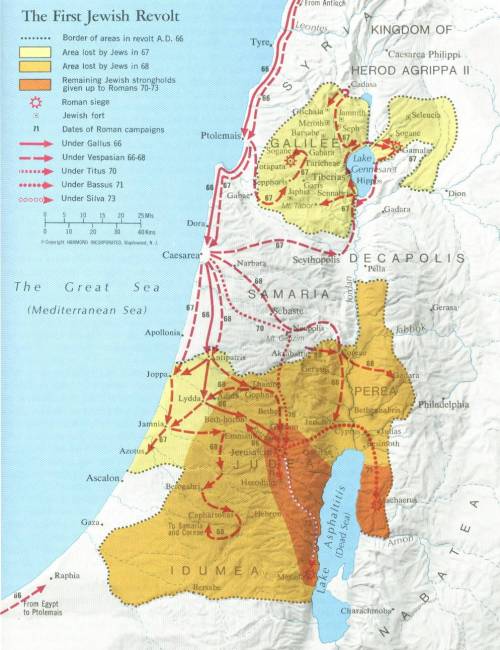
In early spring 67 AD, which was 3.5 years before Jerusalem’s final downfall, Vespasian first entered Judea with a 60,000-member army. In the campaign which was to follow he destroyed at least 150,000 inhabitants of Galilee and Judea, along with many towns. One of the first towns Vespasian crushed was Joppa, because its inhabitants had provoked his men by their frequent piracies at sea. The Jews there tried to flee from Vespasian on their ships, but Vespasian was helped by a tremendous storm that blew in just as they began to flee. Their vessels were crushed against each other and against the rocks, and when this slaughter was complete more than 4,200 bodies were strewn along the coast and a very long stretch of the coast was stained with blood.

Third bowl (verses 4-7): Literal “streams of blood” are well documented during the siege of Jerusalem, as blood flowed freely in the streets and polluted the water sources. Also in my term paper I wrote the following regarding the bloody slaughter which occurred immediately following the burning of the Second Temple in Jerusalem:

The Romans then hoisted their own idol-covered banners at every key point of the temple area, and plundered and burned the houses in the city. They murdered by the sword every Jew they could find, man, woman, and child. Their only compassion was for the dead, whom they encountered in mass numbers in many of the houses, mostly victims of the famine. Josephus writes, “But although they had this commiseration for such as were destroyed in that manner, yet had they not the same for those that were still alive, but they ran every one through whom they met with, and obstructed the very lanes with their dead bodies, and made the whole city run down with blood, to such a degree indeed that the fire of many houses was quenched with these men’s blood” (The Wars Of The Jews, 6:8:5).

The amount of blood that flowed, not only in Jerusalem but also throughout the surrounding region, could possibly bring to mind a passage like Revelation 14:19-20, which says, “So the angel swung his sickle across the earth and gathered the grape harvest of the earth and threw it into the great winepress of the wrath of God. And the winepress was trodden outside the city, and blood flowed from the winepress, as high as a horse’s bridle, for 1,600 stadia [about 184 miles].” This was the understanding of John Wesley (1703-1791) who, in his commentary on this passage, wrote:

“And the winepress was trodden – By the Son of God, Rev 19:15. Without [outside] the city – Jerusalem. They to whom St. John writes, when a man said, ‘the city,’ immediately understood this. And blood came out of the winepress, even to the horses’ bridles – So deep at its first flowing from the winepress! One thousand six hundred furlongs – So far! At least two hundred miles, through the whole land of Palestine.”

We also have this account from Josephus:

Now, this destruction that fell upon the Jews, as it was not inferior to any of the rest in itself, so did it still appear greater than it really was; and this, because not only the whole of the country through which they had fled was filled with slaughter, and [the] Jordan [River] could not be passed over, by reason of the dead bodies that were in it, but because the Lake Asphaltitis [the modern Dead Sea] was also full of dead bodies, that were carried down into it by the river. And now, Placidus…slew such as had fled to the lake, insomuch that all Perea had either surrendered themselves, or were taken by the Romans, as far as Macherus (Josephus, “Account of the Lake Asphaltitis,” War of the Jews 4:7:6).

Verse 6 seems to point to Jerusalem in A.D. 70 instead of Rome.  The killing of the prophets was among the great sins of Israel (This can be seen, for example, in 2 Chronicles 36:15-16, Luke 13:33-34 and Acts 7:52).  Jesus named this fact as the very reason that the symbolized blood of the righteous would be poured out in judgment upon that generation which heard Him speak (Matt 23:31-36) (Gregg, p. 366). More is said on this in our study of Revelation 17:6 and also Rev. 18:20, 24.

Fourth bowl (verses 8-9): These verses probably need to be taken symbolically, as there is no record of increasing heat that was both dangerous and scorching to the people during this time.  The sun in this instance is seen “as a symbol of mighty political and religious leaders…or refers to the oppression and tyranny exercised by the leaders of the Zealot sects that terrorized the citizens inside the besieged city of Jerusalem,” assuming Jerusalem was the intended target for this judgment.  If Rome is the target, then this judgment “may represent the tyranny of Roman leaders or the ruthlessness of the gothic and Vandal kings that attacked Rome and brought about her downfall [in 476 AD]” (Gregg, p. 368). God declared that He would judge an unfaithful Israel in this way (with scorching), as seen in Deuteronomy 28:22.

** Note that this is the opposite of the blessing the Israelites received in the Exodus, when Israel was shielded from the heat of the sun by the Glory-Cloud (Exodus 13:21-22, also Psalm 91:1-6). Also it was pointed out in our study of chapter 8 that judgment references to the sun in the Old Testament were clearly not meant to be seen as literal. David Chilton wrote regarding Revelation 8:12:

The imagery here was long used in the prophets to depict the fall of nations and national rulers (cf. Isa. 13:9-11, 19; 24:19-23; 34:4-5; Ezek. 32:7-8, 11-12; Joel 2:10, 28-32; Acts 2:16-21. [He quotes F.W. Farrar (1831-1903), who wrote that] “ruler after ruler, chieftain after chieftain of the Roman Empire and the Jewish nation was assassinated and ruined. Gaius, Claudius, Nero, Galba, Otho, Vitellius, all died by murder or suicide; Herod the Great, Herod Antipas, Herod Agrippa, and most of the Herodian Princes, together with not a few of the leading High Priests of Jerusalem, perished in disgrace, or in exile, or by violent hands. All these were quenched suns and darkened stars” (Gregg, pp. 166, 168).

Fifth bowl (verses 10-11): This verse clearly seems to be pointed at the Roman Empire. The throne of the beast is well thought to be the city of Rome itself (See our study on Revelation 13). David Chilton is referenced here, and he writes,

“Although most of the judgments throughout Revelation are aimed specifically at apostate Israel, the heathen who join Israel against the Church come under condemnation as well. Indeed the Great Tribulation itself would prove to be “the hour of testing, that hour which is to come upon the whole world, to test those who dwell upon the Land” (372).

The darkness referenced here which comes upon the throne of the beast (i.e. Rome) is symbolically taken to be the political turmoil and overthrow of its leaders, in particular when Nero (the beast in the singular sense) committed suicide in 68 A.D.  Upon his death, the Roman Empire quickly began to crumble, and the following year (69 A.D.) became known as the “Year of the Four Emperors” because of the rise and fall of four more leaders in Rome – Galba, Otho and Vitellius, all of whom reigned for eight months or less.

Those expositors who see the second half of Revelation as pointing to the fall of the Roman Empire refer to these verses as pertaining to the invasions which led to the ultimate fall of Rome in the fifth century.

Sixth bowl (verses 12-16): The great river Euphrates is represented in this bowl judgment just like it was in the sixth trumpet judgment. (The drying up the river was the strategy of Cyrus the Persian, the conqueror of historical Babylon in 536 B.C. The river was diverted away from the walls of Babylon, and this allowed his army to march under the wall and overtake the city and its king, Belshazzar, without much resistance.)  Here, the Babylon of Revelation is seen by some to be Rome and this bowl judgment to be the downfall of the Roman Empire in the fifth century A.D. (Gregg, p. 378).

Other writers see the Babylon of Revelation again pointing to Jerusalem and its related destruction in 70 A.D. God helped his people Israel through the drying up of the Red Sea (Exodus 14:21-22) and the River Jordan (Joshua 3:9-17; 4:22-24).  It is ironic that God is now using this same type of judgment against Israel, the new Babylon which is invaded by a new Cyrus (all the while miraculously saving the true Covenant people). History tells us that this vision mirrors the return of Vespasian’s armies (now led by his son, Titus) bringing in reinforcements, and Josephus writes that these reinforcements came from the region of the Euphrates in the east (Gregg, p. 380).

Coming from the mouth of the devil (the dragon) were three unclean spirits like frogs, a parallel to the second Egyptian plague (Ex. 8:1-15). “Natural Egypt was judged with natural frogs, and spiritual Egypt (Israel) was judged with spiritual frogs” (p. 380).

Neither preterist camp believes that Armageddon is a literal place in northern Israel, but that it instead refers to the “mountain of Megiddo”, the nearest hill to the plain of Megiddo where many Old Testament battles were fought (Judges 5:19; 2 Kings 9:27; 2 Chron. 35:20-25). There is debate over whether this refers to the siege on Jerusalem in 70 A.D. or whether it foreshadowed the destruction of Rome. The Historicist view is that the term “Armageddon” simply refers to any great nation suffering a great disaster (pp. 382, 384). Earlier we saw that John Wesley tied this passage to Rev. 19:11-21, and rightly so. We noted the following in our study of Revelation 14:

This is often referred to as the “Battle of Armageddon,” which Tim Lahaye and other Futurist authors generally say will happen in the plain of Megiddo. Author John Noe, on the other hand, notes that what the Bible refers to as a “battle on the great day of God the Almighty” (Rev. 16:14) would transpire “at the place that in Hebrew is called Armageddon” (Rev. 16:16). In Hebrew it’s actually “Har-Magedon,” as “har” means mountain in Hebrew (“Armageddon” is based on the Greek rendering, since “h” is silent in Hebrew). Therefore, this battle was to take place primarily on a mountain, not in a valley. Noe adds,

The most likely case is that Revelation’s “Har” is Jerusalem. Geographically, Jerusalem sits on top of a mountain. To get there from any direction one must go “up to Jerusalem” (2 Sam. 19:34; 1 Ki. 12:28; 2 Ki. 18:17; 2 Chron. 2:16; Ezra 1:3; 7:7; Zech. 14:17; Matt. 20:17, 18; Mark 10:32, 33; Luke 18:31; 19:28; John 2:13; 5:1; Acts 11:2; 15:2; 21:12, 15; 24:11; 25:9; Gal. 1:17, 18). Jerusalem is also called God’s “holy mountain” (Psa. 43:3) and the “chief among the mountains” (Isa. 2:2-3; also 14:13; Exod. 15:17; Joel 2:32; 3:16-17)… “Magedon/Megiddo” may also be comparative imagery. A great slaughter once took place in the valley of Megiddo (2 Ki. 9:27; Zech. 12:11). Throughout ancient history, this valley was also a favorite corridor for invading armies and the scene of numerous famous battles (Jud. 4-7; 1 Sam. 29-31; 2 Sam. 4; 1 Ki. 9:15; 2 Ki. 9-10; 22; 2 Chron. 35). So much blood was shed in this valley of Jezreel or Megiddo that it became a synonym for slaughter, violence, bloodshed, and battlefield, as well as a symbol for God’s judgment (Hos. 1:4-5). In our day, Armageddon has also become synonymous with and a symbol for the ultimate in warfare and conflict.

In a similar fashion, the word “Waterloo” has garnered a symbolic use. Back in 1815, this town in Belgium was the battleground and scene of Napoleon’s final defeat. Today, we have a saying that some one or some thing has met their “Waterloo.” We don’t mean they have met that city in Europe. We mean, by way of comparative imagery, that they have met a decisive or crushing defeat, or their demise. I suggest Revelation employs the word Magedon/Megiddo in this same manner. History records that a great slaughter took place on a mountain in Palestine within the lifetime of the original recipients of the book of Revelation. In A.D. 70 the Roman armies of Titus totally destroyed Jerusalem and the Temple. According to Eusebius, 1.1 million Jews were killed.

In verse 15, Jesus tells us that He is coming like a thief.  This parallels His words to the Laodiceans, stating that they should buy white garments (see Rev. 3:18), and also His similar words to the people of Sardis (see 3:5).

Steve Gregg writes,

Jesus told His disciples that some of them standing with him “shall not taste death” before they “see the Son of Man coming in His kingdom” (Matt. 16:28).  This could not have been fulfilled much later than A.D. 70, since most of the generation of disciples would have died by that time.  This “coming” of the Son Man could refer to the judgment upon Jerusalem (384).

If interested in a more detailed discussion of whether or not Christ came in judgment upon Jerusalem in 70 AD, please see this post here and also this post here.

Seventh bowl (verses 17-21): Again, which city is this judgment falling on, Jerusalem or Rome?  Steve Gregg notes that some Preterists see Revelation 11:13 and 16:19 as concrete evidence that Revelation chapters 4-11 refer to the judgments on Jerusalem (Israel) and that chapters 13-19 refer to the fall of Rome. If referring to Rome, this bowl judgment would have been consummated in 476 A.D, the year pagan Rome fell. There is more evidence, however, to support the idea that the great city is referring to Jerusalem, and its fall in 70 A.D. The following post on Revelation 17 will get into this evidence in much more detail.

Verse 18: We are told that there was a great earthquake, greater than any other in history. The writer of Hebrews notes that a great earthquake in both heaven and earth would take place with the dissolution of the Old Covenant (Heb. 12:26-28, also see Heb. 8:13). As we saw in Rev. 4:5, 8:5, and 11:19, the cosmic phenomena here (“flashes of lightning, rumblings, peals of thunder“) mirrors the phenomena that occurred when Moses delivered the Law to the Israelites on Mount Sinai (Exodus 19:16). The significance of this parallel is that Jerusalem’s destruction (along with the temple) completed the transition from Judaism (the Old Covenant) to the New Covenant.

Verse 19: It should be noted that the city was broken up into three parts. This can only mean Jerusalem.  This is a reference to Ezekiel 5:1-12, when the prophet was required to shave his head and divide it into three parts, and was told by God: “This is Jerusalem” (Ezek 5:5).  One third was burned, one third was chopped up by the sword, and the last third was scattered into the wind.  This happened in 586 B.C. (some were burned inside the city, some were slain by swords by the Babylonians, and the remaining were scattered among the nations). The city was again divided like this in 70 A.D. Josephus, and also the early church writer Eusebius, tell us that at least 1.1 million Jews were killed in the burning of the Second Temple and Jerusalem, some due to the fire, and some due to the sword (see quotes from the section on the Third Bowl Judgment above). Just as in 586 BC, those who survived were sold into slavery:

All above the age of seventeen were sent in chains into Egypt, to be employed there as slaves, or distributed throughout the empire to be sacrificed as gladiators in the amphitheatres ; whilst those who were under this age, were exposed to sale.

Philip Carrington (in 1931) noted an additional means of fulfillment for this vision,

This refers to the division into three factions, which became acute after the return of Titus. While Titus was besieging it from without, the three leaders of rival factions were fighting fiercely within: but for this the city might have staved off defeat for a long time, even perhaps indefinitely, for no great army could support itself for the long in those days in the neighborhood of Jerusalem; there was no water and no supplies. The fighting within the city delivered it quickly into the hands of Titus (Gregg, p. 393-94).

The three factions were led by [1] Eleazar, who was over the Zealots [2] John of Gischala, who was over the Galileans, and [3] Simon, who was over the Idumeans. It remained this way until the city was destroyed. The conditions were awful. In one night 8500 people were killed, and their bodies were cast outside of Jerusalem without being buried. The outer temple was “overflowing with blood” (says Josephus) and the inner court even had large pools of blood in it. Homes and gravesites were looted.

Verse 21: Josephus gives us great insight into the “hailstones, weighting about one hundred pounds.”  He wrote of large stones being shot from catapults by the Roman armies, which the watchmen in the city reported as appearing white in the sky (Gregg, p. 395-96). I wrote the following in my term paper on Jerusalem’s destruction in 70 AD:

The 10th Legion of the Romans begins to launch white boulders as heavy as 100 pounds over the city walls into Jerusalem. They are cast by catapults from Roman engines from a distance of up to two furlongs (a quarter mile) away. Josephus records that the watchmen on the wall, if they saw them coming, would shout, “The Son cometh!” (Wars 5.6.3). After a while the Romans learned to blacken the stones so that they couldn’t as easily be detected, and thus many were crushed by these stones.

J. Stuart Russell, in his 1878 book titled The Parousia, offers this explanation [for the words of the watchmen] (p. 482): “It could not but be well known to the Jews that the great hope and faith of the Christians was the speedy coming of the Son. It was about this very time, according to Hegesippus [110-180 AD], that St. James, the brother of our Lord, publicly testified in the temple that ‘the Son of man was about to come in the clouds of heaven,’ and then sealed his testimony with his blood [in 62 AD]. It seems highly probable that the Jews, in their defiant and desperate blasphemy, when they saw the white mass hurtling though the air, raised the ribald cry, ‘The Son is coming,’ in mockery of the Christian hope of the Parousia.”

Stones used by Roman catapults

Boulders believed to be used in Roman catapults (Photo Source)

—————————————————————————————————————————

APPENDIX 1:Comparison of the Trumpet and Bowl Judgments of Revelation with the Plagues upon Egypt

David Chilton saw many parallels between the seven Trumpet Judgments (Revelation 8:6-9:21, 11:15-19), the seven Bowl Judgments (Revelation 16:1-21), and the ten plagues upon Egypt (Exodus 7:14-11:32). Many of these parallels are demonstrated in the chart below. Just as God’s people, Israel, came out of Egypt during the days of Moses, God’s people (the Church) came out of apostate Israel/Judaism during the generation following Christ’s death and resurrection, at which time He inaugurated the New Covenant. Before drawing this comparison, Chilton gives a brief summary of how this imagery has played out since the blowing of the Seventh Trumpet:

The Seventh Trumpet was the sign that ‘there shall be no more delay’ (cf. 10:6-7). Time has run out; wrath to the utmost has now come upon Israel. From this point on, St. John abandons the language and imagery of warning, concentrating wholly on the message of Jerusalem’s impending destruction. As he describes the City’s doom, he extends and intensifies the Exodus imagery that has already been so pervasive throughout the prophecy… St. John’s more usual metaphors for the Great City are taken from the Exodus pattern: Jerusalem is not only Egypt [Rev. 11:8], but also the other enemies of Israel. He has shown us the Egyptian Dragon chasing the Woman into the wilderness (Chapter 12); a revived Balak and Balaam seeking to destroy God’s people by war and by seduction to idolatry (chapter 13); the sealed armies of the New Israel gathered on Mount Zion to celebrate the feasts (Chapter 14); and the saints standing in triumph at the ‘Red Sea,’ singing the Song of Moses (chapter 15). Now, in Chapter 16, seven judgments corresponding to the ten Egyptian Plagues are to be poured out on the Great City. There is also a marked correspondence between these Chalice [Bowl]—judgments and the Trumpet—judgments of Chapters 8-11. Because the Trumpets were essentially warnings, they took only a third of the Land; with the Chalices, the destruction is total.

TRUMPET JUDGMENTS BOWL JUDGMENTS CORRESPONDING PLAGUES ON EGYPT
1.  On the LAND; 1/3 earth, trees, grass burned (Revelation 8:7) 1. On the LAND, becoming sores (Revelation 16:2) 1. Boils (6th Plague: Exodus 9:8-12)
2. On the sea; 1/3 sea becomes blood, 1/3 sea creatures die, 1/3 ships destroyed (8:8-9) 2.  On the sea, becoming blood (16:3) 2.  Waters become blood (1st Plague: Ex. 7:17-21)
3. On the rivers and springs; 1/3 waters become wormwood (8:10-11) 3. On rivers and springs, becoming blood (16:4-7) 3. Waters become blood (1st Plague: Ex. 7:17-21)
4. 1/4 of sun, moon, and stars darkened (8:12) 4. On the sun, causing it to scorch (16:8-9) 4. Darkness (9th Plague: Ex. 10:21-23)
5.  Demonic locusts tormenting men (9:1-12) 5. On the throne of the Beast, causing darkness (16:10-11) 5. Locusts (8th Plague: Ex. 10:4-20)
6. Army from Euphrates kills 1/3 mankind (9:13-21) 6.  On Euphrates, drying it up to make way for kings of the East; invasion of frog-demons; Armageddon (16:12-16) 6. Invasion of frogs from river (2nd Plague: Ex. 8:2-4)
7.  Voices, storm, earthquake, hail (11:15-19) 7.  On the air, causing storm, earthquake, and hail (16:17-21) 7. Hail (7th Plague: Ex. 9:18-26)

Source: http://www.preteristarchive.com/StudyArchive/c/chilton-david.html

————————————————————————————————————————————————————————————————————

APPENDIX 2: WAS FLAVIUS JOSEPHUS FAMILIAR WITH THE APOCALYPSE OF JOHN?

A couple weeks ago, PJ Miller highlighted a most interesting comparison of three prophecies in Revelation 16 and three similar accounts from Josephus, the famous Jewish historian who was an eyewitness to the Roman-Jewish War of 67-73 AD. They are as follows:

1. John’s Revelation – “And there were noises and thundering and lightnings; and there was a great earthquake, such a mighty and great earthquake as had not occurred since men were on the earth.” (16:18)

1. Josephus – “for there broke out a prodigious storm in the night, with the utmost violence, and very strong winds, with the largest showers of rain, with continued lightnings, terrible thunderings, and amazing concussions and bellowings of the earth, that was in an earthquake. These things were a manifest indication that some destruction was coming upon men, when the system of the world was put into this disorder; and any one would guess that these wonders foreshowed some grand calamities that were coming” (“Wars of the Jews” 4:4:5)

2. John’s Revelation – “Now the great city was divided into three parts, and the cities of the nations fell. And great Babylon was remembered before God, to give her the cup of the wine of the fierceness of His wrath.” (16:19)

2. Josephus – “it so happened that the sedition at Jerusalem was revived, and parted into three factions, and that one faction fought against the other; which partition in such evil cases may be said to be a good thing, and the effect of divine justice.” (5:1:1)

3. John’s Revelation – “And great hail from heaven fell upon men, each hailstone about the weight of a talent.” (16:21)

3. Josephus –  “Now the stones that were cast were of the weight of a talent, and were carried two furlongs and further. The blow they gave was no way to be sustained, not only by those that stood first in the way, but by those that were beyond them for a great space. As for the Jews, they at first watched the coming of the stone, for it was of a white color, and could therefore not only be perceived by the great noise it made, but could be seen also before it came by its brightness;” (5:6:3)

Source: http://pjmiller.wordpress.com/2009/12/02/flavius-josephus-and-the-apocalypse-of-john/
Original Source: http://www.preteristarchive.com/JewishWars/credibility-and-importance.html

Regarding #1 above, we noted in the body of this post that verse 18 actually appears to parallel the phenomena which occurred when Moses delivered the Law to the Israelites on Mount Sinai (Exodus 19:16). It’s possible that the “great earthquake” spoken of here was not a physical one, but was rather a spiritual earthquake signifying the overthrow of the Old Covenant in favor of the New Covenant existing exclusively and universally (Hebrews 12:26-28, Matthew 21:33-45). Personally, I view Josephus’ account of that earthquake as a fulfillment not of Revelation 16:18, but of Rev. 11:13, which reads, “And at that hour there was a great earthquake, and a tenth of the city fell. Seven thousand people were killed in the earthquake, and the rest were terrified and gave glory to the God of heaven.”

The reason for this is that a few short sections later after Josephus’ words quoted above, still speaking of this same event, he adds, “[Taking advantage of the noise of the storm, some of the Jewish zealots cut the bars of the temple gates with temple saws, allowing the Idumaeans to come in and join them in slaughtering some of the people]. The din from all quarters was rendered more terrific by the howling of the storm. And by daybreak they saw 8,500 dead bodies there” (Wars of the Jews 4:5:1). This occurred in 68 AD.

Josephus does not attribute a certain number of deaths to the earthquake, and a certain number of deaths to the warfare which took place, but only notes that a total of 8500 dead bodies were discovered the morning after this earthquake. This is remarkably close to the Biblical account (i.e. it’s entirely possible that 7000 were killed due to the earthquake, and 1500 due to the warfare). These things were discussed here.

—————————————————————————————————————————–

Our study of Revelation 17 (Part 1) can be found here.

All of our Revelation chapter-by-chapter studies, and any other posts related to the book of Revelation, can be found here.

PP20: The Spiritual Significance of 70 AD (Conclusion)


This is now the twentieth and final* post in our series on “A Partial-Preterist Perspective on the Destruction of Jerusalem in 70 AD.” This is the same title as a term paper I recently submitted to Northwestern College. All previous posts can be found below and, together with this present post, make up the entire contents of my term paper. It’s recommended that all previous posts be read in order before reading this post:

[1] https://kloposmasm.wordpress.com/2009/08/13/brief-explanation-of-partial-preterism/
[2] https://kloposmasm.wordpress.com/2009/08/13/pp2-references/
[3] https://kloposmasm.wordpress.com/2009/08/13/pp3-external-evidence-for-an-early-date-revelation/
[4] https://kloposmasm.wordpress.com/2009/08/14/pp4-internal-evidence-for-an-early-date-revelation-part-1/
[5] https://kloposmasm.wordpress.com/2009/08/14/pp5-internal-evidence-for-an-early-date-revelation-part-2/
[6] https://kloposmasm.wordpress.com/2009/08/14/pp6-internal-evidence-for-an-early-date-revelation-part-3/
[7] https://kloposmasm.wordpress.com/2009/08/14/pp7-internal-evidence-for-an-early-date-revelation-part-4/
[8] https://kloposmasm.wordpress.com/2009/08/14/pp8-daniels-70-week-prophecy-part-1/
[9] https://kloposmasm.wordpress.com/2009/08/15/pp9-daniels-70-week-prophecy-part-2/
[10] https://kloposmasm.wordpress.com/2009/08/15/pp10-jerusalems-destruction-foretold-in-the-olivet-discourse/
[11] https://kloposmasm.wordpress.com/2009/08/15/pp11-did-jesus-come-in-70-ad-part-1/
[12] https://kloposmasm.wordpress.com/2009/08/15/pp12-did-jesus-come-in-70-ad-part-2/
[13] https://kloposmasm.wordpress.com/2009/08/16/pp13-signs-of-the-close-of-the-age/
[14] https://kloposmasm.wordpress.com/2009/08/16/pp14-abomination-of-desolation/
[15] https://kloposmasm.wordpress.com/2009/08/16/pp15-the-man-of-lawlessness-ii-thess-2-part-1/
[16] https://kloposmasm.wordpress.com/2009/08/16/pp16-the-man-of-lawlessness-ii-thess-2-part-2/
[17] https://kloposmasm.wordpress.com/2009/08/16/pp17-the-historical-events-leading-up-to-70-ad-part-1/
[18] https://kloposmasm.wordpress.com/2009/08/22/pp18-the-historical-events-leading-up-to-70-ad-part-2/
[19] https://kloposmasm.wordpress.com/2009/08/22/pp19-the-historical-events-leading-up-to-70-ad-part-3/

In the previous three posts we discussed the historical events which led up to the destruction of Jerusalem and its temple in 70 AD. In this final* post we will see statements from 20 different persons of influence in Church history, spanning from the 2nd century until the present, regarding the spiritual significance of what took place in 70 AD.

*(This is the final post in the sense that it brings to completion the contents of my 48-page term paper as it was submitted to Northwestern College in July 2009. There may be future posts which function as appendixes to what has been included here so far.)

Adam Maarschalk

——————————————————————————————————————————————————————–

H. The Spiritual Significance of 70 AD

It seems clear that the knowledge of Jerusalem’s destruction in 70 AD, and the significance of this event, once held a prominent place in Christian theology, and that this understanding has been supplanted in direct proportion to the rise of Dispensationalism within the last 180 years. As R.C. Sproul says in his book, The Last Days according to Jesus (p. 26), “No matter what view of eschatology we embrace, we must take seriously the redemptive-historical importance of Jerusalem’s destruction in 70 AD.” The following are quotes from early church writers, reformers, and other leaders regarding the spiritual significance of 70 AD (Todd Dennis [19], 2009):

[1] Irenaeus (174 AD): “CHAP. IV.–ANSWER TO ANOTHER OBJECTION, SHOWING THAT THE DESTRUCTION OF JERUSALEM, WHICH WAS THE CITY OF THE GREAT KING, DIMINISHED NOTHING FROM THE SUPREME MAJESTY’ AND POWER OF GOD, FOR THAT THIS DESTRUCTION WAS PUT IN EXECUTION BY THE MOST WISE COUNSEL OF THE SAME GOD. (1) Further, also, concerning Jerusalem and the Lord, they venture to assert that, if it had been ‘the city of the great King,’ it would not have been deserted. This is just as if anyone should say, that if straw were a creation of God, it would never part company with the wheat; and that the vine twigs, if made by God, never would be lopped away and deprived of the clusters… Even as Esaias saith, ‘The children of Jacob shall strike root, and Israel shall flourish, and the whole world shall be filled with his fruit.’ The fruit, therefore, having been sown throughout all the world, she (Jerusalem) was deservedly forsaken, and those things which had formerly brought forth fruit abundantly were taken away; for from these, according to the flesh, were Christ and the apostles enabled to bring forth fruit. But now these are no longer useful for bringing forth fruit. For all things which have a beginning in time must of course have an end in time also. (2) Since, then, the law originated with Moses, it terminated with John as a necessary consequence. Christ had come to fulfil it: wherefore ‘the law and the prophets were’ with them ‘until John.’ And therefore Jerusalem, taking its commencement from David, and fulfilling its own times, must have an end of legislation when the new covenant was revealed.”

[2] Tertullian (160-220 AD): “Therefore, when these times also were completed, and the Jews subdued, there afterwards ceased in that place [Jerusalem] ‘libations and sacrifices,’ which thenceforward have not been able to be in that place celebrated; for ‘the unction,’ too, was ‘exterminated’ in that place after the passion of Christ. For it had been predicted that the unction should be exterminated in that place; as in the Psalms it is prophesied, ‘They exterminated my hands and feet.’ … Accordingly, all the synagogue of Israel did slay Him, saying to Pilate, when he was desirous to dismiss Him, ‘His blood be upon us, and upon our children;’ and, ‘If thou dismiss him, thou art not a friend of Caesar;’ in order that all things might be fulfilled which had been written of Him” (An Answer to the Jews, Chapter VII—Of Jerusalem’s Destruction).

[3] Hyppolytus of Rome, disciple of Irenaeus (170-236 AD): “Come, then, O blessed Isaiah; arise, tell us clearly what thou didst prophesy with respect to the mighty Babylon [Isaiah 13]. For thou didst speak also of Jerusalem, and thy word is accomplished. For thou didst speak boldly and openly: ‘Your country is desolate, your cities are burned with fire; your land, strangers devour it in your presence, and it is desolate as overthrown by many strangers. The daughter of Sion shall be left as a cottage in a vineyard, and as a lodge in a garden of cucumbers, as a besieged city’ [Isaiah 1:8]. What then? Are not these things come to pass? Are not the things announced by thee fulfilled? Is not their country, Judea, desolate? Is not the holy place burned with fire? Are not their walls cast down? Are not their cities destroyed? Their land, do not strangers devour it? Do not the Romans rule the country? And indeed these impious people hated thee, and did saw thee asunder, and they crucified Christ. Thou art dead in the world, but thou livest in Christ” (Fragments of Dogmatic and Historical Works).

[4] Origen (185-254 AD): “Therefore He [God], also, having separated from her [Israel], married, so to speak, another [the Church], having given into the hands of the former the bill of divorcement; wherefore they can no longer do the things enjoined on them by the law, because of the bill of divorcement. And a sign that she has received the bill of divorcement is this, that Jerusalem was destroyed along with what they called the sanctuary of the things in it which were believed to be holy, and with the altar of burnt offerings, and all the worship associated with it… And what was more unseemly than the fact, that they all said in His case, ‘Crucify Him, crucify Him,’ and ‘Away with such a fellow from the earth’? And can this be freed from the charge of unseemliness, ‘His blood be upon us, and upon our children’? Wherefore, when He was avenged, Jerusalem was compassed with armies, and its desolation was near, and their house was taken away from it, and ‘the daughter of Zion was left as a booth in a vineyard, and as a lodge in a garden of cucumbers, and as a besieged city.’ And, about the same time, I think, the husband wrote out a bill of divorcement to his former wife, and gave it into her hands, and sent her away from His own house, and the bond of her who came from the Gentiles has been cancelled about which the Apostle says, ‘Having blotted out the bond written in ordinances, which was contrary to us, and He hath taken it out of the way, nailing it to the cross;’ for Paul also and others became proselytes of Israel for her who came from the Gentiles” (Commentary on the Gospel According to Matthew, Book 2, Section 19).

[5] Lactantius (240-320 AD): “Also Zechariah says: ‘And they shall look on me whom they pierced.’ Amos thus speaks of the obscuring of the sun: ‘In that day, saith the Lord, the sun shall go down at noon, and the clear day shall be dark; and I will turn your feasts into mourning, and your songs into lamentation.’ Jeremiah also speaks of the city of Jerusalem, in which He suffered: ‘Her sun is gone down while it was yet day; she hath been confounded and reviled, and the residue of them will I deliver to the sword.’ Nor were these things spoken in vain. For after a short time the Emperor Vespasian subdued the Jews, and laid waste their lands with the sword and fire, besieged and reduced them by famine, overthrew Jerusalem, led the captives in triumph, and prohibited the others who were left from ever returning to their native land. And these things were done by God on account of that crucifixion of Christ, as He before declared this to Solomon in their Scriptures, saying, ‘And Israel shall be for perdition and a reproach to the people, and this house shall be desolate; and every one that shall pass by shall be astonished, and shall say, “Why hath God done these evils to this land, and to this house? And they shall say, Because they forsook the Lord their God, and persecuted their King, who was dearly beloved by God, and crucified Him with great degradation, therefore hath God brought upon them these evils.”’ For what would they not deserve who put to death their Lord, who had come for their salvation?” (Epitome of the Divine Institutes, Chapter 46).

[6] Eusebius (314 AD): “If any one compares the words of our Saviour with the other accounts of the historian (Josephus) concerning the whole war, how can one fail to wonder, and to admit that the foreknowledge and the prophecy of our Saviour were truly divine and marvelously strange” (Proof of the Gospel, Book III, Ch. VII).

[7] Athanasius (345 AD): “When did prophet and vision cease from Israel? Was it not when Christ came, the Holy One of holies? It is, in fact, a sign and notable proof of the coming of the Word that Jerusalem no longer stands, neither is prophet raised up nor vision revealed among them. And it is natural that it should be so, for when He that was signified had come, what need was there any longer of any to signify Him? And when the Truth had come, what further need was there of the shadow? On His account only they prophesied continually, until such time as Essential Righteousness has come, Who was made the Ransom for the sins of all. For the same reason Jerusalem stood until the same time, in order that there men might premeditate the types before the Truth was known. So, of course, once the Holy One of holies had come, both vision and prophecy were sealed” (Incarnation, Chapter VI).

[8] John Calvin (1509-1564): “So in this passage [Daniel 9], without doubt, he treats of the period after the destruction of the Temple; there could be no hope of restoration, as the law with all its ceremonies would then arrive at its termination… That devastation happened as soon as the gospel began to be promulgated. God then deserted his Temple, because it was only founded for a time, and was but a shadow, until the Jews so completely violated the whole covenant that no sanctity remained in either the Temple, the nation, or the land itself. Some restrict this [the abomination of desolation] to those standards which Tiberius erected on the very highest pinnacle of the Temple, and others to the statue of Caligula, but I have already stated my view of these opinions as too forced. I have no hesitation in referring this language of the angel to that profanation of the Temple which happened after the manifestation of Christ, when sacrifices ceased, and the shadows of the law were abolished. From the time, therefore, at which the sacrifice really ceased to be offered; this refers to the period at which Christ by his advent should abolish the shadows of the law, thus making all offering of sacrifices to God totally valueless… The Jews never anticipated the final cessation of their ceremonies, and always boasted in their peculiar external worship, and unless God had openly demonstrated it before their eyes, they would never have renounced their sacrifices and rites as mere shadowy representations. Hence Jerusalem and their Temple were exposed to the vengeance of the Gentiles. This, therefore, was the setting up of this stupefying abomination; it was a clear testimony to the wrath of God, exhorting the Jews in their confusion to boast no longer in their Temple and its holiness.”

[9] Jonathan Edwards (1703-1758): “Thus there was a final end to the Old Testament world: all was finished with a kind of day of judgment, in which the people of God were saved, and His enemies terribly destroyed” (1736).

[10] William Whiston (1667-1752): “Josephus speaks so, that it is most evident he was fully satisfied that God was on the Romans’ side, and made use of them now for the destruction of the Jews, which was for certain the true state of this matter, as the prophet Daniel first, and our Saviour himself afterwards had clearly foretold” (Literature Accomplished of Prophecy, p. 64, 1737).

[11] John Wesley (1703-1791): “Josephus’ History of the Jewish War is the best commentary on this chapter (Matt. 24). It is a wonderful instance of God’s providence, that he, an eyewitness, and one who lived and died a Jew, should, especially in so extraordinary a manner, be preserved, to transmit to us a collection of important facts, which so exactly illustrate this glorious prophecy, in almost every circumstance” (Explanatory Notes Upon the New Testament, 1754).

[12] Dom Toutee (1790): “St. Chrysostom shows that the destruction of Jerusalem is to be ascribed, not to the power of the Romans, for God had often delivered it from no less dangers; but to a special providence which was pleased to put it out of the power of human perversity to delay or respite the extinction of those ceremonial observances.”

[13] William Dool Killen (1859): “Nero died A.D. 68, and the war which involved the destruction of Jerusalem and of upwards of a million of the Jews, was already in progress. The holy city fell A.D. 70; and the Mosaic economy, which had been virtually abolished by the death of Christ, now reached its practical termination. At the same period the prophecy of Daniel was literally fulfilled; for “the sacrifice and the oblation” were made to cease, [168:5] as the demolition of the temple and the dispersion of the priests put an end to the celebration of the Levitical worship. The overthrow of the metropolis of Palestine contributed in various ways to the advancement of the Christian cause. Judaism, no longer able to provide for the maintenance of its ritual, was exhibited to the world as a defunct system; its institutions, now more narrowly examined by the spiritual eye, were discovered to be but types of the blessings of a more glorious dispensation; and many believers, who had hitherto adhered to the ceremonial law, discontinued its observances. Christ, forty years before, had predicted the siege and desolation of Jerusalem; [169:1] and the remarkable verification of a prophecy, delivered at a time when the catastrophe was exceedingly improbable, appears to have induced not a few to think more favourably of the credentials of the gospel. In another point of view the ruin of the ancient capital of Judea proved advantageous to the Church. In the subversion of their chief city the power of the Jews sustained a shock from which it has never since recovered; and the disciples were partially delivered from the attacks of their most restless and implacable persecutors” (The Ancient Church: Its History, Doctrine, Worship, and Constitution, Project Gutenberg, available at http://www2.cddc.vt.edu/gutenberg/1/6/7/0/16700/16700-8.txt).

[14] C.H. (Charles) Spurgeon (1834-1892): “The destruction of Jerusalem was more terrible than anything that the world has ever witnessed, either before or since. Even Titus seemed to see in his cruel work the hand of an avenging God… Truly, the blood of the martyrs slain in Jerusalem was amply avenged when the whole city became veritable Aceldama, or field of blood… There was a sufficient interval for the full proclamation of the gospel by the apostles and evangelists of the early Christian Church, and for the gathering out of those who recognized the crucified Christ as their true Messiah. Then came the awful end, which the Saviour foresaw and foretold, and the prospect of which wrung from his lips and heart the sorrowful lament that followed his prophecy of the doom awaiting this guilty capital…Nothing remained for the King but to pronounce the solemn sentence of death upon those who would not come unto him that they might have life: ‘Behold, your house is left unto you desolate.’ The whole ‘house’ of the Jews was left desolate when Jesus departed from them; and the temple, the holy and beautiful ‘house’ became a spiritual desolation when Christ finally left it. Jerusalem was too far gone to be rescued from its self-sought doom (Commentary on Matthew, 1868, pp. 412-413).

[15] Philip Schaff (1819-1893): “A few years afterwards followed the destruction of Jerusalem, which must have made an overpowering impression and broken the last ties which bound Jewish Christianity to the old theocracy…The awfiul catastrophe of the destruction of the Jewish theocracy must have produced the profoundest sensation among the Christians… It was the greatest calamity of Judaism and a great benefit to Christianity; a refutation of the one, a vindication…of the other. It separated them forever” (History of the Christian Church, Vol. 1, 1877, pp. 403-404).

[16] F.W. Farrar (1831-1903): “The Fall of Jerusalem and all the events which accompanied and followed it in the Roman world and in the Christian world, had a significance which it is hardly possible to overestimate. They were the final end of the Old Dispensation. They were the full inauguration of the New Covenant. They were God’s own overwhelming judgment on that form of Judaic Christianity which threatened to crush the work of St. Paul, to lay on the Gentiles the yoke of abrogated Mosaism, to establish itself by threats and anathemas as the only orthodoxy… No event less awful than the desolation of Judea, the destruction of Judaism, the annihilation of all possibility of observing the precepts of Moses, could have opened the eyes of the Judaisers from their dream of imagined infallibility. Nothing but God’s own unmistakable interposition – nothing but the manifest coming of Christ – could have persuaded Jewish Christians that the Law of the Wilderness was annulled” (The Early Days of Christianity, 1882, pp. 489-490).

[17] Philip Mauro (1859-1952): “It is greatly to be regretted that those who, in our day, give themselves to the study and exposition of prophecy, seem not to be aware of the immense significance of the destruction of Jerusalem in A.D. 70, which was accompanied by the extinction of Jewish national existence, and the dispersion of the Jewish people among all the nations. The failure to recognize the significance of that event, and the vast amount of prophecy which it fulfilled, has been the cause of great confusion, for the necessary consequence of missing the past fulfillment of predicted events is to leave on our hands a mass of prophecies for which we must needs contrive fulfillments in the future. The harmful results are twofold; for first, we are thus deprived of the evidential value, and the support to the faith, of those remarkable fulfillments of prophecy which are so clearly presented to us in authentic contemporary histories; and second, our vision of things to come is greatly obscured and confused by the transference to the future of predicted events which, in fact, have already happened, and whereof complete records have been preserved for our information.

“Yet, in the face of all this, we have today a widely held scheme of prophetic interpretation, which has for its very cornerstone the idea that, when God’s time to remember His promised mercies to Israel shall at last have come, He will gather them into their ancient land again, only to pour upon them calamities and distresses far exceeding even the horrors which attended the destruction of Jerusalem in A.D. 70. This is, we are convinced, an error of such magnitude as to derange the whole program of unfulfilled prophecy” (Seventy Weeks and the Great Tribulation, 1921, emphasis added).

[18] Tony Campolo (1988): “Jesus told his disciples that their generation would not pass away before everything that needed to be fulfilled for His return would take place. I do not believe the Lord was wrong. I am convinced that by A.D. 70 everything was in place for the [physical] return of Christ, and that it has been right for Christians to expect His return ever since that time… I must point out that for centuries Christians did not see any need for the restoration of the state of Israel or the rebuilding of the temple…for the return of Christ” (20 Hot Potatoes Christians are Afraid to Touch, p.233).

[19] John Piper (1996): “It is almost impossible to exaggerate the importance of what happened in A.D. 70 in Jerusalem. It was an event that, for Jews and Christians, was critical in defining their faith for the next 2000 years.”

[20] R.C. Sproul (1997-98): “The coming of Christ in A.D.70 was a coming in judgment on the Jewish nation, indicating the end of the Jewish age and the fulfillment of a day of the Lord. Jesus really did come in judgment at this time, fulfilling his prophecy in the Olivet Discourse” (The Last Days According to Jesus, p. 158, 1998). “The most significant, redemptive, historical action that takes place outside the New Testament, is the judgment that falls on Jerusalem, and by which judgment the Christian Church now [clearly] emerges as The Body of Christ” (R.C. Sproul, Dust to Glory video series, 1997).

Kevin Daly (2009) states, “In much the same way as a person might unwittingly wait for a bus that has already departed, our ignorance of the history of the interval between Jesus’ ascension and the Roman siege of AD70 has contributed much to our expectation that events mentioned in Matthew 24 must still come to pass.” However, these events were designed to achieve several purposes, and this has already been accomplished.

One of these purposes was to demonstrate once and for all that the very means by which forgiveness and mercy were administered under the Old Covenant, i.e. the temple, the sacrificial system, and the priesthood, were done away with (Hebrews 8:13). Those things ceased to exist so that one could no longer look to them for redemption or atonement, even if one were to try. Forgiveness and mercy are found solely through Jesus Christ and His work on the cross. Just as we rejoice in seeing prophecy fulfilled in Christ’s first coming as our Savior to take away sin, we can also rejoice in seeing how many of the words of Christ and the prophets were fulfilled in 70 AD.

———————————————————————————————————————————————————————————–

Sources can be found here: https://kloposmasm.wordpress.com/2009/08/13/pp2-references/

PP19: The Historical Events Leading Up to 70 AD (Part 3)


This is now the nineteenth post in our series on “A Partial-Preterist Perspective on the Destruction of Jerusalem in 70 AD.” This is the same title as a term paper I recently submitted to Northwestern College. All the previous posts can be found here, and it’s recommended that they be read in order before reading this post:

[1] https://kloposmasm.wordpress.com/2009/08/13/brief-explanation-of-partial-preterism/
[2] https://kloposmasm.wordpress.com/2009/08/13/pp2-references/
[3] https://kloposmasm.wordpress.com/2009/08/13/pp3-external-evidence-for-an-early-date-revelation/
[4] https://kloposmasm.wordpress.com/2009/08/14/pp4-internal-evidence-for-an-early-date-revelation-part-1/
[5] https://kloposmasm.wordpress.com/2009/08/14/pp5-internal-evidence-for-an-early-date-revelation-part-2/
[6] https://kloposmasm.wordpress.com/2009/08/14/pp6-internal-evidence-for-an-early-date-revelation-part-3/
[7] https://kloposmasm.wordpress.com/2009/08/14/pp7-internal-evidence-for-an-early-date-revelation-part-4/
[8] https://kloposmasm.wordpress.com/2009/08/14/pp8-daniels-70-week-prophecy-part-1/
[9] https://kloposmasm.wordpress.com/2009/08/15/pp9-daniels-70-week-prophecy-part-2/
[10] https://kloposmasm.wordpress.com/2009/08/15/pp10-jerusalems-destruction-foretold-in-the-olivet-discourse/
[11] https://kloposmasm.wordpress.com/2009/08/15/pp11-did-jesus-come-in-70-ad-part-1/
[12] https://kloposmasm.wordpress.com/2009/08/15/pp12-did-jesus-come-in-70-ad-part-2/
[13] https://kloposmasm.wordpress.com/2009/08/16/pp13-signs-of-the-close-of-the-age/
[14] https://kloposmasm.wordpress.com/2009/08/16/pp14-abomination-of-desolation/
[15] https://kloposmasm.wordpress.com/2009/08/16/pp15-the-man-of-lawlessness-ii-thess-2-part-1/
[16] https://kloposmasm.wordpress.com/2009/08/16/pp16-the-man-of-lawlessness-ii-thess-2-part-2/
[17] https://kloposmasm.wordpress.com/2009/08/16/pp17-the-historical-events-leading-up-to-70-ad-part-1/
[18] https://kloposmasm.wordpress.com/2009/08/22/pp18-the-historical-events-leading-up-to-70-ad-part-2/

In the previous two posts we have been discussing the historical events which led up to Jerusalem’s destruction in 70 AD. In the first post we saw a timeline of these events, and in the last post we examined some of these historical events in more detail. In this present post we will speak of Rome’s burning of the temple and the city of Jerusalem.

For further details regarding the final five-month siege on Jerusalem (April-September 70 AD), and the crushing of all remaining Jewish resistance in the nation of Israel (Sept. 70 – May 73 AD), please refer back to the timeline which is laid out in part 1 (PP17).

Adam Maarschalk

—————————————————————————————————————————————————-

G. The Historical Events Leading Up to 70 AD (Part 3)

Titus, the son of Vespasian, had determined to spare the temple as an ornament to the Roman Empire. In a speech to the Jews defending the city, he had said, “I appeal to my own army, and the Jews that are now with me, and even to you yourselves, that I do not force you to defile this sanctuary; and if you will but change the place whereon you will fight, no Roman shall either come near your sanctuary, or offer any affront to it; nay, I will endeavor to preserve you your holy house, whether you will or not” (The Wars of The Jews, 6:2:4).

However, a Roman soldier, ignoring his words because he was urged on by a “divine impulse,” threw a flaming stick into a window of the temple, setting it on fire. The Jews instantly rushed in and tried in vain to extinguish the flames. Titus also shouted for help in stopping the fire, but his own men helped only to spread them wider. Writes Holford,

They rushed furiously upon [the Jews], slaying some with the sword, trampling others under their feet, or crushing them to death against the walls. Many, falling amongst the smoking ruins of the porches and galleries, were suffocated. The unarmed poor, and even sick persons, were slaughtered without mercy. Of these unhappy people numbers were left weltering in their gore. Multitudes of the dead and dying were heaped round about the altar, to which they had formerly fled for protection, while the steps that led from it into the outer court were literally deluged with their blood… The Romans, exasperated to the highest pitch against the Jews, seized every person whom they could find, and, without the least regard to sex, age or quality, first plundered and then slew them. The old and the young, the common people and the priests, those who surrendered and those who resisted, were equally involved in this horrible and indiscriminate carnage. Meanwhile the Temple continued burning, until at length, vast as was its size, the flames completely enveloped the whole building; which, from the extent of the conflagration, impressed the distant spectator with an idea that the whole city was now on fire. The tumult and disorder which ensued upon this event, it is impossible (says Josephus) for language to describe. The Roman legions made the most horrid outcries; the rebels, finding themselves exposed to the fury of both fire and sword, screamed dreadfully; while the unhappy people who were pent up between the enemy and the flames, deplored their situation in the most pitiable complaints. Those on the hill and those in the city seemed mutually to return the groans of each other. Such as were expiring through famine, were revived by this hideous scene, and seemed to acquire new spirits to deplore their misfortunes. The lamentations from the city were re-echoed from the adjacent mountains, and places beyond Jordan. The flames which enveloped the Temple were so violent and impetuous, that the lofty hill on which it stood appeared, even from its deep foundations, as one large body of fire. The blood of the sufferers flowed in proportion to the rage of this destructive element; and the number of the slain exceeded all calculation. The ground could not be seen for the dead bodies, over which the Romans trampled in pursuit of the fugitives; while the crackling noise of the devouring flames mingled with the clamor of arms, the groans of the dying and the shrieks of despair, augmented the tremendous horror of a scene, to which the pages of history can furnish no parallel.

The smoke of Jerusalem’s burning was indeed seen by those who stood afar off and who were out at sea (Revelation 18:17-18). Ivan Lewis writes (Todd Dennis [24], 2009), “No one believed that God would permit His Temple to be destroyed, and when this finally did happen, everyone within the city, men and women, young and old, were crazed with despair. Thousands cast themselves into the fire while others fell on their own swords.”

The Romans then hoisted their own idol-covered banners at every key point of the temple area, and plundered and burned the houses in the city. They murdered by the sword every Jew they could find, man, woman, and child. Their only compassion was for the dead, whom they encountered in mass numbers in many of the houses, mostly victims of the famine. Josephus writes, “But although they had this commiseration for such as were destroyed in that manner, yet had they not the same for those that were still alive, but they ran every one through whom they met with, and obstructed the very lanes with their dead bodies, and made the whole city run down with blood, to such a degree indeed that the fire of many houses was quenched with these men’s blood” (The Wars Of The Jews, 6:8:5).

The amount of blood that flowed, not only in Jerusalem but also throughout the surrounding region, could possibly bring to mind a passage like Revelation 14:19-20, which says, “So the angel swung his sickle across the earth and gathered the grape harvest of the earth and threw it into the great winepress of the wrath of God. And the winepress was trodden outside the city, and blood flowed from the winepress, as high as a horse’s bridle, for 1,600 stadia [about 184 miles].” This was the understanding of John Wesley (1703-1791) who, in his commentary on this passage, wrote:

And the winepress was trodden – By the Son of God, Rev 19:15. Without [outside] the city – Jerusalem. They to whom St. John writes, when a man said, ‘the city,’ immediately understood this. And blood came out of the winepress, even to the horses’ bridles – So deep at its first flowing from the winepress! One thousand six hundred furlongs – So far! At least two hundred miles, through the whole land of Palestine.

Wesley, like many today, tied this passage (Revelation 14:19-20) to Rev. 19:11-21, and rightly so. This is often referred to as the “Battle of Armageddon,” which Tim Lahaye and other Futurist authors generally say will happen in the plain of Megiddo. Author John Noe, on the other hand, notes that what the Bible refers to as a “battle on the great day of God the Almighty” (Rev. 16:14) would transpire “at the place that in Hebrew is called Armageddon” (Rev. 16:16). In Hebrew it’s actually “Har-Magedon,” as “har” means mountain in Hebrew (“Armageddon” is based on the Greek rendering, since “h” is silent in Hebrew). Therefore, this battle was to take place primarily on a mountain, not in a valley. Noe adds,

The most likely case is that Revelation’s “Har” is Jerusalem. Geographically, Jerusalem sits on top of a mountain. To get there from any direction one must go “up to Jerusalem” (2 Sam. 19:34; 1 Ki. 12:28; 2 Ki. 18:17; 2 Chron. 2:16; Ezra 1:3; 7:7; Zech. 14:17; Matt. 20:17, 18; Mark 10:32, 33; Luke 18:31; 19:28; John 2:13; 5:1; Acts 11:2; 15:2; 21:12, 15; 24:11; 25:9; Gal. 1:17, 18). Jerusalem is also called God’s “holy mountain” (Psa. 43:3) and the “chief among the mountains” (Isa. 2:2-3; also 14:13; Exod. 15:17; Joel 2:32; 3:16-17)… “Magedon/Megiddo” may also be comparative imagery. A great slaughter once took place in the valley of Megiddo (2 Ki. 9:27; Zech. 12:11). Throughout ancient history, this valley was also a favorite corridor for invading armies and the scene of numerous famous battles (Jud. 4-7; 1 Sam. 29-31; 2 Sam. 4; 1 Ki. 9:15; 2 Ki. 9-10; 22; 2 Chron. 35). So much blood was shed in this valley of Jezreel or Megiddo that it became a synonym for slaughter, violence, bloodshed, and battlefield, as well as a symbol for God’s judgment (Hos. 1:4-5). In our day, Armageddon has also become synonymous with and a symbol for the ultimate in warfare and conflict.

In a similar fashion, the word “Waterloo” has garnered a symbolic use. Back in 1815, this town in Belgium was the battleground and scene of Napoleon’s final defeat. Today, we have a saying that some one or some thing has met their “Waterloo.” We don’t mean they have met that city in Europe. We mean, by way of comparative imagery, that they have met a decisive or crushing defeat, or their demise. I suggest Revelation employs the word Magedon/Megiddo in this same manner. History records that a great slaughter took place on a mountain in Palestine within the lifetime of the original recipients of the book of Revelation. In A.D. 70 the Roman armies of Titus totally destroyed Jerusalem and the Temple. According to Eusebius, 1.1million Jews were killed (Todd Dennis [15], 2009).

Josephus goes on to say, “Now as soon as the army had no more people to slay or plunder, because there remained none to be the objects of their fury, Caesar gave orders that they should now demolish the entire city and temple but for all the rest of the wall, it was so thoroughly laid even with the ground by those that dug it up to the foundation, that there was left nothing to make those that came thither believe it had ever been inhabited” (The Wars Of The Jews, 7:1:1).

First Jewish Revolt (66-73 AD)

The final siege ended on September 26, 70 AD after a duration of five months. The destruction of Jerusalem, though, was not the end of Rome’s fury. Jews outside of Jerusalem also became victims. Holford continues,

All above the age of seventeen were sent in chains into Egypt, to be employed there as slaves, or distributed throughout the empire to be sacrificed as gladiators in the amphitheatres ; whilst those who were under this age, were exposed to sale. During the time that these things were transacted, eleven thousand Jews, guarded by one of the generals, named Fronto, were literally starved to death. This melancholy occurrence happened partly through the scarcity of provisions, and partly through their own obstinacy, and the negligence of the Romans. Of the Jews destroyed during the siege, Josephus reckons not less than one million and one hundred thousand [1.1 million], to which must be added, above two-hundred and thirty-seven thousand [237,000] who perished in other places, and innumerable multitudes who were swept away by famine, and pestilence, and of which no calculation could be made. Not less than two thousand [2000] laid violent hands upon themselves. Of the captives the whole was about ninety-seven thousand [97,000]… After the destruction of Jerusalem seventeen hundred [1700] Jews who surrendered at Macherus were slain, and of fugitives not less than three thousand [3000] in the wood of Jardes. Titus, having marched his army to Caesarea, he there, with great splendour, celebrated the birthday of his brother Domitian; and according to the barbarous manner of those times, punished many Jews in honour of it. The number who were burnt, and who fell by fighting with wild beasts, and in mutual combats, exceeded two thousand five hundred [2500]. At the siege of Massada [73 AD], Eleazer, the commander, instigated the garrison [of Jews] to burn their stores, and to destroy first the women and children, and then themselves.

In summary, says Josephus, “neither did any other city ever allow such miseries, nor did any age ever breed a generation more fruitful in wickedness than this was, from the beginning of the world” (Josephus, The Jewish War, Book 5, Chapter 10, Paragraph 5).

PP18: The Historical Events Leading Up to 70 AD (Part 2)


This is now the eighteenth post in our series on “A Partial-Preterist Perspective on the Destruction of Jerusalem in 70 AD.” This is the same title as a term paper I recently submitted to Northwestern College. All the previous posts can be found here, and it’s recommended that they be read in order before reading this post:

[1] https://kloposmasm.wordpress.com/2009/08/13/brief-explanation-of-partial-preterism/
[2] https://kloposmasm.wordpress.com/2009/08/13/pp2-references/
[3] https://kloposmasm.wordpress.com/2009/08/13/pp3-external-evidence-for-an-early-date-revelation/
[4] https://kloposmasm.wordpress.com/2009/08/14/pp4-internal-evidence-for-an-early-date-revelation-part-1/
[5] https://kloposmasm.wordpress.com/2009/08/14/pp5-internal-evidence-for-an-early-date-revelation-part-2/
[6] https://kloposmasm.wordpress.com/2009/08/14/pp6-internal-evidence-for-an-early-date-revelation-part-3/
[7] https://kloposmasm.wordpress.com/2009/08/14/pp7-internal-evidence-for-an-early-date-revelation-part-4/
[8] https://kloposmasm.wordpress.com/2009/08/14/pp8-daniels-70-week-prophecy-part-1/
[9] https://kloposmasm.wordpress.com/2009/08/15/pp9-daniels-70-week-prophecy-part-2/
[10] https://kloposmasm.wordpress.com/2009/08/15/pp10-jerusalems-destruction-foretold-in-the-olivet-discourse/
[11] https://kloposmasm.wordpress.com/2009/08/15/pp11-did-jesus-come-in-70-ad-part-1/
[12] https://kloposmasm.wordpress.com/2009/08/15/pp12-did-jesus-come-in-70-ad-part-2/
[13] https://kloposmasm.wordpress.com/2009/08/16/pp13-signs-of-the-close-of-the-age/
[14] https://kloposmasm.wordpress.com/2009/08/16/pp14-abomination-of-desolation/
[15] https://kloposmasm.wordpress.com/2009/08/16/pp15-the-man-of-lawlessness-ii-thess-2-part-1/
[16] https://kloposmasm.wordpress.com/2009/08/16/pp16-the-man-of-lawlessness-ii-thess-2-part-2/
[17] https://kloposmasm.wordpress.com/2009/08/16/pp17-the-historical-events-leading-up-to-70-ad-part-1/

In the previous post we turned to a discussion of the historical events which led up to Jerusalem’s destruction in 70 AD. In the first post we saw a timeline of these events, beginning with the martyrdom of James, the brother of Jesus, in 62 AD. In this post we will first briefly consider some of the predictions of Daniel, before moving on to examine some of these historical events in more detail.

Adam Maarschalk

———————————————————————————————————————————————————————-

G. The Historical Events Leading Up to 70 AD (Part 2)

Before enumerating some of the above events in more detail, it should be pointed out that some Preterists believe that the time references in Daniel of 1290, 1335, and 2300 days (Daniel 8:13-14; 12:11-12) found their fulfillment in the siege and destruction of Jerusalem and the desolation of all Israel. This is not least because Daniel was told that “when the shattering of the power of the holy people comes to an end” all the wonders he had seen would be finished (Daniel 12:6-7). Even though a large portion of chapter 11 speaks in detail of Antiochus IV Epiphanes (215-164 BC), ruler of the Seleucid realm, and his attacks on Egypt about 240 years earlier,[1] it was the events of the Roman/Jewish War (67-73 AD) which epitomized “the shattering of the power of the holy people.”[2]

Also, as Ed Meelhuysen (1992), a Futurist, points out, precisely three lunar years transpired between the defiling of the temple (the sacrifice of a pig on the altar and the setting up of a statue of Zeus in the temple) on 25 Chislev 167 BC[3] and the cleansing and restoration of the temple by Judas Maccabees and other zealous Jews on 25 Chislev 164 BC. Therefore, the time range within which these (and other related) events took place falls short of all the time references in Daniel by at least six months.

Preterists and Futurists alike agree that Daniel does foretell Jerusalem’s destruction, if nowhere else, then at least in his pivotal 70-Weeks prophecy (Daniel 9:26b). Preterists would maintain that the “time of trouble, such as never has been since there was a nation till that time” (Daniel 12:1) also refers to 67-70 AD, as does the reference to “a time, times, and half a time” (verse 7),[4] and the reference to the regular burnt offering being taken away (Daniel 8:11-14, 12:11). Regarding this offering, Philip Mauro quotes the following from Josephus to show that it was taken away at the very end of the final siege on Jerusalem, i.e. late July 70 AD (Todd Dennis [21], 2009):

And now Titus gave orders to his soldiers that were with him to dig up the foundations of the tower of Antonia, and make a ready passage for his army to come up, while he himself had Josephus brought to him; for he had been informed that, on that very day, which was the seventeenth day of Panemus, the sacrifice called ‘the daily sacrifice’ had failed, and had not been offered to God for want of men to offer it; and that the people were grievously troubled at it (Wars, VI. 2.1.).[5]

John Denton, of the UK-based Bible Research and Investigation Company, offers the following chart in an effort to show that these time references played out precisely as stated in the Jewish/Roman War (Todd Dennis [18], 2009):[6]

SN850132

George Peter Holford, in his 1805 book titled “The Destruction of Jerusalem,” wrote that Nero was the one who appointed Vespasian (assisted by his son, Titus) to prosecute the war against the Jews (Todd Dennis [8], 2009). In early spring 67 AD, which was 3.5 years before Jerusalem’s final downfall, Vespasian first entered Judea with a 60,000-member army. In the campaign which was to follow he destroyed at least 150,000 inhabitants of Galilee and Judea, along with many towns. One of the first towns Vespasian crushed was Joppa, because its inhabitants had provoked his men by their frequent piracies at sea. The Jews there tried to flee from Vespasian on their ships, but Vespasian was helped by a tremendous storm that blew in just as they began to flee. Their vessels were crushed against each other and against the rocks, and when this slaughter was complete more than 4,200 bodies were strewn along the coast and a very long stretch of the coast was stained with blood.

Eusebius records that when Vespasian began to close in on Jerusalem, believers living there received a sign, “given by revelation to those in Jerusalem who were ‘approved,’ bidding them leave the doomed city and settle in Pella” (F.F. Bruce, 1983, p. 375). Pella was a community on the other side of the Jordan River in modern day Jordan. This perhaps calls to mind the sign of the woman and the dragon in Revelation 12: “…and the woman fled into the wilderness, where she has a place prepared by God, in which she is to be nourished for 1,260 days; And when the dragon saw that he had been thrown to the earth, he pursued the woman who had given birth to the male child. But the woman was given two wings of the great eagle so that she might fly from the serpent into the wilderness, to the place where she is to be nourished for a time, and times, and half a time” (Rev. 12:6, 13-14). Pella is indicated by the number “2” on the map.

HolyJordanMap

Vespasian pulled back in his campaign to take over Jerusalem when he was informed of Nero’s death in June 68 AD. Yet the people there did not repent of their wicked ways and instead, as Josephus and Tacitus reported in detail, their evil deeds increased. Civil war among the Jews resulted in thousands being murdered at a time, their bodies often left unburied. Holford writes about one such slaughter:

Athirst for blood, and inflamed by revenge, they spared neither age, sex, nor infancy; and the morning beheld eight thousand five hundred dead bodies lying in the streets of the holy city. They plundered every house, and having found the chief priests Ananius and Jesus, not only slew them, but, insulting their bodies, cast them forth unburied. They slaughtered the common people as unfeelingly as if they had been a herd of the vilest beasts… Such as fled were intercepted and slain: their carcasses lay in heaps on all the public roads: every symptom of pity seemed utterly extinguished, and with it, all respect for authority, both human and divine.

At the same time, there were bands of robbers and murderers plundering towns and homes throughout Judea, also not sparing even women or children. Simon, son of Gioras, the commander of one of these bands, entered Jerusalem and began a third faction in addition to the two who were already engaged in senseless warfare. The city was in anarchy, as it was divided into three sections under the following leaders: [1] Eleazar, the son of Simon, leader of the Zealots [2] John of Gischala, a Galilean partisan and Zealot leader [3] Simon Gioras, leader of the priestly party. Writes Holford:

The three factions, rendered frantic by drunkenness, rage, and desperation, trampling on heaps of slain, fought against each other with brutal savageness and madness. Even such as brought sacrifices to the temple were murdered. The dead bodies of priests and worshippers, both natives and foreigners were heaped together, and a lake of blood stagnated in the sacred courts. John of Gischala, who headed one of the factions, burnt storehouses full of provisions ; and Simon, his great antagonist, who headed another of them, soon afterwards followed his example. Thus they cut the very sinews of their own strength. At this critical and alarming conjuncture, intelligence arrived that the Roman army was approaching the city.

In the absence of believers in Jerusalem, Josephus writes of many rampant and callous evil acts taking place (Todd Dennis [13], 2009). These included sacrilegious activities taking place in the temple, committed by the Jews, things which even the Roman emperors wouldn’t have done:

But as for John [one of the Jewish leaders], when he could no longer plunder the people, he betook himself to sacrilege, and melted down many of the sacred utensils, which had been given to the temple; as also were many of those vessels which were necessary for such as ministered about holy things, – the caldrons, the dishes, and the table; nay, he did not abstain from those pouring-vessels that were sent them by Augustus and his wife; for the Romans emperors did ever both honour and adorn this temple; …on which account he emptied the vessels of that sacred wine and oil which the priests kept to be poured on the burnt-offerings, and which lay in the inner court of the temple, and distributed it among the multitude, who, in their anointing themselves and drinking, used [each of them] above an hin of them; and here I cannot but speak my mind, and what the concerns I am under dictates to me, and it is this: – I suppose that had the Romans made any longer delay in coming against these villains, the city would either have been swallowed up by the ground opening upon them, or been overflowed by water, or else been destroyed by such thunder as the country of Sodom perished by, for it had brought forth a generation of men much more atheistical that were those that suffered such punishments; for by their madness it was that all the people came to be destroyed.

This description by Josephus may perhaps bring to mind the latter part of Revelation 6:6, which says, “…do not harm the oil and wine!” In a way that is reminiscent of this same passage (Rev. 6:5-6), Josephus writes of the dire conditions that came about in Jerusalem due to famine. This escalated when the Romans finally broke through two of the three walls which surrounded the city. Even while under siege, the pitiful situation of the Jews caused them to turn on each other in almost unthinkable ways:

It was now a miserable case, and a sight that would justly bring tears into our eyes, how men stood as to their food, while the more powerful had more than enough, and the weaker were lamenting [for want of it]; …insomuch that children pulled the very morsels that their fathers were eating out of their very mouths, and what was still more to be pitied, so did the mothers do as to their infants; and when those that were most dear were perishing under their hands, they were not ashamed to take from them the very last drops that might preserve their lives: and while they ate after this manner, yet were they not concealed in so doing; but the seditious everywhere came upon them immediately, and snatched away from them what they had gotten from others; for when they saw any house shut up, this was to them a signal that the people within had gotten some food; whereupon they broke open the doors, and ran in, and took pieces of what they were eating almost up out of their very throats, and this by force: the old men, who held their food fast, were beaten; and if the women hid what they had within their hands, their hair was torn for so doing; nor was there any commiseration shown either to the aged or to the infants, but they lifted up children from the ground as they hung upon the morsels they had gotten, and shook them down upon the floor. But still they were more barbarously cruel to those that had prevented their coming in, and had actually swallowed down what they were going to seize upon, as if they had been unjustly defrauded of their right. They also invented terrible methods of torments to discover where any food was, and they were these to stop up the passages of the privy parts of the miserable wretches, and to drive sharp stakes up their fundaments; and a man was forced to bear what it is terrible even to hear, in order to make him confess that he had but one loaf of bread, or that he might discover a handful of barley-meal that was concealed.

Holford remarks that Jesus was just in His words when He said, “And alas for women who are pregnant and for those who are nursing infants in those days” (Matthew 24:19). Josephus also told of one mother who roasted her own infant son and ate half of him, offering the other half to her neighbor. He mentions at one point seeing more than 600,000 dead bodies thrown out of the city gates, due to famine and other causes. It was common for whole families to perish, he said, and tomb-robbing was also rampant. At one point an individual attempted to desert the city, but he was caught with gold that he had swallowed in an attempt to smuggle it out. Suspecting that others were trying to do the same, the Romans killed and ripped open the stomachs of more than 2000 individuals in one night. Josephus (Jewish War 5:13:4) writes that some escaped from Jerusalem during the final siege by jumping from the wall and fleeing to the Romans. However, being extremely ravaged by famine, they failed to restrain their appetites and quickly ate so much that they literally caused their bodies to burst open.

The starvation in Jerusalem was especially severe because so many Jews from the countryside foolishly tried to take refuge there, against the advice of Jesus (Luke 21:21). They also had come up from various nations for the Feast of Unleavened Bread. The famine grew so bad that, records Holford, the “Jews, for want of food were at length compelled to eat their belts, their sandals, the skins of their shields, dried grass, and even the ordure [dung] of oxen.” When a woman was discovered to have eaten half of her own child, the Roman soldiers were horrified and “the whole city stood aghast, and poured forth their congratulations on those whom death had hurried away from such heartrending scenes.” Josephus declared that if there had not been many credible witnesses of this event he would not have recorded it because “such a shocking violation, never having been perpetuated by any Greek or barbarian, the insertion of it might have diminished the credibility of his history.” Yet these things fulfilled what was spoken by Moses at the end of giving the Law to the people, when he stated what would happen if they forsook the path of obedience:

The man who is the most tender and refined among you willbegrudge food to his brother, to the wife he embraces,and to the last of the children whom he has left, so that he will not give to any of them any of the flesh of his children whom he is eating, because he has nothing else left,in the siege and in the distress with which your enemy shall distress you in all your towns. The most tender and refined woman among you, who would not venture to set the sole of her foot on the ground because she is so delicate and tender, will begrudge to the husband she embraces, to her son and to her daughter, her afterbirth that comes out from between her feet and her children whom she bears, because lacking everything she will eat them secretly, in the siege and in the distress with which your enemy shall distress you in your towns (Deut. 28:54-57).

In the weeks leading up to the final five-month siege on Jerusalem the Romans used engines called “ballistas” equipped with strong catapults which were capable of launching boulders weighing between 75-160 pounds in weight. According to Josephus, when the assault first began these boulders, some a quarter mile wide, could be seen coming because they were white in color. The Romans soon modified them to be black in color, and the slaughter of the Jews in this way became much more effective. These missiles killed many priests and worshippers in the temple and even at the altar itself because, writes Josephus, “despite war, the sacrifices went on.” They came “from all over the earth,” says Josephus, because they deemed the temple and the city to be holy. Revelation 16:19-21 speaks of hailstones falling out of heaven, with each stone weighing about 100 pounds. The Roman boulders, being white in color, would have resembled giant hailstones falling from the sky.[7]

In the end, after months of failed attempts, the Romans at last succeeded in penetrating the final wall surrounding Jerusalem. Records Josephus (William Whiston [2], 2009), “A false prophet was the occasion of the people’s destruction, who had made a public proclamation in the city that very day, that God commanded them to get upon the temple, and that there they should receive miraculous signs of their deliverance.” Another remarkable event occurred, says Tacitus: “In the sky appeared a vision of armies in conflict, of glittering armour. A sudden lightening flash from the clouds lit up the Temple. The doors of the holy place abruptly opened, a superhuman voice was heard to declare that the gods were leaving it, and in the same instant came the rushing tumult of their departure.”


[1] Philip Mauro, in his 1921 publication, “The Seventy Weeks and the Great Tribulation” (pages 53-63) makes a fascinating and compelling case for Herod being the king spoken of in Daniel 11:36-45, i.e. the same Herod who killed all the male children in Bethlehem and the surrounding region in an effort to destroy Jesus (cf. Daniel 11:37a, 44). This publication can be viewed in its entirety here: http://www.preteristarchive.com/Books/pdf/1921_mauro_seventyweeks.pdf.

[2] In order for this prophecy to remain unfulfilled, i.e. awaiting a future fulfillment as Futurists say, it must be demonstrated that ethnic Jews are still God’s holy people. This is, in fact, a common premise of Dispensationalism. The New Testament, however, identifies the Church as God’s holy people (e.g. I Peter 2:4-10) and unbelieving Jews (and, by implication, unbelieving Gentiles also) by such unsavory titles as the synagogue of Satan (e.g. Revelation 2:9, 3:9).

[3] The abolishing of the daily sacrifices took place only 10 days prior to the sacrifice of the pig, on 15 Chislev 167 BC, according to I Maccabees 1:54-60 and 4:52. See Daniel 8:11 and Daniel 12:11.

[4] Philip Mauro, anticipating the trouble many would have assigning Daniel 12:2 to the past, makes this observation: “The words ‘and many that sleep in the dust of the earth shall awake,’ etc. are commonly taken as referring to the bodily resurrection of the dead, and this is one reason why the entire passage is frequently relegated to the future. But there is nothing said here about either death or resurrection.” He goes on to point out that such language was commonly used in Scripture to denote a spiritual awakening (e.g. Isaiah 9:2, 29:10; Matthew 4:14-16; and especially John 5:25 and Ephesians 5:14). Not all who would be awakened would be saved, reminiscent of Christ speaking of those who would and wouldn’t receive Him (cf. John 3:16, 18, 36). The turning of many to righteousness and the running to and fro (Daniel 12:3-4), says Mauro, speaks of the rapid spread of the gospel in the time of the apostles and the early Church.

[5] In view of the wording in Daniel 12:11, notes Mauro, it could appear that these events happened in the reverse order. That is, Daniel seems to suggest that the offering is taken away at the beginning of the 1290 days, and the abomination of desolation is set up at the end of those days. Historically speaking, and by comparing Luke 21:20 with Matthew 24:15, the desolation of Jerusalem occurred in late 66 AD when the Roman armies first surrounded her, precisely 43 months (or 1290 days) before the daily offering was taken away. That these events appear to be reversed is not an issue, says Mauro, quoting from the 19th century scholar James Farquharson who said regarding this verse that “there is nothing whatever in the verbs of the sentence to indicate which of the events should precede the other; the interval of time between them only is expressed.”

[6] The historical dates used by John Denton are based on The Complete Works of Josephus (Kregel Publications: Grand Rapids (Michigan), 1981).

[7] Preterists have taken some flak for suggesting that this historic event fulfilled the prophecy of one-hundred pound hailstones, because this would mean a non-literal fulfillment. Gary DeMar (2008) responds, “Benware and other dispensationalists claim that the only way Revelation can be interpreted is literally. Let’s put their standard to the test. “The third angel sounded, and a great star fell from heaven, burning like a torch, and it fell on a third of the rivers and on the springs of waters” (Rev. 8:10). If one star hits the earth, the earth will be vaporized in an instant. In fact, if a star gets even close to the earth, the earth is going to burn up before it hits. Then there’s Revelation 8:12: “Then the fourth angel sounded, and a third of the sun and a third of the moon and a third of the stars were smitten, so that a third of them might be darkened and the day might not shine for a third of it, and the night in the same way.” How can a “third of the sun” be smitten without catastrophic results on the whole earth and not just a third of it? All of this language is drawn from the Old Testament and only has meaning as it is interpreted in light of its Old Testament context—the judgment and destruction of nations (Isa. 14:12; Jer. 9:12–16). To ignore how a passage is used in the Old Testament is like trying to interpret Egyptian hieroglyphics without the Rosetta Stone.”

PP17: The Historical Events Leading Up to 70 AD (Part 1)


This is now the seventeenth post in our series on “A Partial-Preterist Perspective on the Destruction of Jerusalem in 70 AD.” This is the same title as a term paper I recently submitted to Northwestern College. All the previous posts can be found here, and it’s recommended that they be read in order before reading this post:

[1] Brief Explanation of Preterism
[2] References
[3] External Evidence for An Early Date for the Writing of Revelation
[4] Internal Evidence for An Early Date for the Writing of Revelation (Part 1)
[5] Internal Evidence for An Early Date for the Writing of Revelation (Part 2)
[6] Internal Evidence for An Early Date for the Writing of Revelation (Part 3)
[7] Internal Evidence for An Early Date for the Writing of Revelation (Part 4)
[8] Daniel’s 70 Week Prophecy (Part 1)
[9] Daniel’s 70 Week Prophecy (Part 2)
[10] Jerusalem’s Destruction Foretold in the Olivet Discourse
[11] Did Jesus Come in 70 AD? (Part 1)
[12] Did Jesus Come in 70 AD? (Part 2)
[13] Signs of the Close of the Age
[14] Abomination of Desolation
[15] The Man of Lawlessness – II Thessalonians 2 (Part 1)
[16] The Man of Lawlessness – II Thessalonians 2 (Part 2)

We will now turn to a discussion of the historical events which led up to Jerusalem’s destruction in 70 AD. In this first post we will see a fascinating timeline of these events, beginning with the martyrdom of James, the brother of Jesus. It’s not really practical to break up this timeline, so take a deep breath because this will be the longest post yet.

Adam Maarschalk

———————————————————————————————————–

G. The Historical Events Leading Up to 70 AD (Part 1)

A number of historical events belonging to this time period have already been enumerated in previous sections, but here further details will be added. Some are of a gory nature, but it should be remembered that one purpose of this judgment was to advance the kingdom of God. Jesus said as much in Luke 21:31 when He stated, “So also, when you see these things taking place, you know that the kingdom of God is near.” John Wesley, in his commentary on this passage, said, “The destruction of the Jewish city, temple, and religion” occurred in order “to make way for the advancement of [God’s] kingdom” (Todd Dennis [10], 2009).

In order to see a basic framework for the historical events leading up to 70 AD, the following is a timeline derived from dates given by Josephus (Todd Dennis [11], 2009),[1] and combined with information from sources referenced in this paper. Some commentary is included, as well as related Scripture references as inferred by Preterist sources:

DATE EVENT(S)
62 AD James, the brother of Jesus, is martyred in Jerusalem. According to Hegesippus [110-180 AD], the Scribes and Pharisees confronted James and said to him, “We entreat thee, restrain the people; for they are gone astray in regard to Jesus, as if he were the Christ.” However, James used his last words on earth to say, “Why do ye ask me concerning Jesus, the Son of Man? He himself sitteth in heaven at the right hand of the great Power, and is about to come upon the clouds of heaven.” At that statement, James was thrown off the temple and stoned to death. The believers among the crowd, seeing and hearing his testimony, shouted, “Hosanna to the Son of David!” This prompted the Pharisees to say, “We have done badly in supplying such testimony to Jesus.”
Late 62 Jesus, the son of Ananus and a common Roman citizen, came to the Feast of Tabernacles in Jerusalem during a time of great peace and prosperity and began to cry out, “A voice from the east, a voice from the west, a voice from the four winds, a voice against Jerusalem and the holy house, a voice against the bridegrooms and the brides, and a voice against this whole people!” He continued to do this for seven years and five months, day and night, in all the lanes of the city, crying out the loudest during the festivals. He was often whipped until his bones were bare, but witnesses say he never shed a tear, only crying out at every lash, “Woe, woe to Jerusalem!” He was dismissed by the Roman Procurator as a madman.
June 64 Nero reportedly sets fire to Rome, watching the “beauty of the flames” with delight from Mecena’s Tower while dressed in actor’s clothes and singing of the destruction of Troy. When he is pinned down as guilty by rumors, he places the blame for this fire on the Christians.
November 64 Nero launches an imperial persecution against Christians throughout the empire, and against anyone who would not declare allegiance to him. This proves to be the first and the most intense persecution in Rome’s history. Some are covered with the skins of wild beasts and sent into arenas to be torn apart by dogs, while others are crucified. Many others are burned, their bodies first clothed with pitch, paper, and wax, and then fastened to stakes through their throats. At night their bodies are lit up as torches to give light, especially to provide light in Nero’s garden so that he could put on circus shows. This time of persecution lasts until Nero’s death in June 68, a period of 42 months (cf. Revelation 13:5-7).
65 The elaborate temple renovations begun by Herod the Great in 20 BC are finally completed.
Spring 66 Cestius Gallus reports to Nero on the strength and status of Jerusalem. On Passover 256,500 sacrifices were made, so based on estimates of how many individuals were fed by each lamb Gallus reports that 2.7 million were present for the feast.
April 66 [1] On the 8th day of Nisan, when great crowds are gathered in Jerusalem for the Feast of Unleavened Bread, a tremendous light begins to shine around “the altar and the holy house.” This happens at 3:00 AM, lasting for half an hour, and it appears to be “bright day time.” Many interpret this to be a good sign, perhaps God’s favor. [2] At this same festival, a heifer, led by the (false and blasphemous) high priest to be sacrificed, suddenly gives birth to a lamb in the midst of the temple. [3] One night at midnight the eastern gate of the inner court of the temple opens of its own accord. This gate, made of very heavy brass, normally requires the strength of 20 men to open and shut it, and it “had bolts fastened very deep into the firm floor.” Writes Josephus, “This also appeared to the vulgar to be a very happy prodigy, as if God did thereby open them the gate of happiness.” [4] A few days after the feast, seen and recorded by multiple witnesses, just before sunset “chariots and troops of soldiers in their armor are seen running about among the clouds,” surrounding the cities.
June 66 At the Feast of Pentecost, the priests who are going at night into the inner court of the temple to perform the sacred duties feel a quaking and hear a great noise. Then they hear “a sound as of a great multitude, saying, ‘Let us remove hence.’”
Fall 66 [1] Zealots and Revolutionaries (against Rome) take control of the Jerusalem temple. [2] The Jewish/Roman War begins in October with a revolt at Caesarea due to a group of Greeks sacrificing birds in front of a local synagogue. The revolt occurred because the Jews were frustrated that the local Roman garrison did not intervene. [3] The High Priest successfully leads a massacre of the Roman garrison stationed in Jerusalem, the 12th Legion led by Cestius Gallus of Syria. [4] The Romans in Caesarea slaughter 20,000 Jews. [5] About 13,000 more Jews are put to death in Damascus, Syria.
Late 66/Early 67 [1] Cestius Gallus, the Roman governor of Syria, takes the Twelfth Legion to put down the Jewish rebellion. He plunders and burns the city of Zebulon in Galilee, then moves south to surround Jerusalem. He arrives when most of Judea is gathered in Jerusalem for the Feast of Tabernacles. Surprisingly, his army is defeated and driven away, with the Romans suffering about 5700 deaths. This gives many Jews confidence that they could overcome any Roman army, and the moderates who advocated maintaining peace with Rome are scorned all the more. [2] Thousands of Christian believers, however, recalling the warnings Jesus gave (e.g. Luke 21:20-21, Matthew 24:15-20-23, Mark 13:14-18), and also collectively being instructed by a divine oracle, flee to Pella beyond the Jordan River.*** It’s recorded that not one single believer perished in the siege that would come later. [3] The Jews cease to offer prayers and sacrifices at the temple for Nero, the Roman Emperor.
Early February 67 Rome officially declares war on Israel, and Nero formally commissions Vespasian as his general to lead this war (Revelation 6:2).
Early spring 67 Vespasian marches into Judea with an army of 60,000 men. At least 150,000 Jewish inhabitants of Galilee and Judea are killed in the coming months. Josephus describes Galilee at one point as “filled with fire and blood,” and writes that the sea turned to blood near Joppa after a brutal slaughter there, recording also that the Sea of Galilee was filled with dead bodies.
June 29, 67 Paul the Apostle is beheaded in Rome on this day, according to Chrysostom and later records of the eastern and western church. Dionysius, Bishop of Corinth, affirms in a letter that Peter is martyred with him, crucified upside down as Christ had foretold (John 21:18-19).
August 67 Josephus is captured by the Romans when Yotapata falls. He surrenders, thus receiving the label of traitor by the Zealots. Josephus is held in Caesaria until 69 AD, and returns with Titus to Jerusalem in 70 AD as an eye-witness to the final siege there.
Fall/Winter 67 Civil War breaks out in Judea between the revolutionaries and those who want peace with Rome. Jerusalem is eventually divided into three factions led by [1] Eleazar, who was over the Zealots [2] John of Gischala, who was over the Galileans, and [3] Simon, who was over the Idumeans. It remains this way until the city is destroyed.[2] Numerous earthquakes occur at this time..
November 67 [1] Gischala was the last city in all of Galilee to be taken by Vespasian and his son, Titus, because it was a farming community. However, John, who was fond of war and most corrupt, had built a wall around it. When Titus arrived with 1000 horsemen, John pretended that he cared about honoring the Sabbath day and persuaded Titus to retreat until the Sabbath was over. However he escaped during the night with all the armed men and many families. The next day Titus the remaining inhabitants came out of the city and embraced Titus as if he was a deliverer, so their lives were spared but they were taken captive. Titus could not catch John before he reached Jerusalem, so in his anger he slew 6000 of the women and children who had followed behind him in the escape. [2] John of Gischala, the enemy of Josephus, arrives in Jerusalem with numerous followers; he proves to be a false prophet as he repeatedly assures everyone that Rome lacks the power to take Jerusalem. He is also the cause of much division and fighting.
Winter 67/68 [1] Guerilla groups make their way to Jerusalem and are welcomed by the populace; [2] Relatives of King Agrippa and other Royalists are executed by the Zealots for supposed treason; [3] The Zealots appoint their own High Priest, Phannias, annulling the previous succession of the high priesthood. Phannias, in the months to come, commits what, to Judaism, are lawless acts of false worship. [4] The people are incited to rebel against the Zealots by prominent men (including Ananus, the former High Priest), but the Zealots, hearing of the plan, strike first. When the people retaliate much bloodshed occurs and the Zealots fall back into the Inner Court and bar themselves inside. [5] Certain Zealot leaders escape and, using deceitful means, persuade 20,000 Idumeans to march on Jerusalem.  [6] The Idumeans are kept shut outside the city gates, but a verbal war ensues. Overnight a terrible storm takes place, along with a great earthquake, which Josephus described as “amazing concussions and bellowing of the earth” (Wars 4.4.5). Certain Zealots take advantage of the awful noise to cut through the gates unnoticed. The Idumeans enter, and the Zealots fight from within, and by daybreak 8,500 are dead. The outer temple is said to be “overflowing with blood.” Houses are then looted and their inhabitants killed. The corpses are cast outside the city without burial.
February 68 [1] The Zealots and Idumeans murder 12,000 of their opponents who will not join them, including Ananus and Jesus son of Gamaliel, two former High Priests who had been popular with many people. The Idumeans discover that they were duped by John of Gischala numerous times and decide to leave Jerusalem. Unchecked, the Zealots continue to murder all possible opponents and persons of authority. [2] Vespasian of Rome decides not to attack Jerusalem yet, giving time for the dissension to weaken its inhabitants first. [3] The Zealots ridicule “every dictate of religion” and “scoffed at the oracles of the [Old Testament] prophets as impostor’s tales.” [4] Simon, son of Gioras, leaves Masada, gains a following, and comes to Jerusalem to “proclaim liberty for the slaves and rewards for the free.”
Feb./March 68 Vespasian attacks Gadara before moving on toward Jerusalem.
March/April 68 The Sicarii (assassins) at Masada conduct raids on Judea, including a Passover attack on En Gedi.
June 68 [1] Vespasian reaches the walls of Jerusalem. [2] Nero’s reign ends when he commits suicide. Vespasian, unnerved by this news, loosens his grip on Jerusalem. He is forced to return to Rome to deal with the outbreaks of civil war there. Numerous false prophets in Jerusalem and Judea proclaim God’s favor and deliverance for the Jews. [3] The “Year of Four Emperors” begins, as Nero is succeeded by Galba, Ortho, Vitellius, and finally Vespasian. Rome is in political disarray during this time and teeters on the brink of total collapse. [4] Simon takes control of parts of Judea and clashes with the Zealots. With 20,000 troops he overcomes Idumaea, takes Hebron and begins to ravage the country. When his wife is kidnapped by the Zealots, he attacks Jerusalem in a rage until they give her back.
April 69 Simon drives many Idumean refugees back into Jerusalem.
Spring 69 [1] The Galilean followers of John dress like women (probably during the festival of Purim) and “indulge themselves in feminine wantoness,” while attacking men at random and running them through with swords kept under their gowns. [2] The Idumeans gather together against John and his followers, but the Zealots rush to John’s defense. [3] The chief priests, Idumaeans, and the wealthy in Jerusalem invite Simon to Jerusalem to overthrow John, and Simon is hailed as “their Savior and Protector.” [4] Simon becomes the Master of Jerusalem and attacks the Zealots in the temple. The part of the temple deemed as the Holy Court is filled with lakes of blood and dead carcasses.
June 69 Vespasian resumes his attack on Judea and Jerusalem, retaking areas conquered by Simon as he makes his advance.
Summer 69 A star and a comet, both resembling a sword, appear over the city of Jerusalem, and remain there stationary for a full year, until Jerusalem’s destruction is final.
December 69 [1] Vespasian is declared Emperor in Rome. He dispatches his son Titus to crush Jerusalem. [2] Eleazar the son of Simon breaks from the Zealots, and takes over the Inner temple, planting weapons on top of the gates. [3] The parties of Eleazar, Simon, and John exchange missile fire, making victims of the “worshippers who still come to the Temple from all corners of the Earth,” and “the blood of all manner of corpses formed pools in the courts of God.” [4] John of Gischala foolishly sets fire to the supply warehouses, and nearly all the grain supplies are burned, which would have lasted the city for years. This sets up a massive famine that will prove to be Jerusalem’s undoing. [5] As Titus advances on Jerusalem with four legions of the Roman army (more than 80,000 men), some of the Jews launch successful guerilla warfare-type attacks on his men, attacking quickly and then retreating. [6] Titus arrives and camps with his army at the Mount of Olives. The factions in Jerusalem temporarily stop fighting, only to resume later while under the final siege.
April 70 [1] Titus suddenly closes in on Jerusalem and the final siege of begins in full fury, 40 years to the week from the crucifixion of Christ, according to Josephus. This siege is to last for five months. Many had come up to Jerusalem for the Feast of Unleavened Bread, and were unable to escape because they were trapped by the Roman armies. [2] The 10th Legion of the Romans begins to launch white boulders as heavy as 100 pounds over the city walls into Jerusalem. They are cast by catapults from Roman engines from a distance of up to two furlongs (a quarter mile) away. Josephus records that the watchmen on the wall, if they saw them coming, would shout, “The Son cometh!”[3] After a while the Romans learned to blacken the stones so that they couldn’t as easily be detected, and thus many were crushed by these stones. [3] Jesus, the son of Ananus, is killed by a large stone flung from one of the Roman engines. He had loudly and repeatedly prophesied Jerusalem’s destruction throughout the city for seven years and five months. Just before he was struck, he cried out with great force, “Woe, woe to the city again, and to the people, and to the holy house! Woe, woe to myself also!”
April 10-14, 70 The Roman armies, situated some distance outside of Jerusalem, begin leveling the ground between them and the city walls. This is completed in four days.
Mid-late April 70 The Romans begin to bombard the city with missiles, shot from their siege towers. Titus begins to pound the third (outer) wall with his battering rams.
April 29, 70 One of the Roman battering rams breaches the third wall.
May 25, 70 The Romans completely bypass the third wall and capture the New City northwest of the temple.
May/June 70 [1] The Romans bypass the second wall; the Jews retreat behind the first wall. [2] Titus divides his army and they try to attack the first wall and the Fortress of Antonia at the same time, but fail. [3] Within three days Titus and his army cast a trench around Jerusalem, and the entire city is enclosed with a new wall, nine miles in length. All available timber within a 10-mile radius around Jerusalem is used, and the entire area is stripped bare of foliage. [4] Titus challenges the Jewish fanatics to let the citizens go, promising that they would receive their houses back in time, but the fanatics instead begin to execute any caught discussing the idea of surrender. Their bodies are mutilated and thrown over the wall to the Romans. [5] Titus, making his rounds, sees the valleys full of dead bodies and groans with his hands spread toward the sky, calling heaven as a witness that these deaths were not his doing but “were the sad case of the city itself.”
Summer 70 [1] In the city, dead bodies are piled up in heaps, the result of famine and civil war. Some of the mansion houses are used as body depositories. The stench of decomposing bodies fills the city. [2] Robbers plunder the city houses at will, thrusting some of the starving ones through with their swords for sheer pleasure. However, writes Josephus, those who asked to be killed in order to escape their misery were laughed at and left alone to suffer. Most of them died with their eyes fixed on the temple, as if they hoped until the end that the temple itself could save them. [3] During the siege many desperate Jews tried to escape Jerusalem, mostly men who left behind their wives and children thinking they alone could escape unnoticed. However, writes Josephus (Jewish Wars, Book 5, Chapter 6), they were caught by the thousands, whipped, tortured by various means, and crucified just outside the city walls at a rate of 500 crucifixions per day. Titus took pity on these victims, but didn’t interfere because he hoped that the inhabitants (who could see this going on) would surrender in order to avoid a similar fate. In the end, being that there weren’t enough crosses and scarcely room for all of them in any case, more than one Jew was often nailed to the same cross.
Late June/July 70 [1] The Romans breach part of the first (inner) wall with their battering rams, but discover to their dismay that the rebel forces under John have built another inner wall behind it. [2] The Romans take their fight all the way to the temple gates, but meet fierce resistance and are forced to retreat. [3] On July 18th, the Jews set a fire trap in the walkway connecting the temple and the Fortress of Antonia. These Jews pretend to retreat, luring the Roman soldiers into the walkway and into the fire trap. Many Roman troops are burned.
July 22, 70 [1] The Fortress of Antonia falls to Titus. [2] Around this time (the 17th of Tammuz) the daily sacrifice of the Jews fails, as recorded by Josephus in Wars, VI, 2.1., greatly troubling the Jewish people: “[T]he last lamb was gone and not even a handful of flour was left in the city. Thus the sacrifice ended and the fire on the altar was extinguished.”
July 29, 70 Earthworks are completed, and Titus and his troops approach the temple outer courtyard from the west. The Romans try to scale the temple walls with ladders, but fail. As a last resort, Titus orders his troops to set fire to the temple gates, but to spare the temple itself. [2] Since the time of the initial invasion and withdrawal of Cestius Gallus at the end of 66 AD, a time period of roughly three years and seven months has transpired, or 1,290 days if each year is reckoned as 360 days (cf. Daniel 12:12).
August 10, 70 [1] The Romans burn the gates and enter the temple courtyards. Despite the orders of Titus to spare the temple, it is burnt to the ground on the exact same day and month as the previous temple had been burnt by the Babylonians in 586 BC (Josephus, Antiquities 2.11.8). The flames are so great that from a distance, the entire city of Jerusalem appears to be on fire. [2] Old Covenant Judaism ceases to be intact from this point forward. History records that Judaism has never been the same since, and that religious Jews, having no central temple, have ever since been unable to obey the stipulations which required the presence of the temple. [3] Surviving Jews flee the temple and go into the city to continue the fight from there or to search for hiding places. [4] The victorious Romans carry the idolatrous standards of their legions into the temple courtyards and make sacrifices to them there.
Aug/Sept 70 [1] Surviving Jews retreat to the Upper City of Jerusalem, where many continue to plunder, ambush, and assault their fellow Jews. The victims are too weakened by famine to resist, and quite a few are killed senselessly. Josephus tries to persuade them to surrender to the Romans and spare what is left of the city, but he is laughed at. Josephus records that some put on happy faces “in expectation, as they said, of death to end their miseries.” [2] Many Jews seek refuge in the caves and underground caverns, hoping to remain hidden once the Romans would reach the Upper City. However, Josephus records: “This was no better than a dream of theirs; for they were not able to lie hid either from God or from the Romans” (cf. Revelation 6:15-17). [3] The Romans burn the Lower City, assault Herod’s Palace, and prepare to enter the Upper City. They are once again forced to build earth ramps, which are completed on August 27. The next day the whole city is burning. Josephus estimates the death toll in Jerusalem to be 1,197,000. Most of the surviving Jews are sold into international slavery (cf. Luke 21:24), a total of 97,000.
September 14, 70 [1] With all resistance ended, and cleanup complete, Titus leaves Jerusalem for Caesarea. [2] Since the time of the initial invasion and withdrawal of Cestius Gallus, a time period of three years, eight months, and 15 days has transpired, or 1,335 days (cf. Daniel 12:12).
Late 70-Early 73 [1] Those who had managed to escape from Jerusalem during its final overthrow create pockets of resistance around the Dead Sea areas, including at the hill fortress of Masada. [2] Titus throws two birthday parties, one for his brother (Domitian) and one for his father. As entertainment, Jewish captives are forced to fight beasts or each other, and others are burnt. At least 2500 are killed in this manner in the first party, and an even greater “multitude” in the second party.
April 8, 73 Masada is taken by the Romans and the last of the Jewish refugees, 960 individuals, commit mass suicide rather than surrender to the Romans. This is accomplished by the men first killing their own wives and children, then killing all but 10 among themselves, according to the lots they had cast. Nine of the final 10 are killed by one last man, who sets fire to the palace and then plunges himself through with a sword. This account is related to Josephus by two woman who survive by hiding inside a cistern with five children.
May 20, 73 The last of the territories of Israel is sold off, leaving no trace of the Jewish homeland, its territories, or its temple in Jewish hands. Since the initial invasion and withdrawal of Cestius Gallus, a time period of just over six years and four months has transpired (cf. Daniel 8:14, regarding “2,300 evenings and mornings”).

[1] One of the best sources containing the complete works of Josephus, including his “War of the Jews” and “Antiquities of the Jews,” can be found in the translated work of William Whiston, located here: http://www.ccel.org/j/josephus/works/JOSEPHUS.HTM. A chronology based on Josephus’ writings has been compiled by G. J. Goldberg and can be seen here: http://www.josephus.org/warChronologyIntro.htm.

[2] Kurt Simmons (2009 [2]) sees this fact as a fulfillment of Revelation 16:19; “The great city was split into three parts…”

[3] J. Stuart Russell, in his 1878 book titled The Parousia, offers this explanation (p. 482): “It could not but be well known to the Jews that the great hope and faith of the Christians was the speedy coming of the Son. It was about this very time, according to Hegesippus [110-180 AD], that St. James, the brother of our Lord, publicly testified in the temple that ‘the Son of man was about to come in the clouds of heaven,’ and then sealed his testimony with his blood [in 62 AD]. It seems highly probable that the Jews, in their defiant and desperate blasphemy, when they saw the white mass hurtling though the air, raised the ribald cry, ‘The Son is coming,’ in mockery of the Christian hope of the Parousia” (Todd Dennis [23], 2009).

***The timing of this event is based on the testimonies of Eusebius (263-339 AD) and Remigius (437-533 AD), who said that the Christians dwelling in Jerusalem and the surrounding regions fled to Pella beyond the Jordan “on the approach of the Roman army” (See post 14 entitled, “Abomination of Desolation”). There are some who suggest that the believers may not have fled during the first approach of the Roman army in late 66/early 67 AD, but rather during the Roman army’s second approach in 69/70 AD. They note correctly that Vespasian, having swept through Galilee and Judea and having closed in on Jerusalem by early 68 AD, upon learning of Nero’s death in 68 AD then retreated to Rome to deal with the sudden civil war there. It was then his son, Titus, who led the Roman army’s second march toward Jerusalem, arriving by April 70 AD. The contention is that the last of the believers may have only fled during this second approach led by Titus.

PP16: The Man of Lawlessness (II Thess. 2) Part 2


This is now the sixteenth post in our series on “A Partial-Preterist Perspective on the Destruction of Jerusalem in 70 AD.” This is the same title as a term paper I recently submitted to Northwestern College. All the previous posts can be found here, and it’s recommended that they be read in order before reading this post:

[1] https://kloposmasm.wordpress.com/2009/08/13/brief-explanation-of-partial-preterism/
[2] https://kloposmasm.wordpress.com/2009/08/13/pp2-references/
[3] https://kloposmasm.wordpress.com/2009/08/13/pp3-external-evidence-for-an-early-date-revelation/
[4] https://kloposmasm.wordpress.com/2009/08/14/pp4-internal-evidence-for-an-early-date-revelation-part-1/
[5] https://kloposmasm.wordpress.com/2009/08/14/pp5-internal-evidence-for-an-early-date-revelation-part-2/
[6] https://kloposmasm.wordpress.com/2009/08/14/pp6-internal-evidence-for-an-early-date-revelation-part-3/
[7] https://kloposmasm.wordpress.com/2009/08/14/pp7-internal-evidence-for-an-early-date-revelation-part-4/
[8] https://kloposmasm.wordpress.com/2009/08/14/pp8-daniels-70-week-prophecy-part-1/
[9] https://kloposmasm.wordpress.com/2009/08/15/pp9-daniels-70-week-prophecy-part-2/
[10] https://kloposmasm.wordpress.com/2009/08/15/pp10-jerusalems-destruction-foretold-in-the-olivet-discourse/
[11] https://kloposmasm.wordpress.com/2009/08/15/pp11-did-jesus-come-in-70-ad-part-1/
[12] https://kloposmasm.wordpress.com/2009/08/15/pp12-did-jesus-come-in-70-ad-part-2/
[13] https://kloposmasm.wordpress.com/2009/08/16/pp13-signs-of-the-close-of-the-age/
[14] https://kloposmasm.wordpress.com/2009/08/16/pp14-abomination-of-desolation/
[15] https://kloposmasm.wordpress.com/2009/08/16/pp15-the-man-of-lawlessness-ii-thess-2-part-1/

In the last post we turned to a discussion of the man of lawlessness spoken of in II Thessalonians 2. This  is a two-part study in which we are considering the relevance to the first-century Church of Paul’s prediction of a coming man of lawlessness and a rebellion to the first-century Church. We’re also considering the identity of this man of sin.

Adam Maarschalk

————————————————————————————————————————————————————–

F. The Man of Lawlessness (II Thessalonians 2) [Part 2]

Regarding the identity of the man of lawlessness, also known as the “man of sin” and the “son of perdition,” there has been no end of speculation in history. Aside from 20th and 21st century figures, and various Catholic Popes, more than one 1st century personality has also been tagged as the man of lawlessness. Not all Preterists assume that the man of lawlessness and the beast of Revelation are one and the same. One reason for this is because of the language used in II Thess. 2:4, which says that the man of lawlessness “opposes and exalts himself against every so-called god or object of worship, so that he takes his seat in the temple of God, proclaiming himself to be God.” Nero, who is generally regarded within Preterism as the beast of Revelation, certainly proclaimed himself to be God, but some question whether he was the man of sin because he is not known to have physically entered into the Jerusalem temple.

On the other hand, some have interpreted the phrase “temple of God” to refer to the Church (e.g. Ephesians 2:11-22) rather than to any physical temple. In other words, the man of lawlessness would attempt to usurp the place of God as the object of supreme worship within the Church. This Nero did, of course, but this alone perhaps isn’t proof that Paul wasn’t referring to a physical temple. He could just as well have been referring to the physical temple which still stood in his day, that is, except for one other point of truth. God had already rejected that temple as His own. As Jesus said, “See, your house is left to you desolate” (Matthew 23:38). Keeping this statement by Jesus in mind, why would God then refer to the Jerusalem temple as the “temple of God”? This interpretation then, of a spiritual temple rather than a physical one, has solid ground to stand upon. Kurt Simmons points out that similar language to that used by Paul is used in the Old Testament, as in this instance regarding the prince of Tyre: “Thus says the Lord God: Because your heart is proud, and you have said, ‘I am a god, I sit in the seat of the gods, in the heart of the seas…’” (Ezekiel 28:2).

Dispensationalism is surely wrong in saying that Paul had in mind a physical temple which, in our time, has not yet been rebuilt. For one thing, the Thessalonian believers had the ability to know from Jesus’ own prophecies that the temple they were acquainted with would be destroyed in their generation (Matthew 23:29-24:1, 24:3, 24:34; Luke 19:41-44, Luke 21:5-33, etc.). How strange it would have been for them to consider that this temple would later be replaced for the purpose of granting a momentary seat to a lawless individual, one whom they didn’t need to be concerned about because he was generations away from appearing. Also, as noted earlier, any future temple which may still be rebuilt for the purpose of resuming Old Covenant sacrifices would in no sense be God’s temple, but would be the ultimate symbol of apostasy and an outright rejection of Christ. It’s a tragedy that many believers today are passionate about seeing such a project come to pass in modern Israel, even to the point of sending millions of dollars to see it happen.

Nero does seem to have been the candidate of choice, though, among many early church writers, as the man of lawlessness spoken of by Paul. Aside from Victorino and Augustine, Chrysostom (347-407 AD) also wrote: “‘For the mystery of lawlessness doth already work.’ He speaks here of Nero… But he did not also wish to point him out plainly: and this not from cowardice, but instructing us not to bring upon ourselves unnecessary enmities, when there is nothing to call for it” (Kurt Simmons [2] , 2009). Lactantius (260-330 AD), embracing the viewpoint that by “temple of God” Paul was referring to the Church, said that Nero became enraged by the “faithful and steadfast temple of the Lord” built through the evangelism of Peter, Paul, and the early Church. So Nero “sprung forward to raze the heavenly temple and destroy the true faith” (emphasis added).

Aside from Claudius, the emperor who preceded Nero, another figure who has been suggested as the restrainer[1] is Ananus, the high priest who opposed the Zealot-led rebellion against Rome. He is seen to have restrained the Zealots as long as he was in his position. Within a couple months from the time he was removed from his position and replaced by Phannias, who was one of the Zealots’ own men, the Zealots and the Idumeans together slaughtered 12,000 Jews who would not join their cause. Around the same time, they also caused the temple to “overflow with blood” in one particular civil war in which 8,500 were killed in one night. This view either regards the Zealots as a corporate “lawless one,” or their leader, John of Gischala, as the man of lawlessness.

As will be seen in the final section, John led a faction in Jerusalem during the Roman/Jewish War which occupied the Jerusalem temple and turned it into a military fortress. John personally melted down the sacred temple vessels and dishes, poured out the wine and oil which was meant to be poured on the burnt-offerings, and caused the Jews to become drunk from the wine. His behavior provoked Josephus to exclaim that Jerusalem was more worthy of judgment than Sodom ever was, and that such madness was the true cause of the people’s destruction. This was terrible sacrilege from the standpoint of Judaism, of course, but the temple ceremonies were invalid in God’s eyes anyway because Christ had already gone to the cross. This view of Ananus as the restrainer and John and/or the Zealots as the “man of sin” seems highly unlikely, though, for the simple reason that there is no record of John or any of the other zealots claiming to be God. John also fails as the candidate for the man of lawlessness, in any case, because he survived the destruction of Jerusalem in 70 AD and instead spent the rest of his life in a Roman prison. The true lawless one, Paul said, would be killed by the appearance of Christ’s coming in vengeance (II Thess. 1:8): “And then the lawless one will be revealed, whom the Lord Jesus will kill with the breath of His mouth and bring to nothing by the appearance of His coming” (II Thess. 2:8). Of this language, James Stuart Russell said:

In this significant expression we have a note of the time when the man of sin is destined to perish, marked with singular exactitude. It is the coming of the Lord, the Parousia, which is to be the signal of his destruction; yet not the full splendour of that event so much as the first appearance or dawn of it. Alford (after Bengel) very properly points out that the rendering ‘brightness of his coming’ should be ‘the appearance of his coming,’ and he quotes the sublime expression of Milton, —‘far off His coming shone.’ Bengel, with fine discrimination, remarks, ‘Here the appearance of His coming, or, at all events, the first glimmerings of His coming, are prior to the coming itself.’ This evidently implies that the man of sin was destined to perish, not in the full blaze of the Parousia, but at its first dawn or beginning. Now what do we actually find? Remembering how the Parousia is connected with the destruction of Jerusalem, we find that the death of Nero preceded the event. It took place in June A.D. 68, in the very midst of the Jewish war which ended in the capture and destruction of the city and the temple. It might therefore be justly said that ‘the appearance, or dawn, of the Parousia was the signal for the tyrant’s destruction (Todd Dennis [26], 2009).

David Lowman (2009 [1]) points out that the Greek word for the phrase “gathered together,” episunagoge, used in II Thess. 2:1, appears three times in the New Testament[2]: [1] in Matthew 24:31 (“…and He will send out His angels with a loud trumpet call, and they will gather His elect from the four winds, from one end of heaven to the other.”), [2] here in this passage, [3] and in Hebrews 10:25 (“not neglecting to meet together, as is the habit of some, but encouraging one another, and all the more as you see the Day drawing near.”). In each of these cases the term denotes the fellowship of believers or the gathering of the Church in terms of the spread of the gospel. Lowman notes that, where this term was used in the Olivet Discourse, it was the fall of the temple and Jerusalem that enabled the gospel to be released apart from infringement[3] by Jewish authorities. It also accomplished the official separation of Christians and Jews in the eyes of the Roman world.[4]

Before this gathering to Christ was to occur, there was one more event, not yet discussed in any detail, that Paul said had to happen first. There had to be a rebellion. David Lowman again comments:

The Greek word “apostasia” is used here. It can mean rebellion or falling away. Most modern translations have properly identified the proper usage as “rebellion.” This is not to be seen necessarily as a spiritual falling away, but rather a social or political rebellion. It is quite probable that Paul is making the argument that the Day of the Lord’s judgment against Judea will not happen until the rebellion of the zealots has already occurred. We know this began taking place some 15 years or so after the writing of this letter (David Lowman [2], 2009).

The Jewish rebellion against the Romans played a large role in ensuring that Jerusalem would be crushed. This and other related historical events will be examined in the following section.


[1] Dispensationalists often assert that the restrainer (II Thess. 2:6-7) is the Holy Spirit, who will be taken out of the way when the Rapture snatches away the Church before a future Tribulation. This creates a dilemma, though, because Dispensationalism also says that there will be a revival during the 7-year Tribulation Period led by 144,000 Jewish evangelists. It’s impossible that such a spiritual harvest, or any salvation at all, could be accomplished without the work of the Holy Spirit.

[2] It can be argued, though, that a different form of the same root (Greek) word is used several more times in other instances.

[3] Whether or not this interpretation is accepted, such infringement is certainly in view in I Thessalonians 2:14-16, where Paul says the Jews “oppose all mankind by hindering us from speaking to the Gentiles that they might be saved—so as always to fill up the measure of their sins. But God’s wrath has come upon them at last!”

[4] Some full preterists believe that this “gathering together” was a physical resurrection of Old Testament saints as well as the faithful who had died in Christ up until that point, as a parallel to Revelation 14:13 and Revelation 20:4-6.

PP15: The Man of Lawlessness (II Thess. 2) Part 1


This is now the fifteenth post in our series on “A Partial-Preterist Perspective on the Destruction of Jerusalem in 70 AD.” This is the same title as a term paper I recently submitted to Northwestern College. All the previous posts can be found here, and it’s recommended that they be read in order before reading this post:

[1] https://kloposmasm.wordpress.com/2009/08/13/brief-explanation-of-partial-preterism/
[2] https://kloposmasm.wordpress.com/2009/08/13/pp2-references/
[3] https://kloposmasm.wordpress.com/2009/08/13/pp3-external-evidence-for-an-early-date-revelation/
[4] https://kloposmasm.wordpress.com/2009/08/14/pp4-internal-evidence-for-an-early-date-revelation-part-1/
[5] https://kloposmasm.wordpress.com/2009/08/14/pp5-internal-evidence-for-an-early-date-revelation-part-2/
[6] https://kloposmasm.wordpress.com/2009/08/14/pp6-internal-evidence-for-an-early-date-revelation-part-3/
[7] https://kloposmasm.wordpress.com/2009/08/14/pp7-internal-evidence-for-an-early-date-revelation-part-4/
[8] https://kloposmasm.wordpress.com/2009/08/14/pp8-daniels-70-week-prophecy-part-1/
[9] https://kloposmasm.wordpress.com/2009/08/15/pp9-daniels-70-week-prophecy-part-2/
[10] https://kloposmasm.wordpress.com/2009/08/15/pp10-jerusalems-destruction-foretold-in-the-olivet-discourse/
[11] https://kloposmasm.wordpress.com/2009/08/15/pp11-did-jesus-come-in-70-ad-part-1/
[12] https://kloposmasm.wordpress.com/2009/08/15/pp12-did-jesus-come-in-70-ad-part-2/
[13] https://kloposmasm.wordpress.com/2009/08/16/pp13-signs-of-the-close-of-the-age/
[14] https://kloposmasm.wordpress.com/2009/08/16/pp14-abomination-of-desolation/

We now turn from a discussion of the Olivet Discourse to the man of lawlessness spoken of in II Thessalonians 2. This will be a two-part study in which we will consider the relevance to the first-century Church of Paul’s prediction of a man of lawlessness and a rebellion. We will also consider the identity of this man of sin.

Adam Maarschalk

————————————————————————————————————————————————————–

F. The Man of Lawlessness (II Thessalonians 2) [Part 1]

Just like the seven churches who first received the book of Revelation, Paul wrote to a church in Thessalonica that was under persecution (II Thessalonians 1:4-7). This persecution was evidently coming from the Jews, based on Acts 17:1-13 and I Thessalonians 2:14-16. Also the first Imperial persecution against Christians under Nero had not yet begun, since this book was written around 52 AD.[1] The Thessalonians would experience relief from their affliction, they were told, when Jesus came in vengeance, and to be glorified in and marveled at by His people (verses 7-10).

In this regard, Paul writes to a church that was concerned that they had missed this coming, for Paul writes: “Now concerning the coming of our Lord Jesus Christ and our being gathered together to Him, we ask you, brothers, not to be quickly shaken in mind or alarmed, either by a spirit or a spoken word, or a letter seeming to be from us, to the effect that the day of the Lord has come” (II Thess. 2:1-2). The nature of their expectation must be considered. For if their expectation of the Lord’s coming was that it would be visible, it would bring an end to the world, or it would result in the instant removal of all believers from the earth, it’s hard to imagine how they could be led to believe that these things had already occurred. Referring to their concern, David Lowman (2009 [1]) writes:

This Day of the Lord is commonly argued to be the Second Coming, but the context simply does not allow for it. As mentioned in a previous post, it would literally make no sense for the Thessalonians to write a letter asking if the Day of the Lord has passed if the Day of the Lord was the Resurrection or rapture. Should the Thessalonians expect Paul to still be around if the day of the Lord meant “rapture”? If the Day of the Lord truly was understood to be the “rapture” then writing to Paul would be fruitless! Now, if on the other hand, the Thessalonians believed the Day of the Lord to be the coming judgment against apostate Israel, then asking about that event would make sense. And if they had friends or relatives in the Judean area it would easily explain their concern that the Day of the Lord had passed.

When the term “day of the Lord” is used elsewhere in Scripture, it almost exclusively speaks of an instance of God’s judgment. Therefore, it should be easy enough to conceive of Paul using the term in this text to refer to a day of the Lord against Jerusalem, if that’s what the context demands.

Paul states that two events had to occur before the day of the Lord would come: [1] the rebellion, and [2] the revealing of the man of lawlessness (II Thess. 2:3). Paul reminded the Thessalonians that he had already discussed these things with them in person (verse 5), and his language indicates that we are not given all the details of their conversation. Apparently, Paul had privately discussed with them the identity of the man of lawlessness and the entity that was restraining him, because he says, “And you know what is restraining him now so that he may be revealed in his time” (verse 6). This points to a first-century fulfillment, as does Paul’s next statement: “For the mystery of lawlessness is already at work. Only he who now restrains it will do so until he is out of the way” (verse 7).

James Stuart Russell, whose book, Parousia, in 1878 had a profound effect on both Charles Spurgeon[2] and R.C. Sproul, wrote the following about the immediate relevance of this subject to the Thessalonians (Todd Dennis [26], 2009):

Is it not obvious that whoever the man of sin may be, he must be someone with whom the apostle and his readers had to do? Is he not writing to living men about matters in which they are intensely interested? Why should he delineate the features of this mysterious personage to the Thessalonians if he was one with whom the Thessalonians had nothing to do, from whom they had nothing to fear, and who would not be revealed for ages yet to come? It is clear that he speaks of one whose influence was already beginning to be felt, and whose unchecked and lawless fury would ere [before] long burst forth.

But why does not the apostle speak out frankly? Why this reserve and reticence in darkly hinting what he does not name? It was not from ignorance; it could not be from the affectation of mystery. There must have been some strong reason for this extreme caution. No doubt; but of what nature? Why should he have been in the habit, as he says, of speaking so freely on the subject in private, and then write so obscurely in his epistle? Obviously, because it was not safe to be more explicit. On the one hand, a hint was enough, for they could all understand his meaning; on the other, more than a hint was dangerous, for to name the person might have compromised himself and them…

But how striking are the indications that point to Nero in the year when this epistle was written, say A.D.52 or 53. At that time Nero was not yet ‘manifested;’ his true character was not discovered; he had not yet succeeded to the Empire. Claudius, his step-father, lived, and stood in the way of the son of Agrippina. But that hindrance was soon removed. In less than a year, probably, after this epistle was received by the Thessalonians, Claudius was ‘taken out of the way,’ a victim to the deadly practice of the infamous Agrippina; her son also, according to Suetonius, being accessory to the deed. But ‘the mystery of lawlessness was already working;’ the influence of Nero must have been powerful in the last days of the wretched Claudius; the very plots were probably being hatched that paved the way for the accession of the son of the murderess. A few months more would witness the advent to the throne of the world of a miscreant whose name is gibbeted in everlasting infamy as the most brutal of tyrants and the vilest of men.

Kurt Simmons (2009 [2]) relates that there was no shortage of early church writers who agreed that Paul spoke of events in his own generation:

This has long been recognized as referring to Claudius Caesar and the restraining power of the religio licita…[3] Victorinus [???-303 AD], in his commentary on the Apocalypse, states:  “[John tells us that the beast] was in the kingdom of the Romans, and that he was among the Caesars. The Apostle Paul also bears witness, for he says to the Thessalonians: ‘Let him who now restraineth restrain, until he be taken out of the way; and then shall appear the Wicked One, even he whose coming is after the working of Satan, with signs and lying wonders.’ And that they might know that he should come who then was the prince, he adds: ‘He already endeavours after the secret of mischief’ – that is, the mischief which he is about to do he strives to do secretly; but he is not raised up by his own power, nor by that of his father, but by command of God.”

Victorinus here connects the “beast” from the abyss with the Roman empire and the “Wicked One” with the one who was prince when Paul wrote (Nero), and would follow his father (Claudius) to the throne.

Augustine (A.D. 354-430) is even more explicit: “Some think that these words refer to the Roman empire, and that the apostle Paul did not wish to write more explicitly, lest he should incur a charge of calumny against the Roman empire, in wishing ill to it when men hoped that it was to be everlasting. So in the words: ‘For the secret power of lawlessness is already at work’ he referred to Nero, whose deeds already seemed to be as those of Antichrist” (emphasis in original).


[1] This date has been determined, in part, because the authors (Paul, Silas, and Timothy; see II Thess. 1:1) were all together in Corinth at that time (Acts 18:5), where Paul dwelt for 18 months (Acts 18:11).

[2] Charles Spurgeon had this to say in his review of Russell’s book: “Though the author’s theory is carried too far, it has so much of truth in it, and throws so much new light upon obscure portions of the Scriptures, and is accompanied with so much critical research and close reasoning, that it can be injurious to none and may be profitable to all” (The Sword and the Trowel [magazine], October 1878 issue).

[3] This is Latin for “tolerated religion,” and it meant that adherents of a certain religion could enjoy various benefits under the Roman Empire, including exemption from following the official Imperial Cult. In Paul’s time, Judaism was the only tolerated religion in Rome, although Tiberius (who ruled from 14-37 AD) sought to change this during his time. Claudius (ruler from 41-54 AD), feeling much the same way, actually protected the Christians from the Jews, restraining them from more openly persecuting the Christians as they wished to do. Suetonius records that Claudius even banished the Jews from Rome at one point for rioting over the spread of the Christian faith (cf. Acts 18:2). When Claudius was poisoned by Agrippina, Nero’s mother, Judaism again enjoyed royal favor under Nero. Nero’s wife, Poppaea, was a Jewish proselyte, and Nero himself expressed interest in the Jewish religion.

PP14: Abomination of Desolation


This is now the fourteenth post in our series on “A Partial-Preterist Perspective on the Destruction of Jerusalem in 70 AD.” This is the same title as a term paper I recently submitted to Northwestern College. All the previous posts can be found here, and it’s recommended that they be read in order before reading this post:

[1] https://kloposmasm.wordpress.com/2009/08/13/brief-explanation-of-partial-preterism/
[2] https://kloposmasm.wordpress.com/2009/08/13/pp2-references/
[3] https://kloposmasm.wordpress.com/2009/08/13/pp3-external-evidence-for-an-early-date-revelation/
[4] https://kloposmasm.wordpress.com/2009/08/14/pp4-internal-evidence-for-an-early-date-revelation-part-1/
[5] https://kloposmasm.wordpress.com/2009/08/14/pp5-internal-evidence-for-an-early-date-revelation-part-2/
[6] https://kloposmasm.wordpress.com/2009/08/14/pp6-internal-evidence-for-an-early-date-revelation-part-3/
[7] https://kloposmasm.wordpress.com/2009/08/14/pp7-internal-evidence-for-an-early-date-revelation-part-4/
[8] https://kloposmasm.wordpress.com/2009/08/14/pp8-daniels-70-week-prophecy-part-1/
[9] https://kloposmasm.wordpress.com/2009/08/15/pp9-daniels-70-week-prophecy-part-2/
[10] https://kloposmasm.wordpress.com/2009/08/15/pp10-jerusalems-destruction-foretold-in-the-olivet-discourse/
[11] https://kloposmasm.wordpress.com/2009/08/15/pp11-did-jesus-come-in-70-ad-part-1/
[12] https://kloposmasm.wordpress.com/2009/08/15/pp12-did-jesus-come-in-70-ad-part-2/
[13] https://kloposmasm.wordpress.com/2009/08/16/pp13-signs-of-the-close-of-the-age/

This will be the last of four posts in which we are considering the words of Jesus in the Olivet Discourse related to the predicted judgment on apostate Israel in 67-70 AD.  We have already considered Christ’s non-physical return in judgment on Jerusalem in 70 AD, and His declaration that His generation would not pass away until all that He had prophesied would take place. In the previous post we  examined the signs that Jesus said would lead up to the end of the age. In this post we will speak of the abomination of desolation, as well as the great tribulation which Jesus said would find no comparison in history.

Adam Maarschalk

———————————————————————————————————————————————————-

III. The Abomination of Desolation

It is said by a number of futurists that, in the time of Jerusalem’s destruction, nothing occurred which may have fulfilled Christ’s prophecy of a coming abomination of desolation, spoken of by Daniel (8:13; 9:26-27, 11:31, 12:11). Of this, Jesus said, “when you see the abomination of desolation spoken of by the prophet Daniel, standing in the holy place (let the reader understand), then let those who are in Judea flee to the mountains” (Matthew 24:15-16). A number of early church writers, however, did teach that the abomination of desolation occurred in the time period of Jerusalem’s destruction. These included Clement of Alexandria (150-215 AD), Eusebius (263-339) Athanasius (296-372), Augustine (379), Chrysostom (379), Jerome (347-420), and Remigius (437-533). Eusebius, for example, said:

…the many great sieges which were carried on against the cities of Judea, and the excessive sufferings endured by those that fled to Jerusalem itself, as to a city of perfect safety, and finally the general course of the whole war, as well as its particular occurrences in detail, and how at last the abomination of desolation, proclaimed by the prophets, stood in the very temple of God, so celebrated of old, the temple which was now awaiting its total and final destruction by fire– all these things any one that wishes may find accurately described in the history written by Josephus (Dennis [4], 2009).

Sam Storms (2006) is one contemporary pastor and author who believes that the abomination of desolation and the great tribulation are already long past. He says, “[A] careful study of [Matthew 24 and Mark 13] will reveal that ‘the abomination of desolation’ to which [Jesus] refers, as well as the ‘great tribulation,’ pertain to the events of 70 a.d.”

From Scripture it seems possible that the holy place mentioned by Jesus was not the temple, but Jerusalem, since the entire city was considered holy (Daniel 9:24, Nehemiah 11:1, Matthew 4:5, Matthew 27:53). In Daniel’s day the temple was holy, but Jesus had just pronounced it desolate (Matthew 23:38). This was the viewpoint of Chrysostom, who wrote, “For this it seems to me that the abomination of desolation means the army by which the holy city of Jerusalem was made desolate” (recorded in The Ante-Nicene Fathers). Thomas Newton, in his dissertation titled “The Prophecy of Matthew 24” written in 1753, also took this position (Todd Dennis [12], 2009):

Whatever difficulty there is in these words [in Matthew 24:15-16], it may be cleared up by the parallel place in St. Luke, ‘And when ye shall see Jerusalem compassed with armies, then know that the desolation thereof is nigh. Then let them which are in Judea flee to the mountains,’-xxi – 20, 21. So that ‘the abomination of desolation’ is the Roman army, and ‘the abomination of desolation standing in the holy place’ is the Roman army besieging Jerusalem. This, saith our Saviour, is ‘the abomination of desolation, spoken of by Daniel the prophet,’ in the ninth and eleventh chapters; and so let every one who readeth those prophecies, understand them. The Roman army is called ‘the abomination,’ for its ensigns and images, which were so to the Jews.

Other commentators roughly contemporary to Thomas Newton held to the same view, i.e. that these words of Jesus were fulfilled in 67-70 AD, also allowing that “the holy place” was not the inner temple but Jerusalem itself. These included John Wesley (1754), Adam Clarke (1837), C. H. (Charles) Spurgeon (1868), and Philip Schaff (1877). For many of these commentators, it was enough of an abomination that the Romans came into Jerusalem bearing standards, emblems, and banners with images of their gods and proclamations of the deity of their emperor.[1] B.H. Carroll (1915), in his well-known work, “An Introduction of the English Bible,” related an interesting incident which took place during the reign of Tiberius (14-37 AD). This incident sheds light on what was constituted as such an abomination at this time:

Pilate, at that time Roman Procurator, sent from Caesarea, the seaport of that country on the Mediterranean Sea, a legion of Roman soldiers and had them secretly introduced into the city and sheltered in the tower of Antonio overlooking the Temple, and these soldiers brought with them their ensigns. The Roman sign was a straight staff, capped with a metallic eagle, and right under the eagle was a graven image of Caesar. Caesar claimed to be divine. Caesar exacted divine worship, and every evening when those standards were placed, the Roman legion got down and worshiped the image of Caesar thereof, and every morning at the roll call a part of the parade was for the whole legion to prostrate themselves before that graven image and worship it. The Jews were so horrified when they saw that image and the consequent worship, they went to Pilate, who was at that time living in Caesarea, and prostrated themselves before him and said, ‘Kill us, if you will, but take that abomination of desolation out of our Holy City and from the neighborhood of our holy temple’ (pp. 263-264).

As we will see later, it’s a historical fact that thousands of believers, recalling Jesus’ words, did flee to the mountains around 67 AD. According to Remigius, they did so as the Roman army approached, even a couple years before the Romans invaded the temple itself:

[F]or on the approach of the Roman army, all the Christians in the province, warned, as ecclesiastical history tells us [referring to Eusebius], miraculously from heaven, withdrew, and passing the Jordan, took refuge in the city of Pella; and under the protection of that King Agrippa, of whom we read in the Acts of the Apostles, they continued some time.

IV. No Greater Tribulation Before Or Since

Holford writes that in the final days and hours of the siege on Jerusalem, when the temple was penetrated, many Jews inexplicably forsook the towers of the temple which they had arrogantly deemed to be impenetrable. In a panic, they “sought refuge in caverns and subterraneous passages; in which dismal retreats no less than two thousand dead bodies were afterwards found. Thus, as our Lord had predicted, did these miserable creatures, in effect, “say to the mountains, ‘Fall on us,’ and to the rocks, ‘Cover us’ (Luke 23:30; cf. Rev. 6:16).” Even the Roman general Titus recognized the hand of God in Israel’s destruction, for he exclaimed, “Had not God himself aided our operations, and driven the Jews from their fortresses, it would have been absolutely impossible to have taken them; for what could men, and the force of engines, have done against such towers as these?”

Josephus vindicates the words of Jesus in Matthew 24:21 (“For then there will be great tribulation, such as has not been from the beginning of the world until now, no, and never will be.”) with his own firsthand report: “If the misfortunes of all nations, from the beginning of the world, were compared with those which befell the Jews, they would appear far less in comparison; No other city ever suffered such things, as no other generation, from the beginning of the world, was ever more fruitful in wickedness.”

This statement by Jesus is one more indication that the tribulation He spoke of is already past. For if this refers to a yet future time just prior to the Second Coming, and not 67-70 AD, why would Jesus use the phrase “and never will be”? It wouldn’t make so much sense to use the expression “and never will be” when referring to an event that brings humanity to the very end of time. Instead this phrase implies that a significant period of time would follow the great tribulation Jesus spoke of, which makes sense if it was completed by 70 AD. The final section will show in more detail how awful that tribulation was.


[1] E.g. Spurgeon said, “This portion of our Savior’s words appears to relate solely to the destruction of Jerusalem. As soon as Christ’s disciples saw ‘the abomination of desolution’, that is, the Roman ensigns, with their idolatrous emblems, ‘stand in the holy place’, they knew that the time for them to escape had arrived, and they did ‘flee to the mountains.’ The Christians in Jerusalem and the surrounding towns and villages, ‘in Judea’, availed themselves of the first opportunity for eluding the Roman armies, and fled to the mountain city of Pella, in Perea, where they were preserved from the general destruction which overthrew the Jews (Haynes, 2001).

PP13: Signs of the Close of the Age


This is now the thirteenth post in our series on “A Partial-Preterist Perspective on the Destruction of Jerusalem in 70 AD.” This is the same title as a term paper I recently submitted to Northwestern College. All the previous posts can be found here, and it’s recommended that they be read in order before reading this post:

[1] https://kloposmasm.wordpress.com/2009/08/13/brief-explanation-of-partial-preterism/
[2] https://kloposmasm.wordpress.com/2009/08/13/pp2-references/
[3] https://kloposmasm.wordpress.com/2009/08/13/pp3-external-evidence-for-an-early-date-revelation/
[4] https://kloposmasm.wordpress.com/2009/08/14/pp4-internal-evidence-for-an-early-date-revelation-part-1/
[5] https://kloposmasm.wordpress.com/2009/08/14/pp5-internal-evidence-for-an-early-date-revelation-part-2/
[6] https://kloposmasm.wordpress.com/2009/08/14/pp6-internal-evidence-for-an-early-date-revelation-part-3/
[7] https://kloposmasm.wordpress.com/2009/08/14/pp7-internal-evidence-for-an-early-date-revelation-part-4/
[8] https://kloposmasm.wordpress.com/2009/08/14/pp8-daniels-70-week-prophecy-part-1/
[9] https://kloposmasm.wordpress.com/2009/08/15/pp9-daniels-70-week-prophecy-part-2/
[10] https://kloposmasm.wordpress.com/2009/08/15/pp10-jerusalems-destruction-foretold-in-the-olivet-discourse/
[11] https://kloposmasm.wordpress.com/2009/08/15/pp11-did-jesus-come-in-70-ad-part-1/
[12] https://kloposmasm.wordpress.com/2009/08/15/pp12-did-jesus-come-in-70-ad-part-2/

In the last three posts we have begun to consider the words of Jesus in the Olivet Discourse as they relate to the predicted judgment on apostate Israel in 67-70 AD. The two previous posts were a two-part discussion of Christ’s non-physical return in judgment on Jerusalem in 70 AD, and Jesus’ declaration that His generation would not pass away until all that He had prophesied would take place. In this present post we will examine the signs that Jesus said would lead up to the end of the age.

Adam Maarschalk

————————————————————————————————————————————————————-

II. Signs of the Close of the Age

Regarding the time markers and signs which Jesus gave in His Olivet Discourse, one may object, for example, that Matthew 24:14 couldn’t have possibly been fulfilled before 70 AD. Here Jesus states that “this gospel of the kingdom will be proclaimed throughout the whole world as a testimony to all nations, and then the end will come.” However, it’s interesting that Paul told his Roman readers that their faith “is spoken of throughout the whole world” (Romans 1:8). In his epistle to the Colossians he also said that “the word of the truth of the gospel,” which had come to them, had gone to “the entire world” (Colossians 1:6) and had “been proclaimed in all creation under heaven” (verse 23). Devout Jews “from every nation under heaven” even heard the gospel in their own languages on the day of Pentecost (Acts 2:5).

Do these statements not indicate that Matthew 24:14 had already been fulfilled by the time they were written? The phrase “the whole world” here then must mean what it meant in Luke 2:1 when we are told that “the entire world” was registered in the days of Caesar Augustus, i.e. the known world or the Roman Empire (cf. Luke 11:28, Acts 24:5, Romans 16:25-26). Eusebius (263-339), the early church father whose quotation of Irenaeus’ words became pivotal to the late-date theory for Revelation, said this about Matthew 24:14:

Thus, under the influence of heavenly power, and with the divine co-operation, the doctrine of the Saviour, like the rays of the sun, quickly illumined the whole world; [1] and straightway, in accordance with the divine Scriptures, [2] the voice of the inspired evangelists and apostles went forth through all the earth, and their words to the end of the world;  the Apostles preached the Gospel in all the world, and some of them passed beyond the bounds of the ocean, and visited the Britannic isles (Dennis Todd [4]; [8], 2009).

Bishop Newton of Brazil (ordained in 1949) says of the spread of the gospel:

It appears from the writers of the history of the church, that before the destruction of Jerusalem the Gospel was not only preached in the Lesser Asia, and Greece, and Italy, the great theatres of action then in the world, but was likewise propagated as fax northward as Scythia, as far southward as Ethiopia, as far eastward as Parthia and India, as far westward as Spain and Britain (Todd Dennis [8], 2009).

John Wesley believed Jesus didn’t mean in this verse that the gospel would be preached in all the world “universally” before the end came. He said, “[T]his is not done yet: but in general through the several parts of the world, and not only in Judea [this happened]. And this was done by St. Paul and the other apostles, before Jerusalem was destroyed. And then shall the end come—Of the city and temple.” Regarding ‘the end’ that Jesus said would come, then, it’s clear that Wesley and other Preterists do not regard this as the end of the world. Kevin Daly (2009) comments:

Jesus’ coming in judgment would bring about the destruction of the city and the Sanctuary – in the case of the latter, to the removal of its last stone. Daniel prophesied some 530 years earlier that ‘seventy weeks’ were decreed ‘for your people and your holy city … The people of the ruler who will come will destroy the city and the Sanctuary. The end will come like a flood: War will continue until the end, and desolations have been decreed’ (Daniel 9:24, 26b). ‘The end’ that Daniel spoke of and the same ‘end of the age’ that the disciples refer to in their question [Matthew 24:3], is thus the end precipitated by the destruction of the Sanctuary, not the end of the mortal age, as many conclude.

Daly points out that the events predicted by Jesus in response to the disciples’ question were to be land-specific and people-specific, indeed “wrath against this people” (Luke 21:23). Jesus said those days were to be “days of vengeance, to fulfill all that is written” (Luke 21:22). He naturally then drew on Old Testament prophecy “regarding the fate of impenitent Israel.” As an example, Daly puts forth the following chart:

MATTHEW 24:6, 14 DANIEL 9:26b
You will hear of wars and rumors of wars … but the end is not yet. War will continue until the end.
And there will be famines and pestilences and earthquakes in different places. And desolations have been decreed.
Then the end will come. The end will come like a flood.

Daly adds, “We have it on the authority of scripture and history that war and famine ensued from the time of Jesus’ crucifixion to the time that the Romans conquered Jerusalem, forty years later. More than ten major earthquakes were recorded during that time.”[1] John Wesley (1703-1791), reflecting the same viewpoint, wrote the following in the introduction to his commentary on Matthew 24:

Josephus’ History of the Jewish War is the best commentary on this chapter. It is a wonderful instance of God’s providence, that he, an eyewitness, and one who lived and died a Jew, should, especially in so extraordinary a manner, be preserved, to transmit to us a collection of important facts, which so exactly illustrate this glorious prophecy, in almost every circumstance (Todd Dennis [10], 2009).

Regarding wars in this time period, the Roman historian Tacitus had this to say, “The history on which I am entering is that of a period rich in disasters, terrible with battles, torn by civil struggles, horrible even in peace. Four emperors fell by the sword; there were three civil wars, more foreign wars, and often both at the same time” (The Histories, 1:2).

George Peter Holford, in the year 1805, wrote a book entitled “The Destruction of Jerusalem.” His work contained many historical details from the time between Jesus’ ascension and Jerusalem’s downfall in 70 AD, which he showed to line up with the prophecies of Jesus in the Olivet Discourse (Todd Dennis [8], 2009). He writes, for example:

[Jesus commenced] with a caution: “Take heed,” says He, “that no man deceive you; for many shall come in my name, saying, ‘I am Christ, and shall deceive many” [Matthew 24:4-5]. The necessity for this friendly warning soon appeared; for within one year after our Lord’s ascension, rose Dositheus the Samaritan, who had the boldness to assert that he was the Messiah, of whom Moses prophesied; while his disciple Simon Magus deluded multitudes into a belief that he, himself, was the “GREAT POWER OF GOD.”

Holford went on to list a host of similar deceivers in that generation, some who literally called themselves “the Christ” or “Messiah,” and others who promised to take on His expected role in delivering the Jews from Roman bondage and bringing a physical kingdom to Jerusalem. Holford also referred to the great earthquakes which took place during those years, along with terrifying storms and violent winds, the like of which prompted Josephus to say, “It seems as if the system of the world had been confounded for the destruction of mankind; and one might well conjecture that these were signs of no common events.”

Holford then notes that the great famine predicted by Agabus in Acts 11:27-30 began in the fourth year of the reign of Claudius (i.e. 45 AD) and “was of long continuance. It extended through Greece, and even into Italy, but was felt most severely in Judea and especially at Jerusalem, where many perished for want of bread.”  This famine was recorded by Eusebius, Orosius, and Josephus, who related that “an assaron [about 3.5 pints] of corn was sold for five drachmae” (in the heyday of ancient Greece in the 4th century BC one drachmae was the daily wage for a skilled worker). This brings to mind Revelation 6:6, where under the third seal judgment it is said that a denarius (or a typical daily wage) would only purchase a quart of wheat. This situation was said by Josephus to have climaxed during the five-month siege on Jerusalem in 67-70 AD. Regarding Christ’s predictions of pestilences, Holford writes:

History…particularly distinguishes two instances of this calamity, which occurred before the commencement of the Jewish war. The first took place at Babylon about A. D. 40, and raged so alarmingly, that great multitudes of Jews fled from that city to Seleucia for safety, as hath been hinted already. The other happened at Rome A.D. 65, and carried off prodigious multitudes. Both Tacitus and Suetonius also record, that similar calamities prevailed, during this period, in various parts of the Roman empire. After Jerusalem was surrounded by the army of Titus, pestilential diseases soon made their appearance there to aggravate the miseries, and deepen the horrors of the siege. They were partly occasioned by the immense multitudes which were crowded together in the city, partly by the putrid effluvia which arose from the unburied dead, and partly from spread of famine.

Jesus also predicted that there would be “terrors and great signs from heaven” (Luke 21:11) and “signs in sun and moon and stars” (verse 25). In this regard Holford pointed to a number of strange accounts recorded by Josephus, some of which portend to heavenly signs:

[1] “A meteor, resembling a sword, hung over Jerusalem during one whole year.” This could not be a comet, for it was stationary, and was visible for twelve successive months.

[2] “On the eighth of the month Zanthicus, (before the feast of unleavened bread) at the ninth hour of the night, there shone round about the altar, and the circumjacent buildings of the temple, a light equal to the brightness of the day, which continued for the space of half an hour.” [Does this recall Zech. 14:7?]

[3] “As the High Priest were leading a heifer to the altar to be sacrificed, she brought forth a lamb, in the midst of the temple.” Such is the strange account given by the historian. Some may regard it as a “Grecian fable,” while others may think that they discern in this prodigy a miraculous rebuke of Jewish infidelity and impiety, for rejecting the ANTITYPICAL Lamb, who had offered Up Himself as an atonement, “once for all,” and who, by thus completely fulfilling their design, had virtually abrogated the Levitical sacrifices. However this may be, the circumstances of the prodigy are remarkable. It did not occur in an obscure part of the city, but in the temple ; not at an ordinary time, but at the passover, the season of our LORD’S crucifixion in the presence, not of the vulgar merely, but of the High Priests and their attendants, and when they were leading the sacrifice to the altar.

[4] “About the sixth hour of the night, the eastern gate of the temple was seen to open without human assistance.” When the guards informed the Curator of this event, he sent men to assist them in shutting it, who with great difficulty succeeded. — This gate, as hath been observed already, ‘Was of solid brass, and required twenty men to close it every evening. It could not have been opened by a “strong gust of wind,” or a slight earthquake;” for Josephus says, it was secured by iron bolts And bars, which were let down into a large threshold; consisting of one entire stone.”

[5] “Soon after the feast of the Passover, in various parts of the country, before the setting of the sun, chariots and armed men were seen in the air, passing round about Jerusalem.”

[6] Josephus relates that one Jesus, the son of Ananus, a rustic of the lower class, during the Feast of Tabernacles, suddenly exclaimed in the temple, “A voice from the east, a voice from the west — a voice from the four winds- a voice against Jerusalem and the temple — a voice against bridegrooms and brides — a voice against the whole people!” These words he incessantly proclaimed aloud both day and night, through all the streets of Jerusalem, for seven years and five months together, commencing at a time (A. D. 62) when the city was in a state of peace, and overflowing with prosperity, and terminating amidst the horrors of the siege. This disturber, having excited the attention of the magistracy, was brought before Albinus the Roman governor, who commanded that he should be scourged. But the severest stripes drew from him neither tears nor supplications. As he never thanked those who relieved, so neither did he complain of the injustice of those who struck him. And no other answer could the governor obtain to his interrogatories, but his usual denunciation of “Woe, woe to Jerusalem!” which he still continued to proclaim through the city, but especially during the festivals, when his manner became more earnest, and the tone of his voice louder. At length, on the commencement of the siege, he ascended the walls, and, in a more powerful voice than ever, exclaimed, “Woe, woe to this city, this temple, and this people!” And then, with a presentment of his own death, added, “Woe, woe to myself”‘ He had scarcely uttered these words when a stone from one of the Roman engines killed him on the spot.

Except for the first omen above, says Holford, all the others were placed by Josephus during the final year leading up to the Jewish War (67-73 AD). Some of these accounts were also recorded by the Roman historian Tacitus.

Holford picks up on the phrase spoken by Jesus in Matthew 24:28, “For wherever the carcass is, there the eagles will be gathered together.” Without being dogmatic on the meaning of this phrase, he notes that not only was Israel fit to be described as a carcass in 70 AD; being spiritually, politically, and judicially dead; but it was also a curious fact that the eagle was the principal figure on the Roman ensigns which were planted throughout the city of Jerusalem and finally in the temple itself. Holford also notes a very sad situation predicted in the words of Jesus Himself:

The day on which Titus encompassed Jerusalem, was the feast of the Passover; and it is deserving of the very particular attention of the reader, that this was the anniversary of that memorable period in which the Jews crucified their Messiah! At this season multitudes came up from all the surrounding country, and from distant parts, to keep the festival. How suitable and how kind, then, was the prophetic admonition of our LORD, and how clearly he saw into futurity when he said, “Let not them that are in the countries enter into Jerusalem (Luke 21:21).

Nevertheless, the city was at this time crowded with Jewish strangers, and foreigners from all parts, so that the whole nation may be considered as having been shut up in one prison, preparatory to the execution of the Divine vengeance; and, according to Josephus this event took place suddenly; thus, not only fulfilling the predictions of our LORD, that these calamities should come, like the swift-darting lightning “that cometh out of the east and shineth even unto the West,” and ” as a snare on all of them (the Jews) who dwelt upon the face of the whole earth ” (Matt. 24:27, and Luke 21:35,) but justifying, also, his friendly direction, that those who fled from the place should use the utmost possible [speed].

Eusebius, in his work entitled “Proof of the Gospel” (Book III, Chapter VII), written in 314 AD, did not assign these events to the future as Dispensationalists do. Quoting from Christ’s words in Matthew 24:19-21, he said:

It is fitting to add to these accounts the true prediction of our Saviour in which he foretold these very events. His words are as follows: “Woe unto them that are with child, and to them that give suck in those days! But pray ye that your flight be not in the winter, neither on the Sabbath day; For there shall be great tribulation, such as was not since the beginning of the world to this time, no, nor ever shall be.” …These things took place in this manner in the second year of the reign of Vespasian, in accordance with the prophecies of our Lord and Saviour Jesus Christ, who by divine power saw them beforehand as if they were already present, and wept and mourned according to the statement of the holy evangelists (Todd Dennis [19], 2009).

There is also a logical reason for Preterists as to why Jesus told His listeners to pray that their flight from Jerusalem would not be on a Sabbath (Matthew 24:20). Prior to 70 AD the Jews who controlled the city would close the city gates on the Sabbath and there would be no way to escape (See Nehemiah 13:15-22). It’s significant to note that this is not a practice in modern Israel; if it was, it would be helpful to the Futurist view which says that this will happen soon.


[1] A great famine which would cover the entire Roman world was foretold in Acts 11:27-30. The earthquakes took place in Crete, Smyrna, Miletus, Chios, Samos, Laodicea, Hierapolis, Colosse, Campania, Rome, Judea and Pompei (February 5, 63 AD). Other earthquakes are recorded in Scripture in Matthew 27:51-54, Matt. 28:2, and Acts 16:26.