Several days ago I presented nine case studies showing parallels between “The Wars of the Jews” by Josephus and the Book of Revelation. We noted that John wrote Revelation before the Jewish-Roman War of 66-73 AD, and that Josephus wrote “The Wars of the Jews” in 75 AD.
One person who listened to my presentation (Jeff Good) later pointed out two different parallels between Revelation 6:5-6 and “The Wars of the Jews.” I’d like to discuss that double parallel in this post.
“When He opened the third seal, I heard the third living creature say, ‘Come and see.’ And I looked, and behold, a black horse, and he who sat on it had a pair of scales in his hand. And I heard a voice in the midst of the four living creatures saying, ‘A quart of wheat for a denarius, and three quarts of barley for a denarius; and do not harm the oil and the wine’” (Rev. 6:5-6).
This description of the third seal is clearly about famine conditions, and it references a time when a quart of wheat or three quarts of barley would cost as much as the average worker earned in a day (a denarius). Consider this description by Josephus of the famine which took place around May 70 AD during the Roman siege of Jerusalem:
“Many there were indeed who sold what they had for one measure; it was of wheat, if they were of the richer sort; but of barley, if they were poorer. When these had so done, they shut themselves up in the inmost rooms of their houses, and ate the corn they had gotten; some did it without grinding it, by reason of the extremity of the want they were in, and others baked bread of it, according as necessity and fear dictated to them: a table was nowhere laid for a distinct meal, but they snatched the bread out of the fire, half-baked, and ate it very hastily” (Wars 5.10.2).
So both John and Josephus spoke of the great difficulty that people had, during the famine of 70 AD, just to obtain wheat and barley. They had to spend a day’s wage, or sell all that they had, just to obtain one measure. Notice that both John and Josephus singled out these same two food items.
As another listener, Chad Kennow, pointed out, by July 70 AD the famine conditions in Jerusalem became so bad that a mother cooked and ate her own child. Her name was Mary of Bethezub, and her story is recorded in Wars 6.3.4. This fulfilled what Deuteronomy 28:53, 56-57 said would happen to a perverse generation (Deut. 32:20) during a siege in Israel’s latter days (Deut. 31:29).
Josephus also described a sacrilegious act involving oil and wine. It was carried out by one of the Zealot leaders, John Levi of Gischala:
“But as for John, when he could no longer plunder the people, he betook himself to sacrilege, and melted down many of the sacred utensils, which had been given to the temple; as also many of those vessels which were necessary for such as ministered about holy things, the caldrons, the dishes, and the tables; nay, he did not abstain from those pouring vessels that were sent them by Augustus and his wife; for the Roman emperors did ever both honor and adorn this temple; whereas this man, who was a Jew, seized upon what were the donations of foreigners, and said to those that were with him, that it was proper for them to use Divine things, while they were fighting for the Divinity, without fear, and that such whose warfare is for the temple should live of the temple; on which account he emptied the vessels of that sacred wine and oil, which the priests kept to be poured on the burnt-offerings, and which lay in the inner court of the temple, and distributed it among the multitude, who, in their anointing themselves and drinking, used [each of them] above an hin of them” (Wars 5.13.6).
So one of the four living creatures in John’s vision said, “Do not harm the oil and the wine,” and Josephus recorded how a Zealot leader abused the “sacred wine and oil” used by the priests for their work in the temple.
In summary, here is a simple chart showing these two parallels between Josephus and Revelation 6:5-6.
John (Revelation)
Josephus (The Wars of the Jews)
“A quart of wheat for a denarius, and three quarts of barley for a denarius…” (Revelation 6:6).
“Many there were indeed who sold what they had for one measure; it was of wheat, if they were of the richer sort; but of barley, if they were poorer…” (Wars 5.10.2).
“…and do not harm the oiland thewine…” (Revelation 6:6).
“…he betook himself to sacrilege… he emptied the vessels of that sacred wine and oil…” (Wars 5.13.6).
Ten Case Studies So Far
With this new case study on Revelation 6:5-6 added (#3 below), here’s an updated chart comparing Josephus and the Book of Revelation:
Yesterday I had the privilege of speaking in a conference call hosted by my friend, Jordan Hardgrave. My message was titled, “Josephus and the Book of Revelation (Nine Case Studies).” Here’s the audio of my message (3:40 Introduction; 50:35 Presentation; 21:45 Q & A), followed by my notes. There’s a chart in my introduction below which I believe you’ll find helpful.
In John Wesley’s commentary on Matthew 24 (1755), he said, “Josephus’s History of the Jewish War is the best commentary on this chapter…” I believe this is also true for the book of Revelation.
The preterist movement is known for believing that the book of Revelation was written before the destruction of Jerusalem in AD 70. This belief is backed by both external and internal evidence, that is, testimonies in early church history as well as (more importantly) evidence within the text.
“The Wars of the Jews” by Josephus is another major source of evidence that Revelation was written before AD 70. This work by Josephus was published in AD 75, less than 15 years after Revelation was written. It contains seven books, most of which cover the Jewish-Roman War of AD 66-73.
In this message I want to present nine case studies showing parallels between the book of Revelation and “The Wars of the Jews.” As we look at these parallels, consider what they mean for the popular idea that John wrote Revelation around AD 95. Some of the parallels are so striking that a person would basically have to conclude that John borrowed from the earlier writings of Josephus, and then used the language of Josephus to prophesy of a much later war. We know, however, that John wrote his prophecies first, and Josephus wrote his works a decade or so later. John wrote before the Jewish-Roman War and Josephus wrote after the war.
In this presentation I’ve included the month and year of each event that Josephus referred to. This is based on dates that Josephus himself cited, as well as a helpful table in Ed Stevens’ book, “The Final Decade before the End” (p. 242) showing the modern equivalents of the months cited by Josephus. In the chart below, I’ve color-coded the case studies that feature the seal, trumpet, and bowl judgments:
Please feel free to share whether or not you believe these parallels are legitimate. The more parallels we can nail down between the book of Revelation and the writings of Josephus, the better we can understand the structure of Revelation. For example, were the seals, trumpets, and bowls fulfilled chronologically? When Josephus made reference to them, did he do so in the same order John listed them? How much recapitulation (restating of events) actually exists in Revelation?
Case Study #1 (Revelation 6:4)
“And another horse, fiery red, went out. And it was granted to the one who sat on it to take peace from the earth, and that people should kill one another; and there was given to him a great sword.”
Revelation 6:4 describes the opening of the second seal. Here we see that peace would be taken from “the earth.” This phrase can also be translated as “land” (as it is in Young’s Literal Translation), a reference to “the promised land,” i.e. the land of Israel. A good example of this is Luke 21:23, where Jesus clearly spoke of Judea, yet some translations say “on the earth” and others say “in the land.”
Here’s a description given by Josephus about the civil war among the Jews, which began outside of Jerusalem but spread to Jerusalem by the time the war began in August AD 66 (Wars 4.3.2):
“But then it must be observed, that the multitude that came out of the country were at discord before the Jerusalem sedition began… There were besides disorders and civil wars in every city; and all those that were at quiet from the Romans turned their hands one against another. There was also a bitter contest between those that were fond of war, and those that were desirous for peace. At the first this quarrelsome temper caught hold of private families, who…began already to stand in opposition one to another; so that seditions arose everywhere… the barbarity and iniquity those of the same nation did no way differ from the Romans; nay, it seemed to be a much lighter thing to be ruined by the Romans than by themselves.”
Josephus was describing the events of November AD 67 when he gave this summary. Josephus used phrases like “one against another”, “in opposition one to another”, “civil wars in every city,” and “barbarity.” This lines up well with John’s vision of people “killing one another” in the land. This domestic fighting was so significant that the approach of the Romans was seen as “a much lighter thing.”
In John’s vision, he also saw “a great sword.” Numerous times Josephus spoke of the Zealots killing others with swords and cutting their throats (e.g. Wars 2.18.3, Wars 4.4.3, Wars 4.5.3, and Wars 5.8.1). Were these beheadings? These four instances of throat cutting took place in Galilee and Jerusalem in August AD 66, February/March AD 68, and May AD 70.
Case Study #2 (Revelation 6:15-16)
“And the kings of the earth, the great men, the rich men, the commanders, the mighty men, every slave and every free man, hid themselves in the caves and in the rocks of the mountains, and said to the mountains and rocks, ‘Fall on us and hide us from the face of Him who sits on the throne and from the wrath of the Lamb! For the great day of His wrath has come, and who is able to stand?’” (Revelation 6:15-17).
This passage describes the sixth seal. Notice how Josephus described the attempts of the Zealots to save themselves when they were driven out of the lower city of Jerusalem in August AD 70 (Wars 6.7.3):
“So now the last hope which supported the tyrants, and that crew of robbers who were with them, was in the caves and caverns underground; whither, if they could once fly, they did not expect to be searched for; but endeavored, that after the whole city should be destroyed, and the Romans gone away, they might come out again, and escape from them. This was no better than a dream of theirs; for they were not able to lie hid either from God or from the Romans.”
So John saw a vision of commanders and other men [1] hiding in the caves and rocks and [2] attempting to hide from God. Josephus likewise described the Zealots [1] heading to the caves and caverns as their last hope and [2] being unable to hide from God and the Romans.
These accounts are also parallel to an earlier prophecy given by Jesus on His way to Golgotha:
And a great multitude of the people followed Him, and women who also mourned and lamented Him.But Jesus, turning to them, said, “Daughters of Jerusalem, do not weep for Me, but weep for yourselves and for your children. For indeed the days are coming in which they will say, ‘Blessed are the barren, wombs that never bore, and breasts which never nursed!’ Then they will begin ‘to say to the mountains, “Fall on us!” and to the hills, “Cover us!” (Luke 23:27-30)
Jesus told those ladies that they and their children would personally see the day when people in Jerusalem would call upon the mountains to fall on them and hide them. About 40 years later it happened just as He said, just as John foretold, and as Josephus recorded it. See also Hosea 10:8.
Case Study #3 (Revelation 8:7-9)
“The first angel sounded: And hail and fire followed, mingled with blood, and they were thrown to the earth; and a third of the trees were burned up, and all green grass was burned up. Then the second angel sounded: And something like a great mountain burning with fire was thrown into the sea, and a third of the sea became blood; and a third of the living creatures in the sea died, and a third of the ships were destroyed.”
This passage describes the first and second trumpet judgments. Notice that both judgments feature a mixture of fire and blood. Compare this with what Josephus said happened in Galilee in late spring AD 67 after he tried to fortify the city of Sepphoris, the capital and largest city of Galilee (see Wars 3.2.4):
“By this means he [Josephus] provoked the Romans to treat the country according to the law of war; nor did the Romans, out of the anger they bore at this attempt, leave off, either by night or by day, burning the places in the plain, and stealing away the cattle that were in the country, and killing whatsoever appeared capable of fighting perpetually, and leading the weaker people as slaves into captivity; so that Galilee was all over filled with fire and blood; nor was it exempted from any kind of misery or calamity…” (Wars 3.4.1).
Sepphoris was located halfway between the Mediterranean Sea and the Sea of Galilee, and only three miles away from Nazareth. In Wars 3.9.3 Josephus described what happened on the Sea of Galilee around June AD 67 to thousands of Jews who tried to escape from Joppa:
“Now as those people of Joppa were floating about in this sea, in the morning there fell a violent wind upon them; it is called by those that sail there “the black north wind,” and there dashed their ships one against another, and dashed some of them against the rocks, and carried many of them by force, while they strove against the opposite waves, into the main sea; for the shore was so rocky, and had so many of the enemy upon it, that they were afraid to come to land… And much lamentation there was when the ships were dashed against one another, and a terrible noise when they were broken to pieces; and some of the multitude that were in them were covered with waves, and so perished, and a great many were embarrassed with shipwrecks. But some of them thought that to die by their own swords was lighter than by the sea, and so they killed themselves before they were drowned; although the greatest part of them were carried by the waves, and dashed to pieces against the abrupt parts of the rocks, insomuch that the sea was bloody a long way, and the maritime parts were full of dead bodies; for the Romans came upon those that were carried to the shore, and destroyed them; and the number of the bodies that were thus thrown out of the sea was four thousand and two hundred.”
In Wars 3.10.9 Josephus also described what happened on the Sea of Galilee in August AD 67 to people from Tiberias and Taricheae:
“Sometimes the Romans leaped into their ships, with swords in their hands, and slew them; but when some of them met the vessels, the Romans caught them by the middle, and destroyed at once their ships and themselves who were taken in them. And for such as were drowning in the sea, if they lifted their heads up above the water, they were either killed by darts, or caught by the vessels; but if, in the desperate case they were in, they attempted to swim to their enemies, the Romans cut off either their heads or their hands; …one might then see the lake all bloody, and full of dead bodies, for not one of them escaped. And a terrible stink, and a very sad sight there was on the following days over that country; for as for the shores, they were full of shipwrecks, and of dead bodies all swelled; and as the dead bodies were inflamed by the sun, and putrefied, they corrupted the air…”
So John saw fire and blood, land being burned, and ships being destroyed. Josephus described those very things taking place throughout Galilee from April – August AD 67.
Case Study #4 (Revelation 9:13-16)
“Then the sixth angel sounded: And I heard a voice from the four horns of the golden altar which is before God, saying to the sixth angel who had the trumpet, ‘Release the four angels who are bound at the great river Euphrates.’ So the four angels, who had been prepared for the hour and day and month and year, were released to kill a third of mankind. Now the number of the army of the horsemen was two hundred million, and I heard the number of them” (Revelation 9:13-16).
This is a partial description of the sixth trumpet. Momentarily we’ll take a look at a quote from Josephus about four commanders who led a murderous army, but first here’s some background.
During the winter of AD 67-68, Ananus II, the former high priest in Jerusalem, urged the people of Jerusalem to oppose the lawless Jewish Zealots who had taken over the temple as “blood-shedding villains.” John Levi of Gischala had recently come to Jerusalem, and he pretended to be on the side of Ananus and was invited to be an ambassador to the Zealots (Wars 4.3.13). However, John quickly betrayed Ananus and falsely claimed that he had invited the Roman general Vespasian to conquer Jerusalem (Wars 4.3.14).
In response, the Zealot leaders Eleazar ben Simon and Zacharias ben Phalek requested help from the Idumeans (Idumea was south of Judea). They told the Idumeans that “unless they would come immediately to their assistance… the city would be in the power of the Romans.” The Idumeans quickly prepared an army of 20,000 directed by four commanders (Wars 4.4.2):
“Now these [Idumean] rulers were greatly surprised at the contents of the letter, and at what those that came with it further told them; whereupon they ran about the nation like madmen, and made proclamation that the people should come to war; so a multitude was suddenly got together, sooner indeed than the time appointed in the proclamation, and everybody caught up their arms, in order to maintain the liberty of their metropolis; and twenty thousand of them were put into battle-array, and came to Jerusalem, under four commanders, John, and Jacob the son of Sosas; and besides these were Simon, the son of Cathlas, and Phineas, the son of Clusothus.”
What about the discrepancy between the numbers “200 million” and “20,000”? Earlier I quoted from the New King James Version. Like most versions, it gives some variation of the number “200 million.” Young’s Literal Translation says “two myriads of myriads.” The Interlinear translates this phrase as “twice ten thousand ten thousands.” The word “myriad” in Greek meant “10,000,” so two myriads was “20,000,” the same number that Josephus assigned to the Idumean army.
A similar expression is used in Psalm 68:17 (“The chariots of God are twenty thousand, even thousands of thousands; The Lord is among them as in Sinai, in the Holy Place” –NKJV). This verse is far more often translated to say “20,000” than Revelation 9:16 is. The Interlinear for Psalm 68:17translates this verse to say “even thousands, twenty thousand of God are the chariots.” When it comes to Revelation 9:16, it seems that most translations have unnecessarily squared the number “10,000” before doubling it, coming up with 200 million instead of 20,000.
In any case, John and Josephus both described an army of 20,000 led by four commanders. The Idumeans came to Jerusalem in February AD 68. We’ll hear more about them in the next section.
Case Study #5 (Revelation 11:7-13)
“Now when they [the two witnesses] finish their testimony, the beast that ascends out of the bottomless pit will make war against them, overcome them, and kill them. And their dead bodies will lie in the street of the great city which spiritually is called Sodom and Egypt, where also our Lord was crucified. Then those from the peoples, tribes, tongues, and nations will see their dead bodies three and a half days, and not allow their dead bodies to be put into graves. And those who dwell on the earth will rejoice over them, make merry, and send gifts to one another, because these two prophets tormented those who dwell on the earth… In the same hour there was a great earthquake, and a tenth of the city fell. In the earthquake seven thousand men were killed, and the rest were afraid and gave glory to the God of heaven.”
This vision is also part of the sixth trumpet, or at least it appears before the seventh trumpet sounds. This is the first passage in Revelation where “the beast” is mentioned, and it’s also where “the great city” is first mentioned and defined – as being the city where Jesus was crucified, i.e. Jerusalem.
Josephus described a morning in February AD 68 when the city of Jerusalem woke up to find that 8,500 people had died during the night due to an earthquake and a slaughter carried out by the Idumeans. Here’s how he described the earthquake in the midst of a great storm (Wars 4.4.5):
“[F]or there broke out a prodigious storm in the night, with the utmost violence, and very strong winds, with the largest showers of rain, with continued lightnings, terrible thunderings, and amazing concussions and bellowings of the earth, that was in an earthquake… anyone would guess that these wonders foreshowed some grand calamities that were coming.”
And here’s how he described the slaughter carried out by the Idumeans that same night, after they managed to saw through the gates and break into the city (Wars 4.5.1):
“The zealots also joined in the shouts raised by the Idumeans; and the storm itself rendered the cry more terrible; nor did the Idumeans spare anybody; for as they are naturally a most barbarous and bloody nation, and had been distressed by the tempest, they made use of their weapons against those that had shut the gates against them… Now there was at present neither any place for flight, nor any hope of preservation; but as they were driven one upon another in heaps, so were they slain… And now the outer temple was all of it overflowed with blood; and that day, as it came on, they saw eight thousand five hundred dead bodies there.”
Recall that John said “in the earthquake seven thousand men were killed.” Josephus didn’t distinguish between how many died in the earthquake and how many were killed by the sword, so it’s possible that the earthquake killed 7000 and the Idumeans killed 1,500.
The next day the Idumeans, working on behalf of the Zealots, hunted down and killed a couple of former high priests, Ananus and Jesus, who had long tormented the Zealots by opposing their war and working for peace. Here’s how Josephus described their deaths in Wars 4.5.2:
“[The Idumeans] sought for the high priests, and…went with the greatest zeal against them; and as soon as they caught them they slew them, and then standing upon their dead bodies, in way of jest, upbraided Ananus with his kindness to the people, and Jesus with his speech made to them from the wall. Nay, they proceeded to that degree of impiety, as to cast away their dead bodies without burial… I should not mistake if I said that the death of Ananus was the beginning of the destruction of the city… He…preferred peace above all things; …he was a shrewd man in speaking and persuading the people, and had already gotten the mastery of those that opposed his designs, or were for the war… And this at last was the end of Ananus and Jesus.”
So John and Josephus both described two individuals in Jerusalem who were hated, killed, and not allowed to be buried. If we go back to Rev. 11:5-6, they also both describe a couple of men who could not be taken down by their enemies until this particular time. And they describe this happening at the same time as an earthquake that coincided with the deaths of at least 7000 people.
I realize this case study is probably the most controversial, and it deserves a deeper study. I plan to do that in a series I’m currently working on about the beast of Revelation, which should be ready in a few weeks. Until recently I believed that the beast was Rome (generally) and Nero (specifically). I now believe the beast was Zealot-led Israel and I’ll present a lot of evidence for that in my upcoming series.
One thing we should note here in Revelation 11 is the fact that the beast oversees the deaths of the two witnesses in Jerusalem. If this indeed happened in AD 68, the beast could not have been Roman. From August AD 66 until April AD 70 the Romans were not in Jerusalem, except for a few days in November AD 66 when Cestius Gallus led a failed attack on the city. If the events of Revelation 11 took place anytime between late AD 66 and the spring of AD 70, the beast that overcame the two witnesses was Jewish, not Roman. And based on the four case studies we’ve already looked at, and the next four that we’re about to look at, it’s very fitting that the events of Revelation would have taken place in early 68 AD.
Case Study #6 (Revelation 16:3-6)
“Then the second angel poured out his bowl on the sea, and it became blood as of a dead man, and every living creature in the sea died.Then the third angel poured out his bowl on the rivers and springs of water, and they became blood. And I heard the angel of the waters saying: ‘You are righteous, O Lord, the One who is and who was and who is to be, because You have judged these things. For they have shed the blood of saints and prophets, and You have given them blood to drink. For it is their just due.’”
This is a description of the second and third bowl judgments. Josephus described how, in the spring of AD 68, Vespasian prepared for the eventual siege on Jerusalem by marching “against Gadara, the metropolis of Perea” (Wars 4.7.3) and the rest of Perea as well (Wars 4.7.6). Perea was the region east of the Jordan River, just next to Judea and Jerusalem.
Some of the Jews who fled from Gadara joined with others and “got in great numbers together and fled to Jericho” (Wars 4.7.5) with Placidus, Vespasian’s assistant, chasing them. Placidus drove the whole multitude to the riverside, along the Jordan River. Then things really took a tragic turn (Wars 4.7.5-6):
“They then extended themselves a very great way along the banks of the river, and sustained the darts that were thrown at them, as well as the attacks of the horsemen, who beat many of them, and pushed them into the current. At which fight, hand to hand, fifteen thousand…were slain, while the number of those that were unwillingly forced to leap into Jordan was prodigious… and Jordan could not be passed over, by reason of the dead bodies that were in it, but because the lake Asphaltiris was also full of dead bodies, that were carried down into it by the river. And now Placidus… put his soldiers on board the ships, and slew such as had fled to the lake…”
Lake Asphaltiris was the Greek name for the Dead Sea. So John saw a sea that “became blood as of a dead man” (Rev. 16:3) and he saw that “every living creature in the sea died.” Josephus said that the Dead Sea was “full of dead bodies” and that Placidus killed everyone else who fled to the Dead Sea.
John saw rivers and springs of water turn to blood, and that those who shed the blood of saints and prophets were given “blood to drink.” Josephus said that a multitude of Jews was pushed into, and “unwillingly forced to leap into,” the current of the Jordan River. That river was so full of dead bodies that no one could pass over it. Some of them drank the bloody water as they drowned.
“Now the great city was divided into three parts, and the cities of the nations fell. And great Babylon was remembered before God, to give her the cup of the wine of the fierceness of His wrath.”
This is from John’s description of the seventh bowl. “The great city,” as we already saw, was Jerusalem.
The Cities of the Nations Fell
The downfall of the nation of Galilee in AD 67 can be seen mostly in The War of the Jews, Book 3. In the previous section, we saw that Vespasian subdued the entire nation of Perea in the spring of AD 68. Then in the summer of AD 68, Vespasian was at Caesarea, ready “to march directly to Jerusalem” when he learned that Nero had died (in June AD 68). So, Vespasian waited there for almost a year (Wars 4.9.2).
In the meantime, though, another nation fell. That was the nation of Idumea, but it was at the hands of Simon Bar Giora, a Jewish Zealot leader. He first “laid waste the whole country” of Idumea, attacking Hebron, ravaging cities and villages, and making Idumea like a desert (Wars 4.9.7). Then he “compelled a great number of [the Idumeans] to retire to Jerusalem; he followed them himself also to the city.” Josephus said he “was a greater terror to the people than the Romans themselves,” but the Zealots in Jerusalem were even “more heavy upon” the people than Simon and the Romans (Wars 4.9.10).
So, amazingly, Simon was invited into Jerusalem. The people “made joyful acclamation to him, as their savior and their preserver,” thinking he would save them from the madness of the Zealots. However, Simon Bar Giora looked upon them all as his enemies (Wars 4.9.11). In April AD 69, Simon “got possession of Jerusalem” (Wars 4.9.12). Soon the stage would be set for Jerusalem to be divided into three factions, but first we’ll take note of more cities that fell.
In May-June AD 69, Vespasian “marched against those places of Judea which were not yet overthrown,” sparing only Herodium, Masada, Macherus, and Jerusalem which were controlled by the Zealots (Wars 4.9.9). He paused his campaign again, however, when he learned that Vitellus had become emperor of Rome (Wars 4.10.2). In December AD 69, he was named emperor of Rome (Wars 4.11.4-5) and his son, Titus, was dispatched to besiege Jerusalem (Wars 4.11.5 and Wars 5.1.1).
Here’s a simple table of nations that fell from AD 67 to mid-AD 69:
Nations that Fell
Time Period
Conqueror
Galilee
AD 67
Vespasian and Titus (Romans)
Perea
Spring AD 68
Vespasian
Idumea
Late AD 68 – Early AD 69
Simon Bar Giora (Jewish Zealot)
Judea (most of it)
May/June AD 69
Vespasian
Jerusalem Divided Into Three Parts
In Wars 5.1.1 and Wars 5.1.4, Josephus described the conditions in Jerusalem in December 69 AD:
“[T]he sedition at Jerusalem was revived, and parted into three factions, and that one faction fought against the other… one should not mistake if he called it a sedition begotten by another sedition, and to be like a wild beast grown mad, which for want of food from abroad, fell now upon eating its own flesh.”
“And now there were three treacherous factions in the city, the one parted from the other. Eleazar [ben Simon] and his party, that kept the sacred first-fruits, came against John [Levi of Gischala] in their cups. Those that were with John plundered the populace and went out with zeal against Simon [Bar Giora].”
So this is a very clear fulfillment of John’s words that the great city, Jerusalem, “was divided into three parts” (Revelation 16:19). It’s also a flashback to Jerusalem’s earlier destruction in 586 BC. In Ezekiel 5:1-12 we see that Ezekiel was required to shave his head and divide it into three parts, and God told him, “This is Jerusalem” (verse 5). One third of his hair was burned, one third was chopped up by the sword, and the last third was scattered into the wind.
Case Study #8 (Revelation 16:21)
“And great hail from heaven fell upon men, every hailstone about the weight of a talent. And men blasphemed God because of the plague of the hail, since that plague was exceedingly great.”
This is also from John’s description of the seventh bowl. Compare this to the following description of large stones catapulted over the wall in Jerusalem by the tenth Roman legion in May AD 70 (Wars 5.6.3):
“The engines, that all the legions had ready prepared for them, were admirably contrived; but still more extraordinary ones belonged to the tenth legion… Now the stones that were cast were of the weight of a talent, and were carried two furlongs and further. The blow they gave was no way to be sustained, not only by those that stood first in the way, but by those that were beyond them for a great space. As for the Jews, they at first watched the coming of the stone, for it was of a white color, and could therefore not only be perceived by the great noise it made, but could be seen also before it came by its brightness; accordingly the watchmen that sat upon the towers gave them notice when the engine was let go, and the stone came from it, and cried out aloud, in their own country language, ‘THE STONE COMETH,’ so those that were in its way stood off, and threw themselves down upon the ground; by which means, and by their thus guarding themselves, the stone fell down and did them no harm. But the Romans contrived how to prevent that by blacking the stone, who then could aim at them with success, when the stone was not discerned beforehand, as it had been till then; and so they destroyed many of them at one blow.”
So John saw hailstones weighing a talent falling from the sky over Jerusalem, and Josephus describes white stones weighing a talent being catapulted into the city. A talent was 75 – 100 pounds.
According to William Whiston’s famous translation of the works of Josephus, the watchmen shouted, “THE SON COMETH,” rather than “THE STONE COMETH.” J. Stuart Russell, in his 1878 book The Parousia (p. 482), pointed out that it was only eight years before this, in AD 62, that as James was being martyred he cried out that “the Son of Man was about to come in the clouds of heaven.” So Russell speculated that the watchmen gave this cry “in mockery of the Christian hope of the Parousia.”
These large stones were actually discovered in an archaeological dig during the last year. See hereand here for articles on this find, including photos of the stones.
Case Study #9 (Revelation 17:12-16)
“And the ten horns which you saw are ten kings who have received no kingdom as of yet, but they receive authority for one hour as kings with the beast. These are of one mind, and they will give their power and authority to the beast. These will make war with the Lamb, and the Lamb will overcome them… And the ten horns which you saw on the beast, these will hate the harlot, make her desolate and naked, eat her flesh and burn her with fire.”
As I mentioned earlier, until a few months ago I believed that the beast in Revelation was Rome and Nero. I assumed that the 10 horns must have been the 10 Senatorial Provinces of Rome working with Nero to persecute Christians and to capture and burn Jerusalem in AD 70.
When I started to rethink this subject, one thing I discovered is that when Titus overthrew Jerusalem in AD 70, he did not have leaders or representatives of those 10 provinces with him. He didn’t even have 10 legions with him. Instead he had four legions – the 5th, 10th, 12th, and 15th legions (Wars 5.1.6).
Then I was surprised to discover that Josephus listed exactly 10 high priests and religious leaders in Israel who were given authority as generals in December AD 66. Three of them were even killed by the Zealots in early AD 68, fulfilling Daniel 7:8, 20, 24. Here’s a quick summary of what led up to the selection of those 10 generals. (More details can be seen in this article.)
Josephus says that the Jewish-Roman War officially began in August AD 66 when Eleazar, the son of Ananias the high priest, “who was at that time governor of the Temple, persuaded those that officiated in the divine service to receive no gift or sacrifice for any foreigner.” They used this new law to reject “the sacrifice of Caesar” (Wars 2.17.2). They also massacred a Roman garrison stationed at the Antonia Fortress on the east side of Jerusalem (Wars 2.17.7).
In November AD 66, Cestius Gallus brought the 12th Legion to put down the Jewish rebellion. Surprisingly, his army suffered about 5,700 deaths, his weapons and supplies were stolen during an ambush, they retreated on November 22nd, and the Jewish rebels chased and killed many of them over the next five days. The Jewish temple leaders knew that a full-scale Roman revenge was inevitable. So they “got together in great numbers in the temple, and appointed a great many generals for the war.” Here’s a list of the territories they were to oversee in preparation for war with Rome (Wars 2.20.3-4):
Joseph, the son of Gorion (Governor of Jerusalem)
Ananus, the high priest (Governor of Jerusalem)
Jesus, the son of Sapphias, one of the high priests (Idumaea)
Eleazar, the son of Ananias, the high priest (Idumaea)
Niger, the then governor of Idumea (Idumaea)
Joseph, the son of Simon (Jericho)
Manasseh (Perea)
John, the Esscue (toparchy of Thamna; “Lydda was also added to his portion, and Joppa, and Emmaus”)
John, the son of Matthias (toparchies of Gophnitica and Acrabattene)
Josephus, the son of Matthias (both the Galilees; “Gamala also, which was the strongest city in those parts, was put under his command”)
The three generals who were killed by the Zealots in fulfillment of Daniel 7:8, 20, 24 were [1] Ananus ben Ananus [2] Niger of Perea, and [3] Joseph ben Gorion. Their deaths are recorded in Wars 4.5.2 and Wars 4.6.1.
How did these horns make war with the Lamb? In a nutshell, Jesus made war against the harlot/great city, Jerusalem, and He used the Roman army as His instrument (see Matthew 22:7). The Zealots and those who were aligned with them fought desperately to maintain power over Jerusalem and to gain independence for Israel. This question is addressed further here.
How did they turn on the harlot, make her desolate, eat her flesh, and burn her with fire? They were assigned to Idumea, Jericho, Perea, Galilee, Jerusalem, etc. During the Jewish-Roman War, Jerusalem became more and more isolated as Rome captured Galilee, Perea, and other places. Many people made their way to Jerusalem, and presumably these generals did the same. Josephus, of course, was captured.
We already saw the quote from Wars 5.1.1 where Josephus described “the sedition” in Jerusalem, and the civil war between the Zealot factions, as “a wild beast grown mad, which, for want of food from abroad, fell now upon eating its own flesh.” Josephus also repeatedly blamed the Jews, especially the Zealots, for the fire that burned Jerusalem and the temple. In Wars 6.4.5, he said, “[T]hese flames took their rise from the Jews themselves, and were occasioned by them.” In Wars 6.6.2, he records a speech given by Titus in which he said to the Zealots, “You…have set fire to your holy house with your own hands.” Josephus made similar statements in Wars 5.4.4, Wars 6.2.9, and other places.
Conclusion
Based on these case studies, I would like to tentatively suggest that the seals, trumpets, and bowls were structured in this way:
Seals – From AD 66 (or earlier) to AD 70 Trumpets – From early AD 67 to early AD 68
(Zealot siege)
Bowls – From spring AD 68 to AD 70
To use an arm as an analogy, the seals would stretch from the shoulder to the fingers; the trumpets would stretch from the shoulder to the elbow; (the elbow would represent the Zealot siege of early AD 68); and the bowls would stretch from the elbow to the fingers.
This presentation represents an ongoing study, as there are more parallels between the Book of Revelation and Josephus that are not included here. Those who listen to or read this presentation are welcome to evaluate these case studies and this tentative conclusion.
Tonight at 8 pm EST I’ll be speaking in a conference call on the subject of “Josephus and the Book of Revelation.” My presentation will feature nine case studies showing parallels between the book of Revelation and “The Wars of the Jews” by Josephus (published in 75 AD). The study guide below is for those who are already signed up for the call (this will be posted in a Facebook group), but also for anyone else who may wish to join the call or simply use this as a study tool.
The call-in number for tonight’s conference call is 302-202-1108, and the conference code is 984266. By default, callers are muted the whole time (but able to listen), and are able to “raise a hand” to speak during the Q & A time after my presentation.
In the chart below, I’ve color-coded the case studies that feature the seal, trumpet, and bowljudgments:
Based on the case studies I’ll be presenting, I’m tentatively suggesting that the seals, trumpets, and bowls were structured in this way:
Seals – From 66 AD (or earlier) to 70 AD Trumpets – From early 67 AD to early 68 AD
(Zealot siege)
Bowls – From spring 68 AD to 70 AD.
In about another week, I’ll create a new post with the audio of this conference call and all of my written notes. At that time, and even now, please feel free to evaluate these case studies and this tentative conclusion.
“For the children of Israel are servants to Me; they are My servants who I brought out of the land of Egypt… Then, if you walk contrary to Me, and are not willing to obey Me, I will bring on you seven times more plagues, according to your sins” (Leviticus 26:21).
“…Come out of her, My people, lest you share in her sins, and lest you receive of her plagues…” (Revelation 18:4).
Those who are familiar with the Book of Revelation know that the number “seven” appears regularly in this book. John wrote letters to seven churches in Asia (Rev. 1:4, 11). One like the Son of Man stood in the midst of seven golden lampstands with seven stars in His hand (Rev. 1:12-13, 16). There were seven lamps of fire before God’s throne (Rev. 4:5) and seven Spirits of God (Rev. 1:4; 3:1; 4:5; 5:6). A scroll was sealed with seven seals. Seven thunders said things that weren’t written down (Rev. 10:3-4). The Lamb had seven horns and seven eyes (Rev. 5:6), and the dragon and the beast both had seven heads (Rev. 12:3; 13:1; 17:3, 7). There are seven mountains and seven kings (Rev. 17:9-10).
Michael Rusten, my former study mentor at The University of Northwestern (Saint Paul, Minnesota), included the following chart in his 2008 work, “Charts for Understanding How the Bible Fits Together”:
Perhaps most famously, the Book of Revelation features seven seals (Rev. 5:1-5; 6:1-17; 8:1-2), seven trumpets (Rev. 8:2; 8:6-9:21; 11:15-19), and seven bowls (Rev. 15:6-16:21; 17:1, 21:9).
Why is it significant that these judgments came in sets of seven?
“Babylon the great” (Revelation 17:5) was the recipient of these judgments (Rev. 16:19; 18:2-8). Babylon was also known as “the great harlot” (Rev. 17:1) and the “great city” (Rev. 17:18), which was first identified as the place “where also our Lord was crucified” (Rev. 11:8), i.e., Jerusalem. Babylon was responsible for the bloodshed of the saints, prophets, and apostles (Rev. 16:4-7, 17:6, 18:20, 18:24). This is the same bloodshed which Jesus said the religious leaders of Israel would be held responsible for and judged for in His own generation (Matthew 23:29-36).
In Deuteronomy 31:29, 32:20, and 32:29, God spoke of “the latter end” of Israel, when there would be “a perverse and crooked generation…children in whom is no faith” (Deut. 32:5, 20; see also Matthew 17:17, Luke 18:8, and Philippians 2:14-15). Upon that generation He would “avenge the blood of His servants” (Deut. 32:43). In Leviticus 26, God repeatedly warned that Israel would one day receive seven-fold judgments:
“And after all this, if you do not obey Me, then I will punish you seven times more for your sins” (Lev. 26:18).
“Then, if you walk contrary to Me, and are not willing to obey Me, I will bring on you seven times more plagues, according to your sins” (Lev. 26:21).
“And if by these things you are not reformed by Me, but walk contrary to Me, then I also will walk contrary to you, and I will punish you yet seven times for your sins” (Lev. 26:23-24).
“And after all this, if you do not obey Me, but walk contrary to Me, then I will also walk contrary to you in fury; and I, even I, will chastise you seven times for your sins” (Lev. 26:27-28).
God called this the vengeance of His covenant (Lev. 26:25). Revelation is a book about covenants, a book about the transition from the old covenant to the new covenant. An earlier post, “Echoes of Mount Sinai in the Book of Revelation,” details how the covenant imagery of Mount Sinai (Exodus 19) is present at the opening of the seventh seal, the sounding of the seventh trumpet, and the pouring out of the seventh bowl.
Interestingly, when Josephus described the spoils of war that the Romans took from Jerusalem in 70 AD, he wrote, “…These lamps were in number seven, and represented the dignity of the number seven among the Jews” (Wars 7.5.5).
Why did the judgments in the Book of Revelation come in the form of seven seals, seven trumpets, and seven bowls? These were the seven-fold plagues that God promised would come upon Israel in her latter days:
“…I will bring on you seven times more plagues, according to your sins” (Leviticus 26:21).
“…Come out of her, My people, lest you share in her sins, and lest you receive of her plagues… Therefore her plagues will come in one day…” (Revelation 18:4, 8).
These plagues were poured out during the Jewish-Roman War of 66-73 AD in fulfillment of what God promised in Leviticus 26 and Deuteronomy 28, 32. The seven seal, trumpet, and bowl judgments of the Book of Revelation have nothing to do with our future, and they were never intended for the entire planet. They were for the final generation of old covenant Israel, the crooked and perverse generation of Jesus’ own day.
The apostles, prophets, and all of heaven rejoiced when this was accomplished: “Rejoice over her, O heaven, and you saints and apostles and prophets, because God has pronounced judgment for you against her… And in her was found the blood of prophets and of saints, and of all who have been slaughtered on the earth” (Revelation 18:20).
I recently came across an article on Jesus’ words about casting a mountain into the sea (Matthew 21:20-22, Mark 11:21-24), and I found it to be very good overall. The author, Don Walker, discusses how His followers in the first century AD did exactly that with the specific mountain that Jesus was talking about – Jerusalem / Israel / the old covenant system. This is confirmed in Revelation 8:3-4, 8-9.
It’s a brief article and I will include it in this post. In the second paragraph, Don discounts other applications of this passage, and I understand his point about the failure to first consider how Jesus’ listeners would have understood His words (audience relevance). However, Jesus Himself makes a secondary, greater application to what He said about casting the mountain into the sea, and I want to focus on that application in the final section of this post. A mountain was cast into the sea in the generation of Jesus and His disciples, and great victories can also take place in our generation. Here’s a simple outline for this post:
1. Don Walker’s Article 2. A Further Explanation of That Mountain Being Cast Into the Sea 3. A Prototype for More Victories
The failure of many scholars and Bible commentators to recognize the significance of the fall of Jerusalem in 70 A.D. is evidenced through much of their interpretation of the New Testament. One clear case of this is found in Matthew 21:21-22 where Jesus says: “Truly I say to you, if you have faith, and do not doubt, you shall not only do what was done to the fig tree, but even if you say to this mountain, ‘Be taken up and cast into the sea,’ it shall happen. And all things you ask in prayer, believing, you shall receive.”
This passage has been “fodder” for many sermons on “Mountain-Moving Faith.” I have heard sermons on “a mountain of debt,” “a mountain of worry,” “a mountain of problems,” “ a mountain of sickness,” on and on ad nauseam. Time and again this passage, along with Mark 11:23-24, becomes the “launching pad” for a “faith rocket” aimed in any direction we want it to go. This is a clear example of “a text taken out of context becoming a pretext for just about anything.” As an aside, having heard many of the so-called “faith preachers” expound on these verses about how they are to be taken “literally,” I have not, as of yet, heard of any one of them casting a “literal” mountain into the sea.
In order to properly interpret this passage we must note that Jesus did not say, “a mountain.” Jesus said, “this mountain,” which holds great hermeneutical importance. He is not speaking about “any mountain.” He is speaking about a specific one. The Greek language is quite clear on this point. There is a definite article following the word “oros” (meaning mountain). Without the definite article it would mean that this would be translated as “a mountain.” Obviously, “a mountain,” and “this mountain” makes a difference in how one interprets what Jesus was referring to.
What mountain was Jesus specifically speaking about? I believe Jesus’ Jewish disciples, steeped in the language of the Old Testament, knew exactly what Jesus was referring to in this instance, and which mountain was to ‘Be taken up and cast into the sea.’
Mountains in the Scriptures symbolize nations and people (Isa.41:14-16, Zech. 4:7). Exodus 15:17 tells us that God that would “plant” Israel “in the mountain of Thine inheritance.” Throughout the Old Testament the nation was spoken of as “Mount Zion” (example: Ps. 48:11, 74:2, 125:1; Isa. 8:18, 10:12, 24:23, 29:8; Joel 2:32). The disciples were well aware of this and understood the implication of Jesus’ words. In addition, William Telford in his book, The Barren Temple and the Withered Tree, states that the phrase “this mountain” was a standard expression among the Jewish people for the Temple Mount.
“This mountain” was understood, by the disciples, to be in reference to the nation of Israel which was directly related to the Temple. Coupled with this statement from Jesus, in the midst of His warnings about the destruction of Jerusalem (Matt. 20-25), is His cursing of an unfruitful fig tree, as a symbol of judgment upon Israel.
Jesus was not suddenly changing the topic away from the destruction of Jerusalem, but focusing in on the role of His followers to pray, in faith, for its destruction. Commenting on this passage in his book, Days of Vengeance, David Chilton writes:
“Jesus was instructing His disciples to pray imprecatory prayers, beseeching God to destroy Israel, to wither the fig tree, to cast the apostate mountain into the sea.”
In Revelation 8:8 we see the fulfillment of the prayers of the saints (Rev. 8:3-4), when we are told, “something like a great mountain burning with fire was thrown into the sea.” This is also the fulfillment of Jeremiah’s prophecy concerning the judgment of Babylon, which Jerusalem had become, “a destroying mountain” on which God unleashed His wrath. The imagery of Revelation 8:8 parallels that of Jeremiah 51:25,42, which declares:
“Behold, I am against you, O destroying mountain, who destroys the whole earth,” declares the Lord, “and I will stretch out My hand against you, and roll you down from the crags and I will make you a burnt out mountain… The sea has come up over Babylon; she has been engulfed with its tumultous waves.”
The apostate mountain that is “cast into the sea” speaks symbolically of the Diaspora, the dispersion of the Jewish people across the earth, into the “sea of humanity.” The mountain was not only “taken up” but also “cast into the sea” in the language of the Scriptures. It was, therefore, an actual fulfillment of the prayers of the saints who obeyed Christ’s instructions.
The “this mountain” that Jesus speaks of in Matthew 21:21 was replaced by “the great mountain” of Daniel 2:35. We see the replacement of the Harlot with the Bride, Israel with the Church, and Babylon (earthly Jerusalem) with the heavenly Jerusalem.
The failure of most Bible commentators to see the significance of the fall of Jerusalem “clouds” their interpretation of this and many other passages of Scripture. It has also hindered the Church of Jesus Christ from seeing the surpassing greatness of the New Covenant, which has made the old obsolete (Heb. 8:13).
2. A Further Explanation of That Mountain Being Cast Into the Sea
Geographically, Jerusalem sits on top of a mountain. To get there from any direction one must go “up to Jerusalem” (2 Sam. 19:34; 1 Ki. 12:28; 2 Ki. 18:17; 2 Chron. 2:16; Ezra 1:3; 7:7; Zech. 14:17; Matt. 20:17, 18; Mark 10:32, 33; Luke 18:31; 19:28; John 2:13; 5:1; Acts 11:2; 15:2; 21:12, 15; 24:11; 25:9; Gal. 1:17, 18). Jerusalem is also called God’s “holy mountain” (Psa. 43:3) and the “chief among the mountains” (Isa. 2:2-3; also 14:13; Exod. 15:17; Joel 2:32; 3:16-17).
In Revelation 6:9-11 John saw “the souls of those who had been slain for the word of God and for the testimony which they held” crying out and asking God how soon He would judge and avenge their blood on those who were dwelling on the earth (or “in the land”). See also Luke 18:1-8 (the Parable of the Persistent Widow).
Centuries before it was prophesied that this blood would be avenged (Deuteronomy 32:43) upon “a perverse and crooked generation” (Deut. 32:5, 20; cf. Matthew 17:17) at Israel’s “latter end” (Deut. 32:28-29). Jesus also declared that His own generation would be held responsible and judged because of this righteous blood (Matthew 23:34-36). See also I Thessalonians 2:14-16.
As the seven angels prepared to blow the seven trumpets, John saw the following scene:
“Then another angel, having a golden censer, came and stood at the altar. And he was given much incense, that he should offer it with the prayers of all the saints upon the golden altar which was before the throne. And the smoke of the incense, with the prayers of the saints, ascended before God from the angel’s hand. Then the angel took the censer, filled it with fire from the altar, and threw it to the earth. And there were noises, thunderings, lightnings, and an earthquake. So the seven angels who had the trumpets prepared themselves to sound” (Revelation 8:3-6).
It seems evident that the collective prayers of the saints were received by God and that the seven trumpets which followed were connected to those prayers. This is how John described the second trumpet:
“Then the second angel sounded: And something like a great mountain burning with fire was thrown into the sea, and a third of the sea became blood; and a third of the living creatures in the sea died, and a third of the ships were destroyed” (Revelation 8:8-9).
As Don Walker pointed out, this calls to mind how Jerusalem and the Second Temple were burned and destroyed in 70 AD. It also calls to mind some of the battles that took place during the Jewish-Roman War (66-73 AD). According to Josephus and other historians, more than 150,000 Jews were killed in Galilee and Judea, and around 1.1 million were killed in Jerusalem in 70 AD. At least 97,000 Jews were sold as slaves to different parts of the Roman Empire. Here’s how Josephus described one battle that took place in the Sea of Galilee:
“Sometimes the Romans leaped into their ships, with swords in their hands, and slew them; but when some of them met the vessels, the Romans caught them by the middle, and destroyed at once their ships and themselves who were taken in them. And for such as were drowning in the sea, if they lifted their heads up above the water, they were either killed by darts, or caught by the vessels; but if, in the desperate case they were in, they attempted to swim to their enemies, the Romans cut off either their heads or their hands; and indeed they were destroyed after various manners every where, till the rest being put to flight, were forced to get upon the land, while the vessels encompassed them about [on the sea]: but as many of these were repulsed when they were getting ashore, they were killed by the darts upon the lake; and the Romans leaped out of their vessels, and destroyed a great many more upon the land: one might then see the lake all bloody, and full of dead bodies, for not one of them escaped” (Wars 3.10.9; also see Wars 3.9.3 for what happened near Joppa).
When we compare the literary structure of this verse in Revelation 8 to the literary structure of “the great city’s” downfall in Revelation 18, it’s even more clear that they are talking about the same thing (keep in mind that “the great city” was first identified as Jerusalem in Revelation 11:8):
Revelation 8:8
Revelation 18:21a
Revelation 18:21b
“And the second angel sounded,
“And a strong angel
saying,
and something like agreat
took up a stone like agreat
‘Thus will Babylon thatgreat
mountain burning with fire
millstone
city
wasthrown into the sea…”
andthrew it into the sea,
will bethrown downwith violence
and it will not be found any longer.”
As the outpouring of judgment progresses in the book of Revelation, we see how God answers the cries of the martyrs:
Then the third angel poured out his bowl on the rivers and springs of water, and they became blood. And I heard the angel of the waters saying: “You are righteous, O Lord, the One who is and who was and who is to be, because You have judged these things. For they have shed the blood of saints and prophets, and You have given them blood to drink. For it is their just due” (Revelation 16:4-6; see also Rev. 17:3-6).
“…Rejoice over her, O heaven, and you holy apostles and prophets, for God has avenged you on her!” …And in her was found the blood of prophets and saints, and of all who were slain on the earth” (Rev. 18:19-24).
“For true and righteous are His judgments, because He has judged the great harlot who corrupted the earth with her fornication; and He has avenged on her the blood of His servants shed by her” (Rev. 19:2).
In response to the prayers of the saints, that mountain was cast into the sea. “Mount Sinai” and “Jerusalem…in bondage with her children” were cast out, but the heavenly Jerusalem is free (Galatians 4:21-31) and God’s people have come to Mount Zion, the new covenant city of God (Hebrews 12:22-24).
3. A Prototype for More Victories
Are there grounds for seeing this as a prototype for other “mountains to be cast into the sea,” so to speak? I believe there are. After all, Jesus first caused a fig tree to wither and die as a prototype for how “this mountain” could be cast down (Matthew 21:18-20; Mark 11:12-14, 20-21). After affirming that His disciples also would have the authority to tell that mountain to be cast into the sea, and that it would be done, Jesus said this:
“And all things, whatever you ask in prayer, believing, you will receive” (Matthew 21:22).
“Therefore I say to you, whatever things you ask when you pray, believe that you receive them, and you will have them” (Mark 11:24).
Here Jesus says to His disciples that just like they would be able to cast that mountain into the sea, they would also be able to see other victories take place and other strongholds fall. It wasn’t just the 12 disciples who prayed and declared the casting down of that mountain, but it was the saints as a whole.
Today we have an everlasting kingdom and dominion in our hands, but much of the body of Christ hardly realizes it:
“And the stone that struck the image became a great mountain and filled the whole earth… And in the days of these kings the God of heaven will set up a kingdom which shall never be destroyed; and the kingdom shall not be left to other people; it shall break in pieces and consume all these kingdoms, and it shall stand forever” (Daniel 2:35, 44).
“Then to Him was given dominion and glory and a kingdom, that all peoples, nations, and languages should serve Him. His dominion is an everlasting dominion, which shall not pass away, and His kingdom the one which shall not be destroyed” (Daniel 7:14).
“But the saints of the Most High shall receive the kingdom, and possess the kingdom forever, even forever and ever… the Ancient of Days came, and a judgment was made in favor of the saints of the Most High, and the time came for the saints to possess the kingdom… Then the kingdom and dominion and the greatness of the kingdoms under the whole heaven, shall be given to the people, the saints of the Most High. His kingdom is an everlasting kingdom, and all dominions shall serve and obey Him” (Daniel 7:18, 22, 27).
“And He will reign over the house of Jacob forever, and of His kingdom there will be no end” (Luke 1:33).
“For unto us a Child is born, unto us a Son is given; and the government will be upon His shoulder. And His name will be called Wonderful, Counselor, Mighty God, Everlasting Father, Prince of Peace. Of the increase of His government and peace there will be no end, upon the throne of David and over His kingdom, to order it and establish it with judgment and justice from that time forward, even forever. The zeal of the Lord of hosts will perform this” (Isaiah 9:6-7).
“…on this rock I will build My church, and the gates of Hades shall not prevail against it” (Matthew 16:18).
“Then the seventh angel sounded: And there were loud voices in heaven, saying, ‘The kingdoms of this world have become the kingdoms of our Lord and of His Christ, and He shall reign forever and ever‘” (Revelation 11:15).
In 1989 the Berlin Wall came down, and this is not the only victory seen during the last 2000 years of Church history. What strongholds, what “mountains,” what barriers are facing the body of Christ in this generation? What is exalting itself against the knowledge of Christ in our world, in your nation, or in our communities at this time?
Is it ISIS / terrorism?
Is it wars in different parts of the world? Is it racism? Is it poverty? Is it government corruption?
Is it the Israeli/Palestinian conflict?
Is it the abortion epidemic? Is it something else?
Just as the first century saints cast down the mountain that opposed the people, plans, and purposes of God in their time, we can and should unite in prayer and declaration to do the same to “mountains” that exalt themselves against the kingdom of God at this point in history.
In March 2016 I had the privilege of speaking at an “end times” conference in Long Island, New York which was hosted by Pastor Michael Miano of Blue Point Bible Church. I wrote about that here and here. One of the other speakers, Apostle Johnny Ova, impacted me with his words about living worthy of the kingdom of God, praying and declaring life instead of death. and how the state of this world is a direct reflection of the strength of the Church. At one point, he expressed dismay at the words of some Christians who are complaining about ISIS and Islam and even wishing death upon Muslims around the world. He said:
“Do you know what I want to see? I want to see everyone of them get saved and give their lives to Christ. That’s what I want to see. To me that would be an unbelievable miracle. Imagine that – a revival in ISIS, that no one wants to kill them anymore; all ISIS wants to give God praise now. To me that would cause shock waves throughout the whole entire world. Why aren’t we praying for that? If we would pray as much as we complain, we would see some genuine change in this world.”
Amen. Johnny’s entire message (26 minutes) can be seen here. This is a clip of the part (21:25 – 23:55) that impacted me the most:
Let’s be people who realize the power of the kingdom that we possess, and work and pray together to cast down mountains even as that mountain was cast down long ago.
In the past I’ve echoed the view of other preterist teachers that the 10 horns of the beast in Revelation 17 were the leaders of Rome’s 10 Senatorial Provinces. Recently, however, I learned that there were never 10 Roman provinces involved in the Jewish-Roman War (66-73 AD). Only four legions joined forces with Titus in the siege of Jerusalem in 70 AD (Wars 5.1.6), and therefore could not have been the 10 horns that burned the harlot (old covenant Jerusalem) with fire (Revelation 17:16).
This was one of the factors that caused me to rethink this section of John’s prophecy. Then I was surprised to discover that Josephus listed exactly 10 high priests and religious leaders in Israel who were given authority as generals in December 66 AD or January 67 AD. I would like to propose that they fulfilled the prophecy given to John by the angel in Rev. 17:12-14. This would mean, of course, that the beast in Revelation 17 was Jewish, not Roman.
The 10 Horns of Revelation 17:12-14
In this post we will focus on the 10 horns/kings who did not yet have authority when John wrote his book, but who would soon “receive authority for one hour as kings” with the scarlet beast. Here is how these three verses read:
“And the ten horns which you saw are ten kings who have received no kingdom as yet, but they receive authority for one hour as kings with the beast. These are of one mind, and they will give their power and authority to the beast. These will make war with the Lamb, and the Lamb will overcome them, for He is Lord of lords and King of kings; and those who are with Him are called, chosen, and faithful” (Revelation 17:12-14).
Before we look at what Josephus wrote in War of the Jews, Book 2, Chapter 20, here’s some important historical background which can be found in the works of Josephus (e.g. Wars 2.20.1) and Roman historians like Suetonius (The Twelve Caesars, Vespasian 4), Tacitus (The Histories V), and Dio Cassius:
Spring 66 AD
Cestius Gallus was a general in the Roman army and the Governor of the Roman province of Syria, who played a major role at the beginning of the Jewish-Roman War (66-73 AD). In the spring of 66 AD he visited Jerusalem during the Passover and brought a report to Nero on the strength and status of Jerusalem. On Passover 256,500 sacrifices were made, so based on estimates of how many individuals were fed by each lamb Gallus reported that 2.7 million were present for the feast.
Summer 66 AD
During the summer of 66 AD a group of Jewish zealots and revolutionaries, who were opposed to Rome, took control of the Jerusalem temple. Josephus says that the Jewish/Roman War officially began in August 66 AD when Eleazar, the son of Ananias the high priest, “who was at that time governor of the Temple, persuaded those that officiated in the divine service to receive no gift or sacrifice for any foreigner.” They used this new law to reject “the sacrifice of Caesar” (Wars 2.17.2). They also massacred a Roman garrison stationed at the Antonia Fortress on the east side of Jerusalem (Wars 2.17.7).
November 66 AD
In November 66 AD Cestius Gallus brought the 12th Legion to put down the Jewish rebellion. He plundered and burned the city of Zebulon in Galilee, then moved south to surround Jerusalem. He arrived when most of Judea was gathered in Jerusalem for the Feast of Tabernacles. Surprisingly, his army suffered about 5,700 deaths, his weapons and supplies were stolen during an ambush, they retreated from Jerusalem on November 22nd, and hundreds were chased and killed by Jewish rebels over the next five days. This gave many Jews confidence that they could overcome any Roman army, believing heaven was with them.
The Jewish religious leaders and nationalists knew that a full-scale Roman revenge was inevitable. (Indeed Nero officially declared war against Israel in February 67 AD, sending Vespasian as his general. See Revelation 6:1-2.) So these Jewish leaders “got together in great numbers in the temple, and appointed a great many generals for the war” (Wars 2.20.3). As Josephus reveals, exactly 10 generals were appointed and some of them were high priests (this is from sections 3-4 of Wars 2.20):
3. But as to those who had pursued after Cestius, when they were returned back to Jerusalem, they overbore some of those that favored the Romans by violence, and some them persuaded [by en-treaties] to join with them, and got together in great numbers in the temple, and appointed a great many generals for the war. Joseph also, the son of Gorion, and Ananus the high priest, were chosen as governors of all affairs within the city, and with a particular charge to repair the walls of the city; for they did not ordain Eleazar the son of Simon to that office, although he had gotten into his possession the prey they had taken from the Romans, and the money they had taken from Cestius, together with a great part of the public treasures, because they saw he was of a tyrannical temper, and that his followers were, in their behavior, like guards about him. However, the want they were in of Eleazar’s money, and the subtle tricks used by him, brought all so about, that the people were circumvented, and submitted themselves to his authority in all public affairs.
4. They also chose other generals for Idumea; Jesus, the son of Sapphias, one of the high priests; and Eleazar, the son of Ananias, the high priest; they also enjoined Niger, the then governor of Idumea, who was of a family that belonged to Perea, beyond Jordan, and was thence called the Peraite, that he should be obedient to those fore-named commanders. Nor did they neglect the care of other parts of the country; but Joseph the son of Simon was sent as general to Jericho, as was Manasseh to Perea, and John, the Esscue, to the toparchy of Thamna; Lydda was also added to his portion, and Joppa, and Emmaus. But John, the son of Matthias, was made governor of the toparchies of Gophnitica and Acrabattene; as was Josephus, the son of Matthias, of both the Galilees. Gamala also, which was the strongest city in those parts, was put under his command.
Here’s a list of these 10 generals and the territories they were to oversee in preparation for war with Rome:
1. Joseph, the son of Gorion (Governor of Jerusalem) 2. Ananus, the high priest (Governor of Jerusalem) 3. Jesus, the son of Sapphias, one of the high priests (Idumaea) 4. Eleazar, the son of Ananias, the high priest (Idumaea) 5. Niger, the then governor of Idumea (Idumaea) 6. Joseph, the son of Simon (Jericho) 7. Manasseh (Perea) 8. John, the Esscue (toparchy of Thamna; “Lydda was also added to his portion, and Joppa, and Emmaus”) 9. John, the son of Matthias (toparchies of Gophnitica and Acrabattene) 10. Josephus, the son of Matthias (both the Galilees; “Gamala also, which was the strongest city in those parts, was put under his command”)
They Receive Authority for One Hour
We read in Revelation 17:12 that the 10 horns had “received no kingdom as yet.” This was true at the time when John wrote Revelation. Before the winter of 66-67 AD these generals didn’t oversee Jerusalem, Idumaea, Jericho, Perea, etc. They received these kingdoms and this authority around the beginning of 67 AD after the defeat of Cestius Gallus.
Rev. 17:12-13 goes on to say that “they receive authority for one hour as kings with the beast. These are of one mind, and they will give their power and authority to the beast.” The phrase “one hour” is used again three times in Revelation 18, each time to describe the judgment of the great city, the harlot, Babylon the great:
“And the kings of the earth who committed fornication and lived luxuriously with her will weep and lament for her, when they see the smoke of her burning, standing at a distance for fear of her torment, saying, ‘Alas, alas, that great city Babylon, that mighty city! For in one hour your judgment has come‘” (Rev. 18:9-10).
“For in one hour such great riches came to nothing…” (Rev. 18:17).
“…For in one hour she is made desolate” (Rev. 18:19).
We know that “the great city” was first identified in Revelation 11:8 as Jerusalem, “where also our Lord was crucified.” We also know that both Daniel and Revelation frame this time of judgment as 3.5 years, repeatedly using terms like “42 months”, “1260 days,” and “a time, times, and half a time.” During this time Israel experienced seven seal, trumpet, and bowl judgments. It was 3.5 years from the time that Nero declared war on Jerusalem in February 67 AD until the city and its temple were destroyed and burned in August 70 AD. This is also how long the ten kings, the generals listed by Josephus, kept their authority. So it seems that in Revelation 17:12; 18:10, 17, 19, “one hour” = 3.5 years.
These Will Make War with the Lamb
In Revelation 17:14 we read, “These will make war with the Lamb, and the Lamb will overcome them, for He is Lord or lords and King of kings; and those who are with Him are called, chosen, and faithful.”
Jesus made war against the harlot/great city and He used the Roman army as His instrument. Probably the clearest indication of this fact can be seen in The Parable of the Wedding Feast (Matthew 22:1-14). When the king (God) arranged a marriage for his son (Jesus), those who were invited refused to come, and some even mistreated and killed the king’s servants. Jesus went on to say, “But when the king heard about it, he was furious. And he sent out his armies, destroyed those murderers, and burned up their city” (verse 7). We also know that Jesus promised to come in judgment within the lifetime of His disciples, and in their own generation (Matthew 16:27-28, I Thessalonians 2:14-16, II Thessalonians 1:6-8, James 5:8-9, Revelation 22:12, etc.).
So when these 10 generals (high priests among them) attempted to defeat the Romans and maintain Jerusalem as the center of the old covenant system which Jesus had already made obsolete (Hebrews 8:6, 13, etc.), this was nothing less than war against Jesus Himself. There’s evidence that they even knew this and warred against Jesus intentionally, as they called to mind His predictions that Jerusalem would be destroyed in that generation.
When Jesus said, “the kingdom of God will be taken from you and given to a nation bearing the fruits of it…on whomever [this stone] falls, it will grind him to powder” (Matthew 21:43-44), the chief priests and Pharisees knew He was speaking of them (verse 45).
When James, the brother of Jesus, was martyred in 62 AD with the approval of the high priest, Ananus, these were James’ last words: “Why do ye ask me concerning Jesus, the Son of Man? He himself sitteth in heaven at the right hand of the great Power, and is about to come upon the clouds of heaven.” The Pharisees responded, “We have done badly in supplying such testimony to Jesus.”
In 70 AD, during the 5-month siege on Jerusalem which ultimately caused its downfall, the 10th Legion of the Romans launched white boulders as heavy as 100 pounds over the city walls into Jerusalem (see Revelation 16:21). They were catapulted from Roman engines from up to a quarter mile away. Josephus records that the watchmen on the wall, if they saw them coming, would shout,“The Son cometh!” After a while the Romans learned to blacken the stones so that they couldn’t as easily be detected, and then many were crushed by these stones. J. Stuart Russell, in his 1878 book, The Parousia, offered this explanation (p. 482):
“It could not but be well known to the Jews that the great hope and faith of the Christians was the speedy coming of the Son. It was about this very time, according to Hegesippus [110-180 AD], that St. James, the brother of our Lord, publicly testified in the temple that ‘the Son of man was about to come in the clouds of heaven,’ and then sealed his testimony with his blood. It seems highly probable that the Jews, in their defiant and desperate blasphemy, when they saw the white mass hurtling though the air, raised the ribald cry, ‘The Son is coming,’ in mockery of the Christian hope of the Parousia.”
And the Lamb Will Overcome Them
These 10 generals, the 10 horns, were of one mind. They thought they could use their own power and authority to prevent Jesus’ predictions from coming true. They thought they could maintain power over the great temple and their prosperous old covenant system. Of course, they failed and all of them perished or were captured. The words of God were fulfilled (Revelation 17:17). They made war with the Lamb, but the Lamb overcame. Just as it was true then, it’s still true now: In every generation, we who are with the Lamb are “called, chosen, and faithful.”
The 10 Horns Turned on the Harlot
Revelation 17:16 says, “And the ten horns which you saw on the beast, these will hate the harlot, make her desolate and naked, eat her flesh and burn her with fire.”
Previously I thought that this verse couldn’t possibly describe the actions of the Jews, and that it must be about the Romans only. However, we can take note that Josephus described the various Jewish groups fighting among themselves from 67-70 AD, and that he blamed them for Jerusalem’s destruction. For example, Josephus likened the situation in Jerusalem to a wild beast gone mad and eating its own flesh (Wars 5.1.1, 5):
“…it so happened that the sedition at Jerusalem was revived, and parted into three factions, and that one faction fought against the other; which partition in such evil cases may be said to be a good thing, and the effect of Divine justice. Now as to the attack the zealots made upon the people, and which I esteem the beginning of the city’s destruction, it hath been already explained after an accurate manner; as also whence it arose, and to how great a mischief it was increased. But for the present sedition, one should not mistake if he called it a sedition begotten by another sedition, and to be like a wild beast grown mad, which, for want of food from abroad, fell now upon eating its own flesh… And now, as the city was engaged in a war on all sides, from these treacherous crowds of wicked men, the people of the city, between them, were like a great body torn in pieces.”
Josephus, in another place (Wars 4.3.10) said that the Romans would treat the Jews with “much greater moderation” than the Jews were treating themselves:
“[T]hough we should be taken by them [the Romans] (God forbid the event should be so!), yet can we undergo nothing that will be harder to be borne than what these [Jewish] men have already brought upon us….Besides, can any one be afraid of a war abroad, and that with such as will have comparatively much greater moderation than our own people have? For truly, if we may suit our words to the things they represent, it is probable one may hereafter find the Romans to be the supporters of our laws, and those within ourselves the subverters of them.”
It was also one of the Jewish leaders who destroyed the food supply during the siege, making the famine conditions much worse. So I tend to think that this insane, self-defeating behavior is what is described in Rev. 17:16. This will be explored further in an upcoming series on the beast of Revelation, including how the Jews had a significant hand in causing the temple and their city to be burned.
————————-
What are your thoughts about this view of the 10 horns?
“The 10 horns (kings) of Revelation 17 came and went more than 1900 years ago.”
————————————–
Among those who believe in a future fulfillment of the book of Revelation, there has long been an interest in linking the 10 horns (10 kings) of Revelation 17 to political partnerships in Europe, especially the European Union. Gary DeMar, an author and Bible prophecy teacher, pointed out in an article this week that the well-known Oswald J. Smith made the following prediction in 1927:
“Ten nations, no more, no less, are to become allied and known as the Roman empire because Rome will be the centre, the capital, and it will be in Rome that the Emperor will reign.”
Hal Lindsey also assured readers of The Late Great Planet Earth (1970) that “a ten nation confederacy” (pp. 96-97) would form in Europe by 1980, in order to set the stage for Revelation 17 (and Daniel 2) to be fulfilled. Of course, this topic has come to light again this week because of the Brexit referendum and Britain’s vote to leave the European Union. The Babylon Bee, a satire site, posted an article suggesting that dispensationalists are frantically adjusting their prophecy charts to include the Brexit vote. Another satire article posted in “The End Times” states that dispensationalist Christians are shocked, disappointed, angry, and depressed over this news.
What happens in this world is important, but all this speculation about how the European Union might fit into Bible prophecy is a waste of time. The 10 horns (kings) of Revelation 17 came and went more than 1900 years ago.
John’s Vision of a Harlot, a Beast, and 10 Horns
In Revelation 17, John had a vision of a harlot that was about to be judged (verse 1). John saw the harlot sitting on a beast with seven heads and 10 horns (verse 3), and the woman was “drunk with the blood of the saints and with the blood of the martyrs of Jesus” (verse 6).
The Harlot
The harlot is also referred to as “the great city” a number of times in Revelation (e.g. 11:8, 14:8, 16:19, 17:18, 18:10, 18:18). This title was first given to Jerusalem in Revelation 11:8, where it was said to be the place “where also our Lord was crucified.” Jerusalem and the Second Templewere burned with firein 70 AD after a 5-month siege, as predicted in Revelation 17:16; 18:8-9, 18. This was God’s judgment upon the harlot drunk with the blood of His saints (17:1, 6). As outlined in another post, “The Avenging of Righteous Blood (Deuteronomy, Matthew, and Revelation),”
1. Moses prophesied that God would “avenge the blood of His servants” upon a faithless, perverse, and crooked generation at the time of Israel’s “latter end” (Deuteronomy 32:5, 20, 29, 43).
2. Jesus repeatedly denounced His own generation as “perverse”, “faithless”, and “adulterous.” Paul told the Philippian church that they were shining as lights in the midst of “a crooked and perverse generation” (Phil. 2:14-15).
3. Jesus told the religious leaders of Israel that their generation would be held responsible and judged for all the righteous blood shed on earth (Matthew 23:29-36).
4. John was shown a scene of martyrs crying out for their blood to soon be avenged “on those who dwell on the earth” (Revelation 6:10).
5. John then saw seven bowls poured out “on the earth” (Rev. 16:1), and one of them caused the rivers and springs to become blood in order to judge those who had “shed the blood of saints and prophets” (Rev. 16:4-6).
6. John also saw a harlot dressed like a high priest of Israel and “drunk with the blood of the saints and with the blood of the martyrs of Jesus” (Rev. 17:3-6).
7. In Revelation 18:19-24, John saw the great city…overthrown and made desolate (see Matthew 23:38). The holy prophets and apostles, and all of heaven, were told to rejoice over this scene because God had avenged them on her, and because “in her was found the blood of prophets and saints, and of all who were slain on the earth.“
The Beast
John describes a scarlet 7-headed, 10-horned beast which carries the harlot. Its seven heads are identified in Rev. 17:10 as seven kings, five of whom had fallen, one that was, and one that would soon come, but only briefly. John was also told that “the beast that was, and is not, is himself also the eighth, and is of the seven, and is going to destruction” (Rev. 17:11).
These seven kings were the high priests of the house of Annas (Ananus). Annas, his five sons, and his son-in-law monopolized the position of High Priest from about the time of Jesus’ birth until Jerusalem’s destruction in 70 AD (verse 10). The first five had died, the sixth one was still alive, and the seventh, Ananus, was about to rule. He only ruled for three months. Here is the list of the seven high priests of the house of Ananus, and the years that they reigned. The five sons of Ananus are #2, #4, #5, #6, and #7:
1 Ananus (or Annas) the son of Seth (6–15 AD) 2 Eleazar the son of Ananus (16–17 AD) 3 Joseph, the son of Caiaphas (18–36 AD); he was the son-in-law of Ananus 4 Jonathan the son of Ananus (36–37 AD and 44 AD) 5 Theophilus the son of Ananus (37–41 AD) 6 Matthias the son of Ananus (43 AD) 7 Ananus the son of Ananus (62 AD)
“The eighth” was Matthias, the grandson of Annas, and he was “also of the seven” because he was part of that family lineage (verse 11). He ruled as high priest from 65-66 AD and was murdered when the Jewish Zealots sieged the temple.
In Revelation 17:7-18, an angel explained the meaning of the vision, and he described the 10 horns in this way:
“And the ten horns which you saw are ten kings who have received no kingdom as yet, but they receive authority for one hour as kings with the beast. These are of one mind, and they will give their power and authority to the beast. These will make war with the Lamb, and the Lamb will overcome them…” (Revelation 17:12-14).
All of John’s visions were concerning “things which must shortly take place” because “the time [was] near” (Revelation 1:1-3; 22:6, 10). In War of the Jews (Book 2, Chapter 20), Josephus listed exactly 10 high priests and religious leaders in Israel who were given authority as generals from early 67 AD until Jerusalem’s downfall 3.5 years later.
Here’s some important historical background which shows why these generals were appointed at that time. This information can be found in the works of Josephus (e.g. Wars 2.20.1) and Roman historians like Suetonius (The Twelve Caesars, Vespasian 4), Tacitus (The Histories V), and Dio Cassius. (This is abbreviated; a longer version can be seen in this post.)
Summer 66 AD
During the summer of 66 AD a group of Jewish zealots and revolutionaries, who were opposed to Rome, took control of the Jerusalem temple. Josephus says that the Jewish/Roman War officially began in August 66 AD when Eleazar, the son of Ananias the high priest, “who was at that time governor of the Temple, persuaded those that officiated in the divine service to receive no gift or sacrifice for any foreigner.” They used this new law to reject “the sacrifice of Caesar” (Wars 2.17.2). They also massacred a Roman garrison stationed at the Antonia Fortress on the east side of Jerusalem (Wars 2.17.7).
November 66 AD
In November 66 AD Cestius Gallus brought the 12th Legion to put down the Jewish rebellion. He plundered and burned the city of Zebulon in Galilee, then moved south to surround Jerusalem. He arrived when most of Judea was gathered in Jerusalem for the Feast of Tabernacles. Surprisingly, his army suffered about 5,700 deaths, his weapons and supplies were stolen during an ambush, they retreated from Jerusalem on November 22nd, and hundreds were chased and killed by Jewish rebels over the next five days. This gave many Jews confidence that they could overcome any Roman army, believing heaven was with them.
The Jewish religious leaders and nationalists knew that a full-scale Roman revenge was inevitable. (Indeed Nero officially declared war against Israel in February 67 AD, sending Vespasian as his general. See Revelation 6:1-2.) So these Jewish leaders “got together in great numbers in the temple, and appointed a great many generals for the war” (Wars 2.20.3). As Josephus reveals, exactly 10 generals were appointed and some of them were high priests (this is from sections 3-4 of Wars 2.20):
3. But as to those who had pursued after Cestius, when they were returned back to Jerusalem, they overbore some of those that favored the Romans by violence, and some them persuaded [by en-treaties] to join with them, and got together in great numbers in the temple, and appointed a great many generals for the war. Joseph also, the son of Gorion, and Ananus the high priest, were chosen as governors of all affairs within the city, and with a particular charge to repair the walls of the city; for they did not ordain Eleazar the son of Simon to that office, although he had gotten into his possession the prey they had taken from the Romans, and the money they had taken from Cestius, together with a great part of the public treasures, because they saw he was of a tyrannical temper, and that his followers were, in their behavior, like guards about him. However, the want they were in of Eleazar’s money, and the subtle tricks used by him, brought all so about, that the people were circumvented, and submitted themselves to his authority in all public affairs.
4. They also chose other generals for Idumea; Jesus, the son of Sapphias, one of the high priests; and Eleazar, the son of Ananias, the high priest; they also enjoined Niger, the then governor of Idumea, who was of a family that belonged to Perea, beyond Jordan, and was thence called the Peraite, that he should be obedient to those fore-named commanders. Nor did they neglect the care of other parts of the country; but Joseph the son of Simon was sent as general to Jericho, as was Manasseh to Perea, and John, the Esscue, to the toparchy of Thamna; Lydda was also added to his portion, and Joppa, and Emmaus. But John, the son of Matthias, was made governor of the toparchies of Gophnitica and Acrabattene; as was Josephus, the son of Matthias, of both the Galilees. Gamala also, which was the strongest city in those parts, was put under his command.
Here’s a list of these 10 generals and the territories they were to oversee in preparation for war with Rome:
1. Joseph, the son of Gorion (Governor of Jerusalem) 2. Ananus, the high priest (Governor of Jerusalem) 3. Jesus, the son of Sapphias, one of the high priests (Idumaea) 4. Eleazar, the son of Ananias, the high priest (Idumaea) 5. Niger, the then governor of Idumea (Idumaea) 6. Joseph, the son of Simon (Jericho) 7. Manasseh (Perea) 8. John, the Esscue (toparchy of Thamna; “Lydda was also added to his portion, and Joppa, and Emmaus”) 9. John, the son of Matthias (toparchies of Gophnitica and Acrabattene) 10. Josephus, the son of Matthias (both the Galilees; “Gamala also, which was the strongest city in those parts, was put under his command”)
They Receive Authority for One Hour
It’s stated in Revelation 17:12-13 that “they receive authority for one hour as kings with the beast. These are of one mind, and they will give their power and authority to the beast.” The phrase “one hour” is used again three times in Revelation 18, each time to describe the judgment of the great city, the harlot, Babylon the great:
“And the kings of the earth who committed fornication and lived luxuriously with her will weep and lament for her, when they see the smoke of her burning, standing at a distance for fear of her torment, saying, ‘Alas, alas, that great city Babylon, that mighty city! For in one hour your judgment has come‘” (Rev. 18:9-10).
“For in one hour such great riches came to nothing…” (Rev. 18:17).
“…For in one hour she is made desolate” (Rev. 18:19).
Both Daniel and Revelation speak of a 3.5 year time frame of judgment, repeatedly using terms like “42 months”, “1260 days,” and “a time, times, and half a time.” During this time Israel experienced seven seal, trumpet, and bowl judgments. It was 3.5 years from the time that Nero declared war on Jerusalem in February 67 AD until the city and its temple were destroyed and burned in August 70 AD. This is also how long the ten kings, the generals listed by Josephus, kept their authority. So it seems that in Revelation 17:12; 18:10, 17, 19, “one hour” = 3.5 years.
These Will Make War with the Lamb
In Revelation 17:14 we read, “These will make war with the Lamb, and the Lamb will overcome them, for He is Lord or lords and King of kings; and those who are with Him are called, chosen, and faithful.”
Jesus made war against the harlot/great city and He used the Roman army as His instrument. Probably the clearest indication of this fact can be seen in The Parable of the Wedding Feast (Matthew 22:1-14). When the king (God) arranged a marriage for his son (Jesus), those who were invited refused to come, and some even mistreated and killed the king’s servants. Jesus went on to say, “But when the king heard about it, he was furious. And he sent out his armies, destroyed those murderers, and burned up their city” (verse 7). We also know that Jesus promised to come in judgment within the lifetime of His disciples, and in their own generation (Matthew 16:27-28, I Thessalonians 2:14-16, II Thessalonians 1:6-8, James 5:8-9, Revelation 22:12, etc.).
So when these 10 generals (high priests among them) attempted to defeat the Romans and maintain Jerusalem as the center of the old covenant system which Jesus had already made obsolete (Hebrews 8:6, 13, etc.), this was nothing less than war against Jesus Himself. There’s evidence that they even knew this and warred against Jesus intentionally, as they called to mind His predictions that Jerusalem would be destroyed in that generation.
When Jesus said, “the kingdom of God will be taken from you and given to a nation bearing the fruits of it…on whomever [this stone] falls, it will grind him to powder” (Matthew 21:43-44), the chief priests and Pharisees knew He was speaking of them (verse 45).
When James, the brother of Jesus, was martyred in 62 AD with the approval of the high priest, Ananus, these were James’ last words: “Why do ye ask me concerning Jesus, the Son of Man? He himself sitteth in heaven at the right hand of the great Power, and is about to come upon the clouds of heaven.” The Pharisees responded, “We have done badly in supplying such testimony to Jesus.”
In 70 AD, during the 5-month siege on Jerusalem which ultimately caused its downfall, the 10thLegion of the Romans launched white boulders as heavy as 100 pounds over the city walls into Jerusalem (see Revelation 16:21). They were catapulted from Roman engines from up to a quarter mile away. Josephus records that the watchmen on the wall, if they saw them coming, would shout,“The Son cometh!” After a while the Romans learned to blacken the stones so that they couldn’t as easily be detected, and then many were crushed by these stones. J. Stuart Russell, in his 1878 book, The Parousia, offered this explanation (p. 482):
“It could not but be well known to the Jews that the great hope and faith of the Christians was the speedy coming of the Son. It was about this very time, according to Hegesippus [110-180 AD], that St. James, the brother of our Lord, publicly testified in the temple that ‘the Son of man was about to come in the clouds of heaven,’ and then sealed his testimony with his blood. It seems highly probable that the Jews, in their defiant and desperate blasphemy, when they saw the white mass hurtling though the air, raised the ribald cry, ‘The Son is coming,’ in mockery of the Christian hope of the Parousia.”
And the Lamb Will Overcome Them
These 10 generals, the 10 horns, were of one mind. They thought they could use their own power and authority to prevent Jesus’ predictions from coming true. They thought they could maintain power over the great temple and their prosperous old covenant system. Of course, they failed and all of them perished or were captured. The words of God were fulfilled (Revelation 17:17). They made war with the Lamb, but the Lamb overcame.
The 10 Horns Turned on the Harlot
Revelation 17:16 says, “And the ten horns which you saw on the beast, these will hate the harlot, make her desolate and naked, eat her flesh and burn her with fire.”
See the final section of this post to see how Josephus likened Jerusalem in 67-70 AD to a wild beast that had gone mad and was eating its own flesh.
—————————-
The 10 horns have nothing to do with Brexit, the European Union, or the 21st century. We don’t have to worry about them coming on the scene in our day. They played their role and “fulfill[ed] His purpose” (Rev. 17:17) many centuries ago, at the end of the old covenant age in the first century AD.
In the last post, “Making Sense of Ezekiel’s Temple Vision,” we saw Steve Gregg’s overview of Ezekiel 40-48 in which he pointed out that Ezekiel’s vision of a new temple was conditional on obedience, that the new temple was never built to specifications because of disobedience, and that Ezekiel also foresaw the new covenant realities of this present age. This post will present Chapter 12 from Philip Mauro’s 1922 book, “The Hope of Israel.”
Chapters 40 to 46 inclusive of the Book of Ezekiel contain the record of a vision given to that prophet, in which he was shown the pattern of a temple and its various appointments, the arrangements, gates, courts, and chambers, their dimensions and other details being stated with minuteness. The space given to the description of this temple would indicate that it is a matter of considerable importance in the eyes of God. So it will be well worth our while to seek an understanding of the vision, and to inquire into the purpose for which it is given – even more so because of much barren conjecture and diverging opinion in this regard, amongst those who seek to expound the Scriptures.
These visions present difficulties of interpretation, as is generally recognized. But whatever they may or may not mean, they certainly give no support for the doctrine of a political future for the earthly Israel. Insofar as this prophecy was to have its fulfillment in the realm of the natural, it was fulfilled after the return from Babylon. But, as with the pattern of the temple showed to Moses on Mt. Sinai, so likewise here it seems we must take the visions seen by Ezekiel on that ‘very high mountain’ (40:2) to be the patterns of things heavenly and spiritual.
Moreover, in chapter 43:9-11 it is distinctly stated that all these promises given through Ezekiel were conditional, and we further know that that people did not fulfill the conditions that were laid down any more than they fulfilled those of the old covenant. Hence these later promises (along with all the others) have been forfeited irreversibly, and they find their ‘yea’ and their ‘amen’ in Christ, being all ‘unto the glory of God by us’ – the true Israel (2 Cor. 1:20). That is to say, God will have glory through the fulfillment of those promises in and through His new covenant people.
IS IT THE PLAN OF A TEMPLE FOR THE MILLENNIUM?
One solution of the problem we are studying (to which many strongly adhere) is that Ezekiel’s vision relates to Millennial times, when the temple shown to Ezekiel will be erected on Mt. Moriah, when also the system of worship described in the concluding chapters of Ezekiel will be instituted and carried on. This view is characteristic of that peculiar system of interpreting the Scriptures which rids itself of all difficulties in the prophetic Word by simply and expediently postponing their fulfillment to the Millennial age.Thus the Millennium becomes the convenient and oft used dumping ground of all portions of Scripture that offer any difficulty, and the unhappy consequence is that many prophecies which were fulfilled before or at the first coming of Christ, or are currently being fulfilled in this age of the gospel, and many Scriptures, such as the Sermon on the Mount, which apply directly to the saints of this dispensation, are wrenched out of their proper place, and are relegated to a distant future, much to the loss of the people of God and to the integrity of the Scriptures as a whole.
The ‘postponement’ system doubtless owes the popularity it enjoys to the circumstance that its method is both safe and easy. It is safe because, when a fulfilment of prophecy is relegated to the Millennium, it cannot be conclusively refuted until the time comes. All date-setting schemes owe their measure of popularity to the same fact. It is easy because it relieves the Bible student of the trouble of searching for the contextual or Christological meaning and application of difficult passages.
But, coming to the special case in hand, which is illustrative of many others, we must now boldly assert and undertake to show, that there are insurmountable objections to the view that Ezekiel’s temple is for future Millennial times.
To begin with, if the Jews do indeed occupy the land of Canaan again as an earthly nation, and if they restore the ancient system of temple-worship, either according to the plan shown to and described by Ezekiel, or according to any other plan, we maintain that the Scripture plainly forbids it. For it was by God’s own hand that the ancient system of worship was abolished and obliterated, and the obliteration of it was for reasons so closely connected with the redeeming word of the Lord Jesus Christ, that to re-establish it would be to dishonour that work and its achievements.
Moreover, the sacrifices of animals was a strictly temporary institution, belonging to an economy that ‘made nothing perfect.’ I have shown in a previous chapter that the entire system – temple, altar, priesthood and all – was but a ‘shadow’ of that which was to come, a figure for the time then present, in which were offered both gifts and sacrifices, that could not make him that did the service perfect as pertaining to the conscience’, that God had ‘no pleasure’ in them; and that they were completely and forever abolished by the ‘One Sacrifice for sins’ offered by the Lord Jesus Christ ‘once for all’ (Heb. 7:18-19, 9:6-10, 10:1-9). For it was not by the destruction of Jerusalem and the temple by the Roman armies in AD 70, that the Jewish system of worship was overthrown, but by the Sacrifice of the Lamb of God on Calvary, and it follows that, so long as the merits and efficacy of that Sacrifice endure, there will be no room in God’s universe for any other. It is important for us to recognize and to hold fast to the truth that the ‘old covenant’ and everything pertaining to it – sanctuary, altar, priesthood, feasts, sabbaths, and especially animal sacrifices – have been completely and ‘forever’ done away with. Surely the words in which this truth is declared are plain, and the reason for it is clear. For the Spirit says expressly: ‘He takes away the first’ – the sacrifices of the law – ‘that He may establish the second’ – the true spiritual worship of the heavenly sanctuary, based upon the one Sacrifice of Jesus Christ (Heb. 10:8-12,18-22). And the words ‘takes away,’ and ‘establish,’ signify something eternally accomplished.
THE VISION
But let us turn to the prophecy of Ezekiel with the object of learning what the record itself tells us of the purpose for which the vision was given.
First we would point out that, in the sixth year of Jehoiachin’s captivity, that is to say, while Solomon’s temple was yet standing, Ezekiel had a wonderful vision in which he saw the glory of the Lord departing from the house (8:1, 10:18). The vision of the new temple was given 19 years later, for Ezekiel is careful to record that it was ‘the fourteenth year after that the city was smitten’ (40:1-2). To this I will return. At present I wish only to point out that the most conspicuous features of the temple shown in this vision are the various places for the slaughter of animals, and for offering the same upon the altar, sprinkling their blood, etc. Thus we find a description of the tables, eight in number, for slaying the burnt offerings and other sacrifices, and upon which ‘they laid the instruments wherewith they slew the burnt offering and the sacrifice’ (40:38-43). Therefore, in the clear light of the Letter to the Hebrews and of all Scripture pertaining to the Sacrifice of Christ, it is impossible to place this temple in any dispensation subsequent to Calvary.
But an attempt has been made to avoid this objection and to make possible the locating of Ezekiel’s temple in the Millennium, by saying that the sacrifice of animals in that era will be only for a ‘reminder’ or a ‘memorial’ of the former days. But this is a very weak effort of the imagination. For what grounds have we for supposing that God would require any memorial of those sacrifices which, even in the time when they were needed, He had no pleasure? And how preposterous is the idea that He would require the slaughter of innumerable creatures merely to revive the memory of those other defective sacrifices which could never take away sins! Surely they who advance this idea have forgotten the Scriptures which they all apply to the Millennium, and which says, ‘They shall not hurt nor destroy in all My holy mountain’ (Isa. 11:9).
But the passage itself completely refutes this idea, for it plainly declares that the sacrifices specified there were not at all for a remembrance or a memorial, but were for the very different purposes of sin offerings, trespass offerings, peace offerings, etc. Also for cleansing the house, making reconciliation both for the princes of Israel and for the people, and the like. All five of the offerings of the levitical system are mentioned by name (40:39, 42:13, 43:27, 45:17, 46:20), and provision is made for sprinkling the blood of the sin offering upon the corners of the altar, upon the posts of the house and court in order to cleanse them (43:20, 45:18-19). In a word the sacrifices are the levitical sacrifices, and they are expressly declared to be for their original purposes.Hence it is impossible to locate this temple, as an actual structure (apart from the spiritual signification of it), in any era other than that of the Mosaic Law.
THE PURPOSE OF THE VISION
What then was the immediate purpose of this vision? I think this question has a simple answer in the light of the passage itself and that of other Scriptures.
Ezekiel prophesied during the captivity. That captivity was to be of seventy years duration, as predicted by Jeremiah. At its end the captives were to return and re-build the city and the temple. This new temple was to serve as the sanctuary of God until Christ should come. God’s plan had always been to give to His people the exact pattern of the sanctuary they were to build for His Name. To Moses He had shown the pattern of the tabernacle, giving him at the same time the strictest injunctions to make every detail in exact accordance with that pattern. Likewise to David, God had revealed the pattern of the temple which was to be built at Jerusalem, with all its institutions, vessels of service, etc. ‘All this,’ says David, ‘the Lord made me understand in writing by His hand upon me, even all the works of this pattern’ (1 Chr. 28:11-19).
And once again, after the exile, a house was to be built for the Name of the Lord in Jerusalem. Therefore, having in mind His invariable method in such case, we should expect to find at this period a revelation from heaven of the pattern to be followed in the building of that house. And right here we do find the revelation from God of the completed pattern and institutions of a temple, with directions to the prophet to show the same to the house of Israel.
Furthermore we find that even as Moses was admonished to make all things according to the pattern shown him ‘in the mount,’ so Ezekiel was taken to ‘a very high mountain’ where this pattern was shown to him, and he was told to set his heart upon all that should be revealed to him, and to declare all he should see to the house of Israel (40:3-4; 44:5).
Again, as regards the ministers of the sanctuary, it is strictly commanded that the priests are to be Levites of the sons of Zadok (45:15), which proves that the whole system was for an era when the priesthood of Aaron was not as yet abolished.
Furthermore, special instructions are given in this vision regarding ‘the prince.’ Now it was only after the return from Babylon that Israel was subject to a ‘prince,’ as Zerubbabel in the days of Ezra, and the Hasmonaean princes at a later day.
Finally, this vision contains instructions for the re-allotment of the land, corresponding to the instructions given Moses and Joshua at the first occupation of the land. This provision embraces the whole twelve tribes of Israel. For it should be noted that in the land of their captivity Israel and Judah were mingled together; and from that time onward the distinction between the ten northern tribes and the other two no longer exists. Thus Ezekiel was sent to ‘the children of Israel,’ to ‘the house of Israel,’ and as in several passages to ‘all the house of Israel’ (11:15, 20:40, etc.). Likewise Daniel confessed on behalf of ‘all Israel’ and prayed for his ‘people Israel’ (9:11,20), and those who returned with Ezra were ‘all Israel’ (Ezra 2:70, 8:25; 9:1 etc.). And this continued to New Testament times, when Peter makes his proclamation at Pentecost to ‘all the house of Israel’ (Acts 2:36), Paul speaks to Herod Agrippa of ‘our twelve tribes’ (Acts 26:7), and James writes to ‘the twelve tribes scattered abroad’ (Jam. 1:1). This effectually disposes of all speculation regarding ‘the ten lost tribes,’ and particularly of the grand delusion of Anglo-Israelism.
WAS THE PATTERN SHOWN EZEKIEL FOLLOWED?
So far as I am aware there is no evidence now available as to the plan of the temple built in the days of Ezra. Herod the Great had so transformed it in the days of Christ, though without interrupting the regular services and sacrifices, as to destroy all trace of the original design. That question, however, which we cannot now answer, does not affect the question of the purpose for which the pattern was revealed to Ezekiel.
It should be noted that everything in connection with the return of the people of Israel out of Babylon was purely voluntary. Only those returned to Jerusalem ‘whose spirit God had raised to go up to build the house of the Lord which is in Jerusalem’ (Ezra 1:5). They were not taken out of Babylon as out of Egypt in a body and by strength of hand. But we know that they brought with them the holy vessels, and we know that they had, and could have followed, the pattern shown in the mount to Ezekiel. For God had commanded the prophet to show it to them, and He gave him also this charge: ‘Thou son of man, show the house to the house of Israel, that they may be ashamed of their iniquities; and let them measure the pattern. And if they be ashamed of all they have done, show them the form of the house, and the fashion thereof, and the goings out thereof and the comings in thereof and all the forms thereof, and all the ordinances thereof and all the forms thereof, and all the laws thereof, and write it in their sight, that they may keep the whole form thereof, and all the ordinances thereof, and do them” (43:10,11).
The blessings promised to Israel through Ezekiel were like those promised through Moses, conditional upon their faithfulness and obedience; and, since they were not obedient, the blessings were forfeited. So we are left in uncertainty as to what, if anything, resulted from this revelation to Ezekiel. But as regards the purpose for which it was given, we think there is no uncertainty at all.
Of course this vision, like all visions and prophecies, has a spiritual fulfillment in Christ, and this is very apparent, we think, from chapter 47. Chapter 47 contains the vision of the life-giving waters, which the prophet saw issuing out from the temple, a shallow stream at first, but increasing to a mighty river – ‘waters to swim in, a river that could not be passed over’ (v. 5).
As with respect to Zechariah’s prophecy concerning the ‘living waters’ (Zech 14:8), referred to in a former chapter, so with respect to this vision of Ezekiel, we confidently submit that its fulfillment is in the living waters of the gospel, which began, on the day of Pentecost, to flow out from the Temple at Jerusalem. Our Lord uses the expression ‘rivers of living water,’ in John 7:38; and the meaning of the expression is given in the next verse: ‘But this spoke He of the Spirit, which they that believe on Him should receive.’ This explanation controls the passage we are considering. This will be apparent from what follows.
WHERE DID THE SPIRIT DESCEND AT PENTECOST?
For the purpose of a better understanding of the foregoing prophetic vision of Ezekiel, and because, moreover, the events of the day of Pentecost, recorded in Acts 2, are of great importance, it is a matter of much interest to ascertain just where, in the city of Jerusalem, the disciples were assembled at the moment when the Holy Spirit came upon them.
Some may wonder that there should be any question as to this, seeing it seems to be generally agreed that the gathering place of the disciples was the ‘upper room’. Indeed it is often positively asserted, as if it were a recorded fact, that the upper room was the ‘birthplace of the Church.’ But the truth is that scripture does not support the idea that the disciples were in an upper room when the Holy Spirit came upon them, or that the upper room mentioned in Acts 1:13 was ever their assembling place during the ten days of their waiting in Jerusalem, in obedience to the Lord’s command, for “the Promise of the Father.”
All that is said concerning the ‘upper room’ is that the apostles, after witnessing the Lord’s ascension from Mount Olivet, returned to Jerusalem and went to an upper room, where Peter, James, John and the other of the eleven apostles were lodging (Acts 1:13). What appears from the record, and all that appears, is that those Galileans, during their stay in Jerusalem, had their lodgings in an ‘upper room.’ There is no suggestion at all that the sleeping quarters of those eleven men was also the meeting place of the one hundred and twenty disciples of Christ who were in Jerusalem at that time. Still less reason is there for supposing that the morning of the great Feast-day, which the Law compelled them to attend, would have found them gathered in such a place.
IN THE TEMPLE
There was, in fact, only one place in the city of Jerusalem where devout Jews, of whatever sect, would have congregated on that morning, and one place where the events recorded in Acts 2 could possibly have transpired. That place is the Temple. But it is not upon inference alone that we base our conclusion, for after a careful examination of the inspired records, we venture to say that they contain positive proof that it was in the Temple itself that the Holy Spirit came ‘suddenly’ upon the company of the disciples of the Lord Jesus Christ, and that from that Temple the proclamation of God’s Good News began to go forth to all the world. And I will try to show that it was the outflow of the gospel – ‘all the words of this life’ (Acts 5:20) – that was foreseen by the vision of ‘living waters’ issuing from the Temple.
Surely it is befitting that it should have been so. For it is in accordance with all that has been revealed to us of the dealings of God, and of the connection between the Old Covenant and the New, that the first manifestation of the Holy Spirit’s personal presence should have been in the Temple, that the spiritual House should have its beginnings on the site of the material House. Indeed the same reasons which required that the preaching of forgiveness in the Name of the risen Christ should begin ‘at Jerusalem’ (Luke 24:47), would seem also to require that it should begin at the Temple. I will look into this a little later, but first I want to establish whether the inspired record gives any definite indications as to the place where the wonderful events of Pentecost occurred.
“CONTINUALLY IN THE TEMPLE”
The first Scripture that bears on the matter is the concluding portion of Luke’s Gospel whereof the book of Acts is a continuation, written by the same hand.
Luke records the Lord’s commandment to His disciples to tarry in the city of Jerusalem until they should be endued with power from on high (Luke 24:49). The brief record of this verse does not state whether or not the Lord designated any particular place in Jerusalem where they were to await the promised endowment; but the further record given in verses 52 and 53 of what they did in obedience to the Lord’s commands, supplies this information. For we read that “they worshipped Him and returned to Jerusalem with great joy, and were continually in the Temple praising and blessing God” (Luke 24:52,53).
This passage definitely declares that the Temple was the place where they assembled for the purpose of waiting upon God in worship and prayer; and it declares furthermore that they were there continually. Hence we need nothing further to tell us just where they were assembled whenever we read of their being gathered during that period, “in one place.” We have the emphasis of the word “continually,” which leaves no room for the supposition that during the ten days following, they were assembled as a company in any place other than the Temple. This passage alone seems to make it clear that the Lord had told them to wait in the Temple for the promised endowment of the Spirit.
When, moreover, we bear in mind the fact (which appears both from the Scriptures and from other contemporary records) that the Temple, with its vast corridors or “porches,” was the regular gathering place of all the various parties and sects of Jews, however antagonistic the one to the other, it will be easy to realize that the Temple is just the place – both because of its hallowed associations, and also because of its many convenient meeting places – where the disciples would naturally congregate. Edersheim says that the vast Temple area was capable of containing a concourse of 210,000 people; and he mentions also that the colonnades in Solomon’s Porch formed many gathering places for the various sects, schools and congregations of the people. In commenting on John 7 this trustworthy authority says that the gathering places in Solomon’s Porch “had benches in them; and from the liberty of speaking and teaching in Israel, Jesus might here address the people in the very face of His enemies.” It was, moreover, and this is an important item of evidence, in Solomon’s Porch that the concourse of Jews gathered which Peter addressed in Acts 3 (see verse 11). Hence there can be little doubt that one of the assembling places to which Alfred Edersheim refers was the “house” where the disciples were “sitting” when the Holy Spirit came upon them.
When Luke takes up, in the book of Acts, the thread of the narrative he dropped at the end of his Gospel, he says (speaking of the apostles) that “These all continued (lit. were continuing) with one accord in prayer and supplication with the women, and Mary the mother of Jesus, and with His brethren” (Acts 1:14). We have here in substance a repetition of what is recorded in the last verse of Luke’s Gospel, namely that, during the ten days following the Lord’s ascension, His disciples were “continually” together waiting upon God (they “continued with one accord in prayer and supplication”). The record in Acts omits mention of the place where they so continued, but that information was not needed, seeing it had already been definitely stated in Luke 24:52,53. But the evangelist adds the interesting facts that the women, Mary the mother of the Lord, and His brethren, were with them. All this, be it remembered, was done by the Lord’s express instructions. They were of course praying for the promised Gift from on high (Luke 11:13).
THE DAY OF PENTECOST
Thus the day of Pentecost came; and its being the great Feast-day of the Jews on which the giving of the Law at Sinai is celebrated, provides an additional reason why they should be found assembled in the Temple. The services – the offering of the morning sacrifice and incense, with the accompanying prayers (in which they would undoubtedly have taken part) – began at sunrise. This service being concluded, they would naturally be “sitting” in their customary place; and then it was that “suddenly” out of heaven came that sound “as of a rushing wind.” The words “they were all with one accord in one place” (compare 1:14) indicate that they were in their customary gathering place in the Temple. Similar words found at the end of chapter 2 lend emphasis to this; for we find there the statement that, after about three thousand souls had been “added” to them, they still continued with one accord in the Temple (Verse 46). This shows that what they had been doing as a small company they “continued” to do, still “with one accord,” as an exceedingly large and growing company. It shows further that the place where they were gathered when the Holy Spirit came upon them must have been of such dimensions as to admit of three thousand more being “added” to them; and it need hardly be said that the Temple was the only building in Jerusalem open to the public, where this would have been possible.
By having before our eye the several statements of Scripture that bear upon the matter we are examining it will be seen, we think, that there is no room for doubt about it. These are the statements:
Luke 24:52-53: “And they worshipped Him, and returned to Jerusalem with great joy, and were continually in the Temple, praising and blessing God.”
Acts 1:14. “All these were continuing with one accord in prayer and supplication, with the women, and Mary the mother of Jesus, and with His brethren.”
Acts 2:1. “And when the day of Pentecost was fully come, they were all with one accord in one place.”
Acts 2:46. “And they, continuing daily with one accord in the Temple.”
These passages reiterate that the disciple continued, during all the period in question, in one place; and the first and last passages quoted state that the place was the Temple.
From the last passage it plainly appears that, after Pentecost, they still made it a practice to meet “daily in the Temple,” the wording being such as to show that this was not a new custom from that date, but was the “continuing” of what had been their custom since the Lord’s ascension into heaven.
THE SERVICE OF THE FEAST OF PENTECOST
Acts 2:1, in its literal meaning, casts more light on our subject. As rendered in the Authorized Version it reads “And when the day of Pentecost was fully come.” The word translated by the three English words “was fully come” (which rendering manifestly does not give the true sense, since a day cannot be more “fully come” after it has actually come), means literally “was being accomplished.” In Bagster’s interlinear translation the reading is: “And during the accomplishing of the day of Pentecost, they were all with one accord in the same place.”
What is seemingly implied is that they were, as we should expect, in the Temple, for the purpose of taking part in the appointed services of the great feast day. During an intermission in those ceremonies they would naturally be “sitting” together in their customary meeting-place within the Temple area. What seems to be impressed upon us by this verse is that, during the accomplishing of the various ceremonies of the day of Pentecost, the disciples were not dispersed and mingled with the great crowds of worshippers, but kept together, and were with one accord in one place. It can hardly be doubted, therefore, that at the moment the Spirit descended upon them they were all together somewhere within the large area of the Temple, presumably in Solomon’s Porch.
Concerning the verse we are now considering (Acts 2:1), Dr. G. Campbell Morgan, in a letter to the author, said: “Personally, I believe that the statement that the day of Pentecost ‘was being fulfilled’ means far more than that they were observing its ritual. I am convinced that the meaning of Luke here is that all that was signified by that Feast was finding its historic fulfilment.”
With the aid of this comment we can see a great wealth of meaning in these few words of Scripture. The coming of the Holy Spirit took place some little time before nine in the morning (see verse 15), just long enough for it to be “noised abroad” (2:6), and for an enormous crowd to congregate. On reading attentively the record of verses 1-14 it will be seen that the events there narrated all happened in one and the same locality. The disciples were in the same place when they began to speak in other languages, and the astonished multitude assembled and listened, than they were when the Holy Spirit came upon them.
Concerning the words of verse 6, “Now when this was noised abroad,” Dr. Morgan, in the letter already quoted, says that this is not to be taken as meaning that a rumour of the marvellous event was spread abroad; for the verb rendered ‘noised broad’ in the Authorised Version is never used in the sense of a rumour. “I believe the sound as of a mighty wind was heard by the entire city. That being so, your interpretation as to the place falls in with tremendous naturalness to me. The devout Jews would, at the hearing of some supernatural sound, rush to the Temple.” In this connection the force of the words of Acts 2:2 should be specially noted: “And suddenly there came a sound from heaven as of a rushing mighty wind (or Breath) and it filled all the house where they were sitting.”
It is important to note that in those days, and for a considerable period thereafter, the disciples were in “favour with all the people” (Acts 2:48); and hence they were permitted to enjoy, in common with all Jewish sects and parties, the privileges of assembling for the usual purposes, and as a distinct company or sect, in the Temple. It should also be specially noted that no pious Jews would be anywhere but in the Temple on that day (See Acts 20:16).
We conclude, therefore, that the material House of God served as the womb for the spiritual House, and that from it the Church was to come forth, and soon did come forth. For a little while the two were identified, as the true spiritual ‘Israel of God’ was, for awhile, identified with ‘Israel after the flesh’ – the spiritual seed of Abraham with his natural seed. And this is in keeping with the revealed ways of God.
THE SOURCE OF THE LIVING WATERS
It is evident that the matter into which we have been inquiring has a direct relation to certain prophecies, such as Ezekiel 47, referred to above, where the prophet describes his vision of the healing and life-giving waters issuing from out of the Temple. It was shown to the prophet, as we have already noted, that the water was to go down into the desert (which suggests barren Israel), and into the sea (which symbolizes the nations), whose waters should be healed; and the description continues –
“And it shall come to pass that everything that lives which moves, wherever the rivers shall come, shall live; and there shall be a very great multitude of fish, because these waters shall come thither; for they shall be healed. And everything shall live wherever the river comes” (Ezekiel 47:9).
It is easy to see in this passage the familiar scriptural figures of the Gospel, and its life-giving and healing ministry. So we note with interest that the Temple – the House of God – was to be the source of the stream of living waters.
Therefore, we cannot fail to see in this prophetic vision a spiritual foretelling of the issuing forth of the Gospel for all mankind from God’s appointed center, which broadly was Israel, and more definitely Jerusalem, and still more definitely the Temple. Other portions of Ezekiel’s prophecy have clearly a spiritual fulfilment in this dispensation of the Holy Spirit, as we have sought to show.
In this connection we would call attention also to the prophecy of Joel. Inasmuch as the Apostle Peter showed the coming and manifestations of the Holy Spirit at the fulfilment of the verses quoted from the second chapter of Joel, it is significant that there is the promise in Joel 3 that “all of the rivers of Judah will flow with waters, and a fountain shall come forth of the House of the Lord” (3:18). We believe that those who are spiritual will be able to see in this verse and its context much that is applicable to this present dispensation, though it may be that the complete fulfilment of this passage, and also of that quoted by Peter from chapter 2, awaits the coming again of the Lord from heaven. [I disagree with this last statement. – Adam]
LIVING WATERS FLOWING FROM THE HOUSE OF GOD
For some time after Pentecost the church continued at Jerusalem, and seems to have been tolerated, in accordance with the advice of Gamaliel (Acts 5:33-40) until the time of the stoning of Stephen, after which period the gospel stream spread throughout Judea and Samaria (Acts 8:1), the church at Jerusalem, the spiritual house of God, being thus far its source. A little later we find another “church” of God at Antioch; for it is written that Barnabas sought Saul at Tarsus, and brought him unto Antioch, and that for “a whole year they assembled themselves with the church, and taught much people” (Acts 11:25,26). Here again in the church in Antioch we find the Holy Spirit in full charge; and after a year of teaching inside the House, we see the living waters flowing out, and producing the results intended in the purposes of God. For we read at Acts 13:1-2, concerning “the church that was at Antioch,” that “as they ministered to the Lord and fasted, the Holy Ghost said, ‘Separate Me Barnabas and Saul for the work thereunto I have called them.’” And thus, from the House of God, and in the power of the Spirit of God, the stream of the Gospel flowed out in a new direction, and extended further than it had gone before.
Still later on the gospel was carried into Europe and it came to Thessalonica – not in word only, but also in power, and in the Holy Ghost, and in much assurance (1 Thess. 1:5). The result was “the church of the Thessalonians in God the Father, and in the Lord Jesus Christ” (1:1). And this is declared to be an ‘example’ or pattern for other churches, for the express reason, as the apostle writes to them that, “From you sounded out the Word of the Lord, not only in Macedonia and Achaia, but also in every place you faith to God-ward is spread abroad” (1:8).
A GREAT DIFFERENCE
Our study brings into view a great difference between the Temple – God’s dwelling place in the old order, and the Church – His dwelling place in the new. In the case of the Temple, sacrifices were brought to it, blood flowed in it, and incense (worship) ascended from it. But no healing waters flowed from it. Hence what Ezekiel saw, and what was revealed also to Joel and to Zechariah, living waters going out from Jerusalem (Joel 3:18; Zech. 14:8), was something quite new, and to which the former Temple and its ritual presented no analogy.
Ezekiel 40-48 has been seen by many as a challenging section of Scripture. Steve Gregg asks some good questions and offers a good analysis in the article below. In the next post I would like to interact with Philip Mauro’s thoughts on this subject in his 1922 book, “The Hope of Israel.”
————————————————————————
This article first appeared in the Practical Hermeneutics column of the Christian Research Journal, volume 35, number 03 (2012).
The book of Ezekiel closes with a vision of a temple and its associated rituals. In chapter 40, the prophet is transported in vision from his home among the exiles in Babylon to Israel, where a divine messenger holding a measuring rod appears to him. The messenger gives Ezekiel a tour of the temple, measuring the various walls, gates, and courts. At one point, the glory of the Lord, which was seen departing from the temple in an earlier vision (chap. 10), is seen returning to inhabit the temple (43:1–4).
The following chapters describe various sacrificial rituals performed by priests. Special attention is given to the role of one who is referred to as “the prince.” Near the end, a river is seen flowing out of the temple from under the threshold. The book closes with portions of the land assigned to various tribes.
Biblical scholars acknowledge that the temple vision, which occupies the last nine chapters of Ezekiel, presents special challenges in its interpretation. Some have even described it as the most difficult passage in the Old Testament.
As with the descriptions in Exodus of the tabernacle and its furnishings, many readers will find this section of Ezekiel tedious, due to its many arcane details, but this is not the greatest difficulty presented by these chapters. By far, the greater difficulty has to do with identifying the time and manner of the fulfillment of the vision.
Is It Solomon’s Temple? When Ezekiel saw the vision (573 BC), there was no temple standing in Jerusalem. Solomon’s temple, which had previously stood there, had been destroyed thirteen years earlier by Nebuchadnezzar, when he conquered Jerusalem and deported the citizens to Babylon. This means that Ezekiel was not seeing Solomon’s temple, or any temple that was actually standing at the time. What temple, then, was he shown?
Is It Zerubbabel’s Temple? Perhaps the answer that first comes to mind would be that this was the temple that came to be built, under the leadership of Zerubbabel, on the return of the Jews from Babylon to Jerusalem. However, this solution seems to be ruled out by the fact that Zerubbabel’s temple ended up being much smaller, and less elaborate, than the one Ezekiel describes. If Ezekiel was prophesying that the temple built by the returning exiles would fit this description, the prophecy failed to come true. This option does not commend itself to those who accept the inspiration of Scripture. Other interpretations, therefore, have been offered by evangelical scholars.
Is It the Church? Some Christian commentators have understood the content of these chapters as an apocalyptic vision, which is best interpreted spiritually. They point out that the church, in the New Testament, is often referred to as God’s “temple” or habitation. Each Christian is a “living stone” (1 Pet. 2:5), built, along with others, “upon the foundation of the apostles and prophets” (Eph. 2:20) into a “temple of God” (1 Cor. 3:16). On this view, the features of temple worship—priests, altars, sacrifices, blood rituals—would be seen as pertaining to spiritual, rather than literal, realities, and applied to our worship of God in the present time. In particular, the description of the river, in chapter 47, would seem to support a nonliteral interpretation. If this is the correct view, we would be required either to see many of the tedious details as being either superfluous or as corresponding to spiritual ideas that would be very difficult to identify with confidence.
Is It the Millennial Temple? Another view of this vision, commonly held among dispensationalists, is that Ezekiel’s temple will be established after the second coming of Christ and will serve as the worship center for all people during the “millennium.” On this view, the one described as “the prince” is often identified as Christ Himself, ruling over the millennial kingdom.
Choosing a Hermeneutical Strategy. In choosing among these options, we are compelled to decide between differing hermeneutical priorities. One of the chief hermeneutical principles recommended by dispensationalist scholars is that of maintaining a consistently literal interpretation. This would mean that “spiritualizing” the text must be seen as a departure from the most faithful handling of Scripture. Therefore, dispensationalists argue for a literal, physical building to be established in fulfillment of Ezekiel’s vision. Since the temple erected after Ezekiel’s time did not fit Ezekiel’s description, they believe that there must be another temple in the future that will do so more admirably.
It would be easier to accept this theory if we did not have the New Testament to guide our thinking. The most obvious problem presented here is that the book of Hebrews (e.g., 10:1–18) speaks of the death of Christ on the cross as a termination of the efficacy of bloody animal sacrifices, such as those Israel offered in the temple. If Ezekiel’s vision applies to a future time, why do we again find the offering of animal sacrifices?
The dispensationalist answer is that the millennial sacrifices will not be intended to atone for sins. The blood of Christ precludes any need for that. Just as the Old Testament sacrificesanticipated the death of Christ as a future event, it is suggested the future millennial sacrifices will commemorate the death of Christ as a past event.
The text of Ezekiel, however, seems to preclude this, since the various offerings in the temple are said to “make atonement for the house of Israel” (45:17).1 Thus, the sacrifices are presented as an atonement for sin, not as a memorial. Christ Himself recommended the use of wine and bread to commemorate His death (1 Cor. 11:24–26). Why would God replace this with animal sacrifices in which God never found any particular pleasure (Ps. 40:6; 51:16; Heb. 10:6)?
Further, Ezekiel says that “the prince” will offer a sin offering “for himself and for all the people” (45:22). If the prince is required to offer sacrifices for his own sins, this would militate against any theory that identifies him with Christ, who never sinned.
Other objections to the idea that Ezekiel’s vision describes a worship economy to be established in the future would include the following:
The vision presents a centralized worship in a specified geographical place. In the Old Testament, people were expected to approach the tabernacle, or (later) the temple, for this purpose (Deut. 12:5, 11). Jesus, however, announced to the Samaritan woman that the time of centralized worship was soon to end and to be replaced with spiritual worship, which does not depend on being in any particular place (John 4:21–24; cf. Acts 7:48–50).
In Ezekiel’s vision, the Levites and Aaronic priesthood are seen in their former places of service. According to the New Testament, there has been a change of the priesthood (Heb. 7:12). The Jewish priesthood has been replaced by a different priesthood (1 Pet. 2:5) and a non-Aaronic high priest (Jesus). This modification will not be reversed, for Christ is said to be “a priest forever, after the order of Melchizedek” (Ps. 110:4; Heb. 7:17, 21).
Literal Interpretation Is Not Always Best. While the difficulties of the dispensational interpretation seem insurmountable, its only strength lies in its hermeneutic of literal interpretation. There is another hermeneutic principle, however, that overrides literalism—namely, the superior revelation given in Christ.
Hebrews 1:1–3 affirms that, while God spoke to Israel through various prophets in the past, the revelation that has come through Christ is more comprehensive because He is no mere prophet, but “the brightness of [God’s] glory and the express image of His person.” The New Testament is not a mere appendix added to the writings of the Old Testament prophets. It is a revelation of the new order in Jesus Christ, in whom all previous revelation finds its fulfillment, and through whom all previous revelation must be understood.
Christ opened the understanding of His disciples so that they “might understand the [Old Testament] scriptures” (Luke 24:45). This being the case, it would be foolish for us to seek a meaning of the prophets contrary to that which Christ and the apostles taught. It is their witness that provides the strongest objections to any literalistic interpretation of Ezekiel 40–48. In Christ’s new order (which, unlike the old order, is permanent), the temple, priesthood, and sacrifices are likewise spiritual (1 Pet. 2:5).
Making Sense of the Vision. How then are we to understand the temple vision? First, one might reasonably refer to the vision as that which “might have been,” had the Jewish exiles in Babylon exhibited a more thorough repentance than they did. There is an indication that the realization of this vision in Israel’s future was contingent on the people being sufficiently ashamed, or repentant, of their past sins: “Son of man, describe the temple to the house of Israel, that they may be ashamed of their iniquities; and let them measure the pattern. And if they are ashamed of all that they have done, make known to them the design of the temple” (Ezek. 43:10–11).
The response of the Jews to their opportunity to return and to rebuild their temple was notoriously tepid. Only a small remnant opted even to return to Jerusalem, while the rest were content to remain in Babylon. As a result, the temple they built proved to be inferior to the one that Ezekiel described.
Though the Jews did not meet the conditions to have such a temple as Ezekiel’s, the pattern preserved in these chapters stands as a description of an intended order, which, had it materialized, would have testified, as the tabernacle once did, as a type and shadow of “heavenly things” (Heb. 8:5)—the new order in Jesus Christ. This, we may assume, was the long-term purpose served by the vision.
Though some features of the vision were probably intended symbolically from the start (e.g., the seemingly miraculous, ever-deepening river), it is probable that the temple and its rituals would have been literally instituted, as here described, had Israel met God’s conditions.
Whether or not the temple had ever actually been rebuilt, the new revelation in Christ encourages us to see its pattern as having been fulfilled in Jesus Christ Himself, who is the final atoning sacrifice and the eternal high priest of God’s people.
—Steve Gregg
Steve Gregg is the author of Revelation: Four Views: A Parallel Commentary, and host of the radio show The Narrow Path (www.thenarrowpath.com). He lives in Temecula, California.
NOTES
All Bible quotations are from the New King James Version.
Almost two months from now, believers in different parts of the world will celebrate a new holiday known as “Parousia – New Jerusalem Day.” The idea for this holiday came from a friend of mine, Joshua John Trent, who asked me to write about the meaning of the holiday’s name. Joshua is the founder and creator of Iron Scepter Concepts (Los Angeles).
Parousia – New Jerusalem Day is celebrated on the first Sunday of August (August 7th this year). This is close to August 10th, the day that the famous Second Temple was destroyed in Jerusalem in 70 AD. The old temple and the old city of Jerusalem became desolate (Matthew 23:38) and marked for destruction (Matthew 22:7, 24:1-3; Mark 13:1-4; Luke 21:5-7), but Jesus became the cornerstone of a new temple, God’s dwelling place made up of His people from all nations (Ephesians 2:19-22). New Jerusalem and the new covenant were chosen while old Jerusalem and the old covenant were cast out (Galatians 4:21-31).
Definition of the Word “Parousia”
The word “parousia” (pronounced par-oo-see’-ah) is a Greek word which means “presence.” According to Wikipedia, it also meant “arrival” or “official visit,” and “was used in the East as a technical expression to denote the arrival or visit of a king or emperor, and celebrated the glory of the sovereign publicly.” The word “parousia” appears 24 times in the New Testament. In several instances it is used to speak of the coming or presence of various individuals: Stephanas, Fortunatas, and Achaicus (I Corinthians 16:17); Titus (II Cor. 7:6-7); Paul (II Cor. 10:10; Philippians 1:26, 2:12); and the lawless one (II Thessalonians 2:9).
In the majority of instances (16 times), though, it is used in connection with the promise of Christ’s coming. The Blue Letter Bible shows that this word comes “from the present participle of G3918 [“pareimi”]; a being near, i.e. advent (often, return; specially, of Christ to punish Jerusalem, or finally the wicked); (by implication) physically, aspect:—coming, presence.” I’ll develop this study more below.
“Parousia” Goes Hand-in-Hand with “New Jerusalem.”
Revelation 21:1 – 22:5 is the most detailed description of the New Jerusalem, and there we read that “the tabernacle of God is with men, and He will dwell with them, and they shall be His people, and God Himself will be with them and be their God” (Rev. 21:3). We also see that the Lamb, Jesus, is the light of God’s city (Revelation 21:22-24; 22:5). New Jerusalem is filled with the presence (“parousia”) of Jesus; New Jerusalem is His dwelling place.
“Parousia” in the New Testament
Here are the 16 New Testament passages where Christ’s “Parousia” is promised:
“Now as He sat on the Mount of Olives, the disciples came to Him privately, saying, ‘Tell us, when will these things be? And what will be the sign of Your coming, and of the end of the age?’” (Matthew 24:3).
“For as the lightning comes from the east and flashes to the west, so also will the coming of the Son of Man be” (Matthew 24:27).
“For as in the days before the flood, they were eating and drinking, marrying and giving in marriage, until the day that Noah entered the ark, and did not know until the flood came and took them all away, so also will the coming of the Son of Man be” (Matthew 24:38-39).
“For as in Adam all die, even so in Christ all shall be made alive. But each one in his own order: Christ the firstfruits, afterward those who are Christ’s at His coming” (I Corinthians 15:22-23).
“For what is our hope, or joy, or crown of rejoicing? Is it not even you in the presence of our Lord Jesus Christ at His coming?” (I Thessalonians 2:19).
“And may the Lord make you increase and abound in love to one another and to all, just as we do to you, so that He may establish your hearts blameless in holiness before our God and Father at the coming of our Lord Jesus Christ with all His saints” (I Thessalonians 3:12-13).
“For this we say to you by the word of the Lord, that we who are alive and remain until the coming of the Lord will by no means precede those who are asleep” (I Thessalonians 4:15).
“Now may the God of peace Himself sanctify you completely; and may your whole spirit, soul, and body be preserved blameless at the coming of our Lord Jesus Christ” (I Thessalonians 5:23).
“Now, brethren, concerning the coming of our Lord Jesus Christ and our gathering together to Him, we ask you not to be soon shaken in mind or troubled, either by spirit or by word or by letter, as if from us, as though the day of Christ had come” (II Thessalonians 2:1-2).
“And then the lawless one will be revealed, whom the Lord will consume with the breath of His mouth and destroy with the brightness of His coming” (II Thessalonians 2:8).
– 12. “Therefore be patient, brethren, until the coming of the Lord. See how the farmer waits for the precious fruit of the earth, waiting patiently for it until it receives the early and latter rain. You also be patient. Establish your hearts, for the coming of the Lord is at hand. Do not grumble against one another, brethren, lest you be condemned. Behold, the Judge is standing at the door!” (James 5:7-9).
“For we did not follow cunningly devised fables when we made known to you the power and coming of our Lord Jesus Christ, but were eyewitnesses of His majesty” (II Peter 1:16).
“Beloved, I now write to you this second epistle… that you may be mindful of the words which were spoken before by the holy prophets, and of the commandments of us the apostles of the Lord and Savior, knowing this first: that scoffers will come in the last days, walking according to their own lusts, and saying, ‘Where is the promise of His coming? For since the fathers fell asleep, all things continue as they were from the beginning of creation’” (II Peter 3:1-4).
“But the day of the Lord will come as a thief in the night, in which the heavens will pass away with a great noise, and the elements will melt with fervent heat; both the earth and the works that are in it will be burned up. Therefore, since all these things will be dissolved, what manner of persons ought you to be in holy conduct and godliness, looking for and hastening the coming of the day of God, because of which the heavens will be dissolved being on fire, and the elements will melt with fervent heat? Nevertheless we, according to His promise, look for new heavens and a new earth in which righteousness dwells” (II Peter 3:10-13).
“And now, little children, abide in Him, that when He appears, we may have confidence and not be ashamed before Him at His coming” (I John 2:28).
“When the emperor visited a colony or province, the citizens of the country would go to meet him at some distance from the city. It would be disrespectful to have him actually arrive at the gates as though his subjects couldn’t be bothered to greet him properly. When they met him, they wouldn’t then stay out in the open country: they would escort him royally into the city itself. When Paul speaks of “meeting” the Lord “in the air,” the point is precisely not – as in the popular rapture theology – that the saved believers would then stay up in the air somewhere, away from earth. The point is that, having gone out to meet their returning Lord, they will escort him royally into his domain, that is, back to the place they have come from. Even when we realize that this is highly charged metaphor, not literal description, the meaning is the same as in the parallel in Philippians 3:20. Being citizens of heaven, as the Phillippians would know, doesn’t mean that one is expecting to go back to the mother city but rather means that one is expecting the emperor to come from the mother city to give the colony its full dignity, to rescue it if need be, to subdue local enemies and put everything to rights” (emphasis added).
More than 100 passages in the New Testament declared that the events of “the last days,” including the Great Tribulation and the coming of Christ, were “near” and about to take place “soon” in the first century. Jesus Himself promised to come before His disciples could go through the cities of Israel (Matthew 10:23). He promised to come [1] in the glory of His Father [2] with His angels [3] in judgment, and [4] in His kingdom before all of His disciples would die (Matthew 16:27-28). He promised to come “on the clouds of heaven with power and great glory” before His generation would pass away (Matthew 24:30, 34).
Jesus told His disciples that when they would see “all these things” (earthquakes, wars, famines, etc.) promised in the Olivet Discourse, they would know that He “is near, at the very doors” (Matthew 24:33). As we saw above, James declared that Christ’s coming was at hand and that the Judge was standing “at the door” (James 5:8-9). James wrote that nearly 1,950 years ago, and it’s apparent that he saw those things come to pass in his lifetime just as Jesus promised.
John wrote in his first epistle that it was already “the last hour” in his day (I John 2:18). It was the last hour of the old covenant age. His opening words in the book of Revelation declared that the visions he saw “must shortly take place” because the time was “near” (Revelation 1:1, 3). The angel echoed these words at the end of the book (Rev. 22:6, 10) and Jesus declared three times that He was coming quickly (Rev. 22:7, 12, 20).
In summary, “parousia” is a Greek word used repeatedly in the New Testament to describe the first century arrival of Jesus’ presence in the New Jerusalem, and into the kingdom that He established, the corporate body of His followers. His “parousia” (presence) is in our midst today.
New Jerusalem
Isaiah prophesied that God would create new heavens and a new earth, and “Jerusalem as a rejoicing” (Isaiah 65:17-18). In those days there would still be childbirth, death, building, and planting (65:20-23), i.e. the realities we know and experience today. There would also be joy, peace, satisfaction, glory, and comfort like a mother’s comfort (65:19; 66:10-13).
The apostle Paul also described “the Jerusalem above” as a comforting mother (Galatians 4:26-28). The author of Hebrews told the first century saints that they had already come to “the city of the living God, the heavenly Jerusalem… to Jesus the Mediator of the new covenant…” (Hebrews 12:22-24). These two passages, along with the book of Revelation, contrast two covenants (the old and the new), two women (the harlot and the bride), and two cities (old Jerusalem and New Jerusalem):
The New Jerusalem is described by John in Revelation 21:1 – 22:5. In these 32 verses, there are numerous parallel passages in the New Testament where Jesus and the apostles described the life of those who follow Christ. In other words, we are the New Jerusalem community right now. In these 32 verses there are also numerous parallel passages in the Old Testament where the prophets looked ahead to this present new covenant age. Here are some of them:
Passage
Description and Parallels
Rev. 21:2
New Jerusalem is God’s holy city, pictured as a bride. Jesus said His people are a city set on a hill, the light of the world (Matthew 5:14). See also Hebrews 12:22-24, Galatians 4:26.
Rev. 21:3
God dwells with His people, He’s with them, and He’s their God. See Ezekiel 37:27, 43:7, 48:35; II Corinthians 6:16.
Rev. 21:9
John sees the New Jerusalem as a bride, the Lamb’s wife. He contrasts the bride with the harlot/”great city” of Rev. 17, old covenant Jerusalem (Rev. 11:8). Paul also contrasted two women/two covenants in Galatians 4:21-31.
Rev. 21:12-13
The new Jerusalem has a high wall with 12 gates, bearing the names of the 12 tribes of Israel; three gates each on the east, north, south, and west sides. Compare to Isaiah 60:18, Luke 13:29, and to Ezekiel 48:30-35 (“…and the name of the city from that day shall be: THE LORD IS THERE”).
Rev. 21:14
The city’s foundations bear the names of the 12 apostles. Compare to Ephesians 2:20.
Rev. 21:15-18
The new Jerusalem in John’s vision is cube-shaped, as was the holy of holies in Solomon’s temple (I Kings 6:20). The holy of holies was overlaid with pure gold, and the holy city in John’s vision is also entirely made of pure gold.
Rev. 21:19-21
The foundations of the city walls are covered in precious gems. This fulfills Isaiah 54:11-12, and Paul clearly affirms that Isaiah 54 is about the church (Galatians 4:27).
Rev. 21:22-23
Jesus is the temple and the light of this city. See Isaiah 60:19.
Rev. 21:24
The nations of those who are saved walk in the light of this city. See Isaiah 60:3, 10.
Rev. 21:25-26
The gates of the city are never shut, and the glory and honor of the nations come in to the city. See Isaiah 60:5, 11.
Rev. 21:27
Only those who are written in the Lamb’s Book of Life enter this city. See Isaiah 60:21.
Rev. 22:1
A pure, clear river of water of life flows from the throne of God and of the Lamb. See John 4:13-14, 7:37; Zechariah 14:8; Rev. 22:17.
Rev. 22:2
On both sides of the river is the tree of life, which bears different fruit each month. The leaves of the tree are for the healing of the nations. See Ezekiel 47:1-12.
Rev. 22:5
There’s no night in the city, and no need for a lamp. See Isaiah 60:1, 19-20; Daniel 12:3, Matthew 13:43, John 8:12. The citizens of New Jerusalem reign forever and ever. See Isaiah 9:6-7, Luke 1:33, Rev. 1:6.
The New Jerusalem means “the new city of peace.” Jesus is the Prince of Peace and His presence, His parousia, is in this city. He is peace (Micah 5:5), and there will be no end to His government and peace (Isaiah 9:6-7). Let’s rejoice and celebrate, not only on August 7th, but every day that His presence is in our midst, in the city of God, the New Jerusalem.


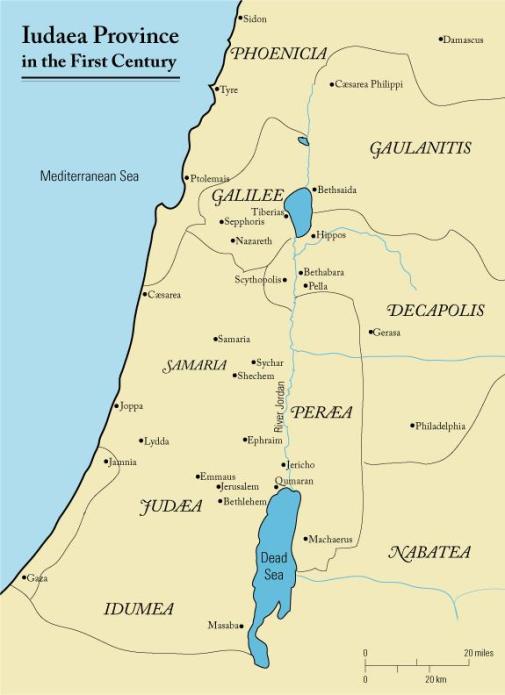

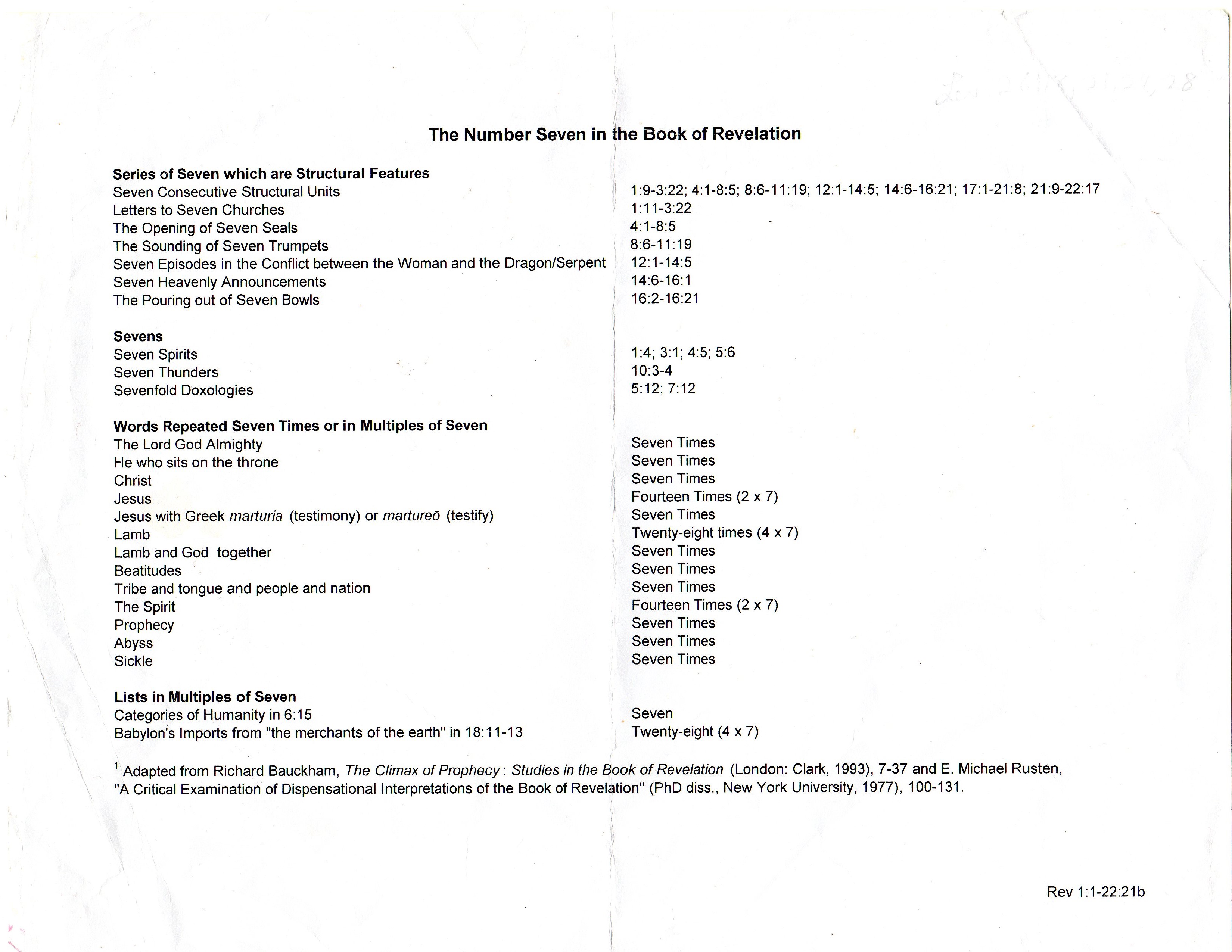


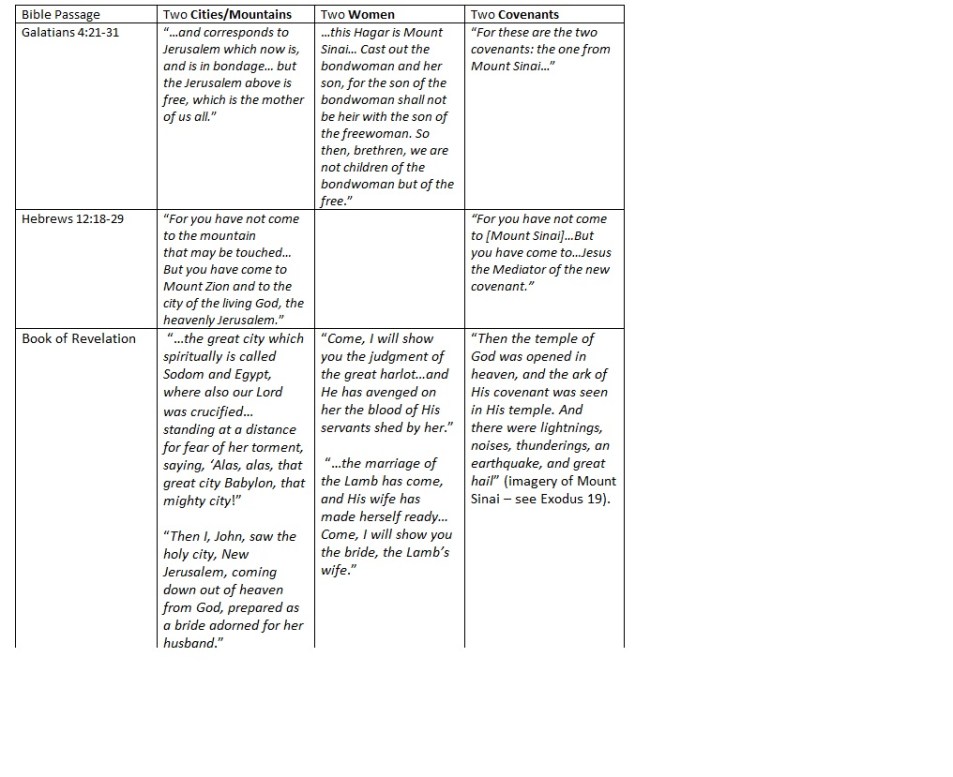


 Pursuing Truth