Israel’s 5-Month Locust Invasion In 70 AD (Revelation 9:1-11)


Series: “Little Gems from Our Study of the Book of Revelation”

The following study was published yesterday in The Fulfilled Connection (TFC) Magazine, and is adapted from our study of Revelation 9:

In this study of the first half of Revelation 9, we will see that:

  • John’s vision of locusts tormenting men for five months is parallel to the length of time that Israel was prone to locust invasions throughout its history;
  • This also mirrors the length of the Roman siege in Jerusalem in 70 AD, leading to that city’s downfall;
  • The Roman siege even took place during the same months that locusts would typically invade Israel’s land;
  • Josephus spoke of men longing for death, just like John saw in his visions (Rev. 6:16, 9:6) and just like Jesus said would be the case for the “daughters of Jerusalem” and their children (Luke 23:27-30);
  • The name of this locust army’s leader, Apollyon, is remarkably similar to the 15th Roman legion, Apollinarus, that Titus led into Jerusalem in 70 AD (verse 11). This legion was named after the Greek god, Apollo.

In verses 1-2, the key to the bottomless pit was given to “a star [that had] fallen from heaven to earth.” John’s readers are not told explicitly who this star is, but some believe that it was Lucifer (see Luke 10:18 and Rev. 12:9-10). In “Days of Vengeance,” published in 1987David Chilton notes that “the bottomless pit” is referenced a total of seven times in the book Revelation (9:1, 2, 11; 11:7; 17:8; 20:1, 3). Chilton adds,

In Biblical symbolism, the Abyss is the farthest extreme from heaven (Genesis 49:25Deuteronomy 33:13) and from the high mountains (Psalm 36:6). It is used in Scripture as a reference to the deepest parts of the sea (Job 28:14; 38:16; Psalm 33:7) and to subterranean rivers and vaults of water (Deuteronomy 8:7; Job 36:16), whence the waters of the Flood came (Genesis 7:11; 8:2; Proverbs 3:20; 8:24), and which nourished the kingdom of Assyria (Ezekiel 31:4, 15). The Red Sea crossing of the covenant people is repeatedly likened to a passage through the Abyss (Psalm 77:16; 106:9; Isaiah 44:27; 51:10; 63:13). The prophet Ezekiel threatened Tyre with a great desolation of the land, in which God would bring up the Abyss to cover the city with a new Flood, bringing its people down to the pit in the lower parts of the earth (Ezekiel 26:19-21), and Jonah spoke of the Abyss in terms of excommunication from God’s presence, a banishment from the Temple (Jonah 2:5-6). The domain of the Dragon (Job 41:31;Psalm 148:7; Revelation 11:7; 17:8), the prison of the demons (Luke 8:31; Revelation 20:1-3; cf.2 Peter 2:4; Jude 6), and the realm of the dead (Romans 10:7) are all called by the name Abyss.

St. John is thus warning his readers that hell is about to break loose upon the Land of Israel; as with Tyre of old, the Abyss is being dredged up to cover the Land with its unclean spirits. Apostate Israel is to be cast out of God’s presence, excommunicated from the Temple, and filled with demons. One of the central messages of Revelation is that the Church tabernacles in heaven (see Revelation 7:15; 12:12; 13:6); the corollary of this is that the false church tabernacles in hell (David Chilton, Days of Vengeance, 1987).

In verses 3-4, the locusts are seen coming “upon the earth.” The Greek word for “earth,” ge, can be and sometimes is also translated as “land.” As the Greek Lexicon reveals, this is not necessarily the entire planet, but may rather be just a region. Here in Revelation 9, and in numerous other cases in Revelation, there is good reason to see this term as referring to the land of Israel, i.e. the Promised Land. I have discussed this distinctive pattern in Revelation, particularly the oft-repeated phrase “those who dwell on the earth,” in much greater detail in an earlier 3-part series (Part 1, Part 2, Part 3).  

Question: In verse 4, we see that the locusts are told not to harm the grass, green plants, or trees, but only those without the seal of God on their foreheads. Is this seen elsewhere in Revelation?
Answer: It’s also seen in Revelation 7:1-4, where 144,000 believers are sealed before destruction begins.

In verse 5, John’s readers learn that the locusts are given authority to torment men for five months. Chilton notes that in Judea it was typical for locusts to appear in the land anytime between May and September, a period of five months. Here in Revelation 9, these locusts were allowed to attack relentlessly for five months. The Jewish historian, Josephus, as well as Roman historians, recorded that the Roman armies laid a siege upon Jerusalem in 70 AD which lasted for five months. Even more significantly, this siege began in mid-April of that year and lasted until late August/ early September, the very same period when locusts would normally appear in Judea. (It began around 14 April 70 AD, during the Passover Feast, in order to trap as many visitors as possible in Jerusalem).

John’s vision here is full of all kinds of significance for the people of ancient Israel. John’s vision, of course, calls to mind an older vision involving the same imagery. In Joel 1:2-7 and 2:1-11, God’s vine and His fig tree (1:7), Zion (2:1), is stripped bare and thrown away by a destroying army which is likened to locusts, because of Judah’s unfaithfulness (2:12-17, 3:1).

The “Models of Eschatology” site (moderated by a person identified as “wbdjr” for the United Christian Church in Richmond, Virginia) has this to say about the five month siege:

Five months is the time period that the Roman siege lasted around Jerusalem. During this time the Romans didn’t try to take the city, but let the work of the siege slowly weaken the city defenders and bring conditions upon them that could fit the definition of a great tribulation. During the siege the Zealots inside Jerusalem set fire to the foodstocks that were stored up thinking that without food the inhabitants would be more compelled to join them in fighting the Romans. As food disappeared people were compelled to eat leather from belts, shoes, and anywhere else it could be found.

Kenneth Gentry (Before Jerusalem Fell, p. 248) also states, quoting from F.F. Bruce (New Testament History, p. 382): “Titus began the siege of Jerusalem in April, 70. The defenders held out desperately for five months, but by the end of August the Temple area was occupied and the holy house burned down, and by the end of September all resistance in the city had come to an end.”

In verse 6, John’s readers are told that people would “seek death and…not find it” and “long to die, but death [would] flee from them.” Josephus records that during the height of the siege in 70 AD, surviving Jews “poured forth their congratulations on those whom death had hurried away from such heartrending scenes” as were seen during the siege. They were envious of the dead, Josephus says. Thousands were literally starved to death during those months. As I pointed out in a study on Revelation 6, Josephus also records that when the temple was burned in August 70 AD, many survivors retreated to Upper Jerusalem and longed for death. Josephus said in Wars 6.7.2 that “as they saw the city on fire, they appeared cheerful, and put on joyful countenances, in expectation, as they said, of death to end their miseries.” This is reminiscent of what Jesus said in Luke 23:27-30 would happen to the first century daughters of Jerusalem and their children (see also Revelation 6:16).

Kenneth Gentry sees verses 1-12 as speaking strictly of demonic activity, and verses 13-19 as speaking of the invasion of a physical army. In any case, his reference to Jesus’ words in Matthew is most compelling:

Revelation 9:1-12 clearly seems to speak of demons under the imagery of locusts (perhaps due to their destructive power and the gnawing agony they cause). A great many commentators agree that, stripped of the poetical imagery, the locusts are really demons and their sting is that of the pain and influence of demonic oppression. This seems to be quite clearly the case in light of their origin (the bottomless pit, 9:1-3), their task (they afflict only men, 9:4), and their ruler (“the angel of the abyss,” surely Satan, 9:11). Were this a reference to the Roman army (or some later army), their restriction from killing (Rev. 9:5, 10) would be inexplicable in that the Roman army actually did destroy thousands of Jews in its assault. But if these are demons, and the physical killing is left to the armies (which are seen later, Rev. 9:13ff), the picture begins to come into focus.

If demons are in view in this passage, this fits well with requirements of the early date [for the writing of the book of Revelation, i.e. before 70 AD] and the prophetic expectation of Christ inMatthew 12:38-45. There Christ teaches that during His earthly ministry He had cast out demons in Israel, but because of Israel’s resistance to His message, the demons will return in greater numbers within the “generation” (ibid, pp. 247-248)

While I agree that this text does not speak of literal locusts present during this judgment, I see the possibility that in addition to a picture of demonic activity there are also hints of attacks by a human army, i.e. both happening concurrently. In verse 7 it is said that they appeared as “horses prepared for battle.” Their faces were “like human faces” (verse 7b), they had “hair like women’s hair,” they had breastplates of iron, and the noise made by their “wings” was “like the noise of many chariots with horses rushing into battle” (verse 9). There are enough references mixed in here to give a picture of 1st century-type warfare. Steve Gregg, editor of Revelation: Four Views (A Parallel Commentary), has this to say (pp. 182, 184):

Though the locusts themselves are no doubt a portrayal of armies of demons that afflicted the whole society of the Jews during their conflicts with the Romans, the description is perhaps mingled with some features of the demonized zealots who made life so miserable for their fellow Jews during the siege. That they have hair like women’s hair [v. 8] may actually be a reference to their transvestitism, as Josephus describes:

“With their insatiable hunger for loot, they ransacked the houses of the wealthy, murdered men and violated women for sport; they drank their spoils with blood, and from mere satiety and shamelessness gave themselves up to effeminate practices, plaiting their hair and putting on women’s clothes, drenched themselves with perfumes and painting their eyelids to make themselves attractive. They copied not merely the dress, but also the passions of women, devising in their excess of licentiousness unlawful pleasures in which they wallowed as in a brothel. Thus they entirely polluted the city with their foul practices. Yet though they wore women’s faces, their hands were murderous. They would approach with mincing steps, then suddenly become fighting men, and, whipping out their swords from under their dyed cloaks, they would run through every passerby” (Wars, IV:9:10).

Regarding the appearance of this army, David Chilton adds,

The frightening description of the demon-locusts in Revelation 9:7-11 bears many similarities to the invading heathen armies mentioned in the prophets (Jeremiah 51:27; Joel 1:6; 2:4-10; cf.Leviticus 17:7 and 2 Chronicles 11:15, where the Hebrew word for demon is ‘hairy one’). This passage may also refer, in part, to the Satanic gangs of murderous Zealots that preyed on the citizens of Jerusalem, ransacking houses and committing murder and rape indiscriminately. Characteristically, these perverts dressed up as harlots in order to seduce unsuspecting men to their deaths. One particularly interesting point about the description of the demon army is St. John’s statement that “the sound of their wings was like the sound of chariots, of many horses rushing to battle.” That is the same sound made by the wings of the angels in the Glory-Cloud (Ezekiel 1:24; 3:13; 2 Kings 7:5-7); the difference here is that the noise is made by fallen angels.

In verse 11, we learn that the king over this army was named “Abaddon” in Hebrew, but “Apollyon” in Greek. According to Livius, an online ancient history encyclopedia compiled by the Dutch historian, Jona Lendering, “Apollo” was the favorite god of the Roman emperor, Augustus. For this reason, the famous 15th Roman legion was called “Legio XV Apollinaris.” When the Jewish revolt against Rome began in 66 AD, this 15th legion, Apollinaris, was moved from Alexandria, Egypt, and called to advance toward Judea. In 67 AD this legion captured Josephus in Jotapata (in Galilee).

Emblem on the Shields of the Roman 15th Legion (Photo Source)

After Vespasian was named emperor in 69 AD, his son, Titus, led the 15th legion, Apollinarus, toward Jerusalem. After a 5-month siege, Titus and his legion overthrew Jerusalem, destroyed the temple, and burned the city. It appears that Titus was the Apollyon of Revelation 9:11. 

Revelation 6 and Luke 23: Hide Us From the Wrath of the Lamb


Series: “Little Gems from Our Study of the Book of Revelation”

My favorite series on this site is our in-depth study of the book of Revelation. Many of the chapter-by-chapter studies are rather lengthy, and buried within these posts are some very interesting mini studies (in my opinion).  Over time I would like to pull out some of these little gems and present them briefly, one post at a time. They will be added to the “Revelation” page on this site as they are posted. This is the first such post.

Revelation 6:15-17 Is the Fulfillment of Luke 23:27-30

One can learn a lot and gain a lot of insight by comparing Scripture with Scripture, or letting Scripture interpret Scripture. Consider John’s description of the opening of the 6th seal judgment, Revelation 6:15-17 in particular:

I looked when He opened the sixth seal, and behold, there was a great earthquake; and the sun became black as sackcloth of hair, and the moon became like blood. And the stars of heaven fell to the earth, as a fig tree drops its late figs when it is shaken by a mighty wind. Then the sky receded as a scroll when it is rolled up, and every mountain and island was moved out of its place. And the kings of the earth, the great men, the rich men, the commanders, the mighty men, every slave and every free man, hid themselves in the caves and in the rocks of the mountains, and said to the mountains and rocks, “Fall on us and hide us from the face of Him who sits on the throne and from the wrath of the Lamb! For the great day of His wrath has come, and who is able to stand?” (Rev. 6:12-17)

Comparing these verses with an earlier prophecy by Jesus in Luke 23:27-30 is very enlightening:

And a great multitude of the people followed Him, and women who also mourned and lamented Him. But Jesus, turning to them, said, “Daughters of Jerusalem, do not weep for Me, but weep for yourselves and for your children. For indeed the days are coming in which they will say, ‘Blessed are the barren, wombs that never bore, and breasts which never nursed!’ Then they will begin ‘to say to the mountains, “Fall on us!” and to the hills, “Cover us!”

  • Question #1: Who did Jesus say would call upon the mountains to fall on them because of His wrath and judgment?
  • Answer #1: The daughters of Jerusalem, and – even more so – their children (note the word “they” in reference to the children).
  • Question #2: When did Jesus say this would happen?
  • Answer #2: During the lifetimes of the ladies who were weeping as Jesus walked past them toward the cross, and during the lifetimes of their children.

In Luke 23, Jesus foretold what would happen to His own people, and to His own generation. In Revelation 6, John saw a vision of the same scene playing out during the great day of the Lord’s wrath. This was not to be a global event, nor was it to occur thousands of years later. It would, and did, occur in the same place where Jesus walked and lived, and upon His own generation which largely rejected Him.

Echoes of Hosea

The same prophecy was once given by the prophet Hosea concerning Israel:

“Also the high places of Aven, the sin of Israel, shall be destroyed. The thorn and thistle shall grow on their altars, and they shall say to the mountains, “Cover us!”, and to the hills, “Fall on us!” (Hosea 10:8).

This is one of many indications in the book of Revelation that the judgments were directed at apostate Israel and the “evil”, “wicked”, “faithless,” and “vile” generation that Jesus often spoke against.

The Significance of “The Kings of the Earth”

Revelation 6:15 speaks of “the kings of the earth.” Note that the Greek word for “earth” here (“ge”) can be, and sometimes is, translated as “land.” This can be understood as the Promised Land, i.e. Israel, and there is no doubt that this is the meaning in Luke 21:23, for example, where this same word is used:

But when you see Jerusalem surrounded by armies, then know that its desolation is near. Then let those who are in Judea flee to the mountains… But woe to those who are pregnant and to those who are nursing babies in those days! For there will be great distress in the land and wrath upon this people” (Luke 21:20-23).

The expression “those who dwell on the earth” occurs frequently in the book of Revelation, and ample evidence points to this being a unique reference to first century Israel, as outlined in this 3-part series (here, here, and here).

F.F. Bruce on Revelation 6:16 and Luke 23:30

F.F. Bruce (1910-1990), well-known Bible scholar from Scotland, regarding verse 16 in Revelation 6:

“The best commentary on the present passage is found in our Lord’s words to the ‘daughters of Jerusalem’ on the Via Dolorosa (Lk. 23:30).”

(“Revelation” in International Bible Commentary, p. 1608, published in 1986)

Josephus on The Final Days of the Roman Siege on Jerusalem in 70 AD

On July 31, 70 AD, after a five month siege, the Romans succeeded in penetrating the final wall around Jerusalem and burned the temple to the ground. Tens of thousands of Jews were killed, but the surviving Jews retreated to the Upper City of Jerusalem, where Josephus says that many continued to plunder, ambush, and assault their fellow Jews. The victims were too weakened by famine to resist, and quite a few were killed senselessly. Josephus tried to persuade them to surrender to the Romans and spare what was left of the city, but he was only laughed at. Josephus records that some put on happy faces “in expectation, as they said, of death to end their miseries.” Many Jews sought refuge in the caves and underground caverns, hoping to remain hidden once the Romans would reach the Upper City:

So now the last hope which supported the tyrants and that crew of robbers who were with them, was in the caves and caverns underground; whither, if they could once fly, they did not expect to be searched for; but endeavored, that after the whole city should be destroyed, and the Romans gone away, they might come out again, and escape from them. This was no better than a dream of theirs; for they were not able to lie hid either from God or from the Romans (Josephus, Wars, 6:7:3).

————————————————————————————————————–

See here for our complete study of Revelation 6:

Part 1 (Rev. 6:1-8)
Part 2 (Rev. 6:9-17)

Video: The 3.5 Year Siege of Jerusalem (66 – 70 AD)


I recently became aware of an hour-long video on YouTube, depicting Rome’s 3.5 year advance on Jerusalem resulting in its destruction in 70 AD. This video is part three of a 2006 TV series titled, “Ancient Rome: The Rise and Fall of an Empire” (BBC). It’s based on the writings of the Jewish historian, Josephus. The filmmakers consulted with Martin Goodman, professor of Jewish Studies at Wolfson College, Oxford, who has also written extensively on Jewish history in the Greek/Roman period.

I’m posting this video for its educational value and because of its relation to the study of eschatology, particularly the Olivet Discourse (Matthew 24, Mark 13, Luke 21) and 1st century history. It does portray fairly graphic violence (ancient warfare) at times, but you can turn your head when it happens and not really miss anything.

https://www.youtube.com/watch?v=SGnTI-cT3nw

Among other fulfillments of Jesus’ words, this film depicts the civil war and famine that plagued Jerusalem from 67 – 70 AD (see Matthew 24:6-8/Mark 13:7-8/Luke 21:9-11 and Revelation 6:3-6). It also depicts the roughly 100 pound stones that the Romans catapulted into the temple complex in Jerusalem (see Revelation 16:21; the film shows the Romans doing this in Jotapata where Josephus was captured, but Josephus records that they also did this against Jerusalem in 70 AD).

PP19: The Historical Events Leading Up to 70 AD (Part 3)


This is now the nineteenth post in our series on “A Partial-Preterist Perspective on the Destruction of Jerusalem in 70 AD.” This is the same title as a term paper I recently submitted to Northwestern College. All the previous posts can be found here, and it’s recommended that they be read in order before reading this post:

[1] https://kloposmasm.wordpress.com/2009/08/13/brief-explanation-of-partial-preterism/
[2] https://kloposmasm.wordpress.com/2009/08/13/pp2-references/
[3] https://kloposmasm.wordpress.com/2009/08/13/pp3-external-evidence-for-an-early-date-revelation/
[4] https://kloposmasm.wordpress.com/2009/08/14/pp4-internal-evidence-for-an-early-date-revelation-part-1/
[5] https://kloposmasm.wordpress.com/2009/08/14/pp5-internal-evidence-for-an-early-date-revelation-part-2/
[6] https://kloposmasm.wordpress.com/2009/08/14/pp6-internal-evidence-for-an-early-date-revelation-part-3/
[7] https://kloposmasm.wordpress.com/2009/08/14/pp7-internal-evidence-for-an-early-date-revelation-part-4/
[8] https://kloposmasm.wordpress.com/2009/08/14/pp8-daniels-70-week-prophecy-part-1/
[9] https://kloposmasm.wordpress.com/2009/08/15/pp9-daniels-70-week-prophecy-part-2/
[10] https://kloposmasm.wordpress.com/2009/08/15/pp10-jerusalems-destruction-foretold-in-the-olivet-discourse/
[11] https://kloposmasm.wordpress.com/2009/08/15/pp11-did-jesus-come-in-70-ad-part-1/
[12] https://kloposmasm.wordpress.com/2009/08/15/pp12-did-jesus-come-in-70-ad-part-2/
[13] https://kloposmasm.wordpress.com/2009/08/16/pp13-signs-of-the-close-of-the-age/
[14] https://kloposmasm.wordpress.com/2009/08/16/pp14-abomination-of-desolation/
[15] https://kloposmasm.wordpress.com/2009/08/16/pp15-the-man-of-lawlessness-ii-thess-2-part-1/
[16] https://kloposmasm.wordpress.com/2009/08/16/pp16-the-man-of-lawlessness-ii-thess-2-part-2/
[17] https://kloposmasm.wordpress.com/2009/08/16/pp17-the-historical-events-leading-up-to-70-ad-part-1/
[18] https://kloposmasm.wordpress.com/2009/08/22/pp18-the-historical-events-leading-up-to-70-ad-part-2/

In the previous two posts we have been discussing the historical events which led up to Jerusalem’s destruction in 70 AD. In the first post we saw a timeline of these events, and in the last post we examined some of these historical events in more detail. In this present post we will speak of Rome’s burning of the temple and the city of Jerusalem.

For further details regarding the final five-month siege on Jerusalem (April-September 70 AD), and the crushing of all remaining Jewish resistance in the nation of Israel (Sept. 70 – May 73 AD), please refer back to the timeline which is laid out in part 1 (PP17).

Adam Maarschalk

—————————————————————————————————————————————————-

G. The Historical Events Leading Up to 70 AD (Part 3)

Titus, the son of Vespasian, had determined to spare the temple as an ornament to the Roman Empire. In a speech to the Jews defending the city, he had said, “I appeal to my own army, and the Jews that are now with me, and even to you yourselves, that I do not force you to defile this sanctuary; and if you will but change the place whereon you will fight, no Roman shall either come near your sanctuary, or offer any affront to it; nay, I will endeavor to preserve you your holy house, whether you will or not” (The Wars of The Jews, 6:2:4).

However, a Roman soldier, ignoring his words because he was urged on by a “divine impulse,” threw a flaming stick into a window of the temple, setting it on fire. The Jews instantly rushed in and tried in vain to extinguish the flames. Titus also shouted for help in stopping the fire, but his own men helped only to spread them wider. Writes Holford,

They rushed furiously upon [the Jews], slaying some with the sword, trampling others under their feet, or crushing them to death against the walls. Many, falling amongst the smoking ruins of the porches and galleries, were suffocated. The unarmed poor, and even sick persons, were slaughtered without mercy. Of these unhappy people numbers were left weltering in their gore. Multitudes of the dead and dying were heaped round about the altar, to which they had formerly fled for protection, while the steps that led from it into the outer court were literally deluged with their blood… The Romans, exasperated to the highest pitch against the Jews, seized every person whom they could find, and, without the least regard to sex, age or quality, first plundered and then slew them. The old and the young, the common people and the priests, those who surrendered and those who resisted, were equally involved in this horrible and indiscriminate carnage. Meanwhile the Temple continued burning, until at length, vast as was its size, the flames completely enveloped the whole building; which, from the extent of the conflagration, impressed the distant spectator with an idea that the whole city was now on fire. The tumult and disorder which ensued upon this event, it is impossible (says Josephus) for language to describe. The Roman legions made the most horrid outcries; the rebels, finding themselves exposed to the fury of both fire and sword, screamed dreadfully; while the unhappy people who were pent up between the enemy and the flames, deplored their situation in the most pitiable complaints. Those on the hill and those in the city seemed mutually to return the groans of each other. Such as were expiring through famine, were revived by this hideous scene, and seemed to acquire new spirits to deplore their misfortunes. The lamentations from the city were re-echoed from the adjacent mountains, and places beyond Jordan. The flames which enveloped the Temple were so violent and impetuous, that the lofty hill on which it stood appeared, even from its deep foundations, as one large body of fire. The blood of the sufferers flowed in proportion to the rage of this destructive element; and the number of the slain exceeded all calculation. The ground could not be seen for the dead bodies, over which the Romans trampled in pursuit of the fugitives; while the crackling noise of the devouring flames mingled with the clamor of arms, the groans of the dying and the shrieks of despair, augmented the tremendous horror of a scene, to which the pages of history can furnish no parallel.

The smoke of Jerusalem’s burning was indeed seen by those who stood afar off and who were out at sea (Revelation 18:17-18). Ivan Lewis writes (Todd Dennis [24], 2009), “No one believed that God would permit His Temple to be destroyed, and when this finally did happen, everyone within the city, men and women, young and old, were crazed with despair. Thousands cast themselves into the fire while others fell on their own swords.”

The Romans then hoisted their own idol-covered banners at every key point of the temple area, and plundered and burned the houses in the city. They murdered by the sword every Jew they could find, man, woman, and child. Their only compassion was for the dead, whom they encountered in mass numbers in many of the houses, mostly victims of the famine. Josephus writes, “But although they had this commiseration for such as were destroyed in that manner, yet had they not the same for those that were still alive, but they ran every one through whom they met with, and obstructed the very lanes with their dead bodies, and made the whole city run down with blood, to such a degree indeed that the fire of many houses was quenched with these men’s blood” (The Wars Of The Jews, 6:8:5).

The amount of blood that flowed, not only in Jerusalem but also throughout the surrounding region, could possibly bring to mind a passage like Revelation 14:19-20, which says, “So the angel swung his sickle across the earth and gathered the grape harvest of the earth and threw it into the great winepress of the wrath of God. And the winepress was trodden outside the city, and blood flowed from the winepress, as high as a horse’s bridle, for 1,600 stadia [about 184 miles].” This was the understanding of John Wesley (1703-1791) who, in his commentary on this passage, wrote:

And the winepress was trodden – By the Son of God, Rev 19:15. Without [outside] the city – Jerusalem. They to whom St. John writes, when a man said, ‘the city,’ immediately understood this. And blood came out of the winepress, even to the horses’ bridles – So deep at its first flowing from the winepress! One thousand six hundred furlongs – So far! At least two hundred miles, through the whole land of Palestine.

Wesley, like many today, tied this passage (Revelation 14:19-20) to Rev. 19:11-21, and rightly so. This is often referred to as the “Battle of Armageddon,” which Tim Lahaye and other Futurist authors generally say will happen in the plain of Megiddo. Author John Noe, on the other hand, notes that what the Bible refers to as a “battle on the great day of God the Almighty” (Rev. 16:14) would transpire “at the place that in Hebrew is called Armageddon” (Rev. 16:16). In Hebrew it’s actually “Har-Magedon,” as “har” means mountain in Hebrew (“Armageddon” is based on the Greek rendering, since “h” is silent in Hebrew). Therefore, this battle was to take place primarily on a mountain, not in a valley. Noe adds,

The most likely case is that Revelation’s “Har” is Jerusalem. Geographically, Jerusalem sits on top of a mountain. To get there from any direction one must go “up to Jerusalem” (2 Sam. 19:34; 1 Ki. 12:28; 2 Ki. 18:17; 2 Chron. 2:16; Ezra 1:3; 7:7; Zech. 14:17; Matt. 20:17, 18; Mark 10:32, 33; Luke 18:31; 19:28; John 2:13; 5:1; Acts 11:2; 15:2; 21:12, 15; 24:11; 25:9; Gal. 1:17, 18). Jerusalem is also called God’s “holy mountain” (Psa. 43:3) and the “chief among the mountains” (Isa. 2:2-3; also 14:13; Exod. 15:17; Joel 2:32; 3:16-17)… “Magedon/Megiddo” may also be comparative imagery. A great slaughter once took place in the valley of Megiddo (2 Ki. 9:27; Zech. 12:11). Throughout ancient history, this valley was also a favorite corridor for invading armies and the scene of numerous famous battles (Jud. 4-7; 1 Sam. 29-31; 2 Sam. 4; 1 Ki. 9:15; 2 Ki. 9-10; 22; 2 Chron. 35). So much blood was shed in this valley of Jezreel or Megiddo that it became a synonym for slaughter, violence, bloodshed, and battlefield, as well as a symbol for God’s judgment (Hos. 1:4-5). In our day, Armageddon has also become synonymous with and a symbol for the ultimate in warfare and conflict.

In a similar fashion, the word “Waterloo” has garnered a symbolic use. Back in 1815, this town in Belgium was the battleground and scene of Napoleon’s final defeat. Today, we have a saying that some one or some thing has met their “Waterloo.” We don’t mean they have met that city in Europe. We mean, by way of comparative imagery, that they have met a decisive or crushing defeat, or their demise. I suggest Revelation employs the word Magedon/Megiddo in this same manner. History records that a great slaughter took place on a mountain in Palestine within the lifetime of the original recipients of the book of Revelation. In A.D. 70 the Roman armies of Titus totally destroyed Jerusalem and the Temple. According to Eusebius, 1.1million Jews were killed (Todd Dennis [15], 2009).

Josephus goes on to say, “Now as soon as the army had no more people to slay or plunder, because there remained none to be the objects of their fury, Caesar gave orders that they should now demolish the entire city and temple but for all the rest of the wall, it was so thoroughly laid even with the ground by those that dug it up to the foundation, that there was left nothing to make those that came thither believe it had ever been inhabited” (The Wars Of The Jews, 7:1:1).

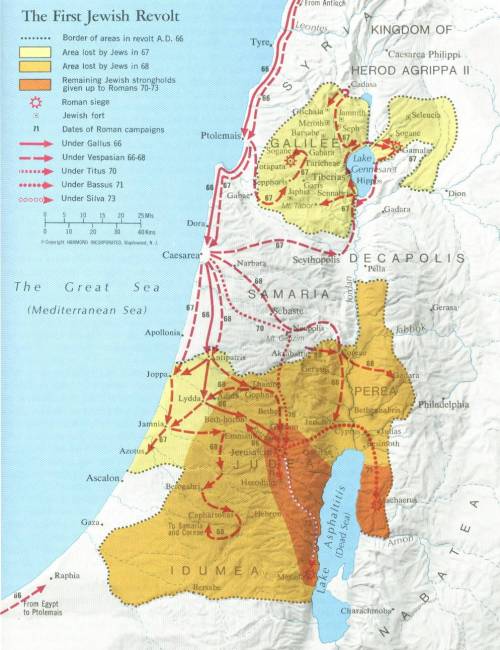
First Jewish Revolt (66-73 AD)

The final siege ended on September 26, 70 AD after a duration of five months. The destruction of Jerusalem, though, was not the end of Rome’s fury. Jews outside of Jerusalem also became victims. Holford continues,

All above the age of seventeen were sent in chains into Egypt, to be employed there as slaves, or distributed throughout the empire to be sacrificed as gladiators in the amphitheatres ; whilst those who were under this age, were exposed to sale. During the time that these things were transacted, eleven thousand Jews, guarded by one of the generals, named Fronto, were literally starved to death. This melancholy occurrence happened partly through the scarcity of provisions, and partly through their own obstinacy, and the negligence of the Romans. Of the Jews destroyed during the siege, Josephus reckons not less than one million and one hundred thousand [1.1 million], to which must be added, above two-hundred and thirty-seven thousand [237,000] who perished in other places, and innumerable multitudes who were swept away by famine, and pestilence, and of which no calculation could be made. Not less than two thousand [2000] laid violent hands upon themselves. Of the captives the whole was about ninety-seven thousand [97,000]… After the destruction of Jerusalem seventeen hundred [1700] Jews who surrendered at Macherus were slain, and of fugitives not less than three thousand [3000] in the wood of Jardes. Titus, having marched his army to Caesarea, he there, with great splendour, celebrated the birthday of his brother Domitian; and according to the barbarous manner of those times, punished many Jews in honour of it. The number who were burnt, and who fell by fighting with wild beasts, and in mutual combats, exceeded two thousand five hundred [2500]. At the siege of Massada [73 AD], Eleazer, the commander, instigated the garrison [of Jews] to burn their stores, and to destroy first the women and children, and then themselves.

In summary, says Josephus, “neither did any other city ever allow such miseries, nor did any age ever breed a generation more fruitful in wickedness than this was, from the beginning of the world” (Josephus, The Jewish War, Book 5, Chapter 10, Paragraph 5).

PP18: The Historical Events Leading Up to 70 AD (Part 2)


This is now the eighteenth post in our series on “A Partial-Preterist Perspective on the Destruction of Jerusalem in 70 AD.” This is the same title as a term paper I recently submitted to Northwestern College. All the previous posts can be found here, and it’s recommended that they be read in order before reading this post:

[1] https://kloposmasm.wordpress.com/2009/08/13/brief-explanation-of-partial-preterism/
[2] https://kloposmasm.wordpress.com/2009/08/13/pp2-references/
[3] https://kloposmasm.wordpress.com/2009/08/13/pp3-external-evidence-for-an-early-date-revelation/
[4] https://kloposmasm.wordpress.com/2009/08/14/pp4-internal-evidence-for-an-early-date-revelation-part-1/
[5] https://kloposmasm.wordpress.com/2009/08/14/pp5-internal-evidence-for-an-early-date-revelation-part-2/
[6] https://kloposmasm.wordpress.com/2009/08/14/pp6-internal-evidence-for-an-early-date-revelation-part-3/
[7] https://kloposmasm.wordpress.com/2009/08/14/pp7-internal-evidence-for-an-early-date-revelation-part-4/
[8] https://kloposmasm.wordpress.com/2009/08/14/pp8-daniels-70-week-prophecy-part-1/
[9] https://kloposmasm.wordpress.com/2009/08/15/pp9-daniels-70-week-prophecy-part-2/
[10] https://kloposmasm.wordpress.com/2009/08/15/pp10-jerusalems-destruction-foretold-in-the-olivet-discourse/
[11] https://kloposmasm.wordpress.com/2009/08/15/pp11-did-jesus-come-in-70-ad-part-1/
[12] https://kloposmasm.wordpress.com/2009/08/15/pp12-did-jesus-come-in-70-ad-part-2/
[13] https://kloposmasm.wordpress.com/2009/08/16/pp13-signs-of-the-close-of-the-age/
[14] https://kloposmasm.wordpress.com/2009/08/16/pp14-abomination-of-desolation/
[15] https://kloposmasm.wordpress.com/2009/08/16/pp15-the-man-of-lawlessness-ii-thess-2-part-1/
[16] https://kloposmasm.wordpress.com/2009/08/16/pp16-the-man-of-lawlessness-ii-thess-2-part-2/
[17] https://kloposmasm.wordpress.com/2009/08/16/pp17-the-historical-events-leading-up-to-70-ad-part-1/

In the previous post we turned to a discussion of the historical events which led up to Jerusalem’s destruction in 70 AD. In the first post we saw a timeline of these events, beginning with the martyrdom of James, the brother of Jesus, in 62 AD. In this post we will first briefly consider some of the predictions of Daniel, before moving on to examine some of these historical events in more detail.

Adam Maarschalk

———————————————————————————————————————————————————————-

G. The Historical Events Leading Up to 70 AD (Part 2)

Before enumerating some of the above events in more detail, it should be pointed out that some Preterists believe that the time references in Daniel of 1290, 1335, and 2300 days (Daniel 8:13-14; 12:11-12) found their fulfillment in the siege and destruction of Jerusalem and the desolation of all Israel. This is not least because Daniel was told that “when the shattering of the power of the holy people comes to an end” all the wonders he had seen would be finished (Daniel 12:6-7). Even though a large portion of chapter 11 speaks in detail of Antiochus IV Epiphanes (215-164 BC), ruler of the Seleucid realm, and his attacks on Egypt about 240 years earlier,[1] it was the events of the Roman/Jewish War (67-73 AD) which epitomized “the shattering of the power of the holy people.”[2]

Also, as Ed Meelhuysen (1992), a Futurist, points out, precisely three lunar years transpired between the defiling of the temple (the sacrifice of a pig on the altar and the setting up of a statue of Zeus in the temple) on 25 Chislev 167 BC[3] and the cleansing and restoration of the temple by Judas Maccabees and other zealous Jews on 25 Chislev 164 BC. Therefore, the time range within which these (and other related) events took place falls short of all the time references in Daniel by at least six months.

Preterists and Futurists alike agree that Daniel does foretell Jerusalem’s destruction, if nowhere else, then at least in his pivotal 70-Weeks prophecy (Daniel 9:26b). Preterists would maintain that the “time of trouble, such as never has been since there was a nation till that time” (Daniel 12:1) also refers to 67-70 AD, as does the reference to “a time, times, and half a time” (verse 7),[4] and the reference to the regular burnt offering being taken away (Daniel 8:11-14, 12:11). Regarding this offering, Philip Mauro quotes the following from Josephus to show that it was taken away at the very end of the final siege on Jerusalem, i.e. late July 70 AD (Todd Dennis [21], 2009):

And now Titus gave orders to his soldiers that were with him to dig up the foundations of the tower of Antonia, and make a ready passage for his army to come up, while he himself had Josephus brought to him; for he had been informed that, on that very day, which was the seventeenth day of Panemus, the sacrifice called ‘the daily sacrifice’ had failed, and had not been offered to God for want of men to offer it; and that the people were grievously troubled at it (Wars, VI. 2.1.).[5]

John Denton, of the UK-based Bible Research and Investigation Company, offers the following chart in an effort to show that these time references played out precisely as stated in the Jewish/Roman War (Todd Dennis [18], 2009):[6]

SN850132

George Peter Holford, in his 1805 book titled “The Destruction of Jerusalem,” wrote that Nero was the one who appointed Vespasian (assisted by his son, Titus) to prosecute the war against the Jews (Todd Dennis [8], 2009). In early spring 67 AD, which was 3.5 years before Jerusalem’s final downfall, Vespasian first entered Judea with a 60,000-member army. In the campaign which was to follow he destroyed at least 150,000 inhabitants of Galilee and Judea, along with many towns. One of the first towns Vespasian crushed was Joppa, because its inhabitants had provoked his men by their frequent piracies at sea. The Jews there tried to flee from Vespasian on their ships, but Vespasian was helped by a tremendous storm that blew in just as they began to flee. Their vessels were crushed against each other and against the rocks, and when this slaughter was complete more than 4,200 bodies were strewn along the coast and a very long stretch of the coast was stained with blood.

Eusebius records that when Vespasian began to close in on Jerusalem, believers living there received a sign, “given by revelation to those in Jerusalem who were ‘approved,’ bidding them leave the doomed city and settle in Pella” (F.F. Bruce, 1983, p. 375). Pella was a community on the other side of the Jordan River in modern day Jordan. This perhaps calls to mind the sign of the woman and the dragon in Revelation 12: “…and the woman fled into the wilderness, where she has a place prepared by God, in which she is to be nourished for 1,260 days; And when the dragon saw that he had been thrown to the earth, he pursued the woman who had given birth to the male child. But the woman was given two wings of the great eagle so that she might fly from the serpent into the wilderness, to the place where she is to be nourished for a time, and times, and half a time” (Rev. 12:6, 13-14). Pella is indicated by the number “2” on the map.

HolyJordanMap

Vespasian pulled back in his campaign to take over Jerusalem when he was informed of Nero’s death in June 68 AD. Yet the people there did not repent of their wicked ways and instead, as Josephus and Tacitus reported in detail, their evil deeds increased. Civil war among the Jews resulted in thousands being murdered at a time, their bodies often left unburied. Holford writes about one such slaughter:

Athirst for blood, and inflamed by revenge, they spared neither age, sex, nor infancy; and the morning beheld eight thousand five hundred dead bodies lying in the streets of the holy city. They plundered every house, and having found the chief priests Ananius and Jesus, not only slew them, but, insulting their bodies, cast them forth unburied. They slaughtered the common people as unfeelingly as if they had been a herd of the vilest beasts… Such as fled were intercepted and slain: their carcasses lay in heaps on all the public roads: every symptom of pity seemed utterly extinguished, and with it, all respect for authority, both human and divine.

At the same time, there were bands of robbers and murderers plundering towns and homes throughout Judea, also not sparing even women or children. Simon, son of Gioras, the commander of one of these bands, entered Jerusalem and began a third faction in addition to the two who were already engaged in senseless warfare. The city was in anarchy, as it was divided into three sections under the following leaders: [1] Eleazar, the son of Simon, leader of the Zealots [2] John of Gischala, a Galilean partisan and Zealot leader [3] Simon Gioras, leader of the priestly party. Writes Holford:

The three factions, rendered frantic by drunkenness, rage, and desperation, trampling on heaps of slain, fought against each other with brutal savageness and madness. Even such as brought sacrifices to the temple were murdered. The dead bodies of priests and worshippers, both natives and foreigners were heaped together, and a lake of blood stagnated in the sacred courts. John of Gischala, who headed one of the factions, burnt storehouses full of provisions ; and Simon, his great antagonist, who headed another of them, soon afterwards followed his example. Thus they cut the very sinews of their own strength. At this critical and alarming conjuncture, intelligence arrived that the Roman army was approaching the city.

In the absence of believers in Jerusalem, Josephus writes of many rampant and callous evil acts taking place (Todd Dennis [13], 2009). These included sacrilegious activities taking place in the temple, committed by the Jews, things which even the Roman emperors wouldn’t have done:

But as for John [one of the Jewish leaders], when he could no longer plunder the people, he betook himself to sacrilege, and melted down many of the sacred utensils, which had been given to the temple; as also were many of those vessels which were necessary for such as ministered about holy things, – the caldrons, the dishes, and the table; nay, he did not abstain from those pouring-vessels that were sent them by Augustus and his wife; for the Romans emperors did ever both honour and adorn this temple; …on which account he emptied the vessels of that sacred wine and oil which the priests kept to be poured on the burnt-offerings, and which lay in the inner court of the temple, and distributed it among the multitude, who, in their anointing themselves and drinking, used [each of them] above an hin of them; and here I cannot but speak my mind, and what the concerns I am under dictates to me, and it is this: – I suppose that had the Romans made any longer delay in coming against these villains, the city would either have been swallowed up by the ground opening upon them, or been overflowed by water, or else been destroyed by such thunder as the country of Sodom perished by, for it had brought forth a generation of men much more atheistical that were those that suffered such punishments; for by their madness it was that all the people came to be destroyed.

This description by Josephus may perhaps bring to mind the latter part of Revelation 6:6, which says, “…do not harm the oil and wine!” In a way that is reminiscent of this same passage (Rev. 6:5-6), Josephus writes of the dire conditions that came about in Jerusalem due to famine. This escalated when the Romans finally broke through two of the three walls which surrounded the city. Even while under siege, the pitiful situation of the Jews caused them to turn on each other in almost unthinkable ways:

It was now a miserable case, and a sight that would justly bring tears into our eyes, how men stood as to their food, while the more powerful had more than enough, and the weaker were lamenting [for want of it]; …insomuch that children pulled the very morsels that their fathers were eating out of their very mouths, and what was still more to be pitied, so did the mothers do as to their infants; and when those that were most dear were perishing under their hands, they were not ashamed to take from them the very last drops that might preserve their lives: and while they ate after this manner, yet were they not concealed in so doing; but the seditious everywhere came upon them immediately, and snatched away from them what they had gotten from others; for when they saw any house shut up, this was to them a signal that the people within had gotten some food; whereupon they broke open the doors, and ran in, and took pieces of what they were eating almost up out of their very throats, and this by force: the old men, who held their food fast, were beaten; and if the women hid what they had within their hands, their hair was torn for so doing; nor was there any commiseration shown either to the aged or to the infants, but they lifted up children from the ground as they hung upon the morsels they had gotten, and shook them down upon the floor. But still they were more barbarously cruel to those that had prevented their coming in, and had actually swallowed down what they were going to seize upon, as if they had been unjustly defrauded of their right. They also invented terrible methods of torments to discover where any food was, and they were these to stop up the passages of the privy parts of the miserable wretches, and to drive sharp stakes up their fundaments; and a man was forced to bear what it is terrible even to hear, in order to make him confess that he had but one loaf of bread, or that he might discover a handful of barley-meal that was concealed.

Holford remarks that Jesus was just in His words when He said, “And alas for women who are pregnant and for those who are nursing infants in those days” (Matthew 24:19). Josephus also told of one mother who roasted her own infant son and ate half of him, offering the other half to her neighbor. He mentions at one point seeing more than 600,000 dead bodies thrown out of the city gates, due to famine and other causes. It was common for whole families to perish, he said, and tomb-robbing was also rampant. At one point an individual attempted to desert the city, but he was caught with gold that he had swallowed in an attempt to smuggle it out. Suspecting that others were trying to do the same, the Romans killed and ripped open the stomachs of more than 2000 individuals in one night. Josephus (Jewish War 5:13:4) writes that some escaped from Jerusalem during the final siege by jumping from the wall and fleeing to the Romans. However, being extremely ravaged by famine, they failed to restrain their appetites and quickly ate so much that they literally caused their bodies to burst open.

The starvation in Jerusalem was especially severe because so many Jews from the countryside foolishly tried to take refuge there, against the advice of Jesus (Luke 21:21). They also had come up from various nations for the Feast of Unleavened Bread. The famine grew so bad that, records Holford, the “Jews, for want of food were at length compelled to eat their belts, their sandals, the skins of their shields, dried grass, and even the ordure [dung] of oxen.” When a woman was discovered to have eaten half of her own child, the Roman soldiers were horrified and “the whole city stood aghast, and poured forth their congratulations on those whom death had hurried away from such heartrending scenes.” Josephus declared that if there had not been many credible witnesses of this event he would not have recorded it because “such a shocking violation, never having been perpetuated by any Greek or barbarian, the insertion of it might have diminished the credibility of his history.” Yet these things fulfilled what was spoken by Moses at the end of giving the Law to the people, when he stated what would happen if they forsook the path of obedience:

The man who is the most tender and refined among you willbegrudge food to his brother, to the wife he embraces,and to the last of the children whom he has left, so that he will not give to any of them any of the flesh of his children whom he is eating, because he has nothing else left,in the siege and in the distress with which your enemy shall distress you in all your towns. The most tender and refined woman among you, who would not venture to set the sole of her foot on the ground because she is so delicate and tender, will begrudge to the husband she embraces, to her son and to her daughter, her afterbirth that comes out from between her feet and her children whom she bears, because lacking everything she will eat them secretly, in the siege and in the distress with which your enemy shall distress you in your towns (Deut. 28:54-57).

In the weeks leading up to the final five-month siege on Jerusalem the Romans used engines called “ballistas” equipped with strong catapults which were capable of launching boulders weighing between 75-160 pounds in weight. According to Josephus, when the assault first began these boulders, some a quarter mile wide, could be seen coming because they were white in color. The Romans soon modified them to be black in color, and the slaughter of the Jews in this way became much more effective. These missiles killed many priests and worshippers in the temple and even at the altar itself because, writes Josephus, “despite war, the sacrifices went on.” They came “from all over the earth,” says Josephus, because they deemed the temple and the city to be holy. Revelation 16:19-21 speaks of hailstones falling out of heaven, with each stone weighing about 100 pounds. The Roman boulders, being white in color, would have resembled giant hailstones falling from the sky.[7]

In the end, after months of failed attempts, the Romans at last succeeded in penetrating the final wall surrounding Jerusalem. Records Josephus (William Whiston [2], 2009), “A false prophet was the occasion of the people’s destruction, who had made a public proclamation in the city that very day, that God commanded them to get upon the temple, and that there they should receive miraculous signs of their deliverance.” Another remarkable event occurred, says Tacitus: “In the sky appeared a vision of armies in conflict, of glittering armour. A sudden lightening flash from the clouds lit up the Temple. The doors of the holy place abruptly opened, a superhuman voice was heard to declare that the gods were leaving it, and in the same instant came the rushing tumult of their departure.”


[1] Philip Mauro, in his 1921 publication, “The Seventy Weeks and the Great Tribulation” (pages 53-63) makes a fascinating and compelling case for Herod being the king spoken of in Daniel 11:36-45, i.e. the same Herod who killed all the male children in Bethlehem and the surrounding region in an effort to destroy Jesus (cf. Daniel 11:37a, 44). This publication can be viewed in its entirety here: http://www.preteristarchive.com/Books/pdf/1921_mauro_seventyweeks.pdf.

[2] In order for this prophecy to remain unfulfilled, i.e. awaiting a future fulfillment as Futurists say, it must be demonstrated that ethnic Jews are still God’s holy people. This is, in fact, a common premise of Dispensationalism. The New Testament, however, identifies the Church as God’s holy people (e.g. I Peter 2:4-10) and unbelieving Jews (and, by implication, unbelieving Gentiles also) by such unsavory titles as the synagogue of Satan (e.g. Revelation 2:9, 3:9).

[3] The abolishing of the daily sacrifices took place only 10 days prior to the sacrifice of the pig, on 15 Chislev 167 BC, according to I Maccabees 1:54-60 and 4:52. See Daniel 8:11 and Daniel 12:11.

[4] Philip Mauro, anticipating the trouble many would have assigning Daniel 12:2 to the past, makes this observation: “The words ‘and many that sleep in the dust of the earth shall awake,’ etc. are commonly taken as referring to the bodily resurrection of the dead, and this is one reason why the entire passage is frequently relegated to the future. But there is nothing said here about either death or resurrection.” He goes on to point out that such language was commonly used in Scripture to denote a spiritual awakening (e.g. Isaiah 9:2, 29:10; Matthew 4:14-16; and especially John 5:25 and Ephesians 5:14). Not all who would be awakened would be saved, reminiscent of Christ speaking of those who would and wouldn’t receive Him (cf. John 3:16, 18, 36). The turning of many to righteousness and the running to and fro (Daniel 12:3-4), says Mauro, speaks of the rapid spread of the gospel in the time of the apostles and the early Church.

[5] In view of the wording in Daniel 12:11, notes Mauro, it could appear that these events happened in the reverse order. That is, Daniel seems to suggest that the offering is taken away at the beginning of the 1290 days, and the abomination of desolation is set up at the end of those days. Historically speaking, and by comparing Luke 21:20 with Matthew 24:15, the desolation of Jerusalem occurred in late 66 AD when the Roman armies first surrounded her, precisely 43 months (or 1290 days) before the daily offering was taken away. That these events appear to be reversed is not an issue, says Mauro, quoting from the 19th century scholar James Farquharson who said regarding this verse that “there is nothing whatever in the verbs of the sentence to indicate which of the events should precede the other; the interval of time between them only is expressed.”

[6] The historical dates used by John Denton are based on The Complete Works of Josephus (Kregel Publications: Grand Rapids (Michigan), 1981).

[7] Preterists have taken some flak for suggesting that this historic event fulfilled the prophecy of one-hundred pound hailstones, because this would mean a non-literal fulfillment. Gary DeMar (2008) responds, “Benware and other dispensationalists claim that the only way Revelation can be interpreted is literally. Let’s put their standard to the test. “The third angel sounded, and a great star fell from heaven, burning like a torch, and it fell on a third of the rivers and on the springs of waters” (Rev. 8:10). If one star hits the earth, the earth will be vaporized in an instant. In fact, if a star gets even close to the earth, the earth is going to burn up before it hits. Then there’s Revelation 8:12: “Then the fourth angel sounded, and a third of the sun and a third of the moon and a third of the stars were smitten, so that a third of them might be darkened and the day might not shine for a third of it, and the night in the same way.” How can a “third of the sun” be smitten without catastrophic results on the whole earth and not just a third of it? All of this language is drawn from the Old Testament and only has meaning as it is interpreted in light of its Old Testament context—the judgment and destruction of nations (Isa. 14:12; Jer. 9:12–16). To ignore how a passage is used in the Old Testament is like trying to interpret Egyptian hieroglyphics without the Rosetta Stone.”

PP17: The Historical Events Leading Up to 70 AD (Part 1)


This is now the seventeenth post in our series on “A Partial-Preterist Perspective on the Destruction of Jerusalem in 70 AD.” This is the same title as a term paper I recently submitted to Northwestern College. All the previous posts can be found here, and it’s recommended that they be read in order before reading this post:

[1] Brief Explanation of Preterism
[2] References
[3] External Evidence for An Early Date for the Writing of Revelation
[4] Internal Evidence for An Early Date for the Writing of Revelation (Part 1)
[5] Internal Evidence for An Early Date for the Writing of Revelation (Part 2)
[6] Internal Evidence for An Early Date for the Writing of Revelation (Part 3)
[7] Internal Evidence for An Early Date for the Writing of Revelation (Part 4)
[8] Daniel’s 70 Week Prophecy (Part 1)
[9] Daniel’s 70 Week Prophecy (Part 2)
[10] Jerusalem’s Destruction Foretold in the Olivet Discourse
[11] Did Jesus Come in 70 AD? (Part 1)
[12] Did Jesus Come in 70 AD? (Part 2)
[13] Signs of the Close of the Age
[14] Abomination of Desolation
[15] The Man of Lawlessness – II Thessalonians 2 (Part 1)
[16] The Man of Lawlessness – II Thessalonians 2 (Part 2)

We will now turn to a discussion of the historical events which led up to Jerusalem’s destruction in 70 AD. In this first post we will see a fascinating timeline of these events, beginning with the martyrdom of James, the brother of Jesus. It’s not really practical to break up this timeline, so take a deep breath because this will be the longest post yet.

Adam Maarschalk

———————————————————————————————————–

G. The Historical Events Leading Up to 70 AD (Part 1)

A number of historical events belonging to this time period have already been enumerated in previous sections, but here further details will be added. Some are of a gory nature, but it should be remembered that one purpose of this judgment was to advance the kingdom of God. Jesus said as much in Luke 21:31 when He stated, “So also, when you see these things taking place, you know that the kingdom of God is near.” John Wesley, in his commentary on this passage, said, “The destruction of the Jewish city, temple, and religion” occurred in order “to make way for the advancement of [God’s] kingdom” (Todd Dennis [10], 2009).

In order to see a basic framework for the historical events leading up to 70 AD, the following is a timeline derived from dates given by Josephus (Todd Dennis [11], 2009),[1] and combined with information from sources referenced in this paper. Some commentary is included, as well as related Scripture references as inferred by Preterist sources:

DATE EVENT(S)
62 AD James, the brother of Jesus, is martyred in Jerusalem. According to Hegesippus [110-180 AD], the Scribes and Pharisees confronted James and said to him, “We entreat thee, restrain the people; for they are gone astray in regard to Jesus, as if he were the Christ.” However, James used his last words on earth to say, “Why do ye ask me concerning Jesus, the Son of Man? He himself sitteth in heaven at the right hand of the great Power, and is about to come upon the clouds of heaven.” At that statement, James was thrown off the temple and stoned to death. The believers among the crowd, seeing and hearing his testimony, shouted, “Hosanna to the Son of David!” This prompted the Pharisees to say, “We have done badly in supplying such testimony to Jesus.”
Late 62 Jesus, the son of Ananus and a common Roman citizen, came to the Feast of Tabernacles in Jerusalem during a time of great peace and prosperity and began to cry out, “A voice from the east, a voice from the west, a voice from the four winds, a voice against Jerusalem and the holy house, a voice against the bridegrooms and the brides, and a voice against this whole people!” He continued to do this for seven years and five months, day and night, in all the lanes of the city, crying out the loudest during the festivals. He was often whipped until his bones were bare, but witnesses say he never shed a tear, only crying out at every lash, “Woe, woe to Jerusalem!” He was dismissed by the Roman Procurator as a madman.
June 64 Nero reportedly sets fire to Rome, watching the “beauty of the flames” with delight from Mecena’s Tower while dressed in actor’s clothes and singing of the destruction of Troy. When he is pinned down as guilty by rumors, he places the blame for this fire on the Christians.
November 64 Nero launches an imperial persecution against Christians throughout the empire, and against anyone who would not declare allegiance to him. This proves to be the first and the most intense persecution in Rome’s history. Some are covered with the skins of wild beasts and sent into arenas to be torn apart by dogs, while others are crucified. Many others are burned, their bodies first clothed with pitch, paper, and wax, and then fastened to stakes through their throats. At night their bodies are lit up as torches to give light, especially to provide light in Nero’s garden so that he could put on circus shows. This time of persecution lasts until Nero’s death in June 68, a period of 42 months (cf. Revelation 13:5-7).
65 The elaborate temple renovations begun by Herod the Great in 20 BC are finally completed.
Spring 66 Cestius Gallus reports to Nero on the strength and status of Jerusalem. On Passover 256,500 sacrifices were made, so based on estimates of how many individuals were fed by each lamb Gallus reports that 2.7 million were present for the feast.
April 66 [1] On the 8th day of Nisan, when great crowds are gathered in Jerusalem for the Feast of Unleavened Bread, a tremendous light begins to shine around “the altar and the holy house.” This happens at 3:00 AM, lasting for half an hour, and it appears to be “bright day time.” Many interpret this to be a good sign, perhaps God’s favor. [2] At this same festival, a heifer, led by the (false and blasphemous) high priest to be sacrificed, suddenly gives birth to a lamb in the midst of the temple. [3] One night at midnight the eastern gate of the inner court of the temple opens of its own accord. This gate, made of very heavy brass, normally requires the strength of 20 men to open and shut it, and it “had bolts fastened very deep into the firm floor.” Writes Josephus, “This also appeared to the vulgar to be a very happy prodigy, as if God did thereby open them the gate of happiness.” [4] A few days after the feast, seen and recorded by multiple witnesses, just before sunset “chariots and troops of soldiers in their armor are seen running about among the clouds,” surrounding the cities.
June 66 At the Feast of Pentecost, the priests who are going at night into the inner court of the temple to perform the sacred duties feel a quaking and hear a great noise. Then they hear “a sound as of a great multitude, saying, ‘Let us remove hence.’”
Fall 66 [1] Zealots and Revolutionaries (against Rome) take control of the Jerusalem temple. [2] The Jewish/Roman War begins in October with a revolt at Caesarea due to a group of Greeks sacrificing birds in front of a local synagogue. The revolt occurred because the Jews were frustrated that the local Roman garrison did not intervene. [3] The High Priest successfully leads a massacre of the Roman garrison stationed in Jerusalem, the 12th Legion led by Cestius Gallus of Syria. [4] The Romans in Caesarea slaughter 20,000 Jews. [5] About 13,000 more Jews are put to death in Damascus, Syria.
Late 66/Early 67 [1] Cestius Gallus, the Roman governor of Syria, takes the Twelfth Legion to put down the Jewish rebellion. He plunders and burns the city of Zebulon in Galilee, then moves south to surround Jerusalem. He arrives when most of Judea is gathered in Jerusalem for the Feast of Tabernacles. Surprisingly, his army is defeated and driven away, with the Romans suffering about 5700 deaths. This gives many Jews confidence that they could overcome any Roman army, and the moderates who advocated maintaining peace with Rome are scorned all the more. [2] Thousands of Christian believers, however, recalling the warnings Jesus gave (e.g. Luke 21:20-21, Matthew 24:15-20-23, Mark 13:14-18), and also collectively being instructed by a divine oracle, flee to Pella beyond the Jordan River.*** It’s recorded that not one single believer perished in the siege that would come later. [3] The Jews cease to offer prayers and sacrifices at the temple for Nero, the Roman Emperor.
Early February 67 Rome officially declares war on Israel, and Nero formally commissions Vespasian as his general to lead this war (Revelation 6:2).
Early spring 67 Vespasian marches into Judea with an army of 60,000 men. At least 150,000 Jewish inhabitants of Galilee and Judea are killed in the coming months. Josephus describes Galilee at one point as “filled with fire and blood,” and writes that the sea turned to blood near Joppa after a brutal slaughter there, recording also that the Sea of Galilee was filled with dead bodies.
June 29, 67 Paul the Apostle is beheaded in Rome on this day, according to Chrysostom and later records of the eastern and western church. Dionysius, Bishop of Corinth, affirms in a letter that Peter is martyred with him, crucified upside down as Christ had foretold (John 21:18-19).
August 67 Josephus is captured by the Romans when Yotapata falls. He surrenders, thus receiving the label of traitor by the Zealots. Josephus is held in Caesaria until 69 AD, and returns with Titus to Jerusalem in 70 AD as an eye-witness to the final siege there.
Fall/Winter 67 Civil War breaks out in Judea between the revolutionaries and those who want peace with Rome. Jerusalem is eventually divided into three factions led by [1] Eleazar, who was over the Zealots [2] John of Gischala, who was over the Galileans, and [3] Simon, who was over the Idumeans. It remains this way until the city is destroyed.[2] Numerous earthquakes occur at this time..
November 67 [1] Gischala was the last city in all of Galilee to be taken by Vespasian and his son, Titus, because it was a farming community. However, John, who was fond of war and most corrupt, had built a wall around it. When Titus arrived with 1000 horsemen, John pretended that he cared about honoring the Sabbath day and persuaded Titus to retreat until the Sabbath was over. However he escaped during the night with all the armed men and many families. The next day Titus the remaining inhabitants came out of the city and embraced Titus as if he was a deliverer, so their lives were spared but they were taken captive. Titus could not catch John before he reached Jerusalem, so in his anger he slew 6000 of the women and children who had followed behind him in the escape. [2] John of Gischala, the enemy of Josephus, arrives in Jerusalem with numerous followers; he proves to be a false prophet as he repeatedly assures everyone that Rome lacks the power to take Jerusalem. He is also the cause of much division and fighting.
Winter 67/68 [1] Guerilla groups make their way to Jerusalem and are welcomed by the populace; [2] Relatives of King Agrippa and other Royalists are executed by the Zealots for supposed treason; [3] The Zealots appoint their own High Priest, Phannias, annulling the previous succession of the high priesthood. Phannias, in the months to come, commits what, to Judaism, are lawless acts of false worship. [4] The people are incited to rebel against the Zealots by prominent men (including Ananus, the former High Priest), but the Zealots, hearing of the plan, strike first. When the people retaliate much bloodshed occurs and the Zealots fall back into the Inner Court and bar themselves inside. [5] Certain Zealot leaders escape and, using deceitful means, persuade 20,000 Idumeans to march on Jerusalem.  [6] The Idumeans are kept shut outside the city gates, but a verbal war ensues. Overnight a terrible storm takes place, along with a great earthquake, which Josephus described as “amazing concussions and bellowing of the earth” (Wars 4.4.5). Certain Zealots take advantage of the awful noise to cut through the gates unnoticed. The Idumeans enter, and the Zealots fight from within, and by daybreak 8,500 are dead. The outer temple is said to be “overflowing with blood.” Houses are then looted and their inhabitants killed. The corpses are cast outside the city without burial.
February 68 [1] The Zealots and Idumeans murder 12,000 of their opponents who will not join them, including Ananus and Jesus son of Gamaliel, two former High Priests who had been popular with many people. The Idumeans discover that they were duped by John of Gischala numerous times and decide to leave Jerusalem. Unchecked, the Zealots continue to murder all possible opponents and persons of authority. [2] Vespasian of Rome decides not to attack Jerusalem yet, giving time for the dissension to weaken its inhabitants first. [3] The Zealots ridicule “every dictate of religion” and “scoffed at the oracles of the [Old Testament] prophets as impostor’s tales.” [4] Simon, son of Gioras, leaves Masada, gains a following, and comes to Jerusalem to “proclaim liberty for the slaves and rewards for the free.”
Feb./March 68 Vespasian attacks Gadara before moving on toward Jerusalem.
March/April 68 The Sicarii (assassins) at Masada conduct raids on Judea, including a Passover attack on En Gedi.
June 68 [1] Vespasian reaches the walls of Jerusalem. [2] Nero’s reign ends when he commits suicide. Vespasian, unnerved by this news, loosens his grip on Jerusalem. He is forced to return to Rome to deal with the outbreaks of civil war there. Numerous false prophets in Jerusalem and Judea proclaim God’s favor and deliverance for the Jews. [3] The “Year of Four Emperors” begins, as Nero is succeeded by Galba, Ortho, Vitellius, and finally Vespasian. Rome is in political disarray during this time and teeters on the brink of total collapse. [4] Simon takes control of parts of Judea and clashes with the Zealots. With 20,000 troops he overcomes Idumaea, takes Hebron and begins to ravage the country. When his wife is kidnapped by the Zealots, he attacks Jerusalem in a rage until they give her back.
April 69 Simon drives many Idumean refugees back into Jerusalem.
Spring 69 [1] The Galilean followers of John dress like women (probably during the festival of Purim) and “indulge themselves in feminine wantoness,” while attacking men at random and running them through with swords kept under their gowns. [2] The Idumeans gather together against John and his followers, but the Zealots rush to John’s defense. [3] The chief priests, Idumaeans, and the wealthy in Jerusalem invite Simon to Jerusalem to overthrow John, and Simon is hailed as “their Savior and Protector.” [4] Simon becomes the Master of Jerusalem and attacks the Zealots in the temple. The part of the temple deemed as the Holy Court is filled with lakes of blood and dead carcasses.
June 69 Vespasian resumes his attack on Judea and Jerusalem, retaking areas conquered by Simon as he makes his advance.
Summer 69 A star and a comet, both resembling a sword, appear over the city of Jerusalem, and remain there stationary for a full year, until Jerusalem’s destruction is final.
December 69 [1] Vespasian is declared Emperor in Rome. He dispatches his son Titus to crush Jerusalem. [2] Eleazar the son of Simon breaks from the Zealots, and takes over the Inner temple, planting weapons on top of the gates. [3] The parties of Eleazar, Simon, and John exchange missile fire, making victims of the “worshippers who still come to the Temple from all corners of the Earth,” and “the blood of all manner of corpses formed pools in the courts of God.” [4] John of Gischala foolishly sets fire to the supply warehouses, and nearly all the grain supplies are burned, which would have lasted the city for years. This sets up a massive famine that will prove to be Jerusalem’s undoing. [5] As Titus advances on Jerusalem with four legions of the Roman army (more than 80,000 men), some of the Jews launch successful guerilla warfare-type attacks on his men, attacking quickly and then retreating. [6] Titus arrives and camps with his army at the Mount of Olives. The factions in Jerusalem temporarily stop fighting, only to resume later while under the final siege.
April 70 [1] Titus suddenly closes in on Jerusalem and the final siege of begins in full fury, 40 years to the week from the crucifixion of Christ, according to Josephus. This siege is to last for five months. Many had come up to Jerusalem for the Feast of Unleavened Bread, and were unable to escape because they were trapped by the Roman armies. [2] The 10th Legion of the Romans begins to launch white boulders as heavy as 100 pounds over the city walls into Jerusalem. They are cast by catapults from Roman engines from a distance of up to two furlongs (a quarter mile) away. Josephus records that the watchmen on the wall, if they saw them coming, would shout, “The Son cometh!”[3] After a while the Romans learned to blacken the stones so that they couldn’t as easily be detected, and thus many were crushed by these stones. [3] Jesus, the son of Ananus, is killed by a large stone flung from one of the Roman engines. He had loudly and repeatedly prophesied Jerusalem’s destruction throughout the city for seven years and five months. Just before he was struck, he cried out with great force, “Woe, woe to the city again, and to the people, and to the holy house! Woe, woe to myself also!”
April 10-14, 70 The Roman armies, situated some distance outside of Jerusalem, begin leveling the ground between them and the city walls. This is completed in four days.
Mid-late April 70 The Romans begin to bombard the city with missiles, shot from their siege towers. Titus begins to pound the third (outer) wall with his battering rams.
April 29, 70 One of the Roman battering rams breaches the third wall.
May 25, 70 The Romans completely bypass the third wall and capture the New City northwest of the temple.
May/June 70 [1] The Romans bypass the second wall; the Jews retreat behind the first wall. [2] Titus divides his army and they try to attack the first wall and the Fortress of Antonia at the same time, but fail. [3] Within three days Titus and his army cast a trench around Jerusalem, and the entire city is enclosed with a new wall, nine miles in length. All available timber within a 10-mile radius around Jerusalem is used, and the entire area is stripped bare of foliage. [4] Titus challenges the Jewish fanatics to let the citizens go, promising that they would receive their houses back in time, but the fanatics instead begin to execute any caught discussing the idea of surrender. Their bodies are mutilated and thrown over the wall to the Romans. [5] Titus, making his rounds, sees the valleys full of dead bodies and groans with his hands spread toward the sky, calling heaven as a witness that these deaths were not his doing but “were the sad case of the city itself.”
Summer 70 [1] In the city, dead bodies are piled up in heaps, the result of famine and civil war. Some of the mansion houses are used as body depositories. The stench of decomposing bodies fills the city. [2] Robbers plunder the city houses at will, thrusting some of the starving ones through with their swords for sheer pleasure. However, writes Josephus, those who asked to be killed in order to escape their misery were laughed at and left alone to suffer. Most of them died with their eyes fixed on the temple, as if they hoped until the end that the temple itself could save them. [3] During the siege many desperate Jews tried to escape Jerusalem, mostly men who left behind their wives and children thinking they alone could escape unnoticed. However, writes Josephus (Jewish Wars, Book 5, Chapter 6), they were caught by the thousands, whipped, tortured by various means, and crucified just outside the city walls at a rate of 500 crucifixions per day. Titus took pity on these victims, but didn’t interfere because he hoped that the inhabitants (who could see this going on) would surrender in order to avoid a similar fate. In the end, being that there weren’t enough crosses and scarcely room for all of them in any case, more than one Jew was often nailed to the same cross.
Late June/July 70 [1] The Romans breach part of the first (inner) wall with their battering rams, but discover to their dismay that the rebel forces under John have built another inner wall behind it. [2] The Romans take their fight all the way to the temple gates, but meet fierce resistance and are forced to retreat. [3] On July 18th, the Jews set a fire trap in the walkway connecting the temple and the Fortress of Antonia. These Jews pretend to retreat, luring the Roman soldiers into the walkway and into the fire trap. Many Roman troops are burned.
July 22, 70 [1] The Fortress of Antonia falls to Titus. [2] Around this time (the 17th of Tammuz) the daily sacrifice of the Jews fails, as recorded by Josephus in Wars, VI, 2.1., greatly troubling the Jewish people: “[T]he last lamb was gone and not even a handful of flour was left in the city. Thus the sacrifice ended and the fire on the altar was extinguished.”
July 29, 70 Earthworks are completed, and Titus and his troops approach the temple outer courtyard from the west. The Romans try to scale the temple walls with ladders, but fail. As a last resort, Titus orders his troops to set fire to the temple gates, but to spare the temple itself. [2] Since the time of the initial invasion and withdrawal of Cestius Gallus at the end of 66 AD, a time period of roughly three years and seven months has transpired, or 1,290 days if each year is reckoned as 360 days (cf. Daniel 12:12).
August 10, 70 [1] The Romans burn the gates and enter the temple courtyards. Despite the orders of Titus to spare the temple, it is burnt to the ground on the exact same day and month as the previous temple had been burnt by the Babylonians in 586 BC (Josephus, Antiquities 2.11.8). The flames are so great that from a distance, the entire city of Jerusalem appears to be on fire. [2] Old Covenant Judaism ceases to be intact from this point forward. History records that Judaism has never been the same since, and that religious Jews, having no central temple, have ever since been unable to obey the stipulations which required the presence of the temple. [3] Surviving Jews flee the temple and go into the city to continue the fight from there or to search for hiding places. [4] The victorious Romans carry the idolatrous standards of their legions into the temple courtyards and make sacrifices to them there.
Aug/Sept 70 [1] Surviving Jews retreat to the Upper City of Jerusalem, where many continue to plunder, ambush, and assault their fellow Jews. The victims are too weakened by famine to resist, and quite a few are killed senselessly. Josephus tries to persuade them to surrender to the Romans and spare what is left of the city, but he is laughed at. Josephus records that some put on happy faces “in expectation, as they said, of death to end their miseries.” [2] Many Jews seek refuge in the caves and underground caverns, hoping to remain hidden once the Romans would reach the Upper City. However, Josephus records: “This was no better than a dream of theirs; for they were not able to lie hid either from God or from the Romans” (cf. Revelation 6:15-17). [3] The Romans burn the Lower City, assault Herod’s Palace, and prepare to enter the Upper City. They are once again forced to build earth ramps, which are completed on August 27. The next day the whole city is burning. Josephus estimates the death toll in Jerusalem to be 1,197,000. Most of the surviving Jews are sold into international slavery (cf. Luke 21:24), a total of 97,000.
September 14, 70 [1] With all resistance ended, and cleanup complete, Titus leaves Jerusalem for Caesarea. [2] Since the time of the initial invasion and withdrawal of Cestius Gallus, a time period of three years, eight months, and 15 days has transpired, or 1,335 days (cf. Daniel 12:12).
Late 70-Early 73 [1] Those who had managed to escape from Jerusalem during its final overthrow create pockets of resistance around the Dead Sea areas, including at the hill fortress of Masada. [2] Titus throws two birthday parties, one for his brother (Domitian) and one for his father. As entertainment, Jewish captives are forced to fight beasts or each other, and others are burnt. At least 2500 are killed in this manner in the first party, and an even greater “multitude” in the second party.
April 8, 73 Masada is taken by the Romans and the last of the Jewish refugees, 960 individuals, commit mass suicide rather than surrender to the Romans. This is accomplished by the men first killing their own wives and children, then killing all but 10 among themselves, according to the lots they had cast. Nine of the final 10 are killed by one last man, who sets fire to the palace and then plunges himself through with a sword. This account is related to Josephus by two woman who survive by hiding inside a cistern with five children.
May 20, 73 The last of the territories of Israel is sold off, leaving no trace of the Jewish homeland, its territories, or its temple in Jewish hands. Since the initial invasion and withdrawal of Cestius Gallus, a time period of just over six years and four months has transpired (cf. Daniel 8:14, regarding “2,300 evenings and mornings”).

[1] One of the best sources containing the complete works of Josephus, including his “War of the Jews” and “Antiquities of the Jews,” can be found in the translated work of William Whiston, located here: http://www.ccel.org/j/josephus/works/JOSEPHUS.HTM. A chronology based on Josephus’ writings has been compiled by G. J. Goldberg and can be seen here: http://www.josephus.org/warChronologyIntro.htm.

[2] Kurt Simmons (2009 [2]) sees this fact as a fulfillment of Revelation 16:19; “The great city was split into three parts…”

[3] J. Stuart Russell, in his 1878 book titled The Parousia, offers this explanation (p. 482): “It could not but be well known to the Jews that the great hope and faith of the Christians was the speedy coming of the Son. It was about this very time, according to Hegesippus [110-180 AD], that St. James, the brother of our Lord, publicly testified in the temple that ‘the Son of man was about to come in the clouds of heaven,’ and then sealed his testimony with his blood [in 62 AD]. It seems highly probable that the Jews, in their defiant and desperate blasphemy, when they saw the white mass hurtling though the air, raised the ribald cry, ‘The Son is coming,’ in mockery of the Christian hope of the Parousia” (Todd Dennis [23], 2009).

***The timing of this event is based on the testimonies of Eusebius (263-339 AD) and Remigius (437-533 AD), who said that the Christians dwelling in Jerusalem and the surrounding regions fled to Pella beyond the Jordan “on the approach of the Roman army” (See post 14 entitled, “Abomination of Desolation”). There are some who suggest that the believers may not have fled during the first approach of the Roman army in late 66/early 67 AD, but rather during the Roman army’s second approach in 69/70 AD. They note correctly that Vespasian, having swept through Galilee and Judea and having closed in on Jerusalem by early 68 AD, upon learning of Nero’s death in 68 AD then retreated to Rome to deal with the sudden civil war there. It was then his son, Titus, who led the Roman army’s second march toward Jerusalem, arriving by April 70 AD. The contention is that the last of the believers may have only fled during this second approach led by Titus.

PP13: Signs of the Close of the Age


This is now the thirteenth post in our series on “A Partial-Preterist Perspective on the Destruction of Jerusalem in 70 AD.” This is the same title as a term paper I recently submitted to Northwestern College. All the previous posts can be found here, and it’s recommended that they be read in order before reading this post:

[1] https://kloposmasm.wordpress.com/2009/08/13/brief-explanation-of-partial-preterism/
[2] https://kloposmasm.wordpress.com/2009/08/13/pp2-references/
[3] https://kloposmasm.wordpress.com/2009/08/13/pp3-external-evidence-for-an-early-date-revelation/
[4] https://kloposmasm.wordpress.com/2009/08/14/pp4-internal-evidence-for-an-early-date-revelation-part-1/
[5] https://kloposmasm.wordpress.com/2009/08/14/pp5-internal-evidence-for-an-early-date-revelation-part-2/
[6] https://kloposmasm.wordpress.com/2009/08/14/pp6-internal-evidence-for-an-early-date-revelation-part-3/
[7] https://kloposmasm.wordpress.com/2009/08/14/pp7-internal-evidence-for-an-early-date-revelation-part-4/
[8] https://kloposmasm.wordpress.com/2009/08/14/pp8-daniels-70-week-prophecy-part-1/
[9] https://kloposmasm.wordpress.com/2009/08/15/pp9-daniels-70-week-prophecy-part-2/
[10] https://kloposmasm.wordpress.com/2009/08/15/pp10-jerusalems-destruction-foretold-in-the-olivet-discourse/
[11] https://kloposmasm.wordpress.com/2009/08/15/pp11-did-jesus-come-in-70-ad-part-1/
[12] https://kloposmasm.wordpress.com/2009/08/15/pp12-did-jesus-come-in-70-ad-part-2/

In the last three posts we have begun to consider the words of Jesus in the Olivet Discourse as they relate to the predicted judgment on apostate Israel in 67-70 AD. The two previous posts were a two-part discussion of Christ’s non-physical return in judgment on Jerusalem in 70 AD, and Jesus’ declaration that His generation would not pass away until all that He had prophesied would take place. In this present post we will examine the signs that Jesus said would lead up to the end of the age.

Adam Maarschalk

————————————————————————————————————————————————————-

II. Signs of the Close of the Age

Regarding the time markers and signs which Jesus gave in His Olivet Discourse, one may object, for example, that Matthew 24:14 couldn’t have possibly been fulfilled before 70 AD. Here Jesus states that “this gospel of the kingdom will be proclaimed throughout the whole world as a testimony to all nations, and then the end will come.” However, it’s interesting that Paul told his Roman readers that their faith “is spoken of throughout the whole world” (Romans 1:8). In his epistle to the Colossians he also said that “the word of the truth of the gospel,” which had come to them, had gone to “the entire world” (Colossians 1:6) and had “been proclaimed in all creation under heaven” (verse 23). Devout Jews “from every nation under heaven” even heard the gospel in their own languages on the day of Pentecost (Acts 2:5).

Do these statements not indicate that Matthew 24:14 had already been fulfilled by the time they were written? The phrase “the whole world” here then must mean what it meant in Luke 2:1 when we are told that “the entire world” was registered in the days of Caesar Augustus, i.e. the known world or the Roman Empire (cf. Luke 11:28, Acts 24:5, Romans 16:25-26). Eusebius (263-339), the early church father whose quotation of Irenaeus’ words became pivotal to the late-date theory for Revelation, said this about Matthew 24:14:

Thus, under the influence of heavenly power, and with the divine co-operation, the doctrine of the Saviour, like the rays of the sun, quickly illumined the whole world; [1] and straightway, in accordance with the divine Scriptures, [2] the voice of the inspired evangelists and apostles went forth through all the earth, and their words to the end of the world;  the Apostles preached the Gospel in all the world, and some of them passed beyond the bounds of the ocean, and visited the Britannic isles (Dennis Todd [4]; [8], 2009).

Bishop Newton of Brazil (ordained in 1949) says of the spread of the gospel:

It appears from the writers of the history of the church, that before the destruction of Jerusalem the Gospel was not only preached in the Lesser Asia, and Greece, and Italy, the great theatres of action then in the world, but was likewise propagated as fax northward as Scythia, as far southward as Ethiopia, as far eastward as Parthia and India, as far westward as Spain and Britain (Todd Dennis [8], 2009).

John Wesley believed Jesus didn’t mean in this verse that the gospel would be preached in all the world “universally” before the end came. He said, “[T]his is not done yet: but in general through the several parts of the world, and not only in Judea [this happened]. And this was done by St. Paul and the other apostles, before Jerusalem was destroyed. And then shall the end come—Of the city and temple.” Regarding ‘the end’ that Jesus said would come, then, it’s clear that Wesley and other Preterists do not regard this as the end of the world. Kevin Daly (2009) comments:

Jesus’ coming in judgment would bring about the destruction of the city and the Sanctuary – in the case of the latter, to the removal of its last stone. Daniel prophesied some 530 years earlier that ‘seventy weeks’ were decreed ‘for your people and your holy city … The people of the ruler who will come will destroy the city and the Sanctuary. The end will come like a flood: War will continue until the end, and desolations have been decreed’ (Daniel 9:24, 26b). ‘The end’ that Daniel spoke of and the same ‘end of the age’ that the disciples refer to in their question [Matthew 24:3], is thus the end precipitated by the destruction of the Sanctuary, not the end of the mortal age, as many conclude.

Daly points out that the events predicted by Jesus in response to the disciples’ question were to be land-specific and people-specific, indeed “wrath against this people” (Luke 21:23). Jesus said those days were to be “days of vengeance, to fulfill all that is written” (Luke 21:22). He naturally then drew on Old Testament prophecy “regarding the fate of impenitent Israel.” As an example, Daly puts forth the following chart:

MATTHEW 24:6, 14 DANIEL 9:26b
You will hear of wars and rumors of wars … but the end is not yet. War will continue until the end.
And there will be famines and pestilences and earthquakes in different places. And desolations have been decreed.
Then the end will come. The end will come like a flood.

Daly adds, “We have it on the authority of scripture and history that war and famine ensued from the time of Jesus’ crucifixion to the time that the Romans conquered Jerusalem, forty years later. More than ten major earthquakes were recorded during that time.”[1] John Wesley (1703-1791), reflecting the same viewpoint, wrote the following in the introduction to his commentary on Matthew 24:

Josephus’ History of the Jewish War is the best commentary on this chapter. It is a wonderful instance of God’s providence, that he, an eyewitness, and one who lived and died a Jew, should, especially in so extraordinary a manner, be preserved, to transmit to us a collection of important facts, which so exactly illustrate this glorious prophecy, in almost every circumstance (Todd Dennis [10], 2009).

Regarding wars in this time period, the Roman historian Tacitus had this to say, “The history on which I am entering is that of a period rich in disasters, terrible with battles, torn by civil struggles, horrible even in peace. Four emperors fell by the sword; there were three civil wars, more foreign wars, and often both at the same time” (The Histories, 1:2).

George Peter Holford, in the year 1805, wrote a book entitled “The Destruction of Jerusalem.” His work contained many historical details from the time between Jesus’ ascension and Jerusalem’s downfall in 70 AD, which he showed to line up with the prophecies of Jesus in the Olivet Discourse (Todd Dennis [8], 2009). He writes, for example:

[Jesus commenced] with a caution: “Take heed,” says He, “that no man deceive you; for many shall come in my name, saying, ‘I am Christ, and shall deceive many” [Matthew 24:4-5]. The necessity for this friendly warning soon appeared; for within one year after our Lord’s ascension, rose Dositheus the Samaritan, who had the boldness to assert that he was the Messiah, of whom Moses prophesied; while his disciple Simon Magus deluded multitudes into a belief that he, himself, was the “GREAT POWER OF GOD.”

Holford went on to list a host of similar deceivers in that generation, some who literally called themselves “the Christ” or “Messiah,” and others who promised to take on His expected role in delivering the Jews from Roman bondage and bringing a physical kingdom to Jerusalem. Holford also referred to the great earthquakes which took place during those years, along with terrifying storms and violent winds, the like of which prompted Josephus to say, “It seems as if the system of the world had been confounded for the destruction of mankind; and one might well conjecture that these were signs of no common events.”

Holford then notes that the great famine predicted by Agabus in Acts 11:27-30 began in the fourth year of the reign of Claudius (i.e. 45 AD) and “was of long continuance. It extended through Greece, and even into Italy, but was felt most severely in Judea and especially at Jerusalem, where many perished for want of bread.”  This famine was recorded by Eusebius, Orosius, and Josephus, who related that “an assaron [about 3.5 pints] of corn was sold for five drachmae” (in the heyday of ancient Greece in the 4th century BC one drachmae was the daily wage for a skilled worker). This brings to mind Revelation 6:6, where under the third seal judgment it is said that a denarius (or a typical daily wage) would only purchase a quart of wheat. This situation was said by Josephus to have climaxed during the five-month siege on Jerusalem in 67-70 AD. Regarding Christ’s predictions of pestilences, Holford writes:

History…particularly distinguishes two instances of this calamity, which occurred before the commencement of the Jewish war. The first took place at Babylon about A. D. 40, and raged so alarmingly, that great multitudes of Jews fled from that city to Seleucia for safety, as hath been hinted already. The other happened at Rome A.D. 65, and carried off prodigious multitudes. Both Tacitus and Suetonius also record, that similar calamities prevailed, during this period, in various parts of the Roman empire. After Jerusalem was surrounded by the army of Titus, pestilential diseases soon made their appearance there to aggravate the miseries, and deepen the horrors of the siege. They were partly occasioned by the immense multitudes which were crowded together in the city, partly by the putrid effluvia which arose from the unburied dead, and partly from spread of famine.

Jesus also predicted that there would be “terrors and great signs from heaven” (Luke 21:11) and “signs in sun and moon and stars” (verse 25). In this regard Holford pointed to a number of strange accounts recorded by Josephus, some of which portend to heavenly signs:

[1] “A meteor, resembling a sword, hung over Jerusalem during one whole year.” This could not be a comet, for it was stationary, and was visible for twelve successive months.

[2] “On the eighth of the month Zanthicus, (before the feast of unleavened bread) at the ninth hour of the night, there shone round about the altar, and the circumjacent buildings of the temple, a light equal to the brightness of the day, which continued for the space of half an hour.” [Does this recall Zech. 14:7?]

[3] “As the High Priest were leading a heifer to the altar to be sacrificed, she brought forth a lamb, in the midst of the temple.” Such is the strange account given by the historian. Some may regard it as a “Grecian fable,” while others may think that they discern in this prodigy a miraculous rebuke of Jewish infidelity and impiety, for rejecting the ANTITYPICAL Lamb, who had offered Up Himself as an atonement, “once for all,” and who, by thus completely fulfilling their design, had virtually abrogated the Levitical sacrifices. However this may be, the circumstances of the prodigy are remarkable. It did not occur in an obscure part of the city, but in the temple ; not at an ordinary time, but at the passover, the season of our LORD’S crucifixion in the presence, not of the vulgar merely, but of the High Priests and their attendants, and when they were leading the sacrifice to the altar.

[4] “About the sixth hour of the night, the eastern gate of the temple was seen to open without human assistance.” When the guards informed the Curator of this event, he sent men to assist them in shutting it, who with great difficulty succeeded. — This gate, as hath been observed already, ‘Was of solid brass, and required twenty men to close it every evening. It could not have been opened by a “strong gust of wind,” or a slight earthquake;” for Josephus says, it was secured by iron bolts And bars, which were let down into a large threshold; consisting of one entire stone.”

[5] “Soon after the feast of the Passover, in various parts of the country, before the setting of the sun, chariots and armed men were seen in the air, passing round about Jerusalem.”

[6] Josephus relates that one Jesus, the son of Ananus, a rustic of the lower class, during the Feast of Tabernacles, suddenly exclaimed in the temple, “A voice from the east, a voice from the west — a voice from the four winds- a voice against Jerusalem and the temple — a voice against bridegrooms and brides — a voice against the whole people!” These words he incessantly proclaimed aloud both day and night, through all the streets of Jerusalem, for seven years and five months together, commencing at a time (A. D. 62) when the city was in a state of peace, and overflowing with prosperity, and terminating amidst the horrors of the siege. This disturber, having excited the attention of the magistracy, was brought before Albinus the Roman governor, who commanded that he should be scourged. But the severest stripes drew from him neither tears nor supplications. As he never thanked those who relieved, so neither did he complain of the injustice of those who struck him. And no other answer could the governor obtain to his interrogatories, but his usual denunciation of “Woe, woe to Jerusalem!” which he still continued to proclaim through the city, but especially during the festivals, when his manner became more earnest, and the tone of his voice louder. At length, on the commencement of the siege, he ascended the walls, and, in a more powerful voice than ever, exclaimed, “Woe, woe to this city, this temple, and this people!” And then, with a presentment of his own death, added, “Woe, woe to myself”‘ He had scarcely uttered these words when a stone from one of the Roman engines killed him on the spot.

Except for the first omen above, says Holford, all the others were placed by Josephus during the final year leading up to the Jewish War (67-73 AD). Some of these accounts were also recorded by the Roman historian Tacitus.

Holford picks up on the phrase spoken by Jesus in Matthew 24:28, “For wherever the carcass is, there the eagles will be gathered together.” Without being dogmatic on the meaning of this phrase, he notes that not only was Israel fit to be described as a carcass in 70 AD; being spiritually, politically, and judicially dead; but it was also a curious fact that the eagle was the principal figure on the Roman ensigns which were planted throughout the city of Jerusalem and finally in the temple itself. Holford also notes a very sad situation predicted in the words of Jesus Himself:

The day on which Titus encompassed Jerusalem, was the feast of the Passover; and it is deserving of the very particular attention of the reader, that this was the anniversary of that memorable period in which the Jews crucified their Messiah! At this season multitudes came up from all the surrounding country, and from distant parts, to keep the festival. How suitable and how kind, then, was the prophetic admonition of our LORD, and how clearly he saw into futurity when he said, “Let not them that are in the countries enter into Jerusalem (Luke 21:21).

Nevertheless, the city was at this time crowded with Jewish strangers, and foreigners from all parts, so that the whole nation may be considered as having been shut up in one prison, preparatory to the execution of the Divine vengeance; and, according to Josephus this event took place suddenly; thus, not only fulfilling the predictions of our LORD, that these calamities should come, like the swift-darting lightning “that cometh out of the east and shineth even unto the West,” and ” as a snare on all of them (the Jews) who dwelt upon the face of the whole earth ” (Matt. 24:27, and Luke 21:35,) but justifying, also, his friendly direction, that those who fled from the place should use the utmost possible [speed].

Eusebius, in his work entitled “Proof of the Gospel” (Book III, Chapter VII), written in 314 AD, did not assign these events to the future as Dispensationalists do. Quoting from Christ’s words in Matthew 24:19-21, he said:

It is fitting to add to these accounts the true prediction of our Saviour in which he foretold these very events. His words are as follows: “Woe unto them that are with child, and to them that give suck in those days! But pray ye that your flight be not in the winter, neither on the Sabbath day; For there shall be great tribulation, such as was not since the beginning of the world to this time, no, nor ever shall be.” …These things took place in this manner in the second year of the reign of Vespasian, in accordance with the prophecies of our Lord and Saviour Jesus Christ, who by divine power saw them beforehand as if they were already present, and wept and mourned according to the statement of the holy evangelists (Todd Dennis [19], 2009).

There is also a logical reason for Preterists as to why Jesus told His listeners to pray that their flight from Jerusalem would not be on a Sabbath (Matthew 24:20). Prior to 70 AD the Jews who controlled the city would close the city gates on the Sabbath and there would be no way to escape (See Nehemiah 13:15-22). It’s significant to note that this is not a practice in modern Israel; if it was, it would be helpful to the Futurist view which says that this will happen soon.


[1] A great famine which would cover the entire Roman world was foretold in Acts 11:27-30. The earthquakes took place in Crete, Smyrna, Miletus, Chios, Samos, Laodicea, Hierapolis, Colosse, Campania, Rome, Judea and Pompei (February 5, 63 AD). Other earthquakes are recorded in Scripture in Matthew 27:51-54, Matt. 28:2, and Acts 16:26.