Jerusalem, a Dwelling Place of Demons


Series: “Little Gems from Our Study of the Book of Revelation”

And [the angel] cried mightily with a loud voice, saying, “Babylon the great is fallen, is fallen, and has become a dwelling place of demons, a prison for every foul spirit, and a cage for every unclean and hated bird!” (Revelation 18:2)

A survey of the Old Testament reveals a common theme, as God repeatedly proclaimed that Israel, Jerusalem, and the temple were His dwelling place. Consider the following texts (this is just a sample):

You will bring them in and plant them In the mountain of Your inheritance, In the place, O Lord, which You have made for Your own dwelling, the sanctuary, O Lord, which Your hands have established” (Exodus 15:17).

But you shall seek the place where the Lord your God chooses, out of all your tribes, to put His name for His dwelling place; and there you shall go” (Deuteronomy 12:5).

In Jerusalem also is His tabernacle, and His dwelling place in Zion” (Psalm 76:2).

For the Lord has chosen Zion; He has desired it for His dwelling place(Psalm 132:13).

At the same time, God’s dwelling place was in heaven (e.g. I Kings 8:30, 39, 43, 49):

“And may You hear the supplication of Your servant and of Your people Israel, when they pray toward this place. Hear in heaven Your dwelling place; and when You hear, forgive…”

A survey of the Old Testament also reveals that Israel and Jerusalem often proved unworthy of serving as a dwelling place for God. In these times of unfaithfulness, Jeremiah, Ezekiel, and Hosea were among those who referred to Israel as a harlot:

The Lord said also to me in the days of Josiah the king: “Have you seen what backsliding Israel has done? She has gone up on every high mountain and under every green tree, and there played the harlotAnd I said, after she had done all these things, ‘Return to Me.’ But she did not return. And her treacherous sister Judah saw it. Then I saw that for all the causes for which backsliding Israel had committed adultery, I had put her away and given her a certificate of divorce; yet her treacherous sister Judah did not fear, but went and played the harlot also” (Jeremiah 3:6-8).

But you trusted in your own beauty, played the harlot because of your fame, and poured out your harlotry on everyone passing by who would have it” (Ezekiel 16:15).

I have seen a horrible thing in the house of Israel: There is the harlotry of Ephraim; Israel is defiled” (Hosea 6:10).

When Jesus came, He summed up what had become of Jerusalem in this lament:

O Jerusalem, Jerusalem, the one who kills the prophets and stones those who are sent to her! How often I wanted to gather your children together, as a hen gathers her chicks under her wings, but you were not willing! See! Your house is left to you desolate” (Matthew 23:37-38).

Strong’s Concordance defines the word “desolate” (#2048), used by Matthew here, as “lonesome, waste, desert, solitary, wilderness.” In the New Testament, we see indications that demons are attracted to such places:

For Jesus had commanded the unclean spirit to come out of the man. For it had often seized him, and he was kept under guard, bound with chains and shackles; and he broke the bonds and was driven by the demon into the wilderness” (Luke 8:29; some translations say “solitary places” or “deserted places”).

Similarly, recall what Jesus said would be true of the nation of Israel in His generation:

The men of Nineveh will rise up in the judgment with this generation and condemn it, because they repented at the preaching of Jonah; and indeed a greater than Jonah is here. The queen of the South will rise up in the judgment with this generation and condemn it, for she came from the ends of the earth to hear the wisdom of Solomon; and indeed a greater than Solomon is here. When an unclean spirit goes out of a man, he goes through dry places, seeking rest, and finds none. Then he says, ‘I will return to my house from which I came.’ And when he comes, he finds it empty, swept, and put in order. Then he goes and takes with him seven other spirits more wicked than himself, and they enter and dwell there; and the last state of that man is worse than the first. So shall it also be with this wicked generation” (Matthew 12:41-45).

John wrote the book of Revelation in Jesus’ generation, and there we see a tragic picture of what had become of His former dwelling place, as John describes “Babylon the great”:

And [the angel] cried mightily with a loud voice, saying, “Babylon the great is fallen, is fallen, and has become a dwelling place of demons, a prison for every foul spirit, and a cage for every unclean and hated bird!” (Revelation 18:2).

Someone may object here and say that Babylon the great is not Jerusalem. However, if we pay attention, John does positively identify the great city, Babylon. In the previous chapter, John is shown “the judgment of the great harlot who sits on many waters, with whom the kings of the earth committed fornication” (Rev. 17:1-2). She is shown sitting on a great beast (verse 3), and on her forehead are written these words: “MYSTERY, BABYLON THE GREAT, THE MOTHER OF HARLOTS AND OF THE ABOMINATIONS OF THE EARTH” (verse 5). John sees her drunk with the blood of the saints and the martyrs (verse 6). The angel says to John, “The woman whom you saw is that great city which reigns over the kings of the earth” (verse 18). So the following is clear:

The harlot = Babylon the great = the great city

The “great city” is mentioned five times in Rev. 18 (verses 10, 16, 18, 19, and 21). In verses 10 and 21 it’s referred to as “the great city Babylon.” (See also Rev. 14:8.) Yet it’s in the first mention of “the great city” where we see the positive identification of that city. We see this in the scene of the two witnesses who are killed by the beast:

 “And their dead bodies will lie in the street of the great city which spiritually is called Sodom and Egypt, where also our Lord was crucified” (Rev. 11:8).

Jesus was crucified in Jerusalem. Therefore, “the great city” is Jerusalem. This title was also given to Jerusalem by Josephus (Wars 7:8:7) and Appian, a Roman historian of the same era. It may also be a throwback to Jeremiah’s words when he described the soon-coming judgment upon Jerusalem by Babylon, which took place in 586 BC:

And many nations will pass by this city, and every man will say to his neighbor, “Why has the Lord dealt thus with this great city?” And they will answer, “Because they have forsaken the covenant of the Lord their God and worshiped other gods and served them” (Jeremiah 22:8-9).

The great city, Babylon, is further confirmed as Jerusalem in at least the following three ways:

[1] This would not be the first time that Israel was referred to as “Sodom.” Isaiah did the same thing: Hear the word of the Lord, you rulers of SodomGive ear to the law of our God, you people of Gomorrah: ‘To what purpose is the multitude of your sacrifices to Me?’ says the Lord…” (Isaiah 1:10-11)John invokes the names of two of Israel’s oldest enemies, Sodom and Egypt, and uses them to describe first century Jerusalem.

[2] John describes the great city using the imagery of a harlot. As discussed above, Jeremiah, Ezekiel, and Hosea referred to Israel as a harlot in their day. Israel was in a covenant relationship with God, and therefore capable of spiritual adultery, unlike other nations in John’s day (or the United States or any other nation in our own day).

[3] John sees the harlot, Babylon the great, drunk with the blood of martyrs and saints (Rev. 17:6), and filled with the blood of prophets and apostles (Rev. 18:20, 24; see also Rev. 16:6, 19:2). Jesus said that Israel would be held responsible and judged in His generation for shedding this very blood (Matthew 23:29-36). He also said that “it cannot be that a prophet should perish outside of Jerusalem” (Luke 13:33). 

In all this we see that a terrible thing had happened to Jerusalem, God’s former dwelling place. It was given over to spiritual adultery and had become overrun by demons:

“Babylon the great is fallen, is fallen, and has become a dwelling place of demons, a prison for every foul spirit, and a cage for every unclean and hated bird!” (Revelation 18:2).

With God having abandoned Jerusalem as His dwelling place, was He then without a dwelling place of His own? Not at all. In the next post, we will see that God has chosen as His dwelling place the new Jerusalem, the community of saints who abide in His Son, Jesus.

————————————————————————————

For more information and details on the content in this post, see our studies on Revelation 17 (verses 1-6 and verses 7-18) and Revelation 18.

If time allows, consider also our study on Revelation 9, where John sees an army of torturing locusts emerging out of the abyss. There is good reason to believe John witnesses a horde of demons sweeping through the land of Israel. The locusts didn’t touch any vegetation, but were given authority to torment only those who were not God’s servants, and this torment was to last for five months. In Judea, locusts typically came between May and September (a 5-month period), and this is roughly the same period when Rome laid a 5-month siege upon Jerusalem in 70 AD leading to Jerusalem’s downfall in September of that year.

Dueling Jewish Perspectives on the Israeli/Palestinian Conflict


Today I read two articles concerning the Israeli/Palestinian conflict, both focusing in part on recent comments by US Secretary of State John Kerry, and both reflecting Jewish perspectives. They almost couldn’t have been more opposite. I thought it would be good to post both of these perspectives together, for the sake of comparison, and without any further comments on my part.

The first perspective is from Jewish Voice for Peace, whose tagline is “Israelis and Palestinians. Two Peoples, One Future.” JVP is based in Oakland, California, and describes itself as “a diverse and democratic community of activists inspired by Jewish tradition to work together for peace, social justice, and human rights [to] support the aspirations of Israelis and Palestinians for security and self-determination.” The second perspective is from Israel Today, which describes itself as “a Jerusalem-based news agency providing a biblical and objective perspective on local news.”

The following is Jewish Voice for Peace’sStatement on Peace Process, 4/11/2014“:

Poof.

It wasn’t exactly poetry, but Secretary of State John Kerry’s testimony to Congress this week on the stalled peace talks might go down in history as a fundamental turning point in the last 20 plus years of US-orchestrated negotiations between Israelis and Palestinians. (1)

For the first time— and despite later efforts to backtrack— a US Secretary of State admitted it was the Israelis who derailed talks.

Kerry couldn’t have been clearer about the sequence of events. First Israel refused to release the last group of Palestinian prisoners they had promised to free, then they announced construction of 700 new settlement units, and only then did the Palestinians respond with an announcement that they would attempt to join 15 international human rights conventions.

The US and Israel vigorously criticized that move, prompting many to ask: what kind of “peace process” considers signing on to covenants promoting the rights of children, the disabled, and others a threat to peace? (2)

Of course, unilateral Israeli actions to undermine peace go back much further.

Since the Oslo Accords, the number of Jewish settlers on Palestinian land has more than doubled and today there are some 650,000 settlers in the West Bank and East Jerusalem. (3) In fact, Benjamin Netanyahu campaigned for re-election on a promise of one million Jews living in “Judea and Samaria”. (4)

Rather than holding Israel accountable, the United States has repeatedly rewarded the Israel government whenever it violated the law or agreements, now fueling the occupation with $3.2 billion in annual military aid.

During these talks, the United States is acting like a broker—one representing Israel’s interests.

The losers in this peace scam? The Palestinians most of all, but also every Israeli who wants a lasting and just peace.  And every US resident who wants our tax money to be used for freedom and democracy, not occupation and apartheid.

What about the peace framework that Kerry wants as a basis for negotiations?

The terms Kerry and Israel set forth have nothing to do with equality – they’ll require Palestinians to sit at the back of the bus.

But they give us an idea of what will be on the table should talks limp along.

They include an unprecedented demand that the Palestinian Authority recognize Israel as a Jewish state. That’s code for condemning Israel’s 25% of citizens who are non-Jewish to second and third class status, and denying the internationally recognized rights of Palestinian refugees. (5)

And the land being negotiated for a future Palestinian “state”?

It looks more like the holes in a piece of Swiss cheese, thanks to decades of US-enabled settlement expansion. Put another way, whatever the rhetoric of a “two-state solution,” Israeli policies have already created a de-facto single state including all of Israel, the West Bank, Gaza and occupied East Jerusalem, albeit one built on the premise of separate and unequal lives for Jews and non-Jews. This is the very definition of apartheid.

So what next?

At Jewish Voice for Peace, we believe that the struggle for freedom and self-determination will still end, like similar struggles in Northern Ireland and South Africa, at the negotiation table. But that can only happen when all parties can sit down together with equal power.

Israel has one of the strongest militaries of the world, the only nuclear arsenal in the entire Middle East, the unconditional backing of the world’s sole super power, and is the 24th wealthiest country in the world, while the Palestinians across the table remain stateless, impoverished, occupied, or second-class citizens inside of Israel.

But the balance of power is changing.

And the engine of that change is the unstoppable movement of nonviolent resistance by Palestinians and their allies – including Jews of conscience – around the globe. Education, lobbying, the involvement of international legal bodies, demonstrations in the streets in Israel and Palestine, have all made a difference and will continue to grow.

And where our governments have thus far failed us, more and more people everywhere have begun to stand up and use nonviolent, economic power to build pressure on Israel to do the right thing.

The successes of the Palestinian-led nonviolent movement for Boycott, Divestment, and Sanctions are growing, with billions of dollars and major multinational corporations already impacted. That pressure has already been felt at this round of talks. That pressure is so significant that Prime Minister Netanyahu mentioned BDS 26 times in his speech to AIPAC, the US largest pro-Israel lobbying organization.

The Boycott, Divestment and Sanctions movement is where the Civil Rights movement was when the Montgomery Bus Boycott began. 

This movement for us as Jews is a form of tochecha, the Jewish tradition of sacred rebuke, which comes from a place of love and is the religious obligation to remind one’s friends to live by their values. It is a nonviolent and principled way to liberate our own community from the dehumanizing role of oppressor.

Can BDS really work? We think so.

Israeli government officials agree. Israeli finance minister Yair Lapid warned that even a limited EU boycott could cost the Israeli economy over $5 billion dollars a year.

Foreign Minister Tzipi Livni put it even more directly: “The boycott is moving and advancing uniformly and exponentially…Those who don’t want to see it, will end up feeling it.”

Already impacted, even Israel’s business elite is organizing to demand a negotiated agreement.

Certainly, BDS is working better than any strategy has before. It’s a movement rooted in Palestinian civil society – women’s groups, trade unions, students – and so it has no leader that can be stopped. No single funder that can be cut off.

It is fueled instead by the same love for justice, equality, and human rights that has fueled every successful justice movement the world has ever seen.

But why BDS to get to the negotiating table?

Martin Luther King famously wrote in his “Letter from a Birmingham Jail”:

“You may well ask: ‘Why direct action? Why sit-ins, marches and so forth? Isn’t negotiation a better path?’ You are quite right in calling for negotiation. Indeed, this is the very purpose of direct action. Nonviolent direct action seeks to create such a crisis and foster such a tension that a community which has constantly refused to negotiate is forced to confront the issue.”

That is precisely what we are doing.

And we ask you to continue to join us in this historic movement at this historic moment. So that all who live in Israel and Palestine, in whatever configuration both peoples choose, can live as equals, with the same opportunities to raise families safely, go to school, and build a future of equality.

Whatever happens in the coming days and weeks, we have turned a corner, and there’s no going back. 

We invite you to join one of the fastest growing justice movements the world has seen. 

1) http://www.nytimes.com/2014/04/09/world/middleeast/israeli-settlement-plan-derailed-peace-talks-kerry-says.html

2) http://mondoweiss.net/2014/04/absolutely-palestine-process.html

3) http://www.oxfam.org/sites/www.oxfam.org/files/oxfam-oslo-20-factsheet.pdf

4) http://www.haaretz.com/opinion/israel-going-for-one-million-jews-in-the-west-bank.premium-1.508510

5) http://en.wikipedia.org/wiki/Demographics_of_Israel

6) IMF 2013

Israel Today’s perspective was featured in a Breaking Christian News (BCN) article two days ago:

(Israel)-Israel Today reported that Israel was “stunned” by US Secretary of State John Kerry’s accusation that Israel sank peace talks with its plans for new housing for Jewish settlers in East Jerusalem, across 1967 lines, in an area Palestinians claim for a future state.

“Poof, that was sort of the moment,” said Kerry, referring to the housing plans.

Israelis, stung by what they’ve labeled the “poof speech,” countered that it was the Palestinians who had “violated their fundamental commitments” by applying to join 15 UN international conventions and treaties.

In response, Prime Minister Benjamin Netanyahu made the following remarks on at the start of his weekly Cabinet meeting:

“In recent months the State of Israel has conducted negotiations with the Palestinians in order to reach a peace agreement. Israelis expect peace, a genuine peace, in which our vital national interests are assured, with security first and foremost. During these talks we carried out difficult steps and showed a willingness to continue implementing moves that were not easy, in the coming months as well, in order to create a framework that would allow for putting an end to the conflict between us. Just as we were about to enter into that framework for the continuation of the negotiations, Abu Mazen hastened to declare that he is not prepared even to discuss recognizing Israel as the national state of the Jewish People, which we have made clear to both the President of the United States and to other world leaders as well.

“To my regret as we reached the moment before agreeing on the continuation of the talks, the Palestinian leadership hastened to unilaterally request to accede to 14 international treaties. Thus the Palestinians substantially violated the understandings that were reached with American involvement.

“The Palestinians’ threats to appeal to the UN will not affect us. The Palestinians have much to lose by this unilateral move. They will achieve a state only by direct negotiations, not by empty statements and not by unilateral moves. These will only push a peace agreement farther away and unilateral steps on their part will be met with unilateral steps on our part. We are ready to continue the talks but not at any price.”

Israel Today included the following within their statement on the matter:

Israel was stunned on Wednesday, as attested to by the morning newspaper headlines, that US Secretary of State John Kerry had effectively “thrown it under the bus” by apportioning the lion’s share of the blame for failed peace talks to the Jewish state.

During a hearing before the Senate Foreign Relations Committee on Tuesday, Kerry explained the failure of his obsessive peace efforts thus:

“The [Palestinian] prisoners were not released by Israel on the day they were supposed to be released and then another day passed and another day – and then 700 [housing] units were approved in Jerusalem and then poof.”

…What Kerry left out is that the “unhelpful” step taken by the Palestinian leadership not only threw a wrench in current negotiations, but was a fundamental violation of all signed agreements between Israel and the Palestinians going back to 1993.

As chief Israeli negotiator Tzipi Livni pointed out, when Palestinian leader Mahmoud Abbas signed 15 treaties with international organizations and conventions, he reneged on the Palestinians’ promise to only seek independence and sovereignty via a bilateral agreement with Israel.

In response to Abbas’ maneuvering, Prime Minister Benjamin Netanyahu on Wednesday ordered his government to suspend all ties and cooperation with the Palestinian Authority.

As things currently stand, an overwhelming 92 percent majority of Israelis do not believe negotiations can lead to a final status peace agreement, according to a survey conducted by the Israel Democracy Institute and Tel Aviv University. Even 87 percent of left-wing Israelis said peace with the current Palestinian leadership is beyond reach.

God’s Promise of A New Covenant to the House of Israel


(This post is somewhat similar to my April 2011 post titled, “No Alienation from the Commonwealth of Israel.” This post, however, features several new details and approaches the topic from a different angle.)

Summary Outline

In this post we will see that Scripture presents the following case:

1. God promised, through Jeremiah, that He would make a new covenant with the house of Israel, and that He would be their God and they would be His people.
2. In the New Testament, the church is called “the household of faith” and “the household of God”, which is no longer alienated from the commonwealth of Israel or separated from “the covenants of promise.”
3. In the Old Testament, God repeatedly said that He had chosen Israel, Jerusalem, and the temple as His dwelling place.
4. In the New Testament, John says Jerusalem has become a dwelling place for demons.
5. In the New Testament, God declares that the bride of Christ and “the holy city, New Jerusalem” has become His dwelling place, and that He is their God and they are His people.
6. In the New Testament, the household of God is said to be built on the foundation of the apostles, who are known as “ministers of the new covenant.” Jesus is the cornerstone of God’s new house.

Jeremiah’s Prophecy of a New Covenant for the House of Israel

Jeremiah, a prophet of Judah before and during the Babylonian exile (586 – 538 BC), delivered a key promise to the house of Israel and the house of Judah, a promise of coming days when God would establish a new covenant:

Behold, the days are coming, says the Lord, when I will make a new covenant with the house of Israel and with the house of Judah not according to the covenant that I made with their fathers in the day that I took them by the hand to lead them out of the land of Egypt, My covenant which they broke, though I was a husband to them, says the Lord. But this is the covenant that I will make with the house of Israel after those days, says the Lord: I will put My law in their minds, and write it on their hearts; and I will be their God, and they shall be My people. No more shall every man teach his neighbor, and every man his brother, saying, ‘Know the Lord,’ for they all shall know Me, from the least of them to the greatest of them, says the Lord. For I will forgive their iniquity, and their sin I will remember no more” (Jeremiah 31:31-34).

In this promise of a new covenant, we see the following elements:

Participants in this covenant: [1] God [2] the house of Israel, and the house of Judah*

Nature of this covenant: Not according to the covenant made at Mount Sinai, which was broken by the house of Israel

Features of this covenant:

[1] God’s laws in their hearts and minds [2] The house of Israel is God’s people, and He is their God [3] Everyone in the house of Israel will know the Lord, from the least to the greatest [4] God will forgive their sins and remember them no more.

*The houses of Israel and Judah were separated soon after Solomon’s death around 975 BC. The Assyrians captured Israel (the northern kingdom) in 722 BC, and Babylon would defeat Judah and Jerusalem in 586 BC.

Has Jeremiah’s prophecy come true? Has a new covenant been established with the house of Israel? Some insist that the answer to these questions is “no”:

[1] “This covenant must follow the return of Christ at the second advent… This covenant will be realized in the millennial age… the new covenant of Jeremiah 31:31-34 must and can be fulfilled only by the nation Israel and not by the Church” (Dwight Pentecost, Things to Come, 1958).

[2] “…the new covenant is with Israel and the fulfillment [will be] in the millennial kingdom after the second coming of Christ… the new covenant as revealed in the Old Testament concerns Israel and requires fulfillment in the millennium kingdom” (John F. Walvoord, The Millennial Kingdom, 1959).

[3] “The Church, then, is not under the new covenant…it is Israel which is God’s covenant people” (Harry Ironside, Notes on the Prophecy of and Lamentations of Jeremiah, 1906).

Those who believe this way apparently insist that we identify “the house of Israel,” even now, as national Israel. This assumption acts as a powerful filter against the idea that the new covenant has already been established:

  • It matters not that Jesus explicitly said His blood was to be poured out in order to give birth to the new covenant, “made with many for the forgiveness of sins” (Matthew 26:28), the very purpose for which Jeremiah said it was designed.
  • It matters not that Paul said he and his co-workers in the gospel were “ministers of the new covenant,” which he likened to “the ministry of the Spirit” and “the ministry of righteousness.” Paul’s ministry excelled the “ministry of death, written and engraved on stones” and ready to pass away (II Corinthians 3:5-11).
  • It matters not that Paul gave an “analogy of two covenants,” one represented by Mount Sinai (the birthplace of the old covenant), a woman in bondage, and earthly Jerusalem, which was about to be cast out; and the other covenant representing the “Jerusalem above,” which is free and “the mother of us all” (Galatians 4:21-31).
  • It matters not that the author of Hebrews states that Jesus “has obtained a more excellent ministry, inasmuch as He is also Mediator of a better covenant, which was established on better promises” (Hebrews 8:6).
  • It matters not that the author of Hebrews immediately goes on to quote from Jeremiah’s prophecy and explicitly states (Hebrews 8:6-13) that this New Covenant had been established in his own time (i.e. the first century AD), even as the first covenant had been made obsolete and was ready to vanish away.
  • It matters not that Hebrews 12:22-24 says that the church had already “come to Mount Zion and to the city of the living God, the heavenly Jerusalem…to Jesus the Mediator of the new covenant, and to the blood of sprinkling that speaks better things than that of Abel.”
  • It matters not that “the New Testament” is named as such due to its unveiling of God’s new covenant.

One of the many cures for this hangup can be found in Paul’s epistle to the Ephesians. Notice the vocabulary that Paul uses in the following passage (Eph. 2:11-22):

11 Therefore remember that at one time you Gentiles in the flesh, called “the uncircumcision” by what is called the circumcision, which is made in the flesh by hands— 12 remember that you were at that time separated from Christ, alienated from the commonwealth of Israel and strangers to the covenants of promise, having no hope and without God in the world. 13 But now in Christ Jesus you who once were far off have been brought near by the blood of Christ. 14 For He himself is our peace, who has made us both one and has broken down in His flesh the dividing wall of hostility 15 by abolishing the law of commandments expressed in ordinances, that He might create in himself one new man in place of the two, so making peace, 16 and might reconcile us both to God in one body through the cross, thereby killing the hostility. 17 And He came and preached peace to you who were far off and peace to those who were near. 18 For through Him we both have access in one Spirit to the Father. 19 So then you are no longer strangers and aliens, but you are fellow citizens with the saints and members of the household of God20 built on the foundation of the apostles and prophets, Christ Jesus himself being the cornerstone, 21 in whom the whole structure, being joined together, grows into a holy temple in the Lord. 22 In Him you also are being built together into a dwelling place for God by the Spirit.

There are plenty of gems worth unpacking in this beautiful passage, but I’ve highlighted two sections to examine (verses 12 and 19-21), as well as three phrases which I believe relate to Jeremiah’s prophecy:

  • the commonwealth of Israel
  • the household of God
  • a dwelling place for God

The Commonwealth of Israel

In verse 11 Paul specifically addresses Gentile believers, i.e. non-Jewish followers of Christ. He reminds them (verse 12) that, just as they were separated from Christ, they were also “alienated from the commonwealth of Israel.” By speaking this way, he indicates they now belong to the commonwealth of Israel, just as they now belong to Christ. This expression, “commonwealth of Israel,” appears to mirror the expression, “the house of Israel,” used in Jeremiah 31 and throughout the Old Testament. The Strong’s Concordance entry for the Greek word translated as “commonwealth” (#4174) is defined as “citizenship; a community.”

Paul also reminds these Gentile believers that they were once “strangers to the covenants of promise.” Again, by speaking this way, Paul indicates they are now recipients of “the covenants of promise” made to Israel. Paul made a similar point in his epistle to the Galatians, when he declared that all the promises were made to Abraham and his offspring, i.e. Christ alone (Gal. 3:16). He then added that those who belong to Christ—regardless of ethnicity, gender, or status (Gal. 3:28)—are heirs of those promises (Gal. 3:29). We, as followers of Jesus, have received “the covenants of promise” because they were made to Jesus, who is true Israel.

The Household of God

In verse 19, Paul refers to the Church as “the household of God,” very similar to the way he calls the Church “the household of faith” in Galatians 6:10. Again, it seems these titles are parallel to the title, “the house of Israel,” used since the days of Moses. The following is a sample of texts where this title occurs (notice the progression toward unfaithfulness and a state of being lost):

And the house of Israel called its name Manna. And it was like white coriander seed, and the taste of it was like wafers made with honey” (Exodus 16:31).

For the cloud of the Lord was above the tabernacle by day, and fire was over it by night, in the sight of all the house of Israel, throughout all their journeys” (Exodus 40:38).

So the Lord gave to Israel all the land of which He had sworn to give to their fathers, and they took possession of it and dwelt in it… Not a word failed of any good thing which the Lord had spoken to the house of Israel. All came to pass” (Joshua 21:43-45).

For the vineyard of the Lord of hosts is the house of Israel, And the men of Judah are His pleasant plant. He looked for justice, but behold, oppression; For righteousness, but behold, a cry for help” (Isaiah 5:7).

I have seen a horrible thing in the house of Israel: There is the harlotry of Ephraim; Israel is defiled” (Hosea 6:10).

But go rather to the lost sheep of the house of Israel” (Matthew 10:6).

But He answered and said, ‘I was not sent except to the lost sheep of the house of Israel’” (Matthew 15:24).

Therefore let all the house of Israel know assuredly that God has made this Jesus, whom you crucified, both Lord and Christ” (Acts 2:36).

In Ephesians 2:20-22, Paul goes on to define “the household of God” as “built on the foundation of the apostles and prophets,” with Jesus as the cornerstone. Everyone, joined together, “grows into a holy temple in the Lord.” This is significant. Jeremiah prophesied that a new covenant would be made with the house of Israel. Here we see that the household of God, in Jesus, was built on the foundation of the apostles and prophets. Recall that Paul said he and his co-workers were “ministers of the new covenant” (II Corinthians 3:5). Since Paul was a minister of the new covenant, this was also true of Peter, John, James, and the other apostles. The household of God, with Jesus as the cornerstone, has been built on the foundation of apostles who were ministers of the new covenant. This is nothing less than Jeremiah’s prophecy unveiled as a reality in the first century.

A Dwelling Place for God

Paul says something else very profound to the believers in Ephesus: “In Him you also are being built together into a dwelling place for God by the Spirit.” Paul’s words very clearly echo a common and central theme in the Old Testament, where God repeatedly stated that He had chosen Israel, Jerusalem, and the temple as His dwelling place. Consider the following sample of texts:

You will bring them in and plant them In the mountain of Your inheritance, In the place, O Lord, which You have made for Your own dwelling, the sanctuary, O Lord, which Your hands have established” (Exodus 15:17).

But you shall seek the place where the Lord your God chooses, out of all your tribes, to put His name for His dwelling place; and there you shall go” (Deuteronomy 12:5).

In Jerusalem also is His tabernacle, and His dwelling place in Zion” (Psalm 76:2).

For the Lord has chosen Zion; He has desired it for His dwelling place(Psalm 132:13).

At the same time, God’s dwelling place was in heaven (e.g. I Kings 8:30, 39, 43, 49).

By the time John wrote the book of Revelation in the first century, we see a tragic picture of what had become of His former dwelling place, through John’s description of “Babylon the great.” Also known as “the great city” (see Rev. 14:8 and 17:18) and “the harlot” (see Rev. 17:1-6), “Babylon the great” was first identified in Rev. 11:8 as “the great city which spiritually is called Sodom and Egypt, where also our Lord was crucified.” This is a clear reference to Jerusalem, the place of Jesus’ crucifixion. As we saw in the section above, Hosea called Israel a harlot in his day as well (Hosea 6:10). John invokes the names of two of Israel’s oldest enemies, Sodom and Egypt, and uses them to describe first century Jerusalem. Now, instead of being God’s dwelling place, a terrible thing had happened. Observe what God said had happened to His former dwelling place:

And [the angel] cried mightily with a loud voice, saying, “Babylon the great is fallen, is fallen, and has become a dwelling place of demons, a prison for every foul spirit, and a cage for every unclean and hated bird!” (Revelation 18:2; see our study on Rev. 18)

Had God lost His earthly dwelling place then? Not at all. He dwells with (and in) those who belong to His Son:

Then I, John, saw the holy city, New Jerusalem, coming down out of heaven from God, prepared as a bride adorned for her husband. And I heard a loud voice from the throne saying, ‘Behold, the dwelling place of God is with man. He will dwell with them, and they will be His people, and God Himself will be with them as their God’” (Rev. 21:2-3; see part 1 and part 2 of our study on Rev. 21).

In her last days before judgment, Jerusalem was given over to demons, but since the time of Christ, God dwells in “the holy city, New Jerusalem.” We, the church, are that city: “You are the light of the world. A city that is set on a hill cannot be hidden” (Matthew 5:14). Is this promise from Revelation 21 awaiting future fulfillment? The author of Hebrews didn’t believe so when he told his first century audience that they had already “come to Mount Zion and to the city of the living God, the heavenly Jerusalem… to Jesus the Mediator of the new covenant, and to the blood of sprinkling…” (Hebrews 12:22-24). The apostle Paul also didn’t believe so when he quoted Exodus 29:45, Leviticus 26:11, and Ezekiel 37:27 as a present reality for the Church in his own day:

For you are the temple of the living God. As God has said: ‘I will dwell in them and walk among them. I will be their God, and they shall be My people‘” (II Corinthians 6:16).

Here, and also in Rev. 21, we see one of the features of Jeremiah’s prophecy of a new covenant for the house of Israel: “I will be their God, and they shall be My people” (Jer. 31:33). Consider also this description of the church by Peter:

Coming to Him as to a living stone, rejected indeed by men, but chosen by God and precious, you also, as living stones, are being built up a spiritual house, a holy priesthood, to offer up spiritual sacrifices acceptable to God through Jesus Christ” (I Peter 2:4-5).

The conclusion is simple. Jeremiah laid out certain things that would be true of the house of Israel when God made a new covenant with that house. Paul, John, and Peter said these things were true of the church, the bride of Christ, in their day. Therefore, the church is the house of Israel, and God has made His new covenant with us. Let us rejoice in this truth, and not allow anyone to try to steal this birthright from the people of God who are in Christ.


Why I Stand With Israel


I believe that all Christians should stand with Israel. The very name “Christian” is undermined when we fail to do this, and standing with Israel is central to our faith.

Going further, I believe that all Christians should be united for Israel.

Proposal: The Israel that is beloved in the eyes of God, and which has significance for His people, is not a political nation in the Middle East. First and foremost, Israel is Jesus. Secondly, Israel is the church (the body of Christ), because we abide in Jesus and He abides in us. He extends this name, this status, and this reality to His followers.

Basis: Matthew, Luke, and John are among the New Testament authors who demonstrate that what was said of ancient Israel in the Old Testament is now said of Jesus, our Savior. Isaiah, at least once, made the same connection.

Testimonies of Isaiah and Matthew

 In Exodus 4:22, God instructs Moses to say to Pharaoh, “Thus says the Lord, ‘Israel is My firstborn son, and I say to you, “Let My son go that he may serve Me.”’” In Hosea 11:1-2 we read, “When Israel was a child, I loved him, and out of Egypt I called My son. The more they were called, the more they went away; they kept sacrificing to the Baals and burning offerings to idols.” Who is Israel here? Clearly it’s that ancient nation that was established after Moses led the Israelites out of Egypt.

Yet look at how this verse is applied in Matthew 2:14-15, according to Matthew’s commentary here. An angel warns Joseph, the father of Jesus, to flee to Egypt with his family, because Herod was going to seek to destroy Jesus: “And he [Joseph] rose and took the child [Jesus] and His mother by night and departed to Egypt and remained there until the death of Herod. This was to fulfill what the Lord had spoken by the prophet, ‘Out of Egypt I called My son.’”

Only 40 verses into the New Testament, we see that what was said of the nation of Israel in the Old Testament is now said of Jesus. By strong implication, Matthew communicates that Jesus is true Israel. Matthew does this to prove to his mainly Jewish audience that Jesus is the Lord’s servant spoken of throughout the Old Testament. In the book of Isaiah, we see quite a number of times when God describes the nation of Israel as “My servant” (e.g. Isaiah 41:8-10, 44:1-3).

But you, Israel, are My servantJacob whom I have chosen, the descendants of Abraham My friend. You whom I have taken from the ends of the earth, and called from its farthest regions, and said to you, You are My servantI have chosen you and have not cast you away: Fear not, for I am with you; Be not dismayed, for I am your God. I will strengthen you, yes, I will help you, I will uphold you with My righteous right hand” (Isaiah 41:8-10).

Yet hear now, O Jacob My servant, and Israel whom I have chosenThus says the Lord who made you and formed you from the womb, who will help you: ‘Fear not, O Jacob My servantAnd you, Jeshurun, whom I have chosen. For I will pour water on him who is thirsty, and floods on the dry ground; I will pour My Spirit on your descendants, and My blessing on your offspring” (Isaiah 44:1-3).

Isaiah, speaking as a prophet on behalf of God, also repeatedly describes the coming Messiah as “My servant.” Matthew refers to these prophecies several times in his book, and we will look at a couple of those instances in just a moment. First, though, let’s examine an instance where Isaiah referred to God’s servant as “Israel,” when He was clearly describing Jesus:

And He said to me, You are My servant, O Israel, in whom I will be glorified.’ Then I said, ‘I have labored in vain, I have spent my strength for nothing and in vain; Yet surely my just reward is with the Lord, and my work with my God.’ And now the Lord says, Who formed Me from the womb to be His Servant, to bring Jacob back to Him, so that Israel is gathered to Him (For I shall be glorious in the eyes of the Lord, and My God shall be My strength), indeed He says, ‘It is too small a thing that You should be My Servant to raise up the tribes of Jacob, and to restore the preserved ones of Israel; I will also give You as a light to the Gentiles, that You should be My salvation to the ends of the earth’” (Isaiah 49:3-6).

Albert Barnes (1834), Adam Clarke (1831), John Gill (1746), The Geneva Study Bible (1599), Jamieson/Faussett/Brown (1882), Matthew Henry (1708), The Pulpit Commentary (1880’s), and John Wesley (1754) all stand in agreement that Isaiah was speaking here of Jesus, and that Isaiah referred to Jesus as “Israel.” See their commentaries on verse 3, verse 4, verse 5, and verse 6.

Coming back to Matthew, we see in chapter 8 that Jesus heals Peter’s mother-in-law of a fever, and that same evening He heals many other sick people and casts out many demons. Matthew says this fulfilled Isaiah’s prophecy of a wise servant (Isaiah 52:13) who would sprinkle (or startle) many nations (52:15), suffer and be rejected (53:3), and carry our griefs and sorrows (53:4):

Behold, My Servant shall deal prudently; He shall be exalted and extolled and be very high.  Just as many were astonished at you, so His visage was marred more than any man, and His form more than the sons of men; So shall He sprinkle many nations. Kings shall shut their mouths at Him; For what had not been told them they shall see, and what they had not heard they shall consider” (Isaiah 52:13-15). He is despised and rejected by men, a Man of sorrows and acquainted with grief. And we hid, as it were, our faces from Him; He was despised, and we did not esteem Him. Surely He has borne our griefs and carried our sorrows; Yet we esteemed Him stricken, smitten by God, and afflicted” (Isaiah 53:3-4).

Now when Jesus had come into Peter’s house, He saw his wife’s mother lying sick with a fever. So He touched her hand, and the fever left her. And she arose and served them. When evening had come, they brought to Him many who were demon-possessed. And He cast out the spirits with a word, and healed all who were sick, that it might be fulfilled which was spoken by Isaiah the prophet, saying: ‘He Himself took our infirmities and bore our sicknesses‘” (Matthew 8:14-17).

In Matthew 12:15-21 we see Jesus withdrawing from a synagogue after He heals a man there with a withered hand. He heals others who followed Him, but tells them not to make Him known. Matthew says this fulfilled what was prophesied in Isaiah 42:1-3, where Isaiah described God’s chosen servant as delighting His soul, having His Spirit, and bringing justice to the nations:

But when Jesus knew it, He withdrew from there. And great multitudes followed Him, and He healed them all. Yet He warned them not to make Him known, that it might be fulfilled which was spoken by Isaiah the prophet, saying: ‘Behold! My Servant whom I have chosen, My Beloved in whom My soul is well pleased! I will put My Spirit upon Him, and He will declare justice to the Gentiles. He will not quarrel nor cry out, nor will anyone hear His voice in the streets. A bruised reed He will not break, and smoking flax He will not quench, till He sends forth justice to victory; And in His name Gentiles will trust‘” (Matthew 12:15-21; quote of Isaiah 42:1-3).

Luke’s Testimony

Luke follows the same pattern as Matthew. He speaks of the nation Israel as God’s servant (Luke 1:54), speaks of David in the same way (Luke 1:69), and then records Peter speaking of Jesus as God’s servant (Acts 3:13, 26):

He has helped His servant Israel, in remembrance of His mercy, as He spoke to our fathers, to Abraham and to his seed forever” (Luke 1:54-55).

And [God} has raised up a horn of salvation for us in the house of His servant David, as He spoke by the mouth of His holy prophets” (Luke 1:69-70).

The God of Abraham, Isaac, and Jacob, the God of our fathers, glorified His Servant Jesus, whom you delivered up and denied in the presence of Pilate, when he was determined to let Him go… To you first, God, having raised up His Servant Jesus, sent Him to bless you, in turning away every one of you from your iniquities” (Acts 3:13, 26).

In Acts 8:26-39, Luke records the story of Philip meeting the Ethiopian eunuch on the road out of Jerusalem. Philip finds him reading the prophecy of Isaiah 53:7-8 about God’s servant who would be led like a lamb to the slaughter and have His life taken away. Philip confirms to him that this servant is Jesus.

John’s Testimony

About a week ago, PJ Miller at Sola Dei Gloria posted an article titled, “Jesus Came to Fulfill What Israel Failed to Achieve.” At the beginning of her post, she pointed out several Scriptures from the Old Testament where Israel was referred to as God’s “vine” or “vineyard”:

You transplanted a vine from Egypt; you drove out the nations and planted it. You cleared the ground for it, and it took root and filled the land” (Psalm 80: 8-9).

“’Now you dwellers in Jerusalem and people of Judah, judge between Me and My vineyard. What more could have been done for My vineyard than I have done for it? When I looked for good grapes, why did it yield only bad? Now I will tell you what I am going to do to My vineyard; I will take away its hedge, and it will be destroyed; I will break down its wall, and it will be trampled. I will make it a wasteland, neither pruned nor cultivated, and briers and thorns will grow there. I will command the clouds not to rain on it.’  The vineyard of the Lord Almighty is the nation of Israel, and the people of Judah are the vines He delighted in” (Isaiah 5:3-7).

I planted you as a choice vine, from the purest stock. How then did you turn degenerate and become a wild vine?” (Jeremiah 2:21).

Then when Jesus came, He declared that He is the true vine:

I am the true vine, and My Father is the vinedresser. Every branch in Me that does not bear fruit He takes away; and every branch that bears fruit He prunes, that it may bear more fruit. You are already clean because of the word which I have spoken to you. Abide in Me, and I in you. As the branch cannot bear fruit of itself, unless it abides in the vine, neither can you, unless you abide in Me. I am the vine, you are the branches. He who abides in Me, and I in him, bears much fruit; for without Me you can do nothing. If anyone does not abide in Me, he is cast out as a branch and is withered; and they gather them and throw them into the fire, and they are burned” (John 15:1-6).

What the nation of Israel was, Jesus is, and He will never become degenerate or bear bad fruit.

Isaiah also speaks of “a light to the Gentiles” and “a light to the nations,” and John reveals that Jesus is “the true light” and “the light of the world”:

I, the Lord, have called You in righteousness, and will hold Your hand; I will keep You and give You as a covenant to the people, as a light to the Gentiles, to open blind eyes, to bring out prisoners from the prison, those who sit in darkness from the prison house” (Isaiah 42:6-7).

“Indeed He says, ‘It is too small a thing that You should be My Servant to raise up the tribes of Jacob, and to restore the preserved ones of Israel; I will also give You as a light to the Gentiles, that You should be My salvation to the ends of the earth’” (Isaiah 49:3-6).

Arise, shine; For your light has come! And the glory of the Lord is risen upon you. For behold, the darkness shall cover the earth, and deep darkness the people; But the Lord will arise over you, and His glory will be seen upon you. The Gentiles shall come to your light, and kings to the brightness of your rising” (Isaiah 60:1-3).

There was a man sent from God, whose name was John. This man came for a witness, to bear witness of the Light, that all through him might believe. He was not that Light, but was sent to bear witness of that Light. That was the true Light which gives light to every man coming into the world“” (John 1: 6-9).

When Jesus spoke again to the people, He said, ‘I am the Light of the World. Whoever follows Me will never walk in darkness but have the light of life.’” (John 8:12)

This is a somewhat different case, as even leaders in the Christian Zionism movement often identify at least Isaiah 42:6 and Isaiah 49:6 as Messianic prophecies about Jesus. For example, David Parsons, the Media Director for International Christian Embassy Jerusalem (ICEJ), acknowledges that “Isaiah is speaking about a person of “light” – undoubtedly the promised Messiah.” Yet he goes on to say that “Israel has carried this magnificent light for generations.”

Wikipedia notes that various Jewish Rabbis during the 19th and 20th centuries began to revive the idea that the Jewish people are “a light unto the nations.” Then David Ben-Gurion, Israel’s primary founder and first Prime Minister, spoke of Israel as “a light unto the nations,” as did Benjamin Netanyahu in a 2010 speech at the Herzliya Conference, “Israel’s center stage for the articulation of national policy by its most prominent leaders.”

Daniel C. Juster, a pastor of 27 years, the co-founder of Messianic Jewish Biblical Institute, and the founding president of the (mainly US-based) Union of Messianic Jewish Congregation, authored a book in 2007 titled “The Irrevocable Calling: Israel’s Role As A Light to the Nations.” Juster says this in his own review of the book:

“It is written to answer a question. The Book of Romans tells us that the ‘gifts and call of God (to Israel) are irrevocable.’ However, few seem to know what this is. This book seeks to answer that question in terms of the priestly and intercessory role of the Jewish people and their inheritance of important specific promises such as their inheritance of the Land of Israel.”

It’s one thing when non-Christian, secular government leaders look to a political nation to be a light to the world rather than Jesus, but another matter when Christians do the same.

Similarities Between the Nation of Israel and True Israel, Jesus

The end of PJ Miller’s recent post also featured a list of similarities between ancient Israel and Jesus:

  • In the Old Testament, a young man named Joseph had dreams and went into Egypt to preserve his family alive (Genesis 45:5). In the New Testament we find another Joseph, who likewise had dreams and then went to Egypt to preserve his family (Matthew 2:13).
  • When the young nation of Israel came out of Egypt, God called that nation “my son” in Exodus 4:22. When the baby Jesus came out of Egypt, God said, “Out of Egypt have I called my son.” Matthew 2:15.
  • When Israel left Egypt, the people went through the Red Sea. The apostle Paul says they were “baptized unto Moses … in the sea.” 1 Corinthians 10:2. Jesus was also baptized “to fulfill all righteousness,” and immediately afterward God proclaimed Him, “My beloved Son” (Matthew 3:15-17).
  • After the Israelites went through the Red Sea, they spent 40 years in the wilderness. Immediately after His baptism, Jesus was “led up of the Spirit into the wilderness” for 40 days (Matthew 4:1, 2).
  • At the end of their 40-year wilderness wandering, Moses wrote the book of Deuteronomy. At the end of Jesus’ 40 days in the wilderness, He resisted Satan’s temptations by quoting three Scriptures-all from Deuteronomy.
  • In Psalm 80:8, God calls Israel a “vine” that He brought “out of Egypt.” Yet Jesus later declared, “I am the true vine.” John 15:1.
  • In the Old Testament, the name “Israel” first applied to one man, to Jacob. It represented Jacob’s spiritual victory over sin. Even so, in the beginning of the New Testament we discover that Jesus Christ is the new Israel who came “out of Egypt.” He is the one victorious Man who overcame all sin – A New Nation

Conclusion

At the time of Jesus’ death and resurrection, God had His perfect, new, spiritual and eternal Israel in His Son, Jesus; and the imperfect, old, natural, generally unfaithful, and temporary nation of Israel was marked for judgment, though God did save a remnant out of that nation. Nearly 40 years later judgment came, and it passed away in the sight of man. The majority of that nation was cut off from God’s people for their rejection of Jesus, true Israel, (Acts 3:22-23). The shadow (OT Israel) gave way to the sustenance and the fulfillment (Jesus). Israel didn’t cease. It just continued in Jesus. The fulfillment is here. The shadow doesn’t need to come back.

Because Jesus is the Israel of God, those who belong to Him are one with Him, and through Him we are also the Israel of God, as Galatians 6:16 says:

But God forbid that I should boast except in the cross of our Lord Jesus Christ, by whom the world has been crucified to me, and I to the world. For in Christ Jesus neither circumcision nor uncircumcision avails anything, but a new creation. And as many as walk according to this rule, peace and mercy be upon them, and upon the Israel of God” (Galatians 6:14-16).

(See this article for an excellent explanation of why Galatians 6:16 uses the phrase “the Israel of God” to refer to the Church.)

What about the promises made to Israel in the Old Testament? Are they reserved for national Israel, as many claim, to be fulfilled only or primarily among ethnic Jews and/or national Israel? The apostle Paul, in Galatians 3, is clear. Jesus is singularly the recipient of all of God’s promises (verse 16), and He extends those promises to His followers (verse 29), who are all one in Him regardless of ethnicity, gender, etc. (verse 28):

Now the promises were made to Abraham and to his offspring. It does not say, ‘And to offsprings,’ referring to many, but referring to one, ‘And to your offspring,’ who is Christ… There is neither Jew nor Greek, there is neither slave nor free, there is neither male nor female, for you are all one in Christ Jesus. And if you are Christ’s, then you are Abraham’s offspring, heirs according to promise” (Galatians 3:16, 28-29).

Does Paul leave any room for those who are outside of Christ to be heirs of the promises? No, he doesn’t, not even for unbelieving Jews. Nor did Jesus (see, for example, John 8:31-47). We are collectively Abraham’s offspring only because Jesus is singularly Abraham’s offspring, and He makes us one with Him. As Paul says in II Corinthians 1:20, all of God’s promises are “yes” and “amen” in Jesus. What are they outside of Jesus? Meaningless and void.

I stand with Israel because He is my Savior, Lord, and Redeemer.

Why I Believe Jews Are God’s Chosen People


I believe Jews are God’s chosen people, and in this post I’d like to explain why I believe this. Jews are described very well in Peter’s first epistle:

But you are a chosen generation, a royal priesthood, a holy nation, His own special people, that you may proclaim the praises of Him who called you out of darkness into His marvelous light; who once were not a people but are now the people of God, who had not obtained mercy but now have obtained mercy” (I Peter 2:9-10).

Indeed, Jews are called out, chosen, made holy, have received God’s mercy, and are walking as light in the midst of darkness. Here are a couple more passages which mention and describe God’s chosen people:

In Him also we have obtained an inheritance, being chosen according to the purpose of Him who works all things according to the counsel of His will, that we who first trusted in Christ should be to the praise of His glory” (Ephesians 1:11-12).

Therefore, as God’s chosen people, holy and beloved, put on tender mercies, kindness, humility, meekness, longsuffering; bearing with one another, and forgiving one another, if anyone has a complaint against another; even as Christ forgave you, so you also must do” (Colossians 3:12-13).

Would you agree that each of the above passages describe Jews? Why not? After all, the apostle Paul, an ethnic Jew, says that true Jews are those whose hearts have been circumcised:

For he is not a Jew who is one outwardly, nor is circumcision that which is outward in the flesh; but he is a Jew who is one inwardly; and circumcision is that of the heart, in the Spirit, not in the letter; whose praise is not from men but from God” (Romans 2:28-29).

Statements abound on the internet, made by Christians, claiming that all Jews are God’s chosen people, and by this they mean ethnic Jews. This flies in the face of what Paul wrote: “For he is not a Jew who is one outwardly.” On the other hand, Paul affirms who really is a Jew: “…but he is a Jew who is one inwardly; and circumcision is of the heart, in the Spirit.”

Only those who are circumcised in heart, through the power of the Holy Spirit, can live out the callings of God’s chosen people described in I Peter 2, Ephesians 1, and Colossians 3. Are some ethnic Jews part of this chosen people, and living out these callings? Yes. Is this true of all ethnic Jews, or even a majority of them? No. Are some non-Jews (ethnically speaking) part of this chosen people, and living out these callings? Yes.

Notice the verses immediately preceding Colossians 3:12 where Paul speaks of God’s chosen (or elect) people. He says that God’s people “have put on the new man who is renewed in knowledge according to the image of Him who created him, where there is neither Greek nor Jew, circumcised nor uncircumcised, barbarian, Scythian, slave nor free, but Christ is all and in all” (Colossians 3:10-11). He then goes on to say, “Therefore, as the elect of God, holy and beloved…” God’s chosen ones are simply those who are in Christ, and ethnicity is not a factor at all.

Circumcision of the flesh (a major identifying trait of ethnic Jews) is meaningless under the new covenant, and meaningless when it comes to the role and identity of God’s chosen people:

For in Christ Jesus neither circumcision nor uncircumcision avails anything, but faith working through love… For in Christ Jesus neither circumcision nor uncircumcision avails anything, but a new creation. And as many as walk according to this rule, peace and mercy be upon them, and upon the Israel of God” (Galatians 5:6, 6:15-16).

Remember that true Jews, Paul says, are those who are circumcised in their hearts. And Paul says elsewhere, “For we are the circumcision, who worship God in the Spirit, rejoice in Christ Jesus, and have no confidence in the flesh…” (Philippians 3:3).

Ultimately, why is it that God’s chosen people are chosen today? It’s because we are in Jesus, and Jesus is the chosen One!

Behold! My Servant whom I uphold, My Elect One in whom My soul delights! I have put My Spirit upon Him; He will bring forth justice to the Gentiles” (Isaiah 42:1).

When He had been baptized, Jesus came up immediately from the water; and behold, the heavens were opened to Him, and He saw the Spirit of God descending like a dove and alighting upon Him. And suddenly a voice came from heaven, saying, ‘This is My beloved Son, in whom I am well pleased‘” (Matthew 3:16-17).

The following passages further demonstrate why all ethnic Jews are not God’s chosen people, but why all who are in Christ are God’s chosen people:

But when he saw many of the Pharisees and Sadducees coming to his baptism, he said to them, ‘Brood of vipers! Who warned you to flee from the wrath to come? Therefore bear fruits worthy of repentance, and do not think to say to yourselves, “We have Abraham as our father.” For I say to you that God is able to raise up children to Abraham from these stones. And even now the ax is laid to the root of the trees. Therefore every tree which does not bear good fruit is cut down and thrown into the fire‘” (Matthew 3:7-10).

And I say to you that many will come from east and west, and sit down with Abraham, Isaac, and Jacob in the kingdom of heaven. But the sons of the kingdom will be cast out into outer darkness. There will be weeping and gnashing of teeth” (Matthew 8:11-12).

He came to His own, and His own did not receive Him. But as many as received Him, to them He gave the right to become children of God, to those who believe in His name: who were born, not of blood, nor of the will of the flesh, nor of the will of man, but of God” (John 1:11-13).

Jesus answered, ‘You know neither Me nor My Father. If you had known Me, you would have known My Father also.’ …They answered and said to Him, ‘Abraham is our father.’ Jesus said to them, ‘If you were Abraham’s children, you would do the works of Abraham.’ …You are of your father the devil, and the desires of your father you want to do” (John 8:19, 39, 44). 

For Moses truly said to the fathers, ‘The Lord your God will raise up for you a Prophet like me from your brethren. Him you shall hear in all things, whatever He says to you. And it shall be that every soul who will not hear that Prophet shall be utterly destroyed from among the people’” (Acts 3:22-23).

How can those who are in outer darkness, who don’t receive Jesus (God’s chosen One), whose father is the devil, and who are “utterly destroyed from among the people” — how can they be God’s chosen people? And how is it that thousands of Christians are ready to roll out the accusation of “replacement theology” as soon as someone says that Christians are God’s chosen people? It’s a phenomenon of our time.

To Review

1. God’s chosen people are a holy nation, called out of darkness into God’s light, proclaim God’s praises, have obtained mercy, have an inheritance, and are called and empowered to obey Christ’s commands.

2. Ethnic Jews, who are only outwardly Jews or circumcised in the flesh, are not Jews in the eyes of God. Those who are circumcised in their hearts are Jews inwardly, and are Jews in the eyes of God.

3. Among God’s chosen people, there “is neither Greek nor Jew, circumcised nor uncircumcised,” and all that matters is being made a new creation in Christ.

4. The circumcised in heart, who Paul says are Jews in the eyes of God, are those who worship God in the Spirit and rejoice in Jesus Christ.

5. All ethnic Jews (and others) who reject Jesus are children of the devil and not Abraham, are in outer darkness, do not know the Father, and are utterly cut off from God’s people.

Why I Embrace Christian Zionism


There was a time when I was a stranger to Christian Zionism. I was on the outside, I was in the darkness, and I was very much missing out on the blessings found in Christian Zionism. Then God, in His mercy, added me to the family, and to the number of those who have embraced Christian Zionism for the last 2000 years. I haven’t been the same since!

The author of Hebrews described this great transformation about 1950 years ago to his audience at the time, members of the early church:

But you have come to Mount Zion and to the city of the living God, the heavenly Jerusalem, to an innumerable company of angels, to the general assembly and church of the firstborn who are registered in heaven, to God the Judge of all, to the spirits of just men made perfect, to Jesus the Mediator of the new covenant, and to the blood of sprinkling that speaks better things than that of Abel” (Hebrews 12:22-24).

I am a Christian Zionist because I am a Christian who has been brought to the heavenly Mount Zion, the one that is connected to the heavenly Jerusalem, to Jesus as our Mediator, to the body of Christ, and to the new covenant. This Zionism is glorious, and it’s all about the blessings and promises found in Jesus.

At the same time, I’m not a Christian Zionist. It all depends upon the definition, and one’s covenant perspective. I’m not a Christian Zionist if one goes by the following definitions:

[1] Zionists seek to support, facilitate and advance the return of the Jewish people and sovereignty to their native homeland–the land of Israel. Christians who see the regathering of the Jewish people in their land, as well as the establishment of the sovereign nation of Israel in 1948, as the literal fulfillment of biblical prophecy are known as “Christian Zionists”. Christian Zionists see the Jewish people as the “apple of God’s eye”–His Chosen people, and hold firm that God’s promises, established in the Abrahamic Covenant, remain in effect today.

Christian Zionists are “Biblical advocates” for the Jewish people and the state of Israel. Furthermore, they stand in firm, diametrical opposition to land concessions of any sort which involve the forfeiture of the holy land of Israel as it is a sacred manifestation of the promises of God to the people He calls the “apple of His eye”. Christian Zionists also seek to stand with Israel, showing her unconditional support, solidarity and love whilst praying for her spiritual return to the God of Abraham, Isaac and Jacob, who “foreknew” her.

Mikael Knighton, Christians Standing With Israel, 2007 (Source)

[2] “Zionism [is] the national movement for the return of the Jewish people to their homeland and the resumption of Jewish sovereignty in the Land of Israel… Jews of all persuasions, left and right, religious and secular, joined to form the Zionist movement and worked together toward these goals. Disagreements led to rifts, but ultimately, the common goal of a Jewish state in its ancient homeland was attained. The term “Zionism” was coined in 1890 by Nathan Birnbaum.” (Jewish Virtual Library).

If Zionism is the belief in the Jewish people’s right to return to their homeland, then a Christian Zionist should simply be defined as a Christian who supports the Jewish people’s right to return to their homeland… The actual theology of Christian Zionism, also known as Biblical Zionism, supports the right of the Jewish people to return to their homeland on scriptural grounds… Christian Zionism is confirmed throughout the Hebrew Scriptures… Christian Zionism differs with Replacement Theology which teaches that the special relationship that Israel had with her God in terms of her national destiny and her national homeland has been lost because of her rejection of Jesus as Messiah, and therefore the Church has become the new Israel.

Rev. Malcolm Hedding, Vice-chairman of the Board, International Christian Embassy Jerusalem, “Christian Zionism 101 – Giving Definition to the Movement.” (Source)

[3] “Christian Zionism is a belief among some Christians that the return of the Jews to the Holy Land, and the establishment of the State of Israel in 1948, is in accordance with Biblical prophecy.”

Wikipedia, March 2014 (Source)

John Hagee, the founder of Christians United For Israel (CUFI), is recognized as a well-known leader in this movement known as Christian Zionism. CUFI’s theme verse is Isaiah 62:1. “For Zion’s sake I will not keep silent, for Jerusalem’s sake I will not remain quiet, til her righteousness shines out like the dawn, her salvation like a blazing torch.” (Source) It doesn’t take much digging around to understand how Hagee interprets this verse and applies it to the present day. Shhh – don’t tell him that righteousness and salvation have been shining out from Jesus and His church like a blazing torch for the last 2000 years!

Earthly or Heavenly Zion?

You may have already noticed how incredibly preoccupied the Christian Zionist movement is with earthly Zion (Israel). This movement is heavily invested in political/earthly Israel, political/earthly Jerusalem, and the old covenant. This is essentially where this movement goes off track.

Did you notice the very first word in the passage from Hebrews early in this post? It’s a mere conjunction, but it’s very important. It’s the word “but.”

But you have come to Mount Zion and to the city of the living God, the heavenly Jerusalem…”

Through a basic language rule, we know that the author of Hebrews is contrasting something he said earlier. Let’s take a look at the previous few verses:

For you have not come to the mountain that may be touched and that burned with fire, and to blackness and darkness and tempest, and the sound of a trumpet and the voice of words, so that those who heard it begged that the word should not be spoken to them anymore. For they could not endure what was commanded: “And if so much as a beast touches the mountain, it shall be stoned or shot with an arrow.” And so terrifying was the sight that Moses said, “I am exceedingly afraid and trembling” (Hebrews 12:18-21).

What did he describe here? He described the scene at Mount Sinai where the law code and the old covenant was given to the people of Israel through Moses. The following contrast is shown:

Mount Sinai = physical (able to be touched), earthly, old covenant… Mount Zion = spiritual (not able to be touched), heavenly, new covenant…

In light of this passage, how does the Christian Zionist movement align itself? Where does it stand in light of what Paul says in Galatians 4:21-31?

Tell me, you who desire to be under the law, do you not hear the law? For it is written that Abraham had two sons: the one by a bondwoman, the other by a freewoman. But he who was of the bondwoman was born according to the flesh, and he of the freewoman through promise, which things are symbolic. For these are the two covenants: the one from Mount Sinai which gives birth to bondage, which is Hagar— for this Hagar is Mount Sinai in Arabia, and corresponds to Jerusalem which now is, and is in bondage with her children but the Jerusalem above is free, which is the mother of us all. For it is written: “Rejoice, O barren, you who do not bear! Break forth and shout, you who are not in labor! For the desolate has many more children than she who has a husband.” Now we, brethren, as Isaac was, are children of promise. But, as he who was born according to the flesh then persecuted him who was born according to the Spirit, even so it is now. Nevertheless what does the Scripture say? “Cast out the bondwoman and her son, for the son of the bondwoman shall not be heir with the son of the freewoman.” So then, brethren, we are not children of the bondwoman but of the free.

The Christian Zionist movement has hijacked both terms that it carries, “Christian” and “Zionism.” For decades it has tried to tell the world that Christians are obsessed with a certain land, a certain country, a certain city, a certain race of people, and a Zion that is of this world. It has suppressed new covenant truths, such as God not showing favoritism to one race over others (e.g. Romans 10:12), and has promoted and financially supported injustice and ethnic cleansing, all in the name of Christianity and before the eyes of a watching world.

Biblical Zionism, according to Galatians 4 and Hebrews 12, is aligned with heavenly Jerusalem, Jesus as our Mediator, His church, His shed blood, transformed hearts, freedom, God’s promises, and the new covenant.

This is the Christian Zionism that I embrace.

Echoes of Mount Sinai in the Book of Revelation


Series: “Little Gems from Our Study of the Book of Revelation”

What point(s) did John, through the inspiration of the Holy Spirit, wish to get across to his initial readers when he distributed the book of Revelation to seven churches in first century Asia Minor? What themes are weaved through the book? In considering these questions, keep in mind that the full title of the book is “The Revelation of Jesus Christ.”

Proposal: One of the Holy Spirit’s aims in Revelation is to guide the early church in navigating the transition period from one covenant (the old) to the next (the new), especially as that period was drawing to a close. This period lasted roughly 40 years (30 AD – 70 AD), parallel to the 40 years that the Israelites wandered in the wilderness.

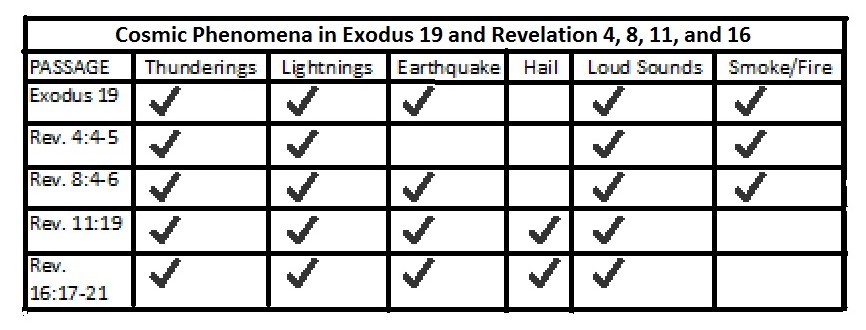
Basis (one of several): The same imagery that was present at the giving of the law, the old covenant, is echoed several times in the book of Revelation (4:5, 8:5, 11:19, and 16:18). This post will highlight these passages and their significance.

Parallel Scripture Passage: In that He says, ‘a new covenant,’ He has made the first obsolete. Now what is becoming obsolete and growing old is ready to vanish away” (Hebrews 8:13, 1st century AD).

Moses and the Israelites at Mount Sinai

Just before examining these passages in Revelation, let’s look at Exodus 19, the passage I believe they echo:

In the third month after the children of Israel had gone out of the land of Egypt, on the same day, they came to the Wilderness of Sinai. For they had departed from Rephidim, had come to the Wilderness of Sinai, and camped in the wilderness. So Israel camped there before the mountain. And Moses went up to God, and the Lord called to him from the mountain, saying, “Thus you shall say to the house of Jacob, and tell the children of Israel: ‘You have seen what I did to the Egyptians, and how I bore you on eagles’ wings and brought you to Myself. Now therefore, if you will indeed obey My voice and keep My covenant, then you shall be a special treasure to Me above all people; for all the earth is Mine. And you shall be to Me a kingdom of priests and a holy nation.’ These are the words which you shall speak to the children of Israel.”

Then it came to pass on the third day, in the morning, that there were thunderings and lightnings, and a thick cloud on the mountain; and the sound of the trumpet was very loud, so that all the people who were in the camp trembled. And Moses brought the people out of the camp to meet with God, and they stood at the foot of the mountain. Now Mount Sinai was completely in smoke, because the Lord descended upon it in fire. Its smoke ascended like the smoke of a furnace, and the whole mountain quaked greatly  (Exodus 19:1-18).

So we see that God reminded them of how He bore the people of Israel “on eagles’ wings”* out of Egypt and to Himself. God was establishing a covenant with them at this time, and He called them to be “a kingdom of priests and a holy nation.”** This gathering was marked by thundering and lightning, the sound of a loud trumpet, thick smoke, and the whole mountain quaking greatly.

*Compare to Revelation 12:13-14, where the persecuted womanwas given two wings of a great eagle, that she might fly into the wilderness to her place, where she is nourished for a time and times and half a time, from the presence of the serpent.”

**Compare this with John’s opening greeting to the seven churches, where he says that Jesus “has made us kings and priests to His God and Father” (Revelation 1:6).

Four Passages That Echo Mount Sinai in Revelation

The same cosmic phenomena present at Mount Sinai are seen again in the book of Revelation. Observe the following passages, with some brief notes on their likely significance:

1. Revelation 4:4-5

Around the throne were 24 thrones, and on the thrones I saw 24 elders sitting, clothed in white robes; and they had crowns of gold on their heads. And from the throne proceeded lightnings, thunderings, and voices. Seven lamps of fire were burning before the throne, which are the seven Spirits of God.”

As we noted in our study of Revelation 4, the 24 elders may very well “depict the 12 patriarchs of Israel and the 12 apostles, who represent the redeemed of both covenants now united in Christ.” This seems to be substantiated by the names of the 12 tribes and the 12 apostles found written on the gates and walls of the new Jerusalem (Rev. 21:12-14). So it appears that this covenant-establishing imagery takes place in the presence of elders representing both the old and the new covenant ages.

2. Revelation 8:4-6

And the smoke of the incense, with the prayers of the saints, ascended before God from the angel’s hand. Then the angel took the censer, filled it with fire from the altar, and threw it to the earth. And there were noises, thunderings, lightnings, and an earthquake. So the seven angels who had the seven trumpets prepared themselves to sound.”

This scene takes place at the opening of the seventh and final seal (Rev. 8:1). An angel with a golden censer offers the prayers of the saints, along with incense, upon the altar before God’s throne (verse 3). We proposed in our study of Rev. 8 that these prayers are linked to the cries of the martyrs for God to avenge their “blood on those who dwell on the earth” – Rev. 6:10 (see this post for a more complete study on this subject). It seems likely that the seal judgments are poured out in response to the prayers of God’s people. Therefore, the covenant-establishing imagery of Mount Sinai appears here because the prayers of the new covenant community were about to result in the old covenant system reaching its demise.

3. Revelation 11:19

Then the temple of God was opened in heaven, and the ark of His covenant was seen in His temple. And there were lightnings, noises, thunderings, an earthquake, and great hail.

Just as the scene we examined in Rev. 8 takes place at the opening of the seventh seal, this scene takes place at the sounding of the seventh trumpet. Loud voices declare, “The kingdoms of this world have become the kingdoms of our Lord and of His Christ, and He shall reign forever and ever!” The 24 elders are present at this scene (Rev. 11:15-16).

In verse 19 we see probably the most explicit reference connecting the old covenant to the prophecies in the book of Revelation. John sees a vision of God’s temple housing “the ark of His covenant.” In ancient Israel, the ark of the covenant was a centerpiece of the temple and the old covenant. Located in the Most Holy Place, it represented God’s presence: “You shall put the mercy seat on top of the ark, and in the ark you shall put the Testimony that I will give you. And there I will meet with you, and I will speak with you from above the mercy seat, from between the two cherubim which are on the ark of the Testimony, about everything which I will give you in commandment to the children of Israel” (Exodus 25:21-22). For further significance, see Numbers 7:89, 10:33-35; Joshua 3:13, 7:6-11; Judges 20:27; II Samuel 6:2; II Kings 19:15; Psalm 28:2, 80:1.

When the dust settles from the barrage of judgments in Revelation, what does heaven shout? “Behold, the tabernacle of God is with men, and He will dwell with them, and they shall be His people. God Himself will be with them and be their God” (Rev. 21:3). This did not suddenly become true because some buildings fell in 70 AD. Remember that Paul told the Corinthian church this was already their reality and that they were “the temple of the living God (II Cor. 6:16). The downfall of Israel, Jerusalem, and the temple in 70 AD, however, did remove the far less glorious old covenant system which competed against, and greatly opposed, this reality. It was a stunning and vivid demonstration that God had chosen the glorious new covenant over the inferior old covenant (see Hebrews 8). This was the time for rewarding God’s “servants the prophets and the saints, and those who fear [His] name, small and great” (Rev. 11:18).

Several verses earlier, John witnesses an actual earthquake that kills 7000 people in“the city” (Rev. 11:13), already identified in verse 8 as Jerusalem (“the great city…where also our Lord was crucified“). As we noted in our study of Revelation 11, Josephus records one awful night in early 68 AD when “a prodigious storm” took place in Jerusalem, marked by “the largest showers of rain, with continued lightnings, terrible thunderings, and amazing concussions and bellowings of the earth, that was in an earthquake.” Josephus adds that the Jewish zealots allowed the Idumaeans to come in and help them slaughter some of their fellow Jews who opposed their rebellion against the Romans. Between this slaughter and the earthquake, 8500 people died that night (Josephus, Wars 4:4:5, 4:4:7-4:5:1).

4. Revelation 16:17-21

Then the seventh angel poured out his bowl into the air, and a loud voice came out of the temple of heaven, from the throne, saying, ‘It is done!’ And there were noises and thunderings and lightnings; and there was a great earthquake, such a mighty and great earthquake as had not occurred since men were on the earth. Now the great city was divided into three parts, and the cities of the nations fell. And great Babylon was remembered before God, to give her the cup of the wine of the fierceness of His wrath. Then every island fled away, and the mountains were not found. And great hail from heaven fell upon men, each hailstone about the weight of a talent. Men blasphemed God because of the plague of the hail, since that plague was exceedingly great. 

Just as the scene we examined in Rev. 8 takes place at the opening of the seventh seal, and the scene in Rev. 11 takes place at the sounding of the seventh trumpet, this scene takes place at the pouring out of the seventh bowl.

John sees the great city, Jerusalem, divided into three parts. As we noted in our study of Revelation 16, this is a flashback to Ezekiel 5:1-12, when the prophet was required to shave his head and divide it into three parts, and was told by God: “This is Jerusalem” (Ezek 5:5).  One third of his hair was burned, one third was chopped up by the sword, and the last third was scattered into the wind. This was fulfilled when Jerusalem was destroyed in 586 B.C. at the hands of Babylon, and Josephus records the same tragedies in 70 AD at the hands of Rome (1.1 million Jews killed by the sword or by fire, and all the survivors exiled or sold into slavery). Jerusalem was also divided between 67-70 AD into three warring factions: [1] the Zealots, led by Eleazar [2] the Galileans, led by John of Gischala, and [3] the Idumeans, led by Simon.

Just as an actual deadly earthquake took place as foretold in Rev. 11, actual hail – “about the weight of a talent” (i.e. 75 – 100 pounds) – also fell as foretold in Rev. 16. Josephus wrote of large stones shot from catapults by the Roman armies into the temple complex in Jerusalem, which the watchmen in the city reported as appearing white in the sky:

“Now the stones that were cast were of the weight of a talent, and were carried two furlongs and further. The blow they gave was no way to be sustained, not only by those that stood first in the way, but by those that were beyond them for a great space. As for the Jews, they at first watched the coming of the stone, for it was of a white color, and could therefore not only be perceived by the great noise it made, but could be seen also before it came by its brightness” (Josephus, Wars 5:6:3).

Josephus also records that the watchmen on the wall, when they saw the stones coming, would shout, “The Son cometh!” After a while the Romans learned to blacken the stones so that they couldn’t as easily be detected, and many more were crushed by these stones. J. Stuart Russell, in his 1878 book titled The Parousia, offers this explanation for the words of the watchmen (p. 482):

“It could not but be well known to the Jews that the great hope and faith of the Christians was the speedy coming of the Son. It was about this very time, according to Hegesippus [110-180 AD], that St. James, the brother of our Lord, publicly testified in the temple that ‘the Son of man was about to come in the clouds of heaven,’ and then sealed his testimony with his blood [in 62 AD]. It seems highly probable that the Jews, in their defiant and desperate blasphemy, when they saw the white mass hurtling though the air, raised the ribald cry, ‘The Son is coming,’ in mockery of the Christian hope of the Parousia.”

—————————————————————————

In his book,Revelation: Four Views (A Parallel Commentary),” Steve Gregg also sees the connection between Mount Sinai and Revelation, as he shares concerning Rev. 4 (p. 88):

“The lightnings, thundering and voices (v. 5) recall Mount Sinai, where God first established His covenant with Israel [Exodus 19:16; cf. Rev. 8:5, 11:19]. Similar phenomena are mentioned here to suggest the end of that covenant and its replacement with another. The writer of Hebrews (citing Hag. 2) likened the overthrow of the first covenant (publicly demonstrated by the destruction of Jerusalem and the temple in A.D. 70) to the time of its establishment at Sinai, but the latter would be accompanied by even more fearful phenomena (Heb. 12:18-29).”

Steve Gregg also shares David Chilton’s comparison of Revelation 19:1-6 with Revelation 11:15-19 (which we have already examined). Chilton indicates that very similar subject matter is established “in the two passages which represent the closing visions of the two major sections of the book” (p. 440):

1. loud voices…in heaven (11:15; 19:1);
2. the declaration of the commencement of the reign of God (11:15, 17; 19:1, 6);
3. the twenty-four elders fall on their faces and worship (11:16; 19:4);
4. the avenging of the blood of His servants is announced (11:18; 18:24; 19:2);
5. reference to God’s servants…who fear Him, small and great (11:18; 19:5);
6. loud noises, including thunderings (11:19; 19:6).

—————————————————————

Check out the first two posts in this mini-series:

1. Revelation 6 and Luke 23: Hide Us From the Wrath of the Lamb
2. The Avenging of Righteous Blood (Deuteronomy, Matthew, and Revelation)

New WordPress Theme, Facebook Page, and Personal Site


In this post, I’d like to briefly share some information about this site’s new theme, a new Facebook page for this site, and a personal website.

New WordPress Theme (Motif)

A few days ago I switched to a different WordPress theme for this site. Previously I was using the “Under the Influence” theme. I didn’t know until I was browsing alternate themes that “Under the Influence” was retired in 2012 and was no longer being updated. I’m now using the “Motif” theme, which is fully responsive (for optimized viewing on computers, tablets, and smartphones).

I welcome any feedback you have on the new theme, including the site’s appearance, how the pages load, and anything else you might observe (or find to be a challenge). The background picture, by the way, is the same one found at the top of a post I wrote last September featuring St. Paul, Minnesota’s downtown skyway.

Downtown St. Paul 02 - Copy

You’ll probably notice several additions to the sidebar, and a couple of changes as well, including the search widget at the top. The previous header image is no longer in the header position, but it can be seen at the top of our About page. My wife created it about a year ago, and I think she did a great job:

cropped-adamfufilledpic1.jpg

New Facebook Page for Pursuing Truth

One of the additions in the sidebar is a new Facebook page for this site. It was also created just the other day and I haven’t yet announced it on my personal Facebook page or anywhere else. If “liking” Facebook posts, comments, and pages is one of your hobbies or addictions (just kidding), do feel free to “like” the new page:

https://www.facebook.com/KloposmasmPursuingTruth

Personal Website

(2016 Update: The site I described below was discontinued, and http://www.adammaarschalk.com is now the URL for this site instead of http://www.kloposmasm.com.)

My wife’s skills are also on display at a personal website I created last fall. The home page was “under construction” for several months, mainly because I didn’t know what I was doing. This site, Pursuing Truth, is hosted on WordPress.com, but my personal site, www.adammaarschalk.com, is hosted on WordPress.org. WordPress.org has a much different setup, with certain options (e.g. plugins) not available on WordPress.com.

Most of the design work was done by my wife, and she also created the neat photo slideshow on the home page. I know I’m biased, but I do think she could have a good future ahead of her in web design.

—————————————————————————-

Thank you, as always, for visiting and participating here, and I hope you find the content to be a blessing, educational, and of value.

Revelation: The Land (“Ge”) Is Referenced 22 Times More Often Than the World (“Kosmos”)


It’s well-known that the book of Revelation foretells, among other things, a series of frightening judgments falling upon an entity known as Babylon the Great and “the harlot.” Just as importantly, Revelation also portrays beautiful worship scenes and glorious destinies and realities for God’s people. Regarding the judgments, Does John picture them being poured out upon the entire planet, or upon a particular location?

Jonathan Welton, author of the book “Raptureless,” has created another helpful graphic illustrating the fulfillment of Bible prophecy (See his previous graphic on Daniel 2 illustrating that God’s kingdom has come). Titled “John’s Olivet Discourse: A Look at the Writings of John,” Welton’s graphic [1] makes a case that the book of Revelation contains John’s version of the Olivet Discourse [2] shows some of John’s time tables [3] notes an important principle of Bible interpretation, and [4] shows that John speaks far more about local events in Revelation than he speaks about global events.

We can also add Revelation 1:1 and 1:3 to Welton’s list of time statements made by the apostle John:

The Revelation of Jesus Christ, which God gave Him to show His servants—things which must shortly take place.
Blessed is he who reads and those who hear the words of this prophecy, and keep those things which are written in it; for the time is near.

The last part of Welton’s graphic is very informative. The following chart takes the numbers he provides (plus a couple more that I looked up) and allows us to see how focused John was on local events in the book of Revelation compared to his gospel account:

John’s books Number of chapters in each book Number of times John uses the word “kosmos,” meaning the entire planet Number of times John uses the word “ge,” meaning the land (a region)
The Gospel According to John 21 57 3
I John 5 17 1
II John 1 1 0
III John 1 0 0
Revelation 22 3 67

In other New Testament passages where the word “ge” is translated as “earth,” many assume that those passages are speaking about the entire planet. We need to be more careful with this assumption. One instance where it appears is in Luke’s version of the Olivet Discourse (Luke 21:23). There, Luke is clearly speaking about Israel. Some Bible versions translate this word as “earth,” while others translate it as “land.” Here is how Luke 21:23 reads, in context:

But when you see Jerusalem surrounded by armies, then know that its desolation is near. Then let those who are in Judea flee to the mountains, let those who are in the midst of her depart, and let not those who are in the country enter her. For these are the days of vengeance, that all things which are written may be fulfilled. But woe to those who are pregnant and to those who are nursing babies in those days! For there will be great distress in the land and wrath upon this people” (Luke 21:20-23).

The same word that Luke used in reference to Judea is the one that John used 67 times in the book of Revelation.

18 Case Studies on How John Used “Ge” to Speak of 1st Century Israel in Revelation

In 2010 I wrote a 3-part series tracking this phenomenon throughout the book of Revelation. The phrase “those who dwell on the earth” appears 10 times in Revelation, and at least a couple dozen more times in various forms. This series presents 18 case studies showing when and how this expression is used, examining the context in each case, and seeing how it’s used elsewhere in Scripture. A strong case is made that this expression in Revelation indicates 1st century apostate Israel. This series can be seen here: Part 1, Part 2, Part 3. If you have the time to read it, I believe you’ll find it informative.

A Final Note on How John Used the Word “Kosmos” Three Times in Revelation

Although it’s fun and enlightening to see how John used the word “ge” so many times in reference to the land of Israel, it’s also enlightening to see how he used the word “kosmos” to speak of the planet on which we live. Two of these instances concern those whose names are, or are not, written in the Book of Life. This is a global reference, as it ought to be, for the body of Christ is global and the message of the gospel is for every nation, tribe, language, and tongue. The third reference is to the kingdom of God, its triumph and greatness over all the kingdoms of this world (planet), and the eternal and universal reign of Jesus Christ:

1. “Then the seventh angel sounded: And there were loud voices in heaven, saying, ‘The kingdoms of this world have become the kingdoms of our Lord and of His Christ, and He shall reign forever and ever!'” (Rev. 11:15)
2. “All who dwell on the earth will worship him, whose names have not been written in the Book of Life of the Lamb slain from the foundation of the world” (Rev. 13:8).
3. “The beast that you saw was, and is not, and will ascend out of the bottomless pit and go to perdition. And those who dwell on the earth will marvel, whose names are not written in the Book of Life from the foundation of the world, when they see the beast that was, and is not, and yet is” (Rev. 17:8).

The Avenging of Righteous Blood (Deuteronomy, Matthew and Revelation)


Series: “Little Gems from Our Study of the Book of Revelation”

Recently my friend, Jerry William Bowers Jr., posted the following status on Facebook:

Revelation simplified:

Revelation 6:10, 16:6, 17:6, 18:24, 19:2, 20:4 speaks to the avenging of righteous blood.

This was prophesied in Deuteronomy 32:43, and would occur in Israel’s “END” (Deuteronomy 32:20) in their “Latter end” (Deuteronomy 32:29).

Matthew 23:34-36 very clearly says this would be fulfilled in their own generation.

It just doesn’t get any simpler than that!

I agree with Jerry’s summary, and would like to develop it further. During the last several years of studying eschatology, one thing I’ve enjoyed immensely is allowing Scripture to interpret Scripture. It’s an enlightening exercise. To give one example, I was taught for a long time that Isaiah’s imagery of a wolf lying down with a lamb is both unfulfilled and a literal reference to the animal kingdom. However, I’ve now come to understand, by allowing Romans 15 to interpret Isaiah 11, that this is presently fulfilled in Christ, who broke down the wall of division between Jews and Gentiles so that all may find their hope in Him (see “Romans 15 Shows That Isaiah 11 Is Fulfilled“).

Deuteronomy 32: Prediction of Israel’s End and Judgment for Murdering God’s People

Jerry’s status is also an appeal to allow Scripture to interpret Scripture, in this case concerning the theme of the blood of the martyrs. Let’s take a look at the passages he referenced in Deuteronomy 32, plus one more (verse 5). There Moses is speaking to Israel (Deut. 31:30), which he very interestingly addresses as “heaven” and “earth” (Deut. 32:1).

“They have corrupted themselves; They are not His children, because of their blemish: a perverse and crooked generation” (Deut. 32:5).

And He said: ‘I will hide My face from them, I will see what their end will be, for they are a perverse generation, children in whom is no faith‘” (Deut. 32:20).

For they are a nation void of counsel, nor is there any understanding in them. Oh, that they were wise, that they understood this, that they would consider their latter end! (Deut. 32:28-29).

Rejoice, O Gentiles, with His people; For He will avenge the blood of His servants, and render vengeance to His adversaries; He will provide atonement for His land and His people” (Deut. 32:43).

Does anything jump out when noting Moses’ language in verse 20? Recall what Jesus said to His Israelite audience in Matthew 17:

Then Jesus answered and said, “O faithless and perverse generation, how long shall I be with you? How long shall I bear with you? Bring him here to Me” (Matthew 17:17).

Moses predicted that at the time of Israel’s end, they would be a perverse and faithless generation. Jesus ministered in Israel to the same generation that was overthrown by the Romans in 70 AD, and He called that generation “faithless and perverse.” It would seem that Jesus intentionally invoked Moses’ words in Deut. 32:20. The apostle Paul did the same thing when addressing the Philippian church, as he used the exact same phrase Moses used in Deut. 32:5.

Do all things without complaining and disputing, that you may become blameless and harmless, children of God without fault in the midst of a crooked and perverse generation, among whom you shine as lights in the world…” (Philippians 2:14-15).

Matthew 23: Jesus’ Own Generation Responsible for The Blood of God’s Servants

We turn now to Jesus’ prediction in His woes upon the Scribes and Pharisees. He declared that they “build the tombs of the prophets and adorn the monuments of the righteous” (Matt. 23:29), and that they “are sons of those who murdered the prophets” (verse 31). Jesus went on to say:

Therefore, indeed, I send you prophets, wise men, and scribes: some of them you will kill and crucify, and some of them you will scourge in your synagogues and persecute from city to city, that on you may come all the righteous blood shed on the earth, from the blood of righteous Abel to the blood of Zechariah, son of Berechiah, whom you murdered between the temple and the altar. Assuredly, I say to you, all these things will come upon this generation” (Matt. 23:34-36).

Moses, in Deuteronomy 32, predicted that God would “avenge the blood of His servants” at the time of Israel’s end. Jesus told the religious leaders of Israel that they would be held responsible for “all the righteous blood shed on earth” (or land, that is, Israel’s land). He made it clear that their generation would experience that judgment.

Revelation: The Avenging of the Blood of God’s Saints, Prophets, and Apostles

In the book of Revelation, as John is shown a series of judgments being poured out, we see this scene in heaven:

When He opened the fifth seal, I saw under the altar the souls of those who had been slain for the word of God and for the testimony which they held. And they cried with a loud voice, saying, “How long, O Lord, holy and true, until You judge and avenge our blood on those who dwell on the earth?” (Rev. 6:9-10)

Many believe or teach that the judgments of Revelation will be poured out in our own future and upon the entire globe, but who did Jesus say would be held responsible for all the bloodshed of God’s servants? What generation did He say would experience that vengeance? Without a doubt, it was His own people (Israel) and His own generation. As the outpouring of judgment progresses in the book of Revelation, we see how God answers the cries of the martyrs:

Then the third angel poured out his bowl on the rivers and springs of water, and they became blood. And I heard the angel of the waters saying: “You are righteous, O Lord, the One who is and who was and who is to be, because You have judged these things. For they have shed the blood of saints and prophets, and You have given them blood to drink. For it is their just due” (Rev. 16:4-6).

So he carried me away in the Spirit into the wilderness. And I saw a woman sitting on a scarlet beast which was full of names of blasphemy, having seven heads and ten horns. The woman was arrayed in purple and scarlet, and adorned with gold and precious stones and pearls, having in her hand a golden cup full of abominations and the filthiness of her fornication. And on her forehead a name was written: MYSTERY, BABYLON THE GREAT, THE MOTHER OF HARLOTS AND OF THE ABOMINATIONS OF THE EARTH. I saw the woman, drunk with the blood of the saints and with the blood of the martyrs of Jesus. And when I saw her, I marveled with great amazement” (Rev. 17:3-6).

They threw dust on their heads and cried out, weeping and wailing, and saying, ‘Alas, alas, that great city, in which all who had ships on the sea became rich by her wealth! For in one hour she is made desolate.’ “Rejoice over her, O heaven, and you holy apostles and prophets, for God has avenged you on her!” …And in her was found the blood of prophets and saints, and of all who were slain on the earth” (Rev. 18:19-24).

For true and righteous are His judgments, because He has judged the great harlot who corrupted the earth with her fornication; and He has avenged on her the blood of His servants shed by her” (Rev. 19:2).

In our series on the book of Revelation, we noted that “the great city” was first identified in Rev. 11:8 as the place “where our Lord was crucified.” This is a positive identification of Jerusalem as “the great city” spoken of in the book of Revelation. It’s no wonder that “in her was found the blood of prophets and saints…” This is the very thing that Jesus said in Matthew 23 would be true of first century Jerusalem. This is also the time when the apostles lived and ministered (Rev. 18:20).

The great city, Babylon the Great, was called “the mother of harlots.” Did Jesus not refer to His own generation in Israel as “a wicked and adulterous generation” (e.g. Matthew 12:39, 16:4)? Did Jeremiah not use similar language to describe ancient Israel during times of apostasy? Was it not legitimate for God to use the language of adultery against an unfaithful nation that was in covenant with Him? Had first century Israel not become as awful and wicked as their ancient enemy and conqueror, Babylon?

See our study on Revelation 17:1-6 for the significance of the harlot imagery that John used, the garments that the harlot wore, the words on her forehead, the rich Old Testament background for all these things, and the harlot’s close partnership with first-century Rome.

The Apostle Paul Prophesies Judgment and Tribulation Against the Israel of His Day

In light of everything we’ve discussed above, it’s also good to take note of what the apostle Paul said to the believers in Thessalonica who were suffering and enduring persecution at the time of his letters (52-54 AD):

For you, brethren, became imitators of the churches of God which are in Judea in Christ Jesus. For you also suffered the same things from your own countrymen, just as they did from the Judeans, who killed both the Lord Jesus and their own prophets, and have persecuted us; and they do not please God and are contrary to all men, forbidding us to speak to the Gentiles that they may be saved, so as always to fill up the measure of their sins; but wrath has come upon them to the uttermost” (I Thessalonians 2:14-16)

“…[We] ourselves boast of you among the churches of God for your patience and faith in all your persecutions and tribulations that you endure, which is manifest evidence of the righteous judgment of God, that you may be counted worthy of the kingdom of God, for which you also suffer; since it is a righteous thing with God to repay with tribulation those who trouble you, and to give you who are troubled rest with us when the Lord Jesus is revealed from heaven with His mighty angels, in flaming fire taking vengeance on those who do not know God, and on those who do not obey the gospel of our Lord Jesus Christ” (II Thessalonians 1:4-8).

Paul affirmed that the time had nearly come for the inhabitants of Judea to experience God’s wrath “to the uttermost” for killing Jesus and the prophets. Their opposition to the gospel was “contrary to all men” and was a great hindrance in the quest to spread the gospel among the Gentiles. It would be “a righteous thing with God” when they were repaid with tribulation, and it would result in them receiving rest. Jesus had promised to come with His angels in judgment and in His kingdom while some of His disciples were still alive (Matthew 16:27-28).

To Review

1. Moses prophesied that God would “avenge the blood of His servants” upon a faithless, perverse, and crooked generation at the time of Israel’s “latter end” (Deuteronomy 32:5, 20, 29, 43).

2. Jesus repeatedly denounced His own generation as “perverse”, “faithless”, and “adulterous.” Paul told the Philippian church that they were shining as lights in the midst of “a crooked and perverse generation” (Phil. 2:14-15).

3. Jesus told the religious leaders of Israel that their generation would be held responsible and judged for all the righteous blood shed on earth (Matthew 23:29-36).

4. John was shown a scene of martyrs crying out for their blood to soon be avenged “on those who dwell on the earth” (Revelation 6:10).

5. John then sees seven bowls poured out “on the earth” (Rev. 16:1), and one of them causes the rivers and springs to become blood in order to judge those who had “shed the blood of saints and prophets” (Rev. 16:4-6).

6. John also sees a harlot dressed like a high priest of Israel and “drunk with the blood of the saints and with the blood of the martyrs of Jesus” (Rev. 17:3-6).

7. In Revelation 18:19-24, John sees the great city, earlier identified as Jerusalem (Rev. 11:8), overthrown and made desolate (see Matthew 23:38). The holy prophets and apostles, and all of heaven, were told to rejoice over this scene because God had avenged them on her, and because “in her was found the blood of prophets and saints, and of all who were slain on the earth.

8. In Revelation 19, John sees a heavenly scene in which there is much rejoicing over God’s righteous and true judgments, because He had judged the great harlot and “avenged on her the blood of His servants shed by her” (verse 2). With the harlot judged and put away, John sees that “the marriage of the Lamb has come, and His wife has made herself ready” (verse 7).