Revelation 6 and Luke 23: Hide Us From the Wrath of the Lamb


Series: “Little Gems from Our Study of the Book of Revelation”

My favorite series on this site is our in-depth study of the book of Revelation. Many of the chapter-by-chapter studies are rather lengthy, and buried within these posts are some very interesting mini studies (in my opinion).  Over time I would like to pull out some of these little gems and present them briefly, one post at a time. They will be added to the “Revelation” page on this site as they are posted. This is the first such post.

Revelation 6:15-17 Is the Fulfillment of Luke 23:27-30

One can learn a lot and gain a lot of insight by comparing Scripture with Scripture, or letting Scripture interpret Scripture. Consider John’s description of the opening of the 6th seal judgment, Revelation 6:15-17 in particular:

I looked when He opened the sixth seal, and behold, there was a great earthquake; and the sun became black as sackcloth of hair, and the moon became like blood. And the stars of heaven fell to the earth, as a fig tree drops its late figs when it is shaken by a mighty wind. Then the sky receded as a scroll when it is rolled up, and every mountain and island was moved out of its place. And the kings of the earth, the great men, the rich men, the commanders, the mighty men, every slave and every free man, hid themselves in the caves and in the rocks of the mountains, and said to the mountains and rocks, “Fall on us and hide us from the face of Him who sits on the throne and from the wrath of the Lamb! For the great day of His wrath has come, and who is able to stand?” (Rev. 6:12-17)

Comparing these verses with an earlier prophecy by Jesus in Luke 23:27-30 is very enlightening:

And a great multitude of the people followed Him, and women who also mourned and lamented Him. But Jesus, turning to them, said, “Daughters of Jerusalem, do not weep for Me, but weep for yourselves and for your children. For indeed the days are coming in which they will say, ‘Blessed are the barren, wombs that never bore, and breasts which never nursed!’ Then they will begin ‘to say to the mountains, “Fall on us!” and to the hills, “Cover us!”

  • Question #1: Who did Jesus say would call upon the mountains to fall on them because of His wrath and judgment?
  • Answer #1: The daughters of Jerusalem, and – even more so – their children (note the word “they” in reference to the children).
  • Question #2: When did Jesus say this would happen?
  • Answer #2: During the lifetimes of the ladies who were weeping as Jesus walked past them toward the cross, and during the lifetimes of their children.

In Luke 23, Jesus foretold what would happen to His own people, and to His own generation. In Revelation 6, John saw a vision of the same scene playing out during the great day of the Lord’s wrath. This was not to be a global event, nor was it to occur thousands of years later. It would, and did, occur in the same place where Jesus walked and lived, and upon His own generation which largely rejected Him.

Echoes of Hosea

The same prophecy was once given by the prophet Hosea concerning Israel:

“Also the high places of Aven, the sin of Israel, shall be destroyed. The thorn and thistle shall grow on their altars, and they shall say to the mountains, “Cover us!”, and to the hills, “Fall on us!” (Hosea 10:8).

This is one of many indications in the book of Revelation that the judgments were directed at apostate Israel and the “evil”, “wicked”, “faithless,” and “vile” generation that Jesus often spoke against.

The Significance of “The Kings of the Earth”

Revelation 6:15 speaks of “the kings of the earth.” Note that the Greek word for “earth” here (“ge”) can be, and sometimes is, translated as “land.” This can be understood as the Promised Land, i.e. Israel, and there is no doubt that this is the meaning in Luke 21:23, for example, where this same word is used:

But when you see Jerusalem surrounded by armies, then know that its desolation is near. Then let those who are in Judea flee to the mountains… But woe to those who are pregnant and to those who are nursing babies in those days! For there will be great distress in the land and wrath upon this people” (Luke 21:20-23).

The expression “those who dwell on the earth” occurs frequently in the book of Revelation, and ample evidence points to this being a unique reference to first century Israel, as outlined in this 3-part series (here, here, and here).

F.F. Bruce on Revelation 6:16 and Luke 23:30

F.F. Bruce (1910-1990), well-known Bible scholar from Scotland, regarding verse 16 in Revelation 6:

“The best commentary on the present passage is found in our Lord’s words to the ‘daughters of Jerusalem’ on the Via Dolorosa (Lk. 23:30).”

(“Revelation” in International Bible Commentary, p. 1608, published in 1986)

Josephus on The Final Days of the Roman Siege on Jerusalem in 70 AD

On July 31, 70 AD, after a five month siege, the Romans succeeded in penetrating the final wall around Jerusalem and burned the temple to the ground. Tens of thousands of Jews were killed, but the surviving Jews retreated to the Upper City of Jerusalem, where Josephus says that many continued to plunder, ambush, and assault their fellow Jews. The victims were too weakened by famine to resist, and quite a few were killed senselessly. Josephus tried to persuade them to surrender to the Romans and spare what was left of the city, but he was only laughed at. Josephus records that some put on happy faces “in expectation, as they said, of death to end their miseries.” Many Jews sought refuge in the caves and underground caverns, hoping to remain hidden once the Romans would reach the Upper City:

So now the last hope which supported the tyrants and that crew of robbers who were with them, was in the caves and caverns underground; whither, if they could once fly, they did not expect to be searched for; but endeavored, that after the whole city should be destroyed, and the Romans gone away, they might come out again, and escape from them. This was no better than a dream of theirs; for they were not able to lie hid either from God or from the Romans (Josephus, Wars, 6:7:3).

————————————————————————————————————–

See here for our complete study of Revelation 6:

Part 1 (Rev. 6:1-8)
Part 2 (Rev. 6:9-17)

Daniel 2: The Kingdom Is Here


Jonathan Welton, the author of the book “Raptureless,” has created a neat illustration of Nebuchadnezzar’s dream and Daniel’s interpretation of it in Daniel 2. I very much agree with the main conclusion: “The kingdom is present; the kingdom is growing. We are in the kingdom age… and we are the King’s ambassadors.”

Daniel 2:44 is indeed a pivotal verse, as it states clearly the timing for the setting up of God’s eternal kingdom:

And in the days of these kings the God of heaven will set up a kingdom which shall never be destroyed; and the kingdom shall not be left to other people; it shall break in pieces and consume all these kingdoms, and it shall stand forever.”

As many scholars agree, Rome was the fourth kingdom depicted in Nebuchadnezzar’s vision. Rome was preceded by Nebuchadnezzar’s own Babylonian kingdom (#1), Medo-Persia (#2), and Greece (#3). These were successive empires, and the Roman empire ceased to exist in 476 AD (Sources: BBC History, History Learning Site, Rome.Info, Wikipedia, About.com’s Ancient History). Daniel, a true and faithful prophet, recorded that God’s kingdom would be set up before all four of those kingdoms ceased to exist.

By the year 600 AD the final earthly kingdom revealed in Nebuchadnezzar’s vision had been gone for more than 100 years. By 1500 AD that fourth kingdom had already been gone for a full millennium (1000 years). What are we to make, then, of popular teachings which say that, as of the year 2014, God has not yet set up His kingdom? We are now 1538 years beyond the parameters of Daniel’s prophecy: “And in the days of these kings…” If God’s kingdom has not yet been established, it would seem that Daniel was not a true prophet.

The problem, however, is not with Daniel, but rather with premillennialism and any other school of thought which says that God’s kingdom is not yet here, or that when it comes it will take on earthly characteristics (e.g. a temple and a spiritual headquarters in Jerusalem, Israel) that the world has not yet seen.

Now when He was asked by the Pharisees when the kingdom of God would come, He answered them and said, “The kingdom of God does not come with observation; nor will they say, ‘See here!’ or ‘See there!’ For indeed, the kingdom of God is within you” (Luke 17:20-21).

Daniel 7 Reveals the Timing of the Kingdom

Coming back to Daniel, he later had a vision of four beasts, the fourth of which was “dreadful and terrible, exceedingly strong,” and having 10 horns (Daniel 7:7). Daniel also foresaw “One like the Son of Man coming with the clouds of heavento the Ancient of Days – a picture of Jesus’ ascension.

I was watching in the night visions, and behold, One like the Son of Man, coming with the clouds of heaven! He came to the Ancient of Days, and they brought Him near before Him. Then to Him was given dominion and glory and a kingdom, that all peoples, nations, and languages should serve Him. His dominion is an everlasting dominion, which shall not pass away, and His kingdom the one which shall not be destroyed” (Daniel 7:13-14).

In the rest of the chapter, Daniel sees or is told three times that the kingdom would be given into the hands of the saints:

But the saints of the Most High shall receive the kingdom, and possess the kingdom forever, even forever and ever” (verse 18).

I was watching; and the same horn was making war against the saints, and prevailing against them, until the Ancient of Days came, and a judgment was made in favor of the saints of the Most High, and the time came for the saints to possess the kingdom” (verses 21-22).

Then the saints shall be given into [the fourth beast’s] hand for a time and times and half a time. But the court shall be seated, and they shall take away his dominion, to consume and destroy it forever. Then the kingdom and dominion, and the greatness of the kingdoms under the whole heaven, shall be given to the people, the saints of the Most High. His kingdom is an everlasting kingdom, and all dominions shall serve and obey Him” (verses 25-27).

Parallel to this is Revelation 13:1-8, where John also saw a beast with 10 horns speaking blasphemous things and making war with the saints and overcoming them for 42 months (which is equal to 3.5 years, and also equal to Daniel’s “time and times and half a time”). In our study of Revelation, we saw how this was fulfilled in Nero and his 3.5 year campaign of persecution against Christians in the Roman empire from November 64 AD – June 68 AD (see here and here). In Daniel 7 then, we first see that Jesus received the kingdom immediately after His ascension, and then we see that God’s kingdom was set up and given into the hands of His people during the days of the fourth kingdom/beast, Rome.

The Gospels Reveal the Timing of the Kingdom

John the Baptist and Jesus, in their day, repeatedly proclaimed that the kingdom of God was at hand. Then Jesus told His disciples (Matthew 16:27-28) and the crowds (Mark 8:34-9:1) that He would come in His kingdom while some of them were still alive.

For the Son of Man will come in the glory of His Father with His angels, and then He will reward each according to his works. Assuredly, I say to you, there are some standing here who shall not taste death till they see the Son of Man coming in His kingdom” (Matt. 16:27-28; see also Matthew 10:23).

In Luke 21 Jesus described a series of events which were to occur before the temple would fall (Luke 21:5-7) and before His generation would pass away (Luke 21:32). According to Jesus, when His disciples saw those things take place, they could be sure that God’s kingdom was near.

Then He spoke to them a parable: ‘Look at the fig tree, and all the trees. When they are already budding, you see and know for yourselves that summer is now near. So you also, when you see these things happening, know that the kingdom of God is near” (Luke 21:29-31).

Matthew 21: The Parable of the Tenants

The Parable of the Tenants (Matthew 21:33-46) is also important in regard to when God’s kingdom was to be established, and we see in this parable a parallel to Daniel 7. Jesus, speaking to the chief priests and elders of the people (Matt. 21:23), exposes the vinedressers (the stewards) of God’s vineyard for their long-term persecution, beating, and killing of God’s servants, and for finally conspiring to kill Him and attempt to seize His inheritance. Jesus continued the discussion in this way:

“Therefore, when the owner of the vineyard comes, what will he do to those vinedressers?” They said to Him, “He will destroy those wicked men miserably, and lease his vineyard to other vinedressers who will render to him the fruits in their seasons.” Jesus said to them, “Have you never read in the Scriptures: ‘The stone which the builders rejected has become the chief cornerstone. This was the Lord’s doing, and it is marvelous in our eyes’? “Therefore I say to you, the kingdom of God will be taken from you and given to a nation bearing the fruits of it. And whoever falls on this stone will be broken; but on whomever it falls, it will grind him to powder” (Matthew 21:40-44).

Jesus thus proclaimed that the kingdom would be taken away from the corrupt Jewish religious leaders at the time of their judgment for shedding the blood of God’s saints and God’s Son. (This judgment was to fall upon Jesus’ own generation, according to Matthew 23:29-37.) It was at this time that the kingdom would be given to a fruit-bearing nation, the church.

As in Daniel 2, Jesus is the rock that crushes His opponents. In this case, faithless Israel, except for a remnant, had set itself up in opposition to Him, and the Rock would fall and “grind him to powder.” This happened with the destruction of Jerusalem, Israel, and the temple in 70 AD. At the same time, Jesus is a mighty Rock and fortress for those who trust in Him.

Hebrews 12 Reveals the Timing of the Kingdom

The author of Hebrews spoke of the kingdom that his audience was receiving in the first century (Hebrews 12:28), and he pointed out that it was a kingdom which could not be shaken, unlike those things made with hands which could and would be shaken (verses 26-27). I believe this was a reference, in particular, to the temple in Jerusalem, the worship center for old covenant Judaism. The context bears this idea out. Ten verses earlier we read that the saints had not come to Mount Sinai, where the old covenant had been established (verse 18), but they had “come to Mount Zion and to the city of the living God, the heavenly Jerusalem…to Jesus the Mediator of the new covenant…” (verses 22-24). If we compare this with Galatians 4:21-31, we see that earthly Jerusalem was in bondage and was about to be cast out (verses 25 and 30), but the heavenly Jerusalem is said to be the mother of God’s people (verse 26). Here is what Hebrews 12 has to say:

For you have not come to the mountain that may be touched and that burned with fire, and to blackness and darkness and tempest, and the sound of a trumpet and the voice of words, so that those who heard it begged that the word should not be spoken to them anymore. (For they could not endure what was commanded: “And if so much as a beast touches the mountain, it shall be stoned or shot with an arrow.” And so terrifying was the sight that Moses said, “I am exceedingly afraid and trembling.”)

But you have come to Mount Zion and to the city of the living God, the heavenly Jerusalem, to an innumerable company of angels, to the general assembly and church of the firstborn who are registered in heaven, to God the Judge of all, to the spirits of just men made perfect, to Jesus the Mediator of the new covenant, and to the blood of sprinkling that speaks better things than that of Abel.

See that you do not refuse Him who speaks. For if they did not escape who refused Him who spoke on earth, much more shall we not escape if we turn away from Him who speaks from heaven, whose voice then shook the earth; but now He has promised, saying, “Yet once more I shake not only the earth, but also heaven.” Now this, “Yet once more,” indicates the removal of those things that are being shaken, as of things that are made, that the things which cannot be shaken may remain. Therefore, since we are receiving a kingdom which cannot be shaken, let us have grace, by which we may serve God acceptably with reverence and godly fear. For our God is a consuming fire. (Hebrews 12:18-29)

To Review

1. Daniel 2 reveals that God would set up His kingdom before Babylon, Medo-Persia, Greece, and Rome had all expired as kingdoms/empires.
2. Daniel 7 reveals that Jesus would receive His kingdom at the time of His ascension to His Father’s throne. It also confirms that God’s kingdom would be put into the hands of His people, the church, during the time of the Roman empire and immediately following a vicious campaign of persecution meant to eradicate the church.
3. John the Baptist and Jesus repeatedly proclaimed that the kingdom of God was near in their day. Jesus promised to come in His kingdom while some of His disciples were still alive, and He revealed that His kingdom would be given to His church at the same time it was taken away from rebellious Israel at the time of their judgment.
4. Hebrews 12 reveals that God’s people were receiving an unshakable kingdom in the first century, and that they would receive it at a time when all that could be shaken would be shaken.

The nation of Israel, as a whole, was found unworthy to steward God’s kingdom. Jesus, on the other hand, was perfectly obedient, laid down His life, rose again, and was found worthy to receive the kingdom. He came to take it out of the hands of Israel’s leaders, and He placed it into the hands of His church. We have been given the privilege of being the stewards of God’s kingdom. How much is the church being limited in its ability to spread God’s kingdom, and walk in its realities and power, because of the pervasive belief that it hasn’t even come yet?

God’s kingdom has come, and God’s kingdom will remain forever.

————————————————————————————————————————–

For the record, I agree with everything in Jonathan Welton’s illustration except for this statement:

“Since Jesus (the Rock) crashed into the feet of the statue in His first coming, the kingdom has been present and growing all the way until His second coming.”

Spared Three Times In Five Days


This week I’ve witnessed three car accidents happen in front of me, and have nearly been involved each time, but Friday’s incident was the most bizarre. I’ve also seen the aftermath of an even higher number of accidents this week. Many in different parts of the US, I know, can say the same thing.

Before I share what happened Friday, I should mention that in recent months I’ve been out on the road more than the average person. Since my wife and I moved to Bowling Green, Ohio last August I’ve been driving a shuttle van/Honda CRV (and occasionally dispatching) for a taxi company here. Aside from transporting college students and others in town, I also transport people to and from:

1. the Detroit airport (75 miles to the north)
2. the Toledo airport (30 miles to the north)
3. the Greyhound bus station in Toledo
4. the Megabus station in Toledo
5. the Amtrak station in Toledo
6. the Greyhound bus station in Findlay (25 miles to the south)
7. medical appointments to determine eligibility for health insurance under the Affordable Care Act (a.k.a. Obamacare); the taxi company I drive for is contracted to do this, and it involves waiting for the duration of each appointment before taking the passenger back home; this takes me to Toledo, Findlay, Lima, etc. in NW Ohio
8. and more.

I would estimate that at least 20% of my passengers in Bowling Green are from Saudi Arabia, and I’ve enjoyed learning Arabic words and phrases from them, learning about their culture, and building some neat relationships.

I also tutor on the side through Wyzant, mostly in the areas of ESL (English as a Second Language) and proofreading/editing, and that work also sometimes involves traveling to Toledo, Findlay, etc.

Friday’s Strange Mishap

Friday morning at around 10:00 I was on my way to pick up a passenger who had finished his night shift at an industrial plant. A lady driving a minivan toward me caught my eye because she was sitting in the passenger seat and leaning way over to the side to grip the steering wheel. Even though the road was dry, she lost control, swerved both ways, and then rammed into a snow bank as I was about to pass her.

I immediately stopped, but before I could do anything she got out of the passenger side, ran around to the driver’s side, managed to reverse the van, and promptly drove away. I could see that no one else was in the van. I don’t know how she was pressing the gas and brake pedals, but later I humored myself by imagining she was using a toilet plunger.

Someone who heard the story suggested that she could have been a rural mail carrier, as they sometimes use their own vehicles which are altered in such a way that they can drive via the passenger seat and easily reach into mailboxes. (If anyone reading this post knows how that works, I’d be interested to learn more about it.) However, this incident occurred within Bowling Green’s corporation limit, her van was unmarked, and she was leaning over very awkwardly as she drove. I’m inclined to think she was drunk, but I could be wrong.

I’m glad her final swerve took her into the snow bank, or we could have collided head-on.

Monday’s Near Misses

The roads were especially treacherous in Bowling Green on Monday, after Sunday’s snowfall, and with no salt on the roads.  I experienced numerous “near misses” as drivers had a hard time stopping at intersections, but an accident took place in front of me twice.

In the first incident, I passed over Interstate 75 on a two-lane road, and as I drove down the hill I saw that a car had stopped at a stop sign a little further up and to the right. (There was no stop sign coming up for me.) Then I saw another car come up behind the first one – too fast – and he slid sideways and rear-ended her hard enough to push her into my path. By the grace of God, I was able to swerve to my left and make it around her. They were both OK.

In the second incident, I was stopping at a four-way stop when an SUV approaching from the side slammed head-on into an electric pole just before the intersection. The collision nearly took down the pole, and the wires flopped up and down violently for a few seconds. Because of his speed, my guess is that he didn’t notice until the last second that he had a stop sign ahead of him. He got out a minute later, dazed, but apparently OK, and emergency vehicles were soon there.

————————————————

These incidents and others were more than enough “excitement” for one week, but I’m grateful for God’s protection in each case.

Abraham’s Inheritance: Misunderstood


Yesterday PJ Miller of Sola Dei Gloria posted an excellent study on Abraham’s inheritance, and how the promises that God made to Abraham are expounded upon as the Old Testament progresses and the New Testament is introduced. This study was originally crafted and posted by Stephen Sizer.

pjmiller's avatarSola Dei Gloria

Good message

They say, “where there’s a will, there’s a family” and boy has there been a family dispute over the inheritance of Abraham. Millions and millions of the relatives of Ishmael and Isaac believe they are the rightful heirs. The Arab-Israeli conflict is the longest running dispute in the hands of the United Nations. In fact its over 4,000 years old. It is also the most dangerous military conflict in the world, without any international regulation of the chemical, biological and nuclear weapons held by some of Abraham’s descendants.

And it is undoubtedly the most controversial media story in the world with accusations of holocaust denial, anti-semitism, racism, apartheid and Islamophobia. And, sadly, it is being perpetuated by some misguided Christians… 

Abraham’s Inheritance was Promised

“On that day the Lord made a covenant with Abram and said, “To your descendants I give this land, from the Wadi of Egypt…

View original post 2,540 more words

Video: The 3.5 Year Siege of Jerusalem (66 – 70 AD)


I recently became aware of an hour-long video on YouTube, depicting Rome’s 3.5 year advance on Jerusalem resulting in its destruction in 70 AD. This video is part three of a 2006 TV series titled, “Ancient Rome: The Rise and Fall of an Empire” (BBC). It’s based on the writings of the Jewish historian, Josephus. The filmmakers consulted with Martin Goodman, professor of Jewish Studies at Wolfson College, Oxford, who has also written extensively on Jewish history in the Greek/Roman period.

I’m posting this video for its educational value and because of its relation to the study of eschatology, particularly the Olivet Discourse (Matthew 24, Mark 13, Luke 21) and 1st century history. It does portray fairly graphic violence (ancient warfare) at times, but you can turn your head when it happens and not really miss anything.

Among other fulfillments of Jesus’ words, this film depicts the civil war and famine that plagued Jerusalem from 67 – 70 AD (see Matthew 24:6-8/Mark 13:7-8/Luke 21:9-11 and Revelation 6:3-6). It also depicts the roughly 100 pound stones that the Romans catapulted into the temple complex in Jerusalem (see Revelation 16:21; the film shows the Romans doing this in Jotapata where Josephus was captured, but Josephus records that they also did this against Jerusalem in 70 AD).

Avocado Banana Smoothie


Despite two posts in a row highlighting food ideas, I assure you that we aren’t turning this into a food and recipe blog site. 🙂

It was during my time living in Malaysia (2001-2007) that I first learned avocados are drinkable. I rarely encountered avocado drinks in Malaysia, though. They were far more popular in Indonesia, Malaysia’s neighbor to the south, and I made sure to have one every time I traveled there for a conference. After one try, I was hooked. A typical Indonesian smoothie is made with avocados, sweetened condensed milk, and Hershey’s chocolate syrup drizzled along the sides of the cup.

Indonesian Avocado SmoothiePhoto Source

Back here in America, I haven’t recreated the Indonesian-style smoothie shown above, but I’ve experimented some with avocado-based smoothies. I’ll share one simple recipe that my wife also appreciates. This makes enough to serve two people:

1. Two avocados
2. Two bananas
3. Milk
4. Cinnamon (optional)
5. Nutmeg (optional)
6. Vanilla (optional)
7. Honey (if smoothie is not sweet enough for your personal taste)

Mix in a blender and serve. The total cost should be about $3, assuming you already have any desired spices on hand.

Peanut Butter Curry Meal Idea


About a week ago I cooked a meal that my wife and I both really enjoyed. I love curry dishes, and this one might be considered somewhat “off the beaten path.” When we told my wife’s family about it on Christmas day, they were surprised at the combination of ingredients, and that we were able to pull them all together to make a good meal. If you like peanut butter, and if you don’t mind (fairly) spicy food, I think you would enjoy it too. Here’s a list of the ingredients, but in most cases I didn’t take note of the exact amount I used:

1. Ground Turkey (20 ounce package, 93% fat free)
2. Peanut Butter (a generous amount)
3. Curry Powder (a lot!)
4. Milk (Vanilla Soy Milk, in our case)
5. Cinnamon
6. Nutmeg
7. Basil
8. Parsley
9. Oregano
10. Black Pepper
11. Cayenne Pepper
12. Tomatoes (chopped)
13. Avocados (chopped)
14. Bell Peppers (chopped)

Once I cooked the ground turkey meat, I mixed in everything else and served it with brown rice. We had enough leftovers for two more meals for each of us.

The inspiration for this meal came from this sauce, which I’ve used several times with some kind of meat and a medley of frozen vegetables, and served over rice or noodles:

Bangkok padang peanut sauce

Other ideas for this meal:

1. Substitute boneless chicken breasts (chopped) for ground turkey. Or substitute tofu if you prefer to avoid meats.
2. Use a can of Thai red curry instead of curry powder and milk.
3. Use coconut milk instead of regular milk.
4. Add or substitute other vegetables.
5. Experiment further by adding garlic, ginger, turmeric, fresh cilantro, etc. You might be surprised by what goes well with peanut butter.

The Wolf Has Been Approaching for 29 Years/Good News for the People of Iran


In a recent post, I opened by citing the words of Iranian foreign minister, Javad Zarif, who pointed out that Israel has been claiming for the last 22 years that Iran is mere months away from having a nuclear weapon. It turns out that this rhetoric has actually been going on for at least 29 years – since I was in kindergarten, Ronald Reagan was nearing the end of his first term in office, and seven years before the World Wide Web was introduced.

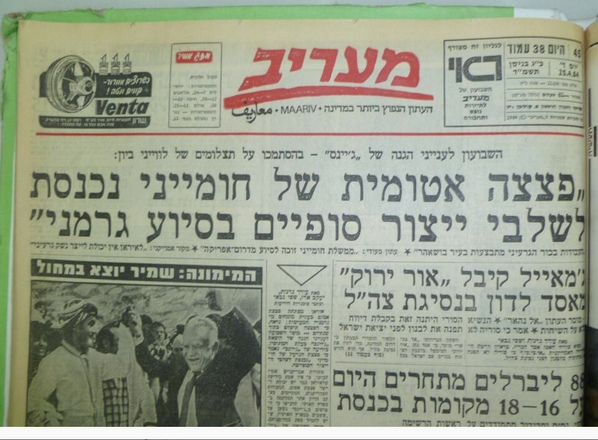
On November 27th, Mondoweiss re-posted a Twitter status from Richard Silverstein, the creator of the Tikun Olam blog, showing a Maariv headline from April 25, 1984. The headline read: “Iran In Final Stages of Production of Nuclear Bomb.”

Maariv headline

Maariv is a Hebrew-language daily newspaper, which was founded in 1948, and is the second highest selling newspaper in Israel. To be fair, the above story in Maariv cited Jane’s Defence Weekly,  which quoted West German intelligence sources regarding Iran. For a good perspective on the long-repeated warnings about Iran’s nuclear program, see this timeline at The Christian Science Monitor. The loudest warnings have come from the United States, the world’s nuclear champion and a signatory of the NPT (Non-Proliferation Treaty), and Israel, a nation believed to have as many as 200 nuclear weapons (undeclared) and a nation which has refused to sign the NPT.

As is now well-known, Iran signed an interim 6-month agreement on November 23rd, after a couple rounds of discussions with the United States and several other nations. The US will provide “limited” and “modest” sanctions relief in exchange for Iran “halting certain levels of enrichment and neutralizing part of its stockpiles,” among other concessions. According to President Obama, America’s toughest sanctions will continue to be applied to Iran. New channels of communication have certainly opened between Iran, the US, and other countries in recent weeks.

Many nations have treated these developments as good news. Saudi Arabia and certain other Gulf States (strongly opposed to the Shiite form of Islam) have not. Israel, predictably, is going nuts. Israeli Prime Minister Benjamin Netanyahu had these words to say the next day:

“What was achieved last night in Geneva is not an historic agreement; it is an historic mistake. Today the world has become a much more dangerous place because the most dangerous regime in the world has taken a significant step toward attaining the most dangerous weapon in the world… Israel is not bound by this agreement. The Iranian regime is committed to the destruction of Israel and Israel has the right and the obligation to defend itself…”

It’s hard to know if Netanyahu actually believes what he says or not. The government he represents has been crying wolf on Iran for 29 years. Some are suggesting that Israel needs to keep hyping up the Iran issue in order to deflect attention away from its illegal settlements, bulldozing of Palestinian homes, the blockade on Gaza, and other controversial domestic activities.

Just as predictably, Christian Zionist sources (for example, author Joel Rosenberg) have lined up to agree with Netanyahu and continue to demonize Iran.

I’m glad to see these recent developments, though, and I believe they are good steps in the right direction. They are especially good for the people of Iran, who have been suffering the effects of harsh sanctions. As I shared in a post on this subject almost a month ago, the effects of sanctions on the Iranian people have included “a 20% unemployment rate, a 30% – 50% inflation rate, expensive basic goods, the plunging value of Iran’s currency, increasingly unsafe commercial aircraft, an increasing inability to export oil, and other economic ramifications. They are also said to be resulting in half the population struggling to provide food and shelter for themselves, and struggling to maintain emotional health.”

Iranian Muslims, Iranian Jews, and Iranian Christians alike have experienced these things, in part due to a relentless campaign of deceit, politicking, and warmongering that has been vigorously supported by the Christian Zionist movement. Only God knows the extent to which Iranian and Palestinian Christians have suffered needlessly as a result of activities and rhetoric coming from many of their professing brothers and sisters in Christ.

An NBC News article highlights the provisions Iran can expect to see with the new easing of sanctions, concluding that Iran’s people will only see “precious little” relief in the short-term future, but that this deal provides “far more of a psychological benefit than an economic one” for now. Some groups are still investing in efforts to not only reverse these changes, but to bring even harsher sanctions quite soon. Others are watching for the slightest indication that Iran is not holding up its end of this deal, so that such actions can be justified (allegedly). Meanwhile, in plain sight are 2007 intelligence reports and other official statements from the CIA, Mossad, and other agencies agreeing that there is no evidence Iran is pursuing nuclear weapons.

While Israeli and Christian Zionist leaders continue to say that Iran is bent on destroying Israel, Iran’s Jewish parliamentary representative, Siamak Moreh Sedgh, praises Iran for allowing Iranian Jews to worship freely. Sedgh states that conditions for Iranian Jews are “better than yesterday, and today, our condition is much better than 10 years or 20 years ago.” Interestingly, he added that Iran’s Jewish community chose not to commemorate Israel’s 60th anniversary in 2008 because they are “in complete disagreement with the behavior of Israel” and its “anti-human behavior.”

The secular nation of Israel will do as it will do. As for God’s people, may we reflect and work toward God’s desire to see the nations, including Iran and Israel, healed by the river of life that flows from His throne (Revelation 22:1-2).

US Congress Ignores Drone Attack Survivors in Washington DC


I don’t use this blog to wade into partisan politics, but I do pay attention to certain components of American politics, and in particular I care about our foreign policy. If you were to ask me right now, as an American, how many nations America is at war with, I’m not sure I could give you an accurate response. There are the official wars, and then there are the unofficial wars. I find all of them to be disturbing.

Launching drone missiles into other nations and killing their citizens – these are acts of war. If any other nation sent drone strikes into Austin, Boston, or Tuscon, killing residents there, it’s not hard to imagine how the US would react and how we would label such acts. However, there’s apparently a world of difference if we’re the perpetrators rather than the victims. The US may not officially be at war with Pakistan, Libya, Yemen, and Somalia, but our government under both George Bush and Barack Obama (and any hidden hands that order their steps) has been carrying out acts of war against these nations, and the American public is mostly silent.

Hundreds of civilians, including women and children, have been killed by American drone strikes. Others have lost body limbs. Even more people are afraid to step outside, walk to school, go to the neighborhood convenience store, etc. I’ve bookmarked a number of articles on this phenomenon, with eye-opening statistics and more, and I’ll probably include most of them in a future post.

In this post I’d like to share an article about a Congressional hearing on this issue that took place in Washington, DC at the end of October. I had read about this upcoming hearing, where US lawmakers could hear from drone attack survivors for the first time. I had read about the Pakistani lawyer representing these survivors being repeatedly harrassed by manufactured visa issues. And I had hoped that this hearing would be well attended, well publicized, and effective in turning the tide toward justice and compassion. Out of America’s 535 lawmakers (435 Congress representatives and 100 Senators), only five had the decency to attend:

In “historic” briefing, Rehman family gives heartbreaking account of drone killing of 65-year-old grandmother… to five lawmakers.

– Lauren McCauley, staff writer: October 29, 2013

The Rehman family waits to testify at the Congressional Briefing on drone strikes Tuesday, October 29. (Photo: @akneerudh/ Twitter)

Despite being heralded as the first time in history that U.S. lawmakers would hear directly from the survivors of a U.S. drone strike, only five elected officials chose to attend the congressional briefing that took place Tuesday.

Nabila Rehman, 9, holds up a picture she drew depicting the US drone strike on her Pakistan village which killed her grandmother. (Photograph: Jason Reed/Reuters)

Pakistani schoolteacher Rafiq ur Rehman and his two children—9 year-old daughter Nabila and 13 year-old son Zubair—came to Washington, DC to give their account of a U.S. drone attack that killed Rafiq’s mother, Momina Bibi, and injured the two children in the remote tribal region of North Waziristan last October.

According to journalist Anjali Kamat, who was present and tweeting live during the hearing, the only lawmakers to attend the briefing organized by Rep. Alan Grayson (D-Fla.), were Rep. John Conyers (D-Mich.), Rep. Jan Schakowsky (D-Ill.), Rep. Rush Holt (D-NJ) and Rep. Rick Nolan (D-Minn.).

Before the handful of reporters and scant lawmakers, however, Rafiq and his children gave dramatic testimony which reportedly caused the translator to break down into tears.

In her testimony, Nabila shared that she was picking okra with her grandmother when the U.S. missile struck and both children described how they used to play outside but are now too afraid.

“I no longer love blue skies. In fact, I now prefer grey skies. Drones don’t fly when sky is grey,” said [13 year old] Zubair, whose leg was injured by shrapnel during the strike.

“My grandmother was nobody’s enemy,” he added.

“Nobody has ever told me why my mother was targeted that day,” Rafiq wrote in an open letter to President Barack Obama last week. “The media reported that the attack was on a car, but there is no road alongside my mother’s house. Several reported the attack was on a house. But the missiles hit a nearby field, not a house. All reported that five militants were killed. Only one person was killed – a 65-year-old grandmother of nine.”

“But the United States and its citizens probably do not know this,” Rafiq continued. “No one ever asked us who was killed or injured that day. Not the United States or my own government. Nobody has come to investigate nor has anyone been held accountable.”

He concluded, “Quite simply, nobody seems to care.”

You can watch a recording of the briefing below and here:

The purpose of the briefing, Grayson told the Guardian, is “simply to get people to start to think through the implications of killing hundreds of people ordered by the president, or worse, unelected and unidentifiable bureaucrats within the Department of Defense without any declaration of war.”

The family was joined by their legal representative Jennifer Gibson of the UK human rights organization Reprieve. Their Islamabad-based lawyer, Shahzad Akbar, was also supposed to be present but was denied a visa by the US authorities—”a recurring problem,” according to Reprieve, “since he began representing civilian victims of drone strikes in 2011.”

“The onus is now on President Obama and his Administration to bring this war out of the shadows and to give answers,” said Gibson.

Also present was U.S. filmmaker Robert Greenwald, who first met Rafiq when he traveled to Pakistan to interview the drone strike victims for his documentary Unmanned: America’s Drone Wars.  Before the briefing, Greenwald told the Guardian that he hoped the briefing “will begin the process of demanding investigation. Innocent people are being killed.”

The following clip from Unmanned was shown at Tuesday’s hearing:

My Wife’s Singing Gift


One of the many blessings I’m able to enjoy in my marriage (of 15 months and counting) is my wife’s beautiful singing voice. Back in April of this year, she posted five videos of herself singing on YouTube. Perhaps later she’ll add more songs, and even eventually some of the original songs she’s written which have never been shared publicly. With her permission, here are those five songs from seven months ago:

1. “Can’t Give Up Now” by Mary Mary (Cover)

2. “Shackles” by Mary Mary (Cover):

3. “Miss Celie’s Blues” (Cover):

4. “The Lord’s Prayer”:

5. “You Can See With Your Heart”:

For anyone who notices that most of these songs follow a theme of hopes and dreams, it might be good to point out that they were posted at a time when we were forced to give up on St. Paul Cultural Village, the multicultural marketplace and community center we were developing. By April 30th, less than a month after they were posted, we had vacated the building we were renting for that purpose. Once I update the St. Paul Cultural Village website, I plan to share in more detail what happened with that project. For my wife and I, January – April 2013 was a period marked by a lot of pain and shattered dreams, but God kept and sustained us then, and He continues to do so now.

-Adam