The Olivet Discourse: “This” Generation or “That” Generation (Part 2 of 4)


In the previous post (Part 1), we examined the first part of Jesus’ famous Olivet Discourse, recorded in Matthew 24:1-3, Mark 13:1-4, and Luke 21:5-7. All three accounts show the disciples admiring the temple, Jesus telling them it would soon be destroyed, and the disciples asking Him when that would take place. In Matthew’s account alone they asked Him about His coming and the end of the age, which we identified as the Old Covenant age. We looked at how He had already told them (Matt. 10:23 and 16:27-28) that His coming was to be: [1] with His angels [2] in His kingdom [3] in the glory of His Father [4] to repay each person for their deeds, and [5] within the lifetime of some of His disciples.

In this post we will examine a roughly 10-verse segment in each account where Jesus describes some of the signs which would take place before the temple’s destruction. We will see how these signs were fulfilled between the time of His ascension around 30 AD and the temple’s overthrow in 70 AD, about 40 years later.

MATTHEW 24:4-14

MARK 13:5-13

LUKE 21:8-19

4 Jesus answered: “Watch out that no one deceives you. 5 For many will come in my name, claiming, ‘I am the Messiah,’ and will deceive many. 6 You will hear of wars and rumors of wars, but see to it that you are not alarmed. Such things must happen, but the end is still to come. 7 Nation will rise against nation, and kingdom against kingdom. There will be famines and earthquakes in various places. 8All these are the beginning of birth pains.9 “Then you will be handed over to be persecuted and put to death, and you will be hated by all nations because of me. 10 At that time many will turn away from the faith and will betray and hate each other, 11 and many false prophets will appear and deceive many people. 12 Because of the increase of wickedness, the love of most will grow cold, 13but the one who stands firm to the end will be saved.14 And this gospel of the kingdom will be preached in the whole world as a testimony to all nations, and then the end will come. 5 Jesus said to them: “Watch out that no one deceives you. 6 Many will come in my name, claiming, ‘I am he,’ and will deceive many. 7 When you hear of wars and rumors of wars, do not be alarmed. Such things must happen, but the end is still to come. 8Nation will rise against nation, and kingdom against kingdom. There will be earthquakes in various places, and famines. These are the beginning of birth pains.9 “You must be on your guard. You will be handed over to the local councils and flogged in the synagogues. On account of me you will stand before governors and kings as witnesses to them. 10 And the gospel must first be preached to all nations. 11Whenever you are arrested and brought to trial, do not worry beforehand about what to say. Just say whatever is given you at the time, for it is not you speaking, but the Holy Spirit.12 “Brother will betray brother to death, and a father his child. Children will rebel against their parents and have them put to death. 13 Everyone will hate you because of me, but the one who stands firm to the end will be saved. 8 He replied: “Watch out that you are not deceived. For many will come in my name, claiming, ‘I am he,’ and, ‘The time is near.’ Do not follow them. 9When you hear of wars and uprisings, do not be frightened. These things must happen first, but the end will not come right away.”10 Then he said to them: “Nation will rise against nation, and kingdom against kingdom. 11There will be great earthquakes, famines and pestilences in various places, and fearful events and great signs from heaven.12 “But before all this, they will seize you and persecute you. They will hand you over to synagogues and put you in prison, and you will be brought before kings and governors, and all on account of my name. 13 And so you will bear testimony to me. 14 But make up your mind not to worry beforehand how you will defend yourselves. 15 For I will give you words and wisdom that none of your adversaries will be able to resist or contradict. 16 You will be betrayed even by parents, brothers and sisters, relatives and friends, and they will put some of you to death. 17 Everyone will hate you because of me. 18 But not a hair of your head will perish. 19 Stand firm, and you will win life.

John Wesley (1703-1791), in the introduction to his commentary on Matthew 24, wrote the following:

“Josephus’ History of the Jewish War is the best commentary on this chapter. It is a wonderful instance of God’s providence, that he, an eyewitness, and one who lived and died a Jew, should, especially in so extraordinary a manner, be preserved, to transmit to us a collection of important facts, which so exactly illustrate this glorious prophecy, in almost every circumstance.”

Clearly, Wesley believed that Matthew 24 was fulfilled by the time the Roman-Jewish War (66-73 AD) came to an end. Nearly 250 years after Wesley’s statement was made, statements like this one by Hal Lindsey in 2009 are far more typical when it comes to interpreting this passage:

“What generation? Obviously, in context, the generation that would see the signs – chief among them the rebirth of the State of Israel… I believe we are in the generation that will live to see the fulfillment of the ‘birth pangs’ that Jesus predicted would all come together in one time frame shortly before the Tribulations events that bring about His return.”

These interpretations couldn’t be more different. In this section of the Olivet Discourse, we will see that Wesley certainly had a point when he spoke of the relevance of Josephus’ historical records. We will be looking at one small portion at a time from the parallel Scripture texts above.

Matt. 24:4-5/Mark 13:5-6/Luke 21:8– Jesus warns the disciples about deceivers who would come claiming to be the Messiah and leading many astray. Matthew also speaks of “false prophets” again in verse 11 and verse 24, and Mark does so again in verse 22.

Luke here makes a remark that we don’t see in the other two accounts. He adds that these false prophets would claim that the time was “near” (or “at hand” in some translations), and that His disciples were not to go after them when they said that. We should give this some extra thought.

As we will see in Luke 21:28, Jesus later says “Now when these things begin to take place, straighten up and raise your heads, because your redemption is drawing near.” Jesus thus gives permission at that stage for His people to realize the very thing that earlier they were not to believe, that is, that the time was near. First they had to see “these things begin to take place,” and then they could know and proclaim that the end was near. The expression “these things” refers to what Jesus goes on to describe in verses 9-27.

Did any of the writers of the New Testament proclaim that the time was near? Consider these statements:

“…For salvation is nearer to us now than when we first believed. The night is far gone; the day is at hand…” (Romans 13:11-12).

Let your reasonableness be known to everyone. The Lord is at hand” (Philippians 4:5).

Yet a little while, and the coming One will come and will not delay” (Hebrews 10:37).

You also, be patient. Establish your hearts, for the coming of the Lord is at hand” (James 5:8).

The end of all things is at hand; therefore be self-controlled and sober-minded for the sake of your prayers” (I Peter 4:7).

Children, it is the last hour, and as you have heard that antichrist is coming, so now many antichrists have come. Therefore we know that it is the last hour” (I John 2:18).

From these statements we see that Paul, James, Peter, and John all proclaimed that the time was near. Did they become the very false prophets Jesus had warned about in Luke 21:8, since they uttered the very statement that Jesus warned His followers not to believe? If the signs of the Olivet Discourse are still future and unfulfilled, as futurists insist, then they certainly did become those false prophets. We know, however, that this is not the case. This is actually one more indication that the events predicted by Jesus came to pass within His own generation. They witnessed the predicted signs coming to pass, and on this authority they announced that the end was near. Soon afterwards, that end came, the end of the Old Covenant world and age. Jesus kept His word and His promise.

George Peter Holford, in the year 1805, wrote a book entitled “The Destruction of Jerusalem, An Absolute and Irresistible Proof of the Divine Origin of Christianity” in which he outlined many of the events recorded by Josephus and other historians of that time. Concerning Matthew 24:4-5, he wrote:

[Jesus commenced] with a caution: “Take heed,’ says He, ‘that no man deceive you; for many shall come in My name, saying, ‘I am Christ,’ and shall deceive many.” The necessity of this friendly warning soon appeared; for within one year after our Lord’s ascension, rose Dositheus the Samaritan, who had the boldness to assert that he was the Messiah, of whom Moses prophesied; while his disciple Simon Magus deluded multitudes into a belief that he, himself, was the “GREAT POWER OF GOD.”

Holford went on to list a host of similar deceivers in that generation, some who literally called themselves “the Christ” or “Messiah,” and others who promised to take on His expected role in delivering the Jews from Roman bondage and bringing a physical, earthly kingdom to Jerusalem. This was a popular expectation, and one that Jesus didn’t live up to, so it was easily used to sway people their way.

Matt. 24:6-7a/Mark 13:7-8a/Luke 21:9-10 – Jesus’ next warning is about wars, rumors of wars, and nations and kingdoms rising against each other. Luke adds the word “uprisings.” An example of one kingdom rising up against another can be seen in the Roman-Parthian War of AD 58-63:

“The Roman-Parthian War of 58-63 CE was sparked off when the Parthian Empire’s ruler imposed his own brother as the new king of Armenia, considered by Rome to be a quasi-neutral buffer state between the two empires. When Parthia went a step further and declared Armenia a vassal state in 58 CE all-out war broke out. The on-off war, in which the Roman commander Corbulo excelled, would only be settled in 63 CE with the Treaty of Rhandia which shared the responsibility of ruling Armenia between the two powers.”
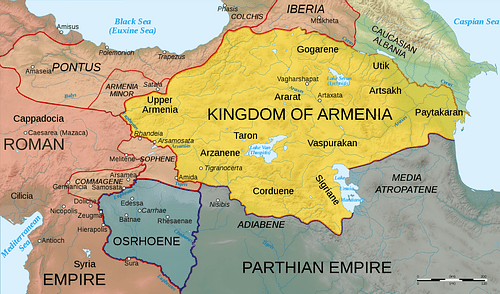
Map of Armenia, 50 CE

(Source)

Regarding conflicts within the Roman Empire in the decades following Jesus’ ascension, the Roman historian Tacitus had this to say,

“The history on which I am entering is that of a period rich in disasters, terrible with battles, torn by civil struggles, horrible even in peace. Four emperors fell by the sword; there were three civil wars, more foreign wars, and often both at the same time” (The Histories, 1:2).

As just one example, the Roman-Jewish War took place over a 6-7 year period, in which an incredible amount of blood was shed throughout Judea and Galilee, and women even ate their babies out of desperation. When Nero committed suicide in June 68 AD, even the Roman Empire nearly collapsed in on itself due to jostling for power and what Josephus called “civil wars of horrible ferocity and dramatic proportions.” Rome went through four emperors within one year, and Josephus remarked that “every part of the habitable earth under them [the Romans] was in an unsettled and tottering condition” (Wars 7.4.2).

In the fall/winter of 67 AD a brutal civil war also broke out in Jerusalem and Judea between the revolutionaries and those who wanted to maintain peace with Rome. Jerusalem was eventually divided into three factions led by [1] Eleazar, who was over the Zealots [2] John of Gischala, who was over the Galileans, and [3] Simon, who was over the Idumeans. It remained this way until the city was destroyed in September 70 AD. In one night 8500 people were killed, and their bodies were cast outside of Jerusalem without being buried. The outer temple was “overflowing with blood,” according to Josephus, and the inner court even had pools of blood in it.

Matt. 24:7b-8/Mark 13:8b/Luke 21:11 – Jesus next predicts famines and earthquakes. Once again, Luke adds other details: pestilences and “fearful events and great signs from heaven.”

   New Zealand

Haiti

 Japan

Was Jesus predicting the recent earthquakes we’ve seen in Pakistan, New Zealand, Haiti, and Japan, and others yet to come? Many prophecy teachers today would have us believe that He did. George Peter Holford (in 1805) also referred to a number of great earthquakes which took place during the generation to which Jesus and His disciples belonged.

In one instance in early 68 AD a terrible earthquake was accompanied by terrifying storms and violent winds, prompting Josephus to say, “These things were a manifest indication that some destruction was coming upon men, when the system of the world was put into this disorder; and any one would guess that these wonders foreshowed some grand calamities that were coming” (Wars 4.4.5). Seneca the Younger, a Roman philosopher, wrote the following in 58 AD:

“How often have cities of Asia and Achaea fallen with one fatal shock! Show many cities have been swallowed up in Syria, how many in Macedonia! How often has Cyprus been wasted by this calamity! How often has Paphos become a ruin! News has often been brought us of the demolition of whole cities at once.”

Henry Alford, The New Testament for English Readers (Chicago, IL: Moody Press, n.d.), 163.

Large earthquakes took place in Crete, Smyrna, Miletus, Chios, Samos, Laodicea, Hierapolis, Colosse, Campania, Rome, Judea and Pompei (February 5, 63 AD). Other earthquakes are recorded in Scripture in Matthew 27:51-54, Matthew 28:2, and Acts 16:26.

Holford then notes that the great famine predicted by Agabus in Acts 11:27-30 began in the fourth year of the reign of Claudius (i.e. 45 AD) and “was of long continuance. It extended through Greece, and even into Italy, but was felt most severely in Judea and especially at Jerusalem, where many perished for want of bread.” This famine was recorded by Eusebius, Orosius, and Josephus, who related that “an assaron [about 3.5 pints] of corn was sold for five drachmae” (in the heyday of ancient Greece in the 4th century BC one drachmae was the daily wage for a skilled worker). Regarding Christ’s predictions of pestilences, Holford writes:

History…particularly distinguishes two instances of this calamity, which occurred before the commencement of the Jewish war. The first took place at Babylon about A. D. 40, and raged so alarmingly, that great multitudes of Jews fled from that city to Seleucia for safety, as hath been hinted already. The other happened at Rome A.D. 65, and carried off prodigious multitudes. Both Tacitus and Suetonius also record, that similar calamities prevailed, during this period, in various parts of the Roman Empire. After Jerusalem was surrounded by the army of Titus, pestilential diseases soon made their appearance there to aggravate the miseries, and deepen the horrors of the siege. They were partly occasioned by the immense multitudes which were crowded together in the city, partly by the putrid effluvia which arose from the unburied dead, and partly from spread of famine.

These calamities, along with mothers eating their own children, are reminiscent of what God said would happen to Israel if that nation became faithless and rebellious (e.g. Leviticus 26:25-29, Deuteronomy 28:58-62, Deut. 32). It was also said that they would be punished sevenfold, so it’s of great interest that “Babylon the great” (Revelation 17:5), also called “the great city” (Rev. 17:18), was to be the recipient of seven seal, trumpet, and bowl judgments. The “great city” in the book of Revelation was first identified as the place where Jesus was crucified (Rev. 11:8), i.e. Jerusalem. “Babylon the great” was responsible for the blood of the saints, prophets, and apostles (Rev. 16:4-7, 17:6, 18:20, 18:24), the same thing for which Jesus said the religious leaders of Israel in His own generation were responsible for (Matthew 23:29-36).

Interestingly, for those who believe that famines are increasing on our planet today, a recent report reveals that the opposite is true. The Huffington Post reports that, according to the 2015 Global Hunger Index, “calamitous famines that cause more than 1 million deaths” have been completely eliminated. Additionally, there has been a “reduction ‘almost to a vanishing point’ of great famines, which cause more than 100,000 deaths.” Around 27 million died of famine between 1900 – 1909; more than 14 million died of famine during the 1940s, 1950s, and 1960s; about 1.4 million died of famine in the 1990s; only about 600,000 died of famine between 2000 – 2015 (that’s still too many, but deaths from famine are mercifully becoming more rare).

Jesus also predicted that there would be “terrors and great signs from heaven” (Luke 21:11). In this regard, Holford pointed to a number of strange accounts recorded by Josephus:

[1] “A meteor, resembling a sword, hung over Jerusalem during one whole year.” This could not be a comet, for it was stationary, and was visible for twelve successive months.

[2] “On the eighth of the month of Zanthicus, (before the feast of unleavened bread) at the ninth hour of the night [3 AM], there shone round about the altar, and the circumjacent buildings of the temple, a light equal to the brightness of the day, which continued for the space of half an hour.” [Does this recall Zech. 14:7?]

[3] “As the High Priest was leading a heifer to the altar to be sacrificed, she brought forth a lamb, in the midst of the temple.” …[Some] may think that they discern in this prodigy a miraculous rebuke of Jewish infidelity and impiety, for rejecting the ANTITYPICAL Lamb, who had offered Up Himself as an atonement, “once for all,” and who, by thus completely fulfilling their design, had virtually abrogated the Levitical sacrifices… It did not occur in an obscure part of the city, but in the temple ; not at an ordinary time, but at the passover, the season of our LORD’S crucifixion in the presence…of the High Priests and their attendants, and when they were leading the sacrifice to the altar.

[4] “About the sixth hour of the night, the eastern gate of the temple was seen to open without human assistance.” When the guards informed the Curator of this event, he sent men to assist them in shutting it, who with great difficulty succeeded. — This gate, as hath been observed already, ‘Was of solid brass, and required twenty men to close it every evening. It could not have been opened by a “strong gust of wind,” or a slight earthquake;” for Josephus says, it was secured by iron bolts And bars, which were let down into a large threshold; consisting of one entire stone.”

[5] “Soon after the feast of the Passover, in various parts of the country, before the setting of the sun, chariots and armed men were seen in the air, passing round about Jerusalem.”

Except for the first omen above, says Holford, all the others were placed by Josephus during the final year leading up to the Jewish War (67-73 AD). Some of these accounts were also recorded by the Roman historian Tacitus.

Matt. 24:9-13/Mark 13:9-13/Luke 21:12-19 – Here Jesus tells His followers that they will experience persecution, arrests, death, and betrayal even by family members because of their faith in Him. Many would turn away from the faith, but those who would stand firm until the end would be saved. Matthew alone adds that wickedness would increase and that most would grow cold in their love. Mark and Luke speak of Christ’s followers needing to testify before kings and governors, at which time they were to depend on the Holy Spirit to give them the words to say.

On the early believers being brought before kings and governors, Albert Barnes remarked in 1834, “This prediction was completely and abundantly fulfilled, Acts 5:26Acts 12:1-4Acts 23:33Acts 26:1Acts 26:28Acts 26:30. Peter is said to have been brought before Nero, and John before Domitian, Roman emperors; and others before Parthian, Scythian, and Indian kings.” John Gill, in 1746, added: “Meaning Roman governors; so Paul was had before Gallio, Felix, and Festas; … and kings for my sake; as Herod, Agrippa, Nero, Domitian, and others, before whom one or other of the apostles were brought; not as thieves, or murderers, or traitors, and seditious persons, or for having done any wrong or injury to any man’s person or property; but purely for the sake of Christ.”

Mark and Luke also both speak of Jesus’ followers being handed over to the synagogues, and Mark adds that they would be flogged there. This clearly speaks of persecution at the hands of the Jews, just one strong indication that this was to take place in the first century. Jewish persecution is not a mark of our time, but it was a mark of that time (In fact, it only prevailed up until Israel’s destruction in 70 AD, for after that the surviving Jews were persecuted together with the Christians by the Roman Empire). For example, Paul said this to the Thessalonian believers (I Thess. 2:14-16):

For you, brothers, became imitators of the churches of God in Christ Jesus that are in Judea. For you suffered the same things from your own countrymen as they did from the Jews, who killed both the Lord Jesus and the prophets, and drove us out, and displease God and oppose all mankind by hindering us from speaking to the Gentiles that they might be saved – so as always to fill up the measure of their sins. But God’s wrath has come upon them at last!”

The city of Smyrna had the largest Jewish population of any Asian city, and Jesus commended the church there for their patient endurance in the face of Jewish persecution (Revelation 2:9): “I know your tribulation and your poverty (but you are rich) and the slander of those who say that they are Jews and are not, but are a synagogue of Satan.” A very similar statement was made to the church in Philadelphia in Rev. 3:9.

Concerning the love of many growing cold, even as we see in Acts and the epistles evidence that the gospel was greatly advanced, we also learn of a falling away taking place at the same time. The church in Ephesus had abandoned the love they had at first (Revelation 2:4), the church in Laodicea had become lukewarm and was in a miserable state (Rev. 3:15-17). The church in Galatia had turned aside to a different gospel (Galatians 1:6-7).

Matt. 24:14/Mark 13:10 – Luke doesn’t mention this, but both Matthew and Mark state that the end wouldn’t come until the gospel was preached to “all nations” (Mark) and “in the whole world” (Matthew). “The end,” of course, was “the end of the age” spoken of in Matthew 24:3.

Here is where many might object that Matthew 24:14 couldn’t have possibly been fulfilled before 70 AD. However, we can’t overlook the testimonies of Scripture itself:

[1] “Now there were dwelling in Jerusalem Jews, devout men from every nation under heaven… And they were amazed and astonished, saying… ‘we hear them telling in our own tongues the mighty works of God’” (Acts 2:5-11).

[2] “First, I thank my God through Jesus Christ for all of you, because your faith is proclaimed in all the world” (Romans 1:8).

[3] “Now to Him who is able to strengthen you according to my gospel and the preaching of Jesus Christ, according to the revelation of the mystery that was kept secret for long ages but has now been disclosed and through the prophetic writings has been made known to all nations…” (Romans 16:25-26).

[4] “…the word of the truth, the gospel, which has come to you, as indeed in the whole world it is bearing fruit and growing… (Colossians 1:5-6).

[5] “…if indeed you continue in the faith, stable and steadfast, not shifting from the hope of the gospel that you heard, which has been proclaimed in all creation under heaven, and of which I, Paul, became a minister (Colossians 1:23).

Do these statements not indicate that Matthew 24:14 had already been fulfilled by the time they were written? The phrase “the whole world” here then must mean what it meant in Luke 2:1 when we are told that “the entire world” was registered in the days of Caesar Augustus, i.e. the known world or the Roman Empire (cf. Acts 24:5). Eusebius (263-339), the early church father, said this when commenting on Matthew 24:

Thus, under the influence of heavenly power, and with the divine co-operation, the doctrine of the Saviour, like the rays of the sun, quickly illumined the whole world; [1] and straightway, in accordance with the divine Scriptures, [2] the voice of the inspired evangelists and apostles went forth through all the earth, and their words to the end of the world;  the Apostles preached the Gospel in all the world, and some of them passed beyond the bounds of the ocean, and visited the Britannic isles.

Bishop Newton of Brazil (ordained in 1949) says of the spread of the gospel:

It appears from the writers of the history of the church, that before the destruction of Jerusalem the Gospel was not only preached in the Lesser Asia, and Greece, and Italy, the great theatres of action then in the world, but was likewise propagated as fax northward as Scythia, as far southward as Ethiopia, as far eastward as Parthia and India, as far westward as Spain and Britain.

John Wesley believed Jesus didn’t mean in this verse that the gospel would be preached in all the world “universally” before the end came. He said, “[T]his is not done yet: but in general through the several parts of the world, and not only in Judea [this happened]. And this was done by St. Paul and the other apostles, before Jerusalem was destroyed. And then shall the end come—of the city and temple.” Today we don’t need to be motivated by an impending time of judgment, and certainly not a desire “to be raptured out of here,” in order to preach the gospel. Just as the early church succeeded in spreading the gospel throughout their known world, we should be about the business of doing the same. Paul’s motivation can be ours:

“I make it my ambition to preach the gospel, not where Christ has already been named, lest I build on someone else’s foundation, but as it is written, ‘Those who have never been told of Him will see, and those who have never heard will understand’” (Romans 15:20-21).

In the next post (Part 3), one of the things we will look at is what Jesus said about the abomination of desolation, and the surrounding of Jerusalem by foreign armies, and how the early believers did flee as Jesus told them to when they saw those things.

Quotes to Note

F.W. Farrar (1831-1903): “The Fall of Jerusalem and all the events which accompanied and followed it in the Roman world and in the Christian world, had a significance which it is hardly possible to overestimate. They were the final end of the Old Dispensation. They were the full inauguration of the New Covenant. They were God’s own overwhelming judgment on that form of Judaic Christianity which threatened to crush the work of St. Paul, to lay on the Gentiles the yoke of abrogated Mosaism, to establish itself by threats and anathemas as the only orthodoxy… No event less awful than the desolation of Judea, the destruction of Judaism, the annihilation of all possibility of observing the precepts of Moses, could have opened the eyes of the Judaisers from their dream of imagined infallibility. Nothing but God’s own unmistakable interposition – nothing but the manifest coming of Christ – could have persuaded Jewish Christians that the Law of the Wilderness was annulled” (The Early Days of Christianity, 1882, pp. 489-490).

R.C. Sproul (1997-98): “The coming of Christ in A.D.70 was a coming in judgment on the Jewish nation, indicating the end of the Jewish age and the fulfillment of a day of the Lord. Jesus really did come in judgment at this time, fulfilling his prophecy in the Olivet Discourse” (The Last Days According to Jesus, p. 158, 1998). “The most significant, redemptive, historical action that takes place outside the New Testament, is the judgment that falls on Jerusalem, and by which judgment the Christian Church now [clearly] emerges as The Body of Christ” (R.C. Sproul, Dust to Glory video series, 1997).

The Olivet Discourse: “This” Generation or “That” Generation (Part 1 of 4)


Much attention is being given these days to what is known as The Olivet Discourse, found in three of the four gospel accounts: Matthew 24, Mark 13, and Luke 21. Jesus delivered this famous address from the Mount of Olives just days before His crucifixion. Many today are linking this narrative to current events, such as recent large earthquakes and tsunamis in Japan, Haiti, New Zealand, and Indonesia. They believe these are sure signs pointing to the end of the world.


         SOURCE                                              SOURCE                                                       SOURCE

Is this how Jesus intended for us to view this prophecy? When He said, “This generation will certainly not pass away until all these things take place” (Matt. 24:34, Mark 13:30, Luke 21:32), was He speaking of a generation 2000 years into the future? Or was He speaking of His own generation, and events which were to take place in their time? When He said “this generation,” did He really mean “that generation” (one that was distant to His first century audience)? This is what we will be looking at in the four posts which will make up this series. We will examine all three accounts of this prophecy side-by-side, as I believe this will be helpful in seeing what Jesus was saying and how He intended to be understood.

In this first post, we will take a close look at the initial remarks made by Jesus’ disciples, His shocking response, and their resulting question(s) which led to His discourse. Here is that text, from the accounts of Matthew, Mark, and Luke.

MATTHEW 24:1-3

MARK 13:1-4

LUKE 21:5-7

1 Jesus left the temple and was walking away when his disciples came up to him to call his attention to its buildings. 2 “Do you see all these things?” he asked. “Truly I tell you, not one stone here will be left on another; every one will be thrown down.”3 As Jesus was sitting on the Mount of Olives, the disciples came to him privately. “Tell us,” they said, “when will this happen, and what will be the sign of your coming and of the end of the age?  1As Jesus was leaving the temple, one of his disciples said to him, “Look, Teacher! What massive stones! What magnificent buildings!”2 “Do you see all these great buildings?” replied Jesus. “Not one stone here will be left on another; every one will be thrown down.”3 As Jesus was sitting on the Mount of Olives opposite the temple, Peter, James, John and Andrew asked him privately, 4 “Tell us, when will these things happen, and what will be the sign that they are all about to be fulfilled?

5 Some of his disciples were remarking about how the temple was adorned with beautiful stones and with gifts dedicated to God. But Jesus said, 6 “As for what you see here, the time will come when not one stone will be left on another; every one of them will be thrown down.”

 7 “Teacher,” they asked, “when will these things happen, and what will be the sign that they are about to take place?

In all three accounts we see one or more of the disciples admiring the beautiful, massive stones which made up the Second Temple. According to some Jews who encountered Jesus early in His ministry (John 2:18-22), Herod’s massive expansion project had already been going on for 46 years. Indeed, history tells us that it began in 19 BC, and that the renovations continued until 65 AD, a mere five years before the temple was destroyed by the Romans. Tacitus (56-117 AD), the Roman historian and Senator, said that the temple “was famous beyond all other works of men.”

Jesus’ response to His disciples’ remarks must have been shocking, in light of the breathtaking sight before their eyes: “Not one stone here will be left on another; every one will be thrown down.” Of course, Jesus had said this before. His ominous prophecy, though, is what prompts their next question. Or is it questions (plural)? There is only one specific question asked in all three accounts. In the accounts of Mark and Luke, at least, there should be no doubt that it’s this question which Jesus spends the next 25 or 26 verses answering: “…when will these things happen, and what will be the sign that they are about to be fulfilled?” The only thing Jesus had said would happen at this point was that all the temple’s stones would be thrown down.

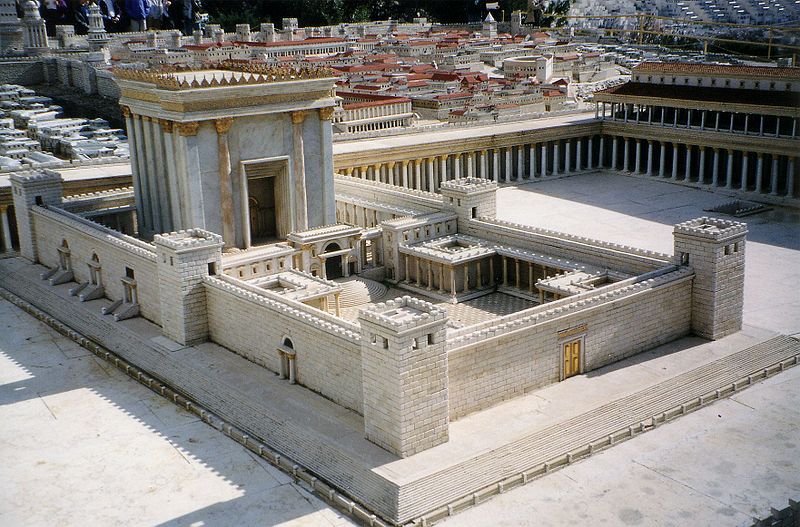
Model of the Second Temple; Source: http://en.wikipedia.org/wiki/File:Jerus-n4i.jpg

Do we know from history that this temple, the same temple the disciples observed, was destroyed? Yes, we do. Josephus, the Jewish historian, for example, records in astounding detail how Jerusalem and the temple were destroyed in 70 AD after a horrendous 5-month siege (see here, here, and here to learn more about what happened). According to both Mark and Luke, the signs that Jesus gave in the next 25 verses (in Luke’s case) and the next 26 verses (in Mark’s case) were to precede the downfall of the temple. In the next couple of posts, we will look at those prophesied signs, which include earthquakes and other calamities. Many today are saying that these same prophesied signs are happening in our own day, and that this means we are only now about to see Jesus’ prophecies fulfilled. How can this be, though, if they were to happen before a prophesied event which we know took place 1,941 years ago?

Only in Matthew’s account do the disciples perhaps appear to ask two additional questions: [1] about Jesus’ coming and [2] about “the end of the age.” For those who believe that Matthew 24 has yet to be fulfilled, it’s often these questions which are said to indicate a required future fulfillment, despite the fact that they don’t even appear in Mark’s and Luke’s parallel accounts. It’s common these days to see a division of questions, as if the disciples asked about the near future as well as the very distant future, but as this study continues we’ll see that it wasn’t so common in earlier church history. Thomas Newton, a well-known English cleric, scholar, and author, said the following in 1754 about this passage:

‘The coming of Christ,’ and ‘the conclusion of the age,’ being therefore only different expressions to denote the same period with the destruction of Jerusalem, the purpose of the question plainly is, when shall the destruction of Jerusalem be, and what shall be the signs of it?

Background to Jesus’ Promised Coming: Matthew 10:23 and 16:27-28

What prompted the disciples to ask about Jesus’ coming, especially in the context of what He said about the temple’s impending destruction? Where had Jesus previously spoken of His coming, and what had He said about this event? Jesus had in fact spoken of His coming twice already in Matthew’s account. In Matthew 10:23, Jesus made this very interesting statement: “When they persecute you in one town, flee to the next, for truly, I say to you, you will not have gone through all the towns of Israel before the Son of Man comes.”[i] During the next couple of decades after Jesus said this, we can see numerous examples of Jesus and His followers doing this very thing (e.g. Matthew 12:14-15, Acts 8:1, Acts 9:23-25, Acts 9:29-30, Acts 14:5-6, Acts 17:4-10, Acts 17:13-14).

In Matthew 16:27-28, He was even more descriptive about what His coming would accomplish, and within what timeframe it would take place: “For the Son of Man is going to come with His angels in the glory of His Father, and then He will repay each person for what he has done. Truly, I say to you, there are some standing here who will not taste death until they see the Son of Man coming in His kingdom.”

If this statement was fulfilled in His transfiguration six days later, as some contend, in what sense did Jesus “come with His angels” then and repay each person according to what he had done (a clear picture of judgment)? We know this didn’t happen on that occasion. We also know that none of His disciples died within those six days, but some were indeed martyred before 70 AD when Jerusalem and the temple were destroyed. To believe that Jesus hasn’t yet (in the year 2011) come back as He promised in this passage is to believe either that [a] He lied or [b] there are 2000 year old men still walking around on this planet.[ii] Let’s look at four aspects of this promised coming, as this should help us to know what was in the minds of Jesus’ disciples when they asked Him about His coming in Matthew 24:3.

1. IN HIS KINGDOM: From this text, we know that one purpose for His coming, which He promised would take place before all of His disciples had died, was to establish His kingdom. This fits perfectly with the following prophecy given to Daniel: “And in the days of those kings* the God of heaven will set up a kingdom that shall never be destroyed, nor shall the kingdom be left to another people” (Daniel 2:44). [*Biblical scholars hold a virtual consensus that the four kingdoms in Daniel’s vision were Babylon, Medo-Persia, Greece, and Rome. Since Rome was destroyed in 476 AD, we know that, for this prophecy to be true, the kingdom was set up before that time.] A first century fulfillment fits; a 21st century fulfillment doesn’t. Furthermore, the kingdom was to be given to the saints (Daniel 7:18, 22, 27). This is reminiscent of Jesus’ words in the Parable of the Tenants that the kingdom of God would soon be taken away from the Jewish leaders and their nation and given instead “to a people producing its fruits” (Matthew 21:43) – a clear description of the body of Christ. This was to happen even as the stone was to crush those who would fall (verse 44) – 1.1 million Jews killed in August/September 70 AD by the Romans would seem to qualify as a fulfillment of this prediction.

2. TO REPAY EACH PERSON: The context of Jesus’ promise to come “to repay each person” for what they had done was His foretelling of His own death and suffering at the hands of the Jewish leaders (Matt. 16:21-23), and also of the suffering that His own disciples could expect (verses 24-26). In other words, it would be for vindication. This is similar in nature to what Paul promised to the Thessalonian believers when he told them that they could expect relief “when the Lord Jesus is revealed from heaven with His mighty angels in flaming fire, inflicting vengeance” (II Thessalonians 1:7), with the purpose being “to repay with affliction those who afflict you” (verse 6). This was imminent in their day, for Paul said that the wrath of God had already come upon the Jewish persecutors (I Thess. 2:14-16). He knew this to be true because Jesus had declared in no uncertain terms (Matthew 23:35-36) that the blood of all the prophets would be required of His own (first century) generation in Israel.

3. WITH HIS ANGELS: Just like Paul’s prophecy to the Thessalonians, Jesus’ promise to come while some of His disciples were still alive (Matt. 16:28) was also to involve His angels (“The Son of Man is going to come with His angels…”). As my good friend, Mark Church, has pointed out, all throughout the book of Revelation we see His angels pouring out judgment upon “the great city” where the Lord was crucified (Revelation 11:8) – that is, Jerusalem, the same city which was marked as a harlot because of its shedding of the blood of the saints and martyrs (Rev. 17:1-6), apostles, and prophets (Rev. 18:20-24). [For those who believe that Revelation remains unfulfilled, is there any modern nation or entity which is responsible for the martyrdom of the apostles?]

4. IN THE GLORY OF HIS FATHER: Jesus also promised to come “in the glory of His Father” (Matt. 16:27). As Don Preston well points out, this can be understood to mean that just as the Father had come in the past, Jesus would also come in the same manner. Don gives as an example Isaiah 64:1-3, where the writer declares that God had “come down” numerous times in the past:

“Oh, that You would rend the heavens and come down, that the mountains might quake at Your presence – as when fire kindles brushwood, and the fire causes water to boil – to make Your name known to Your adversaries, and that the nations might tremble at Your presence! When You did awesome things that we did not look for, You came down, the mountains quaked at Your presence.”

Just as the Father’s comings in times past had not been bodily, visible, or physical in nature, neither would the coming of Jesus in judgment be bodily, visible, or physical. We will discuss this in more depth when we come to Jesus’ predicted coming in the clouds in Matt. 24:30/Mark 13:26/Luke 21:27. We will see that there are numerous examples in the Old Testament where God is said to have come in the clouds in judgment upon various nations and enemies of His people, even examples where the language is remarkably similar to the language used in The Olivet Discourse.

So we can see from these two passages (Matt. 10:23 and 16:27-28) why Jesus’ disciples expected Him to come again in their own lifetimes. We’re also beginning to see why, in Matthew 24:3, they linked this coming to His dark prediction about the temple’s future. Other strong clues also exist in the previous two chapters (Matthew 22-23).[iii] Kevin Daly, from the South African ministry “Messianic Good News,” has this to say:

It is Jesus’ confirmation that the Temple’s fate is sealed that leads to the disciples’ question: ‘When will this happen, and what will be the sign of your coming and of the end of the age?’

Some argue this to be three separate questions – so that Jesus’ answer in the subsequent verses must be unraveled and applied to three different events, namely (i) the temple’s destruction, (ii) his coming and (iii) the end of the age. But this is not supported by the parallel accounts in Mark’s and Luke’s gospels. These render the disciples’ question as follows:

‘Tell us, when will these things happen? And what will be the sign that they are all about to be fulfilled?’ (Mark 13:4)

‘Teacher,’ they asked, ‘when will these things happen? And what will be the sign that they are about to take place?’ (Luke 21:7)

In Matthew’s wording of the disciples’ question, what Jesus prophesied against the Temple would, by implication, happen at our Lord’s coming in judgment and would also, by further implication, bring about the end of that age.

Matthew phrases the question in the prophetic language of the Old Testament, which was familiar to the Jewish audience for which his gospel was written. In this language, the execution of Divine judgment was commonly spoken of as a visitation of the LORD, as either His coming or His coming in the cloud. [Consider] Micah’s prophecy against the ‘high places’ of Judah – being localities of false worship, which the Temple in Jerusalem had now become:

‘For behold, the LORD comes forth from His place, and will come down, and tread upon the high places of the earth. And the mountains shall be melted under Him, and the valleys shall be cleft, as wax before the fire, and as the waters that are poured down a steep place. For the transgression of Jacob is all this, and for the sins of the house of Israel  …  What are the high places of Judah? Are they not Jerusalem?’ (Micah 1:3-5).

Source: Kevin Daly, When Will These Things Happen – Matthew 24 and the Vindication of Messiah. 2009.

Micah’s prophecy was fulfilled in 586 BC when Jerusalem fell to the Babylonian armies. We know that God didn’t physically and bodily come down at that time, but He did still “come down” in judgment in fulfillment of this prophecy. It’s this same apocalyptic language that Matthew uses to speak of another and more final judgment which was about to come once again upon Jerusalem. History tells us that it did come. Some readers may be surprised to know that Jonathan Edwards (1703-1758), who preached the famous sermon “Sinners in the Hands of An Angry God,” once made this statement in his work titled “Miscellany #1199”:

“Tis evident that when Christ speaks of his coming; his being revealed; his coming in his Kingdom; or his Kingdom’s coming; He has respect to his appearing in those great works of his Power Justice and Grace, which should be in the Destruction of Jerusalem and other extraordinary Providences which should attend it [So in Luke 17:20 – 18:8].”

The way that the Olivet Discourse is popularly approached today has Jesus effectively saying this to His disciples: “You guys have asked a very interesting question about when this temple will be destroyed, but let Me ignore your question and tell you instead about some events which will begin and end about 2000 years in the future.” Rather than being about us, and our generation, Jesus addressed the concerns of His disciples regarding their own generation.

THE END OF THE AGE

Having now given considerable space to the question of Christ’s coming, we’ll give only brief space here to the disciples’ question about the end of the age. The King James Version used the expression “the end of the world” in Matthew 24:3, but most newer translations use the expression “the end of the age.” Clearly, Jesus tied the end of the age that they were speaking of to the time of His coming, which we have seen was promised to occur in their own generation.

Therefore, the disciples weren’t asking about the final days of this planet. Their question was about the end of the Old Covenant age. That age came to an end along with the destruction of the temple in 70 AD. This “end” was spoken of by Daniel and other Old Testament prophets. The book of Hebrews even speaks of the Old Covenant “becoming obsolete and growing old…ready to vanish away” (Hebrews 8:13). It vanished along with the temple. We are now in what the New Testament frequently called “the age to come.” A great transition took place a long time ago, and we are privileged to live in the New Covenant age. The heavenly Jerusalem is a present reality for God’s people (Hebrews 12:22-24). Regarding “the end” spoken of in both Matthew and Daniel, Kevin Daly provides this helpful chart:

you will hear of wars and rumours of wars … but the end is not yet

war will continue until the end

and there will be famines and pestilences and earthquakes in different places

and desolations have been decreed

 then the end will come

the end will come like a flood:

 Matthew 24:6,14

Dan 9:26b

“The end” spoken of in Daniel’s prophecy was clearly to be the destruction of “the city and the sanctuary” (Daniel 9:26). We know as an indisputable fact of history that Jerusalem and the temple were destroyed in 70 AD. That brought about the end of an age, the Old Covenant age. It is popularly taught today that we are living in what the Bible calls “the last days,” and that these last days began on the Day of Pentecost because of Peter’s reference to Joel’s prophecy about an outpouring in “the last days.” However, this cannot be true, because Hebrews 1:1-3, Hebrews 9:26, and I Peter 1:18-20 tell us explicitly that Jesus’ incarnational ministry took place in the last days. Therefore, Jesus appeared and ministered in the last days of an age that had clearly begun quite some time before He appeared. That age still had not ended when Paul wrote his epistle to the Corinthian church, but it was drawing even closer to the end, for he told his readers that they were those “on whom the end of the ages has come” (I Corinthians 10:11).

Rather than open this up further, or to try to defend this premise in greater depth here, I’d like to point to an earlier post on this subject which I believe you’ll find to be a good explanation of these things (HERE). You’ll see that the New Testament placed Jesus’ ministry, death, etc. in “the last days” and at “the end of the age,” and that after Jesus’ ascension the apostles still spoke of their time in the same terms. Jerry William Bowers Jr. has also compiled a very informative article, based on David Green’s 101 Time Statements showing that John the Baptist, Jesus, and the early church were not only consistent, but also correct, when they repeatedly stated that certain events were near, at hand, about to take place, etc. That article can be seen (HERE).

In the next post, we will look at the beginning of Jesus’ reply to the disciples’ question about the signs which would lead to the destruction of the temple, His coming, and the end of the age. We will examine Matthew 24:4-14, Mark 13:5-13, and Luke 21:8-18 side-by-side.

———————————————————————————————————————————-

A THOUGHT: Do you find it interesting that John, in his gospel account, omits the Olivet Discourse entirely, even though he was no doubt present when Jesus spoke these things? One likely reason for this curious fact is that the book of Revelation, which he authored, actually functions as his exposition of the Olivet Discourse, though in much greater detail. Therefore, he felt no need to include the Olivet Discourse passage in his gospel account, especially if the book of John was written after the book of Revelation.

QUOTES TO NOTE

Eusebius (314 AD): “If any one compares the words of our Saviour with the other accounts of the historian (Josephus) concerning the whole war, how can one fail to wonder, and to admit that the foreknowledge and the prophecy of our Saviour were truly divine and marvelously strange” (Proof of the GospelBook III, Ch. VII).

John Wesley (1703-1791): “Josephus’ History of the Jewish War is the best commentary on this chapter (Matt. 24). It is a wonderful instance of God’s providence, that he, an eyewitness, and one who lived and died a Jew, should, especially in so extraordinary a manner, be preserved, to transmit to us a collection of important facts, which so exactly illustrate this glorious prophecy, in almost every circumstance” (Explanatory Notes Upon the New Testament, 1754).

——————————————————————————————————————————————————————————————-


[i] John Wesley (1703-1791) is one of many in church history who taught that Jesus was referring in Matt. 10:23 to a judgment coming in 70 AD in which He would “destroy their temple and nation” (John Wesley, Explanatory Notes Upon the New Testament, 1754).

[ii] John Wesley, again, is one of many in church history who taught a 70 AD fulfillment of Matthew 16:27-28, saying, “For there is no way to escape the righteous judgment of God. And, as an emblem of this, there are some here who shall live to see the Messiah coming to set up His mediatorial kingdom with great power and glory, by the destruction of the temple, city, and polity of the Jews” (John Wesley, Explanatory Notes Upon the New Testament, 1754). Some believe this is also identical to the prophecy Jesus gave in Revelation 22:12, revealing why John’s 1st century audience was to understand that He was about to come: “Behold, I am coming soon, bringing My recompense with Me, to repay everyone for what he has done.”

[iii] In Matthew 22:1-14 we read the Parable of the Wedding Feast. In this parable, speaking of the kingdom of heaven (vs. 2), a king (God) was to prepare a wedding feast for his son (Jesus), but those who were originally invited (the Jewish nation) refused to come (vss. 3-5) and even killed the king’s servants who had invited them (v. 6). Therefore, these murderers were destroyed (cf. Matthew 23:29-38; Rev. 16:4-7, 17:6, 18:20, 18:24), and their city was burned (cf. Rev. 18:8-10, 18; 19:3). This is precisely what we see having happened in Jerusalem’s destruction and burning in 70 AD. The invitation then goes out to others (Gentiles as well as Jews; vss. 9-10), but only those with proper wedding garments were allowed to remain (vss. 10-14; cf. Rev. 19:8). Those who lacked these garments remained in outer darkness and were not part of the chosen people of God (vss. 13-14; cf. Matt. 8:11-12).

In Matthew 23:29-38, we see that in the 7th woe pronounced upon the Scribes and Pharisees, Jesus charges them with shedding the blood of all the prophets (vss. 29-31). He even says that they will kill, crucify, flog, and persecute others from town to town (verse 34). As a result, He says, they would be held responsible for all the shed blood from generations past up until their own generation. He concludes, “Truly, I say to you, all these things will come upon this generation” (verse 36). He then lifts up a lament for Jerusalem, whose house, He said, was left to them desolate. This would naturally remind His listeners of Daniel 9:26, where it was said that “the city and the sanctuary” would be destroyed, with desolations decreed. The expected timeframe for this judgment was “this generation” (Jesus’ first century audience).

No Alienation from the Commonwealth of Israel


(Thoughts on Ephesians 2:12)

Paul’s letter to the Ephesians is a remarkable book, one that is full of wonderful expressions of truth. In the first three chapters Paul lays out, in glorious fashion, the riches of the grace we have in Christ. His adoration for the gospel just keeps spilling out, and he even gets long-winded (in a good way) as he does so. Take a look at some of his gospel-saturated, lengthy sentences which span several verses at a time (e.g. 1:7-10, 1:15-21, 3:14-19). Some of the most magnificent portrayals of the New Covenant are found in this book.

With this in mind, it’s amazing to consider that today there is a popular teaching insisting that the New Covenant which Paul describes here in Ephesians and elsewhere is NOT the same New Covenant which was foreseen by the Old Testament prophets (e.g. Jeremiah 31:31-34, Ezekiel 36:26-27). This is despite the fact that the author of Hebrews quotes from Jeremiah’s prophecy and explicitly states (Hebrews 8:6-13) that this New Covenant had been established in his own time (i.e. in the first century AD). The “problem” seems to be that Jeremiah and Ezekiel addressed their prophecies to “the house of Israel.” Dispensationalism and Christian Zionism are notoriously unwilling to acknowledge that the Church IS spiritual Israel, and their proponents often have harsh words for those who believe this. Shortly we will see that Ephesians 2:12, being just one such example in the New Testament, does not allow their position to stand.

[Please bear with this brief explanation before we get back to looking at Ephesians. Prior to Progressive Dispensationalism taking root in western Christianity within the last few decades, Classic Dispensationalists like H.A. Ironside, Charles Ryrie, Dwight Pentecost, and John Walvoord claimed that the Old Testament never foresaw the coming of the Church age, and that God will one day bring an end to the Church age and resume His program with national/ethnic Israel. This was the teaching of John Nelson Darby, who founded this theological system in the 1830’s, and of C.I. Scofield, who published his famous reference Bible in 1909. These men and others also taught (or teach) that the New Covenant is reserved for a future millennium period! Consider the following statements regarding Jeremiah’s prophecy of a coming New Covenant:

[1] “This covenant must follow the return of Christ at the [yet future] second advent… This covenant will be realized in the [yet future] millennial age… the new covenant of Jeremiah 31:31-34 must and can be fulfilled only by the nation Israel and not by the Church” (Dwight Pentecost, Things to Come, 1958).

[2] “…the new covenant is with Israel and the fulfillment [will be] in the millennial kingdom after the second coming of Christ… the new covenant as revealed in the Old Testament concerns Israel and requires fulfillment in the millennium kingdom” (John F. Walvoord, The Millennial Kingdom, 1959).

[3] “The Church, then, is not under the new covenant…it is Israel which is God’s covenant people” (Harry Ironside, Notes on the Prophecy of and Lamentations of Jeremiah, 1906).

One proposed solution by more recent Progressive Dispensationalists is that there are two new covenants (!) in Scripture, one for the Church (now) and one for national/ethnic Israel (later). This belief seems to be true for those who would affirm that the Church presently lives in the New Covenant (and experiences the taking away of sin), but who also assert that Romans 11:26-27 (“And in this way all Israel will be saved…and this will be My covenant with them when I take away their sins”) will only be fulfilled in the future for ethnic Jews. This belief doesn’t stand up either, as we will see. For a much fuller treatment of the implications of this facet of Dispensationalist teaching, please see the first half of this post from our series on Revelation 20.]

Having expressed these thoughts, let’s now look at a very pivotal section in Ephesians 2, verses 11-22. I don’t want to take anything away from the very valuable things Paul expresses earlier in this chapter, and in fact verse 11 begins with “therefore,” meaning that what Paul says next is based on what he has just said earlier. So here’s a quick summary of the first half of the chapter: Paul reminds the believers in Ephesus that they were once dead in their sins (verses 1-3), but that God in His mercy and love had made them alive in Christ (verses 4-5). They are now seated with God in Christ in heavenly places (verses 6-7). It was not by any works of their own that they were saved, but only by grace through faith. Their salvation was a gift from God, and they were created anew for the purpose of walking in good works (verses 8-10). With this as context, here’s what Paul says in verses 11-22:

11Therefore remember that at one time you Gentiles in the flesh, called “the uncircumcision” by what is called the circumcision, which is made in the flesh by hands— 12remember that you were at that time separated from Christ, alienated from the commonwealth of Israel and strangers to the covenants of promise, having no hope and without God in the world. 13But now in Christ Jesus you who once werefar off have been brought near by the blood of Christ. 14For He himself is our peace, who has made us both one and has broken down in His flesh the dividing wall of hostility 15by abolishing the law of commandments expressed in ordinances, that He might create in himself one new man in place of the two, so making peace, 16and might reconcile us both to God in one body through the cross, thereby killing the hostility. 17And He came and preached peace to you who were far off and peace to those who were near. 18Forthrough Him we both have access in one Spirit to the Father. 19So then you are no longer strangers and aliens, but you are fellow citizens with the saints and members of the household of God20 built on the foundation of the apostles and prophets, Christ Jesus himself being the cornerstone, 21 in whom the whole structure, being joined together, grows into a holy temple in the Lord. 22In Him you also are being built together into a dwelling place for God by the Spirit.

It would certainly be profitable to break this passage down verse-by-verse, and there are so many rich truths here, but I’d like to mainly zero in on verse 12 which is highlighted above. First, we should note that Paul is specifically addressing Gentile believers (verse 11), that is, non-Jewish followers of Christ. One of his reminders to them is that they were once “alienated from the commonwealth of Israel.” By speaking this way, Paul clearly indicates that they are now part of “the commonwealth of Israel.”

There is simply no getting around the idea that Gentile (non-Jewish) believers are part of God’s people, Israel, here in Ephesians 2:12. And make no mistake about it, Jewish believers are part of this same covenant people of God, but no more so and no less so: “For there is no difference between Jew and Gentile—the same Lord is Lord of all and richly blesses all who call on Him” (Romans 10:12); “There is neither Jew nor Greek, there is neither slave nor free, there is no male and female, for you are all one in Christ Jesus” (Galatians 3:28). There are no spiritual blessings which are available for males but not for females, nor are there any spiritual blessings which are available for Jews but not for non-Jews. Does Scripture leave us any room to believe that a future age will come along and change this reality? No, it does not.

In Ephesians 2:12 Paul also reminds His believing Gentile audience that they were once “strangers to the covenants of promise.” Again, by speaking this way, Paul clearly indicates that they are now recipients ofthe covenants of promise” which were made to Israel. In the next chapter, Paul explicitly defines the mystery of Christ (which had been kept hidden in generations past) as the joining together of Jewish and non-Jewish believers in the partaking of the promise in Christ through the gospel: “This mystery is that the Gentiles are fellow heirs, members of the same body, and partakers of the promise in Christ Jesus through the gospel” (Eph. 3:6). In Galatians 3 Paul likewise declares that all the promises were made to Abraham and his offspring. He then defines Abraham’s “offspring,” contrary to what many might expect, as singularly Christ (Gal. 3:16). He finally adds that those who belong to Christ—with zero regard for ethnicity, gender, or status (Gal. 3:28)—are heirs of those promises (Gal. 3:29). So Paul says here in Ephesians 2 exactly what he also says in Galatians 3.

With these things established, can it be possible that any Old Testament covenants or promises are yet to be fulfilled for ethnic Jews only? Can Jeremiah 31:31-34 and Ezekiel 36:26-27 (which promised a coming New Covenant) be awaiting a fulfillment which Gentile believers will have no part in? No. Such an idea does great violence to all that Paul argues in Galatians, Ephesians, and elsewhere. Those who are still looking for such a covenant to arrive are about 2000 years too late, and far too narrow in their view of to whom this covenant belongs. The New Covenant is already here, and the heavenly Jerusalem is already a reality for God’s people (Hebrews 12:22-24).

I also highlighted Ephesians 2:19 because Paul refers to the Church as “the household of God,” very similar to the way he calls the Church “the household of faith” in Galatians 6:10. It would seem that these phrases are a New Testament equivalent to the oft-used expression in the Old Testament, “the household of Israel,” used by both Jeremiah and Ezekiel as we have seen. As mentioned near the beginning of this post, it seems that Dispensationalists and Christian Zionists tend to trip up over the Old Testament phrase, “the household of Israel,” because they are somehow convinced that the promises made to ancient Israel must only be fulfilled among their physical descendants.

However, we must let Scripture interpret Scripture. First, how often did Jesus and the apostles make the point that being able to physically trace one’s self to Abraham means nothing? Observe what Jesus said in John 8 to the Jews of His day who appealed to Abraham as their father, and observe whom Jesus said was their father instead. Observe what Paul says in Romans 9:6-8, “…For not all who are descended from Israel belong to Israel, and not all are children of Abraham because they are his offspring… This means that it is not the children of the flesh who are the children of God, but the children of the promise are counted as offspring.” Here Paul equates being a part of Israel with being a child of God. In this New Covenant age, then, can you be a child of God and not be a part of Israel? (Of course, I’m not referring to that nation in the Middle East which happens to bear this same name. By “Israel,” I mean God’s covenant people.) In Romans 2:28-29, Paul further says that “no one is a Jew who is merely one outwardly…a Jew is one inwardly, and circumcision is a matter of the heart…” In Galatians 6:15-16, Paul declares that only a new creation counts for anything, and then pronounces peace and mercy upon “the Israel of God.” If, despite the evidence above, you are one of the many who believe that Paul’s use of this phrase, “the Israel of God,” must refer only to Jewish believers, please examine this very well-written and informative article by Michael Marlowe.

Secondly, an honest appraisal of the New Testament will show that the inspired writers of the NT clearly apply many specific promises once made to ancient Israel to the Church, the body of Christ. Shall we rebuke them for promoting the allegedly false teachings of “replacement theology”? As we have seen above, the NT authors also declare that the Church is no longer alienated from ANY of the promises and covenants, because they are recipients of ALL of them. They are all found in Christ, but they are not to be found outside of Christ. Again, Jews are not left out, for a remnant from among them would call out to the Lord and be saved (they have done so throughout the last 2000 years). Paul makes this clear (see Romans 11:1-6, where he uses himself as an example).

Let’s look again at what Ephesians 2:12 says: “[R]emember that you were at that time separated from Christ, alienated from the commonwealth of Israel and strangers to the covenants of promise.” What is “the commonwealth of Israel”? What is it not? As we consider how we are not alienated from this entity, if we try to replace this phrase with “national Israel” or “ethnic Jews,” we’ll see that this doesn’t work. If you are a non-Jew (ethnically speaking), can you say that because of Christ you are now fully integrated into the political nation of Israel? Or can you say that you are very much a part of the worldwide ethnic Jewish community? No, but I believe you’ll find that this explanation given by Albert Barnes in 1834 makes sense:

Being aliens from the commonwealth of Israel – …This means more than that they were not Jews. It means that they were strangers to that ‘polity’ …or arrangement by which the worship of the true God had been kept up in the world, and of course were strangers to the true religion. The arrangements for the public worship of Yahweh were made among the Jews. They had his law, his temple, his sabbaths, and the ordinances of his religion; see the notes at Romans 3:2… The word rendered here as ‘commonwealth’ – πολιτεία politeia – means properly ‘citizenship,’ or ‘the right of citizenship,’ and then ‘a community,’ or ‘state.’ It means here ‘that arrangement or organization by which the worship of the true God was maintained.’”

Indeed, Paul says this of his own “kinsmen according to the flesh” (Romans 9:3),

They are Israelites, and to them belong the adoption, the glory, the covenants, the giving of the law, the worship, and the promises. To them belong the patriarchs, and from their race, according to the flesh, is the Christ who is God over all, blessed forever. Amen” (Romans 9:4-5).

Paul, who agonized over his own people so much that he could have wished himself “accursed and cut off from Christ” (verse 3) for their sake, yet affirms to the Gentile believers in Ephesus that they were present heirs of all the promises and covenants which were articulated to the commonwealth of Israel in times past. All alienation had ceased. It hasn’t resumed since then, it hasn’t resumed in our day, and it won’t resume in the future. It’s gone because of the work of the cross, and that alienation is gone forever. Please don’t let anyone tell you otherwise. If you are a follower of Christ, it doesn’t matter what your ethnic background is. You are a full-fledged member of the commonwealth of Israel, and all of God’s promises are yours through Jesus Christ.

Prioritizing God’s Kingdom Is An Antidote to Anxiety


(A Study of Matthew 6:25-34)

This blog was started back in August 2009 when our Bible study group decided to post our studies on the book of Revelation, for the purpose of being able to reference them long-term and also to be a blessing to others. Since completing our study of Revelation, the blog has expanded somewhat, although we are no longer posting our weekly Bible studies online. We’ve gone on to study several New Testament epistles, and we are now in Matthew.

I’d like to make an exception by looking at a portion from Matthew 6 which we studied on Wednesday night (April 13th). This chapter is at the heart of Jesus’ most famous message, the Sermon on the Mount. In this portion, Jesus addresses the subject of anxiety. This text really spoke to my soul because for the last six months (exactly 6 months, actually) I’ve had far more reason to be anxious, worried, hurt, fearful, angry, etc. than I have at any other time in my life. Most who read this will have no idea what’s going on in my life, and that’s OK – although if this is enough information to compel you to pray I won’t turn you down. In any case, I believe we will see that as Jesus brings this subject to a conclusion, He not only urges us to prioritize His kingdom above all else, but He sets this forth as a perfect antidote to the anxiety which would like to take a prominent place in our lives. Let’s look at what He has to say, and feel free to share your own thoughts on how His words speak to you in the comment section below.

Verse 25: Therefore I tell you, do not worry about your life, what you will eat or drink; or about your body, what you will wear. Is not life more than food, and the body more than clothes?”

The word “therefore” refers back to the previous section on money, where Jesus gives this sober warning about attempting to maintain a divided loyalty: “No one can serve two masters. Either you will hate the one and love the other, or you will be devoted to the one and despise the other. You cannot serve both God and money.” If the pursuit of wealth, and the laying up of perishable earthly treasures (verse 19), can lead to idolatry and distraction in our lives, so can worry and anxiety over the things we want and need in life.

What we eat, drink, and wear are some of the basics of life, but these decisions can cause anxiety if we let them. This cuts to the heart of where our trust lies. Can we trust God for basic provision? If not, what does this say about our capacity to trust Him when life’s circumstances become most unbearable? We can walk in our divinely-ordained callings in life all the more if we’re not weighed down by such concerns.

Verse 26: Look at the birds of the air; they do not sow or reap or store away in barns, and yet your heavenly Father feeds them. Are you not much more valuable than they?”

Jesus poses this as a question, but clearly we are meant to understand that we are of more value in His sight than the birds. If God faithfully takes care of and provides for them, how much more will He do so for His people? This is not, of course, an excuse to intentionally avoid work.

Verse 27: Can any one of you by worrying add a single hour to your life?”

Jesus speaks to the folly of being filled with worry, which likely springs from a lack of trust. Increased anxiety can actually shorten our lives, or at least lessen the quality of life. We also often worry about negative outcomes which don’t materialize. Such worry ends up being a complete waste of our energy, time, and focus. Any and all worry works to keep us from the more important things in life. Trusting in God rather than ourselves requires humility.

Verses 28-30: And why do you worry about clothes? See how the flowers of the field grow. They do not labor or spin. Yet I tell you that not even Solomon in all his splendor was dressed like one of these. If that is how God clothes the grass of the field, which is here today and tomorrow is thrown into the fire, will He not much more clothe you—you of little faith?”

These verses don’t appear to speak directly to the issue of vanity or showing off to others, but rather a person’s worry about being able to afford the basic clothes that they or their family members might need. Just as the birds don’t obtain their provision through their own striving, the flowers of the field don’t obtain their beauty through their own toil. God takes care of them, and they need God to take care of them. It would seem that the materially rich don’t need to worry about being able to afford clothing (or food/drinks/other basics), but they might miss out on the blessings of being in a position where one needs to depend on God in faith for regular provision.

Verses 31:32: So do not worry, saying, ‘What shall we eat?’ or ‘What shall we drink?’ or ‘What shall we wear?’ For the pagans run after all these things, and your heavenly Father knows that you need them.”

When we fret, especially about basic needs, we begin to behave as if we don’t belong to God and as if we don’t need Him. Unbelievers lack a regard for God, and one of the ways this disregard is demonstrated is through trusting in themselves rather than in Him. As those who do know God, there is no reason why we should mirror those who don’t by the way that we carry on in our everyday lives. God’s people should be distinct from the ways of the world. At the same time, God acknowledges that we do need these basic things.

Verse 33: But seek first His kingdom and His righteousness, and all these things will be given to you as well.”

The key to avoiding anxiety is to prioritize the kingdom of God. It’s more about what we pursue (“the kingdom of God and His righteousness”) than what we avoid (anxiety over the basics of life). Being that this is true concerning anxiety over what is basic, it’s also true when it comes to heavier issues which may appear in our lives. Even the most devastating of circumstances can fade as concerns if we are in passionate pursuit of His kingdom. Losses that we may suffer during our short time on this earth need not strike us with such devastating force if we hold loosely to what is of this world, and we hold tightly to God’s kingdom, which cannot be shaken (Hebrews 12:18-28, esp. vss. 27-28).

From verses 9-10 we see that God’s kingdom involves His honor and fame, His reign, and His will, along with a desire that these aspects of His kingdom become true where we live just as they are already true in heaven. We’re promised that the very things we’re urged not to fret over (provision of food, drinks, clothing, and the like) will come naturally to us when we prioritize God’s kingdom and His righteousness. At this point I’ll ask, but not answer, a somewhat difficult question: How do we reconcile this promise with the fact that there are faithful believers who pursue God’s kingdom and His righteousness, who also endure significant stretches of their lives lacking food and other basic comforts (perhaps or perhaps not as a result of persecution)?

Verse 34: Therefore do not worry about tomorrow, for tomorrow will worry about itself. Each day has enough trouble of its own.”

What does it mean to say that “tomorrow will be anxious for itself”? As mentioned already, sometimes when we anticipate troubles, they don’t materialize. Even if that trouble does materialize, worrying about it in advance won’t be profitable. Each day God is more than able to provide the grace that we need for what we will face that day.

The book of Lamentations was written at an extremely low point in Israel’s history, during the aftermath of Babylon’s destructive invasion of Israel in 586 BC. In the midst of great tragedy, sorrow, and suffering, the author writes, “The steadfast love of the Lord never ceases; His mercies never come to an end; they are new every morning; great is Your faithfulness. ‘The Lord is my portion,’ says my soul, ‘therefore I will hope in Him’” (Lam. 3:22-24).

The Story of David and Svea Flood


Yesterday I came across a fantastic story at Truthspeaker’s Blog about a Swedish missionary couple who had a seemingly fruitless ministry to Africa nearly 100 years ago. Crying is something I don’t do often enough, but this story made me cry. “Truthspeaker” introduced the story in this way:

The following story is true and encourages us that God has a purpose for everything He allows in our lives.   We are not to despise the day of small beginnings! The full story can be found in “Aggie; A Girl Without a Country” (previously published under the title, “One Witness”), written by Aggie Hurst.
What follows is a story that is both heartbreaking and inspiring at the same time. It’s a tremendous testimony of what God can do “behind the scenes,” things of which we are not always aware:

In 1921, a missionary couple named David and Svea Flood went with their two-year-old son David, from Sweden to the heart of Africa—to what was then called the Belgian Congo. They met up with another young Scandinavian couple, the Ericksons, and the four of them sought God for direction. In those days of much tenderness and devotion and sacrifice, they felt led of the Lord to go out from the main mission station and take the gospel to a remote area.

This was a huge step of faith. At the remote village of N’dolera they were rebuffed by the chief, who would not let them enter his village for fear of alienating the local gods. The two couples opted to go half a mile up the slope and build their own mud huts.

They prayed for a spiritual breakthrough, but there was none. Their only contact with the villagers was a young boy, who was allowed to sell them chickens and eggs twice a week. Svea Flood — a tiny woman missionary only four feet, eight inches tall, decided that if this was the only African she could talk to, she would try to lead the boy to Jesus. And in fact, after many weeks of loving and witnessing to him, he trusted Christ as his Savior.

But there were no other encouragements. Meanwhile, malaria continued to strike one member of the little band after another. In time the Ericksons decided they had had enough suffering and left to return to the central mission station. David and Svea Flood remained near N’dolera to go on alone.

Then, of all things, Svea found herself pregnant in the middle of the primitive wilderness. When the time came for her to give birth (1923), the village chief softened enough to allow a midwife to help her. A little girl was born, whom they named Aina (A-ee-nah).

The delivery, however, was exhausting, and Svea Flood was already weak from bouts of malaria. The birth process was a heavy blow to her stamina. After seventeen desperate days of prayer and struggle, she died.

Inside David Flood, something snapped in that moment. His heart full of bitterness, he dug a crude grave, buried his twenty-seven-year-old wife and took his children back down the mountain to the mission station. Giving his newborn daughter to the Ericksons, he said, “I’m going back to Sweden. I’ve lost my wife, and I can’t take care of this baby. God has ruined my life.” With two year old David, he headed for the coast, rejecting not only his calling, but God himself.

Within eight months both the Ericksons were stricken with a mysterious illness (some believe they were poisoned by a local chief who hated the missionaries) and died within days of each other. The nine month old baby Aina was given to an American missionary couple named Berg, who adjusted her Swedish name to “Aggie” and eventually brought her back to the United States at age three.

The Bergs loved little Aggie but were afraid that if they tried to return to Africa, some legal obstacle might separate her from them since they had at that time, been unable to legally adopt her. So they decided to stay in the United States and switch from missionary work to pastoral ministry. And that is how Aggie grew up in South Dakota. As a young woman, she attended North Central Bible college in Minneapolis. There she met and married a young preacher named Dewey Hurst.

Years passed. The Hursts enjoyed a fruitful ministry. Aggie gave birth first to a daughter, then a son. In time her husband became president of a Christian college in the Seattle area, and Aggie was intrigued to find so much Scandinavian heritage there.

One day around 1963, a Swedish religious magazine appeared in her mailbox. She had no idea who sent it, and of course she couldn’t read the words. But as she turned the pages, all of a sudden a photo stopped her cold. There in a primitive setting in the heart of Africa was a grave with a white cross and on the cross was her mother’s name, SVEA FLOOD.

Aggie jumped in her car and drove straight to a college faculty member who, she knew, could translate the article. “What does this say?” she asked.

The instructor translated the story:

It tells about missionaries who went to N’dolera in the heart of the Belgian Congo in 1921… the birth of a white baby girl… the death of the young missionary mother… the one little African boy who had been led to Christ… and how, after the all whites had left, the little African boy grew up and persuaded the chief to let him build a school in the village.

The article told how that gradually the now grown up boy won all his students to Christ… the children led their parents to Christ… even the chief had become a Christian. Today (1963) there were six hundred Christian believers in that one village.

Because of the willingness of David and Svea Flood to answer God’s call to Africa, because they endured so much but were still faithful to witness and lead one little boy to trust Jesus, God had saved six hundred people. And the little boy, as a grown man, became head of the Pentacostal Church and leader of 110,000 Christians in Zaire (formerly the Belgian Congo).

At the time Svea Flood died, it appeared, to human reason, that God had led the young couple to Africa, only to desert them in their time of deepest need. It would be forty years before God’s amazing grace and His real plan for the village of N’dolera would be known.

For Rev. Dewey and Aggie Hurst’s twenty-fifth wedding anniversary, the college presented them with the gift of a vacation to Sweden. There Aggie met her biological father. An old man now, David Flood had remarried, fathered four more children, and generally dissipated his life with alcohol. He had recently suffered a stroke. Still bitter, he had one rule in his family: “Never mention the name of God because God took everything from me.”

After an emotional reunion with her half brothers and half sister, Aggie brought up the subject of seeing her father. The others hesitated. “You can talk to him,” they replied, “even though he’s very ill now. But you need to know that whenever he hears the name of God, he flies into a rage.”

Aggie could not be deterred. She walked into the squalid apartment, with liquor bottles everywhere, and approached the seventy-three-year-old man lying in a rumpled bed.

“Papa?” she said tentatively.

He turned and began to cry. “Aina,” he said, “I never meant to give you away.”

“It’s all right Papa,” she replied, taking him gently in her arms. “God took care of me.”

The man instantly stiffened. The tears stopped.

“God forgot all of us. Our lives have been like this because of Him.” He turned his face back to the wall.

Aggie stroked his face and then continued, undaunted.

“Papa, I’ve got a little story to tell you, and it’s a true one.

You didn’t go to Africa in vain. Mama didn’t die in vain.

The little boy you both won to the Lord grew up to win that whole village to Jesus Christ. The one seed you planted just kept growing and growing. Today (about 1964) there are six hundred African people serving the Lord because you and Momma were faithful to the call of God on your life.”

“Papa, Jesus loves you. He has never hated you.”

The old man turned back to look into his daughter’s eyes. His body relaxed. He began to talk. And by the end of the afternoon, he had come back to the God he had resented for so many decades.

Over the next few days, father and daughter enjoyed warm moments together. Aggie and her husband soon had to return to America—and within a few weeks, David Flood had gone into eternity.

A few years later, the Hursts were attending a high-level evangelism conference in London, England, where a report was given from the nation of Zaire (the former Belgian Congo). The superintendent of the national church, representing some 110,000 baptized believers, spoke eloquently of the gospel’s spread in his nation. Aggie could not help going up afterward to ask him if he had ever heard of David and Svea Flood. “I am their daughter.”

The man began to weep. “Yes, madam,” the man replied in French, his words then being translated into English.

“It was Svea Flood who led me to Jesus Christ. I was the boy who brought food to your parents before you were born. In fact, to this day your mother’s grave and her memory are honored by all of us.”

He embraced her in a long, sobbing hug. Then he continued, “You must come to Africa to see, because your mother is the most famous person in our history.”

In time that is exactly what Aggie Hurst and her husband did. They were welcomed by cheering throngs of villagers. She even met the man who so many years before, when she was less than a month old, had been hired by her father to carry her down the mountain in a soft bark hammock.

The most dramatic moment, of course, was when the pastor escorted Aggie to see her mother’s grave, marked with a white cross, for herself. She knelt in the soil of Africa, the place of her birth, to pray and give thanks. Later that day, in the church service, the pastor read from John 12:24:

“I tell you the truth, unless a kernel of wheat falls to the ground and dies, it remains only a single seed. But if it dies, it produces many seeds.”

He then followed with Psalm 126:5: “They who sow in tears shall reap in joy.”

(An excerpt from Aggie Hurst, Aggie: The Inspiring Story of A Girl Without A Country [Springfield, MO: Gospel Publishing House, 1986].)

Source: http://truthspeaker.wordpress.com/2011/02/03/david-and-svea-flood/

Dismembering an Idol (The Story of Zacchaeus)


by Adam Maarschalk (December 7, 2010)

A few months ago I began receiving monthly ministry updates from Desiring God Ministries (DGM), a ministry under the oversight of Pastor John Piper of Bethlehem Baptist Church here in Minneapolis. I thought the write-up in November was especially good and valuable, and I’d like to share it here. It was written by Jon Bloom, the Executive Director of DGM. Bloom tells the story of Zacchaeus’ change of heart and fruit-bearing repentance in captivating form:

In Luke 19, Zacchaeus the tax collector was converted. He vowed to give back fourfold to anyone he had defrauded. Imagine a conversation he might have had when returning the money.

*          *          *

“Dad, there’s a man at the door. He said his name is Zacchaeus.”

“Zacchaeus!” Judah’s face flushed with sudden anger. “What does he want?” Under his breath he muttered, “The little vermin.” His young daughter didn’t need to hear that.

“I don’t know.”

Judah moved brusquely past his daughter, clenching his jaw. If the little weasel even hints at more money, I swear… a thunderstorm of violent thoughts broke in his mind.

When he saw Zacchaeus he exploded, “WHAT?” Zacchaeus reeled slightly from the verbal blow.

“I’m here to return something to you, Judah.”

“What do you mean?” The words sounded more like “Get out of my sight!”

Zacchaeus held out a small moneybag. Judah was suspiciously confused. This man had robbed half of Jericho collecting taxes for Tiberius. No one was more conniving and slippery with words. Fearing some kind of set-up, Judah didn’t move.

“What are you doing, Zacchaeus?” The cynicism hissed through Judah’s teeth.

“I’m dismembering my idol.”

Judah’s fiery glare turned to stony bewilderment. “What are you talking about?”

“Judah, I know how strange this must sound. And you have every reason not to trust me. I’m here because I’ve defrauded you. I’ve charged you more taxes than Rome required and kept them for my wicked little self. I know that you and everyone else knows that. But now I’ve come to ask your forgiveness for sinning against you like that, and to make restitution. That’s what’s in this bag.”

Zacchaeus held it out again. This time Judah tentatively took it. He looked inside. “There’s a lot in here. It’s got to be more than you overcharged me.”

“Yes. It’s four times what I overcharged you. I’ve got all the records, you know.” Zacchaeus smiled.

“Why are you giving me four times what you owe me?” Judah’s distrust was not dispelled.

“I’m keeping a vow. I promised Jesus that I would repay everyone I defrauded fourfold.”

“You mean the Rabbi Jesus? You know him?”

“I do now. He’s in town, as you know. And the other day I wanted to get a glimpse of him. But being, ah, short-legged, I figured the only way I’d see him was from a tree! Wouldn’t you know, as Jesus passes by he stops, looks up at silly me in the sycamore and says, ‘Zacchaeus, hurry and come down, for I must stay at your house today.'”

Judah gave him a puzzled look.

Zacchaeus said, “I know, I know! I was as shocked as anyone! How did he know my name, right? So Jesus and his disciples come to my house and in a matter of minutes my world falls apart and comes together.”

“Falls apart and comes together.”

“Judah, when I was a boy I was in awe of what I thought money did for people. It seemed to open all the doors to power and pleasure. So I vowed to myself that whatever it took I was going to be rich. And I kept that vow. Back then I had no idea how empty being rich would be. But up till two days ago, I figured it was still better than the alternative.

“But as I sat in my home with Jesus and his disciples, who have nothing, nothing but God—Judah, I’ve never seen happier people in my life! And as Jesus spoke, it was like his words were alive. My heart burned with a longing for God I had never felt before! And a deep shame that I traded him for money.

“Then it hit me like a cedar beam: I’m poor, not rich! They had God; I had a dead idol: money. They were rich; I was no more than a beggar. They were free. But the only doors money ever opened for me led to dungeons. My world, as I had known it, fell apart.

“And there sat Jesus, looking at me as if he could read me like a scroll. Everything in me just wanted to follow him. I wanted the forgiveness and salvation he’s been preaching about. For the first time in my life I wanted God more than… anything! Suddenly, it was like life never made more sense. Before I knew it I was on my feet vowing in front of everyone that, well, that I would dismember my idol.”

“Give away your money.”

“Right. Well, some of it is your money.”

This time Judah smiled.

Later, Judah’s wife found him staring at a small moneybag on the table.

“What’s that?”

“A tax refund.”

“A what?

“I think we need to go hear Rabbi Jesus.”

“Rabbi Jesus? Why?”

“I think we’re poor.”

*          *          *

Some of our idols need to be dismembered for us to be free of them. Jesus knows what they are and how to help us see them. It may feel like we are losing our world to lose them. That’s okay. Jesus said, “whoever would save his life will lose it, but whoever loses his life for my sake will find it” (Matthew 16:25).

“He is no fool who gives what he cannot keep to gain that which he cannot lose” (Jim Elliot, October 28, 1949).

Source: http://www.desiringgod.org/blog/posts/dismembering-an-idol

Reading this, I’m also reminded of Jesus’ sobering and hard-hitting words to the Church in Laodicea:

For you say, ‘I am rich, I have prospered, and I need nothing,’ not realizing that you are wretched, pitiable, poor, blind, and naked. I counsel you to buy from Me gold refined by fire, so that you may be rich, and white garments so that you may clothe yourself and the shame of your nakedness may not be seen, and salve to anoint your eyes, so that you may see. Those whom I love, I reprove and discipline, so be zealous and repent” (Revelation 3:17-19).

[For some historical background on this passage, feel free to see our study of Revelation 3 here, and scroll down about halfway to the section on Laodicia.] To one degree or another, we are all in need of being able to spiritually see more clearly. May pride and self-righteousness not stand in the way and give us the distorted idea that we are in need of nothing. May we also recognize and welcome His discipline, for it’s a mark of His love toward us. Here you can watch and listen to a group of youth (from the Shepherd of the Valley Lutheran Church in Beaverton, Oregon) singing the classic song “The Blind Man”:

I also appreciate this version of the same song sung by an Indian brother living in the UK:

In the mail-out version of Jon Bloom’s letter, he appropriately closed with these words:

“Our featured sermon for November is titled, ‘The Radical Cost of Following Jesus.’ In it John Piper says, ‘Jesus knows everyone’s idol. Jesus knows perfectly what is competing in your heart with affection for Him.’ This is really good news. Because when Jesus asks us to dismember our idols, He’s really offering us fullness of joy and pleasures forever (Psalm 16:11).

Psalm 33:12 and God’s Chosen Nation


Psalm 33:12 and God’s Chosen Nation

by Adam Maarschalk (December 3, 2010)

Psalm 33:12 is a familiar verse to many people. In the United States, it’s often cited in patriotic sermons or at political events along with a declaration that the US is a Christian nation. This is how the verse reads (see here for its context):

Blessed is the nation whose God is the Lord, the people whom He has chosen as His heritage!”

When studying Scripture, it’s important to consider the original intent of the author—as he was inspired by the Holy Spirit—and who was in his original audience (a study method known as “exegesis”). It’s also good to then consider the meaning and application of a given text to one’s own life and time (known as “hermeneutics”). With this in mind, and given your overall knowledge of Scripture, which of these combinations do you believe to be correct for Psalm 33:12?

ORIGINAL AUDIENCE: PRESENTLY APPLIED TO:
Ancient Israel The modern-day nation of Israel and/or the Jewish people
Ancient Israel The nation of Israel, in the future
Ancient Israel The United States of America, at least ideally
Ancient Israel The Church, the body of Christ

I will assume that there is no disagreement regarding the original audience of this Psalm of David, but if there is please do feel free to express your understanding in the Comments section below. Were you surprised to see option #2 listed above? I was certainly surprised the other day when I saw that a fairly well-known pastor and author proposed this as the primary meaning of Psalm 33:12. This is what prompted me to write this post actually. This assertion was made by Pastor Happy Caldwell, founder of Agape Church, a mega church in Little Rock, Arkansas. Caldwell is also an Executive Board Member with Christians United for Israel (CUFI), the influential pro-Israel organization founded by John Hagee. Caldwell wrote the following in the November 23, 2010 CUFI Weekly Update:

The counsel of the Lord standeth forever, the thoughts of His heart to all generations. Blessed is the nation whose God is the Lord: And the people whom He hath chosen for His own inheritance”.

In this Scripture we see the “future” of the nation of Israel, God’s chosen people.  God calls those things that be not as though they were.  He speaks the end results from the beginning. (Job 42:12) (Ecclesiastes 7:8) (Isaiah 46:9, 10)

For I know the thoughts that I think toward you, saith the Lord, thoughts of peace, and not evil, to give you an expected end”.  (Jeremiah 29:11)

As we pray for Israel today, let us remember God’s covenant with Abraham, Isaac and Jacob.  Let us stand together with the Nation of Israel and thank God for the “expected end” . . . which is total peace, prosperity and victory.

The counsel of the Lord standeth forever, the thoughts of His heart to all generations.”

In other words, according to Caldwell, this passage (Psalm 33:11-12), which was written roughly 3000 years ago, is not presently being fulfilled, but it will be fulfilled one day for the geopolitical nation of Israel. To be fair, it’s not clear whether or not Caldwell believes this was once fulfilled in ancient Israel prior to the destruction of that nation in 70 AD. Caldwell also asserts that “God’s chosen people” is made up of the citizens of the nation of Israel (In his mind, does this include the Palestinians, since out of Israel’s population of about 7.6 million people nearly 2 million are non-Jewish?). It’s also clear that Caldwell makes a direct association between the modern nation of Israel and God’s covenant with Abraham, Isaac, and Jacob. We’ll discuss shortly why all these assertions are highly problematic.

The “biblecc” website is one I’ve found to be helpful in that it provides parallel commentaries for any given Scripture passage (as well as parallel translations). Their entry for Psalm 33:12 includes commentary from Albert Barnes (1834), Adam Clarke (1831), John Gill (1746-63), Charles Spurgeon – The Treasury of David (1869-85), the Geneva Study Bible, and Matthew Henry. The comments at the end of Albert Barnes’ entry are notable (emphasis added):

“And the people whom he hath chosen for his own inheritance – Chosen to be “His;” or, His portion. The primary reference here is undoubtedly to the Hebrew people, called his “inheritance:” Deuteronomy 4:20Deuteronomy 9:26Deuteronomy 32:9Psalm 74:2Psalm 78:62Psalm 78:71; or “heritage,” Psalm 94:5Jeremiah 12:7,Jeremiah 12:9; but what is here affirmed of that people is true also of all other people who worship the true God.”

Barnes points to nine Old Testament passages where the term “inheritance” or “heritage” is used as a reference to the ancient nation of Israel. Is he correct in saying that “what is here affirmed of that people is true also of all other people who worship the true God”? Does the New Testament bear this out?

It certainly does. God’s major announcement in Exodus 19 regarding His chosen people finds its New Testament equivalent in I Peter 2, and a comparison of these two passages is very revealing. The following is an excerpt from a post I wrote in September titled, “Who Are God’s Chosen People and Why Are They Chosen?”

God has only ever had one chosen people, and no one (regardless of race) is part of God’s chosen people if they are outside of Christ. God’s chosen people in Old Testament times were chosen for the same purpose as God’s chosen people at this time. Compare what was spoken by Moses to “the people of Israel” (Exodus 19:3) to what has been spoken to the Church through Peter. The parallel language is unmistakable, and I have letter-coded the parallels (A, B, and C):

[1] To ancient national Israel: “Now therefore, if you will indeed obey My voice and keep My covenant, you shall be [A]MY TREASURED POSSESSION among all peoples, for all the earth is mine; and you shall be to Me [B] A KINGDOM OF PRIESTS and a [C] HOLY NATION…” (Exodus 19:5-6).

[2] To the Church: “But you are a chosen race, [B] A ROYAL PRIESTHOOD, a [C] HOLY NATION, a people [A] FOR HIS OWN POSSESSION, that you may proclaim the excellencies of Him who called you out of darkness into His marvelous light. Once you were not a people, but now you are God’s people…” (I Peter 2:9-10).

Can there be any question that the Church is chosen for the same purpose that the nation of Israel was once chosen? …Israel has never ceased to exist. The body of Christ today IS Israel in every true sense (see, for example, Romans 9:6-8 and Galatians 6:16). Outside of Christ there is no Israel (as God’s people), despite the fact that a secular, political nation in the Middle East happens to bear that name today. Romans 9:6-8 is most profound on this point (parenthetical notes are mine): “…For not all who are descended from [natural] Israel belong to [spiritual] Israel, and not all are [spiritual] children of Abraham because they are his [physical] offspring…it is not the children of the flesh who are the children of God, but the children of the promise are counted as offspring.” See this article for an excellent explanation of Galatians 6:16’s use of the phrase “the Israel of God” to refer to the Church: http://www.bible-researcher.com/gal6-16.html. Furthermore, we who are in Christ are spiritual Jews, so to speak: “For no one is a Jew who is merely one outwardly, nor is circumcision outward and physical. But a Jew is one inwardly, and circumcision is a matter of the heart, by the Spirit, not by the letter…” (Romans 2:28-29; see also Philippians 3:3).

Galatians 3:16 further points out that all the promises were made to Abraham and his offspring, “referring to One, ‘And to your offspring,’ who is Christ.” In the same chapter, Paul says, “And if you are Christ’s, then you are Abraham’s offspring, heirs according to promise” (Gal. 3:29). Does Paul leave any room for those who are outside of Christ to be heirs of the promises? No, he doesn’t, not even for unbelieving Jews. Nor did Jesus (see, for example, John 8:31-47), nor does the New Testament in any place.

Today many teach that the Jews (meaning all ethnic Jews) are God’s chosen people. I believe this is classic false teaching. I Peter 2:9-10, already quoted here, makes it explicitly clear why God’s chosen people, the body of Christ (believing Jews and Gentiles), are chosen. His people have been called out of darkness and now have the privilege of proclaiming His excellencies to those who are still in darkness. Unbelieving Jews remain in darkness, and cannot possibly carry out any such calling. For those who teach that all ethnic Jews are God’s chosen people, the question remains: What are they (allegedly) chosen for at this present time?

It’s for these same reasons that America cannot qualify as God’s chosen heritage, the nation spoken of in Psalm 33:12. The majority of people in America remain in darkness, just like the majority of Jews, and they don’t know the excellencies of Christ’s salvation, let alone have the ability to proclaim them. This calling belongs exclusively to those who are in Christ. Why do we look elsewhere, whether to America or to the nation of Israel, to find some group to fulfill it? Likewise, for Happy Caldwell to speak of Psalm 33:12 as awaiting a future fulfillment for a geopolitical nation is for him to effectively deny that God has had a chosen people for the last 2000 years walking in holiness as His special possession and proclaiming the gospel to those walking in darkness.

CUFI ornament depicting Israeli and US flag

SOURCE

In another excerpt from the Sept. 2010 post on God’s chosen people, we saw a quick rundown on what the New Testament has to say about God’s chosen people and why they are chosen:

[1] “For many are called, but few are chosen” (Matthew 22:14; see verses 1-13 for context).

[2] “You did not choose Me, but I chose you and appointed you that you should go and bear fruit and that your fruit should abide, so that whatever you ask the Father in My name, He may give it to you” (John 15:16).

[3] “If you were of the world, the world would love you as its own; but because you are not of the world, but I chose you out of the world, therefore the world hates you” (John 15:19).

[4] “Blessed be the God and Father of our Lord Jesus Christ, who has blessed us in Christ with every spiritual blessing in the heavenly places, even as He chose us in Him before the foundation of the world, that we should be holy and blameless before Him…” (Ephesians 1:3-4; see also verses 5-14 for an even fuller description of what belongs to God’s chosen people).

[5] See also Ephesians 2:11-22 [The word “chosen” is not used, but this passage speaks of God bringing those who were far off (Gentiles) “near by the blood of Christ,” creating “one new man”, “one body,” and breaking down the wall of hostility that separated them (us) from the “the commonwealth of Israel” and “the covenants of promise.”]

[6] “Here there is not Greek and Jew, circumcised and uncircumcised, barbarian, Scythian, slave, free; but Christ is all, and in all. Put on then, as God’s chosen ones, holy and beloved, compassion, kindness, humility, meekness, and patience…” (Colossians 3:11-12).

[7] “As you come to Him, a living stone rejected by men but in the sight of God chosen and precious, you yourselves like living stones are being built up as a spiritual house, to be a holy priesthood, to offer spiritual sacrifices acceptable to God through Jesus Christ… But you are a chosen race, a royal priesthood, a holy nation, a people for His own possession, that you may proclaim the excellencies of Him who called you out of darkness into His marvelous light. Once you were not a people, but now you are God’s people; once you had not received mercy, but now you have received mercy” (I Peter 2:4-10).

Clearly God’s chosen people, according to these passages, are strictly those who belong to Christ. It’s all about bearing spiritual fruit, not being of this world, having every single spiritual blessing, being holy and blameless, being God’s own special possession, proclaiming His excellencies to those who are in darkness, receiving mercy, etc.

Again, these things aren’t true and can’t be true for unbelieving Jews, unbelieving Americans, unbelievers in any location, or for any geopolitical nation as a whole. Yet they are true for the Church. For those who are in Christ, let us rejoice that we are blessed to be part of that nation whose God is the Lord, and the people whom He has chosen as His heritage.

————————————————————————————————————————————————————————————-

All posts on the subject of Christian Zionism can be found here.

The Synagogue of Satan Revealed (Good Teaching)


The Synagogue of Satan Revealed (Good Teaching)

By Adam Maarschalk (October 16, 2010)

Earlier today I came across some excellent teaching at Cathy’s Peacemakers Blog (http://giannina.wordpress.com/) which I’d like to share here. It’s in the form of a 14-minute video put together by Bill White, her husband, whose own website (http://soulrefuge.org/) I have found to be most excellent. Here’s the source for the teaching I’d like to point to. Following this video, I’d like to highlight some of Bill’s excellent points:

0:10 mark – The term “synagogue of Satan” is used twice in the book of Revelation (2:9 and 3:9), both times spoken by Jesus Himself “to describe a group of people who claim to be Jews but they were not.” [If interested, we covered both of these passages in our study of Revelation, here and here, expressing the opinion that these were references to unbelieving Jews who were the chief persecutors of the Church prior to 70 AD.]

2:45 – Today the Lord is also very well aware of who in any church congregation are genuine believers and who are fake.

3:00 – Jesus came to His own (the Jewish people), but they did not receive Him (John 1:11). Yet all who receive Him and believe on His name are given the power to become the sons of God (John 1:12). Most Jews, like most Gentiles, reject Christ.

3:52 – The modern and popular teaching that the Church is God’s second choice, that the Kingdom is postponed, and that the Church is a mere parenthesis in God’s plan is hogwash and dispensational heresy. The majority of the Jewish people who claim to know God have no blood atonement. There’s no temple, no tabernacle, no blood sacrifices, and therefore they are missing the blood atonement which is necessary for sins to be forgiven. The exception, of course, are those Jews who do believe in Jesus and His finished work on the cross.

4:32 – Don’t buy the teaching that ethnic Israel is God’s chosen people. “The term ‘chosen’ is never used to describe the Jewish people outside of Christ in the New Covenant… The term is only used in relation to those who believe in Jesus Christ.”

5:10 – John the Baptist told the Jews of his day that they could not automatically make any claim that Abraham was their father (Matthew 3:9), for God could even raise up children for Abraham from stones. The Abrahamic covenant is indeed everlasting, but it’s only everlasting in Jesus Christ. No one, not even Jews, can say they are a part of the Abrahamic covenant in any way if they reject Christ. To reject Christ is to reject “the whole package.”

6:05 – The “synagogue of Satan” was Jewish by nature, but God’s Word was not abiding in them. John was not impressed with their Jewish heritage, as many are today in the Church world.

7:15 – The Old Testament Scriptures testify of Jesus (e.g. John 5:39-40), but the majority of the Jewish people, according to Jesus, would not come to Him in order to have life.

9:15 – Jesus told the unbelieving Jews of His day that they were of their father the devil (John 8:44). Elsewhere, He referred to them as vipers/snakes, just as John the Baptist had done.

10:08 – The apostle Paul declared that Jews are not those who are Jews outwardly, or through circumcision, but those who are Jews inwardly through the circumcision of the heart (Romans 2:28-29).

11:02 – Abraham was promised to be the heir of the world. This was not limited to physical Israel (Romans 4:13). Christ is the promised Seed of Abraham, and “only true believers in Jesus Christ [are] counted as the true seed (descendants) of Abraham (Galatians 3:29).” In contradiction to these truths, John Hagee has taught that “Jewish people have a relationship with God through the Law of God…as given through Moses.” In other words, says Hagee, as long as they live in light of the Torah, they are in covenant with God. Yet the Bible makes it clear that all unbelievers, Jew or Gentile, have a covenant with death and the wrath of God abides on them (e.g. Mark 16:15-16, John 3:18, John 3:36, John 8:24).

13:00 – By extension, the synagogue of Satan today is “a humongous ‘spiritual unseen synagogue’ …made up of people who claim to know God, but they do not know Him… Beware the synagogue of Satan.”

——————————————————————————————————————-

All posts on the subject of Christian Zionism can be found here.

Stephen Sizer: Why Zionists Are Ticked Off About the Film ‘With God on Our Side’


Stephen Sizer: Why Zionists Are Ticked Off About the Film “With God on Our Side”

by Adam Maarschalk (October 16, 2010)

Back in late April I wrote a favorable review for the film documentary entitled, “With God on Our Side.” This film takes a critical look at the movement known as Christian Zionism, which by and large gives uncritical support for the policies of the Israeli government and shows great partiality to the Jewish people at the expense of Palestinians and other non-Jews. The Bible, on the other hand, holds that Jews and non-Jews are equally lost without Christ, and that all who are in Christ have the same access to God’s blessings and promises regardless of ethnicity. The review I wrote on this film can be seen here.

Then in July I wrote a critique of Jan Markell’s strong denunciation of this film. This critique can be seen here. One of the film’s participants was Stephen Sizer, a pastor in England who is also an author, theologian, and an international speaker specializing in topics relating to the land of Israel. Jan unfairly said of Sizer that he “cannot stand the stench of Israel,” a point which I know from reading his materials is not the least bit true. Beneath that post one person also left a comment which simply included three links attempting to associate Sizer with Dale Crowley, a Washington journalist known for denying the Holocaust. As far as I could tell, after examining those links, Sizer had merely cited a statistic from Crowley in order to answer a question asked of him in a video interview with Alan Hart. He also, in that same interview, cited a statistic from John Hagee, the founder of Christians United for Israel. No sound-minded person would suggest that Sizer, by doing so, endorsed the views of John Hagee.

The film, “With God on Our Side,” has not surprisingly stirred up a significant amount of opposition from supporters of Christian Zionism. However, I have yet to see any critiques of this film which deal with the actual content of the film in a fair way. Perhaps someone else knows of one?

A new critique has now come out, which Stephen Sizer wrote about on his blog last Sunday, October 10th. This critique is in the form of a booklet, which I have not had a chance to read, and was written by Eliyahu Ben-Haim, a Jewish believer in Christ who ministers as a pastor in Israel. The booklet is being sold by Intercessors for Israel, with this description:

The original motivation to write this paper was to provide a response to the video “With God on our Side,” produced by Porter Speakman Jr. in 2010. The video is a direct attack upon Israel and upon “Christian Zionists,” that part of the Church that is standing with God’s plan for the restoration and salvation of Israel. The question of Israel’s legitimacy as a nation in the family of nations is an issue that is being raised more frequently every day even in the Church. In many circles, present day Israel as a fulfillment of God’s prophetic word is denied as a false interpretation of Scripture. This is a battle that is not going away but on the contrary will increase in intensity. In many ways the delegitimization of Israel is an attack on God’s character, His Word, His sovereignty and His covenants. It really brings into question the truth of Scripture and God’s promises to us through His Son Jesus. Most of you will never see this video and I don’t recommend it to anyone. However the questions it raises, the accusations it makes, need answers. I have tried to provide responses historically, legally and Scripturally.

While it’s unfortunate that readers of this booklet are discouraged from viewing the documentary, it would seem to be a good thing that Eliyahu has attempted to interact with the questions raised in the film. How effectively or fairly he did so, I do not know, but the statement that With God on Our Side is “a direct attack upon Israel” already raises my level of skepticism. The following is Stephen Sizer’s assessment of Eliyahu’s critique:

Intercessors for Israel have ill-advisedly rushed into print a rebuttal of the hugely popular new film With God on our Side. Entitled, Setting the Record Straight, the booklet wrongly claims our film is “a direct attack upon Israel”. It most certainly is not, either in intent or delivery.

With God on our Side is a direct challenge to the foolish idea that Christian Zionism has any biblical or moral foundation. It is an oxymoron, as absurd as to suggest that biblical Christianity and apartheid are in any way compatible. The Dutch Reformed Church in South Africa tried and failed and eventually repented. Would that Christian Zionists did the same.

It is utterly reprehensible that so called Christians would try and justify on theological grounds the theft of land, the demolition of homes, the destruction of property, the creation of ghettos and the denial of fundamental human rights, in order to create what is increasingly becoming a racist state.

It is not an understatement to say that what is at stake is our understanding of the gospel, the centrality of the cross, the role of the church, and the nature of our missionary mandate, not least, to the beloved Jewish people. If we don’t see Jesus at the heart of the Hebrew scriptures, and the continuity between his Old Testament and New Testament saints in the one inclusive Church, we’re not reading them correctly. The key question is this: “Was the coming of Jesus and the birth of the Church the fulfilment or the postponement of the promises God made to Abraham?”

Christian Zionists see the promises of identity, land and destiny as part of an ongoing covenant God has with the Jewish people. In Zion’s Christian Soldiers I unpack this question and show that Christian Zionism is a recent manifestation of a heresy conclusively refuted by the New Testament.

For a clear and comprehensive refutation of Christian Zionism see Zion’s Christian Soldiers: The Bible, Israel and the Church.

I so appreciate Sizer’s point that Jesus is at the heart of the Hebrew Scriptures, and that there is great continuity rather than a disconnect between the people of God before and after Christ’s first coming.

How would you answer Sizer’s key question: “Was the coming of Jesus and the birth of the Church [a] the fulfillment or [b] the postponement of the promises God made to Abraham?” My answer is that this was the fulfillment of God’s promises to Abraham, and that all of God’s promises are fulfilled in Christ and that none remain to be fulfilled outside of Christ. What’s your answer?

Sizer also said this regarding Christian Zionism, and all the implications of following this movement and accepting its claims: “It is not an understatement to say that what is at stake is our understanding of the gospel, the centrality of the cross, the role of the church, and the nature of our missionary mandate, not least, to the beloved Jewish people.” That’s quite a statement. How do you find this to be, or perhaps not to be, true?

————————————————————————————————————————-

All posts on the subject of Christian Zionism can be found here.

Who Are God’s Chosen People and Why Are They Chosen?


Who Are God’s Chosen People and Why Are They Chosen?

by Adam Maarschalk (September 22, 2010)

What follows is an actual discussion which took place on my Facebook page during the month of August 2010, concerning the very pivotal theological question of who God’s chosen people are. I was pleased that the discussion drew out the common ideas which are normally expressed on this topic. Lord willing, this won’t be the only post at this site dealing with this question, but I believe that the reader will find the following conversation to be educational and profitable. Anyone is more than welcome to add further thoughts, as well as to express agreement or disagreement with any of the thoughts expressed in this discussion. All of the 29 comments have been numbered for easy referencing, and they are also color-coded to indicate which participant wrote them (Adam, Dan, Mike, Manuel, Nadia, David). Last names have been removed for the sake of privacy. Here are the questions posed, and the comments which followed:

ORIGINAL POST: Important Christian theology question: According to the Bible, who are God’s chosen people at this present time? For what purpose are they chosen? How many chosen peoples does God have? One? Two?

COMMENT #1 (by Dan):  Ah, your favorite subject. God can choose different people for different things simultaneously. He doesn’t have to cancel out one choice for one purpose before he makes another choice for another purpose. He can have more than one plan in operation at one time. God chose us, the church, for eternal life. He didn’t choose Israel for eternal life, He chose them for other things, like for preserving His words and for being a means of revealing the true God to this world, etc. So, 2 peoples chosen for 2 different purposes. There’s no conflict here.

COMMENT #2 (by Adam): Hi Dan. Thanks for your comment. I’ll share my own viewpoint later today after I see what feedback comes in. In the meantime, I have a few questions for clarification, in particular regarding the second group you named (Israel):

[1] Do you believe that all who live in Israel today are presently chosen to preserve God’s words, reveal Him to this world, etc? In other words, does this include Palestinians and foreigners who are working/studying there? Does this exclude Jews who happen to live outside of Israel?

[2] Do you believe that God had only one chosen people (the Church) from 70 AD – 1948 when there was no established nation of Israel, and that ever since 1948 He has had two chosen peoples?

[3] What, if any, New Testament Scriptures speak of a present calling for the political nation of Israel (or for ethnic Jews, if this is what you mean instead)?

COMMENT #3 (by Mike): My question would be… EVERYONE in Israel? Just the Jews? Or Christians? What about Israeli Muslims? Is it a question of religion or ethnicity? Also kind of along the same lines, who are the 144,000 in Revelations? I used to think that was a big number, then I grew up.

COMMENT #4 (by Manuel): 1) Those who have trusted in Christ for salvation. 2) They are saved and therefore are the “chosen” to spread the good news of God’s redemption through Christ. 3) God only has one chosen people which are the spiritual seed of Abraham. In other words, the believers in Jesus Christ (people of faith in Christ). This is also known as spiritual Israel (not the nation of Israel). In my opinion.

COMMENT #5 (by Adam): Manuel, you have articulated my position on this matter, and I very much agree with what you have written. God has only ever had one chosen people, and no one (regardless of race) is part of God’s chosen people if they are outside of Christ. God’s chosen people in Old Testament times were chosen for the same purpose as God’s chosen people at this time. Compare what was spoken by Moses to “the people of Israel” (Exodus 19:3) to what has been spoken to the Church through Peter. The parallel language is unmistakable, and I have letter-coded the parallels (A, B, and C):

[1] To ancient national Israel: “Now therefore, if you will indeed obey My voice and keep My covenant, you shall be [A] MY TREASURED POSSESSION among all peoples, for all the earth is mine; and you shall be to Me [B] A KINGDOM OF PRIESTS and a [C] HOLY NATION…” (Exodus 19:5-6).

[2] To the Church: “But you are a chosen race, [B] A ROYAL PRIESTHOOD, a [C] HOLY NATION, a people [A] FOR HIS OWN POSSESSION, that you may proclaim the excellencies of Him who called you out of darkness into His marvelous light. Once you were not a people, but now you are God’s people…” (I Peter 2:9-10).

Can there be any question that the Church is chosen for the same purpose that the nation of Israel was once chosen? In fact, Dan, I forgot in my previous reply to ask about your statement that ancient Israel was not chosen for eternal life. I believe the people of Israel were indeed chosen for this, and that the faithful among them have this inheritance as much as we do. Otherwise, should we expect that Moses, Joshua, David, Isaiah, Jeremiah, Ezekiel, Daniel, and many other faithful servants from Israel fell short of inheriting eternal life? Will we be separated from them for eternity? The people of Israel were to make known the path to eternal life (faith in the coming Messiah) to the nations surrounding them, but this often did not happen. The kingdom was eventually taken away from faithless Israel, as Jesus prophesied (Matthew 21:43, cf. Matt. 22:1-14), and given to “a people producing its fruits” (clearly the Church, those who belong to Christ and are indwelt by the Holy Spirit who enables us to produce spiritual fruit). This “people” (some translations say “nation”), of course, is made up of both Jews and Gentiles (i.e. those who trust in Christ).

As Manuel said/implied, Israel has never ceased to exist. The body of Christ today IS Israel in every true sense (see, for example, Romans 9:6-8 and Galatians 6:16). Outside of Christ there is no Israel (as God’s people), despite the fact that a secular, political nation in the Middle East happens to bear that name today. Romans 9:6-8 is most profound on this point (parenthetical notes are mine): “…For not all who are descended from [natural] Israel belong to [spiritual] Israel, and not all are [spiritual] children of Abraham because they are his [physical] offspring…it is not the children of the flesh who are the children of God, but the children of the promise are counted as offspring.” See this article for an excellent explanation of Galatians 6:16’s use of the phrase “the Israel of God” to refer to the Church: http://www.bible-researcher.com/gal6-16.html. Furthermore, we who are in Christ are spiritual Jews, so to speak: “For no one is a Jew who is merely one outwardly, nor is circumcision outward and physical. But a Jew is one inwardly, and circumcision is a matter of the heart, by the Spirit, not by the letter…” (Romans 2:28-29; see also Philippians 3:3).

Galatians 3:16 further points out that all the promises were made to Abraham and his offspring, “referring to One, ‘And to your offspring,’ who is Christ.” In the same chapter, Paul says, “And if you are Christ’s, then you are Abraham’s offspring, heirs according to promise” (Gal. 3:29). Does Paul leave any room for those who are outside of Christ to be heirs of the promises? No, he doesn’t, not even for unbelieving Jews. Nor did Jesus (see, for example, John 8:31-47), nor does the New Testament in any place.

Today many teach that the Jews (meaning all ethnic Jews) are God’s chosen people. I believe this is classic false teaching. I Peter 2:9-10, already quoted here, makes it explicitly clear why God’s chosen people, the body of Christ (believing Jews and Gentiles), are chosen. His people have been called out of darkness and now have the privilege of proclaiming His excellencies to those who are still in darkness. Unbelieving Jews remain in darkness, and cannot possibly carry out any such calling. For those who teach that all ethnic Jews are God’s chosen people, the question remains: What are they (allegedly) chosen for at this present time?

Another implication of this teaching (that all Jews are God’s chosen people) is that it makes Jewish believers superior to non-Jewish believers, something that the New Testament declares cannot be the case (e.g. Romans 10:12-13; Galatians 3:16, 28-29; Gal. 5:6, Gal. 6:15-16). The reason this superiority is implied is that Jewish believers would then be heirs of two sets of spiritual promises/blessings. One set of promises would be theirs simply because they are ethnically Jewish, and the other set would be theirs because they belong to Christ. Gentile believers could only partake of the second set of promises, and could never partake of the first set. The New Testament doesn’t allow for this, and in fact combats this idea, saying, for example: “For there is no distinction between Jew and Greek; the same Lord is Lord of all, bestowing His riches on all who call on Him” (Romans 10:12).

God never rejected the entire race of Jewish people, but continues to have a remnant from among them (Romans 9:27, 11:1-5). Any Jew who trusts in Christ for salvation is part of God’s one and only chosen people, the Church. In Christ there is no distinction between Jew and Gentile, no partiality, no superiority for one group over the other, and no special plan that applies to one group and not the other. Any Jew who does not trust in Christ is just as much lost and in darkness as any non-Jew who does not belong to Christ. They are chosen, along with lost Gentiles, only for condemnation (John 3:18).

COMMENT #6 (by Adam): An excellent, though lengthy, treatment of this subject of God’s chosen people can be seen here in this article by Stephen Sizer:

http://www.cc-vw.org/articles/zcs2.pdf

COMMENT #7 (by Adam): Hi Mike. I appreciated your thoughtful questions above. And I liked your line about the 144,000 (“I used to think that was a big number, then I grew up”). I can identify with that. 🙂 Regarding the 144,000, I personally believe they were first-century AD believers (all Jewish, or mostly Jewish) who fled from Jerusalem to Pella (in modern day Jordan) before that city was invaded by the Romans. They did this in response to a very specific warning given by Jesus (see Matthew 24:15-20 and Luke 21:20-23). I believe their virginity (Revelation 14:4) was not necessarily physical, but rather spiritual (this is language commonly used in the Old Testament for faithfulness versus faithlessness). If interested, feel free to check out the studies on my blog on Revelation 7 and 14 (where the 144,000 are mentioned):

[1] https://kloposmasm.wordpress.com/2009/09/27/revelation-7-study/
[2] https://kloposmasm.wordpress.com/2009/11/30/revelation-chapter-14/

COMMENT #8 (by Nadia): Adam, I see you have your own theological forum. Nice work:)

COMMENT #9 (by Adam): Thanks, Nadia. Do you have any thoughts you’d like to add to what’s already been stated here?

COMMENT #10 (by David): The beginning of the Mission to the Gentiles is very strong evidence that Jesus of Nazareth is the promised Messiah. It was God’s purpose all along that the blessings promised to Abraham and his seed should go out to all the nations of the world. It is this that we see unfolding in the book of Acts.

COMMENT #11 (by David): We should learn to read the whole of the Bible missiologically, rather than see world evangelism as being based merely on the texts traditionally known as The Great Commission. That’s the grand narrative expounded in Christopher J H Wright’s book, “The Mission of God”.

COMMENT #12 (by David): Don’t you hate it when people who oppose Adam’s position accuse us of teaching “replacement theology”? If ever there was a bad description of consistent Biblical theology, surely that is one.

COMMENT #13 (by David): Often overlooked when Christians are debating this theological topic: The suffering of Palestinian Christians. Brethren – pray for them.

COMMENT #14 (by Adam): David, thank you for your comments. Yes, world evangelization was a Biblical goal long before Jesus delivered what is known as the Great Commission. I also understand what you’re saying about the common accusation of teaching “replacement theology.” This phrase seems to be used quite often as a cop-out or a conversation stopper. Ironically, those who use it as a weapon often assign promises made to the Church to either the modern nation of Israel or to the Jewish people as a race, the majority of whom are completely separated from Christ, in whom all promises are fulfilled. In effect, then, it’s the Church that becomes (at least in part) “replaced.”

I also agree with you about the plight of Palestinian Christians. Their suffering is not only far too often overlooked, but is even perpetuated by hardline Zionist policies which are rabidly supported by many American professing Christians. But that’s perhaps a subject for another time and place. Indeed, let’s pray for them.

COMMENT #15 (by Nadia): Unfortunately, I don’t have any thoughts to add. This was our last week’s assignment and I am behind 😦 Maybe later I will put my two cents 🙂

COMMENT #16 (by Dan): ‎? I guess I needed to be more specific. I didn’t use the word ‘Israel’ to mean the current political entity in the Holy Land. That seems to be the assumption behind the questions. God called the descendants of Jacob, “Israel’, regardless of whether they were living in the promised land or not. For example, the prophet Ezekiel was among the captives of Judah in Babylon, long after the northern tribes were taken captive by Assyria. He used the word “Israel’ almost 200 times. It looks like most of those times were the words of God talking to Israel and calling them ‘Israel’ even though they weren’t in their land. That’s the meaning I intended.

All Israel (all ethnic Jews) haven’t been saved (received eternal life). All the Church has been saved, or they wouldn’t be the Church. So, I meant Israel, as a whole, isn’t guaranteed eternal life. This doesn’t exclude Abraham, Moses, David, etc. from attaining it. The problem with contrasting Israel and the Church is that there is a lot of overlap between the two, as well as the contrasts. The Church wasn’t something completely separate from Israel. God gave the New Covenant to Israel, but called Gentiles to be a part, also, as wild olive branches grafted into the natural olive tree (Romans 11). God didn’t create a whole new tree, He grafted us into the old one. That’s why the parallel passages from Moses and Peter make perfect sense. At the same time, God does have covenants with ethnic Israel that are irrevocable (also Romans 11). Caboose…

COMMENT #17 (by Adam): Dan, thank you for following up on your previous comment, and for addressing some of my (and Mike’s) questions. OK, so I think we’re clear now that you believe that all ethnic Jews are God’s chosen people, and that this chosen people is distinct from God’s other chosen people, the Church. You and I have talked briefly about dispensationalism in the past, but I know that it’s this system (invented by John Nelson Darby in the 1830’s) which holds that Israel and the Church are distinct, with each entity having separate (although some overlapping) promises.

To me, the parallel language used by Moses (Exodus 19) and Peter (I Peter 2) only makes sense if the Church now IS Israel, and if outside of the Church there is no Israel (regardless of the fact that a political entity bears that name today).

You said that God grafted Gentile believers into God’s natural olive tree. However, was/is the olive tree natural or spiritual? I believe it’s spiritual, and that it’s the natural branches (the Jews) who, because they didn’t believe in Christ, were cut off from the tree (Romans 11:17-24) but can be grafted in on an individual basis if they believe on Christ (verse 23). The grafting in of Gentiles is likewise on an individual basis, only for those who believe. You also said that the New Covenant was given to Israel, which you have defined as referring to ethnic Jews. Surely we agree, though, that unbelieving Jews have nothing to do with the New Covenant, right? The New Covenant was established through Christ’s work on the cross. Also, in response to what you said, what exactly are the covenants that God maintains with ethnic Israel to this day, and how do we reconcile this idea with New Testament teaching (see previous comments) that all spiritual blessings belong to the Church and that all promises are fulfilled in Christ (and therefore none are fulfilled outside of Christ)?

In any case, the words of Moses and Peter simply cannot be true of ethnic Jews as a whole or for anyone who does not belong to Christ. So the question remains: If ethnic Jews are God’s chosen people at this present time, where does the New Testament express the purpose for which they are chosen? On the other hand, here is what the New Testament has to say about God’s chosen people and why they are chosen (I did a quick Bible Concordance search for NT passages speaking of God’s chosen ones in a corporate sense):

[1] “For many are called, but few are chosen” (Matthew 22:14; see verses 1-13 for context).

[2] “You did not choose Me, but I chose you and appointed you that you should go and bear fruit and that your fruit should abide, so that whatever you ask the Father in My name, He may give it to you” (John 15:16).

[3] “If you were of the world, the world would love you as its own; but because you are not of the world, but I chose you out of the world, therefore the world hates you” (John 15:19).

[4] “Blessed be the God and Father of our Lord Jesus Christ, who has blessed us in Christ with every spiritual blessing in the heavenly places, even as He chose us in Him before the foundation of the world, that we should be holy and blameless before Him…” (Ephesians 1:3-4; see also verses 5-14 for an even fuller description of what belongs to God’s chosen people).

[5] See also Ephesians 2:11-22 [The word “chosen” is not used, but this passage speaks of God bringing those who were far off (Gentiles) “near by the blood of Christ,” creating “one new man”, “one body,” and breaking down the wall of hostility that separated them (us) from the “the commonwealth of Israel” and “the covenants of promise.”]

[6] “Here there is not Greek and Jew, circumcised and uncircumcised, barbarian, Scythian, slave, free; but Christ is all, and in all. Put on then, as God’s chosen ones, holy and beloved, compassion, kindness, humility, meekness, and patience…” (Colossians 3:11-12).

[7] “As you come to Him, a living stone rejected by men but in the sight of God chosen and precious, you yourselves like living stones are being built up as a spiritual house, to be a holy priesthood, to offer spiritual sacrifices acceptable to God through Jesus Christ… But you are a chosen race, a royal priesthood, a holy nation, a people for His own possession, that you may proclaim the excellencies of Him who called you out of darkness into His marvelous light. Once you were not a people, but now you are God’s people; once you had not received mercy, but now you have received mercy” (I Peter 2:4-10).

Clearly God’s chosen people, according to these passages, are strictly those who belong to Christ. It’s all about bearing spiritual fruit, not being of this world, having every single spiritual blessing, being holy and blameless, being God’s own special possession, proclaiming His excellencies to those who are in darkness, receiving mercy, etc. None of these things can be true for unbelieving Jews, or for the Jewish race as a whole. So where is the evidence in the New Testament that all ethnic Jews are chosen for any unique purpose at all? What are they presently chosen for?

COMMENT #18 (by Dan): I guess John Nelson Darby organized ideas in the 1830’s about Bible dispensations to a greater degree than previously, but he didn’t invent it. Writings about various ‘dispensations’ (also called ‘economies’) in the Bible goes back to Justin Martyr (110-165 A.D.), Irenaeus (130-200 A.D.), Clement of Alexandria, who specified 4 dispensations (150-220 A.D.), and Augustine (354-530 A.D.). Some of them were even premillenialists, believing that Jerusalem and the Temple had to be rebuilt because of prophecies about the Antichrist. Nearer to Darby, Pierre Poiret (1646-1719) wrote a 6-volume systematic theology that included 7 dispensations. John Edwards (1637-1716) wrote a 2-volume systematic theology titled “A Complete History or Survey of All the Dispensations”. Isaac Watts (1674-1748) wrote about 6 dispensations. Even the apostle Paul, in his letter to the Ephesians refers to a future dispensation: “… the dispensation of the fullness of times…” (Eph. 1:10). That would be the last dispensation, sometimes called ‘the eternal state’.

Actually, I’ve never warmed up to the term, ‘Dispensationalism”. It’s never made sense to me to focus so much on dispensations. If someone says that I’m a dispensationalist, I think, “OK, whatever.” I also don’t think much about ‘Covenantalism’, the antithesis of Dispensationalism. I can’t get into the debate about whether to focus on dispensations or covenants. I see them both in the Bible, and I don’t understand this whole thing about drawing a line in the sand and lining up on one side or the other. I think it’s much more important to focus on whether to take the words of the Bible literally or to take them symbolically. And I realize that some of the differences between Dispensationalism and Covenantalism DO involve this. Dispensationalists tend to take the Bible literally and Covenantalists tend to allegorize the Bible. I read recently that any kind of ‘ism’ in systematic theology has problem scriptures. I suppose that’s true. Some dispensationalists are realizing the necessity to fine-tune some of their doctrine. They’re called Progressive Dispensationalists. Mostly, they’re realizing that Classic Dispensationalism makes too much distinction between Israel and the Church and that they shouldn’t keep them distinct forever. Some Covenantalists are also realizing the necessity to fine-tune some of their doctrine. They’re called Progressive Covenantalists, and they realize that they can’t just allegorize the wealth of specific details in all the prophecies about Israel’s future, including their national restoration in their land. I’ve also read that anyone’s beliefs about Israel indicate whether they’re a Dispensationalist of a Covenantalist. That’s actually not true. After reading some of Stephen Sizers articles on his website, I read a couple books by his friend, David Pawson, defending Christian Zionism. I was really suprised to find out that David Pawson, even though he is a Christian Zionist, is NOT a dispensationalist, and very much against dispensationalism. So, I find this whole ‘ism’ thing in systematic theology not very helpful in understanding things. Caboose time again (that pesky Post Office)…

COMMENT #19 (by Adam): Dan, I also don’t have a problem with seeing a few different ages or dispensations in history. I understand that some in the past have seen three dispensations: law (up until Christ), grace (this present age), and kingdom/eternal state. Others have seen four: patriarchal, Mosaic, Church age, Zionic and/or kingdom age. Darby, however, is credited even by Classic Dispensationalists as having developed the modern system of dispensationalism. You’re correct that some now favor Progressive Dispensationalism (which I’m not really sure how to define), and that some Christian Zionists are not classic dispensationalists.

Beyond the breaking up of history into ages (dispensations), the key component of dispensationalism seems to be the distinction between national Israel and the Church, as well as the assertion that God’s promises to national Israel have never been fulfilled but will be in the future. Another key component is the idea that this present Church age is an unforeseen parenthesis (interruption) in God’s program with national Israel, which He will allegedly fully resume during a future 7-year Tribulation period after the Church is taken away (raptured). According to classic dispensationalism, the “Tribulation saints” will somehow be saved without the work of the Holy Spirit (the restrainer of II Thess. 2), who will have been removed from the earth together with the Church. John Nelson Darby also championed the idea that all ethnic Jews are God’s chosen people, even if they reject Christ. It’s these ideas that I personally reject more so than the breaking up of history into different ages (although I also don’t believe that there will be a future earthly kingdom based out of Jerusalem–premillennialism, nor do I believe that the Great Tribulation is future or that it was ever said to be 7 years in length).

Anyway, as much as I’m happy to discuss dispensationalism, I hope this topic doesn’t become a rabbit trail leading away from the specific topic at hand:

“Who are God’s chosen people? Does He have one chosen people or two, and for what purpose are they chosen?”

Dispensationalism is related in a way, though, since Darby (and C.I. Scofield after him) did so much to promote the idea that all ethnic Jews are God’s chosen people. So feel free to respond to what I’ve written here about dispensationalism, but if at all possible I’d like to hear from you (and anyone else who shares your viewpoint) why you believe that even unbelieving Jews remain among God’s chosen people. That is, for what purpose are they presently chosen? In particular, I’d like to know which New Testament texts express this idea. Feel free to invite anyone else here to tackle this question.

COMMENT #20 (by Dan): I agree with much of what you said here. I’ve also heard that the Church age is an unforeseen parenthesis, and that God will someday ‘resume’ His program with Israel. Completely untrue. Even back at the beginning, when God first called Abraham, He promised him that all the families of the earth would be blessed through Abraham’s one, specific seed/descendent – which we know is Jesus. “All the families of the earth” reaches way out beyond the promised land to include the whole planet, and reaches way out beyond one particular line of the sons of Shem to include all men. The church would only be ‘unforeseen’ to someone ignorant of the Bible. And God’s dealings with ethnic Israel doesn’t have to ‘resume’ because it was never put on hold to begin with. God’s dealings with ethnic Israel during their diaspora/dispersion were fully explained by Moses in Leviticus 26 and elsewhere, so rather than being on hold, the program of God for Israel has been ongoing in just the way the Bible said it would.

You’re also correct that the Great Tribulation was never said to be 7 years in length. We’ve heard the phrase “seven-year Tribulation” so often that many think it comes from the Bible. It doesn’t. It comes from people thinking that the entire 70th week of Daniel is the Tribulation, but there’s no Biblical reason to think that. And you brought up the teaching that the ‘Tribulation saints’ will be saved without the work of the Holy Spirit. Right – saved without the Holy Spirit. Where do people come up with this stuff? It’d be funny if it wasn’t so sad. Christians should know better.

“Who are God’s chosen people? Does He have one chosen people or two?” Answering that with either a simple “one” or “two” could be misunderstood and misleading and wouldn’t communicate effectively or satisfactorily. The answer has to have more information with it than just one word. It has to also include some explanation. So, the best answer I can think of right now is to say that God has one chosen group and one group of chosen individuals. This is a very important distinction! We’re not comparing apples with apples here, or even apples with oranges – we’re comparing apples with trees. Again, God has one chosen group and one group of chosen individuals – and the chosen group is chosen for different purposes than the chosen individuals are chosen for. I think the distinction is profound. There’s no reason to think that God has to unchoose the group before He starts choosing the individuals. As I said before, God can have more than one plan in operation at one time. He’s God.

Israel was chosen as a nation, not as individuals – chosen as a group, irregardless of what any specific individuals within the group did or didn’t do; or what they believed or didn’t believe. God chose to bring about certain results/purposes through this chosen nation-group as a whole. He blessed them as a whole and judged them as a whole. It was primarily the whole – ‘the big picture’.

The church, however, is chosen one at a time, individually, and not as a group, a nation, or a people. They’re randomly scattered and completely unrelated. Like Peter said, “once you were not a people, but now you are God’s people“. 1Pt.2:10

Why did God choose ethnic Israel?
And because He loved your fathers, therefore He chose their descendants after them;…” Deut. 4:37
The LORD did not set His love on you nor choose you because you were more in number than any other people, for you were the least of all peoples;
“but because the LORD loves you, and because He would keep the oath which He swore to your fathers
,…” Deut. 7:7,8
The LORD delighted only in your fathers, to love them; and He chose their descendants after them, you above all peoples, as it is this day.” Deut. 10:15

What about now?
“…they are still the beloved (dear to Him) for the sake of their forefathers.
“For God’s gifts and His call are irrevocable. [He never withdraws them when once they are given, and He does not change His mind about those to whom He gives His grace or to whom He sends His call
.] Rom. 11:28,29 Amplified.

After Jesus came, was there still a legitimate expectation that God would still restore national Israel according to the words of the prophets? The disciples asked Him about this in Acts 1:6, “Therefore, when they had come together, they asked Him, saying, “Lord, will You at this time restore the kingdom to Israel?” Jesus didn’t tell them that God wasn’t dealing with the nation of Israel anymore. He said, “It is not for you to know times or seasons which the Father has put in His own authority.” In other words, God has decided when the restoration of Israel will happen, but is keeping that timetable to himself right now.

Caboose.

COMMENT #21 (by Manuel): To say that God loves the Jewish people more than any other is a racist statement. God chose Abraham as an example of the faith people and his seed or people of faith (in Jesus specifically for our time). Jesus himself wept over Israel’s decision not to follow Him. that He came unto his own but His own did not receive him. So what did Jesus do – He chose those who would believe in Him. Remember when Jesus’ 1/2 brothers and sisters came looking for Him. Jesus said to the onlookers – “But he answered and said unto him tahat told him, Who is my mother? and who are my brethren? And he stretched forth his hand toward his disciples, and said, Behold my mother and my brethren! For whosoever shall do the will of my Father which is in heaven, the same is my brother, and sister, and mother.” Mat 12:48-50
So Jesus did not respect a blood line. He only sees a spiritual line to believers.

There is another principle we have to consider: God is not a respector of persons. And by the same token of nations, or creeds, or whatever.
God the Father is no respecter of persons, and He will not be showing any type of partiality or favoritism to any man or woman He has ever created.
Acts 10:34, Gal 2:6, Deut 10:17, 1 Peter 1:17

Now let’s look at the Jewish response to Jesus according to Jesus himself:

Matt 23:37 “O Jerusalem, Jerusalem, you who kill the prophets and stone those sent to you, how often I have longed to gather your children together, as a hen gathers her chicks under her wings, but you were not willing.”  Verse 38 “Behold your house is left desolate.”
Verse 39 “For I say unto you, Ye shall not see me henceforth, till ye shall say, Blessed is he that cometh in the name of the Lord.”

On verse 39 – Jesus is saying that He will not be seen by the Jewish people until they individually can see Him as the Savior. In other words, until they become his spiritual children, not his physical ethnic group. Please remember that God does not save nations, He only saves individuals from nations. God will not wait for the whole nation to change its mind. If I have already decided to follow him now, I am accepted when I say yes to Him. When I say yes, then I am included into His spiritual family and become a child of God. Now I can rightly say that I am his brethren as noted in Mat 12:50.

I can’t make this more clear than using the Lord’s own words from the word of God.

I think that we as believers should concentrate more on the lost than to wait around for the Jewish nation to repent and see Jesus for who He really is – messiah. There should be an outreach to the Jewish nation as other nations that do not know who the savior is. God loves all people and has children in many nations. We clearly see that God is not showing any favoritism to Israel. We can choose Jesus as savior, or eternal judgement, regardless of our ethnic background. Period.

COMMENT #22 (by Dan): ‎”To say that God loves the Jewish people more than any other is a racist statement”. I agree – who said that?

COMMENT #23 (by Adam): Dan, I’ve been meaning for some time now to reply to your response from over a week ago, but here it is finally. I appreciate your openness regarding the claims of dispensationalism, and where you stand on some of these things. It all makes for very interesting discussion, and helps in getting to know you better. At some point in the future I’d be interested in knowing how you view the 70th week of Daniel (e.g. who makes—or made—the covenant with many, who the “many” are, how the sacrifices and offerings of Daniel 9:27 are to be viewed, etc.). That’s such a pivotal prophecy.

I agree with you that no program of God’s has been postponed or put on hold, including His program with Israel. The difference we have in this regard seems to be in how we identify Israel. In the viewpoint that you’ve articulated, Israel is made up of ethnic Jews. On the other hand, I see Scripture teaching that Israel is the Church, and that outside of the Church there is no true Israel. In other words, there is only continuity, and God has never ceased to have one special and chosen people for Himself, Israel. Some passages to examine on this point are those already quoted above: Romans 2:28-29, Romans 9:6-8, and Galatians 6:15-16.

Prior to Christ’s first coming, Israel as a nation was chosen, as you have said. Still, God always had a faithful remnant, just as He has now. Even at that time, provision was made for those who were unfaithful to be cut off from among God’s people. For example:

And God said to Abraham, ‘As for you, you shall keep My covenant, you and your offspring after you throughout their generations… Every male among you shall be circumcised… So shall My covenant be in your flesh an everlasting covenant. Any uncircumcised male who is not circumcised in the flesh of his foreskin shall be cut off from his people; he has broken My covenant” (Genesis 17:9-14).

Seven days you shall eat unleavened bread. On the first day you shall remove leaven out of your houses, for if anyone eats what is leavened, from the first day until the seventh day, that person shall be cut off from Israel” (Exodus 12:15; see also verse 19).

“…but the person who eats of the flesh of the sacrifice of the Lord’s peace offerings while an uncleanness is on him, that person shall be cut off from his people…” (Leviticus 8:20-21).

Now on the tenth day of this seventh month is the Day of Atonement. It shall be for you a time of holy convocation, and you shall afflict yourselves and present a food offering to the Lord… For whoever is not afflicted on that very day shall be cut off from his people. And whoever does any work on that very day, that person I will destroy from among his people. You shall not do any work. It is a statute forever throughout your generations in all your dwelling places” (Leviticus 23:27-31).

The ultimate cutting off from God’s people was to come upon those who reject(ed) Christ:

Moses said, ‘The Lord God will raise up for you a prophet like me from your brothers. You shall listen to Him in whatever He tells you. And it shall be that every soul who does not listen to that prophet shall be destroyed from the people.’ And all the prophets who have spoken, from Samuel and those who came after him, also proclaimed these days. You are the sons of the prophets and of the covenant that God made with your fathers, saying to Abraham, ‘And in your offspring shall all the families of the earth be blessed.’ God, having raised up His servant, sent Him to you first, to bless you by turning every one of you from your wickedness” (Acts 3:22-26).

Under the Old Covenant, God’s people weren’t as plentiful as it might seem that they were, for there were many who descended physically from Abraham but were not counted as being among God’s people, Israel, because of their unfaithfulness. God’s people were those Israelites who served Him faithfully, as well as those from other nations who joined them in this service. When John the Baptist (Matthew 3:7-12) and Jesus (e.g. John 8:37-47) refused to allow their Jewish audience to claim to be among God’s people because of their physical descent from Abraham, they really weren’t saying anything different than what Moses and the Old Testament prophets had said.

Prior to the cross, the majority of those who were counted as God’s people were ethnic Jews. God’s people today are those who belong to Christ, whether Jew or Gentile. There has been an expansion, a very intentional opening up of the gospel to the Gentiles, and today the majority of those who are counted as God’s people are Gentiles. Aside from this difference, there is also much continuity. God had a faithful remnant prior to the cross, and the same is true today.

I have to confess that I don’t understand the distinction you tried to make between God having one chosen group and one group of chosen individuals. I have pondered what you said, but I just don’t see it. You said that the chosen group (and by this, I understand that you mean ethnic Jews) is chosen for different purposes than the group of chosen individuals (the body of Christ) is chosen. But how is this true? As already shown in previous comments, “the people of Israel” (Exodus 19:3-6) were chosen for the very same purposes that the body of Christ is presently chosen (I Peter 2:9-10). You also said that the nation of Israel was chosen as a group, regardless of what individuals did/believed or didn’t do/didn’t believe. However, as shown above, provision was made to cut off faithless individuals from among that group known as Israel, so that only a faithful remnant remained (from God’s vantage point) to make up God’s people. You also said that a distinctive of the Church is that we are chosen “individually, and not as a group, a nation, or a people.” We are saved individually, yes, but our calling/purpose/choosing is certainly corporate, and we are declared by Scripture to be a people and a holy nation (e.g. Matthew 21:43, II Corinthians 6:16-17, Ephesians 2:11-22, I Peter 2:4-10).

Regarding Romans 11:28-29, the Jewish people are spoken of as “beloved for the sake of their forefathers.” This speaks of the historical significance of the Jewish people and the nation of Israel, and to me it also fits with what Peter said (quoted earlier): “God, having raised up His servant, sent Him to you first, to bless you by turning every one of you from your wickedness” (Acts 3:26). Jesus lived and ministered among the Jews, and the gospel was first made available to them, before being proclaimed throughout the nations. At the same time, “God has consigned all to disobedience, that He may have mercy on all” (Rom. 11:32). In other words, Jews are just as lost as anyone else without Christ (and on this I know we agree). However, the Jews are not utterly cast off, for any Jew who would turn from disobedience, drawn to Jesus by the Father (John 6:44), would receive mercy (just as any Gentile would). At that point, and at that point only, could they possibly take their place in fulfilling the purposes for which God’s people are chosen (both in ancient times and also now): to be a holy people, a nation of priests, a people for His own possession, and a light to the nations.

My response concerning Acts 1:6 will follow in the next comment…

COMMENT #24 (by Adam): Regarding Acts 1:6, you’re right that Jesus didn’t explicitly rebuke the disciples for asking a nationalistic question. Their question was similar in nature to the statement made by the two men on the way to Emmaus: “But we had hoped that He was the One to redeem Israel” (Luke 24:21). Jesus was patient in His reply to these two men, just as He was with the question asked by the apostles as recorded in Acts 1:6 (“Lord, will You at this time restore the kingdom to Israel?”). In addition to His statement regarding times and seasons, part of His reply was to again prophesy of the Day of Pentecost, the giving of the Holy Spirit with power, and the mandate to be His witnesses even to the end of the earth. It’s interesting, and I would say very revealing, that after Pentecost came the apostles never again spoke of the kingdom of God in nationalistic terms. I appreciate the explanation that Stephen Sizer gives regarding Acts 1:6.

“It is interesting that in this question, the Apostles at least, see ‘Israel’ as having a separate existence as a people without sovereignty in the land. In his commentary, John Calvin writes, ‘There are as many mistakes in this question as there are words.’ John Stott, in his commentary on the Acts of the Apostles, succinctly appraises errors made:

‘The mistake they made was to misunderstand both the nature of the kingdom and the relation between the kingdom and the Spirit. Their question must have filled Jesus with dismay. Were they still so lacking in perception?… The verb, the noun and the adverb of their sentence all betray doctrinal confusion about the kingdom. For the verb restore shows they were expecting a political and territorial kingdom; the noun Israel that they were expecting a national kingdom; and the adverbial clause at this time that they were expecting its immediate establishment. In his reply (7-8) Jesus corrected their mistaken notions of the kingdom’s nature, extent and arrival.’

Since the Holy Spirit had not been given, the disciples may be forgiven for still holding to an Old Covenant understanding of the Kingdom with the reestablishment of the monarchy and liberation from the brutal colonialism of Rome. Had they been present at Jesus’ trial they might have understood things differently. Jesus explained, ‘My kingdom is not of this world. If it were, my servants would fight to prevent my arrest by the Jews. But now my kingdom is from another place’ (John 18:36).

Jesus repudiated the notion of an earthly and nationalistic kingdom on more than one occasion (see John 6:15). This is why, in reply to the disciples, Jesus says that he has another agenda for the Apostles:

It is not for you to know the times or dates the Father has set by his own authority. But you will receive power when the Holy Spirit comes on you; and you will be my witnesses in Jerusalem, and in all Judea and Samaria, and to the ends of the earth. (Acts 1:8)

The kingdom which Jesus inaugurated would, in contrast to their narrow expectations, be spiritual in character, international in membership and gradual in expansion. And the expansion of this kingdom throughout the world would specifically require their exile from the land. They must turn their backs on Jerusalem and their hopes of ruling there with Jesus in order to fulfill their new role as ambassadors of his kingdom (Matthew 20:20-28; 2 Corinthians 5:20-21). The Acts of the Apostles suggests that they needed something of a kick-start to get going. It is only when the Christians in Jerusalem experience persecution following the death of Stephen and are scattered that they begin to proclaim the gospel to others (see Acts 8:1-4). The Church was sent out into the world to make disciples of all nations but never told to return. Instead Jesus promises to be with them where ever they are in the world (Matthew 28:18-20).”

Source: http://www.cc-vw.org/articles/zcs3.pdf (pages 14-15)

COMMENT #25 (by Adam): Manuel, thank you very much for your latest response as well. I most appreciated your opening up of Matthew 23:39. This is my understanding as well, that Christ was speaking of an individual response, not a corporate one, and that both Jews and Gentiles (us included) have been responding in this way during the last 2000 years. May we continue to labor in the vineyard so that even more will do so.

COMMENT #26 (by Nadia): Adam, I think it’s time to publish a book based on these insights 🙂 looks like you have enough material!

COMMENT #27 (by Manuel ): I have to agree with Nadia on this Adam. That way we can reference from that resource.

COMMENT #28 (by Dan): Adam, I’m getting the distinct impression that we don’t completely agree on some of these things. 😉

Actually, I know that any difference of opinion in these things is just a temporary situation. Ultimately, we will see and know and understand these things in exactly the same way. Now, we know in part, but then we shall know as we are known. Imagine Stephen Sizer, Hal Lindsay, and John Hagee all being in complete agreement about Israel and the Church (OMGosh). It will happen. That’s the power of God.

It’s been awhile since I looked at anything connected with Daniel’s 70th week, so I remember generalities, but I’m a little hazy on specifics. I’ll have to look at it again, and then I’ll get back to you about it.

COMMENT #29 (by Adam): Now, Dan, what gave you that impression? 🙂 Yes, that day you’re speaking of, when we will know fully even as we have been fully known (I Cor. 13:13), is definitely something to look forward to. Very good reminder. I have to admit that the image of Sizer, Lindsay, and Hagee being in complete agreement is a startling one.

I would very much look forward to a discussion of Daniel 9:24-27, if we’re able to do so. When that time comes, it would be good to start a new discussion thread, rather than host it here in this thread. I do continue to appreciate your willingness to dig deeper on some of these things, to challenge and be challenged, etc. It’s very good exercise for the mind and spirit.

——————————————————————————————————————————————–

This wraps up the discussion as it took place on Facebook. What viewpoint do you, the reader, have on this subject of the identity and purpose(s) of God’s chosen people? Are God’s chosen people the physical descendants of Abraham (ethnic Jews)? Are they the spiritual descendants of Abraham (all who belong to Christ through faith)? Do both of these groups make up God’s chosen people? In any response that you may have, please—if you are able to—make an effort to interact with the question of why God’s chosen people are presently chosen. Thank you.

——————————————————————————————————————————————–

All posts on the subject of Christian Zionism can be found here.