The Olivet Discourse: “This” Generation Or “That” Generation (Part 3 of 4)


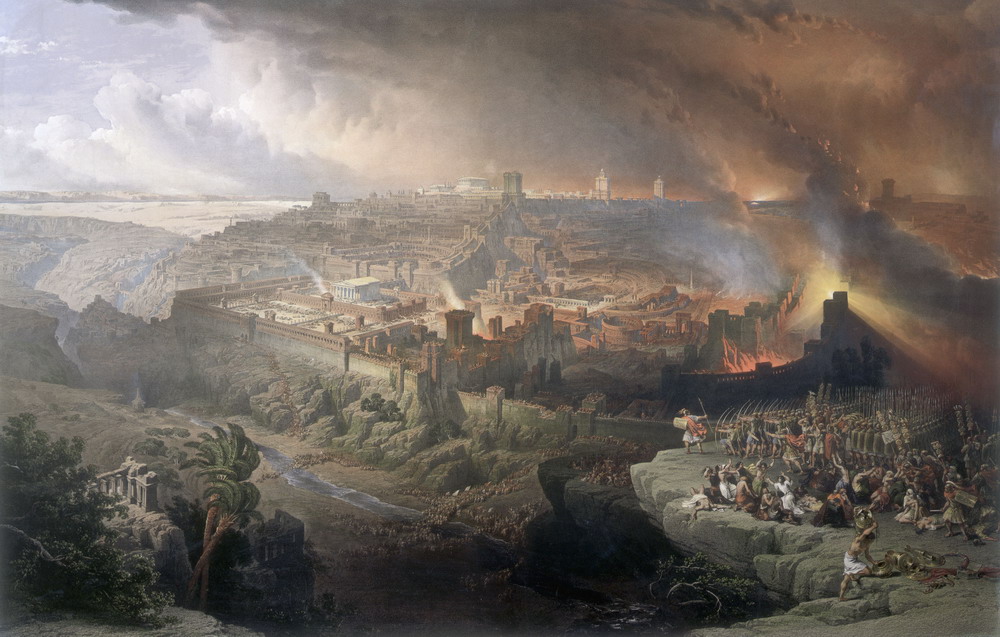
In the first post (Part 1) of this series, we examined the first few verses of Jesus’ famous Olivet Discourse, recorded in Matthew 24:1-3, Mark 13:1-4, and Luke 21:5-7. We saw the disciples admiring the temple, Jesus telling them it would soon be destroyed, and the disciples asking Him when that would take place. In Matthew’s account alone they asked Him about His coming and the end of the age that they were living in. In the second post, we examined a roughly 10-verse segment in each account where Jesus described some of the signs which would take place before the temple’s destruction. We saw how those signs were fulfilled between the time of His ascension around 30 AD and the temple’s overthrow in 70 AD, about 40 years later.

In this post we will look at how Jesus warned His followers living in Judea to flee to the mountains when they saw “the abomination that causes desolation” (Matthew 24:15/Mark 13:14), that is, “Jerusalem being surrounded by armies” (Luke 21:20). We will see some remarkable accounts of how the believers obeyed and did this very thing about 36 years later. We will also consider what Jesus said about a time of great tribulation that was to come.

MATTHEW 24:15-28

MARK 13:14-23

LUKE 21:20-24

15 So when you see standing in the holy place ‘the abomination that causes desolation,’ spoken of through the prophet Daniel—let the reader understand16 then let those who are in Judea flee to the mountains. 17 Let no one on the housetop go down to take anything out of the house. 18 Let no one in the field go back to get their cloak. 19 How dreadful it will be in those days for pregnant women and nursing mothers! 20 Pray that your flight will not take place in winter or on the Sabbath. 21 For then there will be great distress, unequaled from the beginning of the world until now—and never to be equaled again. 22 “If those days had not been cut short, no one would survive, but for the sake of the elect those days will be shortened. 23 At that time if anyone says to you, ‘Look, here is the Messiah!’ or, ‘There he is!’ do not believe it. 24 For false messiahs and false prophets will appear and perform great signs and wonders to deceive, if possible, even the elect. 25See, I have told you ahead of time.26 “So if anyone tells you, ‘There he is, out in the wilderness,’ do not go out; or, ‘Here he is, in the inner rooms,’ do not believe it. 27 For as lightning that comes from the east is visible even in the west, so will be the coming of the Son of Man. 28 Wherever there is a carcass, there the vultures will gather. 14 When you see ‘the abomination that causes desolation’ standing where it does not belong—let the reader understandthen let those who are in Judea flee to the mountains. 15 Let no one on the housetop go down or enter the house to take anything out. 16 Let no one in the field go back to get their cloak. 17 How dreadful it will be in those days for pregnant women and nursing mothers! 18 Pray that this will not take place in winter, 19 because those will be days of distress unequaled from the beginning, when God created the world, until now—and never to be equaled again. 20 “If the Lord had not cut short those days, no one would survive. But for the sake of the elect, whom he has chosen, he has shortened them. 21 At that time if anyone says to you, ‘Look, here is the Messiah!’ or, ‘Look, there he is!’ do not believe it. 22 For false messiahs and false prophets will appear and perform signs and wonders to deceive, if possible, even the elect. 23 So be on your guard; I have told you everything ahead of time. 20 When you see Jerusalem being surrounded by armies, you will know that its desolation is near. 21 Then let those who are in Judea flee to the mountains, let those in the city get out, and let those in the country not enter the city. 22 For this is the time of punishment in fulfillment of all that has been written. 23 How dreadful it will be in those days for pregnant women and nursing mothers! There will be great distress in the land and wrath against this people. 24 They will fall by the sword and will be taken as prisoners to all the nations. Jerusalem will be trampled on by the Gentiles until the times of the Gentiles are fulfilled.

THE ABOMINATION OF DESOLATION

Matt. 24:15-20/Mark 13:14-18/Luke 21:20-21, 23a – Both Matthew and Mark speak of an event which Christ’s followers were to be on the lookout for, “the abomination that causes desolation.” Both writers appeal to the reader “to understand,” and Matthew adds that this was spoken of by Daniel (9:26-27, 11:31, 12:11).  Luke also speaks of an event which would lead to desolation, which he describes as “Jerusalem being surrounded by armies.” Looking at all three accounts together, we can see that these (apparently) two different signs were actually one and the same, for they were to bring about the same response: immediate flight. Luke, addressing a non-Jewish audience, makes plain what the “abomination of desolation” was to be:

AUTHOR:

Matthew

Mark

Luke

CATALYST: “So when you see standing in the holy place ‘the abomination that causes desolation’…” “When you see ‘the abomination that causes desolation’…” “When you see Jerusalem being surrounded by armies… desolation is near.”
RESPONSE: “then let those who are in Judea flee to the mountains.” “then let those who are in Judea flee to the mountains.” “Then let those who are in Judea flee to the mountains…”

Perhaps overlooking this fact, it is often said by futurists that, at the time of Jerusalem’s destruction in 70 AD, nothing occurred which may have fulfilled Christ’s prophecy of a coming abomination of desolation. A number of early church writers, however, did teach that this prophecy was fulfilled at that time. These included Clement of Alexandria (150-215 AD), Eusebius (263-339) Athanasius (296-372), Augustine (379), Chrysostom (379), Jerome (347-420), and Remigius (437-533). Eusebius (263-339 AD) was a Roman scholar and historian, known as the “Father of Church History.” In his work entitled “Proof of the Gospel” (Book III, Chapter VII), written in 314 AD, he said the following:

It is fitting to add to these accounts the true prediction of our Saviour in which he foretold these very events. His words are as follows: “Woe unto them that are with child, and to them that give suck in those days! But pray ye that your flight be not in the winter, neither on the Sabbath day; For there shall be great tribulation, such as was not since the beginning of the world to this time, no, nor ever shall be.” …These things took place in this manner in the second year of the reign of Vespasian, in accordance with the prophecies of our Lord and Saviour Jesus Christ, who by divine power saw them beforehand as if they were already present, and wept and mourned according to the statement of the holy evangelists…

Moreover, the people of the church at Jerusalem, in accordance with a certain oracle that was vouchsafed by way of revelation to the approved men there, had been commanded to depart from the city before the war, and to inhabit a certain city of Peraea. They called it Pella. And when those who believed in Christ had removed from Jerusalem, as if holy men had utterly deserted both the royal metropolis of the Jews itself and the whole land of Judaea, the Justice of God then visited upon them all their acts of violence to Christ and his apostles, by destroying that generation of wicked persons root and branch from among men.

…at last the abomination of desolation, proclaimed by the prophets, stood in the very temple of God, so celebrated of old, the temple which was now awaiting its total and final destruction by fire– all these things any one that wishes may find accurately described in the history written by Josephus.

Remigius (437-533 AD) tells us this:

[F]or on the approach of the Roman army, all the Christians in the province, warned, as ecclesiastical history tells us, miraculously from heaven, withdrew, and passing the Jordan, took refuge in the city of Pella; and under the protection of that King Agrippa, of whom we read in the Acts of the Apostles, they continued some time.

This is fascinating stuff! Athanasius (296-372 AD), the bishop of Alexandria, likewise wrote this:

“And when He Who spake unto Moses, the Word of the Father [i.e. Jesus], appeared in the end of the world [age], He also gave this commandment, saying…, ‘When ye therefore shall see the abomination of desolation, spoken of by Daniel the prophet, stand in the holy place (whoso readeth, let him understand); then let them which be in Judea flee into the mountains…’ [Matt. 24:15-16]. Knowing these things, the Saints regulated their conduct accordingly” (Defence of His Flight).

When Athanasius spoke of the believers in Jerusalem living “accordingly,” it’s likely that he meant they lived simply, in order to be prepared for that time when they would need to suddenly vacate. Indeed, we read in Acts that the believers there “had all things in common,” they “were selling their possessions and belongings and distributing the proceeds to all, as any had need” (Acts 2:44-45), and “no one said that any of the things that belonged to him was his own” (Acts 4:32). Of course, many of these believers were later scattered throughout Judea and Samaria when persecution suddenly arose after Stephen was martyred (Acts 8:1).
SOURCE

From Scripture it seems clear that “the holy place” mentioned by Jesus (Matt. 24:15) was not the temple, but Jerusalem, since the entire city was considered holy (Nehemiah 11:1, Daniel 9:24, Matthew 4:5, Matthew 27:53). In Daniel’s day the temple was holy, but Jesus had just pronounced it desolate (Matthew 23:38). This was the viewpoint of Chrysostom (379 AD), who wrote, “For this it seems to me that the abomination of desolation means the army by which the holy city of Jerusalem was made desolate” (recorded in The Ante-Nicene Fathers). Thomas Newton, in his dissertation titled “The Prophecy of Matthew 24” written in 1753, also took this position:

Whatever difficulty there is in these words [in Matthew 24:15-16], it may be cleared up by the parallel place in St. Luke, ‘And when ye shall see Jerusalem compassed with armies, then know that the desolation thereof is nigh. Then let them which are in Judea flee to the mountains,’-xxi – 20, 21. So that ‘the abomination of desolation’ is the Roman army, and ‘the abomination of desolation standing in the holy place’ is the Roman army besieging Jerusalem. This, saith our Saviour, is ‘the abomination of desolation, spoken of by Daniel the prophet,’ in the ninth and eleventh chapters; and so let every one who readeth those prophecies, understand them. The Roman army is called ‘the abomination,’ for its ensigns and images, which were so to the Jews.

Other commentators roughly contemporary to Thomas Newton held to the same view, i.e. that these words of Jesus were fulfilled in 67-70 AD. These included John Wesley (1754), Adam Clarke (1837), C. H. (Charles) Spurgeon (1868), and Philip Schaff (1877). For example, Charles Spurgeon said (“Popular Exposition of Matthew”),

“This portion of our Savior’s words appears to relate solely to the destruction of Jerusalem. As soon as Christ’s disciples saw ‘the abomination of desolation’, that is, the Roman ensigns, with their idolatrous emblems, ‘stand in the holy place’, they knew that the time for them to escape had arrived, and they did ‘flee to the mountains.’ The Christians in Jerusalem and the surrounding towns and villages, ‘in Judea’, availed themselves of the first opportunity for eluding the Roman armies, and fled to the mountain city of Pella, in Perea, where they were preserved from the general destruction which overthrew the Jews.

The Romans came into Jerusalem bearing standards, emblems, and banners with images of their gods and proclamations of the deity of their emperor. B.H. Carroll (1915), in his well-known work, “An Introduction of the English Bible” (1915), related an interesting incident which took place during the reign of Tiberius (14-37 AD). This incident sheds light on what was constituted as such an abomination at this time:

Pilate, at that time Roman Procurator, sent from Caesarea, the seaport of that country on the Mediterranean Sea, a legion of Roman soldiers and had them secretly introduced into the city and sheltered in the tower of Antonio overlooking the Temple, and these soldiers brought with them their ensigns. The Roman sign was a straight staff, capped with a metallic eagle, and right under the eagle was a graven image of Caesar. Caesar claimed to be divine. Caesar exacted divine worship, and every evening when those standards were placed, the Roman legion got down and worshiped the image of Caesar thereof, and every morning at the roll call a part of the parade was for the whole legion to prostrate themselves before that graven image and worship it. The Jews were so horrified when they saw that image and the consequent worship, they went to Pilate, who was at that time living in Caesarea, and prostrated themselves before him and said, ‘Kill us, if you will, but take that abomination of desolation out of our Holy City and from the neighborhood of our holy temple’ (pp. 263-264).

Jesus had told those living in Judea to head to the mountains, predicting such urgency that they weren’t even to grab what was inside their homes. It would be especially difficult for those who were pregnant or nursing. Neither winter (according to Matthew and Mark) nor the Sabbath (said Matthew) would be an ideal time to have to flee. George Peter Holford, in his 1805 book, “The Destruction of Jerusalem, An Absolute and Irresistible Proof of the Divine Origin of Christianity,” notes a very sad situation predicted in the words of Jesus Himself:

The day on which Titus encompassed Jerusalem, was the feast of the Passover; and it is deserving of the very particular attention of the reader, that this was the anniversary of that memorable period in which the Jews crucified their Messiah! At this season multitudes came up from all the surrounding country, and from distant parts, to keep the festival. How suitable and how kind, then, was the prophetic admonition of our LORD, and how clearly he saw into futurity when he said, “Let not them that are in the countries enter into Jerusalem” (Luke 21:21).

Nevertheless, the city was at this time crowded with Jewish strangers, and foreigners from all parts, so that the whole nation may be considered as having been shut up in one prison, preparatory to the execution of the Divine vengeance; and, according to Josephus this event took place suddenly; thus, not only fulfilling the predictions of our LORD, that these calamities should come, like the swift-darting lightning “that cometh out of the east and shineth even unto the West,” and ” as a snare on all of them (the Jews) who dwelt upon the face of the whole earth ” (Matt. 24:27, and Luke 21:35) but justifying, also, his friendly direction, that those who fled from the place should use the utmost possible [speed].

There is also a significant note to be made concerning Jesus’ instructions to pray that their flight from Jerusalem would not be on a Sabbath (Matthew 24:20). Prior to 70 AD the Jews who controlled the city would close the city gates on the Sabbath and there would be no way to escape (See Nehemiah 13:15-22). It’s significant to note that this is not a practice in modern Israel; if it was, it would be helpful to the Futurist view which says that this will happen soon. As one can see from the quotes above, this Futurist view is a new one that doesn’t reflect what has been taught in church history.

GREAT TRIBULATION

Matt. 24:21/Mark 13:19/Luke 21:22-23 – All three writers define this time as one of “great distress.” This is the phrase used in the NIV, quoted above. In most other translations, the phrase used by Matthew and Mark is “great tribulation.”  That time would be more distressful than any other time since the world began. Matthew and Mark add that it was “never to be equaled again.” This statement by Jesus is one more indication that the tribulation He spoke of is already past. For if this refers to a supposed end of the world in the future, and not 67-70 AD, why would Jesus say such a thing? It wouldn’t make sense to use the expression “never to be equaled again” when referring to an event that brings humanity to the very end of time. Instead this phrase implies that a significant period of time would follow the great tribulation Jesus spoke of, which makes sense if it took place in the first century. This passage has several parallels in Scripture, as can be seen from the following chart:

JEREMIAH 30:7 DANIEL 12:1-7 MATTHEW 24:21 LUKE 21:22-23 REVELATION 7:14
“Alas! That day is so great there is none like it; it is a time of distress for Jacob; “At that time shall arise Michael, the great prince who has charge of your people. And there shall be a time of trouble, “For then there will be great tribulation, “Alas… For there will be great distress upon the earth [or ‘this land’] and wrath against this people.” “And he said to me, ‘These are the ones coming out of the great tribulation’…”
“…there is none like it…” such as never has been since there was a nation till that time. such as has not been from the beginning of the world until now, no, and never will be.”
yet he shall be saved out of it.” But at that time your people shall be delivered, everyone whose name shall be found written in the book.”
“And someone said…, ‘How long shall it be till the end of these wonders?’ And I heard…it would be for a time, times, and half a time, and that when the shattering of the power of the holy people comes to an end all these things would be finished.” “for these are days of vengeance, to fulfill all that is written” (verse 22).

So among the things which we see are that this tribulation was to be for Israel, it would last for 3.5 years (“time, times, and half a time”) and would end when the power of that people had been shattered (Daniel 12:6-7), and the followers of Christ would experience deliverance. We already saw that God delivered the believers of the first century when they obeyed and fled to Pella. The Roman campaign against Israel did in fact last for 3.5 years, from the time that Nero declared war in February 67 AD and dispatched Vespasian as his general (Revelation 6:2) until Jerusalem fell in August 70 AD (Revelation 18:9-24). This accomplished the shattering of the power of “the holy people” (Daniel’s phrase).

Josephus vindicates the words of Jesus in Matthew 24:21 (“For then there will be great tribulation, such as has not been from the beginning of the world until now, no, and never will be.”) with his own firsthand report: “If the misfortunes of all nations, from the beginning of the world, were compared with those which befell the Jews, they would appear far less in comparison; No other city ever suffered such things, as no other generation, from the beginning of the world, was ever more fruitful in wickedness.”

Luke, in his account, adds a couple of very revealing expressions, saying that this great distress would be “in the land” and that the wrath would be “against this people.” The phrase “the land” is not only a common expression in Scripture indicating “the promised land” (Israel), but Judea and Jerusalem are explicitly mentioned in verses 20, 21, and 24. Luke’s use of the phrase “this people” is also a clear reference to the Jews who lived in that land, who were left behind because they didn’t flee. Those who view the “great tribulation” as future tend to view it as a worldwide event, but these are very clear indications that this judgment was localized to Israel. We also have highly detailed historical records showing how utterly devastating Israel’s downfall was at this time in history (67 – 70 AD). To learn more, see this fascinating timeline here.

Another profound statement is made by Luke. He says that this time of punishment would be “in fulfillment of all that has been written.” Evan Erzingatsian provides the following chart showing how Jesus’ predictions are based on Israel’s covenant contract recorded in Leviticus and Deuteronomy. As Evan says,

“The table below shows the paraphrases (found in Matt 24 and Luke 21) based on the contractual terms found in Deuteronomy 28 and Leviticus 26. Only Israel said ‘Amen!’ to the curses (Deut. 27:15-26). Only Israel was bound to experience the calamitous events found in Matthew 24. This is why Matthew 24 mentions Jerusalem and Judea as the places where the events of the last days would unfold (Matt. 24:16, Luke 21:20-23).”

No automatic alt text available.

It has been said by some futurists that the preterist (past fulfillment) position is anti-semitic, because it takes away prophetic significance from modern-day Israel and the Jewish people (over and above other peoples). Ironically, though, it’s the futurist position which is looking forward to mass devastation for Israel and the Jewish people, a time which will supposedly be even worse than what took place in 70 AD.

Matt. 24:22/Mark 13:20 – Matthew and Mark record that the destruction during this time of tribulation would be so great that no one would survive if it was allowed to continue for long. This would be done, says Matthew, for the sake of the elect. Jerusalem was under a very tight siege for five months, from April through September 70 AD, before the whole city was burned (Matthew 22:7). The famine became so great that mothers even ate their own babies. Dead bodies were piled everywhere, and those who tried to escape the city were crucified by the Romans at such a rate that Josephus tells us more than one Jew would often be nailed to the same cross. Josephus records that 1.1 million Jews were killed at this time.

Source: Cindye Coates (Matthew 24 Fulfilled)

Luke 21:24 – Luke tells us that many would be killed “by the sword” during this time. This, of course, is indicative of ancient warfare rather than 21st century style warfare. It is this section of Luke’s account (Luke 21:20-24) which many futurists admit took place in the first century. At the same time, they often insist that Luke’s phrase “this generation” in Luke 21:32 means a future (or present) generation which will see all these signs come together at once. This position is highly contradictory, for at least the following reason.

In the previous post, we saw that a number of signs precede “the abomination of desolation” and “great tribulation” in the accounts of Matthew and Mark: [1] imposters claiming to be Christ [2] wars and rumors of wars [3] nations and kingdoms clashing [4] earthquakes [5] famines [6] persecution and martyrdom [7] betrayal and hatred. Without a doubt, these exact same signs also appear in Luke’s account before Jerusalem is surrounded by armies and there comes a time of “great distress.” According to the Futurist interpretation, then, the above seven signs precede two entirely different time periods; i.e. in Luke they refer to a time period in the first century, and in Matthew and Mark they supposedly refer to our own generation. As we will see in the next post, however, Jesus says in each account that “this generation will not pass away until ALL these things take place.” The Futurist who admits that the “great distress” in Luke 21:20-24 took place from 67-70 AD, but who says that the rest of the prophecy remains unfulfilled, has already stretched out the definition of a generation more than 1900 years.

Luke also speaks of many being taken as prisoners “to all the nations.” We learned from the previous post that when Jesus spoke of all nations (Matt. 24:14, Mark 13:10), this was a reference to the Roman Empire. The same is true here. Josephus tells us that nearly 1.2 million Jews were killed in Jerusalem, and that the Romans carried off 97,000 Jews into international slavery.

Luke tells us that the end of Jerusalem’s trampling by the Gentiles would also be the end of “the times of the Gentiles.” Perhaps the most popular Futurist position is that “the times of the Gentilesbegan in 70 AD, that this continues until today (i.e. it’s the Church Age), and that “God’s program with the Jews will one day soon be resumed.” I believe this to be false, and that “the times of the Gentilesended in 70 AD instead. Without taking up more space here on this subject, I’d like to point to an article by Mike Blume, whom I believe does an excellent job showing that the times of the Gentiles began with Babylon’s affliction and domination of Israel, followed by that of Medo-Persia and Greece, and finally ending with Rome’s destruction of that nation. He also shows that Luke 21:24 is parallel to both Romans 11:25 and Revelation 11:2, which shows that Jerusalem was to be “trampled underfoot” for 42 months. Again, 42 months = 3.5 years, which is precisely how long Rome took to invade and destroy Jerusalem (February 67 AD – August 70 AD).

Matt. 24:23-26/Mark 13:21-23 – Here Matthew and Mark essentially repeat Jesus’ earlier warning (see previous post) about false prophets and false messiahs. Jesus’ 1st century listeners are told to be on their guard (this really did have meaning for them), because these deceivers would even perform great signs and miracles. As David Chilton reminds us, in his 1987 book, The Days of Vengeance (p. 340),

“The Book of Acts records several instances of miracle-working Jewish false prophets who came into conflict with the Church (cf. Acts 8:9-24) and worked under Roman officials (cf. Acts 13:6-11); as Jesus foretold (Matt. 7:22-23), some of them even used His name in their incantations (Acts 19:13-16).”

Matt. 24:27-28 – Jesus compares His coming (which, again, He promised would take place while some of His disciples were still alive – Matt. 16:27-28) to lightning which comes from the east and is also visible in the west. This statement appears only in Matthew’s account, the only account to have specifically mentioned His coming up until this point (in verse 3).

This is possibly a reference to the 12th Roman legion, Fulminata, that participated in the Roman siege of Jerusalem in 70 AD. This legion did not perform well in November 66 AD when Cestius Gallus was defeated by the Jews, but it did very well in 70 AD. Its emblem and nickname was “Thunderbolt.”

Image result for LEGIO XII FULMINATA

Source

Adam Clarke, in his 1810 commentary on this verse, interpreted it this way:

“It is worthy of remark that our Lord, in the most particular manner, points out the very march of the Roman army: they entered into Judea on the EAST, and carried on their conquest WESTWARD, as if not only the extensiveness of the ruin, but the very route which the army would take, were intended in the comparison of the lightning issuing from the east, and shining to the west.”

Then Jesus adds, “Wherever there is a carcass, there the vultures will gather.” Some translations say “eagles” instead of “vultures.” George Peter Holford (in 1805) noted that not only was Israel fit to be described as a carcass in 70 AD; being spiritually, politically, and judicially dead; but it was also a curious fact that the eagle was the principal figure on the Roman ensigns which were planted throughout the city of Jerusalem in 70 AD and finally in the temple itself. Albert Barnes, in his commentary on these two verses in 1832, agreed:

“The words in this verse are proverbial. Vultures and eagles easily ascertain where dead bodies are, and come to devour them. So with the Roman army. Jerusalem is like a dead and putrid corpse. Its life is gone, and it is ready to be devoured. The Roman armies will find it out, as the vultures do a dead carcass, and will come around it, to devour it… This verse is connected with the preceding by the word “for,” implying that this is a reason for what is said there, that the Son of man would certainly come to destroy the city, and that he would come suddenly. The meaning is, he would come by means of the Roman armies, as certainly, as suddenly, and as unexpectedly, as whole flocks of vultures and eagles, though unseen before, suddenly find their prey, see it at a great distance, and gather in multitudes around it.”

Source: Cindye Coates (Matthew 24 Fulfilled)

Quotes to Note

Jonathan Edwards (1736): “Thus there was a final end to the Old Testament world: all was finished with a kind of day of judgment, in which the people of God were saved, and His enemies terribly destroyed.”

Philip Mauro, scholar and US Supreme Court bar lawyer (1859-1952): “It is greatly to be regretted that those who, in our day, give themselves to the study and exposition of prophecy, seem not to be aware of the immense significance of the destruction of Jerusalem in A.D. 70, which was accompanied by the extinction of Jewish national existence, and the dispersion of the Jewish people among all the nations. The failure to recognize the significance of that event, and the vast amount of prophecy which it fulfilled, has been the cause of great confusion, for the necessary consequence of missing the past fulfillment of predicted events is to leave on our hands a mass of prophecies for which we must needs contrive fulfillments in the future. The harmful results are twofold; for first, we are thus deprived of the evidential value, and the support to the faith, of those remarkable fulfillments of prophecy which are so clearly presented to us in authentic contemporary histories; and second, our vision of things to come is greatly obscured and confused by the transference to the future of predicted events which, in fact, have already happened, and whereof complete records have been preserved for our information.

“Yet, in the face of all this, we have today a widely held scheme of prophetic interpretation, which has for its very cornerstone the idea that, when God’s time to remember His promised mercies to Israel shall at last have come, He will gather them into their ancient land again, only to pour upon them calamities and distresses far exceeding even the horrors which attended the destruction of Jerusalem in A.D. 70. This is, we are convinced, an error of such magnitude as to derange the whole program of unfulfilled prophecy” (Seventy Weeks and the Great Tribulation, 1921, emphasis added).

The Olivet Discourse: “This” Generation or “That” Generation (Part 2 of 4)


In the previous post (Part 1), we examined the first part of Jesus’ famous Olivet Discourse, recorded in Matthew 24:1-3, Mark 13:1-4, and Luke 21:5-7. All three accounts show the disciples admiring the temple, Jesus telling them it would soon be destroyed, and the disciples asking Him when that would take place. In Matthew’s account alone they asked Him about His coming and the end of the age, which we identified as the Old Covenant age. We looked at how He had already told them (Matt. 10:23 and 16:27-28) that His coming was to be: [1] with His angels [2] in His kingdom [3] in the glory of His Father [4] to repay each person for their deeds, and [5] within the lifetime of some of His disciples.

In this post we will examine a roughly 10-verse segment in each account where Jesus describes some of the signs which would take place before the temple’s destruction. We will see how these signs were fulfilled between the time of His ascension around 30 AD and the temple’s overthrow in 70 AD, about 40 years later.

MATTHEW 24:4-14

MARK 13:5-13

LUKE 21:8-19

4 Jesus answered: “Watch out that no one deceives you. 5 For many will come in my name, claiming, ‘I am the Messiah,’ and will deceive many. 6 You will hear of wars and rumors of wars, but see to it that you are not alarmed. Such things must happen, but the end is still to come. 7 Nation will rise against nation, and kingdom against kingdom. There will be famines and earthquakes in various places. 8All these are the beginning of birth pains.9 “Then you will be handed over to be persecuted and put to death, and you will be hated by all nations because of me. 10 At that time many will turn away from the faith and will betray and hate each other, 11 and many false prophets will appear and deceive many people. 12 Because of the increase of wickedness, the love of most will grow cold, 13but the one who stands firm to the end will be saved.14 And this gospel of the kingdom will be preached in the whole world as a testimony to all nations, and then the end will come. 5 Jesus said to them: “Watch out that no one deceives you. 6 Many will come in my name, claiming, ‘I am he,’ and will deceive many. 7 When you hear of wars and rumors of wars, do not be alarmed. Such things must happen, but the end is still to come. 8Nation will rise against nation, and kingdom against kingdom. There will be earthquakes in various places, and famines. These are the beginning of birth pains.9 “You must be on your guard. You will be handed over to the local councils and flogged in the synagogues. On account of me you will stand before governors and kings as witnesses to them. 10 And the gospel must first be preached to all nations. 11Whenever you are arrested and brought to trial, do not worry beforehand about what to say. Just say whatever is given you at the time, for it is not you speaking, but the Holy Spirit.12 “Brother will betray brother to death, and a father his child. Children will rebel against their parents and have them put to death. 13 Everyone will hate you because of me, but the one who stands firm to the end will be saved. 8 He replied: “Watch out that you are not deceived. For many will come in my name, claiming, ‘I am he,’ and, ‘The time is near.’ Do not follow them. 9When you hear of wars and uprisings, do not be frightened. These things must happen first, but the end will not come right away.”10 Then he said to them: “Nation will rise against nation, and kingdom against kingdom. 11There will be great earthquakes, famines and pestilences in various places, and fearful events and great signs from heaven.12 “But before all this, they will seize you and persecute you. They will hand you over to synagogues and put you in prison, and you will be brought before kings and governors, and all on account of my name. 13 And so you will bear testimony to me. 14 But make up your mind not to worry beforehand how you will defend yourselves. 15 For I will give you words and wisdom that none of your adversaries will be able to resist or contradict. 16 You will be betrayed even by parents, brothers and sisters, relatives and friends, and they will put some of you to death. 17 Everyone will hate you because of me. 18 But not a hair of your head will perish. 19 Stand firm, and you will win life.

John Wesley (1703-1791), in the introduction to his commentary on Matthew 24, wrote the following:

“Josephus’ History of the Jewish War is the best commentary on this chapter. It is a wonderful instance of God’s providence, that he, an eyewitness, and one who lived and died a Jew, should, especially in so extraordinary a manner, be preserved, to transmit to us a collection of important facts, which so exactly illustrate this glorious prophecy, in almost every circumstance.”

Clearly, Wesley believed that Matthew 24 was fulfilled by the time the Roman-Jewish War (66-73 AD) came to an end. Nearly 250 years after Wesley’s statement was made, statements like this one by Hal Lindsey in 2009 are far more typical when it comes to interpreting this passage:

“What generation? Obviously, in context, the generation that would see the signs – chief among them the rebirth of the State of Israel… I believe we are in the generation that will live to see the fulfillment of the ‘birth pangs’ that Jesus predicted would all come together in one time frame shortly before the Tribulations events that bring about His return.”

These interpretations couldn’t be more different. In this section of the Olivet Discourse, we will see that Wesley certainly had a point when he spoke of the relevance of Josephus’ historical records. We will be looking at one small portion at a time from the parallel Scripture texts above.

Matt. 24:4-5/Mark 13:5-6/Luke 21:8– Jesus warns the disciples about deceivers who would come claiming to be the Messiah and leading many astray. Matthew also speaks of “false prophets” again in verse 11 and verse 24, and Mark does so again in verse 22.

Luke here makes a remark that we don’t see in the other two accounts. He adds that these false prophets would claim that the time was “near” (or “at hand” in some translations), and that His disciples were not to go after them when they said that. We should give this some extra thought.

As we will see in Luke 21:28, Jesus later says “Now when these things begin to take place, straighten up and raise your heads, because your redemption is drawing near.” Jesus thus gives permission at that stage for His people to realize the very thing that earlier they were not to believe, that is, that the time was near. First they had to see “these things begin to take place,” and then they could know and proclaim that the end was near. The expression “these things” refers to what Jesus goes on to describe in verses 9-27.

Did any of the writers of the New Testament proclaim that the time was near? Consider these statements:

“…For salvation is nearer to us now than when we first believed. The night is far gone; the day is at hand…” (Romans 13:11-12).

Let your reasonableness be known to everyone. The Lord is at hand” (Philippians 4:5).

Yet a little while, and the coming One will come and will not delay” (Hebrews 10:37).

You also, be patient. Establish your hearts, for the coming of the Lord is at hand” (James 5:8).

The end of all things is at hand; therefore be self-controlled and sober-minded for the sake of your prayers” (I Peter 4:7).

Children, it is the last hour, and as you have heard that antichrist is coming, so now many antichrists have come. Therefore we know that it is the last hour” (I John 2:18).

From these statements we see that Paul, James, Peter, and John all proclaimed that the time was near. Did they become the very false prophets Jesus had warned about in Luke 21:8, since they uttered the very statement that Jesus warned His followers not to believe? If the signs of the Olivet Discourse are still future and unfulfilled, as futurists insist, then they certainly did become those false prophets. We know, however, that this is not the case. This is actually one more indication that the events predicted by Jesus came to pass within His own generation. They witnessed the predicted signs coming to pass, and on this authority they announced that the end was near. Soon afterwards, that end came, the end of the Old Covenant world and age. Jesus kept His word and His promise.

George Peter Holford, in the year 1805, wrote a book entitled “The Destruction of Jerusalem, An Absolute and Irresistible Proof of the Divine Origin of Christianity” in which he outlined many of the events recorded by Josephus and other historians of that time. Concerning Matthew 24:4-5, he wrote:

[Jesus commenced] with a caution: “Take heed,’ says He, ‘that no man deceive you; for many shall come in My name, saying, ‘I am Christ,’ and shall deceive many.” The necessity of this friendly warning soon appeared; for within one year after our Lord’s ascension, rose Dositheus the Samaritan, who had the boldness to assert that he was the Messiah, of whom Moses prophesied; while his disciple Simon Magus deluded multitudes into a belief that he, himself, was the “GREAT POWER OF GOD.”

Holford went on to list a host of similar deceivers in that generation, some who literally called themselves “the Christ” or “Messiah,” and others who promised to take on His expected role in delivering the Jews from Roman bondage and bringing a physical, earthly kingdom to Jerusalem. This was a popular expectation, and one that Jesus didn’t live up to, so it was easily used to sway people their way.

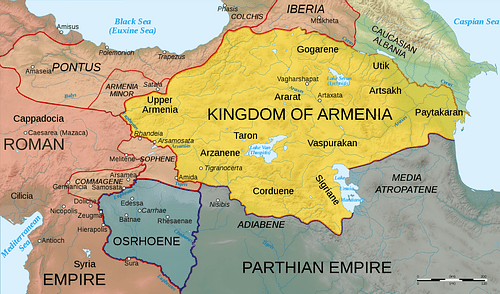
Matt. 24:6-7a/Mark 13:7-8a/Luke 21:9-10 – Jesus’ next warning is about wars, rumors of wars, and nations and kingdoms rising against each other. Luke adds the word “uprisings.” An example of one kingdom rising up against another can be seen in the Roman-Parthian War of AD 58-63:

“The Roman-Parthian War of 58-63 CE was sparked off when the Parthian Empire’s ruler imposed his own brother as the new king of Armenia, considered by Rome to be a quasi-neutral buffer state between the two empires. When Parthia went a step further and declared Armenia a vassal state in 58 CE all-out war broke out. The on-off war, in which the Roman commander Corbulo excelled, would only be settled in 63 CE with the Treaty of Rhandia which shared the responsibility of ruling Armenia between the two powers.”

Map of Armenia, 50 CE

(Source)

Regarding conflicts within the Roman Empire in the decades following Jesus’ ascension, the Roman historian Tacitus had this to say,

“The history on which I am entering is that of a period rich in disasters, terrible with battles, torn by civil struggles, horrible even in peace. Four emperors fell by the sword; there were three civil wars, more foreign wars, and often both at the same time” (The Histories, 1:2).

As just one example, the Roman-Jewish War took place over a 6-7 year period, in which an incredible amount of blood was shed throughout Judea and Galilee, and women even ate their babies out of desperation. When Nero committed suicide in June 68 AD, even the Roman Empire nearly collapsed in on itself due to jostling for power and what Josephus called “civil wars of horrible ferocity and dramatic proportions.” Rome went through four emperors within one year, and Josephus remarked that “every part of the habitable earth under them [the Romans] was in an unsettled and tottering condition” (Wars 7.4.2).

In the fall/winter of 67 AD a brutal civil war also broke out in Jerusalem and Judea between the revolutionaries and those who wanted to maintain peace with Rome. Jerusalem was eventually divided into three factions led by [1] Eleazar, who was over the Zealots [2] John of Gischala, who was over the Galileans, and [3] Simon, who was over the Idumeans. It remained this way until the city was destroyed in September 70 AD. In one night 8500 people were killed, and their bodies were cast outside of Jerusalem without being buried. The outer temple was “overflowing with blood,” according to Josephus, and the inner court even had pools of blood in it.

Matt. 24:7b-8/Mark 13:8b/Luke 21:11 – Jesus next predicts famines and earthquakes. Once again, Luke adds other details: pestilences and “fearful events and great signs from heaven.”

   New Zealand

Haiti

 Japan

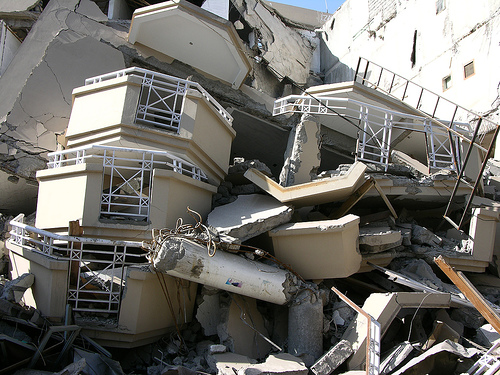
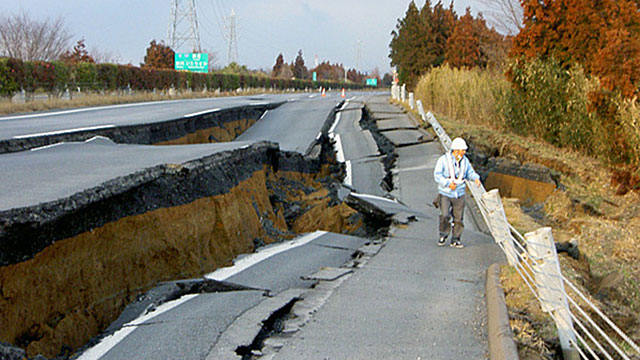
Was Jesus predicting the recent earthquakes we’ve seen in Pakistan, New Zealand, Haiti, and Japan, and others yet to come? Many prophecy teachers today would have us believe that He did. George Peter Holford (in 1805) also referred to a number of great earthquakes which took place during the generation to which Jesus and His disciples belonged.

In one instance in early 68 AD a terrible earthquake was accompanied by terrifying storms and violent winds, prompting Josephus to say, “These things were a manifest indication that some destruction was coming upon men, when the system of the world was put into this disorder; and any one would guess that these wonders foreshowed some grand calamities that were coming” (Wars 4.4.5). Seneca the Younger, a Roman philosopher, wrote the following in 58 AD:

“How often have cities of Asia and Achaea fallen with one fatal shock! Show many cities have been swallowed up in Syria, how many in Macedonia! How often has Cyprus been wasted by this calamity! How often has Paphos become a ruin! News has often been brought us of the demolition of whole cities at once.”

Henry Alford, The New Testament for English Readers (Chicago, IL: Moody Press, n.d.), 163.

Large earthquakes took place in Crete, Smyrna, Miletus, Chios, Samos, Laodicea, Hierapolis, Colosse, Campania, Rome, Judea and Pompei (February 5, 63 AD). Other earthquakes are recorded in Scripture in Matthew 27:51-54, Matthew 28:2, and Acts 16:26.

Holford then notes that the great famine predicted by Agabus in Acts 11:27-30 began in the fourth year of the reign of Claudius (i.e. 45 AD) and “was of long continuance. It extended through Greece, and even into Italy, but was felt most severely in Judea and especially at Jerusalem, where many perished for want of bread.” This famine was recorded by Eusebius, Orosius, and Josephus, who related that “an assaron [about 3.5 pints] of corn was sold for five drachmae” (in the heyday of ancient Greece in the 4th century BC one drachmae was the daily wage for a skilled worker). Regarding Christ’s predictions of pestilences, Holford writes:

History…particularly distinguishes two instances of this calamity, which occurred before the commencement of the Jewish war. The first took place at Babylon about A. D. 40, and raged so alarmingly, that great multitudes of Jews fled from that city to Seleucia for safety, as hath been hinted already. The other happened at Rome A.D. 65, and carried off prodigious multitudes. Both Tacitus and Suetonius also record, that similar calamities prevailed, during this period, in various parts of the Roman Empire. After Jerusalem was surrounded by the army of Titus, pestilential diseases soon made their appearance there to aggravate the miseries, and deepen the horrors of the siege. They were partly occasioned by the immense multitudes which were crowded together in the city, partly by the putrid effluvia which arose from the unburied dead, and partly from spread of famine.

These calamities, along with mothers eating their own children, are reminiscent of what God said would happen to Israel if that nation became faithless and rebellious (e.g. Leviticus 26:25-29, Deuteronomy 28:58-62, Deut. 32). It was also said that they would be punished sevenfold, so it’s of great interest that “Babylon the great” (Revelation 17:5), also called “the great city” (Rev. 17:18), was to be the recipient of seven seal, trumpet, and bowl judgments. The “great city” in the book of Revelation was first identified as the place where Jesus was crucified (Rev. 11:8), i.e. Jerusalem. “Babylon the great” was responsible for the blood of the saints, prophets, and apostles (Rev. 16:4-7, 17:6, 18:20, 18:24), the same thing for which Jesus said the religious leaders of Israel in His own generation were responsible for (Matthew 23:29-36).

Interestingly, for those who believe that famines are increasing on our planet today, a recent report reveals that the opposite is true. The Huffington Post reports that, according to the 2015 Global Hunger Index, “calamitous famines that cause more than 1 million deaths” have been completely eliminated. Additionally, there has been a “reduction ‘almost to a vanishing point’ of great famines, which cause more than 100,000 deaths.” Around 27 million died of famine between 1900 – 1909; more than 14 million died of famine during the 1940s, 1950s, and 1960s; about 1.4 million died of famine in the 1990s; only about 600,000 died of famine between 2000 – 2015 (that’s still too many, but deaths from famine are mercifully becoming more rare).

Jesus also predicted that there would be “terrors and great signs from heaven” (Luke 21:11). In this regard, Holford pointed to a number of strange accounts recorded by Josephus:

[1] “A meteor, resembling a sword, hung over Jerusalem during one whole year.” This could not be a comet, for it was stationary, and was visible for twelve successive months.

[2] “On the eighth of the month of Zanthicus, (before the feast of unleavened bread) at the ninth hour of the night [3 AM], there shone round about the altar, and the circumjacent buildings of the temple, a light equal to the brightness of the day, which continued for the space of half an hour.” [Does this recall Zech. 14:7?]

[3] “As the High Priest was leading a heifer to the altar to be sacrificed, she brought forth a lamb, in the midst of the temple.” …[Some] may think that they discern in this prodigy a miraculous rebuke of Jewish infidelity and impiety, for rejecting the ANTITYPICAL Lamb, who had offered Up Himself as an atonement, “once for all,” and who, by thus completely fulfilling their design, had virtually abrogated the Levitical sacrifices… It did not occur in an obscure part of the city, but in the temple ; not at an ordinary time, but at the passover, the season of our LORD’S crucifixion in the presence…of the High Priests and their attendants, and when they were leading the sacrifice to the altar.

[4] “About the sixth hour of the night, the eastern gate of the temple was seen to open without human assistance.” When the guards informed the Curator of this event, he sent men to assist them in shutting it, who with great difficulty succeeded. — This gate, as hath been observed already, ‘Was of solid brass, and required twenty men to close it every evening. It could not have been opened by a “strong gust of wind,” or a slight earthquake;” for Josephus says, it was secured by iron bolts And bars, which were let down into a large threshold; consisting of one entire stone.”

[5] “Soon after the feast of the Passover, in various parts of the country, before the setting of the sun, chariots and armed men were seen in the air, passing round about Jerusalem.”

Except for the first omen above, says Holford, all the others were placed by Josephus during the final year leading up to the Jewish War (67-73 AD). Some of these accounts were also recorded by the Roman historian Tacitus.

Matt. 24:9-13/Mark 13:9-13/Luke 21:12-19 – Here Jesus tells His followers that they will experience persecution, arrests, death, and betrayal even by family members because of their faith in Him. Many would turn away from the faith, but those who would stand firm until the end would be saved. Matthew alone adds that wickedness would increase and that most would grow cold in their love. Mark and Luke speak of Christ’s followers needing to testify before kings and governors, at which time they were to depend on the Holy Spirit to give them the words to say.

On the early believers being brought before kings and governors, Albert Barnes remarked in 1834, “This prediction was completely and abundantly fulfilled, Acts 5:26Acts 12:1-4Acts 23:33Acts 26:1Acts 26:28Acts 26:30. Peter is said to have been brought before Nero, and John before Domitian, Roman emperors; and others before Parthian, Scythian, and Indian kings.” John Gill, in 1746, added: “Meaning Roman governors; so Paul was had before Gallio, Felix, and Festas; … and kings for my sake; as Herod, Agrippa, Nero, Domitian, and others, before whom one or other of the apostles were brought; not as thieves, or murderers, or traitors, and seditious persons, or for having done any wrong or injury to any man’s person or property; but purely for the sake of Christ.”

Mark and Luke also both speak of Jesus’ followers being handed over to the synagogues, and Mark adds that they would be flogged there. This clearly speaks of persecution at the hands of the Jews, just one strong indication that this was to take place in the first century. Jewish persecution is not a mark of our time, but it was a mark of that time (In fact, it only prevailed up until Israel’s destruction in 70 AD, for after that the surviving Jews were persecuted together with the Christians by the Roman Empire). For example, Paul said this to the Thessalonian believers (I Thess. 2:14-16):

For you, brothers, became imitators of the churches of God in Christ Jesus that are in Judea. For you suffered the same things from your own countrymen as they did from the Jews, who killed both the Lord Jesus and the prophets, and drove us out, and displease God and oppose all mankind by hindering us from speaking to the Gentiles that they might be saved – so as always to fill up the measure of their sins. But God’s wrath has come upon them at last!”

The city of Smyrna had the largest Jewish population of any Asian city, and Jesus commended the church there for their patient endurance in the face of Jewish persecution (Revelation 2:9): “I know your tribulation and your poverty (but you are rich) and the slander of those who say that they are Jews and are not, but are a synagogue of Satan.” A very similar statement was made to the church in Philadelphia in Rev. 3:9.

Concerning the love of many growing cold, even as we see in Acts and the epistles evidence that the gospel was greatly advanced, we also learn of a falling away taking place at the same time. The church in Ephesus had abandoned the love they had at first (Revelation 2:4), the church in Laodicea had become lukewarm and was in a miserable state (Rev. 3:15-17). The church in Galatia had turned aside to a different gospel (Galatians 1:6-7).

Matt. 24:14/Mark 13:10 – Luke doesn’t mention this, but both Matthew and Mark state that the end wouldn’t come until the gospel was preached to “all nations” (Mark) and “in the whole world” (Matthew). “The end,” of course, was “the end of the age” spoken of in Matthew 24:3.

Here is where many might object that Matthew 24:14 couldn’t have possibly been fulfilled before 70 AD. However, we can’t overlook the testimonies of Scripture itself:

[1] “Now there were dwelling in Jerusalem Jews, devout men from every nation under heaven… And they were amazed and astonished, saying… ‘we hear them telling in our own tongues the mighty works of God’” (Acts 2:5-11).

[2] “First, I thank my God through Jesus Christ for all of you, because your faith is proclaimed in all the world” (Romans 1:8).

[3] “Now to Him who is able to strengthen you according to my gospel and the preaching of Jesus Christ, according to the revelation of the mystery that was kept secret for long ages but has now been disclosed and through the prophetic writings has been made known to all nations…” (Romans 16:25-26).

[4] “…the word of the truth, the gospel, which has come to you, as indeed in the whole world it is bearing fruit and growing… (Colossians 1:5-6).

[5] “…if indeed you continue in the faith, stable and steadfast, not shifting from the hope of the gospel that you heard, which has been proclaimed in all creation under heaven, and of which I, Paul, became a minister (Colossians 1:23).

Do these statements not indicate that Matthew 24:14 had already been fulfilled by the time they were written? The phrase “the whole world” here then must mean what it meant in Luke 2:1 when we are told that “the entire world” was registered in the days of Caesar Augustus, i.e. the known world or the Roman Empire (cf. Acts 24:5). Eusebius (263-339), the early church father, said this when commenting on Matthew 24:

Thus, under the influence of heavenly power, and with the divine co-operation, the doctrine of the Saviour, like the rays of the sun, quickly illumined the whole world; [1] and straightway, in accordance with the divine Scriptures, [2] the voice of the inspired evangelists and apostles went forth through all the earth, and their words to the end of the world;  the Apostles preached the Gospel in all the world, and some of them passed beyond the bounds of the ocean, and visited the Britannic isles.

Bishop Newton of Brazil (ordained in 1949) says of the spread of the gospel:

It appears from the writers of the history of the church, that before the destruction of Jerusalem the Gospel was not only preached in the Lesser Asia, and Greece, and Italy, the great theatres of action then in the world, but was likewise propagated as fax northward as Scythia, as far southward as Ethiopia, as far eastward as Parthia and India, as far westward as Spain and Britain.

John Wesley believed Jesus didn’t mean in this verse that the gospel would be preached in all the world “universally” before the end came. He said, “[T]his is not done yet: but in general through the several parts of the world, and not only in Judea [this happened]. And this was done by St. Paul and the other apostles, before Jerusalem was destroyed. And then shall the end come—of the city and temple.” Today we don’t need to be motivated by an impending time of judgment, and certainly not a desire “to be raptured out of here,” in order to preach the gospel. Just as the early church succeeded in spreading the gospel throughout their known world, we should be about the business of doing the same. Paul’s motivation can be ours:

“I make it my ambition to preach the gospel, not where Christ has already been named, lest I build on someone else’s foundation, but as it is written, ‘Those who have never been told of Him will see, and those who have never heard will understand’” (Romans 15:20-21).

In the next post (Part 3), one of the things we will look at is what Jesus said about the abomination of desolation, and the surrounding of Jerusalem by foreign armies, and how the early believers did flee as Jesus told them to when they saw those things.

Quotes to Note

F.W. Farrar (1831-1903): “The Fall of Jerusalem and all the events which accompanied and followed it in the Roman world and in the Christian world, had a significance which it is hardly possible to overestimate. They were the final end of the Old Dispensation. They were the full inauguration of the New Covenant. They were God’s own overwhelming judgment on that form of Judaic Christianity which threatened to crush the work of St. Paul, to lay on the Gentiles the yoke of abrogated Mosaism, to establish itself by threats and anathemas as the only orthodoxy… No event less awful than the desolation of Judea, the destruction of Judaism, the annihilation of all possibility of observing the precepts of Moses, could have opened the eyes of the Judaisers from their dream of imagined infallibility. Nothing but God’s own unmistakable interposition – nothing but the manifest coming of Christ – could have persuaded Jewish Christians that the Law of the Wilderness was annulled” (The Early Days of Christianity, 1882, pp. 489-490).

R.C. Sproul (1997-98): “The coming of Christ in A.D.70 was a coming in judgment on the Jewish nation, indicating the end of the Jewish age and the fulfillment of a day of the Lord. Jesus really did come in judgment at this time, fulfilling his prophecy in the Olivet Discourse” (The Last Days According to Jesus, p. 158, 1998). “The most significant, redemptive, historical action that takes place outside the New Testament, is the judgment that falls on Jerusalem, and by which judgment the Christian Church now [clearly] emerges as The Body of Christ” (R.C. Sproul, Dust to Glory video series, 1997).

The Olivet Discourse: “This” Generation or “That” Generation (Part 1 of 4)


Much attention is being given these days to what is known as The Olivet Discourse, found in three of the four gospel accounts: Matthew 24, Mark 13, and Luke 21. Jesus delivered this famous address from the Mount of Olives just days before His crucifixion. Many today are linking this narrative to current events, such as recent large earthquakes and tsunamis in Japan, Haiti, New Zealand, and Indonesia. They believe these are sure signs pointing to the end of the world.


         SOURCE                                              SOURCE                                                       SOURCE

Is this how Jesus intended for us to view this prophecy? When He said, “This generation will certainly not pass away until all these things take place” (Matt. 24:34, Mark 13:30, Luke 21:32), was He speaking of a generation 2000 years into the future? Or was He speaking of His own generation, and events which were to take place in their time? When He said “this generation,” did He really mean “that generation” (one that was distant to His first century audience)? This is what we will be looking at in the four posts which will make up this series. We will examine all three accounts of this prophecy side-by-side, as I believe this will be helpful in seeing what Jesus was saying and how He intended to be understood.

In this first post, we will take a close look at the initial remarks made by Jesus’ disciples, His shocking response, and their resulting question(s) which led to His discourse. Here is that text, from the accounts of Matthew, Mark, and Luke.

MATTHEW 24:1-3

MARK 13:1-4

LUKE 21:5-7

1 Jesus left the temple and was walking away when his disciples came up to him to call his attention to its buildings. 2 “Do you see all these things?” he asked. “Truly I tell you, not one stone here will be left on another; every one will be thrown down.”3 As Jesus was sitting on the Mount of Olives, the disciples came to him privately. “Tell us,” they said, “when will this happen, and what will be the sign of your coming and of the end of the age?  1As Jesus was leaving the temple, one of his disciples said to him, “Look, Teacher! What massive stones! What magnificent buildings!”2 “Do you see all these great buildings?” replied Jesus. “Not one stone here will be left on another; every one will be thrown down.”3 As Jesus was sitting on the Mount of Olives opposite the temple, Peter, James, John and Andrew asked him privately, 4 “Tell us, when will these things happen, and what will be the sign that they are all about to be fulfilled?

5 Some of his disciples were remarking about how the temple was adorned with beautiful stones and with gifts dedicated to God. But Jesus said, 6 “As for what you see here, the time will come when not one stone will be left on another; every one of them will be thrown down.”

 7 “Teacher,” they asked, “when will these things happen, and what will be the sign that they are about to take place?

In all three accounts we see one or more of the disciples admiring the beautiful, massive stones which made up the Second Temple. According to some Jews who encountered Jesus early in His ministry (John 2:18-22), Herod’s massive expansion project had already been going on for 46 years. Indeed, history tells us that it began in 19 BC, and that the renovations continued until 65 AD, a mere five years before the temple was destroyed by the Romans. Tacitus (56-117 AD), the Roman historian and Senator, said that the temple “was famous beyond all other works of men.”

Jesus’ response to His disciples’ remarks must have been shocking, in light of the breathtaking sight before their eyes: “Not one stone here will be left on another; every one will be thrown down.” Of course, Jesus had said this before. His ominous prophecy, though, is what prompts their next question. Or is it questions (plural)? There is only one specific question asked in all three accounts. In the accounts of Mark and Luke, at least, there should be no doubt that it’s this question which Jesus spends the next 25 or 26 verses answering: “…when will these things happen, and what will be the sign that they are about to be fulfilled?” The only thing Jesus had said would happen at this point was that all the temple’s stones would be thrown down.

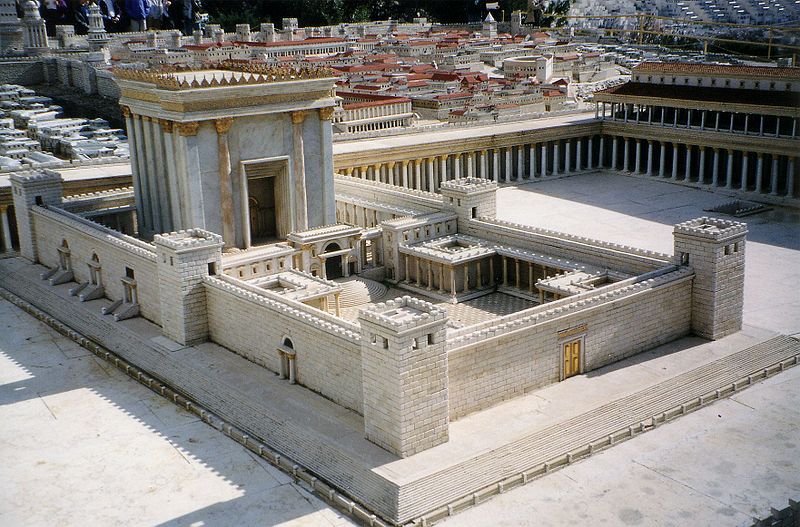
Model of the Second Temple; Source: http://en.wikipedia.org/wiki/File:Jerus-n4i.jpg

Do we know from history that this temple, the same temple the disciples observed, was destroyed? Yes, we do. Josephus, the Jewish historian, for example, records in astounding detail how Jerusalem and the temple were destroyed in 70 AD after a horrendous 5-month siege (see here, here, and here to learn more about what happened). According to both Mark and Luke, the signs that Jesus gave in the next 25 verses (in Luke’s case) and the next 26 verses (in Mark’s case) were to precede the downfall of the temple. In the next couple of posts, we will look at those prophesied signs, which include earthquakes and other calamities. Many today are saying that these same prophesied signs are happening in our own day, and that this means we are only now about to see Jesus’ prophecies fulfilled. How can this be, though, if they were to happen before a prophesied event which we know took place 1,941 years ago?

Only in Matthew’s account do the disciples perhaps appear to ask two additional questions: [1] about Jesus’ coming and [2] about “the end of the age.” For those who believe that Matthew 24 has yet to be fulfilled, it’s often these questions which are said to indicate a required future fulfillment, despite the fact that they don’t even appear in Mark’s and Luke’s parallel accounts. It’s common these days to see a division of questions, as if the disciples asked about the near future as well as the very distant future, but as this study continues we’ll see that it wasn’t so common in earlier church history. Thomas Newton, a well-known English cleric, scholar, and author, said the following in 1754 about this passage:

‘The coming of Christ,’ and ‘the conclusion of the age,’ being therefore only different expressions to denote the same period with the destruction of Jerusalem, the purpose of the question plainly is, when shall the destruction of Jerusalem be, and what shall be the signs of it?

Background to Jesus’ Promised Coming: Matthew 10:23 and 16:27-28

What prompted the disciples to ask about Jesus’ coming, especially in the context of what He said about the temple’s impending destruction? Where had Jesus previously spoken of His coming, and what had He said about this event? Jesus had in fact spoken of His coming twice already in Matthew’s account. In Matthew 10:23, Jesus made this very interesting statement: “When they persecute you in one town, flee to the next, for truly, I say to you, you will not have gone through all the towns of Israel before the Son of Man comes.”[i] During the next couple of decades after Jesus said this, we can see numerous examples of Jesus and His followers doing this very thing (e.g. Matthew 12:14-15, Acts 8:1, Acts 9:23-25, Acts 9:29-30, Acts 14:5-6, Acts 17:4-10, Acts 17:13-14).

In Matthew 16:27-28, He was even more descriptive about what His coming would accomplish, and within what timeframe it would take place: “For the Son of Man is going to come with His angels in the glory of His Father, and then He will repay each person for what he has done. Truly, I say to you, there are some standing here who will not taste death until they see the Son of Man coming in His kingdom.”

If this statement was fulfilled in His transfiguration six days later, as some contend, in what sense did Jesus “come with His angels” then and repay each person according to what he had done (a clear picture of judgment)? We know this didn’t happen on that occasion. We also know that none of His disciples died within those six days, but some were indeed martyred before 70 AD when Jerusalem and the temple were destroyed. To believe that Jesus hasn’t yet (in the year 2011) come back as He promised in this passage is to believe either that [a] He lied or [b] there are 2000 year old men still walking around on this planet.[ii] Let’s look at four aspects of this promised coming, as this should help us to know what was in the minds of Jesus’ disciples when they asked Him about His coming in Matthew 24:3.

1. IN HIS KINGDOM: From this text, we know that one purpose for His coming, which He promised would take place before all of His disciples had died, was to establish His kingdom. This fits perfectly with the following prophecy given to Daniel: “And in the days of those kings* the God of heaven will set up a kingdom that shall never be destroyed, nor shall the kingdom be left to another people” (Daniel 2:44). [*Biblical scholars hold a virtual consensus that the four kingdoms in Daniel’s vision were Babylon, Medo-Persia, Greece, and Rome. Since Rome was destroyed in 476 AD, we know that, for this prophecy to be true, the kingdom was set up before that time.] A first century fulfillment fits; a 21st century fulfillment doesn’t. Furthermore, the kingdom was to be given to the saints (Daniel 7:18, 22, 27). This is reminiscent of Jesus’ words in the Parable of the Tenants that the kingdom of God would soon be taken away from the Jewish leaders and their nation and given instead “to a people producing its fruits” (Matthew 21:43) – a clear description of the body of Christ. This was to happen even as the stone was to crush those who would fall (verse 44) – 1.1 million Jews killed in August/September 70 AD by the Romans would seem to qualify as a fulfillment of this prediction.

2. TO REPAY EACH PERSON: The context of Jesus’ promise to come “to repay each person” for what they had done was His foretelling of His own death and suffering at the hands of the Jewish leaders (Matt. 16:21-23), and also of the suffering that His own disciples could expect (verses 24-26). In other words, it would be for vindication. This is similar in nature to what Paul promised to the Thessalonian believers when he told them that they could expect relief “when the Lord Jesus is revealed from heaven with His mighty angels in flaming fire, inflicting vengeance” (II Thessalonians 1:7), with the purpose being “to repay with affliction those who afflict you” (verse 6). This was imminent in their day, for Paul said that the wrath of God had already come upon the Jewish persecutors (I Thess. 2:14-16). He knew this to be true because Jesus had declared in no uncertain terms (Matthew 23:35-36) that the blood of all the prophets would be required of His own (first century) generation in Israel.

3. WITH HIS ANGELS: Just like Paul’s prophecy to the Thessalonians, Jesus’ promise to come while some of His disciples were still alive (Matt. 16:28) was also to involve His angels (“The Son of Man is going to come with His angels…”). As my good friend, Mark Church, has pointed out, all throughout the book of Revelation we see His angels pouring out judgment upon “the great city” where the Lord was crucified (Revelation 11:8) – that is, Jerusalem, the same city which was marked as a harlot because of its shedding of the blood of the saints and martyrs (Rev. 17:1-6), apostles, and prophets (Rev. 18:20-24). [For those who believe that Revelation remains unfulfilled, is there any modern nation or entity which is responsible for the martyrdom of the apostles?]

4. IN THE GLORY OF HIS FATHER: Jesus also promised to come “in the glory of His Father” (Matt. 16:27). As Don Preston well points out, this can be understood to mean that just as the Father had come in the past, Jesus would also come in the same manner. Don gives as an example Isaiah 64:1-3, where the writer declares that God had “come down” numerous times in the past:

“Oh, that You would rend the heavens and come down, that the mountains might quake at Your presence – as when fire kindles brushwood, and the fire causes water to boil – to make Your name known to Your adversaries, and that the nations might tremble at Your presence! When You did awesome things that we did not look for, You came down, the mountains quaked at Your presence.”

Just as the Father’s comings in times past had not been bodily, visible, or physical in nature, neither would the coming of Jesus in judgment be bodily, visible, or physical. We will discuss this in more depth when we come to Jesus’ predicted coming in the clouds in Matt. 24:30/Mark 13:26/Luke 21:27. We will see that there are numerous examples in the Old Testament where God is said to have come in the clouds in judgment upon various nations and enemies of His people, even examples where the language is remarkably similar to the language used in The Olivet Discourse.

So we can see from these two passages (Matt. 10:23 and 16:27-28) why Jesus’ disciples expected Him to come again in their own lifetimes. We’re also beginning to see why, in Matthew 24:3, they linked this coming to His dark prediction about the temple’s future. Other strong clues also exist in the previous two chapters (Matthew 22-23).[iii] Kevin Daly, from the South African ministry “Messianic Good News,” has this to say:

It is Jesus’ confirmation that the Temple’s fate is sealed that leads to the disciples’ question: ‘When will this happen, and what will be the sign of your coming and of the end of the age?’

Some argue this to be three separate questions – so that Jesus’ answer in the subsequent verses must be unraveled and applied to three different events, namely (i) the temple’s destruction, (ii) his coming and (iii) the end of the age. But this is not supported by the parallel accounts in Mark’s and Luke’s gospels. These render the disciples’ question as follows:

‘Tell us, when will these things happen? And what will be the sign that they are all about to be fulfilled?’ (Mark 13:4)

‘Teacher,’ they asked, ‘when will these things happen? And what will be the sign that they are about to take place?’ (Luke 21:7)

In Matthew’s wording of the disciples’ question, what Jesus prophesied against the Temple would, by implication, happen at our Lord’s coming in judgment and would also, by further implication, bring about the end of that age.

Matthew phrases the question in the prophetic language of the Old Testament, which was familiar to the Jewish audience for which his gospel was written. In this language, the execution of Divine judgment was commonly spoken of as a visitation of the LORD, as either His coming or His coming in the cloud. [Consider] Micah’s prophecy against the ‘high places’ of Judah – being localities of false worship, which the Temple in Jerusalem had now become:

‘For behold, the LORD comes forth from His place, and will come down, and tread upon the high places of the earth. And the mountains shall be melted under Him, and the valleys shall be cleft, as wax before the fire, and as the waters that are poured down a steep place. For the transgression of Jacob is all this, and for the sins of the house of Israel  …  What are the high places of Judah? Are they not Jerusalem?’ (Micah 1:3-5).

Source: Kevin Daly, When Will These Things Happen – Matthew 24 and the Vindication of Messiah. 2009.

Micah’s prophecy was fulfilled in 586 BC when Jerusalem fell to the Babylonian armies. We know that God didn’t physically and bodily come down at that time, but He did still “come down” in judgment in fulfillment of this prophecy. It’s this same apocalyptic language that Matthew uses to speak of another and more final judgment which was about to come once again upon Jerusalem. History tells us that it did come. Some readers may be surprised to know that Jonathan Edwards (1703-1758), who preached the famous sermon “Sinners in the Hands of An Angry God,” once made this statement in his work titled “Miscellany #1199”:

“Tis evident that when Christ speaks of his coming; his being revealed; his coming in his Kingdom; or his Kingdom’s coming; He has respect to his appearing in those great works of his Power Justice and Grace, which should be in the Destruction of Jerusalem and other extraordinary Providences which should attend it [So in Luke 17:20 – 18:8].”

The way that the Olivet Discourse is popularly approached today has Jesus effectively saying this to His disciples: “You guys have asked a very interesting question about when this temple will be destroyed, but let Me ignore your question and tell you instead about some events which will begin and end about 2000 years in the future.” Rather than being about us, and our generation, Jesus addressed the concerns of His disciples regarding their own generation.

THE END OF THE AGE

Having now given considerable space to the question of Christ’s coming, we’ll give only brief space here to the disciples’ question about the end of the age. The King James Version used the expression “the end of the world” in Matthew 24:3, but most newer translations use the expression “the end of the age.” Clearly, Jesus tied the end of the age that they were speaking of to the time of His coming, which we have seen was promised to occur in their own generation.

Therefore, the disciples weren’t asking about the final days of this planet. Their question was about the end of the Old Covenant age. That age came to an end along with the destruction of the temple in 70 AD. This “end” was spoken of by Daniel and other Old Testament prophets. The book of Hebrews even speaks of the Old Covenant “becoming obsolete and growing old…ready to vanish away” (Hebrews 8:13). It vanished along with the temple. We are now in what the New Testament frequently called “the age to come.” A great transition took place a long time ago, and we are privileged to live in the New Covenant age. The heavenly Jerusalem is a present reality for God’s people (Hebrews 12:22-24). Regarding “the end” spoken of in both Matthew and Daniel, Kevin Daly provides this helpful chart:

you will hear of wars and rumours of wars … but the end is not yet

war will continue until the end

and there will be famines and pestilences and earthquakes in different places

and desolations have been decreed

 then the end will come

the end will come like a flood:

 Matthew 24:6,14

Dan 9:26b

“The end” spoken of in Daniel’s prophecy was clearly to be the destruction of “the city and the sanctuary” (Daniel 9:26). We know as an indisputable fact of history that Jerusalem and the temple were destroyed in 70 AD. That brought about the end of an age, the Old Covenant age. It is popularly taught today that we are living in what the Bible calls “the last days,” and that these last days began on the Day of Pentecost because of Peter’s reference to Joel’s prophecy about an outpouring in “the last days.” However, this cannot be true, because Hebrews 1:1-3, Hebrews 9:26, and I Peter 1:18-20 tell us explicitly that Jesus’ incarnational ministry took place in the last days. Therefore, Jesus appeared and ministered in the last days of an age that had clearly begun quite some time before He appeared. That age still had not ended when Paul wrote his epistle to the Corinthian church, but it was drawing even closer to the end, for he told his readers that they were those “on whom the end of the ages has come” (I Corinthians 10:11).

Rather than open this up further, or to try to defend this premise in greater depth here, I’d like to point to an earlier post on this subject which I believe you’ll find to be a good explanation of these things (HERE). You’ll see that the New Testament placed Jesus’ ministry, death, etc. in “the last days” and at “the end of the age,” and that after Jesus’ ascension the apostles still spoke of their time in the same terms. Jerry William Bowers Jr. has also compiled a very informative article, based on David Green’s 101 Time Statements showing that John the Baptist, Jesus, and the early church were not only consistent, but also correct, when they repeatedly stated that certain events were near, at hand, about to take place, etc. That article can be seen (HERE).

In the next post, we will look at the beginning of Jesus’ reply to the disciples’ question about the signs which would lead to the destruction of the temple, His coming, and the end of the age. We will examine Matthew 24:4-14, Mark 13:5-13, and Luke 21:8-18 side-by-side.

———————————————————————————————————————————-

A THOUGHT: Do you find it interesting that John, in his gospel account, omits the Olivet Discourse entirely, even though he was no doubt present when Jesus spoke these things? One likely reason for this curious fact is that the book of Revelation, which he authored, actually functions as his exposition of the Olivet Discourse, though in much greater detail. Therefore, he felt no need to include the Olivet Discourse passage in his gospel account, especially if the book of John was written after the book of Revelation.

QUOTES TO NOTE

Eusebius (314 AD): “If any one compares the words of our Saviour with the other accounts of the historian (Josephus) concerning the whole war, how can one fail to wonder, and to admit that the foreknowledge and the prophecy of our Saviour were truly divine and marvelously strange” (Proof of the GospelBook III, Ch. VII).

John Wesley (1703-1791): “Josephus’ History of the Jewish War is the best commentary on this chapter (Matt. 24). It is a wonderful instance of God’s providence, that he, an eyewitness, and one who lived and died a Jew, should, especially in so extraordinary a manner, be preserved, to transmit to us a collection of important facts, which so exactly illustrate this glorious prophecy, in almost every circumstance” (Explanatory Notes Upon the New Testament, 1754).

——————————————————————————————————————————————————————————————-


[i] John Wesley (1703-1791) is one of many in church history who taught that Jesus was referring in Matt. 10:23 to a judgment coming in 70 AD in which He would “destroy their temple and nation” (John Wesley, Explanatory Notes Upon the New Testament, 1754).

[ii] John Wesley, again, is one of many in church history who taught a 70 AD fulfillment of Matthew 16:27-28, saying, “For there is no way to escape the righteous judgment of God. And, as an emblem of this, there are some here who shall live to see the Messiah coming to set up His mediatorial kingdom with great power and glory, by the destruction of the temple, city, and polity of the Jews” (John Wesley, Explanatory Notes Upon the New Testament, 1754). Some believe this is also identical to the prophecy Jesus gave in Revelation 22:12, revealing why John’s 1st century audience was to understand that He was about to come: “Behold, I am coming soon, bringing My recompense with Me, to repay everyone for what he has done.”

[iii] In Matthew 22:1-14 we read the Parable of the Wedding Feast. In this parable, speaking of the kingdom of heaven (vs. 2), a king (God) was to prepare a wedding feast for his son (Jesus), but those who were originally invited (the Jewish nation) refused to come (vss. 3-5) and even killed the king’s servants who had invited them (v. 6). Therefore, these murderers were destroyed (cf. Matthew 23:29-38; Rev. 16:4-7, 17:6, 18:20, 18:24), and their city was burned (cf. Rev. 18:8-10, 18; 19:3). This is precisely what we see having happened in Jerusalem’s destruction and burning in 70 AD. The invitation then goes out to others (Gentiles as well as Jews; vss. 9-10), but only those with proper wedding garments were allowed to remain (vss. 10-14; cf. Rev. 19:8). Those who lacked these garments remained in outer darkness and were not part of the chosen people of God (vss. 13-14; cf. Matt. 8:11-12).

In Matthew 23:29-38, we see that in the 7th woe pronounced upon the Scribes and Pharisees, Jesus charges them with shedding the blood of all the prophets (vss. 29-31). He even says that they will kill, crucify, flog, and persecute others from town to town (verse 34). As a result, He says, they would be held responsible for all the shed blood from generations past up until their own generation. He concludes, “Truly, I say to you, all these things will come upon this generation” (verse 36). He then lifts up a lament for Jerusalem, whose house, He said, was left to them desolate. This would naturally remind His listeners of Daniel 9:26, where it was said that “the city and the sanctuary” would be destroyed, with desolations decreed. The expected timeframe for this judgment was “this generation” (Jesus’ first century audience).

A Discussion of Two Ages: “This age and the age to come”


A Discussion of Two Ages

Adam Maarschalk: April 10, 2010

Readers familiar with the New Testament will recall that there are two ages frequently spoken of within its pages. NT writers spoke often of “this present age,” i.e. an age that was present in their day. Is this same age still present in our day? Interpreters are divided on this point. The way one answers this question has a significant bearing on one’s eschatology. The well-known and well-respected Puritan theologian Dr. John Owen (1616-1683) would have answered “no” to this question, which would have put him in the minority if he was living today. This is what he once said on this matter:

Most expositors suppose that this expression [In Hebrews 1:2], “The last days,” is a periphrasis [euphemism] for the times of the gospel. But it doth not appear that they are anywhere so called; nor were they ever known by that name among the Jews, upon whose principles the apostle proceeds… It is the last days of the Judaical church and state, which were then drawing to their period and abolition, that are here and elsewhere called “The last days,” or “The latter days,” or “The last hour,” 2 Peter 3:31 John 2:18Jude 1:18… This phrase of speech is signally used in the Old Testament to denote the last days of the Judaical church (John Owen, The Works of John Owen, Volume 19, pp.12 – 13).

Source: David Duncan (Facebook)

Source: David Duncan (Facebook)

This topic was broached briefly during the “Evening of Eschatology” forum moderated by Pastor John Piper in September 2009, and the division between the forum members was evident. Here in this post I will only be presenting one point of view, the same view that John Owen held to. Do feel free, though, to take up this discussion in the “Comments” section below this post, and even to point out any other well-written articles taking up an alternative position.

The bulk of what follows is an article on this subject by Pastor David B. Curtis, based on a message he preached March 14, 1999 at Berean Bible Church in Chesapeake, Virginia. This discussion has a bearing not only on our study of Revelation 20, but also our study of Revelation 21 which will be posted soon. David draws on a large number of texts which refer to “this age and the age to come” and other similar language used in the New Testament. His premise is that we are living in the New Covenant age (which the New Testament often called “the age to come”), and that the previous age, i.e. the Judaic or Old Covenant age, came to an end in 70 AD when Jerusalem and the temple were destroyed. I chose to highlight David’s article because I don’t know that I’ve seen a more thorough or well put-together discussion on this subject. I will only be quoting from the portion of his article which discusses this dichotomy of two ages.

Curtis begins his article by asking whether or not the Bible teaches that this world will end. This is beyond the scope of our discussion here, but one relevant point he does make early in his article is that passages like Matthew 13:40 (and Matt. 24:3) have often been taken to refer to the end of world history when in fact they do not. In the King James Version, Matt. 13:40 reads: “As therefore the tares are gathered and burned in the fire; so shall it be in the end of this world.” However, “world” here is [perhaps not so correctly] translated from the Greek word “aion” which means “age, dispensation, era, or a period of time.” Newer translations do in fact implement this change, such as the New King James Version: Therefore as the tares are gathered and burned in the fire, so it will be at the end of this age.” Clearly Jesus was living in the age He was speaking of, which Curtis believes (and I agree) ended in 70 AD with the destruction of Jerusalem and the Second Temple.

Curtis goes on to show that the end of that age was connected to the destruction of the temple in Jesus’ famous sermon known as the Olivet Discourse (see especially Matt. 24:3, Mark 13:4, and Luke 21:7). For the sake of space I will only sum up Curtis’ closing thoughts regarding the Olivet Discourse (but one may follow the link in the paragraph above to see all that he had to say):

[The disciples’] question was, “When will the end be?” …Jesus tells them quite clearly that the end would come in “this generation” (v 34). The word “generation” means: “those who are contemporaries or live at the same time.” So, the age that was to end was the Jewish age. It would end with the destruction of the Jewish temple and the city Jerusalem. The end of the age did not happen at the cross or at Pentecost but at the destruction of Jerusalem. The world was not going to end but the age of Judaism was. The disciples knew that the fall of the temple and the destruction of the city meant the end of the Old Covenant age and the inauguration of a new age.

As far as I know, this understanding that 70 AD was a dividing point between two ages is not at all consistent with most Futurist and premillennial ideas. Even some preterists, though, would articulate Curtis’ thoughts just a little bit differently. For example, when reviewing the “Evening of Eschatology” hosted by John Piper (video included), I noted this observation from one partial-preterist:

Doug Wilson made the point that the years 30-70 AD were the overlapping of two ages, the Judaic (Old Covenant) age and the Christian (Church) age. He likened this transition to the passing of a baton between two runners, where the first runner keeps running alongside the second runner for some distance, before completely letting go of the baton and giving way to the second runner. One relevant text for this idea is Hebrews 8:13. Doug noted that the Christian age began at Pentecost, but the Judaic age only ended 40 years later with the destruction of the Jerusalem temple in 70 AD (See the video, roughly from the 18:30-22:00 mark).

Source: Cindye Coates, The Porch

So Doug Wilson speaks of the Church age beginning at Pentecost, while David Curtis speaks of it being inaugurated a generation later in 70 AD. Perhaps this is a small distinction, for I know that some preterists will say, for example, that in 70 AD the Church age “carried on exclusively, no longer encumbered by Old Covenant Judaism.” With that caveat out of the way, I’d like to come back now to the article by David Curtis and quote a sizeable portion from it regarding these two ages:

This brings us to a very important question, “HOW MANY AGES ARE THERE? William Barclay says: “Time was divided by the Jews into two great periods– this present age, and the age to come. The present age is wholly bad and beyond all hope of human reformation. It can be mended only by the direct intervention of God. When God does intervene, the golden age, the age to come, will arrive. But in between the two ages there will come the Day of the Lord, which will be a time of terrible and fearful upheaval, like the birth-pangs of a new age.”

Zechariah 14 teaches us that the “Day of the Lord” and the destruction of Jerusalem were connected. So, the destruction of Jerusalem, which was the Day of the Lord, marked the end of one age, the Jewish age, and the beginning of the new age, the Christian age of the New Covenant.

To the Jews, time was divided into two great periods, the Mosaic Age and the Messianic Age. The Messiah was viewed as one who would bring in a new world. The period of the Messiah was, therefore, correctly characterized by the Synagogue as “the world to come.” All through the New Testament we see two ages in contrast: “This age” and the “age to come.”

Matthew 12:32 (NKJV) “Anyone who speaks a word against the Son of Man, it will be forgiven him; but whoever speaks against the Holy Spirit, it will not be forgiven him, either in this age or in the age to come.

The word “come” at the end of the verse is the Greek word mello, which means: “about to be.” We could translate this, the “age about to come” (in the first century). Many think that the age to come will be a sinless age; not according to this verse. Sin against the Holy Spirit will not be forgiven in that age, referring to the age of the New Covenant, our present age. We see here that both of these ages have sin in them.

Ephesians 1:21 (NKJV) far above all principality and power and might and dominion, and every name that is named, not only in this age but also in that which is to come.

Here again we see the two ages. So, the New Testament speaks of two ages, “this age” and “the age to come.” The understanding of these two ages and when they changed is fundamental to interpreting the Bible.

Let’s see what the New Testament teaches us about these two ages. Questions that we need to try to answer are: What age did the new testament writers live in? What age do we live in? How is ‘this age” characterized in the New Testament? What does the New Testament say about “the age to come”? When does “this age” end and “the age to come” begin?

WHAT AGE DID THE NEW TESTAMENT WRITERS LIVE IN?

The New Testament writer lived in the age that they called “this age.” To the New Testament writers the “age to come” was future, but it was very near because “this age” was about to end.

1 Corinthians 2:6-8 (NKJV) However, we speak wisdom among those who are mature, yet not the wisdom of this age, nor of the rulers of this age, who are coming to nothing. 7 But we speak the wisdom of God in a mystery, the hidden wisdom which God ordained before the ages for our glory, 8 which none of the rulers of this age knew; for had they known, they would not have crucified the Lord of glory.

The wisdom and rulers of “this age” were coming to nothing because the age was passing away. He is speaking of the Jewish leaders and the Old Covenant system. The rulers of “this age” crucified the Lord. These rulers would shortly have no realm in which to rule because “this age” was about to end. Think about this. If the Jewish age ended at the cross, as so many claim, why were they still ruling the age?

1 Corinthians 10:11 (NKJV) Now all these things happened to them as examples, and they were written for our admonition, upon whom the ends of the ages have come.

Paul said very plainly that the end of the ages was coming upon them, the first century saints. “This age,” along with its wisdom and rulers, was about to end.

Hebrews 1:1-2 (NKJV) God, who at various times and in various ways spoke in time past to the fathers by the prophets, 2 has in these last days spoken to us by His Son, whom He has appointed heir of all things, through whom also He made the worlds;

Jesus was speaking in the last days. What last days? The last days of the Bible’s “this age” — the Old Covenant age.

Hebrews 9:26 (NKJV) He then would have had to suffer often since the foundation of the world; but now, once at the end of the ages, He has appeared to put away sin by the sacrifice of Himself.

When was it that Jesus appeared? He was born, not at the beginning, but at the end of the ages. To suppose that he meant that Jesus’ incarnation came near the end of the world would be to make his statement false. The world has already lasted longer since the incarnation than the whole duration of the Mosaic economy, from the exodus to the destruction of the temple. Jesus was manifest at the end of the Jewish age. Peter says the same thing.

1 Peter 1:20 (NKJV) He indeed was foreordained before the foundation of the world, but was manifest in these last times for you.

Jesus came during the last days of the age that was the Old Covenant age, the Jewish age. That age came to an end with the destruction of the temple in AD 70. All the things prophesied by Jesus in Matthew 24 occurred at the end of that age. Alright, so the New Testament writers lived in what the Bible calls “this age.”

HOW IS “THIS AGE” CHARACTERIZED IN THE NEW TESTAMENT?

1. It is an evil age:

Galatians 1:3-4 (NKJV) Grace to you and peace from God the Father and our Lord Jesus Christ, 4 who gave Himself for our sins, that He might deliver us from this present evil age, according to the will of our God and Father,

Paul says here that the “present age” which is “this age,” the one that was about to pass away, is an “evil” age. Christ came to deliver them from the “present age” because it was evil. Could “evil age” be referring to Christianity? Could the Christian age be called an “evil age” that we need to be delivered from? No! Christ came to bring us out of the evil age and place us into His kingdom.

2. It was an age of darkness:

Colossians 1:12-13 (NKJV) giving thanks to the Father who has qualified us to be partakers of the inheritance of the saints in the light. 13 He has delivered us from the power of darkness and conveyed us into the kingdom of the Son of His love,

Christ came to deliver them from the “power of darkness.” This is a reference to the Old Covenant or “this age.”[1]

John 8:12 (NKJV) Then Jesus spoke to them again, saying, “I am the light of the world. He who follows Me shall not walk in darkness, but have the light of life.”

Jesus was speaking to the Jews, He was calling them to leave the darkness of the Old Covenant and follow Him.

3. It was an age in which Satan ruled.

Acts 26:18 (NKJV) ‘to open their eyes, in order to turn them from darkness to light, and from the power of Satan to God, that they may receive forgiveness of sins and an inheritance among those who are sanctified by faith in Me.’

The “present age” was one of darkness. Satan is called the god of “this age.”

2 Corinthians 4:3-4 (NKJV) But even if our gospel is veiled, it is veiled to those who are perishing, 4 whose minds the god of this age has blinded, who do not believe, lest the light of the gospel of the glory of Christ, who is the image of God, should shine on them.

Remember “this age” is not referring to our age, it was the “this age” of the first century. Satan ruled in the Old Covenant world of Judaism but his reign was shortly (in the first century) to come to an end.

Romans 16:20 (NKJV) And the God of peace will crush Satan under your feet shortly. The grace of our Lord Jesus Christ be with you. Amen.

Satan would be crushed when the “present age” of darkness came to an end. When John wrote his first epistle he said that the darkness was passing.

1 John 2:8 (NKJV) Again, a new commandment I write to you, which thing is true in Him and in you, because the darkness is passing away, and the true light is already shining.

The “darkness” is speaking of the Old Covenant age, and the “true light” is speaking of the New Covenant age.

4. It was an age of death and condemnation.

2 Corinthians 3:5-11 (NKJV) Not that we are sufficient of ourselves to think of anything as being from ourselves, but our sufficiency is from God, 6 who also made us sufficient as ministers of the new covenant, not of the letter but of the Spirit; for the letter kills, but the Spirit gives life. 7 But if the ministry of death, written and engraved on stones, was glorious, so that the children of Israel could not look steadily at the face of Moses because of the glory of his countenance, which glory was passing away, 8 how will the ministry of the Spirit not be more glorious? 9 For if the ministry of condemnation had glory, the ministry of righteousness exceeds much more in glory. 10 For even what was made glorious had no glory in this respect, because of the glory that excels. 11 For if what is passing away was glorious, what remains is much more glorious.

Here Paul is comparing the two Covenants, the Old Covenant was one of death and condemnation, but the New Covenant was one of life and righteousness. When Paul wrote this to the Corinthians, the Old Covenant age, the “present age,” was in the process of passing away.

Paul spoke to the Galatians about these two covenants and said that the Old Covenant was at that time in effect.

Galatians 4:21-26 (NKJV) Tell me, you who desire to be under the law, do you not hear the law? 22 For it is written that Abraham had two sons: the one by a bondwoman, the other by a freewoman. 23 But he who was of the bondwoman was born according to the flesh, and he of the freewoman through promise, 24 which things are symbolic. For these are the two covenants: the one from Mount Sinai which gives birth to bondage, which is Hagar; 25 for this Hagar is Mount Sinai in Arabia, and corresponds to Jerusalem which now is, and is in bondage with her children; 26 but the Jerusalem above is free, which is the mother of us all.

Hagar, represented both the Old Covenant and the Jerusalem that “now is” (the Old was still present at that time), and Sarah represented both the New Covenant and the New Jerusalem that was “above” (it was still to come).

5. It was an age that was called “night.”

Romans 13:11-12 (NKJV) And do this, knowing the time, that now it is high time to awake out of sleep; for now our salvation is nearer than when we first believed. 12 The night is far spent, the day is at hand. Therefore let us cast off the works of darkness, and let us put on the armor of light.

Their salvation was drawing near, and the night was just about over. Is the Christian age day or night? It is day! The night of Old Covenant Judaism was just about to end, the day of the New Covenant, the Christian age, was just about to dawn.

1 Thessalonians 5:1-4 (NKJV) But concerning the times and the seasons, brethren, you have no need that I should write to you. 2 For you yourselves know perfectly that the day of the Lord so comes as a thief in the night. 3 For when they say, “Peace and safety!” then sudden destruction comes upon them, as labor pains upon a pregnant woman. And they shall not escape. 4 But you, brethren, are not in darkness, so that this Day should overtake you as a thief. 5 You are all sons of light and sons of the day. We are not of the night nor of darkness.

Paul told the Thessalonian Christians that they were not in darkness, they were sons of light and sons of the day that was about to dawn.

So, “this age” of the Bible is the age of the Old Covenant that was about to pass away in the first century. It was characterized as evil, darkness, Satan’s rule, condemnation, death, and night. It should be clear to you that “this age” is not the Christian age in which we live. In the first century the age of the Old Covenant was fading away and would end completely when the temple was destroyed in AD 70.

Hebrews 8:13 (NKJV) In that He says, “A new covenant,” He has made the first obsolete. Now what is becoming obsolete and growing old is ready to vanish away.

The book of Hebrews was written at around 65-69 AD. At this time the Old Covenant was still in effect but it was ready to pass away. It passed away in AD 70 in the destruction of Jerusalem. The “this age” of the Bible is now ancient history.

 I will conclude with these words from David Curtis:

We now live in what was to the first century saints the “age to come.” When most Christians read in the New Testament and see the words “the age to come,” they think of a yet future (to us) age. But the New Testament writers were referring to the Christian age. We live in what was to them the “age to come,” the New Covenant age. Since the “present age” of the Bible ended in AD 70 with the destruction of the temple and the coming of the Lord, we must be in the “age to come.”

David Green, who shares this same viewpoint, has listed 101 Scripture passages from the New Testament which indicate that a very significant event (or series of events) was about to take place in the days of the early Church. The study he has presented is valuable in seeing how frequent this language is in the New Testament, and what was to take place not in the 21st century (or beyond) but at that time.

————————————————————————————————————

All of our Revelation chapter-by-chapter studies, and any other posts related to the book of Revelation, can be found here.

All of our studies on Revelation 20 and the Millennium can be found here.

We are now ready to move on in our study of the book of Revelation to Revelation 21, where John presents his readers with a picture of the New Jerusalem coming down out of heaven.


[1] Another text that gives credence to this idea is Matthew 22:1-14, the Parable of the Wedding Feast. In this parable, speaking of the kingdom of heaven (vs. 2), a king (God) was to prepare a wedding feast for his son (Jesus), but those who were originally invited (the Jews) refused to come (vss. 3-5) and even killed the king’s servants who had invited them (v. 6). Therefore, these murderers were destroyed (cf. Matthew 23:29-38; Rev. 16:4-7, 17:6, 18:20, 18:24), and their city was burned (cf. Rev. 18:8-10, 18; 19:3). This is precisely what we see having happened in Jerusalem’s destruction and burning in 70 AD. The invitation then goes out to others (Gentiles as well as Jews; vss. 9-10), but only those with proper wedding garments were allowed to remain (vss. 10-14; cf. Rev. 19:8). Those who lacked these garments remained in outer darkness and were not part of the chosen people of God (vss. 13-14; cf. Matt. 8:11-12).

Revelation 20: Four Views of Gog and Magog


Revelation 20: Four Views of Gog and Magog

Adam Maarschalk: April 5, 2010

Scripture texts for this study: Ezekiel 38-39; Revelation 20:7-10

Gog and Magog are referenced together twice in Scripture by name, first in Ezekial 38-39 and very briefly in Revelation 20. A third related passage is Revelation 19:17-18, where Gog and Magog are not mentioned by name but the language there appears to be borrowed from Ezekiel’s prophecy. How are Gog and Magog to be identified? The battle prophesied in Ezekiel, in particular, has merited much speculation among prophecy pundits. I would like to discuss four different interpretations for the references to Gog and Magog by both Ezekiel and John (Rev. 20). The following are some questions/factors to consider as we do so:

  1. Does John (in Rev. 19 or Rev. 20) refer to the same historical event as Ezekiel does, or is the battle described by Ezekiel merely a precedent for the battles John is describing?
  2. Is the book of Ezekiel written in a chronological manner, so that the chapters which come before this battle description (e.g. chapters 36-37) and those which follow it (chapters 40-48) suggest the timing of this battle’s occurrence?
  3. The battle described in Rev. 20:7-10 takes place “when the thousand years are ended,” i.e. at the end of the Millennium. One’s eschatological system, therefore, is a large factor in determining when this battle takes place. For Futurists and premillennialists, it will take place 1000 years after the future Second Coming of Christ. For amillennialists and for postmillennialists, it will take place sometime in the future, but before the Second Coming of Christ, since we are in the Millennium now. For full-preterists (those who believe in the past fulfillment of all Bible prophecy), it took place in or just before 70 AD.

The four interpretations we will consider[1] are these:

[A] The position of partial-preterists David Lowman and Gary DeMar that Ezekiel’s prophecy was fulfilled in Esther’s day. For this position, the battles of Ezekiel 38-39 and Revelation 20 are not one and the same.

[B] Partial-preterist Kenneth Gentry’s position that Ezekiel 38-39 was likely fulfilled in the second century BC, and its imagery is used by John to foreshadow the events of Revelation 19:11-21 and Revelation 20:8-10. For this position, the battles of Ezekiel 38-39 and Revelation 20 are not one and the same (nor are the battles of Rev. 19 and Rev. 20).

[C] The popular Futurist/premillennial position, which says that Ezekiel prophesied of a Russian-led attack on national Israel which is very soon to take place, and that John prophesied of an attack on the literal city of Jerusalem at the end of a future 1000-year Millennium. For this position, the battles of Ezekiel 38-39 and Revelation 20 are not one and the same.

[D] Full-preterist Kurt Simmon’s position that Ezekiel 38-39 was a prophecy concerning Rome’s invasion of Jerusalem in 70 AD, as was John’s prophecy in Revelation 20. Clearly, then, for this position, the battles of Ezekiel 38-39 and Revelation 20 ARE indeed one and the same.

After each position is presented, I will offer some pros and cons as I see them (i.e. as I see them at this time; these are not easy texts to interpret, and my views on this subject are not necessarily set in stone). For clarity, my pros and cons will be listed in red and green font, respectively. Feedback is welcome in the comments section.

[A] David Lowman and Gary DeMar: Ezekiel 38-39 Was Fulfilled in Esther’s Day

1. David Lowman’s View

David Lowman is a Presbyterian pastor, and a partial-preterist (one who sees a past fulfillment in many, but not all, Bible prophecies). In the first post in a brief 4-part series on this subject, David Lowman notes that many “prophecy experts…have over the years…promoted the idea that the names used for [Gog, Magog, and their allies] are related to current nations that will supposedly lead a multi-national conglomerate of nations preparing to attack Israel. Those names are Rosh, Meshech and Tubal.” In this thinking, Rosh is supposed to be Russia, Meshech to be Moscow, and Tubal to be Tobolsk. Lowman says that only the NASB (New American Standard Bible) uses the translation “Rosh” in the first place (having been translated by dispensationalists), but even futurists like Charles Ryrie disagree with this translation. He adds,

The term “Rosh” in Hebrew means “chief” or “leader” [and] is a Hebrew word. “Russia” comes from the 11th century Scandanavian word “Rus” and has no relation in root and etemology to the word “rosh.” It’s beyond a stretch of all credulity [to link the two]… “Meshach” and “Tubal” were actual city/nations before the time of Christ and were part of the larger Persian Empire. These words come from the Asiatic words “Mushka” and “Tabal” and they are both literal locations located in modern day Turkey and, again, have NO relation to the nation of Russia in any way. This is such poor exegesis and now many modern Dispensationalist have abandoned these claims, though the more popular prophecy experts still promote it.

In David Lowman’s second post, he makes the point that Ezekiel described a style of warfare that is very much ancient, and that the weapons he mentioned were made out of wood and thus able to be burned (Ezek. 38:4-5; 39:9). Many believe that Russia’s identity is confirmed because these armies were to come from the north (Ezek. 38:6, 15; 39:2), but Lowman notes that other significant invasions of Israel in the Old Testament were also from the north: [1] Babylon (Jeremiah 1:14, 4:6, 6:10, 10:22), Persia (Isaiah 41:25, Jer. 50:41), and Assyria (Zephaniah 2:13). Lowman then adds:

The truth of the matter is that nearly all attacks against Israel came from the north directionally speaking. The easiest way to travel to attack Israel would be from the North. As noted all the great enemies of Israel were from the East or West but their attacks all came from the North. This is also true in several instances in Ezekiel. There are several mentions of nation from the North attaching even though the nation of origin came from the East or West… The closest nation from a northern proximity to ever attack Israel would have been Rome, from across the Mediterranean Sea.

In Lowman’s third post, he agrees with Kenneth Gentry (as we will see) that the battle of Revelation 20, with its reference to Gog and Magog (verse 8), is only an allusion to the battle described in Ezekiel 38-39, but is not a reference to the same historical event.

In Lowman’s fourth post, he notes that many believe that “this event was fulfilled during the time of the Macabbean Revolt [during the second century BC]. This view argues that the enemy in question is Antiochus Epiphanies which would fit the Persian expectation and the worldwide expanse of the Persian empire at that time.” This doesn’t really fit, though, he says, because the Macabbean Revolt involved throwing off the rule of an occupying force after several years, while the attack in Ezekiel describes divine intervention at the time of an invasion.

Instead, Lowman submits that the fulfillment of Ezekiel 38-39 “is found during the time of Esther and involves the Israelite victory over Haman’s “schemes” and complete victory of the outmatched Israel forces.” In the second part of this section, Gary DeMar will expand on the idea that Ezekiel 38-39 was fulfilled in Esther’s day.

2. Gary DeMar’s View—Similar to That of David Lowman’s:

At the outset of Gary DeMar’s article, I would like to include a small disclaimer that I personally appreciate some of DeMar’s works more than others. I have read/skimmed excerpts from his books “Last Days Madness” and “Why the End of the World is Not in Your Future,” and appreciated what I read. In short, I have appreciated his articulation of the preterist viewpoint which I also share. However, I’m not on the same page when it comes to the Postmillennial position of his ministry, American Vision, as well as some of the political rants of AV which seem to follow in the vein of World Net Daily, a publication which I respect just about as much as I respect The National Enquirer. Having said that, DeMar’s article on Gog and Magog is quite thought-provoking:

…If the battle described in Ezekiel 38–39 does not refer to modern-day nations that will attack Israel, then when and where in biblical history did this conflict take place? Instead of looking to the distant future or finding fulfillment in a historical setting outside the Bible where we are dependent on unreliable secular sources, James B. Jordan believes that “it is in [the book of] Esther that we see a conspiracy to plunder the Jews, which backfires with the result that the Jews plundered their enemies. This event is then ceremonially sealed with the institution of the annual Feast of Purim.” Jordan continues by establishing the context for Ezekiel 38 and 39:

Ezekiel describes the attack of Gog, Prince of Magog, and his confederates. Ezekiel states that people from all over the world attack God’s people, who are pictured dwelling at peace in the land. God’s people will completely defeat them, however, and the spoils will be immense. The result is that all nations will see the victory, and “the house of Israel will know that I am the Lord their God from that day onward” (Ezek. 39:21–23). . . . Chronologically this all fits very nicely. The events of Esther took place during the reign of Darius, after the initial rebuilding of the Temple under Joshua [the High Priest] and Zerubbabel and shortly before rebuilding of the walls by Nehemiah. . . . Thus, the interpretive hypothesis I am suggesting (until someone shoots it down) is this: Ezekiel 34–37 describes the first return of the exiles under Zerubbabel, and implies the initial rebuilding of the physical Temple. Ezekiel 38–39 describes the attack of Gog (Haman) and his confederates against the Jews. Finally, Ezekiel 40–48 describes in figurative language the situation as a result of the work of Nehemiah.

Ezekiel 38:5–6 tells us that Israel’s enemies come from “Persia, Cush, and . . . from the remote parts of the north,” all within the boundaries of the Persian Empire of Esther’s day. From Esther we learn that the Persian Empire “extended from India to Cush, 127 provinces” in all (Esther 8:9). Ethiopia (Cush) and Persia are listed in Esther 1:1 and 3 and are also found in Ezekiel 38:5. The other nations were in the geographical boundaries “from India to Ethiopia” in the “127 provinces” over which Ahasueras ruled (Esther 1:1). “In other words, the explicit idea that the Jews were attacked by people from all the provinces of Persia is in both passages,” and the nations listed by Ezekiel were part of the Persian empire of the prophet’s day. The parallels are unmistakable. Even Ezekiel’s statement that the fulfillment of the prophecy takes place in a time when there are “unwalled villages” (Ezek. 38:11) is not an indication of a distant future fulfillment as Grant Jeffrey attempts to argue:

It is interesting to note that during the lifetime of Ezekiel and up until 1900, virtually all of the villages and cities in the Middle East had walls for defense. Ezekiel had never seen a village or city without defensive walls. Yet, in our day, Israel is a “land of unwalled villages” for the simple reason that modern techniques of warfare (bombs and missiles) make city walls irrelevant for defense. This is one more indication that his prophecy refers to our modern generation.

* * * * *

Ezekiel’s reference to “dwell safely” and “without walls . . . neither bars nor gates” refers precisely to Israel’s current military situation, where she is dwelling safely because of her strong armed defense and where her cities and villages have no walls or defensive bars. The prophet had never seen a city without walls, so he was astonished when he saw, in a vision, Israel dwelling in the future without walls. Ezekiel lived in a time when every city in the world used huge walls for military defense.

In Esther we learn that there were Jews who were living peacefully in “unwalled towns” (KJV) (9:19) when Haman conspired against them. Israel’s antagonists in Ezekiel are said to “go up against the land of unwalled villages” (Ezek. 38:11). The Hebrew word perazah is used in Esther 9:19 and Ezekiel 38:11. This fits the conditions of Esther’s day. Jeffrey is mistaken in his assertion that “Ezekiel had never seen a village or city without defensive walls.” They seemed to be quite common outside the main cities. Moreover, his contention that Israel is currently “dwelling safely because of her strong armed defense” is patently untrue. Since 2006, the Israeli government has built more than 435 miles of walls in Israel.

The chief antagonist of the Jews in Esther is Haman, “the son of Hammedatha the Agagite” (Esther 3:1, 10; 8:3, 5; 9:24). An Agagite is a descendant of Amalek, one of the persistent enemies of the people of God. In Numbers 24:20 we read, “Amalek was the first of the nations, but his end shall be destruction.” The phrase “first of the nations” takes us back to the early chapters of Genesis where we find “Gomer,” “Magog,” “Tubal,” and “Meshech,” and their father Japheth (Gen. 10:2), the main antagonist nations that figure prominently in Ezekiel 38 and 39. Amalek was probably a descendant of Japheth (Gen. 10:2). Haman and his ten sons are the last Amalekites who appear in the Bible. In Numbers 24:7, the Septuagint (LXX) translates “Agag” as “Gog.” “One late manuscript to Esther 3:1 and 9:24 refers to Haman as a ‘Gogite.’” Agag and Gog are very similar in their Hebrew spelling and meaning. Agagite means “I will overtop,” while Gog means “mountain.” In his technical commentary on Esther, Lewis Bayles Paton writes:

The only Agag  mentioned in the OT is the king of Amalek [Num. 24:7; 1 Sam. 15:9]. . . . [A]ll Jewish, and many Christian comm[entators] think that Haman is meant to be a descendant of this Agag. This view is probably correct, because Mordecai, his rival, is a descendant of Saul ben Kish, who overthrew Agag [1 Sam. 17:8–16], and is specially cursed in the law [Deut. 25:17]. It is, therefore, probably the author’s intention to represent Haman as descended from this race that was characterized by an ancient and unquenchable hatred of Israel (cf. 3:10, “the enemy of the Jews”).

A cursive Hebrew manuscript identifies Haman as “a Gogite.” Paul Haupt sees a relationship between Haman’s descriptions as an Agagite and “the Gogite.”

There is another link between Haman the Agagite in Esther and Gog in Ezekiel 38–39. “According to Ezekiel 39:11 and 15, the place where the army of Gog is buried will be known as the Valley of Hamon-Gog, and according to verse 16, the nearby city will become known as Hamonah.”[12] The word hamon in Ezekiel “is spelled in Hebrew almost exactly like the name Haman. . . . In Hebrew, both words have the same ‘triliteral root’ (hmn). Only the vowels are different.”

Haman is the “prince-in-chief” of a multi-national force that he gathers from the 127 provinces with the initial permission of king Ahasuerus to wipe out his mortal enemy—the Jews (Ex. 17:8–16; Num. 24:7; 1 Sam. 15:8; 1 Chron. 4:42–43; Deut. 25:17–19). Consider these words: “King Ahasuerus promoted Haman, the son of Hammedatha the Agagite, and advanced him and established his authority over all the princes who were with him” (Esther 3:1). Having “authority over all the princes who were with him” makes him the “chief prince.” In Esther 3:12 we read how Haman is described as the leader of the satraps, governors, and princes… (More here).

A few of the parallels between the accounts in Esther and Ezekiel 38-39, which Gary DeMar didn’t mention but David Lowman does, are as follows:

  • Ezra and Nehemiah both mention the large amounts of silver and gold that the Jews brought back from exile. These are the same items we are told the approaching armies were attacking to plunder.
  • The battle with Haman’s armies takes place after Israel is returned to the land—during Darius’ reign. Ezekiel prophesied until just a few short decades before this time.
  • Esther and Ezekiel’s enemies from the north both contain Persia and Ethiopia.
  • In a very short battle [in Esther] the Israelites destroy Haman’s army killing nearly 100,000 despite being greatly out-manned.
  • In fact, both passages state that the Jews were attacked by all of Persia’s provinces.

PROS: [1] Lowman makes a good point that Ezekiel went to great lengths to describe ancient warfare (“horses and horsemen…full armor…buckler and shield, wielding swords…shields and helmet…bow and arrows, clubs and spears” [Ezek. 38:4-5; 39:9]). Unless context clearly dictates otherwise, it would be a huge stretch to make this a description of modern warfare.

[2] I appreciated DeMar’s effort in noting the context of the chapters surrounding Ezekiel 38-39 (i.e. the first return of the exiles from Babylon under Zerubbabel), thus legitimizing his statement that it’s plausible for this text to be applied to Esther’s day if the other data fits.

[3] DeMar argues well for parallel boundaries between the Persian Empire in Esther’s day and Gog/Magog and her allies in Ezekiel’s vision.

[4] In Ezekiel’s vision, the Jews were living in unwalled towns. DeMar notes that this was also the case in Esther’s day, which makes sense since they were part of the Persian Empire at that time, an empire known for its benevolence and for taking good care of its subjects.

[5] The Agag-Gog connection is very intriguing, where Haman (the enemy of Esther) is shown to be an “Agagite” and even a “Gogite” in some manuscripts. That the invaders in Ezekiel’s vision would be buried in the Valley of Hamon-Gog only adds to the intrigue.

[6] The five parallels between the accounts in Esther and Ezekiel are all credible, making this interpretation a very legitimate possibility.

CONS: [1] There is no Biblical record explicitly stating that what took place in Esther’s day was first prophesied by Ezekiel. The connections, though fascinating, are implicit rather than explicit.

[2] There are details recorded in Ezekiel’s vision that are not recorded in Esther’s account, which can be seen primarily in Esther 9.

[B] Kenneth Gentry: Ezekiel 38-39 is Historically Distinct from Rev. 19 and 20

Kenneth Gentry is an ordained Presbyterian minister and author who, like Gary DeMar and David Lowman, is a partial-preterist. On page 160 of his newest book titled “Navigating the Book of Revelation: Special Studies on Important Issues, Gentry notes several parallels between the structure of Ezekiel and how John organizes the book of Revelation. Among these structural parallels, he says, is the correlation between Ezekiel 38-39 and Revelation 19-20.[2] Gentry’s main contribution here, though, will be his explanation that Revelation 19 and 20 simply draw on Ezekiel 38-39, but are not the same event. In other words, John, in both Revelation 19 and 20, only alludes to the prophecy given by Ezekiel (future to Ezekiel, but past to John) as a harbinger of what is to come in his own future.

Aside from this explanation, I haven’t been able to find Gentry’s precise position on the interpretation of Ezekiel 38-39. At “The Forerunner” website where many of his products are sold I did find an article written in 1990 by his ministry associate, Jay Rogers, titled “Is the Soviet Union Gog and Magog?” In this article, Jay Rogers proposes that Ezekiel’s prophecy concerned the Scythian invaders of the 2nd century BC:

Others have understood this vision as a prophecy which was fulfilled in the 2nd century B.C. at the defeat of the Assyrian invaders of Palestine by Judas Maccabeus… Ezekiel 38-39 should be understood in the context of its apocalyptic literary style; this is a highly visionary passage depicting an earthly struggle of Ezekiel’s time which is only a smaller reflection of a spiritual conflict between the forces of heaven and hell. Historically, the nations mentioned in this passage, Magog, Meshech, Tubal, Gomer and Beth-togarmah, were a barbarous people known as the Scythians. These were a nomadic people who had moved from central Asia to southern Russia. Just about the same time that Ezekiel was born, the Scythians terrorized southwest Asia and the Middle East.

Whether this is Kenneth Gentry’s personal position at this time, I don’t know. The closest admission I could find from Gentry on his own view of Ezekiel’s prophecy is this statement:

[Greg] Beale (980) allows the possibility that Eze. 38–39 could point to second century BC events (Antiochus Epiphanes) that serve as “typological patterns” for what will “happen at the end of history” (cf. Bøe 373). Riddlebarger recognizes that “Divine judgments in history are, so to speak, rehearsals of the last judgment.” That is precisely my understanding of John’s use of Ezekiel to refer to AD 70: for AD 70 is a distant adumbration of the end of history which will come at the Second Advent.

These thoughts from Gentry, as well as what follows, can be found in a publication written by Kenneth Gentry titled “Recapitulation v Progress.” This is a primer for a full-length, verse-by-verse commentary on the book of Revelation which Gentry is currently working on. This particular publication is #13 among his Revelation Commentary Updates so far, and these excerpts are from pages 2-9 of that publication.

What follows is a summary of Gentry’s view that Ezekiel’s prophecy is merely drawn upon by John to signify the events of Revelation 19-20. In our introduction to Revelation 20 we noted that Gentry’s partial-preterist views cause him to agree with the premillennial position that Revelation 20:7-10 does not cover the same historical ground as Revelation 19:11-21 either. The reason that this is important to note is because both of these passages in Revelation allude to Ezekiel 38-39. His (rare) agreement with premillennialists on this point comes, though, “with quite different results,” as he explains:

I hold that Christ’s coming from heaven to wage war in Revelation 19:11ff represents His judgment coming on Israel in AD 70. As such it reflects the theme of the book found in 1:7, where he comes against those tribes who pierced him (the Jews). Consequently, 20:1ff presents the consequence of Christ’s judgment of Israel, Christianity’s first major enemy: the binding of Satan, the vindication of the martyrs, and the spiritual rule of believers with Christ in the present age.

Here Gentry makes the following statements regarding the non-explicit references to Gog and Magog in Revelation 19 and the explicit mention of Gog and Magog in Revelation 20:

R. Fowler White notes [that Revelation] 19:17–18 is “virtually a verbatim quotation” of Ezekiel 39:17–20 (1989: 326), and [Revelation] 20:7–10 specifically mentions “Gog and Magog” (Ezekiel 38:2; 39:1, 6), showing God destroying them with fire from heaven (cp. Rev 20:7–10; Eze 38:22; 39:6). Clearly then, John bases both “the Armageddon revolt (19:17–21) and the Gog-Magog revolt (20:7–10) on the same prophetic passage” (1989: 327)… [Both Revelation 19:19–21 and Revelation 20:7–10] allude to the same OT eschatological battle prophecy (Ezekiel 38–39).

Gentry notes that there are those who draw from these facts the premise that the events of Revelation 19:19-21 and Revelation 20:7-10 must therefore refer to the same historical event. This is most common among amillennialists who also hold to the Historicist (rather than futurist or preterist) position. However, he adds:

Though “significant correspondence” of a “highly peculiar” nature exists between Rev. 19 and Ezekiel 39, problems confront this interpretation: First, similarity does not entail identity. Simply because John patterns both the battles of Rev. 19 and Rev. 20 on Eze. 38–39 does not mean they are the same battle. Similar language is used because similar fundamental realities prevail: God is catastrophically judging oppressive enemies of His people.

Many scholars see AD 70 as a microcosm of the final judgment. Consequently, we may expect the same imagery to apply to both AD 70 and the end. For instance, of those first century events, Bloesch states: “The catastrophe that befell the Jewish people in A.D. 70 is a sign of the final judgment.” Morris agrees: “…[We see that there is] a theological unity between the two judgments, and that some of what Jesus says [in the Olivet Discourse] could apply equally well to both.” Second, as Bøe notes, John often makes double use of Ezekiel’s images (Bøe, 275). The imagery from Ezekiel’s scroll vision in Eze. 2:8–33 applies both to Rev 5:1 and 10:8–11; Ezekiel’s measuring imagery in Eze 40–48 appears in quite distinct passages in Rev 11:1–2 and 21:10–27 (Bøe 371).

…If John had wanted us to understand recapitulation [the repetition of the same events] rather than sequence in this passage [Revelation 20], John “did us no favor” by: (a) recasting the beast and false prophet (19:20) as Gog and Magog (20:8); (b) inserting a thousand year period between the two battles (20:2–5); (c) representing the period of Christian history from the first century to the end as “a short time” (12:12) and as “a thousand years” (20:2–6)… (d) offering no hint that Satan is bound before Rev 19:11ff while emphasizing his being bound before Rev 20:7ff; and (e) telling us that Satan will be thrown into the lake of fire where the beast and false prophet already are (20:10).

…[The judgment of] AD 70 (in Rev. 19:11–21) anticipates the final eschatological battle (Rev. 20:8–10)… It even seems that the NT emphasizes AD 70 more frequently — probably because it was looming in the near future, directly relevant to first century Christians, and of catastrophic significance in re-orienting their thinking regarding the flow of redemptive history… Indeed, it seems that the NT knows of only two great battles remaining in redemptive history: AD 70 which closes the old covenant era (and inaugurates the new covenant) and the Second Advent which closes the new covenant era (and history). Jesus certainly seems to link AD 70 and the Second Advent in his large Olivet Discourse… In addition, John limits Revelation’s prophecies to the near term (1:1, 3; 22:6, 10), which suggests a strong emphasis on AD 70.

Having made his case that Revelation 19:11-21 and Revelation 20:8-10 are separate and distinct events, Gentry then makes his case for why Ezekiel 38-39 is also not one and the same with Revelation 20:

Ezekiel 38–39 does not fit either the imagery of Rev 20:7–10 or its consummational setting… We see this in that:

(1) In Ezekiel God is on the offensive and gathers Gog (38:1–4; 39:1–2), whereas in Revelation Satan takes the offensive and gathers “Gog” (20:7–10).

(2) In Ezekiel Gog is motivated by plunder (Eze 38:12–13), whereas in Rev. 20:8 he is moved by Satan’s deception without regard to plunder.

(3) Ezekiel speaks of an actual battle wherein God causes men to fight one another with swords (38:21), which is a common motif description for confused historical battle (Judges 7:22; 1 Samuel 14:20; Haggai 2:2; Zech. 14:13). This is a common way of showing God providentially and indirectly (rather than miraculously and directly) punishing men in history (e.g., Isaiah 10:5; 13:17). But Rev. 20:7–10 seems to present a purely final-eschatological judgment, involving direct divine destruction by fire (20:9b), with no mention of human implements of war involved.

(4) Ezekiel speaks of Israel becoming faithful at that time because of that battle (39:22–24), whereas Rev. 20 has God’s people already ruling and reigning (20:4) and living in obedience in the “beloved city” (20:9b) at the time of this final judgment…

(6) Ezekiel emphasizes certain events occurring after the battle, including burning the weapons for seven years (39:9), burying the dead (39:12–16), and other nations witnessing God’s triumph and Israel’s faithfulness “from that day onward” (39:21–24). These clearly show history continuing after the battle. But Revelation presents the climactic end-time wrath of God (20:9c), which is followed by the final judgment and the end of history (20:11–15).

PROS: [1] While Gentry says very little about how Ezekiel 38-39 may have been fulfilled, he provides plenty of well-thought-out reasons for why this passage is to be seen as historically distinct from Revelation 19 and Revelation 20. To add to his reasons already given, I offer these as well: [a] Those being attacked in Ezekiel 38-39 dwell in the cities of Israel (Ezek. 39:9) with livestock, goods (38:13), and are dependent on wood from the forests (39:10). Those who are attacked in Revelation 20:7-10 are identified as “the camp of the saints and the beloved city,” a clear parallel to “the city of the living God, the heavenly Jerusalem…the assembly of the firstborn who are enrolled in heaven” (Hebrews 12:22-23; i.e. the Church). [b] In Ezekiel, Israel’s attackers come from “the uttermost parts of the north” (Ezek. 38:6), while in Revelation Gog and Magog comes from “the four corners of the earth” (Rev. 20:8).

[2] The first-century historian Josephus, as will be noted in the futurist section below, affirmed that the Scythian peoples of his day could trace their descent from Magog.

CONS: Kenneth Gentry, at least here in this material, doesn’t offer much of an explanation for how Ezekiel 38-39 may have been fulfilled by events in the second century BC. This does nothing, however, to take away from his well-argued premise that this prophecy is historically distinct from the prophecies of Revelation 19 and 20.

[C] The Futurist Position: Ezekiel 38-39 is Not Yet Fulfilled (and neither is Revelation 19 or 20)

In this section, we will only deal with the futurist position on Ezekiel 38-39, and not on Revelation 19 and 20 (it’s a given that the majority of futurists see Revelation 19 as taking place in the future prior to Christ’s Second Coming, and Revelation 20 taking place 1000 years later at the end of the Millennium. When it comes to discussions on Gog and Magog, futurist authors have had a great deal to say regarding Ezekiel 38-39. The highly resourceful Preterist Archive has preserved several quotes from well-known futurist authors on this subject. For example, Hal Lindsey had this to say:

“When the Russians invade the Middle East with amphibious and mechanized land forces, they will make a ‘blitzkreig’ type of offensive through the area… The current build-up of Russian ships in the Mediterranean serves as another significant sign of the possible nearness of Armageddon” (The Late Great Planet Earth, Grand Rapids, MI: Zondervan, 1970,  p. 145-146)

“Dr. Cummings, writing in 1864, said, “This king of the North I conceive to be the autocrat of Russia.. that Russia occupies a place, and a very momentous place, in the prophetic word has been admitted by almost all expositors.” (ibid., p. 52)

(Hal Lindsey changing tune after [the] fall of Russia) “But world domination — as Ezekiel makes clear — was never in the script for Russia!” (italics in original, Cited in Pate and Haines, p. 138)

Patti and Paul Lalonde made this sweeping statement in 1992:

“Bible scholars agree that ‘Gog’ also described as ‘prince of Rosh,’ is the leader of what is modern day Russia.” (In the Edge of Time: The Final Countdown Has Begun)

And Tim Lahaye made these remarks, also in 1992:

“Etymology is the study of linguistic changes and the history of words.  We will investigate the etymology of the names of nations.  As we will see, “Magog” is an ancient name for the nation now known as Russia.  “Gog” merely means “the chief prince of Magog,” or more literally, the chief prince of Meschech and Tubal (38:2-3; 39:1).

The name “Moscow” derives from the tribal name “Meshech,” and “Tobolsk, the name of the principal state, from “Tubal.” The noun “Gog” is from the original tribal name “Magog,” which gradually became “Rosh,” then “Russ,” and today is known as “Russia.” (“Will God Destroy Russia, in Storming Towards Armageddon: Essays in Apocalypse, ed. Wm. James (Green Forest, AR: New Leaf Press, 1992), p. 260-261)

“Russia is unquestionably the nation identified in the prophecies of Ezekiel 38 and 39.” (“Will God Destroy Russia, in Storming Towards Armageddon: Essays in Apocalypse, ed. Wm. James (Green Forest, AR: New Leaf Press, 1992), p. 259)

Dispensationalist futurist Thomas Ice notes that “Tim LaHaye and Jerry Jenkins in their best-selling novel Left Behind, place this invasion of Israel right before the rapture of the church.” Ice adds: “The strength of this position is that it accounts for the burning of the weapons of war for seven years as mentioned in Ezekiel 39:9. However, Tim LaHaye has told me personally that even though they represented a pre-rapture position on Ezekiel 38 and 39 in their novel, he tends to place it after the rapture but before the tribulation.” Ice then accounts for several other variations within the futurist (mostly dispensationalist) camp regarding the placement of Ezekiel’s vision:

The next view, which is the one I hold at this time, is that it will happen after the rapture but before the tribulation. It will be during the interval of days, weeks, months or years between the rapture and the start of the seven-year tribulation. This view also accounts for the seven years of Ezekiel 39:9. I have always thought that one of the strengths of this view is the way in which it could set the stage for the Biblical scenario of the tribulation. If the tribulation is closely preceded by a failed regional invasion of Israel, in other words Russia and her Muslim allies, then this would remove much of the Russian and Muslim influence currently in the world today and allow a Euro-centric orientation to arise. So the tribulation is preceded by a failed regional attack on Israel and this is why the tribulation ends with all the peoples of the world attacking Israel at Armageddon. It could also set the stage for the rebuilding of the Temple as a result of Islamic humiliation.

Perhaps the most widely held view put forth within dispensational literature is that this invasion will take place around the middle of the seven-year tribulation. This view often identifies Ezekiel 38 and 39 with an invasion of the king of the north in Daniel 11:40. Another major argument is based upon the statement that Israel will be “living securely, all of them” (Ezek. 38:8), which is the result of the false peace brought by the anti-Christ in the first half of the tribulation. This view has a lot in its favor.

A significant number of Bible teachers believe that the Gog and Magog event is synonymous with what the Book of Revelation calls the Campaign of Armageddon (Rev. 16:16). Since Armageddon is a huge invasion of Israel around the time of the second coming and the invasion of Israel described in Ezekiel 38 and 39 is said to be in “the latter years” (Ezek. 38:8) and “in the last days” (Ezek. 38:16), then they must be the same event. A similar, but slightly different view is that the invasion occurs after the second coming of Christ, during the interlude between the tribulation and the start of the millennium. The main argument for this view is that Israel would be dwelling in peace (Ezek. 38:8).

The last major view is that the battle of Ezekiel 38 and 39 will occur at the end of the millennium. The basis for this view is significant since Revelation 20:7–9 speaks of a conflict at the end of the millennium when Satan is released. Verse 8 says, “(Satan) will come out to deceive the nations which are in the four corner of the earth, Gog and Magog, to gather them together for the war . . .” The strength of this view is obvious, Gog and Magog are specifically mentioned in the text.

In Part 2 of this same study, Thomas Ice speculates on the identity of Gog and Magog:

“The name Gog means ‘high, supreme, a height, or a high mountain.’”  The only references to the Gog of Ezekiel’s prophecy appear in the passage itself and there is virtually no information about Gog outside the Bible in history. However, when Gog leads his invasion of Israel he is said to come “from the remote parts of the north” (Ezek. 38:6). Louis Bauman tells us that “L. Sale-Harrison says in his booklet, The Coming Great Northern Confederacy: ‘It is interesting to note that the very word ‘Caucasus’ means ‘Gog’s Fort.’ ‘Gog’ and ‘Chasan’ (Fort) are two Oriental words from which it is derived.’”  So there does appear to be a faint reference to Gog in the general area of Russia that Gog is likely to be from.

Who then is Gog? Bauman says, “Without doubt, Russia will furnish the man—not the Antichrist—who will head up that which is known to most Bible students as ‘the great northeastern confederacy’ of nations and lead it to its doom upon the hills of Israel’s land.” …Hal Lindsey tells us, “Gog is the symbolic name of the nation’s leader and Magog is his land. He is also the prince of the ancient people who were called Rosh, Meshech, and Tubal.”  Arnold Fruchtenbaum informs us: “Who Gog will be can only be determined at the time of the invasion, for ‘Gog’ is not a proper name but a title for the rule of Magog, just as the terms ‘pharaoh,’ ‘kaiser,’ and ‘czar’ were titles for rulers and not proper names.”

…The fact that Magog is used in the table of nations (Genesis 10)  provides a basis for tracing the movement of one of the earliest post-flood descendants of Noah. It appears that Ezekiel is using the names of peoples, primarily from the table of nations, and where they lived at the time of the giving of this prophecy in the sixth century B.C. Therefore, if we are able to find out where these people and places were in the sixth century B.C. then we will be able to trace figure out who would be their modern antecedents today. I believe we will be able to accomplish this task and be able to know who will be involved in this battle if it were to come to pass in our own day.

It is probably fair to say that most scholars and experts would trace Magog’s descendants to the ancient people that we know as the Scythians. Chuck Missler notes that a wide collection of ancient historians “identified Magog with the Scythians and southern Russia in the 7th century B.C.”15 These ancients include: Hesiod, Josephus, Philo, and Herodotus. Josephus lived in the first century A.D. and said, “Magog founded the Magogians, thus named after him but who by the Greeks are called Scythians.”

Who are the Scythians? Edwin Yamauchi tells us that the Scythians were divided into two groups, a narrow and broad grouping. “In the narrow sense, the Scythians were the tribes who lived in the area which Herodotus designated as Scythia (i.e., the territory north of the Black Sea),” notes Yamauchi. “In the broad sense the word Scythian can designate some of the many other tribes in the vast steppes of Russia, stretching from the Ukraine in the west to the region of Siberia in the east.”

I haven’t read further in Ice’s narrative, not in any real detail anyway, but the reader can get the idea where he is going from here, in painstakingly attempting to trace through more than 2000 years of history who are the modern descendants of the Scythians. To continue reading, though, by all means see Part 3, Part 4, Part 5, Part 6, Part 7, Part 8, Part 9, Part 10 (which only brings the reader up to Ezekiel 38:6!), and all the other parts that I lost the energy to link to.

PROS: Aside from identifying these speculations as bad exegesis (critical interpretation), it’s difficult to prove them wrong because they are always said to be just ahead in God’s prophetic calendar [I suppose this is part pro / part con]. Thus, it might be said, who can say that these things won’t play out in the way that futurists say that they will?

CONS: [1] This interpretation, ironically, highly allegorizes the references to ancient warfare (“horses and horsemen…full armor…buckler and shield, wielding swords…shields and helmet…bow and arrows, clubs and spears” [Ezek. 38:4-5; 39:9]). This is ironic because futurists and dispensationalists tend to pride themselves on holding to a literal interpretation of Scripture far more often than those who hold alternative viewpoints.

[2] This interpretation virtually ignores the fact that Ezekiel’s prophecies were, in the primary sense, contemporary to his day and concerned the period in which the Israelites were to return from exile in Babylon under Zerubbabel, Ezra, and Nehemiah.

[3] This interpretation makes the modern, political nation of Israel the recipients of God’s special blessing, promises, and protection in this present age. However, the promises were made to Abraham and his singular offspring, Christ (Galatians 3:16), and Abraham’s true offspring (the heirs according to promise) are only those who belong to Christ (Gal. 3:29).

[4] This prophecy must take place when the nation of Israel, according to this view, is dwelling securely (Ezek. 38:8) in “the land of unwalled villages” (verse 11). This is not even close to the situation in Israel today. Many dispensationalists, though (e.g. Lahaye), say this must be the situation prior to a future 7-year Tribulation period, because the weapons of Israel’s attackers will be burned for seven years (Ezek. 39:9), AFTER seven months of burying their attackers (Ezek. 39:12). Yet, dispensationalists say that peace will be secured for national Israel when “the Antichrist” makes a covenant with that nation at the very beginning of the Tribulation (an idea which I believe to be a severe misapplication of Daniel 9:27), only to break it 3.5 years later.

In this scenario, the 7-month burial period would mean that Israel will be dwelling in security more than half a year prior to the alleged future covenant established by “the Antichrist.” Why would such security exist for months before “the Antichrist” comes along to establish it?

[5] There is much more which could be addressed concerning the various futurist viewpoints noted by Thomas Ice above, but I’d rather not take up  more space in doing so. Perhaps I will do so later in the comments section. For the record, though, I personally happen to believe that the Great Tribulation (Matthew 24:21; Revelation 7:14) was fulfilled during the Roman-Jewish War leading up to Jerusalem’s destruction in 70 AD, a subject which has been addressed at length elsewhere on this blog.

[D] Kurt Simmons: Ezekiel 38-39, Revelation 19, and Revelation 20 Were All Fulfilled in 70 AD

Kurt M. Simmons is a full-preterist who believes that “Gog and Magog [as mentioned in Revelation 20:8] was a symbol employed for the persecution under Nero and the Jews.” In other words, for Simmons, the battle described in this passage brought an end to the Millennium just before 70 AD, thus making the Millennium last for only 40 years (beginning around 30 AD and ending around 70 AD). This idea was discussed more fully in Part 2 of our Minority Views on the Millennium. Simmons’ viewpoint is the only one discussed so far which sees Revelation 20:7-10 as not merely alluding to Ezekiel 38-39, but being one and the same event described in both texts.

By way of background information on Ezekiel 38-39, Simmons says,

The three major themes of the OT prophets were 1) the coming judgment upon Israel and Judah in which they would be carried into captivity; 2) the restoration of the nation to the land; and 3) the kingdom of the Messiah. Although separated by several hundred years, prophecies about the return of the captivity and the nation’s political restoration were often woven together with prophecies about the kingdom of the Messiah and the spiritual restoration of man in Christ. In fact, the gathering together and return of the captivity under Zerubbabel became a type of the Messiah, who would gather together [true] Israel and lead them unto spiritual Zion and the heavenly Jerusalem.

Simmons then cites Hosea 1:11, 3:4-5 and Amos 9:8-14 as two examples of prophecy having a more immediate sense as well as ultimately a fuller sense. Moving on to the book of Ezekiel, Simmons remarks:

The imagery of Gog and Magog in Revelation is adapted from Ezekiel. Like other prophets, Ezekiel wrote about the coming captivity, the restoration to the land, and the coming kingdom of the Messiah. The first half of Ezekiel addresses the coming captivity and is laden with prophecies of wrath and lamentation; the latter half is devoted to the themes of national restoration and the coming of Christ. Ezekiel’s most graphic portrayal of the return of the captivity is set out in his prophecy of the “valley of dry bones” (Ezek. 37:1-17): The nation was in captivity; the ten northern tribes carried away by the Assyrians; Judah carried away to Babylon. The temple was burned, the city lay in ruins. Ezekiel likened the nation unto a defeated army, whose bleached bones lay scattered across a vast plain. The question for the Jews of the captivity was did the nation have a future? The answer was, Yes!

…The prophecy of the dry bones [Ezekiel 37:11-12] would be fulfilled in the restoration of Israel to its land. Cyrus would allow the city to be rebuilt and the captives to return home. This happened in the great migrations under Zerubbabel, Ezra, and Nehemiah. But Ezekiel’s prophecy didn’t stop with the return of the captivity; like other OT prophets it looked beyond the return of the captivity unto the spiritual restoration of man in Christ.

Thus saith the Lord God; Behold, I will take the children of Israel from among the heathen, whither they be gone, and will gather them on every side…and David my servant shall be king over them. Ezek. 37:21, 24; emphasis added.

Like Hosea’s prophecy of “David their king,” David here is a symbol for Christ and speaks to the restoration of the Davidic throne that had been usurped by Nebuchadnezzar and the Gentile powers. However, Christ would not sit upon the throne of David on earth or the terrestrial Jerusalem, but in the heavenly Jerusalem above. Peter made this abundantly clear in the very first gospel sermon after Christ’s resurrection [Acts 2:29-34]… Premillennial hopes of Christ seated upon David throne upon earth are empty and vain; they embody the very hope that led the Jews to crucify Christ; for they looked for a national liberator, not a Savior who would deliver from the bondage of sin and death. When, therefore, Ezekiel and the prophets speak of David ruling over his people, we understand that they spoke of Christ and the church. The church is the restored Israel and kingdom of Messianic prophecy.

Ezekiel’s prophecies of the valley of dry bones and “David my servant” occur in Ezekiel thirty-seven; the prophecy of Gog and Magog occurs in chapters thirty-eight and thirty-nine. Thus, restored Israel (the church) under “David” is the historical and chronological context of the prophecy about Gog and Magog.

The Eschatological Battle of Gog & Magog

Ezekiel describes the great battle of the end time in terms of a pagan hoard that invades the land of Israel; a host so numerous that they ascend like a storm and a cloud to cover the land [Ezekiel 38:1-8]. Several points need to be made at this juncture. First, Gog has set himself as the enemy of God and his people and there is an historical account that the Lord wants to settle. When he says that “after many days thou shalt be visited,” the prophet indicates that God has abstained from vengeance for many years, but that Gog’s day would come. Gog’s war against restored Israel was divinely permitted or ordained, and would provide occasion for judgment and vengeance against the people symbolized by Gog. Second, the invasion of Gog would occur in the latter times. This phrase speaks to the closing years of the world economy marked by the reign of sin and death. This places Gog’s attack upon restored Israel in the period immediately preceding the destruction of Jerusalem in A.D. 70, for the end of the mosaic age coincided with the end of the world order that obtained from the time of mankind’s fall. Third, the description of Gog’s territory mirrors that of the Roman empire. Ethiopia and Libya were Rome’s south-western boundary, Persia beyond the Euphrates unto the Caspian sea was its eastern-most boundary, and the “north quarters” coasting long the Black sea and the Danube unto theBritish isles were its northern-most holdings. Evidence that Ezekiel’s description of Gog’s territory answers to that of Rome is provided by Agrippa II’s famous speech attempting to dissuade the Jews from war with Rome, recorded by Josephus:

For all Euphrates is not a sufficient boundary for them on the east side, nor the Danube on the north, and for their southern limit, Libya has been searched over by them, as far as countries uninhabited, as is Cadiz their limit on the west.” Josephus, Wars, II, xvi, 4, Whiston ed.

Having established the time of Gog’s attack and the extent of his territory, it remains only to show whom he attacked. Ezekiel describes the objects of Gog’s invasion as those “brought forth out of the nations;” viz., restored Israel under “David,” which is to say, the church. But if Gog’s territory answers to the Roman empire, and the time of his attack upon the church preceded the destruction of Jerusalem, then what historical event must the prophet have in mind? That’s right, the great spiritual battle that overtook the church in the first century. The battle of Gog and Magog is a symbol of the eschatological persecution of the saints by Nero and the Jews. This conclusion is corroborated by John’s Revelation.

For the sake of brevity, I’ll skip much of what Simmons says regarding Revelation 11-12, the on and off persecution of the Church between Christ’s ascension and Nero’s reign, his speculation regarding Claudius Caesar being the angel of Revelation 20:1, etc. It can be seen by following the link to this article, but quite honestly I find some of the details in this section to be noteworthy, and others to be rather odd. Simmons then moves in on his conclusion by saying this:

“Satan” is a generic term signifying an adversary. The character which here in verse seven is called “satan” in verse two is called the “dragon.” In other words, the adversary in this case was world civil power embodied in Rome, Nero, and the Jews. In Rome, the beast was identified with Nero, who was its driving power (Rev. 13:1-10); in Asia and other parts of the empire, the Jews, at the behest of their leaders in Jerusalem, were the driving force. John portrays this by a harlot, riding the beast in a surfeit of blood and gore. (Rev. 17:3-6) In Palestine, the persecution was driven by the “false prophet,” the religious leaders of the Jews who bade them to make an inquisition against the church like unto the beast’s. (Rev. 13:11-18) The dragon and beast make war against the church by surrounding the “camp of the saints” (the church). But fire comes down from God out of heaven and consumes Gog and his host, and the dragon, beast, and false prophet are cast into the lake of fire. (Rev. 19:20, 21; 20:9, 10) The harlot is also consumed. (Rev. 18) An angel calls to the birds of heaven to come and devour the carcasses of the slain. (Rev. 19:17, 18; cf. Ezek. 39:17) Following the world-wide devastations of the last days, God renews the earth, in which the church reigns supreme with Christ. (Rev. 21, 22)

Conclusion

The battle of Gog and Magog was a symbol for the eschatological battle of the last days; the persecution under Nero and the Jews.

PROS: [1] I appreciated Simmons’ development of the chapters surrounding Ezekiel 38-39, as he rightfully (I believe) pointed out that Ezekiel 37 was a prophecy (at least in the primary sense) of Israel’s return to its land and subsequent restoration under Zerubbabel, Ezra, and Nehemiah. I was also intrigued by his discussion of the double fulfillment of certain prophetic passages, i.e. having both an immediate sense and an ultimate sense.

[2] Simmons points out that Ezek. 38:8 speaks of this attack taking place in “the latter years,” which he defines as the end of the Mosaic age marked by the destruction of Jerusalem in 70 AD. Being that Ezekiel and Daniel were near contemporaries, it’s interesting that Daniel was told that his visions would see fulfillment at “the time of the end” (Daniel 12:4, 9; cf. Dan. 8:17, 26). The phrase(s) used in Daniel are a bit stronger, but it’s possible that “the latter years” could be a synonym for the “the time of the end.” Some of what Daniel prophesies is thought to have taken place, though, during the 2nd century BC and earlier (e.g. the events of Daniel 8:20-22, Dan. 11:1-19), and not as late as the period leading up to 70 AD.

CONS: [1] Simmons pointed out that Ezekiel 37 (the prophecy of the dry bones) is the immediate context of the battle of Ezekiel 38. Since, in the ultimate sense, the end of Ezekiel 37 foreshadowed “restored Israel (the church) under ‘David,’” he then concludes that Ezekiel 38 must speak of an attack on the Church. Why, though, can’t the immediate sense of Ezekiel 37 (the return of the Israelites to the land of Israel in the 5th century BC) also be the context by which we see the battle of Ezekiel 38? If this is allowed, then Ezekiel 38-39 could very well speak of events in Esther’s day as Gary DeMar and David Lowman have proposed (or, one might say, events in the second century BC as Gentry seems to propose).

[2] The armies in Ezekiel 38 are described in great detail as being arrayed in ancient armor and bearing ancient weapons. It seems to be a very large stretch to equate this type of battle imagery with persecution of the saints. Elsewhere in Scripture, and even in a book like Revelation filled with apocalyptic language, the idea of persecution appears to be presented in a much more straightforward manner. This imagery of armor and weapons is also completely absent from Revelation 20:7-10, although, granted, it could be said that space doesn’t allow for it there.

[3] One goal of the invaders in Ezekiel 38 is to sieze silver, gold, livestock, and goods (Ezek. 38:13). This doesn’t seem to be a goal at all in the attack recorded in Revelation 20.

[4] If Ezekiel 38-39 speaks of the events of 70 AD, in what sense did the church burn the wooden weapons of their persecutors at that time for seven years (Ezek. 39:9-10)?

—————————————————————————————

Having now presented and analyzed each of these four positions, I will now list in descending order how I see these positions in terms of Biblical accuracy and plausibility. At the top of my list is the position I agree with the most, and at the bottom is the position I agree with the least:

#1: David Lowman and Gary DeMar’s position that Ezekiel 38-39 was fulfilled in Esther’s day, Revelation 19 in 70 AD, and Revelation 20:7-10 remains unfulfilled.

#2: Kenneth Gentry’s position that Ezekiel 38-39 was likely fulfilled in the second century BC through the Scythian peoples, Revelation 19 in 70 AD, and Revelation 20:7-10 remains unfulfilled.

#3: Kurt Simmon’s position that Ezekiel 38-39, Revelation 19, and Revelation 20 were all fulfilled in 70 AD.

#4: The futurist position (or one of them anyway) which sees Ezekiel 38-39 as yet to be fulfilled with a Russian/Iranian led invasion upon modern Israel, Revelation 19 awaiting fulfillment at Christ’s future Second Coming, and Revelation 20 as awaiting fulfillment at the end of a future 1000-year Millennium period.

What would your list look like, and why? Do you have an alternative view on these matters which hasn’t been given attention here?

—————————————————————————————————————————

In the next post, we will examine a discussion of the two ages spoken of frequently in the New Testament. This post will serve as a transition into our study of Revelation 21.

All of our Revelation chapter-by-chapter studies, and any other posts related to the book of Revelation, can be found here.

All of our studies on Revelation 20 and the Millennium can be found here.


[1] Another viewpoint which could have been considered is the viewpoint of amillennialist and Historicist Kim Riddlebarger. I have greatly appreciated and learned from quite a few of his writings, but chose not to include his viewpoint in the main body of this article as I am quite limited in my understanding of Historicism. I also noted that he declared Ezekiel’s vision of Gog and Magog to be a prophecy of “the Assyrian invasion of Israel from the north.” I’m puzzled by this idea, as the Syrian invasion took place in 722 BC and Ezekiel ministered in the time period before and after Babylon’s invasion of Judah and Jerusalem in 586 BC. Riddlebarger sees Ezekiel’s vision as “typological of the end-times war upon the entire people of God as witnessed by John in his vision.”

Another amillennialist article also postulates that Ezekiel predicted the Syrian invasion. Though I’m not in agreement with a number of things in this article, the author (Nollie) does provide an interesting comparison chart for the three passages where Gog and Magog is either mentioned directly or clearly alluded to:

Revelation 19:11-21 Ezekiel 38-39 Revelation 20:7-10
Gog & Magog (38:2; 39:1, 6) Gog & Magog (8)
“to gather them for the battle” (ton polemon) in v. 19 (cf. 16:14, 15a) “to gather them for the battle” (ton polemon) in v. 8
birds feast on defeated humans (“kings” “captains” “mighty men” “horses and their riders”) (17-18) animals and birds feast on defeated humans (“mighty men” “princes” “horses” “charioteers” “warriors”) (39:4, 17-20)
fiery judgment on nations, beast, and false prophet (20) fiery judgment on Gog & Magog (38:22; 39:6) fiery judgment on Gog and Magog and Satan (9-10)
total cosmic destruction by earthquake, hail, rain, and fire (38:19-22) total cosmic destruction (11)
total destruction of wicked (19-21) total destruction of the wicked (9-10)

[2] Duncan McKenzie provides an even more comprehensive analysis of the parallels between Ezekiel and Revelation, here and here.

“The Earth” as a Common Reference to Israel in Revelation: Part 3


“The Earth” as a Common Reference to Israel in Revelation: PART 3 of 3

“An In-depth Study of John’s Frequent Use of This Phrase to Indicate Israel’s Imminent Judgment in the First Century AD”

Adam Maarschalk: February 19, 2010

This is now the third and final post in this series regarding the phrase “those who dwell on the earth,” which is used 10 times in the book of Revelation and also appears in Revelation many times in other forms. In the first post we laid a foundation for the meaning of this phrase by examining the passage in which it is mentioned for the first time, Revelation 1:7, arguably Revelation’s theme verse. We noted how “the earth” is very often substituted for “the land” in Revelation and elsewhere in the New Testament. We also took into account three different viewpoints on the meaning behind the usage of this phrase in Revelation. Finally, we began by looking at two instances in Revelation where this phrase (or a form of it) is used: [1] Revelation 1:7 and [2] Revelation 3:10. In the previous post (PART 2)  we looked at 10 more related case studies. In this post we will examine the final six case studies listed in the outline in Post #1. We will also see a brief overview for “the sea” being a common indication for Gentiles in Revelation and elsewhere in Scripture. Before doing so, here is an abbreviated outline for this series (we are now toward the end of section C, which we will complete in this post along with section D).

ABBREVIATED OUTLINE

A. Laying a Foundation for the Meaning of “the earth” in Revelation
I. Revelation 1:7 as the theme of Revelation: The meaning of the phrase “tribes of the earth”
II. The interchangeable use of “land” and “earth” in the New Testament
B. Three Views on the Meaning of “those who dwell on the earth”
I. Future and worldwide: Thomas Ice’s analysis of Isaiah 24-27 and Revelation
II. Future and limited to Israel: Mo Dardinger proposes that they are non-Jews
III. Jews living in Israel prior to 70 AD: Kenneth Gentry and P. S. Desprez
C. 18 Case Studies for “the earth” As An Indication of 1st Century Israel
D. Appendix: The Term “sea” in Revelation (Brief Overview)

———————————————————————————————————————————————

The references to various Scriptures in Revelation are hyperlinked in order to point to the Bible studies we have posted which include these particular passages:

#13: REVELATION 14:3, 6, 18-19 [“…and they were singing a new song before the throne and before the four living creatures and before the elders. No one could learn that song except the 144,000 who had been redeemed from the earth… Then I saw another angel flying directly overhead, with an eternal gospel to proclaim to those who dwell on earth, to every nation and tribe and language and people… And another angel came out from the altar, the angel who has authority over the fire, and he called with a loud voice to the one who had the sharp sickle, ‘Put in your sickle and gather the clusters from the vine of the earth, for its grapes are ripe. So the angel swung his sickle across the earth and gathered the grape harvest of the earth and threw it into the great winepress of the wrath of God.”]

These are the same 144,000 whom we spoke of in our case study on Rev. 7. There we noted that they were sealed by God prior to the destruction which was to come upon “the earth,” and that this mirrored the protection that was afforded the believers who fled to Pella (Jordan) at some point prior to the siege on Jerusalem in 70 AD. Now we see that they have been “redeemed from the earth.” Here we also see them standing on Mount Zion with the Lamb (verse 1), a reference which is remarkably similar to Hebrews 12:22 – 23, which states, “But you have come to Mount Zion and to the city of the living God, the heavenly Jerusalem, and to innumerable angels in festal gathering, and to the assembly of the firstborn who are enrolled in heaven, and to God, the judge of all, and to the spirits of the righteous made perfect.”

Their very early placement in Church history is confirmed by verse 4, which states that they are “firstfruits for God and the Lamb.” As Steve Gregg writes in his commentary on this verse,

Since the church age has been one long harvest of souls (Matt. 9:37f; John 4:35-38), the “firstfruits” must have come in at the beginning of this time (compare James 1:1, 18, which speaks of the Jewish believers as “firstfruits”). If this 144,000 referred to some future group living in the end times (as the futurists believe), one would expect them to be called the “last fruits.”

Thus, there is a solid basis for believing that this group belongs to the first century AD, rather than in our future. The case that “the earth” here (verse 3) is a reference to Israel is very easily made by the fact that every member of this group is from one of the 12 tribes of Israel (Rev. 7:4-8).

Regarding verses 18-19, it makes sense that the wrath of God upon the nation of Israel in 70 AD would be described in these terms. Similar language was used in speaking of God’s judgment upon Jerusalem and Judah in 586 BC, in Lamentations 1:15-20 (“…the Lord has trodden as in a winepress the virgin daughter of Judah…the Lord has commanded against Jacob that his neighbors should be his foes; Jerusalem has become a filthy thing among them…”).

The amount of blood that flowed, not only in Jerusalem but also throughout the surrounding region, in 70 AD could easily suggest the fulfillment of Revelation 14:20, which says, “And the winepress was trodden outside the city, and blood flowed from the winepress, as high as a horse’s bridle, for 1,600 stadia [about 184 miles].” This was the understanding of John Wesley (1703-1791) who, in his commentary on this passage, wrote:

And the winepress was trodden – By the Son of God, Rev 19:15. Without [outside] the city – Jerusalem. They to whom St. John writes, when a man said, ‘the city,’ immediately understood this. And blood came out of the winepress, even to the horses’ bridles – So deep at its first flowing from the winepress! One thousand six hundred furlongs – So far! At least two hundred miles,through the whole land of Palestine.

Josephus writes [concerning the Roman soldiers, after they had burned down the temple in Jerusalem in 70 AD], “they ran every one through whom they met with, and obstructed the very lanes with their dead bodies, and made the whole city run down with blood, to such a degree indeed that the fire of many houses was quenched with these men’s blood” (The Wars Of The Jews, 6:8:5). Jerusalem was geographically situated on a mountain, so the flow of blood in the quantity suggested by Josephus would have flowed downward beyond the city. Furthermore, Jerusalem was only the central target of Rome’s wrath, but by no means the only location within Judea that experienced great carnage at this time.

#14: REVELATION 16:1-2, 18-19 [Then I heard a loud voice from the temple telling the seven angels, ‘Go and pour out on the earth the seven bowls of the wrath of God. So the first angel went and poured out his bowl on the earth, and harmful and painful sores came upon the people who bore the mark of the beast and worshiped its image… And there were flashes of lightning, rumblings, peals of thunder, and a great earthquake such as there had never been since man was on the earth, so great was that earthquake. The great city was split into three parts, and the cities of the nations fell, and God remembered Babylon the great, to make her drain the cup of the wine of the fury of His wrath.”]

If the first plague of “harmful and painful sores” is to be taken literally, it’s of much significance that the people of Israel were warned that this would happen to them if they were not faithful to His covenant: “The Lord will strike you with the boils of Egypt, and with tumors and scabs and itch, of which you cannot be healed… The Lord will strike you on the knees and on the legs with grievous boils of which you cannot be healed, from the sole of your foot to the crown of your head” (Deut. 28:27, 35; cf. Exodus 9:8-11). This lends credence to the notion that 1st century Israel is to be identified with “the earth,” the recipient of this plague.

A very strong case can be made that the third bowl (verses 4-7) could have no target aside from the land of Israel, and no possible fulfillment beyond the first century AD. In this judgment “the rivers and the springs of water…became blood,” prompting an agnel to say, “Just are you, O Holy One, who is and who was, for You brought these judgments. For they have shed the blood of saints and prophets, and You have given them blood to drink. It is what they deserve!” To only one entity belongs this charge, and that is the nation of Israel, specifically the generation alive at the time of Christ’s earthly ministry: “…so that on you may come all the righteous blood shed on earth, from the blood of innocent Abel to the blood of Zechariah the son of Barachiah, whom you murdered between the sanctuary and the altar. Truly, I say to you, all these things will come upon this generation” (Matt. 23:29-36; esp. note verses 35-36; cf. Acts 7:51-53, I Thess. 2:14-16).

Regarding verses 18-19, we noted in our case study on Revelation 8 that “the lightnings, thundering and voices…recall Mount Sinai, where God first established His covenant with Israel [Exodus 19:16; cf. Rev. 8:5, 11:19]. Similar phenomena are mentioned here to suggest the end of that covenant and its replacement with another [the New Covenant].” This interpretation is now vindicated as we read of “a great earthquake such as there had never been since man was on the earth.” In comparing the Old Covenant to the New Covenant (Heb. 12:18-28), the author of Hebrews says:

At that time His voice shook the earth, but now He has promised, “Yet once more I will shake not only the earth but also the heavens.” This phrase, “Yet once more,” indicates the removal of things that are shaken—that is, things that have been made—in order that the things that cannot be shaken may remain. Therefore let us be grateful for receiving a kingdom that cannot be shaken… (Heb. 12:26-28; cf. Matt. 21:43-44).

Old Covenant temple-based Judaism was shakable, but the New Covenant, “the heavenly Jerusalem” (Heb. 12:22-24), is not. This is the symbolic fulfillment of this earthquake, if taken this way. How about the more literal fulfillment? Regarding the splitting into three parts of “the great city,” which we know to be Jerusalem (Rev. 11:8), Philip Carrington wrote in 1931:

This refers to the division into three factions, which became acute after the return of Titus. While Titus was besieging it from without, the three leaders of rival factions were fighting fiercely within: but for this the city might have staved off defeat for a long time, even perhaps indefinitely, for no great army could support itself for the long in those days in the neighborhood of Jerusalem; there was no water and no supplies. The fighting within the city delivered it quickly into the hands of Titus (Steve Gregg, pp. 393-94).

The three factions, we are told by Josephus and others, were led by [1] Eleazar, who was over the Zealots [2] John of Gischala, who was over the Galileans, and [3] Simon, who was over the Idumeans. The city remained divided this way until it was destroyed (cf. Rev. 6:3-4).

There is also a strong allusion here in Revelation 16 to Ezekiel 5:1-12, where we read that Ezekiel was required to shave his head and divide it into three parts. He was told by God, “This is Jerusalem” (Ezek 5:5).  One third was burned, one third was chopped up by the sword, and the last third was scattered into the wind.  This happened in 586 B.C. (some were burned inside the city, some were slain by sword by the Babylonians, and those remaining were scattered among the nations). The city was again divided in this way in 70 AD.

Further evidence for equating “the earth” with Israel in this passage is drawn from Rev. 16:21. Josephus gives us great insight into the “hailstones, weighing about one hundred pounds” which were to fall on “the great city.”  He wrote of large stones being shot from catapults by the Roman armies, which the watchmen in Jerusalem reported as appearing white in the sky (Gregg, pp. 395-96). In Wars 5:6:3, Josephus records the following account:

Now the stones that were cast were of the weight of a talent, and were carried two furlongs and further. The blow they gave was no way to be sustained, not only by those that stood first in the way, but by those that were beyond them for a great space. As for the Jews, they at first watched the coming of the stone, for it was of a white color, and could therefore not only be perceived by the great noise it made, but could be seen also before it came by its brightness.

#15: REVELATION 17:1-2, 5 [Then one of the seven angels who had the seven bowls came and said to me, ‘Come, I will show you the judgment of the great prostitute who is seated on many waters, with whom the kings of the earth have committed sexual immorality, and with the wine of whose sexual immorality the dwellers on earth have become drunk.’ …And on her forehead was written a name of mystery: ‘Babylon the great, mother of prostitutes and of earth’s abominations.’”]

Notice that the reference to “the kings of the earth” here is distinct from the reference to “the kings of the whole world” in Revelation 16:14, where that reference was to the provincial kings of the entire Roman Empire. The Roman world was the world of John’s readers in his day, and in other places in the New Testament “the world” is identified in the same way (e.g. Luke 2:1; Acts 2:5, 9-11). The image of “the great prostitute who is seated on many waters” is clearly symbolic of an entity, rather than a woman (in fact, in verse 18 we’re told that the woman is a city). Likewise, the reference to “sexual immorality” is also symbolic, most naturally of spiritual unfaithfulness. Kenneth Gentry, in his book Before Jerusalem Fell, lists a set of reasons for identifying 1st century Israel with “the great prostitute” shown here (pp. 240-241):

Briefly, the evidence for the identifying of Jerusalem as the Harlot is based on the following: (1) Both are called ‘the great city’ (Rev. 14:8; 11:8). (2) The Harlot is filled with the blood of the saints (cp. Rev. 16:6; 17:6, 18:21, 24; with Matt. 23:34-38; Luke 13:33; Acts 7:51-52). Jerusalem had previously been called by pagan names quite compatible with the designation ‘Babylon’ (cp. Rev. 14:8 and 17:5 with 11:8). (4) Rome could not fornicate against God, for only Jerusalem was God’s wife (Rev. 17:2-5, cp. Isa. 1:20; Jer. 31:31). (5) There is an obvious contrast between the Harlot and the chaste bride (cp. Rev. 17:2-5 with Rev. 21:1ff.) that suggests a contrast with the Jerusalem below and the Jerusalem above (Rev. 21:2; cp. Gal. 4:24ff.; Heb. 12:18ff.). The fact that the Harlot is seated on the seven-headed Beast (obviously representative of Rome) indicates not identity with Rome, but alliance with Rome against Christianity (cp. Matt. 23:37ff.; John 19:6-16; Acts 17:7).

In Jeremiah 3, Israel is also called “a whore” for her spiritual unfaithfulness in Jeremiah’s day (when Jerusalem was destroyed the first time, in 586 BC). In Jer. 3:3 it was said that Israel had “the forehead of a whore.” Likewise, here in Rev. 17:5, “on her forehead was written a name of mystery: ‘Babylon the great, mother of prostitutes and of earth’s abominations.’” If Israel is to be identified with “the earth” here, in what sense was Israel full of abominations? In Daniel 9:26-27 we see that it is on “the wing of abominations” that one comes “who makes desolate” (cf. Rev. 17:16, Matt. 23:38). This is in reference to the destruction of “the city and the sanctuary” (as related to Daniel’s own people and his holy city—Dan. 9:24). What are the abominations spoken of in both Daniel and Revelation? Regarding Daniel 9, John Calvin several centuries ago remarked:

I have no hesitation in referring this language of the angel to that profanation of the Temple which happened after the manifestation of Christ, when sacrifices ceased, and the shadows of the law were abolished. From the time, therefore, at which the sacrifice really ceased to be offered; this refers to the period at which Christ by his advent should abolish the shadows of the law, thus making all offering of sacrifices to God totally valueless… God’s wrath followed the profanation of the Temple. The Jews never anticipated the final cessation of their ceremonies, and always boasted in their peculiar external worship, and unless God had openly demonstrated it before their eyes, they would never have renounced their sacrifices and rites as mere shadowy representations. Hence Jerusalem and their Temple were exposed to the vengeance of the Gentiles.

Physical Jerusalem, as well as Old Covenant, temple-based Judaism, came under judgment in 70 AD. In Rev. 17:4, the woman is seen to be wearing purple and scarlet, and gold, jewels, and pearls. She had in her hand a golden cup “full of abominations and the impurities of her sexual immorality.” Todd Dennis, the founder of the Preterist Archive, makes some helpful observations here:

…the description of the harlot’s attire (purple, scarlet, gold, jewels, and pearls) was nearly identical to the ephod worn by the high priest (Revelation 17:4; cf. Exodus 28:5-21). The golden cup she held was likely symbolic of the temple vessels, the greatest part of which were gold and silver, according to the Jewish historian Josephus (Wars 5.4.4). On Aaron’s forehead was the inscription “Holy to the Lord” (Exodus 28:36). The harlot’s forehead, on the other hand, bore the title “Babylon the great, mother of prostitutes and of earth’s abominations” (Rev. 17:5).

Again, as we’ve seen earlier, only Israel could be charged as drunk “with the blood of the saints, the blood of the martyrs of Jesus” (Rev. 17:6). Jesus had laid this charge upon Israel during His earthly ministry, and He called for judgment to come within one generation (Matt. 23:35-36).

#16: REVELATION 17:8, 18 [The beast that you saw was, and is not, and is about to rise from the bottomless pit and go to destruction. And the dwellers on earth whose names have not been written in the book of life from the foundation of the world will marvel to see the beast, because it was and is not and is to come… And the woman that you saw is the great city that has dominion over the kings of the earth.”]

Regarding “the dwellers on earth” (i.e. the inhabitants of Israel/Palestine) marveling over the beast (i.e. Rome in the general sense, and Nero in the specific sense), we covered this in our two case studies on Revelation 13 and don’t need to repeat these things here. The following passages will grant a quick survey of how the Jewish leaders worked together with Rome to persecute the Church: Acts 4:24-28; 12:1-3; 13:8; 14:5; 17:5-8; 18:12-13; 21:11; 24:1-9; 25:2-3, 9, 24.

In verse 18 John was explicitly told that “the great prostitute” he had seen was “the great city.” This designation was first given to Jerusalem in Revelation 11:8, and is later repeated as a reference to Babylon the Great on at least seven occasions (16:19; 17:18; 18:10, 16, 18, 19, 21; cf. Rev. 14:8). There is also a significant parallel between the language the angel uses here to describe this “great city” and the language used on more than one occasion by Jeremiah to describe Jerusalem in his day. Lamentations, written shortly after Jerusalem fell the first time in 586 BC, begins this way: “How lonely sits the city that was full of people! How like a widow has she become, she who was great among the nations! She who was a princess among the provinces has become a slave.” Interestingly, the great city in John’s day also says, “I sit as a queen, I am no widow, and mourning I shall never see” (Rev. 18:7). Also when Jeremiah prophesied of Jerusalem’s soon coming destruction in his day, he wrote:

And many nations will pass by this city, and every man will say to his neighbor, “Why has the Lord dealt thus with this great city?” And they will answer, “Because they have forsaken the covenant of the Lord their God and worshiped other gods and served them” (Jeremiah 22:8-9).

Thus, Jerusalem was primarily a “great city” because of her covenant status. Jerusalem apparently was great in the political sense as well, though. As Kenneth Gentry writes (Before Jerusalem Fell, p. 171),

Jerusalem housed a Temple that, according to Tacitus “was famous beyond all other works of men.” Another Roman historian, Pliny, said of Jerusalem that it was “by far the most famous city of the ancient Orient.” According to Josephus, a certain Agatharchides spoke of Jerusalem thus: “There are a people called Jews, who dwell in a city the strongest of all other cities, which the inhabitants call Jerusalem.” Appian called it “the great city Jerusalem.” …More important, however, is the covenantal significance of Jerusalem. The obvious role of Jerusalem in the history of the covenant should merit it such greatness… Josephus sadly extols Jerusalem’s lost glory after its destruction: “This was the end which Jerusalem came to be the madness of those that were for innovations; a city otherwise of great magnificance, and of mighty fame among all mankind (Wars 7:1:1)… And where is not that great city, the metropolis of the Jewish nation, which was fortified by so many walls round about, which had so many fortresses and large towers to defend it, which could hardly contain the instruments prepared for the war, and which had so many tens of thousands of men to fight for it? Where is this city that was believed to have God himself inhabiting therein? It is now demolished to the very foundations” (Wars 7:8:7).

J. Stuart Russell makes another observation, regarding the phrase “kings of the earth” used in this verse and often thought to be wider in scope than Israel/Palestine. Not only is this expression found throughout Revelation, he says, but it’s also in Acts 4:26-27. There “Herod and Pontius Pilate are identified by the very same expression. Plainly, then, in Acts the expression means ‘the leaders or rulers of the Land’ (i.e. of Israel). If that is the phrase’s meaning here in verse 18, then Jerusalem surely can be said to be the city that reigns over the rulers of Israel” (Steve Gregg, p. 422).

#17: REVELATION 18:3, 9, 11, 23-24 [For all nations have drunk the wine of the passion of her sexual immorality, and the kings of the earth have committed immorality with her, and the merchants of the earth have grown rich from the power of her luxurious living… And the kings of the earth, who committed sexual immorality and lived in luxury with her, will weep and wail over her when they see the smoke of her burning… And the merchants of the earth weep and mourn for her, since no one buys their cargo anymore, cargo of gold, silver, jewels, pearls, fine linen, purple cloth, silk, scarlet cloth, all kinds of scented wood, all kinds of articles of ivory, all kinds of articles of costly wood, bronze, iron and marble, cinnamon, spice, incense, myrrh, frankincense, wine, oil, fine flour, wheat, cattle and sheep, horses and chariots, and slaves, that is, human souls… and the light of a lamp will shine in you no more, and the voice of bridegroom and bride will be heard in you no more, for your merchants were the great ones of the earth, and all nations were deceived by your sorcery. And in her was found the blood of prophets and of saints, and of all who have been slain on earth.”]

In verse 3 we see that “Babylon the Great” (Rev. 18:2) receives the same indictment as “the great prostitute” and “the great city” in Rev. 17. Indeed, these are one and the same, i.e. three different terms are used to describe the same entity. Steve Gregg notes how very similar language was used of Jerusalem before Jerusalem’s fall at the hand of Babylon in 586 BC, and deduces what this means for 1st century Jerusalem even as she takes on the name of her old conqueror (pp. 424, 426):

Jerusalem was charged with committing fornication with the kings of the earth (v. 3) in Old Testament times (Ezek. 16:14-15, 26, 28-30; 23:12-21). The prophet used this imagery to explain God’s reason for bringing judgment upon Jerusalem by the hands of the Babylonians in 586 B.C. It would seem appropriate that the New Testament apostle/prophet would employ the same language in describing a near-identical event, the destruction of Jerusalem by the Romans.

In addition to “the kings of the earth” spiritually fornicating with apostate Israel/Judaism (cf. Acts 4:26-27), the same is said to be true for “the merchants of the earth.” Both groups, as well as those at sea (verse 17) were to witness and weep over “the smoke of her burning” while standing far off (verses 10, 15, 17). How might this apply to 1st century Israel, if indeed “the earth” here is a reference to a local entity in the past rather than a global reference for the future? George Peter Holford, basing his 1805 account on the writings of Josephus, wrote the following graphic details in describing the burning of Jerusalem’s temple in 70 AD:

The Romans, exasperated to the highest pitch against the Jews, seized every person whom they could find, and, without the least regard to sex, age or quality, first plundered and then slew them. The old and the young, the common people and the priests, those who surrendered and those who resisted, were equally involved in this horrible and indiscriminate carnage. Meanwhile the Temple continued burning, until at length, vast as was its size, the flames completely enveloped the whole building; which, from the extent of the conflagration, impressed the distant spectator with an idea that the whole city was now on fire. The tumult and disorder which ensued upon this event, it is impossible (says Josephus) for language to describe. The Roman legions made the most horrid outcries; the rebels, finding themselves exposed to the fury of both fire and sword, screamed dreadfully; while the unhappy people who were pent up between the enemy and the flames, deplored their situation in the most pitiable complaints. Those on the hill and those in the city seemed mutually to return the groans of each other. Such as were expiring through famine, were revived by this hideous scene, and seemed to acquire new spirits to deplore their misfortunes. The lamentations from the city were re-echoed from the adjacent mountains, and places beyond Jordan. The flames which enveloped the Temple were so violent and impetuous, that the lofty hill on which it stood appeared, even from its deep foundations, as one large body of fire. The blood of the sufferers flowed in proportion to the rage of this destructiveelement; and the number of the slain exceeded all calculation. The ground could not be seen for the dead bodies, over which the Romans trampled in pursuit of the fugitives; while the crackling noise of the devouring flames mingled with the clamor of arms,the groans of the dying and the shrieks of despair, augmented the tremendous horror of a scene, to which the pages of history can furnish no parallel.

The reason for the weeping of the “merchants of the earth,” we are told, is because there were 28 types of cargo they would no longer be able to sell (verses 11-13), the most shocking being “human souls.” Concerning this list, David Chilton writes the following (Steve Gregg, pp. 436): “While there are similarities between the list of goods here and that in Ezekiel 27:12-24 (a prophecy against Tyre), it is likely that the items primarily reflect the Temple and the commerce surrounding it” (emphasis added). On this last statement, Duncan McKenzie has much to say in his 2006 article titled “The Merchandise of the Temple.” The following is an excerpt from that article:

First; why is John providing so much detail about Babylon’s merchandise? How does it add to what he is telling us? It is my position that this list of items is another example, one of the most extensive in Revelation, of physical referents being given in the midst of a symbol to aid in the identification of that symbol. As I have stated earlier, Babylon was not a literal city (not Jerusalem and certainly not Rome). It was a symbol of a community of people, a symbol of God’s unfaithful old covenant community. This community is being represented by images associated with the Temple and the priesthood. If Babylon were a literal city this list of items would add little to the story being told here. If on the other hand Babylon is a symbol of unfaithful Israel then all of a sudden this merchandise makes much more sense. Quite simply, the “merchandise” of Babylon is the merchandise of the Temple.

Carrington wrote the following on the goods of Babylon, “The long list of merchandise in 18:11-13 is surely a catalogue of materials for building the Temple, and stores for maintaining it” [Phillip Carrington, The Meaning of Revelation, (London: Society for Promotion Christian Knowledge, 1931), 287]…

Of the items which are listed in Rev 18, gold and silver, precious stones, fine linen, purple, silk (for vestments) scarlet, precious wood, bronze, iron (cf. Deut 8:9), marble cinnamon (as an ingredient of the sacred anointing oil), spices, incense, ointment, frankincense, wine, oil fine meal (Gr. Semidalis, used frequently in Leviticus for fine flour offering), corn, beasts, sheep are all found in use in the temple. Ivory and probably pearls were found in Herod’s temple. Although horses and chariots do seem to be incongruous, the Greek word for chariot is rhede, a four-wheel chariot, a fairly rare word which appears to come from the Latin name. The author may be insinuating that Roman ways were introduced into the sacred city [ J. Massyngberde Ford, Revelation, The Anchor Bible, vol. 38, eds. William R. Albright and David N. Freedman (New York: Doubleday, 1975), 304-305]. The four wheeled chariots (or carriages as Aune translates rhede) may allude to the wealthy aristocracy that had arisen around the current and former high priests.

The listing of merchandise in Revelation 18 is similar to the listing of the merchandise of Tyre in Ezekiel 27:12-24, as is the lamenting by those who got wealthy off the respective cities (Ezekiel 27:28-36). In Ezekiel 27 the city of Tyre is pictured as a ship (vv. 5-9) that sinks at sea (vv. 26, 32, 34). In Revelation 18 the Temple system of unfaithful Israel is pictured as a city that is overthrown.

McKenzie shows how “Revelation 18:13 consists mostly of items that were used in the sacrifices and offerings of the Temple: cinnamon, incense, fragrant oil, frankincense, wine, oil, fine flour and wheat, cattle and sheep.” His take on the mention of “slaves, that is, human souls” in verse 13 is this:

The leaders of the Jewish temple system were enslaving men’s souls by turning them away from Jesus and attempting to keep them under the old covenant. The Temple hierarchy had been in bed with Rome (so much so that Rome even appointed the high priest). The Roman beast was about to turn on the harlot and destroy the whole old covenant system.

Interestingly, McKenzie points out,

Jesus had accused the Jewish leadership of enslaving men’s souls by preventing them from entering the kingdom of God: “But woe to you, scribes and Pharisees, hypocrites! For you shut up the kingdom of heaven against men; for you neither go in yourselves, nor do you allow those who are entering to go in… Woe to you, scribes and Pharisees, hypocrites! For you travel land and sea to win one proselyte, and when he is won, you make him twice as much a son of hell as yourselves. (Matt. 23:13, 15).

In Galatians 4:24-25 Paul tells how those under the old covenant were enslaved, as opposed to those under New Covenant who were free (Gal. 4:26-27). This gets back to the parallel between the two women/cities of Galatians 4:21-31 and the two women/cities of Revelation. Just as the “other woman” in Galatians had children who were enslaved (those staying under the old covenant, Gal. 4:24-25), so harlot Babylon had her slaves.

In Rev. 18:24, we have the fifth of six references to the shedding of the blood of God’s servants, the others being Rev. 6:10, 16:6, 17:6, 18:20, and 19:2. In several of these passages, Babylon is held responsible for the bloodshed of “saints and prophets.” In Rev. 18:20 even the “apostles” are told to rejoice at the overthrow of Babylon, implying that Babylon was responsible for their martyrdom as well. We can presume that “James the brother of John” was one who rejoiced at Babylon’s overthrow (see Acts 12:1-3). We see another indication that Babylon is Jerusalem, if we note how similar these passages are to II Chronicles 36:15-16, where the chronicler hones in on why Jerusalem fell the first time in 586 BC:

The Lord, the God of their fathers, sent persistently to them by His messengers, because He had compassion on His people and on His dwelling place. But they kept mocking the messengers of God, despising His words and scoffing at His prophets, until the wrath of the Lord rose against His people, until there was no remedy.

In Rev. 18:24, this is what we read: “And in her [Babylon] was found the blood of prophets and saints, and of all who have been slain on earth.” These words are so similar to what Jesus said in Matthew 23:35 that the connection should be unmistakable. The fulfillment of this prophecy simply cannot be yet future, in light of what Jesus said in the next verse, nor can it have been fulfilled in any other geographical location other than Jerusalem and the surrounding region (cf. Luke 13:33). Matt. 23:35 even uses the phrase “on the earth” to indicate where the blood of the saints and prophets had been shed. We know from the context that all of the guilty ones lived within the borders of Israel; the scope was local, not global. Babylon, that is, Jerusalem and Old Covenant Judaism as represented by her famous temple, were thrown down in judgment in 70 AD, just as Jesus said would happen.

Consider also what Paul wrote to the church at Thessalonica: “For you, brothers, became imitators of the churches of God in Christ Jesus that are in Judea. For you suffered the same things from your own countrymen as they did from the Jews, who killed both the Lord Jesus and the prophets, and drove us out, and displease God and oppose all mankind by hindering us from speaking to the Gentiles that they might be saved—so as always to fill up the measure of their sins. But God’s wrath has come upon them at last!” (I Thessalonians 2:14-16)

On verse 16, the famous theologian Jonathan Edwards said, “The ‘wrath is come,’ i.e., it is just at hand; it is at the door: as it proved with respect to that nation: their terrible destruction by the Romans was soon after the apostle wrote this epistle.” (Jonathan Edwards, Works, vol. iv. p. 281). Some translations say that God’s wrath has come upon the Jews “to the uttermost” (KJV, NKJV, NASB), “completely” (Amplified, ESV footnote), or “forever” (Amplified, ESV footnote).

Paul spoke these things nearly 20 years before Jerusalem’s destruction in 70 AD, so why was he so confident to say this? Was it not because of Jesus’ promise that the shed blood of God’s servants, prophets, and apostles would be avenged within one generation (Matt. 23:35-36, Mark 13:Luke 11:49-51). Indeed, Paul’s words regarding the hindrance toward the spread of the gospel among the Gentiles seem to also reflect the words of Christ as recorded in Luke’s gospel account: “Woe to you lawyers! For you have taken away the key of knowledge. You did not enter yourselves, and you hindered those who were entering.”

Kenneth Gentry, representing the preterist view in the book Four Views on the Book of Revelation, writes (pp. 46-47) that one of the dramatic results of “the destruction of Jerusalem and her temple in A.D. 70” is the “[effective universalizing of] the Christian faith by freeing it from all Jewish constraints (Matt. 28:18-20; Eph. 2:12-22) that tend to ‘pervert the gospel of Christ’ (Gal. 1:7; cf. Acts 15:1; Gal. 4:10; Col. 2:16).” By anticipating God’s wrath as he did, Paul should not be seen as having a bloodthirsty vendetta against his fellow Jews, but rather as rejoicing that this great hindrance to the spread of the gospel would be removed.

#18: REVELATION 19:1-2, 19 [After this I heard what seemed to be the loud voice of a great multitude in heaven, crying out, ‘Hallelujah! Salvation and glory and power belong to our God, for His judgments are true and just; for He has judged the great prostitute who corrupted the earth with her immorality, and has avenged on her the blood of His servants.’ …And I saw the beast and the kings of the earth with their armies gathered to make war against Him who was sitting on the horse and against His army.”]

The kings, merchants, and shipmasters “of the earth” mourn when the great prostitute is judged and burned (see previous case study), but all of heaven rejoices. God’s servants, those who have been martyred, are vindicated.

Verse 19 (along with v. 20) briefly portrays one of the three judgments pronounced against the beast—the other two woes can be found in Rev. 13:10 and Rev. 16:10. In verse 20 we see that the beast is captured along with the false prophet, and thrown alive into the lake of fire. For a discussion of the identity of these two entities, which I propose to be Nero/the Roman Empire (the beast) and Judaism/Jewish leadership (the false prophet), please see this post on Revelation 13. It’s interesting that in verse 19 the beast is pictured with “the kings of the earth with their armies,” but in verse 20 the beast is said to be captured along with “the false prophet.” To what degree are “the kings of the earth” (which we have previously understood to be Israel/Palestine; cf. Acts 4:26-27) and “the false prophet” related? The most important detail, though, is that they are captured because they had gathered to make war against Him who was sitting on the horse and against His army (verse 19).

Is this particular detail a reference to a physical battle, or a spiritual one—namely the persecution of God’s people? We saw this same expression used in Revelation 17:12-14, where the ten kings joined the beast for one purpose: “They will make war on the Lamb, and the Lamb will conquer them, for He is Lord of lords and King of kings, and those with Him are called and chosen and faithful.” This speaks of persecution against the saints, for it clearly parallels two other Biblical accounts: [1] Acts 9:5, where Jesus took Saul’s persecution of the saints personally and said, “Saul, Saul, why are you persecuting Me?” [2] Revelation 13:5-7, where the beast was given authority to “make war on the saints and to conquer them” for 42 months (exactly what Nero did during his campaign of persecution from November 64 AD until his death in June 68 AD).

In this understanding, then, the capturing of the beast and the false prophet had everything to do with Christ and the Church overcoming the very agents that had persecuted the Church and had tried to stamp it out. As we have seen, Rome led this effort—prodded on by Israel—beginning in 64 AD under Nero, but prior to Nero’s intense campaign the primary persecuting power against the Church was national Israel (e.g. Acts 4:24-28; 12:1-3; 13:8; 14:5; 17:5-8; 18:12-13; 21:11; 24:1-9; 25:2-3, 9, 24). Thus, it’s once again reasonable to conclude that “the kings of the earth” are confined to a local region (Israel), and are not seen as ruling over the entire globe. By principle, the fulfillment of this passage (Christ’s victory over the persecutors of His people) need not be limited to the events of 70 AD. David S. Clark (a preterist), while seeing in this passage an application to the events of 70 AD, also summarizes his application of this text in the same way that a Historicist like Sam Storms would do (Gregg, p. 454):

But does the conquest of this rider on the white horse pertain only to the Roman Empire? Must we be ever dealing with things that are dead and buried centuries ago? Is there nothing in all this that touches and vitalizes the church of the present day? Or are we never to get beyond the dry dust of the catacombs? … Let the church remember that this rider on the white horse is the living Jesus, that He is in the forefront of every battle, that just as He conquered the beast and the false prophet, so He will conquer every enemy… The rider on the white horse is still riding on. Let the church follow, clothed in linen, clean and white.

Even if the war described in verse 19 is related to the persecution of God’s people more so than to a physical battle, there certainly is a physical battle alluded to in this passage (Rev. 19:11-21). This is the classic text describing the famed “Battle of Armageddon,” although more details are given in two other texts: [1] Rev. 14:17-20, where the “winepress of the wrath of God” is also spoken of (just as in Rev. 19:15), and [2] Rev. 16:12-16, where the name “Armageddon” is actually named as a place. We noted in our study of Revelation 14 and also in our study of Revelation 16 that Tim Lahaye and other Futurist authors generally say this battle will happen in the plain of Megiddo. Author John Noe, on the other hand, notes that what the Bible refers to as a “battle on the great day of God the Almighty” (Rev. 16:14) would transpire “at the place that in Hebrew is called Armageddon” (Rev. 16:16). In Hebrew it’s actually “Har-Magedon,” as “har” means mountain in Hebrew (“Armageddon” is based on the Greek rendering, since “h” is silent in Hebrew). Therefore, this battle was to take place primarily on a mountain, not in a valley.[2] Noe adds,

The most likely case is that Revelation’s “Har” is Jerusalem. Geographically, Jerusalem sits on top of a mountain. To get there from any direction one must go “up to Jerusalem” (2 Sam. 19:34; 1 Ki. 12:28; 2 Ki. 18:17; 2 Chron. 2:16; Ezra 1:3; 7:7; Zech. 14:17; Matt. 20:17, 18; Mark 10:32, 33; Luke 18:31; 19:28; John 2:13; 5:1; Acts 11:2; 15:2; 21:12, 15; 24:11; 25:9; Gal. 1:17, 18). Jerusalem is also called God’s “holy mountain” (Psa. 43:3) and the “chief among the mountains” (Isa. 2:2-3; also 14:13; Exod. 15:17; Joel 2:32; 3:16-17)… “Magedon/Megiddo” may also be comparative imagery. A great slaughter once took place in the valley of Megiddo (2 Ki. 9:27; Zech. 12:11). Throughout ancient history, this valley was also a favorite corridor for invading armies and the scene of numerous famous battles (Jud. 4-7; 1 Sam. 29-31; 2 Sam. 4; 1 Ki. 9:15; 2 Ki. 9-10; 22; 2 Chron. 35). So much blood was shed in this valley of Jezreel or Megiddo that it became a synonym for slaughter, violence, bloodshed, and battlefield, as well as a symbol for God’s judgment (Hos. 1:4-5)…

History records that a great slaughter took place on a mountain in Palestine within the lifetime of the original recipients of the book of Revelation. In A.D. 70 the Roman armies of Titus totally destroyed Jerusalem and the Temple. According to Eusebius, 1.1 million Jews were killed.”

Verses 17-18, and 21, speak of a large gathering of “all the birds that fly directly overhead…for the great supper of God,” human flesh. This is clearly in contrast to the “marriage supper of the Lamb” spoken of in verse 9. Sam Storms takes note of Old Testament parallels to John’s vision in these verses:

Here the angel announces the coming destruction of the beast, false prophet, and their followers through the same imagery found in Ezek. 39:4,17-20 where the defeat of Gog and Magog is described. The picture of vultures or other birds of prey feasting on the flesh of unburied corpses killed in battle (see also Rev. 19:21b) was a familiar one to people in the OT (cf. Deut. 28:26; 1 Sam. 17:44-46; 1 Kings 14:11; 16:4; 21:24; 2 Kings 9:10; Jer. 7:33; 15:3; 16:4; 19:7; 34:20; Ezek. 29:5).

Deuteronomy 28:26 is very interesting in this regard, for this prophecy in Revelation 19 mirrors one of the curses for disobedience if the nation of Israel was to forsake God: “And your dead body shall be food for all birds of the air and for the beasts of the earth, and there shall be no one to frighten them away.” This is also similar to what Jesus said in Matt. 24:28 (to be fulfilled within one generation from the time of His prophecy—Matt. 24:34): “Wherever the corpse is, there the vultures will gather.”

This happened when Jerusalem fell the first time in 586 BC (Psalm 79:2-3), and it was to happen once again when Jerusalem fell the second time. Indeed, it did happen in 70 AD. Josephus records the fact that thousands of dead bodies in Jerusalem were “cast down from the walls into the valleys beneath” (Wars 5.12.3), and “those valleys [were] full of [unburied] dead bodies, and the thick putrefaction running about them” (Wars 5.12.4). No doubt these thousands of unburied dead bodies would have been the very thing needed to attract “the birds that fly directly overhead.

D. Appendix: The Term “Sea” in Revelation

Just as the term “the earth” often refers to the land of Israel in Revelation and elsewhere in Scripture, the term “sea” appears to be applied at times in Revelation to the Gentile nations. So far we have kept our focus on references to “the land” or “the earth” in Revelation. Here we will briefly note a few cases in Revelation where “the sea” appears to represent the Gentiles, i.e. non-Jews. One passage where this is almost certainly the case is Revelation 13:1, in referring to the beast with ten heads and seven horns. This is very similar to (and likely based on) one of Daniel’s visions where he saw four great beasts coming “up out of the sea” (Daniel 7:3); all of them are Gentile leaders. Most scholars are united in saying that these beasts represent [1] Babylon [2] Medo-Persia [3] Greece [4] Rome, with the Roman beast being the one that John saw.

Perhaps an even clearer indication of this idea is seen in Revelation 17:15 where the angel says to John, “The waters that you saw, where the prostitute is seated, are peoples and multitudes and nations and languages” (cf. Rev. 17:1). The word “sea” is not used in this instance, but the same idea (“many waters”—verse 2) is communicated, and this is done in terms of a clear reference to the Gentiles. In Rev. 12:12, we see that a woe is pronounced upon the inhabitants of “the earth and sea” because “the devil has come down to you in great wrath.” It seems it would make more sense for the Gentiles to be alarmed over this fact than for the whales and other sea creatures to feel distress.

Again, though, the mention of the word “sea” does not automatically indicate a reference to the Gentiles. Context matters. For example, Revelation 16:3 reads, “The second angel poured out his bowl into the sea, and it became like the blood of a corpse, and every living thing died that was in the sea.” I take this to refer to a literal sea. If it were a reference to Gentiles, there would have been no survivors among the Gentile nations of the first century. Revelation 8:8-9 is another reference to literal seas.

The Old Testament basis for this pattern of “the sea” as a reference to Gentiles can be seen in the following passages:

[1] Psalm 65:7; The “roaring of the sea” and the “roaring of the waves” is equated with “the tumult of the peoples.” The latter phrase is understood in the Old Testament to be a reference to the Gentiles.
[2] Isaiah 17:12-13; In verse 12, “many peoples” is compared to “the thundering of the sea” and “the roaring of mighty waters.” In verse 13 the same is said of “the nations,” a clear reference in Isaiah’s day to the Gentiles.
[3] Isaiah 57:20; “The wicked,” it is said, are “like the tossing sea,” whose “waters toss up mire and dirt.”
[4] Isaiah 60:1-5; This is a prophecy for the Church, deemed as such by New Testament writers (e.g. Eph. 5:14 RE: verse 1, Rev. 21:24 RE: verse 3). In verse 5 a direct parallel is drawn between “the sea” and “the nations”: “…the abundance of the sea shall be turned to you, the wealth of the nations shall come to you.” Some translations use the phrase “the Gentiles” instead of “the nations.”
[5] Jeremiah 6:23; Here, Jeremiah is prophesying of “a people coming from the north country” (verse 22) to make Jerusalem a desolation (verse 8). Their sound, Jeremiah said, “is like the roaring sea.” Babylon fulfilled this prophecy within Jeremiah’s lifetime when they devastated Jerusalem in 586 BC.

A prominent example of “the sea” as a reference to Gentiles in the New Testament outside of Revelation can be seen in Luke 21:25. Here Jesus is speaking of Jerusalem’s impending desolation (verse 20), what would be an imminent call for all who are in Judea to flee (verse 21), and wrath against “this [same] people” (i.e. the Jews) along with “great distress upon the earth” (or “the land,” i.e. Israel). Jesus prophesies the trampling of Jerusalem by the Gentiles (which Revelation 11:2 indicates would last for 42 months) in verse 24. In His very next thought, Jesus then utilizes a common reference to Israel (“sun and moon and stars”; see Genesis 37:9-10), and says that “on the earth” (Israel/Palestine) there would be “distress of nations in perplexity because of the roaring of the sea and the waves” (verse 25). This is the same language we see used commonly in the Old Testament.

Here in Luke 21:20-25, “the earth” (Israel) is shown to be distinct from “the seas” (“the nations” and “the Gentiles”) in the same passage. This same distinction also takes place within several passages in Revelation:

[1] Revelation 13:1-18; The “beast rising out of the sea” (verse 1) is distinct from the “beast rising out of the earth” (verse 11), though the second beast ends up working on behalf of the first one (verses 12-17; Rev. 16:13) and is captured along with it (Rev. 19:20, 20:10). In our study of Revelation 13, we gave good reasons for believing the sea-beast to be Rome (in the general sense) and Nero (in the singular sense), and the earth-beast to represent Jewish leadership.
[2] Revelation 16:19; The “great city,” explicitly shown to be Jerusalem in Rev. 11:8, is shown to be distinct from “the cities of the nations.” The terms “earth” and “sea” are not used here, but this same idea is communicated.
[3] Revelation 17:15-18; An angel refers John back to Rev. 17:2-3 where he had seen “the great prostitute who is seated on many waters…sitting on a scarlet beast that was full of blasphemous names.” She is equated with “the great city” (verse 18), which we know is Jerusalem (Rev. 11:8), and the “waters…are peoples and multitudes and nations and languages.” The Jewish prostitute is seen sitting on the Gentile beast. Early on they are on good terms with one another, but later on the beast causes the demise of the prostitute (verse 16).

The picture before John then is of Israel’s national and religious leadership having taken a stand against God’s people in partnership with the primary Gentile force of her day, Rome. This is signified by the “sea” and “earth” dichotomy in the book of Revelation. One more reference to “the sea” in Revelation, which some scholars do take to indicate Gentiles, is in Revelation 21:1. There we read, “Then I saw a new heaven and a new earth, for the first heaven and the first earth had passed away, and the sea was no more.” Does this mean that when this passage is (or was, or is being) fulfilled, that there are to be no more non-Jews? No, but it certainly could mean that there would be no more distinction made between Jews and Gentiles. After all, this is the message of Revelation 10:7, the fulfillment of “the mystery of God” (cf. Eph. 3:6; Rom. 10:12-13; Gal. 3:28, 5:6, 6:15). One’s view on whether or not this is John’s indication here in Rev. 21:1 depends on whether one takes the “new heaven and a new earth” and “the holy city, new Jerusalem” (verse 2) to be New Covenant Christianity (Gal. 4:24-26; Heb. 12:22-24) or simply a literal and future dwelling place. Our study on Revelation 21 is not yet posted, but should be within a few days.

———————————————————————————————————————————————–

I hope you’ve found this three-part series to be a blessing, and also informative. As a reminder, our list of chapter studies on the book of Revelation can all be found here: https://kloposmasm.wordpress.com/revelation/. All future posts related to the book of Revelation will also be listed at this link. Expected future posts or series on the book of Revelation include a compilation of direct allusions (in Revelation) to:

[1] the Old Covenant given to Moses at Sinai (meant to contrast the emergence of the New Covenant Church totally separated from temple-based Judaism)
[2] Jerusalem’s destruction in 586 BC (meant to foretell a very similar downfall about to occur in 70 AD, with Jerusalem taking on the name of her 586 BC conqueror–Babylon)
[3] the plagues which came upon Egypt (meant to point out that the punishments inflicted on Israel’s old enemy would now be inflicted upon her)
[4] justice for the martyred and persecuted saints and prophets at the end of the Judaic age


[1] Another seemingly obvious parallel to Rev. 19:9 (and therefore a contrast to Rev. 19:17) is The Parable of the Wedding Feast in Matthew 22:1-11. In this parable, speaking of the kingdom of heaven (vs. 2), a king (God) was to prepare a wedding feast for his son (Jesus), but those who were originally invited (the Jews) refused to come (vss. 3-5) and even killed the king’s servants who had invited them (v. 6). Therefore, these murderers were destroyed (cf. Matthew 23:29-38; Rev. 16:4-7, 17:6, 18:20, 18:24), and their city was burned (cf. Rev. 18:8-10, 18; 19:3). This is precisely what we see having happened in Jerusalem’s destruction and burning in 70 AD. The invitation then goes out to others (Gentiles as well as Jews; vss. 9-10), but only those with proper wedding garments were allowed to remain (vss. 10-14; cf. Rev. 19:8). Those who lacked these garments remained in outer darkness and were not part of the chosen people of God (vss. 13-14; cf. Matt. 8:11-12), despite the claims of John Hagee and other Christian Zionists to the contrary. See also Eph. 5:25-27 and II Cor. 11:2-3, where Paul spoke of preparing the Church in his day as a chaste virgin to be prepared for Christ.

“The Earth” as a Common Reference to Israel in Revelation: Part 2


“The Earth” as a Common Reference to Israel in Revelation: PART 2 of 3

“An In-depth Study of John’s Frequent Use of This Phrase to Indicate Israel’s Imminent Judgment in the First Century AD”

Adam Maarschalk: February 19, 2010

This is now the second post in this series regarding the phrase “those who dwell on the earth,” which is used 10 times in the book of Revelation and also appears in Revelation many times in other forms. In the first post we laid a foundation for the meaning of this phrase by examining the passage in which it is mentioned for the first time, Revelation 1:7, arguably Revelation’s theme verse. We noted how “the earth” is very often substituted for “the land” in Revelation and elsewhere in the New Testament. We also took into account three different viewpoints on the meaning behind the usage of this phrase in Revelation. Finally, we began by looking at two instances in Revelation where this phrase (or a form of it) is used: [1] Revelation 1:7 and [2] Revelation 3:10. In this post we will look at 10 more related case studies. Before doing so, here is an abbreviated outline for this series (we are now in section C).

ABBREVIATED OUTLINE

A. Laying a Foundation for the Meaning of “the earth” in Revelation
I. Revelation 1:7 as the theme of Revelation: The meaning of the phrase “tribes of the earth”
II. The interchangeable use of “land” and “earth” in the New Testament
B. Three Views on the Meaning of “those who dwell on the earth”
I. Future and worldwide: Thomas Ice’s analysis of Isaiah 24-27 and Revelation
II. Future and limited to Israel: Mo Dardinger proposes that they are non-Jews
III. Jews living in Israel prior to 70 AD: Kenneth Gentry and P. S. Desprez
C. 18 Case Studies for “the earth” As An Indication of 1st Century Israel
D. Appendix: The Term “sea” in Revelation (Brief Overview)

———————————————————————————————————————————————

The references to various Scriptures in Revelation are hyperlinked in order to point to the Bible studies we have posted which include these particular passages:

#3: REVELATION 6:3-4, 8 [When He opened the second seal, I heard the second living creature say, ‘Come!’ And out came another horse, bright red. Its rider was permitted to take peace from the earth, so that men should slay one another, and he was given a great sword… And I looked, and behold, a pale horse! And its rider’s name was Death, and Hades followed him. And they were given authority over a fourth of the earth, to kill with sword and with famine and with pestilence and by wild beasts of the earth.]

Regarding the picture of civil war here, we noted the following in our study on this passage, which gives credence to the idea that “the earth” in this passage refers to the land of Israel, prior to 70 AD:

As a historical fact, in the fall/winter of 67 AD a brutal civil war broke out in Jerusalem and Judea between the revolutionaries and those who wanted to maintain peace with Rome. Jerusalem was eventually divided into three factions led by [1] Eleazar, who was over the Zealots [2] John of Gischala, who was over the Galileans, and [3] Simon, who was over the Idumeans. It remained this way until the city was destroyed. The conditions were awful. In one night 8500 people were killed, and their bodies were cast outside of Jerusalem without being buried. The outer temple was “overflowing with blood” and the inner court even had pools of blood in it. Homes and gravesites were looted.

Not only did Josephus and other first-century historians speak of pestilences, famine, and killing by the sword in Jerusalem during that time, but Steve Gregg (pp. 114, 116) sheds more light on the prophetic significance of John’s description of the fourth seal judgment in verse 8:

The reference to the means of death, sword, hunger, death [i.e. pestilence], and beasts of the earth [v. 8] are a deliberate echo of Ezekiel 14:21, where “sword and famine and wild beasts and pestilence” are called God’s “four severe judgments on Jerusalem.” In Ezekiel, God used these means to inflict judgment at the destruction of Jerusalem by the Babylonians in 586 B.C., which was a precursor of this event, similar in detail and in significance, in A.D. 70.

#4: REVELATION 6:9-10, 15-16 [When he opened the fifth seal, I saw under the altar the souls of those who had been slain for the word of God and for the witness they had borne. They cried out with a loud voice, ‘O Sovereign Lord, holy and true, how long before You will judge and avenge our blood on those who dwell on the earth?’” …Then the kings of the earth and the great ones and the generals and the rich and the powerful, and everyone, slave and free, hid themselves in the caves and among the rocks of the mountains, calling to the mountains and rocks, ‘Fall on us and hide us from the face of Him who is seated on the throne, and from the wrath of the Lamb, for the great day of their wrath has come, and who can stand?]

If this equating of the phrase “those who dwell on the earth” with Israeli citizens is accurate, would it have been out of place for believers martyred prior to 70 AD to cry out for their blood to be avenged upon Jewish persecutors? Not at all, for Jesus couldn’t have been more clear that His own generation in Israel would be held responsible for the shedding of the blood of the saints, prophets, and Himself (Matthew 21:33-45, 23:29-38). This was Jesus’ pronouncement of judgment upon the Jewish religious leaders of His day: “that on you may come all the righteous blood shed on earth, from the blood of righteous Abel to the blood of Zechariah the son of Barachiah, whom you murdered between the sanctuary and the altar… Truly I say to you, all these things will come upon this generation” (Matt. 23:35-36). Also noteworthy is this quote by Steve Gregg (p. 118) of J. Stuart Russell, who, writing in 1887, said,

[I]t is impossible not to be struck with the marked resemblance between the vision of the fifth seal and our Lord’s parable of the unjust judge (Luke 18:1-8): ‘And shall not God avenge his own elect, which cry day and night unto him, though he bear long with them? I tell you that he will avenge them speedily. Nevertheless, when the Son of man cometh, shall he find faith in the land?’ This is more than resemblance: it is identity.

Regarding Rev. 6:15-16, this is what we wrote in our study of this particular passage:

F.F. Bruce said the following in 1986 regarding this verse: “The best commentary on the present passage is found in our Lord’s words to the ‘daughters of Jerusalem’ on the Via Dolorosa (Lk. 23:30)… If the same crisis is in view here, the first six seals span the forty years up to A.D.70″ (“Revelation” in International Bible Commentary, p. 1608). This is what Luke 23:27-30 says:

And there followed Him [Jesus] a great multitude of the people and of women who were mourning and lamenting for Him. But turning to them Jesus said, ‘Daughters of Jerusalem, do not weep for Me, but weep for yourselves and for your children. For behold, the days are coming when they will say, “Blessed are the barren and the wombs that never bore and the breasts that never nursed!” Then they will begin to say to the mountains, “Fall on us,” and to the hills, “Cover us.” For if they do these things when the wood is green, what will happen when it is dry?

Jesus spoke these things to the “daughters of Jerusalem,” concerning themselves and their children. If these things were to take place centuries later in judgment upon Gentile nations, why would He have directed these remarks in this way to the present generation of Jews whom He lived among? This is yet another indication that the judgments of the book of Revelation were directed toward apostate 1st-century Israel.

On July 31, 70 AD, after a five month siege, the Romans succeeded in penetrating the final wall around Jerusalem and burned the temple to the ground. Tens of thousands of Jews were killed, but the surviving Jews retreated to the Upper City of Jerusalem, where many continued to plunder, ambush, and assault their fellow Jews. The victims were too weakened by famine to resist, and quite a few were killed senselessly. Josephus tried to persuade them to surrender to the Romans and spare what was left of the city, but he was only laughed at. Josephus records that some put on happy faces “in expectation, as they said, of death to end their miseries.” Many Jews sought refuge in the caves and underground caverns, hoping to remain hidden once the Romans would reach the Upper City, as Josephus records (Steve Gregg, pp. 124, 126):

So now the last hope which supported the tyrants and that crew of robbers who were with them, was in the caves and caverns underground; whither, if they could once fly, they did not expect to be searched for; but endeavored, that after the whole city should be destroyed, and the Romans gone away, they might come out again, and escape from them. This was no better than a dream of theirs; for they were not able to lie hid either from God or from the Romans (Wars, 6:7:3).

#5: REVELATION 7:2-3 [Then I saw another angel ascending from the rising of the sun, with the seal of the living God, and he called with a loud voice to the four angels who had been given power to harm earth and sea, saying, “Do not harm the earth or the sea or the trees, until we have sealed the servants of our God on their foreheads.]

Clearly, God is marking His faithful people so that they will be spared from an impending judgment. Our proposal here is that this judgment is meant to be understood as being local rather than global, and that it took place in the past, namely the destruction of Jerusalem and the Second Temple in 70 AD. Steve Gregg points to a remarkable parallel event, recorded by Ezekiel, which occurred shortly before Jerusalem fell the first time:

Jerusalem twice fell to invaders because of God’s judgment upon them: first, in 586 B.C., to the Babylonians; and second, in A.D. 70, to the Romans. Prior to the conquest in 586 B.C., God took care to identify His own and to separate them for safety during the holocaust. This fact was symbolically portrayed to Ezekiel in a vision of an angel marking God’s faithful with an ink mark on their foreheads. Following this marking, six angels with deadly weapons were dispatched against Jerusalem to slaughter its inhabitants (Ezekiel 9).

Here a similar vision is given to John prior to the second destruction of Jerusalem in his own day. This time, before the four winds (v. 1) are unleashed upon Israel, God’s servants are sealed on their foreheads for their preservation… Those who survived the holocaust of A.D. 70 were those who possessed the seal of God (Eph. 1:13), that is, the Jewish believers in Christ (pp. 126, 128).

Steve Gregg also wrote about the believers in Jerusalem successfully escaping before Jerusalem’s destruction in 70 AD, just as Jesus warned them to do in Matthew 24:15-21 and Luke 21:20-24:

Just prior to the siege of Jerusalem in A.D. 70, the Jewish Christians in that city were warned by a prophetic oracle to flee from the city (echoing Jesus’ own warning in Luke 21:20ff). Historian Eusebius (c. 325) wrote: “The whole body, however, of the church at Jerusalem, having been commanded by a divine revelation, given to men of approved piety there before the war, removed from the city, and dwelt at a certain town beyond the Jordan, called Pella.”

Revelation 7:4 records the number of those sealed as being 144,000. Setting aside for now any discussion of whether or not this number is meant to be taken literally, what is relevant to this study is their testimony as recorded in Rev. 14:4, saying, “…These have been redeemed from mankind as firstfruits for God and the Lamb…” Steve Gregg aptly notes that this is confirmation that this group lived in the first century:

Since the church age has been one long harvest of souls (Matt. 9:37f; John 4:35-38), the “firstfruits” must have come in at the beginning of this time (compare James 1:1, 18, which speaks of the Jewish believers as “firstfruits”). If this 144,000 referred to some future group living in the end times (as the futurists believe), one would expect them to be called the “last fruits.”

#6: REVELATION 8:5, 7, 13 [Then the angel took the censer and filled it with fire from the altar and threw it on the earth, and there were peals of thunder, rumblings, flashes of lightning, and an earthquake… The first angel blew his trumpet, and there followed hail and fire, mixed with blood, and these were thrown upon the earth. And a third of the earth was burned up, and a third of the trees were burned up, and all the green grass was burned up… Then I looked, and I heard an eagle crying with a loud voice as it flew directly overhead, ‘Woe, woe, woe to those who dwell on the earth, at the blasts of the other trumpets that the three angels are about to blow!’”]

This is the second of at least four instances in Revelation where we see these same phenomena: thunder, lightning, and rumblings (along with an earthquake in this case). The first instance was in Rev. 4:5, and we see this again in Rev. 11:19 and Rev. 16:18. Regarding their occurrence in Rev. 4:5, Steve Gregg (p. 88) says something very interesting (and this applies equally well in all four occurrences):

The lightnings, thundering and voices (v. 5) recall Mount Sinai, where God first established His covenant with Israel [Exodus 19:16; cf. Rev. 8:5, 11:19]. Similar phenomena are mentioned here to suggest the end of that covenant and its replacement with another. The writer of Hebrews (citing Hag. 2) likened the overthrow of the first covenant (publicly demonstrated by the destruction of Jerusalem and the temple in A.D. 70) to the time of its establishment at Sinai, but the latter would be accompanied by even more fearful phenomena (Heb. 12:18-29).

When these phenomena are seen again in Rev. 11:19, it’s in the context of the ark of God’s covenant being seen in His temple. There is a transition of covenants taking place, which will become even more evident as we continue in this study. As Gregg pointed out, there is a clear parallel here with the comparison of the Old and New Covenants as pictured in Hebrews 12:18-29. The first century believers who were the original recipients of the book of Hebrews had “come to Mount Zion and to the city of the living God, the heavenly Jerusalem” (verse 22), and were “receiving a kingdom that cannot be shaken” (verse 28), unlike the things pertaining to the Old Covenant which could be (and were) shaken (verse 27).

Regarding the burning of the trees (verse 7), if meant to be taken literally, this account from Josephus points to a very plausible fulfillment during the five-month siege upon Jerusalem leading up to its destruction in 70 AD (Steve Gregg, pp. 151-152):

And now the Romans, although they were greatly distressed in getting together their materials, raised their banks in [21] days, after they had cut down all the trees that were in the country that adjoined to the city, and that for ninety furlongs round about, as I have already related. And, truly, the very view itself of the country was a melancholy thing; for those places which were before adorned with trees and pleasant gardens were now become a desolate country every way, and its trees were all cut down: nor could any foreigner that had formerly seen Judea and the most beautiful suburbs of the city, and now saw it as a desert, but lament and mourn sadly at so great a change; for the war had laid all signs of beauty quite waste (Wars, VI:1:1).

In verse 13, we see that three woes are pronounced upon “those who dwell on the earth.” Steve Gregg quotes from Adam Clarke (1732-1815), who he says is a historicist but “accurately puts forth the preterist position”:

These woes are supposed by many learned men to refer to the destruction of Jerusalem: the first woe—the seditions among the Jews themselves; the second woe—the besieging of the city by the Romans; the third woe—the taking and the sacking of the city, and burning the Temple. This was the greatest of all the woes, as in it the city and Temple were destroyed, and nearly a million men lost their lives.

#7: REVELATION 9:1, 3-4 [And the fifth angel blew his trumpet, and I saw a star fallen from heaven to earth, and he was given the key to the shaft of the bottomless pit… Then from the smoke came locusts on the earth, and they were given power like the power of scorpions of the earth. They were told not to harm the grass of the earth or any green plant or any tree, but only those people who do not have the seal of God on their foreheads.”]

Regarding verse 1, we considered in our study of Revelation 9 that the “star fallen from heaven” could be either: [1] Lucifer (See Luke 10:18 and Rev. 12:9-10), or, perhaps more likely [2] the great star that fell from heaven in Rev. 8:10. If it is the latter, we have these helpful notes from David Chilton:

The name of this fallen star is Wormwood, a term used in the Law and the Prophets to warn Israel of its destruction as a punishment for apostasy (Deut. 29:18; Jer. 9:15; 23:15; Lam. 3:15, 19; Amos 5:7). Again, by combining these Old Testament allusions, St. John makes his point: Israel is apostate, and has become an Egypt; Jerusalem has become a Babylon; and the covenant-breakers will be destroyed, as surely as Egypt and Babylon were destroyed (Steve Gregg, p. 164).

We also noted that the language used by John regarding “Wormwood” mirrored the test for adultery under the Law of Moses, as recorded in Numbers 5:11-31, where the drinking of bitter water would reveal whether or not a woman was guilty of adultery. This has special application to Israel, as the nation which had been joined to God in a covenant, the breaking of which would bring the accusation of adultery.

The army which John was shown in verses 3-4, likened to locusts, was sent to torment people. This torment was to last for five months (verse 5). David Chilton informs us of the interesting fact that in Judea it was typical for locusts to appear in the land anytime between May and September, a period of five months. Most significantly, we know that the siege of the Romans upon Jerusalem in 70 AD indeed lasted for five months, and not just any five months but in fact the same time of the year when locusts would appear in Judea. Kenneth Gentry (Before Jerusalem Fell, p. 248) quotes the following details from F.F. Bruce (New Testament History, p. 382):

Titus began the siege of Jerusalem in April, 70. The defenders held out desperately for five months, but by the end of August the Temple area was occupied and the holy house burned down, and by the end of September all resistance in the city had come to an end.

In verse 6 we are told that, as a result of the locusts’ torment, people would “seek death and…not find it” and “long to die, but death [would] flee from them.” Did this happen in 70 AD? Josephus records that during the height of the siege surviving Jews “poured forth their congratulations on those whom death had hurried away from such heartrending scenes” as were seen during the siege. Thousands were literally starved to death, over a period of months and not just weeks. As we saw in our study on Revelation 6, Josephus also records that when the temple was burned in August 70 AD, many survivors retreated to Upper Jerusalem and some put on happy faces “in expectation, as they said, of death to end their miseries.” This longing for death is reminiscent of what Jesus said in Luke 23:27-30 (cf. Rev. 6:16).

Kenneth Gentry (Before Jerusalem Fell, 1998, pp. 247-248) believes that demons (rather than literal locusts) are in view in this passage, and that “this fits well with requirements of the early date [for the writing of the book of Revelation, i.e. before 70 AD] and the prophetic expectation of Christ in Matthew 12:38-45. There Christ teaches that during His earthly ministry He had cast out demons in Israel, but because of Israel’s resistance to His message, the demons will return in greater numbers within the ‘generation.’”

#8: REVELATION 10:1-2 [Then I saw another mighty angel coming down from heaven, wrapped in a cloud, with a rainbow over his head, and his face was like the sun, and his legs like pillars of fire. He had a little scroll open in his hand. And he set his right foot on the sea, and his left foot on the land…”]

In the Appendix we will briefly make the case that “the sea” is a common reference in Revelation (and elsewhere in Scripture as well) for the Gentile nations. If this is the case here, then this angel’s action signifies a bridging of the gap between Jews (“the land”) and Gentiles (“the sea”). His proclamation only makes this point crystal clear:

And the angel whom I saw standing on the sea and on the land raised his right hand to heaven and swore by Him who lives forever and ever, who created heaven and what is in it, and the sea and what is in it, that there would be no more delay, but that in the days of the trumpet call to be sounded by the seventh angel, the mystery of God would be fulfilled, just as He announced to His servants the prophets (Rev. 10:5-7).

The phrase “the mystery of God” should ring a bell for anyone familiar with the epistles written by Paul. He speaks of this mystery in Romans 16:25-26 (cf. Rom. 11:25), but he covers this topic most thoroughly in his epistles to the Ephesians (1:7-10, 2:11-3:11, 5:31-32, 6:18-20) and to the Colossians (1:24-27, 2:1-4, 4:3-4 [cf. 3:11]). The following brief summary will lead us to a monumental statement made by Paul in Ephesians 3:6.

In his epistle to the Ephesians, Paul reminds the Gentile believers that they were formerly called “the uncircumcision” (2:11), they were “separated from Christ, alienated from the commonwealth of Israel and strangers to the covenants of promise” (2:12), and “far off” (2:13). Now they “have been brought near by the blood of Christ” (2:13) and “made one new man” with Jewish believers (2:15). They are “no longer strangers and aliens,” but are “fellow citizens with the saints and members of the household of God” (2:19), being “joined together…into a holy temple in the Lord” (2:21).

Paul told the Ephesians that by reading his description of the mystery made known to him by revelation (3:1-4), they could perceive his insight into “the mystery of Christ” which was not made known to previous generations as it had been revealed to the apostles and prophets in his day (3:4-5). Paul is then most explicit regarding what this mystery is in Ephesians 3:6, and this is most crucial to our understanding of Revelation 10:7:

This mystery is that the Gentiles are fellow heirs, members of the same body, and partakers of the promise in Christ Jesus through the gospel.

Therefore, David Chilton and Jay Adams are correct as they are quoted for the Preterist commentary on Revelation 10:7 in Steve Gregg’s book:

This ‘Mystery’ is a major aspect of the letters to the Ephesians and Colossians: the union of believing Jews and Gentiles in one church, without distinction (Chilton, as quoted in Steve Gregg, Revelation, p. 208).

The completion of the mystery of God (v. 7) refers to the fact that the “predominantly Jewish nature of the church was to be ended by the destruction of the temple, the distinctive feature in which it centered” (Adams). The mystery itself, of course, is that of which Paul frequently speaks, namely, as Adams writes, “that the Gentiles should come into the church on an equal footing with the Jews, not first having to become Jews themselves…” (Steve Gregg, ibid).

We might do well to remember that several years after Jesus had ascended the Jewish believers were astounded when salvation began to come to the Gentiles (Acts 10:45, 11:18, 13:46, 14:27, 15:9-10). In 70 AD the centerpieces of Old Covenant Judaism, the temple and the once holy city of Jerusalem, were taken out of the way. The kingdom was taken from national Israel and given to the Church, the people whom Jesus said would produce its fruits (See the ‘Parable of the Tenants’ in Matthew 21:33-45; cf. Hebrews 8:13).

The picture of the angel bridging the gap between land and sea is a beautiful symbol of God’s bringing Jews and Gentiles together in Himself on an equal basis, having torn down the dividing wall by His work on the cross (Eph. 2:14). The placing of this picture in the context of events taking place in 70 AD is not to say that this reality was only made true at that time. Rather this reality brought about by the work of the cross was made all the more apparent and universal when the physical temple, the central symbol of Old Covenant Judaism and Israel’s national pride, was visibly brought down forever in 70 AD in favor of “a holy temple in the Lord…a dwelling place for God by the Spirit” (Eph. 2:21-22).

In Daniel 12:7, as in Rev. 10:5-6 we see an angel who “raised his right hand to heaven and swore by Him who lives forever.” The exact same language is used in both passages. When the angel raised his hand to swear by God the first time, he swore that the things being told to Daniel would take place over a 3.5 year time period (“a time, times, and half a time”). It would result in the “shattering of the power of the holy people.” From the time that Nero declared war on the land of Israel in late winter 67 AD until the temple was destroyed in August 70 AD, exactly 3.5 years transpired. No event in Israel’s history epitomizes the shattering of their power like what occurred in 70 AD.

Furthermore, Daniel was told that this would be a “time of trouble” for his people like never before (cf. Matt. 24:21, Jer. 30:7), but that everyone whose names were “written in the book” (believers in Christ; cf. Rev. 3:5, 20:12) would be delivered. This is precisely what happened during the Jewish-Roman War. As we wrote in our study of Rev. 7,

Just prior to the siege of Jerusalem in A.D. 70, the Jewish Christians in that city were warned by a prophetic oracle to flee from the city (echoing Jesus’ own warning in Luke 21:20ff). Historian Eusebius (c. 325) wrote: “The whole body, however, of the church at Jerusalem, having been commanded by a divine revelation, given to men of approved piety there before the war, removed from the city, and dwelt at a certain town beyond the Jordan, called Pella.”

#9: REVELATION 11:6, 10, 18 [They [the two witnesses] have the power to shut the sky, that no rain may fall during the days of their prophesying, and they have power over the waters to turn them into blood and to strike the earth with every kind of plague, as often as they desire… and those who dwell on the earth will rejoice over them and make merry and exchange presents, because these two prophets had been a torment to those who dwell on the earth… The nations raged, but Your wrath came, and the time for the dead to be judged, and for rewarding Your servants, the prophets and saints, and those who fear Your name, both small and great, and for destroying the destroyers of the earth.”]

In the case of the two witnesses, we know for sure that their ministry ends with their death in Jerusalem, for Rev. 11:8 declares that “their dead bodies will lie in the street of the great city that symbolically is called Sodom and Egypt, where their Lord was crucified.” Jesus was crucified within the vicinity of Jerusalem. If the ministry of the two witnesses took place entirely (or primarily) within Israel, it would make sense that “the earth” here is also Israel. That’s where their ministry caused torment, and that’s where their death caused rejoicing (verse 10).

The fact that Jerusalem is referred to here as “Sodom and Egypt” is no doubt a reference to her apostasy. When Isaiah was instructed to prophesy against Judah and Jerusalem (Isaiah 1:1), he called the Israelites by the same name because of their apostasy. It would make sense for John to speak of apostate Jerusalem, once known as the holy city, as “Sodom,” and later (chapters 16-19) as “Babylon” and a bloodthirsty “harlot.” Jesus did the same (Matt. 23:37-38), and called for Jerusalem’s demise within one generation (Matt. 23:35-36, Luke 23:28-31) as a result. Todd Dennis writes, “The image of the unfaithful wife, the harlot, was often used of Israel in the OT. Israel is repeatedly called the wife of God (Jer. 2:2, 3:14, Is. 54:5). But she was an unfaithful wife (Jer. 3:20, Hos. 1:2, Ez. 6:9, Ez. 16, Is. 50:1) behaving as a prostitute (Jer. 3:1-2). This is covenant language, and only a nation that was once in such a covenant could be guilty of breaking it.

In our two posts on Revelation 11, here and here, we proposed that the two witnesses were in fact the Church living in the last days prior to the overthrow of Jerusalem. One of several reasons for believing this is seen in the language of verse 7: “And when they have finished their testimony, the beast that rises from the bottomless pit will make war on them and conquer them and kill them.” The same thing is said of the beast in Rev. 13:5-7 regarding not just two individuals, but all “the saints” under his authority: “And the beast…was allowed to exercise authority for 42 months… Also it was allowed to make war on the saints and to conquer them.” This is also a description of the work of the dragon in Rev. 12:17, who bore the same features as the beast (cp. Rev. 12:3 and Rev. 13:1), clearly with regard to the Church as a whole: “Then the dragon became furious with the woman and went off to make war on the rest of her offspring, on those who keep the commandments of God and hold to the testimony of Jesus.”

In our study of Revelation 13:1-10 we noted that Nero launched a vicious persecution against the Christians within the Roman empire beginning in November 64 AD. This campaign of persecution lasted until his death in June 68 AD, a period of 42 months. What does this have to do with Israel, if in fact Israel can be equated with “the earth” whose inhabitants rejoiced because of this persecution against the Church?

Israel had enjoyed a good relationship with Rome until the Jewish revolt began in 66 AD, and Judaism was recognized as a valid religion within the Roman Empire. Josephus wrote of this relationship, “It seems to me to be necessary here to give an account of all the honors that the Romans and their emperors paid to our nation [Israel], and of the leagues of mutual assistance they have made with it” (Antiquities, 14.10.1-2). The Jews frequently took advantage of this relationship to induce persecution against Jesus and His followers (Luke 23:2; John 18:28-31, 19:15; Acts 4:27, 16:20, 17:7, 18:12, 21:11, 24:1-9, 25:1-2). W.H.C. Frend even writes that “the promptings of orthodox Jews in the capitol had something to do with” Nero’s decision to begin persecuting Christians in 64 AD (The Rise of Christianity [Philadelphia: Fortress, 1984], 109; quoted in Kenneth Gentry, “The Beast of Revelation,” 2002, p. 63). According to numerous accounts, the Jews made use of Nero’s wife at the time, who herself was a convert to Judaism.

#10: REVELATION 12:12, 15-16 [Therefore, rejoice, O heavens and you who dwell in them! But woe to you, O earth and sea, for the devil has come down to you in great wrath, because he knows that his time is short! …The serpent poured water like a river out of his mouth after the woman, to sweep her away with a flood. But the earth came to the help of the woman, and the earth opened its mouth and swallowed the river that the dragon had poured from his mouth.”]

Futurists generally take this throwing down of Satan (verses 9-10) to be future, so that his arrival on earth triggers the last 3.5 years of a future 7-year Tribulation. However, a case can be made that Satan’s role as “accuser of the brethren” (verse 10) ended at the time of the cross, at which time he was also cast down from heaven. As we wrote in our study of Revelation 12, we see this Old Testament role of Satan (prior to the cross) in the case of Job (Job 1:6-7), where Satan stands before God accusing Job of being incapable of serving God if he is left unprotected. We see this again in Zechariah 3:1, where Satan is pictured standing before the angel of the Lord to accuse Joshua the high priest. In Luke 22:31 we are told that Satan has put in a specific request to sift Peter as wheat. A not-as-clear reference to this type of activity also appears in Jude 9, where we learn that Satan entered into contention with the archangel Michael over the body of Moses. Steve Gregg also writes (p. 264),

Because the great dragon was cast out (v. 9) as a consequence of the battle, we can pinpoint the heavenly battle as being at the same time as the accomplishment of the atonement at the death and resurrection of Christ.”  One of several evidences of this is found in Jesus’ statement (recorded by the same author): “now is the judgment of this world; now the ruler of this world will be cast out“  (John 12:31). Another evidence appears in the announcement that Now salvation, and strength, and the kingdom of our God, and the power of His Christ has come (v. 10). This also coincides with the atonement. In addition, other New Testament authors confirm that a victory of this sort over Satan was accomplished by Christ in His death (cf. Col. 2:15, Heb. 2:14-15).

The death of Christ did not put Satan entirely out of business, but it ended his career as the accuser of our brethren (v. 10), his principle role in pre-Christian times (cf. Job 1-2; Zechariah 3). The blood of Christ has undermined the grounds of every charge that Satan might bring against the brethren [Romans 8:33-34]. Satan is cast to the earth. He cannot accuse the saints before God any longer, as they overcame his accusations by appeal to the atoning blood of the Lamb (vs. 11). They also take territory from the satanic kingdom by the word of their testimony (that is, preaching the gospel), and by their willingness to die rather than be intimidated by persecution (vs. 11).

With the timing of Satan’s removal from heaven thus established, we can begin to see why Satan possessed only a short time to do a certain work in the first century in relation to “the earth” (Israel) and “the sea” (Gentile nations). Jesus had promised that certain things would occur within one generation of His own incarnational ministry (note these and other time statements: Matt. 23:35-36, 24:34; Luke 23:28-31). One of these promises was the proclamation of the gospel of the kingdom “throughout the whole world as a testimony to all nations” before the end would come (Matt. 24:14). Was this fulfilled prior to 70 AD? Paul told his Roman readers that their faith “is spoken of throughout the whole world” (Romans 1:8). In his epistle to the Colossians he also said that “the word of the truth of the gospel,” which had come to them, had gone to “the entire world” (Colossians 1:6) and had “been proclaimed in all creation under heaven” (verse 23). Devout Jews “from every nation under heaven” even heard the gospel in their own languages on the day of Pentecost (Acts 2:5).

The phrase “the whole world” here then must mean what it meant in Luke 2:1 when we are told that “the entire world” was registered in the days of Caesar Augustus, i.e. the known world or the Roman Empire (cf. Luke 11:28, Acts 24:5, Romans 16:25-26). In John Wesley’s commentary on Matt. 24:14, he said, “And this was done by St. Paul and the other apostles, before Jerusalem was destroyed. And then shall the end come—Of the city and temple.” Wesley took this phrase, “and then the end shall come,” not as a reference to the end of world history but to the end of “the city and the sanctuary” (Daniel 9:26), i.e. the end of the Judaic age. It’s in this vein that the author of Hebrews speaks of “these last days” (Heb. 1:2; cf. Heb. 9:26), that Peter saw the day of Pentecost as part of “the last days” (Acts 2:17), that Paul spoke of a “present distress” (I Cor. 7:26) significant enough to advocate celibacy because “the present form of this world” was “passing away” (I Cor. 7:31), and Peter was also able to say that Jesus “was made manifest in the last times” (I Peter 1:20); cf. Acts 2:40, Rom. 13:11-12, Rom. 16:20, I Thess. 2:14-16, Heb. 10:25, James 5:7-9, and I Peter 4:7. Steve Gregg picks up on this line of thought (p. 268):

[Satan’s] intention is to stamp out the church before it can extend itself as a globally entity. Since Jesus indicated [Matt. 24:14] that this would be accomplished within a single generation (Matt. 16:28; 24:34), the dragon has only a short time (vs. 12) to stamp out the infant movement. Thus, he goes to war with the remaining seed of the woman.

In verse 14 we are told that the woman “was given the two wings of the great eagle so that she might fly from the serpent into the wilderness, to the place where she is to be nourished for a time, and times, and half a time” (often understood to mean 3.5 years). This is thought to refer (as we did in the case study on Revelation 7) to the escape of the Judean church  to Pella (modern day Jordan) during the invasion of Rome from 67-70 AD. This is the time, says David Chilton (Gregg, p. 270), when “in obedience to Christ’s commands (Matt. 24:15-28), the Christians escaped to shelter in the caves of the desert.” Steve Gregg continues, “The wings of a great eagle (v. 14) which carry the woman to safety are an echo of the Exodus, in which God told Israel that He had carried them out of Egypt on eagles’ wings (Exodus 19:14). Like the woman in this vision, Israel had been delivered from the dragon (cf. Psalm 74:13-14; Ezek. 32:2) and sustained by God in the wilderness.” Steve Gregg then quotes from Steve Farrer, who adds,

The woman is treated as the congregation of Israel, saved from Egypt, lifted by the Lord on eagles’ pinions and brought to Sinai. The dragon’s pursuit of her by throwing a waterflood after her is a generalized image for the action of Pharaoh, who [1] commands Israelite children and especially Moses to be washed down the Nile, [2] comes out after escaping Israel with a host, and [3] counts on the Red Sea to shut Israel in.

David Chilton (Gregg, p. 274) sees verse 16 as suggesting that, with the woman (God’s faithful remnant) gone from Jerusalem/Judea/Galilee, “the land of Israel swallows up the river of wrath, absorbing the blow in her place.” Thus, “the earth” as first century Israel here can be seen not only in Jesus’ words regarding the timing of Satan’s being cast out, as well as the historical parallels to the text under review here, but also in the imagery which echoes some of Israel’s unique history in the Old Testament era.

#11: REVELATION 13:1-3, 8 [And I saw a beast rising out of the sea… One of its heads seemed to have a mortal wound, but its mortal wound was healed, and the whole earth marveled as they followed the beast…and all who dwell on earth will worship it, everyone whose name has not been written before the foundation of the world in the book of life of the Lamb that was slain.”]

This beast is shown to be from among the Gentiles, as indicated by his rising “out of the sea” (see Appendix). In our study of Rev. 13:1-10 we took note of much evidence that this beast is [a] Nero, in the specific sense, and [b] Rome, in the general sense. It’s tempting to post some of the key pieces of evidence here, but a lot of space can be saved by pointing to this very concise summary post here. One piece to the puzzle, though, I will mention here, and that is the explanation of the beast’s seven heads (verse 1) as given in Rev. 17:9-10.

To John it was explained that the seven heads represented not only the “seven mountains on which the woman is seated,” but he was also told of: “seven kings, five of whom have fallen, one is [in John’s day], the other has not yet come, and when he does come he must remain only a little while.” Rome is the one city in history famous for its seven mountains, and first-century Rome celebrated the feast of the “seven-hilled city.” According to Josephus, Dio Cassius, Suetonius, and other historians, the first five Roman emperors (or “kings”; cf. John 19:15) were [1] Julius Caesar [2] Augustus [3] Tiberius [4] Caligula, and [5] Claudius. The sixth was Nero (54-68 AD), and the next emperor was Galba, who reigned for only six months before he was murdered. Thus, Nero fits the bill as the one of whom it was said “one is,” and Galba fits the bill as the seventh king who remained “only a little while.”

Regarding the mortal wound of the beast which was healed, Steve Gregg comments (p. 282) on how this can be seen following Nero’s unexpected suicide in June 68 AD:

Even if Nero is the head mortally wounded, it is not he who personally survives the wound, but the beast that survives the wounding of one of its heads. At the death of Nero, the Roman Empire was thrown into violent convulsions of civil war and anarchy, in which three emperors succeeded one another within a single year. Historians consider it astonishing that the empire stabilized and survived this period that might easily have spelled the end of the imperial rule. Thus the recovery of the empire under Vespasian was a marvel to all—the beast of the empire had survived the mortal wounding of one of its heads (Nero).

If “the whole earth” (verse 3) indeed refers to the Jewish people, should it be a surprise that they would be prepared in the first century to worship the beast? Do we see any indication in the gospels of their willingness to do so? Steve Gregg (p. 286) reminds us of an instance where the Jews not only refused to give allegiance to Christ, but they clearly expressed their allegiance to Caesar instead:

Given the opportunity to own Christ as their king before Pilate, the Jews proclaimed, “We have no king but Caesar!” (John 19:15). Alfred Edersheim writes: “With this cry Judaism was, in the person of its representatives, guilty of denial of God, of blasphemy, of apostasy. It committed suicide.”

In this example from John’s gospel, we see that the rulers of Rome were not only called “emperors,” but also “kings.” This brings further light to the text of Rev. 17:10, where the seven “kings” can easily be understood as Roman emperors.

#12: REVELATION 13:11 [Then I saw another beast rising out of the earth. It had two horns like a lamb and it spoke like a dragon.”]; REVELATION 13:12, 14 [“…It exercises all the authority of the first beast in its presence, and makes the earth and its inhabitants worship the first beast, whose mortal wound was healed…and by the signs that it is allowed to work in the presence of the beast it deceives those who dwell on earth, telling them to make an image for the beast that was wounded by the sword and yet lived.”]

In contrast to the first beast, which rose out of the “sea,” this second one rises out of the “earth.” We see a close alignment between these two beasts, with the second beast acting as a strong advocate for the first beast. A footnote in the English Standard Version notes that the phrase “in its presence” can also be translated “on its behalf.” Scholars seem to be united in their view that the second beast (from “the earth”) is one and the same with the false prophet (Rev. 16:13, 19:20, 20:10).

As we saw in the previous case study, “the whole earth” marveled as they followed the beast from the sea (verse 3). Now we see that they were compelled to do so by this second beast (verse 12). If “the earth” can be interpreted as a reference to Israel, and “the sea” as a reference to Gentiles, then the proposal here is that the Jewish religious leadership of Israel (the false prophet in a corporate sense) compelled the inhabitants of Israel to worship Rome leading up to (and during) Nero’s reign. We’ve already seen that in Christ’s day the Jewish population as a whole was willing to pledge allegiance to Rome (John 19:15). Does the New Testament establish a pattern of Jewish religious leaders cooperating with Rome in fighting against the Church? David Chilton believes it does (Steve Gregg, p. 298):

The Jewish leaders, symbolized by this Beast from the Land, joined forces with the Beast of Rome in an attempt to destroy the Church (Acts 4:24-28; 12:1-3; 13:8; 14:5; 17:5-8; 18:12-13; 21:11; 24:1-9; 25:2-3, 9, 24)… The Book of Acts records several instances of miracle-working Jewish false prophets who came into conflict with the Church (cf. Acts 8:9-24) and worked under Roman officials (cf. Acts 13:6-11); as Jesus foretold (Matt. 7:22-23), some of them even used His name in their incantations (Acts 19:13-16).

Each of the references Chilton cited is worth studying out, but of particular interest is Acts 4:24-28. There we see that Peter and John were persecuted by [1] “the Gentiles” and “the peoples” (verse 25) [2] “the kings of the earth” and “the rulers” (verse 26). In verse 27 “the kings of the earth” are identified as none other than Herod and Pontius Pilate. We know that Herod and Pilate did not reign over the entire globe, including South America and Europe, but only over Israel. Thus, we have another example outside of Revelation where “the earth” is clearly identified with Israel. We know from Rev. 17:18 that “the kings of the earth” were under the dominion of “the great city,” i.e. Jerusalem (Rev. 11:8).

How devoted were the Jewish people to Rome prior to the Roman-Jewish War? We have this testimony from Josephus: “The Jews responded to the favors of Rome…by offering ‘sacrifices twice every day for Caesar, and for the Roman people’” (Josephus, Wars 2:10:4; cf. Daniel 11:31, 12:11). This offering in honor of Nero (who reigned from 54-68 AD), however, was stopped in the summer of 66 AD, which Josephus says led to the Jewish-Roman War:

Eleazar, the son of Ananias the high priest, a very bold youth, who was at that time governor of the temple, persuaded those that officiated in the divine service to receive no gift or sacrifice for any foreigner. And this was the true beginning of our war with the Romans: for they rejected the sacrifice of Caesar on this account: and when many of the high priests and principal men besought them not to omit the sacrifice, which it was customary for them to offer for their princes, they would not be prevailed upon.

Regarding the worship of the first beast’s image, see this post in order to get a picture of the very pronounced and extravagant worship demanded by, and received by, Nero during and after his reign. This included offering sacrifices to Nero’s spirit in the public square even after his death. One statue of Nero stood more than 110 feet high, and coins and other inscriptions hailed him as “Almighty God” and “Savior.” He was hailed as Apollo, Hercules, “the only one from the beginning of time,” and even rulers from other lands had to publicly worship both Nero and his images which were set up on lofty platforms. The Roman historian Dio Cassius writes of such an incident. This occurred in 66 AD when Tiridates, King of Armenia, paid Nero a visit:

Indeed, the proceedings of the conference were not limited to mere conversations, but a lofty platform had been erected on which were set images of Nero, and in the presence of the Armenians, Parthians, and Romans Tiridates approached and paid them reverence; then, after sacrificing to them and calling them by laudatory names, he took off the diadem from his head and set it upon them…Tiridates publicly fell before Nero seated upon the rostra in the Forum: “Master, I am the descendant of Arsaces, brother of the kings Vologaesus and Pacorus, and thy slave. And I have come to thee, my god, to worship thee as I do Mithras. The destiny thou spinnest for me shall be mine; for thou art my Fortune and my Fate” (Gentry, Before Jerusalem Fell, 2002, p. 82).

“By this action this king actually worshiped ‘the image of the Beast’ (Rev. 13:15),” says Gentry. One senator, though, failed to worship Nero and his “Divine Voice,” and Dio Cassius records that he was executed: “Thrasaea was executed because he failed to appear regularly in the senate…and because he never would listen to the emperor’s singing and lyre-playing, nor sacrifice to Nero’s Divine Voice as did the rest.” It’s easy to imagine that if a Roman senator would be executed for failing to worship Nero, then this would be all the more true for subjects throughout the empire, including in Israel (verses 14-15). Interestingly, Justin Martyr, Clementine, and Irenaeus all record that the heretic Simon Magus (Acts 8:9-24) had the ability to bring statutes to life.

In Rev. 13:16-17 we learn that this same beast from “the earth” prevented its subjects from buying or selling without a mark “on the right hand or the forehead” denoting “the name of the [first] beast or the number of its name.” This can be understood as either [1] a non-literal mark, as the seal on the foreheads of God’s servants (Rev. 7:2-3) is most often thought to be, or [2] a literal mark of some kind. In our study of Rev. 13:12-18 we noted three different testimonies regarding this matter:

[1] David Chilton: “Similarly [the Jewish leaders] organized economic boycotts against those who refused to submit to Caesar as Lord, the leaders of the synagogues ‘forbidding all dealings with the excommunicated,’ and going as far as to put them to death.” [Here Chilton partially quotes from Austin Farrer in his 1964 work entitled The Revelation of St. John the Divine (p. 157).]

[2] Richard Anthony: “All those under the jurisdiction of Rome were required by law to publicly proclaim their allegiance to Caesar by burning a pinch of incense and declaring, ‘Caesar is Lord’. Upon compliance with this law, the people were given a papyrus document called a ‘libellus’, which they were required to present when either stopped by the Roman police or attempting to engage in commerce in the Roman marketplace, increasing the difficulty of ‘buying or selling’ without this mark (emphasis added).”

[3] C. Marvin Pate and Calvin B. Haines Jr.: “While earlier emperors were proclaimed deities upon their deaths, Nero abandons all reserve and demanded divine honors while still alive (as did also Caligula before him, AD 37-41).  Those who worshipped the emperor received a certificate or mark of approval – charagma, the same word used in Revelation 13:16 [the famed mark of the beast].”

For a clear and concise review of 10 distinct prophecies concerning the beast which were fulfilled by Nero and the Roman Empire, please see this post here.

———————————————————————————————————————————–

In the third and final post of this series we will examine six more case studies from the book of Revelation where the phrase “the earth” indicates first century Israel. We will also see that the Gentiles are often indicated by the phrase “the sea” in the book of Revelation and elsewhere.

All of our Revelation chapter-by-chapter studies, and any other posts related to the book of Revelation, can be found here.

“The Earth” as a Common Reference to Israel in Revelation: Part 1


“The Earth” as a Common Reference to Israel in Revelation

“An In-depth Study of John’s Frequent Use of This Phrase to Indicate Israel’s Imminent Judgment in the First Century AD”

Adam Maarschalk: February 19, 2010

OUTLINE

A. Laying a Foundation for the Meaning of “the earth” in Revelation
I. Revelation 1:7 as the theme of Revelation: The meaning of the phrase “tribes of the earth”
II. The interchangeable use of “land” and “earth” in the New Testament
B. Three Views on the Meaning of “those who dwell on the earth”
I. Future and worldwide: Thomas Ice’s analysis of Isaiah 24-27 and Revelation
II. Future and limited to Israel: Mo Dardinger proposes that they are non-Jews
III. Jews living in Israel prior to 70 AD: Kenneth Gentry and P. S. Desprez
C. 18 Case Studies for “the earth” As An Indication of 1st Century Israel
1. Revelation 1:7
2. Revelation 3:10
3. Revelation 6:3-4, 8
4. Revelation 6:9-10, 15-16
5. Revelation 7:2-3
6. Revelation 8:5, 7, 13
7. Revelation 9:1, 3-4
8. Revelation 10:1-2
9. Revelation 11:6, 10, 18
10. Revelation 12:12, 15-16
11. Revelation 13:1-3, 8
12. Revelation 13:11-12, 14
13. Revelation 14:3-6, 18-19
14. Revelation 16:1-2, 18-19
15. Revelation 17:1-2, 5
16. Revelation 17:8, 18
17. Revelation 18:3, 9, 11, 23-24
18. Revelation 19:1-2, 19
D. Appendix: The Term “sea” in Revelation (Brief Overview)

A. Laying a Foundation for the Meaning of “the earth” in Revelation

At this point we have completed and posted our studies on the first 19 chapters of Revelation. In our study of Revelation so far, we have often suggested that many of the references to “the earth” in the book of Revelation are not meant to be taken as worldwide in scope, but as dealing instead with the land of Israel/Palestine. In this study I will outline nearly 20 instances where this appears to be the case. Before doing so, however, I will attempt to explain why and how this pattern can be established (This will be a three-part series).

I. Revelation 1:7 as the theme of Revelation: The meaning of the phrase “tribes of the earth”

Many scholars from various viewpoints believe that Revelation 1:7 is the theme of the book of Revelation. This passage reads: “Behold, He is coming with the clouds, and every eye will see Him, even those who pierced Him, and all the tribes of the earth will wail on account of Him. Even so. Amen.” Kenneth Gentry, in his book “Before Jerusalem Fell” (1998), quotes from the following authors who all agree with the premise that Rev. 1:7 is the book’s theme: [1] Moses Stuart (1845) [2] Friedrich Dusterdieck (1886) [3]Bernhard Weiss (1889) [4] Justin A. Smith (1884) [5] Milton S. Terry (1898) [6] J. Stuart Russell (1887) [7] Thomas Dehany Bernard (1864) [8] Donald W. Richardson (1964) [9] David Chilton.[1]

More important than these and other like-minded testimonies, says Gentry, is “the emphasis placed on [Christ’s] coming that is a constant refrain in the personal letters to the Seven Churches (Rev. 2:5, 16, 25; 3:3, 11, 20) and elsewhere (Rev. 16:15; 22:7, 12, 20).”[2] If it is established, then, that this is Revelation’s main theme, it is wise to take notice of a phrase like “the tribes of the earth” rather than casually passing it by. Indeed, from all appearances, its usage here sets the tone for how to understand the phrase “the earth” where it is mentioned in most cases throughout the remainder of the book.

Why is this so? One strong indication can be seen in the fact that Revelation 1:7 is an undeniable reference to Zechariah 12:10-14. It’s helpful to look at that text in order to better understand what is being communicated as Revelation’s theme, and in particular what is meant to be understood by the phrase “the tribes of the earth”:

And I will pour out on the house of David and the inhabitants of Jerusalem a spirit of grace and pleas for mercy, so that, when they look on Me, on Him whom they have pierced, they shall mourn for Him, as one mourns for an only child, and weep bitterly over Him, as one weeps over a firstborn. On that day the mourning in Jerusalem will be as great as the mourning for Hadad-rimmon in the plain of Megiddo. The land shall mourn, each family by itself: the family of the house of David by itself, and their wives by themselves; the family of the house of Nathan by itself, and their wives by themselves; the family of the house of Levi by itself, and their wives by themselves; the family of the Shimeites by itself, and their wives by themselves; and all the families that are left, each by itself, and their wives by themselves.

In analyzing the comparison between Revelation 1 and Zechariah 12, I agree with the conclusions of Richard Anthony, who states:

Obviously, this is the foundation for John’s statement that ‘every eye shall see him, and they also which pierced him: and all kindreds of the earth (or land) shall wail because of him.’ So, in essence, Zechariah was saying that the ‘tribes of the land’ would mourn for Him whom they had pierced. Who were those tribes? ‘The inhabitants of Jerusalem.’ This also helps us identify the ‘earth’ in Revelation 1:7. According to Zechariah, the ‘earth’ is the land of Palestine, specifically, Jerusalem. Also, it is those tribes, i.e., the nation of Israel, who would ‘look upon Me whom they have pierced.’ And because of that, ‘the mourning in Jerusalem’ would be great. With all of this information, we can see that the ‘tribes of the earth’ in Revelation 1:7 are the nation of Israel. The ‘earth’ is Palestine. The land that would mourn is Jerusalem. So, the main purpose of Revelation would be to reveal Jesus to the nation of Israel. The place of this revealing would be Jerusalem. Lastly, this revealing would be to those who pierced Him, i.e., the Jews. [3]

Concerning the Greek word used for “tribe” in Revelation 1:7, Kenneth Gentry notes (p. 127) that when used elsewhere in the New Testament it “most frequently refers to the Jewish tribes.” He cites The Theological Dictionary of the New Testament which states that this Greek word “with few exceptions…becomes a fixed term for the tribal system of Israel.” This is likewise the conclusion of the International Standard Bible Encyclopedia, and this pattern is also borne out in the Arndt-Gingrich and Thayer Greek lexicons. Continues Gentry, “The term obviously has that import in Revelation 7:4ff, where it is used of each of the specifically named Twelve Tribes.”

II. The interchangeable use of “land” and “earth” in the New Testament

Gentry is especially helpful (pp. 128-131) in explaining that “land” and “earth” are often used interchangeably in Scripture, with a meaning that is localized rather than global. He notes (p. 128) that literal translations such as [1] Robert Young’s Literal Translation of the Holy Bible and [2] Alfred Marshall’s The Interlinear Greek-English New Testament come up with the phrase “tribes of the land” rather than “tribes of the earth” in their translations of Revelation 1:7. In this way, “the term can be understood as designating the Promised Land.”

A quick glance at a couple of New Testament Scriptures begins to demonstrate that this is also true outside of the book of Revelation. For example, relating the circumstances surrounding Christ’s death on the cross, Matthew 27:45 in the English Standard Version states, “Now from the sixth hour there was darkness over all the land until the ninth hour.” A footnote says that “earth” could have been used instead of “land” in this text, but most readers will conclude that this darkness was localized that day and not global.

Looking also at Luke 21:20-24, the context likewise shows that these events belong to Judea and Jerusalem, and even Futurists generally agree that this passage speaks of the siege and destruction of Jerusalem from 67-70 AD. Yet verse 23 says, “…For there will be great distress upon the earth and wrath against this people.” The phrase “this people” here no doubt refers to the unrepentant Jews, and “the earth” here is the land of Judea. We should at least consider that the same could be true in the book of Revelation, where we frequently see the phrase “the earth” (and especially the phrase “dwellers on the earth” or “those who dwell on the earth”). Other New Testament texts which use the phrase “the earth” in this way likely include Matthew 23:35, Acts 1:8, Acts 4:26-27, and Romans 10:18.

B. Three Views on the Meaning of “those who dwell on the earth”

There is no one view among scholars, teachers, and laymen regarding the identity of “those who dwell on the earth,” a phrase that appears repeatedly in Revelation. Some see these individuals as taking up residence worldwide, while others believe the reference is limited to the land of Israel. Some envision these individuals living in the future, while others believe they lived and died in the past. In this section we will examine three different views regarding their identity and placement in history.

I. Future and worldwide: Thomas Ice’s analysis of Isaiah 24-27 and Revelation

Thomas Ice, a Dispensationalist Futurist, agrees that the terms “the earth” and “the land” are interchangeable. Though he comes to a different conclusion than I do regarding their meaning in Revelation, he makes some notable observations:

Like most New Testament terminology, “earth dwellers” originates in the Old Testament. A couple forms of the construct are used almost 50 times in the Hebrew Old Testament, not including a similar phrase, “world dwellers,” that occurs five times. The overwhelming majority of times that “earth dwellers” is used in the Old Testament, it is rightly translated “land dwellers” or “inhabitants of the land,” since the context references a localized area of land or country like Israel… When “earth dwellers” and “world dwellers” are used in the same contexts, it serves to strengthen the notion that a global rather than local context is intended… Every global use of “earth dwellers” in the Old Testament appears in a judgment context… [Thomas Ice, “The Earth Dwellers of Revelation,” Midnight Call. Referenced February 10, 2010.]

So Ice concludes that 45 out of 50 times that a form of the phrase “earth dwellers” is used in the Old Testament, this is a reference to a local rather than a global region (Israel in particular). In only five cases, he says, a global context is likely intended, because this phrase is coupled with the phrase “world dwellers.” Yet, despite making no attempt to link the phrase “those who dwell on the earth” in Revelation with any phrase resembling “world dwellers” there, Ice maintains that the “earth dwellers” in Revelation will inhabit the entire globe in the future. According to Ice, then, even though this phrase clearly originated in the Old Testament (a point on which I agree with him), it no longer functions in the book of Revelation as it did in the Old Testament. This seems to be a peculiar conclusion, one perhaps involving some preconceived notions (and this is not to say I’m incapable of having preconceived notions myself).

Ice draws particular attention to Isaiah 24-27, which he rightly observes is known as “Isaiah’s Apocalypse” and likely serves as “the backdrop for understanding what is meant in Revelation 3:10, as well as John’s used of ‘earth dwellers’ throughout Revelation.” Those who examine these four chapters in Isaiah will likely see that Ice has a valid point here. Again, though, it seems that this should lead him to consider that this phrase, as it appears in Revelation, was meant to aid the first-century reader in understanding that the nation of Israel was in view.

After all, in Isaiah’s case, “the earth” was defiled because its inhabitants had “violated the statutes” and “broken the everlasting covenant” (Isaiah 24:5). In Isaiah’s day, what nation was known for having a divine covenant with many statutes? That would be Israel. As in Matthew 27:45, my ESV Bible has a footnote for Isaiah 24:1 (“Behold, the Lord will empty the earth and make it desolate, and He will twist its surface and scatter its inhabitants”). This footnote says that the phrase “the earth” can be translated as “the land,” and that this is the case throughout the entire chapter. The phrase “the earth” appears in Isaiah 24 a total of 17 times: Isaiah 24:1, 3, 4 (2x), 5, 6 (2x), 11, 13, 16, 17, 18, 19 (3x), 20, and 21 (2x).[4]

[I have recently received approval to take on this subject (“’The Earth’ As a Common Reference to Israel in Revelation”) for a term paper I need to write for my university studies. In my term paper I plan to study out Isaiah 24-27 in more depth, as well as interact more thoroughly with Thomas Ice’s arguments. I’m excited by the parallels I see between Revelation 4-21 and Isaiah 24-27, and the implications these hold. When this term paper is completed, I will most likely post that study of Isaiah 24-27 as a follow-up to what can be presently seen here.]

II. Future and limited to Israel: Mo Dardinger proposes that they are non-Jews

Mo Dardinger, an author with Strong Tower Publishing, is another Futurist who has studied out this matter. Unlike Ice, though, he concludes that “the phrase ‘those who dwell on the earth’ actually refers to a subset of humankind, not to all the unsaved… The consensus among scholars is that none of the earth dwellers are redeemed. Indeed, throughout Revelation, they are contrasted with the redeemed and other groups…” [Mo Dardinger, “Earth Dwellers Identified,” 9 August 2008]. For Dardinger, Rev. 1:7 “is a critical piece of the puzzle,” and his comparison of this text with Zechariah 12:10-14 leads him to conclude that:

[The phrase] ‘those who dwell on the earth’ could be equally translated ‘those who dwell on the Land [of Israel].’ … I have not seen anything in the context of Revelation that would tell me the whole world is in view. In fact, the quotation from Zechariah strongly suggests that the context is uniquely the Holy Land.

This drives Dardinger’s interpretation of this phrase (in its various forms) throughout the book of Revelation. On this, I agree with Dardinger. However, his application of this interpretation is radically different than mine. His apparently Dispensationalist theology leads him to propose that the “earth dwellers” of Revelation are not only future, but that they will be non-Jews living in Israel:

They are not the Jews. The earth dwellers never repent—the Jews do. In fact, the earth dwellers are contrasted with the Jews. The spiritual context is worship of the Antichrist and, by extension, persecution of the Jews… Rather than unrepentant humanity, they are invaders. They will illegally and immorally occupy God’s Holy Land during the End Times. Israel is intended by the Almighty to be inhabited by the Jews in perpetuity (and not by those who hate and persecute His Holy People).

The burden of proof is on Dardinger to demonstrate that Revelation portrays [1] ethnic Jews as victims of persecution rather than the perpetrators (Rev. 2:9, 3:9; see also our study on Rev. 13:11—View #3) [2] the repentance of the Jewish people, aside from the remnant in Rev. 7:4-8 [3] the political nation of Israel as a “Holy Land” rather than bearing the stigma of “Sodom and Egypt” (Rev. 11:8) and “Babylon” (see our study on Rev. 17:1-6) [4] ethnic Jews as God’s “Holy People” rather than the Church having this role (Rev. 19:7-9; cf. Matt. 8:10-12, 21:43, 22:1-14; Acts 13:45-46; Romans 2:28-29, 9:6-8; I Peter 2:9-10). I believe that our study in the following section will debunk Dardinger’s premises as to the identity of the “earth dwellers” in Revelation.

III. Jews living in Israel prior to 70 AD: Kenneth Gentry and P. S. Desprez

Kenneth Gentry (p. 128) quotes from P. S. Desprez, who, in his 1855 book titled “The Apocalypse Fulfilled,” wrote the following on the matter of understanding the phrase “on the earth” in Revelation (emphasis added):

But the words in question are sometimes found qualified by governing considerations which define and determine their meaning, and this is always the case, when they are found in connection with the governing clauses “they that dwell”… Then they have, and can have, only one meaning; then they refer only to one land and to one people, and this land and this people must be the land and the people of Judea.[5]

I believe that the contexts in which this phrase appears in Revelation will bear out what Desprez is saying. This phrase can be seen in Revelation 3:10, 6:10, 8:13, 11:10, 13:8, 13:12, 13:14, 14:6, 17:2, and 17:8. Shorter or similar forms of this phrase can be seen in numerous other texts as well. We will examine many of these in the following section.

All of this does not mean, though, that every single time the word “earth” appears in the book of Revelation, that this is a reference to the nation of Israel. The context will generally show whether or not this is the case. For example, Revelation 5:3 reads, “And no one in heaven or on earth or under the earth was able to open the scroll or to look into it.” Here “earth” is contrasted with “heaven,” and I do not assume that this is a reference to Israel.

C. 18 Case Studies for “the earth” As a Representation of 1st Century Israel

I would suggest that the following are among the instances in Revelation where the phrase “the earth” (or “land” in some translations) refers to the nation of Israel in the first century. The references to various Scriptures in Revelation are hyperlinked in order to point to the Bible studies we have posted which include these particular passages:

#1: REVELATION 1:7 [Behold, He is coming with the clouds, and every eye will see Him, even those who pierced Him, and all the tribes ofthe earth will wail on account of Him. Even so. Amen.”]

This passage has already been discussed in the introduction, but it would be good to add some further thoughts here. Kenneth Gentry (p. 127) notes that historian Adam Clarke “argues for an early date for Revelation based on Revelation 1:7,” saying, “By this the Jewish people are most evidently intended, and therefore the whole verse may be understood as predicting the destruction of the Jews; and is a presumptive proof that the Apocalypse [Revelation] was written before the final overthrow of the Jewish state [in 70 AD]”[6]

We haven’t yet noted that unmistakably similar language is also used by Jesus in the Olivet Discourse: “Then will appear in heaven the sign of the Son of Man, and then all the tribes of the earth will mourn, and they will see the Son of Man coming on the clouds of heaven with power and great glory” (Matt. 24:30). Some translations use the word “nations” instead of “tribes,” but this is of little consequence. In our study of Revelation 19 we noted that “in 70 AD the land of Palestine was made up of the following nations: [1] Phoenicia [2] Galilee [3] Samaria [4] Judea [5] Idumea [6] Philistia [7] Gualanitis [8] Decapolis [9] Perea [10] Nabatea.”

Aside from this detail, though, there are plenty of indications in Matthew 24 that Jesus is predicting a local judgment, rather than a global one, including [1] the context of Matthew 23, in which Jesus pronounces numerous woes upon the Scribes, Pharisees, and Jerusalem, even limiting their fulfillment to the generation that heard Him speak these things (Matt. 23:35-36) [2] the explicit references to the temple in Jerusalem (Matt. 23:38; 24:1-3) [3] the command to flee to the mountains, which is only given to “those who are in Judea” (Matt. 24:15-16) [4] the reference to fleeing on the Sabbath (Matt. 24:20), a distinctive Jewish custom [5] the parallels between “the great tribulation, such as has not been from the beginning of the world until now, no, and never will be” in Matt. 24:21 and similar utterances in Jeremiah 30:7 (“That day is so great there is none like it; it is a time of distress for Jacob; yet he shall be saved out of it”) and Daniel 12:1 (“At that time shall arise Michael, the great prince who has charge of your people. And there shall be a time of trouble, such as never has been since there was a nation till that time. But at that time your people shall be delivered, everyone whose name shall be found in the book”), and [6] the sun, moon, and stars (Matt. 24:29) as being established symbols for Israel ever since these symbols appeared in Jacob’s dream (Genesis 37:9-10).

Furthermore, we have the time reference of Jesus limiting the fulfillment of His words thus far in the Olivet Discourse to the generation which heard Him speak those things (Matt. 24:34). Much more is written on all these things in the sections of my term paper on 70 AD which discuss the Olivet Discourse:  [1] here [2] here [3] here [4] here, and [5] here.

Keeping in mind that the Olivet Discourse in Matthew 24, Mark 13, and Luke 21 contains numerous specific references to the land of Israel/Palestine, Kenneth Gentry reminds us of an interesting fact (pp. 130-131): The Gospel of John is completely silent concerning the Olivet Discourse. Because of this fact, there are many who speculate that the book of Revelation “served as [John’s] exposition of the Discourse.” J. Stuart Russell, in his 1887 work titled “The Parousia,” shared this sentiment, saying,

The silence of St. John in his gospel is the more remarkable in that he was one of the four favoured disciples who listened to that discourse; yet, in his gospel we find no trace of it whatever… But the difficulty is explained if it should be found that the Apocalypse [Revelation] is nothing else than a transfigured form of the prophecy on the Mount of Olives.

If it’s true that John expands on the Olivet Discourse in Revelation, and this certainly appears to be the case, then it should be no surprise that the book of Revelation deals largely with the coming judgment upon Israel, the same topic Jesus dealt with in the Olivet Discourse recorded by Matthew, Mark, and Luke. John’s time references speaking of a near fulfillment for his visions take up slightly different language than what Jesus used (e.g. Matt. 24:34), but they are nevertheless frequent and clear enough to give pause to the Futurist position which says that the bulk of Revelation is still awaiting fulfillment: Revelation 1:1-3 (“the things that must soon take place…for the time is near”); 3:11 (“I am coming soon”); 22:7 (“I am coming soon”), 22:12 (“I am coming soon”; cf. Matt. 16:27-28), 22:20 (“I am coming soon”).

We can also note that the Greek word used for “soon” here is the same one Jesus used when He said His time to be crucified was “at hand” (Matthew 26:18), and when John said “the Jews’ Feast of Booths was at hand” (John 7:2), events that no doubt were literally near. If it is somehow maintained that the words “soon” and “near” in the book of Revelation mean something else (i.e. 2000 years later or so), what words could God have used instead if He really did mean to communicate nearness in time (i.e. the expected fulfillment within the lifetime of John’s original readers)?

Steve Gregg, in his book “Revelation: Four Views (A Parallel Commentary),” provides a most concise and helpful articulation of the preterist (i.e. past fulfillment) position on Revelation 1:7, which applies with equal strength to Matthew 24:30 (Gregg, p. 57):

[They] suggest that the passage does not predict the literal Second Coming, but is a figurative description of Christ’s coming in vengeance to destroy Jerusalem, not in person, but using the Roman armies in A.D. 70… Such interpreters note the following considerations: The principal features of the prediction are (a) Christ coming, (b) His coming with clouds; (c) every eye will see Him, even they who pierced him; and (d) all the tribes of the earth [or land] mourning at His coming.

(a) The expression coming of the Lord is used in many contexts that do not appear to be referring to the Second Coming (e.g., Rev. 2:5; 3:20; cf. Deut. 33:2; Isa. 19:1; Zech. 1:16; Mal. 3:1-2; Matt. 10:23), thus leaving open the possibility of another meaning here;

(b) The specific language of the Lord coming with clouds is used in the Old Testament with reference to historic judgments not associated with the end of the world (Isa. 19:1; Ps. 104:3) and may be so understood here as well;

(c) Jesus placed the time of His “coming with the clouds” within the lifetime of some of His contemporaries (Matt. 16:28; 24:30, 34; 26:64). This would allow one to understand they who pierced Him as the actual generation that crucified Christ, which would be the natural understanding to the literalist…

(d) The judgment of Jerusalem is implied by the expression all the tribes of the earth (which can be translated, “all the tribes of the land [Israel]“) will mourn. The Old Testament passage which is alluded to is a prophecy concerning “the inhabitants of Jerusalem” (Zech. 12:10). This view finds further support in the fact that Israel is divisible into tribes, whereas the earth is generally divided into nations.

#2: REVELATION 3:10 [Because you have kept My word about patient endurance, I will keep you from the hour of trial that is coming on the whole world, to try those who dwell on the earth.”]

This was a prophecy to the first-century church living in Philadelphia. In our post on this chapter, we quoted from Sam Storms who noted that it would be most odd if the Futurist position were to be true in this case, as it would mean that Jesus promised to protect one church in Asia Minor “from an event that not one single individual in that church would ever see, indeed, an event that would not transpire for at least another 1,900 years!” Steve Gregg’s note on this verse is helpful, especially in squashing the idea that this refers to a future Rapture event (pp. 76-77):

…removal of Christians from the earth [need not be] the only possible way in which Jesus could keep His people from the wars and plagues anticipated to occur at that time. For example, Jesus prayed thus for His disciples: ‘I do not pray that You should take them out of the world, but that You should keep them from the evil one’ (John 17:15)… Preterists argue that an empire-wide crisis would satisfy the normal use of the terminology in Revelation 3:10. The whole world is a term used to designate the Roman Empire in Luke 2:1 and elsewhere. That it is to test those who dwell on the earth (or “land,” i.e. Israel) may suggest that there is a crisis that will shake the whole empire and put the Jews, in particular, into special peril. In A.D. 68, the death of Nero, and the civil wars that followed, greatly threatened the stability of the Roman Empire, until Vespasian was made emperor in A.D. 70. During this same period (A.D. 66-70), the Jews were embroiled in a fight for the survival of their nation against the Romans…which they lost. Preterism suggests that this judgment on Jerusalem is what is implied in the promise, I am coming quickly! (v. 11).

———————————————————————————————————————————————-

In part 2 of this study we will examine 10 more passages in Revelation where this pattern is also borne out.

All of our Revelation chapter-by-chapter studies, and any other posts related to the book of Revelation, can be found here.


[1] Kenneth Gentry, Before Jerusalem Fell: Dating the Book of Revelation (An Exegetical and Historical Argument for a Pre-A.D. 70 Composition), American Vision: Powder Springs, GA. 1998, pp. 121-122.

[2] Gentry goes on to note that, “although the fact of Revelation’s theme is widely agreed upon, the nature of the fulfillment of the fact is not so broadly agreed upon.” That is, Futurists tend to see all expressions related to Christ’s coming as referring to the Second Coming. Preterists, on the other hand, are more likely to understand such expressions (in places) as referring to Christ’s non-physical coming in judgment upon faithless Israel in 70, in order that the Kingdom might belong instead to the Church (Matt. 21:43-44; 22:2-14). This is a topic I’ve previously discussed here.

[3] While it can be said that all of humanity, in effect, has its part in having pierced Christ, this charge is most specifically laid by Scripture upon the Jewish people in the first century, as Kenneth Gentry elaborates (“Before Jerusalem Fell,” pp. 123-125): “The biblical record is quite clear: the Jews are the ones who sought His death (John 11:53; Matt. 26:4; 27:1), who paid to have Him captured (Matt. 26:14-15, 47; 27:3-9), who brought false witnesses against Him (Matt. 27:59-62), who initially convicted Him (Matt. 27:65-66), who turned Him over to Roman authorities (Matt. 27:2, 11, 12; Acts 3:13), and who even arrogantly (and disastrously!) called down His blood upon their own heads (Matt. 27:24-25).” See also John 18:38-40; 19:6, 11-12, 14-15, for the Jews’ reaction to Pilate in this regard, and especially see Acts 2:22-23, 36; 5:30; 7:52; I Thess. 2:14-15 for explicit statements made by Peter, Stephen, and Paul regarding the guilt of the Jews in murdering Christ and nailing Him to the cross. In case this analysis might receive any charge of anti-semitism, this video by Kenneth Gentry should be helpful in explaining otherwise, as should this source.

[4] I have recently received approval to take on this subject (“’The Earth’ As a Common Reference to Israel in Revelation”) for a term paper I need to write for my university studies. In my term paper I plan to study out Isaiah 24-27 in more depth, as well as interact more thoroughly with Thomas Ice’s arguments. I’m excited by the parallels I see between Revelation 4-21 and Isaiah 24-27, and the implications these hold. When this term paper is completed, I will most likely post that study of Isaiah 24-27 as a follow-up to what can be presently seen here.

[5] Alfred Edersheim, in his 1876 work titled “Sketches of Jewish Social Life,” wrote concerning the significance of the phrase “the land” to the Jewish Rabbis of the first century, prior to Jerusalem’s downfall in 70 AD. To the Rabbis, “the precise limits of Palestine were chiefly interesting so far as they affected the religious obligations or privileges of a district… Indeed, viewing the question from this point, Palestine was to the Rabbis simply ‘the land,’ all other countries being summed up under the designation of ‘outside the land.’”

[6] Adam Clarke, Clarke’s Commentary, 6 vols. (Nashville: Abingdon [c. 1823] rep. n.d.) 6:971.

Revelation Chapter 19


REVELATION 19

Mike**: December 17, 2009

Scripture text for this study: Revelation 19:1-21

——————————————————————————————————————————

**Our study of Revelation 19 was led by Mike on December 17th, 2009, but there is much here in this post beyond what was presented that evening. This post was created on Mike’s behalf, with his permission.          –Adam

——————————————————————————————————————————

Verses 1-6: In the previous chapter we saw much mourning on the part of the kings, merchants, and shipmasters “of the earth” (which we understood to be Palestine)[1]** because of Babylon’s destruction and burning. Here at the beginning of this chapter we see that all of heaven rejoices, for God “has judged the great prostitute…and has avenged on her the blood of His servants” (verse 2). As we have already discussed in chapters 16-18 there is only one entity that Jesus said would be held responsible for the shed blood of His saints, prophets, and apostles, and that is first-century Israel (Matthew 23:35-36, Luke 11:50-51; cf. Rev. 16:4-6, 17:6, 18:20-24).

**[In our study of Revelation so far, we have also suggested that many of the references to “the earth” in the book of Revelation are not meant to be taken as worldwide in scope, but as dealing instead with the land of Israel/Palestine. In a 3-part study on this subject beginning with this post, I have outlined nearly 20 instances where this appears to be the case.]

As we also discussed in our studies of Rev. 17 and Rev. 18, the expression “the smoke from her goes up forever and ever” (verse 3) is more a reference to the eternal extinction of Old Covenant temple-based Judaism than it is to the physical city of Jerusalem, though both were laid waste in 70 AD. This expression was also used in Rev. 14:11 regarding the torment laid up for those who would worship the beast and its image. It hearkens back to Isaiah 34, where the same expression was used in regard to the judgment upon Edom, and perhaps even further back to the judgment upon Sodom (Jerusalem’s namesake; cf. Rev. 11:8) and Gomorrah (Genesis 19:28).

In his book,Revelation: Four Views (A Parallel Commentary),” Steve Gregg presents David Chilton’s side-by-side comparison of the first six verses of Revelation 19 with the last five verses (15-19) of Revelation 11. Chilton indicates that very similar subject matter is established “in the two passages which represent the closing visions of the two major sections of the book.” These are the six similar elements identified by Chilton (p. 440):

1. loud voices…in heaven (11:15; 19:1);
2. the declaration of the commencement of the reign of God (11:15, 17; 19:1, 6);
3. the twenty-four elders fall on their faces and worship (11:16; 19:4);
4. the avenging of the blood of His servants is announced (11:18; 18:24; 19:2);
5. reference to God’s servants…who fear Him, small and great (11:18; 19:5);
6. loud noises, including thunderings (11:19; 19:6).

In verse 6, we see a reference to the onset of God’s kingdom in its fullness in the words of the great multitude crying out: “Hallelujah! For the Lord our God the Almighty reigns.” In the preterist section of the book “Four Views on the Book of Revelation” (edited by Stanley N. Gundry and C. Marvin Pate, Zondervan Publishing: 1998), Kenneth Gentry (pp. 80-81) shares these details about the significance of the kingdom being taken from the harlot and given to the bride:

The New Testament records the gradual establishment of the kingdom (cf. Matt. 13:31-33; Mark 4:26-29): from its ministerial announcement (Matt. 12:28; Mark 1:15) to its legal security at the cross (Matt. 28:18; Rom. 1:3-4; Phil. 2:1-11; Col. 1:13; 2:14-15) to its public vindication in Israel’s overthrow (Matt. 23:32-24:21; Gal. 4:21-31; I Thess. 2:16; Rev. 6-19). God’s removal of the temple system—physically breaking down the “dividing wall of hostility” legally broken in Christ (Eph. 2:14)—conclusively ended the early Zionistic tendencies of many first-century Christians (e.g. Acts 11:1-3; 15:1; Rom. 14:1-8; Gal. 1-5; Col. 2:16; Tit. 3:9) and established Christianity as a separate religion in its own right (this is why Jesus likens the great tribulation to “birth pains,” Matt. 24:8).

In conjunction with the marriage feast preparations, the bridegroom appears. In fact, his divorce and the capital punishment of his adulterous wife-prostitute provide the very justification for this celebration and new marriage (19:11-18). The lesson of Revelation now becomes clear: Christ gloriously appears as a warrior-bridegroom, punishing faithless Jerusalem and taking a new bride.

To this picture of Christ taking a new bride we now turn; we will also see this picture expanded upon greatly in our study of Revelation 21.

Verse 7: Here we see a call for rejoicing, “for the marriage of the Lamb has come, and His Bride has made herself ready.” Steve Gregg cites a couple of examples from elsewhere in the New Testament showing that this was an ongoing process during the generation after Christ’s ascension to the Father (pp. 442, 444):

A prerequisite of the coming of the marriage day is that His wife has made herself ready (v. 7). Chilton comments: “The duty of the apostles during the Last Days was to prepare the Church for her nuptials. Paul wrote of Christ’s sacrifice as the redemption of the Bride: He ‘loved the Church and gave Himself up for her; that He might sanctify her, having cleansed her by the washing of water with the Word; that He might present to Himself the glorious Church, having no spot or wrinkle or any such thing; but that she should be holy and blameless’ (Eph. 5:25-27). Paul extended this imagery in speaking to the Corinthians about the goal of his ministry: ‘I am jealous for you with godly jealousy; for I betrothed you to one Husband, that to Christ I might present you as a pure virgin’ (2 Cor. 11:2-3).”

The preparedness of the bride involves two distinct aspects. On the one hand, the righteous acts that comprise her wedding attire are a gift of grace granted [v. 8] to her by God. On the other, she has made herself ready (v. 7). These bring out both man’s (I Tim. 4:16; I John 3:3) and God’s (Col. 1:22; Eph. 5:26) agency in the sanctification of the church (cf. I Thess. 5:15-24).

David Chilton echoes Gentry’s words earlier with this observation (Steve Gregg, p. 440):

[T]he destruction of the Harlot and the marriage of the Lamb and the Bride—the divorce and the wedding—are correlative events. The existence of the Church as the congregation of the New Covenant marks an entirely new epoch in the history of redemption. God was not now merely taking Gentile believers into the Old Covenant (as He had done under the Old Testament economy). Rather, He was bringing in “the age to come” (Heb. 2:5; 6:5), the age of fulfillment… With the final divorce and destruction of the unfaithful wife in A.D. 70, the marriage of the Church was firmly established.

The Parable of the Tenants (Matthew 21:33-45) foretold this divorce of faithless Israel, and the corresponding marriage of the Church (giving of the kingdom to the Church). The religious leaders of Israel (vs. 45), being guilty of murdering the prophets (vss. 34-36) and finally rejecting and murdering God’s Son (vss. 37-39, vs. 42), were to suffer the loss of the kingdom (vs. 43) when the owner of the vineyard came in judgment (vss. 40-41). The language of verse 44 (“And the one who falls on this stone will be broken to pieces; and when it falls on anyone, it will crush him”) seems to be a clear reference to the catastrophic downfall of Jerusalem and temple-based Judaism in 70 AD.

Regarding Chilton’s statement that “the destruction of the Harlot and the marriage of the Lamb and the Bride…are correlative events,” we made the same observation in our study of chapter 17. There we compared the language of Revelation 17:1, 3 with the language of Revelation 21:9-10:

A. Revelation 17:1: “Then one of the seven angels who had the seven bowls came and said to me, ‘Come, I will show you the judgment of the great prostitute who is seated on many waters.’”

A. Revelation 21:9: “Then came one of the seven angels which had the seven bowls full of the seven last plagues and spoke to me, saying, ‘Come, I will show you the Bride, the wife of the Lamb.’”

B. Revelation 17:3: “And he carried me away in the Spirit into a wilderness, and I saw a woman sitting on a scarlet beast that was full of blasphemous names.”

B. Revelation 21:10: “And he carried me away in the Spirit to a great, high mountain, and showed me the holy Jerusalem coming down out of heaven from God.”

Verse 8: The bride is pictured clothed “with fine linen, bright and pure.” We are told explicitly that the fine linen is “the righteous deeds of the saints.”

Verse 9: An angel instructs John to write these words, “Blessed are those who are invited to the marriage supper of the Lamb.” A seemingly obvious parallel to this is The Parable of the Wedding Feast in Matthew 22:1-11, which follows directly after the Parable of the Tenants cited above. In this parable, speaking of the kingdom of heaven (vs. 2), a king (God) was to prepare a wedding feast for his son (Jesus), but those who were originally invited (the Jews) refused to come (vss. 3-5) and even killed the king’s servants who had invited them (v. 6). Therefore, these murderers were destroyed (cf. Matthew 23:29-38; Rev. 16:4-7, 17:6, 18:20, 18:24), and their city was burned (cf. Rev. 18:8-10, 18; 19:3). This is precisely what we see having happened in Jerusalem’s destruction and burning in 70 AD. The invitation then goes out to others (Gentiles as well as Jews; vss. 9-10), but only those with proper wedding garments were allowed to remain (vss. 10-14; cf. Rev. 19:8). Those who lacked these garments remained in outer darkness and were not part of the chosen people of God (vss. 13-14; cf. Matt. 8:11-12), despite the claims of John Hagee and other Christian Zionists to the contrary.

Verses 11-16: In this section we see Christ proceeding out of an open heaven on a white horse, followed by the armies of heaven, and wielding a sharp sword in His mouth. John’s description of Christ here is beautiful.

Interestingly, Josephus recorded that, in the spring of 66 AD shortly before the Jewish-Roman War began, a “star resembling a sword” appeared over Jerusalem (remaining for a year) and there were also many in Judea who saw chariots and soldiers running in the clouds:

“Thus were the miserable people persuaded by these deceivers, and such as belied God himself; while they did not attend nor give credit to the signs that were so evident, and did so plainly foretell their future desolation, but, like men infatuated, without either eyes to see or minds to consider, did not regard the denunciations that God made to them. Thus there was a star resembling a sword, which stood over the city, and a comet, that continued a whole year… Besides these, a few days after that feast, on the one and twentieth day of the month Artemisius, [Jyar,] a certain prodigious and incredible phenomenon appeared: I suppose the account of it would seem to be a fable, were it not related by those that saw it, and were not the events that followed it of so considerable a nature as to deserve such signals; for, before sun-setting, chariots and troops of soldiers in their armor were seen running about among the clouds, and surrounding of cities” (Wars 6.5.3).

The 1st century Roman historian, Tacitus, also said this:

“
There had been seen hosts joining battle in the skies, the fiery gleam of arms,
 the temple illuminated by a sudden radiance from the clouds” (Histories, Book 5).

Sam Storms shares how John draws from the background of the Old Testament:

A sharp “sword” from his mouth is used to “smite the nations”, which he rules “with a rod of iron” (v. 15). The OT background for this is found in Isa. 49:2; 11:4; and Ps. 2:9. He treads “the wine press” of God’s wrath (v. 15). This image is drawn from Isa. 63:2-6. See also Rev. 14:19-20.

Regarding “the armies of heaven, arrayed in fine linen, white and pure” following Christ on white horses, are they [1] angels [2] humans? The best argument for their being humans comes from earlier in this chapter. Rev. 19:8 speaks of a company clothed with “fine linen, bright and pure,” and there is no doubt that these are believers (i.e. humans), for they are the Bride (verse 7) emanating “righteous deeds” (verse 8). Yet there is also some basis for the possibility that this army is angelic. Storms astutely notes, as we also did in our study of Revelation 15, the one instance where non-human entities are seen clothed in pure, white linen: “After this I looked, and the sanctuary of the tent of witness in heaven was opened, and out of the sanctuary came the seven angels with the seven plagues, clothed in pure, bright linen, with golden sashes around their chests” (Rev. 15:5-6).

As these angels in Revelation 15 came bearing judgment and plagues, it’s possible that they appear again here in chapter 19, as the context is once again judgment. That angels are in view here is further indicated by a parallel passage in Zechariah 14. There we read:

Behold, a day is coming for the Lord, when the spoil taken from you will be divided in your midst. For I will gather all the nations against Jerusalem to battle, and the city shall be taken and the houses plundered and the women raped. Half of the city shall go out into exile, but the rest of the people shall not be cut off from the city. Then the Lord will go out and fight against those nations as when He fights on a day of battle… And you shall flee to the valley of My mountains, for the valley of the mountains shall reach to Azal. And you shall flee as you fled from the earthquake in the days of Uzziah king of Judah. Then the Lord My God will come, and all the holy ones with Him (Zech. 14:1-5).

Some Bible translations agree with the ESV (quoted here) in using the phrase “the holy ones” (e.g. NIV, NASB, NLT, Young’s Literal Translation), while others use “holy angels” (e.g. Contemporary English Version). The King James Version uses the phrase “all the saints,” as does the NKJV. Interestingly, The Amplified Bible uses the phrase “saints and angels.” There are plenty of indications that Zechariah’s prophecy concerns the events of 70 AD, including the New Covenant language of Zech. 13:9, the reference to the taking of the city of Jerusalem (14:2), and the fleeing of God’s people to the mountains (14:5). For the sake of time and space, I will mention only one more indication (though there are many) that this text is speaking of the events of 70 AD. In Zech. 14:7 we read: “And there shall be a unique day, which is known to the Lord, neither day nor night, but at evening time there shall be light.” Josephus records a most interesting event which took place less than a year before Jerusalem was destroyed in 70 AD: “On the eighth of the month Zanthicus, (before the feast of unleavened bread) at the ninth hour of the night, there shone round about the altar, and the circumjacent buildings of the temple, a light equal to the brightness of the day, which continued for the space of half an hour” [Source: George Peter Holford, 1805].

The idea that angels are involved in the judgment of Rev. 19:14-15 is also consistent with the statement that Jesus made to His disciples in Matthew 16:27-28, where He said: “For the Son of Man is going to come with His angels in the glory of His Father, and then He will repay each person according to what he has done. Truly, I say to you, there are some standing here who will not taste death until they see the Son of Man coming in His kingdom.” Some contend that this statement was fulfilled in Christ’s transfiguration six days later, because they find it impossible to avoid the fact that this prophecy was to find fulfillment within the lifetime of some who heard Him say these words. If this is the case, though, in what sense did Jesus “come with His angels” at that time and repay each person according to what he had done (a clear picture of judgment)? This explanation fails, because none of Jesus’ disciples died during the six days after Jesus made this statement, but some were indeed martyred before 70 AD. This text finds a clear parallel in Rev. 22:12 (“Behold, I am coming soon, bringing My recompense with Me, to repay everyone for what He has done“).

Verses 15-18: Here is fulfilled what was prophesied in Revelation 1:7. After all, this text (Rev. 19:11-16) speaks of Christ coming to strike down the nations, and being ready to “tread the winepress of the fury of the wrath of God the Almighty” (vs. 15).

An additional note may be helpful here. This is the classic text regarding the famed “Battle of Armageddon” which many believe is to happen in our future. Many more details are actually given in two other texts: [1] Rev. 14:17-20, where the “winepress of the wrath of God” is also spoken of, and [2] Rev. 16:12-16, where the name “Armageddon” is actually named as a place. We noted in our study of Revelation 14 and also in our study of Revelation 16 that Tim Lahaye and other Futurist authors generally say this battle will happen in the plain of Megiddo. Author John Noe, on the other hand, notes that what the Bible refers to as a “battle on the great day of God the Almighty” (Rev. 16:14) would transpire “at the place that in Hebrew is called Armageddon” (Rev. 16:16). In Hebrew it’s actually “Har-Magedon,” as “har” means mountain in Hebrew (“Armageddon” is based on the Greek rendering, since “h” is silent in Hebrew). Therefore, this battle was to take place primarily on a mountain, not in a valley.[2] Noe adds,

The most likely case is that Revelation’s “Har” is Jerusalem. Geographically, Jerusalem sits on top of a mountain. To get there from any direction one must go “up to Jerusalem” (2 Sam. 19:34; 1 Ki. 12:28; 2 Ki. 18:17; 2 Chron. 2:16; Ezra 1:3; 7:7; Zech. 14:17; Matt. 20:17, 18; Mark 10:32, 33; Luke 18:31; 19:28; John 2:13; 5:1; Acts 11:2; 15:2; 21:12, 15; 24:11; 25:9; Gal. 1:17, 18). Jerusalem is also called God’s “holy mountain” (Psa. 43:3) and the “chief among the mountains” (Isa. 2:2-3; also 14:13; Exod. 15:17; Joel 2:32; 3:16-17)… “Magedon/Megiddo” may also be comparative imagery. A great slaughter once took place in the valley of Megiddo (2 Ki. 9:27; Zech. 12:11). Throughout ancient history, this valley was also a favorite corridor for invading armies and the scene of numerous famous battles (Jud. 4-7; 1 Sam. 29-31; 2 Sam. 4; 1 Ki. 9:15; 2 Ki. 9-10; 22; 2 Chron. 35). So much blood was shed in this valley of Jezreel or Megiddo that it became a synonym for slaughter, violence, bloodshed, and battlefield, as well as a symbol for God’s judgment (Hos. 1:4-5). In our day, Armageddon has also become synonymous with and a symbol for the ultimate in warfare and conflict.

In a similar fashion, the word “Waterloo” has garnered a symbolic use. Back in 1815, this town in Belgium was the battleground and scene of Napoleon’s final defeat. Today, we have a saying that some one or some thing has met their “Waterloo.” We don’t mean they have met that city in Europe. We mean, by way of comparative imagery, that they have met a decisive or crushing defeat, or their demise. I suggest Revelation employs the word Magedon/Megiddo in this same manner. History records that a great slaughter took place on a mountain in Palestine within the lifetime of the original recipients of the book of Revelation. In A.D. 70 the Roman armies of Titus totally destroyed Jerusalem and the Temple. According to Eusebius, 1.1 million Jews were killed.”

Josephus also records these details regarding the bloody slaughter that occurred immediately following the burning of the temple:

“[The Romans] ran everyone through [with swords] whom they met with, and obstructed the very lanes with their dead bodies, and made the whole city run down with blood, to such a degree indeed that the fire of many houses was quenched with these men’s blood” (The Wars Of The Jews, 6:8:5).

John Wesley (1703-1791) understood this event to be the fulfillment of these passages in Revelation, for he wrote the following in his commentary:

And the winepress was trodden – By the Son of God, Rev 19:15. Without [outside] the city – Jerusalem. They to whom St. John writes, when a man said, ‘the city,’ immediately understood this. And blood came out of the winepress, even to the horses’ bridles – So deep at its first flowing from the winepress! One thousand six hundred furlongs – So far! At least two hundred miles, through the whole land of Palestine.

The phrase “the nations” in verse 15 does not necessarily need to be understood as worldwide in scope, for in 70 AD the land of Palestine was made up of the following nations: [1] Phoenicia [2] Galilee [3] Samaria [4] Judea [5] Idumea [6] Philistia [7] Gualanitis [8] Decapolis [9] Perea [10] Nabatea.

File:First century palestine.gif

Photo Credit: http://en.wikipedia.org/wiki/File:First_century_palestine.gif

Kenneth Gentry adds his own reasons for allowing that the destruction of “the flesh of all men” (verse 18) could legitimately have been a local judgment, rather than a global one[3]:

[A]pocalyptic imagery often engages in hyperbole by making universalistic statements. For instance, Isaiah speaks of the destruction of Idumea in Isa 34 as if “all the nations” are to be “utterly destroyed” (34:2) and the universe is to collapse (34:4–5)… Second, even in more mundane contexts Scripture can make universal statements without requiring a global interpretation. Paul states that in his day the gospel was “proclaimed in all creation under heaven” (Col. 1:23), “in all the world” (Col. 1:6), “throughout the whole world” (Rom. 1:8). All agree that he is not claiming the gospel had been preached in South Africa, Antarctica, and Detroit. Elsewhere he is accused by the Jews of preaching “to all men everywhere [pantas pantachç]” (Acts 21:28). Again no record exists for his preaching in Cleveland or even in Gaul. If these statements can be made in mundane narratives, why can they not in apocalyptic drama?

On the fleshly feast prepared for “all the birds that fly directly overhead” (verse 17), Sam Storms has these thoughts:

Here the angel announces the coming destruction of the beast, false prophet, and their followers through the same imagery found in Ezek. 39:4,17-20 where the defeat of Gog and Magog is described. The picture of vultures or other birds of prey feasting on the flesh of unburied corpses killed in battle (see also Rev. 19:21b) was a familiar one to people in the OT (cf. Deut. 28:26; 1 Sam. 17:44-46; 1 Kings 14:11; 16:4; 21:24; 2 Kings 9:10; Jer. 7:33; 15:3; 16:4; 19:7; 34:20; Ezek. 29:5).

Steve Gregg comments further (pp. 452, 454),

The calling of the birds…for the supper of the great God (v. 17) is no doubt intended as a contrast to the marriage feast referred to in verse 9. Jay Adams writes: “Chapter 19 is the story of two suppers. They contrast sharply. One is a joyous marriage feast; the other the carnage of vultures.”

Chilton, who sees the losers of this battle—those who become food for birds—as Israel in A.D. 70, reminds us that “a basic curse of the covenant is that of being eaten by birds of prey (cf. Deut. 28:26, 49). Israel is now a sacrificial corpse (Matt. 24:28), and there is no longer anyone who can drive away the scavengers (cf. Gen. 15:11; Duet. 28:26). John’s language is borrowed from God’s invitation through Ezekiel ‘to every bird and beast of the field’ to devour the corpses of His enemies (Ezek. 39:17-20).”

Gregg’s conclusion that Israel had become the sacrificial corpse spoken of by Jesus in Matthew 24:28, fit to be the prey of birds, is interesting in light of one fact that the Jewish historian Josephus recorded concerning the Roman armies that decimated Jerusalem in 70 AD. I wrote the following in my term paper on this subject:

[George Peter] Holford [referencing Josephus in his 1805 work titled “The Destruction of Jerusalem”] picks up on the phrase spoken by Jesus in Matthew 24:28, “For wherever the carcass is, there the eagles will be gathered together.” Without being dogmatic on the meaning of this phrase, he notes that not only was Israel fit to be described as a carcass in 70 AD; being spiritually, politically, and judicially dead; but it was also a curious fact that the eagle was the principal figure on the Roman ensigns which were planted throughout the city of Jerusalem and finally in the temple itself.

In the preterist section of the bookFour Views on the Book of Revelation,” Kenneth Gentry points to another interesting detail recorded by Josephus (p. 81):

Christ is Israel’s ultimate judge (Matt. 24:29-30; 26:64); he is the one who makes war against her (Rev. 19:11; cf. Matt. 21:40-45; 22:1-7). He so severely judges her that her citizens receive no proper burial, being consumed by birds (Rev. 19:17-18). Robert Thomas well remarks: “The worst indignity perpetrated on a person in that culture was to be left unburied after death (cf. Ps. 79:2-3).” Josephus notes that the bodies of the dead in Jerusalem were “cast down from the walls into the valleys beneath” (Wars 5.12.3). Indeed, “those valleys [were] full of [unburied] dead bodies, and the thick putrefaction running about them” (Wars 5.12.4).

No doubt these thousands of unburied dead bodies would have been the very thing needed to attract “the birds that fly directly overhead.

We would also do well to remember that Revelation 17:16 states that the 10 horns, along with the beast, would not only burn the prostitute with fire, but would also “devour her flesh.

Verses 19-21: This passage briefly portrays one of the three judgments pronounced against the beast—the other two woes can be found in Rev. 13:10 and Rev. 16:10. In verse 20 we see that the beast is captured along with the false prophet, and thrown alive into the lake of fire. They are captured because they had gathered to make war against Him who was sitting on the horse and against His army (verse 19).

——————————————————————————-

All of our Revelation chapter-by-chapter studies, and any other posts related to the book of Revelation, can be found here.


[1] In earlier posts, we have noted that the phrase “the earth” (also properly translated as “land”) in Revelation is a frequent reference to Israel/Palestine (See, for example, the post on Revelation 1, where we examined the phrase “tribes of the earth” in verse 7, which is often thought to be worldwide in scope. When this prophecy is compared, though, to its counterpart in Zechariah 12:10-14, it’s clear that every one of those tribes belonged to the land of Israel).

[2] Sam Storms agrees that Scripture does not indicate a future battle in the plain of Megiddo, the ancient Canaanite stronghold, and that there is no such place as the Mountain of Megiddo (the literal rendering of Har-Magedon).

[3] Source: Kenneth Gentry, “Recapitulation v Progress.” This publication is a primer for a full-length, verse-by-verse commentary on Revelation which Gentry is currently working on. It’s the 13th among his Revelation Commentary Updates.

Revelation Chapter 18


REVELATION 18

Dave: December 10, 2009

Scripture text for this study: Revelation 18:1-24

This post begins with a study prepared by Dave, in black font. Dave has asked a number of very good questions. Feel free to take on these questions in the “Comments” section. An additional study has been prepared by Adam, and is in maroon font below Dave’s study.

———————————————————————————————————————-

Do you see any words or phrases that remind you of other things we have studied in Revelation?

  • An angel with a mighty voice (see Rev. 10:1)
  • “kings of the earth have committed sexual immorality with her” (Rev. 17:2)
  • Babylon was arrayed like the prostitute (Rev. 18:16 and 17:4)
  • The great city (Rev. 11:2, 8; see also 18:2, 10, 16, 18, 19, 21)
  • Babylon was full of the blood of prophets and saints (Rev. 18:24 and 16:4-6, 17:6; cf. Matt. 23:29-38)
  • Babylon’s self-sufficiency is similar to what John wrote of the Laodicean church (Rev. 18:7 and 3:17)

What recurring themes or words do you see in chapter 18?

  • Sexual immorality (verses 3 and 9)
  • Unclean (verse 2)
  • Luxury/riches/wealth ( verses 3, 7, 9, 14, 19)
  • The great city (verses 2, 10, 16, 18, 19, 21)
  • Saints, apostles, prophets (verses 20 and 24)
  • Famine, death, judgment, and mourning (verses 8, 9, 10, 15, 19)

What are the major contrasts in chapter 18?

  • [A] Luxury/wealth/riches/greatness vs. [B] plagues/death/mourning/famine
  • [A] Sexual immorality (verses 3 and 9) vs. [B] standing far off (verse 10)
  • [A] Rejoicing (on the part of the saints, in verse 20) and [B] weeping and mourning (on the part of the merchants, in verse 11)
  • [A] Wealth/greatness/industry/splendor vs. [B] desolation/darkness

Do any questions jump out at you when you read Chapter 18?

  • Who is Babylon?
  • If Babylon is a city, why are the seven churches in Asia (the recipients of the letter) told to “come out of her”?  The saints who are being written to are nowhere near this city. Is something else meant other than physically removing one’s self from a particular city?
  • Can the admonition from the voice of heaven in verse 4 have an application to us here in Minneapolis in the year 2009-2010?
  • In verse 7, Babylon declares, “I am no widow…” What is meant by this attitude?
  • Who are the Bride and the Bridegroom in verse 23?

What are some lessons that we can take from Chapter 18?

  • Riches are not a universal indication of God’s approval.  Babylon had great wealth but God brought upon her plagues, famine, destruction, desolation and death.  Her death is celebrated in heaven.  Financial prosperity can be very dangerous.
  • Rev. 18 helps us to persevere when we see the temporary prosperity of the wicked and godless.  See also Psalm 37 and Psalm 73.
  • We need to be wary of our associations.  “Come out of her, my people, lest you take part in her sins” (verse 4).

What do we know about Babylon?

  • Her fall is sudden  (verses 10, 17, 19).
  • Her fall is permanent (verse 22).
  • She had been a wealthy, prominent, and influential city (verses 11-17).
  • Other leaders and traders are grieved (verses 9, 11, 15, 17).
  • Holy prophets and saints rejoice (verses 20 and 24).

Which of the above lend credence to Babylon being Rome?

Which lend credence to Babylon being Jerusalem (or Judaism)?

What would you say?

————————————————————–

Adam’s Study on Revelation 18: Posted on January 30, 2010

Revelation 18 concerns the irreversible overthrow of Babylon. In the two previous posts on chapter 17, much has already been said regarding Babylon and her identity. These posts can be seen here and here, and the first one lists 13 reasons for why Babylon is to be identified with 1st century Jerusalem and Judaism. Sam Storms, as most Historicists do, sees Babylon as representing Rome. Still, even though his viewpoint is different than what is being proposed here, he makes a number of helpful observations, including this chapter outline here:

(1) the prediction of Babylon’s fall (vv. 1-3); (2) an exhortation to God’s people to separate from Babylon before judgment comes (vv. 4-8); (3) the lament of those who cooperate with Babylon (the kings of the earth) [vv. 9-10], the merchants of the earth [vv. 11-17a], the mariners [vv. 17b-19]); and (4) the rejoicing of the faithful once Babylon’s judgment is complete (vv. 20-24).

Verses 1-2: In chapter 17 John was spoken to and carried away in the Spirit by “one of the seven angels who had the seven bowls.” Now another angel announces to John that Babylon is fallen, and in her fallen state she is a “dwelling place for demons, a haunt for every unclean spirit, a haunt for every unclean bird, a haunt for every unclean and detestable beast.” Steve Gregg, on page 424 of his book “Revelation: Four Views (A Parallel Commentary),” states:

The fact that Babylon has become a habitation of every foul spirit and every unclean and hateful bird (v. 2) is known to be true of Jerusalem, which became overrun by demons, as Christ predicted (Matt. 12:38-45), and which, being reduced to ground level, again as Christ predicted (Matt. 24:2), became the haunt of the desert creatures considered unclean in the Jews’ religion. No such literal fulfillment of these words has been demonstrated with regard to Rome.

Verse 3: Gregg notes that some see evidence for Rome’s identity with Babylon because of the last phrase in this verse: “…and the merchants of the earth have grown rich from the power of her luxurious living.” The idea is that Rome was more known than Jerusalem for having “had a major impact upon the world’s economy.” Yet we noted in the previous post that famous historians also spoke of Jerusalem’s political greatness and magnificent structures. It’s also worth noting Josephus’ description of Jerusalem in his introduction to Wars of the Jews: 

“it had so come to pass, that our city Jerusalem had arrived at a higher degree of felicity than any other city under the Roman government, and yet at last fell into the sorest of calamities again” (Wars Preface 1.4).

In our study of Revelation so far, we have also suggested that many of the references to “the earth” in the book of Revelation are not meant to be taken as worldwide in scope, but as dealing instead with the land of Israel/Palestine. We first saw this in Revelation 1:7, a clear throwback to Zechariah 12:10-14. In a 3-part study on this subject beginning with this post, I have outlined nearly 20 instances where this appears to be the case. What is being communicated here, then, is that Jerusalem made the merchants of Israel/Palestine wealthy by what she had to offer.

The first part of verse 3 reads this way: “For all nations have drunk the wine of the passion of her sexual immorality, and the kings of the earth have committed immorality with her…” Is the “sexual immorality” here meant to be understood literally as sexual contact between human beings, or is spiritual unfaithfulness in mind here? The former understanding has led some to believe that Babylon is the United States, because the US is known for exporting pornography around the world. Sam Storms understands it to be the latter, saying this phrase is meant to “portray religious and philosophical idolatry.” This is also similar to our preferred understanding in chapter 14 that the 144,000 “virgins” held such a status not in the sexual sense, but in terms of being righteous and faithful to God. Steve Gregg notes how very similar language was used of Jerusalem before Jerusalem’s fall at the hand of Babylon in 586 BC, and deduces what this means for 1st century Jerusalem even as she takes on the name of her old conqueror (pp. 424, 426):

Jerusalem was charged with committing fornication with the kings of the earth (v. 3) in Old Testament times (Ezek. 16:14-15, 26, 28-30; 23:12-21). The prophet used this imagery to explain God’s reason for bringing judgment upon Jerusalem by the hands of the Babylonians in 586 B.C. It would seem appropriate that the New Testament apostle/prophet would employ the same language in describing a near-identical event, the destruction of Jerusalem by the Romans.

As it may be helpful to see what Ezekiel said of Jerusalem some 600 years before Christ’s birth, I will quote a portion of the above-mentioned passage here: “And your renown went forth among the nations because of your beauty, for it was perfect through the splendor that I had bestowed upon you, declares the Lord God. But you trusted in your beauty and played the whore because of your renown and lavished your whorings on any passer-by; your beauty became his… How lovesick is your heart, declares the Lord God, because you did all these things, the deeds of a brazen prostitute…” The greater context of this quoted passage (Ezek. 16:14-15, 30) shows that Jerusalem’s prostitution at that time had to do with sharing in the idolatry being practiced by surrounding nations.

Verse 4: Steve Gregg (p. 428) remarks,

The call to Come out of her, my people (v. 4) not only echoes similar exhortations concerning ancient Babylon (cf. Isa. 48:20; Jer. 50:8; 51:6), but also Christ’s instructions to the disciples to flee from the condemned city at the first sign of its imminent doom (cf. Luke 21:20-23). The epistle to the Hebrews as a whole (and especially passages like Heb. 12:25-29; 13:13-14) constitutes just such a call as that found here.

Dave (above) asked a couple of very pertinent questions regarding this verse: “If Babylon is a city, why are the seven churches in Asia (the recipients of the letter) told to ‘come out of her’?  The saints who are being written to are nowhere near this city. Is something else meant other than physically removing one’s self from a particular city?” Dave is right to ask what it would have meant for the inhabitants of Asia Minor to come out of Babylon, if only the physical city of Jerusalem is meant here. I believe that this was a command to part ways with Old Covenant Judaism once and for all. In the second half of our discussion on Rev. 17:1-6, I wrote, “Babylon represented not only Jerusalem, but also the unfaithful community which had rejected Jesus in order to maintain corrupted Old Covenant practices. Both physical Jerusalem and temple-based Judaism were judged and destroyed in 70 AD.” A more lengthy discussion of these matters can be found at that post.

John does seem to switch back and forth in his speech between the physical representation of Jerusalem (the city) and her spiritual representation (Judaism). This is also done elsewhere in Revelation and other Biblical texts on other subjects (e.g. In Romans 9-11, Paul uses the term “Israel” at times to refer to the geographical nation known by that name, but also refers to the Church by the same term, as in Romans 9:6). In any case, the Lord’s admonition to His people to “come out of her” is probably similar to Peter’s words in Acts 2:40, where it is recorded: “And with many other words he bore witness and continued to exhort them, saying, ‘Save yourselves from this crooked generation.’”

Verses 5-6: In these verses Steve Gregg (p. 430) draws three more parallels to Old Covenant Jerusalem:

[1] The statement that her sins have reached to heaven (v. 5) is an apparent allusion to God’s assessment of Sodom in Genesis 18:21, and Sodom has already been used as a symbolic name for Jerusalem (Rev. 11:8).

[2] One of the provisions of the New Covenant was God’s promise that “I will remember no more” the sins and iniquities of His people (Jer. 31:34). This is one of the “better promises” (Heb. 8:6) by which the New Covenant outshines the first. Contrarily, it can be said of her who related to God on the basis of the Old Covenant, and violated it, that God has remembered her iniquities (v. 5). This was Jerusalem.

[3] That God has determined to repay her double (v. 6) for her sins is another link to Jerusalem and Judah, of whom the prophet said, “I will repay double for their iniquity and their sin” (Jer. 16:18) and, “Bring on them the day of doom, and destroy them with double destruction!” (Jer. 17:18).

Verse 7: Here we read of Babylon’s pride, as she says in her heart, “I sit as a queen, I am no widow, and mourning I shall never see.” Sam Storms calls this idolatry and false security, and points out the similarities between these statements and what is written of Babylon in Isaiah’s day: “Now therefore hear this, you lover of pleasures, who sit securely, who say in your heart, ‘I am, and there is no one besides me, I shall not sit as a widow or know the loss of children.’” Also, very interestingly, Lamentations, written shortly after Jerusalem fell the first time in 586 BC, begins this way: “How lonely sits the city that was full of people! How like a widow has she become, she who was great among the nations! She who was a princess among the provinces has become a slave.”

One author, referencing the Jewish historian Josephus, writes of the over-confidence of the Jewish people regarding their city and the temple and the bitter anguish they experienced when the temple was destroyed by fire in 70 AD: “No one believed that God would permit His Temple to be destroyed, and when this finally did happen, everyone within the city, men and women, young and old, were crazed with despair. Thousands cast themselves into the fire while others fell on their own swords.”

Verse 8: Just like Babylon in Isaiah’s day (Is. 47:9), the Babylon John was speaking of was to receive her plagues “in a single day”: death, mourning, famine, and burning with fire. It’s well documented that these very things took place in Jerusalem’s destruction in 70 AD, and I previously wrote in detail about these events here, here, and here.

Verses 9-10: These verses read, “And the kings of the earth, who committed sexual immorality and lived in luxury with her, will weep and wail over her when they see the smoke of her burning. Then they will stand afar off, in fear of her torment, and say, ‘Alas! Alas! You great city, you might city, Babylon! For in a single hour your judgment has come.’” George Peter Holford, basing his 1805 account on the writings of Josephus, wrote the following graphic details in describing the burning of Jerusalem’s temple in 70 AD:

The Romans, exasperated to the highest pitch against the Jews, seized every person whom they could find, and, without the least regard to sex, age or quality, first plundered and then slew them. The old and the young, the common people and the priests, those who surrendered and those who resisted, were equally involved in this horrible and indiscriminate carnage. Meanwhile the Temple continued burning, until at length, vast as was its size, the flames completely enveloped the whole building; which, from the extent of the conflagration, impressed the distant spectator with an idea that the whole city was now on fire. The tumult and disorder which ensued upon this event, it is impossible (says Josephus) for language to describe. The Roman legions made the most horrid outcries; the rebels, finding themselves exposed to the fury of both fire and sword, screamed dreadfully; while the unhappy people who were pent up between the enemy and the flames, deplored their situation in the most pitiable complaints. Those on the hill and those in the city seemed mutually to return the groans of each other. Such as were expiring through famine, were revived by this hideous scene, and seemed to acquire new spirits to deplore their misfortunes. The lamentations from the city were re-echoed from the adjacent mountains, and places beyond Jordan. The flames which enveloped the Temple were so violent and impetuous, that the lofty hill on which it stood appeared, even from its deep foundations, as one large body of fire. The blood of the sufferers flowed in proportion to the rage of this destructive element; and the number of the slain exceeded all calculation. The ground could not be seen for the dead bodies, over which the Romans trampled in pursuit of the fugitives; while the crackling noise of the devouring flames mingled with the clamor of arms, the groans of the dying and the shrieks of despair, augmented the tremendous horror of a scene, to which the pages of history can furnish no parallel.

Verses 11-14: Verse 11 is the first of five verses which will speak of the permanency of Babylon’s fall, the others being verses 14, 21, 22, and 23. This lends credence to the earlier assertion that what is primarily being seen here is the fall of Old Covenant temple-based Judaism, even more so than simply the city of Jerusalem. Try and plan as they might, no one has been able to practice all (or even most of) the tenets of Judaism since the complete and final destruction of the temple in 70 AD. John Hagee, Benny Hinn, and others would do well to reconsider the funds they have raised in order to see a Third Temple built in Jerusalem one day. God was serious about dismantling the Old Covenant system, and the New Covenant means a lot to Him too.

Sam Storms points out that in verses 11-13 there is a list of 28 different types of cargo, no longer to be found in Babylon anymore after her downfall. Most shocking on this list is the mention of “human souls” (verse 13), and Sam Storms believes this indicates not only greed but also a brutality of some sort in the pursuit of all the other 27 items. Some object to Babylon’s identity as Jerusalem because they believe these items indicate a commercial center as prominent as Rome, and more prominent than Jerusalem. Steve Gregg answers this objection (p. 436): “[It] may be said that the demands of the passage do not require that the city in question be the greatest commercial center in the world—only that it was a wealthy, cosmopolitan trading city, by whose business international merchants were made rich. These things were certainly true of Jerusalem. In The Life and Times of Jesus the Messiah, Alfred Edersheim writes concerning Jerusalem:

In these streets and lanes everything might be purchased: the production of Palestine, or imported from foreign lands—nay, the rarest articles from the remotest parts. Exquisitely shaped, curiously designed and jeweled cups, rings, and other workmanship of precious metals; glass, silks, fine linen, woolen stuffs, purple, and costly hangings; essences, ointments, and perfumes, as precious as gold; articles of food and drink from foreign lands—in short, what India, Persia, Arabia, Media, Egypt, Italy, Greece, and even the far-off lands of the Gentiles yielded, might be had in these bazaars. Ancient Jewish writings enable us to identify no fewer than 118 different articles of import from foreign lands, covering more than even modern luxury has devised.”

David Chilton further comments, “The wealth of Jerusalem was a direct result of the blessings promised in Leviticus 26 and Deuteronomy 28. God had made her a great commercial center, but she had abused the gift. While there are similarities between the list of goods here and that in Ezekiel 27:12-24 (a prophecy against Tyre), it is likely that the items primarily reflect the Temple and the commerce surrounding it” (emphasis added). On this last statement, Duncan McKenzie has much to say in his 2006 article titled “The Merchandise of the Temple.” The following is an excerpt from that article:

First; why is John providing so much detail about Babylon’s merchandise? How does it add to what he is telling us? It is my position that this list of items is another example, one of the most extensive in Revelation, of physical referents being given in the midst of a symbol to aid in the identification of that symbol. As I have stated earlier, Babylon was not a literal city (not Jerusalem and certainly not Rome). It was a symbol of a community of people, a symbol of God’s unfaithful old covenant community. This community is being represented by images associated with the Temple and the priesthood. If Babylon were a literal city this list of items would add little to the story being told here. If on the other hand Babylon is a symbol of unfaithful Israel then all of a sudden this merchandise makes much more sense. Quite simply, the “merchandise” of Babylon is the merchandise of the Temple.

Carrington wrote the following on the goods of Babylon, “The long list of merchandise in 18:11-13 is surely a catalogue of materials for building the Temple, and stores for maintaining it” [Phillip Carrington, The Meaning of Revelation, (London: Society for Promotion Christian Knowledge, 1931), 287]…

Of the items which are listed in Rev 18, gold and silver, precious stones, fine linen, purple, silk (for vestments) scarlet, precious wood, bronze, iron (cf. Deut 8:9), marble cinnamon (as an ingredient of the sacred anointing oil), spices, incense, ointment, frankincense, wine, oil fine meal (Gr. Semidalis, used frequently in Leviticus for fine flour offering), corn, beasts, sheep are all found in use in the temple. Ivory and probably pearls were found in Herod’s temple. Although horses and chariots do seem to be incongruous, the Greek word for chariot is rhede, a four-wheel chariot, a fairly rare word which appears to come from the Latin name. The author may be insinuating that Roman ways were introduced into the sacred city [ J. Massyngberde Ford, Revelation, The Anchor Bible, vol. 38, eds. William R. Albright and David N. Freedman (New York: Doubleday, 1975), 304-305]. The four wheeled chariots (or carriages as Aune translates rhede) may allude to the wealthy aristocracy that had arisen around the current and former high priests.

The listing of merchandise in Revelation 18 is similar to the listing of the merchandise of Tyre in Ezekiel 27:12-24, as is the lamenting by those who got wealthy off the respective cities (Ezekiel 27:28-36). In Ezekiel 27 the city of Tyre is pictured as a ship (vv. 5-9) that sinks at sea (vv. 26, 32, 34). In Revelation 18 the Temple system of unfaithful Israel is pictured as a city that is overthrown. As Ford noted, the items in Revelation 18 are considerably different with those of the (literal) city of Tyre. Only fifteen of the twenty-seven items in Revelation 18:12-13 are the same as the thirty eight items listed in Ezekiel 27:12-24. [The count changes by an item or two depending on what translation one uses and whether one counts “bodies and souls” as two items or one (i.e. “slaves, the souls of men” RSV)] There is, however, a connection between the commerce of the Temple and that of Tyre. The currency of Tyre was the only currency allowed in the Temple. Thus Revelation 18’s allusion to the commerce of Tyre may contain an allusion to the commerce of the Temple.

McKenzie then elaborates on the ornate decorations in the Temple of Herod, whose lengthy and famous restoration project was only completed in 65 AD, merely five years before it was destroyed. McKenzie also hosts a discussion of the precious metals used in the temple, and cites the writings of Josephus on this matter. He also shows how “Revelation 18:13 consists mostly of items that were used in the sacrifices and offerings of the Temple: cinnamon, incense, fragrant oil, frankincense, wine, oil, fine flour and wheat, cattle and sheep.” His take on the mention of “slaves, that is, human souls” in verse 13 is this:

The leaders of the Jewish temple system were enslaving men’s souls by turning them away from Jesus and attempting to keep them under the old covenant. The Temple hierarchy had been in bed with Rome (so much so that Rome even appointed the high priest). The Roman beast was about to turn on the harlot and destroy the whole old covenant system.

Interestingly, McKenzie points out,

Jesus had accused the Jewish leadership of enslaving men’s souls by preventing them from entering the kingdom of God: “But woe to you, scribes and Pharisees, hypocrites! For you shut up the kingdom of heaven against men; for you neither go in yourselves, nor do you allow those who are entering to go in… Woe to you, scribes and Pharisees, hypocrites! For you travel land and sea to win one proselyte, and when he is won, you make him twice as much a son of hell as yourselves. (Matt. 23:13, 15).

In Galatians 4:24-25 Paul tells how those under the old covenant were enslaved, as opposed to those under New Covenant who were free (Gal. 4:26-27). This gets back to the parallel between the two women/cities of Galatians 4:21-31 and the two women/cities of Revelation. Just as the “other woman” in Galatians had children who were enslaved (those staying under the old covenant, Gal. 4:24-25), so harlot Babylon had her slaves.

Verses 15-19: In verse 16 we see that the great city “was clothed in fine linen, in purple and scarlet, adorned with gold, with jewels, and with pearls.” We saw this same description in our study of Rev. 17:4, speaking of the woman, “the great prostitute” (17:1) and “Babylon the great, mother of prostitutes and of earth’s abominations” (17:5). There we noted that “the description of the harlot’s attire (purple, scarlet, gold, jewels, and pearls) was nearly identical to the ephod worn by the high priest (…Exodus 28:5-21).” The same is true here; this is another reference to Jerusalem and the temple priesthood of the Old Covenant.

In verses 9-10, “the kings of the earth” were shown standing afar off and weeping and wailing over the smoke of Babylon’s burning. In verses 15-16, the “merchants of…wares” were shown doing the same. Now in verses 17-19 all the “shipmasters and seafaring men, sailors and all whose trade is on the sea” mourn in the same manner. Babylon is referred to again as “the great city” (see also Rev. 16:19; 17:18; 18:10, 16, 18, 19, 21). We first saw this title given to Jerusalem in Rev. 11:8, the passage which speaks of the two witnesses who would “lie in the street of the great city that symbolically is called Sodom and Egypt, where their Lord was crucified.”

Verse 19 says that Jerusalem would become “desolate” in one hour. According to Josephus, when Israel lost the Jewish-Roman War (66 – 73 AD), Jerusalem was not merely “taken” as it had been five times previously. Instead this was its second “desolation”:

“And thus was Jerusalem taken, in the second year of the reign of Vespasian, on the eighth day of the month Gorpeius [Elul]. It had been taken five times before, though this was the second time of its desolation; for Shishak, the king of Egypt, and after him Antiochus, and after him Pompey, and after them Sosius and Herod, took the city, but still preserved it; but before all these, the king of Babylon conquered it, and made it desolate, one thousand four hundred and sixty-eight years and six months after it was built” (Wars 6.10.1).

Verse 20: Here we read, “Rejoice over her, O heaven, and you saints and apostles and prophets, for God has given judgment for you against her!” The same indictment was given in Rev. 16:4-6 and 17:6, and will be repeated again in 18:24. This time it includes a statement of justice for “apostles” as well. If this judgment is yet to come, as proposed by the Futurist standpoint, what 21st century entity might be responsible for shedding the blood of the apostles? However, we know, for example, that James the brother of Jesus was martyred in Jerusalem in 62 AD by the Pharisees and Jewish religious leaders, and that Peter and Paul were martyred at the command of Nero as he was instigated to do by the Jews (see our study on Rev. 17:3).

More importantly for our study, though, we have the clear prophecy of Jesus in Matthew 23:29-38 that the martyrdom of the saints and prophets would be held to the account of His first-century Jewish audience: “that on you may come all the righteous blood shed on earth… Truly, I say to you, all these things will come upon this generation…” (Matt. 23:35-36; cf. 2 Chronicles 36:15-16, Luke 13:33-34 and Acts 7:52). This judgment was poured out within the timeframe of the generation that heard Jesus speak these things, when Jerusalem was laid waste in 70 AD.

Verses 21-23: Once again it is said of Babylon that she “will be found no more.” Here this is demonstrated by a mighty angel throwing a great millstone into the sea. Duncan McKenzie comments, “Seeing the harlot as the old covenant temple system helps to explain Revelation 18:21 (that says Babylon would not rise again).  The city of Jerusalem has risen again; the old covenant temple system has not risen again (and won’t).” The angel then recites a list of activities which would no longer be heard or found in Babylon anymore.

This is also parallel to “the great mountain being thrown into the sea,” which John saw earlier in the sounding of the trumpet judgment (Revelation 8:8-9). The similarities are clearly seen when we compare the literary structures of these two passages:

Revelation 8:8

Revelation 18:21a

Revelation 18:21b

“And the second angelsounded, “And a strong angel saying,
and something like a great took up a stone like a great ‘Thus will Babylon that great
mountain burning with fire millstone city
was thrown into the sea…” and threw it into the sea, will be thrown down with violence
    and it will not be found any longer.”

See this post for more details on how the prayers of the saints were answered when the mountain of Jerusalem was cast into the sea: https://adammaarschalk.com/2016/07/25/that-mountain-was-cast-into-the-sea-and-these-mountains-can-be-too/.

Verse 24: Very similar to verse 20, we read here: “And in her [Babylon] was found the blood of prophets and saints, and of all who have been slain on earth.” These words are so similar to what Jesus said in Matthew 23:35 that the connection should be unmistakable. The fulfillment of this prophecy simply can not be yet future, in light of what Jesus said in the next verse, nor can it have been fulfilled in any other geographical location other than Jerusalem and the surrounding region. Babylon, that is, Jerusalem and Old Covenant Judaism as represented by her famous temple, were thrown down in judgment in 70 AD, just as Jesus said would happen. When we consider, as we did in verse 3, that the phrase “on earth” (also translated “land”) is a natural reference to Israel, this is further borne out.

—————————————————-

Our study of Revelation 19 can be found here.

All of our Revelation chapter-by-chapter studies, and any other posts related to the book of Revelation, can be found here.