The Vision of the Old Testament Prophets for this New Covenant Age (Preterist Conference Call)


On Sunday, May 22nd, I had the privilege of presenting a message in a conference call for those who believe in, or want to know more about, preterism (fulfilled eschatology). I titled my message, “Living Worthy of What the Old Testament Prophets Foretold about this New Covenant Age.” My message lasted 25 minutes and was followed by a time of discussion. Here’s the audio of my message, along with a written transcript of my notes. If you listen or read this message, you’ll see that the prophets had a vision of peace, and I’d love to especially hear your thoughts about that theme:


One thing I’ve heard from people who are skeptical of preterism is that, if everything is fulfilled, there must be nothing left for God’s people today. So I want to talk about some of those things that we do have in this new covenant age, about the present realities, mandates, and destinies that God has for us. Yes, I’m fascinated by all the things that took place in the first century AD during the last days of the old covenant age, and their significance and how they fulfilled prophecy, but I’m also very interested in how the prophets, Jesus, and the apostles said we would be equipped for a glorious, expanding, forward-moving life in God’s kingdom and in His holy city, the new Jerusalem.

This is a very broad subject, so in this message I want to narrow the focus to the vision that the Old Testament prophets had about this age. I will only have time to cover some of it, of course. Before we dig into some great Scripture texts, I want to briefly set this up and talk about one reason why it’s important to study and teach about this vision of the Old Testament prophets, especially at this point in church history. We live during a time when some very strange filters have been laid over the teachings of the Old Testament prophets because premillennial and dispensationalist teachings have dominated in the Church for several generations.

One of the foundation stones of dispensationalism is the idea that this present church age is a surprising parenthesis in God’s long-term plan. Many dispensationalist leaders have taught that this age we live in was never foreseen by the Old Testament prophets. Instead they looked past our time, i.e. the last 2000 years, toward a future 1000-year period known as “the millennium” when Christ would return and finally begin to reign. Here are a few short quotes from some of these leaders:

  1. “It has been illustrated how this whole age existed in the mind of God without having been revealed in the Old Testament.” [J. Dwight Pentecost, Things to Come (Grand Rapids: Zondervan, 1958), p. 137]

  2. “Dispensationalists have regarded the present age as a parenthesis unexpected and without specific prediction in the Old Testament.” [J.F. Walvoord, Millennial Kingdom, 1959, p. 227]

  3. “The first prediction relative to the true Church was uttered by Christ, being recorded in Matthew 16:18.” [L.S. Chafer, Systematic Theology, 8 vols. (Dallas: Dallas Seminary Press, 1947), 4:374]

  4. “The Church is a mystery in the sense that it was completely unrevealed in the Old Testament and now revealed in the New Testament.” [Charles Ryrie, The Basis of the Premillennial Faith (Loizeaux Brothers, 1953), p. 136]

Harry A. Ironside also taught that the Old Testament prophets saw two mountains ahead, which were the first and second comings of Christ. According to Ironside, the church age was in a large valley in between those mountains and the prophets were unable to see into it:

“It has often been pointed out by others, but is well worth repeating, that the Old Testament seer might be likened to a man standing on one of our Western plains looking off toward a great mountain range. Many miles before him is a vast mountain which for the moment fills all his vision. Clouds cover the top of it, so that it seems to pierce the heavens, but suddenly the clouds are lifted and in the blaze of the westering sun he sees another and higher peak beyond, covered with snow, which seems to shine in resplendent glory. What the man gazing upon this scene cannot see, however, is the valley or the lower ranges of mountains that come in between these two peaks. The one may be many miles beyond the other. In between may be lesser hills, valleys, rivers, villages and farms, but all of these are unseen by the man upon the plain.

Let us imagine a cross surmounting the first peak, and call this the vision of the coming of the Lord Jesus Christ to suffer and to die for our sins. Then imagine that the glory surrounding the second and higher peak takes the form of a crown of light, and think of it as indicating the Second Coming of our Lord Jesus to reign in power and glory over all this lower universe. Peter spoke of the “sufferings of Christ, and the glory that should follow.” These two mountains illustrate both. But now, in between them we have all the events of the present age of grace, and these could not be seen by the Old Testament prophets for it was not yet the will of God to make them known. These are the mysteries kept secret from the foundation of the world, which began to be made manifest by our Lord Jesus as He told of the mysteries of the kingdom of heaven; and then were more fully unfolded in the unique revelation of the mystery of the Church, the body of Christ, given to the Apostle Paul, and the unfolding of the mystery of iniquity and of Babylon the Great through Paul and John. Other mysteries there are linked with these, and nearly all of them have to do with what is going on between the First and Second Comings of our Lord.”

Harry A. Ironside, The Great Parenthesis: the Mystery in Daniel’s Prophecy (Grand Rapids: Zondervan), 1943.

This teaching has robbed the body of Christ of a glorious blueprint for our present time, which was laid out in the Old Testament and further developed in the New Testament. This teaching says that God’s best plans, promises, and purposes are not for this present age, but for a future age when the superiority of the Jewish race is once again restored. It’s robbed the body of Christ of wonderful descriptions of our identity and also descriptions of how God invites us to partner with Him in seeing His peace, His government, and His justice expand throughout our world.

So let’s look at some of the passages that reveal the vision that the Old Testament prophets had of this present new covenant age. One major theme that we will see in their vision is the theme of God’s peace.

Daniel 7:14, 18, 21-22, 27

In Daniel 7, Daniel had a vision of Jesus ascending to His Father and receiving everlasting dominion, glory, and a kingdom. Then during the time of the fourth beast, the fourth kingdom that would persecute the saints, God would give the kingdom and dominion into the hands of His people:

Then to Him was given dominion and glory and a kingdom, that all peoples, nations, and languages should serve Him. His dominion is an everlasting dominion, which shall not pass away, and His kingdom the one which shall not be destroyed… But the saints of the Most High shall receive the kingdom, and possess the kingdom forever, even forever and ever… I was watching; and the same horn was making war against the saints, and prevailing against them, until the Ancient of Days came, and a judgment was made in favor of the saints of the Most High, and the time came for the saints to possess the kingdom… Then the kingdom and dominion, and the greatness of the kingdoms under the whole heaven, shall be given to the people, the saints of the Most High. His kingdom is an everlasting kingdom, and all dominions shall serve and obey Him” (Daniel 7:14, 18, 21-22, 27).

  • Revelation 13:5-7 describes this same great persecution as the beast “making war with the saints” and overcoming them for 42 months. I believe this took place under an Israel/Zealot-led persecution from the fall of AD 66 to the spring of AD 70.
  • However, God ruled in favor of the body of Christ. Jesus took the kingdom and dominion that He received at His ascension and placed it into the hands of His people.
  • That’s a powerful picture of us partnering with Christ in expanding His kingdom, carrying His glory, and walking in His dominion.
  • All of Jesus’ parables about His kingdom expanding, growing, and impacting the world are true for us right now. Think of the mustard seed growing into a large tree and other images that Jesus presented.

Isaiah 9:6-7

For unto us a Child is born, unto us a Son is given; and the government will be upon His shoulder. And His name will be called Wonderful, Counselor, Mighty God, Everlasting Father, Prince of Peace. Of the increase of His government and peace there will be no end, upon the throne of David and over His kingdom, to order it and establish it with judgment and justice from that time forward, even forever. The zeal of the Lord of hosts will perform this.

  • Jesus began to reign on the throne of David during the time of the apostles (Acts 2:29-36, Ephesians 1:20-23, Hebrews 1:3-13, Revelation 1:5).
  • One of His names is “Prince of Peace.” Micah 5:5 also says regarding Jesus, “And this One shall be peace.”
  • Isaiah prophesied that Christ’s government and peace would only increase, forever.
  • Isaiah also prophesied that this would happen because of God’s own zeal.
  • God invites us to partner with Him and to know our role in seeing His government and peace expand in this world.

Isaiah 65:17 – 66:13

For behold, I create new heavens and a new earth; and the former shall not be remembered or come to mind. But be glad and rejoice forever in what I create; For behold, I create Jerusalem as a rejoicing, and her people a joy” (Isaiah 65:17-18).

  • Isaiah goes on to describe New Jerusalem as a place with no weeping or crying, but where childbirth, physical death, planting, and building would still take place. Yet the labor of God’s people would not be in vain, and there would also be peace and reconciliation (“The wolf and the lamb shall feed together”), and no hurting or destruction in God’s holy mountain.
  • Names were very important in Scripture. Think about the name, “Jerusalem,” and its meaning. In its name we see “salem” and the closely-related word “shalom.” Jerusalem means “City of Peace.” When Isaiah looked forward to the New Jerusalem, he foresaw a new “city of peace.” We are the city of God, the city of peace.
  • The other part of Jerusalem’s name comes from the Hebrew word, “yara.” This word means “to shoot like an arrow, to throw, to pour, to flow, to teach, to inform, and to direct.”
  • Put those two parts together and we have a picture of shooting and pouring out God’s peace upon one another and into the darkest places of the world around us. Although I disagree with Sid Roth’s futurism and Zionism, his 2008 article “The Real Meaning of Jerusalem” has more valuable things to say on this.
  • We’re destined to live with peace in our hearts. The body of Christ is destined to be known as a community of peace, and we’re destined to see God’s peace touch and impact communities where we live and every part of the world where God’s people are.
  • As Isaiah continues to describe New Jerusalem, he says, “Rejoice with Jerusalem… that you may feed and be satisfied with the consolation of her bosom, that you may drink deeply and be delighted with the abundance of her glory… Behold, I will extend peace to her like a river, and the glory of the Gentiles like a flowing stream… And you shall be comforted in Jerusalem” (Isaiah 66:10-13).
  • Recall what David said in Psalm 122:6-7. “Pray for the peace of Jerusalem: ‘May they prosper who love you. Peace be within your walls, prosperity within your palaces.’” That prayer has been answered, as God has created a new city of peace, the new covenant people of God.
  • When Jesus was talking with His disciples about going to His Father and leaving the Holy Spirit with them, He said, “Peace I leave with you, My peace I give to you; not as the world gives do I give to you. Let not your heart be troubled, neither let it be afraid” (John 14:27).
  • In the New Testament, the clearest descriptions of the New Jerusalem, God’s city of peace, can be seen in Galatians 4:21-31, Hebrews 12:18-29, Revelation 3:12, and Revelation 21:1-22:5.

Isaiah 2:1-4

“…Now it shall come to pass in the latter days that the mountain of the Lord’s house shall be established on the top of the mountains, and shall be exalted above the hills; and all nations shall flow to it. Many people shall come and say, ‘Come, and let us go up to the mountain of the Lord, to the house of the God of Jacob; He will teach us His ways, and we shall walk in His paths.’ For out of Zion shall go forth the law, and the word of the Lord from Jerusalem. He shall judge between the nations, and shall rebuke many people; They shall beat their swords into plowshares, and their spears into pruning hooks; Nation shall not lift up sword against nation, neither shall they learn war anymore.”

  • The mountain of the Lord, New Jerusalem, was destined to attract all nations. It’s the place where the word of the Lord goes forth and people learn God’s ways.
  • Again we see an image of great peace.
  • The same vision is seen in Micah 4:1-3.

Haggai 2:6-9

For thus says the Lord of hosts: ‘Once more (it is a little while) I will shake heaven and earth, the sea and dry land; and I will shake all nations, and they shall come to the Desire of All Nations, and I will fill this temple with glory,’ says the Lord of hosts. ‘The silver is Mine, and the gold is Mine,’ says the Lord of hosts. ‘The glory of this latter temple shall be greater than the former,’ says the Lord of hosts. ‘And in this place I will give peace,’ says the Lord of hosts.”

  • The author of Hebrews quotes from Haggai 2:6 when he writes about the soon-coming shaking and removal of those things related to Mount Sinai, i.e. the old covenant, and how the saints were about to receive a kingdom that couldn’t be shaken.
  • Notice that he did not include the phrase “it is a little while,” which Haggai used. That’s because it was just around the corner for the readers of Hebrews.
  • God again says that His new temple would be filled with glory, and that in His new temple He would give peace.

Ezekiel 34:23-31

I will establish one shepherd over them, and he shall feed them – My servant David. He shall feed them and be their shepherd. And I, the Lord, will be their God, and My servant David a prince among them; I, the Lord, have spoken. I will make a covenant of peace with them, and cause wild beasts to cease from the land; and they will dwell safely in the wilderness and sleep in the woods. I will make them and the places all around My hill a blessing; and I will cause showers to come down in their season; there shall be showers of blessing. Then the trees of the field shall yield their fruit, and the earth shall yield her increase. They shall be safe in their land; and they shall know that I am the Lord, when I have broken the bands of their yoke and delivered them from the hands of those who enslaved them…” (Ezekiel 34:23-27).

  • “David” is obviously Jesus here.
  • This vision speaks of fruitfulness, blessing, and again a covenant of peace.

Ezekiel 47:1-12

Ezekiel 40-48, the final eight chapters of Ezekiel’s book, describe a new city and a new temple. We need some preterist commentaries on these eight chapters, by the way. In this long vision, Ezekiel seems to be looking at both [1] the restoration of Israel to the land after the Babylonian captivity of 586 BC and [2] Israel’s hope fulfilled as Jesus establishes the new covenant. This was the view of Philip Mauro in his 1923 book, “The Hope of Israel” (chapters 11-12). In Ezekiel 47, he describes the same healing waters and trees that John describes in Revelation 22:1-2.

Then he brought me back to the door of the temple; and there was water, flowing from under the threshold of the temple toward the east, for the front of the temple faced east…  And when the man went out to the east with the line in his hand, he measured one thousand cubits, and he brought me through the waters; the water came up to my ankles. Again he measured one thousand and brought me through the waters; the water came up to my knees. Again he measured one thousand and brought me through; the water came up to my waist. Again he measured one thousand, and it was a river that I could not cross; for the water was too deep, water in which one must swim, a river that could not be crossed…  7 When I returned, there, along the bank of the river, were very many trees on one side and the other. Then he said to me: ‘This water flows toward the eastern region, goes down into the valley, and enters the sea. When it reaches the sea, its waters are healed. And it shall be that every living thing that moves, wherever the rivers go, will live. There will be a very great multitude of fish, because these waters go there; for they will be healed, and everything will live wherever the river goes… Along the bank of the river, on this side and that, will grow all kinds of trees used for food; their leaves will not wither, and their fruit will not fail. They will bear fruit every month, because their water flows from the sanctuary. Their fruit will be for food, and their leaves for medicine.’”

  • In the city of God there is constant fruit-bearing, life, and healing. This healing and life IS for God’s people, but it’s also for the nations. Healing is to take place everywhere the river flows. This is our ongoing mandate and calling, and the Lord has fully equipped us.
  • Zechariah 14:8-9 says that, in the day that the Lord would be King over all the earth, living waters would flow from Jerusalem toward the east and toward the west, in both summer and winter.
  • Jesus said that rivers of living water would flow out of the hearts of everyone who believes in Him (John 7:37-38).

Isaiah 54:1-17

For the mountains shall depart and the hills be removed, but My kindness shall not depart from you, nor shall My covenant of peace be removed… O you afflicted one, tossed with tempest, and not comforted, behold, I will lay your stones with colorful gems, and lay your foundations with sapphires. I will make your pinnacles of rubies, your gates of crystal, and all your walls of precious stones. All your children shall be taught by the Lord, and great shall be the peace of your children…” (Isaiah 54:10-13).

  • Here again we see there is a covenant of peace and great peace for the followers of the Lord in this age.
  • Paul quotes from this passage in his allegory of two covenants, two Jerusalems, and two women in Galatians 4:21-31.
  • This description of precious stones can also be found in John’s description of the New Jerusalem in Revelation 21:19-20.

Zechariah 6:12-13

Behold, the Man whose name is the BRANCH! From His place He shall branch out, and He shall build the temple of the Lord. He shall bear the glory, and shall sit and rule on His throne; So He shall be a priest on His throne, and the counsel of peace shall be between them both.”

  • These words were spoken to Joshua, the son of the high priest in Zechariah’s day, but it was already made clear earlier in the book that Joshua was a type of a coming Branch, the Messiah.
  • Ephesians 2 says that Jesus is the chief cornerstone of God’s holy temple, which was made up of the one new man, Jews and Gentiles together, “thus making peace” (verse 15).
  • We see again that “the counsel of peace” marks the reign of Christ as King and Priest.
  • Peace is also one of the fruits of the Spirit (Galatians 5:22-23) and it’s one of the three attributes of God’s kingdom that Paul chose to highlight in Romans 14:17.
  • Zechariah 8 goes on to give a great description of the coming New Jerusalem.

If time allowed, we could also dig into Isaiah 49, Isaiah 60-61, Amos 9, Zephaniah 3, and a number of other prophecies. As another note about God’s peace, recall that when Zachariah, the father of John the Baptist prophesied about His nephew, Jesus, he echoed Isaiah 60 when he said, “…the Dayspring from on high has visited us; to give light to those who sit in darkness and the shadow of death, to guide our feet into the way of peace” (Luke 1:78-79).

Do you want to further study this subject of the vision of the Old Testament prophets for this present age? One study strategy is to look up the passages that premillennialists say are about a future millennium period. Those passages have been arbitrarily tied to Revelation 20 and John’s vision of the 1000 years, as though John alluded to them in his vision. He did not actually. Those passages from the Old Testament, though, are rich with details and blueprints for this present, never-ending age.

Let’s be the peacemakers that Jesus called us to be in the Sermon on the Mount, and partner with Him in His reign to see the never-ending increase of His government and peace.

———————————————

This article was also posted on a new website dedicated to our Monthly Preterist Conference Calls.

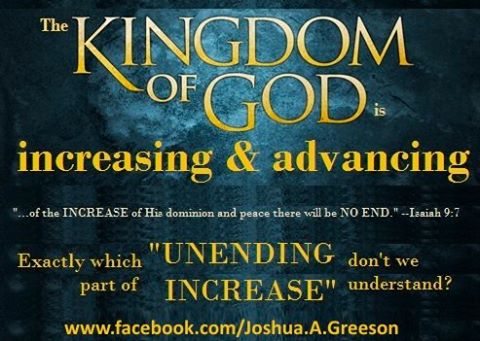
The World is Getting Better (Part 3 of 3)


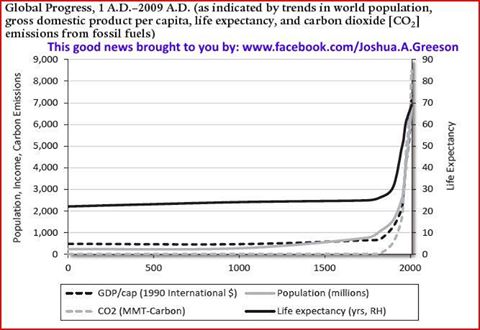
The last two posts (Part 1 and Part 2) have shown various ways that the world is getting better. This is the third and concluding post, again with plenty of charts and statistics. The following information was made public by Joshua Greeson at his Facebook (Author) page during the week of April 4-8, 2016. Joshua is the author of the book, “God’s Will is Always Healing.”

23

24

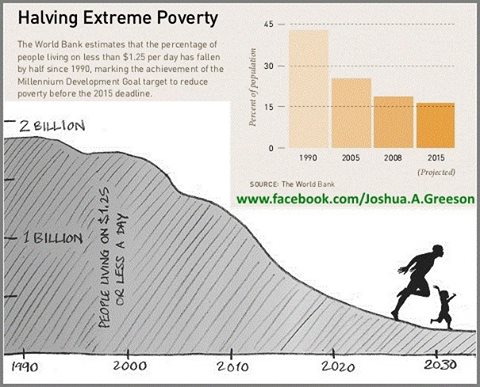
Poverty is shrinking and shrinking—going down the tubes with the rest of the CURSE… #‎theworldisgettingbetter

25

26

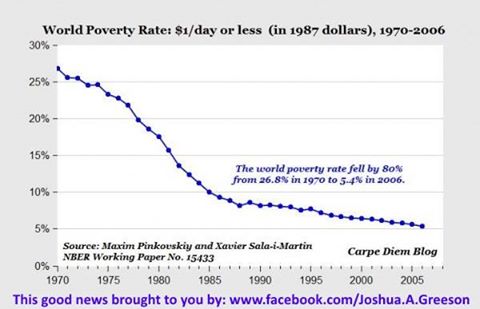
World Poverty Rate? DOWN! #‎theworldisgettingbetter

27

Years of Education for each person? UP!
#‎theworldisgettingbetter

28

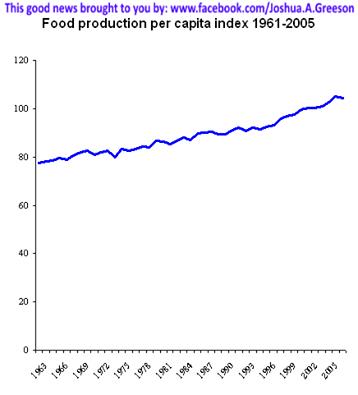
Food Production per capita? UP! #‎theworldisgettingbetter

29

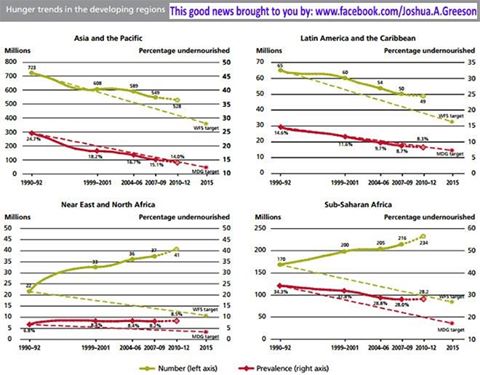
Global Hunger? DOWN! #‎theworldisgettingbetter

30

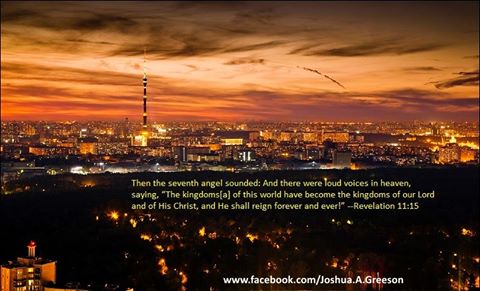
“The World is Getting Better Week” Scripture of the Day: “The kingdoms of this world have become the kingdoms of our Lord and of His Christ, and He shall reign forever and ever (Revelation 11:15)!!!” This is Truth, like it or not! So we should expect to see it happen more and more. Let’s make it a point to watch for it! #‎theworldisgettingbetter

31

#‎theworldisgettingbetter

32

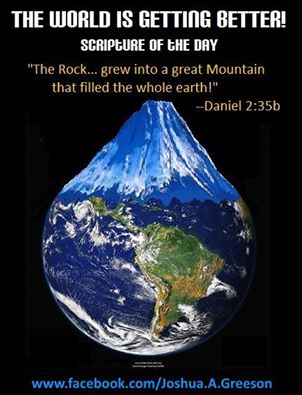
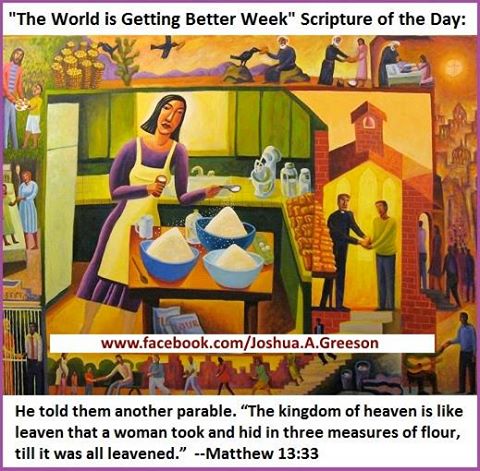
His Kingdom has proven—and will continue to prove—to be EVER-INCREASING, growing, spreading and advancing in the earth. May the mustard seed grow into a MASSIVE tree where many find shelter. May the stone become a mountain that fills the WHOLE EARTH. May the leaven of the Kingdom leaven the WHOLE LUMP. May ALL the kingdoms of this world become the kingdoms of our Lord and of His Christ. May His glory COVER the earth as the waters cover the sea (How much of the sea do the waters cover exactly? ALL!). May the WORLD for whom Jesus died indeed experience this great salvation—in every sense of the word. Joy, peace, and an enduring hope for the future to you all. #‎theworldisgettingbetter Pass it on!

————————————————————————————–

See also this 2014 article which includes “26 Charts and Maps that Show the World is Getting Much, Much Better.”

The World is Getting Better (Part 2 of 3)


Yesterday I posted the first of a 3-part series showing various ways that this world is improving. Today’s post is part two, and again a lot of charts will be presented. The following information was made public by Joshua Greeson at his Facebook (Author) page during the week of April 4-8, 2016. Joshua is the author of the book, “God’s Will is Always Healing.”

10

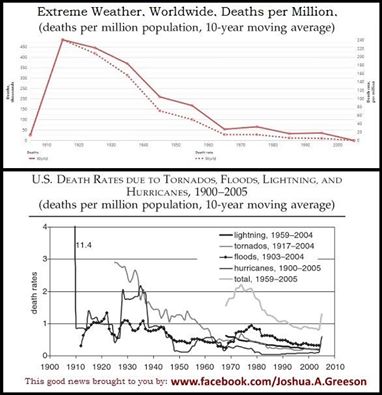
Deaths by Climate Disaster: Going DOWN! #‎theworldisgettingbetter

11

12

(Adam’s note – Here’s a working link: http://hive.org/world/the-world-is-actually-getting-better/)

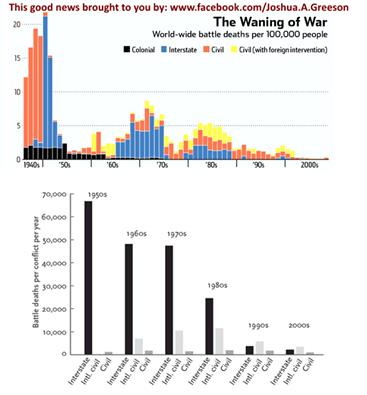
Deaths by WAR: Going DOWN! ‪#‎theworldisgettingbetter

13

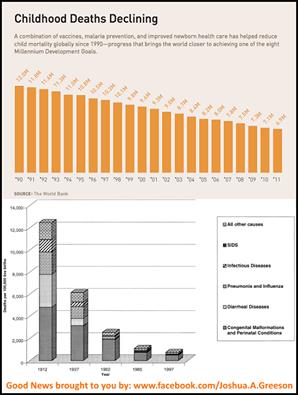
Childhood Mortality: Going DOWN! #‎theworldisgettingbetter

14

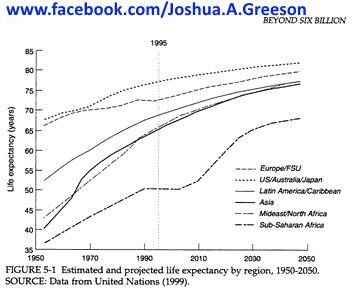
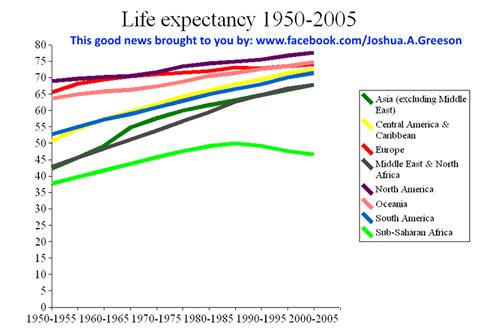
Life Expectancy Around the World: Going UP! #‎theworldisgettingbetter

15

16

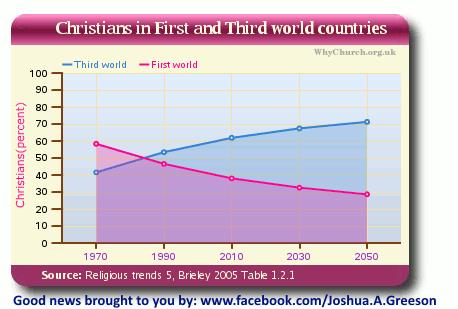
I want to briefly backtrack to the “Religion” category of good news for a minute. This one is another great example of the “Limited LOCATION” perspective and how it can skew our view of the world. Here’s a graph that shows two different statistics on it. The pink line shows the decreasing percentage of Christians in “first world” nations, while the blue line shows the increasing percentage of Christians in “third world” (developing) nations.

So what’s the good news here? Roughly 80% of the world’s population is considered “third world,” and are projected for continually increasing conversion to Christianity… and who knows how steeply that increase will actually continue? Sure we hit a little dip in the industrialized nations; but don’t worry—the WHOLE EARTH is FILLED with the glory of God (Isaiah 6:3; Numbers 14:21)!!! #‎theworldisgettingbetter17

18

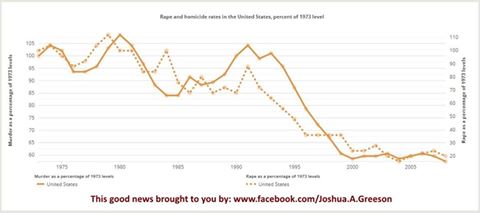
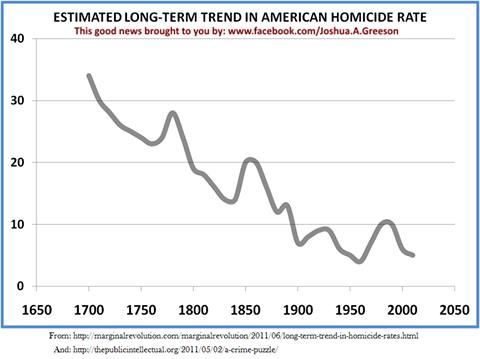
Here are a couple more death stats today (I know, sorry… but they’re good). Here’s the United States’ statistics for Homicide Deaths and Rape from 1970-2010. Yep—yet again—they’re going DOWN! Look at how much it’s improved just in ONE GENERATION. Come on, get happy! ‪#‎theworldisgettingbetter

19

Here again, we have the chance to see what happens when we broaden our “Limited TIMESPAN” perspective. If you thought the U.S. statistics showing the decrease in homicide from the last 40 years were encouraging, look at it for the last 310 years! Holy smoke! So when you hear about the “good ol’ days”—don’t fall for it! They weren’t as “good” as people make them out to be! They just had “Limited INFORMATION!” …and the best days are still ahead!

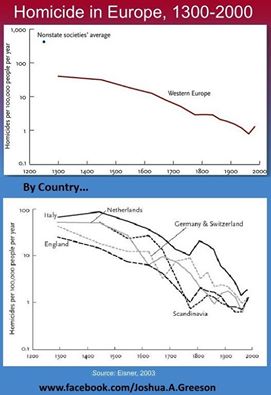
So what’s going on in other parts of the world?
#‎theworldisgettingbetter

20

Here we see Western Europe’s Homicide Death rate going DOWN. The top one is combined, then the bottom one breaks it out for some individual nations. I don’t have any stats for the non-western world. I’m willing to bet that they’re improving right along with the rest of the world, though, due to some other correlated statistics… #‎theworldisgettingbetter

21

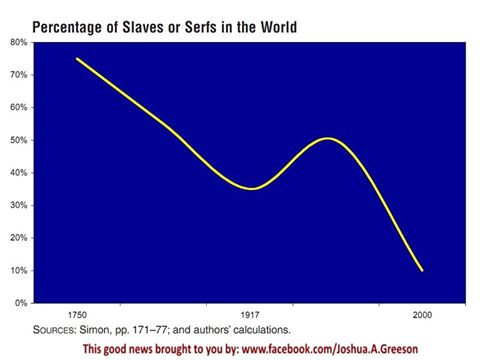
Moving on from death… Oh, look — what do we have here? Slavery? Going DOWN!!! #‎theworldisgettingbetter

22

————————————————————————–

There’s more to come in Part 3 (the conclusion)…

The World is Getting Better (Part 1 of 3)


In 2010 a fellow by the name of William Tapley made a name for himself with his eccentric tune, “Doom and Gloom.” Tapley calls himself the “Third Eagle of the Apocalypse” and “Co-Prophet of the End Times.” In his video he seemed happy about the doom and gloom he believed was soon to come:


Fortunately, “Third Eagle” is way off base when it comes to this world’s destiny. See Isaiah 60, for example, to realize just how opposite Isaiah’s outlook was concerning the new covenant age we live in. There is no end to the increase of Jesus’ government and peace (Isaiah 9:7).

In my last post, Calamitous Famines Have Disappeared (Implications for Eschatology), we saw that the number of deaths from famine have greatly declined over the last several decades. This world is far from perfect, and there are plenty of mountains to be conquered, but the decline of great famines is only one of many ways that the world is getting better. The great tribulation is way behind us, not ahead of us, the book of Revelation has been fulfilled, and “the end times” of the old covenant age have given way to this glorious new covenant age.

This post is the first of a 3-part series showing various ways that this world is improving. The following information was made public by Joshua Greeson at his Facebook (Author) page during the week of April 4-8, 2016. Joshua is the author of the book, “God’s Will is Always Healing.” As you will see, this series features a lot of charts:

Joshua’s Introduction

Good morning! Welcome to “The World is Getting Better Week” here on the page. I know that most American Christians would disagree with the statement, “the world is getting better.” However, that won’t stop me from proclaiming what I believe to be true.

They could quote some Scriptures that they interpret and apply one way, and I could do the same. We can all quote Scriptures to corroborate our beliefs. I’ll share just a few of those Scriptures in very brief form during the week. But the bottom line is that the Kingdom of God (wherever God’s will is being done) is always GROWING, INCREASING and ADVANCING. Soon, it will have affected EVERYTHING in the world.

It might seem on the surface that the world is getting worse. Why? Our view is generally based on limited INFORMATION, limited LOCATION and limited TIMESPAN. But if we’re not judging from our own subjective experience–but are actually examining facts and statistics—we see quite a different picture! If you like statistics, graphs and charts, you’re going to love this week. If you don’t—you might have a change of heart before this week is out!

This week we’ll be looking at a few charts and facts that demonstrate some of the effects of Kingdom “leaven” on the “lump” we call planet earth. Prepare to be challenged some—or perhaps pleasantly surprised—and to have a more optimistic outlook on the future! Blessings! #‎theworldisgettingbetter

01

‪#‎theworldisgettingbetter ‪#‎BroadenYourPerspective

02

This is an awesome website for checking out all kinds of great statistics on Human Progress. It covers many different areas of life—it’s pretty thorough. Check it out and play around with the interactive graphs: www.humanprogress.org

03

#‎theworldisgettingbetter ‪#‎ChristianityIsGrowing

04

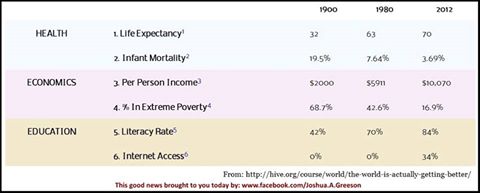
Here are six random stats to whet your appetite for this week! #‎theworldisgettingbetter

05

#‎theworldisgettingbetter ‪#‎KingdomIsGrowing

06

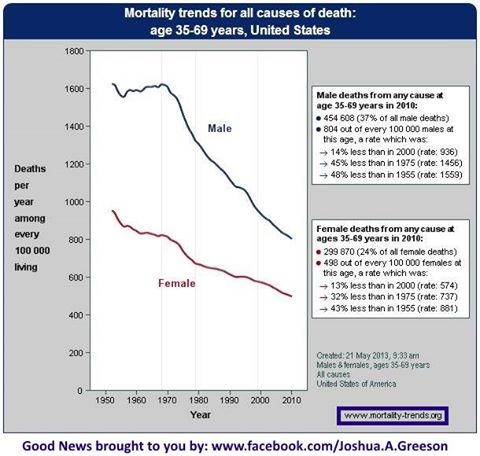
Death by ALL CAUSES in the U.S. is going DOWN!
#‎theworldisgettingbetter

07

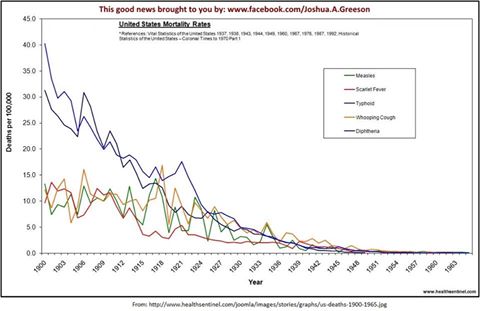
Death by DISEASE in the U.S. is going DOWN! #‎theworldisgettingbetter

08

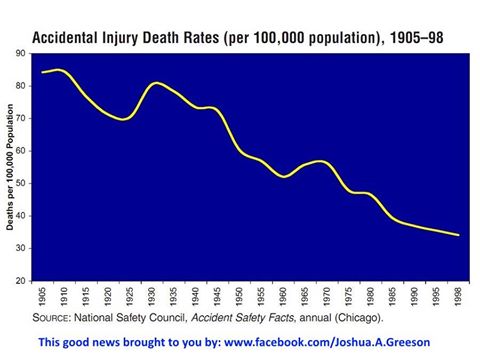
Accidental Deaths: Going DOWN! #‎theworldisgettingbetter

09

————————————————————————–

There’s more to come in Part 2…

Calamitous Famines Have Disappeared (Implications for Eschatology)


Recently I learned some very good news that should be welcomed by everyone, regardless of one’s viewpoint on world affairs or eschatology. This news is that famines have sharply declined over the last 100 years, to the point of almost disappearing. This post will provide details about this trend and will also discuss why and how Jesus’ well-known prediction about famines had everything to do with His own time period and not ours. Doom and gloom is not this world’s destiny, and we have every reason to rejoice when famines disappear and when the world improves in other ways.

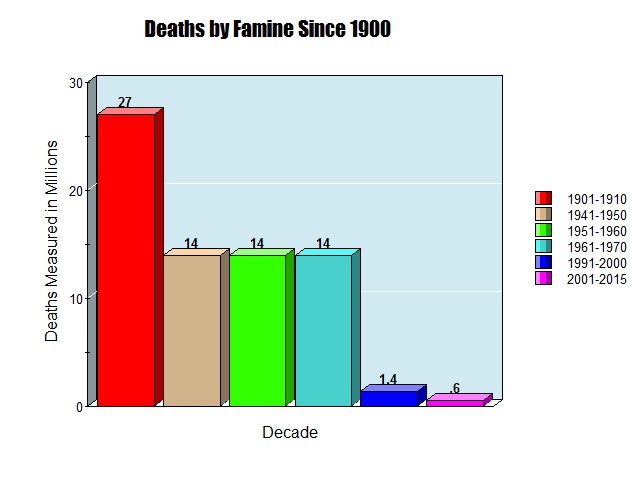
An October 2015 article in The Huffington Post reported that “calamitous famines that cause more than 1 million deaths” have now been completely eliminated (source: the 2015 Global Hunger Index). There has also been a “reduction ‘almost to a vanishing point’ of great famines, which cause more than 100,000 deaths.” Between 1900-1909 around 27 million people died of famine; during the 1940s, 1950s, and 1960s that number was cut in half (14 million deaths per decade); that number was divided by 10 by the 1990s (1.4 million deaths by famine); and about 600,000 died of famine between 2000 – 2015. Based on the given data, the trend would look something like this*:

Deaths by Famine Since 1900

*Note that no data was given for the periods of 1920 – 1940 and 1970 – 1990 in the Huffington Post article cited here. Also note that the final period (in purple) covers 15 years rather than 10 years like the other periods.

“Wait a minute. This shouldn’t be happening,” some might say. “Aren’t we in the end times? Didn’t Jesus say there would be famines and earthquakes before the end? Then why are famines going away?” Yes, Jesus did say that there would be famines before the end:

“And you will hear of wars and rumors of wars. See that you are not troubled; for all these things must come to pass, but the end is not yet. For nation will rise against nation, and kingdom against kingdom. And there will be famines, pestilences, and earthquakes in various places. All these are the beginnings of sorrows” (Matthew 24:6-8; see also Mark 13:7-8 and Luke 21:9-11).

What was “the end” He was speaking of? It was to be “the end of the age” (Matthew 24:3, 14), which would take place when every stone of the temple would be thrown down (Matthew 24:1-3, Mark 13:1-4, Luke 21:5-7). That age did come to an end when the temple was destroyed in 70 AD. It was the age which revolved around the temple, that is, the old covenant age (Hebrews 8:13).

How was Jesus’ prediction about famines fulfilled between the time of His prophecy (around 30 AD) and the end of the old covenant age in 70 AD? A series of famines took place throughout the Roman Empire between 41 AD – 52 AD and another great famine took place in 70 AD. Two of these famines affected Judah and Jerusalem, and both were predicted in Scripture, in Acts 11 and Revelation 6, respectively.

Famines during the Reign of Claudius Caesar (41-54 AD)

A severe famine was predicted by Agabus in Acts 11:28-30.

“And in these days prophets came from Jerusalem to Antioch. Then one of them, named Agabus, stood up and showed by the Spirit that there was going to be a great famine throughout all the world, which also happened in the days of Claudius Caesar. Then the disciples, each according to his ability, determined to send relief to the brethren dwelling in Judea. This they also did, and sent it to the elders by the hands of Barnabas and Saul.”

Claudius Caesar was the fifth Roman emperor, and he ruled from 41 – 54 AD, immediately before Nero. More than one significant famine took place during the reign of Claudius, but one in particular fulfilled the prophecy of Agabus. The Roman historian Dio Cassius recorded details about each of them, and Luther W. Martin wrote the following helpful summary in a 1955 edition of The Gospel Guardian:

“The first famine during this period was centered around the city of Rome in the years 41 and 42 A.D. The second famine known to have occurred during the reign of Claudius was in the fourth year of his office (45 A.D.), and was particularly centered in Judea. It is this famine to which Luke makes reference in Acts 11:28… The third famine during the time of Claudius was centered in Greece in about A.D. 50. The fourth famine took place in 52 A.D. and once again, plagued the city of Rome.

Josephus, the Jewish historian, supplies further information concerning the intensity of this famine, with its great distress and many deaths. In a footnote, it is indicated that it may have lasted for a three year period.”

In addition to Josephus, the Roman historians Suetonius (“Life of Claudius,” chapter 18) and Tacitus (Annals 11:4) also wrote about the great famine which fulfilled the prediction of Agabus. These remarks were made by Josephus in Antiquities 20.2.5:

“[The arrival of Queen Helena of Adiabene] was very advantageous to the people of Jerusalem; for a famine oppressed them at that time, and many people died for want of money to procure food. Queen Helena sent some of her servants to Alexandria with money to buy a great quantity of grain, and others of them to Cyprus to bring back a cargo of dried figs. They quickly returned with the provisions, which she immediately distributed to those that [had] need.  She has thus left a most excellent memorial by the beneficence which she bestowed upon our nation.”

In 1805 George Peter Holford wrote a book titled, “The Destruction of Jerusalem, An Absolute and Irresistible Proof of the Divine Origin of Christianity,” in which he showed that many of the events recorded by Josephus and other first century historians fulfilled Jesus’ predictions in the Olivet Discourse. Regarding this famine, Holford wrote that it “was of long continuance. It extended through Greece, and even into Italy, but was felt most severely in Judea, and especially at Jerusalem, where many perished for want of bread. This famine is recorded by Josephus also, who relates that ‘an assaron of corn was sold for five drachmae’ (i.e. about 3 1/2 pints for three shilling, three denarius).” One drachma was the daily wage for a soldier at that time, and five drachma were worth about $500 in today’s currency. So three pints of corn sold for about $500 during this terrible famine.

The Great Famine in Jerusalem in 70 AD

In 70 AD, when the old covenant age was coming to its final end, there was another great famine, but only in Jerusalem. This famine was made all the more severe because of the actions of a key leader in the civil war that had been raging in Jerusalem between the revolutionaries and those who wanted to maintain peace with Rome.

To give a little background, Jerusalem had been divided into three factions ever since late 67 AD. These factions were led by [1] Eleazar, who was over the Zealots [2] John of Gischala, who was over the Galileans, and [3] Simon, who was over the Idumeans. This was the civil war described in Revelation 6:3-4, also fulfilling Revelation 16:19 where it is said that “the great city” (Jerusalem – see Rev. 11:8) was divided into three parts. (This mirrors the 3-part division that also took place in Ezekiel’s day (Ezekiel 5:1-12) when Jerusalem was destroyed the first time by Babylon in 586 BC.) In December 69 AD John of Gischala foolishly set fire to the supply warehouses in Jerusalem, and nearly all the grain supplies were burned, which would have lasted the city for years (Josephus, Wars 5.1.4, 21-26).

On April 14, 70 AD the Roman General, Titus, laid a siege around Jerusalem. This took place just before Passover, after hundreds of thousands of Jews had already arrived from surrounding nations for the feast, and it lasted for five months until Jerusalem and the temple were burned. The famine brought about conditions fulfilling Revelation 6:6, where John was told that a quart of wheat would be sold for a denarius, the typical salary for one day’s work. It became so severe that there are records of parents roasting and eating their own children. Moses prophesied that this would happen to the people of Israel (Leviticus 26:29) in their latter days (Deut. 31:29) during a time of sevenfold judgment (Lev. 26:18, 21, 24, 28; note the seven seal, trumpet, and bowl judgments in the book of Revelation), the cutting off of their bread supply (Lev. 26:26), and the execution of the vengeance of His covenant (Lev. 26:25).

Others ate their belts, sandals, dried grass, and even oxen dung, according to Josephus. There were also violent home invasions where anyone who was suspected of hoarding food was tormented until they revealed where it was. Some escaped from Jerusalem to the Romans because they couldn’t bear the conditions in the city any longer. George Peter Holford wrote about the pestilential diseases (Leviticus 26:25; Deuteronomy 28:58-62, 32:24; Matthew 24:7) that accompanied this famine:

“After Jerusalem was surrounded by the army of Titus, pestilential diseases soon made their appearance there to aggravate the miseries, and deepen the horrors of the siege. They were partly occasioned by the immense multitudes which were crowded together in the city, partly by the putrid effluvia which arose from the unburied dead, and partly from spread of famine.”

There is No Prophecy of Famine for Today

Every Biblical prophecy about famines, pestilences, earthquakes, and great tribulation was fulfilled many centuries ago. We can rejoice that famines are disappearing at this time. It’s never been easier than right now for humanitarian workers and agencies to respond to difficult situations and events. Communication and transportation have been made easier and more efficient. Because of the internet and social media, the public is more easily made aware of needs, situations, and how to directly help or at least support humanitarian efforts.

Jesus reigns on the throne of David right now (Acts 2:29-36, Ephesians 1:20-23, Hebrews 1:3-13, Revelation 1:5). We can rejoice over anything else that His government is accomplishing for His glory and for the good of this planet. As Isaiah 9:7 says, “Of the increase of His government and peace there will be no end, upon the throne of David and over His kingdom, to order it and establish it with judgment and justice from that time forward, even forever. The zeal of the Lord of hosts will perform this.

Long Island Conference: What WAS the Purpose of the End Times? (Part 2)


Yesterday I posted a video of a presentation I gave at Blue Point Bible Church last weekend as part of a conference on “the end times.” The theme of the conference was two-fold:

  1. What was the purpose of the end times?
  2. How do we walk worthy of the kingdom of God?

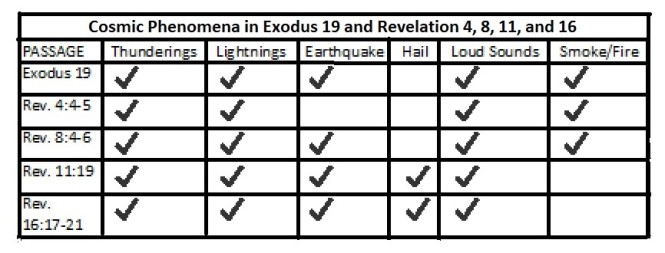
Yesterday’s post (Part 1) included my notes on the first half of the video where I addressed the first question, tracing John’s pattern of referencing the imagery of Mount Sinai (Exodus 19) throughout the book of Revelation (e.g. 4:5, 8:5, 11:19, and 16:18; 1:6 and 12:14). John did this to show that “the end times” and “the last days” were bringing about the final transition from the old covenant age to the new covenant age during the first century AD.

This post (Part 2) includes the notes I used in the second half of my presentation, where I looked at Revelation 21:1 – 22:5 as a blueprint for how to walk worthy of God’s kingdom in the New Jerusalem. This part of the presentation begins around the 29:30 mark of the video.

[Revelation 21:2] New Jerusalem is God’s holy city, pictured as a bride.

  • This is not the first time that the people of God in Christ are pictured as a city.
  • Jesus said His people are a city set on a hill, the light of the world (Matthew 5:14).
  • The author of Hebrews told his readers that they had already “come to Mount Zion, and to the city of the living God, the heavenly Jerusalem…” (Heb. 12:22).
  • This was Isaiah’s prediction as well: “Also the sons of those who afflicted you shall come bowing to you, and all those who despised you shall fall prostrate at the soles of your feet; and they shall call you The City of the Lord, Zion of the Holy One of Israel” (Isaiah 60:14).

[Rev. 21:3] God dwells with His people, He’s with them, and He’s their God.

  • This fulfills a prophecy made by Ezekiel: “Moreover I will make a covenant of peace with them, and it shall be an everlasting covenant with them; I will establish them and multiply them, and I will set My sanctuary in their midst forevermore. My tabernacle also shall be with them; indeed I will be their God, and they shall be My people” (Ezekiel 37:26-27).
    • Don’t let anyone tell you that this isn’t true for the followers of Christ right now just because this was addressed to “the house of Israel.” We are the house of Israel, the Israel of God (Galatians 6:16), because Jesus is true Israel and we are Israel with Him (Galatians 3:16, 29).
  • These truths are also repeated in Ezekiel 43:7, 48:35; II Corinthians 6:16, and elsewhere.

[Rev. 21:9] John sees the New Jerusalem as a bride, the Lamb’s wife.

  • He contrasts the bride with the harlot of Rev. 17, old covenant Jerusalem (Rev. 11:8).
  • Paul also contrasted two women in Galatians 4:21-31, where he portrayed one woman in slavery representing the old covenant and a free woman representing the new covenant.
  • Note the comparisons and contrasts in the following passages:
  1. Revelation 17:1: “Then one of the seven angels who had the seven bowls came and said to me, ‘Come, I will show you the judgment of the great prostitute who is seated on many waters.’”
  2. Revelation 21:9: “Then came one of the seven angels which had the seven bowls full of the seven last plagues and spoke to me, saying, ‘Come, I will show you the Bride, the wife of the Lamb.’
  1. Revelation 17:3: “And he carried me away in the Spirit into a wildernessand I saw a woman sitting on a scarlet beast that was full of blasphemous names.”
  2. Revelation 21:10: “And he carried me away in the Spirit to a great, high mountainand showed me the holy Jerusalem coming down out of heaven from God.”

In Rev. 17:3, it’s likely that John was taken to a wilderness because it was in a wilderness that God established the old covenant with the Israelites. In Rev. 21:10, perhaps John was taken to a great, high mountain because of what God said He would do in the last days of the old covenant age:

Now it shall come to pass in the latter days that the mountain of the Lord’s house shall be established on the top of the mountains, and shall be exalted above the hills; and all nations shall flow to it” (Isaiah 2:2, Micah 4:1).

[Rev. 21:12-13] The new Jerusalem has a high wall with 12 gates, bearing the names of the 12 tribes of Israel; three gates each on the east, north, south, and west sides.

  • Isaiah 60:18, Ezekiel 48:30-35, Matthew 8:11, and Luke 13:29 depict the kingdom of God as a city with walls facing each direction, or with people entering in from all directions.
  • Sam Storms once made these comparisons between the writings of Ezekiel and John on this subject:

Ezekiel is taken to a high mountain by angel and sees a city (40.1-3). John is taken to a high mountain by an angel and sees a city (21.10). The first thing Ezekiel sees is the wall (40.5) that surrounds the city. The first thing John sees is the wall surrounding the city (21.12). The first gate Ezekiel sees is the ‘east gate’ (40.6). The first gate for John is the ‘east gate’ (21.13)… The City has ‘living waters’ in Ezekiel 47.1-ff. So does John (22.1-ff)…

 -Sam Storms, “A Reconstruction of the Millennium”

[Rev. 21:14] The city’s foundations bear the names of the 12 apostles.

  • This is strikingly similar to what Paul wrote to believers in Ephesus: “Now, therefore, you are no longer strangers and foreigners, but fellow citizens with the saints and members of the household of God, having been built on the foundation of the apostles and prophets, Jesus Christ Himself being the chief cornerstone, in whom the whole building, being joined together, grows into a holy temple in the Lord, in whom you also are being built together for a habitation of God in the Spirit” (Ephesians 2:19-22).

[Rev. 21:15-18] The new Jerusalem in John’s vision is cube-shaped, as was the holy of holies in Solomon’s temple (I Kings 6:20). The holy of holies was overlaid with pure gold, and the holy city in John’s vision is also entirely made of pure gold.

[Rev. 21:19-21] The foundations of the city walls are covered in precious gems.

  • This fulfills Isaiah 54:11-12 (“O you afflicted one, tossed with tempest, and not comforted, behold, I will lay your stones with colorful gems, and lay your foundations with sapphires. I will make your pinnacles of rubies, your gates of crystal, and all your walls of precious stones”).
    • Paul clearly affirms that Isaiah 54 is about the church (Galatians 4:27).
  • These precious stones may represent all the spiritual blessings we are equipped with and enjoy today in Christ.

[Rev. 21:22-23] Jesus is the temple and the light of this city.

  • There is again evidence that John is drawing heavily from Isaiah 60, or at least receiving identical revelation to what Isaiah received, as they both describe the body of Christ: “The sun shall no longer be your light by day, nor for brightness shall the moon give light to you; but the Lord will be to you an everlasting light, and your God your glory” (Isaiah 60:19).

[Rev. 21:24] The nations of those who are saved walk in the light of this city.

  • “The Gentiles shall come to your light, and kings to the brightness of your rising” (Isaiah 60:3).
  • “The sons of foreigners shall build up your walls, and their kings shall minister to you…” (Isaiah 60:10).
  • The body of Christ is richer when we fellowship with believers from various nations, cultures, races, and backgrounds.
  • It’s never been easier to do that than now, with instant, worldwide communication through Facebook, with the ability to travel halfway around the world in one day, with a melting pot of cultures here in our cities, etc.
  • The walls of the city of God are built up and strengthened as the people of God from different nations mingle, share with, help, and bless one another.

[Rev. 21:25-26] The gates of the city are never shut; the glory and honor of the nations come in.

  • “Then you shall see and become radiant, and your heart shall swell with joy; because the abundance of the sea shall be turned to you, the wealth of the Gentiles shall come to you… Therefore your gates shall be open continually; they shall not be shut day or night, that men may bring to you the wealth of the Gentiles” (Isaiah 60:5, 11).

[Rev. 21:27] Only those who are written in the Lamb’s Book of Life enter this city.

  • “Also your people shall all be righteous; they shall inherit the land forever, the branch of My planting, the work of My hands, that I may be glorified” (Isaiah 60:21).

[Rev. 22:1] A pure, clear river of water of life flows from the throne of God and of the Lamb.

  • “And in that day it shall be that living waters shall flow from Jerusalem, half of them toward the eastern sea and half of them toward the western sea; in both summer and winter it shall occur” (Zechariah 14:8).
  • “Jesus answered and said to [the Samaritan woman at the well], ‘Whoever drinks of this water will thirst again, but whoever drinks of the water that I shall give him will never thirst. But the water that I shall give him will become in him a fountain of water springing up into everlasting life’” (John 4:13-14).
  • “On the last day, that great day of the feast, Jesus stood and cried out, saying, ‘If anyone thirsts, let him come to Me and drink. He who believes in Me, as the Scripture has said, out of his heart will flow rivers of living water’” (John 7:37-38).
  • “And the Spirit and the bride say, ‘Come!’ And let him who hears say, ‘Come!’ And let him who thirsts come. And whoever desires, let him take the water of life freely” (Revelation 22:17).

[Rev. 22:2] On both sides of the river is the tree of life, which bears different fruit each month. The leaves of the tree are for the healing of the nations. See Ezekiel 47:1-12.

  • Futurist eschatology says that Jesus will return in our future and there will be no more sin, suffering, etc., and that’s when Rev. 21-22 is fulfilled.
  • This picture in Rev. 22:2 shows the nations in need of healing. That time is right now, and we are the channels for that healing.

Recent Article in the Gospel Herald

Here is an example of Christ’s followers using leaves from the tree of life to heal the nations:

“Syrian refugees who fled predominantly Muslim countries amid ongoing war and terrorism are embracing Christianity and teaching their children about Jesus after experiencing firsthand the love and compassion of believers in Greece…

The ministry leader shared one particularly compelling story of how one refugee, who will go by the name of Saddam for security reasons, embraced Christianity after witnessing the kindness of the Christian aid workers. Saddam appeared to have been a man of authority and wealth in Syria, and told the ministry that he found out about them because everyone at the hotel where he was staying was talking about it. When he first arrived, he asked a ministry worker if he was a Christian or a Muslim. Uncertain of why he was asked such a question, the worker asked him why he wanted to know.

With tears streaming from his eyes, Saddam said, ‘I need someone to talk with me about Jesus.’ The workers summoned the ministry co-directors, and the Muslim man told them, ‘All the Muslim countries have turned their back to us. The Muslim nations have ripped us from our treasures. They taught us not to trust the Christians, and that they are liars. I come to Greece and I find myself in the best place with the best food for me and my children. I find love that I have never seen. Please teach me.'”

Leah Marieann Klett, Syrian Refugees Embracing Christ, Teaching Children About Jesus after Witnessing Love of Christians, Gospel Herald, March 15, 2016, http://www.gospelherald.com/articles/62914/20160315/syrian-refugees-embracing-christ-teaching-children-jesus-witnessing-love-christians.htm

  • Contrast this with what a seemingly popular preterist individual said on Facebook a few months ago: “There’s only one way to deal with the Muslim problem. Nuke them all! Nothing less than that will work.”
  • God is doing awesome things in the Muslim world right now, with amazing movements to Christ happening in various places. It’s been said that more Muslims have come to Christ in the last 15 years than in the previous 1400 years. What if God has brought Muslims to our cities on purpose so that we can build relationships with them and invite them to drink of the living waters of Christ?
  • Fulfilled eschatology might be the only school of thought that consistently believes that the healing of the nations is for right now. We should “own this message,” so to speak. How can we work together to see the nations of this world healed?

[Rev. 22:5] There’s no night in the city, and no need for a lamp. The people in the city will reign forever.

  • “Arise, shine; For your light has come! And the glory of the Lord is risen upon you… Your sun shall no longer go down, nor shall your moon withdraw itself; for the Lord will be your everlasting light, and the days of your mourning shall be ended” (Isaiah 60:1, 20).
  • “Then those who are wise shall shine like the brightness of the firmament, and those who turn many to righteousness like the stars forever and ever” (Daniel 12:3).
  • “Then the righteous will shine forth as the sun in the kingdom of their Father…” (Matthew 13:43).
  • “Then Jesus spoke to them again, saying, ‘I am the light of the world. He who follows Me shall not walk in darkness, but have the light of life’” (John 8:12).
  • “For unto us a Child is born, unto us a Son is given; and the government will be upon His shoulder and His name will be called Wonderful, Counselor, Mighty God, Everlasting Father, Prince of Peace. Of the increase of His government and peace there will be no end, upon the throne of David and over His kingdom, to order it and establish it with judgment and justice from that time forward, even forever. The zeal of the Lord of hosts will perform this” (Isaiah 9:6-7).
  • “And He will reign over the house of Jacob forever, and of His kingdom there will be no end” (Luke 1:33).
  • “…and has made us kings and priests to His God and Father…” (Rev. 1:6).
  • We’re not waiting for a future millennium to start. We are called and equipped to rule and reign right now.

——————————————————

I referenced three other speakers during my presentation. Here are two of those videos:

[1] Daniel Colon – https://www.youtube.com/watch?v=49c-hecPH6c

[2] Johnny Ova – https://www.youtube.com/watch?v=Zr8IZnj4yk0

(Jason’s presentation is not yet available.)

There was also a debate on the second night of the conference which you may be interested in viewing. It was between Michael Miano (a preterist) and Stephen Whitsett (a futurist): https://www.youtube.com/watch?v=tPtYL76KbZs

On the last day of the conference, there was a roundtable discussion where members of the audience were able to ask questions for us to answer. I participated in that roundtable and here is that video: https://www.youtube.com/watch?v=bsnEooTpP78

All of the videos from this conference will soon be made available at this link: http://www.powerofpreterism.com/preterism-.html

Long Island Conference: What WAS the Purpose of the End Times? (Part 1)


Last weekend I had the privilege of participating in an “End Times” conference in Blue Point, New York (Long Island). The conference was held at Blue Point Bible Church, pastored by Michael Miano. It was a great time of fellowship with like-minded believers, meeting Facebook friends for the first time, and learning from and being challenged by others. I also had the opportunity to speak on the following two-fold theme:

  1. What was the purpose of the end times?
  2. How do we walk worthy of the kingdom of God?

My presentation video was produced by one of the elders at BPBC. I’m a lot more confident as a writer than I am as a speaker, but I’m sharing this video here anyway and I’ll just hope that no one unsubscribes from this blog because of it. 🙂 Below the video are my notes which correspond with about the first 29 minutes of the video. (Some readers may recognize that the first half of this lecture is based on my article titled, “Echoes of Mount Sinai in the Book of Revelation,” which was posted exactly two years ago today.)

One major theme which weaves through the book of Revelation goes a long way in answering the first question of this conference. This theme is covenant transition:

  • preparing to see the old covenantalready obsolete when Revelation was written – completely vanish away
  • revealing the glories of the new covenantalready valid when Revelation was written – which would soon stand alone

Proposal: Revelation guides the early church in navigating the transition period from one covenant to the next (old to the new), especially as that period was drawing to a close. This period lasted roughly 40 years (30 AD – 70 AD), parallel to the 40 years the Israelites wandered in the wilderness.

Evidence: The same imagery that was present at the giving of the law, the old covenant, is echoed several times in the book of Revelation (4:5, 8:5, 11:19, and 16:18).

Parallel Scripture Passage: “In that He says, ‘a new covenant,’ He has made the first obsolete. Now what is becoming obsolete and growing old is ready to vanish away” (Hebrews 8:13).

1. The background of these passages is Exodus 19.

a. The children of Israel were camped in the Wilderness of Sinai.
b. This was less than three months after leaving Egypt (verse 1).
c. God spoke to Moses from Mount Sinai.

“…Thus you shall say to the house of Jacob, and tell the children of Israel: ‘You have seen what I did to the Egyptians, and how I bore you on eagles’ wings* and brought you to Myself. Now therefore, if you will indeed obey My voice and keep My covenant, then you shall be a special treasure to Me above all people; for all the earth is Mine. And you shall be to Me a kingdom of priests and a holy nation.’**Then it came to pass on the third day, in the morning, that there were thunderings and lightnings, and a thick cloud on the mountain; and the sound of the trumpet was very loud, so that all the people who were in the camp trembled. And Moses brought the people out of the camp to meet with God, and they stood at the foot of the mountain. Now Mount Sinai was completely in smoke, because the Lord descended upon it in fire. Its smoke ascended like the smoke of a furnace, and the whole mountain quaked greatly (Exodus 19:1-18).

2. God reminded them how He bore the people of Israel “on eagles’ wings”*out of Egypt and to Himself.

*Compare to Revelation 12:13-14, where the persecuted woman was given two wings of a great eagle, that she might fly into the wilderness to her place, where she is nourished for a time and times and half a time, from the presence of the serpent.”

3. God was establishing a covenant with them at this time, and He called them to be “a kingdom of priests and a holy nation.”**

**Compare this with John’s opening greeting to the seven churches, where he says that Jesus “has made us kings and priests to His God and Father” (Revelation 1:6).

4. This meeting on Mount Sinai was for establishing the old covenant.

a. It was marked by thundering and lightning, the sound of a loud trumpet, thick smoke, and the whole mountain quaking greatly.

5. The same cosmic phenomena present at Mount Sinai are seen again in the book of Revelation. Obviously it’s not because the old covenant was being established in John’s day. Rather it’s because the old covenant was being dissolved in John’s day, and a new covenant was being established.

Four Passages That Echo Mount Sinai in Revelation

Echoes of Mount Sinai in Revelation

We will observe these four passages, with some brief notes on their significance:

Revelation 4:4-5

Around the throne were 24 thrones, and on the thrones I saw 24 elders sitting, clothed in white robes; and they had crowns of gold on their heads. And from the throne proceeded lightnings, thunderings, and voices. Seven lamps of fire were burning before the throne, which are the seven Spirits of God.”

a. Who are the 24 elders?
b. Some scholars believe they are the 12 patriarchs of Israel and the 12 apostles.

  • They represent the redeemed of both covenants, united in Christ.

c. The names of the 12 tribes and 12 apostles are written on the gates/walls of New Jerusalem (Rev. 21:12-14).
d. This covenant-establishing imagery takes place in the presence of elders representing both the old and the new covenant ages. 
e. There are seven lamps representing seven Spirits of God. We see the number seven in each instance where these features at Mount Sinai are shown.

Revelation 8:4-6

And the smoke of the incense, with the prayers of the saints, ascended before God from the angel’s hand. Then the angel took the censer, filled it with fire from the altar, and threw it to the earth. And there were noises, thunderings, lightnings, and an earthquake. So the seven angels who had the seven trumpets prepared themselves to sound.”

a. This scene takes place at the opening of the seventh and final seal (Rev. 8:1).
b. It’s likely that these prayers are linked to the cries of the martyrs for God to avenge their “blood on those who dwell on the earth” (Rev. 6:10).

c. If so, the seal judgments are poured out in response to the prayers of God’s people.
d. The covenant-establishing imagery of Mount Sinai appears here because the prayers of the new covenant community were about to result in the old covenant system reaching its demise.

Revelation 11:19

Then the temple of God was opened in heaven, and the ark of His covenant was seen in His temple. And there were lightnings, noises, thunderings, an earthquake, and great hail.

a. This scene takes place at the sounding of the seventh trumpet.
b. The 24 elders are also present at this scene (Rev. 11:15-16).
c. Loud voices declare, “The kingdoms of this world have become the kingdoms of our Lord and of His Christ, and He shall reign forever and ever!”
d. Here is perhaps the most explicit reference connecting the old covenant to prophecies in the book of Revelation.
e. John sees a vision of God’s temple housing “the ark of His covenant.

  • In ancient Israel, the ark of the covenant was a centerpiece of the temple and the old covenant.
  • The ark was located in the Most Holy Place and represented God’s presence.

f. When the judgments are over, what does heaven shout? “Behold, the tabernacle of God is with men, and He will dwell with them, and they shall be His people. God Himself will be with them and be their God” (Rev. 21:3).

  • This did not suddenly become true because buildings fell in 70 AD.
  • Paul told the Corinthian church that they were “the temple of the living God“ (II Corinthians 6:16).
  • The downfall of Israel, Jerusalem, and the temple in 70 AD demonstrated and confirmed that God had chosen the glorious new covenant over the inferior old covenant (see Hebrews 8).

g. In this same passage, John witnesses an earthquake that kills 7000 people in “the city” (Rev. 11:13).

  • This is already identified as Jerusalem: “the great city…where our Lord was crucified“ (verse 8).
  • Josephus wrote about one night in early 68 AD when “a prodigious storm” took place in Jerusalem, marked by “the largest showers of rain, with continued lightnings, terrible thunderings, and amazing concussions and bellowings of the earth, that was in an earthquake.”
  • Josephus added that the Jewish zealots allowed the Idumaeans to come in and help slaughter some of their fellow Jews who opposed their rebellion against the Romans. Between this slaughter and the earthquake, 8500 people died that night (Josephus, Wars 4:4:5, 4:4:7-4:5:1).

Revelation 16:17-21

Then the seventh angel poured out his bowl into the air, and a loud voice came out of the temple of heaven, from the throne, saying, ‘It is done!’ And there were noises and thunderings and lightnings; and there was a great earthquake, such a mighty and great earthquake as had not occurred since men were on the earth. Now the great city was divided into three parts, and the cities of the nations fell. And great Babylon was remembered before God, to give her the cup of the wine of the fierceness of His wrath. Then every island fled away, and the mountains were not found. And great hail from heaven fell upon men, each hailstone about the weight of a talent. Men blasphemed God because of the plague of the hail, since that plague was exceedingly great. 

a. This scene takes place at the pouring out of the seventh bowl.
b. John sees the great city, Jerusalem, divided into three parts.

  • This is a flashback to Ezekiel 5:1-12, when the prophet was required to shave his head and divide it into three parts, and was told by God: “This is Jerusalem” (Ezek 5:5). 
  • One third of his hair was burned, one third was chopped up by the sword, and the last third was scattered into the wind.
  • This was fulfilled when Jerusalem was destroyed in 586 B.C. at the hands of Babylon. Jerusalem was also divided between 67-70 AD into three warring factions: [1] the Zealots, led by Eleazar [2] the Galileans, led by John of Gischala, and [3] the Idumeans,  led by Simon.

c. Revelation 11 described a literal earthquake, and Rev. 16 describes literal hail.

  • A talent was about 75-100 pounds.
  • Josephus wrote of large stones shot from catapults by the Roman armies into the temple complex in Jerusalem. This happened during the 5-month siege from April-August 70 AD.
  • The watchmen in the city reported these stones as appearing white in the sky:

“Now the stones that were cast were of the weight of a talent, and were carried two furlongs and further. The blow they gave was no way to be sustained, not only by those that stood first in the way, but by those that were beyond them for a great space. As for the Jews, they at first watched the coming of the stone, for it was of a white color, and could therefore not only be perceived by the great noise it made, but could be seen also before it came by its brightness” (Josephus, Wars 5:6:3).

  • Josephus also records that the watchmen on the wall, when they saw the stones coming, would shout, “The Son cometh!” After a while the Romans learned to blacken the stones so that they couldn’t as easily be detected, and many more were crushed by these stones. J. Stuart Russell, in his 1878 book titled The Parousia, offers this explanation for the words of the watchmen (p. 482):

“It could not but be well known to the Jews that the great hope and faith of the Christians was the speedy coming of the Son. It was about this very time, according to Hegesippus [110-180 AD], that St. James, the brother of our Lord, publicly testified in the temple that ‘the Son of man was about to come in the clouds of heaven,’ and then sealed his testimony with his blood [in 62 AD]. It seems highly probable that the Jews, in their defiant and desperate blasphemy, when they saw the white mass hurtling though the air, raised the ribald cry, ‘The Son is coming,’ in mockery of the Christian hope of the Parousia.”

To Review

  1. The same phenomena that appeared at Mount Sinai appear repeatedly in the book of Revelation.
  2. They take place at the seventh seal, the seventh trumpet, and the seventh bowl. In Leviticus 26:18, 21, 24, and 28 God promised to punish Israel seven times if they abandoned His covenant. God said He would “execute the vengeance of His covenant” (verse 25).
  3. Other covenant imagery can be seen in these passages in Revelation where the phenomena of Mount Sinai appear.
  4. All of this shows that a major goal of the end times was to completely dissolve the old covenant system and to champion the new covenant age that Jesus established at the cross.

——————————————————-

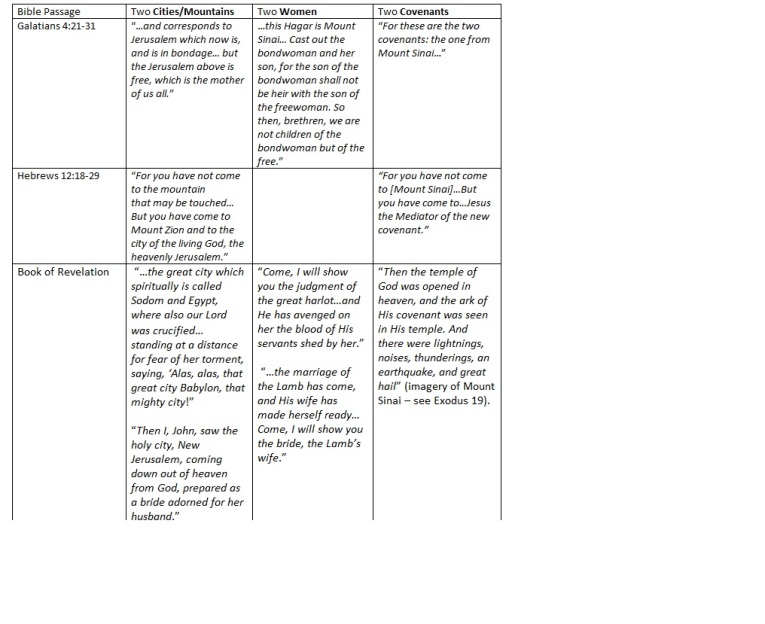
Just as the book of Revelation does, Galatians 4 and Hebrews 12 also contrast Mount Sinai and the new covenant, as well as two cities (earthly Jerusalem and heavenly Jerusalem) and two women (the harlot and the bride of Christ):

For you have not come to the mountain that may be touched and that burned with fire, and to blackness and darkness and tempest, and the sound of a trumpet and the voice of words… But you have come to Mount Zion and to the city of the living God, the heavenly Jerusalem…to the general assembly and church of the firstborn who are registered in heaven…to Jesus the mediator of the new covenant… Now this… indicates the removal of those things that are being shaken, as of things that are made, that the things which cannot be shaken may remain. Therefore, since we are receiving a kingdom which cannot be shaken, let us have grace…” (Hebrews 12:18-28).

“For these are the two covenants: the one from Mount Sinai which gives birth to bondage…and corresponds to Jerusalem which now is…but the Jerusalem above is free, which is the mother of us all… Cast out the slave woman and her son, for the son of the slave woman shall not inherit with the son of the free woman.’ (Galatians 4:27-31).

Two Covenants

—————————————————–

The next post, Part 2, will include the notes that I used in the second half of my presentation, where we looked at Revelation 21:1 – 22:5 as a blueprint for how to walk worthy of God’s kingdom in the New Jerusalem.

“Is the Land Inheritance Still Relevant Today?” by Michael Battle


The following study was written by Michael Battle, a friend on Facebook who also posts regularly in a group I belong to. It’s a good study of the words “forever” and “everlasting” in the Old Testament, as they are used concerning the land of Israel, circumcision, the feasts, the Sabbath, and other ordinances of the law of Moses. This study has implications for the claim that the land of Israel always has belonged, and always will belong, to the physical descendants of Abraham:

The land of Canaan is said to be an inheritance for the decedents of Abraham FOREVER (Genesis 13:15; 17:8).

Does this then mean that the promise of the land inheritance has relevance today? If we were to take Genesis 13:15 and Genesis 17:8 at face value without considering the balance of scripture, then we would certainly have to come to a conclusive yes.

Therefore we need to ask, “Does the balance of scripture support our interpretation of the land inheritance?”

To begin, let’s consider the use of the word “forever” elsewhere in the Old Testament. The same Hebrew word translated as “forever” in Genesis 13:15 is translated as “everlasting” in Genesis 17:8 mentioned above (see also Genesis 48:4; Exodus 32:13).

That’s certainly a good start if we are going to build a case that the land inheritance is still relevant.

However, we immediately have our first hurdle before we ever get out of Genesis 17. In verses 10-14 we read that physical circumcision is an EVERLASTING covenant and that the land inheritance coincides with circumcision. The “uncircumcised” have no share in the covenant through which the land was to be inherited.

This immediately becomes problematic in building a defense for the “land inheritance” having relevance today because in the New Testament the apostle Paul tells us that circumcision in the flesh no longer has any value. According to Paul it is circumcision of the heart (in the Spirit) which matters. [Adam’s note: See especially the book of Galatians and the strong language Paul uses there toward those who attempt to push circumcision as a requirement.]

As we continue through the scriptures we find that the feast of Passover and unleavened bread are said to be an ORDINANCE FOREVER (Exodus 12:14, 17, 24) and the Sabbath was to be a covenant FOREVER (Exodus 31:16-17).

Yet the New Testament tells of that these were only shadows of Christ (Colossians 2:16-17) and that Christ Himself is our Passover (1 Corinthians 5:7).

The ministry of the Levitical priesthood (Aaron and his descendants) within the tabernacle is said to be a statute FOREVER (Exodus 27:21, Exodus 28:43, Exodus 30:21, Leviticus 24:1-3) and an ordinance FOREVER (Numbers 18:8). The wearing of the priestly garments by the sons of Aaron was also referred to as a PERPETURAL (FOREVER) statute. The ceremonial washing of the hands of the priests who served in the tabernacle was to be a statute FOREVER (Exodus 30:21).

Yet according to the New Testament this priesthood has been abolished and has given way to one that is greater and more glorious, and that is the Priesthood of the Lord Jesus Christ.

The Law of Moses also declares that the Levites were to be servants to the priests and this was to be a statute FOREVER (Numbers 18:23).

The law of the meat offering’s portion for the sons of Aaron was also to be a statute FOREVER (Leviticus 6:14-19).

The daily meat offerings offered by Aaron and his descendants was to be a statute FOREVER (Leviticus 6:20).

The commandment for Aaron and his sons not to drink wine nor strong drink in the tabernacle was to be a statute FOREVER (Leviticus 10:9).

The heave and wave offerings belonging to the Levitical priests and their families was a statue FOREVER (Exodus 29:28; Leviticus 10:15; Numbers 18:19).

Like the Passover, the Day of Atonement was also to be a statue FOREVER (Leviticus 16:29, 34, Leviticus 23:31). Yet according to the New Testament, those things which were done under the Law on the Day of Atonement served as a foreshadowing of Christ (Hebrews 10:1-4) and have now been taken away because Christ has become the High Priest of a greater and more perfect tabernacle.

With regards to sacrifices for sin, the Law of Moses also says that the sin offering of the red heifer was to be a statute FOREVER (Numbers 19:9-11).

Yet Hebrews 9:13-14 says, “For if the blood of bulls and of goats, and the ashes of an heifer sprinkling the unclean, sanctifieth to the purifying of the flesh: How much more shall the blood of Christ, who through the eternal Spirit offered Himself without spot to God, purge your conscience from dead works to serve the living God?”

As we can see, the use of the language FOREVER as it applied to the Old Testament promises, statues, and ordinances doesn’t mean “for all eternity” without any change as they originally were.

In studying the scriptures, we should consider the qualifying clause “throughout your generations” and other similar clauses. These should be taken into account when considering those things which were said to be FOREVER.

For instance, Genesis 17 says the covenant of circumcision and the land inheritance is FOREVER in view of THOSE GENERATIONS.

In Exodus 12:14 the scripture says: “And this day shall be unto you for a memorial; and ye shall keep it a feast to the Lord THROUGHOUT YOUR GENERATIONS; ye shall keep it a feast by an ordinance FOREVER (see also verses 17 and 42).

The daily offering of the burnt offering was to be THROUGHOUT YOUR GENERATIONS (Exodus 29:42). The yearly consecration of the altar of incense by the High Priest on the Day of Atonement was to be THROUGHOUT YOUR GENERATIONS (Leviticus 30:10).

These references (above) regarding THROUGHOUT YOUR GENERATIONS are just a few examples of the many times this qualifying clause and others similar to it are mentioned in view of the FOREVERS in the Old Testament.

The Old Covenant was a covenant for God’s people in the flesh and was binding THROUGHOUT THEIR GENERATIONS, wherein the revelation of Christ was hidden in a mystery (Colossians 1:26).The forevers were “types” and “foreshadowings” of Christ.

God has saved us according to His mercy by the washing of REGENERATION, and renewing of the Holy Ghost (Titus 3;5) and that which was “in the flesh” has now given way to that which is “in the Spirit.”

The forevers of the physical covenant have given way and been translated to FOREVER in Christ!

The forever ordinances of things like Passover continue, but now it’s in Christ and not in the outward offering of animals. The same holds true for the land inheritance, the Sabbaths and all other FOREVERS of the first covenant. True inheritance and rest is in Christ!
He is our Passover, He is our Sabbath, He is our promised land!


ADDITIONAL NOTES

  1. Israel’s right to the land, according to scripture, was dependent on their covenant relationship with God. Physical Israel has no covenant with God today because of their rejection of Jesus. Only believing Jews (those who believe in Jesus Christ) have a covenant with God. Physical Israel is a secular nation like all other nations. Covenant membership is found only in Jesus Christ. The only way that secular Israel could be considered God’s people is for there to be two covenants and two groups of people as the people of God. Dual Covenant theology is heresy.
  2. Israel’s right to the land was not exclusive to the physical descendants of Jacob. Throughout Israel’s history, Gentiles were joined to them and inherited full rights as citizens which included land inheritance (see Ester 8:17, Isaiah 56:3-7, Psalm 87:4-6, Ezekiel 47:21-23).
  3. When Israel was given the land it was divided among their tribes, which included Gentiles who had joined them. (See the book of Joshua and Ezekiel 47:21-23).
  4. The Levites were given no land inheritance.
  5. God never meant for Israelis only to have access to the land, Israel was required by God to treat those living among them justly and not to oppress them (Leviticus 19:33-34; Jeremiah 7:5-7; Jeremiah 22:3; Zechariah 7:10; Exodus 22:21-24; Exodus 23:9; Deuteronomy 23: 7-8; Deuteronomy 10:19).
  6. Supporting Israel in everything is unscriptural. For example, God was angry with Jehoshaphat, king of Judah, for making an alliance with Ahab, the King of Israel (See 2 Chronicles 18:1 – 19:2). Also the Apostle Paul tells us that the Jews who killed the Lord Jesus and continued to hinder the message of the Gospel were under the wrath of God (1 Thessalonians 2:14-16).

Hebrews 11:8-16

By faith Abraham obeyed when he was called to go out to the place which he would receive as an inheritance. And he went out, not knowing where he was going. By faith he dwelt in the land of promise as in a foreign country, dwelling in tents with Isaac and Jacob, the heirs with him of the same promise;10 for he waited for the city which has foundations, whose builder and maker is God.

11 By faith Sarah herself also received strength to conceive seed, and she bore a child when she was past the age, because she judged Him faithful who had promised. 12 Therefore from one man, and him as good as dead, were born as many as the stars of the sky in multitude—innumerable as the sand which is by the seashore.

13 These all died in faith, not having received the promises, but having seen them afar off were assured of them, embraced them and confessed that they were strangers and pilgrims on the earth. 14 For those who say such things declare plainly that they seek a homeland. 15 And truly if they had called to mind that country from which they had come out, they would have had opportunity to return. 16 But now they desire a better, that is, a heavenly country. Therefore God is not ashamed to be called their God, for He has prepared a city for them.

Daniel 12, Matthew 13, and the Olivet Discourse – The Righteous Are Shining


Don K. Preston produced a short video yesterday comparing Matthew 13 (“The Parable of the Wheat and the Tares”) to Daniel 12:3, and made some interesting observations.  Here’s his introduction, followed by the 7-minute video:

“In Matthew 13:43 Jesus directly echoes Daniel 12:3. How does this impact our understanding of the end of the age and the resurrection? Well, “orthodoxy” says that Daniel and Matthew 13 refer to the “end of human history.” But, Daniel 12 totally refutes that, demonstrating again how badly church history and “orthodoxy” have missed the story of eschatology!”

I created a chart below showing the parallels between Daniel 12 and Matthew 13, as well as parallels between Daniel 12 and the Olivet Discourse (Matthew 24, Mark 13, and Luke 21).

  Daniel 12:1-7 Matthew 13:24-30, 36-43 Matthew 24 / Mark 13 / Luke 21 (Olivet Discourse)
Prophecies regarding the Jewish people “…who stands watch over the sons of your people… your people” (verse 1)   “…who are in Judea” (Matt. 24:16); “pray that your flight may not be…on the Sabbath” (Matt. 24:20); “…all the tribes of the earth” (Matt. 24:30); “…you will be beaten in the synagogues” (Mark 13:9, Luke 21:12); “For there will be great distress in the land and wrath upon this people” (Luke 21:23); “Jerusalem will be trampled by Gentiles…” (Luke 21:24).
Incomparable time of trouble “…there shall be a time of trouble, such as never was since there was a nation” (verse 1)   “For then there will be great tribulation, such as has not been since the beginning of the world until this time, no, nor ever shall be” (Matt. 24:21, Mark 13:19).
God’s people delivered “And at that time your people shall be delivered, everyone who is found written in the book” (verse 1).   “…then let those who are in Judea flee to the mountains” (Matt. 24:16, Mark 13:14, Luke 21:21).*
Resurrection “And many of those who sleep in the dust of the earth shall awake, some to everlasting life, some to shame and everlasting contempt” (verse 2).   “And He will send His angels with a great sound of a trumpet, and they will gather together His elect from the four winds, from one end of heaven to the other” (Matt. 24:31, Mark 13:27).
Righteous shining like stars “Those who are wise shall shine like the brightness of the firmament, and those who turn many to righteousness like the stars forever and ever” (verse 3) “Then the righteous will shine forth as the sun in the kingdom of their Father” (verse 43).  
Timing of these things “…it shall be for a time, times, and half a time; and when the power of the holy people has been completely shattered, all these things shall be finished” (verse 7). “…the harvest is the end of the age, and the reapers are the angels” (verse 39); “…as the tares are gathered and burned in the fire, so it will be at the end of this age” (verse 40). [Jesus prophesies that the temple will be completely destroyed (Matt. 24:1-2, Mark 13:1-2, Luke 21:5-6).]


[a] Tell us, when will these things be? And what will be the sign of Your coming, and of the end of the age?” (Matt. 24:3)


[b] “Tell us, when will these things be? And what will be the sign when all these things will be fulfilled?” (Mark 13:4, Luke 21:7)


“Assuredly, I say to you, this generation will by no means pass away till all these things are fulfilled” (Matthew 24:34, Mark 13:30, Luke 21:32).

 * Remigius (437-533 AD) tells us this:

“[F]or on the approach of the Roman army, all the Christians in the province, warned, as ecclesiastical history tells us, miraculously from heaven, withdrew, and passing the Jordan, took refuge in the city of Pella; and under the protection of that King Agrippa, of whom we read in the Acts of the Apostles, they continued some time.”

As Daniel 12 and Matthew 13 are related, and Daniel 12 and the Olivet Discourse are also clearly related, so also are Matthew 13 and the Olivet Discourse related. They are related in terms of their content, as well as the time period in which they were to be fulfilled. The “end of the age” referred to the old covenant age, which came to a fiery end when Jerusalem and the temple were burned as Jesus predicted. The power of Daniel’s people was completely shattered at this time, before Jesus’ own generation passed away. The righteous (in Christ) have been shining like the stars from that time, even since the cross.

A detailed study of “the Parable of the Wheat and the Tares” was posted here last year.

Chuck Crisco, pastor of His House Church in Nashville, also has a good article on Matthew 13 and the Parable of the Wheat and the Tares: “Spiritual Myth Busters: Is God Separating the Wheat and the Tares?”

Book of Acts: The Hope of Israel Fulfilled (Conclusion)


This is the final section (part 4) of Don K. Preston’s overview of the book of Acts, titled “Introduction to Acts and the Restoration of Israel.” This overview demonstrates that, throughout the book of Acts, “the hope of Israel” and “the restoration of Israel” are shown to be fulfilled in Christ. Preston’s commentary is part of the “Fulfilled Covenant Bible” project, and can be accessed at the “Bible Prophecy Fulfilled” site run by Mike Day, Gary and Audrey Parrish, Terry Kashian, and Lahaina Dave. See Part 1 of this series here, part 2 here, and part 3 here.

The Nature of the Restoration of Israel

In Paul’s affirmations that he preached nothing but the hope of Israel, and in Luke’s record of the proclamation of that gospel, we have seen the revolutionary re-shaping and re-identification of the Israel of God. The restoration was a spiritual restoration that eschewed and rejected the geopolitical-military restoration of the Davidic kingdom longed for by the Jews. This is evident from Acts 1 to Acts 28. We need to review a bit of this to drive home the point that, first of all, Acts truly is about the restoration of Israel, as foretold in the OT prophets, and, secondly, that restoration was not what the Jews of the first century anticipated or desired.

Acts 1 draws directly from Isaiah 43 that predicted the creation of a New Israel, a New Creation and called on Israel to forget the former days.

Acts 2 shows us that Christ was sitting at the right hand of the Father, in fulfillment of YHVH’s promise to raise Messiah to David’s throne. But Jesus was sitting at the right hand in the heavenlies, not on a literal throne in literal Zion.

Acts 3 records Peter’s call to the Jews to repent so that God would grant them a time of rest before the coming judgment. He reminds them of the prophecy of Deuteronomy 18 that God would raise up a prophet like Moses. And, he warns them that to reject Jesus would result in being “utterly cut off out from among the people” (Acts 3:23). This text is all but definitive in identifying the true Israel: they are the followers of Jesus! Thus, as we noted above, John the Baptizer initiated the “restoration of all things” and Jesus would consummate that restoration at His parousia. But what cannot be denied is that the restoration begun by John, and thus the work of Jesus, was not in any way related to the restoration of nationalistic Israel.

Acts 4 shows us that one of the key markers of Israel, the land, was being overtly rejected by the nascent body of Christ. In a radical, unprecedented move, the members of the body of Christ began to sell their land! This was strictly forbidden by Torah, but they had begun to learn that their salvation was not in the land. They were now – in fulfillment of Isaiah 66 – all priests unto the Lord, and even in Torah God Himself was the true inheritance of the priests; they got no inheritance of physical land (Numbers 18:20).

Likewise, Acts 4 shows that the Chief Corner Stone of the long anticipated Messianic Temple had been laid. Thus, Israel was being restored! Yet the Temple being constructed was a living edifice, built on the living Messiah. And this truth signaled the coming destruction of the Old Temple. Thus, once again, the nature of the restoration of Israel is undeniable. It had nothing whatsoever to do with the old form. It had nothing to do with the old Temple. It had nothing to do with the old City either.

Acts 6-7 records Stephen in the Temple recounting Israel’s long history of rejecting God’s plans and purposes, even killing all of His prophets sent to her. Stephen had the “audacity” to even quote Isaiah 66 which spoke of Israel’s inordinate affection for things physical, i.e. the Temple, and calling their attention to the fact that “God does not dwell in temples made with hands” (Isaiah 66:1). Isaiah 66 not only noted that physical temples were not God’s intended abode, but that the time was coming when the Lord would come against Jerusalem and the old Temple in judgment, to bring in the New People and the New Creation.

All of those students of Torah present that day would have known full well what Stephen was saying in his citation of Isaiah: that wonderful edifice in which he was standing, in which they took so much (too much) pride, was doomed. It was to give way to the New Creation. Acts 8 tells us the story of the restoration of Israel in a profound manner. Israel had been scattered. Samaria was the symbol of that diaspora. Yet now the gospel of the kingdom – Israel’s hope – was being proclaimed in Samaria! But of course, the message being preached was not one of nationalistic restoration. It had nothing to do with a re-gathering to the land. It had nothing to do with the beautiful Temple in Jerusalem. It had nothing to do with the destruction of the Romans or the conquering of Israel’s national enemies. Nonetheless, Israel was being “gathered.” She was being gathered in the very manner that Jesus had desired to gather her (Matthew 23:37) – a covenantal gathering into fellowship with Him. The proclamation of the gospel in and to Samaria was a profound fulfillment of the restoration of Israel. But, once again, the unexpected nature and form of the restoration was on full display.

Acts 8 likewise portrays the restoration of Israel in the story of the conversion of the eunuch. In the prophets, the radical nature of the restoration of Israel under Messiah was hinted at, strongly suggested, but never fully grasped by the Jews. Isaiah had foretold the time – when Israel was restored, and God’s temple was present – that even foreigners and the eunuchs would be given a place in that Temple. They would no longer be outsiders, but true children of God! (See Isaiah 60:5-7 where YHVH foretold the time when “the wealth of the nations” would flow to Jerusalem and those who had always been rejected, foreigners, would actually ascend the altar of the Lord to offer sacrifices! This is a stunning “reformulation” of the priesthood, in the manner of Isaiah 66).

In similar stunning fashion, Acts 10-15 records the conversion of the Gentiles and ensuing controversies. What is so stunning is that, although the OT prophets clearly foretold this, Paul’s inspired interpretation of those prophecies was that the Gentiles were equal partners, equal partakers of the kingdom blessings (Romans 16:25-26; Ephesians 3:3-11)! Salvation was no longer confined to one ethnic group, but, just as God had called Abraham out from the nations to be His people, God was now calling the nations to be His people (Cf. Zechariah 2:10)! So “God’s people” were being re-identified. “Israel” was no longer identified according to the flesh, but according to the Spirit by faith.

Acts 15 is extremely powerful proof that God’s “Israel” – the kingdom – was now fundamentally different, radically transformed. From Abraham foreword, and under Torah, physical circumcision was one of the key markers of the “children of God.” Circumcision was Israel’s covenant sign between YHVH and that nation which gave her the right to the land. No circumcision = no land. And yet, the Jerusalem Council determined that Gentiles – as equal partakers of the promises of Israel – were under no obligation to be circumcised.

Keep in mind that no one taught “the hope of Israel” more firmly, more zealously than did Paul, as we have seen. Yet, as he preached that hope of Israel, he vehemently rejected any attempts to impose physical circumcision – or any of Israel’s cultus – on Gentiles (cf. Galatians 2), and openly taught that to impose it on Gentiles resulted in the loss of fellowship with Christ (Galatians 5). What mattered (matters) was not physical circumcision (and thus, not physical land) but the New Creation foretold by the OT prophets (Galatians 6:15-16).

Here is a fine exemplification of what Isaiah 43 foretold. God said He was going to do a “New Thing” in the last days, and called on Israel to forget the past things. And now here was Paul calling on Israel to forget her past, and look to the New Thing being created in Christ. Stunning indeed! Nothing could have been more revolutionary, more stunning, more offensive to the Jews than this message! This is why Paul called his “circumcision free” gospel an “offense” to the Jews. They realized that the nullification of circumcision was, in fact, the declaration that their right to the land had now been voided! They failed – like so many today – to grasp the spiritual significance of that message. The true “land” that Abraham had longed for, the heavenly Zion, was about to be realized (Hebrews 11:13-16- 12:21f).

Spatial considerations forbid further development of this theme, but what we have presented powerfully illustrates that Luke and Paul were on the same page. Luke’s narrative was about how God had not abandoned Israel. Paul’s gospel was the same. God was fulfilling His promises to Israel. The problem was that Israel longed for the wrong things – national restoration when the promises were, from the very beginning, the promise of spiritual restoration.

This brings us to consider that throughout Acts, from beginning to the end, there are powerful suggestions and pointers that indicated that while God was indeed restoring Israel as promised, that found in her Old Covenant promises all along was the reality, as painful and traumatic as it was to be, that when Israel was restored, the Old Covenant body had to pass away. As when a person has a pecan, and to reach the wonderful “meat” inside, the outer shell has to be crushed, the outer shell of Old Covenant “fleshly” Israel had to be crushed, having fulfilled her purpose, to reveal the “inner man” of the body of Christ (2 Corinthians 4:16f). This was truly a “good news / bad news” scenario, but one that is evident throughout Acts, if we have our eyes open. So, look at a few of those earlier references and warnings.

Acts 1 – Isaiah 43 – If indeed Isaiah 43 lies behind the beginning of Luke’s narrative, then one can hardly help but notice that the coming of the New Thing that God would do would necessitate the passing of the Old Creation.

Acts 2:40 – “Save yourselves from this untoward generation.” There are numerous things in Acts 2 that would have been foreboding to the observant.

A.) The outpouring of the Spirit was to be magnified in the last days before the Great And Terrible Day of the Lord. This Great Day was the Day foretold by John the Baptizer, as Elijah, when the wicked would perish (Malachi 4). It would likewise be when the Lord would judge Israel for violation of Torah (Malachi 3:1-6).

B.) Peter was citing Deuteronomy 32 (in Acts 2:40). The Song of Moses was about Israel’s latter end, when the Lord would avenge the blood of His saints in judgment.

C.) Even the marvelous affirmation that Jesus was sitting at the Right Hand of the Majesty in the heavens had a dark lining to the silver cloud. Psalm 110 not only foretold the enthronement of Messiah, it likewise foretold judgment of His enemies (i.e. those who had rejected Him!) when he would send forth the rod of His anger.

D.) Very clearly, Peter affirmed that his audience needed to save themselves from what was coming on that generation.

Acts 3:23 – While Peter proclaimed the marvelous fulfillment of God’s promises to Israel, he nonetheless warned them that failure to accept Jesus as Messiah would have dire consequences: “And it shall be that every soul who will not hear that Prophet shall be utterly destroyed from among the people.” It should be noted that the force of the language is very graphic. The destruction of those rejecting Jesus would be utter destruction “out from among the people.” The true “the people” are thus identified as followers of Jesus. Those who refuse to accept him are no longer “the people” and are doomed to be cut out from among “the people.” This is both stunning and graphic.

Acts 4 – The thrill of hearing that the Chief Corner Stone of the long anticipated Messianic Temple had been laid was tempered by the somber reality that those who rejected that Stone were to be, according to the Old Covenant promises, crushed by that Stone. As we have seen, this is precisely how the chief leaders in Jerusalem understood the wonderful message of the gospel. While the gospel truly was “good news’ that Israel was being restored as promised, it was “bad news” in that those who had killed Him were now doomed to destruction.

Acts 13:40-41 – As Paul proclaimed the fulfillment of God’s promises to Israel, the Jews rejected that message. Consequently, Paul spoke a warning to them: “Beware therefore, lest what has been spoken in the prophets come upon you: ‘Behold, you despisers, marvel and perish! For I work a work in your days, a work which you will by no means believe, though one were to declare it to you.’”

Paul was quoting from Habakkuk, where the Lord warned Judea and Jerusalem that failure to obey Him would bring – was just about to bring – judgment. There can be no doubt that Paul’s Jewish audience would have fully realized what the apostle was saying. Failure to obey Christ would be a mistake, resulting in national destruction.

Skipping over some other passages, we return to Acts 28. Luke tells us that as Paul expounded on the hope of Israel and the kingdom, and some of the Jews were convinced, but “others disbelieved” (28:24). And when that unbelief became clear to Paul, he cited a text from Isaiah that Jesus himself had cited Isaiah 6:9f: “Hearing ye shall hear and shall not understand; and seeing you shall see and not perceive; for the heart of this people is waxed gross, and their ears are dull of hearing, and their eyes they have closed; lest they should see with their eyes and hear with their ears and understand with their hearts, and should be converted, and I should heal them. Be it known therefore unto you that the salvation of God is sent unto the Gentiles, and that they will hear it.”

We find here an additional echo of what we have seen above: Judgment was about to fall on the Old Covenant Body of Israel for rejecting Messiah and the restoration of Israel taking place in Him.

Paul’s Roman Mission Fulfilling the Mystery of God and the World Mission Awaiting the End

Informed by the Spirit that he was to be imprisoned and taken to Rome, Paul informed the elders of Ephesus of his fate. They were, naturally, deeply disturbed and sorrowful. Yet, Paul told them: “But none of these things move me; nor do I count my life dear to myself, so that I may finish my race with joy, and the ministry which I received from the Lord Jesus, to testify to the gospel of the grace of God” (Acts 20:24)

Paul realized that as Christ’s specially chosen apostle, appointed to “fulfill the mystery of God” and to “fill up what is lacking in the sufferings of Christ” (Colossians 1:24f), that he had to suffer and eventually die. He realized that he had to take the gospel to the “end of the earth” and there complete that task before the Roman authorities.

The eschatological role of Paul is overlooked by many commentators. Yet Paul clearly saw himself as a covenant mediator (2 Corinthians 3-4), and specially appointed by Christ to bring in the “fullness of the Gentiles,” thereby hastening Israel’s salvation at the parousia (Romans 11:25f).

For Paul, his imprisonment in Rome and the opportunity to preach the gospel to the ruler of the ancient world constituted the climax and consummation of his task: “At my first defense no one stood with me, but all forsook me. May it not be charged against them. But the Lord stood with me and strengthened me, so that the message might be preached fully through me, and that all the Gentiles might hear” (2 Timothy 4:16f).

Jesus had said that the gospel was to be preached into all the world, as a witness to the nations, then the end would come. And now, at the end of Acts, Paul was about to preach the gospel to the ruler of the nations, fulfilling his task and role as apostle to the Gentiles. Scholars have pondered why Luke ended his history so abruptly. Why quit the record with Paul in Rome, preaching to the Jews and Gentiles alike? Why not record what he said to Nero? Why not record the success or failure of the great apostle?

I suggest that Luke, as well as Paul, considered the task of the world mission as now completed. The end was near. The gospel had been preached to kings and governors, and even once before Nero, evidently. All that remained was for the judgment suggested by Paul’s warning to the Jewish leaders in 28:26 to now come. Thus, the abrupt ending of Acts is best explained by the fact that Luke’s purpose in recording the “restoration of Israel” had now been properly recorded. The warnings of the passing of the Old Covenant body were about to come to pass. The New Covenant body of Christ was about to be manifested, vindicated and glorified at the parousia that was now about to take place.