The Significance of the Word “Desolate” in the New Testament


Series: “Little Gems from Our Study of the book of Revelation”

The word “desolate” (or the related word “desolation”) only appears 12 times in the New Testament. Seven of these appearances are in the gospel accounts of Matthew, Mark, and Luke, and five of them are references to Jerusalem’s condition in Jesus’ day and to what was about to happen to that city. This word does not appear in John’s gospel account, but its final two appearances in the New Testament demonstrate that John, in the book of Revelation, was showing Jerusalem to be every bit the desolate place that Jesus said it was.

Like the previous post, this one is also inspired by a recent discussion here. PJ Miller, of Sola Dei Gloria, observed the similarity between Matthew’s use of the word “desolate” in both chapters 23 and 24:

[1] “O Jerusalem, Jerusalem, the one who kills the prophets and stones those who are sent to her! How often I wanted to gather your children together, as a hen gathers her chicks under her wings, but you were not willing! See! Your house is left to you desolate” (Matthew 23:37-38).

[2] “Therefore when you see the ‘abomination of desolation,’ spoken of by Daniel the prophet, standing in the holy place” (whoever reads, let him understand), “then let those who are in Judea flee to the mountains” (Matthew 24:15-16).

[1] In Matthew 23:38, Jesus summed up what had become of Jerusalem in His lament over that city. Although formerly God’s house, Jesus now spoke of Jerusalem (and/or the temple) as “your house,” for He had abandoned it and left it to them as “desolate.”  About 650 years earlierGod said the same to Jeremiah just before Babylon destroyed Jerusalem in 586 BC:

I have forsaken My house, I have left My heritageI have given the dearly beloved of My soul into the hand of her enemies… ‘Many rulers have destroyed My vineyard, they have trodden My portion underfoot; They have made My pleasant portion a desolate wilderness. They have made it desolate; Desolate, it mourns to Me; The whole land is made desolate, because no one takes it to heart” (Jeremiah 12:7-11).

(In two recent posts, we discussed how first century Jerusalem became infested with demons, but how God chose new Jerusalem, the bride of Christ, as His house and His dwelling place.)

Strong’s Concordance defines the word “desolate” (#2048), used in Matthew 23:38, as “lonesome, waste, desert, solitary, wilderness.”

[2] In Matthew 24:15, Jesus warned His followers living in Judea to flee to the mountains when they saw the “abomination of desolation.” Matthew’s Jewish audience was familiar with this phrase, and would understand the reference to Daniel, but Luke quotes Jesus differently for his mostly Gentile audience:

But when you see Jerusalem surrounded by armies, then know that its desolation is near. Then let those who are in Judea flee to the mountains…” (Luke 21:20-21).

So the “abomination of desolation” was in the hands of foreign armies coming to complete Jerusalem’s desolation. The warnings of Matthew and Luke, stated differently, were to bring about the same response: immediate flight. In 314 AD, Eusebius, known as the father of church history, wrote the following about the obedience of Jesus’ followers to His words in Matthew 24:

“The people of the church at Jerusalem, in accordance with a certain oracle that was vouchsafed by way of revelation to the approved men there, had been commanded to depart from the city before the [Jewish-Roman war of 67-73 AD], and to inhabit a certain city of Peraea. They called it Pella [in modern-day Jordan]. And when those who believed in Christ had removed from Jerusalem, as if holy men had utterly deserted both the royal metropolis of the Jews itself and the whole land of Judaea, the Justice of God then visited upon them all their acts of violence to Christ and his apostles, by destroying that generation of wicked persons root and branch from among men” (see here for more about this event).

The word “desolation” in Matthew 24:15 is #2049 in Strong’s Concordance, and the definition there is: “from 2048; to lay waste (lit. or fig.): -(bring to, make) desolate (-ion), come to nought.” The word “desolation” in Luke 21:20 is entry #2050, and Strong’s simply points back to #2049. So we can see that all three entries (#2048, #2049, and #2050) are essentially the same word, just as the words “desolate” and “desolation” are essentially the same in English.

“Desolate” and “desolation” appear in Mark 13:14 and Luke 13:35 as direct parallels to Matthew 24 and Matthew 23, respectively. Otherwise, these words only appear six other times in the New Testament.* We’ll look briefly at four of these instances, before looking at their two appearances in Revelation: 

The word “desolation” appears in Matthew 12:25 and Luke 11:17 (parallel passages), where Jesus responds to the Pharisees who question by what power He was casting out demons: “Every kingdom divided against itself is brought to desolation, and every city or house divided against itself will not stand.”

The word “desolate” appears in Acts 1:20 regarding Judas Iscariot: “’For it is written in the Book of Psalms: ‘Let his dwelling place be desolate, and let no one live in it.”

It also shows up in Galatians 4:27, in Paul’s argument that God’s people belong to the Jerusalem above, and not the Jerusalem below. He quotes Isaiah 54: “For it is written: ‘Rejoice, O barren, you who do not bear! Break forth and shout, you who are not in labor! For the desolate has many more children than she who has a husband.’”

The Strong’s entry for Acts 1:20 and Galatians 4:27 is #2048, and the entry for Matthew 12:25 and Luke 11:17 is #2049.

*A different Greek word for “desolate” appears in I Timothy 5:5, and refers to a widow’s grief.

The final two places where this word shows up in the New Testament are in Revelation 17:16 and Revelation 18:19 (Strong’s #2049), regarding the burning of the harlot and the great city:

And the ten horns which you saw on the beast, these will hate the harlot, make her desolate and naked, eat her flesh and burn her with fire.”

They threw dust on their heads and cried out, weeping and wailing, and saying, ‘Alas, alas, that great city, in which all who had ships on the sea became rich by her wealth! For in one hour she is made desolate.’”

As we discussed in a recent post (“Jerusalem, a Dwelling Place of Demons“), “the great city” was first identified as the place “where also our Lord was crucified (Rev. 11:8).” Of course, Jesus was crucified in Jerusalem. This city was also aptly named “the harlot,” the same name given to it by Jeremiah (3:6-8), Ezekiel (16:15), and Hosea (6:10) because it was full of spiritual adultery at that time. Revelation 16-19 repeatedly holds “the great city”, “the harlot,” and “Babylon the great” (different names for the same entity) responsible for shedding the blood of God’s saints, prophets, and apostles. Jesus left no doubt who was responsible for shedding this blood, and when the resulting judgment would come: Israel, in His generation (Matthew 23:29-38).

Jesus declared Jerusalem in His day to be a desolate house, and He warned that “the abomination of desolation” would come and complete its desolation in His own generation. John, in his visions of “things which must shortly take place…for the time is near…at hand” (Rev. 1:1, 3; 22:10), saw the outcome of what Jesus prophesied, Jerusalem made desolate and burned to the ground.

Seeing how the word “desolate” is used here in Revelation 17 and 18, concerning the harlot and the great city, is good confirmation that John was showing Jerusalem to be every bit the desolate place that Jesus said it was in Matthew 23 and 24. This desolation was made complete in the year 70 AD. Gratefully, we can rejoice that we are children of the Jerusalem above (Galatians 4:26), the new Jerusalem aligned with the new covenant established by the blood of our Savior (Hebrews 12:22-24).

Luke 17 Shows That Matthew 24 Can’t Be Divided


Scripture passages for this study: Matthew 24:1-51 and Luke 17:20-37

This post was prompted by a discussion under a recent post, concerning what might be and what might not be fulfilled in Matthew 24 (the Olivet Discourse). There was a time when I didn’t believe that any of Matthew 24 has been fulfilled. Then I came to believe that most of Matthew 24:1-34 was fulfilled in Jesus’ generation, before acknowledging that verse 34 doesn’t allow for only some of it to be fulfilled (“Assuredly, I say to you, this generation will by no means pass away till all these things take place“). At that point, I believed there must be a breaking point somewhere after verse 34, a dividing line after which the rest of the chapter would be fulfilled about 2000 years later (i.e. in our own future). I never could pinpoint that dividing line, though, and be at peace with it.

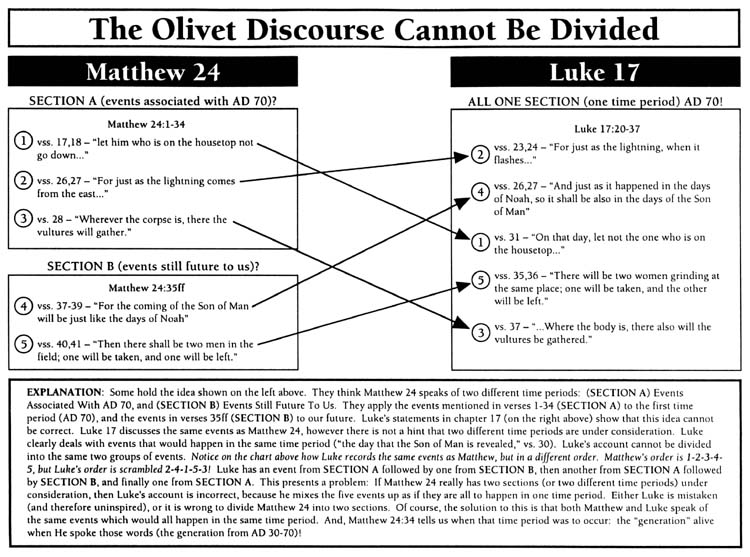
There are numerous reasons why I now believe all of Matthew 24 was fulfilled in the first century AD, in Jesus’ own generation. This post highlights one of those reasons, which is that Luke 17:20-37 demonstrates the impossibility of any time division. Luke 17 scrambles and reorders various portions of Jesus’ predictions in Matthew 24, predictions which are located before and well after verse 34. What is ordered as “1, 2, 3, 4, 5” in Matthew 24:1-41 is ordered as “2, 4, 1, 5, 3” in Luke 17:23-37, as shown in this diagram by Ed Stevens in his book titled, “What Happened in 70 AD?”

Matthew 24 Undivided

Source: World Without End (December 5, 2013); Better design seen here

David Curtis, the pastor of Berean Bible Church in Virginia Beach, Virginia, has also produced a similar chart, in which he fully writes out the passages shown in the diagram above

Matthew 24

Luke 17

SECTION ONE Verses 1-35

1. Matthew 24:17-18 (NKJV)
Let him who is on the housetop not go down to take anything out of his house. 18 “And let him who is in the field not go back to get his clothes.

2. Luke 17:23-24 (NKJV)
“And they will say to you, ‘Look here!’ or ‘Look there!’ Do not go after them or follow them. 24 “For as the lightning that flashes out of one part under heaven shines to the other part under heaven, so also the Son of Man will be in His day.
2. Matthew 24:26-27 (NKJV)
“Therefore if they say to you, ‘Look, He is in the desert!’ do not go out; or ‘Look, He is in the inner rooms!’ do not believe it. 27 “For as the lightning comes from the east and flashes to the west, so also will the coming of the Son of Man be.
4. Luke 17:26-27 (NKJV)
“And as it was in the days of Noah, so it will be also in the days of the Son of Man: 27 “They ate, they drank, they married wives, they were given in marriage, until the day that Noah entered the ark, and the flood came and destroyed them all.
3. Matthew 24:28 (NKJV)
“For wherever the carcass is, there the eagles will be gathered together.
1. Luke 17:31 (NKJV)
“In that day, he who is on the housetop, and his goods are in the house, let him not come down to take them away. And likewise the one who is in the field, let him not turn back.

SECTION TWO Verses 36-51

4. Matthew 24:37-39 (NKJV)
“But as the days of Noah were, so also will the coming of the Son of Man be. 38 “For as in the days before the flood, they were eating and drinking, marrying and giving in marriage, until the day that Noah entered the ark, 39 “and did not know until the flood came and took them all away, so also will the coming of the Son of Man be.

5. Luke 17:35-36 (NKJV)
“Two women will be grinding together: the one will be taken and the other left. 36 “Two men will be in the field: the one will be taken and the other left.”
5. Matthew 24:40-41 (NKJV)
“Then two men will be in the field: one will be taken and the other left. 41 “Two women will be grinding at the mill: one will be taken and the other left.
3. Luke 17:37 (NKJV)
And they answered and said to Him, “Where, Lord?” So He said to them, “Wherever the body is, there the eagles will be gathered together.”
Those who attempt to divide Matthew 24 say that SECTION ONE refers to the events of AD 70. But they say SECTION TWO refers to events yet future to us. If the five prophetic events of Matthew 24 that are found in Luke 17 are numbered 1-2-3-4-5, Luke’s numbering of the same events would be 2-4-1-5-3. Luke has an event from section 1 followed by one from section 2, then another from section 1 followed by section 2, and finally one from section 1. This shows the impossibility of dividing Matthew 24 with a 2,000 year gap.

 What do you think? Is this a valid conclusion? Why or why not?

————————————————————-

Previous posts on the Olivet Discourse can be viewed at this page, including a 4-part series (titled “This Generation Or That Generation?”) examining the accounts of Matthew, Mark, and Luke in a parallel fashion.

New Jerusalem, God’s Dwelling Place


Series: “Little Gems from Our Study of the Book of Revelation”

In the previous post, “Jerusalem, a Dwelling Place of Demons,” we looked at:

  • how Israel, Jerusalem, and the temple were once known as God’s dwelling place on earth
  • how God’s dwelling place is also in heaven
  • how Jerusalem’s unfaithfulness at times earned her the title of “harlot”
  • how Jesus said Jerusalem’s house was “desolate,” and that His “wicked generation” would be like a man exorcised of a demon but then inhabited by seven worse demons,
  • and how John was told that “the great city,” known as “Babylon the great” and “the harlot,” and first identified as Jerusalem, was “a dwelling place of demons.”

We also ended with this question: With God having abandoned Jerusalem as His dwelling place, was He then without a dwelling place of His own? As we also noted, God’s dwelling place was always in heaven (e.g. I Kings 8:30, 39, 43, 49):

“And may You hear the supplication of Your servant and of Your people Israel, when they pray toward this place. Hear in heaven Your dwelling place; and when You hear, forgive…”

Since we, as God’s people in Christ, know that “our citizenship is in heaven” (Philippians 3:20), it’s no surprise to discover that God has chosen us as His dwelling place. The New Testament record is clear that God’s earthly dwelling place is not in any way confined to a geographical location. God dwells with (and in) those who belong to His Son, Jesus.

In the book of Revelation, “those who dwell in heaven” are repeatedly distinguished from “those who dwell on the earth.” This pattern is discussed more fully in a 3-part series (part 1, part 2, and part 3). In the following two passages, we can see this distinction:

Then I heard a loud voice saying in heaven, ‘Now salvation, and strength, and the kingdom of our God, and the power of His Christ have come, for the accuser of our brethren, who accused them before our God day and night, has been cast down. And they overcame him by the blood of the Lamb and by the word of their testimony, and they did not love their lives to the death. Therefore rejoice, O heavens, and you who dwell in them! Woe to the inhabitants of the earth and the sea! For the devil has come down to you, having great wrath, because he knows that he has a short time‘” (Revelation 12:10-12).

“And [the beast] was given a mouth speaking great things and blasphemies, and he was given authority to continue for forty-two months. Then he opened his mouth in blasphemy against God, to blaspheme His name, His tabernacle, and those who dwell in heaven. It was granted to him to make war with the saints and to overcome them. And authority was given him over every tribe, tongue, and nation. All who dwell on the earth will worship him, whose names have not been written in the Book of Life of the Lamb slain from the foundation of the world” (Revelation 13:5-8).

Earthly Jerusalem was filled with demons, marked for judgment, and was judged, but God had already chosen a different Jerusalem as His dwelling place. This is John’s triumphant message after detailing the judgments which were soon (Rev. 1:1-3; 22:10) to be poured out on earthly Jerusalem: 

Then I, John, saw the holy city, New Jerusalem, coming down out of heaven from God, prepared as a bride adorned for her husband. And I heard a loud voice from the throne saying, ‘Behold, the dwelling place of God is with man. He will dwell with them, and they will be His people, and God Himself will be with them as their God’’” (Revelation 21:2-3).

I don’t believe John’s words here only became true after he wrote them, but rather they were already true of those abiding in Christ. John’s vision here stands in contrast to his previous vision of the harlot city ripe for judgment. Earthly Jerusalem, the harlot, had become a dwelling place for demons (Rev. 18:2), and that demon-filled city met its demise, but God’s dwelling place, the bride, stood unshaken. Since the time of Christ, God dwells in “the holy city, New Jerusalem.” We, the church, the bride of Christ, are that city: 

You are the light of the world. A city that is set on a hill cannot be hidden” (Matthew 5:14). 

Many believe that this promise from Revelation 21 has not yet been realized or fulfilled, even in our day. However, the author of Hebrews didn’t believe this way when he told his first century audience that they had already “come to Mount Zion and to the city of the living God, the heavenly Jerusalem…to Jesus the Mediator of the new covenant, and to the blood of sprinkling…” (Hebrews 12:22-24). The apostle Paul also didn’t believe this way when he quoted Exodus 29:45, Leviticus 26:11, and Ezekiel 37:27 as a present reality for the Church in his own day:

For you are the temple of the living God. As God has said: ‘I will dwell in them and walk among them. I will be their God, and they shall be My people‘” (II Corinthians 6:16).

The apostle Paul also said this to the believers in Ephesus:

You are fellow citizens with the saints and members of the household of God, built on the foundation of the apostles and prophets, Christ Jesus Himself being the cornerstone, in whom the whole structure, being joined together, grows into a holy temple in the Lord. In Him you are also being built together into a dwelling place for God by the Spirit” (Ephesians 2:19-22).

I would like to submit that the book of Revelation reflects a picture also shown in Galatians 4:21-31 and in Hebrews 12:18-29, of two cities, two women, and two covenants (this chart appears larger if opened in a new tab):

Two Covenants

Also, note how the following passages in Revelation compare with, and contrast, each other:

A. Revelation 17:1: “Then one of the seven angels who had the seven bowls came and said to me, ‘Come, I will show you the judgment of the great prostitute who is seated on many waters.’”

A. Revelation 21:9: “Then came one of the seven angels which had the seven bowls full of the seven last plagues and spoke to me, saying, ‘Come, I will show you the Bride, the wife of the Lamb.’”

B. Revelation 17:3: “And he carried me away in the Spirit into a wilderness, and I saw a woman sitting on a scarlet beast that was full of blasphemous names.”

B. Revelation 21:10: “And he carried me away in the Spirit to a great, high mountain, and showed me the holy Jerusalem coming down out of heaven from God.”

In the first scene, it’s likely that John was taken to a wilderness because it was in a wilderness that God established the old covenant with the Israelites. In the final scene, it’s likely that John was taken to a great, high mountain because of what God said He would do in the last days of the old covenant age:

Now it shall come to pass in the latter days that the mountain of the Lord’s house shall be established on the top of the mountains, and shall be exalted above the hills; and all nations shall flow to it” (Isaiah 2:2, Micah 4:1).

With His Son, Jesus, as the cornerstone, God has built His church as His spiritual house and temple. Because Jesus is the light of the world, we are also the light of the world, and the nations are being drawn to His light. Jerusalem, in its last days, was a dwelling place for demons, but God’s new covenant community, new Jerusalem, is now His holy dwelling place.

———————————————–

For more details behind the content in this post, see our study on Revelation 21 (verses 1-4 and verses 5-27).

Jerusalem, a Dwelling Place of Demons


Series: “Little Gems from Our Study of the Book of Revelation”

And [the angel] cried mightily with a loud voice, saying, “Babylon the great is fallen, is fallen, and has become a dwelling place of demons, a prison for every foul spirit, and a cage for every unclean and hated bird!” (Revelation 18:2)

A survey of the Old Testament reveals a common theme, as God repeatedly proclaimed that Israel, Jerusalem, and the temple were His dwelling place. Consider the following texts (this is just a sample):

You will bring them in and plant them In the mountain of Your inheritance, In the place, O Lord, which You have made for Your own dwelling, the sanctuary, O Lord, which Your hands have established” (Exodus 15:17).

But you shall seek the place where the Lord your God chooses, out of all your tribes, to put His name for His dwelling place; and there you shall go” (Deuteronomy 12:5).

In Jerusalem also is His tabernacle, and His dwelling place in Zion” (Psalm 76:2).

For the Lord has chosen Zion; He has desired it for His dwelling place(Psalm 132:13).

At the same time, God’s dwelling place was in heaven (e.g. I Kings 8:30, 39, 43, 49):

“And may You hear the supplication of Your servant and of Your people Israel, when they pray toward this place. Hear in heaven Your dwelling place; and when You hear, forgive…”

A survey of the Old Testament also reveals that Israel and Jerusalem often proved unworthy of serving as a dwelling place for God. In these times of unfaithfulness, Jeremiah, Ezekiel, and Hosea were among those who referred to Israel as a harlot:

The Lord said also to me in the days of Josiah the king: “Have you seen what backsliding Israel has done? She has gone up on every high mountain and under every green tree, and there played the harlotAnd I said, after she had done all these things, ‘Return to Me.’ But she did not return. And her treacherous sister Judah saw it. Then I saw that for all the causes for which backsliding Israel had committed adultery, I had put her away and given her a certificate of divorce; yet her treacherous sister Judah did not fear, but went and played the harlot also” (Jeremiah 3:6-8).

But you trusted in your own beauty, played the harlot because of your fame, and poured out your harlotry on everyone passing by who would have it” (Ezekiel 16:15).

I have seen a horrible thing in the house of Israel: There is the harlotry of Ephraim; Israel is defiled” (Hosea 6:10).

When Jesus came, He summed up what had become of Jerusalem in this lament:

O Jerusalem, Jerusalem, the one who kills the prophets and stones those who are sent to her! How often I wanted to gather your children together, as a hen gathers her chicks under her wings, but you were not willing! See! Your house is left to you desolate” (Matthew 23:37-38).

Strong’s Concordance defines the word “desolate” (#2048), used by Matthew here, as “lonesome, waste, desert, solitary, wilderness.” In the New Testament, we see indications that demons are attracted to such places:

For Jesus had commanded the unclean spirit to come out of the man. For it had often seized him, and he was kept under guard, bound with chains and shackles; and he broke the bonds and was driven by the demon into the wilderness” (Luke 8:29; some translations say “solitary places” or “deserted places”).

Similarly, recall what Jesus said would be true of the nation of Israel in His generation:

The men of Nineveh will rise up in the judgment with this generation and condemn it, because they repented at the preaching of Jonah; and indeed a greater than Jonah is here. The queen of the South will rise up in the judgment with this generation and condemn it, for she came from the ends of the earth to hear the wisdom of Solomon; and indeed a greater than Solomon is here. When an unclean spirit goes out of a man, he goes through dry places, seeking rest, and finds none. Then he says, ‘I will return to my house from which I came.’ And when he comes, he finds it empty, swept, and put in order. Then he goes and takes with him seven other spirits more wicked than himself, and they enter and dwell there; and the last state of that man is worse than the first. So shall it also be with this wicked generation” (Matthew 12:41-45).

John wrote the book of Revelation in Jesus’ generation, and there we see a tragic picture of what had become of His former dwelling place, as John describes “Babylon the great”:

And [the angel] cried mightily with a loud voice, saying, “Babylon the great is fallen, is fallen, and has become a dwelling place of demons, a prison for every foul spirit, and a cage for every unclean and hated bird!” (Revelation 18:2).

Someone may object here and say that Babylon the great is not Jerusalem. However, if we pay attention, John does positively identify the great city, Babylon. In the previous chapter, John is shown “the judgment of the great harlot who sits on many waters, with whom the kings of the earth committed fornication” (Rev. 17:1-2). She is shown sitting on a great beast (verse 3), and on her forehead are written these words: “MYSTERY, BABYLON THE GREAT, THE MOTHER OF HARLOTS AND OF THE ABOMINATIONS OF THE EARTH” (verse 5). John sees her drunk with the blood of the saints and the martyrs (verse 6). The angel says to John, “The woman whom you saw is that great city which reigns over the kings of the earth” (verse 18). So the following is clear:

The harlot = Babylon the great = the great city

The “great city” is mentioned five times in Rev. 18 (verses 10, 16, 18, 19, and 21). In verses 10 and 21 it’s referred to as “the great city Babylon.” (See also Rev. 14:8.) Yet it’s in the first mention of “the great city” where we see the positive identification of that city. We see this in the scene of the two witnesses who are killed by the beast:

 “And their dead bodies will lie in the street of the great city which spiritually is called Sodom and Egypt, where also our Lord was crucified” (Rev. 11:8).

Jesus was crucified in Jerusalem. Therefore, “the great city” is Jerusalem. This title was also given to Jerusalem by Josephus (Wars 7:8:7) and Appian, a Roman historian of the same era. It may also be a throwback to Jeremiah’s words when he described the soon-coming judgment upon Jerusalem by Babylon, which took place in 586 BC:

And many nations will pass by this city, and every man will say to his neighbor, “Why has the Lord dealt thus with this great city?” And they will answer, “Because they have forsaken the covenant of the Lord their God and worshiped other gods and served them” (Jeremiah 22:8-9).

The great city, Babylon, is further confirmed as Jerusalem in at least the following three ways:

[1] This would not be the first time that Israel was referred to as “Sodom.” Isaiah did the same thing: Hear the word of the Lord, you rulers of SodomGive ear to the law of our God, you people of Gomorrah: ‘To what purpose is the multitude of your sacrifices to Me?’ says the Lord…” (Isaiah 1:10-11)John invokes the names of two of Israel’s oldest enemies, Sodom and Egypt, and uses them to describe first century Jerusalem.

[2] John describes the great city using the imagery of a harlot. As discussed above, Jeremiah, Ezekiel, and Hosea referred to Israel as a harlot in their day. Israel was in a covenant relationship with God, and therefore capable of spiritual adultery, unlike other nations in John’s day (or the United States or any other nation in our own day).

[3] John sees the harlot, Babylon the great, drunk with the blood of martyrs and saints (Rev. 17:6), and filled with the blood of prophets and apostles (Rev. 18:20, 24; see also Rev. 16:6, 19:2). Jesus said that Israel would be held responsible and judged in His generation for shedding this very blood (Matthew 23:29-36). He also said that “it cannot be that a prophet should perish outside of Jerusalem” (Luke 13:33). 

In all this we see that a terrible thing had happened to Jerusalem, God’s former dwelling place. It was given over to spiritual adultery and had become overrun by demons:

“Babylon the great is fallen, is fallen, and has become a dwelling place of demons, a prison for every foul spirit, and a cage for every unclean and hated bird!” (Revelation 18:2).

With God having abandoned Jerusalem as His dwelling place, was He then without a dwelling place of His own? Not at all. In the next post, we will see that God has chosen as His dwelling place the new Jerusalem, the community of saints who abide in His Son, Jesus.

————————————————————————————

For more information and details on the content in this post, see our studies on Revelation 17 (verses 1-6 and verses 7-18) and Revelation 18.

If time allows, consider also our study on Revelation 9, where John sees an army of torturing locusts emerging out of the abyss. There is good reason to believe John witnesses a horde of demons sweeping through the land of Israel. The locusts didn’t touch any vegetation, but were given authority to torment only those who were not God’s servants, and this torment was to last for five months. In Judea, locusts typically came between May and September (a 5-month period), and this is roughly the same period when Rome laid a 5-month siege upon Jerusalem in 70 AD leading to Jerusalem’s downfall in September of that year.

Echoes of Mount Sinai in the Book of Revelation


Series: “Little Gems from Our Study of the Book of Revelation”

What point(s) did John, through the inspiration of the Holy Spirit, wish to get across to his initial readers when he distributed the book of Revelation to seven churches in first century Asia Minor? What themes are weaved through the book? In considering these questions, keep in mind that the full title of the book is “The Revelation of Jesus Christ.”

Proposal: One of the Holy Spirit’s aims in Revelation is to guide the early church in navigating the transition period from one covenant (the old) to the next (the new), especially as that period was drawing to a close. This period lasted roughly 40 years (30 AD – 70 AD), parallel to the 40 years that the Israelites wandered in the wilderness.

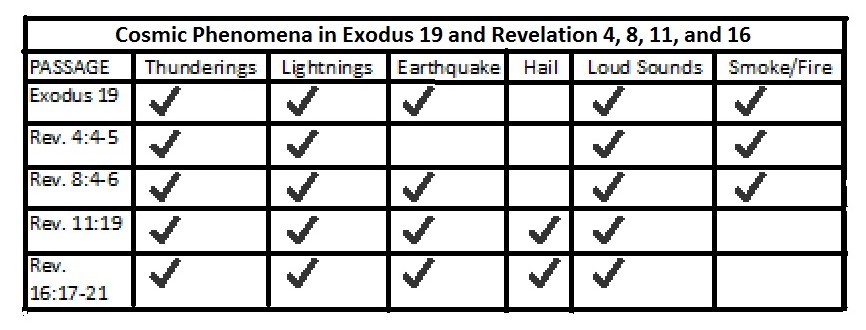
Basis (one of several): The same imagery that was present at the giving of the law, the old covenant, is echoed several times in the book of Revelation (4:5, 8:5, 11:19, and 16:18). This post will highlight these passages and their significance.

Parallel Scripture Passage: In that He says, ‘a new covenant,’ He has made the first obsolete. Now what is becoming obsolete and growing old is ready to vanish away” (Hebrews 8:13, 1st century AD).

Moses and the Israelites at Mount Sinai

Just before examining these passages in Revelation, let’s look at Exodus 19, the passage I believe they echo:

In the third month after the children of Israel had gone out of the land of Egypt, on the same day, they came to the Wilderness of Sinai. For they had departed from Rephidim, had come to the Wilderness of Sinai, and camped in the wilderness. So Israel camped there before the mountain. And Moses went up to God, and the Lord called to him from the mountain, saying, “Thus you shall say to the house of Jacob, and tell the children of Israel: ‘You have seen what I did to the Egyptians, and how I bore you on eagles’ wings and brought you to Myself. Now therefore, if you will indeed obey My voice and keep My covenant, then you shall be a special treasure to Me above all people; for all the earth is Mine. And you shall be to Me a kingdom of priests and a holy nation.’ These are the words which you shall speak to the children of Israel.”

Then it came to pass on the third day, in the morning, that there were thunderings and lightnings, and a thick cloud on the mountain; and the sound of the trumpet was very loud, so that all the people who were in the camp trembled. And Moses brought the people out of the camp to meet with God, and they stood at the foot of the mountain. Now Mount Sinai was completely in smoke, because the Lord descended upon it in fire. Its smoke ascended like the smoke of a furnace, and the whole mountain quaked greatly  (Exodus 19:1-18).

So we see that God reminded them of how He bore the people of Israel “on eagles’ wings”* out of Egypt and to Himself. God was establishing a covenant with them at this time, and He called them to be “a kingdom of priests and a holy nation.”** This gathering was marked by thundering and lightning, the sound of a loud trumpet, thick smoke, and the whole mountain quaking greatly.

*Compare to Revelation 12:13-14, where the persecuted womanwas given two wings of a great eagle, that she might fly into the wilderness to her place, where she is nourished for a time and times and half a time, from the presence of the serpent.”

**Compare this with John’s opening greeting to the seven churches, where he says that Jesus “has made us kings and priests to His God and Father” (Revelation 1:6).

Four Passages That Echo Mount Sinai in Revelation

The same cosmic phenomena present at Mount Sinai are seen again in the book of Revelation. Observe the following passages, with some brief notes on their likely significance:

1. Revelation 4:4-5

Around the throne were 24 thrones, and on the thrones I saw 24 elders sitting, clothed in white robes; and they had crowns of gold on their heads. And from the throne proceeded lightnings, thunderings, and voices. Seven lamps of fire were burning before the throne, which are the seven Spirits of God.”

As we noted in our study of Revelation 4, the 24 elders may very well “depict the 12 patriarchs of Israel and the 12 apostles, who represent the redeemed of both covenants now united in Christ.” This seems to be substantiated by the names of the 12 tribes and the 12 apostles found written on the gates and walls of the new Jerusalem (Rev. 21:12-14). So it appears that this covenant-establishing imagery takes place in the presence of elders representing both the old and the new covenant ages.

2. Revelation 8:4-6

And the smoke of the incense, with the prayers of the saints, ascended before God from the angel’s hand. Then the angel took the censer, filled it with fire from the altar, and threw it to the earth. And there were noises, thunderings, lightnings, and an earthquake. So the seven angels who had the seven trumpets prepared themselves to sound.”

This scene takes place at the opening of the seventh and final seal (Rev. 8:1). An angel with a golden censer offers the prayers of the saints, along with incense, upon the altar before God’s throne (verse 3). We proposed in our study of Rev. 8 that these prayers are linked to the cries of the martyrs for God to avenge their “blood on those who dwell on the earth” – Rev. 6:10 (see this post for a more complete study on this subject). It seems likely that the seal judgments are poured out in response to the prayers of God’s people. Therefore, the covenant-establishing imagery of Mount Sinai appears here because the prayers of the new covenant community were about to result in the old covenant system reaching its demise.

3. Revelation 11:19

Then the temple of God was opened in heaven, and the ark of His covenant was seen in His temple. And there were lightnings, noises, thunderings, an earthquake, and great hail.

Just as the scene we examined in Rev. 8 takes place at the opening of the seventh seal, this scene takes place at the sounding of the seventh trumpet. Loud voices declare, “The kingdoms of this world have become the kingdoms of our Lord and of His Christ, and He shall reign forever and ever!” The 24 elders are present at this scene (Rev. 11:15-16).

In verse 19 we see probably the most explicit reference connecting the old covenant to the prophecies in the book of Revelation. John sees a vision of God’s temple housing “the ark of His covenant.” In ancient Israel, the ark of the covenant was a centerpiece of the temple and the old covenant. Located in the Most Holy Place, it represented God’s presence: “You shall put the mercy seat on top of the ark, and in the ark you shall put the Testimony that I will give you. And there I will meet with you, and I will speak with you from above the mercy seat, from between the two cherubim which are on the ark of the Testimony, about everything which I will give you in commandment to the children of Israel” (Exodus 25:21-22). For further significance, see Numbers 7:89, 10:33-35; Joshua 3:13, 7:6-11; Judges 20:27; II Samuel 6:2; II Kings 19:15; Psalm 28:2, 80:1.

When the dust settles from the barrage of judgments in Revelation, what does heaven shout? “Behold, the tabernacle of God is with men, and He will dwell with them, and they shall be His people. God Himself will be with them and be their God” (Rev. 21:3). This did not suddenly become true because some buildings fell in 70 AD. Remember that Paul told the Corinthian church this was already their reality and that they were “the temple of the living God (II Cor. 6:16). The downfall of Israel, Jerusalem, and the temple in 70 AD, however, did remove the far less glorious old covenant system which competed against, and greatly opposed, this reality. It was a stunning and vivid demonstration that God had chosen the glorious new covenant over the inferior old covenant (see Hebrews 8). This was the time for rewarding God’s “servants the prophets and the saints, and those who fear [His] name, small and great” (Rev. 11:18).

Several verses earlier, John witnesses an actual earthquake that kills 7000 people in“the city” (Rev. 11:13), already identified in verse 8 as Jerusalem (“the great city…where also our Lord was crucified“). As we noted in our study of Revelation 11, Josephus records one awful night in early 68 AD when “a prodigious storm” took place in Jerusalem, marked by “the largest showers of rain, with continued lightnings, terrible thunderings, and amazing concussions and bellowings of the earth, that was in an earthquake.” Josephus adds that the Jewish zealots allowed the Idumaeans to come in and help them slaughter some of their fellow Jews who opposed their rebellion against the Romans. Between this slaughter and the earthquake, 8500 people died that night (Josephus, Wars 4:4:5, 4:4:7-4:5:1).

4. Revelation 16:17-21

Then the seventh angel poured out his bowl into the air, and a loud voice came out of the temple of heaven, from the throne, saying, ‘It is done!’ And there were noises and thunderings and lightnings; and there was a great earthquake, such a mighty and great earthquake as had not occurred since men were on the earth. Now the great city was divided into three parts, and the cities of the nations fell. And great Babylon was remembered before God, to give her the cup of the wine of the fierceness of His wrath. Then every island fled away, and the mountains were not found. And great hail from heaven fell upon men, each hailstone about the weight of a talent. Men blasphemed God because of the plague of the hail, since that plague was exceedingly great. 

Just as the scene we examined in Rev. 8 takes place at the opening of the seventh seal, and the scene in Rev. 11 takes place at the sounding of the seventh trumpet, this scene takes place at the pouring out of the seventh bowl.

John sees the great city, Jerusalem, divided into three parts. As we noted in our study of Revelation 16, this is a flashback to Ezekiel 5:1-12, when the prophet was required to shave his head and divide it into three parts, and was told by God: “This is Jerusalem” (Ezek 5:5).  One third of his hair was burned, one third was chopped up by the sword, and the last third was scattered into the wind. This was fulfilled when Jerusalem was destroyed in 586 B.C. at the hands of Babylon, and Josephus records the same tragedies in 70 AD at the hands of Rome (1.1 million Jews killed by the sword or by fire, and all the survivors exiled or sold into slavery). Jerusalem was also divided between 67-70 AD into three warring factions: [1] the Zealots, led by Eleazar [2] the Galileans, led by John of Gischala, and [3] the Idumeans, led by Simon.

Just as an actual deadly earthquake took place as foretold in Rev. 11, actual hail – “about the weight of a talent” (i.e. 75 – 100 pounds) – also fell as foretold in Rev. 16. Josephus wrote of large stones shot from catapults by the Roman armies into the temple complex in Jerusalem, which the watchmen in the city reported as appearing white in the sky:

“Now the stones that were cast were of the weight of a talent, and were carried two furlongs and further. The blow they gave was no way to be sustained, not only by those that stood first in the way, but by those that were beyond them for a great space. As for the Jews, they at first watched the coming of the stone, for it was of a white color, and could therefore not only be perceived by the great noise it made, but could be seen also before it came by its brightness” (Josephus, Wars 5:6:3).

Josephus also records that the watchmen on the wall, when they saw the stones coming, would shout, “The Son cometh!” After a while the Romans learned to blacken the stones so that they couldn’t as easily be detected, and many more were crushed by these stones. J. Stuart Russell, in his 1878 book titled The Parousia, offers this explanation for the words of the watchmen (p. 482):

“It could not but be well known to the Jews that the great hope and faith of the Christians was the speedy coming of the Son. It was about this very time, according to Hegesippus [110-180 AD], that St. James, the brother of our Lord, publicly testified in the temple that ‘the Son of man was about to come in the clouds of heaven,’ and then sealed his testimony with his blood [in 62 AD]. It seems highly probable that the Jews, in their defiant and desperate blasphemy, when they saw the white mass hurtling though the air, raised the ribald cry, ‘The Son is coming,’ in mockery of the Christian hope of the Parousia.”

—————————————————————————

In his book,Revelation: Four Views (A Parallel Commentary),” Steve Gregg also sees the connection between Mount Sinai and Revelation, as he shares concerning Rev. 4 (p. 88):

“The lightnings, thundering and voices (v. 5) recall Mount Sinai, where God first established His covenant with Israel [Exodus 19:16; cf. Rev. 8:5, 11:19]. Similar phenomena are mentioned here to suggest the end of that covenant and its replacement with another. The writer of Hebrews (citing Hag. 2) likened the overthrow of the first covenant (publicly demonstrated by the destruction of Jerusalem and the temple in A.D. 70) to the time of its establishment at Sinai, but the latter would be accompanied by even more fearful phenomena (Heb. 12:18-29).”

Steve Gregg also shares David Chilton’s comparison of Revelation 19:1-6 with Revelation 11:15-19 (which we have already examined). Chilton indicates that very similar subject matter is established “in the two passages which represent the closing visions of the two major sections of the book” (p. 440):

1. loud voices…in heaven (11:15; 19:1);
2. the declaration of the commencement of the reign of God (11:15, 17; 19:1, 6);
3. the twenty-four elders fall on their faces and worship (11:16; 19:4);
4. the avenging of the blood of His servants is announced (11:18; 18:24; 19:2);
5. reference to God’s servants…who fear Him, small and great (11:18; 19:5);
6. loud noises, including thunderings (11:19; 19:6).

—————————————————————

Check out the first two posts in this mini-series:

1. Revelation 6 and Luke 23: Hide Us From the Wrath of the Lamb
2. The Avenging of Righteous Blood (Deuteronomy, Matthew, and Revelation)

Revelation: The Land (“Ge”) Is Referenced 22 Times More Often Than the World (“Kosmos”)


It’s well-known that the book of Revelation foretells, among other things, a series of frightening judgments falling upon an entity known as Babylon the Great and “the harlot.” Just as importantly, Revelation also portrays beautiful worship scenes and glorious destinies and realities for God’s people. Regarding the judgments, Does John picture them being poured out upon the entire planet, or upon a particular location?

Jonathan Welton, author of the book “Raptureless,” has created another helpful graphic illustrating the fulfillment of Bible prophecy (See his previous graphic on Daniel 2 illustrating that God’s kingdom has come). Titled “John’s Olivet Discourse: A Look at the Writings of John,” Welton’s graphic [1] makes a case that the book of Revelation contains John’s version of the Olivet Discourse [2] shows some of John’s time tables [3] notes an important principle of Bible interpretation, and [4] shows that John speaks far more about local events in Revelation than he speaks about global events.

We can also add Revelation 1:1 and 1:3 to Welton’s list of time statements made by the apostle John:

The Revelation of Jesus Christ, which God gave Him to show His servants—things which must shortly take place.
Blessed is he who reads and those who hear the words of this prophecy, and keep those things which are written in it; for the time is near.

The last part of Welton’s graphic is very informative. The following chart takes the numbers he provides (plus a couple more that I looked up) and allows us to see how focused John was on local events in the book of Revelation compared to his gospel account:

John’s books Number of chapters in each book Number of times John uses the word “kosmos,” meaning the entire planet Number of times John uses the word “ge,” meaning the land (a region)
The Gospel According to John 21 57 3
I John 5 17 1
II John 1 1 0
III John 1 0 0
Revelation 22 3 67

In other New Testament passages where the word “ge” is translated as “earth,” many assume that those passages are speaking about the entire planet. We need to be more careful with this assumption. One instance where it appears is in Luke’s version of the Olivet Discourse (Luke 21:23). There, Luke is clearly speaking about Israel. Some Bible versions translate this word as “earth,” while others translate it as “land.” Here is how Luke 21:23 reads, in context:

But when you see Jerusalem surrounded by armies, then know that its desolation is near. Then let those who are in Judea flee to the mountains, let those who are in the midst of her depart, and let not those who are in the country enter her. For these are the days of vengeance, that all things which are written may be fulfilled. But woe to those who are pregnant and to those who are nursing babies in those days! For there will be great distress in the land and wrath upon this people” (Luke 21:20-23).

The same word that Luke used in reference to Judea is the one that John used 67 times in the book of Revelation.

18 Case Studies on How John Used “Ge” to Speak of 1st Century Israel in Revelation

In 2010 I wrote a 3-part series tracking this phenomenon throughout the book of Revelation. The phrase “those who dwell on the earth” appears 10 times in Revelation, and at least a couple dozen more times in various forms. This series presents 18 case studies showing when and how this expression is used, examining the context in each case, and seeing how it’s used elsewhere in Scripture. A strong case is made that this expression in Revelation indicates 1st century apostate Israel. This series can be seen here: Part 1, Part 2, Part 3. If you have the time to read it, I believe you’ll find it informative.

A Final Note on How John Used the Word “Kosmos” Three Times in Revelation

Although it’s fun and enlightening to see how John used the word “ge” so many times in reference to the land of Israel, it’s also enlightening to see how he used the word “kosmos” to speak of the planet on which we live. Two of these instances concern those whose names are, or are not, written in the Book of Life. This is a global reference, as it ought to be, for the body of Christ is global and the message of the gospel is for every nation, tribe, language, and tongue. The third reference is to the kingdom of God, its triumph and greatness over all the kingdoms of this world (planet), and the eternal and universal reign of Jesus Christ:

1. “Then the seventh angel sounded: And there were loud voices in heaven, saying, ‘The kingdoms of this world have become the kingdoms of our Lord and of His Christ, and He shall reign forever and ever!'” (Rev. 11:15)
2. “All who dwell on the earth will worship him, whose names have not been written in the Book of Life of the Lamb slain from the foundation of the world” (Rev. 13:8).
3. “The beast that you saw was, and is not, and will ascend out of the bottomless pit and go to perdition. And those who dwell on the earth will marvel, whose names are not written in the Book of Life from the foundation of the world, when they see the beast that was, and is not, and yet is” (Rev. 17:8).

The Avenging of Righteous Blood (Deuteronomy, Matthew and Revelation)


Series: “Little Gems from Our Study of the Book of Revelation”

Recently my friend, Jerry William Bowers Jr., posted the following status on Facebook:

Revelation simplified:

Revelation 6:10, 16:6, 17:6, 18:24, 19:2, 20:4 speaks to the avenging of righteous blood.

This was prophesied in Deuteronomy 32:43, and would occur in Israel’s “END” (Deuteronomy 32:20) in their “Latter end” (Deuteronomy 32:29).

Matthew 23:34-36 very clearly says this would be fulfilled in their own generation.

It just doesn’t get any simpler than that!

I agree with Jerry’s summary, and would like to develop it further. During the last several years of studying eschatology, one thing I’ve enjoyed immensely is allowing Scripture to interpret Scripture. It’s an enlightening exercise. To give one example, I was taught for a long time that Isaiah’s imagery of a wolf lying down with a lamb is both unfulfilled and a literal reference to the animal kingdom. However, I’ve now come to understand, by allowing Romans 15 to interpret Isaiah 11, that this is presently fulfilled in Christ, who broke down the wall of division between Jews and Gentiles so that all may find their hope in Him (see “Romans 15 Shows That Isaiah 11 Is Fulfilled“).

Deuteronomy 32: Prediction of Israel’s End and Judgment for Murdering God’s People

Jerry’s status is also an appeal to allow Scripture to interpret Scripture, in this case concerning the theme of the blood of the martyrs. Let’s take a look at the passages he referenced in Deuteronomy 32, plus one more (verse 5). There Moses is speaking to Israel (Deut. 31:30), which he very interestingly addresses as “heaven” and “earth” (Deut. 32:1).

“They have corrupted themselves; They are not His children, because of their blemish: a perverse and crooked generation” (Deut. 32:5).

And He said: ‘I will hide My face from them, I will see what their end will be, for they are a perverse generation, children in whom is no faith‘” (Deut. 32:20).

For they are a nation void of counsel, nor is there any understanding in them. Oh, that they were wise, that they understood this, that they would consider their latter end! (Deut. 32:28-29).

Rejoice, O Gentiles, with His people; For He will avenge the blood of His servants, and render vengeance to His adversaries; He will provide atonement for His land and His people” (Deut. 32:43).

Does anything jump out when noting Moses’ language in verse 20? Recall what Jesus said to His Israelite audience in Matthew 17:

Then Jesus answered and said, “O faithless and perverse generation, how long shall I be with you? How long shall I bear with you? Bring him here to Me” (Matthew 17:17).

Moses predicted that at the time of Israel’s end, they would be a perverse and faithless generation. Jesus ministered in Israel to the same generation that was overthrown by the Romans in 70 AD, and He called that generation “faithless and perverse.” It would seem that Jesus intentionally invoked Moses’ words in Deut. 32:20. The apostle Paul did the same thing when addressing the Philippian church, as he used the exact same phrase Moses used in Deut. 32:5.

Do all things without complaining and disputing, that you may become blameless and harmless, children of God without fault in the midst of a crooked and perverse generation, among whom you shine as lights in the world…” (Philippians 2:14-15).

Matthew 23: Jesus’ Own Generation Responsible for The Blood of God’s Servants

We turn now to Jesus’ prediction in His woes upon the Scribes and Pharisees. He declared that they “build the tombs of the prophets and adorn the monuments of the righteous” (Matt. 23:29), and that they “are sons of those who murdered the prophets” (verse 31). Jesus went on to say:

Therefore, indeed, I send you prophets, wise men, and scribes: some of them you will kill and crucify, and some of them you will scourge in your synagogues and persecute from city to city, that on you may come all the righteous blood shed on the earth, from the blood of righteous Abel to the blood of Zechariah, son of Berechiah, whom you murdered between the temple and the altar. Assuredly, I say to you, all these things will come upon this generation” (Matt. 23:34-36).

Moses, in Deuteronomy 32, predicted that God would “avenge the blood of His servants” at the time of Israel’s end. Jesus told the religious leaders of Israel that they would be held responsible for “all the righteous blood shed on earth” (or land, that is, Israel’s land). He made it clear that their generation would experience that judgment.

Revelation: The Avenging of the Blood of God’s Saints, Prophets, and Apostles

In the book of Revelation, as John is shown a series of judgments being poured out, we see this scene in heaven:

When He opened the fifth seal, I saw under the altar the souls of those who had been slain for the word of God and for the testimony which they held. And they cried with a loud voice, saying, “How long, O Lord, holy and true, until You judge and avenge our blood on those who dwell on the earth?” (Rev. 6:9-10)

Many believe or teach that the judgments of Revelation will be poured out in our own future and upon the entire globe, but who did Jesus say would be held responsible for all the bloodshed of God’s servants? What generation did He say would experience that vengeance? Without a doubt, it was His own people (Israel) and His own generation. As the outpouring of judgment progresses in the book of Revelation, we see how God answers the cries of the martyrs:

Then the third angel poured out his bowl on the rivers and springs of water, and they became blood. And I heard the angel of the waters saying: “You are righteous, O Lord, the One who is and who was and who is to be, because You have judged these things. For they have shed the blood of saints and prophets, and You have given them blood to drink. For it is their just due” (Rev. 16:4-6).

So he carried me away in the Spirit into the wilderness. And I saw a woman sitting on a scarlet beast which was full of names of blasphemy, having seven heads and ten horns. The woman was arrayed in purple and scarlet, and adorned with gold and precious stones and pearls, having in her hand a golden cup full of abominations and the filthiness of her fornication. And on her forehead a name was written: MYSTERY, BABYLON THE GREAT, THE MOTHER OF HARLOTS AND OF THE ABOMINATIONS OF THE EARTH. I saw the woman, drunk with the blood of the saints and with the blood of the martyrs of Jesus. And when I saw her, I marveled with great amazement” (Rev. 17:3-6).

They threw dust on their heads and cried out, weeping and wailing, and saying, ‘Alas, alas, that great city, in which all who had ships on the sea became rich by her wealth! For in one hour she is made desolate.’ “Rejoice over her, O heaven, and you holy apostles and prophets, for God has avenged you on her!” …And in her was found the blood of prophets and saints, and of all who were slain on the earth” (Rev. 18:19-24).

For true and righteous are His judgments, because He has judged the great harlot who corrupted the earth with her fornication; and He has avenged on her the blood of His servants shed by her” (Rev. 19:2).

In our series on the book of Revelation, we noted that “the great city” was first identified in Rev. 11:8 as the place “where our Lord was crucified.” This is a positive identification of Jerusalem as “the great city” spoken of in the book of Revelation. It’s no wonder that “in her was found the blood of prophets and saints…” This is the very thing that Jesus said in Matthew 23 would be true of first century Jerusalem. This is also the time when the apostles lived and ministered (Rev. 18:20).

The great city, Babylon the Great, was called “the mother of harlots.” Did Jesus not refer to His own generation in Israel as “a wicked and adulterous generation” (e.g. Matthew 12:39, 16:4)? Did Jeremiah not use similar language to describe ancient Israel during times of apostasy? Was it not legitimate for God to use the language of adultery against an unfaithful nation that was in covenant with Him? Had first century Israel not become as awful and wicked as their ancient enemy and conqueror, Babylon?

See our study on Revelation 17:1-6 for the significance of the harlot imagery that John used, the garments that the harlot wore, the words on her forehead, the rich Old Testament background for all these things, and the harlot’s close partnership with first-century Rome.

The Apostle Paul Prophesies Judgment and Tribulation Against the Israel of His Day

In light of everything we’ve discussed above, it’s also good to take note of what the apostle Paul said to the believers in Thessalonica who were suffering and enduring persecution at the time of his letters (52-54 AD):

For you, brethren, became imitators of the churches of God which are in Judea in Christ Jesus. For you also suffered the same things from your own countrymen, just as they did from the Judeans, who killed both the Lord Jesus and their own prophets, and have persecuted us; and they do not please God and are contrary to all men, forbidding us to speak to the Gentiles that they may be saved, so as always to fill up the measure of their sins; but wrath has come upon them to the uttermost” (I Thessalonians 2:14-16)

“…[We] ourselves boast of you among the churches of God for your patience and faith in all your persecutions and tribulations that you endure, which is manifest evidence of the righteous judgment of God, that you may be counted worthy of the kingdom of God, for which you also suffer; since it is a righteous thing with God to repay with tribulation those who trouble you, and to give you who are troubled rest with us when the Lord Jesus is revealed from heaven with His mighty angels, in flaming fire taking vengeance on those who do not know God, and on those who do not obey the gospel of our Lord Jesus Christ” (II Thessalonians 1:4-8).

Paul affirmed that the time had nearly come for the inhabitants of Judea to experience God’s wrath “to the uttermost” for killing Jesus and the prophets. Their opposition to the gospel was “contrary to all men” and was a great hindrance in the quest to spread the gospel among the Gentiles. It would be “a righteous thing with God” when they were repaid with tribulation, and it would result in them receiving rest. Jesus had promised to come with His angels in judgment and in His kingdom while some of His disciples were still alive (Matthew 16:27-28).

To Review

1. Moses prophesied that God would “avenge the blood of His servants” upon a faithless, perverse, and crooked generation at the time of Israel’s “latter end” (Deuteronomy 32:5, 20, 29, 43).

2. Jesus repeatedly denounced His own generation as “perverse”, “faithless”, and “adulterous.” Paul told the Philippian church that they were shining as lights in the midst of “a crooked and perverse generation” (Phil. 2:14-15).

3. Jesus told the religious leaders of Israel that their generation would be held responsible and judged for all the righteous blood shed on earth (Matthew 23:29-36).

4. John was shown a scene of martyrs crying out for their blood to soon be avenged “on those who dwell on the earth” (Revelation 6:10).

5. John then sees seven bowls poured out “on the earth” (Rev. 16:1), and one of them causes the rivers and springs to become blood in order to judge those who had “shed the blood of saints and prophets” (Rev. 16:4-6).

6. John also sees a harlot dressed like a high priest of Israel and “drunk with the blood of the saints and with the blood of the martyrs of Jesus” (Rev. 17:3-6).

7. In Revelation 18:19-24, John sees the great city, earlier identified as Jerusalem (Rev. 11:8), overthrown and made desolate (see Matthew 23:38). The holy prophets and apostles, and all of heaven, were told to rejoice over this scene because God had avenged them on her, and because “in her was found the blood of prophets and saints, and of all who were slain on the earth.

8. In Revelation 19, John sees a heavenly scene in which there is much rejoicing over God’s righteous and true judgments, because He had judged the great harlot and “avenged on her the blood of His servants shed by her” (verse 2). With the harlot judged and put away, John sees that “the marriage of the Lamb has come, and His wife has made herself ready” (verse 7).

Revelation 6 and Luke 23: Hide Us From the Wrath of the Lamb


Series: “Little Gems from Our Study of the Book of Revelation”

My favorite series on this site is our in-depth study of the book of Revelation. Many of the chapter-by-chapter studies are rather lengthy, and buried within these posts are some very interesting mini studies (in my opinion).  Over time I would like to pull out some of these little gems and present them briefly, one post at a time. They will be added to the “Revelation” page on this site as they are posted. This is the first such post.

Revelation 6:15-17 Is the Fulfillment of Luke 23:27-30

One can learn a lot and gain a lot of insight by comparing Scripture with Scripture, or letting Scripture interpret Scripture. Consider John’s description of the opening of the 6th seal judgment, Revelation 6:15-17 in particular:

I looked when He opened the sixth seal, and behold, there was a great earthquake; and the sun became black as sackcloth of hair, and the moon became like blood. And the stars of heaven fell to the earth, as a fig tree drops its late figs when it is shaken by a mighty wind. Then the sky receded as a scroll when it is rolled up, and every mountain and island was moved out of its place. And the kings of the earth, the great men, the rich men, the commanders, the mighty men, every slave and every free man, hid themselves in the caves and in the rocks of the mountains, and said to the mountains and rocks, “Fall on us and hide us from the face of Him who sits on the throne and from the wrath of the Lamb! For the great day of His wrath has come, and who is able to stand?” (Rev. 6:12-17)

Comparing these verses with an earlier prophecy by Jesus in Luke 23:27-30 is very enlightening:

And a great multitude of the people followed Him, and women who also mourned and lamented Him. But Jesus, turning to them, said, “Daughters of Jerusalem, do not weep for Me, but weep for yourselves and for your children. For indeed the days are coming in which they will say, ‘Blessed are the barren, wombs that never bore, and breasts which never nursed!’ Then they will begin ‘to say to the mountains, “Fall on us!” and to the hills, “Cover us!”

  • Question #1: Who did Jesus say would call upon the mountains to fall on them because of His wrath and judgment?
  • Answer #1: The daughters of Jerusalem, and – even more so – their children (note the word “they” in reference to the children).
  • Question #2: When did Jesus say this would happen?
  • Answer #2: During the lifetimes of the ladies who were weeping as Jesus walked past them toward the cross, and during the lifetimes of their children.

In Luke 23, Jesus foretold what would happen to His own people, and to His own generation. In Revelation 6, John saw a vision of the same scene playing out during the great day of the Lord’s wrath. This was not to be a global event, nor was it to occur thousands of years later. It would, and did, occur in the same place where Jesus walked and lived, and upon His own generation which largely rejected Him.

Echoes of Hosea

The same prophecy was once given by the prophet Hosea concerning Israel:

“Also the high places of Aven, the sin of Israel, shall be destroyed. The thorn and thistle shall grow on their altars, and they shall say to the mountains, “Cover us!”, and to the hills, “Fall on us!” (Hosea 10:8).

This is one of many indications in the book of Revelation that the judgments were directed at apostate Israel and the “evil”, “wicked”, “faithless,” and “vile” generation that Jesus often spoke against.

The Significance of “The Kings of the Earth”

Revelation 6:15 speaks of “the kings of the earth.” Note that the Greek word for “earth” here (“ge”) can be, and sometimes is, translated as “land.” This can be understood as the Promised Land, i.e. Israel, and there is no doubt that this is the meaning in Luke 21:23, for example, where this same word is used:

But when you see Jerusalem surrounded by armies, then know that its desolation is near. Then let those who are in Judea flee to the mountains… But woe to those who are pregnant and to those who are nursing babies in those days! For there will be great distress in the land and wrath upon this people” (Luke 21:20-23).

The expression “those who dwell on the earth” occurs frequently in the book of Revelation, and ample evidence points to this being a unique reference to first century Israel, as outlined in this 3-part series (here, here, and here).

F.F. Bruce on Revelation 6:16 and Luke 23:30

F.F. Bruce (1910-1990), well-known Bible scholar from Scotland, regarding verse 16 in Revelation 6:

“The best commentary on the present passage is found in our Lord’s words to the ‘daughters of Jerusalem’ on the Via Dolorosa (Lk. 23:30).”

(“Revelation” in International Bible Commentary, p. 1608, published in 1986)

Josephus on The Final Days of the Roman Siege on Jerusalem in 70 AD

On July 31, 70 AD, after a five month siege, the Romans succeeded in penetrating the final wall around Jerusalem and burned the temple to the ground. Tens of thousands of Jews were killed, but the surviving Jews retreated to the Upper City of Jerusalem, where Josephus says that many continued to plunder, ambush, and assault their fellow Jews. The victims were too weakened by famine to resist, and quite a few were killed senselessly. Josephus tried to persuade them to surrender to the Romans and spare what was left of the city, but he was only laughed at. Josephus records that some put on happy faces “in expectation, as they said, of death to end their miseries.” Many Jews sought refuge in the caves and underground caverns, hoping to remain hidden once the Romans would reach the Upper City:

So now the last hope which supported the tyrants and that crew of robbers who were with them, was in the caves and caverns underground; whither, if they could once fly, they did not expect to be searched for; but endeavored, that after the whole city should be destroyed, and the Romans gone away, they might come out again, and escape from them. This was no better than a dream of theirs; for they were not able to lie hid either from God or from the Romans (Josephus, Wars, 6:7:3).

————————————————————————————————————–

See here for our complete study of Revelation 6:

Part 1 (Rev. 6:1-8)
Part 2 (Rev. 6:9-17)

Daniel 2: The Kingdom Is Here


Jonathan Welton, the author of the book “Raptureless,” has created a neat illustration of Nebuchadnezzar’s dream and Daniel’s interpretation of it in Daniel 2. I very much agree with the main conclusion: “The kingdom is present; the kingdom is growing. We are in the kingdom age… and we are the King’s ambassadors.”

Daniel 2:44 is indeed a pivotal verse, as it states clearly the timing for the setting up of God’s eternal kingdom:

And in the days of these kings the God of heaven will set up a kingdom which shall never be destroyed; and the kingdom shall not be left to other people; it shall break in pieces and consume all these kingdoms, and it shall stand forever.”

As many scholars agree, Rome was the fourth kingdom depicted in Nebuchadnezzar’s vision. Rome was preceded by Nebuchadnezzar’s own Babylonian kingdom (#1), Medo-Persia (#2), and Greece (#3). These were successive empires, and the Roman empire ceased to exist in 476 AD (Sources: BBC History, History Learning Site, Rome.Info, Wikipedia, About.com’s Ancient History). Daniel, a true and faithful prophet, recorded that God’s kingdom would be set up before all four of those kingdoms ceased to exist.

By the year 600 AD the final earthly kingdom revealed in Nebuchadnezzar’s vision had been gone for more than 100 years. By 1500 AD that fourth kingdom had already been gone for a full millennium (1000 years). What are we to make, then, of popular teachings which say that, as of the year 2014, God has not yet set up His kingdom? We are now 1538 years beyond the parameters of Daniel’s prophecy: “And in the days of these kings…” If God’s kingdom has not yet been established, it would seem that Daniel was not a true prophet.

The problem, however, is not with Daniel, but rather with premillennialism and any other school of thought which says that God’s kingdom is not yet here, or that when it comes it will take on earthly characteristics (e.g. a temple and a spiritual headquarters in Jerusalem, Israel) that the world has not yet seen.

Now when He was asked by the Pharisees when the kingdom of God would come, He answered them and said, “The kingdom of God does not come with observation; nor will they say, ‘See here!’ or ‘See there!’ For indeed, the kingdom of God is within you” (Luke 17:20-21).

Daniel 7 Reveals the Timing of the Kingdom

Coming back to Daniel, he later had a vision of four beasts, the fourth of which was “dreadful and terrible, exceedingly strong,” and having 10 horns (Daniel 7:7). Daniel also foresaw “One like the Son of Man coming with the clouds of heavento the Ancient of Days – a picture of Jesus’ ascension.

I was watching in the night visions, and behold, One like the Son of Man, coming with the clouds of heaven! He came to the Ancient of Days, and they brought Him near before Him. Then to Him was given dominion and glory and a kingdom, that all peoples, nations, and languages should serve Him. His dominion is an everlasting dominion, which shall not pass away, and His kingdom the one which shall not be destroyed” (Daniel 7:13-14).

In the rest of the chapter, Daniel sees or is told three times that the kingdom would be given into the hands of the saints:

But the saints of the Most High shall receive the kingdom, and possess the kingdom forever, even forever and ever” (verse 18).

I was watching; and the same horn was making war against the saints, and prevailing against them, until the Ancient of Days came, and a judgment was made in favor of the saints of the Most High, and the time came for the saints to possess the kingdom” (verses 21-22).

Then the saints shall be given into [the fourth beast’s] hand for a time and times and half a time. But the court shall be seated, and they shall take away his dominion, to consume and destroy it forever. Then the kingdom and dominion, and the greatness of the kingdoms under the whole heaven, shall be given to the people, the saints of the Most High. His kingdom is an everlasting kingdom, and all dominions shall serve and obey Him” (verses 25-27).

Parallel to this is Revelation 13:1-8, where John also saw a beast with 10 horns speaking blasphemous things and making war with the saints and overcoming them for 42 months (which is equal to 3.5 years, and also equal to Daniel’s “time and times and half a time”). In our study of Revelation, we saw how this was fulfilled in Nero and his 3.5 year campaign of persecution against Christians in the Roman empire from November 64 AD – June 68 AD (see here and here). In Daniel 7 then, we first see that Jesus received the kingdom immediately after His ascension, and then we see that God’s kingdom was set up and given into the hands of His people during the days of the fourth kingdom/beast, Rome.

The Gospels Reveal the Timing of the Kingdom

John the Baptist and Jesus, in their day, repeatedly proclaimed that the kingdom of God was at hand. Then Jesus told His disciples (Matthew 16:27-28) and the crowds (Mark 8:34-9:1) that He would come in His kingdom while some of them were still alive.

For the Son of Man will come in the glory of His Father with His angels, and then He will reward each according to his works. Assuredly, I say to you, there are some standing here who shall not taste death till they see the Son of Man coming in His kingdom” (Matt. 16:27-28; see also Matthew 10:23).

In Luke 21 Jesus described a series of events which were to occur before the temple would fall (Luke 21:5-7) and before His generation would pass away (Luke 21:32). According to Jesus, when His disciples saw those things take place, they could be sure that God’s kingdom was near.

Then He spoke to them a parable: ‘Look at the fig tree, and all the trees. When they are already budding, you see and know for yourselves that summer is now near. So you also, when you see these things happening, know that the kingdom of God is near” (Luke 21:29-31).

Matthew 21: The Parable of the Tenants

The Parable of the Tenants (Matthew 21:33-46) is also important in regard to when God’s kingdom was to be established, and we see in this parable a parallel to Daniel 7. Jesus, speaking to the chief priests and elders of the people (Matt. 21:23), exposes the vinedressers (the stewards) of God’s vineyard for their long-term persecution, beating, and killing of God’s servants, and for finally conspiring to kill Him and attempt to seize His inheritance. Jesus continued the discussion in this way:

“Therefore, when the owner of the vineyard comes, what will he do to those vinedressers?” They said to Him, “He will destroy those wicked men miserably, and lease his vineyard to other vinedressers who will render to him the fruits in their seasons.” Jesus said to them, “Have you never read in the Scriptures: ‘The stone which the builders rejected has become the chief cornerstone. This was the Lord’s doing, and it is marvelous in our eyes’? “Therefore I say to you, the kingdom of God will be taken from you and given to a nation bearing the fruits of it. And whoever falls on this stone will be broken; but on whomever it falls, it will grind him to powder” (Matthew 21:40-44).

Jesus thus proclaimed that the kingdom would be taken away from the corrupt Jewish religious leaders at the time of their judgment for shedding the blood of God’s saints and God’s Son. (This judgment was to fall upon Jesus’ own generation, according to Matthew 23:29-37.) It was at this time that the kingdom would be given to a fruit-bearing nation, the church.

As in Daniel 2, Jesus is the rock that crushes His opponents. In this case, faithless Israel, except for a remnant, had set itself up in opposition to Him, and the Rock would fall and “grind him to powder.” This happened with the destruction of Jerusalem, Israel, and the temple in 70 AD. At the same time, Jesus is a mighty Rock and fortress for those who trust in Him.

Hebrews 12 Reveals the Timing of the Kingdom

The author of Hebrews spoke of the kingdom that his audience was receiving in the first century (Hebrews 12:28), and he pointed out that it was a kingdom which could not be shaken, unlike those things made with hands which could and would be shaken (verses 26-27). I believe this was a reference, in particular, to the temple in Jerusalem, the worship center for old covenant Judaism. The context bears this idea out. Ten verses earlier we read that the saints had not come to Mount Sinai, where the old covenant had been established (verse 18), but they had “come to Mount Zion and to the city of the living God, the heavenly Jerusalem…to Jesus the Mediator of the new covenant…” (verses 22-24). If we compare this with Galatians 4:21-31, we see that earthly Jerusalem was in bondage and was about to be cast out (verses 25 and 30), but the heavenly Jerusalem is said to be the mother of God’s people (verse 26). Here is what Hebrews 12 has to say:

For you have not come to the mountain that may be touched and that burned with fire, and to blackness and darkness and tempest, and the sound of a trumpet and the voice of words, so that those who heard it begged that the word should not be spoken to them anymore. (For they could not endure what was commanded: “And if so much as a beast touches the mountain, it shall be stoned or shot with an arrow.” And so terrifying was the sight that Moses said, “I am exceedingly afraid and trembling.”)

But you have come to Mount Zion and to the city of the living God, the heavenly Jerusalem, to an innumerable company of angels, to the general assembly and church of the firstborn who are registered in heaven, to God the Judge of all, to the spirits of just men made perfect, to Jesus the Mediator of the new covenant, and to the blood of sprinkling that speaks better things than that of Abel.

See that you do not refuse Him who speaks. For if they did not escape who refused Him who spoke on earth, much more shall we not escape if we turn away from Him who speaks from heaven, whose voice then shook the earth; but now He has promised, saying, “Yet once more I shake not only the earth, but also heaven.” Now this, “Yet once more,” indicates the removal of those things that are being shaken, as of things that are made, that the things which cannot be shaken may remain. Therefore, since we are receiving a kingdom which cannot be shaken, let us have grace, by which we may serve God acceptably with reverence and godly fear. For our God is a consuming fire. (Hebrews 12:18-29)

To Review

1. Daniel 2 reveals that God would set up His kingdom before Babylon, Medo-Persia, Greece, and Rome had all expired as kingdoms/empires.
2. Daniel 7 reveals that Jesus would receive His kingdom at the time of His ascension to His Father’s throne. It also confirms that God’s kingdom would be put into the hands of His people, the church, during the time of the Roman empire and immediately following a vicious campaign of persecution meant to eradicate the church.
3. John the Baptist and Jesus repeatedly proclaimed that the kingdom of God was near in their day. Jesus promised to come in His kingdom while some of His disciples were still alive, and He revealed that His kingdom would be given to His church at the same time it was taken away from rebellious Israel at the time of their judgment.
4. Hebrews 12 reveals that God’s people were receiving an unshakable kingdom in the first century, and that they would receive it at a time when all that could be shaken would be shaken.

The nation of Israel, as a whole, was found unworthy to steward God’s kingdom. Jesus, on the other hand, was perfectly obedient, laid down His life, rose again, and was found worthy to receive the kingdom. He came to take it out of the hands of Israel’s leaders, and He placed it into the hands of His church. We have been given the privilege of being the stewards of God’s kingdom. How much is the church being limited in its ability to spread God’s kingdom, and walk in its realities and power, because of the pervasive belief that it hasn’t even come yet?

God’s kingdom has come, and God’s kingdom will remain forever.

————————————————————————————————————————–

For the record, I agree with everything in Jonathan Welton’s illustration except for this statement:

“Since Jesus (the Rock) crashed into the feet of the statue in His first coming, the kingdom has been present and growing all the way until His second coming.”

Video: The 3.5 Year Siege of Jerusalem (66 – 70 AD)


I recently became aware of an hour-long video on YouTube, depicting Rome’s 3.5 year advance on Jerusalem resulting in its destruction in 70 AD. This video is part three of a 2006 TV series titled, “Ancient Rome: The Rise and Fall of an Empire” (BBC). It’s based on the writings of the Jewish historian, Josephus. The filmmakers consulted with Martin Goodman, professor of Jewish Studies at Wolfson College, Oxford, who has also written extensively on Jewish history in the Greek/Roman period.

I’m posting this video for its educational value and because of its relation to the study of eschatology, particularly the Olivet Discourse (Matthew 24, Mark 13, Luke 21) and 1st century history. It does portray fairly graphic violence (ancient warfare) at times, but you can turn your head when it happens and not really miss anything.

https://www.youtube.com/watch?v=SGnTI-cT3nw

Among other fulfillments of Jesus’ words, this film depicts the civil war and famine that plagued Jerusalem from 67 – 70 AD (see Matthew 24:6-8/Mark 13:7-8/Luke 21:9-11 and Revelation 6:3-6). It also depicts the roughly 100 pound stones that the Romans catapulted into the temple complex in Jerusalem (see Revelation 16:21; the film shows the Romans doing this in Jotapata where Josephus was captured, but Josephus records that they also did this against Jerusalem in 70 AD).