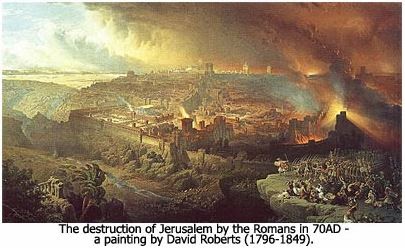
This is a great quote from Philip Mauro, almost 100 years ago, regarding the destruction of Jerusalem in 70 AD, its significance in relation to Bible prophecy, and how popular beliefs on Bible prophecy speak to the people of Israel today:
“It is greatly to be regretted that those who, in our day, give themselves to the study and exposition of prophecy, seem not to be aware of the immense significance of the destruction of Jerusalem in A.D. 70, which was accompanied by the extinction of Jewish national existence, and the dispersion of the Jewish people among all the nations. The failure to recognize the significance of that event, and the vast amount of prophecy which it fulfilled, has been the cause of great confusion, for the necessary consequence of missing the past fulfillment of predicted events is to leave on our hands a mass of prophecies for which we must needs contrive fulfillments in the future. The harmful results are two fold; for first, we are thus deprived of the evidential value, and the support to the faith, of those remarkable fulfillments of prophecy which are so clearly presented to us in authentic contemporary histories; and second, our vision of things to come is greatly obscured and confused by the transference to the future of predicted events which, in fact, have already happened, and whereof complete records have been preserved for our information.”
“Yet, in the face of all this, we have today a widely held scheme of prophetic interpretation, which has for its very cornerstone the idea that, when God’s time to remember His promised mercies to Israel shall at last have come, He will gather them into their ancient land again, only to pour upon them calamities and distresses far exceeding even the horrors which attended the destruction of Jerusalem in A.D. 70. This is, we are convinced, an error of such magnitude as to derange the whole program of unfulfilled prophecy.”
–Philip Mauro, “Seventy Weeks and the Great Tribulation,” 1921
For some good information on the historical events that took place from 62 AD – 70 AD, and the spiritual significance of many of these events in light of Bible prophecy, please see the following posts:
As announced earlier, a debate took place on June 3rd between Dr. Michael Brown and Dr. Don K. Preston regarding Romans 11:25-27. The debate lasted for 1 hour, 45 minutes and was moderated by Dr. James White of Alpha & Omega Ministries. Don K. Preston is an author, pastor, and the president of Preterist Research Institute (websites 1,2, and 3), and Michael Brown is an author, professor, and radio host (websites 1, 2, and 3). Both men have authored 22 books each.
The key questions for the debate were as follows: “Does Romans 11:25-27 state that there will be a national turning of the Jewish people to God? Are there any Old Testament promises made to ethnic Israel that remain to be fulfilled?” Both men had 17 minutes each to make their initial case, 12 minutes each to rebut the other’s arguments, 15 minutes each to cross-examine the other, and five minutes each for concluding statements. Here’s the video of the debate, followed by the less-than-perfect notes I took while watching it. (I’ve also included the video time markers for each section of the debate, and my additional thoughts are in red font.)
A. Introduction by Dr. James White (0:00 – 3:53)
B1. Michael Brown’s Initial Case (3:54 – 20:54)
According to Michael Brown, Romans 11:25-27 is about “ethnic, national Israel” and a future “national turning of the Jewish people.” (Will the unsaved Palestinians and expatriates living in Israel be excluded from this national turning because they’re not Jewish? Will Jews living outside Israel be excluded as well?)
Michael distinguishes this entity, Israel, from “the Gentile church.” (I’m not sure what “the Gentile church” is, since there is no Jew or Gentile in Jesus Christ, and no distinction – Romans 10:12-13, Galatians 3:28, Colossians 3:11.) Paul is looking forward to the full inclusion of Jews, says Michael, not just a remnant. The “partial hardening” of Israel is partial in that it’s not for all time. This hardening, though, is still on Jewish hearts to this day.
–The “fullness of the Gentiles” refers to salvation for Gentiles.
–The church is not Jacob (in reference to Jeremiah 31).
–The wolf is not yet laying down with the lamb. (Paul demonstrates otherwise in Romans 15 by quoting from the same section of Isaiah 11 where it’s predicted that the wolf would lay down with the lamb. Paul applied this passage to Gentiles, in his day, putting their hope in Christ along with Jews.See here for more details.)
–We haven’t yet seen the renovating of the universe spoken of in II Peter 3. (I personally see Peter’s prophecy as speaking of the burning of the Jerusalem temple and the destruction of the old covenant system in 70 AD, as did Eusebius, John Owen, Jonathan Edwards, and others in church history.See here for more.)
–The new covenant was inaugurated with the remnant, but not yet with the nation as a whole.
–“If words mean anything, _____________ has not happened” (in reference to a number of things that Michael Brown believes have not yet been fulfilled).
–The expression “all Israel will be saved” (Romans 11:26) will not necessarily include all Jews, but will include many of them. (Is this because it won’t include Jews living outside Israel, or is this an admission that God only promised to save a remnant from Israel? I was surprised to hear Michael Brown say this.)
B2. Don Preston’s Initial Case (21:41 – 38:37)
Don Preston agrees that Romans 11:25-27 deals with ethnic Israel, and adds that verses 28-29 deal with ethnic Israel and Jewish unbelievers. Don lists the following Scriptures as providing the background to Paul’s teaching here: Deuteronomy 32:18, 43; Isaiah 26:21, 27:10-13, 59:1-21; Jeremiah 31; and Daniel 9:24-27.
–Both judgment and salvation are in view in Isaiah 26-27 and in Isaiah 59, including judgment for the shedding of innocent blood (themes in Matthew 21, 23; Revelation 6, 16-19; etc.).
–Hosea predicts both the divorce of Israel and God’s promise of remarriage for Israel. This is what Paul is speaking of in Romans 11. The remnant of Israel was to be joined with new covenant believers from other nations, and all of them made one in Jesus.
–God would slay the kingdom, but preserve the family.
–“Paul is dealing with the climax of Israel’s covenant history” in Romans 11.
C1. Michael Brown’s Rebuttal (39:16 – 51:13)
–The temple has not yet been rebuilt. –Israel has not yet welcomed Jesus back (Matthew 23:39). –Atonement has been made, but not yet received by national Israel. –Isaiah 60 predicts that Israel would rise and shine, but this hasn’t happened yet. (What if the light that would shine was Jesus, and a remnant of Israel would rise with believers from other nations and shine with His light?See here for more.) –Israel’s return from Babylonian exile in the 6th century did not happen with the expected and predicted glory. Those prophecies only happened in part.
C2. Don Preston’s Rebuttal (51:33 – 1:03:33)
–In I Peter 1, Peter said that the prophets looked into the salvation we have experienced in Christ, and they did not understand the time or the manner of its fulfillment. –Hosea 3 predicted that the 10 northern tribes of Israel would be without a temple, altar, ephod, and sacrifices until the last days when David would be their king.
–In II Peter 2, Peter writes to the 12 tribes of the diaspora, referring to them as a royal priesthood called to make spiritual sacrifices. Jesus, of course, is exalted to the throne of David. Hosea’s predictions for Israel were fulfilled in Peter’s day.
D1. Michael Brown’s Cross-examination of Don Preston (1:04:36 – 1:19:36)
Michael Brown posed this question to Don Preston: “How was all Israel saved in 70 AD and how is there no longer hardening on Israel today?” The following are some of Don’s replies to this and other questions that came up:
–God never promised to save the entire nation of Israel. In fact, Paul quoted Isaiah in saying that only a remnant would be saved (Romans 9:27-28).
–The remnant of Israel was transferred from the old covenant body to the new covenant body. “All Israel will be saved” = The full number of the remnant will come in.
–Any hardening of Jewish hearts in Israel today is not in fulfillment of Romans 11:25, which was a prophecy for Paul’s generation.
–James, who also addressed the 12 tribes, testified that he was among the first fruits gathering of Jewish believers (James 1:18).
–Don addresses the fulfillment of Isaiah 2, in context of Isaiah 2-4, and Jesus’ application of portions of Isaiah 2 in Luke 23:28-31.
D2. Don Preston’s Cross-examination of Michael Brown (1:19:53 – 1:34:54)
Don Preston posed this question to Michael Brown: On what basis can we reject or look beyond instances when the New Testament writers spiritually apply Old Testament promises that, on the surface, appear to require literal or physical fulfillments? The following are some of Michael’s replies to this question:
–If a later interpretation undermines an earlier prophecy, it has to be discounted.
–“If the New Testament writers made void the words of the Old Testament prophets, then it’s the New Testament writers who have to be rightly questioned” (1:22:40). “Consistent interpretation says they made nothing void. They just gave further insight into the meaning of the prophets.”
Don Preston posed this question to Michael Brown: Was the establishment of the kingdom truly at hand when Jesus said it was? The following are some of Michael’s replies to this question:
–Yes. –“We’ve been in the last days for the last 2000 years.” –We are in the transition age that has many “untils.”
Don Preston posed this question to Michael Brown: Peter said, “The end of all things is near” (I Peter 4:7), and Paul said that the consummation (or the goal) of all previous ages was upon his generation” (I Corinthians 10:11). What is the significance of these statements if we are still waiting for the events of the last days to take place? The following are some of Michael’s replies to this question:
–“I take all those things seriously, including I John 1:18” (“Little children, it is the last hour; and as you have heard that theAntichrist is coming, even now many antichrists have come, by which we know that it is the last hour“).
–We live in a holy tension now, as many prophecies are not fully realized.
–“In Isaiah 49 the Messiah appears to have failed in His mission to Israel. And the Lord says to Him, ‘not only will you regather the lost tribes of Israel (national restoration), but You will also be a light to the nations.’ Hence, Isaiah 42 speaks of a persevering until.” (??? I had a hard time understanding what Michael meant here.)
–The national repentance of Israel (Zechariah 12:10-13) hasn’t happened yet.
–“We are living in the last hour.” (How is this possible if John said it was the last hour in the first century, nearly 2000 years ago? This would mean that “the last hour” has lasted longer than the entire old covenant age, which was 1300 years.See here for more.)
E1. Michael Brown’s Closing Statement (1:35:33 – 1:40:34)
“The Israel that is hardened, that has rejected the Messiah, will be the Israel that turns back fully.”
E2. Don Preston’s Closing Statement (1:40:47 – 1:45:49)
–“Isaiah 27 and Isaiah 59 foretold that the salvation of Israel would take place at the time of the judgment of Israel for shedding the innocent blood of the martyrs.”
–Jesus said this blood, from the beginning of Israel’s history until His generation, was going to be held to Israel’s account in Jesus’ own generation in the form of judgment.
–The time of the putting away of Israel’s sin in Daniel 9:24-27 is confined to the 70 weeks and the related destruction of Jerusalem in 70 AD, as Michael Brown concurred earlier in the debate. Therefore, the putting away of Israel’s sin in Romans 11 occurred no later than 70 AD.
–Judah had to be divorced in the same way the 10 tribes were, according to the Old Testament prophets and Jesus. In Matthew 22 those who rejected the wedding invitation persecuted and killed God’s servants. Jerusalem, the principal city of Judah, was to be burned at the time of the marriage promised in the Old Testament. This happened in 70 AD, and this is also in accordance with Revelation 18-19 where Babylon the Great (earlier identified as “the city where our Lord was crucified – Rev. 11:8) was to be burned just before Jesus married New Jerusalem. God married the remnant of Israel along with believers from all other nations.
——————————————————————————
Final thoughts: This was a very civil debate, which was great to see. Both men showed a high level of respect toward the other. I wish Don Preston would have given his perspective on “the fullness of the Gentiles” and also that he would have said more about “the partial hardening” that was on Israel. I understand that there were time pressures, however.
Personally I believe that only Jesus’ generation in Israel was under this hardening, in accordance with Jesus’ frequent statements that they were an evil, wicked, vile, faithless, and adulterous generation; and in accordance with His declaration that they had dull hearts, ears hard of hearing, closed eyes, etc. (see Matthew 13:10-17).
Concerning “the fullness of the Gentiles,” I personally believe this is not related at all to Gentiles being saved, but rather to the Gentile nations that had dominion over Israel from the time of Daniel onward: Babylon, Medo-Persia, Greece, and Rome. This period would end with the 3.5 year trampling of Jerusalem by the Gentiles (compare Romans 11:25 with Luke 21:24 and Revelation 11:1-2). The significance is that New Jerusalem, the new covenant community, is free (Galatians 4:21-31).
God’s promise of a new covenant for the house of Israel (Jeremiah 31)has been fulfilledin the church, the spiritual house built on the foundation of the apostles (ministers of the new covenant – II Cor. 3:5-6), with Jesus as the Chief Cornerstone (Ephesians 2:11-22).
Your thoughts on this debate are welcome in the comment section below.
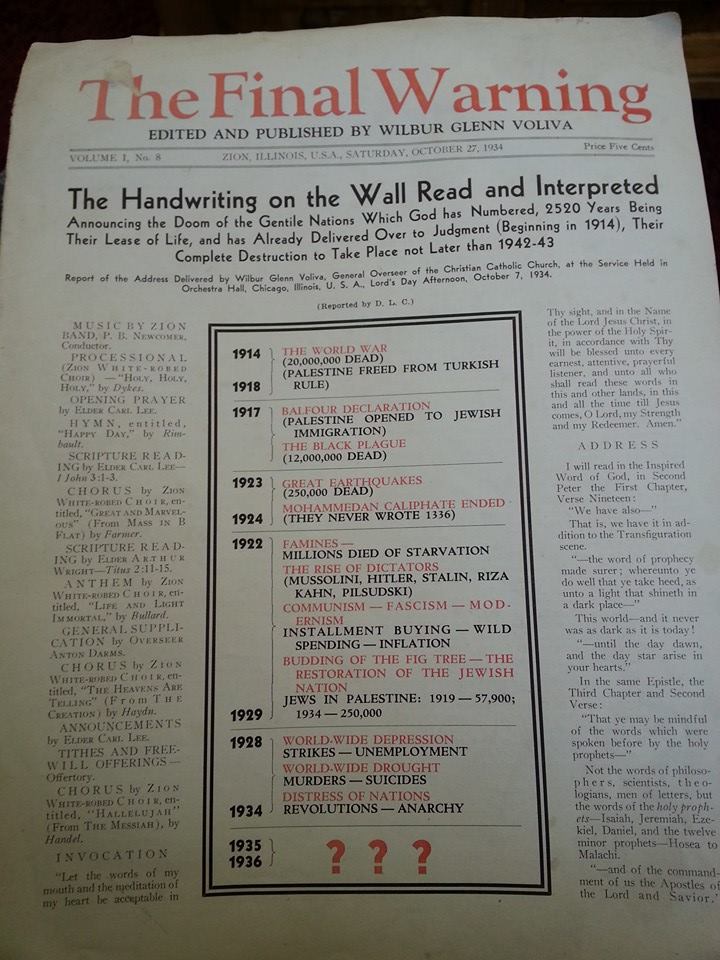
A few weeks ago, someone (Brad Herman) posted a very interesting photo in a Facebook group I belong to (photo shown below). This photo captures the front page of a newspaper, published in October 1934 in Zion, Illinois by Wilbur Glenn Vilova. A few decades earlier, this newspaper had been titled “Leaves of Healing,” but in 1934 it was called “The Final Warning.” This particular edition reveals a lot about some of the dispensationalist/Christian Zionist thinking of the time:
Signs from Jesus’ Olivet Discourse (Matthew 24, Mark 13, Luke 21) were supposedly fulfilled in 1922-1923 (earthquakes and famines).
Luke 21:25 (the “distress of nations“) was supposedly being fulfilled in 1934, the time of this publication.
The year 1943 was supposedly the absolute deadline for the “complete destruction” of “the Gentile nations.”
In 1906 Wilbur had taken over the leadership of the city of Zion, founded by John Alexander Dowie, who began to proclaim in 1901 that he was “Elijah the Restorer.” Dowie died in 1907 and Wilbur filled in as Zion’s leader until close to his death from cancer in 1942. A few years prior to his death, Wilbur put out this publication, sprinkled with some bold and false date-setting:
Brad says he picked up this newspaper at a garage sale. Isn’t it interesting? I was especially struck by the deep pessimism about world affairs (they were in the midst of the Great Depression at the time), the emphasis on coming destruction for all non-Jewish nations, and the idea that “the fig tree” began to bud in 1922.
On this last point, it’s well known that numerous Bible prophecy teachers have taught that “the fig tree” began budding in 1948 when Israel became a nation, and that “God’s prophetic time clock was then restarted” after many centuries of prophetic postponement. The restarting of the clock in 1948, they said, left mankind with a maximum of one generation until the Olivet Discourse would be completely fulfilled. Hal Lindsey and others were, at one time, adamant that a Biblical generation is 40 years. When “the Rapture” and the Great Tribulation didn’t take place by 1988, some pushed the idea that a Biblical generation is 70 years, and more recently that it might even be 100 years long.
Others said that 1948 was “the wrong time marker” for the budding of “the fig tree,” and that the correct time marker was the Six-Day War in 1967, when Israel captured East Jerusalem from Jordan. Now, based on this newspaper from 1934, there is evidence that speculation on the budding “of the fig tree” goes back to at least 1922. This chart shows the range of speculation discussed here, and how it has evolved over the last few decades as end-times prophecies continue to fail:
When did the fig tree start to bud?
How long is a Biblical generation?
1922
40 years
1948
70 years
1967
100 years
Of course, I believe far differently about the Olivet Discourse, i.e. that it was entirely fulfilled in Jesus’ own generation in the first century.
I also observe, from this newspaper, that Wilbur noted the rapidly increasing number of Jews in Palestine (57,000 in 1919 and 250,000 just 15 years later in 1934), without acknowledging the Arabs (Muslims and Christians alike) who also lived there. I also observe Wilbur’s expectation that “a Jewish nation” would be created there.
I’m very curious as to why he taught that “Gentile nations” had a “Lease to Life” of precisely 2520 years. Since he prophesied their “Complete Destruction” by 1943 at the very latest, he apparently believed the lease began in 577 BC. I’m not sure what is significant about that date, although it’s fairly close to 586 BC, when Babylon destroyed Judah and Jerusalem. Approximately 2520 years had transpired from 586 BC to 1934, when Wilbur wrote this (586 + 1934 = 2520), so maybe that’s what he had in mind.
What are your thoughts when you see this newspaper from 1934?
Of all the questions asked by readers here at this site, Romans 11 has been one of the most popular topics brought up over the last five years, particularly the phrase, “In this manner all Israel will be saved” (verse 26). I’m glad to see that two well-known teachers will be leading a moderated debate on June 3rd concerning the meaning of Romans 11:25-27. Don K. Preston, the president of Preterist Research Institute (websites 1 and 2), will be debating this topic with Dr. Michael Brown, an author, professor, and radio host (websites 1, 2, and 3). Dr. James White, an author and speaker, will be moderating the debate. Here is the formal announcement for this debate:
I am thrilled to announce that just this morning, (5-13-14) we confirmed final agreement for a formal, moderated debate between myself and Dr. Michael Brown, a very popular Christian apologist and radio / Internet host. Dr. Brown has done some fine work in debating Muslims and atheists. He is not a “typical” Millennialist, in that he takes the Classic or Historical Premillennial view, which is in many respects, totally different from modern Dispensationalism.
Dr. Brown has a nationally syndicated radio program: “Ask Dr. Brown,” (also known asThe Line of Fire)in which he welcomes callers to ask any question. On April 2014, Dr. Brown issued a challenge to any qualified preterist to engage in a formal moderated debate. Some listeners posted to me about that challenge and I responded, accepting the invitation.
The debate will be on June 3, 2-4 Eastern Time (1-3 Central). I am particularly pleased to say that Dr. James White, ofAlpha and Omega Ministry, also a noted Christian polemicist, will act as the debate moderator.
The Debate subject will be:
Resolved: The Bible teaches in Romans 11:25-27 that at some point of time in our future, “all Israel shall be saved” at the time of the Second Coming of Jesus Christ.
Affirm: Dr. Michael Brown
Deny: Don K. Preston
Needless to say, this is a very, very important topic. Many Postmillennialists, some Amillennialists, and certainly, Millennialists of all stripes believe that there is yet to be a massive conversion of ethnic Jews at the time of the second coming of Christ. Obviously, I believe this view is not supported by the scriptures.
This offers to be a very lively debate, with a ton of information being made available. You don’t want to miss it, so put it on your calendar, and tune in!
Here is the Scripture text which will be under discussion in this debate:
“For I do not desire, brethren, that you should be ignorant of this mystery, lest you should be wise in your own opinion, that blindness in part has happened to Israel until the fullness of the Gentiles has come in. And so all Israel will be saved, as it is written: ‘The Deliverer will come out of Zion, and He will turn away ungodliness from Jacob; For this is My covenant with them, when I take away their sins‘” (Romans 9:25-27).
Since Don Preston first made this announcement, I’ve heard that the debate likely won’t begin at 2 pm EST on June 3rd, but will be somewhat later in the afternoon. I’m not sure if I’ll be able to watch it live, but once the debate video is posted on YouTube or elsewhere, I plan to post it here. It’ll be good to see what these two men have to say on the subject, and there will be an open invitation, for anyone who wishes, to evaluate what they have to say and discuss it here (as well as to look at discussions that may happen elsewhere).
Questions to consider:
1. What is the blindness that happened to Israel? How long was it to last? Where else does Scripture speak of this blindness?
2. What is the meaning of “the fullness of the Gentiles“?
3. Who is Paul speaking of when he says, “all Israel will be saved“?
4. Is Isaiah 59:20-21, quoted in Romans 11:26-27, about Jesus’ first coming and His work on the cross, or is it about His coming in judgment and in His kingdom (often spoken of as His Second Coming)? Is Isaiah 59:20-21 already fulfilled, or not yet fulfilled?
UPDATE: The debate took place as scheduled, and I’ve posted the video, along with notes and time stamps, here:
Today I sawthis graphic, shared by Stephen Sizer on Facebook, and found it to be informative, although it certainly doesn’t touch on every issue concerning the Israeli/Palestinian situation. The statistics are said to be valid as of 2011. This graphic illustrates a range of disparities between three groups of people when it comes to freedom, restrictions, living access, and voting:
5.9 million Jewish citizens in Israel
5.5 million Palestinians in Israel, East Jerusalem, West Bank, and the Gaza Strip
5.7 million Palestinian exiles/refugees with no access to Israel or the Palestinian territories
(Note: This post includes a full-scale teaching illustration below the following introduction.)
The last quarter of the 20th century featured many prophecy charts, based on dispensationalism, depicting a future “Rapture,” 7-year tribulation, Antichrist, series of seal/trumpet/bowl judgments, Battle of Armageddon, etc. When I was younger, I saw a few of these charts in person, and a number of others when I watched “A Thief In the Night” (1972), “A Distant Thunder” (1977) and “Image of the Beast” (1981); all available here.
Charts and illustrations can be good teaching aids. Based on my study of church history, however, the vast majority of respected leaders in the first 1800 (or so) years after Christ would have been horrified to see a lot of these (dispensationalist-based) charts. As my personal journey has taken me away from the pre-trib Rapture/premillennialist view I grew up with, and toward fulfilled eschatology, I’m glad to see that new charts, illustrations, and similar tools are being created which are a lot more sound and Biblical (in my opinion). In a couple of previous posts, I’ve highlighted two such illustrations by author Jonathan Welton, one on Daniel 2 and the kingdom of God and another on John’s use of “ge” (land) versus “kosmos” (world) in the book of Revelation.
Welton’s newest illustration concerns the 70 Weeks prophecy in Daniel 9. Seeing this prophecy differently was a major turning point in my own journey. Previously I was led to believe that Daniel saw a future Antichrist who would make a 7-year political covenant with Israel, then break it 3.5 years later, before presiding over another 3.5 years of planet-wide turmoil and catastrophes. This was to be the 7-year tribulation period. The text (Daniel 9:24-27) says none of these things. I can’t forget how stunned I was when it was pointed out to me, online, that the covenant of Daniel 9:27 is parallel to Jesus’ words on the night He was betrayed by Judas:
“Then he shall confirm a covenant with many for one week; But in the middle of the week he shall bring an end to sacrifice and offering…” (Daniel 9:27).
“For this is My blood of the new covenant, which is shed for many for the remission of sins” (Matthew 26:28).
Each “week” in Daniel’s prophecy represents a period of seven years. We also know that Jesus laid down His life as a sacrifice after 3.5 years of ministry (“…in the middle of the week…”), and that His sacrifice brought an end to the sacrifices and offerings under the old covenant. There went the idea that sacrifices must be restored in a rebuilt temple in Jerusalem in our future. There also went the only Scriptural basis (so I thought) for a 7-year tribulation period. Jonathan Welton does a great job bringing this and more out in his latest illustration:
Lunacy – Def. “originally referring to temporary insanity attributed to changes of the moon.” Cf. Old English “lunatic,” literally “moon-sick.” -Wade Burleson
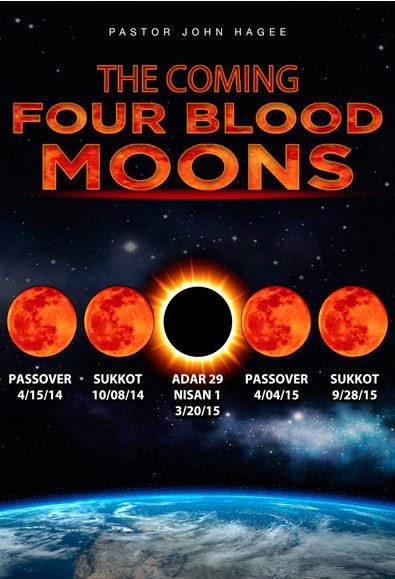
I’ve read a couple of articles, but no books, on one of the latest fads to invade the world of Evangelical Christianity – the “four blood moons” of 2014-2015. My understanding is that this phenomenon was first highlighted by Mark Biltz, a Hebrew roots proponent and pastor of El Shaddai Ministries in Tacoma, Washington. He wrote a book in 2008 called “Blood Moons: Decoding the Imminent Heavenly Signs.” More recently, in 2013, John Hagee published his book on the topic, “Four Blood Moons: Something Is About to Change.”
Wade Burleson, a pastor and author in Enid, Oklahoma, wrote a review in March 2014 of Hagee’s book. I appreciate a lot of his thoughts (not 100%, but close), and believe that his article is informative and thought-provoking, so I’d like to share it here:
…Mr. Hagee’s newest bookFour Blood Moons: Something Is About to Changemakes a case that the author may be suffering from a form of temporary insanity. Christians who believe what John Hagee is proposing without thinking for themselves, could find themselves afflicted with the same disease.
Mr. Hagee believes that something terrible, but ultimately triumphant, is about to happen to the nation of Israel due to thefour total lunar eclipsesthat will occur in the northern hemisphere during 2014 and 2015. These four eclipses,called by astronomers a tetrad, occur on April 15, 2014, which is Jewish Passover; on October 8, 2014, which is the Jewish Festival of Tabernacles; on April 4, 2015, which is (again) Jewish Passover; and on September 28, 2015 which is (again) the Jewish Festival of Tabernacles.
Contrary to what Hagee would have the reader believe, lunar eclipses aren’t that special.There are at least two to five lunar eclipses every year. Likewise,lunar tetrads (total lunar eclipses that occur six months apart, with no partial lunar eclipses in between) also occur frequently. There have been 62 tetrads since Christ. The last one was in 2003 and 2004, and there will be a total of 8 lunar tetrads in this century (2001 to 2100).
Hagee writes that what is rare is that this lunar tetrad is occurring on Jewish holy days. Well, maybe. Since the times of Christ,there have been eight tetrads that have occurred on Jewish Passover and the Festival of Tabernacles. Think about this for a moment, though. If the first total lunar eclipse of a tetrad happens to occur on Passover (15 Nissan on the Hebrew calendar), it is guaranteed that the second total lunar eclipse will occur the Festival of Tabernacles (15 Tishri on the Hebrew calendar) because the Hebrew calendar is lunar, and the Festival of Tabernacles is exactly six lunar months after the Festival of Passover. So it is also guaranteed that the third and fourth lunar eclipses of a tetrad will occur on those same Hebrew festival daysthe following year. Again, the lunar tetrad falling on Hebrew holidays is not as rare as Hagee would like you to believe. Here are the eight that have occurred since Christ.
1. AD 162-163 2. AD 795-796 3. AD 842-843 4. AD 860-861 5. AD 1493-1494 6. AD 1949-1950 7. AD 1967-1968 8. AD 2014-2015
Hagee writes that every time a tetrad occurs on Jewish feast days something traumatic and ‘world-changing’ happens to Israel. He gives three examples. First, in 1492Spain expelled the Jewsand Christopher Columbus discovered America, giving the Jews a place to go. Second, in1948 Israel became a nation again. And third, in 1967 Israel won theSix Day Warand captured Jerusalem. In a moment I will absolutely destroy Hagee’s conclusion about “traumatic things” happening to the Jews and the nation of Israel every time a lunar tetrad occurs on Hebrew holy days. For now, just think about this: Israel wasn’t even a nation the first six times a lunar tetrad occurred.
Yet, Hagee concludes that something traumatic, but ultimately triumphant, is going to happen to Israel during 2014 and 2015, an event that ‘will change the course of world history.’ More to the point, Hagee believes the “rapture” will occur, Israel will go to war in a great battle called Armageddon, and Jesus Christ will return to earth because the prophet Joel said,
“The sun will be turned to darkness and the moon to blood before the coming of the great and dreadful day of the LORD” (Joel 2:31).
Now, while being kind to Mr. Hagee as a brother in Christ, and writing as one who also believes in the full inspiration of Scripture, I would like to show you why the premise of Hagee’s book is speculative at best, and pure lunacy at worst.
7 Reasons Why the Premise of John Hagee’s Four Blood MoonsIs Potential Lunacy
(1). Anytime Jewish literature describes the fall of a government or nation, apocalyptic language is used. This highly symbolic manner of writing, with language like, “the sun was darkened, the moon would not give her light, and the stars shall fall,” is the way the Hebrew prophets described how God would come in judgment upon a nation. The Old Testament refers to the fall of Babylon in 539 BC (Isaiah 13:10-13) in this manner. Likewise, Egypt’s collapse in 590 BC (Ezekiel 32:7-8) and Judah’s fall in 586 BC (Zephaniah 1:14-16) are described with this stellar apocalyptic language. The sun going dark and the moon turning to blood is biblical symbolic language describing the fall of a nation by the judgment of God, not literal astronomy.
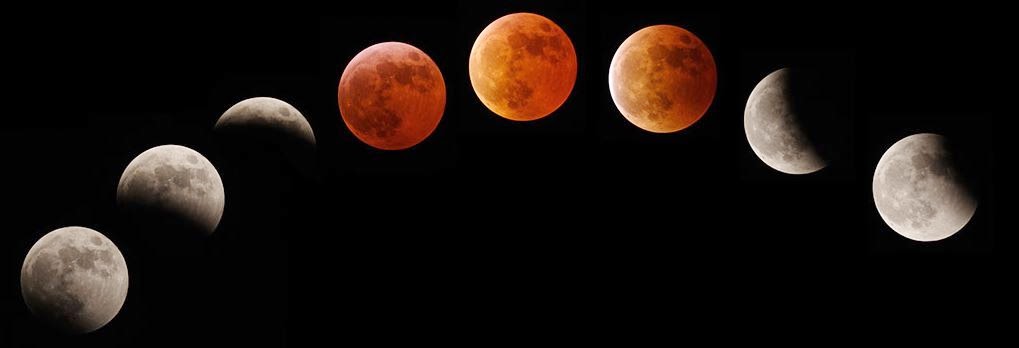
(2). John Hagee falsely calls the lunar tetrad occurring in 2014 and 2015 four blood moons. Thesefour lunar eclipses are not blood moonsat all! They are simply full moons that are eclipsed! Hagee wrongly calls them “blood moons” in order to bringJoel 2:31into play and act as if Jesus is coming as Messiah over Israel after “the moon turns to blood.”Astronomers who hear Christians call the next four lunar eclipses “Blood Moons”will rightly think we are ignorant of astronomy. Truth be told, we are mostly ignorant of the Bible.
(3). When the prophet Joel wrote “The sun will be turned to darkness and the moon to blood before the coming of the great and dreadful day of the LORD” (Joel 2:31), he was describing the judgment of God upon the nation of Israel for their rejection of His Son. National judgment on any people in rebellion to God is often described as “the dreadful day of the Lord.” Joel’s prophecy, referred to by Luke inActs 2:20, was a prediction of the “great day of the Lord” against Israel, the day when God judged the nation by destroying Jerusalem, the Jewish Temple and scattered the people (AD 70). God brought to an end the Old Covenant, formally ushered in the New Covenant (agreement) where people of every nation, race, family and language group find peace with God through faith in the person and work of His Son. Listen to the great Hebrew linguist and Baptist theologian John Gill commentary on Acts 2:20 and Joel’s prophecy:
“The sun shall be turned into darkness”… as at the death of Christ, by a total eclipse of it: “and the moon into blood,” as at the opening of the sixth seal (Rev. 6:12) “before that great and notable day of the Lord come”: when he shall come in power and great glory, as God did a few years after this (AD 70), to take vengeance on the Jews, and destroy their nation, city, and temple; in which there was a display of his greatness, and power, and which was awful and terrible to them, as in Joel it is called “the great and dreadful day of the Lord” (see Gill’s note on Matthew 24:29 also).
(4). Hagee attempts to prove that every time a tetrad occurs on Jewish holy days, something happens to the Jews and Israel. That’s simply not true for a couple of reasons. First, the Jews were scattered for nineteen centuries and Israel did not exist as a nation. NOTHING happened to the Jews or the nation of Israel during the years of the first six tetrads. Hagee tries to suggest that Spain “expelled the Jews” in 1492 and that was this was a ‘traumatic and terrible’ event. However, astronomers tell us that the actual tetrad occurred on Passover and Tabernacles in 1493 and 1494, not 1492. The Jews were expelled from Spain a full eighteen months before the first lunar eclipse of 1493/1494 tetrad even began. Second, there are only two tetrads that fall on Jewish holy days during Israel’s time as a nation (since 1948). Interestingly, Hagee makes the same dating mistake when he speaks of Israel’s “traumatic” war for independence.Israel was declared a nation and went to war in 1948, not during the lunar tetrad of 1949/1950. Hagee’s error of misstating the actual date of astronomical tetrads seems intentional. He must misstate the dates of previous tetrads in order to convince readers that his prophecies in Four Blood Moons are reliable. However, fudging facts to prove an argument is not scientific or ethical.
(5). One of my favoriteBible seriesat Emmanuel was “Portraits of Christ: The Feasts and the Festivals of Israel.” I know enough about Jewish calendaringand the holy days of Old Covenant Israel to know that the priests watched the moon from the mountains of Israel to declare new moons (months), holy days, and other events by blowing the shofars. In other words, the moon was eyeballed by the priests of Israel! Interestingly,the lunar eclipse tetrad of 2014/2015 will not be visible from Israel! We Americans seem to think the world truly revolves around us. Smile. One would think if a special occurrence in the lunar cycle (a tetrad) were important to Israel, they could at least see it!
(6). Hagee’s use of the term “blood moons” for the upcoming lunar eclipse tetrad is utter deception. A tetrad is four successive total lunar eclipses with no partial lunar eclipses in between, each of which is separated from the other by six lunar months. Hagee’s book is about a tetrad, but he’s calling it four blood moons.There are NOT four blood moonsoccurring in 2014 and 2015. A blood moon can only occur in the fall. The twisting of science to conform to one’s alleged presuppositions ofJoel 2:13(the rapture, Armageddon, the return of Christ as Messiah of the nation of Israel, etc…) is pure deceit. Of course, this is done in order to convince people that “the moon turning to blood” before the “day of the Lord” (Jesus’ return), and that Jesus return is going to happen in 2014/2015. We’ve heard these same kinds of predictions on the return of Jesus in times past (88 Reasons Why Jesus Will Return in 1988), and there will be additional false prophecies regarding the “return of Christ” in the future. What’s unfortunate is Christians never take the time to think through these silly predictions for themselves.
“A person at all familiar with the phraseology of the Old Testament Scriptures, knows that the dissolution of the Mosaic economy, and the establishment of the Christian economy, is often spoken of as the removing of the old earth and heavens, and the creation of a new earth and new heavens.” (John Brown, vol. 1, p. 170).
Amen, John Brown. I stand with you in promoting Christ, His mercy and grace, and the incredible blessing of living in a world built on the principles He taught–the Christian economy as you call it. Love your enemy. Do good to those who abuse you. Be merciful and kind, seek justice for the sake of others, forgive those who have wronged you, and remember the poor, the fatherless, and the widows. What kind of world would we live in if we all took seriously the establishment of the Christian economy in our spheres of influence?
I love the nation of Israel. It is a democracy in the middle of Islamic totalitarianism. [Adam’s note: I have reservations about this statement.] However, the only hope for Israel and this world is for individuals in these various nations to become followers of the true and eternal King, to learn to live at peace with all men, and to love others the same way Jesus has loved us. Yet, John Hagee, has declared:
“When all is said and done, the flag of Israel will be flying over the walls of the city of Jerusalem when Messiah comes, and it’s going to be forever. And every nation that rises up in judgment against Israel God will punish and punish severely.”
Mr. Hagee, our time as followers of Jesus might be better spent telling others about the love of God in Christ, and not blindly supporting the nation of Israel. It seems that the New Covenant Scriptures attributes the judgment of God in terms of our treatment of His beloved Son. Do I trust Him, or do I despise Him? Do I love Him, or do I hate Him? It is far better to make a sinful soul at peace with God through a faith relationship in Jesus Christ than it is to muster support for the nation of Israel. Nations come and go. Kingdoms rise and fall. Christ’s Kingdom is the only eternal one. God calls those who love and trust His Son “a chosen people, a royal priesthood, a holy nation, His special possession, so that we might declare the praises of Him who called us out of darkness into His wonderful light” (I Peter 2:9).
We live in a changing world. Something catastrophic may happen to Israel and/or America during 2014/2015, but it’s not the result of blood moons or God’s judgment. God judges individuals on the basis of whether or not they trust in His Son. The only favored nation now is “the holy nation” of people from every nation, tribe, kindred and tongue who have received Christ as Lord and Savior. Our praises of Jesus to a people living in darkness are never enhanced by the proclamation of false prophecies. My hope is that this little blog might save just one person from the lunacy ofFour Blood Moons.
I grew up in a church whereChristian Zionismand dispensationalist theology was (and still is) taught. In that setting, and in others, I was repeatedly taught that Bible prophecy was fulfilled when Israel became a nation in 1948. Furthermore, I was told, this event “restarted God’s prophetic time clock.” Two passages of Scripture allegedly foretold that event, Isaiah 66:7-9 and Matthew 24:32-33. In neither case does this ring true, and both passages carry an entirely different message.
Isaiah 66:5-13
Many believe that Isaiah was looking ahead about 2700 years to the political events of 1948 when he wrote the final portion of his book. They often point to verses 7-9 in particular, and insist that Isaiah foresaw the birth of national Israel “in one day.” Before looking at what this passage says, let’s consider Isaiah’s patterns and themes in the final eight chapters of his book:
Isaiah 59 concludes with a Messianic prophecy (“The Redeemer will come to Zion, and to those who turn from transgression in Jacob…”). This prophecy, quoted in Romans 11:26-27, foretold Christ’s work on the cross as a sacrifice for sin.
Isaiah 60 is filled with prophetic decrees ofthe coming new covenant age(this present age), when the nations come to the light of the gospel.
Isaiah 61 contains a prophecy about the Lord’s anointed One and the good news, healing, and liberty He would bring; Jesus said this was fulfilled during His earthly ministry (see Luke 4:18-19).
Isaiah 65 speaks of new heavens and a new earth, in which sin, death, childbearing, and labor would continue (this makes sense if his prophecy is viewed as the establishment of the new covenant age rather than an overhaul of this planet and the galaxy). Our study on Matthew 24:35 discusses more fully the view that the Bible sometimes uses covenant language when speaking of “the heavens and the earth.”
From these and other examples in the final chapters of Isaiah, we see that Isaiah looks repeatedly to what we know were first century events. Let’s look now at Isaiah 66:5-13.
5 Hear the word of the Lord, You who tremble at His word: “Your brethren who hated you, who cast you out for My name’s sake, said, ‘Let the Lord be glorified, that we may see your joy.’ But they shall be ashamed.” 6 The sound of noise from the city! A voice from the temple! The voice of the Lord, who fully repays His enemies! 7 “Before she was in labor, she gave birth; before her pain came, she delivered a male child. 8 Who has heard such a thing? Who has seen such things? Shall the earth be made to give birth in one day? Or shall a nation be born at once? For as soon as Zion was in labor, she gave birth to her children. 9 Shall I bring to the time of birth, and not cause delivery?” says the Lord. “Shall I who cause delivery shut up the womb?” says your God. 10 “Rejoice with Jerusalem, and be glad with her, all you who love her; rejoice for joy with her, all you who mourn for her; 11 that you may feed and be satisfied with the consolation of her bosom, that you may drink deeply and be delighted with the abundance of her glory.” 12 For thus says the Lord: “Behold, I will extend peace to her like a river, and the glory of the Gentiles like a flowing stream. Then you shall feed; on her sides shall you be carried, and be dandled on her knees. 13 As one whom his mother comforts, so I will comfort you; And you shall be comforted in Jerusalem.“
Verse 5: This is clearly the Lord’s comfort for those who would be persecuted, hated, and cast out for His sake. Albert Barnes (1834), John Gill (1763), and Matthew Henry (1710)all taughtthat Isaiah was referring to the first century when Jesus, the apostles, and the early church preached the gospel and were opposed by the religious leaders of Israel.
Verse 6: Noise and a voice are heard from the city and the temple, and the voice is the Lord’s as He repays His enemies. Who are His enemies here? The text doesn’t say, at least not explicitly. However, if verse 5 is about the religious (temple) authorities persecuting the followers of Christ, then they are the enemies being repaid here at the time of the temple’s downfall; and Matthew 23 and I Thessalonians 1 also foretell this event:
“Woe to you, scribes and Pharisees, hypocrites! …you are sons of those who murdered the prophets… I send you prophets, wise men, and scribes: some of them you will kill and crucify, and some of them you will scourge in your synagogues and persecute from city to city,that on you may come all the righteous blood shed on the earth… all these things will come upon this generation” (Matthew 23:29-36).
“For you, brethren, became imitators of the churches of God which are in Judea in Christ Jesus. For you also suffered the same things from your own countrymen, just as they did from the Judeans,who killed both the Lord Jesus and their own prophets, and have persecuted us; and they do not please God and are contrary to all men,forbidding us to speak to the Gentiles that they may be saved, so as always to fill up the measure of their sins; but wrath has come upon them to the uttermost” (I Thessalonians 2:14-16).
Verses 7-8: Isaiah sees a woman, identified as Zion (verse 8), in labor. She delivers “a male child” (verse 7) and gives birth to “children” (verse 8). A nation is born “in one day” and “at once” (verse 8). Matthew Poole (1683) and John Gill (1763) are among those who taught that Isaiah foretold what would happen on the day of Pentecost, when 3000 Jews heard Peter preach the gospel and believed (Acts 2:41).
Verses 9-11: For those who love Jerusalem, this birthing is cause for rejoicing (verse 10). They are invited to “feed and be satisfied with the consolation of her bosom” and to “drink deeply and be delighted with the abundance of her glory” (verse 11).
Verses 12-13: This woman is given “peace like a river,” and she is filled with “the glory of the Gentiles” (verse 12). [Interestingly, those who insist that this is a prophecy of Israel becoming a nation in 1948 are often fixated on the goal of “a Jewish state,” and sound as if they would be happy to see each and every non-Jew exiled from Israel. The Jerusalem Isaiah saw would be marked by the glory of Gentiles – of Gentiles finding salvation in Christ.] Those who feed from this woman would be carried on her sides and dandled on her knees. God would comfort them in Jerusalem as one is comforted by his own mother.
Where else does Scripture depict Jerusalem as the mother of God’s people? And which Jerusalem is that, the earthly one or the heavenly one?
“For these are the two covenants: the one from Mount Sinai which gives birth to bondage, which is Hagar—for this Hagar is Mount Sinai in Arabia, and corresponds to Jerusalem which now is, and is in bondage with her children— but the Jerusalem ABOVE is free, which is THE MOTHER OF US ALL” (Galatians 4:24-26; see verses 21-31 for a fuller context).
In the next verse Paul quotes from Isaiah 54:1, a passage which is parallel to Isaiah 66:
“For it is written, ‘Rejoice, O barren one who does not bear; break forth and cry aloud, you who are not in labor. For the children of the desolate one will be more than those of the one who has a husband’ (Galatians 4:27).
Observe how Paul goes on to interpret Isaiah 54:1.
“Now you, brothers, like Isaac, are children of promise. But just as at that time he who was born according to the flesh persecuted him who was born according to the Spirit, so also it is now. But what does the Scripture say? ‘Cast out the slave woman and her son, for the son of the slave woman shall not inherit with the son of the free woman.’ So, brothers, we are not children of the slave but of the free woman” (Galatians 4:27-31).
Isaiah 66:8 is parallel to Isaiah 54:1, and it ought to be seen in the same way that Paul made application of Isaiah 54:1 in Galatians 4. Isaiah foresaw the birthing and the breaking forth of the heavenly Jerusalem (66:8-10), even as earthly Jerusalem met her demise (66:6). Ironically, Isaiah 66 does not speak of the restoration of earthly Jerusalem into the hands of mostly unbelieving Jews in 1948. Rather, it mirrors the taking away of the earthly kingdom from unfaithful Israel (in 70 AD), and the giving of the heavenly kingdom to God’s holy nation, the Church, just as Jesus predicted (Matthew 21:43-44; cf. Daniel 7:18, 22, 27). It speaks of the establishment of the new Jerusalem for the bride of Christ, and the dissolving of the old covenant in favor of the new covenant (which was established at the cross). This is the point of both Isaiah and Paul.
Matthew 24:32-33
Matthew 24:32-33 reads this way: “Now learn this parable from the fig tree: When its branch has already become tender and puts forth leaves, you know that summer is near. So you also, when you see all these things, know that He is near—at the doors!” In part 4 of our series on the Olivet Discourse, we noted that dispensationalists are fond of saying that the fig tree represents Israel, and that when Israel became a nation in 1948, the world’s final generation was unveiled. We also noted at least four problems with this view:
[1] When Paul speaks of Israel in his epistle to the Romans (11:17, 24), he uses the illustration of an olive tree, not a fig tree.
[2] In Luke’s account, Jesus speaks of not only the fig tree, but “all the trees” (See Luke 21:29-31).
[3] Jesus does speak of a fig tree elsewhere in Matthew, but observe closely what He says about it: “In the morning, as He was returning to the city, He became hungry. And seeing a fig tree by the wayside, He went to it and found nothing on it but leaves. And He said to it, ‘May no fruit ever come from you again!’” (Matthew 21:18-19). In light of what Jesus said to that fig tree, one ought to think twice about what it means if national Israel is represented by the fig tree.
[4] In Matthew 24:34 Jesus says, “Assuredly, I say to you, this generation will by no means pass away till all these things take place.” This certainly included the branches of the fig tree, so to speak, bringing forth leaves. James saw the signs and declared, “Establish your hearts, for the coming of the Lord is at hand… Behold, the Judge is standing at the door!” (James 5:8-9; compare with Matt. 24:33).
Modern Israel is not in view in either of these passages which are so often cited as predicting the events of the mid-20th century. Some of those who thunder the loudest against what they call “replacement theology” have attempted to take Isaiah’s prophecy about the birth of the new covenant church, and make it about the (re-)birth of national Israel instead. Scripture interprets Scripture to demonstrate that, while God cast out earthly Jerusalem, He chose new Jerusalem to be the nurturing mother of the church.
Series: “Little Gems from Our Study of the book of Revelation”
The word “desolate” (or the related word “desolation”) only appears 12 times in the New Testament. Seven of these appearances are in the gospel accounts of Matthew, Mark, and Luke, and five of them are references to Jerusalem’s condition in Jesus’ day and to what was about to happen to that city. This word does not appear in John’s gospel account, but its final two appearances in the New Testament demonstrate that John, in the book of Revelation, was showing Jerusalem to be every bit the desolate place that Jesus said it was.
Like the previous post, this one is also inspired by a recent discussion here. PJ Miller, of Sola Dei Gloria, observed the similarity between Matthew’s use of the word “desolate” in both chapters 23 and 24:
[1] “O Jerusalem, Jerusalem, the one who kills the prophets and stones those who are sent to her! How often I wanted to gather your children together, as a hen gathers her chicks under her wings, but you were not willing!See! Your house is left to you desolate” (Matthew 23:37-38).
[2] “Therefore when you see the ‘abomination of desolation,’ spoken of by Daniel the prophet, standing in the holy place” (whoever reads, let him understand),“then let those who are in Judea flee to the mountains” (Matthew 24:15-16).
[1] In Matthew 23:38, Jesus summed up what had become of Jerusalem in His lament over that city. Although formerly God’s house, Jesus now spoke of Jerusalem (and/or the temple) as “your house,” for He had abandoned it and left it to them as “desolate.” About 650 years earlier, God said the same to Jeremiah just before Babylon destroyed Jerusalem in 586 BC:
“I have forsakenMy house, I have left My heritage; I have given the dearly beloved of My soul into the hand of her enemies… ‘Many rulers have destroyed My vineyard, they have trodden My portion underfoot; They have made My pleasant portion a desolate wilderness. They have made it desolate; Desolate, it mourns to Me; The whole land is made desolate, because no one takes it to heart” (Jeremiah 12:7-11).
Strong’s Concordance defines the word “desolate” (#2048), used in Matthew 23:38, as “lonesome, waste, desert, solitary, wilderness.”
[2] In Matthew 24:15, Jesus warned His followers living in Judea to flee to the mountains when they saw the “abomination of desolation.” Matthew’s Jewish audience was familiar with this phrase, and would understand the reference to Daniel, but Luke quotes Jesus differently for his mostly Gentile audience:
“But when you see Jerusalem surrounded by armies, then know that its desolation is near. Then let those who are in Judea flee to the mountains…” (Luke 21:20-21).
So the “abomination of desolation” was in the hands of foreign armies coming to complete Jerusalem’s desolation. The warnings of Matthew and Luke, stated differently, were to bring about the same response: immediate flight. In 314 AD, Eusebius, known as the father of church history, wrote the following about the obedience of Jesus’ followers to His words in Matthew 24:
“The people of the church at Jerusalem, in accordance with a certain oracle that was vouchsafed by way of revelation to the approved men there, had been commanded to depart from the city before the [Jewish-Roman war of 67-73 AD], and to inhabit a certain city of Peraea. They called it Pella [in modern-day Jordan]. And when those who believed in Christ had removed from Jerusalem, as if holy men had utterly deserted both the royal metropolis of the Jews itself and the whole land of Judaea, the Justice of God then visited upon them all their acts of violence to Christ and his apostles, by destroying that generation of wicked persons root and branch from among men” (see here for more about this event).
The word “desolation” in Matthew 24:15 is #2049 in Strong’s Concordance, and the definition there is: “from 2048; to lay waste (lit. or fig.): -(bring to, make) desolate (-ion), come to nought.” The word “desolation” in Luke 21:20 is entry #2050, and Strong’s simply points back to #2049. So we can see that all three entries (#2048, #2049, and #2050) are essentially the same word, just as the words “desolate” and “desolation” are essentially the same in English.
“Desolate” and “desolation” appear in Mark 13:14 and Luke 13:35 as direct parallels to Matthew 24 and Matthew 23, respectively. Otherwise, these words only appear six other times in the New Testament.* We’ll look briefly at four of these instances, before looking at their two appearances in Revelation:
The word “desolation” appears in Matthew 12:25 and Luke 11:17 (parallel passages), where Jesus responds to the Pharisees who question by what power He was casting out demons: “Every kingdom divided against itself is brought to desolation, and every city or house divided against itself will not stand.”
The word “desolate” appears in Acts 1:20 regarding Judas Iscariot: “’For it is written in the Book of Psalms: ‘Let his dwelling place be desolate, and let no one live in it.”
It also shows up in Galatians 4:27, in Paul’s argument that God’s people belong to the Jerusalem above, and not the Jerusalem below. He quotes Isaiah 54: “For it is written: ‘Rejoice, O barren, you who do not bear! Break forth and shout, you who are not in labor! For the desolate has many more children than she who has a husband.’”
The Strong’s entry for Acts 1:20 and Galatians 4:27 is #2048, and the entry for Matthew 12:25 and Luke 11:17 is #2049.
*A different Greek word for “desolate” appears in I Timothy 5:5, and refers to a widow’s grief.
The final two places where this word shows up in the New Testament are in Revelation 17:16 and Revelation 18:19 (Strong’s #2049), regarding the burning of the harlot and the great city:
“And the ten horns which you saw on the beast, these will hate the harlot, make her desolate and naked, eat her flesh and burn her with fire.”
“They threw dust on their heads and cried out, weeping and wailing, and saying, ‘Alas, alas, that great city, in which all who had ships on the sea became rich by her wealth! For in one hour she is made desolate.’”
As we discussed in a recent post (“Jerusalem, a Dwelling Place of Demons“), “the great city” was first identified as the place “where also our Lord was crucified (Rev. 11:8).” Of course, Jesus was crucified in Jerusalem. This city was also aptly named “the harlot,” the same name given to it by Jeremiah (3:6-8), Ezekiel (16:15), and Hosea (6:10) because it was full of spiritual adultery at that time. Revelation 16-19 repeatedly holds “the great city”, “the harlot,” and “Babylon the great” (different names for the same entity) responsible for shedding the blood of God’s saints, prophets, and apostles. Jesus left no doubt who was responsible for shedding this blood, and when the resulting judgment would come: Israel, in His generation (Matthew 23:29-38).
Jesus declared Jerusalem in His day to be a desolate house, and He warned that “the abomination of desolation” would come and complete its desolation in His own generation. John, in his visions of “things which must shortly take place…for the time is near…at hand” (Rev. 1:1, 3; 22:10), saw the outcome of what Jesus prophesied, Jerusalem made desolate and burned to the ground.
Seeing how the word “desolate” is used here in Revelation 17 and 18, concerning the harlot and the great city, is good confirmation that John was showing Jerusalem to be every bit the desolate place that Jesus said it was in Matthew 23 and 24. This desolation was made complete in the year 70 AD. Gratefully, we can rejoice that we are children of the Jerusalem above (Galatians 4:26), the new Jerusalem aligned with the new covenant established by the blood of our Savior (Hebrews 12:22-24).
how Israel, Jerusalem, and the temple were once known as God’s dwelling place on earth
how God’s dwelling place is also in heaven
how Jerusalem’s unfaithfulness at times earned her the title of “harlot”
how Jesus said Jerusalem’s house was “desolate,” and that His “wicked generation” would be like a man exorcised of a demon but then inhabited by seven worse demons,
and how John was told that “the great city,” known as “Babylon the great” and “the harlot,” and first identified as Jerusalem, was “a dwelling place of demons.”
We also ended with this question: With God having abandoned Jerusalem as His dwelling place, was He then without a dwelling place of His own? As we also noted, God’s dwelling place was always in heaven (e.g. I Kings 8:30, 39, 43, 49):
“And may You hear the supplication of Your servant and of Your people Israel, when they pray toward this place. Hear in heaven Your dwelling place; and when You hear, forgive…”
Since we, as God’s people in Christ, know that “our citizenship is in heaven” (Philippians 3:20), it’s no surprise to discover that God has chosen us as His dwelling place. The New Testament record is clear that God’s earthly dwelling place is not in any way confined to a geographical location. God dwells with (and in) those who belong to His Son, Jesus.
In the book of Revelation, “those who dwell in heaven” are repeatedly distinguished from “those who dwell on the earth.” This pattern is discussed more fully in a 3-part series (part 1, part 2, and part 3). In the following two passages, we can see this distinction:
“Then I heard a loud voice saying in heaven, ‘Now salvation, and strength, and the kingdom of our God, and the power of His Christ have come, for the accuser of our brethren, who accused them before our God day and night, has been cast down.And they overcame him by the blood of the Lamb and by the word of their testimony, and they did not love their lives to the death.Therefore rejoice, O heavens, and you who dwell in them!Woe to the inhabitants of the earth and the sea! For the devil has come down to you, having great wrath, because he knows that he has a short time‘” (Revelation 12:10-12).
“And [the beast] was given a mouth speaking great things and blasphemies, and he was given authority to continue for forty-two months.Then he opened his mouth in blasphemy against God, to blaspheme His name, His tabernacle, and those who dwell in heaven.It was granted to him to make war with the saints and to overcome them. And authority was given him over every tribe,tongue, and nation.All who dwell on the earth will worship him, whose names have not been written in the Book of Life of the Lamb slain from the foundation of the world” (Revelation 13:5-8).
Earthly Jerusalem was filled with demons, marked for judgment, and was judged, but God had already chosen a different Jerusalem as His dwelling place. This is John’s triumphant message after detailing the judgments which were soon (Rev. 1:1-3; 22:10) to be poured out on earthly Jerusalem:
“Then I, John, saw the holy city, New Jerusalem, coming down out of heaven from God, prepared as a bride adorned for her husband.And I heard a loud voice from the throne saying, ‘Behold, the dwelling place of God is with man. He will dwell with them, and they will be His people, and God Himself will be with them as their God’’” (Revelation 21:2-3).
I don’t believe John’s words here only became true after he wrote them, but rather they were already true of those abiding in Christ. John’s vision here stands in contrast to his previous vision of the harlot city ripe for judgment. Earthly Jerusalem, the harlot, had become a dwelling place for demons (Rev. 18:2), and that demon-filled city met its demise, but God’s dwelling place, the bride, stood unshaken. Since the time of Christ, God dwells in “the holy city, New Jerusalem.” We, the church, the bride of Christ, are that city:
“You are the light of the world. A city that is set on a hill cannot be hidden” (Matthew 5:14).
Many believe that this promise from Revelation 21 has not yet been realized or fulfilled, even in our day. However, the author of Hebrews didn’t believe this way when he told his first century audience that they had already “come to Mount Zion and to the city of the living God, the heavenly Jerusalem…to Jesus the Mediator of the new covenant, and to the blood of sprinkling…” (Hebrews 12:22-24). The apostle Paul also didn’t believe this way when he quoted Exodus 29:45, Leviticus 26:11, and Ezekiel 37:27 as a present reality for the Church in his own day:
“For you are the temple of the living God.As God has said: ‘I will dwell in them and walk among them. I will be their God, and they shall be My people‘” (II Corinthians 6:16).
The apostle Paul also said this to thebelievers in Ephesus:
“You are fellow citizens with the saints and members of the household of God, built on the foundation of the apostles and prophets, Christ Jesus Himself being the cornerstone, in whom the whole structure, being joined together, grows into a holy temple in the Lord. In Him you are also being built together into a dwelling place for God by the Spirit” (Ephesians 2:19-22).
I would like to submit that the book of Revelation reflects a picture also shown in Galatians 4:21-31 and in Hebrews 12:18-29, of two cities, two women, and two covenants (this chart appears larger if opened in a new tab):
Also, note how the following passages in Revelation compare with, and contrast, each other:
A. Revelation 17:1: “Then one of the seven angels who had the seven bowls came and said to me, ‘Come, I will show you the judgment of the great prostitute who is seated on many waters.’”
A. Revelation 21:9: “Then came one of the seven angels which had the seven bowls full of the seven last plagues and spoke to me, saying, ‘Come, I will show you the Bride, the wife of the Lamb.’”
B. Revelation 17:3: “And he carried me away in the Spiritinto a wilderness, and I saw a woman sitting on a scarlet beast that was full of blasphemous names.”
B. Revelation 21:10: “And he carried me away in the Spiritto a great, high mountain, and showed me the holy Jerusalem coming down out of heaven from God.”
In the first scene, it’s likely that John was taken to a wilderness because it was in a wilderness that God established the old covenant with the Israelites. In the final scene, it’s likely that John was taken to a great, high mountain because of what God said He would do in the last days of the old covenant age:
“Now it shall come to pass in the latter days that the mountain of the Lord’s house shall be establishedon the top of the mountains, and shall be exalted above the hills; and all nations shall flow to it” (Isaiah 2:2, Micah 4:1).
With His Son, Jesus, as the cornerstone, God has built His church as His spiritual house and temple. Because Jesus is the light of the world, we are also the light of the world, and the nations are being drawn to His light. Jerusalem, in its last days, was a dwelling place for demons, but God’s new covenant community, new Jerusalem, is now His holy dwelling place.
———————————————–
For more details behind the content in this post, see our study on Revelation 21 (verses 1-4 and verses 5-27).






 Pursuing Truth