The Bible Does Not Teach That Damascus, Syria Is About To Be Destroyed


The Bible does not teach that Damascus, Syria will be destroyed in our future. We will see why this is true from both a historical and Biblical standpoint. Contrary to many predictions that are rapidly accumulating on the internet, not even Isaiah 17 contains such a prophecy for modern-day Damascus:

The burden against Damascus. “Behold, Damascus will cease from being a city, and it will be a ruinous heap. The cities of Aroer are forsaken; they will be for flocks which lie down, and no one will make them afraid. The fortress also will cease from Ephraim, the kingdom from Damascus, and the remnant of Syria; they will be as the glory of the children of Israel,” says the Lord of Hosts. “In that day it shall come to pass that the glory of Jacob will wane, and the fatness of his flesh grow lean… Yet gleaning grapes will be left in it, like the shaking of an olive tree, two or three olives at the top of the uppermost bough, four or five in its most fruitful branches,” says the Lord God of Israel (Isaiah 17:1-6).

Isaiah, by his own testimony (Isaiah 1:1), prophesied during the reigns of Uzziah, Jotham, Ahaz, and Hezekiah, all kings of Judah. Uzziah died around the year 739 B.C. (Isaiah 6:1), and this is generally thought to be the beginning of Isaiah’s ministry as a prophet. So it appears that Isaiah delivered this prophecy against Damascus/Syria and Israel less than a decade before both locations were struck by Assyria for the first time.

 “…Furious, I dyed like a red flower [Rezin’s] charioteers, and their weapons I destroyed, and their horses. I captured his fighters, archers, and shield and lance bearers,.. In order to save his life, Rezin fled alone and entered the gate of his city like a mongoose. I impaled his foremost men alive on stakes and made his land watch. For 45 days I set up my camp around his city and enclosed him like a caged bird. I cut down his gardens, countless orchards. I didn’t leave one standing. I besieged and captured Hadara, the ancestral homeland of Rezin of Damascus and the place of his birth. I took 800 people together with their property, their cattle (and) their sheep as spoil. I took 750 captives of the cities of Kurussa (and) Sama (as well as) 550 captives from the city of Metuna as spoil. I destroyed 591 cities from the 16 districts of Damascus like ruins from the Flood…”

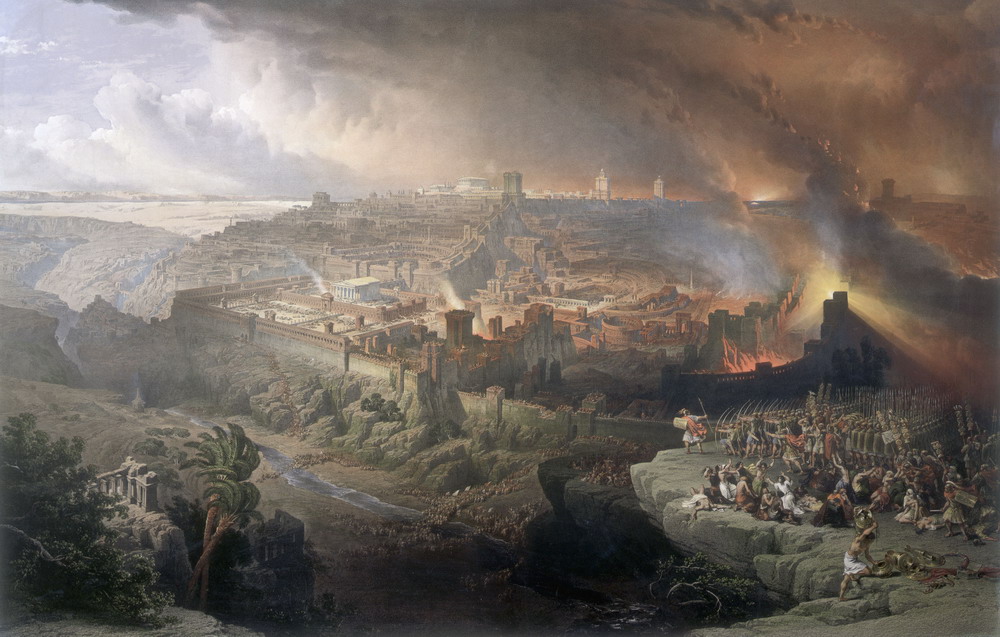
So said Tiglath-Pileser III, the king of Assyria, regarding his military attack on Damascus in 732 B.C. (Annals of the Assyrians 23:13’-5’ and 23:16’-7’). In this campaign he deported many of the surviving citizens of Damascus, replacing them with exiles from other parts of the empire. This was a common tactic used by Assyria to prevent conquered cities from re-emerging. It also ensured that the people and culture of each conquered territory were not left intact. The State Archives of Assyria Online (SAAo), a text database created by a team from the University of Helsinki (Finland) and based on materials found in the royal archives of Nineveh, has this to say about the fall of Damascus at that time:

“In 732 BC, the kingdom of Damascus lost its independence and existence, its holdings carved up into Assyrian provinces. Israel, on the other hand, was allowed to survive, albeit reduced to a fraction of its former size and cut off from the sea” (Source).

Peter Dubovsky, a scholar and professor from Slovakia, recounts the utter ruin of Damascus and the surrounding regions in the aftermath of Tiglath-Pileser’s campaign in his work titled, “Tiglath-pileser III’s campaigns in 734-732 B.C.: Historical background of Isa 7; 2 Kgs 15-16 and 2 Chr 27-28,” Biblica 87 (2006), pp. 153-170. It’s well-documented and worth checking out (See Link #1 or Link #2).

Israel was then attacked once again in 725 B.C., and after a 3-year siege was completely devastated. (Judah and Jerusalem remained intact until their defeat at the hands of Babylon in 586 B.C.) Damascus and Syria were also hit again in 720 B.C. when the newly crowned king of Assyria, Sargon II, crushed a regional rebellion that included these territories. UNESCO (The United Nations Educational, Scientific, and Cultural Organization) summarizes what happened to Damascus from this time forward:

“After being defeated twice by the Assyrians, it was definitively conquered by Nebuchadnezzar in 600 BC. It fell into Persian hands in 530 BC, and then in 333 BC it was annexed to the empire of Alexander the Great. The two adjoining areas were unified by the Romans, during the reigns of Septimius Severus and his son Caracalla (AD 197-217). The city was enclosed by a single ring of enclosure walls that are still be identified. After the interval of rule by the Sassanid Parthians, in 636 its fate was sealed permanently as part of the Arab world, becoming the prestigious and monumental capital of the Umayyad caliph. The city then began to expand outside the enclosure walls and enjoyed a time of particular economic prosperity,..” (Source)

Even more important than the validation of secular history, however, is the validation of Scripture. Isaiah 17 is a proclamation against both Syria and Israel. There is no doubt that the warnings against Israel were fulfilled soon after Isaiah delivered them. The northern kingdom of Israel never rose again after Assyria wiped it out. The warning against Israel begins with these words, “In that day…” (Isaiah 17:4). In what day? It would be in the day that Damascus would cease to be a city, would become a ruinous heap, and would have its kingdom taken away (verses 1-3). If Israel’s defeat took place in Isaiah’s day, as he prophesied, then so did the defeat of Damascus which he prophesied. The phrase, “in that day,” doesn’t allow for a 2700+ year separation between the two prophecies, as many attempt to create when they insist that modern-day Damascus is about to be destroyed in fulfillment of Isaiah’s prophecy.

Amos was a contemporary prophet to Isaiah, and his ministry coincided with the reigns of Jeroboam II and Uzziah. Scholars tend to believe that his message was delivered in 750-749 B.C., perhaps a decade before Isaiah delivered his message. This was Amos’ warning against Damascus:

For three transgressions of Damascus, and for four, I will not turn away its punishment, because they have threshed Gilead with implements of iron. But I will send a fire into the house of Hazael, which shall devour the palaces of Ben-Hadad. I will also break the gate bar of Damascus, and cut off the inhabitant from the Valley of Aven, and the one who holds the scepter from Beth Eden. The people of Syria shall go captive to Kir,” says the Lord (Amos 1:3-5).

Isaiah’s prophecy against Damascus (in Isaiah 17) was an echo of Amos’ slightly earlier prophecy. In II Kings 16 we can see the fulfillment of both prophecies (and other prophecies that we’re about to look at):

In the seventeenth year of Pekah the son of Remaliah, Ahaz the son of Jotham, king of Judah, began to reign…and he reigned sixteen years in Jerusalem… Then Rezin king of Syria and Pekah the son of Remaliah, king of Israel, came up to Jerusalem to make war; and they besieged Ahaz but could not overcome him. At that time Rezin king of Syria captured Elath for Syria, and drove the men of Judah from Elath. Then the Edomites went to Elath, and dwell there to this day. So Ahaz sent messengers to Tiglath-Pileser king of Assyria, saying, “I am your servant and your son. Come up and save me from the hand of the king of Syria and from the hand of the king of Israel, who rise up against me.” And Ahaz took the silver and gold that was found in the house of the Lord, and in the treasuries of the king’s house, and sent it as a present to the king of Assyria. So the king of Assyria heeded him; for the king of Assyria went up against Damascus and took it, carried its people captive to Kir, and killed Rezin (II Kings 16:1-9).

Isaiah 17:3 says that the kingdom would be taken from Damascus. After Rezin’s death, history doesn’t record any other king of Damascus. This city lost its king (due to his death) and its people (due to their captivity and deportation). It was no small city, for Tiglath-Pileser said he destroyed 591 “cities” within Damascus. The mega-city of Damascus was the heart of Syria, and Rezin was supremely important to Damascus, as we see in Isaiah 7:

For the head of Syria is Damascus, and the head of Damascus is Rezin” (Isaiah 7:8).

Just like in II Kings 16, the greater context of Isaiah 7 shows that Israel (the north) and Syria were joining forces in an effort to destroy Judah and Jerusalem:

“…Rezin king of Syria and Pekah the son of Remaliah, king of Israel, went up to Jerusalem to make war against it, but could not prevail against it” (Isaiah 7:1).

Furthermore, the same kind of analogy that we see in verse 8 concerning Syria is also given right afterward concerning Israel:

Within sixty-five years Ephraim will be broken, so that it will not be a people. The head of Ephraim is Samaria, and the head of Samaria is Remaliah’s son [Pekah]” (Isaiah 7:8-9).

So this is what Isaiah highlights concerning both Syria and Israel:

COUNTRY CAPITAL CITY KING
Syria Damascus (“head of Syria”) Rezin (“head of Damascus”)
Israel (Ephraim) Samaria (“head of Ephraim”) Pekah (“head of Samaria”)

What is God’s response to “these two stubs of smoking firebrands” (Isaiah 7:4) and their alliance against Judah and Jerusalem?

“…the riches of Damascus and the spoil of Samaria will be taken away before the king of Assyria” (Isaiah 8:4).

God then goes on to describe Assyria and its king as “the waters of the river, strong and mighty” that He would “bring up over” Syria and Israel (Isaiah 8:7). It’s interesting that God compared Tiglath-Pileser to a river, and he described his destruction of Damascus as “hills over which the flood had swept.”

This, then, is the background of the prophecy in Isaiah 17. It also helps to explain why Isaiah prophesies, in chapter 17, against both Syria/Damascus and Israel at the same time. They were about to be soundly defeated by the same enemy, and during the same time period (“in that day” – Isaiah 17:4). So, in review:

  • Amos prophesied that Damascus was to be punished and defeated, and that the people of Syria would be taken captive to Kir.
  • Isaiah 7 and Isaiah 8 show that Syria (led by king Rezin) and Israel (led by king Pekah) conspired together in an unsuccessful attempt to destroy Judah and Jerusalem. Isaiah foretold that both kingdoms would be wiped out by the kingdom of Assyria.
  • Isaiah 17 again foretells that both Syria and Israel are about to be defeated, and that Damascus would lose its kingdom and be turned into a ruinous heap.
  • II Kings 16 shows Syria and Israel coming together to attack Judah and Jerusalem; followed by the king of Assyria conquering Damascus, killing Rezin (their king), and taking the people of Damascus captive to Kir.

Isaiah and Amos prophesied concerning events that would take place during the lifetime of the audiences that heard their warnings, not about events that would take place more than 2700 years later in the 21st century. Furthermore, by comparing Scripture with Scripture, and by considering historical accounts, we see how their prophecies were soon fulfilled.

Joel C. Rosenberg (a New York Times best-selling author) and Jan Markell (the founder of Olive Tree Ministries in Minneapolis) are two well-known leaders promoting the idea that current events involving Syria are about to lead to the fulfillment of Isaiah 17. In a September 1st article on World Net Daily, Drew Zahn compiles similar thoughts from Carl Gallups (author and radio host), James F. Fitzgerald (author of “The 9/11 Prophecy”), Bill Salus (author of “Psalm 83: The Missing Prophecy Revealed”), Joel Richardson** (author of “The Islamic Antichrist”), Dr. Tommy Ice, andWalid Shoebat, all agreeing that the stage is set (or being set) for “the Biblical doom of Damascus” to unravel “before our eyes.” One prophecy website even shows an aerial photo of the modern city of Damascus with the word “GONE!!!” posted above it in large letters, and Isaiah 17:1 posted beneath it.

If we’re not careful, our failure to recognize fulfilled prophecy can actually give way to a desire to see the destruction of people and nations in our world and in our time, so that we can place check marks next to prophecies that were already fulfilled a long time ago. The Bible does not teach that Damascus and Syria are about to be destroyed. It teaches that Damascus and Syria can experience the healing of the water of life that flows through the city of the New Jerusalem, made up of God’s people:

And he showed me a pure river of water of life, clear as crystal, proceeding from the throne of God and of the Lamb. In the middle of its street, and on either side of the river, was the tree of life, which bore twelve fruits, each tree yielding its fruit every month. The leaves of the tree were for the healing of the nations” (Revelation 22:1-2; see also Ezekiel 47:1-12, Hebrews 12:22-24 and Revelation 21:1-27).

———————————————————————-

**Update: Joel Richardson has clarified that his position is somewhat different than what is stated above. Please see the comment section for that clarification, as well as his explanation of the good work he has been doing to share the viewpoint of Syrian Christians and lobby Congress not to attack Syria.

———————————————————–

A follow-up post to this one mainly focuses on Isaiah 17:12-14, showing that it describes how Assyria attempted to defeat Judah and Jerusalem in 701 BC, but miserably failed when God miraculously intervened: “Isaiah 17:12-14 Is Addressed to the Enemies of Judah.” Isaiah 17 has everything to do with the 8th century BC, and nothing to do with the 21st century.

Israel Is God’s Chosen People – What Does That Mean?


Two days ago Andrew Strom, a well-known minister from New Zealand, created a firestorm with his post, “Replacement?? – Israel & the Church.” I personally agree with about 90% of what he wrote. As expected, there have been many responses, some very emotional. There are nearly 350 comments under that post, as of last count, and they address so many different aspects of this topic (and beyond) that it can make the mind spin. I’m very interested in what some have to say, but quite baffled at what others say. I’d like to get feedback, if possible, regarding one baffling statement that appeared repeatedly in that forum, one which I’ve heard so many times before:

“Israel is God’s chosen people.”

For those who say this and believe it, what does that mean? Does it mean that all citizens of Israel are God’s chosen people? At face value, that’s what it seems they would mean. Somehow, though, I get the impression that people mean Jews only, when they say this. Did you know that there are roughly 1.6 million Arab citizens in Israel? According to this Wikipedia entry, that’s the case. Are they also among God’s chosen people, since they live in Israel?**

Others claim that all ethnic Jews are God’s chosen people, and I also completely disagree with this idea. Scripture teaches that only those who belong to Jesus are God’s chosen people. In I Peter 2:4-10, for example, those who belong to Jesus are chosen to be a royal priesthood, to receive mercy, to be a light in the darkness, etc. This is true of those who belong to Christ. It’s not true for those outside of Christ, even if they happen to be Jewish. For a deeper discussion on this topic, please see this post:

http://kloposmasm.com/2010/09/23/who-are-gods-chosen-people-and-why-are-they-chosen/

However, I’m even more baffled by the claim that the nation of Israel is God’s chosen people. It makes no sense Scripturally, and it doesn’t even make sense politically. What are your thoughts on the claim that “Israel is God’s chosen people”?

———————————————————————————————–

**I believe that some Arab citizens of Israel actually are among God’s chosen people, but only those who belong to Christ. And some of them do – praise God.

Why I Abandoned Replacement Theology


I once believed in and taught “replacement theology,” but no one ever accused me of it at the time. Since turning away from replacement theology, however, I’ve faced this accusation numerous times.

What is replacement theology? Matt Slick, the president and founder of Christian Apologetics and Research Ministry (CARM), says this on the subject:

Replacement theology is the teaching that the Christian church has replaced national Israel regarding the plan, purpose, and promises of God… [In] replacement theology the church has replaced Israel as the primary means by which the world is blessed by God’s work… Replacement theology is also known as supersessionism, which means that the Christian church has superseded Israel in God’s plan.

John Hagee, the founder of Christians United for Israel (CUFI), said this in his 2006 book, “Jerusalem Countdown: A Warning to the World”:

“Adherents of replacement theology believe that the Jews are no longer God’s chosen people, and God does not have specific future plans for the nation of Israel” (page 72)… “Replacement theology means that Israel failed, and God has replaced Israel with the church” (page165).

Ironically, when I formerly taught replacement theology, my thinking was very much in line with Slick and Hagee. I wasn’t replacing Israel with the church, but I sure was replacing Jesus with the modern nation of Israel. I would have agreed with graphics like this one I saw posted on Facebook by a fellow Christian a few weeks ago:

false interpretation of Genesis 12-3

SOURCE

This illustration epitomizes the replacement theology I’ve left behind. It takes the role belonging to Jesus and assigns it to a political nation whose population generally has nothing to do with Him. The New Testament is especially clear in showing that it’s through salvation in Jesus that the nations are blessed.

Consider the progression of Biblical revelation regarding the promise recorded in Genesis 12:3:

[1] It was first made by God to Abraham alone: “It will be through you [Abraham], that all the families of the earth will be blessed.”

[2] It was repeated again in Genesis 22:18, and this time expanded to include his offspring: “And through your offspring all nations on earth will be blessed, because you have obeyed Me.”

[3] In Acts 3:25-26, the apostle Peter, speaking to a Jewish crowd in Jerusalem, is clear in identifying Abraham’s offspring and the means of blessing for the nations:

And you are heirs of the prophets and of the covenant God made with your fathers. He said to Abraham, ‘Through your offspring all peoples on earth will be blessed.’ When God raised up His servant, He sent Him first to you to bless you by turning each of you from your wicked ways.”

It’s Jesus who is Abraham’s offspring, and He blesses the nations, beginning with the proclamation of the gospel to Jews in the first century.

[4] The apostle Paul, in Galatians 3:7-8, declared that Jesus’ followers are Abraham’s offspring too:

Understand, then, that those who believe are children of Abraham. The Scripture foresaw that God would justify the Gentiles by faith, and announced the gospel in advance to Abraham: ‘All nations will be blessed through you.’”

According to the terms laid out by Matt Slick and John Hagee, the apostles Peter and Paul were guilty of teaching replacement theology. Yet according to Peter and Paul, when it comes to God’s plans, purpose, and promises, Slick and Hagee are seeking to replace Jesus and His church with a geopolitical nation located in the Middle East. It’s highly ironic that there are Christians who are comfortable with the idea of replacing Christ (their Savior) with a mere political nation, but are up in arms with those who allegedly replace Israel with the church.

Galatians 3, incidentally, goes on to make the point even more strongly that all of God’s promises are wrapped up first in Jesus and second in His followers. Paul says this in verse 16:

The promises were spoken to Abraham and to his seed. The Scripture does not say ‘and to seeds,’ meaning many people, but ‘and to your seed,’ meaning one person, who is Christ.”

Jesus is singularly the recipient of all of God’s promises, and He extends those promises to His followers (verse 29), who are all one in Him regardless of ethnicity, societal status, or gender (verse 28):

There is neither Jew nor Greek, there is neither slave nor free, there is neither male nor female, for you are all one in Christ Jesus. And if you are Christ’s, then you are Abraham’s offspring, heirs according to promise.” (Galatians 3:28-29)

Does Paul leave any room for those who are outside of Christ to be heirs of the promises? No, he doesn’t, not even for Jews who are outside of Christ. Neither did Peter (Acts 3:23), and neither did Jesus (e.g. Matthew 8:10-12Matthew 21:43John 8:31-47). As Paul says in II Corinthians 1:20, all of God’s promises are “yes” and “amen” in Jesus. What are they outside of Jesus? Meaningless and void.

One of my questions for Slick and Hagee is this: If God’s plan, purpose, and promises are waiting for the nation of Israel to carry them out, then did God utterly abandon the world between 70 AD and 1948 when there was no nation of Israel? Or is it not possible that God’s plan, purpose, and promises continued to be carried out by true Israel, i.e., Jesus and His church?

Consider also what Paul said to the Roman church: “A person is not a Jew who is one only outwardly, nor is circumcision merely outward and physical. No, a person is a Jew who is one inwardly; and circumcision is circumcision of the heart, by the Spirit…” (Romans 2:28-29). “For not all who are descended from Israel belong to Israel, and not all are children of Abraham because they are his offspring… This means that it is not the children of the flesh who are the children of Godbut the children of the promise are counted as offspring” (Romans 9:6-8).

The church is Israel, that is, the Israel of God (Galatians 6:16). This is only true because Jesus is true Israel, and we who belong to Christ are made one with Him. One more example of each of these points will suffice. First we will look at how Matthew takes what was once said about the nation of Israel, and applies it to Jesus. Then, finally, we will look at how Peter takes what was once said of the nation of Israel, and applies it to the church.

[1] In Exodus 4:22, God instructs Moses to say to Pharaoh, “Thus says the Lord, ‘Israel is My firstborn son, and I say to you, “Let My son go that he may serve Me.”’” Then in Hosea 11:1-2 we read, “When Israel was a child, I loved him, and out of Egypt I called My son. The more they were called, the more they went away; they kept sacrificing to the Baals and burning offerings to idols.” Who is Israel in these Old Testament texts? Clearly it’s that ancient nation, known as Israel, which was finally destroyed by the Romans in 70 AD.

Yet look at how Matthew treats this same statement. To set the background, an angel has warned Joseph, the father of Jesus, to flee to Egypt with his family, because Herod would seek to destroy Jesus: “And he [Joseph] rose and took the child [Jesus] and His mother by night and departed to Egypt and remained there until the death of Herod. This was to fulfill what the Lord had spoken by the prophet, ‘Out of Egypt I called My son’” (Matthew 2:14-15).

Only 40 verses into the New Testament, Matthew declares, by strong implication, that Jesus is true Israel.

[2] Compare what Moses spoke to “the people of Israel” (Exodus 19:3) to what Peter said was true of the church. It’s impossible to miss the parallel language, and I have letter-coded the parallels (A, B, and C):

To ancient national Israel: “Now therefore, if you will indeed obey My voice and keep My covenant, you shall be [A] MY TREASURED POSSESSION among all peoples, for all the earth is mine; and you shall be to Me [B] A KINGDOM OF PRIESTS and a [C] HOLY NATION…” (Exodus 19:5-6).

To the church: “But you are a chosen race[B] A ROYAL PRIESTHOOD, a [C] HOLY NATION, a people [A] FOR HIS OWN POSSESSIONthat you may proclaim the excellencies of Him who called you out of darkness into His marvelous light. Once you were not a people, but now you are God’s people…” (I Peter 2:9-10).

Peter leaves no doubt that Christ’s followers are chosen for the same purpose for which the nation of Israel was once chosen.

I abandoned replacement theology because Jesus is irreplaceable, and I love His church.

—————————————————————————————————–

I first published this article on Hubpages on February 10, 2013.

Stephen Sizer Q & A at Taylor University


Early this morning, while preparing and eating breakfast before leaving for work, I was able to listen to Stephen Sizer field questions from students at Taylor University in Upland, Indiana regarding the 2010 film, “With God On Our Side.” As far as I can tell, this event took place on March 2, 2011. It was posted yesterday, however, on Sizer’s blog.

Taylor University is an interdenominational, evangelical Christian university founded in 1846, and presently has an enrollment of approximately 2600 students, according to its official website. A 2012 US News & World Report survey shows that Taylor has been the top college among 109 Midwest Regional Colleges for the last five years.

This video is 33 minutes long, and features questions from students regarding the Israeli-Palestinian conflict, Christian Zionism, Dispensationalism, John Hagee’s eschatology, Jeremiah 31, Ezekiel 37, the Samaritan woman that Jesus encountered, and more. I thought Stephen Sizer did a great job responding to these questions, and I believe that everyone can learn from this session.

I wrote a review of the film “With God On Our Side” which can be seen here.

John Hagee and Benny Hinn: Warmongering for the Wrong Kingdom


For the kingdom of God is not a matter of eating and drinking, but of righteousness, peace and joy in the Holy Spirit” (Romans 14:17). Those who follow Christ are citizens of God’s kingdom. One of its characteristics, says Paul, is peace. This truth and others concerning God’s kingdom seem to be completely lost on some of today’s most popular teachers, as we will see shortly. According to Jesus, His kingdom is also not earthly or political, not even observable by the human eye:

Once, on being asked by the Pharisees when the kingdom of God would come, Jesus replied, “The coming of the kingdom of God is not something that can be observed, nor will people say, ‘Here it is,’ or ‘There it is,’ because the kingdom of God is in your midst [or ‘in you’]” (Luke 17:20-21).

John the Baptist and Jesus both preached the nearness of God’s kingdom during their time, repeatedly saying that this kingdom was “at hand” (e.g. Matthew 3:2, 4:17). In Mark 1:15, Jesus even prefaced His statement by saying “The time is fulfilled.” Did His assurance on this point reflect any time statements in the Old Testament regarding the kingdom? The writings of the prophet Daniel are most helpful in this regard. Daniel 7:13-14 pictures Jesus ascending to His Father and receiving an everlasting kingdom that would never be destroyed (“…behold with the clouds of heaven there came One like a son of man, and He came to the Ancient of Days and was presented before Him. And to Him was given dominion and glory and a kingdom…”).

At this point, Daniel looks to a subsequent time when the saints would soon possess this kingdom forever (Daniel 7:18, 22, 27). This would occur following a time when “the fourth beast” would make war with the saints “until the Ancient of Days came” (verses 21-22). Many say that this has not yet happened. We know, however, that Jesus promised to come [1] in His kingdom [2] in the glory of His Father [3] with His angels [4] and in judgment while some of His disciples (Matthew 16:27-28) and some people among His larger audience (Mark 8:34-9:1) were still alive, i.e. in the first century AD. This timing is further substantiated when we see that Jesus, in the Parable of the Tenants, told the religious leaders of Israel that the kingdom of God would be taken away from them and “given to a people producing its fruits” (Matthew 21:43-45), i.e. the Church, or in Daniel’s words, “the saints of the Most High.” This was to take place in their generation, as Jesus outlined in great detail in the Olivet Discourse (Matthew 24, Mark 13, Luke 21).

Yet another indication of this timing can be seen clearly earlier in the book of Daniel, when he interpreted Nebuchadnezzar’s dream: “And in the days of those kings* the God of heaven will set up a kingdom that shall never be destroyed, nor shall the kingdom be left to another people” (Daniel 2:44). [*Biblical scholars hold a virtual consensus that the four kingdoms in Daniel’s vision were Babylon, Medo-Persia, Greece, and Rome. Since Rome was destroyed in 476 AD, we know that, for this prophecy to be true, the kingdom was set up before that time.] A first century fulfillment fits; a 21st century fulfillment doesn’t.

So the meaning of all this is that God’s kingdom is now fully present (and has been for many centuries), it is spiritual and not physical, and one of its characteristics is peace. Similarly, God’s people now belong to Jerusalem, not the earthly one, but rather the heavenly one. Observe what the author of Hebrews wrote to his first century audience:

But you have come to Mount Zion and to the city of the living God, the heavenly Jerusalem…” (Hebrews 12:22). This truth does not await a future fulfillment, but again has been a present reality for the body of Christ for many centuries. An overview of Hebrews 12:18-28 equates the heavenly Jerusalem with [1] the new covenant (verse 24) and [2] a kingdom that cannot be shaken (verse 28), and contrasts it with the old covenant given through Moses at Mount Sinai (verses 18-21), represented by things that were about to be shaken and removed at that time (verses 26-27). This was accomplished during Israel’s great tribulation (67-70 AD), at which time God’s kingdom was also fully established and set up. This same comparing/contrasting of the two covenants (new and old), and the two Jerusalems (earthly and heavenly) can be seen in Paul’s great allegory of two women (Galatians 4:21-31). Most interestingly, two women are also pictured in the book of Revelation, [1] the adulterous harlot known as “Babylon the Great” and [2] the bride of Christ. One is thrown out, the other is chosen forever. The striking similarities between Galatians 4, Hebrews 12, and Revelation regarding the covenants, Jerusalem (above and below), and God’s kingdom are no coincidence.

The blessings of God belong to those who are His by faith in His Son Jesus, and not according to ethnicity, another truth lost on some of today’s most popular teachers who insist that ethnic Jews are God’s chosen people. Paul couldn’t have been more clear about this (e.g. Galatians 3:16-29).

Enter two of America’s most influential teachers and televangelists, John Hagee and Benny Hinn. In this incredibly sad and disgusting video clip, John Hagee, hosted by Benny Hinn, openly prays (see the 1:05 mark) for God to lead the United States into war against “the enemies of righteousness” (apparently Iran), for the alleged benefit of Israel:

Keeping in mind that peace is one of the traits of God’s kingdom, recall Jesus’ famous and powerful words in the Sermon on the Mount: “Blessed are the peacemakers, for they shall be called the children of God” (Matthew 5:9). PJ Miller well points out the excellent commentary on this verse by Albert Barnes (in 1834):

Those who strive to prevent contention, strife, and war; who use their influence to reconcile opposing parties, and to prevent lawsuits and hostilities in families and neighborhoods. Every man may do something of this; and no man is more like God than he who does it. There ought not to be unlawful and officious interference in that which is none of our business; but without any danger of acquiring this character, every man has many opportunities of reconciling opposing parties. Friends, neighbors, people of influence, lawyers, physicians, ministers of the gospel, may do much to promote peace. And it should be taken in hand in the beginning. “The beginning of strife,” says Solomon, “is like the letting out of water.”

I’m not sure if it’s possible to more blatantly contradict Jesus’ teaching on being peacemakers than what we see in this video. Furthermore, Iran should not be considered the enemy of God’s people who live in America or Britain. Yet, even if we could (hypothetically) say that Iran fills this role, we come face to face with these very powerful words of Jesus, also found in the Sermon on the Mount:

But I say unto you, love your enemies, bless those who curse you, do good to those who hate you, and pray for those who despitefully use you, and persecute you.”

Unless I’ve missed something in the news, how is Hagee so confident that the United States WILL go to war? He says this twice, at the 1:33 mark and again at the 1:55 mark in this video. The way he prayed this “prayer,” one would think he was a close presidential advisor equipped with key inside information that most don’t yet have. His use of the phrase “against the enemies of righteousness” implies that the whole of the United States is righteous and outsiders are not. The angels of heaven even allegedly go before the US army, and Britain’s army as well (2:00 mark).

Just as John Hagee seems to care nothing about the Christian Palestinian population (instead “favoring” mostly unbelieving Jews**), he also implicates the Christians in Iran with his warmongering schemes that would result in their demise, if he could have his way. According to some, Iran is quietly experiencing its greatest revival ever in terms of people coming to Christ:

John Hagee is warmongering instead of seeking peace, and he’s doing so for the wrong kingdom, one that is earthly instead of heavenly, visible instead of spiritual. The Christian Zionist movement he so openly represents is also deeply concerned with (in a distorted way) the wrong Jerusalem, again the earthly one instead of the heavenly one. My hope is that blatant displays of disobedience to God’s word like this will cause even more people to question and turn away from Christian Zionist theology.

John Hagee and others who hold to futurist, dispensationalist teachings tend to believe and proclaim that this generation is ripe for worldwide judgment, that we’re on the precipice of great doom and destruction and decline, that we’ll soon see the end of world history, etc. I believe this generation is pivotal for reasons that are quite the opposite. Many are awakening to the truth that God’s kingdom is already fully established, and that His people are called to advance it in peaceful and spiritually powerful ways. If this generation of God’s people turns away from the doomsday message of teachers like John Hagee, and instead embraces the truth of the New Testament and walks in the realities of the New Covenant established by Christ, great things can happen in the near future and in generations ahead of us. May it be.

————————————————————————————-

**John Hagee, who many might think deeply cares for Jews, raises millions of dollars to bring them to Israel, where, according to his teaching, two (2) out of every three (3) Jews will one day soon be slaughtered in a tribulation that is greater than anything the Jews experienced in 67-70 AD or during the Holocaust of the last century.

The Olivet Discourse: “This” Generation Or “That” Generation (Part 3 of 4)


In the first post (Part 1) of this series, we examined the first few verses of Jesus’ famous Olivet Discourse, recorded in Matthew 24:1-3, Mark 13:1-4, and Luke 21:5-7. We saw the disciples admiring the temple, Jesus telling them it would soon be destroyed, and the disciples asking Him when that would take place. In Matthew’s account alone they asked Him about His coming and the end of the age that they were living in. In the second post, we examined a roughly 10-verse segment in each account where Jesus described some of the signs which would take place before the temple’s destruction. We saw how those signs were fulfilled between the time of His ascension around 30 AD and the temple’s overthrow in 70 AD, about 40 years later.

In this post we will look at how Jesus warned His followers living in Judea to flee to the mountains when they saw “the abomination that causes desolation” (Matthew 24:15/Mark 13:14), that is, “Jerusalem being surrounded by armies” (Luke 21:20). We will see some remarkable accounts of how the believers obeyed and did this very thing about 36 years later. We will also consider what Jesus said about a time of great tribulation that was to come.

MATTHEW 24:15-28

MARK 13:14-23

LUKE 21:20-24

15 So when you see standing in the holy place ‘the abomination that causes desolation,’ spoken of through the prophet Daniel—let the reader understand16 then let those who are in Judea flee to the mountains. 17 Let no one on the housetop go down to take anything out of the house. 18 Let no one in the field go back to get their cloak. 19 How dreadful it will be in those days for pregnant women and nursing mothers! 20 Pray that your flight will not take place in winter or on the Sabbath. 21 For then there will be great distress, unequaled from the beginning of the world until now—and never to be equaled again. 22 “If those days had not been cut short, no one would survive, but for the sake of the elect those days will be shortened. 23 At that time if anyone says to you, ‘Look, here is the Messiah!’ or, ‘There he is!’ do not believe it. 24 For false messiahs and false prophets will appear and perform great signs and wonders to deceive, if possible, even the elect. 25See, I have told you ahead of time.26 “So if anyone tells you, ‘There he is, out in the wilderness,’ do not go out; or, ‘Here he is, in the inner rooms,’ do not believe it. 27 For as lightning that comes from the east is visible even in the west, so will be the coming of the Son of Man. 28 Wherever there is a carcass, there the vultures will gather. 14 When you see ‘the abomination that causes desolation’ standing where it does not belong—let the reader understandthen let those who are in Judea flee to the mountains. 15 Let no one on the housetop go down or enter the house to take anything out. 16 Let no one in the field go back to get their cloak. 17 How dreadful it will be in those days for pregnant women and nursing mothers! 18 Pray that this will not take place in winter, 19 because those will be days of distress unequaled from the beginning, when God created the world, until now—and never to be equaled again. 20 “If the Lord had not cut short those days, no one would survive. But for the sake of the elect, whom he has chosen, he has shortened them. 21 At that time if anyone says to you, ‘Look, here is the Messiah!’ or, ‘Look, there he is!’ do not believe it. 22 For false messiahs and false prophets will appear and perform signs and wonders to deceive, if possible, even the elect. 23 So be on your guard; I have told you everything ahead of time. 20 When you see Jerusalem being surrounded by armies, you will know that its desolation is near. 21 Then let those who are in Judea flee to the mountains, let those in the city get out, and let those in the country not enter the city. 22 For this is the time of punishment in fulfillment of all that has been written. 23 How dreadful it will be in those days for pregnant women and nursing mothers! There will be great distress in the land and wrath against this people. 24 They will fall by the sword and will be taken as prisoners to all the nations. Jerusalem will be trampled on by the Gentiles until the times of the Gentiles are fulfilled.

THE ABOMINATION OF DESOLATION

Matt. 24:15-20/Mark 13:14-18/Luke 21:20-21, 23a – Both Matthew and Mark speak of an event which Christ’s followers were to be on the lookout for, “the abomination that causes desolation.” Both writers appeal to the reader “to understand,” and Matthew adds that this was spoken of by Daniel (9:26-27, 11:31, 12:11).  Luke also speaks of an event which would lead to desolation, which he describes as “Jerusalem being surrounded by armies.” Looking at all three accounts together, we can see that these (apparently) two different signs were actually one and the same, for they were to bring about the same response: immediate flight. Luke, addressing a non-Jewish audience, makes plain what the “abomination of desolation” was to be:

AUTHOR:

Matthew

Mark

Luke

CATALYST: “So when you see standing in the holy place ‘the abomination that causes desolation’…” “When you see ‘the abomination that causes desolation’…” “When you see Jerusalem being surrounded by armies… desolation is near.”
RESPONSE: “then let those who are in Judea flee to the mountains.” “then let those who are in Judea flee to the mountains.” “Then let those who are in Judea flee to the mountains…”

Perhaps overlooking this fact, it is often said by futurists that, at the time of Jerusalem’s destruction in 70 AD, nothing occurred which may have fulfilled Christ’s prophecy of a coming abomination of desolation. A number of early church writers, however, did teach that this prophecy was fulfilled at that time. These included Clement of Alexandria (150-215 AD), Eusebius (263-339) Athanasius (296-372), Augustine (379), Chrysostom (379), Jerome (347-420), and Remigius (437-533). Eusebius (263-339 AD) was a Roman scholar and historian, known as the “Father of Church History.” In his work entitled “Proof of the Gospel” (Book III, Chapter VII), written in 314 AD, he said the following:

It is fitting to add to these accounts the true prediction of our Saviour in which he foretold these very events. His words are as follows: “Woe unto them that are with child, and to them that give suck in those days! But pray ye that your flight be not in the winter, neither on the Sabbath day; For there shall be great tribulation, such as was not since the beginning of the world to this time, no, nor ever shall be.” …These things took place in this manner in the second year of the reign of Vespasian, in accordance with the prophecies of our Lord and Saviour Jesus Christ, who by divine power saw them beforehand as if they were already present, and wept and mourned according to the statement of the holy evangelists…

Moreover, the people of the church at Jerusalem, in accordance with a certain oracle that was vouchsafed by way of revelation to the approved men there, had been commanded to depart from the city before the war, and to inhabit a certain city of Peraea. They called it Pella. And when those who believed in Christ had removed from Jerusalem, as if holy men had utterly deserted both the royal metropolis of the Jews itself and the whole land of Judaea, the Justice of God then visited upon them all their acts of violence to Christ and his apostles, by destroying that generation of wicked persons root and branch from among men.

…at last the abomination of desolation, proclaimed by the prophets, stood in the very temple of God, so celebrated of old, the temple which was now awaiting its total and final destruction by fire– all these things any one that wishes may find accurately described in the history written by Josephus.

Remigius (437-533 AD) tells us this:

[F]or on the approach of the Roman army, all the Christians in the province, warned, as ecclesiastical history tells us, miraculously from heaven, withdrew, and passing the Jordan, took refuge in the city of Pella; and under the protection of that King Agrippa, of whom we read in the Acts of the Apostles, they continued some time.

This is fascinating stuff! Athanasius (296-372 AD), the bishop of Alexandria, likewise wrote this:

“And when He Who spake unto Moses, the Word of the Father [i.e. Jesus], appeared in the end of the world [age], He also gave this commandment, saying…, ‘When ye therefore shall see the abomination of desolation, spoken of by Daniel the prophet, stand in the holy place (whoso readeth, let him understand); then let them which be in Judea flee into the mountains…’ [Matt. 24:15-16]. Knowing these things, the Saints regulated their conduct accordingly” (Defence of His Flight).

When Athanasius spoke of the believers in Jerusalem living “accordingly,” it’s likely that he meant they lived simply, in order to be prepared for that time when they would need to suddenly vacate. Indeed, we read in Acts that the believers there “had all things in common,” they “were selling their possessions and belongings and distributing the proceeds to all, as any had need” (Acts 2:44-45), and “no one said that any of the things that belonged to him was his own” (Acts 4:32). Of course, many of these believers were later scattered throughout Judea and Samaria when persecution suddenly arose after Stephen was martyred (Acts 8:1).

SOURCE

From Scripture it seems clear that “the holy place” mentioned by Jesus (Matt. 24:15) was not the temple, but Jerusalem, since the entire city was considered holy (Nehemiah 11:1, Daniel 9:24, Matthew 4:5, Matthew 27:53). In Daniel’s day the temple was holy, but Jesus had just pronounced it desolate (Matthew 23:38). This was the viewpoint of Chrysostom (379 AD), who wrote, “For this it seems to me that the abomination of desolation means the army by which the holy city of Jerusalem was made desolate” (recorded in The Ante-Nicene Fathers). Thomas Newton, in his dissertation titled “The Prophecy of Matthew 24” written in 1753, also took this position:

Whatever difficulty there is in these words [in Matthew 24:15-16], it may be cleared up by the parallel place in St. Luke, ‘And when ye shall see Jerusalem compassed with armies, then know that the desolation thereof is nigh. Then let them which are in Judea flee to the mountains,’-xxi – 20, 21. So that ‘the abomination of desolation’ is the Roman army, and ‘the abomination of desolation standing in the holy place’ is the Roman army besieging Jerusalem. This, saith our Saviour, is ‘the abomination of desolation, spoken of by Daniel the prophet,’ in the ninth and eleventh chapters; and so let every one who readeth those prophecies, understand them. The Roman army is called ‘the abomination,’ for its ensigns and images, which were so to the Jews.

Other commentators roughly contemporary to Thomas Newton held to the same view, i.e. that these words of Jesus were fulfilled in 67-70 AD. These included John Wesley (1754), Adam Clarke (1837), C. H. (Charles) Spurgeon (1868), and Philip Schaff (1877). For example, Charles Spurgeon said (“Popular Exposition of Matthew”),

“This portion of our Savior’s words appears to relate solely to the destruction of Jerusalem. As soon as Christ’s disciples saw ‘the abomination of desolation’, that is, the Roman ensigns, with their idolatrous emblems, ‘stand in the holy place’, they knew that the time for them to escape had arrived, and they did ‘flee to the mountains.’ The Christians in Jerusalem and the surrounding towns and villages, ‘in Judea’, availed themselves of the first opportunity for eluding the Roman armies, and fled to the mountain city of Pella, in Perea, where they were preserved from the general destruction which overthrew the Jews.

The Romans came into Jerusalem bearing standards, emblems, and banners with images of their gods and proclamations of the deity of their emperor. B.H. Carroll (1915), in his well-known work, “An Introduction of the English Bible” (1915), related an interesting incident which took place during the reign of Tiberius (14-37 AD). This incident sheds light on what was constituted as such an abomination at this time:

Pilate, at that time Roman Procurator, sent from Caesarea, the seaport of that country on the Mediterranean Sea, a legion of Roman soldiers and had them secretly introduced into the city and sheltered in the tower of Antonio overlooking the Temple, and these soldiers brought with them their ensigns. The Roman sign was a straight staff, capped with a metallic eagle, and right under the eagle was a graven image of Caesar. Caesar claimed to be divine. Caesar exacted divine worship, and every evening when those standards were placed, the Roman legion got down and worshiped the image of Caesar thereof, and every morning at the roll call a part of the parade was for the whole legion to prostrate themselves before that graven image and worship it. The Jews were so horrified when they saw that image and the consequent worship, they went to Pilate, who was at that time living in Caesarea, and prostrated themselves before him and said, ‘Kill us, if you will, but take that abomination of desolation out of our Holy City and from the neighborhood of our holy temple’ (pp. 263-264).

Jesus had told those living in Judea to head to the mountains, predicting such urgency that they weren’t even to grab what was inside their homes. It would be especially difficult for those who were pregnant or nursing. Neither winter (according to Matthew and Mark) nor the Sabbath (said Matthew) would be an ideal time to have to flee. George Peter Holford, in his 1805 book, “The Destruction of Jerusalem, An Absolute and Irresistible Proof of the Divine Origin of Christianity,” notes a very sad situation predicted in the words of Jesus Himself:

The day on which Titus encompassed Jerusalem, was the feast of the Passover; and it is deserving of the very particular attention of the reader, that this was the anniversary of that memorable period in which the Jews crucified their Messiah! At this season multitudes came up from all the surrounding country, and from distant parts, to keep the festival. How suitable and how kind, then, was the prophetic admonition of our LORD, and how clearly he saw into futurity when he said, “Let not them that are in the countries enter into Jerusalem” (Luke 21:21).

Nevertheless, the city was at this time crowded with Jewish strangers, and foreigners from all parts, so that the whole nation may be considered as having been shut up in one prison, preparatory to the execution of the Divine vengeance; and, according to Josephus this event took place suddenly; thus, not only fulfilling the predictions of our LORD, that these calamities should come, like the swift-darting lightning “that cometh out of the east and shineth even unto the West,” and ” as a snare on all of them (the Jews) who dwelt upon the face of the whole earth ” (Matt. 24:27, and Luke 21:35) but justifying, also, his friendly direction, that those who fled from the place should use the utmost possible [speed].

There is also a significant note to be made concerning Jesus’ instructions to pray that their flight from Jerusalem would not be on a Sabbath (Matthew 24:20). Prior to 70 AD the Jews who controlled the city would close the city gates on the Sabbath and there would be no way to escape (See Nehemiah 13:15-22). It’s significant to note that this is not a practice in modern Israel; if it was, it would be helpful to the Futurist view which says that this will happen soon. As one can see from the quotes above, this Futurist view is a new one that doesn’t reflect what has been taught in church history.

GREAT TRIBULATION

Matt. 24:21/Mark 13:19/Luke 21:22-23 – All three writers define this time as one of “great distress.” This is the phrase used in the NIV, quoted above. In most other translations, the phrase used by Matthew and Mark is “great tribulation.”  That time would be more distressful than any other time since the world began. Matthew and Mark add that it was “never to be equaled again.” This statement by Jesus is one more indication that the tribulation He spoke of is already past. For if this refers to a supposed end of the world in the future, and not 67-70 AD, why would Jesus say such a thing? It wouldn’t make sense to use the expression “never to be equaled again” when referring to an event that brings humanity to the very end of time. Instead this phrase implies that a significant period of time would follow the great tribulation Jesus spoke of, which makes sense if it took place in the first century. This passage has several parallels in Scripture, as can be seen from the following chart:

JEREMIAH 30:7 DANIEL 12:1-7 MATTHEW 24:21 LUKE 21:22-23 REVELATION 7:14
“Alas! That day is so great there is none like it; it is a time of distress for Jacob; “At that time shall arise Michael, the great prince who has charge of your people. And there shall be a time of trouble, “For then there will be great tribulation, “Alas… For there will be great distress upon the earth [or ‘this land’] and wrath against this people.” “And he said to me, ‘These are the ones coming out of the great tribulation’…”
“…there is none like it…” such as never has been since there was a nation till that time. such as has not been from the beginning of the world until now, no, and never will be.”
yet he shall be saved out of it.” But at that time your people shall be delivered, everyone whose name shall be found written in the book.”
“And someone said…, ‘How long shall it be till the end of these wonders?’ And I heard…it would be for a time, times, and half a time, and that when the shattering of the power of the holy people comes to an end all these things would be finished.” “for these are days of vengeance, to fulfill all that is written” (verse 22).

So among the things which we see are that this tribulation was to be for Israel, it would last for 3.5 years (“time, times, and half a time”) and would end when the power of that people had been shattered (Daniel 12:6-7), and the followers of Christ would experience deliverance. We already saw that God delivered the believers of the first century when they obeyed and fled to Pella. The Roman campaign against Israel did in fact last for 3.5 years, from the time that Nero declared war in February 67 AD and dispatched Vespasian as his general (Revelation 6:2) until Jerusalem fell in August 70 AD (Revelation 18:9-24). This accomplished the shattering of the power of “the holy people” (Daniel’s phrase).

Josephus vindicates the words of Jesus in Matthew 24:21 (“For then there will be great tribulation, such as has not been from the beginning of the world until now, no, and never will be.”) with his own firsthand report: “If the misfortunes of all nations, from the beginning of the world, were compared with those which befell the Jews, they would appear far less in comparison; No other city ever suffered such things, as no other generation, from the beginning of the world, was ever more fruitful in wickedness.”

Luke, in his account, adds a couple of very revealing expressions, saying that this great distress would be “in the land” and that the wrath would be “against this people.” The phrase “the land” is not only a common expression in Scripture indicating “the promised land” (Israel), but Judea and Jerusalem are explicitly mentioned in verses 20, 21, and 24. Luke’s use of the phrase “this people” is also a clear reference to the Jews who lived in that land, who were left behind because they didn’t flee. Those who view the “great tribulation” as future tend to view it as a worldwide event, but these are very clear indications that this judgment was localized to Israel. We also have highly detailed historical records showing how utterly devastating Israel’s downfall was at this time in history (67 – 70 AD). To learn more, see this fascinating timeline here.

Another profound statement is made by Luke. He says that this time of punishment would be “in fulfillment of all that has been written.” Evan Erzingatsian provides the following chart showing how Jesus’ predictions are based on Israel’s covenant contract recorded in Leviticus and Deuteronomy. As Evan says,

“The table below shows the paraphrases (found in Matt 24 and Luke 21) based on the contractual terms found in Deuteronomy 28 and Leviticus 26. Only Israel said ‘Amen!’ to the curses (Deut. 27:15-26). Only Israel was bound to experience the calamitous events found in Matthew 24. This is why Matthew 24 mentions Jerusalem and Judea as the places where the events of the last days would unfold (Matt. 24:16, Luke 21:20-23).”

No automatic alt text available.

It has been said by some futurists that the preterist (past fulfillment) position is anti-semitic, because it takes away prophetic significance from modern-day Israel and the Jewish people (over and above other peoples). Ironically, though, it’s the futurist position which is looking forward to mass devastation for Israel and the Jewish people, a time which will supposedly be even worse than what took place in 70 AD.

Matt. 24:22/Mark 13:20 – Matthew and Mark record that the destruction during this time of tribulation would be so great that no one would survive if it was allowed to continue for long. This would be done, says Matthew, for the sake of the elect. Jerusalem was under a very tight siege for five months, from April through September 70 AD, before the whole city was burned (Matthew 22:7). The famine became so great that mothers even ate their own babies. Dead bodies were piled everywhere, and those who tried to escape the city were crucified by the Romans at such a rate that Josephus tells us more than one Jew would often be nailed to the same cross. Josephus records that 1.1 million Jews were killed at this time.

Source: Cindye Coates (Matthew 24 Fulfilled)

Luke 21:24 – Luke tells us that many would be killed “by the sword” during this time. This, of course, is indicative of ancient warfare rather than 21st century style warfare. It is this section of Luke’s account (Luke 21:20-24) which many futurists admit took place in the first century. At the same time, they often insist that Luke’s phrase “this generation” in Luke 21:32 means a future (or present) generation which will see all these signs come together at once. This position is highly contradictory, for at least the following reason.

In the previous post, we saw that a number of signs precede “the abomination of desolation” and “great tribulation” in the accounts of Matthew and Mark: [1] imposters claiming to be Christ [2] wars and rumors of wars [3] nations and kingdoms clashing [4] earthquakes [5] famines [6] persecution and martyrdom [7] betrayal and hatred. Without a doubt, these exact same signs also appear in Luke’s account before Jerusalem is surrounded by armies and there comes a time of “great distress.” According to the Futurist interpretation, then, the above seven signs precede two entirely different time periods; i.e. in Luke they refer to a time period in the first century, and in Matthew and Mark they supposedly refer to our own generation. As we will see in the next post, however, Jesus says in each account that “this generation will not pass away until ALL these things take place.” The Futurist who admits that the “great distress” in Luke 21:20-24 took place from 67-70 AD, but who says that the rest of the prophecy remains unfulfilled, has already stretched out the definition of a generation more than 1900 years.

Luke also speaks of many being taken as prisoners “to all the nations.” We learned from the previous post that when Jesus spoke of all nations (Matt. 24:14, Mark 13:10), this was a reference to the Roman Empire. The same is true here. Josephus tells us that nearly 1.2 million Jews were killed in Jerusalem, and that the Romans carried off 97,000 Jews into international slavery.

Luke tells us that the end of Jerusalem’s trampling by the Gentiles would also be the end of “the times of the Gentiles.” Perhaps the most popular Futurist position is that “the times of the Gentilesbegan in 70 AD, that this continues until today (i.e. it’s the Church Age), and that “God’s program with the Jews will one day soon be resumed.” I believe this to be false, and that “the times of the Gentilesended in 70 AD instead. Without taking up more space here on this subject, I’d like to point to an article by Mike Blume, whom I believe does an excellent job showing that the times of the Gentiles began with Babylon’s affliction and domination of Israel, followed by that of Medo-Persia and Greece, and finally ending with Rome’s destruction of that nation. He also shows that Luke 21:24 is parallel to both Romans 11:25 and Revelation 11:2, which shows that Jerusalem was to be “trampled underfoot” for 42 months. Again, 42 months = 3.5 years, which is precisely how long Rome took to invade and destroy Jerusalem (February 67 AD – August 70 AD).

Matt. 24:23-26/Mark 13:21-23 – Here Matthew and Mark essentially repeat Jesus’ earlier warning (see previous post) about false prophets and false messiahs. Jesus’ 1st century listeners are told to be on their guard (this really did have meaning for them), because these deceivers would even perform great signs and miracles. As David Chilton reminds us, in his 1987 book, The Days of Vengeance (p. 340),

“The Book of Acts records several instances of miracle-working Jewish false prophets who came into conflict with the Church (cf. Acts 8:9-24) and worked under Roman officials (cf. Acts 13:6-11); as Jesus foretold (Matt. 7:22-23), some of them even used His name in their incantations (Acts 19:13-16).”

Matt. 24:27-28 – Jesus compares His coming (which, again, He promised would take place while some of His disciples were still alive – Matt. 16:27-28) to lightning which comes from the east and is also visible in the west. This statement appears only in Matthew’s account, the only account to have specifically mentioned His coming up until this point (in verse 3).

This is possibly a reference to the 12th Roman legion, Fulminata, that participated in the Roman siege of Jerusalem in 70 AD. This legion did not perform well in November 66 AD when Cestius Gallus was defeated by the Jews, but it did very well in 70 AD. Its emblem and nickname was “Thunderbolt.”

Image result for LEGIO XII FULMINATA

Source

Adam Clarke, in his 1810 commentary on this verse, interpreted it this way:

“It is worthy of remark that our Lord, in the most particular manner, points out the very march of the Roman army: they entered into Judea on the EAST, and carried on their conquest WESTWARD, as if not only the extensiveness of the ruin, but the very route which the army would take, were intended in the comparison of the lightning issuing from the east, and shining to the west.”

Then Jesus adds, “Wherever there is a carcass, there the vultures will gather.” Some translations say “eagles” instead of “vultures.” George Peter Holford (in 1805) noted that not only was Israel fit to be described as a carcass in 70 AD; being spiritually, politically, and judicially dead; but it was also a curious fact that the eagle was the principal figure on the Roman ensigns which were planted throughout the city of Jerusalem in 70 AD and finally in the temple itself. Albert Barnes, in his commentary on these two verses in 1832, agreed:

“The words in this verse are proverbial. Vultures and eagles easily ascertain where dead bodies are, and come to devour them. So with the Roman army. Jerusalem is like a dead and putrid corpse. Its life is gone, and it is ready to be devoured. The Roman armies will find it out, as the vultures do a dead carcass, and will come around it, to devour it… This verse is connected with the preceding by the word “for,” implying that this is a reason for what is said there, that the Son of man would certainly come to destroy the city, and that he would come suddenly. The meaning is, he would come by means of the Roman armies, as certainly, as suddenly, and as unexpectedly, as whole flocks of vultures and eagles, though unseen before, suddenly find their prey, see it at a great distance, and gather in multitudes around it.”

Source: Cindye Coates (Matthew 24 Fulfilled)

Quotes to Note

Jonathan Edwards (1736): “Thus there was a final end to the Old Testament world: all was finished with a kind of day of judgment, in which the people of God were saved, and His enemies terribly destroyed.”

Philip Mauro, scholar and US Supreme Court bar lawyer (1859-1952): “It is greatly to be regretted that those who, in our day, give themselves to the study and exposition of prophecy, seem not to be aware of the immense significance of the destruction of Jerusalem in A.D. 70, which was accompanied by the extinction of Jewish national existence, and the dispersion of the Jewish people among all the nations. The failure to recognize the significance of that event, and the vast amount of prophecy which it fulfilled, has been the cause of great confusion, for the necessary consequence of missing the past fulfillment of predicted events is to leave on our hands a mass of prophecies for which we must needs contrive fulfillments in the future. The harmful results are twofold; for first, we are thus deprived of the evidential value, and the support to the faith, of those remarkable fulfillments of prophecy which are so clearly presented to us in authentic contemporary histories; and second, our vision of things to come is greatly obscured and confused by the transference to the future of predicted events which, in fact, have already happened, and whereof complete records have been preserved for our information.

“Yet, in the face of all this, we have today a widely held scheme of prophetic interpretation, which has for its very cornerstone the idea that, when God’s time to remember His promised mercies to Israel shall at last have come, He will gather them into their ancient land again, only to pour upon them calamities and distresses far exceeding even the horrors which attended the destruction of Jerusalem in A.D. 70. This is, we are convinced, an error of such magnitude as to derange the whole program of unfulfilled prophecy” (Seventy Weeks and the Great Tribulation, 1921, emphasis added).

The Olivet Discourse: “This” Generation or “That” Generation (Part 2 of 4)


In the previous post (Part 1), we examined the first part of Jesus’ famous Olivet Discourse, recorded in Matthew 24:1-3, Mark 13:1-4, and Luke 21:5-7. All three accounts show the disciples admiring the temple, Jesus telling them it would soon be destroyed, and the disciples asking Him when that would take place. In Matthew’s account alone they asked Him about His coming and the end of the age, which we identified as the Old Covenant age. We looked at how He had already told them (Matt. 10:23 and 16:27-28) that His coming was to be: [1] with His angels [2] in His kingdom [3] in the glory of His Father [4] to repay each person for their deeds, and [5] within the lifetime of some of His disciples.

In this post we will examine a roughly 10-verse segment in each account where Jesus describes some of the signs which would take place before the temple’s destruction. We will see how these signs were fulfilled between the time of His ascension around 30 AD and the temple’s overthrow in 70 AD, about 40 years later.

MATTHEW 24:4-14

MARK 13:5-13

LUKE 21:8-19

4 Jesus answered: “Watch out that no one deceives you. 5 For many will come in my name, claiming, ‘I am the Messiah,’ and will deceive many. 6 You will hear of wars and rumors of wars, but see to it that you are not alarmed. Such things must happen, but the end is still to come. 7 Nation will rise against nation, and kingdom against kingdom. There will be famines and earthquakes in various places. 8All these are the beginning of birth pains.9 “Then you will be handed over to be persecuted and put to death, and you will be hated by all nations because of me. 10 At that time many will turn away from the faith and will betray and hate each other, 11 and many false prophets will appear and deceive many people. 12 Because of the increase of wickedness, the love of most will grow cold, 13but the one who stands firm to the end will be saved.14 And this gospel of the kingdom will be preached in the whole world as a testimony to all nations, and then the end will come. 5 Jesus said to them: “Watch out that no one deceives you. 6 Many will come in my name, claiming, ‘I am he,’ and will deceive many. 7 When you hear of wars and rumors of wars, do not be alarmed. Such things must happen, but the end is still to come. 8Nation will rise against nation, and kingdom against kingdom. There will be earthquakes in various places, and famines. These are the beginning of birth pains.9 “You must be on your guard. You will be handed over to the local councils and flogged in the synagogues. On account of me you will stand before governors and kings as witnesses to them. 10 And the gospel must first be preached to all nations. 11Whenever you are arrested and brought to trial, do not worry beforehand about what to say. Just say whatever is given you at the time, for it is not you speaking, but the Holy Spirit.12 “Brother will betray brother to death, and a father his child. Children will rebel against their parents and have them put to death. 13 Everyone will hate you because of me, but the one who stands firm to the end will be saved. 8 He replied: “Watch out that you are not deceived. For many will come in my name, claiming, ‘I am he,’ and, ‘The time is near.’ Do not follow them. 9When you hear of wars and uprisings, do not be frightened. These things must happen first, but the end will not come right away.”10 Then he said to them: “Nation will rise against nation, and kingdom against kingdom. 11There will be great earthquakes, famines and pestilences in various places, and fearful events and great signs from heaven.12 “But before all this, they will seize you and persecute you. They will hand you over to synagogues and put you in prison, and you will be brought before kings and governors, and all on account of my name. 13 And so you will bear testimony to me. 14 But make up your mind not to worry beforehand how you will defend yourselves. 15 For I will give you words and wisdom that none of your adversaries will be able to resist or contradict. 16 You will be betrayed even by parents, brothers and sisters, relatives and friends, and they will put some of you to death. 17 Everyone will hate you because of me. 18 But not a hair of your head will perish. 19 Stand firm, and you will win life.

John Wesley (1703-1791), in the introduction to his commentary on Matthew 24, wrote the following:

“Josephus’ History of the Jewish War is the best commentary on this chapter. It is a wonderful instance of God’s providence, that he, an eyewitness, and one who lived and died a Jew, should, especially in so extraordinary a manner, be preserved, to transmit to us a collection of important facts, which so exactly illustrate this glorious prophecy, in almost every circumstance.”

Clearly, Wesley believed that Matthew 24 was fulfilled by the time the Roman-Jewish War (66-73 AD) came to an end. Nearly 250 years after Wesley’s statement was made, statements like this one by Hal Lindsey in 2009 are far more typical when it comes to interpreting this passage:

“What generation? Obviously, in context, the generation that would see the signs – chief among them the rebirth of the State of Israel… I believe we are in the generation that will live to see the fulfillment of the ‘birth pangs’ that Jesus predicted would all come together in one time frame shortly before the Tribulations events that bring about His return.”

These interpretations couldn’t be more different. In this section of the Olivet Discourse, we will see that Wesley certainly had a point when he spoke of the relevance of Josephus’ historical records. We will be looking at one small portion at a time from the parallel Scripture texts above.

Matt. 24:4-5/Mark 13:5-6/Luke 21:8– Jesus warns the disciples about deceivers who would come claiming to be the Messiah and leading many astray. Matthew also speaks of “false prophets” again in verse 11 and verse 24, and Mark does so again in verse 22.

Luke here makes a remark that we don’t see in the other two accounts. He adds that these false prophets would claim that the time was “near” (or “at hand” in some translations), and that His disciples were not to go after them when they said that. We should give this some extra thought.

As we will see in Luke 21:28, Jesus later says “Now when these things begin to take place, straighten up and raise your heads, because your redemption is drawing near.” Jesus thus gives permission at that stage for His people to realize the very thing that earlier they were not to believe, that is, that the time was near. First they had to see “these things begin to take place,” and then they could know and proclaim that the end was near. The expression “these things” refers to what Jesus goes on to describe in verses 9-27.

Did any of the writers of the New Testament proclaim that the time was near? Consider these statements:

“…For salvation is nearer to us now than when we first believed. The night is far gone; the day is at hand…” (Romans 13:11-12).

Let your reasonableness be known to everyone. The Lord is at hand” (Philippians 4:5).

Yet a little while, and the coming One will come and will not delay” (Hebrews 10:37).

You also, be patient. Establish your hearts, for the coming of the Lord is at hand” (James 5:8).

The end of all things is at hand; therefore be self-controlled and sober-minded for the sake of your prayers” (I Peter 4:7).

Children, it is the last hour, and as you have heard that antichrist is coming, so now many antichrists have come. Therefore we know that it is the last hour” (I John 2:18).

From these statements we see that Paul, James, Peter, and John all proclaimed that the time was near. Did they become the very false prophets Jesus had warned about in Luke 21:8, since they uttered the very statement that Jesus warned His followers not to believe? If the signs of the Olivet Discourse are still future and unfulfilled, as futurists insist, then they certainly did become those false prophets. We know, however, that this is not the case. This is actually one more indication that the events predicted by Jesus came to pass within His own generation. They witnessed the predicted signs coming to pass, and on this authority they announced that the end was near. Soon afterwards, that end came, the end of the Old Covenant world and age. Jesus kept His word and His promise.

George Peter Holford, in the year 1805, wrote a book entitled “The Destruction of Jerusalem, An Absolute and Irresistible Proof of the Divine Origin of Christianity” in which he outlined many of the events recorded by Josephus and other historians of that time. Concerning Matthew 24:4-5, he wrote:

[Jesus commenced] with a caution: “Take heed,’ says He, ‘that no man deceive you; for many shall come in My name, saying, ‘I am Christ,’ and shall deceive many.” The necessity of this friendly warning soon appeared; for within one year after our Lord’s ascension, rose Dositheus the Samaritan, who had the boldness to assert that he was the Messiah, of whom Moses prophesied; while his disciple Simon Magus deluded multitudes into a belief that he, himself, was the “GREAT POWER OF GOD.”

Holford went on to list a host of similar deceivers in that generation, some who literally called themselves “the Christ” or “Messiah,” and others who promised to take on His expected role in delivering the Jews from Roman bondage and bringing a physical, earthly kingdom to Jerusalem. This was a popular expectation, and one that Jesus didn’t live up to, so it was easily used to sway people their way.

Matt. 24:6-7a/Mark 13:7-8a/Luke 21:9-10 – Jesus’ next warning is about wars, rumors of wars, and nations and kingdoms rising against each other. Luke adds the word “uprisings.” An example of one kingdom rising up against another can be seen in the Roman-Parthian War of AD 58-63:

“The Roman-Parthian War of 58-63 CE was sparked off when the Parthian Empire’s ruler imposed his own brother as the new king of Armenia, considered by Rome to be a quasi-neutral buffer state between the two empires. When Parthia went a step further and declared Armenia a vassal state in 58 CE all-out war broke out. The on-off war, in which the Roman commander Corbulo excelled, would only be settled in 63 CE with the Treaty of Rhandia which shared the responsibility of ruling Armenia between the two powers.”
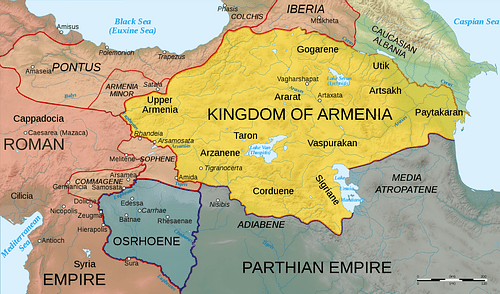
Map of Armenia, 50 CE

(Source)

Regarding conflicts within the Roman Empire in the decades following Jesus’ ascension, the Roman historian Tacitus had this to say,

“The history on which I am entering is that of a period rich in disasters, terrible with battles, torn by civil struggles, horrible even in peace. Four emperors fell by the sword; there were three civil wars, more foreign wars, and often both at the same time” (The Histories, 1:2).

As just one example, the Roman-Jewish War took place over a 6-7 year period, in which an incredible amount of blood was shed throughout Judea and Galilee, and women even ate their babies out of desperation. When Nero committed suicide in June 68 AD, even the Roman Empire nearly collapsed in on itself due to jostling for power and what Josephus called “civil wars of horrible ferocity and dramatic proportions.” Rome went through four emperors within one year, and Josephus remarked that “every part of the habitable earth under them [the Romans] was in an unsettled and tottering condition” (Wars 7.4.2).

In the fall/winter of 67 AD a brutal civil war also broke out in Jerusalem and Judea between the revolutionaries and those who wanted to maintain peace with Rome. Jerusalem was eventually divided into three factions led by [1] Eleazar, who was over the Zealots [2] John of Gischala, who was over the Galileans, and [3] Simon, who was over the Idumeans. It remained this way until the city was destroyed in September 70 AD. In one night 8500 people were killed, and their bodies were cast outside of Jerusalem without being buried. The outer temple was “overflowing with blood,” according to Josephus, and the inner court even had pools of blood in it.

Matt. 24:7b-8/Mark 13:8b/Luke 21:11 – Jesus next predicts famines and earthquakes. Once again, Luke adds other details: pestilences and “fearful events and great signs from heaven.”
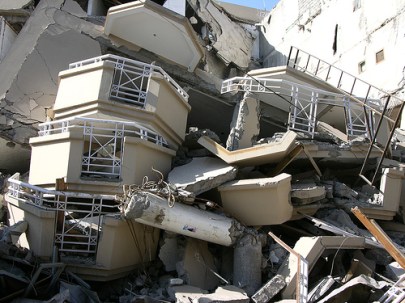
   New Zealand

Haiti

 Japan

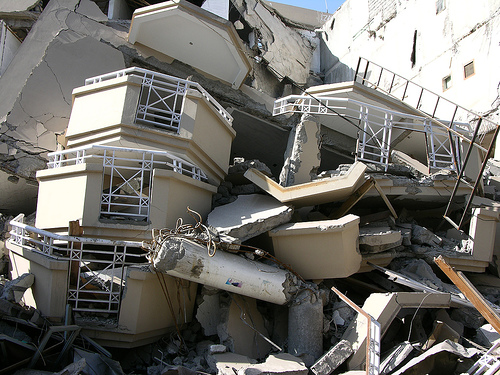
Was Jesus predicting the recent earthquakes we’ve seen in Pakistan, New Zealand, Haiti, and Japan, and others yet to come? Many prophecy teachers today would have us believe that He did. George Peter Holford (in 1805) also referred to a number of great earthquakes which took place during the generation to which Jesus and His disciples belonged.

In one instance in early 68 AD a terrible earthquake was accompanied by terrifying storms and violent winds, prompting Josephus to say, “These things were a manifest indication that some destruction was coming upon men, when the system of the world was put into this disorder; and any one would guess that these wonders foreshowed some grand calamities that were coming” (Wars 4.4.5). Seneca the Younger, a Roman philosopher, wrote the following in 58 AD:

“How often have cities of Asia and Achaea fallen with one fatal shock! Show many cities have been swallowed up in Syria, how many in Macedonia! How often has Cyprus been wasted by this calamity! How often has Paphos become a ruin! News has often been brought us of the demolition of whole cities at once.”

Henry Alford, The New Testament for English Readers (Chicago, IL: Moody Press, n.d.), 163.

Large earthquakes took place in Crete, Smyrna, Miletus, Chios, Samos, Laodicea, Hierapolis, Colosse, Campania, Rome, Judea and Pompei (February 5, 63 AD). Other earthquakes are recorded in Scripture in Matthew 27:51-54, Matthew 28:2, and Acts 16:26.

Holford then notes that the great famine predicted by Agabus in Acts 11:27-30 began in the fourth year of the reign of Claudius (i.e. 45 AD) and “was of long continuance. It extended through Greece, and even into Italy, but was felt most severely in Judea and especially at Jerusalem, where many perished for want of bread.” This famine was recorded by Eusebius, Orosius, and Josephus, who related that “an assaron [about 3.5 pints] of corn was sold for five drachmae” (in the heyday of ancient Greece in the 4th century BC one drachmae was the daily wage for a skilled worker). Regarding Christ’s predictions of pestilences, Holford writes:

History…particularly distinguishes two instances of this calamity, which occurred before the commencement of the Jewish war. The first took place at Babylon about A. D. 40, and raged so alarmingly, that great multitudes of Jews fled from that city to Seleucia for safety, as hath been hinted already. The other happened at Rome A.D. 65, and carried off prodigious multitudes. Both Tacitus and Suetonius also record, that similar calamities prevailed, during this period, in various parts of the Roman Empire. After Jerusalem was surrounded by the army of Titus, pestilential diseases soon made their appearance there to aggravate the miseries, and deepen the horrors of the siege. They were partly occasioned by the immense multitudes which were crowded together in the city, partly by the putrid effluvia which arose from the unburied dead, and partly from spread of famine.

These calamities, along with mothers eating their own children, are reminiscent of what God said would happen to Israel if that nation became faithless and rebellious (e.g. Leviticus 26:25-29, Deuteronomy 28:58-62, Deut. 32). It was also said that they would be punished sevenfold, so it’s of great interest that “Babylon the great” (Revelation 17:5), also called “the great city” (Rev. 17:18), was to be the recipient of seven seal, trumpet, and bowl judgments. The “great city” in the book of Revelation was first identified as the place where Jesus was crucified (Rev. 11:8), i.e. Jerusalem. “Babylon the great” was responsible for the blood of the saints, prophets, and apostles (Rev. 16:4-7, 17:6, 18:20, 18:24), the same thing for which Jesus said the religious leaders of Israel in His own generation were responsible for (Matthew 23:29-36).

Interestingly, for those who believe that famines are increasing on our planet today, a recent report reveals that the opposite is true. The Huffington Post reports that, according to the 2015 Global Hunger Index, “calamitous famines that cause more than 1 million deaths” have been completely eliminated. Additionally, there has been a “reduction ‘almost to a vanishing point’ of great famines, which cause more than 100,000 deaths.” Around 27 million died of famine between 1900 – 1909; more than 14 million died of famine during the 1940s, 1950s, and 1960s; about 1.4 million died of famine in the 1990s; only about 600,000 died of famine between 2000 – 2015 (that’s still too many, but deaths from famine are mercifully becoming more rare).

Jesus also predicted that there would be “terrors and great signs from heaven” (Luke 21:11). In this regard, Holford pointed to a number of strange accounts recorded by Josephus:

[1] “A meteor, resembling a sword, hung over Jerusalem during one whole year.” This could not be a comet, for it was stationary, and was visible for twelve successive months.

[2] “On the eighth of the month of Zanthicus, (before the feast of unleavened bread) at the ninth hour of the night [3 AM], there shone round about the altar, and the circumjacent buildings of the temple, a light equal to the brightness of the day, which continued for the space of half an hour.” [Does this recall Zech. 14:7?]

[3] “As the High Priest was leading a heifer to the altar to be sacrificed, she brought forth a lamb, in the midst of the temple.” …[Some] may think that they discern in this prodigy a miraculous rebuke of Jewish infidelity and impiety, for rejecting the ANTITYPICAL Lamb, who had offered Up Himself as an atonement, “once for all,” and who, by thus completely fulfilling their design, had virtually abrogated the Levitical sacrifices… It did not occur in an obscure part of the city, but in the temple ; not at an ordinary time, but at the passover, the season of our LORD’S crucifixion in the presence…of the High Priests and their attendants, and when they were leading the sacrifice to the altar.

[4] “About the sixth hour of the night, the eastern gate of the temple was seen to open without human assistance.” When the guards informed the Curator of this event, he sent men to assist them in shutting it, who with great difficulty succeeded. — This gate, as hath been observed already, ‘Was of solid brass, and required twenty men to close it every evening. It could not have been opened by a “strong gust of wind,” or a slight earthquake;” for Josephus says, it was secured by iron bolts And bars, which were let down into a large threshold; consisting of one entire stone.”

[5] “Soon after the feast of the Passover, in various parts of the country, before the setting of the sun, chariots and armed men were seen in the air, passing round about Jerusalem.”

Except for the first omen above, says Holford, all the others were placed by Josephus during the final year leading up to the Jewish War (67-73 AD). Some of these accounts were also recorded by the Roman historian Tacitus.

Matt. 24:9-13/Mark 13:9-13/Luke 21:12-19 – Here Jesus tells His followers that they will experience persecution, arrests, death, and betrayal even by family members because of their faith in Him. Many would turn away from the faith, but those who would stand firm until the end would be saved. Matthew alone adds that wickedness would increase and that most would grow cold in their love. Mark and Luke speak of Christ’s followers needing to testify before kings and governors, at which time they were to depend on the Holy Spirit to give them the words to say.

On the early believers being brought before kings and governors, Albert Barnes remarked in 1834, “This prediction was completely and abundantly fulfilled, Acts 5:26Acts 12:1-4Acts 23:33Acts 26:1Acts 26:28Acts 26:30. Peter is said to have been brought before Nero, and John before Domitian, Roman emperors; and others before Parthian, Scythian, and Indian kings.” John Gill, in 1746, added: “Meaning Roman governors; so Paul was had before Gallio, Felix, and Festas; … and kings for my sake; as Herod, Agrippa, Nero, Domitian, and others, before whom one or other of the apostles were brought; not as thieves, or murderers, or traitors, and seditious persons, or for having done any wrong or injury to any man’s person or property; but purely for the sake of Christ.”

Mark and Luke also both speak of Jesus’ followers being handed over to the synagogues, and Mark adds that they would be flogged there. This clearly speaks of persecution at the hands of the Jews, just one strong indication that this was to take place in the first century. Jewish persecution is not a mark of our time, but it was a mark of that time (In fact, it only prevailed up until Israel’s destruction in 70 AD, for after that the surviving Jews were persecuted together with the Christians by the Roman Empire). For example, Paul said this to the Thessalonian believers (I Thess. 2:14-16):

For you, brothers, became imitators of the churches of God in Christ Jesus that are in Judea. For you suffered the same things from your own countrymen as they did from the Jews, who killed both the Lord Jesus and the prophets, and drove us out, and displease God and oppose all mankind by hindering us from speaking to the Gentiles that they might be saved – so as always to fill up the measure of their sins. But God’s wrath has come upon them at last!”

The city of Smyrna had the largest Jewish population of any Asian city, and Jesus commended the church there for their patient endurance in the face of Jewish persecution (Revelation 2:9): “I know your tribulation and your poverty (but you are rich) and the slander of those who say that they are Jews and are not, but are a synagogue of Satan.” A very similar statement was made to the church in Philadelphia in Rev. 3:9.

Concerning the love of many growing cold, even as we see in Acts and the epistles evidence that the gospel was greatly advanced, we also learn of a falling away taking place at the same time. The church in Ephesus had abandoned the love they had at first (Revelation 2:4), the church in Laodicea had become lukewarm and was in a miserable state (Rev. 3:15-17). The church in Galatia had turned aside to a different gospel (Galatians 1:6-7).

Matt. 24:14/Mark 13:10 – Luke doesn’t mention this, but both Matthew and Mark state that the end wouldn’t come until the gospel was preached to “all nations” (Mark) and “in the whole world” (Matthew). “The end,” of course, was “the end of the age” spoken of in Matthew 24:3.

Here is where many might object that Matthew 24:14 couldn’t have possibly been fulfilled before 70 AD. However, we can’t overlook the testimonies of Scripture itself:

[1] “Now there were dwelling in Jerusalem Jews, devout men from every nation under heaven… And they were amazed and astonished, saying… ‘we hear them telling in our own tongues the mighty works of God’” (Acts 2:5-11).

[2] “First, I thank my God through Jesus Christ for all of you, because your faith is proclaimed in all the world” (Romans 1:8).

[3] “Now to Him who is able to strengthen you according to my gospel and the preaching of Jesus Christ, according to the revelation of the mystery that was kept secret for long ages but has now been disclosed and through the prophetic writings has been made known to all nations…” (Romans 16:25-26).

[4] “…the word of the truth, the gospel, which has come to you, as indeed in the whole world it is bearing fruit and growing… (Colossians 1:5-6).

[5] “…if indeed you continue in the faith, stable and steadfast, not shifting from the hope of the gospel that you heard, which has been proclaimed in all creation under heaven, and of which I, Paul, became a minister (Colossians 1:23).

Do these statements not indicate that Matthew 24:14 had already been fulfilled by the time they were written? The phrase “the whole world” here then must mean what it meant in Luke 2:1 when we are told that “the entire world” was registered in the days of Caesar Augustus, i.e. the known world or the Roman Empire (cf. Acts 24:5). Eusebius (263-339), the early church father, said this when commenting on Matthew 24:

Thus, under the influence of heavenly power, and with the divine co-operation, the doctrine of the Saviour, like the rays of the sun, quickly illumined the whole world; [1] and straightway, in accordance with the divine Scriptures, [2] the voice of the inspired evangelists and apostles went forth through all the earth, and their words to the end of the world;  the Apostles preached the Gospel in all the world, and some of them passed beyond the bounds of the ocean, and visited the Britannic isles.

Bishop Newton of Brazil (ordained in 1949) says of the spread of the gospel:

It appears from the writers of the history of the church, that before the destruction of Jerusalem the Gospel was not only preached in the Lesser Asia, and Greece, and Italy, the great theatres of action then in the world, but was likewise propagated as fax northward as Scythia, as far southward as Ethiopia, as far eastward as Parthia and India, as far westward as Spain and Britain.

John Wesley believed Jesus didn’t mean in this verse that the gospel would be preached in all the world “universally” before the end came. He said, “[T]his is not done yet: but in general through the several parts of the world, and not only in Judea [this happened]. And this was done by St. Paul and the other apostles, before Jerusalem was destroyed. And then shall the end come—of the city and temple.” Today we don’t need to be motivated by an impending time of judgment, and certainly not a desire “to be raptured out of here,” in order to preach the gospel. Just as the early church succeeded in spreading the gospel throughout their known world, we should be about the business of doing the same. Paul’s motivation can be ours:

“I make it my ambition to preach the gospel, not where Christ has already been named, lest I build on someone else’s foundation, but as it is written, ‘Those who have never been told of Him will see, and those who have never heard will understand’” (Romans 15:20-21).

In the next post (Part 3), one of the things we will look at is what Jesus said about the abomination of desolation, and the surrounding of Jerusalem by foreign armies, and how the early believers did flee as Jesus told them to when they saw those things.

Quotes to Note

F.W. Farrar (1831-1903): “The Fall of Jerusalem and all the events which accompanied and followed it in the Roman world and in the Christian world, had a significance which it is hardly possible to overestimate. They were the final end of the Old Dispensation. They were the full inauguration of the New Covenant. They were God’s own overwhelming judgment on that form of Judaic Christianity which threatened to crush the work of St. Paul, to lay on the Gentiles the yoke of abrogated Mosaism, to establish itself by threats and anathemas as the only orthodoxy… No event less awful than the desolation of Judea, the destruction of Judaism, the annihilation of all possibility of observing the precepts of Moses, could have opened the eyes of the Judaisers from their dream of imagined infallibility. Nothing but God’s own unmistakable interposition – nothing but the manifest coming of Christ – could have persuaded Jewish Christians that the Law of the Wilderness was annulled” (The Early Days of Christianity, 1882, pp. 489-490).

R.C. Sproul (1997-98): “The coming of Christ in A.D.70 was a coming in judgment on the Jewish nation, indicating the end of the Jewish age and the fulfillment of a day of the Lord. Jesus really did come in judgment at this time, fulfilling his prophecy in the Olivet Discourse” (The Last Days According to Jesus, p. 158, 1998). “The most significant, redemptive, historical action that takes place outside the New Testament, is the judgment that falls on Jerusalem, and by which judgment the Christian Church now [clearly] emerges as The Body of Christ” (R.C. Sproul, Dust to Glory video series, 1997).

The Olivet Discourse: “This” Generation or “That” Generation (Part 1 of 4)


Much attention is being given these days to what is known as The Olivet Discourse, found in three of the four gospel accounts: Matthew 24, Mark 13, and Luke 21. Jesus delivered this famous address from the Mount of Olives just days before His crucifixion. Many today are linking this narrative to current events, such as recent large earthquakes and tsunamis in Japan, Haiti, New Zealand, and Indonesia. They believe these are sure signs pointing to the end of the world.


         SOURCE                                              SOURCE                                                       SOURCE

Is this how Jesus intended for us to view this prophecy? When He said, “This generation will certainly not pass away until all these things take place” (Matt. 24:34, Mark 13:30, Luke 21:32), was He speaking of a generation 2000 years into the future? Or was He speaking of His own generation, and events which were to take place in their time? When He said “this generation,” did He really mean “that generation” (one that was distant to His first century audience)? This is what we will be looking at in the four posts which will make up this series. We will examine all three accounts of this prophecy side-by-side, as I believe this will be helpful in seeing what Jesus was saying and how He intended to be understood.

In this first post, we will take a close look at the initial remarks made by Jesus’ disciples, His shocking response, and their resulting question(s) which led to His discourse. Here is that text, from the accounts of Matthew, Mark, and Luke.

MATTHEW 24:1-3

MARK 13:1-4

LUKE 21:5-7

1 Jesus left the temple and was walking away when his disciples came up to him to call his attention to its buildings. 2 “Do you see all these things?” he asked. “Truly I tell you, not one stone here will be left on another; every one will be thrown down.”3 As Jesus was sitting on the Mount of Olives, the disciples came to him privately. “Tell us,” they said, “when will this happen, and what will be the sign of your coming and of the end of the age?  1As Jesus was leaving the temple, one of his disciples said to him, “Look, Teacher! What massive stones! What magnificent buildings!”2 “Do you see all these great buildings?” replied Jesus. “Not one stone here will be left on another; every one will be thrown down.”3 As Jesus was sitting on the Mount of Olives opposite the temple, Peter, James, John and Andrew asked him privately, 4 “Tell us, when will these things happen, and what will be the sign that they are all about to be fulfilled?

5 Some of his disciples were remarking about how the temple was adorned with beautiful stones and with gifts dedicated to God. But Jesus said, 6 “As for what you see here, the time will come when not one stone will be left on another; every one of them will be thrown down.”

 7 “Teacher,” they asked, “when will these things happen, and what will be the sign that they are about to take place?

In all three accounts we see one or more of the disciples admiring the beautiful, massive stones which made up the Second Temple. According to some Jews who encountered Jesus early in His ministry (John 2:18-22), Herod’s massive expansion project had already been going on for 46 years. Indeed, history tells us that it began in 19 BC, and that the renovations continued until 65 AD, a mere five years before the temple was destroyed by the Romans. Tacitus (56-117 AD), the Roman historian and Senator, said that the temple “was famous beyond all other works of men.”

Jesus’ response to His disciples’ remarks must have been shocking, in light of the breathtaking sight before their eyes: “Not one stone here will be left on another; every one will be thrown down.” Of course, Jesus had said this before. His ominous prophecy, though, is what prompts their next question. Or is it questions (plural)? There is only one specific question asked in all three accounts. In the accounts of Mark and Luke, at least, there should be no doubt that it’s this question which Jesus spends the next 25 or 26 verses answering: “…when will these things happen, and what will be the sign that they are about to be fulfilled?” The only thing Jesus had said would happen at this point was that all the temple’s stones would be thrown down.

Model of the Second Temple; Source: http://en.wikipedia.org/wiki/File:Jerus-n4i.jpg

Do we know from history that this temple, the same temple the disciples observed, was destroyed? Yes, we do. Josephus, the Jewish historian, for example, records in astounding detail how Jerusalem and the temple were destroyed in 70 AD after a horrendous 5-month siege (see here, here, and here to learn more about what happened). According to both Mark and Luke, the signs that Jesus gave in the next 25 verses (in Luke’s case) and the next 26 verses (in Mark’s case) were to precede the downfall of the temple. In the next couple of posts, we will look at those prophesied signs, which include earthquakes and other calamities. Many today are saying that these same prophesied signs are happening in our own day, and that this means we are only now about to see Jesus’ prophecies fulfilled. How can this be, though, if they were to happen before a prophesied event which we know took place 1,941 years ago?

Only in Matthew’s account do the disciples perhaps appear to ask two additional questions: [1] about Jesus’ coming and [2] about “the end of the age.” For those who believe that Matthew 24 has yet to be fulfilled, it’s often these questions which are said to indicate a required future fulfillment, despite the fact that they don’t even appear in Mark’s and Luke’s parallel accounts. It’s common these days to see a division of questions, as if the disciples asked about the near future as well as the very distant future, but as this study continues we’ll see that it wasn’t so common in earlier church history. Thomas Newton, a well-known English cleric, scholar, and author, said the following in 1754 about this passage:

‘The coming of Christ,’ and ‘the conclusion of the age,’ being therefore only different expressions to denote the same period with the destruction of Jerusalem, the purpose of the question plainly is, when shall the destruction of Jerusalem be, and what shall be the signs of it?

Background to Jesus’ Promised Coming: Matthew 10:23 and 16:27-28

What prompted the disciples to ask about Jesus’ coming, especially in the context of what He said about the temple’s impending destruction? Where had Jesus previously spoken of His coming, and what had He said about this event? Jesus had in fact spoken of His coming twice already in Matthew’s account. In Matthew 10:23, Jesus made this very interesting statement: “When they persecute you in one town, flee to the next, for truly, I say to you, you will not have gone through all the towns of Israel before the Son of Man comes.”[i] During the next couple of decades after Jesus said this, we can see numerous examples of Jesus and His followers doing this very thing (e.g. Matthew 12:14-15, Acts 8:1, Acts 9:23-25, Acts 9:29-30, Acts 14:5-6, Acts 17:4-10, Acts 17:13-14).

In Matthew 16:27-28, He was even more descriptive about what His coming would accomplish, and within what timeframe it would take place: “For the Son of Man is going to come with His angels in the glory of His Father, and then He will repay each person for what he has done. Truly, I say to you, there are some standing here who will not taste death until they see the Son of Man coming in His kingdom.”

If this statement was fulfilled in His transfiguration six days later, as some contend, in what sense did Jesus “come with His angels” then and repay each person according to what he had done (a clear picture of judgment)? We know this didn’t happen on that occasion. We also know that none of His disciples died within those six days, but some were indeed martyred before 70 AD when Jerusalem and the temple were destroyed. To believe that Jesus hasn’t yet (in the year 2011) come back as He promised in this passage is to believe either that [a] He lied or [b] there are 2000 year old men still walking around on this planet.[ii] Let’s look at four aspects of this promised coming, as this should help us to know what was in the minds of Jesus’ disciples when they asked Him about His coming in Matthew 24:3.

1. IN HIS KINGDOM: From this text, we know that one purpose for His coming, which He promised would take place before all of His disciples had died, was to establish His kingdom. This fits perfectly with the following prophecy given to Daniel: “And in the days of those kings* the God of heaven will set up a kingdom that shall never be destroyed, nor shall the kingdom be left to another people” (Daniel 2:44). [*Biblical scholars hold a virtual consensus that the four kingdoms in Daniel’s vision were Babylon, Medo-Persia, Greece, and Rome. Since Rome was destroyed in 476 AD, we know that, for this prophecy to be true, the kingdom was set up before that time.] A first century fulfillment fits; a 21st century fulfillment doesn’t. Furthermore, the kingdom was to be given to the saints (Daniel 7:18, 22, 27). This is reminiscent of Jesus’ words in the Parable of the Tenants that the kingdom of God would soon be taken away from the Jewish leaders and their nation and given instead “to a people producing its fruits” (Matthew 21:43) – a clear description of the body of Christ. This was to happen even as the stone was to crush those who would fall (verse 44) – 1.1 million Jews killed in August/September 70 AD by the Romans would seem to qualify as a fulfillment of this prediction.

2. TO REPAY EACH PERSON: The context of Jesus’ promise to come “to repay each person” for what they had done was His foretelling of His own death and suffering at the hands of the Jewish leaders (Matt. 16:21-23), and also of the suffering that His own disciples could expect (verses 24-26). In other words, it would be for vindication. This is similar in nature to what Paul promised to the Thessalonian believers when he told them that they could expect relief “when the Lord Jesus is revealed from heaven with His mighty angels in flaming fire, inflicting vengeance” (II Thessalonians 1:7), with the purpose being “to repay with affliction those who afflict you” (verse 6). This was imminent in their day, for Paul said that the wrath of God had already come upon the Jewish persecutors (I Thess. 2:14-16). He knew this to be true because Jesus had declared in no uncertain terms (Matthew 23:35-36) that the blood of all the prophets would be required of His own (first century) generation in Israel.

3. WITH HIS ANGELS: Just like Paul’s prophecy to the Thessalonians, Jesus’ promise to come while some of His disciples were still alive (Matt. 16:28) was also to involve His angels (“The Son of Man is going to come with His angels…”). As my good friend, Mark Church, has pointed out, all throughout the book of Revelation we see His angels pouring out judgment upon “the great city” where the Lord was crucified (Revelation 11:8) – that is, Jerusalem, the same city which was marked as a harlot because of its shedding of the blood of the saints and martyrs (Rev. 17:1-6), apostles, and prophets (Rev. 18:20-24). [For those who believe that Revelation remains unfulfilled, is there any modern nation or entity which is responsible for the martyrdom of the apostles?]

4. IN THE GLORY OF HIS FATHER: Jesus also promised to come “in the glory of His Father” (Matt. 16:27). As Don Preston well points out, this can be understood to mean that just as the Father had come in the past, Jesus would also come in the same manner. Don gives as an example Isaiah 64:1-3, where the writer declares that God had “come down” numerous times in the past:

“Oh, that You would rend the heavens and come down, that the mountains might quake at Your presence – as when fire kindles brushwood, and the fire causes water to boil – to make Your name known to Your adversaries, and that the nations might tremble at Your presence! When You did awesome things that we did not look for, You came down, the mountains quaked at Your presence.”

Just as the Father’s comings in times past had not been bodily, visible, or physical in nature, neither would the coming of Jesus in judgment be bodily, visible, or physical. We will discuss this in more depth when we come to Jesus’ predicted coming in the clouds in Matt. 24:30/Mark 13:26/Luke 21:27. We will see that there are numerous examples in the Old Testament where God is said to have come in the clouds in judgment upon various nations and enemies of His people, even examples where the language is remarkably similar to the language used in The Olivet Discourse.

So we can see from these two passages (Matt. 10:23 and 16:27-28) why Jesus’ disciples expected Him to come again in their own lifetimes. We’re also beginning to see why, in Matthew 24:3, they linked this coming to His dark prediction about the temple’s future. Other strong clues also exist in the previous two chapters (Matthew 22-23).[iii] Kevin Daly, from the South African ministry “Messianic Good News,” has this to say:

It is Jesus’ confirmation that the Temple’s fate is sealed that leads to the disciples’ question: ‘When will this happen, and what will be the sign of your coming and of the end of the age?’

Some argue this to be three separate questions – so that Jesus’ answer in the subsequent verses must be unraveled and applied to three different events, namely (i) the temple’s destruction, (ii) his coming and (iii) the end of the age. But this is not supported by the parallel accounts in Mark’s and Luke’s gospels. These render the disciples’ question as follows:

‘Tell us, when will these things happen? And what will be the sign that they are all about to be fulfilled?’ (Mark 13:4)

‘Teacher,’ they asked, ‘when will these things happen? And what will be the sign that they are about to take place?’ (Luke 21:7)

In Matthew’s wording of the disciples’ question, what Jesus prophesied against the Temple would, by implication, happen at our Lord’s coming in judgment and would also, by further implication, bring about the end of that age.

Matthew phrases the question in the prophetic language of the Old Testament, which was familiar to the Jewish audience for which his gospel was written. In this language, the execution of Divine judgment was commonly spoken of as a visitation of the LORD, as either His coming or His coming in the cloud. [Consider] Micah’s prophecy against the ‘high places’ of Judah – being localities of false worship, which the Temple in Jerusalem had now become:

‘For behold, the LORD comes forth from His place, and will come down, and tread upon the high places of the earth. And the mountains shall be melted under Him, and the valleys shall be cleft, as wax before the fire, and as the waters that are poured down a steep place. For the transgression of Jacob is all this, and for the sins of the house of Israel  …  What are the high places of Judah? Are they not Jerusalem?’ (Micah 1:3-5).

Source: Kevin Daly, When Will These Things Happen – Matthew 24 and the Vindication of Messiah. 2009.

Micah’s prophecy was fulfilled in 586 BC when Jerusalem fell to the Babylonian armies. We know that God didn’t physically and bodily come down at that time, but He did still “come down” in judgment in fulfillment of this prophecy. It’s this same apocalyptic language that Matthew uses to speak of another and more final judgment which was about to come once again upon Jerusalem. History tells us that it did come. Some readers may be surprised to know that Jonathan Edwards (1703-1758), who preached the famous sermon “Sinners in the Hands of An Angry God,” once made this statement in his work titled “Miscellany #1199”:

“Tis evident that when Christ speaks of his coming; his being revealed; his coming in his Kingdom; or his Kingdom’s coming; He has respect to his appearing in those great works of his Power Justice and Grace, which should be in the Destruction of Jerusalem and other extraordinary Providences which should attend it [So in Luke 17:20 – 18:8].”

The way that the Olivet Discourse is popularly approached today has Jesus effectively saying this to His disciples: “You guys have asked a very interesting question about when this temple will be destroyed, but let Me ignore your question and tell you instead about some events which will begin and end about 2000 years in the future.” Rather than being about us, and our generation, Jesus addressed the concerns of His disciples regarding their own generation.

THE END OF THE AGE

Having now given considerable space to the question of Christ’s coming, we’ll give only brief space here to the disciples’ question about the end of the age. The King James Version used the expression “the end of the world” in Matthew 24:3, but most newer translations use the expression “the end of the age.” Clearly, Jesus tied the end of the age that they were speaking of to the time of His coming, which we have seen was promised to occur in their own generation.

Therefore, the disciples weren’t asking about the final days of this planet. Their question was about the end of the Old Covenant age. That age came to an end along with the destruction of the temple in 70 AD. This “end” was spoken of by Daniel and other Old Testament prophets. The book of Hebrews even speaks of the Old Covenant “becoming obsolete and growing old…ready to vanish away” (Hebrews 8:13). It vanished along with the temple. We are now in what the New Testament frequently called “the age to come.” A great transition took place a long time ago, and we are privileged to live in the New Covenant age. The heavenly Jerusalem is a present reality for God’s people (Hebrews 12:22-24). Regarding “the end” spoken of in both Matthew and Daniel, Kevin Daly provides this helpful chart:

you will hear of wars and rumours of wars … but the end is not yet

war will continue until the end

and there will be famines and pestilences and earthquakes in different places

and desolations have been decreed

 then the end will come

the end will come like a flood:

 Matthew 24:6,14

Dan 9:26b

“The end” spoken of in Daniel’s prophecy was clearly to be the destruction of “the city and the sanctuary” (Daniel 9:26). We know as an indisputable fact of history that Jerusalem and the temple were destroyed in 70 AD. That brought about the end of an age, the Old Covenant age. It is popularly taught today that we are living in what the Bible calls “the last days,” and that these last days began on the Day of Pentecost because of Peter’s reference to Joel’s prophecy about an outpouring in “the last days.” However, this cannot be true, because Hebrews 1:1-3, Hebrews 9:26, and I Peter 1:18-20 tell us explicitly that Jesus’ incarnational ministry took place in the last days. Therefore, Jesus appeared and ministered in the last days of an age that had clearly begun quite some time before He appeared. That age still had not ended when Paul wrote his epistle to the Corinthian church, but it was drawing even closer to the end, for he told his readers that they were those “on whom the end of the ages has come” (I Corinthians 10:11).

Rather than open this up further, or to try to defend this premise in greater depth here, I’d like to point to an earlier post on this subject which I believe you’ll find to be a good explanation of these things (HERE). You’ll see that the New Testament placed Jesus’ ministry, death, etc. in “the last days” and at “the end of the age,” and that after Jesus’ ascension the apostles still spoke of their time in the same terms. Jerry William Bowers Jr. has also compiled a very informative article, based on David Green’s 101 Time Statements showing that John the Baptist, Jesus, and the early church were not only consistent, but also correct, when they repeatedly stated that certain events were near, at hand, about to take place, etc. That article can be seen (HERE).

In the next post, we will look at the beginning of Jesus’ reply to the disciples’ question about the signs which would lead to the destruction of the temple, His coming, and the end of the age. We will examine Matthew 24:4-14, Mark 13:5-13, and Luke 21:8-18 side-by-side.

———————————————————————————————————————————-

A THOUGHT: Do you find it interesting that John, in his gospel account, omits the Olivet Discourse entirely, even though he was no doubt present when Jesus spoke these things? One likely reason for this curious fact is that the book of Revelation, which he authored, actually functions as his exposition of the Olivet Discourse, though in much greater detail. Therefore, he felt no need to include the Olivet Discourse passage in his gospel account, especially if the book of John was written after the book of Revelation.

QUOTES TO NOTE

Eusebius (314 AD): “If any one compares the words of our Saviour with the other accounts of the historian (Josephus) concerning the whole war, how can one fail to wonder, and to admit that the foreknowledge and the prophecy of our Saviour were truly divine and marvelously strange” (Proof of the GospelBook III, Ch. VII).

John Wesley (1703-1791): “Josephus’ History of the Jewish War is the best commentary on this chapter (Matt. 24). It is a wonderful instance of God’s providence, that he, an eyewitness, and one who lived and died a Jew, should, especially in so extraordinary a manner, be preserved, to transmit to us a collection of important facts, which so exactly illustrate this glorious prophecy, in almost every circumstance” (Explanatory Notes Upon the New Testament, 1754).

——————————————————————————————————————————————————————————————-


[i] John Wesley (1703-1791) is one of many in church history who taught that Jesus was referring in Matt. 10:23 to a judgment coming in 70 AD in which He would “destroy their temple and nation” (John Wesley, Explanatory Notes Upon the New Testament, 1754).

[ii] John Wesley, again, is one of many in church history who taught a 70 AD fulfillment of Matthew 16:27-28, saying, “For there is no way to escape the righteous judgment of God. And, as an emblem of this, there are some here who shall live to see the Messiah coming to set up His mediatorial kingdom with great power and glory, by the destruction of the temple, city, and polity of the Jews” (John Wesley, Explanatory Notes Upon the New Testament, 1754). Some believe this is also identical to the prophecy Jesus gave in Revelation 22:12, revealing why John’s 1st century audience was to understand that He was about to come: “Behold, I am coming soon, bringing My recompense with Me, to repay everyone for what he has done.”

[iii] In Matthew 22:1-14 we read the Parable of the Wedding Feast. In this parable, speaking of the kingdom of heaven (vs. 2), a king (God) was to prepare a wedding feast for his son (Jesus), but those who were originally invited (the Jewish nation) refused to come (vss. 3-5) and even killed the king’s servants who had invited them (v. 6). Therefore, these murderers were destroyed (cf. Matthew 23:29-38; Rev. 16:4-7, 17:6, 18:20, 18:24), and their city was burned (cf. Rev. 18:8-10, 18; 19:3). This is precisely what we see having happened in Jerusalem’s destruction and burning in 70 AD. The invitation then goes out to others (Gentiles as well as Jews; vss. 9-10), but only those with proper wedding garments were allowed to remain (vss. 10-14; cf. Rev. 19:8). Those who lacked these garments remained in outer darkness and were not part of the chosen people of God (vss. 13-14; cf. Matt. 8:11-12).

In Matthew 23:29-38, we see that in the 7th woe pronounced upon the Scribes and Pharisees, Jesus charges them with shedding the blood of all the prophets (vss. 29-31). He even says that they will kill, crucify, flog, and persecute others from town to town (verse 34). As a result, He says, they would be held responsible for all the shed blood from generations past up until their own generation. He concludes, “Truly, I say to you, all these things will come upon this generation” (verse 36). He then lifts up a lament for Jerusalem, whose house, He said, was left to them desolate. This would naturally remind His listeners of Daniel 9:26, where it was said that “the city and the sanctuary” would be destroyed, with desolations decreed. The expected timeframe for this judgment was “this generation” (Jesus’ first century audience).

No Alienation from the Commonwealth of Israel


(Thoughts on Ephesians 2:12)

Paul’s letter to the Ephesians is a remarkable book, one that is full of wonderful expressions of truth. In the first three chapters Paul lays out, in glorious fashion, the riches of the grace we have in Christ. His adoration for the gospel just keeps spilling out, and he even gets long-winded (in a good way) as he does so. Take a look at some of his gospel-saturated, lengthy sentences which span several verses at a time (e.g. 1:7-10, 1:15-21, 3:14-19). Some of the most magnificent portrayals of the New Covenant are found in this book.

With this in mind, it’s amazing to consider that today there is a popular teaching insisting that the New Covenant which Paul describes here in Ephesians and elsewhere is NOT the same New Covenant which was foreseen by the Old Testament prophets (e.g. Jeremiah 31:31-34, Ezekiel 36:26-27). This is despite the fact that the author of Hebrews quotes from Jeremiah’s prophecy and explicitly states (Hebrews 8:6-13) that this New Covenant had been established in his own time (i.e. in the first century AD). The “problem” seems to be that Jeremiah and Ezekiel addressed their prophecies to “the house of Israel.” Dispensationalism and Christian Zionism are notoriously unwilling to acknowledge that the Church IS spiritual Israel, and their proponents often have harsh words for those who believe this. Shortly we will see that Ephesians 2:12, being just one such example in the New Testament, does not allow their position to stand.

[Please bear with this brief explanation before we get back to looking at Ephesians. Prior to Progressive Dispensationalism taking root in western Christianity within the last few decades, Classic Dispensationalists like H.A. Ironside, Charles Ryrie, Dwight Pentecost, and John Walvoord claimed that the Old Testament never foresaw the coming of the Church age, and that God will one day bring an end to the Church age and resume His program with national/ethnic Israel. This was the teaching of John Nelson Darby, who founded this theological system in the 1830’s, and of C.I. Scofield, who published his famous reference Bible in 1909. These men and others also taught (or teach) that the New Covenant is reserved for a future millennium period! Consider the following statements regarding Jeremiah’s prophecy of a coming New Covenant:

[1] “This covenant must follow the return of Christ at the [yet future] second advent… This covenant will be realized in the [yet future] millennial age… the new covenant of Jeremiah 31:31-34 must and can be fulfilled only by the nation Israel and not by the Church” (Dwight Pentecost, Things to Come, 1958).

[2] “…the new covenant is with Israel and the fulfillment [will be] in the millennial kingdom after the second coming of Christ… the new covenant as revealed in the Old Testament concerns Israel and requires fulfillment in the millennium kingdom” (John F. Walvoord, The Millennial Kingdom, 1959).

[3] “The Church, then, is not under the new covenant…it is Israel which is God’s covenant people” (Harry Ironside, Notes on the Prophecy of and Lamentations of Jeremiah, 1906).

One proposed solution by more recent Progressive Dispensationalists is that there are two new covenants (!) in Scripture, one for the Church (now) and one for national/ethnic Israel (later). This belief seems to be true for those who would affirm that the Church presently lives in the New Covenant (and experiences the taking away of sin), but who also assert that Romans 11:26-27 (“And in this way all Israel will be saved…and this will be My covenant with them when I take away their sins”) will only be fulfilled in the future for ethnic Jews. This belief doesn’t stand up either, as we will see. For a much fuller treatment of the implications of this facet of Dispensationalist teaching, please see the first half of this post from our series on Revelation 20.]

Having expressed these thoughts, let’s now look at a very pivotal section in Ephesians 2, verses 11-22. I don’t want to take anything away from the very valuable things Paul expresses earlier in this chapter, and in fact verse 11 begins with “therefore,” meaning that what Paul says next is based on what he has just said earlier. So here’s a quick summary of the first half of the chapter: Paul reminds the believers in Ephesus that they were once dead in their sins (verses 1-3), but that God in His mercy and love had made them alive in Christ (verses 4-5). They are now seated with God in Christ in heavenly places (verses 6-7). It was not by any works of their own that they were saved, but only by grace through faith. Their salvation was a gift from God, and they were created anew for the purpose of walking in good works (verses 8-10). With this as context, here’s what Paul says in verses 11-22:

11Therefore remember that at one time you Gentiles in the flesh, called “the uncircumcision” by what is called the circumcision, which is made in the flesh by hands— 12remember that you were at that time separated from Christ, alienated from the commonwealth of Israel and strangers to the covenants of promise, having no hope and without God in the world. 13But now in Christ Jesus you who once werefar off have been brought near by the blood of Christ. 14For He himself is our peace, who has made us both one and has broken down in His flesh the dividing wall of hostility 15by abolishing the law of commandments expressed in ordinances, that He might create in himself one new man in place of the two, so making peace, 16and might reconcile us both to God in one body through the cross, thereby killing the hostility. 17And He came and preached peace to you who were far off and peace to those who were near. 18Forthrough Him we both have access in one Spirit to the Father. 19So then you are no longer strangers and aliens, but you are fellow citizens with the saints and members of the household of God20 built on the foundation of the apostles and prophets, Christ Jesus himself being the cornerstone, 21 in whom the whole structure, being joined together, grows into a holy temple in the Lord. 22In Him you also are being built together into a dwelling place for God by the Spirit.

It would certainly be profitable to break this passage down verse-by-verse, and there are so many rich truths here, but I’d like to mainly zero in on verse 12 which is highlighted above. First, we should note that Paul is specifically addressing Gentile believers (verse 11), that is, non-Jewish followers of Christ. One of his reminders to them is that they were once “alienated from the commonwealth of Israel.” By speaking this way, Paul clearly indicates that they are now part of “the commonwealth of Israel.”

There is simply no getting around the idea that Gentile (non-Jewish) believers are part of God’s people, Israel, here in Ephesians 2:12. And make no mistake about it, Jewish believers are part of this same covenant people of God, but no more so and no less so: “For there is no difference between Jew and Gentile—the same Lord is Lord of all and richly blesses all who call on Him” (Romans 10:12); “There is neither Jew nor Greek, there is neither slave nor free, there is no male and female, for you are all one in Christ Jesus” (Galatians 3:28). There are no spiritual blessings which are available for males but not for females, nor are there any spiritual blessings which are available for Jews but not for non-Jews. Does Scripture leave us any room to believe that a future age will come along and change this reality? No, it does not.

In Ephesians 2:12 Paul also reminds His believing Gentile audience that they were once “strangers to the covenants of promise.” Again, by speaking this way, Paul clearly indicates that they are now recipients ofthe covenants of promise” which were made to Israel. In the next chapter, Paul explicitly defines the mystery of Christ (which had been kept hidden in generations past) as the joining together of Jewish and non-Jewish believers in the partaking of the promise in Christ through the gospel: “This mystery is that the Gentiles are fellow heirs, members of the same body, and partakers of the promise in Christ Jesus through the gospel” (Eph. 3:6). In Galatians 3 Paul likewise declares that all the promises were made to Abraham and his offspring. He then defines Abraham’s “offspring,” contrary to what many might expect, as singularly Christ (Gal. 3:16). He finally adds that those who belong to Christ—with zero regard for ethnicity, gender, or status (Gal. 3:28)—are heirs of those promises (Gal. 3:29). So Paul says here in Ephesians 2 exactly what he also says in Galatians 3.

With these things established, can it be possible that any Old Testament covenants or promises are yet to be fulfilled for ethnic Jews only? Can Jeremiah 31:31-34 and Ezekiel 36:26-27 (which promised a coming New Covenant) be awaiting a fulfillment which Gentile believers will have no part in? No. Such an idea does great violence to all that Paul argues in Galatians, Ephesians, and elsewhere. Those who are still looking for such a covenant to arrive are about 2000 years too late, and far too narrow in their view of to whom this covenant belongs. The New Covenant is already here, and the heavenly Jerusalem is already a reality for God’s people (Hebrews 12:22-24).

I also highlighted Ephesians 2:19 because Paul refers to the Church as “the household of God,” very similar to the way he calls the Church “the household of faith” in Galatians 6:10. It would seem that these phrases are a New Testament equivalent to the oft-used expression in the Old Testament, “the household of Israel,” used by both Jeremiah and Ezekiel as we have seen. As mentioned near the beginning of this post, it seems that Dispensationalists and Christian Zionists tend to trip up over the Old Testament phrase, “the household of Israel,” because they are somehow convinced that the promises made to ancient Israel must only be fulfilled among their physical descendants.

However, we must let Scripture interpret Scripture. First, how often did Jesus and the apostles make the point that being able to physically trace one’s self to Abraham means nothing? Observe what Jesus said in John 8 to the Jews of His day who appealed to Abraham as their father, and observe whom Jesus said was their father instead. Observe what Paul says in Romans 9:6-8, “…For not all who are descended from Israel belong to Israel, and not all are children of Abraham because they are his offspring… This means that it is not the children of the flesh who are the children of God, but the children of the promise are counted as offspring.” Here Paul equates being a part of Israel with being a child of God. In this New Covenant age, then, can you be a child of God and not be a part of Israel? (Of course, I’m not referring to that nation in the Middle East which happens to bear this same name. By “Israel,” I mean God’s covenant people.) In Romans 2:28-29, Paul further says that “no one is a Jew who is merely one outwardly…a Jew is one inwardly, and circumcision is a matter of the heart…” In Galatians 6:15-16, Paul declares that only a new creation counts for anything, and then pronounces peace and mercy upon “the Israel of God.” If, despite the evidence above, you are one of the many who believe that Paul’s use of this phrase, “the Israel of God,” must refer only to Jewish believers, please examine this very well-written and informative article by Michael Marlowe.

Secondly, an honest appraisal of the New Testament will show that the inspired writers of the NT clearly apply many specific promises once made to ancient Israel to the Church, the body of Christ. Shall we rebuke them for promoting the allegedly false teachings of “replacement theology”? As we have seen above, the NT authors also declare that the Church is no longer alienated from ANY of the promises and covenants, because they are recipients of ALL of them. They are all found in Christ, but they are not to be found outside of Christ. Again, Jews are not left out, for a remnant from among them would call out to the Lord and be saved (they have done so throughout the last 2000 years). Paul makes this clear (see Romans 11:1-6, where he uses himself as an example).

Let’s look again at what Ephesians 2:12 says: “[R]emember that you were at that time separated from Christ, alienated from the commonwealth of Israel and strangers to the covenants of promise.” What is “the commonwealth of Israel”? What is it not? As we consider how we are not alienated from this entity, if we try to replace this phrase with “national Israel” or “ethnic Jews,” we’ll see that this doesn’t work. If you are a non-Jew (ethnically speaking), can you say that because of Christ you are now fully integrated into the political nation of Israel? Or can you say that you are very much a part of the worldwide ethnic Jewish community? No, but I believe you’ll find that this explanation given by Albert Barnes in 1834 makes sense:

Being aliens from the commonwealth of Israel – …This means more than that they were not Jews. It means that they were strangers to that ‘polity’ …or arrangement by which the worship of the true God had been kept up in the world, and of course were strangers to the true religion. The arrangements for the public worship of Yahweh were made among the Jews. They had his law, his temple, his sabbaths, and the ordinances of his religion; see the notes at Romans 3:2… The word rendered here as ‘commonwealth’ – πολιτεία politeia – means properly ‘citizenship,’ or ‘the right of citizenship,’ and then ‘a community,’ or ‘state.’ It means here ‘that arrangement or organization by which the worship of the true God was maintained.’”

Indeed, Paul says this of his own “kinsmen according to the flesh” (Romans 9:3),

They are Israelites, and to them belong the adoption, the glory, the covenants, the giving of the law, the worship, and the promises. To them belong the patriarchs, and from their race, according to the flesh, is the Christ who is God over all, blessed forever. Amen” (Romans 9:4-5).

Paul, who agonized over his own people so much that he could have wished himself “accursed and cut off from Christ” (verse 3) for their sake, yet affirms to the Gentile believers in Ephesus that they were present heirs of all the promises and covenants which were articulated to the commonwealth of Israel in times past. All alienation had ceased. It hasn’t resumed since then, it hasn’t resumed in our day, and it won’t resume in the future. It’s gone because of the work of the cross, and that alienation is gone forever. Please don’t let anyone tell you otherwise. If you are a follower of Christ, it doesn’t matter what your ethnic background is. You are a full-fledged member of the commonwealth of Israel, and all of God’s promises are yours through Jesus Christ.

Psalm 33:12 and God’s Chosen Nation


Psalm 33:12 and God’s Chosen Nation

by Adam Maarschalk (December 3, 2010)

Psalm 33:12 is a familiar verse to many people. In the United States, it’s often cited in patriotic sermons or at political events along with a declaration that the US is a Christian nation. This is how the verse reads (see here for its context):

Blessed is the nation whose God is the Lord, the people whom He has chosen as His heritage!”

When studying Scripture, it’s important to consider the original intent of the author—as he was inspired by the Holy Spirit—and who was in his original audience (a study method known as “exegesis”). It’s also good to then consider the meaning and application of a given text to one’s own life and time (known as “hermeneutics”). With this in mind, and given your overall knowledge of Scripture, which of these combinations do you believe to be correct for Psalm 33:12?

ORIGINAL AUDIENCE: PRESENTLY APPLIED TO:
Ancient Israel The modern-day nation of Israel and/or the Jewish people
Ancient Israel The nation of Israel, in the future
Ancient Israel The United States of America, at least ideally
Ancient Israel The Church, the body of Christ

I will assume that there is no disagreement regarding the original audience of this Psalm of David, but if there is please do feel free to express your understanding in the Comments section below. Were you surprised to see option #2 listed above? I was certainly surprised the other day when I saw that a fairly well-known pastor and author proposed this as the primary meaning of Psalm 33:12. This is what prompted me to write this post actually. This assertion was made by Pastor Happy Caldwell, founder of Agape Church, a mega church in Little Rock, Arkansas. Caldwell is also an Executive Board Member with Christians United for Israel (CUFI), the influential pro-Israel organization founded by John Hagee. Caldwell wrote the following in the November 23, 2010 CUFI Weekly Update:

The counsel of the Lord standeth forever, the thoughts of His heart to all generations. Blessed is the nation whose God is the Lord: And the people whom He hath chosen for His own inheritance”.

In this Scripture we see the “future” of the nation of Israel, God’s chosen people.  God calls those things that be not as though they were.  He speaks the end results from the beginning. (Job 42:12) (Ecclesiastes 7:8) (Isaiah 46:9, 10)

For I know the thoughts that I think toward you, saith the Lord, thoughts of peace, and not evil, to give you an expected end”.  (Jeremiah 29:11)

As we pray for Israel today, let us remember God’s covenant with Abraham, Isaac and Jacob.  Let us stand together with the Nation of Israel and thank God for the “expected end” . . . which is total peace, prosperity and victory.

The counsel of the Lord standeth forever, the thoughts of His heart to all generations.”

In other words, according to Caldwell, this passage (Psalm 33:11-12), which was written roughly 3000 years ago, is not presently being fulfilled, but it will be fulfilled one day for the geopolitical nation of Israel. To be fair, it’s not clear whether or not Caldwell believes this was once fulfilled in ancient Israel prior to the destruction of that nation in 70 AD. Caldwell also asserts that “God’s chosen people” is made up of the citizens of the nation of Israel (In his mind, does this include the Palestinians, since out of Israel’s population of about 7.6 million people nearly 2 million are non-Jewish?). It’s also clear that Caldwell makes a direct association between the modern nation of Israel and God’s covenant with Abraham, Isaac, and Jacob. We’ll discuss shortly why all these assertions are highly problematic.

The “biblecc” website is one I’ve found to be helpful in that it provides parallel commentaries for any given Scripture passage (as well as parallel translations). Their entry for Psalm 33:12 includes commentary from Albert Barnes (1834), Adam Clarke (1831), John Gill (1746-63), Charles Spurgeon – The Treasury of David (1869-85), the Geneva Study Bible, and Matthew Henry. The comments at the end of Albert Barnes’ entry are notable (emphasis added):

“And the people whom he hath chosen for his own inheritance – Chosen to be “His;” or, His portion. The primary reference here is undoubtedly to the Hebrew people, called his “inheritance:” Deuteronomy 4:20Deuteronomy 9:26Deuteronomy 32:9Psalm 74:2Psalm 78:62Psalm 78:71; or “heritage,” Psalm 94:5Jeremiah 12:7,Jeremiah 12:9; but what is here affirmed of that people is true also of all other people who worship the true God.”

Barnes points to nine Old Testament passages where the term “inheritance” or “heritage” is used as a reference to the ancient nation of Israel. Is he correct in saying that “what is here affirmed of that people is true also of all other people who worship the true God”? Does the New Testament bear this out?

It certainly does. God’s major announcement in Exodus 19 regarding His chosen people finds its New Testament equivalent in I Peter 2, and a comparison of these two passages is very revealing. The following is an excerpt from a post I wrote in September titled, “Who Are God’s Chosen People and Why Are They Chosen?”

God has only ever had one chosen people, and no one (regardless of race) is part of God’s chosen people if they are outside of Christ. God’s chosen people in Old Testament times were chosen for the same purpose as God’s chosen people at this time. Compare what was spoken by Moses to “the people of Israel” (Exodus 19:3) to what has been spoken to the Church through Peter. The parallel language is unmistakable, and I have letter-coded the parallels (A, B, and C):

[1] To ancient national Israel: “Now therefore, if you will indeed obey My voice and keep My covenant, you shall be [A]MY TREASURED POSSESSION among all peoples, for all the earth is mine; and you shall be to Me [B] A KINGDOM OF PRIESTS and a [C] HOLY NATION…” (Exodus 19:5-6).

[2] To the Church: “But you are a chosen race, [B] A ROYAL PRIESTHOOD, a [C] HOLY NATION, a people [A] FOR HIS OWN POSSESSION, that you may proclaim the excellencies of Him who called you out of darkness into His marvelous light. Once you were not a people, but now you are God’s people…” (I Peter 2:9-10).

Can there be any question that the Church is chosen for the same purpose that the nation of Israel was once chosen? …Israel has never ceased to exist. The body of Christ today IS Israel in every true sense (see, for example, Romans 9:6-8 and Galatians 6:16). Outside of Christ there is no Israel (as God’s people), despite the fact that a secular, political nation in the Middle East happens to bear that name today. Romans 9:6-8 is most profound on this point (parenthetical notes are mine): “…For not all who are descended from [natural] Israel belong to [spiritual] Israel, and not all are [spiritual] children of Abraham because they are his [physical] offspring…it is not the children of the flesh who are the children of God, but the children of the promise are counted as offspring.” See this article for an excellent explanation of Galatians 6:16’s use of the phrase “the Israel of God” to refer to the Church: http://www.bible-researcher.com/gal6-16.html. Furthermore, we who are in Christ are spiritual Jews, so to speak: “For no one is a Jew who is merely one outwardly, nor is circumcision outward and physical. But a Jew is one inwardly, and circumcision is a matter of the heart, by the Spirit, not by the letter…” (Romans 2:28-29; see also Philippians 3:3).

Galatians 3:16 further points out that all the promises were made to Abraham and his offspring, “referring to One, ‘And to your offspring,’ who is Christ.” In the same chapter, Paul says, “And if you are Christ’s, then you are Abraham’s offspring, heirs according to promise” (Gal. 3:29). Does Paul leave any room for those who are outside of Christ to be heirs of the promises? No, he doesn’t, not even for unbelieving Jews. Nor did Jesus (see, for example, John 8:31-47), nor does the New Testament in any place.

Today many teach that the Jews (meaning all ethnic Jews) are God’s chosen people. I believe this is classic false teaching. I Peter 2:9-10, already quoted here, makes it explicitly clear why God’s chosen people, the body of Christ (believing Jews and Gentiles), are chosen. His people have been called out of darkness and now have the privilege of proclaiming His excellencies to those who are still in darkness. Unbelieving Jews remain in darkness, and cannot possibly carry out any such calling. For those who teach that all ethnic Jews are God’s chosen people, the question remains: What are they (allegedly) chosen for at this present time?

It’s for these same reasons that America cannot qualify as God’s chosen heritage, the nation spoken of in Psalm 33:12. The majority of people in America remain in darkness, just like the majority of Jews, and they don’t know the excellencies of Christ’s salvation, let alone have the ability to proclaim them. This calling belongs exclusively to those who are in Christ. Why do we look elsewhere, whether to America or to the nation of Israel, to find some group to fulfill it? Likewise, for Happy Caldwell to speak of Psalm 33:12 as awaiting a future fulfillment for a geopolitical nation is for him to effectively deny that God has had a chosen people for the last 2000 years walking in holiness as His special possession and proclaiming the gospel to those walking in darkness.

CUFI ornament depicting Israeli and US flag

SOURCE

In another excerpt from the Sept. 2010 post on God’s chosen people, we saw a quick rundown on what the New Testament has to say about God’s chosen people and why they are chosen:

[1] “For many are called, but few are chosen” (Matthew 22:14; see verses 1-13 for context).

[2] “You did not choose Me, but I chose you and appointed you that you should go and bear fruit and that your fruit should abide, so that whatever you ask the Father in My name, He may give it to you” (John 15:16).

[3] “If you were of the world, the world would love you as its own; but because you are not of the world, but I chose you out of the world, therefore the world hates you” (John 15:19).

[4] “Blessed be the God and Father of our Lord Jesus Christ, who has blessed us in Christ with every spiritual blessing in the heavenly places, even as He chose us in Him before the foundation of the world, that we should be holy and blameless before Him…” (Ephesians 1:3-4; see also verses 5-14 for an even fuller description of what belongs to God’s chosen people).

[5] See also Ephesians 2:11-22 [The word “chosen” is not used, but this passage speaks of God bringing those who were far off (Gentiles) “near by the blood of Christ,” creating “one new man”, “one body,” and breaking down the wall of hostility that separated them (us) from the “the commonwealth of Israel” and “the covenants of promise.”]

[6] “Here there is not Greek and Jew, circumcised and uncircumcised, barbarian, Scythian, slave, free; but Christ is all, and in all. Put on then, as God’s chosen ones, holy and beloved, compassion, kindness, humility, meekness, and patience…” (Colossians 3:11-12).

[7] “As you come to Him, a living stone rejected by men but in the sight of God chosen and precious, you yourselves like living stones are being built up as a spiritual house, to be a holy priesthood, to offer spiritual sacrifices acceptable to God through Jesus Christ… But you are a chosen race, a royal priesthood, a holy nation, a people for His own possession, that you may proclaim the excellencies of Him who called you out of darkness into His marvelous light. Once you were not a people, but now you are God’s people; once you had not received mercy, but now you have received mercy” (I Peter 2:4-10).

Clearly God’s chosen people, according to these passages, are strictly those who belong to Christ. It’s all about bearing spiritual fruit, not being of this world, having every single spiritual blessing, being holy and blameless, being God’s own special possession, proclaiming His excellencies to those who are in darkness, receiving mercy, etc.

Again, these things aren’t true and can’t be true for unbelieving Jews, unbelieving Americans, unbelievers in any location, or for any geopolitical nation as a whole. Yet they are true for the Church. For those who are in Christ, let us rejoice that we are blessed to be part of that nation whose God is the Lord, and the people whom He has chosen as His heritage.

————————————————————————————————————————————————————————————-

All posts on the subject of Christian Zionism can be found here.