Matthew 24: Double Fulfillment Is Not Possible


In a previous post, I shared J. Stuart Russell’s argument against the idea of a dual fulfillment in the Olivet Discourse (Matthew 24-25, Mark 13, and Luke 21). Russell argued (well, in my opinion) that neither in Jesus’ own words, nor in the words of any other New Testament author, does any teaching appear which supports “a twofold reference in the predictions of Jesus concerning the end.”

An article written in 2004 by Michael Fenemore goes into even more detail on why the idea of dual fulfillment does not work when it comes to Jesus’ famous words in Matthew 24:

Some prophecy teachers, while acknowledging a fulfillment of Matthew 24 in the first century, predict a future second fulfillment, but this time, with worldwide implications… We might wonder whether those who promote the double-fulfillment theory ever took the time to test it by reading over the text even once. How could this be fulfilled twice?

This gospel of the kingdom shall be preached in the whole world as a testimony to all the nations, and then the end will come (v. 14, NASB throughout unless otherwise noted).

Will the “great commission” be fulfilled twice? Does “the end” come twice? If it does, then, the first one wasn’t the end.

A modern second fulfillment is usually presented as a worldwide catastrophe, but notice verse 20: “…pray that your flight will not be in the winter, or on a Sabbath.” What relevance would this have today? Outside modern-day Israel, relatively few people in the world keep the Sabbath. And what if they do? In ancient times, the gates of Jerusalem were shut on the Sabbath preventing escape (Neh. 13:1922Jer. 17:2124). However, this is not a problem for anyone today. Most Christians probably live out their entire lives without ever praying their “flight” will not take place on the Sabbath. Mark’s account adds this: “…be on your guard; for they will deliver you to the courts, and you will be flogged in the synagogues” (Mark 13:9). How could this be fulfilled worldwide in our time? Today’s Sanhedrin has no jurisdiction outside Israel. There are likely very few Christians in the world, if any, who worry about being “flogged in the synagogues.”

Will there be two “great” tribulations?For there will be greater anguish than at any time since the world began. And it will never be so great again” (Matt. 24:21, NLT). Since this anguish would “never be so great again,” how could it occur twice? Some might protest that such language is hyperbolic; it was not intended to be taken literally. Perhaps that is true. But then, the same people should be able to understand that the rest of Matthew 24 is replete with the same Old Testament-style hyperbole. They should not require a second fulfillment just because some events did not occur exactly as Jesus described them.

Will the “elect” be gathered twice?He will send forth His angels with a great trumpet and they will gather together His elect from the four winds, from one end of the sky to the other” (v. 31). This is referring to the “last trumpet” of 1 Cor. 15:51-52: the resurrection and the moment when the living Christians would be “caught up” and “changed.” If Matthew 24 was to be fulfilled twice, then, clearly, the resurrection must have occurred during the first fulfillment within the lifetimes of Christ’s listeners. But if all God’s people in Hades were resurrected in the first century, and now Christians go straight to heaven at death, how could any saints be resurrected from Hades in the future?

Jesus never said Matthew 24 would be fulfilled twice, and there’s no rule anywhere in the Bible saying prophecy should be interpreted this way. The double-fulfillment concept is simply an untenable fabrication created in desperation, probably deemed necessary because its adherents expect literal fulfillments of the highly figurative, cosmic predictions in Matthew 24 and other places, which of course, have never occurred (and never will). In some cases we find types and antitypes in scripture. For instance, Israelite worship under the Old Covenant was a type or “shadow” of things to come under the New Covenant (Col. 2:16-17). However, the New Covenant does not create more shadows for greater fulfillments later. Here is another example of biblical typology:

Old Testament types:

Sodom, Egypt, Babylon

New Testament antitype:

Jerusalem

Sodom, Egypt, and Babylon were probably the three most detestable place names from Israel’s past. To this day, Sodom symbolizes sexual perversion (sodomy). Egypt and Babylon represented sin and captivity. However, by the first century, the sins of God’s own people, the Jews, had become so repugnant that in Revelation, he called Jerusalem by all three names: “…the great city which mystically is called Sodom and Egypt, where also their Lord was crucified” (Rev. 11:8); “BABYLON THE GREAT, THE MOTHER OF HARLOTS AND OF THE ABOMINATIONS OF THE EARTH” (Rev. 17:5). See also Isa. 1:21. It’s possible, if not probable, Jesus intended to draw the Babylon parallel when he described Jerusalem’s destruction in Matthew 24:

the sun will be darkened, and the moon will not give its light (v. 29)

The same pronouncement was made against Old Testament Babylon:

The sun will be dark when it rises
And the moon will not shed its light. (Isa. 13:10)

Jerusalem had become the antitype of Babylon. Jerusalem’s destruction would be the antitype of Babylon’s destruction.

It’s all fulfilled. There is no third fulfillment. The destruction in Matthew 24 is not a type of something in the future; it’s the antitype of something from the past. The New Testament does not create new types requiring future antitypes. Types and antitypes might be considered double fulfillments by some, but if a double-fulfillment rule should be applied to all biblical predictions without exception, we should expect two Messiahs, two crucifixions, two judgments, two kingdoms, etc. It gets ridiculous.

Evidently, many influential Bible teachers spend little time testing the double-fulfillment idea before teaching it to trusting Christians. They routinely predict events which actually occurred long ago. For instance, some prophecies require a Roman Empire, but since it no longer exists — and hasn’t for over 1,500 years — they predict a “revived” one. However, if they would give up their literal-fulfillment requirements (stars falling from heaven, etc.) and fully accept the first and only fulfillments of New Testament prophecies, there would be no need for any such flimsy double-fulfillment theories, and credulous Christians could be spared a lot of useless speculation.

Objection

Objection: Pastor John Hagee says prophecy should be interpreted by the double-fulfillment model because of “the law of double reference” (John Hagee, From Daniel To Doomsday [Nashville: Thomas Nelson, Inc, 1999], 181).

Answer: Those who promote the law of double reference are unable to show where in the Bible this “law” is mentioned. It is a law only because they say it is, not because of any biblical directive.

J. Stuart Russell on the Single Fulfillment of Jesus’ Words


It’s a fairly popular idea today to say that Jesus’ predictions in the Olivet Discourse (Matthew 24, Mark 13, Luke 21) pointed to a dual fulfillment. In other words, some say, Jesus foretold events that took place before or during the destruction of Jerusalem at the hands of the Romans in 70 AD, but that this was only a precursor to an ultimate fulfillment of those same predictions in the far distant future. There are plenty of indications within the text of the Olivet Discourse which show that this is not possible, and Michael Fenemore points out a number of these indications in this 2004 article.

J. Stuart Russell, in his 1878 book, “Parousia,” offered yet another proof that Jesus didn’t promote a dual fulfillment: the complete absence of any such interpretation in the words of Luke, Paul, James, Peter, John, or any inspired author of the New Testament. Russell’s book was endorsed by Charles Spurgeon, who said that it “throws so much new light upon obscure portions of the Scriptures, and is accompanied with so much critical research and close reasoning, that it can be injurious to none and may be profitable for all.” This is what Russell said concerning the idea of dual fulfillment in the Olivet Discourse, particularly Matthew 24:34/Mark 13:30/Luke 21:32.

“There is not a scintilla of evidence that the apostles and primitive Christians had any suspicion of a twofold reference in the predictions of Jesus concerning the end. No hint is anywhere dropped that a primary and a partial fulfillment of His sayings was to take place in that generation, but that the complete and exhaustive fulfillment was reserved for a future and far distant period. The very contrary is the fact. What can be more comprehensive and conclusive than our Lord’s words, ‘Verily I say unto you, This generation shall not pass, till ALL these things be fulfilled’? What critical torture has been applied to these words to exhort from them some other meaning than their obvious and natural one!

How has γενεά [the Greek word for “generation”] been hunted through all its lineage and genealogy to discover that it may not mean the persons then living on the earth! But all such efforts are wholly futile. While the words remain in the text their plain and obvious sense will prevail over all the glosses and perversions of ingenious criticism. The hypothesis of a twofold fulfillment receives no countenance from the Scriptures. We have only to read the language in which the apostles speak of the approaching consummation, to be convinced that they had one, and only one, great event in view, and they thought and spoke of it as just at hand.”

(“The Parousia: The New Testament Doctrine of Our Lord’s Second Coming,” J. Stuart Russell, 1878, page 545)

Indeed, the New Testament is riddled with statements of a fast-approaching consummation of “the end-times.” Peter said that the day of Pentecost was a fulfillment of the last days prophesied by Joel (Acts 2:16-17). Hebrews 9:26 says that Jesus put away sin by the sacrifice of Himself (i.e. His work on the cross) at the end of the age. James talked about greedy people already storing up earthly treasure “in the last days” (James 5:1-3). Peter said that “the end of all things” was at hand in his own day (I Peter 4:7). John said that it was “the last hour” when he wrote one of his epistles (I John 2:18). Etc. Etc. Etc.

David Green has compiled a thought-provoking list of 101 “time-indicator” passages clearly showing that the authors of the New Testament believed this consummation was just around the corner in their own time, and that they were united in holding to this idea. Where did they get this idea? They got it from the words of Jesus.

Jesus’ Use of “This Generation” in the Olivet Discourse Is No Different Than Anywhere Else


There is plenty of disagreement on what Jesus meant when He said, “Truly, I say to you, this generation will not pass away until all these things take place” (Matthew 24:34, Mark 13:30, Luke 21:32). He was making a reference, of course, to all that He had said prior to this statement. This included prophecies about war, earthquakes, famine, false prophets, persecution in the synagogues, the spreading of the gospel to all nations, the surrounding of Jerusalem and Judea by a foreign army, a time of unparalleled distress, His coming in the clouds with great power and glory, the arrival of His kingdom, and redemption for His people.

The careful reader will take note that Jesus was prompted to make these predictions in response to His disciples’ question about when the temple would be destroyed, and what signs would point forward to that event (Matthew 24:1-3, Mark 13:1-4, Luke 21:5-7). It was this question that led to His discourse, known as the Olivet Discourse.

Mark and Luke, in their accounts, only show the disciples asking this one question about the temple. Matthew shows them asking a three-part question or, some would say, three separate questions: [1] When will the temple fall? [2] What will be the sign of Your coming? [3] What will be the sign of the end of the age? Those who believe in fulfilled eschatology maintain that these events are synonymous, while those who regard this discourse as unfulfilled often say that the last two belong to our future.

When it comes, then, to the timing of this prophecy’s fulfillment, there is debate at both ends of the Olivet Discourse:

[1] Did Jesus set out to answer just one question? Or did He set out to answer three questions, and therefore He may have prophesied about two different time periods?

[2] When Jesus said “this generation,” did He mean His own generation? Or did He have in mind, as some are fond of saying, a future generation that would begin to see those signs take place all at once? Did He even perhaps imply a dual fulfillment, a partial fulfillment in His own generation, and an ultimate fulfillment in the far distant future?

We will set aside the first question for the rest of this article, and focus on the second question, for Jesus is shown to say precisely the same thing in all three accounts: “…this generation will not pass away until all these things take place.”

At the very beginning of the New Testament, we get a good idea of how Matthew defined the word “generation.” Consider his genealogy listing from Abraham to Jesus:

So all the generations from Abraham to David are fourteen generations, from David until the captivity in Babylon are fourteen generations, and from the captivity in Babylon until the Christ are fourteen generations” (Matthew 1:17).

We learn from Matthew that 14 generations passed from the Babylonian captivity until the time of Jesus. We also know that Babylon took Judah captive in 586 BC. Putting these two pieces together, we can calculate that each of these 14 generations was about 42 years in length (586 divided by 14). [For more details on this, see my study on Matthew 24:29-34 / Mark 13:24-30 / Luke 21:25-32.]

This being the case, let us ask if the temple was destroyed, as Jesus predicted, within one generation of that prediction, i.e. within approximately 42 years. It was! Jesus was crucified in or around 30 AD, and the temple was destroyed by the Roman armies in 70 AD, that is, 40 years later.

The Olivet Discourse was not the first time that Jesus had used the expression, “this generation.” In all His other uses of this phrase, it’s more than evident that He meant His own generation. Consider the following examples:

“To what can I compare this generation? They are like children sitting in the marketplaces and calling out to others: ‘We played the pipe for you,and you did not dance; we sang a dirge,and you did not mourn.’” (Matthew 11:16-17)

“The men of Nineveh will stand up at the judgment with this generation and condemn it; for they repented at the preaching of Jonah, and now something greater than Jonah is here. The Queen of the South will rise at the judgment with this generation and condemn it; for she came from the ends of the earth to listen to Solomon’s wisdom, and now something greater than Solomon is here.” (Matthew 12:41-42; see also Luke 11:29-32)

“Then it goes and takes with it seven other spirits more wicked than itself, and they go in and live there. And the final condition of that person is worse than the first. That is how it will be with this wicked generation.” (Matthew 12:45)

You unbelieving and perverse generation,” Jesus replied, “how long shall I stay with you? How long shall I put up with you? Bring the boy here to me.” (Matthew 17:17)

And so upon you will come all the righteous blood that has been shed on earth, from the blood of righteous Abel to the blood of Zechariah son of Berekiah, whom you murdered between the temple and the altar.Truly I tell you, all this will come on this generation.” (Matthew 23:35-36)

He sighed deeply and said, “Why does this generation ask for a sign? Truly I tell you, no sign will be given to it.” (Mark 8:12)

Jesus went on to say, “To what, then, can I compare the people of this generation? What are they like?” (Luke 7:31)

“But first He must suffer many things and be rejected by this generation.” (Luke 17:25)

Time and space limitations will not allow us to examine all the signs that Jesus predicted would take place before “this generation” would pass away, although I believe that [1] a study comparing Scripture with Scripture and [2] a study of 1st century history will show that they did take place before Jesus’ own generation passed away. As an example of the first point, Luke says that Jews “from every nation under heaven” heard the mighty works of God proclaimed in their own languages (Acts 2:5-11), and the apostle Paul was emphatic that the gospel was preached all over the (known) world in his lifetime (Romans 1:8, Romans 16:25-26, Colossians 1:5-6, and Colossians 1:23).

However, as helpful as these confirmations may be, they are not even necessary for our understanding of Jesus’ words, “…this generation will not pass away until all these things take place.” The generation that would pass away had to see, not some, but all of those things take place. There’s only one generation that witnessed the fall of the temple, and that was Jesus’ own generation. This will never happen again, and this point alone indicates that “all these things” could not possibly take place in our own generation or in the future. Remember also that the earthquakes, wars, the invasion of Judea and Jerusalem, the great distress, and all the other signs were to take place, not after the temple fell, but before the temple would fall (Matthew 24:1-3, Mark 13:1-4, Luke 21:5-7).

To the people of Jesus’ time, we who live in the 21st century would be regarded as “that generation.” To those of us living in the 21st century, the people of Jesus’ time would also be regarded as “that generation.” Jesus didn’t use that phrase, however. The people of Jesus’ time would have understood their own generation as “this generation,” just as they did when He uttered this phrase in Matthew 11:16-17; Matt. 12:41-42; Matt. 12:45; Matt. 17:17; Matt. 23:35-36; Mark 8:12; Luke 7:31; Luke 11:29-32; and Luke 17:25.

—————————————————

All of our studies on the Olivet Discourse can be seen here, including a verse-by-verse parallel study of Matthew 24-25, Mark 13, and Luke 21.

The Implications of Luke 21:8


Some of Jesus’ disciples were remarking about how the temple was adorned with beautiful stones and with gifts dedicated to God. But Jesus said, “As for what you see here, the time will come when not one stone will be left on another; every one of them will be thrown down.” 

“Teacher,” they asked, “when will these things happen? And what will be the sign that they are about to take place?” He replied: “Watch out that you are not deceived. For many will come in my name, claiming, ‘I am he,’ and, ‘The time is near.’ Do not follow them.

Luke 21:5-8

In six previous posts (hereherehere, here, here, and herewe examined the Olivet Discourse, recorded in Matthew 24-25, Mark 13, and Luke 21. Jesus elsewhere warned His disciples that false prophets would claim to be Him (e.g. Matthew 24:5, 23, 26; Mark 13:6, 21; Luke 17:22-23). It’s only in Luke 21:8, though, that Jesus warns His followers not to pay attention to those who would proclaim that “the time is near” (or “at hand” in some translations). In fact, they were to regard such a proclamation as a characteristic of false prophets…at least for a while. We should give this some extra thought.

If we look ahead to Luke 21:28, we see that Jesus later says, “Now when these things begin to take place, straighten up and raise your heads, because your redemption is drawing near.” Jesus thus gives permission at that point for His people to realize the very thing that earlier they were not to believe, that is, that the time was near. First they had to see “these things begin to take place,” and then they could know and proclaim that the end was near. The expression “these things” refers to what Jesus describes in verses 9-27 (see Part 2, Part 3, and Part 4 of our series for an explanation on how all these things were indeed fulfilled in Jesus’ own generation).

Did any of the writers of the New Testament proclaim that the time was near? Consider these statements:

“…For salvation is nearer to us now than when we first believed. The night is far gone; the day is at hand…” (Romans 13:11-12).

Let your reasonableness be known to everyone. The Lord is at hand” (Philippians 4:5).

Yet a little while, and the coming One will come and will not delay” (Hebrews 10:37).

You also, be patient. Establish your hearts, for the coming of the Lord is at hand…behold, the Judge is standing at the door” (James 5:8).

The end of all things is at hand; therefore be self-controlled and sober-minded for the sake of your prayers” (I Peter 4:7).

Children, it is the last hour, and as you have heard that antichrist is coming, so now many antichrists have come. Therefore we know that it is the last hour” (I John 2:18).

From these statements we see that Paul, James, Peter, and John all proclaimed that the time was near. They stated that “the day” was at hand, “the Lord” was at hand, “the coming of the Lord” was at hand, “the end of all things” was at hand, and that it was “the last hour.”

Did they become the very false prophets Jesus had warned about in Luke 21:8, since they uttered the very statement that Jesus warned His followers not to believe? If the signs of the Olivet Discourse are still future and unfulfilled, as futurists insist, then they certainly did become those false prophets.

We know, however, that this is not the case. This is actually one more indication that the events predicted by Jesus came to pass within His own generation. The apostles witnessed the predicted signs coming to pass, and on this authority they announced that the end was near. Notice how closely the language they used mirrors what Jesus said, as recorded by Mark: “So also, when you see these things taking place, you know that He is near, at the very gates. Truly, I say to you, this generation will not pass away until all these things take place” (Mark 13:29-30).

Soon after Paul, James, Peter, and John made these declarations, that end did come, i.e. the end of the Old Covenant world and age. The apostles were not false prophets. Jesus also did not lie to, or tease, His disciples. Nor did He speak in terms, or with time markers, that they couldn’t understand. Nor did He ascend to His Father, only to find out that His overall rejection by the Jewish people would set in motion an unforeseen 2000 year postponement of His promises. Instead He kept His word, and fulfilled all that He said He would do within the time frame that He boldly market out. (He said these things would happen before the downfall of the temple, and before His own generation passed away). We can trust that everything else He said outside of the area of eschatology is also true.

A New Testament Pattern: A Wedding Follows Jerusalem’s Demise


In the last two posts (here and here), we wrapped up our study of Matthew 24, covering verses 35-51. This followed a 4-part parallel study of Matthew 24:1-34, Mark 13:1-30, and Luke 21:5-32 (seen here, here, here, and here).

As Matthew 24 transitions into Matthew 25, we observe something that reflects a pattern seen elsewhere in the New Testament. That is, Matthew 24-25 is one of three New Testament passages where the destructive judgment upon Jerusalem gives way to something far more redemptive and glorious, the wedding of Christ to His bride.

Matthew 24-25

As discussed in the six posts devoted to the Olivet Discourse (cited above), Jesus has just foretold the destruction of the temple, and His coming in judgment and in His kingdom, all of which was fulfilled within His own generation. Consider what He says next: “Then the kingdom of heaven will be like ten virgins who took their lamps and went to meet the bridegroom” (Matthew 25:1). He then goes on to describe how those who were equipped with plenty of oil were able to go into the marriage feast with the bridegroom (Matt. 25:1-13), a most blessed opportunity. This is already the second time we’ve seen this pattern in the book of Matthew.

Matthew 22

Recall Matthew 22 and the Parable of the Wedding Feast (Matt. 22:1-14). In this parable, a king put on a wedding feast for his son, and the king’s servants were sent out to tell “those who were invited” (verse 2) that everything had been prepared. This represented God preparing a feast for His Son, Jesus, and the gospel first being spread among the Jewish people (e.g. Matthew 10:5-7, Matthew 15:24, Luke 24:47, Acts 1:8, Acts 3:26, Acts 13:46, Romans 1:16).

Many who were invited repeatedly ignored the invitation, and others even mistreated and killed the king’s servants who had invited them (verse 6). As a result:

The king was angry, and he sent his troops and destroyed those murderers and burned their city. Then he said to his servants, ‘The wedding feast is ready, but those invited were not worthy. Go therefore to the main roads and invite to the wedding feast as many as you find’” (verses 7-9).

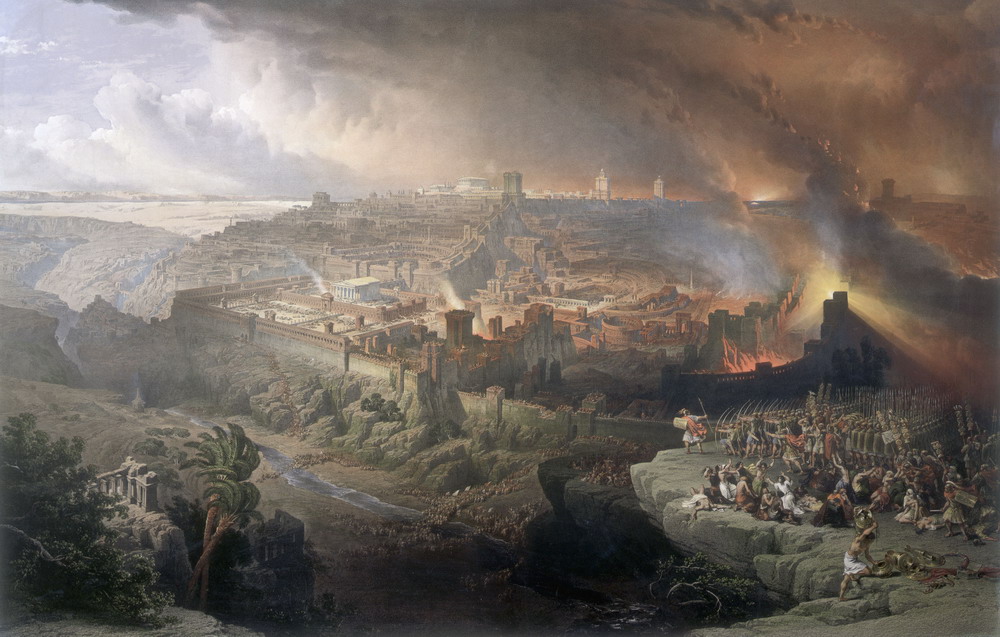
This, of course, was a foretelling of what would happen, and what did happen, to Jerusalem in 70 AD when it was burned by God’s instrument of judgment, the Romans.

The invitation then goes out to others (Gentiles as well as Jews; vss. 9-10), which I believe can be seen, for example, in the bold proclamation made by Paul and Barnabas in the city of Antioch:

The next Sabbath almost the whole city gathered to hear the word of the Lord. But when the Jews saw the crowds, they were filled with jealousy and began to contradict what was spoken by Paul, reviling him. And Paul and Barnabas spoke out boldly, saying, “It was necessary that the word of God be spoken first to you. Since you thrust it aside and judge yourselves unworthy of eternal life, behold, we are turning to the Gentiles. For so the Lord has commanded us, saying, ‘I have made you a light for the Gentiles, that you may bring salvation to the ends of the earth’” (Acts 13:44-47).

Only those with proper wedding garments were allowed to remain at the wedding feast (vss. 10-14). In Jesus’ analogy before His first century audience, the speechless man (verse 12) perhaps represents the Jew who believed that his ethnic descent from Abraham earned him an automatic place in the kingdom of God. The proper wedding garment, however, meant being clothed in the righteousness of Christ (see Revelation 19:8). Those who lacked these garments remained in outer darkness and were not part of the chosen people of God (vss. 13-14; see also Matthew 8:11-12; Matt. 13:24-30, 36-43; Matt. 21:43-45).

Revelation 19

Outside of Matthew, this pattern of judgment before bridal bliss is also repeated. Babylon the Great is shown in Revelation 16-18 to be an adulterous city that was responsible for the shedding of the blood of prophets, apostles, and saints (see especially Rev. 16:4-6, 17:6, 18:20, and 18:24). This detail alone answers so clearly to what Jesus said in Matthew 23:29-38 that there is no further need to speculate on the identity of Babylon the Great. In Matthew 23, He not only tells who would be held responsible for the martyrdom of His people, but also when they would be held responsible:

Woe to you, Scribes and Pharisees… I send you prophets and wise men and scribes, some of whom you will kill and crucify, and some you will flog in your synagogues and persecute from town to town, so that on you may come all the righteous blood shed on earth… Truly, I say to you, all these things will come upon this generationO Jerusalem, Jerusalem, the city that kills the prophets and stones those who are sent to it! How often would I have gathered your children together… See, your house is left to you desolate.”

To make Babylon’s identity even more clear, though, John’s readers are told in Revelation 11 exactly what city he speaks of later in the book. In Rev. 11:8 we first come across the expression, “the great city,” which is later used seven more times in chapters 16-18 (Rev. 16:19, 17:18; 18:9, 16, 17, 19, 21) in reference to Babylon the Great. Speaking of God’s “two witnesses” (Rev. 11:3), John was told that their dead bodies would lie “in the street of the great city that symbolically is called Sodom and Egypt, where their Lord was crucified.” In what city was Jesus crucified? Of course, we know that it was Jerusalem.

So, with these things established, John’s readers are told four times that “the great city,” identified as Jerusalem, was to be burned with fire (Rev. 17:16, 18:8-9, 18:17, and 19:3). This literally happened in 70 AD, as Josephus and other eyewitnesses affirm. As the book of Matthew has already demonstrated, the story doesn’t end there. A great multitude in heaven cries out:

Hallelujah! Salvation and glory and power belong to our God, for His judgments are true and just; for He has judged the great prostitute who corrupted the earth with her immorality, and has avenged on her the blood of his servants… Hallelujah! The smoke from her goes up forever and ever” (Rev. 19:1-3).

The great multitude then goes on to say:

Hallelujah! For the Lord our God the Almighty reigns. Let us rejoice and exult and give Him the glory, for the marriage of the Lamb has come, and His bride has made herself ready” (Rev. 19:6-7).

Mirroring the words of Jesus in Matthew 22 and 25, an angel proclaims, “Blessed are those who are invited to the marriage supper of the Lamb” (Rev. 19:9).

This perhaps comes into greater focus when we recall that the apostle Paul said things like this to his first century readers:

Therefore, my brethren, you also have become dead to the law through the body of Christ, that you may be married to another—to Him who was raised from the dead, that we should bear fruit to God.” (Romans 7:4)

For I feel a divine jealousy for you, since I betrothed you to one husband, to present you as a pure virgin to Christ.” (II Corinthians 11:2)

Husbands, love your wives, as Christ loved the church and gave himself up for her, that he might sanctify her, having cleansed her by the washing of water with the word, so that he might present the church to Himself in splendor, without spot or wrinkle or any such thing, that she might be holy and without blemish… This mystery is profound, and I am saying that it refers to Christ and the church.” (Ephesians 5:25-32)

So, in summary, we see that a wedding immediately follows the destruction of Jerusalem in Matthew 22:7-8, Matthew 24-25, and Revelation 19:1-10. This wedding feast, the marriage supper of the Lamb, is not awaiting fulfillment. It commenced in the first century. Let us rejoice, for God’s people are still called to partake of this feast even now!

————————————————————————-

Thoughts Are Welcome

What are your thoughts on what Scripture says concerning the marriage of Christ to the Church?

For years, I was taught that the Church has not yet entered into the Marriage Supper of the Lamb, and that we remain betrothed (i.e. engaged) to Christ (see II Cor. 11:2, quoted above). This will be the case, I was taught, until He returns, at which time the marriage will take place. If this were true, what would be the significance/implications of a betrothal period lasting for 2000 years or more?

I now believe that Scripture shows that this betrothal period lasted for about one generation, and that the marriage and feast began at the time of Jerusalem’s destruction and the dissolution of the Old Covenant system in the first century. Since I believe this is true, I’m asking myself what is the significance of the betrothal period lasting for just that one generation?

I’m thinking aloud, but I’m guessing that Romans 7:4 (quoted above) holds a clue to this. Paul told his readers that they became dead to the law for a purpose. It was so that they could be married to Jesus who had been raised from the dead. Why was there a connection between the Church turning its back on the law, and looking forward to being married to Christ?

In our study of Matthew 24:35, we looked into Jesus’ statement in Matthew 5:17-18 that nothing would pass from the Law until heaven and earth disappeared. We saw that, viewing Scripture as a whole, “heaven and earth” is used as covenant language here. The Old Covenant was made obsolete at the cross, but a few decades later when Hebrews was written it was still “becoming obsolete and growing old” and “ready to vanish away” (Hebrews 8:13). This was accomplished when temple-based, Old Covenant Judaism met its demise in 70 AD. On the heels of the manifest passing of the Law, then (in fulfillment of Matthew 5:17-18), the Church was married to Christ. This took place as predicted in Matthew 22:7-8, Matthew 24-25, and Revelation 19:1-10; and as alluded to in Romans 7:4, II Corinthians 11:2, and Ephesians 5:25-32.

These are my thoughts. What are yours?

Matthew 24:35-51 (Part 2 of 2)


Matthew 24:35-51 (Part 2 of 2)

This post is a continued addendum to the 4-part Olivet Discourse series posted between April and August 2011. That series featured a parallel study of Matthew 24:1-34, Mark 13:1-30, and Luke 21:5-32. It can be seen here, here, here, and here.

In the last post (Part 1 of our study of Matthew 24:35-51), we extensively looked at Matthew 24:35, showing that when Jesus said heaven and earth would pass away, He was using covenant language already used elsewhere in Scripture. In doing so, He spoke of the soon-to-come passing of the Old Covenant world. That post also included an examination of Luke 21:34-36.

In this post we will finish covering the last 17 verses of Matthew 24 (verses 35-51), the text of which is below. The first two verses in this text are also found as direct parallels in the gospel accounts of Mark and Luke (highlighted in red), and several other verses seem to allude to similar statements in Mark and Luke (these are highlighted in blue):

MATTHEW 24:35-51

Parallels and Similarities in Mark 13 and Luke 21

35 Heaven and earth will pass away, but my words will not pass away. 36 But concerning that day and hour no one knows, not even the angels of heaven, nor the Son, but the Father only. 37 For as were the days of Noah, so will be the coming of the Son of Man. 38 For as in those days before the flood they were eating and drinking, marrying and giving in marriage, until the day when Noah entered the ark, 39 and they were unaware until the flood came and swept them all away, so will be the coming of the Son of Man. 40 Then two men will be in the field; one will be taken and one left. 41 Two women will be grinding at the mill; one will be taken and one left. 42 Therefore, stay awake, for you do not know on what day your Lord is coming. 43 But know this, that if the master of the house had known in what part of the night the thief was coming, he would have stayed awake and would not have let his house be broken into. 44 Therefore you also must be ready, for the Son of Man is coming at an hour you do not expect.45 “Who then is the faithful and wise servant, whom his master has set over his household, to give them their food at the proper time? 46 Blessed is that servant whom his master will find so doing when he comes. 47 Truly, I say to you, he will set him over all his possessions. 48 But if that wicked servant says to himself, ‘My master is delayed,’ 49 and begins to beat his fellow servants and eats and drinks with drunkards, 50 the master of that servant will come on a day when he does not expect him and at an hour he does not kno51 and will cut him in pieces and put him with the hypocrites. In that place there will be weeping and gnashing of teeth.  

1. Direct Parallels

Verse 35 –> Mark 13:31,  Luke 21:33

Verse 36 –> Mark 13:32

2. Similarities

Verses 42-44, 48-50 –> Mark 13:33-37, Luke 21:36

Verse 36: Jesus’ disciples are now told that only the Father knew “that day and hour.” According to the context, Jesus Himself, at that time, did not know the day and hour of [1] the passing of “heaven and earth” (verse 35), and [2] the judgment upon Jerusalem which He had just predicted (verses 1-34). Again, the passing of Jerusalem, and the passing of heaven and earth, were spoken of as one climactic event. The generation in which these things would happen was known and revealed—i.e. it was to be His own generation (verse 34). However, the exact day was not known when Jesus spoke these words in about 30 AD. James Stuart Russell, writing in 1878, made the following point:

To have specified the day and the hour, to have said, ‘In the seven and thirtieth year*, in the sixth month and the eighth day of the month, the city shall be taken and the temple burnt with fire,’ would not only have been inconsistent with the manner of prophecy, but would have taken away one of the strongest inducements to constant watchfulness and prayer—the uncertainty of the precise time (The Parousia, p. 90).

*(Russell apparently supposes that Jesus spoke these words in 33 AD, that is, 37 years before the Romans destroyed Jerusalem.)

Verses 37-39: Jesus compares the time of His coming to the time when Noah built an ark in preparation for a great flood. That story is recorded in Genesis 6-7. During those days of preparation, those who would be swept away spent their days eating, drinking, marrying, and carrying on as normal, as if there was no tragic event just around the corner. Only righteous Noah and his family prepared in faith. It would be the same for Jesus’ own generation, He said. The implication was that His followers would prepare in faith for the perilous events that Jesus had predicted, but those outside of God’s family would not do so.

One early church father indicated that Christ’s followers did indeed behave differently leading up to the days of Jesus’ coming in judgment and in His kingdom. Athanasius (296-372 AD) once said:

“And when [Jesus] appeared in the end of the world [age], He also gave this commandment, saying…, ‘When ye therefore shall see the abomination of desolation…then let them which be in Judea flee into the mountains…’ [Matthew 24:15-16]. Knowing these things, the saints regulated their conduct accordingly.

I understand Athanasius to mean that the early believers lived very simply, in order to be prepared for that time when they would need to suddenly vacate Jerusalem. That’s why we read in the book of Acts that the believers in Jerusalem “had all things in common,” they “were selling their possessions and belongings and distributing the proceeds to all, as any had need” (Acts 2:44-45), and “no one said that any of the things that belonged to him was his own” (Acts 4:32).

They took seriously Jesus’ words that His doomsday predictions for Jerusalem and Judea would be fulfilled in His own generation (Matthew 24:34, Mark 13:30, Luke 21:32). They didn’t know the day or the hour of these events (Matthew 24:36), but they did know the generation when it would all take place, and they knew it was their own. As it was for Noah and his family, this knowledge affected their behavior.

History then tells us that Roman armies did come and surround Jerusalem in 67 AD (see also Luke 21:20-24), and at that time the believers remembered what Jesus had said. Remigius (437-533 AD) explains:

“[For] on the approach of the Roman army, all the Christians in the province, warned, as ecclesiastical history tells us, miraculously from heaven, withdrew, and passing the Jordan, took refuge in the city of Pella; and under the protection of that King Agrippa, of whom we read in the Acts of the Apostles, they continued some time.”

The city of Pella was like Noah’s ark to these 1st century believers.

Verses 40-41: At the time of His coming, Jesus said, some would be “taken” and others would be “left.” Jesus used the illustrations of two men in a field, and two women grinding with a hand mill, to demonstrate this point. This has been interpreted in various ways. Some believe, as I do, that this prophecy was fulfilled during the Roman-Jewish War of 66-73 AD, while many teach and believe that this prophecy remains to be fulfilled.

In this section, though, we will focus more on another variant among these interpretations. Some believe that to be “taken” was to be a blessed event, while those who were “left” would face great horror. This was the opinion of John Wesley (1703-1791), who said in his commentary on verse 40, “One is taken – Into God’s immediate protection: and one is left – To share the common calamities.”

Others believe that to be “left” was instead to be desired, while those who were “taken” were the unfortunate ones. This was the opinion of Albert Barnes (1834), who said, “The word ‘taken’ may mean either to be taken away from the danger – that is, rescued, as Lot was (Luke 17:28-29), or to be taken away ‘by death.’ Probably the latter is the meaning.” Likewise, John Gill (1746-63) said, “the one shall be taken; …by the eagles, the Roman army, and either killed or carried captive by them: and the other left; …by the Romans, being by some remarkable providence, or another, delivered out of their hands.”

Here are some reasons which might be given by proponents of both views (whether they see this as a past or a future event):

WHY IT’S GOOD TO BE “TAKEN”

WHY IT’S GOOD TO BE “LEFT”

The picture of being “taken” mirrors the picture of being gathered “from the four winds, from one end of the heavens to the other” (Matthew 24:31). Jesus said this would happen to the elect. In the Parable of the Weeds (Matthew 13:36-43), Jesus said that the angels would first gather (take) the weeds and burn them with fire. As Jesus said, “so will it be at the close of the age.” That age ended in Jesus’ own generation, as He predicted (Matthew 24:3, 34).
This text speaks of “the Rapture,” a time when living believers will be literally caught up in the sky in an instant to be with Jesus. Therefore, being “taken” is a good thing. A study of the history of the Roman-Jewish War reveals that from 67-70 AD the Roman armies swept through Judea and Galilee massacring large populations. In this way, they were “taken” by the Romans. Finally, Rome laid siege on Jerusalem for five months and burned that city with fire.
Noah is pictured as entering the ark first (Matthew 24:38). This corresponds to being “taken.” Only then were the wicked, the ones “left” outside of the ark, swept away (verse 39). The reference to being “taken,” which occurs twice in Matthew 24:40-41, seems to correspond with being “swept away” (verse 39), the description used for those who perished in the flood in Noah’s day. In the case of Noah, those who were left behind (i.e. spared by taking refuge in the ark) were the fortunate ones, but those who were taken/swept away (i.e. destroyed) were not.
Of the 10 virgins spoken of in Matthew 25:1-13, the five wise virgins were “taken” in to be with the bridegroom, but the five foolish virgins were “left” out and the door was not opened to them. In another example, Isaiah 6:11-12 speaks of cities lying “waste without inhabitant, and houses without people, and the land a desolate waste,” and the Lord removing people far away (which was an act of judgment upon those people). The verses preceding these were quoted by Jesus concerning His own generation: “’Keep on hearing, but do not understand; keep on seeing, but do not perceive…’” (Isaiah 6:9-10, quoted in Matthew 13:10-17).

The reader may decide which option is more convincing. The challenge is that we are not told explicitly in this text who “takes” the one, and who “leaves” the other. Other clues to this mystery, however, might come from the parallel text given in Luke’s account (Luke 17:28-37):

It was the same in the days of Lot. People were eating and drinking, buying and selling, planting and building. But the day Lot left Sodom, fire and sulfur rained down from heaven and destroyed them all. It will be just like this on the day the Son of Man is revealed. On that day no one who is on the housetop, with possessions inside, should go down to get them. Likewise, no one in the field should go back for anything. Remember Lot’s wife! Whoever tries to keep their life will lose it, and whoever loses their life will preserve it. I tell you, on that night two people will be in one bed; one will be taken and the other left. Two women will be grinding grain together; one will be taken and the other left. Two men will be in the field; one will be taken and the other left. “Where, Lord?” they asked. He replied, “Where there is a dead body, there the vultures will gather.”

In Luke’s account, Jesus connected the “taking” and “leaving” with His command that His people should flee without delay. This was specific to people living in Judea. We know that this flight was in conjunction with Jerusalem being surrounded by Roman armies (see Matthew 24:15-20, Mark 13:14-18, Luke 21:20-23, and Part 3 of our Olivet Discourse series). Those who believe, then, that being “taken” instead of “left” speaks of a future, worldwide Rapture should take note that it actually has to do with a promised invasion of Judea, one that history tells us already took place in the same manner (and within the same timeframe) that Jesus said it would.

This text also pokes another hole in the position of the partial-preterist who says that Matthew 24:1-34 is fulfilled, but Matthew 24:35-51 remains unfulfilled. For when does Jesus say that “one will be taken and the other left”? He said it would be “on that night.” What night was He speaking of? It was clearly the same night when His followers would need to flee with great haste from Jerusalem. That flight was foretold in Matthew 24:15-20, within the portion of Matthew 24 that partial-preterists affirm has been fulfilled. Luke 17 ties these events together in such a way that no amount of time can separate them, let alone 2000 years.

According to Strong’s Comprehensive Concordance of the Bible (KJV version), the Greek word which is translated as “taken” is “paralambano.” It comes from two root words: [1] “para,” meaning near/beside/at the vicinity of/on account of, and [2] “lambano,” meaning to take/to get hold of/have offered to one/to seize or remove. The suggested meanings of “paralambano” are to receive near/to assume an office/receive/take (unto, with). This word is used 16 times in the book of Matthew. These entries are listed below so that the reader can see how this word is used in other contexts outside of Matthew 24:40-41.

[1] “…fear not to take unto thee Mary thy wife…” (Matthew 1:20)

[2] “Then Joseph…took unto him his wife…” (Matt. 1:24)

[3] “Arise, and take the young child and his mother, and flee into Egypt…” (Matt. 2:13)

[4] “When he arose, he took the young child and his mother by night…” (Matt. 2:14)

[5] [6] —same usage as in the two previous examples (Matt. 2:20, 21)

[7] “Then the devil taketh Him (Jesus) up into the holy city…” (Matt. 4:5)

[8] “Again, the devil taketh Him up into an exceeding high mountain…” (Matt. 4:8)

[9] “Then goeth he, and taketh with himself seven other spirits…” (Matt. 12:45)

[10] “And after six days Jesus taketh Peter, James, and John…” (Matt. 17:1)

[11] “But if he will not hear, take with thee one or two more [witnesses]…” (Matt. 18:6)

[12] “And Jesus going up to Jerusalem took the 12 disciples apart in the way…” (Matt. 20:1)

[13] [14] “…the one shall be taken, and the other left…” (Matt. 24:40, 41)

[15] “And He took with him Peter and the two sons of Zebedee…” (Matt. 26:37)

[16] “Then the soldiers of the governor took Jesus into the common hall…” (Matt. 27:27)

The Greek word which is translated as “left” in Matthew 24:40-41 is “aphiemi,” meaning to send (forth)/cry/forgive/forsake/lay aside/leave/let (alone, be, go, have)/omit/put (send) away/remit, suffer, yield up. According to the Blue Letter Bible Lexicon, this Greek word appears in Matthew a total of 40 times, being translated in various ways. It’s only translated as “left,” however, a total of 10 times in the book of Matthew:

[1] “And they straightway left their nets, and followed Him.” (Matthew 4:20)

[2] “And they immediately left the ship and their father, and followed Him.” (Matt. 4:22)

[3] “And He touched her hand, and the fever left her…” (Matt. 8:15)

[4] “When they had heard these words, they marveled and left Him…” (Matt. 22:22)

[5] “…the first…[died and] left his wife unto his brother.” (Matt. 22:25)

[6] “Behold, your house is left unto you desolate.” (Matt. 23:38)

[7] “…There shall not be left here one stone upon another…” (Matt. 24:2)

[8] [9] “…the one shall be taken, and the other left…” (Matt. 24:40, 41)

[10] “And He left them, and went away again, and prayed the third time…” (Matt. 26:44)

In Luke’s account we see another connection that we don’t see in Matthew’s account. When Jesus says “one will be taken and the other left,” the disciples ask, “Where, Lord?” His response is striking: “Where there is a dead body, there the vultures will gather.” It’s not made explicitly clear whether His answer is in regard to those who are “taken,” or in regard to those who are “left.” The options are:

[1] The disciples asked where the people would be taken.

[2] The disciples asked where the people would be left.

Does the surrounding text answer either one of these questions? Yes, it does. In the examples Jesus gives, those who are “left” are still (1) in bed (2) at a grain mill (3) in a field. Therefore, the disciples had been told, and already knew, the whereabouts of those who were to be “left.” It then could make more sense that they wanted to know the destiny of those who were to be “taken.” It would then be this question which Jesus answers when He speaks of vultures gathering around dead bodies. If this is the case, then it was not a good thing to be taken at the time of the fulfillment of this prophecy, for those who were taken became a meal for the vultures.

There is also the possibility, however, that Jesus is not answering a question about what happens to those who are taken, but rather gives a clue as to what will happen to those left behind. From an already fulfilled-perspective, there would be a way to view this as the meaning behind Jesus’ words. As pointed out earlier, we have historical records showing that Jesus’ followers did indeed flee from Judea and Jerusalem and take refuge in Pella, while those who remained behind were ravaged by the Romans. If it was a good thing to be “taken” at the time of the fulfillment of this prophecy, it can be seen in Christ’s followers being “taken,” i.e. brought by God’s providence, to Pella where they dwelt safely during this very tumultuous time.

In the end, it’s up to the reader to decide which proposal holds more validity.

Verses 42-44: Jesus’ followers were urged to stay awake in anticipation of His coming. Take note again that they, living in the first century, were to hold this expectation that He would come in their lifetime (compare with Matthew 16:27-28). Some indeed lived until that time; others were martyred in advance.

They had already been warned about false prophets who were soon to come, of false signs and wonders, of betrayal, of lawlessness, of the love of many growing cold, of fearful signs, etc. As we saw earlier in the Olivet Discourse series, these warnings certainly became a reality in the years following Jesus’ ascension. We also know that apostate Judaizers plagued the church in the decades that were to come, something that we see Paul addressing often in his epistles. This is evidence, then, that many did not stay awake. Jesus said that the hour (precise time) of His coming would not be according to expectations, and therefore staying awake was of great importance.

Verses 45-51: Jesus gives an analogy contrasting a faithful and wise servant with a wicked servant. The faithful servant would be given joyful responsibilities at the time of the master’s coming. On the other hand, the wicked servant would be unpleasantly surprised at the coming of his master, and would experience agonizing punishment. It’s interesting to note that Jesus refers to the servant who would say, “my master is delaying his coming,” as evil. Yet many believers today are fond of using the expression, “if the Lord tarries.”

The reference to weeping and gnashing of teeth goes back to Matthew 8:10-12, where Jesus said that many outsiders would dine in the kingdom of heaven with the prophets and patriarchs of old, but many “sons of the kingdom” (Jews) would find themselves in outer darkness with “weeping and gnashing of teeth.” This, of course, would have been a shocking statement to many Jews who believed, that by virtue of their ethnicity, they had an automatic place in God’s economy. Weeping and gnashing of teeth was also to be the destiny of the tares thrown into the fire at the end of the age (Matthew 13:41-42).

Matthew 24:35-51 (Part 1 of 2)


Post Outline

1. A Study of Matthew 24:35
2. A Study of Luke 21:34-36

This post is a continuation of the 4-part Olivet Discourse series posted between April and August 2011 (here, here, here, and here). That series featured a parallel study of Matthew 24:1-34, Mark 13:1-30, and Luke 21:5-32. At this point in the Olivet Discourse, Matthew gives us an extended version of this discourse, 63 more verses actually, in Matt. 24:35-51 and Matt. 25:1-46. Mark and Luke, on the other hand, wrap up Jesus’ message in just a few verses. In Mark’s case, there are seven (7) more verses (Mark 13:31-37), and in Luke’s case there are only four (4) more verses (Luke 21:33-36).

These next two posts will cover the last 17 verses of Matthew 24 (verses 35-51), the text of which is below. The first two verses in this text are also found as direct parallels in the gospel accounts of Mark and Luke (highlighted in red), and several other verses seem to allude to similar statements in Mark and Luke (these are highlighted in blue):

MATTHEW 24:35-51

Parallels and Similarities in Mark 13 and Luke 21

35 Heaven and earth will pass away, but my words will not pass away. 36 But concerning that day and hour no one knows, not even the angels of heaven, nor the Son, but the Father only. 37 For as were the days of Noah, so will be the coming of the Son of Man. 38 For as in those days before the flood they were eating and drinking, marrying and giving in marriage, until the day when Noah entered the ark, 39 and they were unaware until the flood came and swept them all away, so will be the coming of the Son of Man. 40 Then two men will be in the field; one will be taken and one left. 41 Two women will be grinding at the mill; one will be taken and one left. 42 Therefore, stay awake, for you do not know on what day your Lord is coming. 43 But know this, that if the master of the house had known in what part of the night the thief was coming, he would have stayed awake and would not have let his house be broken into. 44 Therefore you also must be ready, for the Son of Man is coming at an hour you do not expect.45 “Who then is the faithful and wise servant, whom his master has set over his household, to give them their food at the proper time? 46 Blessed is that servant whom his master will find so doing when he comes. 47 Truly, I say to you, he will set him over all his possessions. 48 But if that wicked servant says to himself, ‘My master is delayed,’ 49 and begins to beat his fellow servants and eats and drinks with drunkards, 50 the master of that servant will come on a day when he does not expect him and at an hour he does not know 51 and will cut him in pieces and put him with the hypocrites. In that place there will be weeping and gnashing of teeth.  

1. Direct Parallels

Verse 35 –> Mark 13:31,  Luke 21:33

Verse 36 –> Mark 13:32

2. Similarities

Verses 42-44, 48-50 –> Mark 13:33-37, Luke 21:36


Verse 35: In the last portion of the Olivet Discourse (covering Matthew 24:29-34/Mark 13:24-30/Luke 21:25-32), we examined Jesus’ declaration that “all these things” (the fall of the temple, and all that would precede that event) must take place before His own generation would pass away. Following that statement, He immediately adds that “heaven and earth” would also pass away. This was in contrast to “His Word,” which would never pass away. This statement also appears in Mark’s and Luke’s version of the Olivet Discourse (Mark 13:31 and Luke 21:33).

Are there grounds for believing that Jesus was saying that heaven and earth would pass away along with His own generation? I believe there are. Certainly, there is no clear indication that Jesus suddenly goes here from speaking about first century events (verses 1-34) to speaking (in verse 35 and beyond) of events that are future to us 2000 years later. This idea has been proposed by some, but the weight of the gospel accounts in their entirety do not allow for this. If we examine, for example, Luke 17:22-37, we will see that four portions of this passage are directly parallel to content found within Matthew 24:1-34, and two separate portions are directly parallel to content found within Matthew 24:35-51.

Portions of Luke 17:20-37 parallel to content in Matthew 24:1-34

Portions of Luke 17:20-37 parallel to content in Matthew 24:35-51

Parallel to Matthew 24:23

Luke 17:23And they will say to you, ‘Look, there!’ or ‘Look, here!’ Do not go out or follow them.

Parallel to Matthew 24:27

Luke 17:24For as the lightning flashes and lights up the sky from one side to the other, so will the Son of Man be in his day.

Parallel to Matthew 24:17-18

Luke 17:31On that day, let the one who is on the housetop, with his goods in the house, not come down to take them away, and likewise let the one who is in the field not turn back.

Parallel to Matthew 24:28

Luke 17:37And they said to him, “Where, Lord?” He said to them, “Where the corpse is, there the vultures will gather.”


Parallel to Matthew 24:37-39

Luke 17:26Just as it was in the days of Noah, so will it be in the days of the Son of Man.27 They were eating and drinking and marrying and being given in marriage, until the day when Noah entered the ark, and the flood came and destroyed them all.

Parallel to Matthew 24:41

Luke 17:35There will be two women grinding together. One will be taken and the other left.

So we see that in Luke 17:22-37, Jesus blends these six references (four of which are present in Matthew 24:1-34, and two of which are present in Matthew 24:35-51) together, without any distinctions related to time. Therefore, the one who acknowledges that everything Jesus said in Matthew 24:1-34 is tied to His own first century generation, but insists that what He said in Matthew 24:35 and beyond is not yet fulfilled, is very much inconsistent. Otherwise, in Luke 17:22-37, Jesus arbitrarily switched back and forth between speaking of first century events and events in the 21st century (or beyond).

What would Jesus have meant then by saying that heaven and earth would pass away in His own generation? We have repeatedly seen in our study of the Olivet Discourse that the prophetic language of the Old Testament provides quite a backdrop to what Jesus says in this discourse. The same is true for the expression “heaven and earth.” It’s covenant language. This is perhaps most evident in the book of Isaiah.

Isaiah was given a vision concerning Judah and Jerusalem, according to the very first verse (1:1). The very first words he uttered were these: “Hear, O heavens, and give ear, O earth; for the Lord has spoken” (Isaiah 1:2). This is not unique to Isaiah, for heaven and earth were repeatedly called as witnesses against Israel (e.g. Deuteronomy 4:26, 30:18-19, 31:28, 32:1; Jeremiah 2:12, 6:19; Micah 6:2). In Isaiah 51, speaking to the people of Israel, God says:

I, I am He who comforts you; who are you that you…have forgotten the Lord, your Maker, who stretched out the heavens and laid the foundations of the earth…? …And I have put My words in your mouth and covered you in the shadow of My hand, establishing the heavens and laying the foundations of the earth, and saying to Zion, ‘You are My people (verses 12-16).

The establishment of the heavens and the earth is thus linked directly to the establishment of Israel as God’s people at Mount Sinai (Exodus 19:5-6). Psalm 68:7-8 reiterates that the earth and the heavens were greatly affected when “God, the One of Sinai” marched through the wilderness before His people, as does Judges 5:4-5. Jeremiah also spoke of Jerusalem’s pending destruction (in 586 BC) in a way that might seem as if he was talking about planet earth and the galaxies, if it weren’t for the context:

My anguish, my anguish! I writhe in pain! Oh, the walls of my heart! My heart is beating wildly; I cannot keep silent, for I hear the sound of the trumpet, the alarm of war… I looked on the earth, and behold, it was without form and void; and to the heavens, and they had no light… For thus says the Lord, ‘The whole land shall be a desolation; yet I will not make a full end. For this the earth shall mourn, and the heavens above be dark…’” (Jeremiah 4:19, 23, 27).

On a more pleasant note, Isaiah also prophesied of “new heavens and a new earth,” and the creation of Jerusalem as a joy (Isaiah 65:17-19). That this is covenantal language, and not language referring to the material/physical heavens and earth, can be seen in the fact that the new heavens and new earth were to be marked by sin and death (verse 20), building and planting (verses 21-22), and the reproduction of children (verse 23). When I was younger, I was taught that the new heavens and earth would be set up following a future Second Coming of Christ and a 1000 year “millennial reign” based out of Jerusalem, at which time sin and death would completely cease to exist.

Isaiah’s description of the new heavens and earth, however, does not allow for this. Instead, his description speaks of present realities, the earthly existence being experienced by anyone reading this. It also mirrors what we see in the New Testament. Paul told the Ephesians that God’s people are called to “put on the new self, created after the likeness of God in true righteousness and holiness” (Ephesians 4:24). He likewise told the Corinthians, “Therefore, if anyone is in Christ, he is a new creation. The old has passed away; behold, the new has come” (II Corinthians 5:17). In Christ, a new temple/tabernacle had come (e.g. I Corinthians 3:16-17, I Cor. 6:19, II Cor. 6:16, Ephesians 2:21, Revelation 3:12), and the old temple/tabernacle had to go. During the one generation following the cross, all of the rituals attached to the temple in Jerusalem were worthless. By the end of that generation, that temple and those worthless rituals were gone.

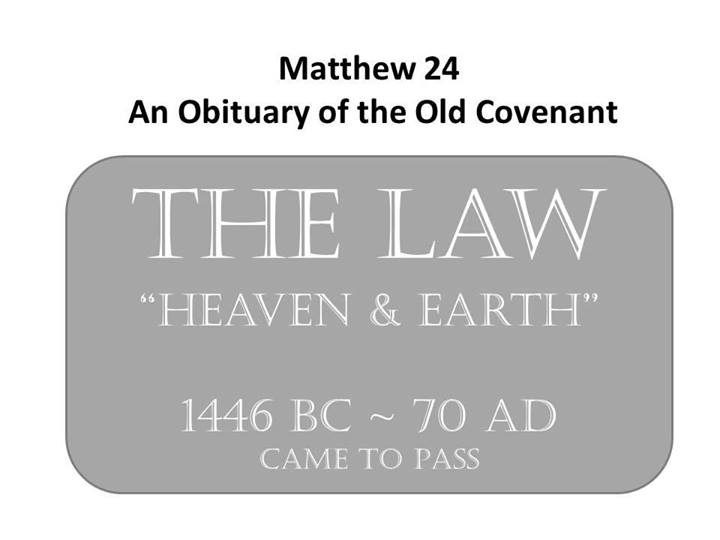
Obituary of the Old Covenant

SOURCE

We would also do well to remember that Jesus had already made a very significant statement about the disappearance of (the old) heaven and earth in the Sermon on the Mount:

Do not think that I have come to abolish the Law or the Prophets; I have not come to abolish them but to fulfill them. For truly I tell you, until heaven and earth disappear, not the smallest letter, not the least stroke of a pen, will be any means disappear from the Law until everything is accomplished” (Matthew 5:17-18).

Is the Law 100% intact even now in the year 2012, and are we thus still under the old heavens and earth? Or did Jesus accomplish everything and fulfill the Law, so that we are now under the covenantal framework of the new heavens and earth? Matthew 5:17-18 is an all-or-nothing statement. If “heaven and earth” have not yet disappeared, neither then has even one trace of the Law of Moses.

The “heaven and earth” spoken of by Jesus here are certainly connected to the temple worship and law keeping of the Jewish world. We know that Jerusalem, the temple, and the Old Covenant system attached to it passed away in a fiery blaze in 70 AD. Jesus, of course, predicted this (in Matthew 22:7; Revelation 17:16-17; Rev. 18:8-9, 17-18).

II Peter 3:7-13 also speaks of the heavens and earth of that time being “stored up for fire” (verse 7) and ready to “pass away with a roar” and be “burned up and dissolved” (verse 10), giving way to “new heavens and a new earth in which righteousness dwells” (verse 13). As Bishop John Lightfoot (1601-1675) wrote in his Commentary on the Acts of the Apostles (Vol. 3, p. 452),

“Compare this with Deut. 32:22, Heb. 12:26, Gal. 4:9, Coloss. 2:20: and observe that by elements are understood the Mosaic elements: and you will not doubt that St. Peter speaks only of the conflagration of Jerusalem, the destruction of the nation, and the abolishing of the dispensation of Moses.”

Indeed, Galatians 4:9 and Colossians 2:20 make use of the same word translated as “elements” in II Peter 3:10. It’s clear that Paul spoke there, not of the cosmos, but of what was contained in the Law:

[1] “But now that you have come to know God, or rather to be known by God, how can you turn back again to the weak and worthless elementary principles of the world, whose slaves you want to be once more? You observe days and months and seasons and years!” (Galatians 4:9-10).

[2] “If with Christ you died to the elemental spirits of the world, why, as if you were still alive in the world, do you submit to regulations—‘Do not handle, Do not taste, Do not touch’ (referring to things that all perish as they are used)—according to human precepts and teachings?” (Colossians 2:20-22).

In a 1721 sermon, the Puritan preacher John Owen said,

I affirm that the heavens and earth here intended in this prophecy of Peter, the coming of the Lord, the day of judgment and perdition of ungodly men, mentioned in the destruction of that heaven and earth, do all of them relate, not to the last and final judgment of the world, but to that utter desolation and destruction that was to be made of the Judaical church and state… [A]nd then the heavens and earth that God Himself planted, -the sun, moon, and stars of the Judaical polity and church, – the whole old world of worship and worshippers, that stand out in their obstinancy against the Lord Christ, shall be sensibly dissolved and destroyed: this we know shall be the end of these things, and that shortly.”

Jonathan Edwards (in 1739) said this in his work, “The Perpetuity and Change of the Sabbath, Vol. 2”:

The Scriptures further teach us to call the gospel-restoration and redemption, a creation of a new heaven and a new earth… The gospel state is everywhere spoken of as a renewed state of things, wherein old things are passed away, and all things become new… And the dissolution of the Jewish state was often spoken of in the Old Testament as the end of the world. But we who belong to the gospel-church, belong to the new creation; and therefore there seems to be at least as much reason, that we should commemorate the work of this creation, as that the members of the ancient Jewish church should commemorate the work of the old creation.

C.H. (Charles) Spurgeon also had the same understanding. In a sermon delivered in 1865 (Metropolitan Tabernacle Pulpit, Vo. XXXVII, p. 354), he said:

Did you ever regret the absence of the burnt-offering, or the red heifer, of any one of the sacrifices and rites of the Jews? Did you ever pine for the feast of tabernacle, or the dedication? No, because, though these were like the old heavens and earth to the Jewish believers, they have passed away and we now live under a new heavens and a new earth, so far as the dispensation of divine teaching is concerned. The substance is come, and the shadow has gone: and we do not remember it.

Here also is a very intriguing quote from the church father, Eusebius (265-340 AD), from one of his writings known as “the Theophania”:

All authorities concur in the declaration that “when all these things should have been done”, ‘The End’ should come: that “the mystery of God should be finished as he had declared to His servants the prophets“: it should be completed: time should now be no more: the End of all things (so foretold) should be at hand, and be fully brought to pass: in these days should be fulfilled all that had been spoken of Christ (and of His church) by the prophets: or, in other words, when the gospel should have been preached in all the world for a testimony to all nations, and the power of the Holy People be scattered (abroad), then should the End come, then should all these things be finished. I need now only say, all these things have been done: the old and elementary system passed away with a great noise; all these predicted empires have actually fallen, and the new kingdom, the new heaven and earth, the new Jerusalem–all of which were to descend from God, to be formed by His power, have been realised on earth; all these things have been done in the sight of all the nations; God’s holy arm has been made bare in their sight: His judgments have prevailed, and they remain for an everlasting testimony to the whole world. His kingdom has come, as it was foretold it should, and His will has, so far, been done; His purposes have been finished; and, from that day to the extreme end of time, it will be the duty, as indeed it will be the great privilege of the Church, to gather into its bosom the Jew, the Greek, the Scythian, the Barbarian, bond and free; and to do this as the Apostles did in their days–in obedience, faith and hope.

A LOOK AT LUKE 21:34-36

Before going on to the rest of Matthew 24, some details from Luke 21:34-36 are also very much worth noting. This passage follows His two-fold declaration in verses 32-33 that [1] His own generation and [2] heaven and earth would pass away. He then says,

But watch yourselves lest your hearts be weighed down with dissipation and drunkenness and cares of this life, and that day come upon you suddenly like a trap. For it will come upon all who dwell on the face of the whole earth. But stay awake at all times, praying that you may have strength to escape all these things that are going to take place, and to stand before the Son of Man” (Luke 21:34-36).

In verse 34, Jesus refers to “that day.” Taking this reference in context, what day would He be referring to? It should be clear that He was referring [1] to the passing of His generation after all that He had prophesied would take place and [2] to the passing away of heaven and earth. This command to “watch yourselves” was given to His followers living in the first century.

In verse 35, Jesus says “that day” will come “upon all who dwell on the face of the whole earth.”  On the Biblos Online Parallel Bible website (www.bible.cc), there are 18 parallel translations listed for this verse. All of them render the final phrase of this verse as “the whole earth,” except for Young’s Literal Translation, which renders it as “all the land.” Indeed, the Greek word used here, “ge,” can be rendered as “land” in many cases where it is used, and can refer specifically to the Promised Land (i.e. Israel). In various commentaries on Luke 21:35, Albert Barnes (1834) and Adam Clarke (1831) agreed that these troubles were to come upon Judea, and John Gill (1746-1763) said that Jerusalem, Galilee, and Judea suffered the calamities that Jesus predicted.

This certainly makes sense here, as we have already seen in Luke 21:23 that Jesus says those days would be full of great distress for “this people” and for “the earth” (or “the land”), and this is very clearly equated with “those who are in Judea” (Luke 21:21). The same Greek word, “ge,” is also used in verse 23, and there it is rendered as “land” instead of as “earth” 17 out of 18 times in the Biblos entry for that verse.

The expression “those who dwell on the earth” (or similar forms of this expression) can also be seen often in the book of Revelation, and a solid case can be made that it refers, not to the globe, but to 1st century apostate Israel. See the 3-part series I have written on this phenomenon: here, here, and here.

Lastly, in Luke 21:36, we see that Jesus makes reference to “all these things that are going to take place.” In verses 34-36 He does not detail any number of things that are going to take place. We must conclude, then, that He is referring to what He has already described in verses 5-32 (see verses 7, 9, 12, 22, 26, 31, and 32 for similar references). This is further evidence that Jesus does not, as some have suggested, speak of 1st century events in certain parts of this chapter and speak of yet unfulfilled events in other parts. For He declares in verse 32 that all these things must take place before His own generation passes away. Furthermore, in verses 8 and following He details the signs which must take place before the temple was to be completely destroyed (see verses 6-7), an event that we know took place in 70 AD.

———————————————————————————————-

In the following post, we will conclude our study of Matthew 24 by examining the remaining 16 verses (Matthew 24:36-51).

The Olivet Discourse: This Generation or That Generation (Part 4 of 4)


In the first post (Part 1) of this series, we examined the first few verses of Jesus’ famous Olivet Discourse, recorded in Matthew 24:1-3, Mark 13:1-4, and Luke 21:5-7. In the second post, we examined Jesus’ description of the signs which would take place before the temple’s destruction. We saw how those signs were fulfilled between the time of His ascension around 30 AD and the temple’s overthrow in 70 AD, about 40 years later. In the third post we examined Jesus’ warning to His followers about a soon-coming “abomination that causes desolation” (Matthew 24:15/Mark 13:14), or, as Luke puts it, “Jerusalem being surrounded by armies” (Luke 21:20). We also considered what Jesus said about a time of great tribulation which was soon to come.

In this fourth and final part of this series on the Olivet Discourse, we will take a look at Jesus’ prophecy of the heavenly bodies being shaken, a depiction given numerous times in the Old Testament. We will also see that Jesus predicted His own coming “in a cloud”/”on clouds,” another expression borrowed from the OT. We will consider what Jesus meant when He spoke of the fig tree. Then we will conclude by taking stock of Christ’s very foundational statement that all of the above-mentioned prophecies must take place within “this generation.”

MATTHEW 24:29-34

MARK 13:24-30

LUKE 21:25-32

29“Immediately after the distress of those days “‘the sun will be darkened, and the moon will not give its light; the stars will fall from the sky, and the heavenly bodies will be shaken.’30 “Then will appear the sign of the Son of Man in heaven. And then all the peoples of the earth will mourn when they see the Son of Man coming on the clouds of heaven, with power and great glory. 31And he will send his angels with a loud trumpet call, and they will gather his elect from the four winds, from one end of the heavens to the other.32 “Now learn this lesson from the fig tree: As soon as its twigs get tender and its leaves come out, you know that summer is near. 33 Even so, when you see all these things, you know that it is near, right at the door. 34 Truly I tell you, this generation will certainly not pass away until all these things have happened. 24 “But in those days, following that distress, “‘the sun will be darkened, and the moon will not give its light; 25the stars will fall from the sky, and the heavenly bodies will be shaken.’26 “At that time people will see the Son of Man coming in clouds with great power and glory. 27And he will send his angels and gather his elect from the four winds, from  the ends of the earth to the ends of the heavens.28 “Now learn this lesson from the fig tree: As soon as its twigs get tender and its leaves come out, you know that summer is near. 29 Even so, when you see these things happening, you know that it is near, right at the door. 30 Truly I tell you, this generation will certainly not pass away until all these things have happened. 25 “There will be signs in the sun, moon and stars. On the earth, nations will be in anguish and perplexity at the roaring and tossing of the sea. 26 People will faint from terror, apprehensive of what is coming on the world, for the heavenly bodies will be shaken. 27 At that time they will see the Son of Man coming in a cloud with power and great glory. 28When these things begin to take place, stand up and lift up your heads, because your redemption is drawing near.”29 He told them this parable: “Look at the fig tree and all the trees. 30 When they sprout leaves, you can see for yourselves and know that summer is near. 31Even so, when you see these things happening, you know that the kingdom of God is near.32Truly I tell you, this generation will certainly not pass away until all these things have happened.

Matt. 24:29/Mark 13:24-25/Luke 21:25-26 (Sun, moon, and stars darkened)

In the accounts of both Matthew and Mark, Jesus asserts that “the sun will be darkened, and the moon will not give its light; the stars will fall from the sky, and the heavenly bodies will be shaken.” This was to happen, they said, after the time of distress and tribulation. According to Luke’s account, it would also follow the times of the Gentiles and the trampling of the city of Jerusalem. Luke doesn’t specifically mention the darkening of the heavenly bodies, but simply says that “there will be signs in the sun, moon, and stars.” He gives just as much attention to what would happen on the earth: “[N]ations will be in anguish and perplexity at the roaring and tossing of the sea. People will faint from terror, apprehensive of what is coming on the world.”

A look at several Old Testament passages indicates that it was already common for God to use this same type of language when announcing impending judgments upon various nations. Consider these examples:

[1] Regarding Babylon: “For the stars of the heavens and their constellations will not give their light; the sun will be dark at its rising, and the moon will not shed its light” (Isaiah 13:10). Babylon was to fall at the hands of the Medes (verse 17), and we know that this prophecy was fulfilled in 539 BC (see Daniel 5).

[2] Regarding Edom: “All the host of heaven shall rot away, and the skies roll up like a scroll. All their host shall fall, as leaves fall from the vine, like leaves falling from the fig tree…her land shall become burning pitch. Night and day it shall not be quenched; its smoke shall go up forever…” (Isaiah 34:4, 9-10). The capital of Edom was Petra. Assyria (under Sennacherib), Babylon (Jeremiah 27:3-6), and the Nabataeans attacked and plundered this region between the 6th and 4th centuries BC, as did Israel during the Maccabean period (in fulfillment of Ezekiel 25:14). It was made desolate as far as Teman (modern day Maan), as predicted in Ezekiel 25:13. Petra was conquered by Muslim nations, and then lost for more than 1000 years until it was rediscovered in 1812 (see Jeremiah 49:14-17). See this article for even more information.

[3] Regarding Egypt: “Behold, the Lord is riding on a swift cloud and comes to Egypt; and the idols of Egypt will tremble at His presence, and the heart of the Egyptians will melt within themWhen I blot you out, I will cover the heavens and make their stars dark; I will cover the sun with a cloud, and the moon shall not give its light. All the bright lights of heaven will I make dark over you, and put darkness on your land, declares the Lord God” (Isaiah 19:1; Ezekiel 32:7-8). Isaiah 20 makes it clear that Egypt’s defeat was to come at the hand of the Assyrians. Sargon, the king of Assyria, was even mentioned by name for his role in sending his chief commander (Tarton) to capture Ashdod (Isaiah 20:1). This took place in 711 BC. Assyria’s invasion of Egypt was also historically fulfilled during Sargon’s reign (722-705 BC) and, as prophesied, Cush (modern-day Ethiopia) was of no help to Egypt.

When judgment came to Babylon, Edom, and Egypt, there were no literal cosmic catastrophes affecting the entire planet, and the literal sun, moon, and stars continued to shine. This was symbolic, metaphorical language used commonly in the Old Testament, and now appearing in the New Testament as well. The OT even includes instances where God used this same language to speak of “putting out the lights,” so to speak, of Israel (e.g. Jeremiah 4:14, 28; Jeremiah 13:16; Joel 2:10, 31; Amos 8:9). In the case of Joel’s prophecy, this was to happen in Israel’s last days, which Peter acknowledged as having come to his own generation (Acts 2:16-21).

Furthermore, it’s quite possible that Jesus’ reference to the sun, moon, and stars would have reminded His Jewish listeners of Joseph’s dream in which “the sun, the moon, and eleven stars” bowed down to him (Genesis 37:9). Thus, in addition to speaking of the collapse of a political structure, the darkening of these heavenly bodies would have specifically pointed to the downfall of the nation of Israel.

Another vivid illustration of the Bible’s use of this type of language to denote political events can be found in Psalm 18, written by David “on the day when the Lord rescued him from the hand of all his enemies, and from the hand of Saul.” David writes of being entangled by “the cords of Sheol” (verse 5); the earth reeling and rocking and the mountains trembling (verse 7); devouring fire coming from God’s mouth (verse 8); God bowing the heavens, thick darkness, God riding on a cherub and coming to him (verses 9-10); hailstones and coals of fire coming to the earth through the clouds (verses 12-13); God sending arrows and lightning (verse 14); and the sea being divided and “the foundations of the world” being laid bare (verse 15). There is no record, Biblical or otherwise, of any such events literally taking place during David’s lifetime. Again, this is apocalyptic and metaphorical language, common throughout the Bible.

Matt. 24:30/Mark 13:26/Luke 21:27 (Jesus coming on the clouds of heaven)

All three gospel accounts then speak of the Son of Man coming with power and great glory. Matthew says He would come “on the clouds of heaven,” Mark says “in clouds,” and Luke says “in a cloud.” His coming was to be visible. Matthew alone precedes His description of Christ’s coming by saying that a sign would appear in heaven, and he alone remarks that the tribes of the earth would mourn when they saw His coming. Does that mean He was to physically appear? We will take up this question shortly. First, let us consider again the timing of His promised coming.

As we saw in part 1 of this series, prior to the Olivet Discourse Jesus had already told His disciples that His coming would take place [1] before they would be able to go through all the towns of Israel (Matthew 10:23) and [2] while some of them were still alive (Matthew 16:27-28). Furthermore, He said He would come [a] in His kingdom [b] with His angels [c] in the glory of His Father and [d] to repay each person for what they had done, i.e. in judgment. None of His disciples lived beyond the first century AD. Therefore, if He was telling the truth, His promised coming already took place. This is confirmed yet again at the end of the Olivet Discourse, as we will see later in this post.

The imminence of His coming, and of the end of the age, in the first century can be seen repeatedly elsewhere in the New Testament. Consider these examples by Paul, the author of Hebrews, James, Peter, and John:

Paul: “Besides this you know the time, that the hour has come for you to wake from sleep. For salvation is nearer to us now than when we first believed. The night is far gone; the day is at hand. So then let us cast off the works of darkness and put on the armor of light” (Romans 13:11-12). “This is what I mean, brothers: the appointed time has grown very short. From now on, let those who have wives live as though they had none…and those who buy as though they had no goods, and those who deal with the world as though they had no dealings with it. For the present form of this world is passing away” (I Corinthians 7:29-31). “Now these things happened to them as an example, but they were written down for our instruction, on whom the end of the ages has come” (I Cor. 10:11). “The Lord is at hand” (Philippians 4:5).

Hebrews (author unknown): “…encouraging one another, and all the more as you see the Day drawing near” (Hebrews 10:25). “Yet a little while, and the coming One will come and will not delay…” (Heb. 10:37).

James: “Come now, you rich, weep and howl for the miseries that are coming upon you… You have laid up treasure in the last days” (James 5:1-3). “Establish your hearts, for the coming of the Lord is at hand… behold, the Judge is standing at the door” (James 5:8-9).

Peter: “The end of all things is at hand” (I Peter 4:7).

John: “Children, it is the last hour, and as you have heard that antichrist is coming, so now many antichrists have come. Therefore we know that it is the last hour” (I John 2:18).

So, with the timing of Christ’s coming established, what was to be the nature of it? We already saw that the darkening of the sun, moon, and stars was metaphorical language used to describe past judgments in history. What about His promise to come on clouds of glory? Surely this indicates a physical appearing, right? Although this idea is most popular today, we did already see two clearly fulfilled passages where God came with clouds to bring judgment as He saw fit:

[1] “He bowed the heavens and came down; thick darkness was under His feet. He rode on a cherub and flew; He came swiftly on the wings of the wind. He made darkness His covering, His canopy around Him, thick clouds dark with water. Out of the brightness before Him hailstones and coals of fire broke through His clouds” (Psalm 18:9-12; fulfilled on the day when God rescued David from the hand of Saul and his other enemies).

[2] “Behold, the Lord is riding on a swift cloud and comes to Egypt…” (Isaiah 19:1; fulfilled around 700 BC).

Kenneth Gentry, in his book “Before Jerusalem Fell: Dating the Book of Revelation” (1998), notes how often this type of language is used in Scripture without referring to any type of history-ending events (p. 123):

“The Old Testament frequently uses clouds as indicators of divine judgment. God is said to be surrounded with thick, foreboding clouds as emblems of His unapproachable holiness and righteousness (Gen. 15:17; Ex. 13:21-22; 14:19-20; 19:9, 16-19; Deut. 4:11; Job 22:14; Psa. 18:8ff; 97:2; 104:3; Isa. 19:1; Eze. 32:7-8). He is poetically portrayed as coming in clouds in historical judgments upon men (Psa. 18:7-15; 104:3; Isa. 19:1; Joel 2:1, 2; Nah. 1:2ff; Zeph. 1:14, 15). Thus, the New Testament speaks of Christ’s coming in clouds of judgment in history at Matthew 24:30 and 26:64…”

When Jesus said in the Olivet Discourse that He would come on the clouds of heaven, anyone in His audience who was familiar with the Old Testament knew that He was claiming to be one with His Father. Only God could ride on the clouds of heaven (e.g. Deuteronomy 33:26, Psalm 68:4, Psalm 104:3, Ezekiel 30:3, Nahum 1:3). That’s why the high priest accused Jesus of blasphemy when He made this same claim just before His crucifixion, and the crowd declared Him worthy of death (Matthew 26:63-66).

As noted earlier, Jesus promised to come “in the glory of His Father” (Matt. 16:27). As Don Preston well points out, this can be understood to mean that just as the Father had come in the past, Jesus would also come in the same manner. Don gives as an example Isaiah 64:1-3, where the writer declares that God had “come down” numerous times in the past:

Oh, that You would rend the heavens and come down, that the mountains might quake at Your presence – as when fire kindles brushwood, and the fire causes water to boil – to make Your name known to Your adversaries, and that the nations might tremble at Your presence! When You did awesome things that we did not look for, You came down, the mountains quaked at Your presence.”

Consider also this prophecy by Micah, which was fulfilled in 586 BC when Jerusalem fell to the Babylonian armies:

For behold, the LORD comes forth from His place, and will come down, and tread upon the high places of the earth. And the mountains shall be melted under Him, and the valleys shall be cleft, as wax before the fire, and as the waters that are poured down a steep place. For the transgression of Jacob is all this, and for the sins of the house of Israel …  What are the high places of Judah? Are they not Jerusalem?’ (Micah 1:3-5).

Just as the Father’s comings in times past had not been bodily or physical in nature, there is also no promise here in the Olivet Discourse that Christ’s coming would be of this nature. Matthew, Mark, and Luke all used the same apocalyptic language that is typical in the Old Testament to speak of the final judgment which was about to come once again upon Jerusalem. Secular and church history tells us that it did come, from 67-70 AD. It was through this judgment, both predicted and fulfilled by Jesus, that “the tribes of the earth” saw Him coming with clouds.

This prophecy in the Olivet Discourse is parallel to John’s words in Revelation 1:7, which many scholars believe is the theme verse of the book of Revelation: “Behold, He is coming with the clouds, and every eye will see Him, even those who pierced Him, and all tribes of the earth will wail on account of Him. Even so. Amen.” Indeed, Matthew 24:30 also says that “all the tribes of the earth will mourn” when they see Jesus coming on the clouds of heaven. Kenneth Gentry comments, “His Cloud-Coming is a Judgment-Coming that brings mourning. But upon whom? And when? And how? Fortunately…time cues exist within the theme text, and can be found in the other New Testament allusions to this same passage.”

Gentry then makes the case that, although the Romans had a part in crucifying and piercing Jesus (and in the broadest sense, all of mankind did), the responsibility for these deeds belonged to the Jews of that generation who instigated and demanded that they be done (See Acts 2:22-23, 36; 3:13-15a; Acts 5:30; 7:52; I Thessalonians 2:14-15). He quotes from Adam Clarke who, in his 1823 commentary on Revelation 1:7, remarked, “By this the Jewish people are most evidently intended, and therefore the whole verse may be understood as predicting the destruction of the Jews; and is a presumptive proof that the Apocalypse [the book of Revelation] was written before the final overthrow of the Jewish state [in 70 AD].”

Seeing that both Matthew 24:30 and Revelation 1:7 use the phrase “all tribes of the earth” to indicate who would wail upon seeing Christ coming with the clouds, Gentry notes that the Greek word for “tribe” refers to the Jewish tribes when used elsewhere in Scripture, almost without exception. With his conclusion, the Theological Dictionary of the New Testament and the International Standard Bible Encyclopedia agrees (see also Revelation 5:5, 7:4, and 21:12). The strongest indication of this association, though, can be seen in the fact that Revelation 1:7 is clearly a reference to Zechariah 12:10, a passage leaving no doubt that Israel and Jerusalem are in view: “And I will pour out on the house of David and the inhabitants of Jerusalem a spirit of grace and pleas for mercy, so that, when they look on Me, on Him whom they have pierced, they shall mourn for Him, as one mourns for an only child, and weep bitterly over Him, as one weeps over a firstborn.”

Source: Cindye Coates (Matthew 24 Fulfilled)

Furthermore, the phrase “the earth” used in both Matthew 24:30 and Revelation 1:7, can just as well be translated “the land,” i.e. the Promised Land of Israel. The same expression is used in Luke 21:23, an obvious reference to Jerusalem and Israel. Aside from the ESV, most Bible translations choose to speak of “the land” rather than “the earth” in Luke’s gospel, but in Matthew’s gospel they tend to speak of “the earth,” which many today take to be an indication of a world-wide, history-ending event. From the context of Zechariah 12:10, however, we can know that this is not the case.

Another consideration regarding the language of Matthew 24:30 (and the parallel passages in Mark, Luke, and Revelation 1:7) is that it is reminiscent of Daniel 7:13-14: “I saw in the night visions, and behold, with the clouds of heaven there came one like a Son of Man, and He came to the Ancient of Days and was presented before Him. And to Him was given dominion and glory and a kingdom, that all peoples, nations, and languages should serve Him.” We can see that the vision shown to Daniel was actually of Christ ascending to the Father, not descending to the earth.

Jesus’ ascension took place about 40 years prior to 70 AD, of course. Yet the picture of His ascension is tied to the judgment which came nearly a generation later. This judgment, then, would verify or point to the reality of Christ’s ascension with power and great glory. Kevin Daly of Messianic Good News (South Africa) writes regarding these things:

The appearance of a sign (verse 30) would not be necessary if the Son of Man would come visibly at this time. The sign is necessary because his coming in the clouds of heaven, in power and vindication glory, alludes once more to Daniel, who spoke of ‘one like the son of man, coming with the clouds of heaven,’ to receive from the Ancient of Days ‘authority, glory and sovereign power’ so that ‘all peoples, nations and men of every language’ might worship him. The fall of Jerusalem was itself the sign (evidence) that Jesus was enthroned at the right hand of the Father in heaven, bringing judgment on the city.

Adam Clarke [1762-1832] likewise comments on verse 30: “The plain meaning of this is, that the destruction of Jerusalem will be such a remarkable instance of Divine vengeance, such a signal manifestation of Christ’s power and glory, that all the Jewish tribes shall mourn, and many will, in consequence of this manifestation of God, be led to acknowledge Christ and his religion.”

Matt. 24:31/Mark 13:27/Luke 21:28 (Gathering of the elect/redemption near)

This portion of the Olivet Discourse is, to me, perhaps the most difficult to interpret. Here is how the next verse reads in each of the three accounts:

Matthew 24:31

Mark 13:27

Luke 21:28

“And He will send out His angels with a loud trumpet call, and they will gather His elect from the four winds, from one end of heaven to the other.” “And then He will send out His angels and gather His elect from the four winds, from the ends of the earth to the ends of heaven.” “Now when these things begin to take place, straighten up and raise your heads, because your redemption is drawing near.”

Luke’s choice of language here is noticeably different from what we see in the accounts of Matthew and Mark, but I believe we’re correct in seeing his words as being parallel. In all three accounts, these statements are nestled between Jesus’ declaration that He would come in clouds with power and great glory, and His analogy of the fig tree (the next portion we will examine).

In this portion we can observe the following: [1] God’s elect are gathered. [2] They are gathered by His angels. [3] The gathering is global. [4] Luke equates this gathering with redemption.

We know from the Parable of the Weeds (Matthew 13:24-30, 36-43) that God’s angels would be used at the end of the age to first “gather out of His kingdom all causes of sin and all law-breakers” (13:33, 41-42) and then gather the righteous in His kingdom that they might shine like the sun (13:30, 43; cf. Daniel 12:3). In the Olivet Discourse Jesus is telling the disciples what would happen at the end of their own age (Matt. 24:3). We also know from Matthew 16:27-28 that Jesus’ coming within the lifetime of some of His disciples was to be “with His angels.” So the parallels are here: [1] angels [2] a gathering [3] the end of the age [4] Christ’s coming.

With these things in mind, I’m aware of three somewhat different interpretations for this gathering of the elect from the four winds of the earth. I’m not so sure that one of these options is the correct interpretation, and the other two are wrong. All three explanations may very well be viable. They are as follows:

[A] This refers to a great spiritual harvest of people from all ethnic backgrounds coming to Christ across the globe from that time forward.

Kevin Daly, quoted above, gives this opinion: “The trumpet call that called back the exiles in Isaiah 27:13 would now call in the elect from the four corners of the earth. This harvest of souls to whom the gospel was sown, from far and wide for Messiah’s glory, is contrasted with the tribes of the land (Greek – της γης), who would mourn for the one they had pierced, in accordance with Zechariah 12:10.” The Judaizing movement was the greatest hindrance to the spread of the gospel among the Gentiles, as we can see in these words from Paul:

For you suffered the same things from your own countrymen as [the Judean believers] did from the Jews, who killed both the Lord Jesus and the prophets, and drove us out, and displease God and oppose all mankind by hindering us from speaking to the Gentiles that they might be saved… But God’s wrath has come upon them at last!” (I Thessalonians 2:14-16)

The destruction and removal of the temple, the very life and center of Judaism, would be one of the catalysts for the greater spread of the gospel to all peoples.

 [B] This refers to the translation of God’s people out of the Old Covenant (age) into the New Covenant/eternal kingdom age.

This view is expressed by Duncan McKenzie, for example, in his book “The Antichrist and the Second Coming: A Preterist Examination – Volume 1” (pp. 227-228). After quoting Matthew 24:30-34, he writes:

“This ingathering of God’s people was not a physical rapture to heaven but a spiritual gathering of believers into the fullness of the new covenant. Jesus ‘would gather together in one the children of God who were scattered abroad’ (John 11:49-52; cf. Matt 3:5-12). This gathering happened at the fulfillment of the Feast of Ingathering in AD 70 (cf. Rev. 14:14-20). According to the prophecy of Daniel this blessed time was to be fulfilled forty-five days (Dan. 12:12) after the shattering of the power of Daniel’s people (Dan. 12:7). This was the end of the great tribulation and the beginning of the resurrection (Dan. 12:1-3; cf. Rev. 20:4-6). This was the time when God’s people fully possessed the kingdom (Dan. 7:17-27; cf. Rev. 11:15-18)

Jesus had said that much of physical Israel would be cast out at this time of the messianic banquet: ‘And I say to you that many will come from east and west, and sit down with Abraham, Isaac, and Jacob in the kingdom of heaven. But the sons of the kingdom will be cast out…’ (Matt. 8:11-12; cf. Matt. 3:4-12; 22:1-10; Gal. 4:21-31). Those believers who die in the post-AD 70 kingdom age (which includes believers today) are those of whom it is written, “‘Blessed are the dead who die in the Lord from now on.’ ‘Yes,’ says the Spirit, ‘that they may rest from their labors, and their works follow them’” (Rev. 14:13). Notice that the next two verses after this declaration of blessedness show the ingathering of the harvest (symbolizing Jesus’ gathering together his own at his Second Coming; Rev. 14:14-16).” [See the third comment under this post for this excerpt in its greater context.]

As Dr. Cindye Coates points out, when Jesus mourned over Jerusalem in Matthew 23:37, He said, “Jerusalem…how often I have longed to gather your children together…but you were not willing.” Jerusalem and Israel, with the exception of a remnant, was not willing to embrace Jesus and His heavenly kingdom, but God’s plan was not derailed. He found and gathered a people from all over the world who would receive that kingdom and bear its fruit (Matthew 21:43).

Jerusalem not willing

[C] This refers to the general resurrection of Old Testament saints and those who had died in Christ prior to 70 AD (followed by the individual and immediate resurrection of all who would die in Christ from that time forward).

This view was expressed, for example, by Daniel Lamont, D.D., Professor Emeritus of Practical Theology at the University of Edinburgh. Writing in 1945, and holding to the viewpoint that the Olivet Discourse was fulfilled in the 1st century, he expressed these thoughts on Matthew 24:31

“[This was] the inauguration of the new age in which the sting of death is removed for the people of God and they pass at once when they die into the nearer Presence (Parousia) of their Lord… ‘The dead in Christ shall rise first,’ (1 Thess. 4:16) said Paul, writing before, but in expectation of, our Lord’s Parousia.  Here in these verses (1 Thess. 4:13-18) he uses apocalyptic language, but there is good reason to believe that he means exactly the same as John in his Gospel (14:1-3).  Christ will come for His own people as they pass one by one from the earthly scene, but this He cannot do till the age of His Parousia begins.  The fullness of His Presence will be available for His people from that time onwards.”

Matt. 24:32-33/Mark 13:28-29/Luke 21:29-31 (Leaves sprouting on the fig tree)

Jesus then uses the fig tree to illustrate how His listeners would know that His coming was near. A tender branch and the sprouting of leaves on a fig tree mean that summer is near. In the same way, when all the preceding signs would take place, they could know for certain that He was near. Those signs did take place within that same generation, as we saw in Part 2 and Part 3. Luke says, “So also, when you see these things taking place, you know that the kingdom of God is near.” Matthew and Mark use the expression, “you know that He is near, at the very gates,” once again showing that His coming and the arrival of His kingdom were to be synonymous. Do we see anything like this elsewhere in the New Testament? Yes! One of the clearest and most emphatic statements of this sort is made by James, the brother of Jesus: “Establish your hearts, for the coming of the Lord is at hand… behold, the Judge is standing at the door” (James 5:8-9).

As is well known, many futurists (especially Dispensationalists) are fond of saying that the fig tree represents Israel. Therefore, they continue, when Israel became a nation in 1948, God’s prophetic time clock to the end (of world history) began to tick again, and the terminal generation has been revealed. There are numerous problems with this interpretation, among which are these:

[1] When Paul speaks of Israel in Romans (11:17, 24), he uses the illustration of an olive tree, not a fig tree.

[2] In Luke’s account, Jesus speaks of not only the fig tree, but “all the trees.”

[3] Jesus does speak of a fig tree elsewhere, but observe closely what He says about it: “In the morning, as He was returning to the city, He became hungry. And seeing a fig tree by the wayside, He went to it and found nothing on it but leaves. And He said to it, ‘May no fruit ever come from you again!’” (Matthew 21:18-19). If you agree with the Dispensationalist viewpoint regarding the fig tree in the Olivet Discourse, are you really sure you want the fig tree to represent Israel?

[4] This interpretation has led many to falsely name dates, change their own dates, and falsely predict the imminence of “end-times” events. As Gary DeMar writes,

[In] LaHaye’s 1991 revised edition of The Beginning of the End (1972), he wrote: “Carefully putting all this together, we now recognize this strategic generation. It is the generation that ‘sees’ the events of 1948…”

The 1948–1988 connection was all the rage in the early 1970s, especially with the publication of Hal Lindsey’s Late Great Planet Earth (1970): “The most important sign in Matthew has to be the restoration of the Jews to the land in the rebirth of Israel. Even the figure of speech ‘fig tree’ has been a historic symbol [note that Lindsey does not offer any biblical support] of national Israel. When the Jewish people, after nearly 2,000 years of exile, under relentless persecution, became a nation again on 14 May 1948 the ‘fig tree’ put forth its first leaves. Jesus said that this would indicate that He was ‘at the door,’ ready to return. Then He said, ‘Truly I say to you, this generation will not pass away until all these things take place’ (Matthew 24:34, NASB). What generation? Obviously, in context, the generation that would see the signs—chief among them the rebirth of Israel. A generation in the Bible is something like forty years…”

Chuck Smith, pastor of Calvary Chapel and founder of the worldwide Calvary Chapel system of churches, went a step further than Lindsey: “That generation that was living in May 1948 shall not pass away until the second coming of Jesus Christ takes place and the kingdom of God established upon the earth. How long is a generation? Forty years on average in the Bible. . . . Where does that put us? It puts us right out at the end. We’re coming down to the wire.”[8] He wrote this in 1976.

[5] For a lengthier explanation of why neither the Olivet Discourse, nor Isaiah 66:5-10, speaks of the establishment of Israel in 1948 (and how Isaiah 54:1 and Galatians 4:21-31 deal a death blow to this idea), see the first comment under this post here.

Matt. 24:34/Mark 13:30/Luke 21:32 (This generation will not pass away)

We now come to a very pivotal verse, with which we will conclude this study. In this verse Jesus once again sets a tight parameter and establishes the timeline within which everything He has said up to this point much take place: Truly, I say to you, this generation will not pass away until all these things take place.” As the title of this series suggests, one’s interpretation of the Olivet Discourse often rises and falls on an understanding of Jesus’ phrase, “this generation.”

We must ask ourselves how Jesus’ original audience would have understood these words. In their minds, did He really mean “this” (i.e. their) generation, or did He mean “that” (i.e. a future) generation? Not only have we seen that every one of His predictions did take place in the first century, but we will also do well to remember that this entire discourse was in answer to His disciples’ question, “When will these things [the destruction of the temple; see Matt. 24:1-2, Mark 13:1-2, Luke 21:5-6] be, and what will be the sign when these things are about to take place?” History tells us that the temple fell, as Jesus predicted, in 70 AD. Accordingly, everything Jesus predicted here was to take place by that time.

Although the plain reading of this statement would then indicate that Jesus was speaking of His own generation, there are many who believe He was speaking of a future generation far beyond His own (i.e. our own generation). This usually works itself out in a couple of different ways:

[1] There are those who agree that the generation which begins to see these things take place is the one which would see them all take place, but they are adamant that only in our own day have we begun to see these signs. This crowd holds to a more literal definition of generation, that is, 40 years or sometimes 70 years.

[2] Others hold to a theory of dual fulfillment. That is, they will admit that some or most of these things took place in the first century AD (especially Luke 21:20-24a), but they say they must take place again, and/or they will point to a perceived delay in Christ’s predicted coming to show that all has not yet taken place. This being the case, they must then stretch the definition of “generation” to somehow mean a period of around 2000 years, since some of these signs already took place and others allegedly have yet to take place.

The reader may be surprised to know that the famous author, C.S. Lewis, held to a bizarre combination of some of these views, leading him to teach that Jesus meant for His own first century audience to believe that all these things would take place in their own time, but that He both deceived them and didn’t know what He was talking about:

“The apocalyptic beliefs of the first Christians have been proved to be false. It is clear from the New Testament that they all expected the Second Coming in their own lifetime. And, worse still, they had a reason, and one which you will find very embarrassing. Their Master had told them so. He shared, and indeed created, their delusion. He said in so many words, ‘this generation shall not pass till all these things be done.’ And he was wrong. He clearly knew no more about the end of the world than anyone else. This is certainly the most embarrassing verse in the Bible.” (Essay: “The World’s Last Night” (1960), found in The Essential C.S. Lewis, p. 385.)

Clearly, C.S. Lewis, while understanding that Jesus spoke of His own generation, held the view that Jesus’ Second Coming was to be physical and bodily in nature, and because history doesn’t record any such coming, he was willing to impugn Jesus’ credibility. This is dangerous, of course, because if Jesus was wrong and lied about this, as Lewis said, what else might He have been wrong about? Salvation and eternal life through His work on the cross? Thank God we can know that Jesus wasn’t wrong about any of the above.

Furthermore, why would Jesus have meant anything different by the phrase “this generation” here than He did in Matthew 11:16; 12:41-42, 45; 17:17; 23:35-36; Mark 8:12; Luke 7:31; 11:29-32; 17:25 (all clearly referring to His immediate audience)? We also get a very good idea of how Matthew defined “generation” when we consider his account of the genealogy from Abraham to Jesus: “So all the generations from Abraham to David are fourteen generations, from David until the captivity in Babylon are fourteen generations, and from the captivity in Babylon until the Christ are fourteen generations” (Matthew 1:17). Matthew tells us that 14 generations passed from the Babylonian captivity until Christ. Babylon captured Israel in 586 BC, meaning that each generation was about 42 years (586/14 = 41.86).

Some contend that “generation” actually means “race.” However, as my friend, Jerry Bowers, points out, one would be hard-pressed to say that there were 42 races of people from Abraham to Christ. Saying that Jesus meant that “this [race] will not pass away until all these things take place” would imply that the Jewish race would cease to exist once the temple fell, famine and wars came, etc. This is an idea Dispensationalists would probably not want to own.

The idea that “this generation” meant a future generation beyond Jesus’ own time is not common in church history. The following is just a small sample of quotes from the 2nd century onward tying this expression to Jesus’ own day:

Clement (150-220 AD): “And in like manner He spoke in plain words the things that were straightway to happen, which we can now see with our eyes, in order that the accomplishment might be among those to whom the word was spoken.”

Eusebius (263-339 AD): “And when those that believed in Christ had come thither [out] from Jerusalem [in obedience to Matthew 24:15-16], then, as if the royal city of the Jews and the whole land of Judea were entirely destitute of holy men, the judgment of God at length overtook those who had committed such outrages against Christ and his apostles, and totally destroyed that generation of impious men (Proof of the Gospel, Book III, Ch. 5)… [When] the lamentation and wailing that was predicted for the Jews, and the burning of the Temple and its utter desolation, can also be seen even now to have occurred according to the prediction, surely we must also agree that the King who was prophesied, the Christ of God, has come, since the signs of His coming have been shewn in each instance I have treated to have been clearly fulfilled” (Proof of the Gospel, Book VIII).

John Calvin (1509-1564): “This prophecy does not relate to evils that are distant, and which posterity will see after the lapse of many centuries, but which are now hanging over you, and ready to fall in one mass, so that there is no part of it which the present generation [in Jesus’ time] will not experience.”

John Wesley (1754): “The expression implies that great part of that generation would be passed away, but not the whole. Just so it was; for the city and temple were destroyed thirty-nine or forty years after.”

Adam Clarke (1837): “It is literally true in reference to the destruction of Jerusalem. John probably lived to see these things come to pass; compare Matthew 16:28, with John 21:22; and there were some rabbins alive at the time when Christ spoke these words who lived till the city was destroyed, viz. Rabban Simeon, who perished with the city; R. Jochanan ben Zaccai, who outlived it; R. Zadoch, R. Ismael, and others.”

Charles Spurgeon (1868): “The King left his followers in no doubt as to when these things should happen: ‘Verily I say unto you, this generation shall not pass till all these things be fulfilled.’ It was just about the ordinary limit of a generation when the Roman armies compassed Jerusalem, whose measure of iniquity was then full, and overflowed in misery, agony, distress, and bloodshed such as the world never saw before or since. Jesus was a true Prophet; everything that he foretold was literally fulfilled.”

—————————————————————————————————————

Source: Cindye Coates (Matthew 24 Fulfilled)

Quotes To Note

1. Kevin Daly, of Messianic Good News (South Africa), states, “In much the same way as a person might unwittingly wait for a bus that has already departed, our ignorance of the history of the interval between Jesus’ ascension and the Roman siege of AD70 has contributed much to our expectation that events mentioned in Matthew 24 must still come to pass.”

2. St. Chrysostom [John Chrysostom of Antioch] (347 – 407 AD): “Remembering, therefore, this command of the Savior, and all that came to pass for our sake, the cross, the tomb, the resurrection on the third day, the ascension into heaven, the enthronement at the right hand of the Father, and the second, glorious coming…” (St. Chrysostom’s Liturgy)

The Olivet Discourse: “This” Generation Or “That” Generation (Part 3 of 4)


In the first post (Part 1) of this series, we examined the first few verses of Jesus’ famous Olivet Discourse, recorded in Matthew 24:1-3, Mark 13:1-4, and Luke 21:5-7. We saw the disciples admiring the temple, Jesus telling them it would soon be destroyed, and the disciples asking Him when that would take place. In Matthew’s account alone they asked Him about His coming and the end of the age that they were living in. In the second post, we examined a roughly 10-verse segment in each account where Jesus described some of the signs which would take place before the temple’s destruction. We saw how those signs were fulfilled between the time of His ascension around 30 AD and the temple’s overthrow in 70 AD, about 40 years later.

In this post we will look at how Jesus warned His followers living in Judea to flee to the mountains when they saw “the abomination that causes desolation” (Matthew 24:15/Mark 13:14), that is, “Jerusalem being surrounded by armies” (Luke 21:20). We will see some remarkable accounts of how the believers obeyed and did this very thing about 36 years later. We will also consider what Jesus said about a time of great tribulation that was to come.

MATTHEW 24:15-28

MARK 13:14-23

LUKE 21:20-24

15 So when you see standing in the holy place ‘the abomination that causes desolation,’ spoken of through the prophet Daniel—let the reader understand16 then let those who are in Judea flee to the mountains. 17 Let no one on the housetop go down to take anything out of the house. 18 Let no one in the field go back to get their cloak. 19 How dreadful it will be in those days for pregnant women and nursing mothers! 20 Pray that your flight will not take place in winter or on the Sabbath. 21 For then there will be great distress, unequaled from the beginning of the world until now—and never to be equaled again. 22 “If those days had not been cut short, no one would survive, but for the sake of the elect those days will be shortened. 23 At that time if anyone says to you, ‘Look, here is the Messiah!’ or, ‘There he is!’ do not believe it. 24 For false messiahs and false prophets will appear and perform great signs and wonders to deceive, if possible, even the elect. 25See, I have told you ahead of time.26 “So if anyone tells you, ‘There he is, out in the wilderness,’ do not go out; or, ‘Here he is, in the inner rooms,’ do not believe it. 27 For as lightning that comes from the east is visible even in the west, so will be the coming of the Son of Man. 28 Wherever there is a carcass, there the vultures will gather. 14 When you see ‘the abomination that causes desolation’ standing where it does not belong—let the reader understandthen let those who are in Judea flee to the mountains. 15 Let no one on the housetop go down or enter the house to take anything out. 16 Let no one in the field go back to get their cloak. 17 How dreadful it will be in those days for pregnant women and nursing mothers! 18 Pray that this will not take place in winter, 19 because those will be days of distress unequaled from the beginning, when God created the world, until now—and never to be equaled again. 20 “If the Lord had not cut short those days, no one would survive. But for the sake of the elect, whom he has chosen, he has shortened them. 21 At that time if anyone says to you, ‘Look, here is the Messiah!’ or, ‘Look, there he is!’ do not believe it. 22 For false messiahs and false prophets will appear and perform signs and wonders to deceive, if possible, even the elect. 23 So be on your guard; I have told you everything ahead of time. 20 When you see Jerusalem being surrounded by armies, you will know that its desolation is near. 21 Then let those who are in Judea flee to the mountains, let those in the city get out, and let those in the country not enter the city. 22 For this is the time of punishment in fulfillment of all that has been written. 23 How dreadful it will be in those days for pregnant women and nursing mothers! There will be great distress in the land and wrath against this people. 24 They will fall by the sword and will be taken as prisoners to all the nations. Jerusalem will be trampled on by the Gentiles until the times of the Gentiles are fulfilled.

THE ABOMINATION OF DESOLATION

Matt. 24:15-20/Mark 13:14-18/Luke 21:20-21, 23a – Both Matthew and Mark speak of an event which Christ’s followers were to be on the lookout for, “the abomination that causes desolation.” Both writers appeal to the reader “to understand,” and Matthew adds that this was spoken of by Daniel (9:26-27, 11:31, 12:11).  Luke also speaks of an event which would lead to desolation, which he describes as “Jerusalem being surrounded by armies.” Looking at all three accounts together, we can see that these (apparently) two different signs were actually one and the same, for they were to bring about the same response: immediate flight. Luke, addressing a non-Jewish audience, makes plain what the “abomination of desolation” was to be:

AUTHOR:

Matthew

Mark

Luke

CATALYST: “So when you see standing in the holy place ‘the abomination that causes desolation’…” “When you see ‘the abomination that causes desolation’…” “When you see Jerusalem being surrounded by armies… desolation is near.”
RESPONSE: “then let those who are in Judea flee to the mountains.” “then let those who are in Judea flee to the mountains.” “Then let those who are in Judea flee to the mountains…”

Perhaps overlooking this fact, it is often said by futurists that, at the time of Jerusalem’s destruction in 70 AD, nothing occurred which may have fulfilled Christ’s prophecy of a coming abomination of desolation. A number of early church writers, however, did teach that this prophecy was fulfilled at that time. These included Clement of Alexandria (150-215 AD), Eusebius (263-339) Athanasius (296-372), Augustine (379), Chrysostom (379), Jerome (347-420), and Remigius (437-533). Eusebius (263-339 AD) was a Roman scholar and historian, known as the “Father of Church History.” In his work entitled “Proof of the Gospel” (Book III, Chapter VII), written in 314 AD, he said the following:

It is fitting to add to these accounts the true prediction of our Saviour in which he foretold these very events. His words are as follows: “Woe unto them that are with child, and to them that give suck in those days! But pray ye that your flight be not in the winter, neither on the Sabbath day; For there shall be great tribulation, such as was not since the beginning of the world to this time, no, nor ever shall be.” …These things took place in this manner in the second year of the reign of Vespasian, in accordance with the prophecies of our Lord and Saviour Jesus Christ, who by divine power saw them beforehand as if they were already present, and wept and mourned according to the statement of the holy evangelists…

Moreover, the people of the church at Jerusalem, in accordance with a certain oracle that was vouchsafed by way of revelation to the approved men there, had been commanded to depart from the city before the war, and to inhabit a certain city of Peraea. They called it Pella. And when those who believed in Christ had removed from Jerusalem, as if holy men had utterly deserted both the royal metropolis of the Jews itself and the whole land of Judaea, the Justice of God then visited upon them all their acts of violence to Christ and his apostles, by destroying that generation of wicked persons root and branch from among men.

…at last the abomination of desolation, proclaimed by the prophets, stood in the very temple of God, so celebrated of old, the temple which was now awaiting its total and final destruction by fire– all these things any one that wishes may find accurately described in the history written by Josephus.

Remigius (437-533 AD) tells us this:

[F]or on the approach of the Roman army, all the Christians in the province, warned, as ecclesiastical history tells us, miraculously from heaven, withdrew, and passing the Jordan, took refuge in the city of Pella; and under the protection of that King Agrippa, of whom we read in the Acts of the Apostles, they continued some time.

This is fascinating stuff! Athanasius (296-372 AD), the bishop of Alexandria, likewise wrote this:

“And when He Who spake unto Moses, the Word of the Father [i.e. Jesus], appeared in the end of the world [age], He also gave this commandment, saying…, ‘When ye therefore shall see the abomination of desolation, spoken of by Daniel the prophet, stand in the holy place (whoso readeth, let him understand); then let them which be in Judea flee into the mountains…’ [Matt. 24:15-16]. Knowing these things, the Saints regulated their conduct accordingly” (Defence of His Flight).

When Athanasius spoke of the believers in Jerusalem living “accordingly,” it’s likely that he meant they lived simply, in order to be prepared for that time when they would need to suddenly vacate. Indeed, we read in Acts that the believers there “had all things in common,” they “were selling their possessions and belongings and distributing the proceeds to all, as any had need” (Acts 2:44-45), and “no one said that any of the things that belonged to him was his own” (Acts 4:32). Of course, many of these believers were later scattered throughout Judea and Samaria when persecution suddenly arose after Stephen was martyred (Acts 8:1).

SOURCE

From Scripture it seems clear that “the holy place” mentioned by Jesus (Matt. 24:15) was not the temple, but Jerusalem, since the entire city was considered holy (Nehemiah 11:1, Daniel 9:24, Matthew 4:5, Matthew 27:53). In Daniel’s day the temple was holy, but Jesus had just pronounced it desolate (Matthew 23:38). This was the viewpoint of Chrysostom (379 AD), who wrote, “For this it seems to me that the abomination of desolation means the army by which the holy city of Jerusalem was made desolate” (recorded in The Ante-Nicene Fathers). Thomas Newton, in his dissertation titled “The Prophecy of Matthew 24” written in 1753, also took this position:

Whatever difficulty there is in these words [in Matthew 24:15-16], it may be cleared up by the parallel place in St. Luke, ‘And when ye shall see Jerusalem compassed with armies, then know that the desolation thereof is nigh. Then let them which are in Judea flee to the mountains,’-xxi – 20, 21. So that ‘the abomination of desolation’ is the Roman army, and ‘the abomination of desolation standing in the holy place’ is the Roman army besieging Jerusalem. This, saith our Saviour, is ‘the abomination of desolation, spoken of by Daniel the prophet,’ in the ninth and eleventh chapters; and so let every one who readeth those prophecies, understand them. The Roman army is called ‘the abomination,’ for its ensigns and images, which were so to the Jews.

Other commentators roughly contemporary to Thomas Newton held to the same view, i.e. that these words of Jesus were fulfilled in 67-70 AD. These included John Wesley (1754), Adam Clarke (1837), C. H. (Charles) Spurgeon (1868), and Philip Schaff (1877). For example, Charles Spurgeon said (“Popular Exposition of Matthew”),

“This portion of our Savior’s words appears to relate solely to the destruction of Jerusalem. As soon as Christ’s disciples saw ‘the abomination of desolation’, that is, the Roman ensigns, with their idolatrous emblems, ‘stand in the holy place’, they knew that the time for them to escape had arrived, and they did ‘flee to the mountains.’ The Christians in Jerusalem and the surrounding towns and villages, ‘in Judea’, availed themselves of the first opportunity for eluding the Roman armies, and fled to the mountain city of Pella, in Perea, where they were preserved from the general destruction which overthrew the Jews.

The Romans came into Jerusalem bearing standards, emblems, and banners with images of their gods and proclamations of the deity of their emperor. B.H. Carroll (1915), in his well-known work, “An Introduction of the English Bible” (1915), related an interesting incident which took place during the reign of Tiberius (14-37 AD). This incident sheds light on what was constituted as such an abomination at this time:

Pilate, at that time Roman Procurator, sent from Caesarea, the seaport of that country on the Mediterranean Sea, a legion of Roman soldiers and had them secretly introduced into the city and sheltered in the tower of Antonio overlooking the Temple, and these soldiers brought with them their ensigns. The Roman sign was a straight staff, capped with a metallic eagle, and right under the eagle was a graven image of Caesar. Caesar claimed to be divine. Caesar exacted divine worship, and every evening when those standards were placed, the Roman legion got down and worshiped the image of Caesar thereof, and every morning at the roll call a part of the parade was for the whole legion to prostrate themselves before that graven image and worship it. The Jews were so horrified when they saw that image and the consequent worship, they went to Pilate, who was at that time living in Caesarea, and prostrated themselves before him and said, ‘Kill us, if you will, but take that abomination of desolation out of our Holy City and from the neighborhood of our holy temple’ (pp. 263-264).

Jesus had told those living in Judea to head to the mountains, predicting such urgency that they weren’t even to grab what was inside their homes. It would be especially difficult for those who were pregnant or nursing. Neither winter (according to Matthew and Mark) nor the Sabbath (said Matthew) would be an ideal time to have to flee. George Peter Holford, in his 1805 book, “The Destruction of Jerusalem, An Absolute and Irresistible Proof of the Divine Origin of Christianity,” notes a very sad situation predicted in the words of Jesus Himself:

The day on which Titus encompassed Jerusalem, was the feast of the Passover; and it is deserving of the very particular attention of the reader, that this was the anniversary of that memorable period in which the Jews crucified their Messiah! At this season multitudes came up from all the surrounding country, and from distant parts, to keep the festival. How suitable and how kind, then, was the prophetic admonition of our LORD, and how clearly he saw into futurity when he said, “Let not them that are in the countries enter into Jerusalem” (Luke 21:21).

Nevertheless, the city was at this time crowded with Jewish strangers, and foreigners from all parts, so that the whole nation may be considered as having been shut up in one prison, preparatory to the execution of the Divine vengeance; and, according to Josephus this event took place suddenly; thus, not only fulfilling the predictions of our LORD, that these calamities should come, like the swift-darting lightning “that cometh out of the east and shineth even unto the West,” and ” as a snare on all of them (the Jews) who dwelt upon the face of the whole earth ” (Matt. 24:27, and Luke 21:35) but justifying, also, his friendly direction, that those who fled from the place should use the utmost possible [speed].

There is also a significant note to be made concerning Jesus’ instructions to pray that their flight from Jerusalem would not be on a Sabbath (Matthew 24:20). Prior to 70 AD the Jews who controlled the city would close the city gates on the Sabbath and there would be no way to escape (See Nehemiah 13:15-22). It’s significant to note that this is not a practice in modern Israel; if it was, it would be helpful to the Futurist view which says that this will happen soon. As one can see from the quotes above, this Futurist view is a new one that doesn’t reflect what has been taught in church history.

GREAT TRIBULATION

Matt. 24:21/Mark 13:19/Luke 21:22-23 – All three writers define this time as one of “great distress.” This is the phrase used in the NIV, quoted above. In most other translations, the phrase used by Matthew and Mark is “great tribulation.”  That time would be more distressful than any other time since the world began. Matthew and Mark add that it was “never to be equaled again.” This statement by Jesus is one more indication that the tribulation He spoke of is already past. For if this refers to a supposed end of the world in the future, and not 67-70 AD, why would Jesus say such a thing? It wouldn’t make sense to use the expression “never to be equaled again” when referring to an event that brings humanity to the very end of time. Instead this phrase implies that a significant period of time would follow the great tribulation Jesus spoke of, which makes sense if it took place in the first century. This passage has several parallels in Scripture, as can be seen from the following chart:

JEREMIAH 30:7 DANIEL 12:1-7 MATTHEW 24:21 LUKE 21:22-23 REVELATION 7:14
“Alas! That day is so great there is none like it; it is a time of distress for Jacob; “At that time shall arise Michael, the great prince who has charge of your people. And there shall be a time of trouble, “For then there will be great tribulation, “Alas… For there will be great distress upon the earth [or ‘this land’] and wrath against this people.” “And he said to me, ‘These are the ones coming out of the great tribulation’…”
“…there is none like it…” such as never has been since there was a nation till that time. such as has not been from the beginning of the world until now, no, and never will be.”
yet he shall be saved out of it.” But at that time your people shall be delivered, everyone whose name shall be found written in the book.”
“And someone said…, ‘How long shall it be till the end of these wonders?’ And I heard…it would be for a time, times, and half a time, and that when the shattering of the power of the holy people comes to an end all these things would be finished.” “for these are days of vengeance, to fulfill all that is written” (verse 22).

So among the things which we see are that this tribulation was to be for Israel, it would last for 3.5 years (“time, times, and half a time”) and would end when the power of that people had been shattered (Daniel 12:6-7), and the followers of Christ would experience deliverance. We already saw that God delivered the believers of the first century when they obeyed and fled to Pella. The Roman campaign against Israel did in fact last for 3.5 years, from the time that Nero declared war in February 67 AD and dispatched Vespasian as his general (Revelation 6:2) until Jerusalem fell in August 70 AD (Revelation 18:9-24). This accomplished the shattering of the power of “the holy people” (Daniel’s phrase).

Josephus vindicates the words of Jesus in Matthew 24:21 (“For then there will be great tribulation, such as has not been from the beginning of the world until now, no, and never will be.”) with his own firsthand report: “If the misfortunes of all nations, from the beginning of the world, were compared with those which befell the Jews, they would appear far less in comparison; No other city ever suffered such things, as no other generation, from the beginning of the world, was ever more fruitful in wickedness.”

Luke, in his account, adds a couple of very revealing expressions, saying that this great distress would be “in the land” and that the wrath would be “against this people.” The phrase “the land” is not only a common expression in Scripture indicating “the promised land” (Israel), but Judea and Jerusalem are explicitly mentioned in verses 20, 21, and 24. Luke’s use of the phrase “this people” is also a clear reference to the Jews who lived in that land, who were left behind because they didn’t flee. Those who view the “great tribulation” as future tend to view it as a worldwide event, but these are very clear indications that this judgment was localized to Israel. We also have highly detailed historical records showing how utterly devastating Israel’s downfall was at this time in history (67 – 70 AD). To learn more, see this fascinating timeline here.

Another profound statement is made by Luke. He says that this time of punishment would be “in fulfillment of all that has been written.” Evan Erzingatsian provides the following chart showing how Jesus’ predictions are based on Israel’s covenant contract recorded in Leviticus and Deuteronomy. As Evan says,

“The table below shows the paraphrases (found in Matt 24 and Luke 21) based on the contractual terms found in Deuteronomy 28 and Leviticus 26. Only Israel said ‘Amen!’ to the curses (Deut. 27:15-26). Only Israel was bound to experience the calamitous events found in Matthew 24. This is why Matthew 24 mentions Jerusalem and Judea as the places where the events of the last days would unfold (Matt. 24:16, Luke 21:20-23).”

No automatic alt text available.

It has been said by some futurists that the preterist (past fulfillment) position is anti-semitic, because it takes away prophetic significance from modern-day Israel and the Jewish people (over and above other peoples). Ironically, though, it’s the futurist position which is looking forward to mass devastation for Israel and the Jewish people, a time which will supposedly be even worse than what took place in 70 AD.

Matt. 24:22/Mark 13:20 – Matthew and Mark record that the destruction during this time of tribulation would be so great that no one would survive if it was allowed to continue for long. This would be done, says Matthew, for the sake of the elect. Jerusalem was under a very tight siege for five months, from April through September 70 AD, before the whole city was burned (Matthew 22:7). The famine became so great that mothers even ate their own babies. Dead bodies were piled everywhere, and those who tried to escape the city were crucified by the Romans at such a rate that Josephus tells us more than one Jew would often be nailed to the same cross. Josephus records that 1.1 million Jews were killed at this time.

Source: Cindye Coates (Matthew 24 Fulfilled)

Luke 21:24 – Luke tells us that many would be killed “by the sword” during this time. This, of course, is indicative of ancient warfare rather than 21st century style warfare. It is this section of Luke’s account (Luke 21:20-24) which many futurists admit took place in the first century. At the same time, they often insist that Luke’s phrase “this generation” in Luke 21:32 means a future (or present) generation which will see all these signs come together at once. This position is highly contradictory, for at least the following reason.

In the previous post, we saw that a number of signs precede “the abomination of desolation” and “great tribulation” in the accounts of Matthew and Mark: [1] imposters claiming to be Christ [2] wars and rumors of wars [3] nations and kingdoms clashing [4] earthquakes [5] famines [6] persecution and martyrdom [7] betrayal and hatred. Without a doubt, these exact same signs also appear in Luke’s account before Jerusalem is surrounded by armies and there comes a time of “great distress.” According to the Futurist interpretation, then, the above seven signs precede two entirely different time periods; i.e. in Luke they refer to a time period in the first century, and in Matthew and Mark they supposedly refer to our own generation. As we will see in the next post, however, Jesus says in each account that “this generation will not pass away until ALL these things take place.” The Futurist who admits that the “great distress” in Luke 21:20-24 took place from 67-70 AD, but who says that the rest of the prophecy remains unfulfilled, has already stretched out the definition of a generation more than 1900 years.

Luke also speaks of many being taken as prisoners “to all the nations.” We learned from the previous post that when Jesus spoke of all nations (Matt. 24:14, Mark 13:10), this was a reference to the Roman Empire. The same is true here. Josephus tells us that nearly 1.2 million Jews were killed in Jerusalem, and that the Romans carried off 97,000 Jews into international slavery.

Luke tells us that the end of Jerusalem’s trampling by the Gentiles would also be the end of “the times of the Gentiles.” Perhaps the most popular Futurist position is that “the times of the Gentilesbegan in 70 AD, that this continues until today (i.e. it’s the Church Age), and that “God’s program with the Jews will one day soon be resumed.” I believe this to be false, and that “the times of the Gentilesended in 70 AD instead. Without taking up more space here on this subject, I’d like to point to an article by Mike Blume, whom I believe does an excellent job showing that the times of the Gentiles began with Babylon’s affliction and domination of Israel, followed by that of Medo-Persia and Greece, and finally ending with Rome’s destruction of that nation. He also shows that Luke 21:24 is parallel to both Romans 11:25 and Revelation 11:2, which shows that Jerusalem was to be “trampled underfoot” for 42 months. Again, 42 months = 3.5 years, which is precisely how long Rome took to invade and destroy Jerusalem (February 67 AD – August 70 AD).

Matt. 24:23-26/Mark 13:21-23 – Here Matthew and Mark essentially repeat Jesus’ earlier warning (see previous post) about false prophets and false messiahs. Jesus’ 1st century listeners are told to be on their guard (this really did have meaning for them), because these deceivers would even perform great signs and miracles. As David Chilton reminds us, in his 1987 book, The Days of Vengeance (p. 340),

“The Book of Acts records several instances of miracle-working Jewish false prophets who came into conflict with the Church (cf. Acts 8:9-24) and worked under Roman officials (cf. Acts 13:6-11); as Jesus foretold (Matt. 7:22-23), some of them even used His name in their incantations (Acts 19:13-16).”

Matt. 24:27-28 – Jesus compares His coming (which, again, He promised would take place while some of His disciples were still alive – Matt. 16:27-28) to lightning which comes from the east and is also visible in the west. This statement appears only in Matthew’s account, the only account to have specifically mentioned His coming up until this point (in verse 3).

This is possibly a reference to the 12th Roman legion, Fulminata, that participated in the Roman siege of Jerusalem in 70 AD. This legion did not perform well in November 66 AD when Cestius Gallus was defeated by the Jews, but it did very well in 70 AD. Its emblem and nickname was “Thunderbolt.”

Image result for LEGIO XII FULMINATA

Source

Adam Clarke, in his 1810 commentary on this verse, interpreted it this way:

“It is worthy of remark that our Lord, in the most particular manner, points out the very march of the Roman army: they entered into Judea on the EAST, and carried on their conquest WESTWARD, as if not only the extensiveness of the ruin, but the very route which the army would take, were intended in the comparison of the lightning issuing from the east, and shining to the west.”

Then Jesus adds, “Wherever there is a carcass, there the vultures will gather.” Some translations say “eagles” instead of “vultures.” George Peter Holford (in 1805) noted that not only was Israel fit to be described as a carcass in 70 AD; being spiritually, politically, and judicially dead; but it was also a curious fact that the eagle was the principal figure on the Roman ensigns which were planted throughout the city of Jerusalem in 70 AD and finally in the temple itself. Albert Barnes, in his commentary on these two verses in 1832, agreed:

“The words in this verse are proverbial. Vultures and eagles easily ascertain where dead bodies are, and come to devour them. So with the Roman army. Jerusalem is like a dead and putrid corpse. Its life is gone, and it is ready to be devoured. The Roman armies will find it out, as the vultures do a dead carcass, and will come around it, to devour it… This verse is connected with the preceding by the word “for,” implying that this is a reason for what is said there, that the Son of man would certainly come to destroy the city, and that he would come suddenly. The meaning is, he would come by means of the Roman armies, as certainly, as suddenly, and as unexpectedly, as whole flocks of vultures and eagles, though unseen before, suddenly find their prey, see it at a great distance, and gather in multitudes around it.”

Source: Cindye Coates (Matthew 24 Fulfilled)

Quotes to Note

Jonathan Edwards (1736): “Thus there was a final end to the Old Testament world: all was finished with a kind of day of judgment, in which the people of God were saved, and His enemies terribly destroyed.”

Philip Mauro, scholar and US Supreme Court bar lawyer (1859-1952): “It is greatly to be regretted that those who, in our day, give themselves to the study and exposition of prophecy, seem not to be aware of the immense significance of the destruction of Jerusalem in A.D. 70, which was accompanied by the extinction of Jewish national existence, and the dispersion of the Jewish people among all the nations. The failure to recognize the significance of that event, and the vast amount of prophecy which it fulfilled, has been the cause of great confusion, for the necessary consequence of missing the past fulfillment of predicted events is to leave on our hands a mass of prophecies for which we must needs contrive fulfillments in the future. The harmful results are twofold; for first, we are thus deprived of the evidential value, and the support to the faith, of those remarkable fulfillments of prophecy which are so clearly presented to us in authentic contemporary histories; and second, our vision of things to come is greatly obscured and confused by the transference to the future of predicted events which, in fact, have already happened, and whereof complete records have been preserved for our information.

“Yet, in the face of all this, we have today a widely held scheme of prophetic interpretation, which has for its very cornerstone the idea that, when God’s time to remember His promised mercies to Israel shall at last have come, He will gather them into their ancient land again, only to pour upon them calamities and distresses far exceeding even the horrors which attended the destruction of Jerusalem in A.D. 70. This is, we are convinced, an error of such magnitude as to derange the whole program of unfulfilled prophecy” (Seventy Weeks and the Great Tribulation, 1921, emphasis added).

The Olivet Discourse: “This” Generation or “That” Generation (Part 2 of 4)


In the previous post (Part 1), we examined the first part of Jesus’ famous Olivet Discourse, recorded in Matthew 24:1-3, Mark 13:1-4, and Luke 21:5-7. All three accounts show the disciples admiring the temple, Jesus telling them it would soon be destroyed, and the disciples asking Him when that would take place. In Matthew’s account alone they asked Him about His coming and the end of the age, which we identified as the Old Covenant age. We looked at how He had already told them (Matt. 10:23 and 16:27-28) that His coming was to be: [1] with His angels [2] in His kingdom [3] in the glory of His Father [4] to repay each person for their deeds, and [5] within the lifetime of some of His disciples.

In this post we will examine a roughly 10-verse segment in each account where Jesus describes some of the signs which would take place before the temple’s destruction. We will see how these signs were fulfilled between the time of His ascension around 30 AD and the temple’s overthrow in 70 AD, about 40 years later.

MATTHEW 24:4-14

MARK 13:5-13

LUKE 21:8-19

4 Jesus answered: “Watch out that no one deceives you. 5 For many will come in my name, claiming, ‘I am the Messiah,’ and will deceive many. 6 You will hear of wars and rumors of wars, but see to it that you are not alarmed. Such things must happen, but the end is still to come. 7 Nation will rise against nation, and kingdom against kingdom. There will be famines and earthquakes in various places. 8All these are the beginning of birth pains.9 “Then you will be handed over to be persecuted and put to death, and you will be hated by all nations because of me. 10 At that time many will turn away from the faith and will betray and hate each other, 11 and many false prophets will appear and deceive many people. 12 Because of the increase of wickedness, the love of most will grow cold, 13but the one who stands firm to the end will be saved.14 And this gospel of the kingdom will be preached in the whole world as a testimony to all nations, and then the end will come. 5 Jesus said to them: “Watch out that no one deceives you. 6 Many will come in my name, claiming, ‘I am he,’ and will deceive many. 7 When you hear of wars and rumors of wars, do not be alarmed. Such things must happen, but the end is still to come. 8Nation will rise against nation, and kingdom against kingdom. There will be earthquakes in various places, and famines. These are the beginning of birth pains.9 “You must be on your guard. You will be handed over to the local councils and flogged in the synagogues. On account of me you will stand before governors and kings as witnesses to them. 10 And the gospel must first be preached to all nations. 11Whenever you are arrested and brought to trial, do not worry beforehand about what to say. Just say whatever is given you at the time, for it is not you speaking, but the Holy Spirit.12 “Brother will betray brother to death, and a father his child. Children will rebel against their parents and have them put to death. 13 Everyone will hate you because of me, but the one who stands firm to the end will be saved. 8 He replied: “Watch out that you are not deceived. For many will come in my name, claiming, ‘I am he,’ and, ‘The time is near.’ Do not follow them. 9When you hear of wars and uprisings, do not be frightened. These things must happen first, but the end will not come right away.”10 Then he said to them: “Nation will rise against nation, and kingdom against kingdom. 11There will be great earthquakes, famines and pestilences in various places, and fearful events and great signs from heaven.12 “But before all this, they will seize you and persecute you. They will hand you over to synagogues and put you in prison, and you will be brought before kings and governors, and all on account of my name. 13 And so you will bear testimony to me. 14 But make up your mind not to worry beforehand how you will defend yourselves. 15 For I will give you words and wisdom that none of your adversaries will be able to resist or contradict. 16 You will be betrayed even by parents, brothers and sisters, relatives and friends, and they will put some of you to death. 17 Everyone will hate you because of me. 18 But not a hair of your head will perish. 19 Stand firm, and you will win life.

John Wesley (1703-1791), in the introduction to his commentary on Matthew 24, wrote the following:

“Josephus’ History of the Jewish War is the best commentary on this chapter. It is a wonderful instance of God’s providence, that he, an eyewitness, and one who lived and died a Jew, should, especially in so extraordinary a manner, be preserved, to transmit to us a collection of important facts, which so exactly illustrate this glorious prophecy, in almost every circumstance.”

Clearly, Wesley believed that Matthew 24 was fulfilled by the time the Roman-Jewish War (66-73 AD) came to an end. Nearly 250 years after Wesley’s statement was made, statements like this one by Hal Lindsey in 2009 are far more typical when it comes to interpreting this passage:

“What generation? Obviously, in context, the generation that would see the signs – chief among them the rebirth of the State of Israel… I believe we are in the generation that will live to see the fulfillment of the ‘birth pangs’ that Jesus predicted would all come together in one time frame shortly before the Tribulations events that bring about His return.”

These interpretations couldn’t be more different. In this section of the Olivet Discourse, we will see that Wesley certainly had a point when he spoke of the relevance of Josephus’ historical records. We will be looking at one small portion at a time from the parallel Scripture texts above.

Matt. 24:4-5/Mark 13:5-6/Luke 21:8– Jesus warns the disciples about deceivers who would come claiming to be the Messiah and leading many astray. Matthew also speaks of “false prophets” again in verse 11 and verse 24, and Mark does so again in verse 22.

Luke here makes a remark that we don’t see in the other two accounts. He adds that these false prophets would claim that the time was “near” (or “at hand” in some translations), and that His disciples were not to go after them when they said that. We should give this some extra thought.

As we will see in Luke 21:28, Jesus later says “Now when these things begin to take place, straighten up and raise your heads, because your redemption is drawing near.” Jesus thus gives permission at that stage for His people to realize the very thing that earlier they were not to believe, that is, that the time was near. First they had to see “these things begin to take place,” and then they could know and proclaim that the end was near. The expression “these things” refers to what Jesus goes on to describe in verses 9-27.

Did any of the writers of the New Testament proclaim that the time was near? Consider these statements:

“…For salvation is nearer to us now than when we first believed. The night is far gone; the day is at hand…” (Romans 13:11-12).

Let your reasonableness be known to everyone. The Lord is at hand” (Philippians 4:5).

Yet a little while, and the coming One will come and will not delay” (Hebrews 10:37).

You also, be patient. Establish your hearts, for the coming of the Lord is at hand” (James 5:8).

The end of all things is at hand; therefore be self-controlled and sober-minded for the sake of your prayers” (I Peter 4:7).

Children, it is the last hour, and as you have heard that antichrist is coming, so now many antichrists have come. Therefore we know that it is the last hour” (I John 2:18).

From these statements we see that Paul, James, Peter, and John all proclaimed that the time was near. Did they become the very false prophets Jesus had warned about in Luke 21:8, since they uttered the very statement that Jesus warned His followers not to believe? If the signs of the Olivet Discourse are still future and unfulfilled, as futurists insist, then they certainly did become those false prophets. We know, however, that this is not the case. This is actually one more indication that the events predicted by Jesus came to pass within His own generation. They witnessed the predicted signs coming to pass, and on this authority they announced that the end was near. Soon afterwards, that end came, the end of the Old Covenant world and age. Jesus kept His word and His promise.

George Peter Holford, in the year 1805, wrote a book entitled “The Destruction of Jerusalem, An Absolute and Irresistible Proof of the Divine Origin of Christianity” in which he outlined many of the events recorded by Josephus and other historians of that time. Concerning Matthew 24:4-5, he wrote:

[Jesus commenced] with a caution: “Take heed,’ says He, ‘that no man deceive you; for many shall come in My name, saying, ‘I am Christ,’ and shall deceive many.” The necessity of this friendly warning soon appeared; for within one year after our Lord’s ascension, rose Dositheus the Samaritan, who had the boldness to assert that he was the Messiah, of whom Moses prophesied; while his disciple Simon Magus deluded multitudes into a belief that he, himself, was the “GREAT POWER OF GOD.”

Holford went on to list a host of similar deceivers in that generation, some who literally called themselves “the Christ” or “Messiah,” and others who promised to take on His expected role in delivering the Jews from Roman bondage and bringing a physical, earthly kingdom to Jerusalem. This was a popular expectation, and one that Jesus didn’t live up to, so it was easily used to sway people their way.

Matt. 24:6-7a/Mark 13:7-8a/Luke 21:9-10 – Jesus’ next warning is about wars, rumors of wars, and nations and kingdoms rising against each other. Luke adds the word “uprisings.” An example of one kingdom rising up against another can be seen in the Roman-Parthian War of AD 58-63:

“The Roman-Parthian War of 58-63 CE was sparked off when the Parthian Empire’s ruler imposed his own brother as the new king of Armenia, considered by Rome to be a quasi-neutral buffer state between the two empires. When Parthia went a step further and declared Armenia a vassal state in 58 CE all-out war broke out. The on-off war, in which the Roman commander Corbulo excelled, would only be settled in 63 CE with the Treaty of Rhandia which shared the responsibility of ruling Armenia between the two powers.”

Map of Armenia, 50 CE

(Source)

Regarding conflicts within the Roman Empire in the decades following Jesus’ ascension, the Roman historian Tacitus had this to say,

“The history on which I am entering is that of a period rich in disasters, terrible with battles, torn by civil struggles, horrible even in peace. Four emperors fell by the sword; there were three civil wars, more foreign wars, and often both at the same time” (The Histories, 1:2).

As just one example, the Roman-Jewish War took place over a 6-7 year period, in which an incredible amount of blood was shed throughout Judea and Galilee, and women even ate their babies out of desperation. When Nero committed suicide in June 68 AD, even the Roman Empire nearly collapsed in on itself due to jostling for power and what Josephus called “civil wars of horrible ferocity and dramatic proportions.” Rome went through four emperors within one year, and Josephus remarked that “every part of the habitable earth under them [the Romans] was in an unsettled and tottering condition” (Wars 7.4.2).

In the fall/winter of 67 AD a brutal civil war also broke out in Jerusalem and Judea between the revolutionaries and those who wanted to maintain peace with Rome. Jerusalem was eventually divided into three factions led by [1] Eleazar, who was over the Zealots [2] John of Gischala, who was over the Galileans, and [3] Simon, who was over the Idumeans. It remained this way until the city was destroyed in September 70 AD. In one night 8500 people were killed, and their bodies were cast outside of Jerusalem without being buried. The outer temple was “overflowing with blood,” according to Josephus, and the inner court even had pools of blood in it.

Matt. 24:7b-8/Mark 13:8b/Luke 21:11 – Jesus next predicts famines and earthquakes. Once again, Luke adds other details: pestilences and “fearful events and great signs from heaven.”

   New Zealand

Haiti

 Japan

Was Jesus predicting the recent earthquakes we’ve seen in Pakistan, New Zealand, Haiti, and Japan, and others yet to come? Many prophecy teachers today would have us believe that He did. George Peter Holford (in 1805) also referred to a number of great earthquakes which took place during the generation to which Jesus and His disciples belonged.

In one instance in early 68 AD a terrible earthquake was accompanied by terrifying storms and violent winds, prompting Josephus to say, “These things were a manifest indication that some destruction was coming upon men, when the system of the world was put into this disorder; and any one would guess that these wonders foreshowed some grand calamities that were coming” (Wars 4.4.5). Seneca the Younger, a Roman philosopher, wrote the following in 58 AD:

“How often have cities of Asia and Achaea fallen with one fatal shock! Show many cities have been swallowed up in Syria, how many in Macedonia! How often has Cyprus been wasted by this calamity! How often has Paphos become a ruin! News has often been brought us of the demolition of whole cities at once.”

Henry Alford, The New Testament for English Readers (Chicago, IL: Moody Press, n.d.), 163.

Large earthquakes took place in Crete, Smyrna, Miletus, Chios, Samos, Laodicea, Hierapolis, Colosse, Campania, Rome, Judea and Pompei (February 5, 63 AD). Other earthquakes are recorded in Scripture in Matthew 27:51-54, Matthew 28:2, and Acts 16:26.

Holford then notes that the great famine predicted by Agabus in Acts 11:27-30 began in the fourth year of the reign of Claudius (i.e. 45 AD) and “was of long continuance. It extended through Greece, and even into Italy, but was felt most severely in Judea and especially at Jerusalem, where many perished for want of bread.” This famine was recorded by Eusebius, Orosius, and Josephus, who related that “an assaron [about 3.5 pints] of corn was sold for five drachmae” (in the heyday of ancient Greece in the 4th century BC one drachmae was the daily wage for a skilled worker). Regarding Christ’s predictions of pestilences, Holford writes:

History…particularly distinguishes two instances of this calamity, which occurred before the commencement of the Jewish war. The first took place at Babylon about A. D. 40, and raged so alarmingly, that great multitudes of Jews fled from that city to Seleucia for safety, as hath been hinted already. The other happened at Rome A.D. 65, and carried off prodigious multitudes. Both Tacitus and Suetonius also record, that similar calamities prevailed, during this period, in various parts of the Roman Empire. After Jerusalem was surrounded by the army of Titus, pestilential diseases soon made their appearance there to aggravate the miseries, and deepen the horrors of the siege. They were partly occasioned by the immense multitudes which were crowded together in the city, partly by the putrid effluvia which arose from the unburied dead, and partly from spread of famine.

These calamities, along with mothers eating their own children, are reminiscent of what God said would happen to Israel if that nation became faithless and rebellious (e.g. Leviticus 26:25-29, Deuteronomy 28:58-62, Deut. 32). It was also said that they would be punished sevenfold, so it’s of great interest that “Babylon the great” (Revelation 17:5), also called “the great city” (Rev. 17:18), was to be the recipient of seven seal, trumpet, and bowl judgments. The “great city” in the book of Revelation was first identified as the place where Jesus was crucified (Rev. 11:8), i.e. Jerusalem. “Babylon the great” was responsible for the blood of the saints, prophets, and apostles (Rev. 16:4-7, 17:6, 18:20, 18:24), the same thing for which Jesus said the religious leaders of Israel in His own generation were responsible for (Matthew 23:29-36).

Interestingly, for those who believe that famines are increasing on our planet today, a recent report reveals that the opposite is true. The Huffington Post reports that, according to the 2015 Global Hunger Index, “calamitous famines that cause more than 1 million deaths” have been completely eliminated. Additionally, there has been a “reduction ‘almost to a vanishing point’ of great famines, which cause more than 100,000 deaths.” Around 27 million died of famine between 1900 – 1909; more than 14 million died of famine during the 1940s, 1950s, and 1960s; about 1.4 million died of famine in the 1990s; only about 600,000 died of famine between 2000 – 2015 (that’s still too many, but deaths from famine are mercifully becoming more rare).

Jesus also predicted that there would be “terrors and great signs from heaven” (Luke 21:11). In this regard, Holford pointed to a number of strange accounts recorded by Josephus:

[1] “A meteor, resembling a sword, hung over Jerusalem during one whole year.” This could not be a comet, for it was stationary, and was visible for twelve successive months.

[2] “On the eighth of the month of Zanthicus, (before the feast of unleavened bread) at the ninth hour of the night [3 AM], there shone round about the altar, and the circumjacent buildings of the temple, a light equal to the brightness of the day, which continued for the space of half an hour.” [Does this recall Zech. 14:7?]

[3] “As the High Priest was leading a heifer to the altar to be sacrificed, she brought forth a lamb, in the midst of the temple.” …[Some] may think that they discern in this prodigy a miraculous rebuke of Jewish infidelity and impiety, for rejecting the ANTITYPICAL Lamb, who had offered Up Himself as an atonement, “once for all,” and who, by thus completely fulfilling their design, had virtually abrogated the Levitical sacrifices… It did not occur in an obscure part of the city, but in the temple ; not at an ordinary time, but at the passover, the season of our LORD’S crucifixion in the presence…of the High Priests and their attendants, and when they were leading the sacrifice to the altar.

[4] “About the sixth hour of the night, the eastern gate of the temple was seen to open without human assistance.” When the guards informed the Curator of this event, he sent men to assist them in shutting it, who with great difficulty succeeded. — This gate, as hath been observed already, ‘Was of solid brass, and required twenty men to close it every evening. It could not have been opened by a “strong gust of wind,” or a slight earthquake;” for Josephus says, it was secured by iron bolts And bars, which were let down into a large threshold; consisting of one entire stone.”

[5] “Soon after the feast of the Passover, in various parts of the country, before the setting of the sun, chariots and armed men were seen in the air, passing round about Jerusalem.”

Except for the first omen above, says Holford, all the others were placed by Josephus during the final year leading up to the Jewish War (67-73 AD). Some of these accounts were also recorded by the Roman historian Tacitus.

Matt. 24:9-13/Mark 13:9-13/Luke 21:12-19 – Here Jesus tells His followers that they will experience persecution, arrests, death, and betrayal even by family members because of their faith in Him. Many would turn away from the faith, but those who would stand firm until the end would be saved. Matthew alone adds that wickedness would increase and that most would grow cold in their love. Mark and Luke speak of Christ’s followers needing to testify before kings and governors, at which time they were to depend on the Holy Spirit to give them the words to say.

On the early believers being brought before kings and governors, Albert Barnes remarked in 1834, “This prediction was completely and abundantly fulfilled, Acts 5:26Acts 12:1-4Acts 23:33Acts 26:1Acts 26:28Acts 26:30. Peter is said to have been brought before Nero, and John before Domitian, Roman emperors; and others before Parthian, Scythian, and Indian kings.” John Gill, in 1746, added: “Meaning Roman governors; so Paul was had before Gallio, Felix, and Festas; … and kings for my sake; as Herod, Agrippa, Nero, Domitian, and others, before whom one or other of the apostles were brought; not as thieves, or murderers, or traitors, and seditious persons, or for having done any wrong or injury to any man’s person or property; but purely for the sake of Christ.”

Mark and Luke also both speak of Jesus’ followers being handed over to the synagogues, and Mark adds that they would be flogged there. This clearly speaks of persecution at the hands of the Jews, just one strong indication that this was to take place in the first century. Jewish persecution is not a mark of our time, but it was a mark of that time (In fact, it only prevailed up until Israel’s destruction in 70 AD, for after that the surviving Jews were persecuted together with the Christians by the Roman Empire). For example, Paul said this to the Thessalonian believers (I Thess. 2:14-16):

For you, brothers, became imitators of the churches of God in Christ Jesus that are in Judea. For you suffered the same things from your own countrymen as they did from the Jews, who killed both the Lord Jesus and the prophets, and drove us out, and displease God and oppose all mankind by hindering us from speaking to the Gentiles that they might be saved – so as always to fill up the measure of their sins. But God’s wrath has come upon them at last!”

The city of Smyrna had the largest Jewish population of any Asian city, and Jesus commended the church there for their patient endurance in the face of Jewish persecution (Revelation 2:9): “I know your tribulation and your poverty (but you are rich) and the slander of those who say that they are Jews and are not, but are a synagogue of Satan.” A very similar statement was made to the church in Philadelphia in Rev. 3:9.

Concerning the love of many growing cold, even as we see in Acts and the epistles evidence that the gospel was greatly advanced, we also learn of a falling away taking place at the same time. The church in Ephesus had abandoned the love they had at first (Revelation 2:4), the church in Laodicea had become lukewarm and was in a miserable state (Rev. 3:15-17). The church in Galatia had turned aside to a different gospel (Galatians 1:6-7).

Matt. 24:14/Mark 13:10 – Luke doesn’t mention this, but both Matthew and Mark state that the end wouldn’t come until the gospel was preached to “all nations” (Mark) and “in the whole world” (Matthew). “The end,” of course, was “the end of the age” spoken of in Matthew 24:3.

Here is where many might object that Matthew 24:14 couldn’t have possibly been fulfilled before 70 AD. However, we can’t overlook the testimonies of Scripture itself:

[1] “Now there were dwelling in Jerusalem Jews, devout men from every nation under heaven… And they were amazed and astonished, saying… ‘we hear them telling in our own tongues the mighty works of God’” (Acts 2:5-11).

[2] “First, I thank my God through Jesus Christ for all of you, because your faith is proclaimed in all the world” (Romans 1:8).

[3] “Now to Him who is able to strengthen you according to my gospel and the preaching of Jesus Christ, according to the revelation of the mystery that was kept secret for long ages but has now been disclosed and through the prophetic writings has been made known to all nations…” (Romans 16:25-26).

[4] “…the word of the truth, the gospel, which has come to you, as indeed in the whole world it is bearing fruit and growing… (Colossians 1:5-6).

[5] “…if indeed you continue in the faith, stable and steadfast, not shifting from the hope of the gospel that you heard, which has been proclaimed in all creation under heaven, and of which I, Paul, became a minister (Colossians 1:23).

Do these statements not indicate that Matthew 24:14 had already been fulfilled by the time they were written? The phrase “the whole world” here then must mean what it meant in Luke 2:1 when we are told that “the entire world” was registered in the days of Caesar Augustus, i.e. the known world or the Roman Empire (cf. Acts 24:5). Eusebius (263-339), the early church father, said this when commenting on Matthew 24:

Thus, under the influence of heavenly power, and with the divine co-operation, the doctrine of the Saviour, like the rays of the sun, quickly illumined the whole world; [1] and straightway, in accordance with the divine Scriptures, [2] the voice of the inspired evangelists and apostles went forth through all the earth, and their words to the end of the world;  the Apostles preached the Gospel in all the world, and some of them passed beyond the bounds of the ocean, and visited the Britannic isles.

Bishop Newton of Brazil (ordained in 1949) says of the spread of the gospel:

It appears from the writers of the history of the church, that before the destruction of Jerusalem the Gospel was not only preached in the Lesser Asia, and Greece, and Italy, the great theatres of action then in the world, but was likewise propagated as fax northward as Scythia, as far southward as Ethiopia, as far eastward as Parthia and India, as far westward as Spain and Britain.

John Wesley believed Jesus didn’t mean in this verse that the gospel would be preached in all the world “universally” before the end came. He said, “[T]his is not done yet: but in general through the several parts of the world, and not only in Judea [this happened]. And this was done by St. Paul and the other apostles, before Jerusalem was destroyed. And then shall the end come—of the city and temple.” Today we don’t need to be motivated by an impending time of judgment, and certainly not a desire “to be raptured out of here,” in order to preach the gospel. Just as the early church succeeded in spreading the gospel throughout their known world, we should be about the business of doing the same. Paul’s motivation can be ours:

“I make it my ambition to preach the gospel, not where Christ has already been named, lest I build on someone else’s foundation, but as it is written, ‘Those who have never been told of Him will see, and those who have never heard will understand’” (Romans 15:20-21).

In the next post (Part 3), one of the things we will look at is what Jesus said about the abomination of desolation, and the surrounding of Jerusalem by foreign armies, and how the early believers did flee as Jesus told them to when they saw those things.

Quotes to Note

F.W. Farrar (1831-1903): “The Fall of Jerusalem and all the events which accompanied and followed it in the Roman world and in the Christian world, had a significance which it is hardly possible to overestimate. They were the final end of the Old Dispensation. They were the full inauguration of the New Covenant. They were God’s own overwhelming judgment on that form of Judaic Christianity which threatened to crush the work of St. Paul, to lay on the Gentiles the yoke of abrogated Mosaism, to establish itself by threats and anathemas as the only orthodoxy… No event less awful than the desolation of Judea, the destruction of Judaism, the annihilation of all possibility of observing the precepts of Moses, could have opened the eyes of the Judaisers from their dream of imagined infallibility. Nothing but God’s own unmistakable interposition – nothing but the manifest coming of Christ – could have persuaded Jewish Christians that the Law of the Wilderness was annulled” (The Early Days of Christianity, 1882, pp. 489-490).

R.C. Sproul (1997-98): “The coming of Christ in A.D.70 was a coming in judgment on the Jewish nation, indicating the end of the Jewish age and the fulfillment of a day of the Lord. Jesus really did come in judgment at this time, fulfilling his prophecy in the Olivet Discourse” (The Last Days According to Jesus, p. 158, 1998). “The most significant, redemptive, historical action that takes place outside the New Testament, is the judgment that falls on Jerusalem, and by which judgment the Christian Church now [clearly] emerges as The Body of Christ” (R.C. Sproul, Dust to Glory video series, 1997).