Long Island Conference: What WAS the Purpose of the End Times? (Part 2)


Yesterday I posted a video of a presentation I gave at Blue Point Bible Church last weekend as part of a conference on “the end times.” The theme of the conference was two-fold:

  1. What was the purpose of the end times?
  2. How do we walk worthy of the kingdom of God?

Yesterday’s post (Part 1) included my notes on the first half of the video where I addressed the first question, tracing John’s pattern of referencing the imagery of Mount Sinai (Exodus 19) throughout the book of Revelation (e.g. 4:5, 8:5, 11:19, and 16:18; 1:6 and 12:14). John did this to show that “the end times” and “the last days” were bringing about the final transition from the old covenant age to the new covenant age during the first century AD.

This post (Part 2) includes the notes I used in the second half of my presentation, where I looked at Revelation 21:1 – 22:5 as a blueprint for how to walk worthy of God’s kingdom in the New Jerusalem. This part of the presentation begins around the 29:30 mark of the video.

[Revelation 21:2] New Jerusalem is God’s holy city, pictured as a bride.

  • This is not the first time that the people of God in Christ are pictured as a city.
  • Jesus said His people are a city set on a hill, the light of the world (Matthew 5:14).
  • The author of Hebrews told his readers that they had already “come to Mount Zion, and to the city of the living God, the heavenly Jerusalem…” (Heb. 12:22).
  • This was Isaiah’s prediction as well: “Also the sons of those who afflicted you shall come bowing to you, and all those who despised you shall fall prostrate at the soles of your feet; and they shall call you The City of the Lord, Zion of the Holy One of Israel” (Isaiah 60:14).

[Rev. 21:3] God dwells with His people, He’s with them, and He’s their God.

  • This fulfills a prophecy made by Ezekiel: “Moreover I will make a covenant of peace with them, and it shall be an everlasting covenant with them; I will establish them and multiply them, and I will set My sanctuary in their midst forevermore. My tabernacle also shall be with them; indeed I will be their God, and they shall be My people” (Ezekiel 37:26-27).
    • Don’t let anyone tell you that this isn’t true for the followers of Christ right now just because this was addressed to “the house of Israel.” We are the house of Israel, the Israel of God (Galatians 6:16), because Jesus is true Israel and we are Israel with Him (Galatians 3:16, 29).
  • These truths are also repeated in Ezekiel 43:7, 48:35; II Corinthians 6:16, and elsewhere.

[Rev. 21:9] John sees the New Jerusalem as a bride, the Lamb’s wife.

  • He contrasts the bride with the harlot of Rev. 17, old covenant Jerusalem (Rev. 11:8).
  • Paul also contrasted two women in Galatians 4:21-31, where he portrayed one woman in slavery representing the old covenant and a free woman representing the new covenant.
  • Note the comparisons and contrasts in the following passages:
  1. Revelation 17:1: “Then one of the seven angels who had the seven bowls came and said to me, ‘Come, I will show you the judgment of the great prostitute who is seated on many waters.’”
  2. Revelation 21:9: “Then came one of the seven angels which had the seven bowls full of the seven last plagues and spoke to me, saying, ‘Come, I will show you the Bride, the wife of the Lamb.’
  1. Revelation 17:3: “And he carried me away in the Spirit into a wildernessand I saw a woman sitting on a scarlet beast that was full of blasphemous names.”
  2. Revelation 21:10: “And he carried me away in the Spirit to a great, high mountainand showed me the holy Jerusalem coming down out of heaven from God.”

In Rev. 17:3, it’s likely that John was taken to a wilderness because it was in a wilderness that God established the old covenant with the Israelites. In Rev. 21:10, perhaps John was taken to a great, high mountain because of what God said He would do in the last days of the old covenant age:

Now it shall come to pass in the latter days that the mountain of the Lord’s house shall be established on the top of the mountains, and shall be exalted above the hills; and all nations shall flow to it” (Isaiah 2:2, Micah 4:1).

[Rev. 21:12-13] The new Jerusalem has a high wall with 12 gates, bearing the names of the 12 tribes of Israel; three gates each on the east, north, south, and west sides.

  • Isaiah 60:18, Ezekiel 48:30-35, Matthew 8:11, and Luke 13:29 depict the kingdom of God as a city with walls facing each direction, or with people entering in from all directions.
  • Sam Storms once made these comparisons between the writings of Ezekiel and John on this subject:

Ezekiel is taken to a high mountain by angel and sees a city (40.1-3). John is taken to a high mountain by an angel and sees a city (21.10). The first thing Ezekiel sees is the wall (40.5) that surrounds the city. The first thing John sees is the wall surrounding the city (21.12). The first gate Ezekiel sees is the ‘east gate’ (40.6). The first gate for John is the ‘east gate’ (21.13)… The City has ‘living waters’ in Ezekiel 47.1-ff. So does John (22.1-ff)…

 -Sam Storms, “A Reconstruction of the Millennium”

[Rev. 21:14] The city’s foundations bear the names of the 12 apostles.

  • This is strikingly similar to what Paul wrote to believers in Ephesus: “Now, therefore, you are no longer strangers and foreigners, but fellow citizens with the saints and members of the household of God, having been built on the foundation of the apostles and prophets, Jesus Christ Himself being the chief cornerstone, in whom the whole building, being joined together, grows into a holy temple in the Lord, in whom you also are being built together for a habitation of God in the Spirit” (Ephesians 2:19-22).

[Rev. 21:15-18] The new Jerusalem in John’s vision is cube-shaped, as was the holy of holies in Solomon’s temple (I Kings 6:20). The holy of holies was overlaid with pure gold, and the holy city in John’s vision is also entirely made of pure gold.

[Rev. 21:19-21] The foundations of the city walls are covered in precious gems.

  • This fulfills Isaiah 54:11-12 (“O you afflicted one, tossed with tempest, and not comforted, behold, I will lay your stones with colorful gems, and lay your foundations with sapphires. I will make your pinnacles of rubies, your gates of crystal, and all your walls of precious stones”).
    • Paul clearly affirms that Isaiah 54 is about the church (Galatians 4:27).
  • These precious stones may represent all the spiritual blessings we are equipped with and enjoy today in Christ.

[Rev. 21:22-23] Jesus is the temple and the light of this city.

  • There is again evidence that John is drawing heavily from Isaiah 60, or at least receiving identical revelation to what Isaiah received, as they both describe the body of Christ: “The sun shall no longer be your light by day, nor for brightness shall the moon give light to you; but the Lord will be to you an everlasting light, and your God your glory” (Isaiah 60:19).

[Rev. 21:24] The nations of those who are saved walk in the light of this city.

  • “The Gentiles shall come to your light, and kings to the brightness of your rising” (Isaiah 60:3).
  • “The sons of foreigners shall build up your walls, and their kings shall minister to you…” (Isaiah 60:10).
  • The body of Christ is richer when we fellowship with believers from various nations, cultures, races, and backgrounds.
  • It’s never been easier to do that than now, with instant, worldwide communication through Facebook, with the ability to travel halfway around the world in one day, with a melting pot of cultures here in our cities, etc.
  • The walls of the city of God are built up and strengthened as the people of God from different nations mingle, share with, help, and bless one another.

[Rev. 21:25-26] The gates of the city are never shut; the glory and honor of the nations come in.

  • “Then you shall see and become radiant, and your heart shall swell with joy; because the abundance of the sea shall be turned to you, the wealth of the Gentiles shall come to you… Therefore your gates shall be open continually; they shall not be shut day or night, that men may bring to you the wealth of the Gentiles” (Isaiah 60:5, 11).

[Rev. 21:27] Only those who are written in the Lamb’s Book of Life enter this city.

  • “Also your people shall all be righteous; they shall inherit the land forever, the branch of My planting, the work of My hands, that I may be glorified” (Isaiah 60:21).

[Rev. 22:1] A pure, clear river of water of life flows from the throne of God and of the Lamb.

  • “And in that day it shall be that living waters shall flow from Jerusalem, half of them toward the eastern sea and half of them toward the western sea; in both summer and winter it shall occur” (Zechariah 14:8).
  • “Jesus answered and said to [the Samaritan woman at the well], ‘Whoever drinks of this water will thirst again, but whoever drinks of the water that I shall give him will never thirst. But the water that I shall give him will become in him a fountain of water springing up into everlasting life’” (John 4:13-14).
  • “On the last day, that great day of the feast, Jesus stood and cried out, saying, ‘If anyone thirsts, let him come to Me and drink. He who believes in Me, as the Scripture has said, out of his heart will flow rivers of living water’” (John 7:37-38).
  • “And the Spirit and the bride say, ‘Come!’ And let him who hears say, ‘Come!’ And let him who thirsts come. And whoever desires, let him take the water of life freely” (Revelation 22:17).

[Rev. 22:2] On both sides of the river is the tree of life, which bears different fruit each month. The leaves of the tree are for the healing of the nations. See Ezekiel 47:1-12.

  • Futurist eschatology says that Jesus will return in our future and there will be no more sin, suffering, etc., and that’s when Rev. 21-22 is fulfilled.
  • This picture in Rev. 22:2 shows the nations in need of healing. That time is right now, and we are the channels for that healing.

Recent Article in the Gospel Herald

Here is an example of Christ’s followers using leaves from the tree of life to heal the nations:

“Syrian refugees who fled predominantly Muslim countries amid ongoing war and terrorism are embracing Christianity and teaching their children about Jesus after experiencing firsthand the love and compassion of believers in Greece…

The ministry leader shared one particularly compelling story of how one refugee, who will go by the name of Saddam for security reasons, embraced Christianity after witnessing the kindness of the Christian aid workers. Saddam appeared to have been a man of authority and wealth in Syria, and told the ministry that he found out about them because everyone at the hotel where he was staying was talking about it. When he first arrived, he asked a ministry worker if he was a Christian or a Muslim. Uncertain of why he was asked such a question, the worker asked him why he wanted to know.

With tears streaming from his eyes, Saddam said, ‘I need someone to talk with me about Jesus.’ The workers summoned the ministry co-directors, and the Muslim man told them, ‘All the Muslim countries have turned their back to us. The Muslim nations have ripped us from our treasures. They taught us not to trust the Christians, and that they are liars. I come to Greece and I find myself in the best place with the best food for me and my children. I find love that I have never seen. Please teach me.'”

Leah Marieann Klett, Syrian Refugees Embracing Christ, Teaching Children About Jesus after Witnessing Love of Christians, Gospel Herald, March 15, 2016, http://www.gospelherald.com/articles/62914/20160315/syrian-refugees-embracing-christ-teaching-children-jesus-witnessing-love-christians.htm

  • Contrast this with what a seemingly popular preterist individual said on Facebook a few months ago: “There’s only one way to deal with the Muslim problem. Nuke them all! Nothing less than that will work.”
  • God is doing awesome things in the Muslim world right now, with amazing movements to Christ happening in various places. It’s been said that more Muslims have come to Christ in the last 15 years than in the previous 1400 years. What if God has brought Muslims to our cities on purpose so that we can build relationships with them and invite them to drink of the living waters of Christ?
  • Fulfilled eschatology might be the only school of thought that consistently believes that the healing of the nations is for right now. We should “own this message,” so to speak. How can we work together to see the nations of this world healed?

[Rev. 22:5] There’s no night in the city, and no need for a lamp. The people in the city will reign forever.

  • “Arise, shine; For your light has come! And the glory of the Lord is risen upon you… Your sun shall no longer go down, nor shall your moon withdraw itself; for the Lord will be your everlasting light, and the days of your mourning shall be ended” (Isaiah 60:1, 20).
  • “Then those who are wise shall shine like the brightness of the firmament, and those who turn many to righteousness like the stars forever and ever” (Daniel 12:3).
  • “Then the righteous will shine forth as the sun in the kingdom of their Father…” (Matthew 13:43).
  • “Then Jesus spoke to them again, saying, ‘I am the light of the world. He who follows Me shall not walk in darkness, but have the light of life’” (John 8:12).
  • “For unto us a Child is born, unto us a Son is given; and the government will be upon His shoulder and His name will be called Wonderful, Counselor, Mighty God, Everlasting Father, Prince of Peace. Of the increase of His government and peace there will be no end, upon the throne of David and over His kingdom, to order it and establish it with judgment and justice from that time forward, even forever. The zeal of the Lord of hosts will perform this” (Isaiah 9:6-7).
  • “And He will reign over the house of Jacob forever, and of His kingdom there will be no end” (Luke 1:33).
  • “…and has made us kings and priests to His God and Father…” (Rev. 1:6).
  • We’re not waiting for a future millennium to start. We are called and equipped to rule and reign right now.

——————————————————

I referenced three other speakers during my presentation. Here are two of those videos:

[1] Daniel Colon – https://www.youtube.com/watch?v=49c-hecPH6c

[2] Johnny Ova – https://www.youtube.com/watch?v=Zr8IZnj4yk0

(Jason’s presentation is not yet available.)

There was also a debate on the second night of the conference which you may be interested in viewing. It was between Michael Miano (a preterist) and Stephen Whitsett (a futurist): https://www.youtube.com/watch?v=tPtYL76KbZs

On the last day of the conference, there was a roundtable discussion where members of the audience were able to ask questions for us to answer. I participated in that roundtable and here is that video: https://www.youtube.com/watch?v=bsnEooTpP78

All of the videos from this conference will soon be made available at this link: http://www.powerofpreterism.com/preterism-.html

Long Island Conference: What WAS the Purpose of the End Times? (Part 1)


Last weekend I had the privilege of participating in an “End Times” conference in Blue Point, New York (Long Island). The conference was held at Blue Point Bible Church, pastored by Michael Miano. It was a great time of fellowship with like-minded believers, meeting Facebook friends for the first time, and learning from and being challenged by others. I also had the opportunity to speak on the following two-fold theme:

  1. What was the purpose of the end times?
  2. How do we walk worthy of the kingdom of God?

My presentation video was produced by one of the elders at BPBC. I’m a lot more confident as a writer than I am as a speaker, but I’m sharing this video here anyway and I’ll just hope that no one unsubscribes from this blog because of it. 🙂 Below the video are my notes which correspond with about the first 29 minutes of the video. (Some readers may recognize that the first half of this lecture is based on my article titled, “Echoes of Mount Sinai in the Book of Revelation,” which was posted exactly two years ago today.)

One major theme which weaves through the book of Revelation goes a long way in answering the first question of this conference. This theme is covenant transition:

  • preparing to see the old covenantalready obsolete when Revelation was written – completely vanish away
  • revealing the glories of the new covenantalready valid when Revelation was written – which would soon stand alone

Proposal: Revelation guides the early church in navigating the transition period from one covenant to the next (old to the new), especially as that period was drawing to a close. This period lasted roughly 40 years (30 AD – 70 AD), parallel to the 40 years the Israelites wandered in the wilderness.

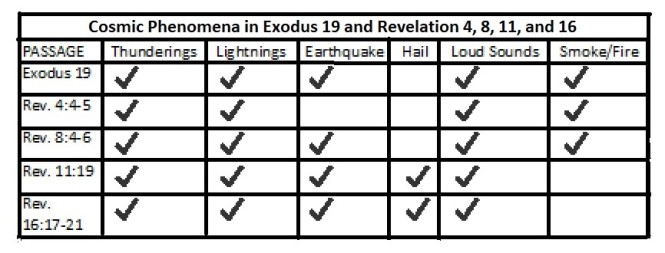
Evidence: The same imagery that was present at the giving of the law, the old covenant, is echoed several times in the book of Revelation (4:5, 8:5, 11:19, and 16:18).

Parallel Scripture Passage: “In that He says, ‘a new covenant,’ He has made the first obsolete. Now what is becoming obsolete and growing old is ready to vanish away” (Hebrews 8:13).

1. The background of these passages is Exodus 19.

a. The children of Israel were camped in the Wilderness of Sinai.
b. This was less than three months after leaving Egypt (verse 1).
c. God spoke to Moses from Mount Sinai.

“…Thus you shall say to the house of Jacob, and tell the children of Israel: ‘You have seen what I did to the Egyptians, and how I bore you on eagles’ wings* and brought you to Myself. Now therefore, if you will indeed obey My voice and keep My covenant, then you shall be a special treasure to Me above all people; for all the earth is Mine. And you shall be to Me a kingdom of priests and a holy nation.’**Then it came to pass on the third day, in the morning, that there were thunderings and lightnings, and a thick cloud on the mountain; and the sound of the trumpet was very loud, so that all the people who were in the camp trembled. And Moses brought the people out of the camp to meet with God, and they stood at the foot of the mountain. Now Mount Sinai was completely in smoke, because the Lord descended upon it in fire. Its smoke ascended like the smoke of a furnace, and the whole mountain quaked greatly (Exodus 19:1-18).

2. God reminded them how He bore the people of Israel “on eagles’ wings”*out of Egypt and to Himself.

*Compare to Revelation 12:13-14, where the persecuted woman was given two wings of a great eagle, that she might fly into the wilderness to her place, where she is nourished for a time and times and half a time, from the presence of the serpent.”

3. God was establishing a covenant with them at this time, and He called them to be “a kingdom of priests and a holy nation.”**

**Compare this with John’s opening greeting to the seven churches, where he says that Jesus “has made us kings and priests to His God and Father” (Revelation 1:6).

4. This meeting on Mount Sinai was for establishing the old covenant.

a. It was marked by thundering and lightning, the sound of a loud trumpet, thick smoke, and the whole mountain quaking greatly.

5. The same cosmic phenomena present at Mount Sinai are seen again in the book of Revelation. Obviously it’s not because the old covenant was being established in John’s day. Rather it’s because the old covenant was being dissolved in John’s day, and a new covenant was being established.

Four Passages That Echo Mount Sinai in Revelation

Echoes of Mount Sinai in Revelation

We will observe these four passages, with some brief notes on their significance:

Revelation 4:4-5

Around the throne were 24 thrones, and on the thrones I saw 24 elders sitting, clothed in white robes; and they had crowns of gold on their heads. And from the throne proceeded lightnings, thunderings, and voices. Seven lamps of fire were burning before the throne, which are the seven Spirits of God.”

a. Who are the 24 elders?
b. Some scholars believe they are the 12 patriarchs of Israel and the 12 apostles.

  • They represent the redeemed of both covenants, united in Christ.

c. The names of the 12 tribes and 12 apostles are written on the gates/walls of New Jerusalem (Rev. 21:12-14).
d. This covenant-establishing imagery takes place in the presence of elders representing both the old and the new covenant ages. 
e. There are seven lamps representing seven Spirits of God. We see the number seven in each instance where these features at Mount Sinai are shown.

Revelation 8:4-6

And the smoke of the incense, with the prayers of the saints, ascended before God from the angel’s hand. Then the angel took the censer, filled it with fire from the altar, and threw it to the earth. And there were noises, thunderings, lightnings, and an earthquake. So the seven angels who had the seven trumpets prepared themselves to sound.”

a. This scene takes place at the opening of the seventh and final seal (Rev. 8:1).
b. It’s likely that these prayers are linked to the cries of the martyrs for God to avenge their “blood on those who dwell on the earth” (Rev. 6:10).

c. If so, the seal judgments are poured out in response to the prayers of God’s people.
d. The covenant-establishing imagery of Mount Sinai appears here because the prayers of the new covenant community were about to result in the old covenant system reaching its demise.

Revelation 11:19

Then the temple of God was opened in heaven, and the ark of His covenant was seen in His temple. And there were lightnings, noises, thunderings, an earthquake, and great hail.

a. This scene takes place at the sounding of the seventh trumpet.
b. The 24 elders are also present at this scene (Rev. 11:15-16).
c. Loud voices declare, “The kingdoms of this world have become the kingdoms of our Lord and of His Christ, and He shall reign forever and ever!”
d. Here is perhaps the most explicit reference connecting the old covenant to prophecies in the book of Revelation.
e. John sees a vision of God’s temple housing “the ark of His covenant.

  • In ancient Israel, the ark of the covenant was a centerpiece of the temple and the old covenant.
  • The ark was located in the Most Holy Place and represented God’s presence.

f. When the judgments are over, what does heaven shout? “Behold, the tabernacle of God is with men, and He will dwell with them, and they shall be His people. God Himself will be with them and be their God” (Rev. 21:3).

  • This did not suddenly become true because buildings fell in 70 AD.
  • Paul told the Corinthian church that they were “the temple of the living God“ (II Corinthians 6:16).
  • The downfall of Israel, Jerusalem, and the temple in 70 AD demonstrated and confirmed that God had chosen the glorious new covenant over the inferior old covenant (see Hebrews 8).

g. In this same passage, John witnesses an earthquake that kills 7000 people in “the city” (Rev. 11:13).

  • This is already identified as Jerusalem: “the great city…where our Lord was crucified“ (verse 8).
  • Josephus wrote about one night in early 68 AD when “a prodigious storm” took place in Jerusalem, marked by “the largest showers of rain, with continued lightnings, terrible thunderings, and amazing concussions and bellowings of the earth, that was in an earthquake.”
  • Josephus added that the Jewish zealots allowed the Idumaeans to come in and help slaughter some of their fellow Jews who opposed their rebellion against the Romans. Between this slaughter and the earthquake, 8500 people died that night (Josephus, Wars 4:4:5, 4:4:7-4:5:1).

Revelation 16:17-21

Then the seventh angel poured out his bowl into the air, and a loud voice came out of the temple of heaven, from the throne, saying, ‘It is done!’ And there were noises and thunderings and lightnings; and there was a great earthquake, such a mighty and great earthquake as had not occurred since men were on the earth. Now the great city was divided into three parts, and the cities of the nations fell. And great Babylon was remembered before God, to give her the cup of the wine of the fierceness of His wrath. Then every island fled away, and the mountains were not found. And great hail from heaven fell upon men, each hailstone about the weight of a talent. Men blasphemed God because of the plague of the hail, since that plague was exceedingly great. 

a. This scene takes place at the pouring out of the seventh bowl.
b. John sees the great city, Jerusalem, divided into three parts.

  • This is a flashback to Ezekiel 5:1-12, when the prophet was required to shave his head and divide it into three parts, and was told by God: “This is Jerusalem” (Ezek 5:5). 
  • One third of his hair was burned, one third was chopped up by the sword, and the last third was scattered into the wind.
  • This was fulfilled when Jerusalem was destroyed in 586 B.C. at the hands of Babylon. Jerusalem was also divided between 67-70 AD into three warring factions: [1] the Zealots, led by Eleazar [2] the Galileans, led by John of Gischala, and [3] the Idumeans,  led by Simon.

c. Revelation 11 described a literal earthquake, and Rev. 16 describes literal hail.

  • A talent was about 75-100 pounds.
  • Josephus wrote of large stones shot from catapults by the Roman armies into the temple complex in Jerusalem. This happened during the 5-month siege from April-August 70 AD.
  • The watchmen in the city reported these stones as appearing white in the sky:

“Now the stones that were cast were of the weight of a talent, and were carried two furlongs and further. The blow they gave was no way to be sustained, not only by those that stood first in the way, but by those that were beyond them for a great space. As for the Jews, they at first watched the coming of the stone, for it was of a white color, and could therefore not only be perceived by the great noise it made, but could be seen also before it came by its brightness” (Josephus, Wars 5:6:3).

  • Josephus also records that the watchmen on the wall, when they saw the stones coming, would shout, “The Son cometh!” After a while the Romans learned to blacken the stones so that they couldn’t as easily be detected, and many more were crushed by these stones. J. Stuart Russell, in his 1878 book titled The Parousia, offers this explanation for the words of the watchmen (p. 482):

“It could not but be well known to the Jews that the great hope and faith of the Christians was the speedy coming of the Son. It was about this very time, according to Hegesippus [110-180 AD], that St. James, the brother of our Lord, publicly testified in the temple that ‘the Son of man was about to come in the clouds of heaven,’ and then sealed his testimony with his blood [in 62 AD]. It seems highly probable that the Jews, in their defiant and desperate blasphemy, when they saw the white mass hurtling though the air, raised the ribald cry, ‘The Son is coming,’ in mockery of the Christian hope of the Parousia.”

To Review

  1. The same phenomena that appeared at Mount Sinai appear repeatedly in the book of Revelation.
  2. They take place at the seventh seal, the seventh trumpet, and the seventh bowl. In Leviticus 26:18, 21, 24, and 28 God promised to punish Israel seven times if they abandoned His covenant. God said He would “execute the vengeance of His covenant” (verse 25).
  3. Other covenant imagery can be seen in these passages in Revelation where the phenomena of Mount Sinai appear.
  4. All of this shows that a major goal of the end times was to completely dissolve the old covenant system and to champion the new covenant age that Jesus established at the cross.

——————————————————-

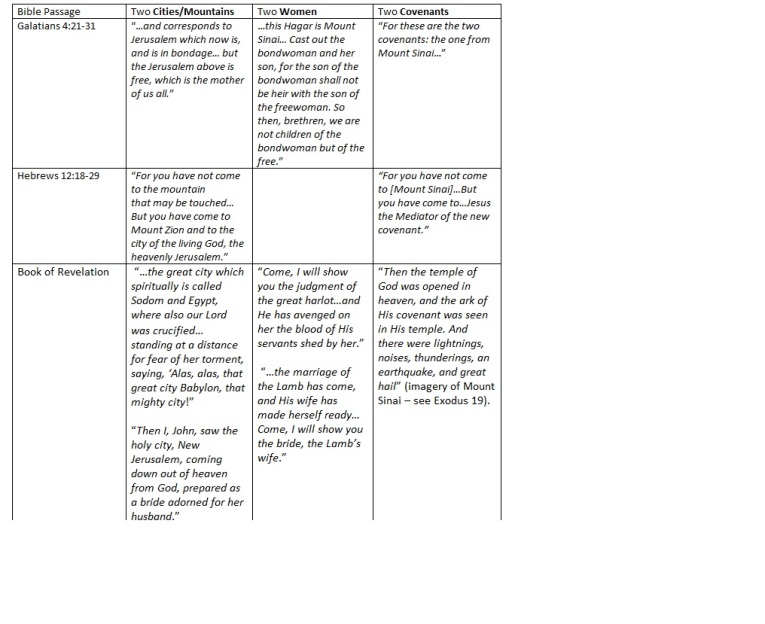
Just as the book of Revelation does, Galatians 4 and Hebrews 12 also contrast Mount Sinai and the new covenant, as well as two cities (earthly Jerusalem and heavenly Jerusalem) and two women (the harlot and the bride of Christ):

For you have not come to the mountain that may be touched and that burned with fire, and to blackness and darkness and tempest, and the sound of a trumpet and the voice of words… But you have come to Mount Zion and to the city of the living God, the heavenly Jerusalem…to the general assembly and church of the firstborn who are registered in heaven…to Jesus the mediator of the new covenant… Now this… indicates the removal of those things that are being shaken, as of things that are made, that the things which cannot be shaken may remain. Therefore, since we are receiving a kingdom which cannot be shaken, let us have grace…” (Hebrews 12:18-28).

“For these are the two covenants: the one from Mount Sinai which gives birth to bondage…and corresponds to Jerusalem which now is…but the Jerusalem above is free, which is the mother of us all… Cast out the slave woman and her son, for the son of the slave woman shall not inherit with the son of the free woman.’ (Galatians 4:27-31).

Two Covenants

—————————————————–

The next post, Part 2, will include the notes that I used in the second half of my presentation, where we looked at Revelation 21:1 – 22:5 as a blueprint for how to walk worthy of God’s kingdom in the New Jerusalem.

“The Great City Babylon…Shall Not Be Found Anymore” (Revelation 18)


Series: “Little Gems from Our Study of the Book of Revelation”

The following study was published yesterday in The Fulfilled Connection (TFC) Magazine, and is adapted from our study of Revelation 18:

Revelation 18 concerns the final and irreversible overthrow of Babylon. My two previous articles in this series reveal much about Babylon and her identity: [1] The Harlot of Revelation 17 and Its Relationship to Old Covenant Israel and [2] The Seven-Headed, Ten-Horned Beast of Revelation 17This article will build on those posts.

Verses 1-2: This chapter begins with a glorious angel announcing to John that Babylon is fallen, and that she is a “dwelling place for demons, a haunt for every unclean spirit, a haunt for every unclean bird, a haunt for every unclean and detestable beast.” Steve Gregg, in his book “Revelation: Four Views (A Parallel Commentary),” states (p. 424):

[This] is known to be true of Jerusalem, which became overrun by demons, as Christ predicted (Matt. 12:38-45), and which, being reduced to ground level, again as Christ predicted (Matt. 24:2), became the haunt of the desert creatures considered unclean in the Jews’ religion.

Verse 3:For all nations have drunk the wine of the passion of her sexual immorality, and the kings of the earth have committed immorality with her, and the merchants of the earth have grown rich from the power of her luxurious living.” Just as the 144,000 of Revelation 14 were called “virgins” because of their faithfulness, Babylon was found guilty of spiritual unfaithfulness. Steve Gregg notes how similar language was used of Jerusalem before falling to Babylon in 586 BC, and deduces what this means for first century Jerusalem as she takes on the name of her old conqueror (pp. 424, 426):

Jerusalem was charged with committing fornication with the kings of the earth (v. 3) in Old Testament times (Ezek. 16:14-15, 26, 28-30; 23:12-21). The prophet used this imagery to explain God’s reason for bringing judgment upon Jerusalem by the hands of the Babylonians in 586 B.C. It would seem appropriate that the New Testament apostle/prophet would employ the same language in describing a near-identical event, the destruction of Jerusalem by the Romans.

As I noted in my previous article, first century historians spoke of Jerusalem’s political greatness, magnificent structures, and wealth. Jerusalem made the merchants of Israel/Palestine wealthy (“ge” in Greek can be translated as “earth” or “land”).

Verse 4: And I heard another voice from heaven saying, ‘Come out of her, my people, lest you share in her sins, and lest you receive of her plagues.’” It’s important to realize that Babylon was not just a city (Jerusalem). John wrote to seven churches in Asia Minor, to people who didn’t live in Jerusalem or even in Israel. So this was not a call to flee from a city, but to part ways with old covenant Judaism once and for all. Babylon represented the unfaithful community which had rejected Jesus and was clinging to the old covenant. Both Jerusalem and temple-based Judaism were judged and destroyed in 70 AD. The Lord’s admonition to “come out of her” is similar to Peter’s words in Acts 2:40: “And with many other words he bore witness and continued to exhort them, saying, ‘Save yourselves from this crooked generation.’” Steve Gregg (p. 428) remarks,

The call to Come out of her, my people (v. 4)…echoes similar exhortations concerning ancient Babylon (cf. Isa. 48:20; Jer. 50:8; 51:6)… The epistle to the Hebrews as a whole (and especially passages like Heb. 12:25-29; 13:13-14) constitutes just such a call as that found here.

Verses 5-6: In these verses Steve Gregg (p. 430) draws three more parallels to Old Covenant Jerusalem:

[1] The statement that her sins have reached to heaven (v. 5) is an apparent allusion to God’s assessment of Sodom in Genesis 18:21, and Sodom has already been used as a symbolic name for Jerusalem (Rev. 11:8).

[2] One of the provisions of the New Covenant was God’s promise that “I will remember no more” the sins and iniquities of His people (Jer. 31:34). This is one of the “better promises” (Heb. 8:6) by which the New Covenant outshines the first. Contrarily, it can be said of her who related to God on the basis of the Old Covenant, and violated it, that God has remembered her iniquities (v. 5). This was Jerusalem.

[3] That God has determined to repay her double (v. 6) for her sins is another link to Jerusalem and Judah, of whom the prophet said, “I will repay double for their iniquity and their sin” (Jer. 16:18) and, “Bring on them the day of doom, and destroy them with double destruction!” (Jer. 17:18).

Verse 7: Here we read of Babylon’s pride, as she says in her heart, “I sit as a queen, I am no widow, and mourning I shall never see.” Compare this to what is written of Babylon in Isaiah’s day: “Now therefore hear this, you lover of pleasures, who sit securely, who say in your heart, ‘I am, and there is no one besides me, I shall not sit as a widow or know the loss of children’” (Isaiah 47:8). Interestingly, Lamentations 1:1 says this about Jerusalem shortly after she fell the first time in 586 BC: “How lonely sits the city that was full of people! How like a widow has she become, she who was great among the nations! She who was a princess among the provinces has become a slave.”

Verse 8: Just like Babylon in Isaiah’s day (Is. 47:9), “Babylon” in John’s day was to receive her plagues “in a single day”: death, mourning, famine, and burning with fire. It’s well documented that these very things took place in Jerusalem’s destruction in 70 AD, and I previously wrote in detail about these events herehere, and here.

Verses 9-10: “And the kings of the earth, who committed sexual immorality and lived in luxury with her, will weep and wail over her when they see the smoke of her burning. Then they will stand afar off, in fear of her torment, and say, ‘Alas! Alas! You great city, you mighty city, Babylon! For in a single hour your judgment has come.’” George Peter Holford, basing his 1805 account on the writings of Josephus, wrote the following about the burning of Jerusalem’s temple in 70 AD:

The Romans, exasperated to the highest pitch against the Jews, seized every person whom they could find, and, without the least regard to sex, age or quality, first plundered and then slew them. The old and the young, the common people and the priests, those who surrendered and those who resisted, were equally involved in this horrible and indiscriminate carnage. Meanwhile the Temple continued burning, until at length, vast as was its size, the flames completely enveloped the whole building; which, from the extent of the conflagration, impressed the distant spectator with an idea that the whole city was now on fire.

Verses 11-14: Verse 11 is the first of five verses which speak of the permanency of Babylon’s fall (cf. verses 14, 21, 22, and 23). Indeed, no one has been able to practice old covenant Judaism since the destruction of the temple in 70 AD.

These verses list 28 different types of cargo which would no longer be found in Babylon, including “human souls” (verse 13). Steve Gregg remarks about this list (p. 436): “The demands of the passage do not require that the city in question be the greatest commercial center in the world—only that it was a wealthy, cosmopolitan trading city, by whose business international merchants were made rich.” These things were certainly true of Jerusalem. In The Life and Times of Jesus the Messiah, Alfred Edersheim writes:

“In these streets and lanes everything might be purchased: the production of Palestine, or imported from foreign lands—nay, the rarest articles from the remotest parts. Exquisitely shaped, curiously designed and jeweled cups, rings, and other workmanship of precious metals; glass, silks, fine linen, woolen stuffs, purple, and costly hangings; essences, ointments, and perfumes, as precious as gold; articles of food and drink from foreign lands—in short, what India, Persia, Arabia, Media, Egypt, Italy, Greece, and even the far-off lands of the Gentiles yielded, might be had in these bazaars. Ancient Jewish writings enable us to identify no fewer than 118 different articles of import from foreign lands, covering more than even modern luxury has devised.”

Duncan McKenzie has much to say about these verses in his 2006 article titled “The Merchandise of the Temple.” The following is an excerpt from that article:

Babylon was not a literal city (not Jerusalem and certainly not Rome). It was a symbol of a community of people, a symbol of God’s unfaithful old covenant community. This community is being represented by images associated with the Temple and the priesthood… Of the items which are listed in Rev 18, gold and silver, precious stones, fine linen, purple, silk (for vestments) scarlet, precious wood, bronze, iron (cf. Deut 8:9), marble cinnamon (as an ingredient of the sacred anointing oil), spices, incense, ointment, frankincense, wine, oil fine meal (Gr. Semidalis, used frequently in Leviticus for fine flour offering), corn, beasts, sheep are all found in use in the temple. Ivory and probably pearls were found in Herod’s temple…

The listing of merchandise in Revelation 18 is similar to the listing of the merchandise of Tyre in Ezekiel 27:12-24, as is the lamenting by those who got wealthy off the respective cities (Ezekiel 27:28-36). In Ezekiel 27 the city of Tyre is pictured as a ship (vv. 5-9) that sinks at sea (vv. 26, 32, 34). In Revelation 18 the Temple system of unfaithful Israel is pictured as a city that is overthrown… Only 15 of the 27 items in Revelation 18:12-13 are the same as the 38 items listed in Ezekiel 27:12-24… There is, however, a connection between the commerce of the Temple and that of Tyre. The currency of Tyre was the only currency allowed in the Temple. Thus Revelation 18’s allusion to the commerce of Tyre may contain an allusion to the commerce of the Temple.

McKenzie also points out that “Revelation 18:13 consists mostly of items that were used in the sacrifices and offerings of the Temple: cinnamon, incense, fragrant oil, frankincense, wine, oil, fine flour and wheat, cattle and sheep.” He has some interesting thoughts on why “bodies and souls of men” are among the merchandise in verse 13:

The leaders of the Jewish temple system were enslaving men’s souls by turning them away from Jesus and attempting to keep them under the old covenant. The Temple hierarchy had been in bed with Rome (so much so that Rome even appointed the high priest)…

Jesus had accused the Jewish leadership of enslaving men’s souls by preventing them from entering the kingdom of God: “But woe to you, scribes and Pharisees, hypocrites! For you shut up the kingdom of heaven against men; for you neither go in yourselves, nor do you allow those who are entering to go in… Woe to you, scribes and Pharisees, hypocrites! For you travel land and sea to win one proselyte, and when he is won, you make him twice as much a son of hell as yourselves. (Matt. 23:13, 15).

In Galatians 4:24-25 Paul tells how those under the old covenant were enslaved, as opposed to those under New Covenant who were free (Gal. 4:26-27). This gets back to the parallel between the two women/cities of Galatians 4:21-31 and the two women/cities of Revelation. Just as the “other woman” in Galatians had children who were enslaved (those staying under the old covenant, Gal. 4:24-25), so harlot Babylon had her slaves.

Verses 15-19: In verse 16 we see that the great city “was clothed in fine linen, in purple and scarlet, adorned with gold, with jewels, and with pearls.” In our study of Rev. 17:4, we saw this same description given to the harlot, Babylon the great (17:1, 5). There we noted that the description of the harlot’s attire was nearly identical to the ephod worn by the high priest (Exodus 28:5-21).

Babylon is referred to again as “the great city” (Rev. 16:19; 17:18; 18:10, 16, 18, 19, 21). This title was first given to Jerusalem in Rev. 11:8, where it’s said that two witnesses would “lie in the street of the great city that symbolically is called Sodom and Egypt, where their Lord was crucified.” In Rev. 18:17-19 we see the “merchants of wares” and the sea traders weeping and wailing as they watch Babylon burn.

Verse 20:Rejoice over her, O heaven, and you saints and apostles and prophets, for God has given judgment for you against her!” This same indictment was given in Rev. 16:4-6 and 17:6, and is repeated again in 18:24. This time “apostles” are included as well as prophets and saints. James, the brother of Jesus, was just one of the apostles martyred in the first century. In 62 AD he was thrown off the temple by the Pharisees and religious leaders, and was then stoned to death. Peter and Paul were martyred by Nero, at the instigation of the Jews.

Jesus clearly prophesied that the martyrdom of the saints and prophets would be held to the account of His first-century audience in Israel: “…that on you may come all the righteous blood shed on earth… Truly, I say to you, all these things will come upon this generation…” (Matt. 23:35-36; cf. Acts 7:52).

Verses 21-23: Once again it is said of Babylon that she “will be found no more.” Here this is demonstrated by a mighty angel throwing a great millstone into the sea. Duncan McKenzie comments, “Seeing the harlot as the old covenant temple system helps to explain Revelation 18:21… The city of Jerusalem has risen again; the old covenant temple system has not risen again (and won’t).”

Verse 24: “And in her was found the blood of prophets and saints, and of all who have been slain on earth.” These words are so similar to what Jesus said in Matthew 23:35 that the connection should be unmistakable. Babylon was judged in 70 AD, just as Jesus said would happen. The one who said she was a queen and would never see sorrow was irreversibly put to death, but God’s dwelling place was found with His new covenant bride.

The Harlot of Revelation 17 and its Relationship to Old Covenant Israel


Series: “Little Gems from Our Study of the Book of Revelation”

UPDATE: This post was written when I understood the scarlet beast of Revelation 17 to be the same as the sea beast of Revelation 13:1-10, the seven kings of Revelation 17:10 to be the first seven Roman emperors, and the 10 horns of Revelation 17:12-14 to be the rulers of Rome’s 10 Senatorial Provinces. I now understand the seven kings to Revelation 17:10 to be the family dynasty of Hezekiah the Zealot, and the 10 horns to be 10 Jewish generals (named by Josephus) who were appointed around January 67 AD to oversee specific territories and to prepare for war with Rome. This post will be updated accordingly when time allows.

The following study was published yesterday in The Fulfilled Connection (TFC) Magazine, and is adapted from our study of Revelation 17 (Part 1):

In Revelation 17, John was shown a woman known as “Babylon the Great”, “the mother of harlots,” and “the great city.” This woman/city has been interpreted in various ways, from the Roman Catholic Church, to New York City, to modern Iraq, to the church in America, etc. This article will discuss a number of reasons why “Babylon the Great” was first century Jerusalem and old covenant Judaism. In doing so, we will look at the first six verses of Revelation 17.

The fall of Babylon was first announced in Revelation 14:8, and Revelation 11:8 identified “the great city” as the place “where also our Lord was crucified,” which, of course, was Jerusalem. Revelation 17-19 describes Babylon’s fall in more detail. This is then followed by a description of the bride, the wife of Jesus, who stands in contrast to the harlot. Note how the following passages deliberately contrast each other:

A. Revelation 17:1: “Then one of the seven angels who had the seven bowls came and said to me, ‘Come, I will show you the judgment of the great prostitute who is seated on many waters.’”

A. Revelation 21:9: “Then came one of the seven angels which had the seven bowls full of the seven last plagues and spoke to me, saying, ‘Come, I will show you the Bride, the wife of the Lamb.’”

B. Revelation 17:3: “And he carried me away in the Spirit into a wilderness, and I saw a woman sitting on a scarlet beast that was full of blasphemous names.”

B. Revelation 21:10: “And he carried me away in the Spirit to a great, high mountain, and showed me the holy Jerusalem coming down out of heaven from God.”

In Revelation 17:2, Babylon is prosecuted for its sexual immorality, by which “the dwellers on earth” and “the kings of the earth” were made guilty. Notice that the reference to “the kings of the earth” here is distinct from the reference to “the kings of the whole world” in Revelation 16:14, where that reference was to the provincial kings of the Roman Empire. In an earlier 3-part series, I discussed 20 instances in Revelation where the phrase “those who dwell on the earth” refers to first century Israel rather than to everyone on the planet (see Part 1, Part 2, and Part 3). 

Verse 3: John then sees a woman sitting on a scarlet beast with seven heads and ten horns. One of my previous articles, “Ten Fulfilled Prophecies Concerning the Beast from the Sea,” makes the case that the beast was Nero in the specific sense and the Roman Empire in the general sense. The fact that the woman is sitting on the beast suggests a very close relationship between the woman and the beast, who are both distinct in their identity. On this topic, I wrote the following elsewhere regarding the woman (Jerusalem) riding the beast (Rome):

In what sense might Jerusalem have sat on the beast that would ultimately turn on her and destroy her (Rev. 17:3, 9, 16-18)? Israel had enjoyed a good relationship with Rome until the Jewish revolt began in 66 AD, and Judaism was recognized as a valid religion within the Roman Empire. Josephus wrote of this relationship, “It seems to me to be necessary here to give an account of all the honors that the Romans and their emperors paid to our nation [Israel], and of the leagues of mutual assistance they have made with it” (Antiquities, 14.10.1-2). The Jews frequently took advantage of this relationship to induce persecution against Jesus and His followers (Luke 23:2; John 18:28-31, 19:15; Acts 4:27, 16:20, 17:7, 18:12, 21:11, 24:1-9, 25:1-2). W.H.C. Frend even writes that “the promptings of orthodox Jews in the capitol had something to do with” Nero’s decision to begin persecuting Christians in 64 AD (The Rise of Christianity [Philadelphia: Fortress, 1984], 109; quoted in Kenneth Gentry, Before Jerusalem Fell, 2002, p. 63).

Kenneth Gentry suggests that the beast was the color scarlet for any of the following reasons: [1] The robes worn by Roman emperors were red in color [2] Rome, led by Nero, was responsible for shedding much blood among God’s people [3] Nero was famous for his red beard.

Verses 4-5: The woman wore purple, scarlet, gold, jewels, and pearls. She had in her hand a golden cup “full of abominations and the impurities of her sexual immorality.” Her forehead proclaimed that she was “Babylon the great, mother of prostitutes and of earth’s abominations.” According to Todd Dennis, the founder of the Preterist Archive,

…the description of the harlot’s attire (purple, scarlet, gold, jewels, and pearls) was nearly identical to the ephod worn by the high priest (Revelation 17:4; cf. Exodus 28:5-21). The golden cup she held was likely symbolic of the temple vessels, the greatest part of which were gold and silver, according to the Jewish historian Josephus (Wars 5.4.4). On Aaron’s forehead was the inscription “Holy to the Lord” (Exodus 28:36). The harlot’s forehead, on the other hand, bore the title “Babylon the great, mother of prostitutes and of earth’s abominations” (Rev. 17:5).

In Jeremiah’s day, Judah (with its capital of Jerusalem) was prosecuted because it had “played the whore with many lovers” and “polluted the land with…vile whoredom” (Jeremiah 3:1-2). Like Israel in John’s day, Judah prior to its fall in 586 BC had “the forehead of a whore” (verse 3).

Duncan McKenzie’s article has helped me to understand that “Babylon the Great” here was more than just a physical city. It was also a religious system full of abominations, old covenant temple-based Judaism. In Revelation 18 God commands His people regarding Babylon, “Come out of her, my people, lest you take part in her sins, lest you share in her plagues” (Rev. 18:4). We know from Revelation 1 that John’s immediate audience didn’t live in Jerusalem, but in Asia Minor. So this was not a command to flee from the city of Jerusalem.

God’s message was about breaking completely free from old covenant temple-based Judaism. Babylon represented not only Jerusalem, but also the unfaithful community which had rejected Jesus and the new covenant. Both physical Jerusalem and temple-based Judaism were judged and destroyed in 70 AD. In Daniel 9:26-27 we see that it is on “the wing of abominations” that one comes “who makes desolate” (see also Rev. 17:16, Matt. 23:38). This was related to the destruction of “the city and the sanctuary” (Daniel 9:24). The abominations of the earth (land) were the apostate practices of old covenant Judaism.

As mentioned earlier, John was shown a contrasting picture of two women: the harlot of chapters 17 and 18, and the bride in chapter 19 clothed with “fine linen, bright and pure…the righteous deeds of the saints” (see verses 1-8). One (the harlot) persecuted the other (the bride, Christ’s Church). What is most fascinating is Paul’s own contrasting of two women in his epistle to the Galatians:

Tell me, you who desire to be under the law, do you not listen to the law? For it is written that Abraham had two sons, one by a slave woman and one by a free woman. But the son of the slave was born according to the flesh, while the son of the free woman was born through promise. Now this may be interpreted allegorically: these women are two covenants. One is from Mount Sinai, bearing children for slavery; she is Hagar. Now Hagar is Mount Sinai in Arabia; she corresponds to the present Jerusalem, for she is in slavery with her children. But the Jerusalem above is free, and she is our mother. For it is written, “Rejoice, O barren one who does not bear; break forth and cry aloud, you who are not in labor. For the children of the desolate one will be more than those of the one who has a husband.” Now you, brothers, like Isaac, are children of promise. But just as at that time he who was born according to the flesh persecuted him who was born according to the Spirit, so also it is now. But what does the Scripture say? ”Cast out the slave woman and her son, for the son of the slave woman shall not inherit with the son of the free woman.” So, brothers, we are not children of the slave but of the free woman (Galatians 4:21-31).

Just as Paul wrote in Galatians 4, we see in Revelation that God casts out and destroys the harlot (Revelation 18:21), but the bride inherits the Lamb as her husband.

Verse 6: The woman is said to be “drunk with the blood of the saints, the blood of the martyrs of Jesus.” This same charge was laid upon those of “the earth” in the previous chapter (Rev. 16:1), where it was said that “they have shed the blood of saints and prophets (16:4-7).” In chapter 18 we also see that “in her was found the blood of prophets and of saints, and of all who have been slain on the earth” (18:24), and that the “saints and apostles and prophets” were told to rejoice over her destruction (18:20). Who was responsible for shedding all the blood of the prophets, apostles, and the saints, according to Jesus, and who would receive judgment as a result? The answer can be found in Matthew 23:

Woe to you, scribes and Pharisees, hypocrites! For you build the tombs of the prophets and decorate the monuments of the righteous, saying, ‘If we had lived in the days of our fathers, we would not have taken part with them in shedding the blood of the prophets’” Thus you witness against yourselves that you are sons of those who murdered the prophets. Fill up, then, the measure of your fathers. You serpents, you brood of vipers, how are you to escape being sentenced to hell? Therefore I send you prophets and wise men and scribes, some of whom you will kill and crucify, and some you will flog in your synagogues and persecute from town to town, so that on you may come all the righteous blood shed on earth, from the blood of innocent Abel to the blood of Zechariah the son of Barachiah, whom you murdered between the sanctuary and the altar. Truly, I say to you, all these things will come upon this generation. O Jerusalem, Jerusalem, the city that kills the prophets and stones those who are sent to it! How often would I have gathered your children together as a hen gathers her brood under her wings, and you would not! See, your house is left to you desolate (Matthew 23:29-38).

The harlot is not a 21st century entity, but was the first century old covenant community. As God’s people, those of us who are in Christ today have the privilege of being part of the pure woman, God’s bride.

Comparing Matthew 24 and I Thessalonians 4-5


Today a Facebook friend, Chris Palios, shared a chart comparing Matthew 24 and I Thessalonians 4-5. I’ve seen this comparison before, and his post was a good reminder that I’ve been meaning to post it here as well. As Chris said, the similarities between these two passages are fascinating.

While it’s still popular to view Matthew 24 as yet unfulfilled, there are plenty (and even more in church history) who recognize that Jesus was prophesying there concerning Jerusalem’s destruction in 70 AD and other events which would take place within His own generation. [A detailed study on the Olivet Discourse (Matthew 24, Mark 13, and Luke 21) can be seen at the top of this page.] However, among those who view Matthew 24 as fulfilled, some believe that I Thessalonians 4-5 speak of future events. Here is the well-known passage that speaks of the resurrection of believers, which others take as being about a “rapture”: 

For this we say to you by the word of the Lord, that we who are alive and remain until the coming of the Lord will by no means precede those who are asleep. 16 For the Lord Himself will descend from heaven with a shout, with the voice of an archangel, and with the trumpet of God. And the dead in Christ will rise first. 17 Then we who are alive and remain shall be caught up together with them in the clouds to meet the Lord in the air. And thus we shall always be with the Lord. 18 Therefore comfort one another with these words” (I Thessalonians 4:15-18).

As I’ve promised Steve (who posted a 3-part series here as a guest last year), a deeper study on the resurrection of believers is still in the works. For now, though, here is a chart showing the strong similarities between Matthew 24 and I Thessalonians 4-5. The relationship is so close that I don’t believe it’s possible to view one passage as being fulfilled in the first century AD and the other as not yet fulfilled:

Statements Regarding Jesus’ Coming Reference in Matthew 24 Reference in I Thess. 4 or 5
1. Christ Himself returns Matthew 24:30 I Thess. 4:16
2. From heaven Matthew 24:30 I Thess. 4:16
3. With a shout Matthew 24:30 I Thess. 4:16
4. Accompanied by angels Matthew 24:31 I Thess. 4:16
5. With the trumpet of God Matthew 24:31 I Thess. 4:16
6. In clouds Matthew 24:30 I Thess. 4:17
7. Believers are gathered Matthew 24:31 I Thess. 4:17
8. At an unknown time Matthew 24:36 I Thess. 5:1-2
9. He will come as a thief Matthew 24:43 I Thess. 5:2, 4
10. People unaware of coming judgment Matthew 24:37-39 I Thess. 5:3
11. Judgment comes as travail upon an expectant mother Matthew 24:8 I Thess. 5:3
12. Believers are to watch Matthew 24:42 I Thess. 5:4
13. Warning against drunkenness Matthew 24:49 I Thess. 5:7

Zechariah 12 Fulfilled


This post is in response to recent and past questions about whether or not the prophecies of Zechariah 12 have been fulfilled. At a later time I may do my own in-depth study of this passage, but this post draws on a few studies done by others who believe that Zechariah 12 was fulfilled in the first century AD. Here are a couple of questions to consider regarding Zechariah 12-14:

1. Did Zechariah speak of only earthly Jerusalem throughout these three chapters, or did he shift at any time to speaking about the new/heavenly Jerusalem?
2. Did Zechariah possibly have a glimpse of the revelation that Paul had in Galatians 4:21-31, when he spoke of two Jerusalems; one that was in bondage and ready to be cast out, and one that was free and is the mother of God’s people? Isaiah had this revelation to some degree (see Isaiah 65:17 – 66:24).

A. In the first study I’d like to present, Don K. Preston discusses Zechariah 12 in conjunction with Revelation 1:7, a related passage, and gives some historical and contextual background for Zechariah 12:

It seems to have escaped the notice of those who offer Revelation 1:7 as proof of a yet future coming of Jesus that this verse is taken directly out of the book of Zechariah; and as we shall see Jesus also uses this verse in the great eschatological discourse of Matthew 24. Surely the Bible student will want to be fully aware of how the verse is used in those contexts.

In Zechariah 12:10 the Spirit is speaking of a time which he designated as “in that day.” This little term is used extensively by the prophet and is a limiting factor for everything which he discusses. Some of the “in that day” statements are confessedly enigmatic; but enough of them are sufficiently specific as to subject or time that there can be no misunderstanding.

1. “In that day” was to be when God would “break my covenant made with all the people” (Zech. 11:7-11). This is undeniably when the Old Covenant would pass.

2. “In that day” would be “when they shall be in the siege both against Judah and Jerusalem” (12:1).

3. “In that day would be when “there shall be great mourning in Jerusalem” (12:11).

4. “In that day” would be when “there shall be a fountain opened to the house of David…for sin and for uncleanness” (13:1).

5. “In that day” would be when God would “cause the prophets and the unclean spirit to pass out of the land” (13:2).

6. “In that day” would be when the shepherd would be smitten and the sheep scattered (13:6-7).

7. “In that day” would be when only a remnant would be saved (13:8).

8. “In that day” would be when God would “gather all nations against Jerusalem to battle,” (14:2).

9. “In that day” “living waters would go out from Jerusalem” (14:8).

10. “In that day” there would be only one God and one Lord (14:9).

… Is it not patent that all the above… happened in one generation? How then can one divorce the appearance of the Messiah, when they would look on him whom they had pierced, from that same fateful generation?

Interestingly, John the author of Revelation used Zechariah 12:10 on another occasion. In John 19:37 as Jesus hung on the cross the Lord’s favorite apostle records the event as fulfillment of Zechariah’s words. This application of a single prediction to two events is not unknown in scripture… For John, Zechariah 12:10 was applicable to Jesus’ crucifixion; but it would receive final fulfillment when “all the tribes of the earth” would mourn when they looked on him whom they had pierced. To John this would be when Jesus returned in the clouds of glory.

Jesus and Zechariah 12:10

As shown, Zechariah 12:10 is the background for Revelation 1:7 and the context demands the event be in the first century generation. But our Lord also employed the language of Zechariah/Revelation in such a way that all controversy as to WHEN it would happen should be dispelled. In the famous apocalypse of Matthew 24 our Lord predicted the destruction of Jerusalem… 

In Matthew 24:29-31 Jesus adopts the classical style of Jewish apocalyptic literature in describing the fall of the Theocracy. In verse 30 Messiah quotes Zechariah 12:10 as occurring when the Son of Man would be seen “coming in the clouds of heaven with power and great glory.” Now notice the emphatic time statements. In verse 32 Jesus tells the parable of the fig tree. When the predicted events began to be seen by the apostles and disciples they were to “know it is near, even at the doors.” He then [states] in positive terms, “Verily, I say unto you, This generation shall not pass away, until all these things shall be fulfilled” (v.34). Our Lord has specifically told us when he would come with the clouds, cf. Rev.1:7, when he would be seen by all those who pierced him. It would be in his generation.

In confirmation of the time frame of his coming with the clouds in judgment one needs to examine Matthew 16:27-28 and compare Revelation 22:12. There is absolute harmony and unity between all these verses. In Matthew 16:27-28 Jesus promised to return in judgment with the angels in the lifetime of his disciples. In Matthew 24 he promised to come and be seen by those who had pierced him and it was to be in that generation. In Revelation he would be seen by those who had pierced him and, “Behold, I come quickly, and my reward is with me to give to every man according as his work shall be,” Rev.1:7; 22:12.

How can one objectively examine these texts and ignore the time frame so inextricably woven into the text? Upon what basis can one say that while Jesus in Matthew 24 cited Zechariah 12 as to be fulfilled at his return in Jerusalem’s fall, that in Revelation, although it emphatically tells us it would shortly come to pass (l:l-3) it has not yet been fulfilled?

Notice the correlation between the theme of the three texts. In Zechariah we are dealing with a time when Jerusalem would be surrounded and besieged, 12:2,11; 13:8ff; 14:2. In Matthew 24 the subject is the destruction of Jerusalem, 24:1-3. In Revelation the theme is the destruction of the great city “where our Lord was crucified,” 11:8. In all three texts you have the coming of the Lord, Zech.14:3-5; Matthew 24:29-31; Revelation 1:7. In each of the texts those who pierced him would see him, Zechariah 12:10,Matthew 24:30, Revelation 1:7. And of course at the risk of being repetitious, all three [accounts of this event] were set in a specific time frame – “in that day.” Zech.12; “this generation shall not pass away,” Matthew 24:34; and “the time is at hand,” Rev.1:3

B. The second article I’d like to share is on one of Don K. Preston’s websites, but features the writings of Frank Speer and Ed Stevens as they address an article by Thomas Ice titled “Preterism and Zechariah 12-14.” Frank Speer lists some of the “difficulties that arise from taking a yet future approach to Zechariah chapters 12-14”:

• The battle described in these chapters is waged on HORSEBACK (12:4) with SWORDS! (13:7) Is that how the COMING 21st century Great Tribulation is to be fought?

• Modern Jews do not and will not live in “TENTS” (12:7).

• Modern Jewish people CAN NO LONGER BE divided by their 12 ancestral tribes (12:6-14) since those tribes have long since been genetically diluted – the Jewish peoples of today simply CANNOT be equated with ancient, biblical Israel.

• Zech 13:1 is clearly speaking of “The Cross of Christ” (i.e. a first century event). Has there been no Messianic “fountain” of forgiveness available to the Jewish people since the cross?? Have they been made to wait all this time and then some (until Messiah’s STILL FUTURE RETURN) to have access to divine forgiveness of sin?

• The modern Jews do not and will not worship then “many Idols” mentioned in (13:2) – today’s Jews are mostly atheistic.

• There are no modern Jewish “prophets” (13:2) – nor will there be.

• (13:4) – Will false Hebrew prophets wearing “HAIRY ROBES” soon appear in modern day Palestine in order to deceive a mass of Jewish peoples? …

• (13:3) – The modern Jewish peoples do not obey these ancient “Mosaic Laws” (parents killing children for false predictions etc)!

• (13:4-5) – Will “SLAVERY & AGRICULTURE” once again become COMMON PRACTICE for 21st century Palestinians and ALL NATIONS OF THE WORLD??

• Is the modern Palestinian Economy…based on GOLD, SILVER, FABRIC, HORSES, MULES, CAMELS, DONKEYS AND CATTLE?? (14:14-15)

• Notice that the “ALL NATIONS” of 14:1 are QUALIFIED later by “all the SURROUNDING nations” in 14:14. There is no mention here of ALL THE MODERN NATIONS OF THE 21st CENTURY WORLD! These ancient “Middle Eastern nations” surrounding ancient Israel were the same constant thorns Israel dealt with through their entire history!!

• (14:16) Will the modern Jewish peoples, under Messiah, be keeping all of the Old Covenant “feasts” when the N.T. writers (under the inspiration of the Holy Spirit) clearly state that such things were merely TEMPORARY TYPOLOGICAL TUTORS intended to lead Israel to Christ??

Will Christ then, in the future, lead the “modern Jewish Christians” and ALL THE NATIONS OF THE MODERN WORLD backwards – to those ancient and “rudimentary things” ( Gk: “stoicheion” – Col 2:8, 20; 2 Pet 3:10) that only served to point to Messiah, the cross, the resurrection, etc.???

The N.T. writers tell us that a RETURN to the Mosaic Economy (the OLD covenant system) would be to apostatize from Christ and to INVALIDATE the cross of Christ!!

• (14:16) – Will “all the nations” [of the entire modern world] soon be “GOING UP” to the modern city of Jerusalem each year to celebrate the Jewish feasts?? How will we all FIT??

Will ALL THE NATIONS OF THE WORLD soon SUDDENLY become AGRARIAN BASED in order to begin THE ANNUAL PLANTING AND HARVESTING CYCLE necessary to keep the feast of booths (tabernacles) yearly? Because, if we do not, God is going to bring PLAGUES upon all those wicked nations and destroy their crops by withholding rain on their crops. (14:17-20)

• Is modern Israel under Messiah going to return to bloody ANIMAL SACRIFICES (the NT says that would be nothing short of “blasphemous” – (study the Book of Hebrews)?

Don K. Preston then quotes from Thomas Ice, who argues that Zechariah 12-14 shows Israel being rescued, not judged, and therefore this passage can not be speaking of events related to the Jewish-Roman War of 66-73 AD. According to Ice, those who say that Zechariah 12-14 has been fulfilled teach “in essence…that the Church had replaced Israel.” He says that preterists have made two errors: [1] believing that Zechariah speaks of “God’s judgment at the hands of the Romans in AD 70 upon Israel,” and [2] failing to see that “Zechariah 12-14 clearly speaks of a time when Israel is rescued by the Lord from an attack by ‘all the nations of the earth,’ not just the Romans” (Ice, of course, should realize that the Roman Empire did absorb many nations and made up most of the known world at the time). 

Ed Stevens then responds to the arguments of Thomas Ice:

Mr. Ice…assumes that ALL preterists (partials and fulls) are guilty of “replacement” theology (when in fact, almost all full preterists, as far as I know, are teaching “remnant” theology). We believe that God did not cut off ALL Israel from his Olive Tree. There was a righteous remnant left who did accept Jesus as their Messiah. Into that righteous remnant of True Israel (the Spiritual Israel) the Gentiles were grafted, in order to make the Jews jealous and entice them to be grafted back into their native Olive Tree and save some of them. Together with the engrafted Gentiles and the re-grafted Israelites, this righteous remnant became the ALL ISRAEL that inherited the promises.

He assumes that the Jerusalem mentioned in Zechariah is the physical city of Jerusalem (when in fact it is talking about the New Heavenly Jerusalem mentioned in Hebrew 12 and Revelation 21-22). 

He assumes that the references to “Israel” in Zech are the physical nation of Israel (when in fact it is talking about the New True Spiritual Israel that Paul refers to in the book of Romans 2, and chs. 9-11, as well as the allegory in Gal. 4).

He forgets about the Neronic persecution (AD 64) when both Rome and the Jews combined forces against the Church to destroy her and wipe her off the map. Jesus said in Matthew 24 that unless those days had been cut short, they would have succeeded. Sure enough, two years later (AD 66) the Jewish War broke out and Rome turned its attention away from hunting Christians, to attacking the Jews.

He forgets that by the first century the Hebrew people had become a melting pot of ALL NATIONS, especially in the Diaspora (Persia, India, Africa, Turkey, Greece, Rome, France, Spain, Britain, Germania, Scythia, Armenia, etc.). Just look at the description in Acts 2 of all the nations where “Jews” came from. There were Jewish communities scattered all over Europe, Asia, and Africa. When the Neronic persecution broke out, every Jewish community in the Diaspora (among “all the nations”) took advantage of the opportunity to wipe out the Christians, and used Roman authority to do it. They  were just like the wicked Haman of the book of Esther who plotted to wipe out all the Jews. That was when “all the nations” (Diaspora Jews) came against God’s people (the Christians, the New Jerusalem, the true Spiritual Israel) in the Neronic persecution (AD 64). But God turned the tables on the Hamanites. Less than two years later (AD 66) the Jews revolted, and God brought the Romans to wipe out “all the nations” (Diaspora Jews) who had come up against His true spiritual people.

Because Tommy Ice does not know his history nor understand prophetic language, he does not realize that “all the nations” which came against the True Israel and the New Jerusalem, really were destroyed by the Romans. In AD 66, when the war broke out, Diaspora Jews were forced to flee from “all the nations” where they had been scattered and take refuge in Israel. When they got back to the land, they joined the revolt and ended up being killed and enslaved afterwards.

[I don’t agree with Stevens’ final paragraph and did not include it here.]

C. Don K. Preston has another article on this topic titled, “Was Zechariah 12:3 Fulfilled in AD 70?” I’ll quote just a couple of portions from that article:

Our understanding of Zechariah is aided by the prophet’s references to “in that day.” These temporal parameters place fulfillment within the borders of a single generation, the first century generation. There are, if my count is correct, some 19 references to “in that day” in Zechariah. Space forbids an extensive examination of the “in that day” references. However, notice that the “in that day” references of chapter 12 take us directly back to chapter 11. In chapter 11 we find the betrayal of Jesus at the hands of Judas, who was paid the thirty pieces of silver (Zechariah 11:12-13). This in turn would be when YHVH would abandon His covenant “with both houses of Israel” (Zechariah 11:6-10), when they would eat their own flesh in the siege that was coming.

This is confirmed by Jesus’ application of Zechariah 12:10 to the fall of Jerusalem in Matthew 24:30, 34, and by John’s application of the same verse to the time when “those who pierced him” would look on him and mourn, in the destruction of the city “where the Lord was slain” (Revelation 1:7; 11:8)…

Please note: This judgment that is described, when the citizens of Jerusalem would eat the flesh of their own children, was to be part of the Mosaic Covenant provisions of wrath for violation of the Mosaic Covenant (Deuteronomy 28:52-57). Here is what is so critical about this fact: All dispensationalists agree that the Mosaic Covenant has been abrogated!

Thomas Ice affirms that the Torah was “forever fulfilled and discontinued in Christ” (Prophecy Watch, Eugene, Or. 1998, 258)! He acknowledges of the AD 70 catastrophe:  “Those first century days are called the ‘days of vengeance’ for Jerusalem is under the divine judgment of covenantal sanctions recorded in Leviticus 26 and Deuteronomy 28. Luke notes that God’s vengeance on His elect nation ‘is in order that all things that are written may be fulfilled.’ Jesus is telling the nation that God will fulfill all the curses of the Mosaic Covenant because of Israel’s disobedience. He will not relent and merely bring to pass a partial fulfillment of His vengeance” (Thomas Ice/ Kenneth Gentry, The Great Tribulation , Past or Future? Grand Rapids, Kregel, 1999).

…Here is the issue: All millennialists say the Law of Moses has been abrogated. Yet, Zechariah’s prediction of the assault on Jerusalem would be the fulfillment of the Mosaic Covenant… Zechariah had to be fulfilled at a time when Torah was still in effect.

ROME WAS NOT ALONE!

When our millennial friends take note that Zechariah 12 mentions “all the nations of the earth” it is perfectly justified to ask if they mean “all”? Do they mean that America will fight against Jerusalem? If not, why not? Do they mean that the 17 smallest countries in the world, most of which have no armies, will join the battle? If, after all, one is going to insist that  “all the nations” means literally, every nation on earth, then to be consistent, one must argue that every South American country, the USA and every other country on the globe will join in…

In fact, Josephus records that Titus had ten cohorts of  auxiliary troops from kings of different countries, such as Arabia, Syria and other countries (Wars, Bk. 4, chapter 4, Whiston, p. 642). In other words, it was the kings of the earth that gathered against literal Jerusalem!

A TALE OF TWO CITIES

It is critical to honor the fact that in Zechariah (and other OT prophetic books), there is what I call the doctrine of Two Jerusalems… What this means is that in some texts there is a seeming conundrum. On the one hand Jerusalem is destroyed, and yet in the same texts, Jerusalem is delivered! This apparent difficulty is resolved by understanding that Old Covenant Jerusalem was to perish, while the heavenly Jerusalem would be delivered. Galatians 4:22f; Philippians 3; Hebrews 12, and Revelation are some of the NT texts that teach this. This suggestion well explains the situation in Zechariah. The Old Jerusalem would indeed be desolated, in the final outpouring of Mosaic Covenant wrath. Yet, the Jerusalem that is above, the True Jerusalem, would be delivered, and it would be in her that deliverance, the fountain for sin would be opened for salvation (Zechariah 13:1f)…

Zechariah’s prophecy demands that it was fulfilled in the first century, “in that day” when Judas betrayed the Lord. The context demands that the prophecy was fulfilled at a time when the Mosaic Law was still in effect. The judgment described is Mosaic Covenant Wrath. The “kings of the earth” did in fact support Rome’s assault. Finally,  the doctrine of the Two Jerusalems demands the passing of the Old Jerusalem, but the deliverance of the New Covenant Jerusalem. This happened in AD 70.

What do you think? Does the idea of two Jerusalems, one earthly and one heavenly, help to explain Zechariah’s prophecy? Is Zechariah 12 more clear when it’s viewed in relation to the two passages where it’s quoted – Matthew 24:30 and Revelation 1:7? In the near future, I also plan to post a 3-part study by Gary DeMar on Zechariah 14.

Revelation 12:4-5 (Addendum to Earlier Study)


A couple days ago a friend pointed out that our study on Revelation 12 was missing commentary on verses 4-5 from a fulfilled (preterist) perspective. Whatever my reason for skipping those verses at the time (November 2009), it was a good reminder to add them now. The following study of Revelation 12:4-5 has been edited into our study of Revelation 12:1-17.

Introduction

This is a glossary of terms we included in our original study of Revelation 12:

Woman = [1] Old Testament Israel (i.e. the faithful remnant among the Israelites); and [2] later God’s people, the remnant among the nations, after Christ’s death and resurrection
Dragon = Satan, influencing Rome
Male Child = Jesus Christ

In verses 1-3 John was shown a vision of “a woman clothed with the sun, with the moon under her feet, and on her head a garland of twelve stars.” She was in painful labor. In that vision, John also saw “a great, fiery red dragon having seven heads and ten horns, and seven diadems on his heads.” We noted that this is very similar to the description of the beast (Revelation 13:1) who received authority from the dragon (Rev. 13:2).

A Study of Revelation 12:4-5

Verse 4: In the first half of verse 4, speaking of the dragon with seven heads and 10 horns, we read:

“His tail drew a third of the stars of heaven and threw them to the earth.”

There is reason to believe that these “stars” are angels. In Revelation 1:20, stars are seen as angels: “…The seven stars are the angels of the seven churches…” Here in verse 4, the dragon is able to throw stars (angels) to the earth, but in verses 9-12 we see that “the great dragon…that serpent of old, called the Devil and Satan” would himself later be cast out of heaven to the earth, along with his angels.

Some believe that verse 4a is parallel to Jude 6:

And the angels who did not keep their proper domain, but left their own habitation, He has reserved in everlasting chains under darkness for the judgment of the great day.”

Others see a parallel to Daniel 8:10, which speaks of “a little horn” (Antiochus Ephiphanes, a Greek king of the Seleucid Empire from 175 – 164 BC):

And out of one of [the four horns] came a little horn which grew exceedingly great toward the south, toward the east, and toward the Glorious Land. And it grew up to the host of heaven; and it cast down some of the host and some of the stars to the ground, and trampled them…” (Daniel 8:10-11).

Albert Barnes, in his 1834 commentary on Revelation 12, took note of this parallel and wrote the following:

“The main idea here undoubtedly is that of power, and the object of John is to show that the power of the dragon was as if it extended to the stars, and as if it dragged down a third part of them to the earth, or swept them away with its tail, leaving two-thirds unaffected. A power that would sweep them all away would be universal; a power that would sweep away one-third only would represent a dominion of that extent only… Suppose, then, that the dragon here was designed to represent the Roman pagan power; suppose that it referred to that power about to engage in the work of persecution, and at a time when the church was about to be greatly enlarged, and to fill the world; …the conditions here referred to would be fulfilled…

The second half of verse 4 may be a reference to Herod’s attempt to kill Jesus by enforcing the death of all Hebrew children below age 2:

“And the dragon stood before the woman who was ready to give birth, to devour her Child as soon as it was born.”

In Matthew 2:1-18 we read about the wise men from the east who came to Jerusalem asking about the birth of the King of the Jews (verses 1-2). This troubled Herod, who quizzed the chief priests and scribes and found out that, according to Micah 5:2, the Messiah was to be born in Bethlehem (verses 3-6). He instructed the wise men to find the Child, Jesus, and to let him know where he was (verses 7-8). However, the wise men were warned in a dream not to return to Herod (verse 12), and Herod, when he discovered that they had deceived him, put to death all children below the age of two throughout Bethlehem and its districts (verses 16-18). Joseph and Mary had already been warned in a dream to take Jesus and flee to Egypt (verses 13-15).

Duncan McKenzie, on the other hand, believes this is a reference to Jesus’ resurrection from the dead:

In Revelation 12 we are being shown this “birthing” of the Messiah. The male Child, after being born, is caught up to God’s throne. Once again what is being shown here is not Jesus being born on earth, but His being “born” when God the Father raised Him from the dead (Acts 13:33).* Thus, as soon as the male Child is delivered He is caught up to God’s throne. Jesus referred to the birthing analogy in talking about His death and resurrection in John 16:20-22. Notice how the dragon (Satan, Rev. 12:9) was expecting to devour the male Child. Satan thought he would be destroying Jesus at the cross. Instead the Child is caught up to the throne of God. Jesus was exalted to the right hand of God the Father at the resurrection (Acts 2:31-36). Satan, instead of devouring the Child as he had planned, ends up being cast out of heaven (Rev. 12:9).

*Acts 13:33 reads this way: “God has fulfilled this for us their children, in that He has raised up Jesus. As it is also written in the second Psalm: ‘You are My Son, today I have begotten You.’”

Verse 5: The first half of verse 5 refers to the birth of Jesus, either by Mary (specifically) or through the seed of Abraham (generally). The second understanding is to be preferred when we note the progression of what happens to this woman – [1] giving birth to Jesus and [2] later being protected in the wilderness for 3.5 years (verses 6, 13-17). The first part of verse 5 is also parallel to Psalm 2:9 and Revelation 19:15.

“She gave birth to a male child, one who is to rule all the nations with a rod of iron…”

Psalm 2 is a Messianic prophecy about the coming reign of Jesus, of whom the Father would say, “You are My Son, today I have begotten You” (verse 7). Jesus would be set on God’s “holy hill of Zion” as King (verse 6), would receive the nations as His inheritance (verse 8), and would “break them with a rod of iron” and “dash them in pieces like a potter’s vessel” (verse 9).

This prophecy is repeated in John’s vision of Christ sitting on a white horse, judging and making war (Revelation 19:11). The armies in heaven would also follow Him riding on white horses (verse 14), and a sharp sword would come out of His mouth, which He would use to “strike the nations” and “rule them with a rod of iron” (verse 15).

The second half of verse 5 refers to Jesus’ ascension (Acts 1:9-11).

“And her Child was caught up to God and to His throne.”

Acts 1:9 records Jesus being “taken up” and received by a cloud out of the disciples’ sight. Two angels confirm that He was taken “into heaven” (verse 11). Daniel 7:13-14 reveals that He then appeared before the throne of His Father and was given the everlasting kingdom:

I was watching in the night visions, and behold, One like the Son of Man, coming with the clouds of heaven! He came to the Ancient of Days, and they brought Him near before Him. Then to Him was given dominion and glory and a kingdom, that all peoples, nations, and languages should serve Him. His dominion is an everlasting dominion, which shall not pass away, and His kingdom the one which shall not be destroyed.”

As Daniel reveals, this kingdom was then promised to “the saints of the Most High” (Daniel 7:18). The “time came for the saints to possess the kingdom” when the horn and the fourth beast was making war against them and prevailing “until the Ancient of Days came, and a judgment was made in favor of the saints” (verses 21-22; see also Revelation 13:5-7 and Matthew 21:43). The fourth beast and the persecuting horn would prevail over the saints for 3.5 years (“a time and times and half a time”) before his dominion would be taken away and the saints would receive the kingdom (Daniel 7:25-27).

Revelation 12:6-17 goes on to record a Satanic battle leveled against God’s people, which would precede the giving of the kingdom into the hands of the saints (Daniel 7; Revelation 11:15).

————————————————————————————————–

The rest of our study on Revelation 12 can be found here, including a comparison of the preterist (fulfilled) view, the futurist view, and the historicist view.

All of our Revelation chapter-by-chapter studies, and any other posts related to the book of Revelation, can be found here.

The Mystery of God (Revelation 10:7) Has Long Been Finished


Series: “Little Gems from Our Study of the Book of Revelation”

The following study was published yesterday in The Fulfilled Connection (TFC) Magazine, and was adapted from our study of Revelation 10:

“…in the days of the sounding of the seventh angel, when he is about to sound, the mystery of God would be finished, as He declared to His servants the prophets” (Revelation 10:7).

Like so many of the visions and prophecies in the book of Revelation, this one has a rich background in the Old Testament. John was told that the finishing of “the mystery of God” had been foretold by “His servants the prophets.” For a long time, the prophets had been looking forward to what John was about to witness!

Before we examine verse 7 and the meaning of “the mystery of God,” let’s briefly consider the context of this verse. The first six trumpet judgments are featured in Revelation 8-9. (One earlier post discusses the third trumpet, Wormwood, and another discusses the fifth trumpet, the locust invasion.) Then in Revelation 10:

  • A mighty angel comes down from heaven, whose appearance (verse 1) is similar to that of Jesus in Revelation 1:15-16, and his behavior resembles that of “the man clothed in linen” who announces the shattering of the holy people in Daniel 12:7.
  • This mighty angel “sets his right foot on the sea and his left foot on the land” (verses 2, 5).
  • He swears that, without any further delay (verse 6), the sounding of the seventh trumpet would bring about the completion of the mystery of God (verse 7).

The expression, “His servants the prophets” (verse 7), was commonly used in the Old Testament to refer to the prophets God sent to the nation of Israel (e.g. II Kings 9:7, Jeremiah 7:25, Zechariah 1:6, and especially Daniel 9:6). The expression, “the mystery of God,” should ring a bell for anyone familiar with the epistles written by Paul. He speaks of this mystery in Romans 16:25-26 (see also Rom. 11:25), but he covers this topic most thoroughly in his epistles to the Ephesians (1:7-10, 2:11-3:11, 5:31-32, 6:18-20) and to the Colossians (1:24-27, 2:1-4, 4:3-4).

Paul told the Ephesians that they could perceive his insight into “the mystery of Christ” which was not made known to previous generations as it had been revealed to the apostles and prophets in his day (3:4-5). Then in Ephesians 3:6, Paul explicitly defines this mystery, and this definition is most crucial to our understanding of Revelation 10:7.

“This mystery is that the Gentiles are fellow heirs, members of the same body, and partakers of the promise in Christ Jesus through the gospel.

Indeed, in the previous chapter, Paul had already declared that Jesus had “broken down the middle wall of division” between Jews and Gentiles, creating “one new man from the two” (Eph. 2:14-15). They were joined together “into a holy temple in the Lord” (verse 21) and were “being built together for a habitation of God in the Spirit” (verse 22). This, of course, lines up with other New Testament declarations that, in Jesus, there is no difference, no favoritism, and no distinction between Jews and non-Jews (Romans 10:12, Galatians 3:28, Colossians 3:11).

Here is one place where fulfilled eschatology and futurist eschatology can stand very far apart. Steve Gregg has edited an excellent book titled, “Revelation: Four Views (A Parallel Commentary).” His book features parallel commentaries from four different viewpoints regarding the book of Revelation. We have already observed how “the mystery of God” is clearly defined throughout the New Testament. Notice, then, how this phrase in Revelation 10:7 is defined in vastly different ways by [1] futurists and [2] preterists in Gregg’s book:

Futurist Interpretations of Revelation 10:7
Preterist Interpretations of Revelation 10:7
“Everything will then be made plain. The mystery of retribution—the mystery of predestination—the mystery of the great struggle between light and darkness and good and evil—all will be explained then” (H.A. Ironside, pp. 209-211).
“This ‘Mystery’ is a major aspect of the letters to the Ephesians and Colossians: the union of believing Jews and Gentiles in one church, without distinction” (David Chilton, p. 208).
“The reference to the mystery of God seems to mean truth concerning God Himself which has not been fully revealed. It is often overlooked, however, that the mystery is said to have been ‘declared to his servants the prophets’ (v. 7). The mystery of God which is declared as subject to fulfillment is unfolded therefore in the Old Testament in many passages which speak of the establishment of the kingdom of God on earth” (John Walvoord, p. 209).
“The completion of the mystery of God (v. 7) refers to the fact that the ‘predominantly Jewish nature of the church was to be ended by the destruction of the temple, the distinctive feature in which it centered.’ The mystery itself, of course, is… ‘that the Gentiles should come into the church on an equal footing with the Jews, not first having to become Jews themselves…’” (Jay Adams, p. 208).
[The mystery of God is] the secret of His allowing Satan to have his own way, and man too (that is to say, the wonder of evil prospering and of good being trodden underfoot)” [William Kelly, p. 209].
 
“How great has been that mystery! Evil had apparently triumphed; the heavens for so long have been silent. Satan had been permitted to be the god of this age deceiving the nations… And now the time has come when the mystery of God will be completed” (Arno C. Gaebelein, p. 209).
 

Each of these futurist interpretations of Revelation 10:7 completely miss Paul’s clear definition of the mystery of God. Perhaps, among futurists, there is a deliberate reluctance to compare Scripture with Scripture in this case, knowing that the first century transition from the old covenant to the new covenant (Hebrews 8:13) is easy to see here.

In this passage (Revelation 10:1-7), we can see the significance of the angel standing with one foot on the sea and one foot on the land (verses 2, 5). Numerous scholars have recognized a Scriptural pattern where “the sea” often represents Gentile nations and “the land” (or “the earth”) represents Israel. P.S. Desprez, for example, in his 1855 book, “The Apocalypse Fulfilled,” wrote the following concerning the expression “those who dwell on the earth” which appears often in Revelation:

“But the words in question are sometimes found qualified by governing considerations which define and determine their meaning, and this is always the case, when they are found in connection with the governing clauses ‘they that dwell’… Then they have, and can have, only one meaning; then they refer only to one land and to one people, and this land and this people must be the land and the people of Judea.”

My 3-part study on this pattern can be seen here (part 1, part 2, part 3).

So if the sea is interpreted as a reference to the Gentiles, and the land as a reference to Israel (i.e. the Jews, generally speaking), then the image of the angel with one foot on both suggests a bridging of the gap between the two. This is precisely what we see in Paul’s definition of the mystery of God and his teachings that, in Christ, Jews and Gentiles are one. “Gentiles in the flesh” were once “aliens from the commonwealth of Israel and strangers from the covenants of promise” (Ephesians 2:11-12), but, in Christ, they were “no longer strangers and foreigners, but fellow citizens” (verse 19).

The picture of the angel bridging the gap between land and sea is a beautiful symbol of God’s bringing Jews and Gentiles together in Himself on an equal basis, having torn down the dividing wall by His work on the cross. This mystery was made complete in John’s day, in the first century. All delay soon came to an end (Rev. 10:6) and the temple in Jerusalem, the chief symbol of old covenant Judaism and Israel’s national pride, was brought down forever in 70 AD in favor of “a holy temple in the Lord…a dwelling place for God by the Spirit” (Eph. 2:21-22).

“…but in the days of the sounding of the seventh angel, when he is about to sound, the mystery of God would be finished, as He declared to His servants the prophets” (Revelation 10:7).

Then the seventh angel sounded: And there were loud voices in heaven, saying, ‘The kingdoms of this world have become the kingdoms of our Lord and of His Christ, and He shall reign forever and ever! …Then the temple of God was opened in heaven, and the ark of His covenant was seen in His temple…” (Revelation 11:15-19).

——————————————————————————————-

All of our studies on the book of Revelation can be seen here.

The New Testament Repeatedly Applies Isaiah 65-66 To This Present Age


Series: “Little Gems from Our Study of the Book of Revelation”

This post serves as a follow-up to my last post, “We Now Live in the New Heavens and the New Earth” (which explored Matthew 5:17-18, Matthew 24:35, II Peter 3:7-13, portions of Isaiah and Jeremiah, and more). There is one Scripture text on the subject of the old/new heaven and earth which I didn’t explore in that post: 

And I saw a new heaven and a new earth, for the first heaven and the first earth had passed away. Also there was no more sea. Then I, John, saw the holy city, New Jerusalem, coming down out of heaven from God, prepared as a bride adorned for her husband. And I heard a loud voice from heaven saying, ‘Behold, the tabernacle of God is with men, and He will dwell with them, and they shall be His people, and God Himself will be with them and be their God‘” (Revelation 21:1-3).

We do, however, have a detailed study on this text in our series on the book of Revelation. In that study we highlighted an excellent observation made by Steve Gregg in his book, “Revelation: Four Views (A Parallel Commentary).”  

Revelation 21:1

Isaiah 65-66 clearly provides a background to Revelation 21:1, most notably Isaiah 65:17-19 and 66:10-13, 22.

For behold, I create new heavens and a new earth; and the former shall not be remembered or come to mind. but be glad and rejoice forever in what I create; For behold, I create Jerusalem as a rejoicing and her people a joy. I will rejoice in Jerusalem, and joy in My people; The voice of weeping shall no longer be heard in her, nor the voice of crying” (Isaiah 65:17-19).

“‘For as the new heavens and the new earth which I will make shall remain before Me,’ says the Lord, ‘so shall your descendants and your name remain‘” (Isaiah 66:22).

Gregg shows that this portion of Isaiah is not awaiting future fulfillment — not according to Jesus, Luke, John, and Paul. On page 489 of his book, Gregg writes,

“[The] specific promise of ‘new heavens and a new earth,’ found exclusively in Isaiah 65:17 and 66:22, fall within a portion of Isaiah which New Testament writers applied to the present age.”

On page 506, Gregg gives the following comparisons to illustrate what he is saying here:

[a] Isaiah 65:23 with I Cor. 15:58
[b] Isaiah 65:25 with Luke 10:19
[c] Isaiah 66:1f with I Tim. 3:15
[d] Isaiah 66:8 with Gal. 4:26
[e] Isaiah 66:11 with Matt. 5:6
[f] Isaiah 66:12 with John 14:27
[g] Isaiah 66:15f with Matt. 22:7
[h] Isaiah 66:18 with Matt. 8:11
[i] Isaiah 66:19 with Eph. 3:8 and Col. 1:27
[j] Isaiah 66:20 with Rom. 15:16

Let’s observe these comparisons in the form of a chart, and with these passages written out:

Passages from Isaiah 65 – 66
Corresponding New Testament Passages
“They shall not labor in vain, nor bring forth children for trouble; For they shall be the descendants of the blessed of the Lord, and their offspring with them” (Isaiah 65:23).
“Therefore, my beloved brethren, be steadfast, immovable, always abounding in the work of the Lord, knowing that your labor is not in vain in the Lord” (I Corinthians 15:58).
“’The wolf and the lamb shall feed together, the lion shall eat straw like the ox, and dust shall be the serpent’s food. They shall not hurt nor destroy in all My holy mountain,’ says the Lord” (Isaiah 65:25).
“Behold, I give you the authority to trample on serpents and scorpions, and over all the power of the enemy, and nothing shall by any means hurt you” (Luke 10:19).
“Thus says the Lord: ‘Heaven is My throne, and earth is My footstool. Where is the house that you will build Me? And where is the place of My rest?’” (Isaiah 66:1)
“…but if I am delayed, I write so that you may know how you ought to conduct yourself in the house of God, which is the church of the living God, the pillar and ground of the truth” (I Timothy 3:15).
“Who has heard such a thing? Who has seen such things? Shall the earth be made to give birth in one day? Or shall a nation be born at once? For as soon as Zion was in labor, she gave birth to her children” (Isaiah 66:8).
“…but the Jerusalem above is free, which is the mother of us all” (Galatians 4:26).
“…that you may feed and be satisfied with the consolation of her bosom, that you may drink deeply and be delighted with the abundance of her glory” (Isaiah 66:11).
“Blessed are those who hunger and thirst for righteousness, for they shall be filled” (Matthew 5:6).
“Behold, I will extend peace to her like a river, and the glory of the Gentiles like a flowing stream. Then you shall feed; On her sides shall you be carried, and be dandled on her knees” (Isaiah 66:12).
“Peace I leave with you, My peace I give to you; not as the world gives do I give to you. Let not your heart be troubled, neither let it be afraid” (John 14:27).
“For behold, the Lord will come with fire and with His chariots, like a whirlwind, to render His anger with fury, and His rebuke with flames of fire” (Isaiah 66:15).
“But when the king heard about it, he was furious. And he sent out his armies, destroyed those murderers, and burned up their city” (Matthew 22:7; see also Matt. 16:27-28, II Thess. 1:6-8, Jude 14-15).
“For I know their works and their thoughts. It shall be that I will gather all nations and tongues; and they shall come and see My glory” (Isaiah 66:18).
“And I say to you that many will come from east and west, and sit down with Abraham, Isaac, and Jacob in the kingdom of heaven” (Matthew 8:11; see also Acts 2:5-12).
 “I will set a sign among them; and those among them who escape I will send to the nations: to Tarshish and Pul and Lud, who draw the bow, and Tubal and Javan, to the coastlands afar off who have not heard My fame nor seen My glory. And they shall declare My glory among the Gentiles” (Isaiah 66:19).
“To me, who am less than the least of all the saints, this grace was given, that I should preach among the Gentiles the unsearchable riches of Christ…” (Ephesians 3:8); “To them God willed to make known what are the riches of the glory of this mystery among the Gentiles: which is Christ in you, the hope of glory” (Colossians 1:27).
“’Then they shall bring all your brethren for an offering to the Lord out of all nations, on horses and in chariots and in litters, on mules and on camels, to My holy mountain Jerusalem,’ says the Lord, ‘as the children of Israel bring an offering in a clean vessel into the house of the Lord” (Isaiah 66:20).
“…that I might be a minister of Jesus Christ to the Gentiles, ministering the gospel of God, that the offering of the Gentiles might be acceptable, sanctified by the Holy Spirit” (Romans 15:16).

So we can see that Isaiah was given a vision of the coming new covenant age, the age in which we now live, and the fiery passing away of the old covenant age (I believe this occurred in 70 AD with the destruction of the temple and Jerusalem; see especially II Peter 3:7-13). Kenneth Gentry adds these thoughts on this subject:

“Isaiah’s prophecy clearly portrays the coming new covenant order established by Christ, which Paul calls a ‘new creation’ (2 Corinthians 5:17; Galatians 6:15; cp. Ephesians 2:10; 4:24… We know that Isaiah was not speaking of the consummate order, for he includes aspects of the present fallen order in his description: ‘No longer will there be in it an infant who lives but a few days, or an old man who does not live out his days; For the youth will die at the age of one hundred and the one who does not reach the age of one hundred shall be thought accursed‘ (Isaiah 65:20). The eternal order will not include infants, death, aging, and curse.”

Kenneth Gentry, “Navigating the Book of Revelation: Special Studies on Important Issues,” GoodBirth Ministries: Fountain Inn, SC, 2009, p. 169.

Presbyterian Pastor David Lowman agrees, saying:

“[It] is best to understand the NHNE [new heavens and new earth] covenantally as a picture of the promised New Covenant that finds origination in the Old testament, institution in the Gospels, unfolding in the [book of] Acts and explanation in the rest of the New Testament.”

Revelation 21:2

In Revelation 21, John goes on to speak of New Jerusalem, “the holy city,” coming down out of heaven as Christ’s bride. Recall the promise that Jesus made to the first century church in Philadelphia:

The one who conquers, I will make him a pillar in the temple of My God. Never shall he go out of it, and I will write on him the name of my God, and the name of the city of my God, the new Jerusalem, which comes down from My God out of heaven, and my own new name” (Rev. 3:12).

The temple of which Christ spoke, of course, is the Church:

“For we are God’s fellow workers; you are God’s field, you are God’s building (I Corinthians 3:9).

“Do you not know that you are the temple of God and that the Spirit of God dwells in you? If anyone defiles the temple of God, God will destroy him. For the temple of God is holy, which temple you are” (I Cor. 3:16-17).

“Or do you not know that your body is the temple of the Holy Spirit who is in you, whom you have from God, and you are not your own?” (I Cor. 6:19)

“And what agreement has the temple of God with idols? For you are the temple of the living God. As God has said: ‘I will dwell in them and walk among them. I will be their God, and they shall be My people'” (II Cor. 6:16).

“Now, therefore, you are no longer strangers and foreigners, but fellow citizens with the saints and members of the household of God, having been built on the foundation of the apostles and prophets, Jesus Christ Himself being the chief cornerstone, in whom the whole building, being fitted together, grows into a holy temple in the Lord, in whom you also are being built together for a dwelling place of God in the Spirit” (Ephesians 2:19-21).

The author of Hebrews not only refers to the heavenly Jerusalem as a reality in the first century, but he also equates it with the new covenant:

“But you have come to Mount Zion and to the city of the living God, the heavenly Jerusalem, to an innumerable company of angels, to the general assembly and church of the firstborn who are registered in heaven, to God the Judge of all, to the spirits of just men made perfect, to Jesus the Mediator of the new covenant, and to the blood of sprinkling that speaks better things than that of Abel” (Hebrews 12:22-24).

Revelation 21:3

Before concluding, let’s look briefly at one more proof that Revelation 21 is speaking of this present age. In verse 3, God declared that His tabernacle would be with men, and that He would “dwell with them, and they shall be His people, and God Himself will be with them and be their God.” This promise was first given in Exodus 29:45 and Leviticus 26:11, but it was conditional, only to be true as long as the Israelites walked in His statutes and kept His commandments (Lev. 26:3). In Revelation 21:3, this promise is unconditional.

Revelation 21:3 mirrors the description of the new covenant in Jeremiah 31:31-34, and identical language is also used in Ezekiel 37:27-28, a passage connected to the new covenant promises in Ezekiel 36:24-28. In Ezekiel’s own vision of a holy city, he was told that this city would be the place where God would dwell with His people (Ezekiel 43:7, 48:35). As we already observed above, Paul quoted Exodus 29:45 and Leviticus 26:11 as a present reality for the Church in his own day (II Corinthians 6:16).

Conclusion

Revelation 21 applies Isaiah 65-66 to the present new covenant age in which we now live. However, it does not carry out this application alone. As we have seen, multiple New Testament authors have done the same. What a blessing it is to live under the new heavens and the new earth.

—————————————————————————

Our study on the entire chapter of Revelation 21 can be seen here (verses 1-4 and verses 5-27).

The Book of Revelation Written Before 70 AD: An Illustration


So far this year I’ve posted three prophecy charts created by Jonathan Welton, regarding [1] the fulfillment of Daniel 2, [2] Revelation’s focus on the land of Israel in the first century, and [3] the fulfillment of Daniel’s 70 Weeks Prophecy

Jonathan’s newest illustration deals with the date when the book of Revelation was written (if you click on the chart, it should open in a new tab/window and you’ll be able to click it again to zoom in and see the words more clearly):

Revelation (Welton)

Photo Source: Weebly and Pinterest

The internal evidence, i.e. evidence within Scripture itself, is more important than anyone’s opinion about when Revelation was written. I’ll never forget how the truth of point #2 in Jonathan’s illustration hit me between the eyes a few years ago. The apostle John made it very clear during which time period he was in Patmos recording his visions and prophecies: “There are seven kings. Five have fallen, one is, and the other has not yet come. And when he comes, he must continue a short time” (Revelation 17:10). Nero was the sixth king, as Jonathan Welton pointed out, and as this chart also shows (Source – Study on Revelation 17:7-18):

Order of Emperors Name of Emperor Length of Reign Notes/Details
#1 Julius Caesar October 49 BC – March 44 BC “Perpetual Dictator”
#2 Augustus January 27 BC – August 14 AD -time of Jesus’ birth
#3 Tiberius August 14 AD – March 37 AD -time of Jesus’ ascension
#4 Caligula March 37 AD – January 41 AD Murdered
#5 Claudius January 41 AD – October 54 AD Assassinated
#6 Nero October 54 AD – June 68 AD Committed suicide
#7 Galba June 68 AD – January 69 AD Murdered
#8 Otho January 69 AD – April 69 AD Committed suicide
#9 Vitellius April 69 AD – December 69AD Murdered
#10 Vespasian December 69 AD – June 79 AD Destroyed Jerusalem

For more information on the external and internal evidence that Revelation was written prior to 70 AD, see these five posts:

[1] External Evidence for An Early Date
[2] Internal Evidence for An Early Date (Part 1)
[3] Internal Evidence for An Early Date (Part 2)
[4] Internal Evidence for An Early Date (Part 3)
[5] Internal Evidence for An Early Date (Part 4)

All of our posts on the book of Revelation, including chapter-by-chapter studies, can be found here.