Benjamin L. Corey: Jesus Says Those “Left Behind” Are The Lucky Ones (the most ironic thing the movie won’t tell you)


This is an excellent article written by Benjamin L. Corey at Formerly Fundie (Patheos): 

In the lead up to the release of the remake of Left Behind hitting theaters in a few weeks, I wanted to take a moment to tell you about the most ironic thing the Left Behind movie (or rapture believers) won’t tell you about getting “left behind.”

The basic premise of the theology is this: the world is going to get progressively worse as “the end” draws near. Before the worst period of time in world history (a seven year period called the “tribulation,” though there’s no verse in the Bible that discusses a seven year tribulation) believers in Jesus are suddenly snatched away during the second coming of Christ (which rapture believers argue is done in secret and without explanation, instead of the public second coming described in scripture).

The entire premise of the theology and the Left Behind movie is based on a passage from Matthew that you’ll see in the official Left Behind image included to your left. The passage states:

“Then shall two be in the field; the one shall be taken and the other left.”

And this is where we get the term “left behind”… Jesus said “one shall be taken and the other left.”

Pretty simple, no? It appears from this passage that Jesus is describing an event where some people actually do “get taken” and the others are “left behind.” It must be a rapture then.

Or maybe not.

As I have explained before, the chapter of Matthew 24 is a chapter where Jesus describes the events that will lead up to the destruction of the temple which occurred in AD 70. That’s not so much my scholarly opinion as it is what Jesus plainly states in the first few verses of Matthew 24; it is a context pretty difficult to explain away since Jesus says “this temple will be destroyed” and his disciples ask, “please, tell us when this will happen.” The rest of the discourse is Jesus prophesying the events that will lead up to the temple’s destruction, which we know historically unfolded as Jesus had predicted. (As I have alluded to in What Jesus Talked About When He Talked About Hell and Don’t Worry The Tribulation Is In The Past, if one does not understand the significance of the destruction of the temple to ancient Judaism, one will have a very hard time understanding what Jesus talks about when he talks about “the end.”)

Anyhow, during the end of this discourse in Matthew we hit the “rapture” verse: “one will be taken and one will be left.” Surely, this part must be about the future, and Jesus MUST be describing a rapture. Since that’s what my childhood pastor taught me, it’s probably a good idea to stick with that.

Just one problem: Matthew 24 isn’t the only place where Jesus talks about “some being taken and some being left behind.” Jesus also discusses this in Luke 17 when he says:

 “I tell you, on that night two people will be in one bed; one will be taken and the other left. 35 Two women will be grinding grain together; one will be taken and the other left.”

Building a compelling case for the rapture yet? Not quite. Check this out: Jesus’ disciples in the Luke version of the discourse must have been interested in this left behind stuff, because they ask a critical followup question. However, they actually seem more concerned with those who were “taken” than those who were “left behind” and ask Jesus for a little more information on this whole getting taken away stuff.

“Where, Lord?” is the question of the disciples. Where did all of these people go??

If this were a passage about the “rapture” as depicted in the Left Behind movie, one would expect Jesus to answer something to the point of “they were taken to be with me to wait out the tribulation.” But, that’s not what Jesus says. Instead, Jesus gives them a blunt answer about those who were “taken”: “just look for the vultures, and you’ll find their bodies.” (v. 37)

That’s right. The ones who were “taken” were killed. Not exactly the blessed rapture.

The Roman occupation was brutal, and when they finally sacked the city and destroyed the temple in AD70, things got impressively bloody. To be “taken” as Jesus prophesied, was to be killed by the invading army. This is precisely why, in this passage and the Matthew version, Jesus gives all sorts of other advice that makes no sense if this is a verse about the rapture. Jesus warns that when this moment comes one should flee quickly– to not even go back into their house to gather their belongings– and laments that it will be an especially difficult event for pregnant and nursing mothers. He even goes on to warn them that if they respond to the army with resistance (the very thing that causes the mess in the lead-up to AD70), they’ll just get killed (“whoever seeks to save his life will lose it”). Jesus, it seems, wants his disciples to get it: when the Roman army comes, flee quickly or else you might not be left behind!

Surely, Jesus is not talking about a rapture. He’s not warning people to avoid missing the rapture because they went home to get their possessions… he’s talking about fleeing an advancing army and not doing anything stupid that will get them killed (v 30-34).

Very practical advice for his original audience and would have come in handy for those who wanted to avoid being “raptured” (slaughtered) by the Roman army.

And so my friends, this is the most ironic thing the Left Behind movie won’t tell you: in the original “left behind” story Jesus tells in the Gospels, the ones who are “left behind” are actually the lucky ones.

So the next time folks tell you that they don’t want to be “left behind,” you might want to tell them to be careful what they wish for.

In our study of Matthew 24:36-51, I also proposed that Jesus said it would be better to be “left behind” than to be “taken,” and noted that 2-3 centuries ago this was taught by John Gill (1746-1763) and Albert Barnes (1834). Benjamin Corey does an excellent job showing the revealing connection between what Jesus says in Luke 17 and what He says in the more frequently quoted Matthew 24:40. His article also comes at a good time, less than two weeks before the remake of the Left Behind movie hits the theaters on October 3rd. Hopefully the theology in this film will soon be left behind by many followers of Christ.

Israel’s 5-Month Locust Invasion In 70 AD (Revelation 9:1-11)


Series: “Little Gems from Our Study of the Book of Revelation”

The following study was published yesterday in The Fulfilled Connection (TFC) Magazine, and is adapted from our study of Revelation 9:

In this study of the first half of Revelation 9, we will see that:

  • John’s vision of locusts tormenting men for five months is parallel to the length of time that Israel was prone to locust invasions throughout its history;
  • This also mirrors the length of the Roman siege in Jerusalem in 70 AD, leading to that city’s downfall;
  • The Roman siege even took place during the same months that locusts would typically invade Israel’s land;
  • Josephus spoke of men longing for death, just like John saw in his visions (Rev. 6:16, 9:6) and just like Jesus said would be the case for the “daughters of Jerusalem” and their children (Luke 23:27-30);
  • The name of this locust army’s leader, Apollyon, is remarkably similar to the 15th Roman legion, Apollinarus, that Titus led into Jerusalem in 70 AD (verse 11). This legion was named after the Greek god, Apollo.

In verses 1-2, the key to the bottomless pit was given to “a star [that had] fallen from heaven to earth.” John’s readers are not told explicitly who this star is, but some believe that it was Lucifer (see Luke 10:18 and Rev. 12:9-10). In “Days of Vengeance,” published in 1987David Chilton notes that “the bottomless pit” is referenced a total of seven times in the book Revelation (9:1, 2, 11; 11:7; 17:8; 20:1, 3). Chilton adds,

In Biblical symbolism, the Abyss is the farthest extreme from heaven (Genesis 49:25Deuteronomy 33:13) and from the high mountains (Psalm 36:6). It is used in Scripture as a reference to the deepest parts of the sea (Job 28:14; 38:16; Psalm 33:7) and to subterranean rivers and vaults of water (Deuteronomy 8:7; Job 36:16), whence the waters of the Flood came (Genesis 7:11; 8:2; Proverbs 3:20; 8:24), and which nourished the kingdom of Assyria (Ezekiel 31:4, 15). The Red Sea crossing of the covenant people is repeatedly likened to a passage through the Abyss (Psalm 77:16; 106:9; Isaiah 44:27; 51:10; 63:13). The prophet Ezekiel threatened Tyre with a great desolation of the land, in which God would bring up the Abyss to cover the city with a new Flood, bringing its people down to the pit in the lower parts of the earth (Ezekiel 26:19-21), and Jonah spoke of the Abyss in terms of excommunication from God’s presence, a banishment from the Temple (Jonah 2:5-6). The domain of the Dragon (Job 41:31;Psalm 148:7; Revelation 11:7; 17:8), the prison of the demons (Luke 8:31; Revelation 20:1-3; cf.2 Peter 2:4; Jude 6), and the realm of the dead (Romans 10:7) are all called by the name Abyss.

St. John is thus warning his readers that hell is about to break loose upon the Land of Israel; as with Tyre of old, the Abyss is being dredged up to cover the Land with its unclean spirits. Apostate Israel is to be cast out of God’s presence, excommunicated from the Temple, and filled with demons. One of the central messages of Revelation is that the Church tabernacles in heaven (see Revelation 7:15; 12:12; 13:6); the corollary of this is that the false church tabernacles in hell (David Chilton, Days of Vengeance, 1987).

In verses 3-4, the locusts are seen coming “upon the earth.” The Greek word for “earth,” ge, can be and sometimes is also translated as “land.” As the Greek Lexicon reveals, this is not necessarily the entire planet, but may rather be just a region. Here in Revelation 9, and in numerous other cases in Revelation, there is good reason to see this term as referring to the land of Israel, i.e. the Promised Land. I have discussed this distinctive pattern in Revelation, particularly the oft-repeated phrase “those who dwell on the earth,” in much greater detail in an earlier 3-part series (Part 1, Part 2, Part 3).  

Question: In verse 4, we see that the locusts are told not to harm the grass, green plants, or trees, but only those without the seal of God on their foreheads. Is this seen elsewhere in Revelation?
Answer: It’s also seen in Revelation 7:1-4, where 144,000 believers are sealed before destruction begins.

In verse 5, John’s readers learn that the locusts are given authority to torment men for five months. Chilton notes that in Judea it was typical for locusts to appear in the land anytime between May and September, a period of five months. Here in Revelation 9, these locusts were allowed to attack relentlessly for five months. The Jewish historian, Josephus, as well as Roman historians, recorded that the Roman armies laid a siege upon Jerusalem in 70 AD which lasted for five months. Even more significantly, this siege began in mid-April of that year and lasted until late August/ early September, the very same period when locusts would normally appear in Judea. (It began around 14 April 70 AD, during the Passover Feast, in order to trap as many visitors as possible in Jerusalem).

John’s vision here is full of all kinds of significance for the people of ancient Israel. John’s vision, of course, calls to mind an older vision involving the same imagery. In Joel 1:2-7 and 2:1-11, God’s vine and His fig tree (1:7), Zion (2:1), is stripped bare and thrown away by a destroying army which is likened to locusts, because of Judah’s unfaithfulness (2:12-17, 3:1).

The “Models of Eschatology” site (moderated by a person identified as “wbdjr” for the United Christian Church in Richmond, Virginia) has this to say about the five month siege:

Five months is the time period that the Roman siege lasted around Jerusalem. During this time the Romans didn’t try to take the city, but let the work of the siege slowly weaken the city defenders and bring conditions upon them that could fit the definition of a great tribulation. During the siege the Zealots inside Jerusalem set fire to the foodstocks that were stored up thinking that without food the inhabitants would be more compelled to join them in fighting the Romans. As food disappeared people were compelled to eat leather from belts, shoes, and anywhere else it could be found.

Kenneth Gentry (Before Jerusalem Fell, p. 248) also states, quoting from F.F. Bruce (New Testament History, p. 382): “Titus began the siege of Jerusalem in April, 70. The defenders held out desperately for five months, but by the end of August the Temple area was occupied and the holy house burned down, and by the end of September all resistance in the city had come to an end.”

In verse 6, John’s readers are told that people would “seek death and…not find it” and “long to die, but death [would] flee from them.” Josephus records that during the height of the siege in 70 AD, surviving Jews “poured forth their congratulations on those whom death had hurried away from such heartrending scenes” as were seen during the siege. They were envious of the dead, Josephus says. Thousands were literally starved to death during those months. As I pointed out in a study on Revelation 6, Josephus also records that when the temple was burned in August 70 AD, many survivors retreated to Upper Jerusalem and longed for death. Josephus said in Wars 6.7.2 that “as they saw the city on fire, they appeared cheerful, and put on joyful countenances, in expectation, as they said, of death to end their miseries.” This is reminiscent of what Jesus said in Luke 23:27-30 would happen to the first century daughters of Jerusalem and their children (see also Revelation 6:16).

Kenneth Gentry sees verses 1-12 as speaking strictly of demonic activity, and verses 13-19 as speaking of the invasion of a physical army. In any case, his reference to Jesus’ words in Matthew is most compelling:

Revelation 9:1-12 clearly seems to speak of demons under the imagery of locusts (perhaps due to their destructive power and the gnawing agony they cause). A great many commentators agree that, stripped of the poetical imagery, the locusts are really demons and their sting is that of the pain and influence of demonic oppression. This seems to be quite clearly the case in light of their origin (the bottomless pit, 9:1-3), their task (they afflict only men, 9:4), and their ruler (“the angel of the abyss,” surely Satan, 9:11). Were this a reference to the Roman army (or some later army), their restriction from killing (Rev. 9:5, 10) would be inexplicable in that the Roman army actually did destroy thousands of Jews in its assault. But if these are demons, and the physical killing is left to the armies (which are seen later, Rev. 9:13ff), the picture begins to come into focus.

If demons are in view in this passage, this fits well with requirements of the early date [for the writing of the book of Revelation, i.e. before 70 AD] and the prophetic expectation of Christ inMatthew 12:38-45. There Christ teaches that during His earthly ministry He had cast out demons in Israel, but because of Israel’s resistance to His message, the demons will return in greater numbers within the “generation” (ibid, pp. 247-248)

While I agree that this text does not speak of literal locusts present during this judgment, I see the possibility that in addition to a picture of demonic activity there are also hints of attacks by a human army, i.e. both happening concurrently. In verse 7 it is said that they appeared as “horses prepared for battle.” Their faces were “like human faces” (verse 7b), they had “hair like women’s hair,” they had breastplates of iron, and the noise made by their “wings” was “like the noise of many chariots with horses rushing into battle” (verse 9). There are enough references mixed in here to give a picture of 1st century-type warfare. Steve Gregg, editor of Revelation: Four Views (A Parallel Commentary), has this to say (pp. 182, 184):

Though the locusts themselves are no doubt a portrayal of armies of demons that afflicted the whole society of the Jews during their conflicts with the Romans, the description is perhaps mingled with some features of the demonized zealots who made life so miserable for their fellow Jews during the siege. That they have hair like women’s hair [v. 8] may actually be a reference to their transvestitism, as Josephus describes:

“With their insatiable hunger for loot, they ransacked the houses of the wealthy, murdered men and violated women for sport; they drank their spoils with blood, and from mere satiety and shamelessness gave themselves up to effeminate practices, plaiting their hair and putting on women’s clothes, drenched themselves with perfumes and painting their eyelids to make themselves attractive. They copied not merely the dress, but also the passions of women, devising in their excess of licentiousness unlawful pleasures in which they wallowed as in a brothel. Thus they entirely polluted the city with their foul practices. Yet though they wore women’s faces, their hands were murderous. They would approach with mincing steps, then suddenly become fighting men, and, whipping out their swords from under their dyed cloaks, they would run through every passerby” (Wars, IV:9:10).

Regarding the appearance of this army, David Chilton adds,

The frightening description of the demon-locusts in Revelation 9:7-11 bears many similarities to the invading heathen armies mentioned in the prophets (Jeremiah 51:27; Joel 1:6; 2:4-10; cf.Leviticus 17:7 and 2 Chronicles 11:15, where the Hebrew word for demon is ‘hairy one’). This passage may also refer, in part, to the Satanic gangs of murderous Zealots that preyed on the citizens of Jerusalem, ransacking houses and committing murder and rape indiscriminately. Characteristically, these perverts dressed up as harlots in order to seduce unsuspecting men to their deaths. One particularly interesting point about the description of the demon army is St. John’s statement that “the sound of their wings was like the sound of chariots, of many horses rushing to battle.” That is the same sound made by the wings of the angels in the Glory-Cloud (Ezekiel 1:24; 3:13; 2 Kings 7:5-7); the difference here is that the noise is made by fallen angels.

In verse 11, we learn that the king over this army was named “Abaddon” in Hebrew, but “Apollyon” in Greek. According to Livius, an online ancient history encyclopedia compiled by the Dutch historian, Jona Lendering, “Apollo” was the favorite god of the Roman emperor, Augustus. For this reason, the famous 15th Roman legion was called “Legio XV Apollinaris.” When the Jewish revolt against Rome began in 66 AD, this 15th legion, Apollinaris, was moved from Alexandria, Egypt, and called to advance toward Judea. In 67 AD this legion captured Josephus in Jotapata (in Galilee).

Emblem on the Shields of the Roman 15th Legion (Photo Source)

After Vespasian was named emperor in 69 AD, his son, Titus, led the 15th legion, Apollinarus, toward Jerusalem. After a 5-month siege, Titus and his legion overthrew Jerusalem, destroyed the temple, and burned the city. It appears that Titus was the Apollyon of Revelation 9:11. 

Wormwood (Revelation 8): An OT-based Judgment Upon Unfaithful Israel


Series: “Little Gems from Our Study of the Book of Revelation”

The following study was published yesterday in The Fulfilled Connection (TFC) Magazine, and was adapted from our study of Revelation 8:

Then the third angel sounded: And a great star fell from heaven, burning like a torch, and it fell on a third of the rivers and on the springs of water. The name of the star is Wormwood. A third of the waters became wormwood, and many men died from the water, because it was made bitter” (Revelation 8:10-11).

Revelation 8 covers the first four out of seven trumpet judgments, poured out in response to the prayers of the saints (vs. 4; cf. Rev. 6:10). The first trumpet involved the burning up of a third of the trees and all of the grass (vs. 7), and the second trumpet involved a third of the sea turning to blood and the death of a third of the living creatures in the sea (vss. 8-9).  

Rev. 8:10-11, quoted above, details the third trumpet and speaks of a “great star” falling from heaven, “burning like a torch,” causing many deaths as a third of the rivers and springs of water become wormwood (bitter). As Steve Gregg, the author of Revelation: Four Views (A Parallel Commentary) points out, some futurists interpret this trumpet judgment symbolically, as referring either to a future Antichrist (e.g. Arno Gaebelein) or a future Pope (e.g. H.A. Ironside) who causes much corruption (Gregg, pp. 161, 163). Other futurist interpreters (e.g. Henry Morris, Charles Ryrie, John Walvoord) see this as a literal reference to a burning meteorite or “a giant set of meteors” that will enter earth’s atmosphere “with contaminating influence upon the rivers and waters” of the entire planet (p. 165). Steve Gregg’s articulation of the Preterist (fulfilled) interpretation reflects my own understanding:

The turning of fresh water sources bitter and toxic may be in part a literal result of the decaying corpses that lay in the Sea of Galilee and in the river as the result of war [i.e. the Roman-Jewish War of 67-73 AD]. However, this fouling of the waters has symbolic significance, occurring as it does here to the nation of Israel. There is probably an intentional allusion to the promise (and implied threat) God made to Israel when they first came out of Egypt. When they came to the bitter waters of Marah, in response to Moses’ casting a tree into the waters, God made the waters sweet and wholesome… However, God’s promise/warning implies that their disobedience to Him will result in His placing upon them the same plagues that He placed on the Egyptians—the waters can be made bitter again [cf. Exodus 15:25-26, Deuteronomy 28:59-60]… It is noteworthy that throughout the pages of Revelation, the plagues that come upon the apostates are comparable to those with which God afflicted the Egyptians in the days of Moses [See the end of this article for a list of more of these parallels]. The star which was burning like a torch (v. 10) is reminiscent of the tree cast into the waters by Moses, but has the opposite effect (pp. 160, 162).

Gregg also quotes from David Chilton, who adds,

The name of this fallen star is Wormwood, a term used in the Law and the Prophets to warn Israel of its destruction as a punishment for apostasy (Deut. 29:18; Jer. 9:15; 23:15Lam. 3:15, 19; Amos 5:7). Again, by combining these Old Testament allusions, St. John makes his point: Israel is apostate, and has become an Egypt; Jerusalem has become a Babylon; and the covenant-breakers will be destroyed, as surely as Egypt and Babylon were destroyed (Gregg, p. 164).

To further illustrate this point, it’s also instructive to consider the test for adultery under the Law of Moses, as recorded in Numbers 5:11-31. This test was to be administered by a priest in cases where a married woman was suspected of defiling herself in an adulterous manner (Numbers 5:11-14). The priest would mix dust from the floor of the tabernacle into holy water contained in a vessel, to create “the water of bitterness that brings the curse” (vss. 16-18). The woman would then take the following oath:

If no man has lain with you, and if you have not turned aside to uncleanness while you were under your husband’s authority, be free from this water of bitterness that brings the curse. But if you have gone astray, though you are under your husband’s authority, and if you have defiled yourself, and some man other than your husband has lain with you, then (let the priest make the woman take the oath of the curse, and say to the woman) the Lord make you a curse and an oath among your people, when the Lord makes your thigh fall away and your body swell. May this water that brings the curse pass into your bowels and make your womb swell and your thigh fall away (vss. 20-22).

The woman would then say, “Amen. Amen,” and the curses would be written into a book and washed off into the bitter water. The woman would then be made to drink the water (vss. 23-26), with the following possible results:

And when he has made her drink the water, then, if she has defiled herself and has broken faith with her husband, the water that brings the curse shall enter into her and cause bitter pain, and her womb shall swell, and her thigh shall fall away, and the woman shall become a curse among her people. But if the woman has not defiled herself and is clean, then she shall be free and shall conceive children (vss. 27-28).

If this imagery and this procedure is the background of the third trumpet judgment, then this is one more indication that Israel had been found to be apostate. Many people died from the bitter water because they were indeed guilty of spiritual adultery, and were found to be in a state of defilement.

Sam Storms shares some interesting thoughts as well regarding how Revelation parallels the plagues which came upon Egypt, the enemy of God’s people at the time:

One of the fascinating things in Revelation is the way it portrays the experience of the people of God in terms very similar to what transpired for Israel in Egypt and the ten plagues of judgment. For example,

1) prominence of the Red Sea (Ex. 14:1-31) // 1) prominence of glassy sea (Rev. 15:2)
2) song of deliverance (Ex. 15:1-18) // 2) song of deliverance (Rev. 15:2-4)
3) God’s enemy: Pharaoh // 3) God’s enemy: the Beast
4) court magicians of Egypt // 4) the False Prophet
5) persecution of Israel // 5) persecution of the Church
6) protected from plagues (Ex. 8:22; 9:4,26; 10:23; 11:7) // 6) protected from wrath (Rev. 7:1-8; 9:4)
7) hardened/unrepentant (Ex. 8:15; 9:12-16) // 7) hardened/unrepentant (Rev. 16:9,11,21)
8] the name of God (Ex. 3:14) // 8] the name of God (Rev. 1:4-6)
9) Israel redeemed from bondage by blood // 9) Church redeemed from sin by blood
10) Israel made a kingdom of priests (Ex. 19:6) // 10) Church made a kingdom of priests (Rev. 1:6)
11) 7th plague (Ex. 9:22-25) // 11) 1st trumpet [Rev. 8:7]
12) 6th plague (Ex. 9:8-12) // 12) 1st bowl [Rev. 16:2]
13) 1st plague (Ex. 7:20-25) // 13) 2nd/3rd trumpet & 2nd/3rd bowl [Rev. 8:8-11, 16:3-7]

14) 9th plague (Ex. 10:21-23) // 14) 4th trumpet & 4th bowl [Rev. 8:12-13, 16:8-9]
15) 8th & 9th plagues (Ex. 10:1-20) // 15) 5th trumpet & 5th bowl [Rev. 9:1-12, 16:10-11]

Jesus so often described His generation in Israel as “adulterous”, “evil”, “wicked”, “vile,” etc. He predicted that they would be held to account and judged for shedding the blood of the prophets and saints (Matthew 23:29-38). The book of Revelation was written concerning “things which must shortly take place,” for “the time [was] near” (Rev. 1:1-3; 22:6, 10, 12). John saw the great city, where Jesus was crucified (Rev. 11:8) as an adulterous woman (a “harlot”), ripe for judgment because she was full of the blood of the prophets, apostles, and saints (see my studies on Rev. 16:4-6, 17:1-6, and 18:20-24).

First century Israel was full of adultery, and guilty of shedding much innocent blood. The terms of Israel’s law code, which was about to go up in flames with Jerusalem and the temple, called for “the water of bitterness that brings the curse” (Numbers 5:20). And Israel’s water was poisoned with bitterness, Wormwood, in her final hour before destruction came. Thank God that He had already prepared a bride, clothed in fine linen and adorned for Himself, her husband (Rev. 19:1-9, 21:1-3).

——————————————————————————————-

All of our studies on the book of Revelation can be seen here.

The Son of Man Will Come… With His Angels


I first published this article two days ago in The Fulfilled Connection Magazine (tfcmag.com):

In the book of Revelation the word “angel(s)” appears a total of 76 times, according to Strong’s Concordance (and based on the King James Version). In the majority of these instances, angels had the role of announcing or pouring out judgments. Why is this significant?

Six days before Jesus was transfigured on a high mountain (Matthew 17:1-8), He made some detailed predictions about His coming, telling His disciples that some of them would live long enough to witness it:

For the Son of Man will come in the glory of His Father with His angels, and then He will reward each according to His works. Assuredly, I say to you, there are some standing here who shall not taste death till they see the Son of Man coming in His kingdom” (Matthew 16:27-28).

In Matthew 16 Jesus said He would come with His angels to judge. In the book of Revelation, as we will see, angels are directly connected with a multitude of judgments poured out on the harlot (see Rev. 11, 16, 17, 18), the great city where Jesus was crucified (Rev. 11:8). I didn’t initially make this connection between Matthew 16:27-28 and Revelation on my own. In early 2011 my friend, Mark Church, introduced himself and this Scriptural connection when he left this comment on my blog:

“Has anyone else ever seen the imagery given by Jesus in Matthew 16:27 about Him coming with His “ANGELS” and the imagery given in the whole of the book of Revelation? Preterists claim that much of what Jesus spoke of on the Mount of Olives was related to the book of Revelation. THEN NOTICE ALL THROUGHOUT REVELATION, THAT IT WAS ***ANGELS*** POURING OUT THE JUDGMENTS UPON THE NATION OF ISRAEL!!! He came back with His ANGELS and poured out His Judgments that He decreed would come upon them! WOW!”

In another post last month, we explored how Jude predicted that Jesus would come with thousands of angels to judge those who were presently troubling the church, and how Enoch predicted that this judgment would take place 70 generations after his time (confirmed in Luke 3 to be the generation in which Jesus lived). Before examining the prevalence of angels in the book of Revelation, let’s break down the four elements of Jesus’ coming which He predicted in Matthew 16:27-28.

1. IN THE GLORY OF HIS FATHER: As Don Preston well points out, this can be understood to mean that just as the Father had come in the past, Jesus would also come in the same manner. Don gives as an example Isaiah 64:1-3, where the writer declares that God had “come down” numerous times in the past:

“Oh, that You would rend the heavens and come down, that the mountains might quake at Your presence – as when fire kindles brushwood, and the fire causes water to boil – to make Your name known to Your adversaries, and that the nations might tremble at Your presence! When You did awesome things that we did not look for,You came down, the mountains quaked at Your presence.”

2. WITH HIS ANGELS: Compare this to what Paul promised the Thessalonian believers when he told them that they could expect relief “when the Lord Jesus is revealed from heaven with His mighty angels in flaming fire, inflicting vengeance (II Thessalonians 1:7), in order “to repay with affliction those who afflict you” (verse 6). This was imminent in their day, for Paul said that the wrath of God had already come upon the Jewish persecutors (I Thess. 2:14-16). He knew this to be true because Jesus had declared in no uncertain terms (Matthew 23:35-36) that the blood of all the prophets would be required of His own generation. As we will see, all throughout the book of Revelation God’s angels pour out judgment upon “the great city” where the Lord was crucified (Revelation 11:8) – that is, Jerusalem, the city marked as a harlot because of its shedding of the blood of the saints and martyrs (Rev. 17:1-6), apostles, and prophets (Rev. 18:20-24).

3. TO REPAY EACH PERSON: The context of Jesus’ promise to come and “repay each person” for what they had done was His foretelling of [1] His own death and suffering at the hands of the Jewish leaders (Matt. 16:21-23) and [2] the suffering that His own disciples would experience (verses 24-26). In other words, Jesus would come to vindicate this very persecution. In Revelation 6:10, the “souls of those who had been slain for the word of God and for the testimony which they held” cried out for this very thing: “How long, O Lord, holy and true, until You judge and avenge our blood on those who dwell on the earth?”

4. IN HIS KINGDOM: Jesus promised to come in His kingdom before all of His disciples had died. This echoes His earlier promise to come before His disciples could pass through all the towns and cities of Israel (Matthew 10:23). It also fits perfectly with the following prophecy given to Daniel: “And in the days of those kings* the God of heaven will set up a kingdom that shall never be destroyed, nor shall the kingdom be left to another people” (Daniel 2:44). [*Many scholars agree that the four kingdoms in Daniel’s vision were Babylon, Medo-Persia, Greece, and Rome. Since Rome was destroyed in 476 AD, the kingdom had to be set up before that time.] A first century fulfillment fits; a 21st century fulfillment doesn’t. Furthermore, the kingdom was to be given to the saints (Daniel 7:18, 22, 27). This is reminiscent of Jesus’ words in the Parable of the Tenants that the kingdom of God would soon be taken away from the Jewish leaders and given instead “to a people producing its fruits” (Matthew 21:43) – i.e. the body of Christ. This was to happen even as the stone was to crush those who would fall (verse 44) – 1.1 million Jews killed in August/September 70 AD by the Romans would seem to qualify as a fulfillment of this prediction.

Let’s now examine the prevalence of angels in the book of Revelation. What follows is a record of all 76 instances where angels are mentioned in Revelation. This is lengthy, but you can skim it, use it as a topical study tool, or skip ahead to the conclusion (if it appears small, press the Control and + keys together on your keyboard to increase the size on your screen):

Instance

Reference

Scripture Text

#1 Rev. 1:1 “And He sent and signified it by His angel to His servant John…”
#2 1:20 “The seven stars are the angels of the seven churches…”
#3 – #9 2:1, 8, 12, 18; 3:1, 7, 14 “To the angel of the church of
Ephesus / Smyrna / Pergamos / Thyatira / Sardis / Philadelphia / Laodicea write…”
#10 3:5 “He who overcomes… I will confess His name before My Father and before His angels.”
#11 5:2 “Then I saw a strong angel proclaiming with a loud voice, ‘Who is worthy to open the scroll and to loose its seals?’”
#12 5:11 “Then I looked, and I heard the voice of many angels around the throne, the living creatures, and the elders; and the number of them was ten thousand times ten thousand, and thousands of thousands…”
#13 7:1 “After these things I saw the four angels standing at the four corners of the earth, holding the four winds of the earth…”
#14 – #15 7:2 “Then I saw another angel ascending from the east, having the seal of the living God. And he cried with a loud voice to the four angels to whom it was granted to harm the earth and the sea…”
#16 7:11 “And all the angels stood around the throne and the elders and the four living creatures, and fell on their faces before the throne and worshiped God…”
#17 8:2 “And I saw the seven angels who stand before God, and to them were given seven trumpets.”
#18 – #20 8:3-5 “Then another angel, having a golden censer, came and stood at the altar. And he was given much incense, that he should offer it with the prayers of all the saints upon the golden altar which was before the throne. And the smoke of the incense, with the prayers of the saints, ascended before God from the angel’s hand. Then the angel took the censer, filled it with fire from the altar, and threw it to the earth. And there were noises, thunderings, lightnings, and an earthquake.”
#21 8:6 “So the seven angels who had the seven trumpets prepared themselves to sound.”
#22 8:7 “The first angel sounded: And hail and fire followed, mingled with blood, and they were thrown to the earth…”
#23 8:8 “Then the second angel sounded: And something like a great mountain burning with fire was thrown into the sea, and a third of the sea became blood…”
#24 8:10 “Then the third angel sounded: And a great star fell from heaven, burning like a torch, and it fell on a third of the rivers and on the springs of water…”
#25 8:12 “Then the fourth angel sounded: And a third of the sun was struck, a third of the moon, and a third of the stars, so that  a third of them were darkened; and a third of the day did not shine, and likewise the night.”
#26 – #27 8:13 “And I looked, and I heard an angel flying through the midst of heaven, saying with a loud voice, ‘Woe, woe, woe to the inhabitants of the earth, because of the remaining blasts of the trumpet of the three angels who are about to sound!’”
#28 9:1 “Then the fifth angel sounded: And I saw a star fallen from heaven to the earth. And to him was given the key to the bottomless pit.”
#29 9:11 “And they had as king over them the angel of the bottomless pit, whose name in Hebrew is Abaddon, but in Greek he has the name Apollyon.”
#30 – #32 9:13-14 “Then the sixth angel sounded: And I heard a voice from the four horns of the golden altar which is before God, saying to the sixth angel who had the trumpet, ‘Release the four angels who are bound at the great River Euphrates.’”
#33 9:15 “So the four angels, who had been prepared for the hour and day and month and year, were released to kill a third of mankind.”
#34 10:1 “And I saw still another mighty angel coming down from heaven, clothed with a cloud. And a rainbow was on his head, his face was like the sun, and his feet like pillars of fire.”
#35 – #36 10:5-7 “And the angel whom I saw standing on the sea and on the land lifted up his hand to heaven and swore… that there should be delay no longer, but in the days of the sounding of the seventh angel, when he is about to sound, the mystery of God would be finished, as He declared to His servants the prophets.”
#37 – #39 10:8-10 “Then the voice which I heard from heaven spoke to me again and said, ‘Go, take the little book which is open in the hand of the angel who stands on the sea and on the earth.’ So I went to the angel and said to him, ‘Give me the little book.’ And he said to me, ‘Take and eat it; and it will make your stomach bitter, but it will be as sweet as honey in your mouth.’”
#40 11:1 “Then I was given a reed like a measuring rod. And the angel stood, saying, ‘Rise and measure the temple of God, the altar, and those who worship there.’”
#41 11:15 “Then the seventh angel sounded: And there were loud voices in heaven, saying, ‘The kingdoms of this world have become the kingdoms of our Lord and of His Christ, and He shall reign forever and ever!’”
#42 – #43 12:7 “And war broke out in heaven: Michael and his angels fought against the dragon; and the dragon and his angels fought…”
#44 12:9 “So the great dragon was cast out, that serpent of old, called the Devil and Satan, who deceives the whole world; he was cast to the earth, and his angels were cast out with him.”
#45 14:6 “Then I saw another angel flying in the midst of heaven, having the everlasting gospel to preach to those who dwell on the earth…”
#46 14:8 “And another angel followed, saying, ‘Babylon is fallen, is fallen, that great city, because she has made all nations drink of the wine of the wrath of her fornication.’”
#47 – #48 14:9-10 “Then a third angel followed them, saying with a loud voice, ‘If anyone worships the beast and his image, and receives his mark on his forehead or on his hand, he himself shall also drink of the wine of the wrath of God, which is poured out full strength into the cup of His indignation. And he shall be tormented with fire and brimstone in the presence of the holy angels and in the presence of the Lamb.’”
#49 14:15 “And another angel came out of the temple, crying with a loud voice to Him who sat on the cloud, ‘Thrust in Your sickle and reap, for the time has come for You to reap, for the harvest of the earth is ripe.’”
#50 14:17 “Then another angel came out of the temple which is in heaven, he also having a sharp sickle.”
#51 – #52 14:18-19 “And another angel came out from the altar, who had power over fire, and he cried with a loud cry to him who had the sharp sickle, saying, ‘Thrust in your sharp sickle and gather the clusters of the vine of the earth, for her grapes are fully ripe.’ So the angel thrust his sickle into the earth and gathered the vine of the earth, and threw it into the great winepress of the wrath of God.”
#53 15:1 “Then I saw another sign in heaven, great and marvelous: seven angels having the seven last plagues, for in them the wrath of God is complete.”
#54 15:6 “And out of the temple came the seven angels having the seven plagues, clothed in pure bright linen…”
#55 15:7 “Then one of the four living creatures gave to the seven angels seven golden bowls full of the wrath of God who lives forever and ever.”
#56 15:8 “The temple was filled with smoke from the glory of God and from His power, and no one was able to enter the temple till the seven plagues of the seven angels were completed.”
#57 16:1 “Then I heard a loud voice from the temple saying to the seven angels, ‘Go and pour out the bowls of the wrath of God on the earth.”
#58 16:3 “Then the second angel poured out his bowl on the sea, and it became blood as of a dead man; and every living creature in the sea died.”
#59 16:4 “Then the third angel poured out his bowl on the rivers and springs of water, and they became blood.”
#60 16:5-6 “And I heard the angel of the waters saying: ‘You are righteous, O Lord… For they have shed the blood of saints and prophets, and You have given them blood to drink. For it is their just due.’”
#61 16:8 “Then the fourth angel poured out his bowl on the sun, and power was given to him to scorch men with fire.”
#62 16:10 “Then the fifth angel poured out his bowl on the throne of the beast, and his kingdom became full of darkness…”
#63 16:12 “Then the sixth angel poured out his bowl on the great river Euphrates, and its water was dried up, so that the way of the kings from the east might be prepared.”
#64 16:17 “Then the seventh angel poured out his bowl into the air, and a loud voice came out of the temple of heaven, from the throne, saying, ‘It is done!’”
#65 17:1 “Then one of the seven angels who had the seven bowls came and talked with me, saying to me, ‘Come, I will show you the judgment of the great harlot who sits on many waters…”
#66 17:7 “But the angel said to me, ‘Why did you marvel? I will tell you the mystery of the woman and of the beast that carries her, which has the seven heads and the ten horns.’”
#67 18:1-2a “After these things I saw another angel coming down from heaven, having great authority, and the earth was illuminated with his glory. And he cried mightily with a loud voice, saying, ‘Babylon the great is fallen!’”
#68 18:21 “Then a mighty angel took up a stone like a great millstone and threw it into the sea, saying, ‘Thus with violence the great city Babylon shall be thrown down, and shall not be found anymore.’”
#69 19:17-18 “Then I saw an angel standing in the sun; and he cried with a loud voice, saying to all the birds that fly in the midst of heaven, ‘Come and gather together for the supper of the great God, that you may eat the flesh of kings…and the flesh of all people, free and slave, both small and great.’”
#70 20:1-2 “Then I saw an angel coming down from heaven, having the key to the bottomless pit and a great chain in his hand. He laid hold of the dragon, that serpent of old, who is the Devil and Satan, and bound him for a thousand years…”
#71 21:9 “Then one of the seven angels who had the seven bowls filled with the seven last plagues came to me and talked with me, saying, ‘Come, I will show you the bride, the Lamb’s wife.’”
#72 21:12 “Also she had a great and high wall with twelve gates, and twelve angels at the gates, and names written on them, which are the names of the twelve tribes of the children of Israel.”
#73 21:17 “Then he measured its wall: one hundred and forty-four cubits, according to the measure of a man, that is, of an angel.”
#74 22:6 “Then he said to me, ‘These words are faithful and true.’ And the Lord God of the holy prophets sent His angel to show His servants the things which must shortly take place.”
#75 22:8 “Now I, John, saw and heard these things. And when I heard and saw, I fell down to worship before the feet of the angel who showed me these things. Then he said to me, ‘See that you do not do that…’”
#76 22:16 “I, Jesus, have sent My angel to testify to you these things in the churches. I am the Root and the Offspring of David, the Bright and Morning Star.”

As we can see from these texts, a different angel was assigned to pour out each seal judgment, each trumpet judgment, and each bowl judgment. The “Revelation of Jesus Christ” was given in the first century to show God’s servants things which would “shortly take place” (Rev. 1:1, 22:6), “for the time [was] near” (Rev. 1:3). Jesus also said in Revelation 22:12 that He would come quickly, and He added, “My reward is with Me, to give to every one according to his work.” This is identical to what He told His disciples in Matthew 16:27-28, i.e. that He would come with His angels, while some of them were still alive, to judge everyone for their deeds.

Jesus, John, and Paul clearly predicted that Jesus was about to come in vengeance, with His angels, in their generation. Indeed, before their generation passed, angels presided over a series of judgments in the events leading up to and including Israel’s downfall and Jerusalem’s destruction in 70 AD. The book of Revelation gives a clear picture of just how deeply the angels would be involved, and everything came to pass just as Jesus said it would.

Jude, Moses, and Enoch on Jesus’ Coming to Execute Judgment


(I first published the following article yesterday in The Fulfilled Connection Magazine):

The book of Enoch is not part of the Biblical canon, the 66 books of the Bible. However, one of Enoch’s prophecies (of judgment) is quoted in Jude 14-15. In this article we will look at this prophecy in relation to Deuteronomy 33:2 and in relation to the timing given by Enoch for the fulfillment of this judgment.

Aside from Jude’s favorable reference to the book of Enoch, this work was also once highly regarded by Barnabas (1st century AD), Irenaeus (130 – 202 AD), Athenagoras (133 – 190 AD), Clement of Alexandria (150 – 215 AD), Tertullian (160 – 225 AD), and other early church leaders. On the other hand, it was banned by Jerome (347 – 420 AD) and Augustine (354 – 430 AD). 

Let’s take a look at Jude 1-19, Deuteronomy 33:1-2, and two portions from the Book of Enoch, including the prophecy referenced by Jude:

JUDE 1-19

Jude, a bondservant of Jesus Christ, and brother of James, to those who are called, sanctified by God the Father, and preserved in Jesus Christ: Mercy, peace, and love be multiplied to you. Beloved, while I was very diligent to write to you concerning our common salvation, I found it necessary to write to you exhorting you to contend earnestly for the faith which was once for all delivered to the saints. For certain men have crept in unnoticed, who long ago were marked out for this condemnation, ungodly men, who turn the grace of our God into lewdness and deny the only Lord God and our Lord Jesus Christ. 

But I want to remind you, though you once knew this, that the Lord, having saved the people out of the land of Egypt, afterward destroyed those who did not believe. And the angels who did not keep their proper domain, but left their own abode, He has reserved in everlasting chains under darkness for the judgment of the great day; as Sodom and Gomorrah, and the cities around them in a similar manner to these, having given themselves over to sexual immorality and gone after strange flesh, are set forth as an example, suffering the vengeance of eternal fire.

Likewise also these dreamers defile the flesh, reject authority, and speak evil of dignitaries. Yet Michael the archangel, in contending with the devil, when he disputed about the body of Moses, dared not bring against him a reviling accusation, but said, “The Lord rebuke you!” 10 But these speak evil of whatever they do not know; and whatever they know naturally, like brute beasts, in these things they corrupt themselves. 11 Woe to them! For they have gone in the way of Cain, have run greedily in the error of Balaam for profit, and perished in the rebellion of Korah.

12 These are spots in your love feasts, while they feast with you without fear, serving only themselves. They are clouds without water, carried about by the winds; late autumn trees without fruit, twice dead, pulled up by the roots; 13 raging waves of the sea, foaming up their own shame; wandering stars for whom is reserved the blackness of darkness forever.

14 Now Enoch, the seventh from Adam, prophesied about these men also, saying, “Behold, the Lord comes with ten thousands of His saints, 15 to execute judgment on all, to convict all who are ungodly among them of all their ungodly deeds which they have committed in an ungodly way, and of all the harsh things which ungodly sinners have spoken against Him.”

16 These are grumblers, complainers, walking according to their own lusts; and they mouth great swelling words, flattering people to gain advantage. 17 But you, beloved, remember the words which were spoken before by the apostles of our Lord Jesus Christ: 18 how they told you that there would be mockers in the last time who would walk according to their own ungodly lusts. 19 These are sensual persons, who cause divisions, not having the Spirit.

Note that Jude was not speaking of ungodly men who would appear 2000 years later. Jude spoke of false teachers who were bothering the church in his own time, the first century. “For certain men have crept in…” Their condemnation was marked out a long time ago (verse 4), and Enoch prophesied about these same men (verse 14), predicting that the Lord would judge them when He would come with thousands of saints. Many scholars believe that “saints” here refers to angels. It’s good to recall that Jesus promised to come in judgment “with His holy angels” while some of His disciples were still alive (Matthew 16:27-28). Also note that angels are present at every judgment outlined in the book of Revelation. Jude told his readers that they were seeing the fulfillment of what Jesus’ other apostles predicted – that mockers would come “in the last time.”

DEUTERONOMY 33:1-2

Now this is the blessing with which Moses the man of God blessed the children of Israel before his death. And he said: “The Lord came from Sinai, and dawned on them from Seir; He shone forth from Mount Paran, and He came with ten thousands of saints; From His right hand came a fiery law for them.

This passage clearly provides a background to Jude 14-15. Moses told the people of Israel that the Lord came from Mount Sinai with thousands of saints (angels) at the time the old covenant law was established. Jude used remarkably similar language to predict the overthrow of that same old covenant system.

ENOCH 1:9

1. The words of the blessing of Enoch, wherewith he blessed the elect ⌈and⌉ righteous, who will be living in the day of tribulation, when all the wicked ⌈and godless⌉ are to be removed. 2. And he took up his parable and said–Enoch a righteous man, whose eyes were opened by God, saw the vision of the Holy One in the heavens, ⌈which⌉ the angels showed me, and from them I heard everything, and from them I understood as I saw, but not for this generation, but for a remote one which is for to come. 3. Concerning the elect I said, and took up my parable concerning them:

The Holy Great One will come forth from His dwelling, 4. And the eternal God will tread upon the earth, (even) on Mount Sinai, ⌈And appear from His camp⌉ And appear in the strength of His might from the heaven of heavens. 5. And all shall be smitten with fear And the Watchers shall quake, And great fear and trembling shall seize them unto the ends of the earth. 6. And the high mountains shall be shaken, And the high hills shall be made low, And shall melt like wax before the flame. 7. And the earth shall be ⌈wholly⌉ rent in sunder, and all that is upon the earth shall perish, and there shall be a judgement upon all (men). 8. But with the righteous He will make peace. And will protect the elect, and mercy shall be upon them. And they shall all belong to God, and they shall be prospered, and they shall ⌈all⌉ be blessed. ⌈And He will help them all⌉, and light shall appear unto them, ⌈and He will make peace with them⌉. 9. And behold! He cometh with ten thousands of ⌈His⌉ holy one to execute judgement upon all, and to destroy ⌈all⌉ the ungodly: and to convict all flesh of all the works ⌈of their ungodliness⌉ which they have ungodly committed, and of all the hard things which ungodly sinners ⌈have spoken⌉ against Him.

ENOCH 10:11-14

And the Lord said unto Michael [in the days of Noah]: ‘Go, bind Semjaza and his associates who have united themselves with women so as to have defiled themselves 12 with them in all their uncleanness. And when their sons have slain one another, and they have seen the destruction of their beloved ones, bind them fast for seventy generations in the valleys of the earth, till the day of their judgement and of their consummation, till the judgement that is 13 for ever and ever is consummated. In those days they shall be led off to the abyss of fire: and 14 to the torment and the prison in which they shall be confined for ever.

Source

The very first part of the book of Enoch reveals that Enoch saw visions “not for this [his own] generation, but for a remote one which is for to come,” who would “be living in the day of tribulation” (verse 2). God would tread on Mount Sinai (verse 4), the place where the old covenant was inaugurated. At that time of judgment, God’s people, the elect, would receive protection and help (verse 8). The portion quoted by Jude is in verse 9.

In the 10th chapter of the book of Enoch, we see that Enoch is even more specific about when this time of judgment and tribulation would occur. Writing in the days of Noah, Enoch said that 70 generations would pass until that time (Enoch 10:12). Luke, who “had perfect understanding of all things from the very first” and who gave “an orderly account” (Luke 1:3), recorded exactly 70 generations from his own time until the generation of Jesus (Luke 3:23-37). 

Jesus’ generation did indeed witness great tribulation (Matthew 24:21, Mark 13:19, Luke 21:23). For a detailed timeline of this period of tribulation, see this article. The old covenant system was judged and destroyed at this time, as Jerusalem and the temple fell to the Roman armies in 70 AD just as Jesus predicted. Furthermore, God’s people, the elect, received protection and help:

“[F]or on the approach of the Roman army, all the Christians in the province, warned, as ecclesiastical history tells us, miraculously from heaven, withdrew, and passing the Jordan, took refuge in the city of Pella; and under the protection of that King Agrippa, of whom we read in the Acts of the Apostles, they continued some time.”

-Remigius (437 – 533 AD)

“Moreover, the people of the church at Jerusalem, in accordance with a certain oracle that was vouchsafed by way of revelation to the approved men there, had been commanded to depart from the city before the war, and to inhabit a certain city of Peraea. They called it Pella. And when those who believed in Christ had removed from Jerusalem, as if holy men had utterly deserted both the royal metropolis of the Jews itself and the whole land of Judaea, the Justice of God then visited upon them all their acts of violence to Christ and his apostles, by destroying that generation of wicked persons root and branch from among men.”

-Eusebius (“father of church history”), Proof of the Gospel (Book III, Chapter VII), 314 AD

The language used by Jude is enough to show that the predicted judgment was to fall upon wicked false teachers who were harassing the church in his day. His tie-in with Deuteronomy 33 confirms that this was to be a judgment upon the old covenant system. The words of Enoch, though not considered inspired Scripture, were respected by Jude and add weight to the many New Testament passages indicating that Jesus would come with His angels in fiery judgment upon unfaithful Israel before His own generation would pass away. These things were fulfilled in the manner and within the time frame they were predicted.

Matthew 24 Fulfilled: Quotes From 200 AD – 1868 AD


When it comes to the study of “the last days” (eschatology), Matthew 24 might be the passage cited most often. Known as The Olivet Discourse, it foretells earthquakes and famine, wars and rumors of war, the great tribulation, etc. Parallel passages are in Mark 13 and Luke 21. While many look to newspapers and CNN for signs that these events are coming to pass, it’s instructive to know that church fathers, reformation leaders, and others in church history looked in the rear-view mirror at these events.

The following quotes are commentary from various leaders on Matthew 24:34, the summary verse where Jesus says to His disciples: “Truly I tell you, this generation will certainly not pass away until all these things have happened” (See also Mark 13:30 and Luke 21:32). These quotes are buried at the end of a previous post, but I wanted to draw attention to them separately here:

Clement (150-220 AD): “And in like manner He spoke in plain words the things that were straightway to happen, which we can now see with our eyes, in order that the accomplishment might be among those to whom the word was spoken.”

Eusebius (263-339 AD): “And when those that believed in Christ had come thither [out] from Jerusalem [in obedience to Matthew 24:15-16], then, as if the royal city of the Jews and the whole land of Judea were entirely destitute of holy men, the judgment of God at length overtook those who had committed such outrages against Christ and his apostles, and totally destroyed that generation of impious men (Proof of the Gospel, Book III, Ch. 5)… [When] the lamentation and wailing that was predicted for the Jews, and the burning of the Temple and its utter desolation, can also be seen even now to have occurred according to the prediction, surely we must also agree that the King who was prophesied, the Christ of God, has come, since the signs of His coming have been shewn in each instance I have treated to have been clearly fulfilled” (Proof of the Gospel, Book VIII).

John Calvin (1509-1564): “This prophecy does not relate to evils that are distant, and which posterity will see after the lapse of many centuries, but which are now hanging over you, and ready to fall in one mass, so that there is no part of it which the present generation [in Jesus’ time] will not experience.”

John Wesley (1754): “The expression implies that great part of that generation would be passed away, but not the whole. Just so it was; for the city and temple were destroyed thirty-nine or forty years after.”

Adam Clarke (1837): “It is literally true in reference to the destruction of Jerusalem. John probably lived to see these things come to pass; compare Matthew 16:28, with John 21:22; and there were some rabbins alive at the time when Christ spoke these words who lived till the city was destroyed, viz. Rabban Simeon, who perished with the city; R. Jochanan ben Zaccai, who outlived it; R. Zadoch, R. Ismael, and others.”

Charles Spurgeon (1868): “The King left his followers in no doubt as to when these things should happen: ‘Verily I say unto you, this generation shall not pass till all these things be fulfilled.’ It was just about the ordinary limit of a generation when the Roman armies compassed Jerusalem, whose measure of iniquity was then full, and overflowed in misery, agony, distress, and bloodshed such as the world never saw before or since. Jesus was a true Prophet; everything that he foretold was literally fulfilled.”

For a detailed study on how the Olivet Discourse was fulfilled by 70 AD, within Jesus’ own generation, see our Olivet Discourse page and this 4-part study (Part 1, Part 2, Part 3, Part 4) in particular.

Are We In “the Last Days”? The Last Days of What?


1. When did the Biblical “last days” begin? Before Jesus began His 3.5 year ministry? On the Day of Pentecost? In 1948? In the late 20th century? 

2. What time period or age are we referring to when we speak of the last days? World history? The old covenant age? The new covenant age? Something else?

3. When were the first days? Billions or millions of years ago? 6000 years ago? Around 1200 BC? The 1950’s?

4. When were the middle days of this time period or age? Logically, we should expect this to be the longest period, with the greatest number of days.

Amidst all the rhetoric about “the last days” being here upon us now in 2014, it’s evident that many have done very little to analyze these types of questions. Consider the following two examples, before comparing their ideas to what the Bible says about “the last days.”

1. A poll was conducted in 2006 by McLaughlin & Associates, asking “1,000 randomly selected American adults” the following question: 

“Do you agree or disagree with the following statement: ‘Events such as the rebirth of the State of Israel, wars and instability in the Middle East, recent earthquakes, and the tsunami in Asia are evidence that we are living in what the Bible calls the last days.'”

They found that 42% of Americans agreed with this statement, and 58% of evangelical/born-again Christians agreed. See here for the rest of the results. From this survey, a majority of evangelical Christians in the US believe that events in the last 65 years or so prove that the Biblical last days are here now. The suggestion is that the last days arrived in recent decades, not a couple thousand years ago.

2. In 1990 the Christian rock band, Petra, produced a song called “Last Daze” (a play on “last days”) – from their album “Beyond Belief.” I was a Petra fan during the 90’s (I still respect them), and this was one of my favorites. From the lyrics to this song, it’s clear that they believed “the last days” are here now, and that spiritual delusion will intensify until the time of “the blaze”:

…In the last daze, the final haze
There was strong delusion to believe a lie
In the last daze before the blaze
They couldn’t see beyond their misty trance
To grab the truth and have a fighting chance
In the last daze…

Some say it’s a certainty
A sign of the times I am told
But I weep for the souls of those
Who will never return to the fold…

What does the New Testament have to say about “the last days” (and other equivalent expressions) and their timing? Here are a few examples:

“God, who at various times and in various ways spoke in time past to the fathers by the prophets, has in these last days spoken to us by His Son, whom He has appointed heir of all things, through whom also He made the worlds” (Hebrews 1:1-2).

“He [Jesus] indeed was foreordained before the foundation of the world, but was manifest in these last times for you” (I Peter 1:20).

“He then would have had to suffer often since the foundation of the world; but now, once at the end of the ages, He has appeared to put away sin by the sacrifice of Himself” (Hebrews 9:26).

“Now all these things happened to them as examples, and they were written for our admonition, upon whom the ends of the ages have come” (I Corinthians 10:11).

“And do this, knowing the time, that now it is high time to awake out of sleep; for now our salvation is nearer than when we first believed. The night is far spent, the day is at hand. Therefore let us cast off the works of darkness, and let us put on the armor of light” (Romans 13:11-12).

“But the end of all things is at hand; therefore be serious and watchful in your prayers” (I Peter 4:7).

“Little children, it is the last hour; and as you have heard that the Antichrist is coming, even now many antichrists have come, by which we know that it is the last hour” (I John 2:18).

According to these and other Scriptures, Jesus lived and ministered in the last days. Notice the distinction in Hebrews 1 between God speaking throughout the old covenant period by the prophets, and God speaking by His Son at the onset of the new covenant period. The last days were linked to the transition period from one covenant to the other. 

We also see that Peter, Paul, and John wrote to believers living at the end of the age(s). John even said it was “the last hour.” This dispels the idea that “the last days” began in the 20th century, and it also dispels the idea that “the last days” began about 2000 years ago and continue until today. How could “the last days” still be here if “the last hour” of the last days arrived almost 2000 years ago? Consider, however, the real possibility that John wrote his epistle around 65 AD. Then it would make sense for John to say it was “the last hour” (of the old covenant age) just a few short years before it came to a dramatic end in 70 AD.

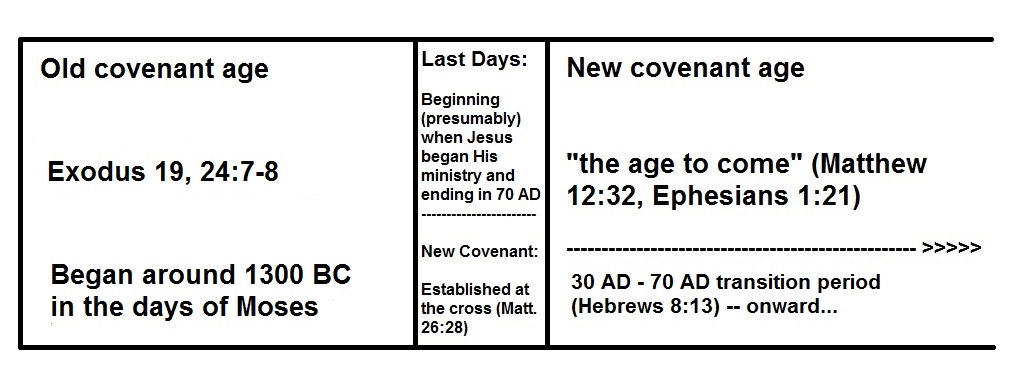
The old covenant age began in roughly 1300 BC during the days of Moses. It was made obsolete by Jesus’ work on the cross (30 AD), but was still “becoming obsolete and growing old” and “ready to vanish away” (Hebrews 8:13). This was its state for one generation – about 40 years. In 70 AD it did vanish away when the Roman armies came and burned the city (Jerusalem) of those who rejected Jesus’ wedding invitation (Matthew 22:7; Revelation 17:16, 18:8-10, 17-20). I believe “the last days” covered this transition period. I agree with Model 3 in the chart below (models 1 and 2 represent other popular ideas about “the last days”:

Duration of old covenant Last Days Began Duration of Last Days
Model 1 1300 years Pentecost 1984 years (and counting)
Model 2 1300 years 1948 66 years (and counting)
Model 3 1300 years Time of Jesus’ ministry 27 – 70 AD (Ended)

The new covenant age has already outlasted the old covenant age by 700 years (i.e. 2000 years and counting, compared to 1300 years):

Last Days Timeline

To answer the four questions at the beginning of this post then, I believe Scripture reveals that [1] the Biblical last days began at (or before) the time of the 3.5 year ministry of Jesus (27-30 AD); [2] they were the last days of the old covenant age; [3] “the first days” were in the days of Moses, around 1300 BC, when the old covenant was established, and [4] “the middle days” were the next 1200 or so years before Jesus was born in Bethlehem, covering the time of the judges, the kings, and the prophets. In light of what Scripture says about “the last days,” how would you answer these questions? 

Here is what the great preacher, John Owen (1616-1683), once said:

“Most expositors suppose that this expression [In Hebrews 1:2], ‘The last days,’ is a periphrasis [euphemism] for the times of the gospel. But it doth not appear that they are anywhere so called; nor were they ever known by that name among the Jews, upon whose principles the apostle proceeds… It is the last days of the Judaical church and state, which were then drawing to their period and abolition, that are here and elsewhere called ‘The last days,’ or ‘The latter days,’ or ‘The last hour,’ 2 Peter 3:31 John 2:18Jude 1:18… This phrase of speech is signally used in the Old Testament to denote the last days of the Judaical church” (The Works of John Owen, Volume 19, pp.12 – 13).

For a more extensive study of the topic of “this age and the age to come,” please see this post.

Jonathan Welton: Daniel’s 70 Weeks Prophecy Is About Jesus, Not An Antichrist


(Note: This post includes a full-scale teaching illustration below the following introduction.)

The last quarter of the 20th century featured many prophecy charts, based on dispensationalism, depicting a future “Rapture,” 7-year tribulation, Antichrist, series of seal/trumpet/bowl judgments, Battle of Armageddon, etc. When I was younger, I saw a few of these charts in person, and a number of others when I watched “A Thief In the Night” (1972), “A Distant Thunder” (1977) and “Image of the Beast” (1981); all available here.

Charts and illustrations can be good teaching aids. Based on my study of church history, however, the vast majority of respected leaders in the first 1800 (or so) years after Christ would have been horrified to see a lot of these (dispensationalist-based) charts. As my personal journey has taken me away from the pre-trib Rapture/premillennialist view I grew up with, and toward fulfilled eschatology, I’m glad to see that new charts, illustrations, and similar tools are being created which are a lot more sound and Biblical (in my opinion). In a couple of previous posts, I’ve highlighted two such illustrations by author Jonathan Welton, one on Daniel 2 and the kingdom of God and another on John’s use of “ge” (land) versus “kosmos” (world) in the book of Revelation.

Welton’s newest illustration concerns the 70 Weeks prophecy in Daniel 9. Seeing this prophecy differently was a major turning point in my own journey. Previously I was led to believe that Daniel saw a future Antichrist who would make a 7-year political covenant with Israel, then break it 3.5 years later, before presiding over another 3.5 years of planet-wide turmoil and catastrophes. This was to be the 7-year tribulation period. The text (Daniel 9:24-27) says none of these things. I can’t forget how stunned I was when it was pointed out to me, online, that the covenant of Daniel 9:27 is parallel to Jesus’ words on the night He was betrayed by Judas:

Then he shall confirm a covenant with many for one week; But in the middle of the week he shall bring an end to sacrifice and offering…” (Daniel 9:27).

For this is My blood of the new covenant, which is shed for many for the remission of sins” (Matthew 26:28).

Each “week” in Daniel’s prophecy represents a period of seven years. We also know that Jesus laid down His life as a sacrifice after 3.5 years of ministry (“…in the middle of the week…”), and that His sacrifice brought an end to the sacrifices and offerings under the old covenant. There went the idea that sacrifices must be restored in a rebuilt temple in Jerusalem in our future. There also went the only Scriptural basis (so I thought) for a 7-year tribulation period. Jonathan Welton does a great job bringing this and more out in his latest illustration:

Luke 17 Shows That Matthew 24 Can’t Be Divided


Scripture passages for this study: Matthew 24:1-51 and Luke 17:20-37

This post was prompted by a discussion under a recent post, concerning what might be and what might not be fulfilled in Matthew 24 (the Olivet Discourse). There was a time when I didn’t believe that any of Matthew 24 has been fulfilled. Then I came to believe that most of Matthew 24:1-34 was fulfilled in Jesus’ generation, before acknowledging that verse 34 doesn’t allow for only some of it to be fulfilled (“Assuredly, I say to you, this generation will by no means pass away till all these things take place“). At that point, I believed there must be a breaking point somewhere after verse 34, a dividing line after which the rest of the chapter would be fulfilled about 2000 years later (i.e. in our own future). I never could pinpoint that dividing line, though, and be at peace with it.

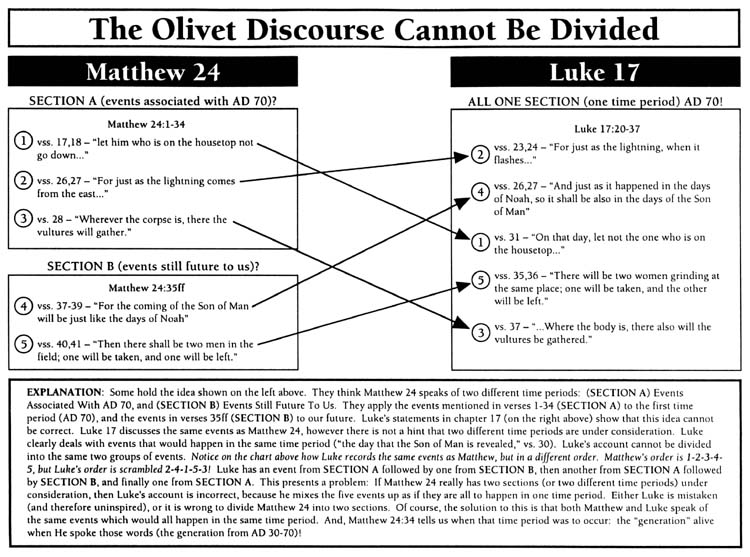
There are numerous reasons why I now believe all of Matthew 24 was fulfilled in the first century AD, in Jesus’ own generation. This post highlights one of those reasons, which is that Luke 17:20-37 demonstrates the impossibility of any time division. Luke 17 scrambles and reorders various portions of Jesus’ predictions in Matthew 24, predictions which are located before and well after verse 34. What is ordered as “1, 2, 3, 4, 5” in Matthew 24:1-41 is ordered as “2, 4, 1, 5, 3” in Luke 17:23-37, as shown in this diagram by Ed Stevens in his book titled, “What Happened in 70 AD?”

Matthew 24 Undivided

Source: World Without End (December 5, 2013); Better design seen here

David Curtis, the pastor of Berean Bible Church in Virginia Beach, Virginia, has also produced a similar chart, in which he fully writes out the passages shown in the diagram above

Matthew 24

Luke 17

SECTION ONE Verses 1-35

1. Matthew 24:17-18 (NKJV)
Let him who is on the housetop not go down to take anything out of his house. 18 “And let him who is in the field not go back to get his clothes.

2. Luke 17:23-24 (NKJV)
“And they will say to you, ‘Look here!’ or ‘Look there!’ Do not go after them or follow them. 24 “For as the lightning that flashes out of one part under heaven shines to the other part under heaven, so also the Son of Man will be in His day.
2. Matthew 24:26-27 (NKJV)
“Therefore if they say to you, ‘Look, He is in the desert!’ do not go out; or ‘Look, He is in the inner rooms!’ do not believe it. 27 “For as the lightning comes from the east and flashes to the west, so also will the coming of the Son of Man be.
4. Luke 17:26-27 (NKJV)
“And as it was in the days of Noah, so it will be also in the days of the Son of Man: 27 “They ate, they drank, they married wives, they were given in marriage, until the day that Noah entered the ark, and the flood came and destroyed them all.
3. Matthew 24:28 (NKJV)
“For wherever the carcass is, there the eagles will be gathered together.
1. Luke 17:31 (NKJV)
“In that day, he who is on the housetop, and his goods are in the house, let him not come down to take them away. And likewise the one who is in the field, let him not turn back.

SECTION TWO Verses 36-51

4. Matthew 24:37-39 (NKJV)
“But as the days of Noah were, so also will the coming of the Son of Man be. 38 “For as in the days before the flood, they were eating and drinking, marrying and giving in marriage, until the day that Noah entered the ark, 39 “and did not know until the flood came and took them all away, so also will the coming of the Son of Man be.

5. Luke 17:35-36 (NKJV)
“Two women will be grinding together: the one will be taken and the other left. 36 “Two men will be in the field: the one will be taken and the other left.”
5. Matthew 24:40-41 (NKJV)
“Then two men will be in the field: one will be taken and the other left. 41 “Two women will be grinding at the mill: one will be taken and the other left.
3. Luke 17:37 (NKJV)
And they answered and said to Him, “Where, Lord?” So He said to them, “Wherever the body is, there the eagles will be gathered together.”
Those who attempt to divide Matthew 24 say that SECTION ONE refers to the events of AD 70. But they say SECTION TWO refers to events yet future to us. If the five prophetic events of Matthew 24 that are found in Luke 17 are numbered 1-2-3-4-5, Luke’s numbering of the same events would be 2-4-1-5-3. Luke has an event from section 1 followed by one from section 2, then another from section 1 followed by section 2, and finally one from section 1. This shows the impossibility of dividing Matthew 24 with a 2,000 year gap.

 What do you think? Is this a valid conclusion? Why or why not?

————————————————————-

Previous posts on the Olivet Discourse can be viewed at this page, including a 4-part series (titled “This Generation Or That Generation?”) examining the accounts of Matthew, Mark, and Luke in a parallel fashion.

Jerusalem, a Dwelling Place of Demons


Series: “Little Gems from Our Study of the Book of Revelation”

And [the angel] cried mightily with a loud voice, saying, “Babylon the great is fallen, is fallen, and has become a dwelling place of demons, a prison for every foul spirit, and a cage for every unclean and hated bird!” (Revelation 18:2)

A survey of the Old Testament reveals a common theme, as God repeatedly proclaimed that Israel, Jerusalem, and the temple were His dwelling place. Consider the following texts (this is just a sample):

You will bring them in and plant them In the mountain of Your inheritance, In the place, O Lord, which You have made for Your own dwelling, the sanctuary, O Lord, which Your hands have established” (Exodus 15:17).

But you shall seek the place where the Lord your God chooses, out of all your tribes, to put His name for His dwelling place; and there you shall go” (Deuteronomy 12:5).

In Jerusalem also is His tabernacle, and His dwelling place in Zion” (Psalm 76:2).

For the Lord has chosen Zion; He has desired it for His dwelling place(Psalm 132:13).

At the same time, God’s dwelling place was in heaven (e.g. I Kings 8:30, 39, 43, 49):

“And may You hear the supplication of Your servant and of Your people Israel, when they pray toward this place. Hear in heaven Your dwelling place; and when You hear, forgive…”

A survey of the Old Testament also reveals that Israel and Jerusalem often proved unworthy of serving as a dwelling place for God. In these times of unfaithfulness, Jeremiah, Ezekiel, and Hosea were among those who referred to Israel as a harlot:

The Lord said also to me in the days of Josiah the king: “Have you seen what backsliding Israel has done? She has gone up on every high mountain and under every green tree, and there played the harlotAnd I said, after she had done all these things, ‘Return to Me.’ But she did not return. And her treacherous sister Judah saw it. Then I saw that for all the causes for which backsliding Israel had committed adultery, I had put her away and given her a certificate of divorce; yet her treacherous sister Judah did not fear, but went and played the harlot also” (Jeremiah 3:6-8).

But you trusted in your own beauty, played the harlot because of your fame, and poured out your harlotry on everyone passing by who would have it” (Ezekiel 16:15).

I have seen a horrible thing in the house of Israel: There is the harlotry of Ephraim; Israel is defiled” (Hosea 6:10).

When Jesus came, He summed up what had become of Jerusalem in this lament:

O Jerusalem, Jerusalem, the one who kills the prophets and stones those who are sent to her! How often I wanted to gather your children together, as a hen gathers her chicks under her wings, but you were not willing! See! Your house is left to you desolate” (Matthew 23:37-38).

Strong’s Concordance defines the word “desolate” (#2048), used by Matthew here, as “lonesome, waste, desert, solitary, wilderness.” In the New Testament, we see indications that demons are attracted to such places:

For Jesus had commanded the unclean spirit to come out of the man. For it had often seized him, and he was kept under guard, bound with chains and shackles; and he broke the bonds and was driven by the demon into the wilderness” (Luke 8:29; some translations say “solitary places” or “deserted places”).

Similarly, recall what Jesus said would be true of the nation of Israel in His generation:

The men of Nineveh will rise up in the judgment with this generation and condemn it, because they repented at the preaching of Jonah; and indeed a greater than Jonah is here. The queen of the South will rise up in the judgment with this generation and condemn it, for she came from the ends of the earth to hear the wisdom of Solomon; and indeed a greater than Solomon is here. When an unclean spirit goes out of a man, he goes through dry places, seeking rest, and finds none. Then he says, ‘I will return to my house from which I came.’ And when he comes, he finds it empty, swept, and put in order. Then he goes and takes with him seven other spirits more wicked than himself, and they enter and dwell there; and the last state of that man is worse than the first. So shall it also be with this wicked generation” (Matthew 12:41-45).

John wrote the book of Revelation in Jesus’ generation, and there we see a tragic picture of what had become of His former dwelling place, as John describes “Babylon the great”:

And [the angel] cried mightily with a loud voice, saying, “Babylon the great is fallen, is fallen, and has become a dwelling place of demons, a prison for every foul spirit, and a cage for every unclean and hated bird!” (Revelation 18:2).

Someone may object here and say that Babylon the great is not Jerusalem. However, if we pay attention, John does positively identify the great city, Babylon. In the previous chapter, John is shown “the judgment of the great harlot who sits on many waters, with whom the kings of the earth committed fornication” (Rev. 17:1-2). She is shown sitting on a great beast (verse 3), and on her forehead are written these words: “MYSTERY, BABYLON THE GREAT, THE MOTHER OF HARLOTS AND OF THE ABOMINATIONS OF THE EARTH” (verse 5). John sees her drunk with the blood of the saints and the martyrs (verse 6). The angel says to John, “The woman whom you saw is that great city which reigns over the kings of the earth” (verse 18). So the following is clear:

The harlot = Babylon the great = the great city

The “great city” is mentioned five times in Rev. 18 (verses 10, 16, 18, 19, and 21). In verses 10 and 21 it’s referred to as “the great city Babylon.” (See also Rev. 14:8.) Yet it’s in the first mention of “the great city” where we see the positive identification of that city. We see this in the scene of the two witnesses who are killed by the beast:

 “And their dead bodies will lie in the street of the great city which spiritually is called Sodom and Egypt, where also our Lord was crucified” (Rev. 11:8).

Jesus was crucified in Jerusalem. Therefore, “the great city” is Jerusalem. This title was also given to Jerusalem by Josephus (Wars 7:8:7) and Appian, a Roman historian of the same era. It may also be a throwback to Jeremiah’s words when he described the soon-coming judgment upon Jerusalem by Babylon, which took place in 586 BC:

And many nations will pass by this city, and every man will say to his neighbor, “Why has the Lord dealt thus with this great city?” And they will answer, “Because they have forsaken the covenant of the Lord their God and worshiped other gods and served them” (Jeremiah 22:8-9).

The great city, Babylon, is further confirmed as Jerusalem in at least the following three ways:

[1] This would not be the first time that Israel was referred to as “Sodom.” Isaiah did the same thing: Hear the word of the Lord, you rulers of SodomGive ear to the law of our God, you people of Gomorrah: ‘To what purpose is the multitude of your sacrifices to Me?’ says the Lord…” (Isaiah 1:10-11)John invokes the names of two of Israel’s oldest enemies, Sodom and Egypt, and uses them to describe first century Jerusalem.

[2] John describes the great city using the imagery of a harlot. As discussed above, Jeremiah, Ezekiel, and Hosea referred to Israel as a harlot in their day. Israel was in a covenant relationship with God, and therefore capable of spiritual adultery, unlike other nations in John’s day (or the United States or any other nation in our own day).

[3] John sees the harlot, Babylon the great, drunk with the blood of martyrs and saints (Rev. 17:6), and filled with the blood of prophets and apostles (Rev. 18:20, 24; see also Rev. 16:6, 19:2). Jesus said that Israel would be held responsible and judged in His generation for shedding this very blood (Matthew 23:29-36). He also said that “it cannot be that a prophet should perish outside of Jerusalem” (Luke 13:33). 

In all this we see that a terrible thing had happened to Jerusalem, God’s former dwelling place. It was given over to spiritual adultery and had become overrun by demons:

“Babylon the great is fallen, is fallen, and has become a dwelling place of demons, a prison for every foul spirit, and a cage for every unclean and hated bird!” (Revelation 18:2).

With God having abandoned Jerusalem as His dwelling place, was He then without a dwelling place of His own? Not at all. In the next post, we will see that God has chosen as His dwelling place the new Jerusalem, the community of saints who abide in His Son, Jesus.

————————————————————————————

For more information and details on the content in this post, see our studies on Revelation 17 (verses 1-6 and verses 7-18) and Revelation 18.

If time allows, consider also our study on Revelation 9, where John sees an army of torturing locusts emerging out of the abyss. There is good reason to believe John witnesses a horde of demons sweeping through the land of Israel. The locusts didn’t touch any vegetation, but were given authority to torment only those who were not God’s servants, and this torment was to last for five months. In Judea, locusts typically came between May and September (a 5-month period), and this is roughly the same period when Rome laid a 5-month siege upon Jerusalem in 70 AD leading to Jerusalem’s downfall in September of that year.