Echoes of Mount Sinai in the Book of Revelation


Series: “Little Gems from Our Study of the Book of Revelation”

What point(s) did John, through the inspiration of the Holy Spirit, wish to get across to his initial readers when he distributed the book of Revelation to seven churches in first century Asia Minor? What themes are weaved through the book? In considering these questions, keep in mind that the full title of the book is “The Revelation of Jesus Christ.”

Proposal: One of the Holy Spirit’s aims in Revelation is to guide the early church in navigating the transition period from one covenant (the old) to the next (the new), especially as that period was drawing to a close. This period lasted roughly 40 years (30 AD – 70 AD), parallel to the 40 years that the Israelites wandered in the wilderness.

Basis (one of several): The same imagery that was present at the giving of the law, the old covenant, is echoed several times in the book of Revelation (4:5, 8:5, 11:19, and 16:18). This post will highlight these passages and their significance.

Parallel Scripture Passage: In that He says, ‘a new covenant,’ He has made the first obsolete. Now what is becoming obsolete and growing old is ready to vanish away” (Hebrews 8:13, 1st century AD).

Moses and the Israelites at Mount Sinai

Just before examining these passages in Revelation, let’s look at Exodus 19, the passage I believe they echo:

In the third month after the children of Israel had gone out of the land of Egypt, on the same day, they came to the Wilderness of Sinai. For they had departed from Rephidim, had come to the Wilderness of Sinai, and camped in the wilderness. So Israel camped there before the mountain. And Moses went up to God, and the Lord called to him from the mountain, saying, “Thus you shall say to the house of Jacob, and tell the children of Israel: ‘You have seen what I did to the Egyptians, and how I bore you on eagles’ wings and brought you to Myself. Now therefore, if you will indeed obey My voice and keep My covenant, then you shall be a special treasure to Me above all people; for all the earth is Mine. And you shall be to Me a kingdom of priests and a holy nation.’ These are the words which you shall speak to the children of Israel.”

Then it came to pass on the third day, in the morning, that there were thunderings and lightnings, and a thick cloud on the mountain; and the sound of the trumpet was very loud, so that all the people who were in the camp trembled. And Moses brought the people out of the camp to meet with God, and they stood at the foot of the mountain. Now Mount Sinai was completely in smoke, because the Lord descended upon it in fire. Its smoke ascended like the smoke of a furnace, and the whole mountain quaked greatly  (Exodus 19:1-18).

So we see that God reminded them of how He bore the people of Israel “on eagles’ wings”* out of Egypt and to Himself. God was establishing a covenant with them at this time, and He called them to be “a kingdom of priests and a holy nation.”** This gathering was marked by thundering and lightning, the sound of a loud trumpet, thick smoke, and the whole mountain quaking greatly.

*Compare to Revelation 12:13-14, where the persecuted womanwas given two wings of a great eagle, that she might fly into the wilderness to her place, where she is nourished for a time and times and half a time, from the presence of the serpent.”

**Compare this with John’s opening greeting to the seven churches, where he says that Jesus “has made us kings and priests to His God and Father” (Revelation 1:6).

Four Passages That Echo Mount Sinai in Revelation
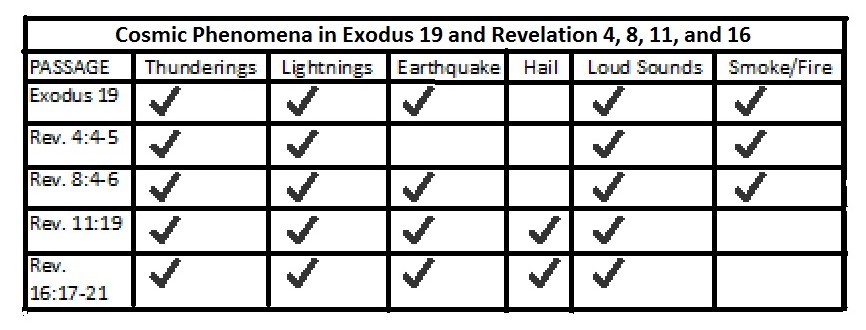
The same cosmic phenomena present at Mount Sinai are seen again in the book of Revelation. Observe the following passages, with some brief notes on their likely significance:

1. Revelation 4:4-5

Around the throne were 24 thrones, and on the thrones I saw 24 elders sitting, clothed in white robes; and they had crowns of gold on their heads. And from the throne proceeded lightnings, thunderings, and voices. Seven lamps of fire were burning before the throne, which are the seven Spirits of God.”

As we noted in our study of Revelation 4, the 24 elders may very well “depict the 12 patriarchs of Israel and the 12 apostles, who represent the redeemed of both covenants now united in Christ.” This seems to be substantiated by the names of the 12 tribes and the 12 apostles found written on the gates and walls of the new Jerusalem (Rev. 21:12-14). So it appears that this covenant-establishing imagery takes place in the presence of elders representing both the old and the new covenant ages.

2. Revelation 8:4-6

And the smoke of the incense, with the prayers of the saints, ascended before God from the angel’s hand. Then the angel took the censer, filled it with fire from the altar, and threw it to the earth. And there were noises, thunderings, lightnings, and an earthquake. So the seven angels who had the seven trumpets prepared themselves to sound.”

This scene takes place at the opening of the seventh and final seal (Rev. 8:1). An angel with a golden censer offers the prayers of the saints, along with incense, upon the altar before God’s throne (verse 3). We proposed in our study of Rev. 8 that these prayers are linked to the cries of the martyrs for God to avenge their “blood on those who dwell on the earth” – Rev. 6:10 (see this post for a more complete study on this subject). It seems likely that the seal judgments are poured out in response to the prayers of God’s people. Therefore, the covenant-establishing imagery of Mount Sinai appears here because the prayers of the new covenant community were about to result in the old covenant system reaching its demise.

3. Revelation 11:19

Then the temple of God was opened in heaven, and the ark of His covenant was seen in His temple. And there were lightnings, noises, thunderings, an earthquake, and great hail.

Just as the scene we examined in Rev. 8 takes place at the opening of the seventh seal, this scene takes place at the sounding of the seventh trumpet. Loud voices declare, “The kingdoms of this world have become the kingdoms of our Lord and of His Christ, and He shall reign forever and ever!” The 24 elders are present at this scene (Rev. 11:15-16).

In verse 19 we see probably the most explicit reference connecting the old covenant to the prophecies in the book of Revelation. John sees a vision of God’s temple housing “the ark of His covenant.” In ancient Israel, the ark of the covenant was a centerpiece of the temple and the old covenant. Located in the Most Holy Place, it represented God’s presence: “You shall put the mercy seat on top of the ark, and in the ark you shall put the Testimony that I will give you. And there I will meet with you, and I will speak with you from above the mercy seat, from between the two cherubim which are on the ark of the Testimony, about everything which I will give you in commandment to the children of Israel” (Exodus 25:21-22). For further significance, see Numbers 7:89, 10:33-35; Joshua 3:13, 7:6-11; Judges 20:27; II Samuel 6:2; II Kings 19:15; Psalm 28:2, 80:1.

When the dust settles from the barrage of judgments in Revelation, what does heaven shout? “Behold, the tabernacle of God is with men, and He will dwell with them, and they shall be His people. God Himself will be with them and be their God” (Rev. 21:3). This did not suddenly become true because some buildings fell in 70 AD. Remember that Paul told the Corinthian church this was already their reality and that they were “the temple of the living God (II Cor. 6:16). The downfall of Israel, Jerusalem, and the temple in 70 AD, however, did remove the far less glorious old covenant system which competed against, and greatly opposed, this reality. It was a stunning and vivid demonstration that God had chosen the glorious new covenant over the inferior old covenant (see Hebrews 8). This was the time for rewarding God’s “servants the prophets and the saints, and those who fear [His] name, small and great” (Rev. 11:18).

Several verses earlier, John witnesses an actual earthquake that kills 7000 people in“the city” (Rev. 11:13), already identified in verse 8 as Jerusalem (“the great city…where also our Lord was crucified“). As we noted in our study of Revelation 11, Josephus records one awful night in early 68 AD when “a prodigious storm” took place in Jerusalem, marked by “the largest showers of rain, with continued lightnings, terrible thunderings, and amazing concussions and bellowings of the earth, that was in an earthquake.” Josephus adds that the Jewish zealots allowed the Idumaeans to come in and help them slaughter some of their fellow Jews who opposed their rebellion against the Romans. Between this slaughter and the earthquake, 8500 people died that night (Josephus, Wars 4:4:5, 4:4:7-4:5:1).

4. Revelation 16:17-21

Then the seventh angel poured out his bowl into the air, and a loud voice came out of the temple of heaven, from the throne, saying, ‘It is done!’ And there were noises and thunderings and lightnings; and there was a great earthquake, such a mighty and great earthquake as had not occurred since men were on the earth. Now the great city was divided into three parts, and the cities of the nations fell. And great Babylon was remembered before God, to give her the cup of the wine of the fierceness of His wrath. Then every island fled away, and the mountains were not found. And great hail from heaven fell upon men, each hailstone about the weight of a talent. Men blasphemed God because of the plague of the hail, since that plague was exceedingly great. 

Just as the scene we examined in Rev. 8 takes place at the opening of the seventh seal, and the scene in Rev. 11 takes place at the sounding of the seventh trumpet, this scene takes place at the pouring out of the seventh bowl.

John sees the great city, Jerusalem, divided into three parts. As we noted in our study of Revelation 16, this is a flashback to Ezekiel 5:1-12, when the prophet was required to shave his head and divide it into three parts, and was told by God: “This is Jerusalem” (Ezek 5:5).  One third of his hair was burned, one third was chopped up by the sword, and the last third was scattered into the wind. This was fulfilled when Jerusalem was destroyed in 586 B.C. at the hands of Babylon, and Josephus records the same tragedies in 70 AD at the hands of Rome (1.1 million Jews killed by the sword or by fire, and all the survivors exiled or sold into slavery). Jerusalem was also divided between 67-70 AD into three warring factions: [1] the Zealots, led by Eleazar [2] the Galileans, led by John of Gischala, and [3] the Idumeans, led by Simon.

Just as an actual deadly earthquake took place as foretold in Rev. 11, actual hail – “about the weight of a talent” (i.e. 75 – 100 pounds) – also fell as foretold in Rev. 16. Josephus wrote of large stones shot from catapults by the Roman armies into the temple complex in Jerusalem, which the watchmen in the city reported as appearing white in the sky:

“Now the stones that were cast were of the weight of a talent, and were carried two furlongs and further. The blow they gave was no way to be sustained, not only by those that stood first in the way, but by those that were beyond them for a great space. As for the Jews, they at first watched the coming of the stone, for it was of a white color, and could therefore not only be perceived by the great noise it made, but could be seen also before it came by its brightness” (Josephus, Wars 5:6:3).

Josephus also records that the watchmen on the wall, when they saw the stones coming, would shout, “The Son cometh!” After a while the Romans learned to blacken the stones so that they couldn’t as easily be detected, and many more were crushed by these stones. J. Stuart Russell, in his 1878 book titled The Parousia, offers this explanation for the words of the watchmen (p. 482):

“It could not but be well known to the Jews that the great hope and faith of the Christians was the speedy coming of the Son. It was about this very time, according to Hegesippus [110-180 AD], that St. James, the brother of our Lord, publicly testified in the temple that ‘the Son of man was about to come in the clouds of heaven,’ and then sealed his testimony with his blood [in 62 AD]. It seems highly probable that the Jews, in their defiant and desperate blasphemy, when they saw the white mass hurtling though the air, raised the ribald cry, ‘The Son is coming,’ in mockery of the Christian hope of the Parousia.”

—————————————————————————

In his book,Revelation: Four Views (A Parallel Commentary),” Steve Gregg also sees the connection between Mount Sinai and Revelation, as he shares concerning Rev. 4 (p. 88):

“The lightnings, thundering and voices (v. 5) recall Mount Sinai, where God first established His covenant with Israel [Exodus 19:16; cf. Rev. 8:5, 11:19]. Similar phenomena are mentioned here to suggest the end of that covenant and its replacement with another. The writer of Hebrews (citing Hag. 2) likened the overthrow of the first covenant (publicly demonstrated by the destruction of Jerusalem and the temple in A.D. 70) to the time of its establishment at Sinai, but the latter would be accompanied by even more fearful phenomena (Heb. 12:18-29).”

Steve Gregg also shares David Chilton’s comparison of Revelation 19:1-6 with Revelation 11:15-19 (which we have already examined). Chilton indicates that very similar subject matter is established “in the two passages which represent the closing visions of the two major sections of the book” (p. 440):

1. loud voices…in heaven (11:15; 19:1);
2. the declaration of the commencement of the reign of God (11:15, 17; 19:1, 6);
3. the twenty-four elders fall on their faces and worship (11:16; 19:4);
4. the avenging of the blood of His servants is announced (11:18; 18:24; 19:2);
5. reference to God’s servants…who fear Him, small and great (11:18; 19:5);
6. loud noises, including thunderings (11:19; 19:6).

—————————————————————

Check out the first two posts in this mini-series:

1. Revelation 6 and Luke 23: Hide Us From the Wrath of the Lamb
2. The Avenging of Righteous Blood (Deuteronomy, Matthew, and Revelation)

Revelation: The Land (“Ge”) Is Referenced 22 Times More Often Than the World (“Kosmos”)


It’s well-known that the book of Revelation foretells, among other things, a series of frightening judgments falling upon an entity known as Babylon the Great and “the harlot.” Just as importantly, Revelation also portrays beautiful worship scenes and glorious destinies and realities for God’s people. Regarding the judgments, Does John picture them being poured out upon the entire planet, or upon a particular location?

Jonathan Welton, author of the book “Raptureless,” has created another helpful graphic illustrating the fulfillment of Bible prophecy (See his previous graphic on Daniel 2 illustrating that God’s kingdom has come). Titled “John’s Olivet Discourse: A Look at the Writings of John,” Welton’s graphic [1] makes a case that the book of Revelation contains John’s version of the Olivet Discourse [2] shows some of John’s time tables [3] notes an important principle of Bible interpretation, and [4] shows that John speaks far more about local events in Revelation than he speaks about global events.

We can also add Revelation 1:1 and 1:3 to Welton’s list of time statements made by the apostle John:

The Revelation of Jesus Christ, which God gave Him to show His servants—things which must shortly take place.
Blessed is he who reads and those who hear the words of this prophecy, and keep those things which are written in it; for the time is near.

The last part of Welton’s graphic is very informative. The following chart takes the numbers he provides (plus a couple more that I looked up) and allows us to see how focused John was on local events in the book of Revelation compared to his gospel account:

John’s books Number of chapters in each book Number of times John uses the word “kosmos,” meaning the entire planet Number of times John uses the word “ge,” meaning the land (a region)
The Gospel According to John 21 57 3
I John 5 17 1
II John 1 1 0
III John 1 0 0
Revelation 22 3 67

In other New Testament passages where the word “ge” is translated as “earth,” many assume that those passages are speaking about the entire planet. We need to be more careful with this assumption. One instance where it appears is in Luke’s version of the Olivet Discourse (Luke 21:23). There, Luke is clearly speaking about Israel. Some Bible versions translate this word as “earth,” while others translate it as “land.” Here is how Luke 21:23 reads, in context:

But when you see Jerusalem surrounded by armies, then know that its desolation is near. Then let those who are in Judea flee to the mountains, let those who are in the midst of her depart, and let not those who are in the country enter her. For these are the days of vengeance, that all things which are written may be fulfilled. But woe to those who are pregnant and to those who are nursing babies in those days! For there will be great distress in the land and wrath upon this people” (Luke 21:20-23).

The same word that Luke used in reference to Judea is the one that John used 67 times in the book of Revelation.

18 Case Studies on How John Used “Ge” to Speak of 1st Century Israel in Revelation

In 2010 I wrote a 3-part series tracking this phenomenon throughout the book of Revelation. The phrase “those who dwell on the earth” appears 10 times in Revelation, and at least a couple dozen more times in various forms. This series presents 18 case studies showing when and how this expression is used, examining the context in each case, and seeing how it’s used elsewhere in Scripture. A strong case is made that this expression in Revelation indicates 1st century apostate Israel. This series can be seen here: Part 1, Part 2, Part 3. If you have the time to read it, I believe you’ll find it informative.

A Final Note on How John Used the Word “Kosmos” Three Times in Revelation

Although it’s fun and enlightening to see how John used the word “ge” so many times in reference to the land of Israel, it’s also enlightening to see how he used the word “kosmos” to speak of the planet on which we live. Two of these instances concern those whose names are, or are not, written in the Book of Life. This is a global reference, as it ought to be, for the body of Christ is global and the message of the gospel is for every nation, tribe, language, and tongue. The third reference is to the kingdom of God, its triumph and greatness over all the kingdoms of this world (planet), and the eternal and universal reign of Jesus Christ:

1. “Then the seventh angel sounded: And there were loud voices in heaven, saying, ‘The kingdoms of this world have become the kingdoms of our Lord and of His Christ, and He shall reign forever and ever!'” (Rev. 11:15)
2. “All who dwell on the earth will worship him, whose names have not been written in the Book of Life of the Lamb slain from the foundation of the world” (Rev. 13:8).
3. “The beast that you saw was, and is not, and will ascend out of the bottomless pit and go to perdition. And those who dwell on the earth will marvel, whose names are not written in the Book of Life from the foundation of the world, when they see the beast that was, and is not, and yet is” (Rev. 17:8).

The Avenging of Righteous Blood (Deuteronomy, Matthew and Revelation)


Series: “Little Gems from Our Study of the Book of Revelation”

Recently my friend, Jerry William Bowers Jr., posted the following status on Facebook:

Revelation simplified:

Revelation 6:10, 16:6, 17:6, 18:24, 19:2, 20:4 speaks to the avenging of righteous blood.

This was prophesied in Deuteronomy 32:43, and would occur in Israel’s “END” (Deuteronomy 32:20) in their “Latter end” (Deuteronomy 32:29).

Matthew 23:34-36 very clearly says this would be fulfilled in their own generation.

It just doesn’t get any simpler than that!

I agree with Jerry’s summary, and would like to develop it further. During the last several years of studying eschatology, one thing I’ve enjoyed immensely is allowing Scripture to interpret Scripture. It’s an enlightening exercise. To give one example, I was taught for a long time that Isaiah’s imagery of a wolf lying down with a lamb is both unfulfilled and a literal reference to the animal kingdom. However, I’ve now come to understand, by allowing Romans 15 to interpret Isaiah 11, that this is presently fulfilled in Christ, who broke down the wall of division between Jews and Gentiles so that all may find their hope in Him (see “Romans 15 Shows That Isaiah 11 Is Fulfilled“).

Deuteronomy 32: Prediction of Israel’s End and Judgment for Murdering God’s People

Jerry’s status is also an appeal to allow Scripture to interpret Scripture, in this case concerning the theme of the blood of the martyrs. Let’s take a look at the passages he referenced in Deuteronomy 32, plus one more (verse 5). There Moses is speaking to Israel (Deut. 31:30), which he very interestingly addresses as “heaven” and “earth” (Deut. 32:1).

“They have corrupted themselves; They are not His children, because of their blemish: a perverse and crooked generation” (Deut. 32:5).

And He said: ‘I will hide My face from them, I will see what their end will be, for they are a perverse generation, children in whom is no faith‘” (Deut. 32:20).

For they are a nation void of counsel, nor is there any understanding in them. Oh, that they were wise, that they understood this, that they would consider their latter end! (Deut. 32:28-29).

Rejoice, O Gentiles, with His people; For He will avenge the blood of His servants, and render vengeance to His adversaries; He will provide atonement for His land and His people” (Deut. 32:43).

Does anything jump out when noting Moses’ language in verse 20? Recall what Jesus said to His Israelite audience in Matthew 17:

Then Jesus answered and said, “O faithless and perverse generation, how long shall I be with you? How long shall I bear with you? Bring him here to Me” (Matthew 17:17).

Moses predicted that at the time of Israel’s end, they would be a perverse and faithless generation. Jesus ministered in Israel to the same generation that was overthrown by the Romans in 70 AD, and He called that generation “faithless and perverse.” It would seem that Jesus intentionally invoked Moses’ words in Deut. 32:20. The apostle Paul did the same thing when addressing the Philippian church, as he used the exact same phrase Moses used in Deut. 32:5.

Do all things without complaining and disputing, that you may become blameless and harmless, children of God without fault in the midst of a crooked and perverse generation, among whom you shine as lights in the world…” (Philippians 2:14-15).

Matthew 23: Jesus’ Own Generation Responsible for The Blood of God’s Servants

We turn now to Jesus’ prediction in His woes upon the Scribes and Pharisees. He declared that they “build the tombs of the prophets and adorn the monuments of the righteous” (Matt. 23:29), and that they “are sons of those who murdered the prophets” (verse 31). Jesus went on to say:

Therefore, indeed, I send you prophets, wise men, and scribes: some of them you will kill and crucify, and some of them you will scourge in your synagogues and persecute from city to city, that on you may come all the righteous blood shed on the earth, from the blood of righteous Abel to the blood of Zechariah, son of Berechiah, whom you murdered between the temple and the altar. Assuredly, I say to you, all these things will come upon this generation” (Matt. 23:34-36).

Moses, in Deuteronomy 32, predicted that God would “avenge the blood of His servants” at the time of Israel’s end. Jesus told the religious leaders of Israel that they would be held responsible for “all the righteous blood shed on earth” (or land, that is, Israel’s land). He made it clear that their generation would experience that judgment.

Revelation: The Avenging of the Blood of God’s Saints, Prophets, and Apostles

In the book of Revelation, as John is shown a series of judgments being poured out, we see this scene in heaven:

When He opened the fifth seal, I saw under the altar the souls of those who had been slain for the word of God and for the testimony which they held. And they cried with a loud voice, saying, “How long, O Lord, holy and true, until You judge and avenge our blood on those who dwell on the earth?” (Rev. 6:9-10)

Many believe or teach that the judgments of Revelation will be poured out in our own future and upon the entire globe, but who did Jesus say would be held responsible for all the bloodshed of God’s servants? What generation did He say would experience that vengeance? Without a doubt, it was His own people (Israel) and His own generation. As the outpouring of judgment progresses in the book of Revelation, we see how God answers the cries of the martyrs:

Then the third angel poured out his bowl on the rivers and springs of water, and they became blood. And I heard the angel of the waters saying: “You are righteous, O Lord, the One who is and who was and who is to be, because You have judged these things. For they have shed the blood of saints and prophets, and You have given them blood to drink. For it is their just due” (Rev. 16:4-6).

So he carried me away in the Spirit into the wilderness. And I saw a woman sitting on a scarlet beast which was full of names of blasphemy, having seven heads and ten horns. The woman was arrayed in purple and scarlet, and adorned with gold and precious stones and pearls, having in her hand a golden cup full of abominations and the filthiness of her fornication. And on her forehead a name was written: MYSTERY, BABYLON THE GREAT, THE MOTHER OF HARLOTS AND OF THE ABOMINATIONS OF THE EARTH. I saw the woman, drunk with the blood of the saints and with the blood of the martyrs of Jesus. And when I saw her, I marveled with great amazement” (Rev. 17:3-6).

They threw dust on their heads and cried out, weeping and wailing, and saying, ‘Alas, alas, that great city, in which all who had ships on the sea became rich by her wealth! For in one hour she is made desolate.’ “Rejoice over her, O heaven, and you holy apostles and prophets, for God has avenged you on her!” …And in her was found the blood of prophets and saints, and of all who were slain on the earth” (Rev. 18:19-24).

For true and righteous are His judgments, because He has judged the great harlot who corrupted the earth with her fornication; and He has avenged on her the blood of His servants shed by her” (Rev. 19:2).

In our series on the book of Revelation, we noted that “the great city” was first identified in Rev. 11:8 as the place “where our Lord was crucified.” This is a positive identification of Jerusalem as “the great city” spoken of in the book of Revelation. It’s no wonder that “in her was found the blood of prophets and saints…” This is the very thing that Jesus said in Matthew 23 would be true of first century Jerusalem. This is also the time when the apostles lived and ministered (Rev. 18:20).

The great city, Babylon the Great, was called “the mother of harlots.” Did Jesus not refer to His own generation in Israel as “a wicked and adulterous generation” (e.g. Matthew 12:39, 16:4)? Did Jeremiah not use similar language to describe ancient Israel during times of apostasy? Was it not legitimate for God to use the language of adultery against an unfaithful nation that was in covenant with Him? Had first century Israel not become as awful and wicked as their ancient enemy and conqueror, Babylon?

See our study on Revelation 17:1-6 for the significance of the harlot imagery that John used, the garments that the harlot wore, the words on her forehead, the rich Old Testament background for all these things, and the harlot’s close partnership with first-century Rome.

The Apostle Paul Prophesies Judgment and Tribulation Against the Israel of His Day

In light of everything we’ve discussed above, it’s also good to take note of what the apostle Paul said to the believers in Thessalonica who were suffering and enduring persecution at the time of his letters (52-54 AD):

For you, brethren, became imitators of the churches of God which are in Judea in Christ Jesus. For you also suffered the same things from your own countrymen, just as they did from the Judeans, who killed both the Lord Jesus and their own prophets, and have persecuted us; and they do not please God and are contrary to all men, forbidding us to speak to the Gentiles that they may be saved, so as always to fill up the measure of their sins; but wrath has come upon them to the uttermost” (I Thessalonians 2:14-16)

“…[We] ourselves boast of you among the churches of God for your patience and faith in all your persecutions and tribulations that you endure, which is manifest evidence of the righteous judgment of God, that you may be counted worthy of the kingdom of God, for which you also suffer; since it is a righteous thing with God to repay with tribulation those who trouble you, and to give you who are troubled rest with us when the Lord Jesus is revealed from heaven with His mighty angels, in flaming fire taking vengeance on those who do not know God, and on those who do not obey the gospel of our Lord Jesus Christ” (II Thessalonians 1:4-8).

Paul affirmed that the time had nearly come for the inhabitants of Judea to experience God’s wrath “to the uttermost” for killing Jesus and the prophets. Their opposition to the gospel was “contrary to all men” and was a great hindrance in the quest to spread the gospel among the Gentiles. It would be “a righteous thing with God” when they were repaid with tribulation, and it would result in them receiving rest. Jesus had promised to come with His angels in judgment and in His kingdom while some of His disciples were still alive (Matthew 16:27-28).

To Review

1. Moses prophesied that God would “avenge the blood of His servants” upon a faithless, perverse, and crooked generation at the time of Israel’s “latter end” (Deuteronomy 32:5, 20, 29, 43).

2. Jesus repeatedly denounced His own generation as “perverse”, “faithless”, and “adulterous.” Paul told the Philippian church that they were shining as lights in the midst of “a crooked and perverse generation” (Phil. 2:14-15).

3. Jesus told the religious leaders of Israel that their generation would be held responsible and judged for all the righteous blood shed on earth (Matthew 23:29-36).

4. John was shown a scene of martyrs crying out for their blood to soon be avenged “on those who dwell on the earth” (Revelation 6:10).

5. John then sees seven bowls poured out “on the earth” (Rev. 16:1), and one of them causes the rivers and springs to become blood in order to judge those who had “shed the blood of saints and prophets” (Rev. 16:4-6).

6. John also sees a harlot dressed like a high priest of Israel and “drunk with the blood of the saints and with the blood of the martyrs of Jesus” (Rev. 17:3-6).

7. In Revelation 18:19-24, John sees the great city, earlier identified as Jerusalem (Rev. 11:8), overthrown and made desolate (see Matthew 23:38). The holy prophets and apostles, and all of heaven, were told to rejoice over this scene because God had avenged them on her, and because “in her was found the blood of prophets and saints, and of all who were slain on the earth.

8. In Revelation 19, John sees a heavenly scene in which there is much rejoicing over God’s righteous and true judgments, because He had judged the great harlot and “avenged on her the blood of His servants shed by her” (verse 2). With the harlot judged and put away, John sees that “the marriage of the Lamb has come, and His wife has made herself ready” (verse 7).

Revelation 6 and Luke 23: Hide Us From the Wrath of the Lamb


Series: “Little Gems from Our Study of the Book of Revelation”

My favorite series on this site is our in-depth study of the book of Revelation. Many of the chapter-by-chapter studies are rather lengthy, and buried within these posts are some very interesting mini studies (in my opinion).  Over time I would like to pull out some of these little gems and present them briefly, one post at a time. They will be added to the “Revelation” page on this site as they are posted. This is the first such post.

Revelation 6:15-17 Is the Fulfillment of Luke 23:27-30

One can learn a lot and gain a lot of insight by comparing Scripture with Scripture, or letting Scripture interpret Scripture. Consider John’s description of the opening of the 6th seal judgment, Revelation 6:15-17 in particular:

I looked when He opened the sixth seal, and behold, there was a great earthquake; and the sun became black as sackcloth of hair, and the moon became like blood. And the stars of heaven fell to the earth, as a fig tree drops its late figs when it is shaken by a mighty wind. Then the sky receded as a scroll when it is rolled up, and every mountain and island was moved out of its place. And the kings of the earth, the great men, the rich men, the commanders, the mighty men, every slave and every free man, hid themselves in the caves and in the rocks of the mountains, and said to the mountains and rocks, “Fall on us and hide us from the face of Him who sits on the throne and from the wrath of the Lamb! For the great day of His wrath has come, and who is able to stand?” (Rev. 6:12-17)

Comparing these verses with an earlier prophecy by Jesus in Luke 23:27-30 is very enlightening:

And a great multitude of the people followed Him, and women who also mourned and lamented Him. But Jesus, turning to them, said, “Daughters of Jerusalem, do not weep for Me, but weep for yourselves and for your children. For indeed the days are coming in which they will say, ‘Blessed are the barren, wombs that never bore, and breasts which never nursed!’ Then they will begin ‘to say to the mountains, “Fall on us!” and to the hills, “Cover us!”

  • Question #1: Who did Jesus say would call upon the mountains to fall on them because of His wrath and judgment?
  • Answer #1: The daughters of Jerusalem, and – even more so – their children (note the word “they” in reference to the children).
  • Question #2: When did Jesus say this would happen?
  • Answer #2: During the lifetimes of the ladies who were weeping as Jesus walked past them toward the cross, and during the lifetimes of their children.

In Luke 23, Jesus foretold what would happen to His own people, and to His own generation. In Revelation 6, John saw a vision of the same scene playing out during the great day of the Lord’s wrath. This was not to be a global event, nor was it to occur thousands of years later. It would, and did, occur in the same place where Jesus walked and lived, and upon His own generation which largely rejected Him.

Echoes of Hosea

The same prophecy was once given by the prophet Hosea concerning Israel:

“Also the high places of Aven, the sin of Israel, shall be destroyed. The thorn and thistle shall grow on their altars, and they shall say to the mountains, “Cover us!”, and to the hills, “Fall on us!” (Hosea 10:8).

This is one of many indications in the book of Revelation that the judgments were directed at apostate Israel and the “evil”, “wicked”, “faithless,” and “vile” generation that Jesus often spoke against.

The Significance of “The Kings of the Earth”

Revelation 6:15 speaks of “the kings of the earth.” Note that the Greek word for “earth” here (“ge”) can be, and sometimes is, translated as “land.” This can be understood as the Promised Land, i.e. Israel, and there is no doubt that this is the meaning in Luke 21:23, for example, where this same word is used:

But when you see Jerusalem surrounded by armies, then know that its desolation is near. Then let those who are in Judea flee to the mountains… But woe to those who are pregnant and to those who are nursing babies in those days! For there will be great distress in the land and wrath upon this people” (Luke 21:20-23).

The expression “those who dwell on the earth” occurs frequently in the book of Revelation, and ample evidence points to this being a unique reference to first century Israel, as outlined in this 3-part series (here, here, and here).

F.F. Bruce on Revelation 6:16 and Luke 23:30

F.F. Bruce (1910-1990), well-known Bible scholar from Scotland, regarding verse 16 in Revelation 6:

“The best commentary on the present passage is found in our Lord’s words to the ‘daughters of Jerusalem’ on the Via Dolorosa (Lk. 23:30).”

(“Revelation” in International Bible Commentary, p. 1608, published in 1986)

Josephus on The Final Days of the Roman Siege on Jerusalem in 70 AD

On July 31, 70 AD, after a five month siege, the Romans succeeded in penetrating the final wall around Jerusalem and burned the temple to the ground. Tens of thousands of Jews were killed, but the surviving Jews retreated to the Upper City of Jerusalem, where Josephus says that many continued to plunder, ambush, and assault their fellow Jews. The victims were too weakened by famine to resist, and quite a few were killed senselessly. Josephus tried to persuade them to surrender to the Romans and spare what was left of the city, but he was only laughed at. Josephus records that some put on happy faces “in expectation, as they said, of death to end their miseries.” Many Jews sought refuge in the caves and underground caverns, hoping to remain hidden once the Romans would reach the Upper City:

So now the last hope which supported the tyrants and that crew of robbers who were with them, was in the caves and caverns underground; whither, if they could once fly, they did not expect to be searched for; but endeavored, that after the whole city should be destroyed, and the Romans gone away, they might come out again, and escape from them. This was no better than a dream of theirs; for they were not able to lie hid either from God or from the Romans (Josephus, Wars, 6:7:3).

————————————————————————————————————–

See here for our complete study of Revelation 6:

Part 1 (Rev. 6:1-8)
Part 2 (Rev. 6:9-17)

Daniel 2: The Kingdom Is Here


Jonathan Welton, the author of the book “Raptureless,” has created a neat illustration of Nebuchadnezzar’s dream and Daniel’s interpretation of it in Daniel 2. I very much agree with the main conclusion: “The kingdom is present; the kingdom is growing. We are in the kingdom age… and we are the King’s ambassadors.”

Daniel 2:44 is indeed a pivotal verse, as it states clearly the timing for the setting up of God’s eternal kingdom:

And in the days of these kings the God of heaven will set up a kingdom which shall never be destroyed; and the kingdom shall not be left to other people; it shall break in pieces and consume all these kingdoms, and it shall stand forever.”

As many scholars agree, Rome was the fourth kingdom depicted in Nebuchadnezzar’s vision. Rome was preceded by Nebuchadnezzar’s own Babylonian kingdom (#1), Medo-Persia (#2), and Greece (#3). These were successive empires, and the Roman empire ceased to exist in 476 AD (Sources: BBC History, History Learning Site, Rome.Info, Wikipedia, About.com’s Ancient History). Daniel, a true and faithful prophet, recorded that God’s kingdom would be set up before all four of those kingdoms ceased to exist.

By the year 600 AD the final earthly kingdom revealed in Nebuchadnezzar’s vision had been gone for more than 100 years. By 1500 AD that fourth kingdom had already been gone for a full millennium (1000 years). What are we to make, then, of popular teachings which say that, as of the year 2014, God has not yet set up His kingdom? We are now 1538 years beyond the parameters of Daniel’s prophecy: “And in the days of these kings…” If God’s kingdom has not yet been established, it would seem that Daniel was not a true prophet.

The problem, however, is not with Daniel, but rather with premillennialism and any other school of thought which says that God’s kingdom is not yet here, or that when it comes it will take on earthly characteristics (e.g. a temple and a spiritual headquarters in Jerusalem, Israel) that the world has not yet seen.

Now when He was asked by the Pharisees when the kingdom of God would come, He answered them and said, “The kingdom of God does not come with observation; nor will they say, ‘See here!’ or ‘See there!’ For indeed, the kingdom of God is within you” (Luke 17:20-21).

Daniel 7 Reveals the Timing of the Kingdom

Coming back to Daniel, he later had a vision of four beasts, the fourth of which was “dreadful and terrible, exceedingly strong,” and having 10 horns (Daniel 7:7). Daniel also foresaw “One like the Son of Man coming with the clouds of heavento the Ancient of Days – a picture of Jesus’ ascension.

I was watching in the night visions, and behold, One like the Son of Man, coming with the clouds of heaven! He came to the Ancient of Days, and they brought Him near before Him. Then to Him was given dominion and glory and a kingdom, that all peoples, nations, and languages should serve Him. His dominion is an everlasting dominion, which shall not pass away, and His kingdom the one which shall not be destroyed” (Daniel 7:13-14).

In the rest of the chapter, Daniel sees or is told three times that the kingdom would be given into the hands of the saints:

But the saints of the Most High shall receive the kingdom, and possess the kingdom forever, even forever and ever” (verse 18).

I was watching; and the same horn was making war against the saints, and prevailing against them, until the Ancient of Days came, and a judgment was made in favor of the saints of the Most High, and the time came for the saints to possess the kingdom” (verses 21-22).

Then the saints shall be given into [the fourth beast’s] hand for a time and times and half a time. But the court shall be seated, and they shall take away his dominion, to consume and destroy it forever. Then the kingdom and dominion, and the greatness of the kingdoms under the whole heaven, shall be given to the people, the saints of the Most High. His kingdom is an everlasting kingdom, and all dominions shall serve and obey Him” (verses 25-27).

Parallel to this is Revelation 13:1-8, where John also saw a beast with 10 horns speaking blasphemous things and making war with the saints and overcoming them for 42 months (which is equal to 3.5 years, and also equal to Daniel’s “time and times and half a time”). In our study of Revelation, we saw how this was fulfilled in Nero and his 3.5 year campaign of persecution against Christians in the Roman empire from November 64 AD – June 68 AD (see here and here). In Daniel 7 then, we first see that Jesus received the kingdom immediately after His ascension, and then we see that God’s kingdom was set up and given into the hands of His people during the days of the fourth kingdom/beast, Rome.

The Gospels Reveal the Timing of the Kingdom

John the Baptist and Jesus, in their day, repeatedly proclaimed that the kingdom of God was at hand. Then Jesus told His disciples (Matthew 16:27-28) and the crowds (Mark 8:34-9:1) that He would come in His kingdom while some of them were still alive.

For the Son of Man will come in the glory of His Father with His angels, and then He will reward each according to his works. Assuredly, I say to you, there are some standing here who shall not taste death till they see the Son of Man coming in His kingdom” (Matt. 16:27-28; see also Matthew 10:23).

In Luke 21 Jesus described a series of events which were to occur before the temple would fall (Luke 21:5-7) and before His generation would pass away (Luke 21:32). According to Jesus, when His disciples saw those things take place, they could be sure that God’s kingdom was near.

Then He spoke to them a parable: ‘Look at the fig tree, and all the trees. When they are already budding, you see and know for yourselves that summer is now near. So you also, when you see these things happening, know that the kingdom of God is near” (Luke 21:29-31).

Matthew 21: The Parable of the Tenants

The Parable of the Tenants (Matthew 21:33-46) is also important in regard to when God’s kingdom was to be established, and we see in this parable a parallel to Daniel 7. Jesus, speaking to the chief priests and elders of the people (Matt. 21:23), exposes the vinedressers (the stewards) of God’s vineyard for their long-term persecution, beating, and killing of God’s servants, and for finally conspiring to kill Him and attempt to seize His inheritance. Jesus continued the discussion in this way:

“Therefore, when the owner of the vineyard comes, what will he do to those vinedressers?” They said to Him, “He will destroy those wicked men miserably, and lease his vineyard to other vinedressers who will render to him the fruits in their seasons.” Jesus said to them, “Have you never read in the Scriptures: ‘The stone which the builders rejected has become the chief cornerstone. This was the Lord’s doing, and it is marvelous in our eyes’? “Therefore I say to you, the kingdom of God will be taken from you and given to a nation bearing the fruits of it. And whoever falls on this stone will be broken; but on whomever it falls, it will grind him to powder” (Matthew 21:40-44).

Jesus thus proclaimed that the kingdom would be taken away from the corrupt Jewish religious leaders at the time of their judgment for shedding the blood of God’s saints and God’s Son. (This judgment was to fall upon Jesus’ own generation, according to Matthew 23:29-37.) It was at this time that the kingdom would be given to a fruit-bearing nation, the church.

As in Daniel 2, Jesus is the rock that crushes His opponents. In this case, faithless Israel, except for a remnant, had set itself up in opposition to Him, and the Rock would fall and “grind him to powder.” This happened with the destruction of Jerusalem, Israel, and the temple in 70 AD. At the same time, Jesus is a mighty Rock and fortress for those who trust in Him.

Hebrews 12 Reveals the Timing of the Kingdom

The author of Hebrews spoke of the kingdom that his audience was receiving in the first century (Hebrews 12:28), and he pointed out that it was a kingdom which could not be shaken, unlike those things made with hands which could and would be shaken (verses 26-27). I believe this was a reference, in particular, to the temple in Jerusalem, the worship center for old covenant Judaism. The context bears this idea out. Ten verses earlier we read that the saints had not come to Mount Sinai, where the old covenant had been established (verse 18), but they had “come to Mount Zion and to the city of the living God, the heavenly Jerusalem…to Jesus the Mediator of the new covenant…” (verses 22-24). If we compare this with Galatians 4:21-31, we see that earthly Jerusalem was in bondage and was about to be cast out (verses 25 and 30), but the heavenly Jerusalem is said to be the mother of God’s people (verse 26). Here is what Hebrews 12 has to say:

For you have not come to the mountain that may be touched and that burned with fire, and to blackness and darkness and tempest, and the sound of a trumpet and the voice of words, so that those who heard it begged that the word should not be spoken to them anymore. (For they could not endure what was commanded: “And if so much as a beast touches the mountain, it shall be stoned or shot with an arrow.” And so terrifying was the sight that Moses said, “I am exceedingly afraid and trembling.”)

But you have come to Mount Zion and to the city of the living God, the heavenly Jerusalem, to an innumerable company of angels, to the general assembly and church of the firstborn who are registered in heaven, to God the Judge of all, to the spirits of just men made perfect, to Jesus the Mediator of the new covenant, and to the blood of sprinkling that speaks better things than that of Abel.

See that you do not refuse Him who speaks. For if they did not escape who refused Him who spoke on earth, much more shall we not escape if we turn away from Him who speaks from heaven, whose voice then shook the earth; but now He has promised, saying, “Yet once more I shake not only the earth, but also heaven.” Now this, “Yet once more,” indicates the removal of those things that are being shaken, as of things that are made, that the things which cannot be shaken may remain. Therefore, since we are receiving a kingdom which cannot be shaken, let us have grace, by which we may serve God acceptably with reverence and godly fear. For our God is a consuming fire. (Hebrews 12:18-29)

To Review

1. Daniel 2 reveals that God would set up His kingdom before Babylon, Medo-Persia, Greece, and Rome had all expired as kingdoms/empires.
2. Daniel 7 reveals that Jesus would receive His kingdom at the time of His ascension to His Father’s throne. It also confirms that God’s kingdom would be put into the hands of His people, the church, during the time of the Roman empire and immediately following a vicious campaign of persecution meant to eradicate the church.
3. John the Baptist and Jesus repeatedly proclaimed that the kingdom of God was near in their day. Jesus promised to come in His kingdom while some of His disciples were still alive, and He revealed that His kingdom would be given to His church at the same time it was taken away from rebellious Israel at the time of their judgment.
4. Hebrews 12 reveals that God’s people were receiving an unshakable kingdom in the first century, and that they would receive it at a time when all that could be shaken would be shaken.

The nation of Israel, as a whole, was found unworthy to steward God’s kingdom. Jesus, on the other hand, was perfectly obedient, laid down His life, rose again, and was found worthy to receive the kingdom. He came to take it out of the hands of Israel’s leaders, and He placed it into the hands of His church. We have been given the privilege of being the stewards of God’s kingdom. How much is the church being limited in its ability to spread God’s kingdom, and walk in its realities and power, because of the pervasive belief that it hasn’t even come yet?

God’s kingdom has come, and God’s kingdom will remain forever.

————————————————————————————————————————–

For the record, I agree with everything in Jonathan Welton’s illustration except for this statement:

“Since Jesus (the Rock) crashed into the feet of the statue in His first coming, the kingdom has been present and growing all the way until His second coming.”

Video: The 3.5 Year Siege of Jerusalem (66 – 70 AD)


I recently became aware of an hour-long video on YouTube, depicting Rome’s 3.5 year advance on Jerusalem resulting in its destruction in 70 AD. This video is part three of a 2006 TV series titled, “Ancient Rome: The Rise and Fall of an Empire” (BBC). It’s based on the writings of the Jewish historian, Josephus. The filmmakers consulted with Martin Goodman, professor of Jewish Studies at Wolfson College, Oxford, who has also written extensively on Jewish history in the Greek/Roman period.

I’m posting this video for its educational value and because of its relation to the study of eschatology, particularly the Olivet Discourse (Matthew 24, Mark 13, Luke 21) and 1st century history. It does portray fairly graphic violence (ancient warfare) at times, but you can turn your head when it happens and not really miss anything.

https://www.youtube.com/watch?v=SGnTI-cT3nw

Among other fulfillments of Jesus’ words, this film depicts the civil war and famine that plagued Jerusalem from 67 – 70 AD (see Matthew 24:6-8/Mark 13:7-8/Luke 21:9-11 and Revelation 6:3-6). It also depicts the roughly 100 pound stones that the Romans catapulted into the temple complex in Jerusalem (see Revelation 16:21; the film shows the Romans doing this in Jotapata where Josephus was captured, but Josephus records that they also did this against Jerusalem in 70 AD).

The Bible: Interesting Facts and Study Principles


Fun Quiz

(Answers are below.)

1. How many books are contained in the Bible?

A. 56 B. 66 C. 76 D. 86

2. How many books are in the Old Testament?

A. 27 B. 29 C. 37 D. 39

3. How many books are in the New Testament?

A. 21 B. 24 C. 27 D. 37

4. What is the only book of the Bible that doesn’t mention God?

A. Esther B. James C. Hezekiah D. Ecclesiastes

5. How many accounts of the gospel are in the Bible, and what are those books called?

6. What is the name of the last book of the Bible?

7. Which book of the Bible has the most chapters, and how many are there?

8. What book of the Bible has the shortest name (i.e. the least amount of letters)?

9. Which five books of the Bible contain only one chapter?

10. Can you name any secular historians who lived during the time when the New Testament was written, and whose writings back up many of the narratives written in the New Testament?

INTERESTING FACTS

There are many interesting facts about the Bible, which, according to Daniel Radosh of The New Yorker, is not only the best-selling book of all time, but also the best-selling book every year. The following are just a few of these facts:

  • Psalm 117 is the shortest chapter in the Bible, containing only two verses. Psalm 119 is the longest chapter in the Bible, containing 176 verses.
  • Psalm 118 is the middle chapter in the Bible (there are 594 chapters before Psalm 118, and 594 chapters after Psalm 118).
  • The middle verse in the Bible is Psalm 118:8, which reads, “It is better to take refuge in the Lord than to trust in man.
  • The book of Psalms, the longest book in the Bible, contains 150 chapters and 43,743 words. The book of 3 John is the shortest book, and contains only 299 words.
  • The longest verse in the Bible is Esther 8:9, with 90 words. The shortest verse in the Bible is John 11:35, with only two words (“Jesus wept“).
  • There are 31,102 verses in the Bible (more than 23,000 in the Old Testament, and almost 8,000 in the New Testament. That’s an average of 26 verses per chapter.
  • The Bible was only divided into chapters in the year 1228, by Stephen Langton, the Archbishop of Canterbury. The New Testament was only divided into verses in the year 1551, by Sir Robert Stephens.

PRINCIPLES FOR UNDERSTANDING THE BIBLE


Distinguish Between Literary Forms and Genres

The Bible is made up of narratives (stories) more than any other type of literature (other genres include law, poetry, wisdom, prophecies, parables, and epistles). Narratives sometimes teach things indirectly, rather than directly. For example, in the story of David committing adultery with Bathsheba (II Samuel 11), we’re not told directly that adultery is wrong. However, this was already taught directly in the law of Moses (e.g. Exodus 20:14). Still, II Samuel 11 illustrates how David’s adultery harmed his personal life and his ability to rule over Israel.

Note the Context

In the Bible, it’s rare that we seek to understand a single verse by itself, or isolated from all surrounding verses. There are exceptions to this, of course, in the book of Proverbs. Looking at a verse or a passage in context means considering a larger portion of the text as a whole.

The word “earth,” for example, is used many times in both the Old and New Testaments. In some places where it’s used, it’s not a reference to the entire globe. Instead, it’s a reference to the land of Israel (i.e. the Promised Land) only. In fact, some Bible translations will use “earth” in the same passages where other translations will use the word “land.” Luke 21:23 is one example of this pattern. Even if a translation uses the word “earth” in this verse, the context ought to clearly show that Jesus was speaking specifically about Israel. He predicted that Jerusalem would be surrounded by armies (verse 20), and He warned “those living in Judea” to flee to the mountains (verse 21). He then spoke of “great distress in the earth” (or “land”) and “wrath against this people” (verse 23). The context shows that He didn’t speak of people in Chicago, or of people living in the 21st century, but of Jews living in his own generation.

Consider Audience Relevance

“Exegesis” is a literary interpretation method that involves determining what a text meant to those who first received it. This method should guide “hermeneutics,” the science of interpretation. So the first question to ask is, “What did the text mean to the original audience that first heard or read it?” Then, and only then, is it time to ask the second question: “What does this text mean to us now?”

Isaiah, Jeremiah, Ezekiel and other Old Testament prophets often announced the future. However, were they speaking about our future, or were they speaking about the more immediate future of Israel, Judah, and other surrounding nations? Many today believe that Ezekiel 38-39 speaks of a future invasion of modern-day Israel by Russia, Ethiopia, and a few other countries. This is despite the fact that Ezekiel described ancient warfare (e.g. the use of horses) in his prophecy.

In II Thessalonians 2, the apostle Paul wrote to the church in Thessalonica about the man of sin and the Day of the Lord. Many today assume that what Paul told them will be revealed soon and will take place for our generation to see. Yet consider what Paul said to his first century readers: “Do you not remember that when I was still with you I told you these things? And now you know what is restraining, that he may be revealed in his own time. For the mystery of lawlessness is already at work; only he who now restrains will do so until he is taken out of the way” (verses 5-7).

Similarly, John told his first century readers in the book of Revelation that they were capable of calculating “the number of the beast”: “Here is wisdom. Let him who has understanding calculate the number of the beast, for it is the number of a man: His number is 666” (Revelation 13:18). In other words, they could figure out who the beast was. Many have not considered the audience relevance when thinking of this text, and have insisted that the beast (or “Antichrist,” they might say) was Napoleon, Adolph Hitler, Joseph Stalin, Barack Obama, etc.

It’s also important to note that we don’t live under the Old Covenant, as ancient Israel once did. This covenant, through Jesus, has been made obsolete (Hebrews 8:13). There are commands that were given to the ancient Israelites under the law, which are no longer instructive to God’s people on how to live. We can still derive principles from those laws, understand God better by reading those portions of Scripture, and understand how certain types and shadows are now fulfilled in Jesus, etc. Yet we are not bound by the Old Covenant laws which functioned as a national constitution for ancient Israelites who lived in the land of Israel. We are told in Hebrews 8, for example, that this first covenant was not faultless (verse 7), was made obsolete (verse 13), and has been replaced by a new covenant with better promises (verse 6).

Scripture Interprets Scripture

We are not the ultimate authority when it comes to interpreting Scripture. If we believe that the Biblical authors were inspired by the Holy Spirit, then we can appreciate how they interpret older Scripture passages, even if it means setting aside our own preconceived notions. We see an interesting example of this principle very early in the New Testament when Matthew takes an Old Testament passage from Hosea 11:1 that clearly refers to ancient Israel (“When Israel was a child, I loved him, and out of Egypt I called my son“), and applies it to Jesus:

Behold, an angel of the Lord appeared to Joseph in a dream, saying, ‘Arise, take the young Child and His mother, flee to Egypt, and stay there until I bring your word; for Herod will seek the young Child to destroy Him.’ When he arose, he took the young Child and His mother by night and departed for Egypt, and was there until the death of Herod, that it might be fulfilled which was spoken by the Lord through the prophet, saying, ‘Out of Egypt I called My Son’” (Matthew 2:13-15).

The implication is that Matthew viewed Israel, not as his own homeland, the political nation of Israel, but rather as Jesus.

In Isaiah 11 and Isaiah 65 we see a prophecy that a wolf will lay down with a lamb. Many today believe or teach that the animal kingdom will literally be transformed in this way in a future millennium, a period lasting 1000 years. However, Paul demonstrated in Romans 15 that Isaiah 11 was fulfilled through Jesus’ work on the cross, and His bringing together Jews and Gentiles in Himself. In other words, the wolf and the lamb represented Jews and Gentiles.

In Matthew 23 Jesus was speaking to the Pharisees, the religious rulers of Israel, when He said:

“I send you prophets, wise men, and scribes; some of them you will kill and crucify, and some of them you will scourge in your synagogues and persecute from city to city, that on you may come all the righteous blood shed on the earth, from the blood of righteous Abel to the blood of Zechariah, son of Berechiah, whom you murdered between the temple and the altar. Assuredly, I say to you, all these things will come upon this generation” (Matthew 23:35-36).

Who did Jesus say would be responsible for shedding the blood of all righteous people, and which generation would be held responsible? Clearly, it’s first century Israel. So what do we conclude then when we see these passages in the book of Revelation?

[1] “Then the third angel poured out his bowl on the rivers and springs of water, and they became blood. And I heard the angel of the waters saying, ‘You are righteous, O Lord, the One who is and who was and who is to be, because You have judged these things. For they have shed the blood of saints and prophets, and You have given them blood to drink. For it is their just due.'” (Revelation 16:4-6)

[2] “I saw the woman [Babylon the Great], drunk with the blood of the saints and with the blood of the martyrs of Jesus.” (Revelation 17:6)

[3] “Alas, alas, that great city… Rejoice over her, O heaven, and you holy apostles and prophets, for God has avenged you on her! … And in her was found the blood of prophets and saints, and of all who were slain on the earth.” (Revelation 18:20, 24)

Not only do Jesus’ words in Matthew 23 tell us who shed this blood and when they did it, but the principle of “first mention” can help us here as well. “The great city” is first mentioned in Revelation 11:8. There it is described as “the great city which spiritually is called Sodom and Egypt, where also our Lord was crucified.” We know, of course, that Jesus was crucified in Jerusalem. The “great city” then is Jerusalem, which also happens to be the city Jesus said in Matthew 23 would be held responsible for the shed blood of all the saints. 

Types and Shadows Point Toward Fulfillment

The New Testament follows the Old Testament in the Bible. Within the Old Testament, there were many practices and laws which foreshadowed realities that have been fulfilled in Jesus. The book of Hebrews speaks much about the types and shadows (e.g. in the sacrificial system) which pointed toward Jesus. One form of eschatology, the study of last things, teaches that in a future millennium there will be renewed animal sacrifices and offerings in a rebuilt temple. Does this teaching not promote a return to types and shadows? One author, Kim Riddlebarger, calls this ” a redemptive-historical U-turn.” Perhaps this teaching persists because some view certain prophetic passages in the Old Testament through a lens that doesn’t recognize apocalyptic language, and assumptions are made that they haven’t yet been fulfilled.

ANSWERS TO THE QUIZ

1. B (66)

2. D (39)

3. C (27)

4. A (Esther); P.S. There is no book called “Hezekiah.”

5. Four: Matthew, Mark, Luke, and John

6. Revelation

7. Psalms; 150

8. Job

9. Obadiah, Philemon, 2 John, 3 John, Jude

10. Josephus (a Jew); Tacitus (a Roman)

Sources:

1. Maarschalk, Adam. “Romans 15 Shows That Isaiah 11 Is Fulfilled.” Pursuing Truth Blog. January 29, 2012. http://kloposmasm.com/2012/01/29/romans-15-shows-that-isaiah-11-is-fulfilled/
2. Radosh, Daniel. “The Good Book Business.” The New Yorker. December 18, 2006. http://www.newyorker.com/archive/2006/12/18/061218fa_fact1
3. Riddlebarger, Kim. “Jesus, The True Temple.” The Riddleblog. April 9, 2008. http://kimriddlebarger.squarespace.com/the-latest-post/2008/4/9/jesus-the-true-temple.html

——————————————————————————————————————————————

This article first appeared on the Yahoo Contributor Network

Isaiah 17:12-14 Is Addressed To the Enemies of Judah


Our previous post, “The Bible does not teach that Damascus, Syria is about to be destroyed,” concluded that Isaiah 17:1-6 was fulfilled during the days of the Assyrian empire, even during Isaiah’s own day. In this post we will study the final eight verses of Isaiah 17, and propose that Isaiah 17 is essentially a three-part prophecy which covers:

1. how Assyria defeated Damascus and Syria in 732 BC (verses 1-3)
2. how Assyria defeated the northern kingdom of Israel in 722 BC (verses 4-11)
3. how Assyria attempted to defeat Judah and Jerusalem in 701 BC, but miserably failed when God miraculously intervened (verses 12-14).

A Review of Isaiah 17:1-6

Here’s a summary of what we covered in the previous post:

  • Amos, a contemporary of Isaiah, prophesied that Damascus was to be punished and defeated, and that the people of Syria would be taken captive to Kir.
  • Isaiah 7 – 8 tell us that Syria (led by king Rezin) and Israel (led by king Pekah) conspired together in an attempt to destroy Judah and Jerusalem. Isaiah foretold that both Syria and Israel would be soundly defeated by Assyria.
  • Isaiah 17 again foretold that both Syria and Israel were about to be defeated, and that Damascus would lose its kingdom and be turned into a ruinous heap.
  • II Kings 16 shows Syria and Israel coming together to attack Judah and Jerusalem. This is followed by the king of Assyria conquering Damascus, killing Rezin (their king), and taking the people of Damascus captive to Kir.
  • Isaiah 17:4 uses the phrase “in that day” to describe when Israel would be defeated. We know that Israel was destroyed in 722 BC, and that it was at the hand of Assyria. “In that day” was a reference to the defeat of Syria and Damascus foretold in verses 1-3. So if Isaiah 17:4-11 was fulfilled when the northern kingdom of Israel fell to Assyria, then Isaiah 17:1-3 was also fulfilled around the same time.
  • We have the testimony of Tiglath-Pileser III of Assyria that he destroyed 591 cities in the 16 districts of Damascus in 732 BC, and other secular testimonies that Damascus ceased to be a kingdom at this time in history (as foretold in Isaiah 17:3).

When Isaiah turned his attention from Syria (verses 1-3) to Israel, he predicted that Jacob’s glory would fade away, his flesh would grow thin, and Jacob would be like an olive tree which had only a few olives in the top branches of the tree (verses 4-6). In 722 BC Assyria struck a fatal blow to the 10 northern tribes of Israel, and they were all carried off to captivity in stages. One way to understand the few remaining olives is to consider that this left only the tribes of Judah and Benjamin to the south, along with the pivotal city of Jerusalem. It could also be a reference to just a few citizens of Israel being left behind, or possibly escaping. The imagery of flesh growing thin may have also been a reference to famine caused by Assyria’s three-year siege from 725 – 722 BC (see II Kings 17:3-6).

The manner in which the Assyrians carried off their captives was humiliating and fairly gruesome. The captives had to march naked, even for hundreds of miles, linked together with string and fishhooks pierced through their lower lips (PG-rated photo at link). Amos predicted that this would come upon Israel:

“The Lord God has sworn by His holiness: ‘Behold, the days shall come upon you when He will take you away with fishhooks, and your posterity with fishhooks. You will go out through broken walls, each one straight ahead of her, and you will be cast into Harmon,’ says the Lord” (Amos 4:2-3).

Isaiah 17:7-11

Isaiah goes on to predict the aftermath of Israel’s fall to Assyria:

In that day a man will look to his Maker, and his eyes will have respect for the Holy One of Israel. He will not look to the altars, the work of his hands; He will not respect what his fingers have made, nor the wooden images nor the incense altars. In that day his strong cities will be as a forsaken bough and an uppermost branch, which they left because of the children of Israel; and there will be desolation. Because you have forgotten the God of your salvation, and have not been mindful of the Rock of your stronghold, therefore you will plant pleasant plants and set out foreign seedlings; In the day you will make your plant to grow, and in the morning you will make your seed to flourish; but the harvest will be a heap of ruins in the day of grief and desperate sorrow” (Isaiah 17:7-11).

What a picture of heartache and futility for the captives of Israel, but also a picture of lessons learned. They would finally see the uselessness of their idols and altars made to other gods, and they would see how true and worthy God was. The Pulpit Commentary (published in 1890) notes that during Josiah’s reign “offerings of money were made for the temple service by ‘men of Manasseh and Ephraim, and of all the remnant of Israel,’ which the Levites collected and brought to Jerusalem (2 Chronicles 34:9)” from the captives. Yet their former cities were forsaken, and their efforts at creating a harvest would yield only “a heap of ruins.” This expression, incidentally, was also used to describe the fate of Damascus (verse 1).

Isaiah 17:12-14

Woe to the multitude of many people who make a noise like the roar of the seas, and to the rushing of nations that make a rushing like the rushing of mighty waters! The nations will rush like the rushing of many waters; But God will rebuke them and they will flee far away, and be chased like the chaff of the mountains before the wind, like a rolling thing before the whirlwind. Then behold, at eventide, trouble! And before the morning, he is no more. This is the portion of those who plunder us, and the lot of those who rob us” (Isaiah 17:12-14).

Here are a couple of questions to ask regarding these final verses of Isaiah 17:

1. Who are the “many people” and “the rushing…nations” spoken of here?
2. Who is Isaiah speaking of when he says “us“?

In the previous post, we saw Syria and Israel forming a coalition to attack Judah (Isaiah 7-8), and Isaiah predicting in detail that they would both be overwhelmed by Assyria. Recall that Isaiah described Assyria as “the waters of the river, strong and mighty” (Isaiah 8:7). This imagery was significant because Israel had “refused the waters of Shiloah that flow softly” (Isaiah 8:6). This was a reference (see Nehemiah 3:15) to the stream of water flowing from the Kidron Valley toward the temple in Jerusalem, the center of worship. Isaiah goes on to describe Assyria in terms of a violent, massive body of water: “He will go up over all his channels and go over all his banks. He will pass through Judah, he will overflow and pass over, he will reach up to the neck; And the stretching out of his wings will fill the breadth of Your land, O Immanuel” (Isaiah 8:7-8).

This indicates that Isaiah is now prophesying against the same entity, Assyria, in this final portion of Isaiah 17. Assyria was an empire made up of many nations, which often had to do Assyria’s bidding “or else.” Just like in Isaiah 8, Assyria was pictured as “rushing like the rushing of mighty waters…the rushing of many waters” (Isaiah 17:12, 13).  Assyria would have already had its way with Syria and Israel, so who were they to seek to plunder and rob next (verse 14)? Isaiah includes himself when he says “us.” He’s referring to his own people, and Jewish tradition has it that Isaiah was from Judah. The overall scheme of his book was also “concerning Judah and Israel” (Isaiah 1:1). Assyria would attempt to attack Judah.

This being the case, how and when were the prophecies of verses 12-14 fulfilled? Numerous older commentators are in consensus that Isaiah’s words played out when Sennacherib, another king of Assyria, came against Judah to attack it in 701 BC. This is the opinion of Albert Barnes (1834), Adam Clarke (1831), John Gill (1763), the Jamieson-Fausset-Brown Bible Commentary (1882), and The Pulpit Commentary (1890). Matthew Henry (1710), John Wesley (1765), and the Geneva Study Bible (1599) also at least identify Assyria as the attacking army (Source: commentaries on verse 12, verse 13, verse 14). We can see the story of Sennacherib’s attack and resounding defeat in II Kings 18-19, II Chronicles 32, and Isaiah 36-37.

In these three accounts we see that Hezekiah, who had much favor from the Lord, rebelled against the king of Assyria and did not serve him. In the fourth year of Hezekiah’s reign, Assyria besieged Samaria, finished off the northern kingdom of Israel three years later, and deported the people of Israel to the cities of the Medes and elsewhere. A decade later, Assyria captured the fortified cities of Judah, causing Hezekiah to strip the silver and gold from the temple in Jerusalem and give it to Sennacherib, who had then become king of Assyria. Sennacherib then sent a great army against Jerusalem, believing that he would take this city too. He taunted and even bribed the people of Judah with many words, saying things like this:

Do you not know what I and my fathers have done to all the peoples of other lands? Were the gods of the nations of those lands in any way able to deliver their lands out of my hand? Who was there among all the gods of those nations that my fathers utterly destroyed that could deliver his people from my hand, that your God should be able to deliver you from my hand? Now therefore, do not let Hezekiah deceive you or persuade you like this, and do not believe him; for no god of any nation or kingdom was able to deliver his people from my hand or the hand of my fathers. How much less will your God deliver you from my hand?” (II Chron. 19:13-15).

Isaiah and Hezekiah prayed and cried out to God together (II Chron. 19:20). Hezekiah specifically prayed these words: “…Truly, Lord, the kings of Assyria have laid waste the nations and their lands, and have cast their gods into the fire; for they were not gods, but the work of men’s hands—wood and stone. Therefore they destroyed them. Now therefore, O Lord our God, I pray, save us from his hand, that all the kingdoms of the earth may know that You are the Lord God, You alone” (II Kings 19:7-9). God’s response was amazing:

And it came to pass on a certain night that the angel of the Lord went out, and killed in the camp of the Assyrians 185,000; and when people arose early in the morning, there were the corpses—all dead. So Sennacherib king of Assyria departed and went away, returned home, and remained at Nineveh. Now it came to pass, as he was worshiping in the temple of Nisroch his god, that his sons Adrammelech and Sharezer struck him down with the sword; and they escaped into the land of Ararat” (II Kings 19:35-37, Isaiah 37:36-38).

This is how God miraculously intervened when Judah was under threat by the most powerful army in the world at that time. It happened in the middle of the night, just like Isaiah 17:14 predicted. “Then behold, at eventide, trouble! And before the morning, he is no more.” Not only did Sennacherib depart, but he was chased for a long distance. Herodotus, the Greek historian known as “The Father of History,” records that when he retreated from Judah “the Egyptians pursued the army of Sennacherib and slew vast numbers” (The Histories 2:141). Isaiah 17:13 predicted that the surviving Assyrians would “be chased like the chaff of the mountains before the wind.” The result of these events was that God was glorified, just as Hezekiah had prayed:

Thus the Lord saved Hezekiah and the inhabitants of Jerusalem from the hand of Sennacherib the king of Assyria, and from the hand of all others, and guided them on every side. And many brought gifts to the Lord at Jerusalem, and presents to Hezekiah king of Judah, so that he was exalted in the sight of all nations thereafter” (II Chron. 32:22-23).

—————————————————————————————————————————————————————-

Isaiah 17 contains fascinating examples of prophecies given and prophecies fulfilled. The way in which they were fulfilled is richer than any futile speculation about how Isaiah 17 might be fulfilled in our own future.

The Bible Does Not Teach That Damascus, Syria Is About To Be Destroyed


The Bible does not teach that Damascus, Syria will be destroyed in our future. We will see why this is true from both a historical and Biblical standpoint. Contrary to many predictions that are rapidly accumulating on the internet, not even Isaiah 17 contains such a prophecy for modern-day Damascus:

The burden against Damascus. “Behold, Damascus will cease from being a city, and it will be a ruinous heap. The cities of Aroer are forsaken; they will be for flocks which lie down, and no one will make them afraid. The fortress also will cease from Ephraim, the kingdom from Damascus, and the remnant of Syria; they will be as the glory of the children of Israel,” says the Lord of Hosts. “In that day it shall come to pass that the glory of Jacob will wane, and the fatness of his flesh grow lean… Yet gleaning grapes will be left in it, like the shaking of an olive tree, two or three olives at the top of the uppermost bough, four or five in its most fruitful branches,” says the Lord God of Israel (Isaiah 17:1-6).

Isaiah, by his own testimony (Isaiah 1:1), prophesied during the reigns of Uzziah, Jotham, Ahaz, and Hezekiah, all kings of Judah. Uzziah died around the year 739 B.C. (Isaiah 6:1), and this is generally thought to be the beginning of Isaiah’s ministry as a prophet. So it appears that Isaiah delivered this prophecy against Damascus/Syria and Israel less than a decade before both locations were struck by Assyria for the first time.

 “…Furious, I dyed like a red flower [Rezin’s] charioteers, and their weapons I destroyed, and their horses. I captured his fighters, archers, and shield and lance bearers,.. In order to save his life, Rezin fled alone and entered the gate of his city like a mongoose. I impaled his foremost men alive on stakes and made his land watch. For 45 days I set up my camp around his city and enclosed him like a caged bird. I cut down his gardens, countless orchards. I didn’t leave one standing. I besieged and captured Hadara, the ancestral homeland of Rezin of Damascus and the place of his birth. I took 800 people together with their property, their cattle (and) their sheep as spoil. I took 750 captives of the cities of Kurussa (and) Sama (as well as) 550 captives from the city of Metuna as spoil. I destroyed 591 cities from the 16 districts of Damascus like ruins from the Flood…”

So said Tiglath-Pileser III, the king of Assyria, regarding his military attack on Damascus in 732 B.C. (Annals of the Assyrians 23:13’-5’ and 23:16’-7’). In this campaign he deported many of the surviving citizens of Damascus, replacing them with exiles from other parts of the empire. This was a common tactic used by Assyria to prevent conquered cities from re-emerging. It also ensured that the people and culture of each conquered territory were not left intact. The State Archives of Assyria Online (SAAo), a text database created by a team from the University of Helsinki (Finland) and based on materials found in the royal archives of Nineveh, has this to say about the fall of Damascus at that time:

“In 732 BC, the kingdom of Damascus lost its independence and existence, its holdings carved up into Assyrian provinces. Israel, on the other hand, was allowed to survive, albeit reduced to a fraction of its former size and cut off from the sea” (Source).

Peter Dubovsky, a scholar and professor from Slovakia, recounts the utter ruin of Damascus and the surrounding regions in the aftermath of Tiglath-Pileser’s campaign in his work titled, “Tiglath-pileser III’s campaigns in 734-732 B.C.: Historical background of Isa 7; 2 Kgs 15-16 and 2 Chr 27-28,” Biblica 87 (2006), pp. 153-170. It’s well-documented and worth checking out (See Link #1 or Link #2).

Israel was then attacked once again in 725 B.C., and after a 3-year siege was completely devastated. (Judah and Jerusalem remained intact until their defeat at the hands of Babylon in 586 B.C.) Damascus and Syria were also hit again in 720 B.C. when the newly crowned king of Assyria, Sargon II, crushed a regional rebellion that included these territories. UNESCO (The United Nations Educational, Scientific, and Cultural Organization) summarizes what happened to Damascus from this time forward:

“After being defeated twice by the Assyrians, it was definitively conquered by Nebuchadnezzar in 600 BC. It fell into Persian hands in 530 BC, and then in 333 BC it was annexed to the empire of Alexander the Great. The two adjoining areas were unified by the Romans, during the reigns of Septimius Severus and his son Caracalla (AD 197-217). The city was enclosed by a single ring of enclosure walls that are still be identified. After the interval of rule by the Sassanid Parthians, in 636 its fate was sealed permanently as part of the Arab world, becoming the prestigious and monumental capital of the Umayyad caliph. The city then began to expand outside the enclosure walls and enjoyed a time of particular economic prosperity,..” (Source)

Even more important than the validation of secular history, however, is the validation of Scripture. Isaiah 17 is a proclamation against both Syria and Israel. There is no doubt that the warnings against Israel were fulfilled soon after Isaiah delivered them. The northern kingdom of Israel never rose again after Assyria wiped it out. The warning against Israel begins with these words, “In that day…” (Isaiah 17:4). In what day? It would be in the day that Damascus would cease to be a city, would become a ruinous heap, and would have its kingdom taken away (verses 1-3). If Israel’s defeat took place in Isaiah’s day, as he prophesied, then so did the defeat of Damascus which he prophesied. The phrase, “in that day,” doesn’t allow for a 2700+ year separation between the two prophecies, as many attempt to create when they insist that modern-day Damascus is about to be destroyed in fulfillment of Isaiah’s prophecy.

Amos was a contemporary prophet to Isaiah, and his ministry coincided with the reigns of Jeroboam II and Uzziah. Scholars tend to believe that his message was delivered in 750-749 B.C., perhaps a decade before Isaiah delivered his message. This was Amos’ warning against Damascus:

For three transgressions of Damascus, and for four, I will not turn away its punishment, because they have threshed Gilead with implements of iron. But I will send a fire into the house of Hazael, which shall devour the palaces of Ben-Hadad. I will also break the gate bar of Damascus, and cut off the inhabitant from the Valley of Aven, and the one who holds the scepter from Beth Eden. The people of Syria shall go captive to Kir,” says the Lord (Amos 1:3-5).

Isaiah’s prophecy against Damascus (in Isaiah 17) was an echo of Amos’ slightly earlier prophecy. In II Kings 16 we can see the fulfillment of both prophecies (and other prophecies that we’re about to look at):

In the seventeenth year of Pekah the son of Remaliah, Ahaz the son of Jotham, king of Judah, began to reign…and he reigned sixteen years in Jerusalem… Then Rezin king of Syria and Pekah the son of Remaliah, king of Israel, came up to Jerusalem to make war; and they besieged Ahaz but could not overcome him. At that time Rezin king of Syria captured Elath for Syria, and drove the men of Judah from Elath. Then the Edomites went to Elath, and dwell there to this day. So Ahaz sent messengers to Tiglath-Pileser king of Assyria, saying, “I am your servant and your son. Come up and save me from the hand of the king of Syria and from the hand of the king of Israel, who rise up against me.” And Ahaz took the silver and gold that was found in the house of the Lord, and in the treasuries of the king’s house, and sent it as a present to the king of Assyria. So the king of Assyria heeded him; for the king of Assyria went up against Damascus and took it, carried its people captive to Kir, and killed Rezin (II Kings 16:1-9).

Isaiah 17:3 says that the kingdom would be taken from Damascus. After Rezin’s death, history doesn’t record any other king of Damascus. This city lost its king (due to his death) and its people (due to their captivity and deportation). It was no small city, for Tiglath-Pileser said he destroyed 591 “cities” within Damascus. The mega-city of Damascus was the heart of Syria, and Rezin was supremely important to Damascus, as we see in Isaiah 7:

For the head of Syria is Damascus, and the head of Damascus is Rezin” (Isaiah 7:8).

Just like in II Kings 16, the greater context of Isaiah 7 shows that Israel (the north) and Syria were joining forces in an effort to destroy Judah and Jerusalem:

“…Rezin king of Syria and Pekah the son of Remaliah, king of Israel, went up to Jerusalem to make war against it, but could not prevail against it” (Isaiah 7:1).

Furthermore, the same kind of analogy that we see in verse 8 concerning Syria is also given right afterward concerning Israel:

Within sixty-five years Ephraim will be broken, so that it will not be a people. The head of Ephraim is Samaria, and the head of Samaria is Remaliah’s son [Pekah]” (Isaiah 7:8-9).

So this is what Isaiah highlights concerning both Syria and Israel:

COUNTRY CAPITAL CITY KING
Syria Damascus (“head of Syria”) Rezin (“head of Damascus”)
Israel (Ephraim) Samaria (“head of Ephraim”) Pekah (“head of Samaria”)

What is God’s response to “these two stubs of smoking firebrands” (Isaiah 7:4) and their alliance against Judah and Jerusalem?

“…the riches of Damascus and the spoil of Samaria will be taken away before the king of Assyria” (Isaiah 8:4).

God then goes on to describe Assyria and its king as “the waters of the river, strong and mighty” that He would “bring up over” Syria and Israel (Isaiah 8:7). It’s interesting that God compared Tiglath-Pileser to a river, and he described his destruction of Damascus as “hills over which the flood had swept.”

This, then, is the background of the prophecy in Isaiah 17. It also helps to explain why Isaiah prophesies, in chapter 17, against both Syria/Damascus and Israel at the same time. They were about to be soundly defeated by the same enemy, and during the same time period (“in that day” – Isaiah 17:4). So, in review:

  • Amos prophesied that Damascus was to be punished and defeated, and that the people of Syria would be taken captive to Kir.
  • Isaiah 7 and Isaiah 8 show that Syria (led by king Rezin) and Israel (led by king Pekah) conspired together in an unsuccessful attempt to destroy Judah and Jerusalem. Isaiah foretold that both kingdoms would be wiped out by the kingdom of Assyria.
  • Isaiah 17 again foretells that both Syria and Israel are about to be defeated, and that Damascus would lose its kingdom and be turned into a ruinous heap.
  • II Kings 16 shows Syria and Israel coming together to attack Judah and Jerusalem; followed by the king of Assyria conquering Damascus, killing Rezin (their king), and taking the people of Damascus captive to Kir.

Isaiah and Amos prophesied concerning events that would take place during the lifetime of the audiences that heard their warnings, not about events that would take place more than 2700 years later in the 21st century. Furthermore, by comparing Scripture with Scripture, and by considering historical accounts, we see how their prophecies were soon fulfilled.

Joel C. Rosenberg (a New York Times best-selling author) and Jan Markell (the founder of Olive Tree Ministries in Minneapolis) are two well-known leaders promoting the idea that current events involving Syria are about to lead to the fulfillment of Isaiah 17. In a September 1st article on World Net Daily, Drew Zahn compiles similar thoughts from Carl Gallups (author and radio host), James F. Fitzgerald (author of “The 9/11 Prophecy”), Bill Salus (author of “Psalm 83: The Missing Prophecy Revealed”), Joel Richardson** (author of “The Islamic Antichrist”), Dr. Tommy Ice, andWalid Shoebat, all agreeing that the stage is set (or being set) for “the Biblical doom of Damascus” to unravel “before our eyes.” One prophecy website even shows an aerial photo of the modern city of Damascus with the word “GONE!!!” posted above it in large letters, and Isaiah 17:1 posted beneath it.

If we’re not careful, our failure to recognize fulfilled prophecy can actually give way to a desire to see the destruction of people and nations in our world and in our time, so that we can place check marks next to prophecies that were already fulfilled a long time ago. The Bible does not teach that Damascus and Syria are about to be destroyed. It teaches that Damascus and Syria can experience the healing of the water of life that flows through the city of the New Jerusalem, made up of God’s people:

And he showed me a pure river of water of life, clear as crystal, proceeding from the throne of God and of the Lamb. In the middle of its street, and on either side of the river, was the tree of life, which bore twelve fruits, each tree yielding its fruit every month. The leaves of the tree were for the healing of the nations” (Revelation 22:1-2; see also Ezekiel 47:1-12, Hebrews 12:22-24 and Revelation 21:1-27).

———————————————————————-

**Update: Joel Richardson has clarified that his position is somewhat different than what is stated above. Please see the comment section for that clarification, as well as his explanation of the good work he has been doing to share the viewpoint of Syrian Christians and lobby Congress not to attack Syria.

———————————————————–

A follow-up post to this one mainly focuses on Isaiah 17:12-14, showing that it describes how Assyria attempted to defeat Judah and Jerusalem in 701 BC, but miserably failed when God miraculously intervened: “Isaiah 17:12-14 Is Addressed to the Enemies of Judah.” Isaiah 17 has everything to do with the 8th century BC, and nothing to do with the 21st century.

101 Preterist Time-Indicators


In the last two posts (here and here), we have discussed the single, rather than dual (as some have supposed), fulfillment of Jesus’ promises concerning the end of the age. We’ve seen that He foretold the end of the old covenant age, an age which only needed to end once, and an age which gave way to this present new covenant age. In telling His followers and His audience about the soon-coming end of the age, Jesus talked about His coming in great power and glory, the establishment of His kingdom, and the judgment He would bring.

Jesus repeatedly spoke of these events as being “at hand,” as needing to take place within the lifetime of His disciples (e.g. Matthew 16:27-28), before His own generation would pass away (e.g. Matthew 24:34, Mark 13:30, Luke 21:32), etc. The famous revivalist, Jonathan Edwards, picked up on this pattern and said this: “Tis evident that when Christ speaks of his coming; his being revealed; his coming in his Kingdom; or his Kingdom’s coming; He has respect to his appearing in those great works of his Power, Justice, and Grace, which should be in the Destruction of Jerusalem and other extraordinary Providences which should attend it” (Miscellany #1199).

So that’s how Jesus spoke of these things, although many don’t see it that way. What about the other writers of the New Testament? Did they speak of a far off coming of Christ, a far off establishment of His kingdom, or a far off time of world-wide judgment? David Green has compiled 101 New Testament Scriptures showing that John the Baptist, Jesus, Peter, Paul, the author of Hebrews, James, and John were all united in anticipating the fulfillment of these events in their own generation. Here’s a sampling from the writers of the epistles:

Paul: “Besides this you know the time, that the hour has come for you to wake from sleep. For salvation is nearer to us now than when we first believed. The night is far gone; the day is at hand. So then let us cast off the works of darkness and put on the armor of light” (Romans 13:11-12). “This is what I mean, brothers: the appointed time has grown very short. From now on, let those who have wives live as though they had none…and those who buy as though they had no goods, and those who deal with the world as though they had no dealings with it. For the present form of this world is passing away” (I Corinthians 7:29-31). “Now these things happened to them as an example, but they were written down for our instruction, on whom the end of the ages has come” (I Cor. 10:11). “The Lord is at hand” (Philippians 4:5).

Hebrews (author unknown): “…encouraging one another, and all the more as you see the Day drawing near” (Hebrews 10:25). “Yet a little while, and the coming One will come and will not delay…” (Heb. 10:37).

James: “Come now, you rich, weep and howl for the miseries that are coming upon you… You have laid up treasure in the last days” (James 5:1-3). “Establish your hearts, for the coming of the Lord is at hand… behold, the Judge is standing at the door” (James 5:8-9).

Peter: “The end of all things is at hand” (I Peter 4:7).

John: “Children, it is the last hour, and as you have heard that antichrist is coming, so now many antichrists have come. Therefore we know that it is the last hour” (I John 2:18).

As David Green says in his original 2002 article showing these 101 time-indicators, these passages display “the overwhelming testimony that our Lord actually fulfilled the Law and the Prophets, as He said He would. (Matt. 5:17).” He goes on to speak of “the spirit of imminence that saturates the New Testament” and the common futurist reasoning that says this “only indicates things that are soon in God’s sight.” David makes a good point, though, that “what God said was near to the Apostles, He said was not near to the earlier prophets. Perhaps the clearest illustration of this truth is found in a comparison of Dan. 8:26 and Rev. 22:10:

6th century B.C: “Seal up the vision; for it shall be for many days.” (Dan. 8:26)

1st century A.D.: “Do not seal up the words of the prophecy of this book, for the time is near.” (Rev. 22:10)

What God said was far away in Daniel’s time, He said was imminent in the Apostles’ time. The implication is inescapable: The imminence in the New Testament was real.”

Here is the complete list of 101 time indicators concerning major eschatological events:

1. “The Kingdom of Heaven is at hand.” (Matt. 3:2)

2. “Who warned you to flee from the wrath about to come?” (Matt. 3:7)

3. “The axe is already laid at the root of the trees.” (Matt. 3:10)

4. “His winnowing fork is in His hand.” (Matt. 3:12)

5. “The kingdom of heaven is at hand.” (Matt. 4:17)

6. “The kingdom of heaven is at hand.” (Matt. 10:7)

7. “You shall not finish going through the cities of Israel, until the Son of Man comes.” (Matt. 10:23)

8. “…the age about to come.” (Matt. 12:32)

9. “The Son of Man is about to come in the glory of His Father with His angels; and will then recompense every man according to his deeds.” (Matt. 16:27)

10. “There are some of those who are standing here who shall not taste death until they see the Son of Man coming in His kingdom.” (Matt. 16:28; cf. Mk. 9:1; Lk. 9:27)

11. “‘When the owner of the vineyard comes, what will he do to those vine-growers?’ ‘…He will bring those wretches to a wretched end, and will rent out the vineyard to other vine-growers, who will pay him the proceeds at the proper seasons.’ ‘…Therefore I say to you, the kingdom of God will be taken away from you, and be given to a nation producing the fruit of it.’ …When the chief priests and the Pharisees heard His parables, they understood that He was speaking about them.” (Matt. 21:40-41,43,45)

12. “This generation will not pass away until all these things take place.” (Matt. 24:34)

13. “From now on, you [Caiaphas, the chief priests, the scribes, the elders, the whole Sanhedrin] shall be seeing the Son of Man sitting at the right hand of Power, and coming on the clouds of heaven.” (Matt. 26:64; Mk. 14:62; Lk. 22:69)

14. “The kingdom of God is at hand.” (Mk. 1:15)

15. “What will the owner of the vineyard do? He will come and destroy the vine-growers, and will give the vineyard to others. …They [the chief priests, scribes and elders] understood that He spoke the parable against them.” (Mk. 12:9,12)

16. “This generation will not pass away until all these things take place.” (Mk. 13:30)

17. “Who warned you to flee from the wrath about to come?” (Lk. 3:7)

18. “The axe is already laid at the root of the trees.” (Lk. 3:9)

19. “His winnowing fork is in His hand…” (Lk. 3:17)

20. “The kingdom of God has come near to you.” (Lk. 10:9)

21. “The kingdom of God has come near.” (Lk. 10:11)

22. “What, therefore, will the owner of the vineyard do to them? He will come and destroy these vine-growers and will give the vineyard to others.” …The scribes and the chief priests…understood that He spoke this parable against them.” (Lk. 20:15-16,19)

23. “These are days of vengeance, in order that all things which are written may be fulfilled.” (Lk. 21:22)

24. “This generation will not pass away until all things take place.” (Lk. 21:32)

25. “Daughters of Jerusalem, stop weeping for Me, but weep for yourselves and for your children. For behold, the days are coming when they will say, ‘Blessed are the barren, and the wombs that never bore, and the breasts that never nursed.’ Then they will begin to say to the mountains, ‘Fall on us,’ and to the hills, ‘Cover us.'” (Lk. 23:28-30; Compare Rev. 6:14-17)

26. “We were hoping that He was the One who is about to redeem Israel.” (Lk. 24:21)

27. “I will come to you. …In that Day you shall know that I am in My Father, and you in Me, and I in you.’ …’Lord, what then has happened that You are about to disclose Yourself to us, and not to the world?'” (Jn. 14:18,20,22)

28. “If I want him to remain until I come, what is that to you?” (Jn. 21:22)

29. “This is what was spoken of through the prophet Joel: ‘And it shall be in the last days…'” (Acts 2:16-17)

30. “He has fixed a day in which He is about to judge the world in righteousness…” (Acts 17:31)

31. “There is about to be a resurrection of both the righteous and the wicked.” (Acts 24:15)

32. “As he was discussing righteousness, self-control and the judgment about to come…” (Acts 24:25)

33. “Not for [Abraham’s] sake only was it written, that [faith] was reckoned to him [as righteousness], but for our sake also, to whom it is about to be reckoned.” (Rom. 4:23-24)

34. “If you are living according to the flesh, you are about to die.” (Rom. 8:13)

35. “I consider that the sufferings of this present time are not worthy to be compared with the glory that is about to be revealed to us.” (Rom. 8:18)

36. “It is already the hour for you to awaken from sleep; for now salvation is nearer to us than when we believed. The night is almost gone, and the day is at hand.” (Rom. 13:11-12)

37. “The God of peace will soon crush Satan under your feet.” (Rom. 16:20)

38. “The time has been shortened.” (I Cor. 7:29)

39. “The form of this world is passing away.” (I Cor. 7:31)

40. “Now these things …were written for our instruction, upon whom the ends of the ages have come.” (I Cor. 10:11)

41. “We shall not all fall sleep, but we shall all be changed, in a moment, in the twinkling of an eye, at the last trumpet; for the trumpet will sound, and the dead will be raised imperishable, and we shall be changed.” (I Cor. 15:51-52)

42. “Maranatha!” [The Lord comes!] (I Cor. 16:22)

43. “…not only in this age, but also in the one about to come.” (Eph. 1:21)

44. “The Lord is near.” (Phil. 4:5)

45. “The gospel …was proclaimed in all creation under heaven.” (Col. 1:23; Compare Matt. 24:14; Rom. 10:18; 16:26; Col. 1:5-6; II Tim. 4:17; Rev. 14:6-7; cf. I Clement 5,7)

46. “…things which are a shadow of what is about to come.” (Col. 2:16-17)

47. “…we who are alive, and remain until the coming of the Lord… We who are alive and remain shall be caught up together with them in the clouds… …You, brethren, are not in darkness, that the Day should overtake you like a thief.” (I Thess. 4:15,17; 5:4)

48. “May your spirit and soul and body be preserved complete, without blame at the coming of our Lord Jesus Christ.” (I Thess. 5:23)

49. “It is only just for God to repay with affliction those who afflict you, and to give relief to you who are afflicted and to us as well when the Lord Jesus shall be revealed from heaven with His mighty angels in flaming fire.” (II Thess. 1:6-7)

50. “Godliness …holds promise for the present life and that which is about to come.” (I Tim. 4:8)

51. “I charge you …that you keep the commandment without stain or reproach until the appearing of our Lord Jesus Christ.” (I Tim. 6:14)

52. “…storing up for themselves the treasure of a good foundation for that which is about to come, so that they may take hold of that which is life indeed.” (I Tim. 6:19)

53. “In the last days difficult times will come. For men will be lovers of self… …Avoid these men. For of these are those who enter into households and captivate weak women… …These also oppose the truth… …But they will not make further progress; for their folly will be obvious to all…” (II Tim. 3:1-2,5-6,8-9)

54. “I solemnly charge you in the presence of God and of Christ Jesus, who is about to judge the living and the dead…” (II Tim. 4:1)

55. “God, after He spoke long ago to the fathers in the prophets in many portions and in many ways, in these last days has spoken to us in His Son.” (Heb. 1:1-2)

56. “Are they not all ministering spirits, sent out to render service for the sake of those who are about to inherit salvation?” (Heb. 1:14)

57. “He did not subject to angels the world about to come.” (Heb. 2:5)

58. “…and have tasted …the powers of the age about to come.” (Heb. 6:5)

59. “For ground that drinks the rain which often falls upon it and brings forth vegetation useful to those for whose sake it is also tilled, receives a blessing from God; but if it yields thorns and thistles, it is worthless and near a curse, and it’s end is for burning.” (Heb. 6:7-8)

60. “When He said, ‘A new covenant,’ He has made the first obsolete. But whatever is becoming obsolete and growing old is ready to disappear.” (Heb. 8:13)

61. “The Holy Spirit is signifying this, that the way of the [heavenly] Holy Places has not yet been revealed, while the outer tabernacle is still standing, which is a symbol for the present time. Accordingly both gifts and sacrifices are offered which cannot make the worshiper perfect in conscience, since they relate only to food and drink and various washings, regulations for the body imposed until a time of reformation.” (Heb. 9:8-10; Compare Gal. 4:19; Eph. 2:21-22; 3:17; 4:13)

62. “But when Christ appeared as a high priest of the good things about to come…” (Heb. 9:11)

63. “Now once at the consummation of the ages He has been manifested to put away sin.” (Heb. 9:26)

64. “For the Law, since it has only a shadow of the good things about to come…” (Heb. 10:1)

65. “…as you see the Day drawing near.” (Heb. 10:25)

66. “…the fury of a fire which is about to consume the adversaries.” (Heb. 10:27)

67. “For yet in a very little while, He who is coming will come, and will not delay.” (Heb. 10:37)

68. “For here we do not have a lasting city, but we are seeking the one that is about to come.” (Heb. 13:14)

69. “Speak and so act, as those who are about to be judged by the law of liberty.” (Jms. 2:12)

70. “Come now, you rich, weep and howl for your miseries which are coming upon you. …It is in the last days that you have stored up your treasure!” (Jms. 5:1,3)

71. “Be patient, therefore, brethren, until the coming of the Lord.” (Jms. 5:7)

72. “You too be patient; strengthen your hearts, for the coming of the Lord is at hand.” (Jms. 5:8)

73. “…salvation ready to be revealed in the last time.” (I Peter 1:6)

74. “He …has appeared in these last times for the sake of you.” (I Peter 1:20)

75. “They shall give account to Him who is ready to judge the living and the dead.” (I Peter 4:5)

76. “The end of all things is at hand; therefore, be of sound judgment and sober spirit for the purpose of prayer.” (I Peter 4:7)

77. “For it is time for judgment to begin with the household of God.” (I Peter 4:17)

78. “…as your fellow elder and witness of the sufferings of Christ, and a partaker also of the glory that is about to be revealed.” (I Peter 5:1)

79. “We have the prophetic word …which you do well to pay attention as to a lamp shining in a dark place, until the Day dawns and the morning star arises in your hearts.” (II Peter 1:19)

80. “Their judgment from long ago is not idle, and their destruction is not asleep.” (II Peter 2:3)

81. “In the last days mockers will come. …For this they willingly are ignorant of…” (I Peter 3:3,5)

82. “But the day of the Lord will come like a thief, in which the heavens will pass away with a roar and the elements will be destroyed with intense heat, and the earth and its works will be burned up. Since all these things are to be destroyed in this way, what sort of people ought you to be in holy conduct and godliness, looking for and hastening the coming of the day of God.” (II Peter 3:10-12)

83. “The darkness is passing away, and the true light is already shining.” (I Jn. 2:8)

84. “The world is passing away, and its desires.” (I Jn. 2:17)

85. “It is the last hour.” (I Jn. 2:18)

86. “Even now many antichrists have arisen; from this we know that it is the last hour.” (I Jn. 2:18; Compare Matt. 24:23-34)

87. “This is that of the antichrist, of which you have heard that it is coming, and now it is already in the world.” (I Jn. 4:3; Compare II Thess. 2:7)

88. “For certain persons have crept in unnoticed, those who were long beforehand marked out for this condemnation. …About these also Enoch …prophesied, saying, ‘Behold, the Lord came with many thousands of His holy ones, to execute judgment upon all, and to convict all the ungodly…'” (Jude 1:4,14-15)

89. “But you, beloved, ought to remember the words that were spoken beforehand by the apostles of our Lord Jesus Christ, that they were saying to you, ‘In the last time there shall be mockers, following after their own ungodly lusts.’ These are the ones who cause divisions…” (Jude 1:17-19)

90. “…to show to His bond-servants, the things which must shortly take place.” (Rev. 1:1)

91. “The time is near.” (Rev. 1:3)

92. “Nevertheless what you have, hold fast until I come.” (Rev. 2:25)

93. “I also will keep you from the hour of testing which is about to come upon the whole world.” (Rev. 3:10)

94. “I am coming quickly.” (Rev. 3:11)

95. “And she gave birth to a son, a male child, who is about to rule all the nations with a rod of iron.” (Rev. 12:5)

96. “And in her [the Great City Babylon] was found the blood of prophets and of saints and of all who have been slain on the earth.” (Rev. 18:24; Compare Matt. 23:35-36; Lk. 11:50-51)

97. “…to show to His bond-servants the things which must shortly take place.” (Rev. 22:6)

98. “Behold, I am coming quickly.” (Rev. 22:7)

99. “Do not seal up the words of the prophecy of this book, for the time is near.” (Rev. 22:10; Compare Dan. 8:26)

100. “Behold, I am coming quickly.” (Rev. 22:12)

101. “Yes, I am coming quickly.” (Rev. 22:20)

Were these writers deceived, mistaken, or misinformed when they clearly believed these things were about to come to pass in their day? Or were they true prophets, and did Jesus do what He said He would do within the time frame He said He would do it?