Revelation Chapter 22 (Part 1: Verses 1-5)


Scripture text for this study: Revelation 22

Review of Revelation 21

Our two posts on Revelation 21 (Part 1 and Part 2) were written in 2010, so this post is very much overdue. In our study of Rev. 21, we saw how John drew heavily on the Old Testament to depict with rich symbolism the glories of this present, everlasting new covenant age. John also echoed many spiritual truths taught elsewhere in the New Testament, which the writers of those epistles proclaimed to be existing realities in their own day. Revelation 21 is not as much about prophecies fulfilled in the past, as it is about ongoing spiritual realities that are being lived out by God’s people to this very day.

For the body of Christ, Revelation 21 is a beautiful portrayal of God’s relationship with His new covenant people. It’s also part of our manual on how the Church is to walk in spiritual victory and advance God’s ever-expanding kingdom on this earth. When John was told that he would be shown “the bride, the Lamb’s wife,” he is actually shown a city called New Jerusalem (Rev. 21:9-10), which John vividly describes for his readers, lacing his words with all kinds of Biblical symbolism. Unlike the Jerusalem that went up in flames (Matthew 22:7; Rev. 17:16, 18:8-9, 18:18), New Jerusalem is a city with no temple, “for the Lord God Almighty and the Lamb are its temple” (verse 22). It’s a city illuminated by the glory of God, where “the Lamb is its light” (verse 23; see also John 8:12).

New Jerusalem is not a cube-shaped city that God’s people will one day live in, but God’s people are New Jerusalem. This is not the only passage of Scripture where a physical structure is used to describe God’s people.  God’s people are also described as a holy structure in Ephesians 2:19-22, and both structures are built on the foundation of the apostles (Ephesians 2:20; Revelation 21:14).

Introduction to Revelation 22

These themes continue as we move into Revelation 22, the final chapter of this book. The beginning of the chapter continues John’s description of the city of God, the new Jerusalem. After that Jesus recaps, through John, what He had already promised earlier in the book, particularly the nearness of His promise to come in judgment. Before we get into a verse-by-verse study of this chapter, let’s review again the very helpful structural outline that Steve Gregg presents on page 492 of his book, “Revelation: Four Views (A Parallel Commentary).” He shows that Revelation 21:1-8 outlines the remainder of the book of Revelation (21:9 – 22:19):

CONTENT In Verses 1-8 In the Remainder
New Jerusalem Verse 2 21:9-21
God dwells among men Verse 3 21:22-27
Renewal of the world Verse 5a 22:1-5
“These words are true and faithful” Verse 5b 22:6-10
Work completed: “I am Alpha and Omega” Verse 6a 22:11-15
Final blessing: water of life to all who thirst Verses 6b – verse 7 22:16-17
Final curse upon the rebellious Verse 8 22:18-19


Verse 1:
In the first five verses of Revelation 22John’s vision of the city of God, New Jerusalem, comes to a conclusion. In verse 1, John sees “a pure river of water of life, clear as crystal, proceeding from the throne of God and of the Lamb.”

Who is the angel who shows John this river? This question takes us back to Revelation 21:9 where the one speaking to John is “one of the seven angels who had the seven bowls full of the seven last plagues.” This same angel takes John to see “the Bride, the wife of the Lamb.” In Revelation 17:1, we saw that an angel, fitting the exact same description, took John to see “the judgment of the great prostitute who is seated on many waters.” According to Steve Gregg (p. 493), this connection “provides a structural link, deliberately placing the harlot in juxtaposition with the bride,” New Jerusalem. In this way, John contrasts two women in the same way that the apostle Paul does in Galatians 4:21-31, where he portrays one woman in slavery representing the old covenant and another free woman representing the new covenant.

John’s vision of the river of life flowing through the new Jerusalem is very similar to Zechariah’s vision at the time of the day of the Lord: “And in that day it shall be that living waters shall flow from Jerusalem, half of them toward the eastern sea and half of them toward the western sea; In both summer and winter it shall occur” (Zechariah 14:8). While some teach that this is future and will literally occur in Jerusalem (i.e. in the Middle East), it’s also possible — and I believe correct — to see that Zechariah received a vision of New Jerusalem, Christ’s bride. John’s vision here is also reminiscent of statements that Jesus made about Himself:

Jesus answered and said to [the woman at the well], ‘Whoever drinks of this water will thirst again, but whoever drinks of the water that I shall give him will never thirst. But the water that I shall give him will become in him a fountain of water springing up into everlasting life‘” (John 4:13-14).

On the last day, that great day of the feast, Jesus stood and cried out, saying, ‘If anyone thirsts, let him come to Me and drink. He who believes in Me, as the Scripture has said, out of his heart will flow rivers of living water” (John 7:37-38).

Verse 2: John is told that “the leaves of the tree” of life were “for the healing of the nations“:

In the middle of its street, and on either side of the river, was the tree of life, which bore twelve fruits, each tree yielding its fruit every month. The leaves of the tree were for the healing of the nations.”

John’s vision is remarkably similar to Ezekiel’s vision of a river flowing from the threshold of the temple (Ezekiel 47:1-12).

When I returned, there, along the bank of the river, were very many trees on one side and the other. Then he said to me: ‘This water flows toward the eastern region, goes down into the valley, and enters the sea. When it reaches the sea, its waters are healed. And it shall be that every living thing that moves, wherever the rivers go, will live...’ Along the bank of the river, on this side and that, will grow all kinds of trees used for food; their leaves will not wither, and their fruit will not fail. They will bear fruit every month, because their water flows from the sanctuary. Their fruit will be for food, and their leaves for medicine” (Ezekiel 47:7-9, 12).

Duncan McKenzie, author of “The Antichrist and the Second Coming,” makes the following observation about these passages and their parallel nature (Duncan’s entire article is very much worth reading):

“In Ezekiel, the prophet is told that the city is the dwelling place of God with his people (43:7; 48:35), which parallels what John is told about the New Jerusalem (Rev. 21:3). The respective cities both have twelve gates with the names of the twelve tribes of Israel inscribed on them (Ezek. 48:30-34; Rev. 21:12-13). The Temple in Ezekiel has healing waters that flow out of it (Ezek. 47:1-11); there are trees on both sides of the river that have leaves for food and healing (v. 12). This parallels Revelation where the river of life flows from the throne of God and the Lamb in the New Jerusalem; the tree of life is on both sides of the river, it has leaves for the healing of the nations (Rev. 22:1-2).”

Duncan McKenzie, “Revelation’s Parallel Use of the Sequence of Ezekiel: Part Two”

This picture, and this language, speaks to our present setting here on earth, where the nations of the world are in need of healing and where all kinds of immorality still exists outside of God’s city (verse 15). So one way of applying this text is to ask questions like these: Is Syria in need of healing today? Is Nigeria in need of healing today? Is Indonesia in need of healing today? Is America in need of healing today? The church, the body of Christ, is a channel of the living waters of Christ, and we are equipped with the healing that the nations need. As members of the body of Christ, we have been given the responsibility and the grace to link arms with one another and work together to see the nations healed by the living water of our Savior, Jesus Christ. 

Steve Gregg (p. 499) discusses the various ways that this text is understood:

The purpose of the leaves of the tree is…said to be for the healing of the nations (verse 2), but the question intrudes itself, what nations? If we take this to mean that humanity in the new creation will be organized into discreet political nations, then these are matters of which we have little or no additional information.

On the other hand, if nations be understood simply in the sense of “the Gentiles,” then it may simply be a reference to the church saints of Gentile extraction in the holy city. Weidner considers the reference to be to “the converted Gentiles who are among the glorified saints.” This view seems to enjoy the favor of most expositors, including Milligan:

“It is impossible to think that the nations here spoken of have yet to be converted. They have already entered the New Jerusalem, and that they are healed can signify no more than this, than they are kept in constant soundness of health by what is here administered to them.”

Taken, however, as a symbolic picture of the New Covenant blessings in the present age, the leaves of the tree could refer simply to the fact that as the gospel advances, the kingdom, like a mustard tree (Matthew 13:31-32), or a cedar tree (Ezekiel 17:22-23), spreads its branches, providing all nations a place of refuge and healing under the shadow of its leaves (cf. Ezekiel 31:4-6; Daniel 4:11-12).

John’s reference to “the tree of life” takes us back to Adam and Eve, the Garden of Eden, and to the tree of life that was there (Genesis 2:9, 3:22-24):

And out of the ground the Lord God made every tree grow that is pleasant to the sight and good for food. The tree of life was also in the midst of the garden, and the tree of the knowledge of good and evil” (Genesis 2:9).

Then the Lord God said, ‘Behold, the man has become like one of Us, to know good and evil. And now, lest he put out his hand and take also of the tree of life, and eat, and live forever’— therefore the Lord God sent him out of the garden of Eden to till the ground from which he was taken. So He drove out the man; and He placed cherubim at the east of the garden of Eden, and a flaming sword which turned every way, to guard the way to the tree of life” (Genesis 3:22-24).

The outcome of eating from the tree of life would be eternal life. In Jesus, eternal life is freely available for those who trust in Him. In Revelation 22, in New Jerusalem, the tree of life is available for everyone in the city of God, bearing fruit 12 months each year. In the Garden of Eden there was one tree of life, but in New Jerusalem there is a tree of life “on either side of the river.” The Jamieson-Fausett-Brown Bible Commentary (1882) said this about the correlation between Genesis 2-3 and Revelation 22:

“How striking it is that, as in the beginning we found Adam and Eve, his bride, in innocence in Paradise, then tempted by the serpent, and driven from the tree of life, and from the pleasant waters of Eden, yet not without a promise of a Redeemer who should crush the serpent; so at the close, the old serpent cast out for ever by the second Adam, the Lord from heaven, who appears with His Bride, the Church, in a better Paradise, and amidst better waters (Rev. 22:1): the tree of life also is there with all its healing properties, not guarded with a flaming sword, but open to all who overcome (Rev. 2:7), and there is no more curse.”

Verse 3: John writes, “And there shall be no more curse, but the throne of God and of the Lamb shall be in it, and His servants shall serve Him.” Is this another reference to the Garden of Eden, and the curses spoken over the serpent and over humanity (Genesis 3:14-24)? Is this a reference to the curse of the law, which was removed in Christ (Galatians 3:10-13)? Kenneth Gentry points out that many Bible scholars see Zechariah 14:11 (“The people shall dwell in [Jerusalem]; and no longer shall there be utter destruction, but Jerusalem shall be safely inhabited“) as the background for John’s statement, and says “we see John’s backdrop from correspondences within the two passages:

Zechariah 14 Contextual Correspondences Revelation 21-22
14:2, 4, 8, 10-12, 14, 16-17, 21 “Jerusalem” 21:2, 10, 14-15, 18-19, 21, 23; 22:14, 19
14:6-7 Alteration of patterns of light, day, night 21:24-25; 22:5
14:8a Living water source in Jerusalem 22:1, 17
14:8b No problem of seasons causing death 22:2
14:11 Absence of anathema; katathema 22:3
14:14 Glory of nations received within 21:24, 26; see also Isaiah 60:5-14
14:16 Nations positively influenced 21:24
14:17-18 Outsiders in negative condition 21:27; 22:15

Gentry goes on to say:

Note the strong similarity between the two statements in Greek:

Zec 14:11: kai anathema ouk estai eti
Rev 22:3: kai pan katathema ouk estai eti

…We should note that John immediately parallels with his katathema statement a comment that intentionally contrasts with it. And by doing so he underscores the objective, concrete matters involved. I will provide a woodenly literal translation of 22:3, then the Greek text, to show the parallel:

And every cursed person will not be [there] any longer (22:3a)
And the throne of God and of the Lamb in it will be (22:3b)

Note the parallel in Greek:

kai pan katathema ouk estai eti (22:3a)
kai ho thronos tou theou kai tou arniou en autç estai (22:3b)

Clearly 22:3b speaks of location, not existence; the same should be true of 22:3a. John means that accursed persons are absent, not that the curse no longer exists… 

Consider that at the end of his external tour of the new Jerusalem he learns that certain persons will forever be excluded from the new Jerusalem: “and nothing unclean and no one who practices abomination and lying, shall ever come into it, but only those whose names are written in the Lamb’s book of life” (21:27). Thus, now as he looks inside the new Jerusalem, he can happily report that this is true: “every cursed person will not be there” (22:3a). This truth is so important that he states it once again at 22:15: “Outside are the dogs and the sorcerers and the immoral persons and the murderers and the idolaters, and everyone who loves and practices lying.”

…In Rev 22:3 John is encouraging the followers of the Lamb who have been abused by the religious leadership of Israel — either directly at their hands or at the hands of their compatriot minions, or indirectly by their influence with the Romans to spark persecution of the Christians. They must understand that those who have tormented them and cast them out of their communion (Mt 10:16–18, 21; 23:34; Jn 9:22, 34–35; 12:42; 16:2; 1Th 2:15) or brought charges against them to the Roman authorities (Ac 17:7; Rev 2:9–10) are themselves “accursed” and will not be allowed into the new Jerusalem. Christianity will not be extinguished through the efforts of the Jews (or the Romans). In fact, the tables will be turned against the [unbelieving] Jews: “the sons of the kingdom shall be cast out” (Mt 8:12; cp. 22:13) as God establishes the new, final redemptive order. Rather than rule by the corrupt “kings of the land,”  the new Jerusalem will be ruled from the throne of the Lamb (22:1, 3).

Kenneth Gentry, Supplement #18 – Absence of Curse  in the New Creation, Revelation 22

Verse 4: John writes, “They shall see His face, and His name shall be on their foreheads.” This is a fulfillment of the promise Jesus made to the church in Philadelphia: “Behold, I am coming quickly! Hold fast what you have, that no one may take your crown. He who overcomes, I will make him a pillar in the temple of My God, and he shall go out no more. I will write on him the name of My God and the name of the city of My God, the New Jerusalem, which comes down out of heaven from My God. And I will write on him My new name” (Revelation 3:11-12). In our studies of Revelation 7 and Revelation 14, we also saw that God sealed the foreheads of His servants with His name. In contrast, those who followed the beast had his mark, his name, or the number of his name on their right hands or foreheads (Rev. 13:15-17). 

In the Sermon on the Mount, Jesus also promised that it would be the pure in heart who would see God (Matthew 5:8). Kurt Simmons gives his take on the significance of Rev. 22:4.

“The fall brought man’s banishment from the presence and fellowship of his Creator; man was driven from the garden; he was estranged from God and became an exile in the earth…  Even in the temple, God was in the Holy of Holies, separate and removed from the worshipper.  None could approach except through the sprinkling of blood and the appointed mediator.  The stranger that drew nigh was put to death.  However, the veil of separation was rent in twain in the cross of Christ (Matt. 27:51); man can now boldly enter into that which is within the veil, made faultless before his presence by the blood of Christ (Heb. 6:1910:19-22; Jude 24).  We are no longer servants, but have attained the adoption of sons, are become heirs of the King, and enjoy a ‘face to face’ relationship with God through Christ.”

Kurt Simmons, “Exposition of Revelation 20-22,” source

Verse 5: John writes, “There shall be no night there: They need no lamp nor light of the sun, for the Lord God gives them light. And they shall reign forever and ever.” In Rev. 21 we already saw that Jesus is the light in New Jerusalem, the city of God: “The city had no need of the sun or of the moon to shine in it, for the glory of God illuminated it. The Lamb is its light”  (verse 23). This also lines up with other statements made by the prophets, as well as those made by the writers of the gospel accounts and epistles in the New Testament:

Arise, shine, for your light has come, and the glory of the LORD rises upon you… The sun shall no longer be your light by day, nor for brightness shall the moon give light to you; But the Lord will be to you an everlasting light, and your God your glory. Your sun shall no longer go down, nor shall your moon withdraw itself; For the Lord will be your everlasting light, and the days of your mourning shall be ended” (Isaiah 60:1, 19-20).

Those who are wise shall shine like the brightness of the firmament, and those who turn many to righteousness like the stars forever and ever” (Daniel 12:3).

In him was life, and that life was the light of all mankind. The light shines in the darknessand the darkness has not overcome it” (John 1:4-5).

Then Jesus spoke to them again, saying, ‘I am the light of the world. He who follows Me shall not walk in darkness, but have the light of life‘” (John 8:12).

And do this, knowing the time, that now it is high time to awake out of sleep; for now our salvation is nearer than when we first believed. The night is far spent, the day is at hand. Therefore let us cast off the works of darkness, and let us put on the armor of light (Romans 13:11-12).

But concerning the times and the seasons, brethren, you have no need that I should write to you. For you yourselves know perfectly that the day of the Lord so comes as a thief in the night… But you, brethren, are not in darkness, so that this Day should overtake you as a thief. You are all sons of light and sons of the day. We are not of the night nor of darkness” (I Thessalonians 5:1-5).

In part 2, we will continue examining Revelation 22, beginning with verse 6.

All of our Revelation chapter-by-chapter studies, and any other posts related to the book of Revelation, can be found here.

Maurice Perry: The Book of Revelation Is All About Covenant


One of my Facebook friends, Maurice Perry, has also been blogging for the last three months. Maurice believes that the book of Revelation is about the Biblical covenants, and the transition from the old covenant to the new covenant. I believe the same (see “Echoes of Mount Sinai in the Book of Revelation”).

His article on this subject, “The Book of Revelation Is All About Covenant,” makes some great points about the judgments in the book of Revelation being covenantal, and fulfilling Jesus’ words (e.g. Matthew 23:29-38) against the rulers of the old covenant age:

However, we speak wisdom among those who are mature, yet not the wisdom of this age, nor of the rulers of this age, who are coming to nothingBut we speak the wisdom of God in a mystery, the hidden wisdom which God ordained before the ages for our glory, which none of the rulers of this age knew; for had they known, they would not have crucified the Lord of glory” (I Corinthians 2:6-8).

Maurice also makes some great points about the main opposition to the church during the generation (roughly 30 AD – 70 AD) when the covenant periods were in transition. That opposition was the bondage of the old covenant and those who sought to impose it upon the new covenant community (Jesus’ followers). This particular opposing force was dealt a huge blow when the Jerusalem temple, the center of old covenant worship and ceremonies, was taken out of the way. I’ve highlighted some of these points in red, below. I’m still mulling over the topics of Satan and the lake of fire, which Maurice also brought up in this article. As always, your thoughts are welcome on these things:

Revelation is all about covenant. It’s a covenantal book. When you look at it that way, things become more simplistic. There were two covenants. One, old. One, new. One (the old) was preparing to vanish away, or be demolished (Hebrews 8:13), while the other (the new) was already in existence because men and women were pressing into it even during Jesus’ earthly ministry (Matt. 11:12, Luke 16:16)…

Revelation, a letter written to 7 churches to SIGNIFY to them things which would shortly come to pass (Rev. 1:1), is virtually entirely written in signs, symbols, metaphors and figurative language. If you read the book with a literal narrative, you will miss the entire meaning and focus.

The Focus?

The revealing of Jesus Christ as Messiah – judgment for the ones that had pierced him (Rev. 1:7) – salvation and deliverance for those 1st century saints that were being persecuted. Covenantally, it was judgment being released on those that killed the apostles and prophets (servants of God). This scenario is played out over, and over, and over and over again throughout Revelation using different imagery, symbols and idiomatic language each time the scenario is retold.

That being said, the majority of stuff in the letter cannot be taken literal. This includes hard things to be understood like “1000 years”, Satan being bound, and the Lake of Fire.

Long story short, Satan being bound for a “1000 years” is in reference to the time in which the gospel went forth relatively unhindered. This would be the gospel of the New Covenant. Remember, it’s all about covenant.

Satan was “loosed for a little while”, and this SIGNIFIED the time when the 1st century saints (who were preaching the gospel of the N.C.) were being persecuted, killed, imprisoned, etc – just as Jesus had previously told them (Matt. 24:9, Mark 13:9, Luke 21:12).

Satan’s main objective was to stop the spreading of the N.C by making the Hebrew Christians trip up and fall away and back into bondage, via the old covenant.

Luke 8:13
They on the rock are they, which, when they hear, receive the word with joy; and these have no root, which for a while believe, and in time of temptation fall away.

Hebrews 3:12
Take heed, brethren, lest there be in any of you an evil heart of unbelief, in departing from the living God.

It was Judaism, or the temple worship, and the pressure of the unbelieving Judaizers that caused many to fall away from the faith (in Jesus) and back into Judaism (bondage under the law). Thus, Jesus’ question-

Luke 18:8
I tell you that he will avenge them speedily. Nevertheless when the Son of man cometh, shall he find faith on the earth?

So, what better way to put an end to [competition against] the New Covenant?

DESTROY the infrastructure of the Old Covenant. That would be the temple!

EVERYTHING in Jerusalem revolved around the temple – worship, politics, economics/commerce (thus, Jesus driving the money changers out!), etc…

When the temple was destroyed in 70 AD, the entire economy and way of life for the Jews was destroyed, and when it was destroyed, the main oppressor, or competition [against] the New Covenant was destroyed also (the Old Covenant had then vanished away).

Satan (which means adversary), who opposed God EVERY step of the way, from Genesis to Revelation, could not stop the ultimate plan of redemption for the entire world – the gospel message of faith in Jesus Christ. His last ditch effort to stop the spread of the gospel was with the persecuting of the saints (Rev. 12 – “chasing after the woman”, then “chasing after the woman’s seed”) through the unbelieving Judaizers. He (Satan) failed miserably!

Him (Satan) being thrown into the Lake of Fire is symbolic of his eternal covenantal judgment, and also symbolizes that he can no longer hinder the progression of the gospel of the kingdom, world without end (Eph. 3:21)

New heavens and New earth is spiritual and covenantal. Lake of Fire is spiritual and covenantal. Those that accept Jesus and the New Covenant enter into New heavens and New earth (which 1st century saints began entering – Hebrews 12:22), and those that reject Jesus and the New Covenant enter into the Lake of Fire, which is the 2nd death, which is representative of being cut off from communion with the Father forever.

Satan, being in the Lake of Fire, cannot plead His case with God. Unbelievers who enter the Lake of Fire will not be able to plead their cases. It’s covenantal judgment.

Satan, and demons HAVE NOT been annihilated. They still roam around the world. Thus, the continued need for deliverance ministry and salvation. But they are forever outside of the kingdom, or City of God.

The gates of the city are continuously open for those that are made righteous in Christ, but closed to those that are unbelievers:

Revelation 22:14-15
14Blessed are they that do his commandments, that they may have right to the tree of life, and may enter in through the gates into the city.
15For without are dogs, and sorcerers, and whoremongers, and murderers, and idolaters, and whosoever loveth and maketh a lie.

We see in Rev. 21:8 that the same people of Rev. 22:15 are said to experience the 2nd death:

Revelation 21:8
But the fearful, and unbelieving, and the abominable, and murderers, and whoremongers, and sorcerers, and idolaters, and all liars, shall have their part in the lake which burneth with fire and brimstone: which is the second death.

So, being in the Lake of Fire, which is the 2nd death, is synonymous with being left outside of the gates of the city, which is a spiritual city, New Jerusalem, heavenly Jerusalem, Mount Zion, the city of God, the general assembly, the CHURCH of the first born! (Hebrews 12:22)

THE CHURCH IS NEW JERUSALEM!!! The kingdom is an everlasting kingdom… the church is an everlasting church!!!

Ephesians 3:21
Unto him be glory IN THE CHURCH by Christ Jesus THROUGHOUT ALL AGES, WORLD WITHOUT END. Amen.

Maurice Perry and his wife, Ericka, live in Murfreesboro, Tennessee with their three daughters. In February 2014, Maurice published his first book, “Restoring Sanity in the Western Church.

The Significance of the Word “Desolate” in the New Testament


Series: “Little Gems from Our Study of the book of Revelation”

The word “desolate” (or the related word “desolation”) only appears 12 times in the New Testament. Seven of these appearances are in the gospel accounts of Matthew, Mark, and Luke, and five of them are references to Jerusalem’s condition in Jesus’ day and to what was about to happen to that city. This word does not appear in John’s gospel account, but its final two appearances in the New Testament demonstrate that John, in the book of Revelation, was showing Jerusalem to be every bit the desolate place that Jesus said it was.

Like the previous post, this one is also inspired by a recent discussion here. PJ Miller, of Sola Dei Gloria, observed the similarity between Matthew’s use of the word “desolate” in both chapters 23 and 24:

[1] “O Jerusalem, Jerusalem, the one who kills the prophets and stones those who are sent to her! How often I wanted to gather your children together, as a hen gathers her chicks under her wings, but you were not willing! See! Your house is left to you desolate” (Matthew 23:37-38).

[2] “Therefore when you see the ‘abomination of desolation,’ spoken of by Daniel the prophet, standing in the holy place” (whoever reads, let him understand), “then let those who are in Judea flee to the mountains” (Matthew 24:15-16).

[1] In Matthew 23:38, Jesus summed up what had become of Jerusalem in His lament over that city. Although formerly God’s house, Jesus now spoke of Jerusalem (and/or the temple) as “your house,” for He had abandoned it and left it to them as “desolate.”  About 650 years earlierGod said the same to Jeremiah just before Babylon destroyed Jerusalem in 586 BC:

I have forsaken My house, I have left My heritageI have given the dearly beloved of My soul into the hand of her enemies… ‘Many rulers have destroyed My vineyard, they have trodden My portion underfoot; They have made My pleasant portion a desolate wilderness. They have made it desolate; Desolate, it mourns to Me; The whole land is made desolate, because no one takes it to heart” (Jeremiah 12:7-11).

(In two recent posts, we discussed how first century Jerusalem became infested with demons, but how God chose new Jerusalem, the bride of Christ, as His house and His dwelling place.)

Strong’s Concordance defines the word “desolate” (#2048), used in Matthew 23:38, as “lonesome, waste, desert, solitary, wilderness.”

[2] In Matthew 24:15, Jesus warned His followers living in Judea to flee to the mountains when they saw the “abomination of desolation.” Matthew’s Jewish audience was familiar with this phrase, and would understand the reference to Daniel, but Luke quotes Jesus differently for his mostly Gentile audience:

But when you see Jerusalem surrounded by armies, then know that its desolation is near. Then let those who are in Judea flee to the mountains…” (Luke 21:20-21).

So the “abomination of desolation” was in the hands of foreign armies coming to complete Jerusalem’s desolation. The warnings of Matthew and Luke, stated differently, were to bring about the same response: immediate flight. In 314 AD, Eusebius, known as the father of church history, wrote the following about the obedience of Jesus’ followers to His words in Matthew 24:

“The people of the church at Jerusalem, in accordance with a certain oracle that was vouchsafed by way of revelation to the approved men there, had been commanded to depart from the city before the [Jewish-Roman war of 67-73 AD], and to inhabit a certain city of Peraea. They called it Pella [in modern-day Jordan]. And when those who believed in Christ had removed from Jerusalem, as if holy men had utterly deserted both the royal metropolis of the Jews itself and the whole land of Judaea, the Justice of God then visited upon them all their acts of violence to Christ and his apostles, by destroying that generation of wicked persons root and branch from among men” (see here for more about this event).

The word “desolation” in Matthew 24:15 is #2049 in Strong’s Concordance, and the definition there is: “from 2048; to lay waste (lit. or fig.): -(bring to, make) desolate (-ion), come to nought.” The word “desolation” in Luke 21:20 is entry #2050, and Strong’s simply points back to #2049. So we can see that all three entries (#2048, #2049, and #2050) are essentially the same word, just as the words “desolate” and “desolation” are essentially the same in English.

“Desolate” and “desolation” appear in Mark 13:14 and Luke 13:35 as direct parallels to Matthew 24 and Matthew 23, respectively. Otherwise, these words only appear six other times in the New Testament.* We’ll look briefly at four of these instances, before looking at their two appearances in Revelation: 

The word “desolation” appears in Matthew 12:25 and Luke 11:17 (parallel passages), where Jesus responds to the Pharisees who question by what power He was casting out demons: “Every kingdom divided against itself is brought to desolation, and every city or house divided against itself will not stand.”

The word “desolate” appears in Acts 1:20 regarding Judas Iscariot: “’For it is written in the Book of Psalms: ‘Let his dwelling place be desolate, and let no one live in it.”

It also shows up in Galatians 4:27, in Paul’s argument that God’s people belong to the Jerusalem above, and not the Jerusalem below. He quotes Isaiah 54: “For it is written: ‘Rejoice, O barren, you who do not bear! Break forth and shout, you who are not in labor! For the desolate has many more children than she who has a husband.’”

The Strong’s entry for Acts 1:20 and Galatians 4:27 is #2048, and the entry for Matthew 12:25 and Luke 11:17 is #2049.

*A different Greek word for “desolate” appears in I Timothy 5:5, and refers to a widow’s grief.

The final two places where this word shows up in the New Testament are in Revelation 17:16 and Revelation 18:19 (Strong’s #2049), regarding the burning of the harlot and the great city:

And the ten horns which you saw on the beast, these will hate the harlot, make her desolate and naked, eat her flesh and burn her with fire.”

They threw dust on their heads and cried out, weeping and wailing, and saying, ‘Alas, alas, that great city, in which all who had ships on the sea became rich by her wealth! For in one hour she is made desolate.’”

As we discussed in a recent post (“Jerusalem, a Dwelling Place of Demons“), “the great city” was first identified as the place “where also our Lord was crucified (Rev. 11:8).” Of course, Jesus was crucified in Jerusalem. This city was also aptly named “the harlot,” the same name given to it by Jeremiah (3:6-8), Ezekiel (16:15), and Hosea (6:10) because it was full of spiritual adultery at that time. Revelation 16-19 repeatedly holds “the great city”, “the harlot,” and “Babylon the great” (different names for the same entity) responsible for shedding the blood of God’s saints, prophets, and apostles. Jesus left no doubt who was responsible for shedding this blood, and when the resulting judgment would come: Israel, in His generation (Matthew 23:29-38).

Jesus declared Jerusalem in His day to be a desolate house, and He warned that “the abomination of desolation” would come and complete its desolation in His own generation. John, in his visions of “things which must shortly take place…for the time is near…at hand” (Rev. 1:1, 3; 22:10), saw the outcome of what Jesus prophesied, Jerusalem made desolate and burned to the ground.

Seeing how the word “desolate” is used here in Revelation 17 and 18, concerning the harlot and the great city, is good confirmation that John was showing Jerusalem to be every bit the desolate place that Jesus said it was in Matthew 23 and 24. This desolation was made complete in the year 70 AD. Gratefully, we can rejoice that we are children of the Jerusalem above (Galatians 4:26), the new Jerusalem aligned with the new covenant established by the blood of our Savior (Hebrews 12:22-24).

New Jerusalem, God’s Dwelling Place


Series: “Little Gems from Our Study of the Book of Revelation”

In the previous post, “Jerusalem, a Dwelling Place of Demons,” we looked at:

  • how Israel, Jerusalem, and the temple were once known as God’s dwelling place on earth
  • how God’s dwelling place is also in heaven
  • how Jerusalem’s unfaithfulness at times earned her the title of “harlot”
  • how Jesus said Jerusalem’s house was “desolate,” and that His “wicked generation” would be like a man exorcised of a demon but then inhabited by seven worse demons,
  • and how John was told that “the great city,” known as “Babylon the great” and “the harlot,” and first identified as Jerusalem, was “a dwelling place of demons.”

We also ended with this question: With God having abandoned Jerusalem as His dwelling place, was He then without a dwelling place of His own? As we also noted, God’s dwelling place was always in heaven (e.g. I Kings 8:30, 39, 43, 49):

“And may You hear the supplication of Your servant and of Your people Israel, when they pray toward this place. Hear in heaven Your dwelling place; and when You hear, forgive…”

Since we, as God’s people in Christ, know that “our citizenship is in heaven” (Philippians 3:20), it’s no surprise to discover that God has chosen us as His dwelling place. The New Testament record is clear that God’s earthly dwelling place is not in any way confined to a geographical location. God dwells with (and in) those who belong to His Son, Jesus.

In the book of Revelation, “those who dwell in heaven” are repeatedly distinguished from “those who dwell on the earth.” This pattern is discussed more fully in a 3-part series (part 1, part 2, and part 3). In the following two passages, we can see this distinction:

Then I heard a loud voice saying in heaven, ‘Now salvation, and strength, and the kingdom of our God, and the power of His Christ have come, for the accuser of our brethren, who accused them before our God day and night, has been cast down. And they overcame him by the blood of the Lamb and by the word of their testimony, and they did not love their lives to the death. Therefore rejoice, O heavens, and you who dwell in them! Woe to the inhabitants of the earth and the sea! For the devil has come down to you, having great wrath, because he knows that he has a short time‘” (Revelation 12:10-12).

“And [the beast] was given a mouth speaking great things and blasphemies, and he was given authority to continue for forty-two months. Then he opened his mouth in blasphemy against God, to blaspheme His name, His tabernacle, and those who dwell in heaven. It was granted to him to make war with the saints and to overcome them. And authority was given him over every tribe, tongue, and nation. All who dwell on the earth will worship him, whose names have not been written in the Book of Life of the Lamb slain from the foundation of the world” (Revelation 13:5-8).

Earthly Jerusalem was filled with demons, marked for judgment, and was judged, but God had already chosen a different Jerusalem as His dwelling place. This is John’s triumphant message after detailing the judgments which were soon (Rev. 1:1-3; 22:10) to be poured out on earthly Jerusalem: 

Then I, John, saw the holy city, New Jerusalem, coming down out of heaven from God, prepared as a bride adorned for her husband. And I heard a loud voice from the throne saying, ‘Behold, the dwelling place of God is with man. He will dwell with them, and they will be His people, and God Himself will be with them as their God’’” (Revelation 21:2-3).

I don’t believe John’s words here only became true after he wrote them, but rather they were already true of those abiding in Christ. John’s vision here stands in contrast to his previous vision of the harlot city ripe for judgment. Earthly Jerusalem, the harlot, had become a dwelling place for demons (Rev. 18:2), and that demon-filled city met its demise, but God’s dwelling place, the bride, stood unshaken. Since the time of Christ, God dwells in “the holy city, New Jerusalem.” We, the church, the bride of Christ, are that city: 

You are the light of the world. A city that is set on a hill cannot be hidden” (Matthew 5:14). 

Many believe that this promise from Revelation 21 has not yet been realized or fulfilled, even in our day. However, the author of Hebrews didn’t believe this way when he told his first century audience that they had already “come to Mount Zion and to the city of the living God, the heavenly Jerusalem…to Jesus the Mediator of the new covenant, and to the blood of sprinkling…” (Hebrews 12:22-24). The apostle Paul also didn’t believe this way when he quoted Exodus 29:45, Leviticus 26:11, and Ezekiel 37:27 as a present reality for the Church in his own day:

For you are the temple of the living God. As God has said: ‘I will dwell in them and walk among them. I will be their God, and they shall be My people‘” (II Corinthians 6:16).

The apostle Paul also said this to the believers in Ephesus:

You are fellow citizens with the saints and members of the household of God, built on the foundation of the apostles and prophets, Christ Jesus Himself being the cornerstone, in whom the whole structure, being joined together, grows into a holy temple in the Lord. In Him you are also being built together into a dwelling place for God by the Spirit” (Ephesians 2:19-22).

I would like to submit that the book of Revelation reflects a picture also shown in Galatians 4:21-31 and in Hebrews 12:18-29, of two cities, two women, and two covenants (this chart appears larger if opened in a new tab):

Two Covenants

Also, note how the following passages in Revelation compare with, and contrast, each other:

A. Revelation 17:1: “Then one of the seven angels who had the seven bowls came and said to me, ‘Come, I will show you the judgment of the great prostitute who is seated on many waters.’”

A. Revelation 21:9: “Then came one of the seven angels which had the seven bowls full of the seven last plagues and spoke to me, saying, ‘Come, I will show you the Bride, the wife of the Lamb.’”

B. Revelation 17:3: “And he carried me away in the Spirit into a wilderness, and I saw a woman sitting on a scarlet beast that was full of blasphemous names.”

B. Revelation 21:10: “And he carried me away in the Spirit to a great, high mountain, and showed me the holy Jerusalem coming down out of heaven from God.”

In the first scene, it’s likely that John was taken to a wilderness because it was in a wilderness that God established the old covenant with the Israelites. In the final scene, it’s likely that John was taken to a great, high mountain because of what God said He would do in the last days of the old covenant age:

Now it shall come to pass in the latter days that the mountain of the Lord’s house shall be established on the top of the mountains, and shall be exalted above the hills; and all nations shall flow to it” (Isaiah 2:2, Micah 4:1).

With His Son, Jesus, as the cornerstone, God has built His church as His spiritual house and temple. Because Jesus is the light of the world, we are also the light of the world, and the nations are being drawn to His light. Jerusalem, in its last days, was a dwelling place for demons, but God’s new covenant community, new Jerusalem, is now His holy dwelling place.

———————————————–

For more details behind the content in this post, see our study on Revelation 21 (verses 1-4 and verses 5-27).

Jerusalem, a Dwelling Place of Demons


Series: “Little Gems from Our Study of the Book of Revelation”

And [the angel] cried mightily with a loud voice, saying, “Babylon the great is fallen, is fallen, and has become a dwelling place of demons, a prison for every foul spirit, and a cage for every unclean and hated bird!” (Revelation 18:2)

A survey of the Old Testament reveals a common theme, as God repeatedly proclaimed that Israel, Jerusalem, and the temple were His dwelling place. Consider the following texts (this is just a sample):

You will bring them in and plant them In the mountain of Your inheritance, In the place, O Lord, which You have made for Your own dwelling, the sanctuary, O Lord, which Your hands have established” (Exodus 15:17).

But you shall seek the place where the Lord your God chooses, out of all your tribes, to put His name for His dwelling place; and there you shall go” (Deuteronomy 12:5).

In Jerusalem also is His tabernacle, and His dwelling place in Zion” (Psalm 76:2).

For the Lord has chosen Zion; He has desired it for His dwelling place(Psalm 132:13).

At the same time, God’s dwelling place was in heaven (e.g. I Kings 8:30, 39, 43, 49):

“And may You hear the supplication of Your servant and of Your people Israel, when they pray toward this place. Hear in heaven Your dwelling place; and when You hear, forgive…”

A survey of the Old Testament also reveals that Israel and Jerusalem often proved unworthy of serving as a dwelling place for God. In these times of unfaithfulness, Jeremiah, Ezekiel, and Hosea were among those who referred to Israel as a harlot:

The Lord said also to me in the days of Josiah the king: “Have you seen what backsliding Israel has done? She has gone up on every high mountain and under every green tree, and there played the harlotAnd I said, after she had done all these things, ‘Return to Me.’ But she did not return. And her treacherous sister Judah saw it. Then I saw that for all the causes for which backsliding Israel had committed adultery, I had put her away and given her a certificate of divorce; yet her treacherous sister Judah did not fear, but went and played the harlot also” (Jeremiah 3:6-8).

But you trusted in your own beauty, played the harlot because of your fame, and poured out your harlotry on everyone passing by who would have it” (Ezekiel 16:15).

I have seen a horrible thing in the house of Israel: There is the harlotry of Ephraim; Israel is defiled” (Hosea 6:10).

When Jesus came, He summed up what had become of Jerusalem in this lament:

O Jerusalem, Jerusalem, the one who kills the prophets and stones those who are sent to her! How often I wanted to gather your children together, as a hen gathers her chicks under her wings, but you were not willing! See! Your house is left to you desolate” (Matthew 23:37-38).

Strong’s Concordance defines the word “desolate” (#2048), used by Matthew here, as “lonesome, waste, desert, solitary, wilderness.” In the New Testament, we see indications that demons are attracted to such places:

For Jesus had commanded the unclean spirit to come out of the man. For it had often seized him, and he was kept under guard, bound with chains and shackles; and he broke the bonds and was driven by the demon into the wilderness” (Luke 8:29; some translations say “solitary places” or “deserted places”).

Similarly, recall what Jesus said would be true of the nation of Israel in His generation:

The men of Nineveh will rise up in the judgment with this generation and condemn it, because they repented at the preaching of Jonah; and indeed a greater than Jonah is here. The queen of the South will rise up in the judgment with this generation and condemn it, for she came from the ends of the earth to hear the wisdom of Solomon; and indeed a greater than Solomon is here. When an unclean spirit goes out of a man, he goes through dry places, seeking rest, and finds none. Then he says, ‘I will return to my house from which I came.’ And when he comes, he finds it empty, swept, and put in order. Then he goes and takes with him seven other spirits more wicked than himself, and they enter and dwell there; and the last state of that man is worse than the first. So shall it also be with this wicked generation” (Matthew 12:41-45).

John wrote the book of Revelation in Jesus’ generation, and there we see a tragic picture of what had become of His former dwelling place, as John describes “Babylon the great”:

And [the angel] cried mightily with a loud voice, saying, “Babylon the great is fallen, is fallen, and has become a dwelling place of demons, a prison for every foul spirit, and a cage for every unclean and hated bird!” (Revelation 18:2).

Someone may object here and say that Babylon the great is not Jerusalem. However, if we pay attention, John does positively identify the great city, Babylon. In the previous chapter, John is shown “the judgment of the great harlot who sits on many waters, with whom the kings of the earth committed fornication” (Rev. 17:1-2). She is shown sitting on a great beast (verse 3), and on her forehead are written these words: “MYSTERY, BABYLON THE GREAT, THE MOTHER OF HARLOTS AND OF THE ABOMINATIONS OF THE EARTH” (verse 5). John sees her drunk with the blood of the saints and the martyrs (verse 6). The angel says to John, “The woman whom you saw is that great city which reigns over the kings of the earth” (verse 18). So the following is clear:

The harlot = Babylon the great = the great city

The “great city” is mentioned five times in Rev. 18 (verses 10, 16, 18, 19, and 21). In verses 10 and 21 it’s referred to as “the great city Babylon.” (See also Rev. 14:8.) Yet it’s in the first mention of “the great city” where we see the positive identification of that city. We see this in the scene of the two witnesses who are killed by the beast:

 “And their dead bodies will lie in the street of the great city which spiritually is called Sodom and Egypt, where also our Lord was crucified” (Rev. 11:8).

Jesus was crucified in Jerusalem. Therefore, “the great city” is Jerusalem. This title was also given to Jerusalem by Josephus (Wars 7:8:7) and Appian, a Roman historian of the same era. It may also be a throwback to Jeremiah’s words when he described the soon-coming judgment upon Jerusalem by Babylon, which took place in 586 BC:

And many nations will pass by this city, and every man will say to his neighbor, “Why has the Lord dealt thus with this great city?” And they will answer, “Because they have forsaken the covenant of the Lord their God and worshiped other gods and served them” (Jeremiah 22:8-9).

The great city, Babylon, is further confirmed as Jerusalem in at least the following three ways:

[1] This would not be the first time that Israel was referred to as “Sodom.” Isaiah did the same thing: Hear the word of the Lord, you rulers of SodomGive ear to the law of our God, you people of Gomorrah: ‘To what purpose is the multitude of your sacrifices to Me?’ says the Lord…” (Isaiah 1:10-11)John invokes the names of two of Israel’s oldest enemies, Sodom and Egypt, and uses them to describe first century Jerusalem.

[2] John describes the great city using the imagery of a harlot. As discussed above, Jeremiah, Ezekiel, and Hosea referred to Israel as a harlot in their day. Israel was in a covenant relationship with God, and therefore capable of spiritual adultery, unlike other nations in John’s day (or the United States or any other nation in our own day).

[3] John sees the harlot, Babylon the great, drunk with the blood of martyrs and saints (Rev. 17:6), and filled with the blood of prophets and apostles (Rev. 18:20, 24; see also Rev. 16:6, 19:2). Jesus said that Israel would be held responsible and judged in His generation for shedding this very blood (Matthew 23:29-36). He also said that “it cannot be that a prophet should perish outside of Jerusalem” (Luke 13:33). 

In all this we see that a terrible thing had happened to Jerusalem, God’s former dwelling place. It was given over to spiritual adultery and had become overrun by demons:

“Babylon the great is fallen, is fallen, and has become a dwelling place of demons, a prison for every foul spirit, and a cage for every unclean and hated bird!” (Revelation 18:2).

With God having abandoned Jerusalem as His dwelling place, was He then without a dwelling place of His own? Not at all. In the next post, we will see that God has chosen as His dwelling place the new Jerusalem, the community of saints who abide in His Son, Jesus.

————————————————————————————

For more information and details on the content in this post, see our studies on Revelation 17 (verses 1-6 and verses 7-18) and Revelation 18.

If time allows, consider also our study on Revelation 9, where John sees an army of torturing locusts emerging out of the abyss. There is good reason to believe John witnesses a horde of demons sweeping through the land of Israel. The locusts didn’t touch any vegetation, but were given authority to torment only those who were not God’s servants, and this torment was to last for five months. In Judea, locusts typically came between May and September (a 5-month period), and this is roughly the same period when Rome laid a 5-month siege upon Jerusalem in 70 AD leading to Jerusalem’s downfall in September of that year.

Echoes of Mount Sinai in the Book of Revelation


Series: “Little Gems from Our Study of the Book of Revelation”

What point(s) did John, through the inspiration of the Holy Spirit, wish to get across to his initial readers when he distributed the book of Revelation to seven churches in first century Asia Minor? What themes are weaved through the book? In considering these questions, keep in mind that the full title of the book is “The Revelation of Jesus Christ.”

Proposal: One of the Holy Spirit’s aims in Revelation is to guide the early church in navigating the transition period from one covenant (the old) to the next (the new), especially as that period was drawing to a close. This period lasted roughly 40 years (30 AD – 70 AD), parallel to the 40 years that the Israelites wandered in the wilderness.

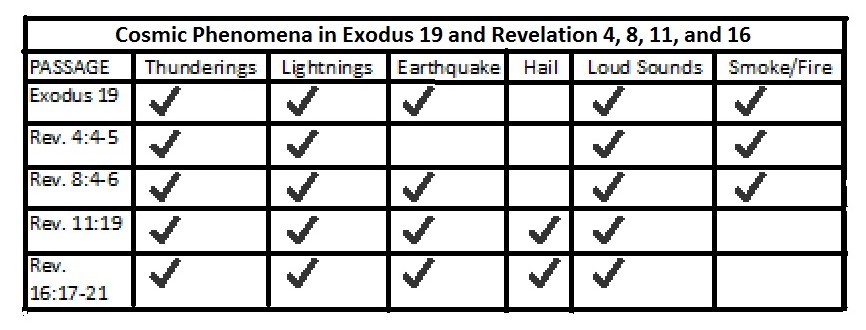
Basis (one of several): The same imagery that was present at the giving of the law, the old covenant, is echoed several times in the book of Revelation (4:5, 8:5, 11:19, and 16:18). This post will highlight these passages and their significance.

Parallel Scripture Passage: In that He says, ‘a new covenant,’ He has made the first obsolete. Now what is becoming obsolete and growing old is ready to vanish away” (Hebrews 8:13, 1st century AD).

Moses and the Israelites at Mount Sinai

Just before examining these passages in Revelation, let’s look at Exodus 19, the passage I believe they echo:

In the third month after the children of Israel had gone out of the land of Egypt, on the same day, they came to the Wilderness of Sinai. For they had departed from Rephidim, had come to the Wilderness of Sinai, and camped in the wilderness. So Israel camped there before the mountain. And Moses went up to God, and the Lord called to him from the mountain, saying, “Thus you shall say to the house of Jacob, and tell the children of Israel: ‘You have seen what I did to the Egyptians, and how I bore you on eagles’ wings and brought you to Myself. Now therefore, if you will indeed obey My voice and keep My covenant, then you shall be a special treasure to Me above all people; for all the earth is Mine. And you shall be to Me a kingdom of priests and a holy nation.’ These are the words which you shall speak to the children of Israel.”

Then it came to pass on the third day, in the morning, that there were thunderings and lightnings, and a thick cloud on the mountain; and the sound of the trumpet was very loud, so that all the people who were in the camp trembled. And Moses brought the people out of the camp to meet with God, and they stood at the foot of the mountain. Now Mount Sinai was completely in smoke, because the Lord descended upon it in fire. Its smoke ascended like the smoke of a furnace, and the whole mountain quaked greatly  (Exodus 19:1-18).

So we see that God reminded them of how He bore the people of Israel “on eagles’ wings”* out of Egypt and to Himself. God was establishing a covenant with them at this time, and He called them to be “a kingdom of priests and a holy nation.”** This gathering was marked by thundering and lightning, the sound of a loud trumpet, thick smoke, and the whole mountain quaking greatly.

*Compare to Revelation 12:13-14, where the persecuted womanwas given two wings of a great eagle, that she might fly into the wilderness to her place, where she is nourished for a time and times and half a time, from the presence of the serpent.”

**Compare this with John’s opening greeting to the seven churches, where he says that Jesus “has made us kings and priests to His God and Father” (Revelation 1:6).

Four Passages That Echo Mount Sinai in Revelation

The same cosmic phenomena present at Mount Sinai are seen again in the book of Revelation. Observe the following passages, with some brief notes on their likely significance:

1. Revelation 4:4-5

Around the throne were 24 thrones, and on the thrones I saw 24 elders sitting, clothed in white robes; and they had crowns of gold on their heads. And from the throne proceeded lightnings, thunderings, and voices. Seven lamps of fire were burning before the throne, which are the seven Spirits of God.”

As we noted in our study of Revelation 4, the 24 elders may very well “depict the 12 patriarchs of Israel and the 12 apostles, who represent the redeemed of both covenants now united in Christ.” This seems to be substantiated by the names of the 12 tribes and the 12 apostles found written on the gates and walls of the new Jerusalem (Rev. 21:12-14). So it appears that this covenant-establishing imagery takes place in the presence of elders representing both the old and the new covenant ages.

2. Revelation 8:4-6

And the smoke of the incense, with the prayers of the saints, ascended before God from the angel’s hand. Then the angel took the censer, filled it with fire from the altar, and threw it to the earth. And there were noises, thunderings, lightnings, and an earthquake. So the seven angels who had the seven trumpets prepared themselves to sound.”

This scene takes place at the opening of the seventh and final seal (Rev. 8:1). An angel with a golden censer offers the prayers of the saints, along with incense, upon the altar before God’s throne (verse 3). We proposed in our study of Rev. 8 that these prayers are linked to the cries of the martyrs for God to avenge their “blood on those who dwell on the earth” – Rev. 6:10 (see this post for a more complete study on this subject). It seems likely that the seal judgments are poured out in response to the prayers of God’s people. Therefore, the covenant-establishing imagery of Mount Sinai appears here because the prayers of the new covenant community were about to result in the old covenant system reaching its demise.

3. Revelation 11:19

Then the temple of God was opened in heaven, and the ark of His covenant was seen in His temple. And there were lightnings, noises, thunderings, an earthquake, and great hail.

Just as the scene we examined in Rev. 8 takes place at the opening of the seventh seal, this scene takes place at the sounding of the seventh trumpet. Loud voices declare, “The kingdoms of this world have become the kingdoms of our Lord and of His Christ, and He shall reign forever and ever!” The 24 elders are present at this scene (Rev. 11:15-16).

In verse 19 we see probably the most explicit reference connecting the old covenant to the prophecies in the book of Revelation. John sees a vision of God’s temple housing “the ark of His covenant.” In ancient Israel, the ark of the covenant was a centerpiece of the temple and the old covenant. Located in the Most Holy Place, it represented God’s presence: “You shall put the mercy seat on top of the ark, and in the ark you shall put the Testimony that I will give you. And there I will meet with you, and I will speak with you from above the mercy seat, from between the two cherubim which are on the ark of the Testimony, about everything which I will give you in commandment to the children of Israel” (Exodus 25:21-22). For further significance, see Numbers 7:89, 10:33-35; Joshua 3:13, 7:6-11; Judges 20:27; II Samuel 6:2; II Kings 19:15; Psalm 28:2, 80:1.

When the dust settles from the barrage of judgments in Revelation, what does heaven shout? “Behold, the tabernacle of God is with men, and He will dwell with them, and they shall be His people. God Himself will be with them and be their God” (Rev. 21:3). This did not suddenly become true because some buildings fell in 70 AD. Remember that Paul told the Corinthian church this was already their reality and that they were “the temple of the living God (II Cor. 6:16). The downfall of Israel, Jerusalem, and the temple in 70 AD, however, did remove the far less glorious old covenant system which competed against, and greatly opposed, this reality. It was a stunning and vivid demonstration that God had chosen the glorious new covenant over the inferior old covenant (see Hebrews 8). This was the time for rewarding God’s “servants the prophets and the saints, and those who fear [His] name, small and great” (Rev. 11:18).

Several verses earlier, John witnesses an actual earthquake that kills 7000 people in“the city” (Rev. 11:13), already identified in verse 8 as Jerusalem (“the great city…where also our Lord was crucified“). As we noted in our study of Revelation 11, Josephus records one awful night in early 68 AD when “a prodigious storm” took place in Jerusalem, marked by “the largest showers of rain, with continued lightnings, terrible thunderings, and amazing concussions and bellowings of the earth, that was in an earthquake.” Josephus adds that the Jewish zealots allowed the Idumaeans to come in and help them slaughter some of their fellow Jews who opposed their rebellion against the Romans. Between this slaughter and the earthquake, 8500 people died that night (Josephus, Wars 4:4:5, 4:4:7-4:5:1).

4. Revelation 16:17-21

Then the seventh angel poured out his bowl into the air, and a loud voice came out of the temple of heaven, from the throne, saying, ‘It is done!’ And there were noises and thunderings and lightnings; and there was a great earthquake, such a mighty and great earthquake as had not occurred since men were on the earth. Now the great city was divided into three parts, and the cities of the nations fell. And great Babylon was remembered before God, to give her the cup of the wine of the fierceness of His wrath. Then every island fled away, and the mountains were not found. And great hail from heaven fell upon men, each hailstone about the weight of a talent. Men blasphemed God because of the plague of the hail, since that plague was exceedingly great. 

Just as the scene we examined in Rev. 8 takes place at the opening of the seventh seal, and the scene in Rev. 11 takes place at the sounding of the seventh trumpet, this scene takes place at the pouring out of the seventh bowl.

John sees the great city, Jerusalem, divided into three parts. As we noted in our study of Revelation 16, this is a flashback to Ezekiel 5:1-12, when the prophet was required to shave his head and divide it into three parts, and was told by God: “This is Jerusalem” (Ezek 5:5).  One third of his hair was burned, one third was chopped up by the sword, and the last third was scattered into the wind. This was fulfilled when Jerusalem was destroyed in 586 B.C. at the hands of Babylon, and Josephus records the same tragedies in 70 AD at the hands of Rome (1.1 million Jews killed by the sword or by fire, and all the survivors exiled or sold into slavery). Jerusalem was also divided between 67-70 AD into three warring factions: [1] the Zealots, led by Eleazar [2] the Galileans, led by John of Gischala, and [3] the Idumeans, led by Simon.

Just as an actual deadly earthquake took place as foretold in Rev. 11, actual hail – “about the weight of a talent” (i.e. 75 – 100 pounds) – also fell as foretold in Rev. 16. Josephus wrote of large stones shot from catapults by the Roman armies into the temple complex in Jerusalem, which the watchmen in the city reported as appearing white in the sky:

“Now the stones that were cast were of the weight of a talent, and were carried two furlongs and further. The blow they gave was no way to be sustained, not only by those that stood first in the way, but by those that were beyond them for a great space. As for the Jews, they at first watched the coming of the stone, for it was of a white color, and could therefore not only be perceived by the great noise it made, but could be seen also before it came by its brightness” (Josephus, Wars 5:6:3).

Josephus also records that the watchmen on the wall, when they saw the stones coming, would shout, “The Son cometh!” After a while the Romans learned to blacken the stones so that they couldn’t as easily be detected, and many more were crushed by these stones. J. Stuart Russell, in his 1878 book titled The Parousia, offers this explanation for the words of the watchmen (p. 482):

“It could not but be well known to the Jews that the great hope and faith of the Christians was the speedy coming of the Son. It was about this very time, according to Hegesippus [110-180 AD], that St. James, the brother of our Lord, publicly testified in the temple that ‘the Son of man was about to come in the clouds of heaven,’ and then sealed his testimony with his blood [in 62 AD]. It seems highly probable that the Jews, in their defiant and desperate blasphemy, when they saw the white mass hurtling though the air, raised the ribald cry, ‘The Son is coming,’ in mockery of the Christian hope of the Parousia.”

—————————————————————————

In his book,Revelation: Four Views (A Parallel Commentary),” Steve Gregg also sees the connection between Mount Sinai and Revelation, as he shares concerning Rev. 4 (p. 88):

“The lightnings, thundering and voices (v. 5) recall Mount Sinai, where God first established His covenant with Israel [Exodus 19:16; cf. Rev. 8:5, 11:19]. Similar phenomena are mentioned here to suggest the end of that covenant and its replacement with another. The writer of Hebrews (citing Hag. 2) likened the overthrow of the first covenant (publicly demonstrated by the destruction of Jerusalem and the temple in A.D. 70) to the time of its establishment at Sinai, but the latter would be accompanied by even more fearful phenomena (Heb. 12:18-29).”

Steve Gregg also shares David Chilton’s comparison of Revelation 19:1-6 with Revelation 11:15-19 (which we have already examined). Chilton indicates that very similar subject matter is established “in the two passages which represent the closing visions of the two major sections of the book” (p. 440):

1. loud voices…in heaven (11:15; 19:1);
2. the declaration of the commencement of the reign of God (11:15, 17; 19:1, 6);
3. the twenty-four elders fall on their faces and worship (11:16; 19:4);
4. the avenging of the blood of His servants is announced (11:18; 18:24; 19:2);
5. reference to God’s servants…who fear Him, small and great (11:18; 19:5);
6. loud noises, including thunderings (11:19; 19:6).

—————————————————————

Check out the first two posts in this mini-series:

1. Revelation 6 and Luke 23: Hide Us From the Wrath of the Lamb
2. The Avenging of Righteous Blood (Deuteronomy, Matthew, and Revelation)

Revelation: The Land (“Ge”) Is Referenced 22 Times More Often Than the World (“Kosmos”)


It’s well-known that the book of Revelation foretells, among other things, a series of frightening judgments falling upon an entity known as Babylon the Great and “the harlot.” Just as importantly, Revelation also portrays beautiful worship scenes and glorious destinies and realities for God’s people. Regarding the judgments, Does John picture them being poured out upon the entire planet, or upon a particular location?

Jonathan Welton, author of the book “Raptureless,” has created another helpful graphic illustrating the fulfillment of Bible prophecy (See his previous graphic on Daniel 2 illustrating that God’s kingdom has come). Titled “John’s Olivet Discourse: A Look at the Writings of John,” Welton’s graphic [1] makes a case that the book of Revelation contains John’s version of the Olivet Discourse [2] shows some of John’s time tables [3] notes an important principle of Bible interpretation, and [4] shows that John speaks far more about local events in Revelation than he speaks about global events.

We can also add Revelation 1:1 and 1:3 to Welton’s list of time statements made by the apostle John:

The Revelation of Jesus Christ, which God gave Him to show His servants—things which must shortly take place.
Blessed is he who reads and those who hear the words of this prophecy, and keep those things which are written in it; for the time is near.

The last part of Welton’s graphic is very informative. The following chart takes the numbers he provides (plus a couple more that I looked up) and allows us to see how focused John was on local events in the book of Revelation compared to his gospel account:

John’s books Number of chapters in each book Number of times John uses the word “kosmos,” meaning the entire planet Number of times John uses the word “ge,” meaning the land (a region)
The Gospel According to John 21 57 3
I John 5 17 1
II John 1 1 0
III John 1 0 0
Revelation 22 3 67

In other New Testament passages where the word “ge” is translated as “earth,” many assume that those passages are speaking about the entire planet. We need to be more careful with this assumption. One instance where it appears is in Luke’s version of the Olivet Discourse (Luke 21:23). There, Luke is clearly speaking about Israel. Some Bible versions translate this word as “earth,” while others translate it as “land.” Here is how Luke 21:23 reads, in context:

But when you see Jerusalem surrounded by armies, then know that its desolation is near. Then let those who are in Judea flee to the mountains, let those who are in the midst of her depart, and let not those who are in the country enter her. For these are the days of vengeance, that all things which are written may be fulfilled. But woe to those who are pregnant and to those who are nursing babies in those days! For there will be great distress in the land and wrath upon this people” (Luke 21:20-23).

The same word that Luke used in reference to Judea is the one that John used 67 times in the book of Revelation.

18 Case Studies on How John Used “Ge” to Speak of 1st Century Israel in Revelation

In 2010 I wrote a 3-part series tracking this phenomenon throughout the book of Revelation. The phrase “those who dwell on the earth” appears 10 times in Revelation, and at least a couple dozen more times in various forms. This series presents 18 case studies showing when and how this expression is used, examining the context in each case, and seeing how it’s used elsewhere in Scripture. A strong case is made that this expression in Revelation indicates 1st century apostate Israel. This series can be seen here: Part 1, Part 2, Part 3. If you have the time to read it, I believe you’ll find it informative.

A Final Note on How John Used the Word “Kosmos” Three Times in Revelation

Although it’s fun and enlightening to see how John used the word “ge” so many times in reference to the land of Israel, it’s also enlightening to see how he used the word “kosmos” to speak of the planet on which we live. Two of these instances concern those whose names are, or are not, written in the Book of Life. This is a global reference, as it ought to be, for the body of Christ is global and the message of the gospel is for every nation, tribe, language, and tongue. The third reference is to the kingdom of God, its triumph and greatness over all the kingdoms of this world (planet), and the eternal and universal reign of Jesus Christ:

1. “Then the seventh angel sounded: And there were loud voices in heaven, saying, ‘The kingdoms of this world have become the kingdoms of our Lord and of His Christ, and He shall reign forever and ever!'” (Rev. 11:15)
2. “All who dwell on the earth will worship him, whose names have not been written in the Book of Life of the Lamb slain from the foundation of the world” (Rev. 13:8).
3. “The beast that you saw was, and is not, and will ascend out of the bottomless pit and go to perdition. And those who dwell on the earth will marvel, whose names are not written in the Book of Life from the foundation of the world, when they see the beast that was, and is not, and yet is” (Rev. 17:8).

Revelation 6 and Luke 23: Hide Us From the Wrath of the Lamb


Series: “Little Gems from Our Study of the Book of Revelation”

My favorite series on this site is our in-depth study of the book of Revelation. Many of the chapter-by-chapter studies are rather lengthy, and buried within these posts are some very interesting mini studies (in my opinion).  Over time I would like to pull out some of these little gems and present them briefly, one post at a time. They will be added to the “Revelation” page on this site as they are posted. This is the first such post.

Revelation 6:15-17 Is the Fulfillment of Luke 23:27-30

One can learn a lot and gain a lot of insight by comparing Scripture with Scripture, or letting Scripture interpret Scripture. Consider John’s description of the opening of the 6th seal judgment, Revelation 6:15-17 in particular:

I looked when He opened the sixth seal, and behold, there was a great earthquake; and the sun became black as sackcloth of hair, and the moon became like blood. And the stars of heaven fell to the earth, as a fig tree drops its late figs when it is shaken by a mighty wind. Then the sky receded as a scroll when it is rolled up, and every mountain and island was moved out of its place. And the kings of the earth, the great men, the rich men, the commanders, the mighty men, every slave and every free man, hid themselves in the caves and in the rocks of the mountains, and said to the mountains and rocks, “Fall on us and hide us from the face of Him who sits on the throne and from the wrath of the Lamb! For the great day of His wrath has come, and who is able to stand?” (Rev. 6:12-17)

Comparing these verses with an earlier prophecy by Jesus in Luke 23:27-30 is very enlightening:

And a great multitude of the people followed Him, and women who also mourned and lamented Him. But Jesus, turning to them, said, “Daughters of Jerusalem, do not weep for Me, but weep for yourselves and for your children. For indeed the days are coming in which they will say, ‘Blessed are the barren, wombs that never bore, and breasts which never nursed!’ Then they will begin ‘to say to the mountains, “Fall on us!” and to the hills, “Cover us!”

  • Question #1: Who did Jesus say would call upon the mountains to fall on them because of His wrath and judgment?
  • Answer #1: The daughters of Jerusalem, and – even more so – their children (note the word “they” in reference to the children).
  • Question #2: When did Jesus say this would happen?
  • Answer #2: During the lifetimes of the ladies who were weeping as Jesus walked past them toward the cross, and during the lifetimes of their children.

In Luke 23, Jesus foretold what would happen to His own people, and to His own generation. In Revelation 6, John saw a vision of the same scene playing out during the great day of the Lord’s wrath. This was not to be a global event, nor was it to occur thousands of years later. It would, and did, occur in the same place where Jesus walked and lived, and upon His own generation which largely rejected Him.

Echoes of Hosea

The same prophecy was once given by the prophet Hosea concerning Israel:

“Also the high places of Aven, the sin of Israel, shall be destroyed. The thorn and thistle shall grow on their altars, and they shall say to the mountains, “Cover us!”, and to the hills, “Fall on us!” (Hosea 10:8).

This is one of many indications in the book of Revelation that the judgments were directed at apostate Israel and the “evil”, “wicked”, “faithless,” and “vile” generation that Jesus often spoke against.

The Significance of “The Kings of the Earth”

Revelation 6:15 speaks of “the kings of the earth.” Note that the Greek word for “earth” here (“ge”) can be, and sometimes is, translated as “land.” This can be understood as the Promised Land, i.e. Israel, and there is no doubt that this is the meaning in Luke 21:23, for example, where this same word is used:

But when you see Jerusalem surrounded by armies, then know that its desolation is near. Then let those who are in Judea flee to the mountains… But woe to those who are pregnant and to those who are nursing babies in those days! For there will be great distress in the land and wrath upon this people” (Luke 21:20-23).

The expression “those who dwell on the earth” occurs frequently in the book of Revelation, and ample evidence points to this being a unique reference to first century Israel, as outlined in this 3-part series (here, here, and here).

F.F. Bruce on Revelation 6:16 and Luke 23:30

F.F. Bruce (1910-1990), well-known Bible scholar from Scotland, regarding verse 16 in Revelation 6:

“The best commentary on the present passage is found in our Lord’s words to the ‘daughters of Jerusalem’ on the Via Dolorosa (Lk. 23:30).”

(“Revelation” in International Bible Commentary, p. 1608, published in 1986)

Josephus on The Final Days of the Roman Siege on Jerusalem in 70 AD

On July 31, 70 AD, after a five month siege, the Romans succeeded in penetrating the final wall around Jerusalem and burned the temple to the ground. Tens of thousands of Jews were killed, but the surviving Jews retreated to the Upper City of Jerusalem, where Josephus says that many continued to plunder, ambush, and assault their fellow Jews. The victims were too weakened by famine to resist, and quite a few were killed senselessly. Josephus tried to persuade them to surrender to the Romans and spare what was left of the city, but he was only laughed at. Josephus records that some put on happy faces “in expectation, as they said, of death to end their miseries.” Many Jews sought refuge in the caves and underground caverns, hoping to remain hidden once the Romans would reach the Upper City:

So now the last hope which supported the tyrants and that crew of robbers who were with them, was in the caves and caverns underground; whither, if they could once fly, they did not expect to be searched for; but endeavored, that after the whole city should be destroyed, and the Romans gone away, they might come out again, and escape from them. This was no better than a dream of theirs; for they were not able to lie hid either from God or from the Romans (Josephus, Wars, 6:7:3).

————————————————————————————————————–

See here for our complete study of Revelation 6:

Part 1 (Rev. 6:1-8)
Part 2 (Rev. 6:9-17)

Dear Abby


‎[Dear Abby]

So, I opened up the newspaper this morning and read this letter by a guy named “John.” No other information was given about him but apparently he wrote about these dreams he had from God on an island about an impending change to the world and the end of this current age. He also had some great insight from God on how my church should change to live more rightly before God.

I was actually very excited and encouraged because it would seem that the tribulation we are enduring will be coming to an end, and the very first line of his letter said that all of this stuff would take place soon.

[Dear Reader]

Don’t get too excited. None of this was meant for you. All those things John was talking about won’t happen for at least another 2,000 years or more. “Soon” doesn’t mean “soon,” darling. It means at a minimum 2,000 years. Get your facts straight!

Those churches he was speaking about aren’t your churches. He was just using the same names, you silly goose. They were metaphorical language for “ages.” The tribulation you Christians are going through at the hands of the Roman authorities you think will end… forget about it. Why do you people think it’s always about YOU? Can’t you see this letter was not written for YOU?

One piece of advice I have for you: Get your time indicators straight. “Soon” doesn’t mean “soon”. It means it might actually happen quickly when it starts. “You” means “them”. “This” generation means “that” generation. “At hand” means…. well something that’s not soon. If you simply take the time indicators and make them the opposite of what they mean, things will make much more sense. So, don’t be encouraged by this [man]’s letters. They’re not for you.

This dialogue above was posted early this morning by Robert Woodrow in a Facebook forum devoted to the subject of eschatology. I felt it was quite creative. Robert said he wanted to imagine that “someone from one of the seven churches [of the first century] actually wrote into an advice column,” and received a response that reflects the way the book of Revelation is often viewed today.

This imagined dialogue is both humorous and thought-provoking. I know that I once gave very little (if any) thought to what the book of Revelation meant to those who first received it into their hands (i.e. God’s people living in the first century). As I was trained, I jumped straight to what it could mean to me and to my generation. In doing so, I got way off track.

No doubt this great book does speak to our generation, but, because that’s so often our first and only consideration, we miss out on what John (and Jesus, through John) wanted to communicate to God’s people at that time. On the other hand, if we will first take into account audience relevance, we are then far more likely to grasp the relevance of this book for our own time. And it does speak to us in a very powerful and hope-filled way.

All of our Revelation chapter-by-chapter studies, and any other posts related to the book of Revelation, can be found here.

Revelation Chapter 21 (Part 2: Verses 5-27)


REVELATION 21 (Part 2: Verses 5-27)

Adam Maarschalk: February 3, 2010

Scripture text for this study: Revelation 21:1-27

Introduction: In the previous post, we covered the first four verses of Revelation 21, giving special attention to the imagery of a new heaven and a new earth (“for the first heaven and the first earth had passed away”), and the New Jerusalem coming down from God out of heaven. Our conclusion is that John was being shown the final transition from the Old Covenant age to the New Covenant age (exclusively and in fullness) in 70 AD. In other words, the New Jerusalem came down from heaven at that time, and is a present reality now, just as the author of Hebrews also said (Heb. 8:13; 12:22-24). The events of 70 AD demonstrated decisively that the kingdom no longer belonged to the Jewish nation, but to the holy nation created at Pentecost (Matt. 21:43-44, I Peter 2:4-10; cf. Daniel 7:22, 27), made up of both Jewish and Gentile believers who enter God’s kingdom on an equal basis.

It is recommended that one read Part 1 of our study of Revelation 21 before proceeding here, in order to have a basis for what is to follow. We will now continue with our study, picking things up in verse 5. We will be relying much on Steve Gregg’s commentary on this chapter.

Verse 5: The One on the throne said, “Behold, I am making all things new…” While the literalist position most often takes this statement to refer, along with the rest of the chapter, to a future physical new heavens and earth, this can also quite naturally be understood as a reference to the same truth which is articulated in II Corinthians 5:17. This verse reads, “Therefore, if anyone is in Christ, he is a new creation. The old has passed away; behold, the new has come.” As believers submitted to Christ, every area of our lives should experience renewal. Even as this is true on a personal level for each believer, it’s also true in terms of the New Covenant. In the book “Revelation: Four Views (A Parallel Commentary),” Steve Gregg writes (p. 491):

The language of these verses also can apply to the passing away of the old covenantal order, which has been so completely replaced by the new order that God commands His people: “Do not remember the former things, nor consider the things of old. Behold I will do a new thing” (Isa. 43:18-19). No place remains for the old covenant, as the writer of Hebrews explains: “In that He says, ‘A new covenant,’ He has made the first obsolete. Now what is becoming obsolete and growing old is ready to vanish away” (Heb. 8:13).

Verses 6-7: The text here reads, “And he said to me, ‘It is done! I am the Alpha and the Omega, the beginning and the end. To the thirsty I will give from the spring of the water of life without payment. The one who conquers will have this heritage, and I will be His God and he will be My son.’” Is this a present reality, or a future reality to be experienced in the eternal state? Steve Gregg reminds us (p. 491):

[T]he promise, I will give of the fountain of the water of life freely to him who thirsts (v. 6), is clearly the same as that made twice by Jesus in John’s Gospel (cf. John 4:10, 14; 7:37f). Also, the phrase He who overcomes (v. 7) is characteristic of the phraseology in the promises made by Christ in the letters to the seven churches (cf. 2:7, 11, 17, 26; 3:5, 12, 21).

The one who overcomes receives this promise: “and I will be His God and he will be my son.” A similar promise is given in II Corinthians 6:18, a passage speaking of the Church as the temple of the living God. There we read: “and I will be a Father to you, and you shall be sons and daughters to Me, says the Lord Almighty.” This present position as God’s children is also spoken of in Romans 8:15-17. Kenneth Gentry, in his latest book “Navigating the Book of Revelation,” adds:

John is encouraging the beleaguered first century saints to hold on through their trials: Once Jerusalem falls, they will complete their entry into the final redemptive-historical order which has been gradually dawning since the time of Christ (John 4:21-23). As the writer of Hebrews puts it: Since we are receiving a kingdom that cannot be shaken, let us be thankful, and so worship God acceptably with reverence and awe” (Heb. 12:28 NIV; cf. Heb. 8:13). Or as Paul expresses it in the mid-50s: “And this do, knowing the time, that it is already the hour for you to awaken from sleep; for now salvation is nearer to us than when we believed. The night is almost gone, and the day is at hand. Let us therefore lay aside the deeds of darkness and put on the armor of light” (Rom. 13:11-12) – a reality worthy of enduring persecution.

Jesus promises His disciples that some of them will live to see the kingdom’s final establishment in power: “Truly I say to you, there are some of those who are standing here who shall not taste death until they see the kingdom of God after it has come with power” (Mark 9:1). Thus in Revelation 21 John paints nascent, post-A.D. 70 Christianity – now finally separated from Judaism – in glowing terms, as a firmly established, glorious reality (p. 167).

Verse 8: This verse reads, “But as for the cowardly, the faithless, the detestable, as for murderers, the sexually immoral, sorcerers, idolaters, and all liars, their portion will be in the lake of fire that burns with fire and sulfur, which is the second death.” Steve Gregg notes that many scholars have equated “the cowardly” with apostates “who defect from the gospel rather than enduring hardship as good soldiers of Jesus Christ,” in contrast to those “who overcome” (v. 7).

We also saw a reference to the lake of fire and the second death in Revelation 20:14, with regard to the Great White Throne Judgment. This is where, according to that passage, death and Hades was to be thrown, along with anyone whose name was not found in the book of life (Rev. 20:15).[1]

Steve Gregg makes a very interesting observation at this point. Speaking of the preceding 8 verses in relation to the rest of the final two chapters, he observes (p. 492):

One way of understanding the structure of these final chapters is to see this whole segment (vv. 1-8) as an outline or summary of the remaining portion of the book. A remarkable correspondence exists between the progression of thought in these first verses and in the remaining chapters.

Compare, after the introductory statement in verse 1:

CONTENT

In Verses 1-8

In the Remainder

New Jerusalem Verse 2 21:9-21
God dwells among men Verse 3 21:22-27
Renewal of the world Verse 5a 22:1-5
“These words are true and faithful” Verse 5b 22:6-10
Work completed: “I am Alpha and Omega” Verse 6a 22:11-15
Final blessing: water of life to all who thirst Verses 6b – verse 7 22:16-17
Final curse upon the rebellious Verse 8 22:18-19

Verse 9: John is now taken to see “the Bride, the wife of the Lamb,” by one of the same seven angels who held the bowl judgments. Steve Gregg notes (p. 493) that one of these same angels—perhaps even the same one—had also taken John to see the great harlot in Revelation 17:1: “Then one of the seven angels who had the seven bowls came and said to me, ‘Come, I will show you the judgment of the great prostitute who is seated on many waters.’” He says that this “provides a structural link, deliberately placing the harlot in juxtaposition with the bride.” We made the same observation in our study of chapter 17, comparing the language of these two texts as follows:

A. Revelation 21:9: “Then came one of the seven angels which had the seven bowls full of the seven last plagues and spoke to me, saying, ‘Come, I will show you the Bride, the wife of the Lamb.’”

B. Revelation 17:3: “And he carried me away in the Spirit into a wilderness, and I saw a woman sitting on a scarlet beast that was full of blasphemous names.”

B. Revelation 21:10: “And he carried me away in the Spirit to a great, high mountain, and showed me the holy Jerusalem coming down out of heaven from God.”

Earthly Jerusalem and the Old Covenant temple system are thus contrasted with heavenly Jerusalem and the New Covenant (cf. Galatians 4:21-31; Hebrews 12:18-28). On the different destinations to where John was taken in these two visions, Steve Gregg comments: “The bride-city is elevated upon a mountain, ‘beautiful in elevation, the joy of the whole earth’ (Ps. 48:2), while the harlot city is situated in a barren wasteland.”

Verses 10-11: The descending of “the holy city Jerusalem coming down out of heaven from God” was also shown to John in verse 2. Steve Gregg comments on the significance of her attire:

Here, the attire of the bride is seen to be her having the glory of God (v. 11). The Shekinah that once rested upon the temple in earthly Jerusalem has departed from that institution and come to alight upon the church, the new temple of the Holy Spirit and the new City of God. The inheritance and hope of the New Testament believer is the hope of obtaining the glory of God (Rom. 2:7; 5:2; 8:18; Col. 1:27; I Thess. 2:12; 2 Thess. 2:14; Heb. 2:10; I Pet. 5:1, 10). This speaks of the likeness of Christ Himself seen upon His people (Rom. 8:29; 2 Cor. 3:18; Phil. 3:21; 2 Pet. 1:19; I John 3:2).

The light radiating from the glorious bride-city is compared to the radiance of a most precious stone, like a jasper stone, clear as crystal (v. 11), which probably refers to a diamond. The believing remnant is likened to jewels in the Old Testament. In Malachi 3:16-17, it is said of those who fear the Lord and meditate on His name, “‘They shall be Mine,’ says the Lord of hosts, ‘on the day that I make them My jewels.’” The context in Malachi [3:16-4:6] suggests that the reference is to the Jewish believers in Christ, who escaped the desolation of the capital city in A.D. 70. In this place also some find grounds for seeing the bride as the surviving church at the time of the destruction of the Jewish polity.

Verses 12-13: This text reads, “It [the New Jerusalem] had a great, high wall, with twelve gates, and at the gates twelve angels, and on the gates the names of the twelve tribes of the sons of Israel were inscribed—on the east three gates, on the north three gates, on the south three gates, and on the west three gates.” Steve Gregg comments (p. 494),

The city is described as surrounded by a great and high wall (v. 12). This is applicable to the church as a spiritual city even today. In speaking of the spiritual Jerusalem, God predicted “and you shall call your walls Salvation” (Isa. 60:18), and “I…will be a wall of fire around her, and I will be the glory in her midst” (Zech. 2:5). If Salvation is the wall—indeed, God Himself is the wall—of the city, then the city and its wall appear to be spiritual in nature. This would be a figurative means of expressing the reality of the believer’s security in the City of God.

The wall of the city has twelve gates (v. 12) which have written upon them the names of the twelve tribes of the children of Israel. In Isaiah, the same passage that calls the city’s wall “Salvation” goes on to say, “And your gates [shall be called] Praise” (Isa. 60:18). The most important of the twelve tribes was Judah, whose name means “Praise.” In Isaiah, the city’s gates are named after this tribe; in Revelation, the gates bear the names of all twelve tribes. There may be no conflict here, since in Judah, that is, in Christ, who is of that tribe, all the “twelve tribes” of the spiritual Israel are included. The attachment  of the tribal names to the gates may suggest that through Israel God made a way for the world to enter the City of God, for “salvation is of the Jews” (John 4:22). Of course, this is only another way of saying that salvation is through Jesus Christ, who sprang from the Jewish race…

Another observation concerning the 12 gates with the names of the 12 tribes of Israel is that this parallels Ezekiel’s vision, where he saw the same thing (Ezekiel 48:30-34). Gregg continues,

It is expedient that there should be three gates on the east, three gates on the north, three gates on the south, and three gates on the west (v. 13), to speak of the universal access into the church, for Jesus predicted that “They will come from the east and the west, from the north and the south, and sit down in the kingdom of God” (Luke 13:29).

In the passage just quoted from Luke 13, we should note that just before Jesus said these words, He also said to the unbelieving Jews that they would be cast out of the kingdom of God and would experience weeping and gnashing of teeth while the patriarchs, prophets, and many Gentiles would find entrance. This mirrors what Jesus said in the Parable of the Tenants (Matt. 21:43-44; cf. Matt. 22:1-14).

Verse 14: This verse reads, “And the walls of the city had twelve foundations, and on them were the twelve names of the twelve apostles of the Lamb.” Steve Gregg’s commentary on this verse is very insightful (p. 494):

Further evidence for identifying the city with the church is seen in the city foundations that have upon them the names of the twelve apostles of the Lamb (v. 14). This detail communicates pictorially what Paul said more directly, that the church is “built upon the foundation of the apostles and prophets” (Eph. 2:20). This is the city for which Abraham looked: “the city which has foundations, whose builder and maker is God” (Heb. 11:10).

Duncan McKenzie likewise says, “A physical structure (a city) is being used here as a symbol to portray the totality of God’s people, just as God’s people are likened to a physical structure (a temple) in Ephesians 2:19-22—notice that both “structures” are built on the foundation of the apostles (Eph. 2:20; Rev. 21:14).”

Verse 15: Here we read, “And the one who spoke with me had a measuring rod of gold to measure the city and its gates and walls.” Steve Gregg again comments (pp. 494-495):

The measuring of the city, its gates, and its wall (v. 15) recalls Ezekiel 40:3, where an angelic messenger carried a measuring line and a reed to measure the gates and walls of “something like the structure of a city” (Ezekiel 40:2) and the temple in it. It seems likely that this vision corresponds to that of Ezekiel, although premillennialists generally apply Ezekiel’s to the Millennium and this one to the state of things after the Millennium.

We should note that a major difference between Ezekiel’s account and John’s account here is that (as we will see) there is no temple in John’s vision. Ezekiel, on the other hand, goes into great detail in describing the temple he sees in his vision [In Philip Mauro’s classic work in 1922, “The Hope of Israel,” he noted that the promises given through Ezekiel were conditional (e.g. Ezekiel 43:9-11), and that these visions had to do with the return from the Babylonian captivity some five centuries before Christ with some foreshadowing also of Christ and the coming Church age].

Verses 16-21: We are now given the physical description of the holy city. Futurists, and premillennialists in particular, see this as a literal description of a future, physical city to be enjoyed during the eternal state following Christ’s millennial reign. On the other hand, as we will see, there is Scriptural warrant for seeing this description as depicting with rich symbolism the glories of the New Covenant church in this present age. Here is the text at hand:

The city lies foursquare; its length the same as its width. And he measured the city with his rod, 12,000 stadia [about 1380 miles]. Its length and width and height are equal. He also measured its wall, 144 cubits by human measurement, which is also an angel’s measurement. The wall was built of jasper, while the city was pure gold, clear as glass. The foundations of the wall of the city were adorned with every kind of jewel. The first was jasper, the second sapphire, the third agate, the fourth emerald, the fifth onyx, the sixth carnelian, the seventh chrysolite, the eighth beryl, the ninth topaz, the tenth chrysoprase, the eleventh jacinth, the twelfth amethyst. And the twelve gates were twelve pearls, each of the gates made of a single pearl, and the street of the city was pure gold, transparent as glass.

One key comparison to take note of is the fact that the holy city in John’s vision is cube-shaped, just as the holy of holies in Solomon’s temple was (I Kings 6:20). The holy of holies was overlaid with pure gold, while the holy city in John’s vision is entirely made of pure gold. What follows is Steve Gregg’s commentary on these verses, found on pages 495-496 of his book:

[VERSES 16-17] Since John sees no temple in the city (v. 22), we may imply that the whole city is the temple, or more specifically, the holy of holies. It is the place of the glory of God (cf. v. 11). This is the place of God’s residence (Eph. 2:20-21; I Tim. 3:15; Heb. 3:6; I Pet. 2:5), where God communes with men. Earlier [Rev. 11:1-2], John had measured the holy of holies (the naos) for its protection and preservation. In this vision, the naos is again measured, indicating its permanence, but it is now identified with the City of God, the church of Jesus Christ.

Part of the adorning of the bride is her jewelry… The walls, foundations, and gates are all made of great gemstones. This harks back to a prophecy of the Old Testament concerning the church: “O you afflicted one, tossed with the tempest, and not comforted, behold, I will lay your stones with colorful gems, and lay your foundations with sapphires. I will make your pinnacles of rubies, your gates of crystal, and all your walls of precious stones” (Isa. 54:11-12). [Steve Gregg’s endnote: That the church is here pictured seems a necessary conclusion to be drawn from Paul’s quotation of the first verse of the chapter in Galatians 4:26-27 and his application of it to the Gentiles of the New Covenant church.]

[VERSE 18] (T)he city itself was of gold, so thoroughly purified as to become transparent. This is an image used to describe the refined character of the sanctified believer (Job 23:10; Zech. 13:9; Mal. 3:3; I Pet. 1:7; Rev. 3:18).

[VERSES 19-20] The twelve gems comprising the foundations call to mind the twelve gems worn upon the breast of the high priest, though again the individual stones are not identical (cf. Ex. 28:15-21). Since these same stones bear the names of the twelve apostles, it could be understood as a statement about the leadership of the people of God having transferred from the high priesthood of the temple to the apostles of the church.

[VERSE 21] There may be symbolic significance to the fact that the twelve gates were twelve pearls (v. 21). Unlike the previously named gems, pearls are created organically. A rough grain of sand irritating the tissues of the oyster causes the secretion of a substance that transforms the source of irritation into a pearl. The pearl thus may stand for affliction turned to benefit, even as silver and gold refined by fire are used in Scripture for the same concept. The gates are the means of entry into the city. If the pearl is understood in this light, we have a picture of one of Paul’s preaching themes: “We must through many tribulations enter the kingdom of God” (Acts 14:22).

In Scripture a way of life is frequently called a path, a way, a highway, or a road (e.g. Prov. 4:18; Isa. 35:8). Therefore it is reasonable to understand the street of the city (v. 21) as representing the way of life of those who comprise the New Jerusalem. This street was pure gold, like transparent glass, which speaks of the godly character and behavior that comes from enduring the refining fires of tribulation.

Verses 22-27: John continues to describe what he observes concerning the heavenly Jerusalem:

And I saw no temple in the city, for its temple is the Lord God the Almighty and the Lamb. And the city has no need of sun or moon to shine on it, for the glory of God gives it light, and its lamp is the Lamb. By its light will the nations walk, and the kings of the earth will bring their glory into it, and its gates will never be shut by day—and there will be no night there. They will bring into it the glory and the honor of the nations. But nothing unclean will ever enter it, nor anyone who does what is detestable or false, but only those who are written in the Lamb’s book of life.

Steve Gregg’s commentary again follows, including a most helpful chart comparing this portion of Revelation 21 with a corresponding portion of Isaiah 60 (pp. 496-497):

On the statement, I saw no temple in it, [J. Stuart] Russell writes: “Some of the features [of this vision] are evidently derived from the visionary city beheld by Ezekiel [chapters 40-48]; but there is this remarkable difference, that whereas the temple and its elaborate details occupy the principal part of the Old Testament vision, no temple at all is seen in the apocalyptic vision—perhaps for the reason that where all is most holy no one place has greater sanctity than another, or because where God’s presence is fully manifested, the whole place becomes one big temple.” Rather than going to a particular place to worship and appearing before God “in the sanctuary,” today one needs only be found “in God” or “in Christ” to worship acceptably, for the Lord God Almighty and the Lamb are its temple (v. 22).

A helpful way of treating this segment is to look at it alongside an Old Testament passage with which it coincides. Compare the details point-by-point with Isaiah chapter 60:

Isaiah 60

Revelation 21

The sun shall no longer be your light by day, nor for brightness shall the moon give light to you; but the Lord will be to you…light (v. 19) The city had no need of the sun or of the moon to shine in it for the glory of God illuminated it (v. 23)
The Gentiles shall come to your light (v. 3) The nations of those who are saved shall walk in its light (v. 24)
Kings shall minister to you (v. 10); the glory of Lebanon shall come to you (v. 13) The kings of the earth bring their glory and honor into it (v. 24)
Your gates shall be open continually…not shut day nor night (v. 11) Its gates shall not be shut at all by day (there shall be no night there) (v. 25)
The wealth of the Gentiles shall come to you (v. 5) They shall bring the glory and the honor of the nations into it (v. 26)
Also your people shall be all righteous (v. 21) There shall by no means enter it anything that defiles (v. 27)

In Isaiah 60, all of this is precipitated by the dawning of the glory of the Lord in a glorious new day (Isa. 60:1-3). This day was seen to dawn with the birth of John the Baptist and Jesus (cf. Luke 1:76-78; Matt. 4:13-16). Both passages then would appear to speak, albeit in symbolic terms, of the realities of the New Covenant age. The coming of the Gentiles into the church and the submission of kings to Christ has been in progress for nearly two thousand years now.

These facts alone (those highlighted in the paragraph above) would seem to be conclusive proof that these prophecies found here simply cannot be said to await a future dispensation or realm, but are indeed realities which have characterized the Church for nearly 2000 years.

This brings us to the end of the chapter, in terms of looking at it verse-by-verse. In this post, we have noted several parallels with the book of Ezekiel. This is actually a very common pattern with the book of Revelation, and numerous scholars have recognized that John borrows much from—or alludes much to—Ezekiel. Just for fun, here is a brief summary from Pastor Sam Frost of some of the parallels between Revelation 21 and various visions of Ezekiel:

Ezekiel is taken to a high mountain by angel and sees a city (40.1-3). John is taken to a high mountain by an angel and sees a city (21.10). The first thing Ezekiel sees is the wall (40.5) that surrounds the city. The first thing John sees is the wall surrounding the city (21.12). The first gate Ezekiel sees is the ‘east gate’ (40.6). The first gate for John is the ‘east gate’ (21.13). Ezekiel sees the East, North (40.20-23) and the South (40.24-27), in that order. John follows the same order: ‘From the East gates, three; and from the North gates, three; and the South gates, three’ (21.13). One omission: Ezekiel does not mention a West gate, but John does.

Each gate/alcove for John and Ezekiel are ‘three’ (21.13; cf. 40.10). Each are being measured (21.15-ff; cf. 40.10-ff). John then measures the city itself and its foundations. Here, Ezekiel goes into the city and sanctuary and begins measuring their dimensions.

Obviously, Ezekiel’s vision is much more detailed that John’s. Nonetheless, the pattern is there, plainly. Each gate (four in all, with three alcoves, giving a total of 12) are named after the tribes of Israel (Ez 48.31-ff). Same as John (21.12). The City has ‘living waters’ in Ezekiel 47.1-ff. So does John (22.1-ff). I can expand the list, but we would be here a little longer. By now, you ought to get the point.

Before we bring this post to a close, and by way of review, the following is a selected outline of Kenneth Gentry’s reasons[2] for seeing a first-century fulfillment of the vision of Revelation 21. My numbering of Gentry’s points is a bit different than his own numbering, as I have left out certain points for the sake of brevity:

[1] The flow of Rev’s drama expects the immediate appearance of the New Jerusalem bride (21:2). John’s theme involves Christ’s judging Israel (1:7), which leads to the destruction of old, historical Jerusalem (under the image of Babylon…). Once the old city is destroyed in AD 70 we should expect the New Jerusalem to take its place. Indeed, the NT declares the heavenly Jerusalem is already present in Christianity, as over against Judaism (Gal 4:26; Heb 12:22; cp. vv 18–21).

[2] Per the “unanimous agreement among scholars” (Mathewson, A New Heaven and a New Earth, 33; cf. Beale, Revelation, 1041), John’s immediate source material is surely Isa 65:17–20 (cf. LXX). Isaiah’s prophecy portrays the coming new covenant order established by Christ (cp. 2Cor 5:17; Gal 6:15; Eph 2:10; 4:24). As Young (Isaiah 3:514) explains: “Heaven and earth are employed as figures to indicate a complete renovation or revolution in the existing course of affairs. With the advent of the Messiah the blessing to be revealed will in every sense be so great that it can be described as the creation of a new heaven and a new earth.”

[3] The coming down of the new Jerusalem (21:2) leads to the loud proclamation from God’s throne: “Behold, the tabernacle of God is among men, and He shall dwell among them, and they shall be His people, and God Himself shall be among them.” This transpires in the first century, as a result of Christ’s work and his pouring out God’s Spirit. Paul writes in 2Co 6:16: “We are the temple of the living God; just as God said, ‘I will dwell in them and walk among them; And I will be their God, and they shall be My people.”

[4] …The promise of the water of life without cost reflects Isa 55:1 and the offer of salvation, which is related to the redemptive-historical order established by Christ in the first century. In his Gospel John speaks of the water of life flowing from Christ during his incarnation (4:10–14) and promises its fuller flow at his exaltation (7:38–39; cp. Ac 2).

[5] The twelve foundation stones of the city in 21:14 picture the historical church, which Paul presents as already “having been built upon the foundation of the apostles and prophets” (Eph. 2:20).

[6] …John writes in 21:22: “And I saw no temple in it, for the Lord God, the Almighty, and the Lamb, are its temple.” This suggests a first century reality, for with Christ’s coming and death the temple is rendered unnecessary (Mk 15:38//; Jn 4:21; Ac 17:24; Heb 8:13), for he is the temple (Jn 2:19–21; Eph 2:19–20) and is greater than the physical temple (Mt 12:6).

[7] That “the nations shall walk by its light” (21:24a) suggests that the nations as separate national entities still exist. Thus, historical conditions still prevail, rather than radically new, eternal conditions of perfect union and the fading of all distinctions.

[8] The city is not a purely consummational phenomenon, for the “unclean” and he “who practices abomination and lying” are not allowed in (21:27). This implies a pre-Judgment setting, where sinners still exist. In fact, the city contains the “tree of life,” which produces leaves “for the healing of the nations” (22:1–2). This also requires conditions subsisting prior to the eternal order. The healing of the nations obviously suggests conversion. John even declares the continued existence of “dogs and the sorcerers and the immoral persons and the murderers and the idolaters, and everyone who loves and practices lying” (22:15), though they are “outside” of the city. Presumably they are the targets of evangelism, for whom the healing leaves of the tree of life exist. (pp. 2-3)

Summary Statement: “So there you have it! John is picturing the glory of new covenant Christianity, which arises from the fallen ashes of collapsed Judaism (cp. Matt 8:11–12; Heb 8:13).”

An Invitation for Feedback

It seems that this is as good a place as any to pose a question I’ve been wishing to resolve for some time. I have no dogmatic position on this as of yet, and would love to have some thoughts/feedback. My question is this: What is the significance of Hebrews 9:8-10, if any, to Revelation 21? This passage in Hebrews reads as follows:

By this the Holy Spirit indicates that the way into the holy places is not yet opened as long as the first section is standing (which is symbolic for the present age). According to this arrangement, gifts and sacrifices are offered that cannot perfect the conscience of the worshipper, but deal only with food and drink and various washings, regulations for the body imposed until the time of reformation.

Rightly or wrongly, I’m linking this passage to Revelation 21 since, as we noted when looking at verse 16, the cube-shaped holy city in John’s vision replaces the cube-shaped holy of holies of the Old Covenant temple (I Kings 6:20). Among my suppositions and considerations are these:

[1] Unless there is a tense error in the English Standard Version from which I quoted this text in Hebrews 9, the first century readers seem to have been told that the way into the holy places was not yet opened in their day, but that it would be opened once the first section no longer stood. This “first section” was spoken of in Heb. 9:6, and is a reference back to Numbers 28:3 where we see a prescription for the regular offering of two male lambs without blemish. Does Heb. 9:8 mean that the first section must no longer physically stand (a reality accomplished only in 70 AD), or simply that it must no longer stand as covenantally significant (a reality accomplished at the cross)?

[2] By the phrase “the present age,” I understand the author of Hebrews to mean the Old Covenant/Judaic age which ended in 70 AD with the destruction of Jerusalem and the temple at the hands of the Romans (see this post here for “a discussion of two ages”). [By the way, if “the present age” is understood—as it popularly is—to mean this present church age, then is “the way into the holy places” still not opened, even in our day? Of course it is. Or is there indeed a tense error in this quoted passage? Curiously, in the ESV the past tense is used in verses 1-5, but the present tense is used in verses 6-10. I’m not so sure that it should be this way. This whole passage may even refer to the wilderness tabernacle, and thus have nothing to do with 70 AD except for the mention of “the present age.”]

[3] The phrase “the time of reformation” I would understand to refer to Christ’s work on the cross, for it was surely this work which brought an end to the imposing of “food and drink and various washings, regulations for the body…”

[4] I want to be careful not to assign any significance to the events of 70 AD which is instead properly assigned to the cross. Jesus and Him crucified must remain central.

So, does anyone have thoughts on this matter? Thanks in advance for any feedback.

————————————————————————————————————————-

Our next post brings us to Revelation 22, which will be our final post in this series of chapter-by-chapter studies of the book of Revelation.

All of our Revelation chapter-by-chapter studies, and any other posts related to the book of Revelation, can be found here.


[1] As we saw in a previous post, Duncan McKenzie makes a good case that the great white throne judgment is a past event—for those who have already died. He sees it as an ongoing event ever since 70 AD, so that everyone who has died since then experiences a personal judgment following their physical death, rather than a one-time event in the future to be experienced by all humanity at once. Hebrews 9:27 (“…it is appointed for man to die once, and after that comes judgment”) is said to reflect this sequence, as is Revelation 11:18. This was also the viewpoint of J. Stuart Russell (1816-1895), who wrote the landmark book “The Parousia.”

[2] Source: Kenneth Gentry, “New Creation as New Covenant” (Supplement to his newest book, Navigating the Book of Revelation: Special Studies on Important Issues), January 2010, p. 4.