Revelation Study Resources


The following is a list of online resources that we used as we studied the book of Revelation in 2009-2010. (At the bottom of this page are two books that we also used.)

[A] Preterist viewpoint:

[1] http://www.ccel.org/contrib/exec_outlines/rev.htm
-“Revelation: A Study Guide” by Mark Copeland
-Includes all 22 chapters of Revelation
-Also available here: http://executableoutlines.com/rev.htm

[2] http://www.preteristarchive.com/StudyArchive/index.html
-Limited Scripture Study Archive
-Only has commentary on the following texts: Revelation 1:7, 6:16-17, 9:11, 11:1, 13:18, 17:10, 20:1-10

[3] http://www.preteristarchive.com/
-Type a Scripture text into the search box, and you may or may not find some valuable commentary on that particular text, both modern and ancient commentary.

[B] Neutral viewpoint:

[4] http://www.desiringgod.org/ResourceLibrary/Sermons/ByScripture/17/
-John Piper’s sermons on Revelation over the years
-Generally non-eschatological
-Sermons available only for chapters 1, 2, 3, 5, 8, 19, 21, 22

[C] Futurist and/or Dispensationalist viewpoint:

[5] http://www.gcfweb.org/institute/general/revelation.pdf
-From the Grace Institute for Biblical Leadership
-In outline form, and covers all 22 chapters of Revelation
-In PDF format, so they can be saved and read offline

[6] http://www.soniclight.com/constable/notes/pdf/revelation.pdf
-Notes on Revelation from Dr. Thomas Constable, Department Chairman and Senior Professor of Bible Exposition at Dallas Theological Seminary
-In outline form, and covers all 22 chapters of Revelation
-In PDF format

[7] http://www.studylight.org/com/guz/view.cgi?book=re
-Commentary on the book of Revelation from David Guzik, director of Calvary Chapel Bible College in Siegen, Germany.
-In outline form, and covers all 22 chapters of Revelation

[D] Dr. Sam Storms/Historicist viewpoint

[8] http://www.enjoyinggodministries.com/studies/eschatology/
-Sam Storms is an Amillennialist, and the best I can tell he is also a Historicist. His writings on the various Millennial views came in handy in our study of Revelation 20.
-His commentary at the above site covers Revelation 10, 11, 12, 14, 17, 18, 19, 20, and 21
-He also writes about the seven seals (chapters 6, 8); the seven trumpets (chapters 8, 9, 11); and the seven bowls (chapter 16).
-His meditations on Revelation 2-3 (letters to the seven churches) are here: http://www.enjoyinggodministries.com/biblical-studies/ (scroll down the page 1/3 of the way)

**********************************************************************************************************

The following are offline sources (books) that we used in our study of Revelation:

[1] Gentry, Kenneth L. Before Jerusalem Fell: Dating the Book of Revelation (An Exegetical and Historical Argument for a Pre-A.D. 70 Composition). American Vision: Powder Springs, Georgia, 1988.

[2] Gregg, Steve. Revelation: Four Views (A Parallel Commentary). Thomas Nelson Publishers: Nashville, 1997.

PP19: The Historical Events Leading Up to 70 AD (Part 3)


This is now the nineteenth post in our series on “A Partial-Preterist Perspective on the Destruction of Jerusalem in 70 AD.” This is the same title as a term paper I recently submitted to Northwestern College. All the previous posts can be found here, and it’s recommended that they be read in order before reading this post:

[1] https://kloposmasm.wordpress.com/2009/08/13/brief-explanation-of-partial-preterism/
[2] https://kloposmasm.wordpress.com/2009/08/13/pp2-references/
[3] https://kloposmasm.wordpress.com/2009/08/13/pp3-external-evidence-for-an-early-date-revelation/
[4] https://kloposmasm.wordpress.com/2009/08/14/pp4-internal-evidence-for-an-early-date-revelation-part-1/
[5] https://kloposmasm.wordpress.com/2009/08/14/pp5-internal-evidence-for-an-early-date-revelation-part-2/
[6] https://kloposmasm.wordpress.com/2009/08/14/pp6-internal-evidence-for-an-early-date-revelation-part-3/
[7] https://kloposmasm.wordpress.com/2009/08/14/pp7-internal-evidence-for-an-early-date-revelation-part-4/
[8] https://kloposmasm.wordpress.com/2009/08/14/pp8-daniels-70-week-prophecy-part-1/
[9] https://kloposmasm.wordpress.com/2009/08/15/pp9-daniels-70-week-prophecy-part-2/
[10] https://kloposmasm.wordpress.com/2009/08/15/pp10-jerusalems-destruction-foretold-in-the-olivet-discourse/
[11] https://kloposmasm.wordpress.com/2009/08/15/pp11-did-jesus-come-in-70-ad-part-1/
[12] https://kloposmasm.wordpress.com/2009/08/15/pp12-did-jesus-come-in-70-ad-part-2/
[13] https://kloposmasm.wordpress.com/2009/08/16/pp13-signs-of-the-close-of-the-age/
[14] https://kloposmasm.wordpress.com/2009/08/16/pp14-abomination-of-desolation/
[15] https://kloposmasm.wordpress.com/2009/08/16/pp15-the-man-of-lawlessness-ii-thess-2-part-1/
[16] https://kloposmasm.wordpress.com/2009/08/16/pp16-the-man-of-lawlessness-ii-thess-2-part-2/
[17] https://kloposmasm.wordpress.com/2009/08/16/pp17-the-historical-events-leading-up-to-70-ad-part-1/
[18] https://kloposmasm.wordpress.com/2009/08/22/pp18-the-historical-events-leading-up-to-70-ad-part-2/

In the previous two posts we have been discussing the historical events which led up to Jerusalem’s destruction in 70 AD. In the first post we saw a timeline of these events, and in the last post we examined some of these historical events in more detail. In this present post we will speak of Rome’s burning of the temple and the city of Jerusalem.

For further details regarding the final five-month siege on Jerusalem (April-September 70 AD), and the crushing of all remaining Jewish resistance in the nation of Israel (Sept. 70 – May 73 AD), please refer back to the timeline which is laid out in part 1 (PP17).

Adam Maarschalk

—————————————————————————————————————————————————-

G. The Historical Events Leading Up to 70 AD (Part 3)

Titus, the son of Vespasian, had determined to spare the temple as an ornament to the Roman Empire. In a speech to the Jews defending the city, he had said, “I appeal to my own army, and the Jews that are now with me, and even to you yourselves, that I do not force you to defile this sanctuary; and if you will but change the place whereon you will fight, no Roman shall either come near your sanctuary, or offer any affront to it; nay, I will endeavor to preserve you your holy house, whether you will or not” (The Wars of The Jews, 6:2:4).

However, a Roman soldier, ignoring his words because he was urged on by a “divine impulse,” threw a flaming stick into a window of the temple, setting it on fire. The Jews instantly rushed in and tried in vain to extinguish the flames. Titus also shouted for help in stopping the fire, but his own men helped only to spread them wider. Writes Holford,

They rushed furiously upon [the Jews], slaying some with the sword, trampling others under their feet, or crushing them to death against the walls. Many, falling amongst the smoking ruins of the porches and galleries, were suffocated. The unarmed poor, and even sick persons, were slaughtered without mercy. Of these unhappy people numbers were left weltering in their gore. Multitudes of the dead and dying were heaped round about the altar, to which they had formerly fled for protection, while the steps that led from it into the outer court were literally deluged with their blood… The Romans, exasperated to the highest pitch against the Jews, seized every person whom they could find, and, without the least regard to sex, age or quality, first plundered and then slew them. The old and the young, the common people and the priests, those who surrendered and those who resisted, were equally involved in this horrible and indiscriminate carnage. Meanwhile the Temple continued burning, until at length, vast as was its size, the flames completely enveloped the whole building; which, from the extent of the conflagration, impressed the distant spectator with an idea that the whole city was now on fire. The tumult and disorder which ensued upon this event, it is impossible (says Josephus) for language to describe. The Roman legions made the most horrid outcries; the rebels, finding themselves exposed to the fury of both fire and sword, screamed dreadfully; while the unhappy people who were pent up between the enemy and the flames, deplored their situation in the most pitiable complaints. Those on the hill and those in the city seemed mutually to return the groans of each other. Such as were expiring through famine, were revived by this hideous scene, and seemed to acquire new spirits to deplore their misfortunes. The lamentations from the city were re-echoed from the adjacent mountains, and places beyond Jordan. The flames which enveloped the Temple were so violent and impetuous, that the lofty hill on which it stood appeared, even from its deep foundations, as one large body of fire. The blood of the sufferers flowed in proportion to the rage of this destructive element; and the number of the slain exceeded all calculation. The ground could not be seen for the dead bodies, over which the Romans trampled in pursuit of the fugitives; while the crackling noise of the devouring flames mingled with the clamor of arms, the groans of the dying and the shrieks of despair, augmented the tremendous horror of a scene, to which the pages of history can furnish no parallel.

The smoke of Jerusalem’s burning was indeed seen by those who stood afar off and who were out at sea (Revelation 18:17-18). Ivan Lewis writes (Todd Dennis [24], 2009), “No one believed that God would permit His Temple to be destroyed, and when this finally did happen, everyone within the city, men and women, young and old, were crazed with despair. Thousands cast themselves into the fire while others fell on their own swords.”

The Romans then hoisted their own idol-covered banners at every key point of the temple area, and plundered and burned the houses in the city. They murdered by the sword every Jew they could find, man, woman, and child. Their only compassion was for the dead, whom they encountered in mass numbers in many of the houses, mostly victims of the famine. Josephus writes, “But although they had this commiseration for such as were destroyed in that manner, yet had they not the same for those that were still alive, but they ran every one through whom they met with, and obstructed the very lanes with their dead bodies, and made the whole city run down with blood, to such a degree indeed that the fire of many houses was quenched with these men’s blood” (The Wars Of The Jews, 6:8:5).

The amount of blood that flowed, not only in Jerusalem but also throughout the surrounding region, could possibly bring to mind a passage like Revelation 14:19-20, which says, “So the angel swung his sickle across the earth and gathered the grape harvest of the earth and threw it into the great winepress of the wrath of God. And the winepress was trodden outside the city, and blood flowed from the winepress, as high as a horse’s bridle, for 1,600 stadia [about 184 miles].” This was the understanding of John Wesley (1703-1791) who, in his commentary on this passage, wrote:

And the winepress was trodden – By the Son of God, Rev 19:15. Without [outside] the city – Jerusalem. They to whom St. John writes, when a man said, ‘the city,’ immediately understood this. And blood came out of the winepress, even to the horses’ bridles – So deep at its first flowing from the winepress! One thousand six hundred furlongs – So far! At least two hundred miles, through the whole land of Palestine.

Wesley, like many today, tied this passage (Revelation 14:19-20) to Rev. 19:11-21, and rightly so. This is often referred to as the “Battle of Armageddon,” which Tim Lahaye and other Futurist authors generally say will happen in the plain of Megiddo. Author John Noe, on the other hand, notes that what the Bible refers to as a “battle on the great day of God the Almighty” (Rev. 16:14) would transpire “at the place that in Hebrew is called Armageddon” (Rev. 16:16). In Hebrew it’s actually “Har-Magedon,” as “har” means mountain in Hebrew (“Armageddon” is based on the Greek rendering, since “h” is silent in Hebrew). Therefore, this battle was to take place primarily on a mountain, not in a valley. Noe adds,

The most likely case is that Revelation’s “Har” is Jerusalem. Geographically, Jerusalem sits on top of a mountain. To get there from any direction one must go “up to Jerusalem” (2 Sam. 19:34; 1 Ki. 12:28; 2 Ki. 18:17; 2 Chron. 2:16; Ezra 1:3; 7:7; Zech. 14:17; Matt. 20:17, 18; Mark 10:32, 33; Luke 18:31; 19:28; John 2:13; 5:1; Acts 11:2; 15:2; 21:12, 15; 24:11; 25:9; Gal. 1:17, 18). Jerusalem is also called God’s “holy mountain” (Psa. 43:3) and the “chief among the mountains” (Isa. 2:2-3; also 14:13; Exod. 15:17; Joel 2:32; 3:16-17)… “Magedon/Megiddo” may also be comparative imagery. A great slaughter once took place in the valley of Megiddo (2 Ki. 9:27; Zech. 12:11). Throughout ancient history, this valley was also a favorite corridor for invading armies and the scene of numerous famous battles (Jud. 4-7; 1 Sam. 29-31; 2 Sam. 4; 1 Ki. 9:15; 2 Ki. 9-10; 22; 2 Chron. 35). So much blood was shed in this valley of Jezreel or Megiddo that it became a synonym for slaughter, violence, bloodshed, and battlefield, as well as a symbol for God’s judgment (Hos. 1:4-5). In our day, Armageddon has also become synonymous with and a symbol for the ultimate in warfare and conflict.

In a similar fashion, the word “Waterloo” has garnered a symbolic use. Back in 1815, this town in Belgium was the battleground and scene of Napoleon’s final defeat. Today, we have a saying that some one or some thing has met their “Waterloo.” We don’t mean they have met that city in Europe. We mean, by way of comparative imagery, that they have met a decisive or crushing defeat, or their demise. I suggest Revelation employs the word Magedon/Megiddo in this same manner. History records that a great slaughter took place on a mountain in Palestine within the lifetime of the original recipients of the book of Revelation. In A.D. 70 the Roman armies of Titus totally destroyed Jerusalem and the Temple. According to Eusebius, 1.1million Jews were killed (Todd Dennis [15], 2009).

Josephus goes on to say, “Now as soon as the army had no more people to slay or plunder, because there remained none to be the objects of their fury, Caesar gave orders that they should now demolish the entire city and temple but for all the rest of the wall, it was so thoroughly laid even with the ground by those that dug it up to the foundation, that there was left nothing to make those that came thither believe it had ever been inhabited” (The Wars Of The Jews, 7:1:1).

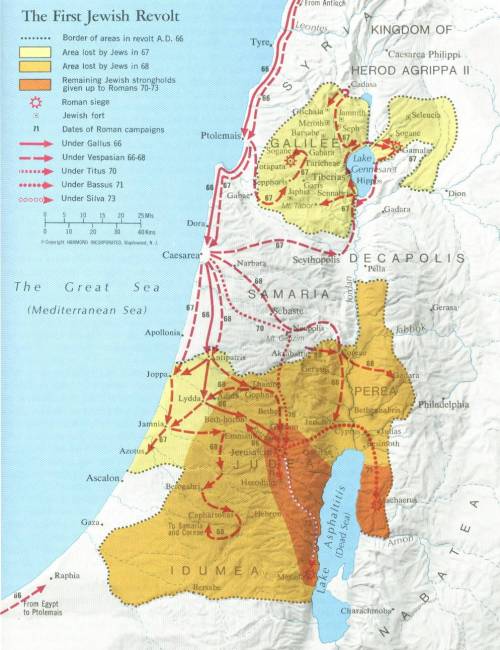
First Jewish Revolt (66-73 AD)

The final siege ended on September 26, 70 AD after a duration of five months. The destruction of Jerusalem, though, was not the end of Rome’s fury. Jews outside of Jerusalem also became victims. Holford continues,

All above the age of seventeen were sent in chains into Egypt, to be employed there as slaves, or distributed throughout the empire to be sacrificed as gladiators in the amphitheatres ; whilst those who were under this age, were exposed to sale. During the time that these things were transacted, eleven thousand Jews, guarded by one of the generals, named Fronto, were literally starved to death. This melancholy occurrence happened partly through the scarcity of provisions, and partly through their own obstinacy, and the negligence of the Romans. Of the Jews destroyed during the siege, Josephus reckons not less than one million and one hundred thousand [1.1 million], to which must be added, above two-hundred and thirty-seven thousand [237,000] who perished in other places, and innumerable multitudes who were swept away by famine, and pestilence, and of which no calculation could be made. Not less than two thousand [2000] laid violent hands upon themselves. Of the captives the whole was about ninety-seven thousand [97,000]… After the destruction of Jerusalem seventeen hundred [1700] Jews who surrendered at Macherus were slain, and of fugitives not less than three thousand [3000] in the wood of Jardes. Titus, having marched his army to Caesarea, he there, with great splendour, celebrated the birthday of his brother Domitian; and according to the barbarous manner of those times, punished many Jews in honour of it. The number who were burnt, and who fell by fighting with wild beasts, and in mutual combats, exceeded two thousand five hundred [2500]. At the siege of Massada [73 AD], Eleazer, the commander, instigated the garrison [of Jews] to burn their stores, and to destroy first the women and children, and then themselves.

In summary, says Josephus, “neither did any other city ever allow such miseries, nor did any age ever breed a generation more fruitful in wickedness than this was, from the beginning of the world” (Josephus, The Jewish War, Book 5, Chapter 10, Paragraph 5).

PP18: The Historical Events Leading Up to 70 AD (Part 2)


This is now the eighteenth post in our series on “A Partial-Preterist Perspective on the Destruction of Jerusalem in 70 AD.” This is the same title as a term paper I recently submitted to Northwestern College. All the previous posts can be found here, and it’s recommended that they be read in order before reading this post:

[1] https://kloposmasm.wordpress.com/2009/08/13/brief-explanation-of-partial-preterism/
[2] https://kloposmasm.wordpress.com/2009/08/13/pp2-references/
[3] https://kloposmasm.wordpress.com/2009/08/13/pp3-external-evidence-for-an-early-date-revelation/
[4] https://kloposmasm.wordpress.com/2009/08/14/pp4-internal-evidence-for-an-early-date-revelation-part-1/
[5] https://kloposmasm.wordpress.com/2009/08/14/pp5-internal-evidence-for-an-early-date-revelation-part-2/
[6] https://kloposmasm.wordpress.com/2009/08/14/pp6-internal-evidence-for-an-early-date-revelation-part-3/
[7] https://kloposmasm.wordpress.com/2009/08/14/pp7-internal-evidence-for-an-early-date-revelation-part-4/
[8] https://kloposmasm.wordpress.com/2009/08/14/pp8-daniels-70-week-prophecy-part-1/
[9] https://kloposmasm.wordpress.com/2009/08/15/pp9-daniels-70-week-prophecy-part-2/
[10] https://kloposmasm.wordpress.com/2009/08/15/pp10-jerusalems-destruction-foretold-in-the-olivet-discourse/
[11] https://kloposmasm.wordpress.com/2009/08/15/pp11-did-jesus-come-in-70-ad-part-1/
[12] https://kloposmasm.wordpress.com/2009/08/15/pp12-did-jesus-come-in-70-ad-part-2/
[13] https://kloposmasm.wordpress.com/2009/08/16/pp13-signs-of-the-close-of-the-age/
[14] https://kloposmasm.wordpress.com/2009/08/16/pp14-abomination-of-desolation/
[15] https://kloposmasm.wordpress.com/2009/08/16/pp15-the-man-of-lawlessness-ii-thess-2-part-1/
[16] https://kloposmasm.wordpress.com/2009/08/16/pp16-the-man-of-lawlessness-ii-thess-2-part-2/
[17] https://kloposmasm.wordpress.com/2009/08/16/pp17-the-historical-events-leading-up-to-70-ad-part-1/

In the previous post we turned to a discussion of the historical events which led up to Jerusalem’s destruction in 70 AD. In the first post we saw a timeline of these events, beginning with the martyrdom of James, the brother of Jesus, in 62 AD. In this post we will first briefly consider some of the predictions of Daniel, before moving on to examine some of these historical events in more detail.

Adam Maarschalk

———————————————————————————————————————————————————————-

G. The Historical Events Leading Up to 70 AD (Part 2)

Before enumerating some of the above events in more detail, it should be pointed out that some Preterists believe that the time references in Daniel of 1290, 1335, and 2300 days (Daniel 8:13-14; 12:11-12) found their fulfillment in the siege and destruction of Jerusalem and the desolation of all Israel. This is not least because Daniel was told that “when the shattering of the power of the holy people comes to an end” all the wonders he had seen would be finished (Daniel 12:6-7). Even though a large portion of chapter 11 speaks in detail of Antiochus IV Epiphanes (215-164 BC), ruler of the Seleucid realm, and his attacks on Egypt about 240 years earlier,[1] it was the events of the Roman/Jewish War (67-73 AD) which epitomized “the shattering of the power of the holy people.”[2]

Also, as Ed Meelhuysen (1992), a Futurist, points out, precisely three lunar years transpired between the defiling of the temple (the sacrifice of a pig on the altar and the setting up of a statue of Zeus in the temple) on 25 Chislev 167 BC[3] and the cleansing and restoration of the temple by Judas Maccabees and other zealous Jews on 25 Chislev 164 BC. Therefore, the time range within which these (and other related) events took place falls short of all the time references in Daniel by at least six months.

Preterists and Futurists alike agree that Daniel does foretell Jerusalem’s destruction, if nowhere else, then at least in his pivotal 70-Weeks prophecy (Daniel 9:26b). Preterists would maintain that the “time of trouble, such as never has been since there was a nation till that time” (Daniel 12:1) also refers to 67-70 AD, as does the reference to “a time, times, and half a time” (verse 7),[4] and the reference to the regular burnt offering being taken away (Daniel 8:11-14, 12:11). Regarding this offering, Philip Mauro quotes the following from Josephus to show that it was taken away at the very end of the final siege on Jerusalem, i.e. late July 70 AD (Todd Dennis [21], 2009):

And now Titus gave orders to his soldiers that were with him to dig up the foundations of the tower of Antonia, and make a ready passage for his army to come up, while he himself had Josephus brought to him; for he had been informed that, on that very day, which was the seventeenth day of Panemus, the sacrifice called ‘the daily sacrifice’ had failed, and had not been offered to God for want of men to offer it; and that the people were grievously troubled at it (Wars, VI. 2.1.).[5]

John Denton, of the UK-based Bible Research and Investigation Company, offers the following chart in an effort to show that these time references played out precisely as stated in the Jewish/Roman War (Todd Dennis [18], 2009):[6]

SN850132

George Peter Holford, in his 1805 book titled “The Destruction of Jerusalem,” wrote that Nero was the one who appointed Vespasian (assisted by his son, Titus) to prosecute the war against the Jews (Todd Dennis [8], 2009). In early spring 67 AD, which was 3.5 years before Jerusalem’s final downfall, Vespasian first entered Judea with a 60,000-member army. In the campaign which was to follow he destroyed at least 150,000 inhabitants of Galilee and Judea, along with many towns. One of the first towns Vespasian crushed was Joppa, because its inhabitants had provoked his men by their frequent piracies at sea. The Jews there tried to flee from Vespasian on their ships, but Vespasian was helped by a tremendous storm that blew in just as they began to flee. Their vessels were crushed against each other and against the rocks, and when this slaughter was complete more than 4,200 bodies were strewn along the coast and a very long stretch of the coast was stained with blood.

Eusebius records that when Vespasian began to close in on Jerusalem, believers living there received a sign, “given by revelation to those in Jerusalem who were ‘approved,’ bidding them leave the doomed city and settle in Pella” (F.F. Bruce, 1983, p. 375). Pella was a community on the other side of the Jordan River in modern day Jordan. This perhaps calls to mind the sign of the woman and the dragon in Revelation 12: “…and the woman fled into the wilderness, where she has a place prepared by God, in which she is to be nourished for 1,260 days; And when the dragon saw that he had been thrown to the earth, he pursued the woman who had given birth to the male child. But the woman was given two wings of the great eagle so that she might fly from the serpent into the wilderness, to the place where she is to be nourished for a time, and times, and half a time” (Rev. 12:6, 13-14). Pella is indicated by the number “2” on the map.
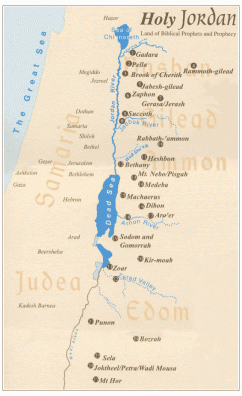
HolyJordanMap

Vespasian pulled back in his campaign to take over Jerusalem when he was informed of Nero’s death in June 68 AD. Yet the people there did not repent of their wicked ways and instead, as Josephus and Tacitus reported in detail, their evil deeds increased. Civil war among the Jews resulted in thousands being murdered at a time, their bodies often left unburied. Holford writes about one such slaughter:

Athirst for blood, and inflamed by revenge, they spared neither age, sex, nor infancy; and the morning beheld eight thousand five hundred dead bodies lying in the streets of the holy city. They plundered every house, and having found the chief priests Ananius and Jesus, not only slew them, but, insulting their bodies, cast them forth unburied. They slaughtered the common people as unfeelingly as if they had been a herd of the vilest beasts… Such as fled were intercepted and slain: their carcasses lay in heaps on all the public roads: every symptom of pity seemed utterly extinguished, and with it, all respect for authority, both human and divine.

At the same time, there were bands of robbers and murderers plundering towns and homes throughout Judea, also not sparing even women or children. Simon, son of Gioras, the commander of one of these bands, entered Jerusalem and began a third faction in addition to the two who were already engaged in senseless warfare. The city was in anarchy, as it was divided into three sections under the following leaders: [1] Eleazar, the son of Simon, leader of the Zealots [2] John of Gischala, a Galilean partisan and Zealot leader [3] Simon Gioras, leader of the priestly party. Writes Holford:

The three factions, rendered frantic by drunkenness, rage, and desperation, trampling on heaps of slain, fought against each other with brutal savageness and madness. Even such as brought sacrifices to the temple were murdered. The dead bodies of priests and worshippers, both natives and foreigners were heaped together, and a lake of blood stagnated in the sacred courts. John of Gischala, who headed one of the factions, burnt storehouses full of provisions ; and Simon, his great antagonist, who headed another of them, soon afterwards followed his example. Thus they cut the very sinews of their own strength. At this critical and alarming conjuncture, intelligence arrived that the Roman army was approaching the city.

In the absence of believers in Jerusalem, Josephus writes of many rampant and callous evil acts taking place (Todd Dennis [13], 2009). These included sacrilegious activities taking place in the temple, committed by the Jews, things which even the Roman emperors wouldn’t have done:

But as for John [one of the Jewish leaders], when he could no longer plunder the people, he betook himself to sacrilege, and melted down many of the sacred utensils, which had been given to the temple; as also were many of those vessels which were necessary for such as ministered about holy things, – the caldrons, the dishes, and the table; nay, he did not abstain from those pouring-vessels that were sent them by Augustus and his wife; for the Romans emperors did ever both honour and adorn this temple; …on which account he emptied the vessels of that sacred wine and oil which the priests kept to be poured on the burnt-offerings, and which lay in the inner court of the temple, and distributed it among the multitude, who, in their anointing themselves and drinking, used [each of them] above an hin of them; and here I cannot but speak my mind, and what the concerns I am under dictates to me, and it is this: – I suppose that had the Romans made any longer delay in coming against these villains, the city would either have been swallowed up by the ground opening upon them, or been overflowed by water, or else been destroyed by such thunder as the country of Sodom perished by, for it had brought forth a generation of men much more atheistical that were those that suffered such punishments; for by their madness it was that all the people came to be destroyed.

This description by Josephus may perhaps bring to mind the latter part of Revelation 6:6, which says, “…do not harm the oil and wine!” In a way that is reminiscent of this same passage (Rev. 6:5-6), Josephus writes of the dire conditions that came about in Jerusalem due to famine. This escalated when the Romans finally broke through two of the three walls which surrounded the city. Even while under siege, the pitiful situation of the Jews caused them to turn on each other in almost unthinkable ways:

It was now a miserable case, and a sight that would justly bring tears into our eyes, how men stood as to their food, while the more powerful had more than enough, and the weaker were lamenting [for want of it]; …insomuch that children pulled the very morsels that their fathers were eating out of their very mouths, and what was still more to be pitied, so did the mothers do as to their infants; and when those that were most dear were perishing under their hands, they were not ashamed to take from them the very last drops that might preserve their lives: and while they ate after this manner, yet were they not concealed in so doing; but the seditious everywhere came upon them immediately, and snatched away from them what they had gotten from others; for when they saw any house shut up, this was to them a signal that the people within had gotten some food; whereupon they broke open the doors, and ran in, and took pieces of what they were eating almost up out of their very throats, and this by force: the old men, who held their food fast, were beaten; and if the women hid what they had within their hands, their hair was torn for so doing; nor was there any commiseration shown either to the aged or to the infants, but they lifted up children from the ground as they hung upon the morsels they had gotten, and shook them down upon the floor. But still they were more barbarously cruel to those that had prevented their coming in, and had actually swallowed down what they were going to seize upon, as if they had been unjustly defrauded of their right. They also invented terrible methods of torments to discover where any food was, and they were these to stop up the passages of the privy parts of the miserable wretches, and to drive sharp stakes up their fundaments; and a man was forced to bear what it is terrible even to hear, in order to make him confess that he had but one loaf of bread, or that he might discover a handful of barley-meal that was concealed.

Holford remarks that Jesus was just in His words when He said, “And alas for women who are pregnant and for those who are nursing infants in those days” (Matthew 24:19). Josephus also told of one mother who roasted her own infant son and ate half of him, offering the other half to her neighbor. He mentions at one point seeing more than 600,000 dead bodies thrown out of the city gates, due to famine and other causes. It was common for whole families to perish, he said, and tomb-robbing was also rampant. At one point an individual attempted to desert the city, but he was caught with gold that he had swallowed in an attempt to smuggle it out. Suspecting that others were trying to do the same, the Romans killed and ripped open the stomachs of more than 2000 individuals in one night. Josephus (Jewish War 5:13:4) writes that some escaped from Jerusalem during the final siege by jumping from the wall and fleeing to the Romans. However, being extremely ravaged by famine, they failed to restrain their appetites and quickly ate so much that they literally caused their bodies to burst open.

The starvation in Jerusalem was especially severe because so many Jews from the countryside foolishly tried to take refuge there, against the advice of Jesus (Luke 21:21). They also had come up from various nations for the Feast of Unleavened Bread. The famine grew so bad that, records Holford, the “Jews, for want of food were at length compelled to eat their belts, their sandals, the skins of their shields, dried grass, and even the ordure [dung] of oxen.” When a woman was discovered to have eaten half of her own child, the Roman soldiers were horrified and “the whole city stood aghast, and poured forth their congratulations on those whom death had hurried away from such heartrending scenes.” Josephus declared that if there had not been many credible witnesses of this event he would not have recorded it because “such a shocking violation, never having been perpetuated by any Greek or barbarian, the insertion of it might have diminished the credibility of his history.” Yet these things fulfilled what was spoken by Moses at the end of giving the Law to the people, when he stated what would happen if they forsook the path of obedience:

The man who is the most tender and refined among you willbegrudge food to his brother, to the wife he embraces,and to the last of the children whom he has left, so that he will not give to any of them any of the flesh of his children whom he is eating, because he has nothing else left,in the siege and in the distress with which your enemy shall distress you in all your towns. The most tender and refined woman among you, who would not venture to set the sole of her foot on the ground because she is so delicate and tender, will begrudge to the husband she embraces, to her son and to her daughter, her afterbirth that comes out from between her feet and her children whom she bears, because lacking everything she will eat them secretly, in the siege and in the distress with which your enemy shall distress you in your towns (Deut. 28:54-57).

In the weeks leading up to the final five-month siege on Jerusalem the Romans used engines called “ballistas” equipped with strong catapults which were capable of launching boulders weighing between 75-160 pounds in weight. According to Josephus, when the assault first began these boulders, some a quarter mile wide, could be seen coming because they were white in color. The Romans soon modified them to be black in color, and the slaughter of the Jews in this way became much more effective. These missiles killed many priests and worshippers in the temple and even at the altar itself because, writes Josephus, “despite war, the sacrifices went on.” They came “from all over the earth,” says Josephus, because they deemed the temple and the city to be holy. Revelation 16:19-21 speaks of hailstones falling out of heaven, with each stone weighing about 100 pounds. The Roman boulders, being white in color, would have resembled giant hailstones falling from the sky.[7]

In the end, after months of failed attempts, the Romans at last succeeded in penetrating the final wall surrounding Jerusalem. Records Josephus (William Whiston [2], 2009), “A false prophet was the occasion of the people’s destruction, who had made a public proclamation in the city that very day, that God commanded them to get upon the temple, and that there they should receive miraculous signs of their deliverance.” Another remarkable event occurred, says Tacitus: “In the sky appeared a vision of armies in conflict, of glittering armour. A sudden lightening flash from the clouds lit up the Temple. The doors of the holy place abruptly opened, a superhuman voice was heard to declare that the gods were leaving it, and in the same instant came the rushing tumult of their departure.”


[1] Philip Mauro, in his 1921 publication, “The Seventy Weeks and the Great Tribulation” (pages 53-63) makes a fascinating and compelling case for Herod being the king spoken of in Daniel 11:36-45, i.e. the same Herod who killed all the male children in Bethlehem and the surrounding region in an effort to destroy Jesus (cf. Daniel 11:37a, 44). This publication can be viewed in its entirety here: http://www.preteristarchive.com/Books/pdf/1921_mauro_seventyweeks.pdf.

[2] In order for this prophecy to remain unfulfilled, i.e. awaiting a future fulfillment as Futurists say, it must be demonstrated that ethnic Jews are still God’s holy people. This is, in fact, a common premise of Dispensationalism. The New Testament, however, identifies the Church as God’s holy people (e.g. I Peter 2:4-10) and unbelieving Jews (and, by implication, unbelieving Gentiles also) by such unsavory titles as the synagogue of Satan (e.g. Revelation 2:9, 3:9).

[3] The abolishing of the daily sacrifices took place only 10 days prior to the sacrifice of the pig, on 15 Chislev 167 BC, according to I Maccabees 1:54-60 and 4:52. See Daniel 8:11 and Daniel 12:11.

[4] Philip Mauro, anticipating the trouble many would have assigning Daniel 12:2 to the past, makes this observation: “The words ‘and many that sleep in the dust of the earth shall awake,’ etc. are commonly taken as referring to the bodily resurrection of the dead, and this is one reason why the entire passage is frequently relegated to the future. But there is nothing said here about either death or resurrection.” He goes on to point out that such language was commonly used in Scripture to denote a spiritual awakening (e.g. Isaiah 9:2, 29:10; Matthew 4:14-16; and especially John 5:25 and Ephesians 5:14). Not all who would be awakened would be saved, reminiscent of Christ speaking of those who would and wouldn’t receive Him (cf. John 3:16, 18, 36). The turning of many to righteousness and the running to and fro (Daniel 12:3-4), says Mauro, speaks of the rapid spread of the gospel in the time of the apostles and the early Church.

[5] In view of the wording in Daniel 12:11, notes Mauro, it could appear that these events happened in the reverse order. That is, Daniel seems to suggest that the offering is taken away at the beginning of the 1290 days, and the abomination of desolation is set up at the end of those days. Historically speaking, and by comparing Luke 21:20 with Matthew 24:15, the desolation of Jerusalem occurred in late 66 AD when the Roman armies first surrounded her, precisely 43 months (or 1290 days) before the daily offering was taken away. That these events appear to be reversed is not an issue, says Mauro, quoting from the 19th century scholar James Farquharson who said regarding this verse that “there is nothing whatever in the verbs of the sentence to indicate which of the events should precede the other; the interval of time between them only is expressed.”

[6] The historical dates used by John Denton are based on The Complete Works of Josephus (Kregel Publications: Grand Rapids (Michigan), 1981).

[7] Preterists have taken some flak for suggesting that this historic event fulfilled the prophecy of one-hundred pound hailstones, because this would mean a non-literal fulfillment. Gary DeMar (2008) responds, “Benware and other dispensationalists claim that the only way Revelation can be interpreted is literally. Let’s put their standard to the test. “The third angel sounded, and a great star fell from heaven, burning like a torch, and it fell on a third of the rivers and on the springs of waters” (Rev. 8:10). If one star hits the earth, the earth will be vaporized in an instant. In fact, if a star gets even close to the earth, the earth is going to burn up before it hits. Then there’s Revelation 8:12: “Then the fourth angel sounded, and a third of the sun and a third of the moon and a third of the stars were smitten, so that a third of them might be darkened and the day might not shine for a third of it, and the night in the same way.” How can a “third of the sun” be smitten without catastrophic results on the whole earth and not just a third of it? All of this language is drawn from the Old Testament and only has meaning as it is interpreted in light of its Old Testament context—the judgment and destruction of nations (Isa. 14:12; Jer. 9:12–16). To ignore how a passage is used in the Old Testament is like trying to interpret Egyptian hieroglyphics without the Rosetta Stone.”

PP6: Internal Evidence for an Early Date (Revelation)-Part 3


This is now the sixth part in our series on “A Partial-Preterist Perspective on the Destruction of Jerusalem in 70 AD.” This is the same title as a term paper I recently submitted to Northwestern College. The first segment included the Title Page, Outline, Introduction, and a brief introduction to Partial-Preterism. The second segment consisted of the References page, and the third segment was a discussion of the external evidence for an early date for the writing of the book of Revelation. These segments can be found here:

[1] https://kloposmasm.wordpress.com/2009/08/13/brief-explanation-of-partial-preterism/
[2] https://kloposmasm.wordpress.com/2009/08/13/pp2-references/
[3] https://kloposmasm.wordpress.com/2009/08/13/pp3-external-evidence-for-an-early-date-revelation/

We then turned to a discussion of the internal evidence for an early date. In Part 1 we discussed the inclusion of Jerusalem, the temple, Babylon the Great, and a great city in the book of Revelation. Part 2 dealt with the seven kings mentioned in Revelation 17:9-10 and the identity of the beast of the book of Revelation. These posts can be found here, and it is recommended that they be read first:

[4] https://kloposmasm.wordpress.com/2009/08/14/pp4-internal-evidence-for-an-early-date-revelation-part-1/
[5] https://kloposmasm.wordpress.com/2009/08/14/pp5-internal-evidence-for-an-early-date-revelation-part-2/

Part 3 will address Nero’s campaign of persecution against the saints, as well as his prophesied demise.

Adam Maarschalk

————————————————————————————————————————————————-

II. Internal Evidence for an Early Date (Part 3)

In what sense might Jerusalem have sat on the beast with seven heads (mountains), the beast that would ultimately turn on her and destroy her (Rev. 17:3, 9, 16-18)? Israel had enjoyed a good relationship with Rome until the Jewish revolt began in 66 AD, and Judaism was recognized as a valid religion within the Roman Empire. Josephus wrote of this relationship, “It seems to me to be necessary here to give an account of all the honors that the Romans and their emperors paid to our nation [Israel], and of the leagues of mutual assistance they have made with it” (Antiquities, 14.10.1-2). The Jews frequently took advantage of this relationship to induce persecution against Jesus and His followers (Luke 23:2; John 18:28-31, 19:15; Acts 4:27, 16:20, 17:7, 18:12, 21:11, 24:1-9, 25:1-2).[1]

Prior to Nero’s persecution, writes Kenneth Gentry (2002), persecution against Christians had come largely from the Jews. Christianity was considered a sect of Judaism, which was a “legal religion.” Gentry notes, “Earlier Paul had safely appealed to Nero Caesar (Acts 25:11-12; 28:19) and in A.D. 62 had been acquitted and released.” Herbert Workman, in his 1906 work, Persecution in the Early Church, said that Rome didn’t make a clear distinction between Christianity and Judaism until 64 AD (pp. 62-63).

Kenneth Gentry takes note of the testimonies of early historians regarding Nero’s campaign of persecution against Christians (pp. 54-55, 64-66). Clement of Rome (30-100 AD) said that it targeted “a vast multitude of the elect…through many indignities and tortures.” Eusebius (260-340 AD) pointed out that Nero was “the first of the emperors who showed himself an enemy of the divine religion,” and Lactantius (240-320 AD) agrees by saying of Nero, “He it was who first persecuted the saints of God.” Sulpicius Severus (360-420 AD) said that he was “the basest of all men, and even of wild beasts, [showing himself] in every way most abominable and cruel…he first attempted to abolish the name of Christian.” Sulpicius devoted two chapters to Nero’s reign of terror in his Sacred History, but only three sentences for Domitian. In 1854 church historian John Laurence von Mosheim added these thoughts:

Foremost in the rank of those emperors, on whom the church looks back with horror as her persecutors, stands Nero, a prince whose conduct towards the Christians admits of no palliation [minimizing], but was to the last degree unprincipled and inhuman. The dreadful persecution which took Diace by order of this tyrant, commenced at Rome about the middle of November,[2] in the year of our Lord 64. This dreadful state of persecution ceased with the death of Nero. The empire, it is well known, was not delivered from the tyranny of this monster until A.D. 68, when he put an end to his own life.[3]

Tacitus, the Roman historian who lived from 56-117 AD, wrote in detail of Nero’s move to persecute the saints soon after the fire that raged through Rome, destroying 10 out of 14 city divisions:

But by no human contrivance, whether lavish contributions of money or of offerings to appease the gods, could Nero rid himself of the ugly rumor that the fire was due to his orders. So to dispel the report, he substituted as the guilty persons and inflicted unheard-of punishments on those who, detested for their abominable crimes, were vulgarly called Christians…wrapped in the hides of wild beasts, they were torn to pieces by dogs, or fastened to crosses to be set on fire, that when the darkness fell they might be burned to illuminate the night (Tacitus, Annals 15:44).

The most remarkable detail about Nero’s campaign of persecution is that it lasted just over 42 months, which Revelation 13:5-8 records is the length of time that would be given to the beast to war against and conquer the saints. The persecution ended when Nero died on June 9, 68 AD. In this context, Revelation 13:10 was a comfort to the saints. Not only were they already told that the beast would only be allowed to persecute them for 3.5 years, but they were also told how their persecutor would be removed: “…he who kills with the sword must be killed with the sword. Here is the patience and faith of the saints.” Nero ended his life by thrusting his sword through his own throat, with the help of his personal secretary, Epaphroditus, when he realized that his popularity had waned and that a coup was in the making.

Upon Nero’s demise, the Roman Empire immediately fell into chaos and civil war, and rooting out Christians became less of a priority for Rome. What followed was the “Year of the Four Emperors,” the reigns of Galba (six months), Otho (four months), Vitellius (eight months), and Vespasian (beginning in December 69 AD). When the empire stabilized more than a year later under Vespasian, Nero’s successors did not carry on his campaign of religious persecution. As The Interpreter’s Bible Dictionary notes, “There is no solid evidence that Christians suffered persecution by the Roman state under Vespasian and his two sons, Titus and Domitian” (p. 67).

Nero’s death by the sword is the type of mortal wound that John said the beast would receive (Revelation 13:10, 12, 14). Richard Anthony (2009) and Kenneth Gentry (1998) postulate that the healing of this wound can perhaps be seen in what took place in the Roman Empire immediately following Nero’s death. Upon his death, the Roman Empire’s founding family suddenly had no representative. “The blood line that had given birth to, extended, stabilized, brought prosperity to, and had received worship from the Roman Empire was cut off forever” (Gentry, p. 311). The “Julio-Claudian House” became extinct. The empire was plunged “into civil wars of horrible ferocity and dramatic proportions” and Rome appeared ready to topple.

The general Vespasian pulled back from the wars he was committed to, including the siege on Jerusalem, because of the turmoil on his own home front.  Josephus, Tacitus, and Suetonius all recorded that Rome at this time was brought near to utter ruin, with Josephus saying that “every part of the habitable earth under them [the Romans] was in an unsettled and tottering condition” (Wars 7.4.2). It wasn’t until Vespasian took the throne in December 69 AD, initiating the Flavian Dynasty, that stability was restored. He was the one who oversaw the destruction of Jerusalem the following year. Perhaps in this sense the beast’s “mortal wound was healed,” i.e. the beast as corporately considered.

Herbert W. Benario (2006) and others show how this question might also be viewed from an additional angle. Benario writes, “Nero’s popularity among the lower classes remained even after his death. His close friend, and successor to Galba, Otho paid him all public honors.” The historians Tacitus, Suetonius, and Zonaras affirm that after Nero’s death proclamations continued to be published in his name as if he was still alive, and that his image was frequently placed upon the rostra (large speaker’s platforms in Rome) “dressed in robes of state.” Even Jewish and Christian writers began to foretell that Nero was back from death as the dreaded Beliar demon. Paul Kroll (1999) adds the following details:

Nero committed suicide in June of AD 68. However, a rumor arose and persisted that he had not died but had fled across the Euphrates river to Rome’s arch-enemy, Parthia. It was said that one day Nero would return at the head of Parthian armies to destroy Rome. This became the so-called “Nero redivivus” myth. In fact, during the decades following Nero’s death, several pretenders did come forth claiming to be Nero (Tacitus, Histories 1.78; 2.8; Suetonius, Nero 57). By the turn of the first century a further twist was added to the Nero legend. It was said he would actually rise from the dead, return to Rome and seize the empire… This myth of Nero’s return so captured the popular fancy that it found its way into Jewish and Christian apocalyptic writings. Here the triumphant Nero was sometimes even pictured as the antichrist (Ascension of Isaiah 4:1-14; Sibylline Oracles 4:119-124; 5:137-154, 361-374)…

With these details, we can begin to see how Nero could have fulfilled what was written of the beast in Revelation 17:11. This text states: “As for the beast that was and is not, it is an eighth but it belongs to the seven, and it goes to destruction.” Kenneth Gentry (1998) notes the following about Otho, the eighth emperor of Rome:

Upon presenting himself to the Senate and returning to the palace, it is said of Otho: “When in the midst of the other adulations of those who congratulated and flattered him, he was hailed by the common herd as Nero, he made no sign of dissent; on the contrary, according to some writers, he even made use of that surname in his commissions and his first letters to some of the governors of the provinces” [Suetonius, Otho 7]. Tacitus, too, speaks of Otho’s predilection for Nero: “It was believed that he also brought up the question of celebrating Nero’s memory with the hope of winning over the Roman people; and in fact some set up statues of Nero; moreover on certain days the people and soldiers, as if adding thereby to Otho’s nobility and distinction, acclaimed him as Nero Otho.” Dio Cassius mentions the same idea: “But men did not fail to realize that his rule was sure to be even more licentious and harsh than Nero’s. Indeed, he immediately added Nero’s name to his own” (pp. 308-309).

Gentry adds that Otho reinstated Nero’s procurators and freedman to the offices they had vacated during Galba’s 6-month reign, and a court historian claims that Otho even used Nero’s title and name in official dispatches to Spain. So Otho, in many ways, took on the persona of Nero, and perhaps in this way Nero was “an eighth” king who also belonged to the seven kings (Revelation 17:10-11). Gentry, though, leans even more to the idea that the revived Roman Empire, under the new dynasty initiated by Vespasian, could be what is meant by the beast that “is an eighth” but also belongs to the seven.


[1] W.H.C. Frend even writes that “the promptings of orthodox Jews in the capitol had something to do with” Nero’s decision to begin persecuting Christians in 64 AD (The Rise of Christianity [Philadelphia: Fortress, 1984], 109; quoted in Kenneth Gentry, 2002, p. 63).

[2] Moses Stuart (1845), a historian contemporary to von Mosheim, wrote that this persecution began at the end of November.

[3] I Clement 6:1; Eusebius, Ecclesiastical History 2:25:2-3; Lactantius, On the Death of the Persecutors 2:2; Severus, Sacred History 2:29; John L. von Mosheim, History of Christianity in the First Three Centuries (New York: Converse, 1854) 1:138-139.

PP5: Internal Evidence for an Early Date (Revelation)-Part 2


This is now the fifth segment in our series on “A Partial-Preterist Perspective on the Destruction of Jerusalem in 70 AD.” This is the same title as a term paper I recently submitted to Northwestern College. The first segment included the Title Page, Outline, Introduction, and a brief introduction to Partial-Preterism. The second segment consisted of the References page, and the third segment was a discussion of the external evidence for an early date for the writing of the book of Revelation. These segments can be found here:

[1] https://kloposmasm.wordpress.com/2009/08/13/brief-explanation-of-partial-preterism/
[2] https://kloposmasm.wordpress.com/2009/08/13/pp2-references/
[3] https://kloposmasm.wordpress.com/2009/08/13/pp3-external-evidence-for-an-early-date-revelation/

We have now turned to a discussion of the internal evidence for an early date. The previous post (Part 1) was a discussion of Jerusalem, the temple, Babylon the Great, and a great city as they are mentioned in the book of Revelation. We discovered that they are all related. That post can be found here:

[4] https://kloposmasm.wordpress.com/2009/08/14/pp4-internal-evidence-for-an-early-date-revelation-part-1/

This part of the discussion (Part 2) will deal with the seven kings mentioned in Revelation 17:9-10, as well as with the identity of the beast of the book of Revelation. Again, it’s recommended that all the previous posts in this series be read in order before reading this one.

Adam Maarschalk

————————————————————————————————————————————————-

II. Internal Evidence for an Early Date (Part 2)

More compelling evidence for an early date is found in John’s reference to seven kings in Revelation 17:9-10, which states, “This calls for a mind with wisdom: the seven heads are seven mountains on which the woman is seated; they are also seven kings, five of whom have fallen, one is, the other has not yet come, and when he does come he must remain only a little while.” This description of the seven kings lines up well with historical data showing the emperors who reigned in the Roman Empire up until the destruction of the temple in 70 AD, which is as follows:

Order of Emperors Name of Emperor Length of Reign Notes/Details
#1 Julius Caesar October 49 BC – March 44 BC “Perpetual Dictator”
#2 Augustus January 27 BC – August 14 AD -time of Jesus’ birth
#3 Tiberius August 14 AD – March 37 AD -time of Jesus’ ascension
#4 Caligula March 37 AD – January 41 AD Murdered
#5 Claudius January 41 AD – October 54 AD Assassinated
#6 Nero October 54 AD – June 68 AD Committed suicide
#7 Galba June 68 AD – January 69 AD Murdered
#8 Otho January 69 AD – April 69 AD Committed suicide
#9 Vitellius April 69 AD – December 69AD Murdered
#10 Vespasian December 69 AD – June 79 AD Destroyed Jerusalem

Some historians do not consider Julius Caesar to be one of the emperors, and rather designate him as one who played a key role in transforming the Roman Republic into the Roman Empire. Flavius Josephus (37-100 AD), however, was one who did, and the above list reflects his own list in his writing titled Antiquities of the Jews (Books 18 and 19). Numerous Roman historians contemporary to Josephus agree. Among these were Dio Cassius and Suetonius (70-135 AD), who wrote Lives of the Twelve Caesars and De Vita Caesarum. Julius Caesar was appointed as “perpetual dictator” in 42 BC, so his inclusion in such a list would not have been strange.

According to the above list, then, Nero was the “king” of whom John said “one is” (i.e. “he is reigning now”), and Galba was the one who had “not yet come.” Galba reigned only six months, making him a good candidate to be the one who “must remain only a little while.” This would place John’s authorship of Revelation sometime before Nero’s death in June 68 AD (and after November 64 AD because, as already noted, John was in Patmos as a result of imperial persecution, and no such persecution existed before Nero initiated his).

Numerous church fathers and leaders during the first several centuries identified Nero as the beast of the book of Revelation, or speculated that it was he. These include Tertullian, Augustine, Clement of Alexandria, and Jerome who stated the following in his commentary on Daniel 11:27-30:

As for the Antichrist, there is no question but what he is going to fight against the holy covenant, and that when he first makes war against the king of Egypt, he shall straightway be frightened off by the assistance of the Romans. But these events were typically prefigured under Antiochus Epiphanes, so that this abominable king who persecuted God’s people foreshadows the Antichrist, who is to persecute the people of Christ. And so there are many of our viewpoint who think that Domitius Nero was the Antichrist because of his outstanding savagery and depravity (Todd Dennis [7], 2009).

C. Marvin Pate and Calvin B. Haines Jr. (1995) point to historical details from the reign of Nero to show how he fit the Biblical description of the beast introduced in Revelation 13 (pp. 41-42, emphasis added):

The blasphemous worship demanded by the beast distinctly reminds one of the imperial cult of the first century, and the war the beast wages on the saints cannot help but recall the intense persecutions Nero, and later Domitian, inflicted on Christians because they did not worship Caesar.  Nero’s persecution of Christians from November AD 64 [when he blamed the Christians for the massive fire he started] to June AD 68 could account, in part, for the forty-two months (or 3 ½ years) of oppression mentioned in Rev. 13:5. The reference in Revelation 13:11-15 to the beast of the land securing worship for the beast from the sea (Rome was across the sea from the place of the writing of the Apocalypse, Asia Minor) reminds one of the local priests of the imperial cult in Asia Minor whose task was to compel the people to offer a sacrifice to Caesar and proclaim him Lord.  Megalomaniac that he was, Nero had coins minted in which he was called “almighty God” and “Savior.” Nero’s portrait also appears on coins as the god Apollo playing a lyre.  While earlier emperors were proclaimed deities upon their deaths, Nero abandons all reserve and demanded divine honors while still alive (as did also Caligula before him, AD 37-41).  Those who worshipped the emperor received a certificate or mark of approval – charagma, the same word used in Revelation 13:16 [the famed mark of the beast].

Richard Anthony (2009) shares more details about Nero’s life and character, all of which is substantiated by Suetonius (in his book Nero) and other historians who lived during the first two centuries:

According to Suetonius, he [Nero] murdered his parents, wife, brother, aunt, and many others close to him and of high station in Rome. He was a torturer, a homosexual rapist, and a sodomite. He even married two young boys and paraded them around as his wives. One of the boys, whose name was Sporus, was castrated by Nero. He was truly bestial in his character, depravity, and actions. He devised a kind of game: covered with the skin of some wild animal, he was let loose from a cage and attacked the private parts of men and women, who were bound at stakes. He also initiated the war against the Jews which led to the destruction of Jerusalem in 70AD.

At one point, writes Kenneth Gentry (2002), Nero divorced his first wife, Octavia, in order to marry Poppaea, his mistress. Poppaea then gave orders to have Octavia banished to an island, where in 62 AD she was beheaded. Three years later, when Poppaea was pregnant and ill, Nero kicked her to death. For entertainment, according to the Roman historian Suetonius, Nero “compelled four hundred senators and six hundred Roman knights, some of whom were well to do and of unblemished reputation, to fight in the arena.” The Roman historian Tacitus (55-117 AD) knew Nero as the one who “put to death so many innocent men,” and Pliny the Elder (23-79 AD) called Nero “the destroyer of the human race” and “the poison of the world” (p. 52).

Kenneth Gentry (1998) writes that the beast in Revelation is sometimes spoken of as an individual (specific sense) and sometimes as a kingdom (generic sense). For example, John’s readers are told to “calculate the number of the beast, for the number is that of a man” (Revelation 13:18). Earlier in that same chapter John saw “a beast coming up out of the sea, having ten horns and seven heads” (Rev. 13:1), and John later identified these seven heads as both “seven mountains on which the woman [harlot] is seated” and “seven kings” (Rev. 17:9-10).[1] It’s not surprising that the beast is interchangeably an individual and a kingdom, if ancient Rome is in view here. Regarding the emperor Augustus, the Roman poet Ovid (43 BC-18AD) wrote, “The state is Caesar.” Gentry also adds, “Scholars as widely divergent as dispensationalist John Walvoord, anti-dispensationalist Philip Mauro, and critical scholar R. H. Charles agree that the Beast in Revelation has both a generic and a specific reference. Thus, he represents both a kingdom and an individual.”


[1] Interestingly, Gentry notes, the Coin of Vespasian (emperor of Rome from 69-79 AD) discovered by archaeologists pictures the goddess Roma as a woman seated on seven hills. Rome, the capital of the Roman Empire, is the one city in history famous for its seven mountains. First-century Rome used to celebrate a feast called Septimontium, the feast of “the seven-hilled city.”

PP4: Internal Evidence for an Early Date (Revelation)-Part 1


This is now the fourth segment in our series on “A Partial-Preterist Perspective on the Destruction of Jerusalem in 70 AD.” This is the same title as a term paper I recently submitted to Northwestern College. The first segment included the Title Page, Outline, Introduction, and a brief introduction to Partial-Preterism. The second segment consisted of the References page, and the third segment was a discussion of the external evidence for an early date for the writing of the book of Revelation. These segments can be found here, and again it’s recommended that they be read in order before reading this current post:

[1] https://kloposmasm.wordpress.com/2009/08/13/brief-explanation-of-partial-preterism/
[2] https://kloposmasm.wordpress.com/2009/08/13/pp2-references/
[3] https://kloposmasm.wordpress.com/2009/08/13/pp3-external-evidence-for-an-early-date-revelation/

We will now turn to some of the internal evidence for an early date. This was a rather long section in my paper, so I’m going to break it up into several parts. Among other things, this first part will deal with references to Jerusalem, a temple, Babylon the Great, and a great city in the book of Revelation.

Adam Maarschalk

—————————————————————————————————————————————————

II. Internal Evidence for an Early Date (Part 1)

The reality is that if an early date for the book of Revelation is valid, this leaves room for the possibility that many of the events in this book were also fulfilled during the siege of Jerusalem, the destruction of the temple in 70 AD, and the Roman/Jewish War of 66-73 AD. Even more telling than the external evidence (e.g. quotes from early church fathers and historians), though, is the internal evidence from the text when it is compared with other passages of Scripture and also with what historically happened during the Roman/Jewish War.

Kenneth Gentry (1998), a former Dispensationalist, discovered in his reading of “The Jewish War” by Josephus a number of accounts which seem to reflect the descriptions of the plagues and judgments in Revelation. For example:

Regarding the blood flow to the “horses’ bridles” [Revelation 14:20], Josephus’ comments on the battle scenes during the Jewish War are enlightening. At one point a naval battle produced a “lake all bloody and full of dead bodies” (Wars 3:10:9). Later he reported that “the whole of the country through which they had fled was filled with slaughter, and [the] Jordan [River] could not be passed over, by reason of the dead bodies that were in it, but because the lake Asphaltitis was also full of dead bodies” (Wars 4-7:6). Surely such carnage and bloodshed are suggested by John’s imagery (p. 245).

John also refers to a time period of 42 months in Revelation 11:2-3, which is significant in light of history. John is told, “Rise and measure the temple of God and the altar and those who worship there, but do not measure the court outside the temple; leave that out, for it is given over to the nations, and they will trample the holy city for forty-two months…” During the Roman/Jewish War, as will be seen, it did take Rome 3.5 years, or 42 months, to overcome Jerusalem and trample it. This occurred from the time Nero dispatched his general Vespasian to advance on Jerusalem in early spring 67 AD until Jerusalem and the temple were demolished and laid level by the end of September 70 AD.

John’s words echoed the words of Jesus given earlier. In Luke 21:24, Jesus, clearly speaking about Jerusalem’s pending destruction (Luke 21:5-7), said, “Jerusalem will be trampled underfoot by the Gentiles, until the times of the Gentiles are fulfilled.” Dispensationalists interpret the phrase “times of the Gentiles” to be the entire Church Age. However, is it not possible that the “times of the Gentiles” is what John wrote about in Rev. 11:2-3?

In this Revelation 11 passage, John is told to measure a temple which apparently still existed. If he wrote this in 95-96 AD, the temple would have met its destruction 25 years before, and one could wonder why John did not raise a question when given this command or even mention the recent destruction of the temple at all in his book. Its absence  after 70 AD was no small thing, not only because of its most central significance to Judaism, but also because of its magnificence and physical stature. After a grand renovation project at the hands of Herod around 20 BC, it was widely acknowledged as one of the most beautiful structures in the world [The use of the phrase “temple of God” quite possibly indicates that the Church is also being referred to here (cf. Eph. 2:11-22; II Cor. 6:16; I Cor. 3:16, 6:19). Therefore it may be that John was (symbolically) measuring the Church which would be trampled (persecuted) for 42 months (see Rev. 13:5-7; this passage will be discussed later). Given the similarity between this passage and Luke 21:24, the physical temple was also probably being alluded to. It may be that both ideas were being spoken of in this case.]

On the other hand, if the temple John measured is still future, as Dispensationalists teach, on what grounds could a future physical temple be referred to as “the temple of God”? Such a temple would be blasphemous in light of Christ’s work on the cross which has created a new, non-physical temple (e.g. Ephesians 2:13-20). The reinstitution of sacrifices would be an even greater insult (See Hebrews 7:11-10:18).

The description of the woman in Revelation 17 offers further internal evidence for an early date. This woman, who rode the beast, was said to be “drunk with the blood of the saints, the blood of the martyrs of Jesus” (verse 6). She is a great city (verse 18), and is hated by the beast and the 10 kings who desolate her and burn her with fire (verses 16-17). More specifically, it is said that “in her was found the blood of prophets and of saints, and of all who have been slain on the earth” (18:24), and the “saints and apostles and prophets” were told to rejoice over her destruction (18:20).

Who was responsible for shedding all the blood of the prophets and the saints, according to Jesus, and who would receive judgment as a result? The answer can be found in Matthew 23, as David Lowman (2009 [3]) so aptly points out:

Woe to you, scribes and Pharisees, hypocrites! For you build the tombs of the prophets and decorate the monuments of the righteous, saying, ‘If we had lived in the days of our fathers, we would not have taken part with them in shedding the blood of the prophets’” Thus you witness against yourselves that you are sons of those who murdered the prophets. Fill up, then, the measure of your fathers. You serpents, you brood of vipers, how are you to escape being sentenced to hell? Therefore I send you prophets and wise men and scribes, some of whom you will kill and crucify, and some you will flog in your synagogues and persecute from town to town, so that on you may come all the righteous blood shed on earth, from the blood of innocent Abel to the blood of Zechariah the son of Barachiah, whom you murdered between the sanctuary and the altar. Truly, I say to you, all these things will come upon this generation. O Jerusalem, Jerusalem, the city that kills the prophets and stones those who are sent to it! How often would I have gathered your children together as a hen gathers her brood under her wings, and you would not! See, your house is left to you desolate (Matthew 23:29-38, emphasis added).

Is it a coincidence that the word “desolate” is used here, just as it is used in Revelation 17:16; 18:17, 19, not to mention Daniel 9:27 and Luke 21:20? No, Jerusalem was the prophetic “Babylon the Great” in the book of Revelation. The generation which heard Jesus speak these things also saw them happen, just as He said they would, in 70 AD. The third bowl judgment, rivers and springs of water becoming blood (Revelation 16:4), also is directly linked to those who had shed righteous blood (verses 5-6): “And I heard the angel in charge of the waters say, ‘Just are You, O Holy One, who is and who was, for You brought these judgments. For they have shed the blood of saints and prophets, and You have given them blood to drink. It is what they deserve!’” As we will see later, Josephus and others recorded that the rivers and springs of Jerusalem and its surroundings were filled with blood during the Roman/Jewish War. Again, Jesus said that it was the generation that would crucify Him that would be held responsible for the blood of saints and prophets (cf. Matthew 21:33-45), not a generation in the 21st century or beyond, and that Jerusalem would experience this wrath.

Jerusalem receives specific mention in Revelation 11:8, where she is clearly identified by the description “the great city that symbolically is called Sodom and Egypt, where [the] Lord was crucified.” It’s worth noting that “Revelation 11:8 suggests that Jerusalem’s streets were intact at the time of John’s writing” (Kenneth Gentry, 1998, p. 236) because the dead bodies of the two witnesses were to lie there for several days. If John wrote this in 95 or 96 AD, Jerusalem would have been a wasteland. As Kathleen M. Kenyon remarked, “It was two centuries or more [after 70 AD] before human activity began once more to make its mark in the whole area of ancient Jerusalem.”[1] It’s also significant in Revelation 11:8 that Jerusalem is called “the great city.” This is the same title given to Babylon the Great on at least six occasions (17:18; 18:10, 16, 18, 19, 21).

To be called “Sodom,” of course, is not a compliment. When Isaiah was instructed to prophesy against Judah and Jerusalem (Isaiah 1:1), he called the Israelites by the same name because of their apostasy. It would make sense for John to speak of apostate Jerusalem, once known as the holy city, as Sodom, Babylon, and a harlot. Todd Dennis writes, “The image of the unfaithful wife, the harlot, was often used of Israel in the OT. Israel is repeatedly called the wife of God (Jer. 2:2, 3:14, Is. 54:5). But she was an unfaithful wife (Jer. 3:20, Hos. 1:2, Ez. 6:9, Ez. 16, Is. 50:1) behaving as a prostitute (Jer. 3:1-2). In the context of Jerusalem’s designation as a prostitute, Is. 1:21 is especially noteworthy: ‘See how the faithful city has become a harlot’” (Todd Dennis [25], 2009). Rome in John’s day or a secular city/state in our day could not be said to fornicate against God in the way that Jerusalem was able to. Kenneth Gentry (1998, p. 241) also writes that there “is an obvious contrast between the Harlot and the chaste bride (cp. Rev. 17:2-5 with Rev. 21:1ff.) that suggests a contrast with the Jerusalem below and the Jerusalem above (Rev. 21:2; cp. Gal. 4:24ff; Heb. 12:18ff.).”

Dennis adds that the description of the harlot’s attire (purple, scarlet, gold, jewels, and pearls) was nearly identical to the ephod worn by the high priest (Revelation 17:4; cf. Exodus 28:5-21). The golden cup she held was likely symbolic of the temple vessels, the greatest part of which were gold and silver, according to the Jewish historian Josephus (Wars 5.4.4). On Aaron’s forehead was the inscription “Holy to the Lord” (Exodus 28:36). The harlot’s forehead, on the other hand, bore the title “Babylon the great, mother of prostitutes and of earth’s abominations” (Rev. 17:5).


[1] Kathleen M. Kenyon, Jerusalem: Excavating 3000 Years of History, 1967, p. 185.

——————————————————————————————————————————–

The Bible study group I belong to has posted fairly comprehensive chapter-by-chapter studies on the book of Revelation. They can all be found here.

PP3: External Evidence for an Early Date (Revelation)


This is now the third segment in our series on “A Partial-Preterist Perspective on the Destruction of Jerusalem in 70 AD.” This is the same title as a term paper I recently submitted to Northwestern College. The first segment included the Title Page, Outline, Introduction, and a brief introduction to Partial-Preterism. The second segment consisted of the References page. These segments can be found here:

[1] https://kloposmasm.wordpress.com/2009/08/13/brief-explanation-of-partial-preterism/
[2] https://kloposmasm.wordpress.com/2009/08/13/pp2-references/

We will now move on to a consideration of the date in which the book of Revelation was written. This segment will consider the external evidence for an early date (likely 64-68 AD) as opposed to a late date (95-96 AD). This will be followed by several posts in which we will consider the internal evidence for an early date. Although this post happens to come first, it’s the internal evidence (what Scripture has to say) which is more important.

Adam Maarschalk

————————————————————————————————————————————————–

C. The Book of Revelation: Early or Late Authorship?

In the Dispensational Futurist view, the events leading up to Jerusalem’s downfall in 70 AD are foretold mainly in (a sizeable portion of) Luke 21, and are briefly mentioned at the very beginning of Matthew 24 and Mark 13. The book of Revelation doesn’t even enter the discussion regarding 70 AD, in the Dispensationalist view, because it is said to have been written about 25 years later and must therefore be speaking about events beyond the first century. However, there is not as much historical consensus on this idea as one might be led to think. In fact, according to the Preterist view, which preceded the Dispensational view in Church history by many centuries, the book of Revelation speaks in great detail about Jerusalem’s impending destruction in 70 AD.

I. External Evidence for an Early Date

Naturally, in order for this to be true, it must be established that the book of Revelation was written prior to 70 AD. Otherwise this book could not foretell Jerusalem’s destruction. An early date is not possible, Dispensationalists say, because of the testimony of Irenaeus, a disciple of Polycarp, who is said to have been a disciple of the apostle John. The following statement made by Irenaeus (120-202 AD), and quoted later by Eusebius (263-339) and others, is often seen as the foundation for the “late date” theory which holds that the book of Revelation was written in 95-96 AD:

We will not, however, incur the risk of pronouncing positively as to the name of Antichrist; for if it were necessary that his name should be distinctly revealed in this present time, it would have been announced by him who beheld the apocalyptic vision. For that was seen no very long time since, but almost in our day, towards the end of Domitian’s reign (Grant Jeffrey, 2001).

At face value, it could appear that Irenaeus said John received his vision during the time of Domitian, who reigned from 81-96 AD and was the last emperor of the Flavius Dynasty. However, a number of objections have been made against this conclusion. Among these are the following, articulated by Richard Joseph Krejcir (2009 [1]), who at first set out to prove through research that Revelation was written around 95 AD but changed his stance as he viewed the evidence: [1] This is a second-hand quote, a paraphrase of a statement originally made by Polycarp. [2] It is not entirely clear what Polycarp meant when he said “that was seen.” (The original manuscript of Irenaeus’ work, in ancient Latin, no longer exists in any legible condition, and those who first translated it complained at the time about the poor condition of the manuscript evidence of his work. Some translators contended that the phrase should have been translated “he was seen,” meaning that Irenaeus was referring to John, rather than his apocalyptic vision, being seen during Domitian’s reign.) [3] The writings of Irenaeus suffer from credibility and textual issues. For example, in the same publication from which this quote comes, Irenaeus stated that Jesus ministered for more than 15 years and was crucified at the age of 50.

Kurt Simmons (2009 [1]) cites the following opinion given by Robert Young, the author of Young’s Analytical Concordance, in his commentary on Revelation written around 1885:

It was written in Patmos about A.D. 68, whither John had been banished by Domitius Nero, as stated in the title of the Syriac version of the book; and with this concurs the express statement of Irenaeus in A.D. 175, who says it happened in the reign of Domitianou – i.e., Domitius (Nero).  Sulpicius, Orosius, etc., stupidly mistaking Dimitianou for Domitianikos, supposed Irenaeus to refer to Domitian, A.D. 95, and most succeeding writers have fallen into the same blunder. The internal testimony is wholly in favor of the early date.

Kenneth L. Gentry, Jr. (1998) records the following quote from the Muratorian Canon (written around 170 AD): “[T]he blessed Apostle Paul, following the rule of his predecessor John, writes to no more than seven churches by name…John too, indeed, in the Apocalypse, although he writes to only seven churches, yet addresses all” (pp. 93-94). By calling John the predecessor of Paul, and saying that Paul followed John’s rule, the writer of this canon clearly taught that John wrote to the seven churches (Revelation 2-3) before Paul finished writing all of his epistles. The ‘Monarchian Prologues,’ dating back to 250-350 AD, make the same claim. It’s universally agreed that Paul died in 67 or 68 AD.

Other sources during the first several centuries after Christ also refer to an earlier date for the writing of Revelation, even explicitly. Krejcir (2009 [2]) cites statements from three sources: [1] The ‘Muratorian Fragment,’ dating back to 170-190 A.D., overtly states that the book of Revelation was written during the reign of Nero (who reigned from 54-68 AD). [2] The ancient ‘Syriac version’ of the New Testament, dated in the sixth century or earlier, echoes this statement that “Revelation was written during the reign of Nero.” [3] “The ‘Aramaic Peshitta’ version [which had become the standard Aramaic/Syriac translation by the early 5th century] has a remark that places its date prior to 70 A.D.”

Tertullian, an early church father who lived from 145-220 AD, seems to place John’s banishment to Patmos at the same time as the martyrdom of Peter and Paul, who we know were killed during the reign of Nero prior to his own death in 68 AD. In his writing, “Exclusion of Heretics,” speaking of the history of Rome, he had this to say (Dennis Todd [6], 2009): “…on which the Apostles poured out all their doctrine, with their blood: where Peter had a like Passion with the Lord; where Paul bath for his crown the same death with John; where the Apostle John was plunged into boiling oil, and suffered nothing, and was afterwards banished to an island.”

Jerome (340-420 AD) and others confirmed in their writings that it was Nero who had John plunged into boiling oil. So based on their testimony, and taken together with this quote from Tertullian, it was also Nero who had John banished to Patmos (Of course, the possibility exists that John was banished twice to the island of Patmos, i.e. during Nero’s reign and again during the reign of Domitian). Eusebius (263-339 AD), whose own writings echoed Irenaeus’ controversial statement, wrote that both Nero and Domitian were known for banishing individuals to various islands, but that Domitian showed more mercy and restraint. Quoting from Tertullian, Eusebius said, “Domitian also, who possessed a share of Nero’s cruelty, attempted once to do the same thing that the latter [Nero] did. But because he had, I suppose, some intelligence, he very soon ceased, and even recalled those whom he had banished” (Dennis Todd [4], 2009). L.L. Thompson (1990) writes that any campaign of terror during Domitian’s reign was rather selective and (unlike in Nero’s time) was generally aimed at influential members and even members of his family suspected of political conspiracy, rather than toward Christians (p. 95). As far as these testimonies are reliable, then, John found himself on Patmos during the reign of Nero (54-68 AD).

A number of late-date proponents (i.e. those who believe Revelation was written around 96 AD) admit that it’s very difficult to find evidence that Christians were undergoing any significant persecution from Rome in that decade. Therefore, it’s not easy to imagine why John would have been banished to Patmos at that time, something that only Rome could do. George Eldon Ladd (1987), a prominent New Testament scholar who teaches that Revelation was written during Domitian’s reign, nevertheless had this to say (p. 37): “The problem with this theory is that there is no evidence that during the last decade of the first century there occurred any open and systematic persecution of the church.” Kenneth Gentry (2002, p. 63) records similar statements from the following late-date authors: Michael Grant (1973), Leon Morris (1969), Reginald Fuller (1971), Donald B. Guthrie (1990), D.A. Carson (1992), Douglas Moo (1992), G.K. Beale (1992).

Andreas, writing in the year 500 AD, said regarding Revelation 6:12-13, “There are not wanting [i.e. it is not hard to find] those who apply this passage to the siege and destruction of Jerusalem by Titus.” A few centuries later, Arethas of Caesarea (850-944 AD), a Byzantine scholar and deacon in Constantinople, said the following in his commentary on Revelation 7:1 and 7:4: “Here, then, were manifestly shown to the Evangelist what things were to befall the Jews in their war against the Romans, in the way of avenging the sufferings inflicted upon Christ; When the Evangelist received these oracles, the destruction in which the Jews were involved was not yet inflicted by the Romans” (Dennis Todd [5], 2009). So Arethas, being only one example of this viewpoint in his time, clearly believed that John wrote Revelation before 70 AD and that what it contained was a prophecy of those events.

Clement of Alexandria, an early church father who lived from 150-220 AD, wrote of John’s release from Patmos, from where he went to Ephesus to appoint bishops and other leaders. Clement places John on the island of Patmos during the reign of one known as “the tyrant,” but it continues to be debated to whom Clement gave this title:

And to give you confidence, when you have thus truly repented, that there remains for you a trustworthy hope of salvation, hear a story that is no mere story, but a true account of John the apostle that has been handed down and preserved in memory. When after the death of the tyrant he removed from the island of Patmos to Ephesus, he used to journey by request to the neighboring districts of the Gentiles, in some places to appoint bishops, in others to regulate whole churches, in others to set among the clergy some one man, it may be, of those indicated by the Spirit (Who is the Rich Man that shall be Saved?).

Grant Jeffrey (2001), a Dispensationalist author, seizes upon this quote as proof that Revelation was written in 96 AD. He notes that the tyrant in view here could either be Nero or Domitian, but assumes that it must be Domitian because Clement elsewhere described John as “old and infirm” at some point beyond his days on Patmos, and therefore he must have been more than 90 years old and a contemporary of Domitian. If “the tyrant” was instead Nero, says Jeffrey, then John could hardly have been described as old, because he would have been only about 60 years old. However, this is nothing more than Jeffrey’s own opinion regarding what it means to be “old,” especially when also noting that the apostle Paul once referred to himself as “Paul, an old man” (Philemon 1:9). Paul was likely around 60 years old when he made this statement, and he was in a much better position than Jeffrey to say what it meant to be “old” in the first century AD. Based on multiple testimonies, John did indeed live until nearly the age of 100, but there is nothing to say that John couldn’t have lived and ministered for more than 30 years after his release from Patmos rather than just 2-3 years, unless clearly proven otherwise.

Clement also wrote that after John’s release from Patmos, he once mounted a horse and chased down a backslidden believer, apprehending him and leading him back to the faith. Jeffrey might do well to ask whether John was more likely able to do this at the age of 60 or at the age of 90. Jerome (342-420), a contemporary of Augustine, said that John was seen in 96 AD “and was so aged and weak and infirm that he was with difficulty carried to the church, and could speak only a few words to the people” (Simmons, 2009). It’s not clear what source Jerome was citing, but if this testimony is true it’s hard to imagine John writing the book of Revelation in that same year, let alone appointing multiple bishops throughout Ephesus and overtaking someone on horseback.

Regarding the title “the tyrant,” it is true that this term was applied on more than one occasion to Domitian. However, the same is true for Nero, who certainly fit the title with his reputation as a ruthless, self-centered dictator whose brutality seemed to know no bounds. Apollonius of Tyana (15-98 AD), a Greek philosopher who outlived both Nero and Domitian, clearly found Nero to be much more of a tyrant than Domitian was (Robinson, 1976):

In my travels, which have been wider than ever man yet accomplished, I have seen many, many wild beasts of Arabia and India; but this beast, that is commonly called a Tyrant, I know not how many heads it has, nor if it be crooked of claw, and armed with horrible fangs. …And of wild beasts you cannot say that they were ever known to eat their own mothers, but Nero has gorged himself on this diet.

———————————————————————————————————————

The discussion of the internal evidence for an early date begins here.

The Bible study group I belong to has posted fairly comprehensive chapter-by-chapter studies on the book of Revelation. They can all be found here.

PP2: References


I thought it good now to provide the references I used for my paper entitled, “A Partial-Preterist Perspective on the Destruction of Jerusalem in 70 AD.”  See previous post here for the Title Page, Outline, and Introduction to this paper:

https://kloposmasm.wordpress.com/2009/08/13/brief-explanation-of-partial-preterism/

The reason it will be good for any readers to have ready access to these references is because of the format I used in my paper. When quoting or referencing a source in this paper, I was simply required to make note of the source’s name and the year in which it was published (e.g. Adam Maarschalk, 2009). The reader then would need to use this small amount of information to locate the source in the Reference Page for further follow-up, if desired. So, having now posted (below) all my references, I plan to also link back to this post every time I create another post in this series. The following, then, are the references I used.

Adam Maarschalk

To proceed to the next section: https://kloposmasm.wordpress.com/2009/08/13/pp3-external-evidence-for-an-early-date-revelation/

————————————————————————————————————————————————-

I. REFERENCES

1) Anthony, Richard

2009    The Mark of the Beast. At http://www.ecclesia.org/truth/beast.html.

2) Benario, Herbert W.

2006    De Imperatoribus Romanis: An Online Encyclopedia of Roman Rulers. At http://www.roman-emperors.org/nero.htm.

3) Brown, Peter; Bowersock, G.W.; Grabar, Oleg

1999    Late Antiquity: A Guide to the Postclassical World. Harvard University Press: Cambridge, MA.

4) Bruce, F.F.

1983    New Testament History. Bantam Doubleday Dell Publishing Group, Inc. New York.

5) Daly, Kevin

2009    When Will These Things Happen? Messianic Good News. At https://www.givengain.com/cgi-bin/giga.cgi?cmd=cause_dir_news_item&cause_id=1507&news_id=68301&cat_id=529.

6) DeMar, Gary

2008    A Review of “Understanding End-Times Prophecy” (by Paul Benware). At http://www.preteristarchive.com/StudyArchive/d/demar-gary.html.

7) Dennis, Todd [1]

2008    Matthew 16:27-28—Not About AD 70. At http://www.hyperpreteristarchive.com/blog1.php/2008/04/19/matthew-16-27-28-is-not-about-ad70.

8] Dennis, Todd [2]

2008    Matthew 26:64—Not About AD 70. At http://www.hyperpreteristarchive.com/blog1.php/2008/04/21/matthew-26-64-not-about-ad70.

9) Dennis, Todd [1]

2009    Jonathan Edwards. At http://www.preteristarchive.com/StudyArchive/e/edwards-jonathan.html

10) Dennis, Todd [2]

2009    Hyper Preterism Study Archive. At http://www.preteristarchive.com/Hyper/index.html

11) Dennis, Todd [3]

2009    Clement of Alexandria. At http://www.preteristarchive.com/StudyArchive/c/clement-of-alexandria.html

12) Dennis, Todd [4]

2009    Eusebius Pamphilius. At http://www.preteristarchive.com/StudyArchive/e/eusebius.html.

13) Dennis, Todd [5]

2009    Arethas of Caesarea. At http://www.preteristarchive.com/StudyArchive/a/arethas_caesarea.html.

14) Dennis, Todd [6]

2009    Quintus Florens Tertullian. At http://www.preteristarchive.com/StudyArchive/t/tertullian.html.

15) Dennis, Todd [7]

2009    Nero. At http://www.preteristarchive.com/StudyArchive/n/nero.html.

16) Dennis, Todd [8]

2009    George Peter Holford. At http://www.preteristarchive.com/Books/1805_holford_proof.html.

17) Dennis, Todd [9]

2009    John Calvin. At http://www.preteristarchive.com/StudyArchive/c/calvin-john.html.

18) Dennis, Todd [10]

2009    John Wesley. At http://www.preteristarchive.com/StudyArchive/w/wesley-john.html.

19) Dennis, Todd [11]

2009    Visual Timeline of the Roman-Jewish War. At http://www.preteristarchive.com/JewishWars/timeline_factional.html.

20) Dennis, Todd [12]

2009    Matthew 24:15 –Abomination of Desolation. At http://www.preteristarchive.com/BibleStudies/Bible_NT/Matthew/matthew_24-15.html.

21) Dennis, Todd [13]

2009    Preterist Perspectives on Josephus’ War on the Jews. At http://www.preteristarchive.com/JewishWars/timeline_theological.html.

22) Dennis, Todd [14]

2009    Daniel 9:24 Study Bible. At http://www.preteristarchive.com/BibleStudies/Bible_OT/Daniel/daniel_09_24-27.html.

23) Dennis, Todd [15]

2009    Armageddon: Past or Future (John Noe). At http://www.preteristarchive.com/Modern/2003_noe_armageddon.html.

24) Dennis, Todd [16]

2009    Matthew 16:27-28 Study Archive. At http://www.preteristarchive.com/BibleStudies/Bible_NT/Matthew/matthew_16-28.html.

25) Dennis, Todd [17]

2009    Matthew 26:64 Study Archive. At http://www.preteristarchive.com/BibleStudies/Bible_NT/Matthew/matthew_26-64.html.

26) Dennis, Todd [18]

2009    Prophetic Day or Year (John Denton). At http://www.preteristarchive.com/PartialPreterism/denton-john_pp_01.html.

27) Dennis, Todd [19]

2009    The Significance of A.D. 70. At http://www.preteristarchive.com/StudyArchive/s/significance-of-ad70.html.

28) Dennis, Todd [20]

2009    The Second Coming of Christ Study Archive. At http://www.preteristarchive.com/StudyArchive/s/second-coming-of-jesus.html.

29) Dennis, Todd [21]

2009    The Seventy Weeks and the Great Tribulation, by Philip Mauro. At http://www.preteristarchive.com/Books/pdf/1921_mauro_seventyweeks.pdf.

30) Dennis, Todd [22]

2009    Daniel’s 70 Weeks—Future or Fulfilled? (Ralph Woodrow) At http://www.preteristarchive.com/Modern/1971_woodrow_seventy-weeks.html.

31) Dennis, Todd [23]

2009    David Chilton: Josephus on the Fall of Jerusalem (1985). At http://www.preteristarchive.com/JewishWars/articles/1985_chilton_josephus.html.

32) Dennis, Todd [24]

2009    The Time of the Destruction of the Temple (Ivan Lewis, 2000). At http://www.preteristarchive.com/JewishWars/articles/2000_lewis_time-destruction.html.

33) Dennis, Todd [25]

2009    Preterism Defined, Defended. At http://www.preteristarchive.com/PartialPreterism/pp_defined.html.

34) Dennis, Todd [26]

2009    The Parousia: A Careful Look at Our Lord’s Second Coming, by James Stuart Russell. At http://www.preteristarchive.com/Books/images/1878_russell_parousia/russell_parousia_02c.html.

35) Gentry, Jr., Kenneth L.

1998    Before Jerusalem Fell: Dating the Book of Revelation. American Vision: Powder Springs, GA.

36) Gentry, Jr., Kenneth L.

1999    Apocalypse Then. At https://www.kennethgentry.com/catalog/apocalypse.htm.

37) Gentry, Jr. Kenneth L.

2002    The Beast of Revelation. American Vision: Powder Springs, GA.

38) Haynes, Joe

2001    Charles Spurgeon on Matthew 24 (Spurgeon’s Popular Exposition of Matthew). http://www.historicism.com/sites/matt24/spurgeon.htm.

39) Jeffrey, Grant

2001    The Time of Christ’s Return. At http://www.keithhunt.com/Trire3.html

40) Jordan, James B.

1988    The Abomination of Desolation. Dominion Press: Tyler, TX.

41) Krejcir, Richard Joseph [1]

2009 Research Insights into the Date of Revelation, Part V. The Francis A. Schaeffer Institute of Church Leadership Development. At http://biblicaleschatology.org/2009/01/05/research-insights-into-the-date-of-revelation-part-v/

42) Krejcir, Richard Joseph [2]

2009 Research Insights into the Date of Revelation, Part IV. The Francis A. Schaeffer Institute of Church Leadership Development. At http://biblicaleschatology.org/2009/01/05/research-insights-into-the-date-of-revelation-part-iv/

43) Kroll, Paul

1999    The “Beasts” of Revelation 13. Grace Communion International. At http://www.wcg.org/lit/bible/Rev/rev13beasts.htm.

44) Ladd, George E.

1987    A Commentary on the Revelation of John (Second Edition). Eerdmans: Grand Rapids, MI.

45) Lowman, David [1]

2009    Rapture Passages—II Thessalonians. Village Seven Presbyterian Church: Colorado Springs, CO. At http://low5point.wordpress.com/2009/02/04/rapture-passages-2-thessalonians/.

46) Lowman, David [2]

2009    Characters and Themes—The Man of Lawlessness Debated. Village Seven Presbyterian Church: Colorado Springs, CO. At http://low5point.wordpress.com/2009/01/29/characters-and-themes-the-man-of-lawlessness-debated/.

47) Lowman, David [3]

2009   Revealing Revelation–The Early Date Theory Part 1. Village Seven Presbyterian Church: Colorado Springs, CO. At http://low5point.wordpress.com/2009/02/17/revealing-revelation-the-early-date-theory-part-1/.

48) Lowman, David [4]

2009   Revealing Revelation–What Time Is It? Part 1. Village Seven Presbyterian Church: Colorado Springs, CO. At http://low5point.wordpress.com/2009/03/02/revealing-revelation-what-time-is-it-part-1/.

49) Meelhuysen, Ed R.

1992    The Kings of the North and the South: A Detailed Commentary on Daniel 10 to 12. At http://www.bibleplus.org/prophecy/kings.html.

50) Miller, PJ

2009   Daniel’s Countdown from Exile to Messiah (Analysis of Article by Kevin Daly of Messianic Good News). Sola Dei Gloria. At http://pjmiller.wordpress.com/2009/04/25/daniel%E2%80%99s-countdown-from-exile-to-messiah/.

51) Pate, C. Martin; Haines Jr., Calvin B.

1995    Doomsday Delusions: What’s Wrong with Predictions about the End of the World. Intervarsity Press: Downer’s Grove, IL.

52) Piper, John

1996    Jesus: Mediator of a Better Covenant, Part 2. Desiring God Ministries, December 22, 1996. Text at http://www.desiringgod.org/ResourceLibrary/Sermons/ByScripture/26/981_Jesus_Mediator_of_a_Better_Covenant_Part_2/

53) Puritan Lad

2008    Christianity in History: The Amillennial Preterism of Clement of Alexandria [AD 162]. March 3. At http://christianityinhistory.blogspot.com/2008/03/amillennial-preterism-of-clement-of.html

54) Robinson, A.T.

1976    Redating the New Testament. Philadelphia: Westminster, p. 235. This quote was taken from Philostratus, Life of Apollonius, Oxford Press, 1912, p. 38.

55) Rusten, Mike [1]

2009    Formal Literary Parallels between Mark 13, Matthew 24 and Luke 21. Personal Reference.

56) Rusten, Mike [2]

2009    Dissimilarities between Luke 21 and Matthew 24/Mark 13. Personal Reference.

57) Simmons, Kurt [1]

2009    Dating the Book of Revelation. At http://www.preteristcentral.com/prev-dating-revelation.htm

58) Simmons, Kurt [2]

2009    The Man of Sin. At http://www.preteristcentral.com/pgt-man-of-sin.htm.

59) Sproul, R.C.

1998    The Last Days According to Jesus. Grand Rapids, MI: Baker House. At http://www.preteristarchive.com/StudyArchive/s/sproul-rc_sr.html

60) Storms, Sam

2006    Daniel’s 70 Weeks (Series: Eschatology). Enjoying God Ministries: Edmond, Oklahoma. At http://www.enjoyinggodministries.com/article/daniels-70-weeks/.

61) Thompson, L.L.

1990    The Book of Revelation: Apocalypse and Empire. Oxford University Press: United Kingdom.

62) Wikipedia Online Encyclopedia

2009    Partial Preterism. At http://en.wikipedia.org/wiki/Partial_Preterism

63) Ussher, James

2009    The Annals of the World. At http://www.angelfire.com/sc3/nwp/World9g.htm.

64) Vilnay, Zev

1973    Legends of Jerusalem, the Sacred Land: Volume 1. Philadelphia: The Jewish Publication Society of America.

65) Whiston, William

2009    The Works of Flavius Josephus (Translated by William Whiston). At http://www.ccel.org/j/josephus/works/JOSEPHUS.HTM.

66) Whiston, William [2]

2009    The Wars of the Jews (or The History of the Destruction of Jerusalem) Book VI: From the Extremity to Which the Jews Were Reduced to the Taking of Jerusalem by Titus. At http://www.ccel.org/j/josephus/works/war-6.htm.

PP1: Brief Explanation of Partial Preterism


I have decided to post my recent term paper here on this blog. The title of this paper is “A Partial-Preterist Perspective on the Destruction of Jerusalem in 70 AD.” It was submitted to Northwestern College in Saint Paul, Minnesota as part of my course requirements, and is 48 pages in length. Due to its size, I plan to post it one segment at a time. For any readers who are not part of our Minneapolis-based Bible Study group here, in June 2009 we began to study the book of Revelation. As we study Revelation we are also comparing the popular Futurist viewpoint with the less popular, but more historic Partial-Preterist viewpoint. This paper will serve to foster further discussion and study.

Here’s a very brief note on my personal journey as it regards eschatology. I was taught the Pre-Tribulation Rapture view growing up, and believed it and passed it on. However, a few years ago I became convinced that this view is not correct or Biblical. At that time I instead embraced the Post-Tribulation Rapture view, based in part on the language used in Matthew 24:29-31 and II Thessalonians 2:3-4. However, during the last six months or so I’ve studied this subject more deeply than ever before, and have now embraced the Partial-Preterist view (As will be seen, I no longer view Matthew 24 or II Thessalonians 2 the way I did as a Post-Tribulationist). I’m certainly not infallible, so anything I post here should be seen for what it is, the writings of a fellow human who is continuing to learn and submit to the Lordship of Jesus Christ. As you read this, please do follow the example of the Bereans who searched the Scriptures to make sure that what they were hearing was the truth (Acts 17:10-11). Responsible comments and critiques will be welcome, and I expect to learn from and be challenged by them.

As a practical note, the title of each segment belonging to this term paper will begin with “PP” and the appropriate number (e.g. this first one begins with “PP1”, the next segment will be headed by “PP2,” etc). It’s recommended that these segments be read in order. This first segment contains the paper’s Title Page, Outline, Introduction, and a brief introduction to Partial-Preterism. The outline will indicate the type of content that is to follow in future posts. All of the posts can also be found here:

https://kloposmasm.wordpress.com/a-partial-preterist-perspective-on-the-destruction-of-jerusalem-in-70-ad/

Adam Maarschalk

[DISCLAIMER (Early 2011): Since 2009, when I wrote this paper, I have progressed in my understanding of eschatology. I’m now closer to full preterism than I was at that time, so please take what I said about the differences between partial-preterism and full preterism with a grain of salt. Thank you.]

——————————————————————————————————————————————————–

A Partial-Preterist Perspective of the Destruction of the Jerusalem Temple in 70 AD

By Adam Maarschalk

Mentor: Mike Rusten

Course: Global Studies

Northwestern College

July 10, 2009

(Second Edition: August 5, 2009)

—————————————————————————————————————————————————–

OUTLINE

A. Introduction
B. Partial-Preterism Explained
C. The Book of Revelation: Early or Late Authorship?

I. External Evidence for an Early Date
II. Internal Evidence for an Early Date
D. Daniel’s 70-Week Prophecy

E. Jerusalem’s Destruction Foretold in the Olivet Discourse

I. Did Jesus Come in 70 AD?
II. Signs of the Close of the Age
III. The Abomination of Desolation
IV. No Greater Tribulation Before or Since
F. The Man of Lawlessness (II Thessalonians 2)

G. The Historical Events Leading Up to 70 AD

H. The Spiritual Significance of 70 AD
I. References

——————————————————————————————————————————————————–

A. INTRODUCTION

Search the average church website in America for teaching articles related to 70 AD, and no results are likely to turn up. A search for articles related to a future temple, though, one which is allegedly to be rebuilt in modern Jerusalem, is more likely to produce results. Taking the internet out of the equation, Church history reveals that this would not have been the case prior to the 1830s. This was the pivotal decade when John Nelson Darby laid the framework for dispensationalism, that system of belief which not only divides history into successive ages but holds to a sharp distinction between Israel and the Church. Dispensationalism was further popularized when the Scofield Reference Bible was published in 1909. As prophecy students were baited with the prospects of a future “third temple,” the story behind the previous one was pushed out of view, perhaps intentionally.

If it weren’t for the censorship of the history of Jerusalem’s destruction in 70 AD, the faith of many Christian believers in America today could be enriched by the knowledge of those events and their significance. The events leading up to and surrounding this event are full of rich implications, especially as they involve the disbanding of the Old Covenant and related practices, beliefs, superstitions, and man-made traditions. A case can be made that the period of time between Christ’s resurrection and the destruction of the temple in 70 AD was a period of transition, and that this event brought about a culmination of the Old Covenant dissolving in favor of the New Covenant. Hebrews 8:13 seems to indicate this when it uses the present perfect tense to say, “In speaking of a new covenant, He makes the first one obsolete. And what is becoming obsolete and growing old is ready to vanish away.”

What happened in 70 AD is not pleasant to consider, as will be seen, but it was accomplished through God’s very hand of judgment. It was not simply a satanic plot to exterminate the Jews, as is often taught by dispensationalists. These events were of such importance that Luke was moved to say, “These are days of vengeance, to fulfill all that is written” (Luke 21:22). After 70 AD it was abundantly clear that a life immersed in Jesus was the true way of life, not Old Covenant Judaism. The events of that year were an outstanding fulfillment of many prophecies given by the prophets, apostles, and by Jesus Himself, and it’s a curious reality that this is not more often pointed out in Christian teaching today.

B. Partial-Preterism Explained

Admittedly, the events which took place around 70 AD hold more importance among Preterists than they do for Dispensationalists. This is because Preterism views this point in history as marking the fulfillment of a great deal of Biblical prophecy, while Dispensationalism holds that most Biblical prophecy remains yet to be fulfilled, including Daniel’s 70th Week, a 7-year tribulation period, and the salvation of national Israel. There are fundamental differences of opinion, then, in these two systems of thought regarding large portions of Biblical text. In this work, Partial-Preterism, rather than Hyper-Preterism, will be advocated and it will be through this lens that the events of 70 AD will be viewed. According to Wikipedia (2009),

Partial preterism is a form of Christian eschatology that places the events of most of the Book of Revelation as occurring during the destruction of Jerusalem in 70 AD…yet still affirms an orthodox future bodily return of Christ to earth at an unknown day and hour. Partial preterism sees Matthew 24, Matthew 25:31-46[1], the Book of Daniel and most of the Book of Revelation (besides its last 2 or 3 chapters) as speaking about events no later than the first century AD, and about a coming of Christ in judgement, not the (second, final and bodily) coming of Christ and Last judgement.

Most Partial Preterists also believe the term Last Days refers not to the last days of planet Earth or the last days of humankind, but rather to the last days of the Mosaic Covenant which God had exclusively with national Israel… As God came in judgment upon various nations in the Old Testament, Christ also came in judgment against those in Israel who rejected him. The “last days,” however, are to be distinguished from the “last day,” which is considered still future and entails the Second Coming of Jesus, the Resurrection of the righteous and unrighteous dead physically from the grave in like-manner to Jesus’ physical resurrection, the Final Judgment, and the creation of a literal (rather than covenantal) New Heavens and a New Earth…. Thus partial preterists are in agreement and conformity with the historic ecumenical creeds of the Church and articulate the doctrine of the resurrection held by the early Church Fathers… Because of the widespread acceptance of Dispensational Futurism amongst American evangelicals, Partial Preterism is often considered unorthodox by many… Partial Preterism is distinct from Full Preterism, which holds that ‘all’ biblical prophecy was fulfilled in the past.

Todd Dennis, founder of the comprehensive and highly resourceful Preterist Archive (www.preteristarchive.com), himself a Partial-Preterist, defines Preterism this way: “Preterism places the prophecies of intense evil and foreboding gloom in the first century, focusing on the events surrounding the forty-two-month long Neronic persecution, the forty-two-month long Jewish war with Rome, and the destruction of the temple. The word ‘preterist’ is based on the Latin ‘praeteritus,’ meaning ‘gone by’ or ‘past’” (Todd Dennis [25], 2009).

Notable proponents of Partial-Preterism include John Wesley, John Calvin, Jonathan Edwards, R. C. Sproul, David Chilton, Kenneth Gentry, Gary DeMar, and Hank Hanegraaff. In his book, The Last Days According to Jesus, R.C. Sproul (1998) clarifies that the Partial-Preterist position does not teach that the Second Coming took place in 70 AD, only that certain Biblical texts which are assumed by some to refer to the Second Coming in fact refer instead to a different type of coming. He says, “While partial preterists acknowledge that in the destruction of Jerusalem in A.D.70 there was a parousia, or coming of Christ, they maintain that it was not the parousia” (page 158). Sproul outlines the differences between the two comings in this way:

A.D. 70 STILL FUTURE
A coming (parousia) of Christ The Coming (parousia) of Christ
A day of the Lord The Day of the Lord
A judgment The (final) Judgment
The end of the Jewish Age The end of history
The Resurrection of the dead
The Rapture of the living

[NOTE (added on March 14, 2010): Some partial-preterists do apparently see the Second Coming as a past event. One of these is Duncan McKenzie, who says,

Like full preterists, I see AD 70 as the time of the Second Coming, resurrection and judgment (with the resurrection and judgment having an ongoing fulfillment since that time).  Like partial preterists I see certain prophetic events that still await fulfillment (e.g., the destruction of Satan at the end of the millennium described in Revelation 20:7-10).  While my position is much closer to full preterism, I strongly disagree with its premise that all biblical prophecy was fulfilled by AD 70. Our approach is most similar to that of nineteenth-century theologian James Stuart Russell.  Like full preterists, Russell saw AD 70 as the time of the Second Coming; unlike full preterists, Russell saw the Second Coming as the beginning of the millennium, not its end.]

Jonathan Edwards (1703-1758), in his work titled “Miscellany #1199, directly tied Christ’s predictions of His coming as recorded in the gospels to the events of 66-70 AD:

Tis evident that when Christ speaks of his coming; his being revealed; his coming in his Kingdom; or his Kingdom’s coming; He has respect to his appearing in those great works of his Power Justice and Grace, which should be in the Destruction of Jerusalem and other extraordinary Providences which should attend it [So in Luke 17:20 – 18:8].

As this idea of Christ’s coming in 70 AD is likely revolutionary for anyone immersed in Dispensationalist thought, it will be given more attention in the section where Christ’s words in the Olivet Discourse are examined. Jonathan Edwards, though, in his work titled “History of Redemption,” called this event the “final end to the Old Testament world,” and added that “the dissolution of the Jewish state was often spoken of in the Old Testament as the end of the world.” According to Edwards, this was an “instance of removing those things which [were] ready to vanish away, that those things which cannot be shaken may remain,” a reference to Hebrews 8:13 and 12:27-28.

Edwards’ position was that the Old Covenant was rendered obsolete because of Christ’s work on the cross, yet it was still “becoming” obsolete at the time Hebrews was written because the worship life that centered on Jerusalem and the temple was still alive (though meaningless) as long as the temple stood (Dennis Todd, 2009 [1]). These things did vanish away in 70 AD, and it became abundantly clear to anyone with eyes to see that all types and shadows had been replaced by the reality, Christ Himself. Judaism has never been the same since that time. With this interpretation John Piper (1996), the pastor of Bethlehem Baptist Church, agrees. He states that it “is almost impossible to exaggerate the importance of what happened in A.D. 70 in Jerusalem. It was an event that, for Jews and Christians, was critical in defining their faith for the next 2000 years.”

It was noted that Hyper-Preterism, also known as Full-Preterism, goes far beyond Partial-Preterism in the significance it ascribes to 70 AD. The following, according to Todd Dennis (2009 [1]), are some of the tenets of Hyper-Preterism: [A] All Bible prophecy was fulfilled by 70 AD. [B] The atonement was incomplete at the cross, but was completed in 70 AD. [C] “The Consummation of the Ages” came in 70 AD. [D] “The Millennium” is in the past, having occurred from 30 AD to 70 AD. [E] The Christian Age began in 70 AD, and this present earth will never end. [F] “The Day of the Lord” was Israel’s destruction ending in 70 AD. [G] The “Second Coming” of Jesus Christ took place around 70 AD. [H] The Great Judgment took place in 70 AD, and there will be no future Judgment. [I] The Law, death, sin, the Devil, Hades, etc. were utterly defeated in 70 AD. [J] “The Resurrection” of the Dead and Living is past, having taken place in 70 AD (Dennis Todd, 2009 [2]). These tenets should not be seen as forming the basis for what is to follow.


[1] The inclusion of Matthew 25:31-46 here, implying a past fulfillment of this text, is debatable. An interesting article relating this judgment event as already fulfilled, but from a Full Preterist viewpoint, can be seen here: http://web.archive.org/web/20051218184900/www.preterism.us/judgement.htm