In late 2016, I compiled nine case studies, plus an additional case study, that showed parallels between the book of Revelation and “Wars of the Jews” by Josephus. Most of them are found among the seals, trumpets, and bowl judgments, assisting with understanding how and when those judgments took place during the Jewish-Roman War (AD 66-73). This article features a new parallel, involving the fourth seal.
“When the Lamb broke the fourth seal, I heard the voice of the fourth living creature saying, ‘Come!’ I looked, and behold, an ashen horse; and the one who sat on it had the name Death, and Hades was following with him. Authority was given to them over a fourth of the earth, to killwith sword, and famine, and plague, and by the wild animals of the earth” (Revelation 6:7-8 NASB).
In this text, we see that people “of the earth” are killed in four ways: [1] with sword [2] with famine [3] with plague [4] by wild animals.
After the temple in Jerusalem was burned, but before it was leveled, Josephus described how the Romans grew “quite tired with killing men,” but needed to decide what to do with the “vast multitude” that remained alive. The emperor Vespasian gave various orders for how to proceed (Wars 6.9.2), and Josephus described how those orders were carried out by Fronto (a military officer), his son Titus, and others. Consider the following description by Josephus regarding two ways in which the war captives were killed and two ways in which outsiders were killed after they came into Jerusalem just before the siege began in April AD 70:
“Titus also sent a great number into the provinces, as a present to them, that they might be destroyed upon their theatres,by the sword and by the wild beasts; but those that were under seventeen years of age were sold for slaves. Now during the days wherein Fronto was distinguishing these men, there perished, for want of food, eleven thousand… Now the number of those that were carried captive during this whole war was collected to be ninety-seven thousand; as was the number of those that perished during the whole siege eleven hundred thousand, the greater part of whom were indeed of the same nation [with the citizens of Jerusalem], but not belonging to the city itself; for they were come up from all the country to the feast of unleavened bread, and were on a sudden shut up by an army, which, at the very first, occasioned so great a straitness among them, that there came a pestilential destruction upon them, and soon afterward such a famine, as destroyed them more suddenly” (Wars 6.9.2-3).
Incidentally, just before this, Josephus wrote, “…as for the rest of the multitude that were above seventeen years old, he put them into bonds, and sent them to the Egyptian mines” (Wars 6.9.2). This fulfilled the prediction by Moses to the people of Israel that “the Lord will bring you back to Egypt in ships… And there you will offer yourselves for sale to your enemies as male and female slaves, but there will be no buyer” (Deuteronomy 28:68). This was part of the evil that would confront them “in the latter days” (Deut. 31:29), at the time of “their end” when they would be “a perverse generation” (Deut. 32:20; cf., Matthew 17:17, Philippians 2:15).
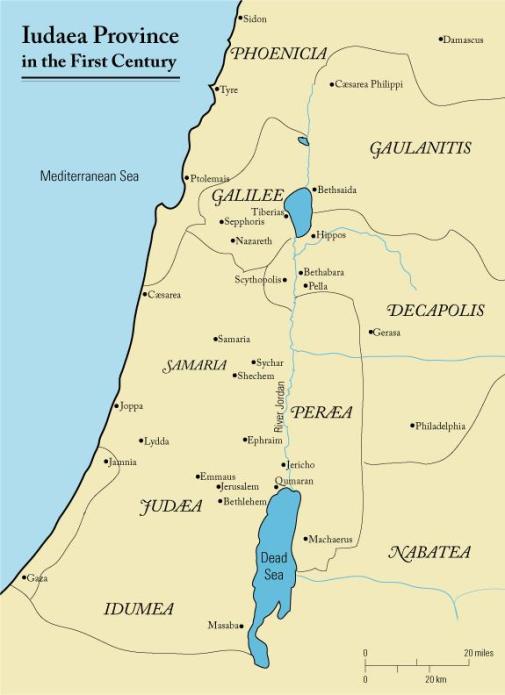
Josephus went on to also describe how Titus “exhibited all sorts of shows” at Caesarea Philippi (about 25 miles north of the Sea of Galilee), where “a great number of the captives were destroyed, some being thrown to wild beasts, and others in multitudes forced to kill one another, as if they were their enemies” (Wars 7.2.1). Similarly, Eleazar ben Jair, in his speech to his followers at Masada, acknowledged how some of their fellow Jews had already died by being “half devoured by wild beasts, and yet have been reserved alive to be devoured by them a second time, in order to afford laughter and sport to our enemies” (Wars 7.8.7).
So, Josephus described how Jews who were taken captive by the Romans were subjected to death by sword and wild beasts for the purpose of gladiator-style entertainment. He also described what happened to those who made the poor decision, against Jesus’ instructions (Luke 21:20-24; cf., Matthew 24:15-21, Mark 13:14-19), to enter Jerusalem for the feast of unleavened bread in spring AD 70. Many of them perished due to “a pestilential destruction” which was soon followed by a famine. This simple chart shows the parallels between what John was shown and what Josephus recorded.
Fourth Seal Fulfilled in AD 70
John (Revelation 6:8)
Josephus
“with sword”
“by the sword” (Wars 6.9.2)
“and famine”
“for want of food…a famine” (Wars 6.9.2-3)
“and plague”
“a pestilential destruction” (Wars 6.9.3)
“and by the wild animals of the earth”
“by the wild beasts” (Wars 6.9.2; 7.2.1; 7.8.7)
Note also that these four judgments also mirrored God’s “four severe judgments” which He told Ezekiel He would send against Jerusalem in his day:
“For this is what the Lord God says: ‘How much more when I send My four severe judgments against Jerusalem: sword, famine, vicious animals, and plague to eliminate human and animal life within it!'” (Ezekiel 14:21).
This correlation between the book of Ezekiel and the book of Revelation is intentional because Ezekiel was describing the first destruction of Jerusalem and the temple (586 BC) while John was describing the destruction of Jerusalem and the temple (AD 70) that was about to take place in his day.
This case study, along with the previous 10 case studies, are all located at this new page on this site: Josephus/Revelation Parallels. Several more case studies are also in the works.
Yesterday I had the privilege of speaking in a conference call hosted by my friend, Jordan Hardgrave. My message was titled, “Josephus and the Book of Revelation (Nine Case Studies).” Here’s the audio of my message (3:40 Introduction; 50:35 Presentation; 21:45 Q & A), followed by my notes. There’s a chart in my introduction below which I believe you’ll find helpful.
In John Wesley’s commentary on Matthew 24 (1755), he said, “Josephus’s History of the Jewish War is the best commentary on this chapter…” I believe this is also true for the book of Revelation.
The preterist movement is known for believing that the book of Revelation was written before the destruction of Jerusalem in AD 70. This belief is backed by both external and internal evidence, that is, testimonies in early church history as well as (more importantly) evidence within the text.
“The Wars of the Jews” by Josephus is another major source of evidence that Revelation was written before AD 70. This work by Josephus was published in AD 75, less than 15 years after Revelation was written. It contains seven books, most of which cover the Jewish-Roman War of AD 66-73.
In this message I want to present nine case studies showing parallels between the book of Revelation and “The Wars of the Jews.” As we look at these parallels, consider what they mean for the popular idea that John wrote Revelation around AD 95. Some of the parallels are so striking that a person would basically have to conclude that John borrowed from the earlier writings of Josephus, and then used the language of Josephus to prophesy of a much later war. We know, however, that John wrote his prophecies first, and Josephus wrote his works a decade or so later. John wrote before the Jewish-Roman War and Josephus wrote after the war.
In this presentation I’ve included the month and year of each event that Josephus referred to. This is based on dates that Josephus himself cited, as well as a helpful table in Ed Stevens’ book, “The Final Decade before the End” (p. 242) showing the modern equivalents of the months cited by Josephus. In the chart below, I’ve color-coded the case studies that feature the seal, trumpet, and bowl judgments:
Please feel free to share whether or not you believe these parallels are legitimate. The more parallels we can nail down between the book of Revelation and the writings of Josephus, the better we can understand the structure of Revelation. For example, were the seals, trumpets, and bowls fulfilled chronologically? When Josephus made reference to them, did he do so in the same order John listed them? How much recapitulation (restating of events) actually exists in Revelation?
Case Study #1 (Revelation 6:4)
“And another horse, fiery red, went out. And it was granted to the one who sat on it to take peace from the earth, and that people should kill one another; and there was given to him a great sword.”
Revelation 6:4 describes the opening of the second seal. Here we see that peace would be taken from “the earth.” This phrase can also be translated as “land” (as it is in Young’s Literal Translation), a reference to “the promised land,” i.e. the land of Israel. A good example of this is Luke 21:23, where Jesus clearly spoke of Judea, yet some translations say “on the earth” and others say “in the land.”
Here’s a description given by Josephus about the civil war among the Jews, which began outside of Jerusalem but spread to Jerusalem by the time the war began in August AD 66 (Wars 4.3.2):
“But then it must be observed, that the multitude that came out of the country were at discord before the Jerusalem sedition began… There were besides disorders and civil wars in every city; and all those that were at quiet from the Romans turned their hands one against another. There was also a bitter contest between those that were fond of war, and those that were desirous for peace. At the first this quarrelsome temper caught hold of private families, who…began already to stand in opposition one to another; so that seditions arose everywhere… the barbarity and iniquity those of the same nation did no way differ from the Romans; nay, it seemed to be a much lighter thing to be ruined by the Romans than by themselves.”
Josephus was describing the events of November AD 67 when he gave this summary. Josephus used phrases like “one against another”, “in opposition one to another”, “civil wars in every city,” and “barbarity.” This lines up well with John’s vision of people “killing one another” in the land. This domestic fighting was so significant that the approach of the Romans was seen as “a much lighter thing.”
In John’s vision, he also saw “a great sword.” Numerous times Josephus spoke of the Zealots killing others with swords and cutting their throats (e.g. Wars 2.18.3, Wars 4.4.3, Wars 4.5.3, and Wars 5.8.1). Were these beheadings? These four instances of throat cutting took place in Galilee and Jerusalem in August AD 66, February/March AD 68, and May AD 70.
Case Study #2 (Revelation 6:15-16)
“And the kings of the earth, the great men, the rich men, the commanders, the mighty men, every slave and every free man, hid themselves in the caves and in the rocks of the mountains, and said to the mountains and rocks, ‘Fall on us and hide us from the face of Him who sits on the throne and from the wrath of the Lamb! For the great day of His wrath has come, and who is able to stand?’” (Revelation 6:15-17).
This passage describes the sixth seal. Notice how Josephus described the attempts of the Zealots to save themselves when they were driven out of the lower city of Jerusalem in August AD 70 (Wars 6.7.3):
“So now the last hope which supported the tyrants, and that crew of robbers who were with them, was in the caves and caverns underground; whither, if they could once fly, they did not expect to be searched for; but endeavored, that after the whole city should be destroyed, and the Romans gone away, they might come out again, and escape from them. This was no better than a dream of theirs; for they were not able to lie hid either from God or from the Romans.”
So John saw a vision of commanders and other men [1] hiding in the caves and rocks and [2] attempting to hide from God. Josephus likewise described the Zealots [1] heading to the caves and caverns as their last hope and [2] being unable to hide from God and the Romans.
These accounts are also parallel to an earlier prophecy given by Jesus on His way to Golgotha:
And a great multitude of the people followed Him, and women who also mourned and lamented Him.But Jesus, turning to them, said, “Daughters of Jerusalem, do not weep for Me, but weep for yourselves and for your children. For indeed the days are coming in which they will say, ‘Blessed are the barren, wombs that never bore, and breasts which never nursed!’ Then they will begin ‘to say to the mountains, “Fall on us!” and to the hills, “Cover us!” (Luke 23:27-30)
Jesus told those ladies that they and their children would personally see the day when people in Jerusalem would call upon the mountains to fall on them and hide them. About 40 years later it happened just as He said, just as John foretold, and as Josephus recorded it. See also Hosea 10:8.
Case Study #3 (Revelation 8:7-9)
“The first angel sounded: And hail and fire followed, mingled with blood, and they were thrown to the earth; and a third of the trees were burned up, and all green grass was burned up. Then the second angel sounded: And something like a great mountain burning with fire was thrown into the sea, and a third of the sea became blood; and a third of the living creatures in the sea died, and a third of the ships were destroyed.”
This passage describes the first and second trumpet judgments. Notice that both judgments feature a mixture of fire and blood. Compare this with what Josephus said happened in Galilee in late spring AD 67 after he tried to fortify the city of Sepphoris, the capital and largest city of Galilee (see Wars 3.2.4):
“By this means he [Josephus] provoked the Romans to treat the country according to the law of war; nor did the Romans, out of the anger they bore at this attempt, leave off, either by night or by day, burning the places in the plain, and stealing away the cattle that were in the country, and killing whatsoever appeared capable of fighting perpetually, and leading the weaker people as slaves into captivity; so that Galilee was all over filled with fire and blood; nor was it exempted from any kind of misery or calamity…” (Wars 3.4.1).
Sepphoris was located halfway between the Mediterranean Sea and the Sea of Galilee, and only three miles away from Nazareth. In Wars 3.9.3 Josephus described what happened on the Sea of Galilee around June AD 67 to thousands of Jews who tried to escape from Joppa:
“Now as those people of Joppa were floating about in this sea, in the morning there fell a violent wind upon them; it is called by those that sail there “the black north wind,” and there dashed their ships one against another, and dashed some of them against the rocks, and carried many of them by force, while they strove against the opposite waves, into the main sea; for the shore was so rocky, and had so many of the enemy upon it, that they were afraid to come to land… And much lamentation there was when the ships were dashed against one another, and a terrible noise when they were broken to pieces; and some of the multitude that were in them were covered with waves, and so perished, and a great many were embarrassed with shipwrecks. But some of them thought that to die by their own swords was lighter than by the sea, and so they killed themselves before they were drowned; although the greatest part of them were carried by the waves, and dashed to pieces against the abrupt parts of the rocks, insomuch that the sea was bloody a long way, and the maritime parts were full of dead bodies; for the Romans came upon those that were carried to the shore, and destroyed them; and the number of the bodies that were thus thrown out of the sea was four thousand and two hundred.”
In Wars 3.10.9 Josephus also described what happened on the Sea of Galilee in August AD 67 to people from Tiberias and Taricheae:
“Sometimes the Romans leaped into their ships, with swords in their hands, and slew them; but when some of them met the vessels, the Romans caught them by the middle, and destroyed at once their ships and themselves who were taken in them. And for such as were drowning in the sea, if they lifted their heads up above the water, they were either killed by darts, or caught by the vessels; but if, in the desperate case they were in, they attempted to swim to their enemies, the Romans cut off either their heads or their hands; …one might then see the lake all bloody, and full of dead bodies, for not one of them escaped. And a terrible stink, and a very sad sight there was on the following days over that country; for as for the shores, they were full of shipwrecks, and of dead bodies all swelled; and as the dead bodies were inflamed by the sun, and putrefied, they corrupted the air…”
So John saw fire and blood, land being burned, and ships being destroyed. Josephus described those very things taking place throughout Galilee from April – August AD 67.
Case Study #4 (Revelation 9:13-16)
“Then the sixth angel sounded: And I heard a voice from the four horns of the golden altar which is before God, saying to the sixth angel who had the trumpet, ‘Release the four angels who are bound at the great river Euphrates.’ So the four angels, who had been prepared for the hour and day and month and year, were released to kill a third of mankind. Now the number of the army of the horsemen was two hundred million, and I heard the number of them” (Revelation 9:13-16).
This is a partial description of the sixth trumpet. Momentarily we’ll take a look at a quote from Josephus about four commanders who led a murderous army, but first here’s some background.
During the winter of AD 67-68, Ananus II, the former high priest in Jerusalem, urged the people of Jerusalem to oppose the lawless Jewish Zealots who had taken over the temple as “blood-shedding villains.” John Levi of Gischala had recently come to Jerusalem, and he pretended to be on the side of Ananus and was invited to be an ambassador to the Zealots (Wars 4.3.13). However, John quickly betrayed Ananus and falsely claimed that he had invited the Roman general Vespasian to conquer Jerusalem (Wars 4.3.14).
In response, the Zealot leaders Eleazar ben Simon and Zacharias ben Phalek requested help from the Idumeans (Idumea was south of Judea). They told the Idumeans that “unless they would come immediately to their assistance… the city would be in the power of the Romans.” The Idumeans quickly prepared an army of 20,000 directed by four commanders (Wars 4.4.2):
“Now these [Idumean] rulers were greatly surprised at the contents of the letter, and at what those that came with it further told them; whereupon they ran about the nation like madmen, and made proclamation that the people should come to war; so a multitude was suddenly got together, sooner indeed than the time appointed in the proclamation, and everybody caught up their arms, in order to maintain the liberty of their metropolis; and twenty thousand of them were put into battle-array, and came to Jerusalem, under four commanders, John, and Jacob the son of Sosas; and besides these were Simon, the son of Cathlas, and Phineas, the son of Clusothus.”
What about the discrepancy between the numbers “200 million” and “20,000”? Earlier I quoted from the New King James Version. Like most versions, it gives some variation of the number “200 million.” Young’s Literal Translation says “two myriads of myriads.” The Interlinear translates this phrase as “twice ten thousand ten thousands.” The word “myriad” in Greek meant “10,000,” so two myriads was “20,000,” the same number that Josephus assigned to the Idumean army.
A similar expression is used in Psalm 68:17 (“The chariots of God are twenty thousand, even thousands of thousands; The Lord is among them as in Sinai, in the Holy Place” –NKJV). This verse is far more often translated to say “20,000” than Revelation 9:16 is. The Interlinear for Psalm 68:17translates this verse to say “even thousands, twenty thousand of God are the chariots.” When it comes to Revelation 9:16, it seems that most translations have unnecessarily squared the number “10,000” before doubling it, coming up with 200 million instead of 20,000.
In any case, John and Josephus both described an army of 20,000 led by four commanders. The Idumeans came to Jerusalem in February AD 68. We’ll hear more about them in the next section.
Case Study #5 (Revelation 11:7-13)
“Now when they [the two witnesses] finish their testimony, the beast that ascends out of the bottomless pit will make war against them, overcome them, and kill them. And their dead bodies will lie in the street of the great city which spiritually is called Sodom and Egypt, where also our Lord was crucified. Then those from the peoples, tribes, tongues, and nations will see their dead bodies three and a half days, and not allow their dead bodies to be put into graves. And those who dwell on the earth will rejoice over them, make merry, and send gifts to one another, because these two prophets tormented those who dwell on the earth… In the same hour there was a great earthquake, and a tenth of the city fell. In the earthquake seven thousand men were killed, and the rest were afraid and gave glory to the God of heaven.”
This vision is also part of the sixth trumpet, or at least it appears before the seventh trumpet sounds. This is the first passage in Revelation where “the beast” is mentioned, and it’s also where “the great city” is first mentioned and defined – as being the city where Jesus was crucified, i.e. Jerusalem.
Josephus described a morning in February AD 68 when the city of Jerusalem woke up to find that 8,500 people had died during the night due to an earthquake and a slaughter carried out by the Idumeans. Here’s how he described the earthquake in the midst of a great storm (Wars 4.4.5):
“[F]or there broke out a prodigious storm in the night, with the utmost violence, and very strong winds, with the largest showers of rain, with continued lightnings, terrible thunderings, and amazing concussions and bellowings of the earth, that was in an earthquake… anyone would guess that these wonders foreshowed some grand calamities that were coming.”
And here’s how he described the slaughter carried out by the Idumeans that same night, after they managed to saw through the gates and break into the city (Wars 4.5.1):
“The zealots also joined in the shouts raised by the Idumeans; and the storm itself rendered the cry more terrible; nor did the Idumeans spare anybody; for as they are naturally a most barbarous and bloody nation, and had been distressed by the tempest, they made use of their weapons against those that had shut the gates against them… Now there was at present neither any place for flight, nor any hope of preservation; but as they were driven one upon another in heaps, so were they slain… And now the outer temple was all of it overflowed with blood; and that day, as it came on, they saw eight thousand five hundred dead bodies there.”
Recall that John said “in the earthquake seven thousand men were killed.” Josephus didn’t distinguish between how many died in the earthquake and how many were killed by the sword, so it’s possible that the earthquake killed 7000 and the Idumeans killed 1,500.
The next day the Idumeans, working on behalf of the Zealots, hunted down and killed a couple of former high priests, Ananus and Jesus, who had long tormented the Zealots by opposing their war and working for peace. Here’s how Josephus described their deaths in Wars 4.5.2:
“[The Idumeans] sought for the high priests, and…went with the greatest zeal against them; and as soon as they caught them they slew them, and then standing upon their dead bodies, in way of jest, upbraided Ananus with his kindness to the people, and Jesus with his speech made to them from the wall. Nay, they proceeded to that degree of impiety, as to cast away their dead bodies without burial… I should not mistake if I said that the death of Ananus was the beginning of the destruction of the city… He…preferred peace above all things; …he was a shrewd man in speaking and persuading the people, and had already gotten the mastery of those that opposed his designs, or were for the war… And this at last was the end of Ananus and Jesus.”
So John and Josephus both described two individuals in Jerusalem who were hated, killed, and not allowed to be buried. If we go back to Rev. 11:5-6, they also both describe a couple of men who could not be taken down by their enemies until this particular time. And they describe this happening at the same time as an earthquake that coincided with the deaths of at least 7000 people.
I realize this case study is probably the most controversial, and it deserves a deeper study. I plan to do that in a series I’m currently working on about the beast of Revelation, which should be ready in a few weeks. Until recently I believed that the beast was Rome (generally) and Nero (specifically). I now believe the beast was Zealot-led Israel and I’ll present a lot of evidence for that in my upcoming series.
One thing we should note here in Revelation 11 is the fact that the beast oversees the deaths of the two witnesses in Jerusalem. If this indeed happened in AD 68, the beast could not have been Roman. From August AD 66 until April AD 70 the Romans were not in Jerusalem, except for a few days in November AD 66 when Cestius Gallus led a failed attack on the city. If the events of Revelation 11 took place anytime between late AD 66 and the spring of AD 70, the beast that overcame the two witnesses was Jewish, not Roman. And based on the four case studies we’ve already looked at, and the next four that we’re about to look at, it’s very fitting that the events of Revelation would have taken place in early 68 AD.
Case Study #6 (Revelation 16:3-6)
“Then the second angel poured out his bowl on the sea, and it became blood as of a dead man, and every living creature in the sea died.Then the third angel poured out his bowl on the rivers and springs of water, and they became blood. And I heard the angel of the waters saying: ‘You are righteous, O Lord, the One who is and who was and who is to be, because You have judged these things. For they have shed the blood of saints and prophets, and You have given them blood to drink. For it is their just due.’”
This is a description of the second and third bowl judgments. Josephus described how, in the spring of AD 68, Vespasian prepared for the eventual siege on Jerusalem by marching “against Gadara, the metropolis of Perea” (Wars 4.7.3) and the rest of Perea as well (Wars 4.7.6). Perea was the region east of the Jordan River, just next to Judea and Jerusalem.
Some of the Jews who fled from Gadara joined with others and “got in great numbers together and fled to Jericho” (Wars 4.7.5) with Placidus, Vespasian’s assistant, chasing them. Placidus drove the whole multitude to the riverside, along the Jordan River. Then things really took a tragic turn (Wars 4.7.5-6):
“They then extended themselves a very great way along the banks of the river, and sustained the darts that were thrown at them, as well as the attacks of the horsemen, who beat many of them, and pushed them into the current. At which fight, hand to hand, fifteen thousand…were slain, while the number of those that were unwillingly forced to leap into Jordan was prodigious… and Jordan could not be passed over, by reason of the dead bodies that were in it, but because the lake Asphaltiris was also full of dead bodies, that were carried down into it by the river. And now Placidus… put his soldiers on board the ships, and slew such as had fled to the lake…”
Lake Asphaltiris was the Greek name for the Dead Sea. So John saw a sea that “became blood as of a dead man” (Rev. 16:3) and he saw that “every living creature in the sea died.” Josephus said that the Dead Sea was “full of dead bodies” and that Placidus killed everyone else who fled to the Dead Sea.
John saw rivers and springs of water turn to blood, and that those who shed the blood of saints and prophets were given “blood to drink.” Josephus said that a multitude of Jews was pushed into, and “unwillingly forced to leap into,” the current of the Jordan River. That river was so full of dead bodies that no one could pass over it. Some of them drank the bloody water as they drowned.
“Now the great city was divided into three parts, and the cities of the nations fell. And great Babylon was remembered before God, to give her the cup of the wine of the fierceness of His wrath.”
This is from John’s description of the seventh bowl. “The great city,” as we already saw, was Jerusalem.
The Cities of the Nations Fell
The downfall of the nation of Galilee in AD 67 can be seen mostly in The War of the Jews, Book 3. In the previous section, we saw that Vespasian subdued the entire nation of Perea in the spring of AD 68. Then in the summer of AD 68, Vespasian was at Caesarea, ready “to march directly to Jerusalem” when he learned that Nero had died (in June AD 68). So, Vespasian waited there for almost a year (Wars 4.9.2).
In the meantime, though, another nation fell. That was the nation of Idumea, but it was at the hands of Simon Bar Giora, a Jewish Zealot leader. He first “laid waste the whole country” of Idumea, attacking Hebron, ravaging cities and villages, and making Idumea like a desert (Wars 4.9.7). Then he “compelled a great number of [the Idumeans] to retire to Jerusalem; he followed them himself also to the city.” Josephus said he “was a greater terror to the people than the Romans themselves,” but the Zealots in Jerusalem were even “more heavy upon” the people than Simon and the Romans (Wars 4.9.10).
So, amazingly, Simon was invited into Jerusalem. The people “made joyful acclamation to him, as their savior and their preserver,” thinking he would save them from the madness of the Zealots. However, Simon Bar Giora looked upon them all as his enemies (Wars 4.9.11). In April AD 69, Simon “got possession of Jerusalem” (Wars 4.9.12). Soon the stage would be set for Jerusalem to be divided into three factions, but first we’ll take note of more cities that fell.
In May-June AD 69, Vespasian “marched against those places of Judea which were not yet overthrown,” sparing only Herodium, Masada, Macherus, and Jerusalem which were controlled by the Zealots (Wars 4.9.9). He paused his campaign again, however, when he learned that Vitellus had become emperor of Rome (Wars 4.10.2). In December AD 69, he was named emperor of Rome (Wars 4.11.4-5) and his son, Titus, was dispatched to besiege Jerusalem (Wars 4.11.5 and Wars 5.1.1).
Here’s a simple table of nations that fell from AD 67 to mid-AD 69:
Nations that Fell
Time Period
Conqueror
Galilee
AD 67
Vespasian and Titus (Romans)
Perea
Spring AD 68
Vespasian
Idumea
Late AD 68 – Early AD 69
Simon Bar Giora (Jewish Zealot)
Judea (most of it)
May/June AD 69
Vespasian
Jerusalem Divided Into Three Parts
In Wars 5.1.1 and Wars 5.1.4, Josephus described the conditions in Jerusalem in December 69 AD:
“[T]he sedition at Jerusalem was revived, and parted into three factions, and that one faction fought against the other… one should not mistake if he called it a sedition begotten by another sedition, and to be like a wild beast grown mad, which for want of food from abroad, fell now upon eating its own flesh.”
“And now there were three treacherous factions in the city, the one parted from the other. Eleazar [ben Simon] and his party, that kept the sacred first-fruits, came against John [Levi of Gischala] in their cups. Those that were with John plundered the populace and went out with zeal against Simon [Bar Giora].”
So this is a very clear fulfillment of John’s words that the great city, Jerusalem, “was divided into three parts” (Revelation 16:19). It’s also a flashback to Jerusalem’s earlier destruction in 586 BC. In Ezekiel 5:1-12 we see that Ezekiel was required to shave his head and divide it into three parts, and God told him, “This is Jerusalem” (verse 5). One third of his hair was burned, one third was chopped up by the sword, and the last third was scattered into the wind.
Case Study #8 (Revelation 16:21)
“And great hail from heaven fell upon men, every hailstone about the weight of a talent. And men blasphemed God because of the plague of the hail, since that plague was exceedingly great.”
This is also from John’s description of the seventh bowl. Compare this to the following description of large stones catapulted over the wall in Jerusalem by the tenth Roman legion in May AD 70 (Wars 5.6.3):
“The engines, that all the legions had ready prepared for them, were admirably contrived; but still more extraordinary ones belonged to the tenth legion… Now the stones that were cast were of the weight of a talent, and were carried two furlongs and further. The blow they gave was no way to be sustained, not only by those that stood first in the way, but by those that were beyond them for a great space. As for the Jews, they at first watched the coming of the stone, for it was of a white color, and could therefore not only be perceived by the great noise it made, but could be seen also before it came by its brightness; accordingly the watchmen that sat upon the towers gave them notice when the engine was let go, and the stone came from it, and cried out aloud, in their own country language, ‘THE STONE COMETH,’ so those that were in its way stood off, and threw themselves down upon the ground; by which means, and by their thus guarding themselves, the stone fell down and did them no harm. But the Romans contrived how to prevent that by blacking the stone, who then could aim at them with success, when the stone was not discerned beforehand, as it had been till then; and so they destroyed many of them at one blow.”
So John saw hailstones weighing a talent falling from the sky over Jerusalem, and Josephus describes white stones weighing a talent being catapulted into the city. A talent was 75 – 100 pounds.
According to William Whiston’s famous translation of the works of Josephus, the watchmen shouted, “THE SON COMETH,” rather than “THE STONE COMETH.” J. Stuart Russell, in his 1878 book The Parousia (p. 482), pointed out that it was only eight years before this, in AD 62, that as James was being martyred he cried out that “the Son of Man was about to come in the clouds of heaven.” So Russell speculated that the watchmen gave this cry “in mockery of the Christian hope of the Parousia.”
These large stones were actually discovered in an archaeological dig during the last year. See hereand here for articles on this find, including photos of the stones.
Case Study #9 (Revelation 17:12-16)
“And the ten horns which you saw are ten kings who have received no kingdom as of yet, but they receive authority for one hour as kings with the beast. These are of one mind, and they will give their power and authority to the beast. These will make war with the Lamb, and the Lamb will overcome them… And the ten horns which you saw on the beast, these will hate the harlot, make her desolate and naked, eat her flesh and burn her with fire.”
As I mentioned earlier, until a few months ago I believed that the beast in Revelation was Rome and Nero. I assumed that the 10 horns must have been the 10 Senatorial Provinces of Rome working with Nero to persecute Christians and to capture and burn Jerusalem in AD 70.
When I started to rethink this subject, one thing I discovered is that when Titus overthrew Jerusalem in AD 70, he did not have leaders or representatives of those 10 provinces with him. He didn’t even have 10 legions with him. Instead he had four legions – the 5th, 10th, 12th, and 15th legions (Wars 5.1.6).
Then I was surprised to discover that Josephus listed exactly 10 high priests and religious leaders in Israel who were given authority as generals in December AD 66. Three of them were even killed by the Zealots in early AD 68, fulfilling Daniel 7:8, 20, 24. Here’s a quick summary of what led up to the selection of those 10 generals. (More details can be seen in this article.)
Josephus says that the Jewish-Roman War officially began in August AD 66 when Eleazar, the son of Ananias the high priest, “who was at that time governor of the Temple, persuaded those that officiated in the divine service to receive no gift or sacrifice for any foreigner.” They used this new law to reject “the sacrifice of Caesar” (Wars 2.17.2). They also massacred a Roman garrison stationed at the Antonia Fortress on the east side of Jerusalem (Wars 2.17.7).
In November AD 66, Cestius Gallus brought the 12th Legion to put down the Jewish rebellion. Surprisingly, his army suffered about 5,700 deaths, his weapons and supplies were stolen during an ambush, they retreated on November 22nd, and the Jewish rebels chased and killed many of them over the next five days. The Jewish temple leaders knew that a full-scale Roman revenge was inevitable. So they “got together in great numbers in the temple, and appointed a great many generals for the war.” Here’s a list of the territories they were to oversee in preparation for war with Rome (Wars 2.20.3-4):
Joseph, the son of Gorion (Governor of Jerusalem)
Ananus, the high priest (Governor of Jerusalem)
Jesus, the son of Sapphias, one of the high priests (Idumaea)
Eleazar, the son of Ananias, the high priest (Idumaea)
Niger, the then governor of Idumea (Idumaea)
Joseph, the son of Simon (Jericho)
Manasseh (Perea)
John, the Esscue (toparchy of Thamna; “Lydda was also added to his portion, and Joppa, and Emmaus”)
John, the son of Matthias (toparchies of Gophnitica and Acrabattene)
Josephus, the son of Matthias (both the Galilees; “Gamala also, which was the strongest city in those parts, was put under his command”)
The three generals who were killed by the Zealots in fulfillment of Daniel 7:8, 20, 24 were [1] Ananus ben Ananus [2] Niger of Perea, and [3] Joseph ben Gorion. Their deaths are recorded in Wars 4.5.2 and Wars 4.6.1.
How did these horns make war with the Lamb? In a nutshell, Jesus made war against the harlot/great city, Jerusalem, and He used the Roman army as His instrument (see Matthew 22:7). The Zealots and those who were aligned with them fought desperately to maintain power over Jerusalem and to gain independence for Israel. This question is addressed further here.
How did they turn on the harlot, make her desolate, eat her flesh, and burn her with fire? They were assigned to Idumea, Jericho, Perea, Galilee, Jerusalem, etc. During the Jewish-Roman War, Jerusalem became more and more isolated as Rome captured Galilee, Perea, and other places. Many people made their way to Jerusalem, and presumably these generals did the same. Josephus, of course, was captured.
We already saw the quote from Wars 5.1.1 where Josephus described “the sedition” in Jerusalem, and the civil war between the Zealot factions, as “a wild beast grown mad, which, for want of food from abroad, fell now upon eating its own flesh.” Josephus also repeatedly blamed the Jews, especially the Zealots, for the fire that burned Jerusalem and the temple. In Wars 6.4.5, he said, “[T]hese flames took their rise from the Jews themselves, and were occasioned by them.” In Wars 6.6.2, he records a speech given by Titus in which he said to the Zealots, “You…have set fire to your holy house with your own hands.” Josephus made similar statements in Wars 5.4.4, Wars 6.2.9, and other places.
Conclusion
Based on these case studies, I would like to tentatively suggest that the seals, trumpets, and bowls were structured in this way:
Seals – From AD 66 (or earlier) to AD 70 Trumpets – From early AD 67 to early AD 68
(Zealot siege)
Bowls – From spring AD 68 to AD 70
To use an arm as an analogy, the seals would stretch from the shoulder to the fingers; the trumpets would stretch from the shoulder to the elbow; (the elbow would represent the Zealot siege of early AD 68); and the bowls would stretch from the elbow to the fingers.
This presentation represents an ongoing study, as there are more parallels between the Book of Revelation and Josephus that are not included here. Those who listen to or read this presentation are welcome to evaluate these case studies and this tentative conclusion.
Almost two months from now, believers in different parts of the world will celebrate a new holiday known as “Parousia – New Jerusalem Day.” The idea for this holiday came from a friend of mine, Joshua John Trent, who asked me to write about the meaning of the holiday’s name. Joshua is the founder and creator of Iron Scepter Concepts (Los Angeles).
Parousia – New Jerusalem Day is celebrated on the first Sunday of August (August 7th this year). This is close to August 10th, the day that the famous Second Temple was destroyed in Jerusalem in 70 AD. The old temple and the old city of Jerusalem became desolate (Matthew 23:38) and marked for destruction (Matthew 22:7, 24:1-3; Mark 13:1-4; Luke 21:5-7), but Jesus became the cornerstone of a new temple, God’s dwelling place made up of His people from all nations (Ephesians 2:19-22). New Jerusalem and the new covenant were chosen while old Jerusalem and the old covenant were cast out (Galatians 4:21-31).
Definition of the Word “Parousia”
The word “parousia” (pronounced par-oo-see’-ah) is a Greek word which means “presence.” According to Wikipedia, it also meant “arrival” or “official visit,” and “was used in the East as a technical expression to denote the arrival or visit of a king or emperor, and celebrated the glory of the sovereign publicly.” The word “parousia” appears 24 times in the New Testament. In several instances it is used to speak of the coming or presence of various individuals: Stephanas, Fortunatas, and Achaicus (I Corinthians 16:17); Titus (II Cor. 7:6-7); Paul (II Cor. 10:10; Philippians 1:26, 2:12); and the lawless one (II Thessalonians 2:9).
In the majority of instances (16 times), though, it is used in connection with the promise of Christ’s coming. The Blue Letter Bible shows that this word comes “from the present participle of G3918 [“pareimi”]; a being near, i.e. advent (often, return; specially, of Christ to punish Jerusalem, or finally the wicked); (by implication) physically, aspect:—coming, presence.” I’ll develop this study more below.
“Parousia” Goes Hand-in-Hand with “New Jerusalem.”
Revelation 21:1 – 22:5 is the most detailed description of the New Jerusalem, and there we read that “the tabernacle of God is with men, and He will dwell with them, and they shall be His people, and God Himself will be with them and be their God” (Rev. 21:3). We also see that the Lamb, Jesus, is the light of God’s city (Revelation 21:22-24; 22:5). New Jerusalem is filled with the presence (“parousia”) of Jesus; New Jerusalem is His dwelling place.
“Parousia” in the New Testament
Here are the 16 New Testament passages where Christ’s “Parousia” is promised:
“Now as He sat on the Mount of Olives, the disciples came to Him privately, saying, ‘Tell us, when will these things be? And what will be the sign of Your coming, and of the end of the age?’” (Matthew 24:3).
“For as the lightning comes from the east and flashes to the west, so also will the coming of the Son of Man be” (Matthew 24:27).
“For as in the days before the flood, they were eating and drinking, marrying and giving in marriage, until the day that Noah entered the ark, and did not know until the flood came and took them all away, so also will the coming of the Son of Man be” (Matthew 24:38-39).
“For as in Adam all die, even so in Christ all shall be made alive. But each one in his own order: Christ the firstfruits, afterward those who are Christ’s at His coming” (I Corinthians 15:22-23).
“For what is our hope, or joy, or crown of rejoicing? Is it not even you in the presence of our Lord Jesus Christ at His coming?” (I Thessalonians 2:19).
“And may the Lord make you increase and abound in love to one another and to all, just as we do to you, so that He may establish your hearts blameless in holiness before our God and Father at the coming of our Lord Jesus Christ with all His saints” (I Thessalonians 3:12-13).
“For this we say to you by the word of the Lord, that we who are alive and remain until the coming of the Lord will by no means precede those who are asleep” (I Thessalonians 4:15).
“Now may the God of peace Himself sanctify you completely; and may your whole spirit, soul, and body be preserved blameless at the coming of our Lord Jesus Christ” (I Thessalonians 5:23).
“Now, brethren, concerning the coming of our Lord Jesus Christ and our gathering together to Him, we ask you not to be soon shaken in mind or troubled, either by spirit or by word or by letter, as if from us, as though the day of Christ had come” (II Thessalonians 2:1-2).
“And then the lawless one will be revealed, whom the Lord will consume with the breath of His mouth and destroy with the brightness of His coming” (II Thessalonians 2:8).
– 12. “Therefore be patient, brethren, until the coming of the Lord. See how the farmer waits for the precious fruit of the earth, waiting patiently for it until it receives the early and latter rain. You also be patient. Establish your hearts, for the coming of the Lord is at hand. Do not grumble against one another, brethren, lest you be condemned. Behold, the Judge is standing at the door!” (James 5:7-9).
“For we did not follow cunningly devised fables when we made known to you the power and coming of our Lord Jesus Christ, but were eyewitnesses of His majesty” (II Peter 1:16).
“Beloved, I now write to you this second epistle… that you may be mindful of the words which were spoken before by the holy prophets, and of the commandments of us the apostles of the Lord and Savior, knowing this first: that scoffers will come in the last days, walking according to their own lusts, and saying, ‘Where is the promise of His coming? For since the fathers fell asleep, all things continue as they were from the beginning of creation’” (II Peter 3:1-4).
“But the day of the Lord will come as a thief in the night, in which the heavens will pass away with a great noise, and the elements will melt with fervent heat; both the earth and the works that are in it will be burned up. Therefore, since all these things will be dissolved, what manner of persons ought you to be in holy conduct and godliness, looking for and hastening the coming of the day of God, because of which the heavens will be dissolved being on fire, and the elements will melt with fervent heat? Nevertheless we, according to His promise, look for new heavens and a new earth in which righteousness dwells” (II Peter 3:10-13).
“And now, little children, abide in Him, that when He appears, we may have confidence and not be ashamed before Him at His coming” (I John 2:28).
“When the emperor visited a colony or province, the citizens of the country would go to meet him at some distance from the city. It would be disrespectful to have him actually arrive at the gates as though his subjects couldn’t be bothered to greet him properly. When they met him, they wouldn’t then stay out in the open country: they would escort him royally into the city itself. When Paul speaks of “meeting” the Lord “in the air,” the point is precisely not – as in the popular rapture theology – that the saved believers would then stay up in the air somewhere, away from earth. The point is that, having gone out to meet their returning Lord, they will escort him royally into his domain, that is, back to the place they have come from. Even when we realize that this is highly charged metaphor, not literal description, the meaning is the same as in the parallel in Philippians 3:20. Being citizens of heaven, as the Phillippians would know, doesn’t mean that one is expecting to go back to the mother city but rather means that one is expecting the emperor to come from the mother city to give the colony its full dignity, to rescue it if need be, to subdue local enemies and put everything to rights” (emphasis added).
More than 100 passages in the New Testament declared that the events of “the last days,” including the Great Tribulation and the coming of Christ, were “near” and about to take place “soon” in the first century. Jesus Himself promised to come before His disciples could go through the cities of Israel (Matthew 10:23). He promised to come [1] in the glory of His Father [2] with His angels [3] in judgment, and [4] in His kingdom before all of His disciples would die (Matthew 16:27-28). He promised to come “on the clouds of heaven with power and great glory” before His generation would pass away (Matthew 24:30, 34).
Jesus told His disciples that when they would see “all these things” (earthquakes, wars, famines, etc.) promised in the Olivet Discourse, they would know that He “is near, at the very doors” (Matthew 24:33). As we saw above, James declared that Christ’s coming was at hand and that the Judge was standing “at the door” (James 5:8-9). James wrote that nearly 1,950 years ago, and it’s apparent that he saw those things come to pass in his lifetime just as Jesus promised.
John wrote in his first epistle that it was already “the last hour” in his day (I John 2:18). It was the last hour of the old covenant age. His opening words in the book of Revelation declared that the visions he saw “must shortly take place” because the time was “near” (Revelation 1:1, 3). The angel echoed these words at the end of the book (Rev. 22:6, 10) and Jesus declared three times that He was coming quickly (Rev. 22:7, 12, 20).
In summary, “parousia” is a Greek word used repeatedly in the New Testament to describe the first century arrival of Jesus’ presence in the New Jerusalem, and into the kingdom that He established, the corporate body of His followers. His “parousia” (presence) is in our midst today.
New Jerusalem
Isaiah prophesied that God would create new heavens and a new earth, and “Jerusalem as a rejoicing” (Isaiah 65:17-18). In those days there would still be childbirth, death, building, and planting (65:20-23), i.e. the realities we know and experience today. There would also be joy, peace, satisfaction, glory, and comfort like a mother’s comfort (65:19; 66:10-13).
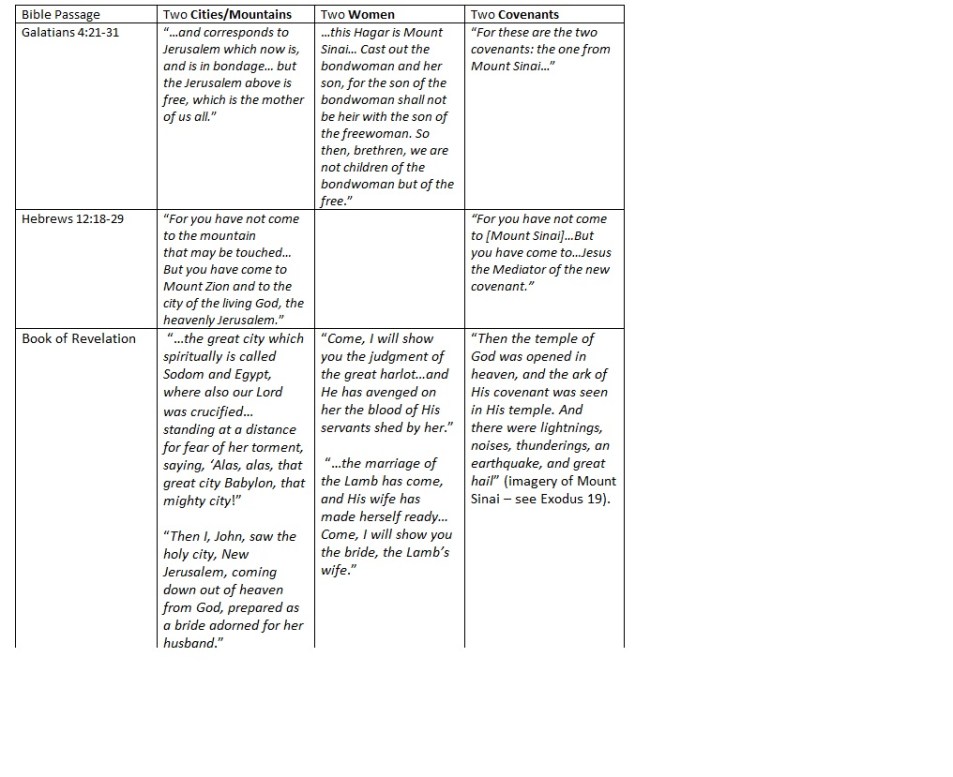
The apostle Paul also described “the Jerusalem above” as a comforting mother (Galatians 4:26-28). The author of Hebrews told the first century saints that they had already come to “the city of the living God, the heavenly Jerusalem… to Jesus the Mediator of the new covenant…” (Hebrews 12:22-24). These two passages, along with the book of Revelation, contrast two covenants (the old and the new), two women (the harlot and the bride), and two cities (old Jerusalem and New Jerusalem):
The New Jerusalem is described by John in Revelation 21:1 – 22:5. In these 32 verses, there are numerous parallel passages in the New Testament where Jesus and the apostles described the life of those who follow Christ. In other words, we are the New Jerusalem community right now. In these 32 verses there are also numerous parallel passages in the Old Testament where the prophets looked ahead to this present new covenant age. Here are some of them:
Passage
Description and Parallels
Rev. 21:2
New Jerusalem is God’s holy city, pictured as a bride. Jesus said His people are a city set on a hill, the light of the world (Matthew 5:14). See also Hebrews 12:22-24, Galatians 4:26.
Rev. 21:3
God dwells with His people, He’s with them, and He’s their God. See Ezekiel 37:27, 43:7, 48:35; II Corinthians 6:16.
Rev. 21:9
John sees the New Jerusalem as a bride, the Lamb’s wife. He contrasts the bride with the harlot/”great city” of Rev. 17, old covenant Jerusalem (Rev. 11:8). Paul also contrasted two women/two covenants in Galatians 4:21-31.
Rev. 21:12-13
The new Jerusalem has a high wall with 12 gates, bearing the names of the 12 tribes of Israel; three gates each on the east, north, south, and west sides. Compare to Isaiah 60:18, Luke 13:29, and to Ezekiel 48:30-35 (“…and the name of the city from that day shall be: THE LORD IS THERE”).
Rev. 21:14
The city’s foundations bear the names of the 12 apostles. Compare to Ephesians 2:20.
Rev. 21:15-18
The new Jerusalem in John’s vision is cube-shaped, as was the holy of holies in Solomon’s temple (I Kings 6:20). The holy of holies was overlaid with pure gold, and the holy city in John’s vision is also entirely made of pure gold.
Rev. 21:19-21
The foundations of the city walls are covered in precious gems. This fulfills Isaiah 54:11-12, and Paul clearly affirms that Isaiah 54 is about the church (Galatians 4:27).
Rev. 21:22-23
Jesus is the temple and the light of this city. See Isaiah 60:19.
Rev. 21:24
The nations of those who are saved walk in the light of this city. See Isaiah 60:3, 10.
Rev. 21:25-26
The gates of the city are never shut, and the glory and honor of the nations come in to the city. See Isaiah 60:5, 11.
Rev. 21:27
Only those who are written in the Lamb’s Book of Life enter this city. See Isaiah 60:21.
Rev. 22:1
A pure, clear river of water of life flows from the throne of God and of the Lamb. See John 4:13-14, 7:37; Zechariah 14:8; Rev. 22:17.
Rev. 22:2
On both sides of the river is the tree of life, which bears different fruit each month. The leaves of the tree are for the healing of the nations. See Ezekiel 47:1-12.
Rev. 22:5
There’s no night in the city, and no need for a lamp. See Isaiah 60:1, 19-20; Daniel 12:3, Matthew 13:43, John 8:12. The citizens of New Jerusalem reign forever and ever. See Isaiah 9:6-7, Luke 1:33, Rev. 1:6.
The New Jerusalem means “the new city of peace.” Jesus is the Prince of Peace and His presence, His parousia, is in this city. He is peace (Micah 5:5), and there will be no end to His government and peace (Isaiah 9:6-7). Let’s rejoice and celebrate, not only on August 7th, but every day that His presence is in our midst, in the city of God, the New Jerusalem.
On Sunday, May 22nd, I had the privilege of presenting a message in a conference call for those who believe in, or want to know more about, preterism (fulfilled eschatology). I titled my message, “Living Worthy of What the Old Testament Prophets Foretold about this New Covenant Age.” My message lasted 25 minutes and was followed by a time of discussion. Here’s the audio of my message, along with a written transcript of my notes. If you listen or read this message, you’ll see that the prophets had a vision of peace, and I’d love to especially hear your thoughts about that theme:
One thing I’ve heard from people who are skeptical of preterism is that, if everything is fulfilled, there must be nothing left for God’s people today. So I want to talk about some of those things that we do have in this new covenant age, about the present realities, mandates, and destinies that God has for us. Yes, I’m fascinated by all the things that took place in the first century AD during the last days of the old covenant age, and their significance and how they fulfilled prophecy, but I’m also very interested in how the prophets, Jesus, and the apostles said we would be equipped for a glorious, expanding, forward-moving life in God’s kingdom and in His holy city, the new Jerusalem.
This is a very broad subject, so in this message I want to narrow the focus to the vision that the Old Testament prophets had about this age. I will only have time to cover some of it, of course. Before we dig into some great Scripture texts, I want to briefly set this up and talk about one reason why it’s important to study and teach about this vision of the Old Testament prophets, especially at this point in church history. We live during a time when some very strange filters have been laid over the teachings of the Old Testament prophets because premillennial and dispensationalist teachings have dominated in the Church for several generations.
One of the foundation stones of dispensationalism is the idea that this present church age is a surprising parenthesis in God’s long-term plan. Many dispensationalist leaders have taught that this age we live in was never foreseen by the Old Testament prophets. Instead they looked past our time, i.e. the last 2000 years, toward a future 1000-year period known as “the millennium” when Christ would return and finally begin to reign. Here are a few short quotes from some of these leaders:
“It has been illustrated how this whole age existed in the mind of God without having been revealed in the Old Testament.” [J. Dwight Pentecost, Things to Come (Grand Rapids: Zondervan, 1958), p. 137]
“Dispensationalists have regarded the present age as a parenthesis unexpected and without specific prediction in the Old Testament.” [J.F. Walvoord, Millennial Kingdom, 1959, p. 227]
“The first prediction relative to the true Church was uttered by Christ, being recorded in Matthew 16:18.” [L.S. Chafer, Systematic Theology, 8 vols. (Dallas: Dallas Seminary Press, 1947), 4:374]
“The Church is a mystery in the sense that it was completely unrevealed in the Old Testament and now revealed in the New Testament.” [Charles Ryrie, The Basis of the Premillennial Faith (Loizeaux Brothers, 1953), p. 136]
Harry A. Ironside also taught that the Old Testament prophets saw two mountains ahead, which were the first and second comings of Christ. According to Ironside, the church age was in a large valley in between those mountains and the prophets were unable to see into it:
“It has often been pointed out by others, but is well worth repeating, that the Old Testament seer might be likened to a man standing on one of our Western plains looking off toward a great mountain range. Many miles before him is a vast mountain which for the moment fills all his vision. Clouds cover the top of it, so that it seems to pierce the heavens, but suddenly the clouds are lifted and in the blaze of the westering sun he sees another and higher peak beyond, covered with snow, which seems to shine in resplendent glory. What the man gazing upon this scene cannot see, however, is the valley or the lower ranges of mountains that come in between these two peaks. The one may be many miles beyond the other. In between may be lesser hills, valleys, rivers, villages and farms, but all of these are unseen by the man upon the plain.
Let us imagine a cross surmounting the first peak, and call this the vision of the coming of the Lord Jesus Christ to suffer and to die for our sins. Then imagine that the glory surrounding the second and higher peak takes the form of a crown of light, and think of it as indicating the Second Coming of our Lord Jesus to reign in power and glory over all this lower universe. Peter spoke of the “sufferings of Christ, and the glory that should follow.” These two mountains illustrate both. But now, in between them we have all the events of the present age of grace, and these could not be seen by the Old Testament prophets for it was not yet the will of God to make them known. These are the mysteries kept secret from the foundation of the world, which began to be made manifest by our Lord Jesus as He told of the mysteries of the kingdom of heaven; and then were more fully unfolded in the unique revelation of the mystery of the Church, the body of Christ, given to the Apostle Paul, and the unfolding of the mystery of iniquity and of Babylon the Great through Paul and John. Other mysteries there are linked with these, and nearly all of them have to do with what is going on between the First and Second Comings of our Lord.”
This teaching has robbed the body of Christ of a glorious blueprint for our present time, which was laid out in the Old Testament and further developed in the New Testament. This teaching says that God’s best plans, promises, and purposes are not for this present age, but for a future age when the superiority of the Jewish race is once again restored. It’s robbed the body of Christ of wonderful descriptions of our identity and also descriptions of how God invites us to partner with Him in seeing His peace, His government, and His justice expand throughout our world.
So let’s look at some of the passages that reveal the vision that the Old Testament prophets had of this present new covenant age. One major theme that we will see in their vision is the theme of God’s peace.
Daniel 7:14, 18, 21-22, 27
In Daniel 7, Daniel had a vision of Jesus ascending to His Father and receiving everlasting dominion, glory, and a kingdom. Then during the time of the fourth beast, the fourth kingdom that would persecute the saints, God would give the kingdom and dominion into the hands of His people:
“Then to Him was given dominion and glory and a kingdom, that all peoples, nations, and languages should serve Him. His dominion is an everlasting dominion, which shall not pass away, and His kingdom the one which shall not be destroyed… But the saints of the Most High shall receive the kingdom, and possess the kingdom forever, even forever and ever… I was watching; and the same horn was making war against the saints, and prevailing against them, until the Ancient of Days came, and a judgment was made in favor of the saints of the Most High, and the time came for the saints to possess the kingdom… Then the kingdom and dominion, and the greatness of the kingdoms under the whole heaven, shall be given to the people, the saints of the Most High. His kingdom is an everlasting kingdom, and all dominions shall serve and obey Him” (Daniel 7:14, 18, 21-22, 27).
Revelation 13:5-7 describes this same great persecution as the beast “making war with the saints” and overcoming them for 42 months. I believe this took place under an Israel/Zealot-led persecution from the fall of AD 66 to the spring of AD 70.
However, God ruled in favor of the body of Christ. Jesus took the kingdom and dominion that He received at His ascension and placed it into the hands of His people.
That’s a powerful picture of us partnering with Christ in expanding His kingdom, carrying His glory, and walking in His dominion.
All of Jesus’ parables about His kingdom expanding, growing, and impacting the world are true for us right now. Think of the mustard seed growing into a large tree and other images that Jesus presented.
Isaiah 9:6-7
“For unto us a Child is born, unto us a Son is given; and the government will be upon His shoulder. And His name will be called Wonderful, Counselor, Mighty God, Everlasting Father, Prince of Peace. Of the increase of His government and peace there will be no end, upon the throne of David and over His kingdom, to order it and establish it with judgment and justice from that time forward, even forever. The zeal of the Lord of hosts will perform this.”
Jesus began to reign on the throne of David during the time of the apostles (Acts 2:29-36, Ephesians 1:20-23, Hebrews 1:3-13, Revelation 1:5).
One of His names is “Prince of Peace.” Micah 5:5 also says regarding Jesus, “And this One shall be peace.”
Isaiah prophesied that Christ’s government and peace would only increase, forever.
Isaiah also prophesied that this would happen because of God’s own zeal.
God invites us to partner with Him and to know our role in seeing His government and peace expand in this world.
Isaiah 65:17 – 66:13
“For behold, I create new heavens and a new earth; and the former shall not be remembered or come to mind. But be glad and rejoice forever in what I create; For behold, I create Jerusalem as a rejoicing, and her people a joy” (Isaiah 65:17-18).
Isaiah goes on to describe New Jerusalem as a place with no weeping or crying, but where childbirth, physical death, planting, and building would still take place. Yet the labor of God’s people would not be in vain, and there would also be peace and reconciliation (“The wolf and the lamb shall feed together”), and no hurting or destruction in God’s holy mountain.
Names were very important in Scripture. Think about the name, “Jerusalem,” and its meaning. In its name we see “salem” and the closely-related word “shalom.” Jerusalem means “City of Peace.” When Isaiah looked forward to the New Jerusalem, he foresaw a new “city of peace.” We are the city of God, the city of peace.
The other part of Jerusalem’s name comes from the Hebrew word, “yara.” This word means “to shoot like an arrow, to throw, to pour, to flow, to teach, to inform, and to direct.”
Put those two parts together and we have a picture of shooting and pouring out God’s peace upon one another and into the darkest places of the world around us. Although I disagree with Sid Roth’s futurism and Zionism, his 2008 article “The Real Meaning of Jerusalem” has more valuable things to say on this.
We’re destined to live with peace in our hearts. The body of Christ is destined to be known as a community of peace, and we’re destined to see God’s peace touch and impact communities where we live and every part of the world where God’s people are.
As Isaiah continues to describe New Jerusalem, he says, “Rejoice with Jerusalem… that you may feed and be satisfied with the consolation of her bosom, that you may drink deeply and be delighted with the abundance of her glory… Behold, I will extend peace to her like a river, and the glory of the Gentiles like a flowing stream… And you shall be comforted in Jerusalem” (Isaiah 66:10-13).
Recall what David said in Psalm 122:6-7. “Pray for the peace of Jerusalem: ‘May they prosper who love you. Peace be within your walls, prosperity within your palaces.’” That prayer has been answered, as God has created a new city of peace, the new covenant people of God.
When Jesus was talking with His disciples about going to His Father and leaving the Holy Spirit with them, He said, “Peace I leave with you, My peace I give to you; not as the world gives do I give to you. Let not your heart be troubled, neither let it be afraid” (John 14:27).
In the New Testament, the clearest descriptions of the New Jerusalem, God’s city of peace, can be seen in Galatians 4:21-31, Hebrews 12:18-29, Revelation 3:12, and Revelation 21:1-22:5.
Isaiah 2:1-4
“…Now it shall come to pass in the latter days that the mountain of the Lord’s house shall be established on the top of the mountains, and shall be exalted above the hills; and all nations shall flow to it. Many people shall come and say, ‘Come, and let us go up to the mountain of the Lord, to the house of the God of Jacob; He will teach us His ways, and we shall walk in His paths.’ For out of Zion shall go forth the law, and the word of the Lord from Jerusalem. He shall judge between the nations, and shall rebuke many people; They shall beat their swords into plowshares, and their spears into pruning hooks; Nation shall not lift up sword against nation, neither shall they learn war anymore.”
The mountain of the Lord, New Jerusalem, was destined to attract all nations. It’s the place where the word of the Lord goes forth and people learn God’s ways.
Again we see an image of great peace.
The same vision is seen in Micah 4:1-3.
Haggai 2:6-9
“For thus says the Lord of hosts: ‘Once more (it is a little while) I will shake heaven and earth, the sea and dry land; and I will shake all nations, and they shall come to the Desire of All Nations, and I will fill this temple with glory,’ says the Lord of hosts. ‘The silver is Mine, and the gold is Mine,’ says the Lord of hosts. ‘The glory of this latter temple shall be greater than the former,’ says the Lord of hosts. ‘And in this place I will give peace,’ says the Lord of hosts.”
The author of Hebrews quotes from Haggai 2:6 when he writes about the soon-coming shaking and removal of those things related to Mount Sinai, i.e. the old covenant, and how the saints were about to receive a kingdom that couldn’t be shaken.
Notice that he did not include the phrase “it is a little while,” which Haggai used. That’s because it was just around the corner for the readers of Hebrews.
God again says that His new temple would be filled with glory, and that in His new temple He would give peace.
Ezekiel 34:23-31
“I will establish one shepherd over them, and he shall feed them – My servant David. He shall feed them and be their shepherd. And I, the Lord, will be their God, and My servant David a prince among them; I, the Lord, have spoken. I will make a covenant of peace with them, and cause wild beasts to cease from the land; and they will dwell safely in the wilderness and sleep in the woods. I will make them and the places all around My hill a blessing; and I will cause showers to come down in their season; there shall be showers of blessing. Then the trees of the field shall yield their fruit, and the earth shall yield her increase. They shall be safe in their land; and they shall know that I am the Lord, when I have broken the bands of their yoke and delivered them from the hands of those who enslaved them…” (Ezekiel 34:23-27).
“David” is obviously Jesus here.
This vision speaks of fruitfulness, blessing, and again a covenant of peace.
Ezekiel 47:1-12
Ezekiel 40-48, the final eight chapters of Ezekiel’s book, describe a new city and a new temple. We need some preterist commentaries on these eight chapters, by the way. In this long vision, Ezekiel seems to be looking at both [1] the restoration of Israel to the land after the Babylonian captivity of 586 BC and [2] Israel’s hope fulfilled as Jesus establishes the new covenant. This was the view of Philip Mauro in his 1923 book, “The Hope of Israel” (chapters 11-12). In Ezekiel 47, he describes the same healing waters and trees that John describes in Revelation 22:1-2.
“Then he brought me back to the door of the temple; and there was water, flowing from under the threshold of the temple toward the east, for the front of the temple faced east… And when the man went out to the east with the line in his hand, he measured one thousand cubits, and he brought me through the waters; the water came up to my ankles. 4 Again he measured one thousand and brought me through the waters; the water came up to my knees. Again he measured one thousand and brought me through; the water came up to my waist. 5 Again he measured one thousand, and it was a river that I could not cross; for the water was too deep, water in which one must swim, a river that could not be crossed… 7 When I returned, there, along the bank of the river, were very many trees on one side and the other. 8 Then he said to me: ‘This water flows toward the eastern region, goes down into the valley, and enters the sea. When it reaches the sea, its waters are healed. 9 And it shall be that every living thing that moves, wherever the rivers go, will live. There will be a very great multitude of fish, because these waters go there; for they will be healed, and everything will live wherever the river goes… Along the bank of the river, on this side and that, will grow all kinds of trees used for food; their leaves will not wither, and their fruit will not fail. They will bear fruit every month, because their water flows from the sanctuary. Their fruit will be for food, and their leaves for medicine.’”
In the city of God there is constant fruit-bearing, life, and healing. This healing and life IS for God’s people, but it’s also for the nations. Healing is to take place everywhere the river flows. This is our ongoing mandate and calling, and the Lord has fully equipped us.
Zechariah 14:8-9 says that, in the day that the Lord would be King over all the earth, living waters would flow from Jerusalem toward the east and toward the west, in both summer and winter.
Jesus said that rivers of living water would flow out of the hearts of everyone who believes in Him (John 7:37-38).
Isaiah 54:1-17
“For the mountains shall depart and the hills be removed, but My kindness shall not depart from you, nor shall My covenant of peace be removed… O you afflicted one, tossed with tempest, and not comforted, behold, I will lay your stones with colorful gems, and lay your foundations with sapphires. I will make your pinnacles of rubies, your gates of crystal, and all your walls of precious stones. All your children shall be taught by the Lord, and great shall be the peace of your children…” (Isaiah 54:10-13).
Here again we see there is a covenant of peace and great peace for the followers of the Lord in this age.
Paul quotes from this passage in his allegory of two covenants, two Jerusalems, and two women in Galatians 4:21-31.
This description of precious stones can also be found in John’s description of the New Jerusalem in Revelation 21:19-20.
Zechariah 6:12-13
“Behold, the Man whose name is the BRANCH! From His place He shall branch out, and He shall build the temple of the Lord. He shall bear the glory, and shall sit and rule on His throne; So He shall be a priest on His throne, and the counsel of peace shall be between them both.”
These words were spoken to Joshua, the son of the high priest in Zechariah’s day, but it was already made clear earlier in the book that Joshua was a type of a coming Branch, the Messiah.
Ephesians 2 says that Jesus is the chief cornerstone of God’s holy temple, which was made up of the one new man, Jews and Gentiles together, “thus making peace” (verse 15).
We see again that “the counsel of peace” marks the reign of Christ as King and Priest.
Peace is also one of the fruits of the Spirit (Galatians 5:22-23) and it’s one of the three attributes of God’s kingdom that Paul chose to highlight in Romans 14:17.
Zechariah 8 goes on to give a great description of the coming New Jerusalem.
If time allowed, we could also dig into Isaiah 49, Isaiah 60-61, Amos 9, Zephaniah 3, and a number of other prophecies. As another note about God’s peace, recall that when Zachariah, the father of John the Baptist prophesied about His nephew, Jesus, he echoed Isaiah 60 when he said, “…the Dayspring from on high has visited us; to give light to those who sit in darkness and the shadow of death, to guide our feet into the way of peace” (Luke 1:78-79).
Do you want to further study this subject of the vision of the Old Testament prophets for this present age? One study strategy is to look up the passages that premillennialists say are about a future millennium period. Those passages have been arbitrarily tied to Revelation 20 and John’s vision of the 1000 years, as though John alluded to them in his vision. He did not actually. Those passages from the Old Testament, though, are rich with details and blueprints for this present, never-ending age.
Let’s be the peacemakers that Jesus called us to be in the Sermon on the Mount, and partner with Him in His reign to see the never-ending increase of His government and peace.






 Pursuing Truth