Maurice Perry: The Book of Revelation Is All About Covenant


One of my Facebook friends, Maurice Perry, has also been blogging for the last three months. Maurice believes that the book of Revelation is about the Biblical covenants, and the transition from the old covenant to the new covenant. I believe the same (see “Echoes of Mount Sinai in the Book of Revelation”).

His article on this subject, “The Book of Revelation Is All About Covenant,” makes some great points about the judgments in the book of Revelation being covenantal, and fulfilling Jesus’ words (e.g. Matthew 23:29-38) against the rulers of the old covenant age:

However, we speak wisdom among those who are mature, yet not the wisdom of this age, nor of the rulers of this age, who are coming to nothingBut we speak the wisdom of God in a mystery, the hidden wisdom which God ordained before the ages for our glory, which none of the rulers of this age knew; for had they known, they would not have crucified the Lord of glory” (I Corinthians 2:6-8).

Maurice also makes some great points about the main opposition to the church during the generation (roughly 30 AD – 70 AD) when the covenant periods were in transition. That opposition was the bondage of the old covenant and those who sought to impose it upon the new covenant community (Jesus’ followers). This particular opposing force was dealt a huge blow when the Jerusalem temple, the center of old covenant worship and ceremonies, was taken out of the way. I’ve highlighted some of these points in red, below. I’m still mulling over the topics of Satan and the lake of fire, which Maurice also brought up in this article. As always, your thoughts are welcome on these things:

Revelation is all about covenant. It’s a covenantal book. When you look at it that way, things become more simplistic. There were two covenants. One, old. One, new. One (the old) was preparing to vanish away, or be demolished (Hebrews 8:13), while the other (the new) was already in existence because men and women were pressing into it even during Jesus’ earthly ministry (Matt. 11:12, Luke 16:16)…

Revelation, a letter written to 7 churches to SIGNIFY to them things which would shortly come to pass (Rev. 1:1), is virtually entirely written in signs, symbols, metaphors and figurative language. If you read the book with a literal narrative, you will miss the entire meaning and focus.

The Focus?

The revealing of Jesus Christ as Messiah – judgment for the ones that had pierced him (Rev. 1:7) – salvation and deliverance for those 1st century saints that were being persecuted. Covenantally, it was judgment being released on those that killed the apostles and prophets (servants of God). This scenario is played out over, and over, and over and over again throughout Revelation using different imagery, symbols and idiomatic language each time the scenario is retold.

That being said, the majority of stuff in the letter cannot be taken literal. This includes hard things to be understood like “1000 years”, Satan being bound, and the Lake of Fire.

Long story short, Satan being bound for a “1000 years” is in reference to the time in which the gospel went forth relatively unhindered. This would be the gospel of the New Covenant. Remember, it’s all about covenant.

Satan was “loosed for a little while”, and this SIGNIFIED the time when the 1st century saints (who were preaching the gospel of the N.C.) were being persecuted, killed, imprisoned, etc – just as Jesus had previously told them (Matt. 24:9, Mark 13:9, Luke 21:12).

Satan’s main objective was to stop the spreading of the N.C by making the Hebrew Christians trip up and fall away and back into bondage, via the old covenant.

Luke 8:13
They on the rock are they, which, when they hear, receive the word with joy; and these have no root, which for a while believe, and in time of temptation fall away.

Hebrews 3:12
Take heed, brethren, lest there be in any of you an evil heart of unbelief, in departing from the living God.

It was Judaism, or the temple worship, and the pressure of the unbelieving Judaizers that caused many to fall away from the faith (in Jesus) and back into Judaism (bondage under the law). Thus, Jesus’ question-

Luke 18:8
I tell you that he will avenge them speedily. Nevertheless when the Son of man cometh, shall he find faith on the earth?

So, what better way to put an end to [competition against] the New Covenant?

DESTROY the infrastructure of the Old Covenant. That would be the temple!

EVERYTHING in Jerusalem revolved around the temple – worship, politics, economics/commerce (thus, Jesus driving the money changers out!), etc…

When the temple was destroyed in 70 AD, the entire economy and way of life for the Jews was destroyed, and when it was destroyed, the main oppressor, or competition [against] the New Covenant was destroyed also (the Old Covenant had then vanished away).

Satan (which means adversary), who opposed God EVERY step of the way, from Genesis to Revelation, could not stop the ultimate plan of redemption for the entire world – the gospel message of faith in Jesus Christ. His last ditch effort to stop the spread of the gospel was with the persecuting of the saints (Rev. 12 – “chasing after the woman”, then “chasing after the woman’s seed”) through the unbelieving Judaizers. He (Satan) failed miserably!

Him (Satan) being thrown into the Lake of Fire is symbolic of his eternal covenantal judgment, and also symbolizes that he can no longer hinder the progression of the gospel of the kingdom, world without end (Eph. 3:21)

New heavens and New earth is spiritual and covenantal. Lake of Fire is spiritual and covenantal. Those that accept Jesus and the New Covenant enter into New heavens and New earth (which 1st century saints began entering – Hebrews 12:22), and those that reject Jesus and the New Covenant enter into the Lake of Fire, which is the 2nd death, which is representative of being cut off from communion with the Father forever.

Satan, being in the Lake of Fire, cannot plead His case with God. Unbelievers who enter the Lake of Fire will not be able to plead their cases. It’s covenantal judgment.

Satan, and demons HAVE NOT been annihilated. They still roam around the world. Thus, the continued need for deliverance ministry and salvation. But they are forever outside of the kingdom, or City of God.

The gates of the city are continuously open for those that are made righteous in Christ, but closed to those that are unbelievers:

Revelation 22:14-15
14Blessed are they that do his commandments, that they may have right to the tree of life, and may enter in through the gates into the city.
15For without are dogs, and sorcerers, and whoremongers, and murderers, and idolaters, and whosoever loveth and maketh a lie.

We see in Rev. 21:8 that the same people of Rev. 22:15 are said to experience the 2nd death:

Revelation 21:8
But the fearful, and unbelieving, and the abominable, and murderers, and whoremongers, and sorcerers, and idolaters, and all liars, shall have their part in the lake which burneth with fire and brimstone: which is the second death.

So, being in the Lake of Fire, which is the 2nd death, is synonymous with being left outside of the gates of the city, which is a spiritual city, New Jerusalem, heavenly Jerusalem, Mount Zion, the city of God, the general assembly, the CHURCH of the first born! (Hebrews 12:22)

THE CHURCH IS NEW JERUSALEM!!! The kingdom is an everlasting kingdom… the church is an everlasting church!!!

Ephesians 3:21
Unto him be glory IN THE CHURCH by Christ Jesus THROUGHOUT ALL AGES, WORLD WITHOUT END. Amen.

Maurice Perry and his wife, Ericka, live in Murfreesboro, Tennessee with their three daughters. In February 2014, Maurice published his first book, “Restoring Sanity in the Western Church.

New Jerusalem, God’s Dwelling Place


Series: “Little Gems from Our Study of the Book of Revelation”

In the previous post, “Jerusalem, a Dwelling Place of Demons,” we looked at:

  • how Israel, Jerusalem, and the temple were once known as God’s dwelling place on earth
  • how God’s dwelling place is also in heaven
  • how Jerusalem’s unfaithfulness at times earned her the title of “harlot”
  • how Jesus said Jerusalem’s house was “desolate,” and that His “wicked generation” would be like a man exorcised of a demon but then inhabited by seven worse demons,
  • and how John was told that “the great city,” known as “Babylon the great” and “the harlot,” and first identified as Jerusalem, was “a dwelling place of demons.”

We also ended with this question: With God having abandoned Jerusalem as His dwelling place, was He then without a dwelling place of His own? As we also noted, God’s dwelling place was always in heaven (e.g. I Kings 8:30, 39, 43, 49):

“And may You hear the supplication of Your servant and of Your people Israel, when they pray toward this place. Hear in heaven Your dwelling place; and when You hear, forgive…”

Since we, as God’s people in Christ, know that “our citizenship is in heaven” (Philippians 3:20), it’s no surprise to discover that God has chosen us as His dwelling place. The New Testament record is clear that God’s earthly dwelling place is not in any way confined to a geographical location. God dwells with (and in) those who belong to His Son, Jesus.

In the book of Revelation, “those who dwell in heaven” are repeatedly distinguished from “those who dwell on the earth.” This pattern is discussed more fully in a 3-part series (part 1, part 2, and part 3). In the following two passages, we can see this distinction:

Then I heard a loud voice saying in heaven, ‘Now salvation, and strength, and the kingdom of our God, and the power of His Christ have come, for the accuser of our brethren, who accused them before our God day and night, has been cast down. And they overcame him by the blood of the Lamb and by the word of their testimony, and they did not love their lives to the death. Therefore rejoice, O heavens, and you who dwell in them! Woe to the inhabitants of the earth and the sea! For the devil has come down to you, having great wrath, because he knows that he has a short time‘” (Revelation 12:10-12).

“And [the beast] was given a mouth speaking great things and blasphemies, and he was given authority to continue for forty-two months. Then he opened his mouth in blasphemy against God, to blaspheme His name, His tabernacle, and those who dwell in heaven. It was granted to him to make war with the saints and to overcome them. And authority was given him over every tribe, tongue, and nation. All who dwell on the earth will worship him, whose names have not been written in the Book of Life of the Lamb slain from the foundation of the world” (Revelation 13:5-8).

Earthly Jerusalem was filled with demons, marked for judgment, and was judged, but God had already chosen a different Jerusalem as His dwelling place. This is John’s triumphant message after detailing the judgments which were soon (Rev. 1:1-3; 22:10) to be poured out on earthly Jerusalem: 

Then I, John, saw the holy city, New Jerusalem, coming down out of heaven from God, prepared as a bride adorned for her husband. And I heard a loud voice from the throne saying, ‘Behold, the dwelling place of God is with man. He will dwell with them, and they will be His people, and God Himself will be with them as their God’’” (Revelation 21:2-3).

I don’t believe John’s words here only became true after he wrote them, but rather they were already true of those abiding in Christ. John’s vision here stands in contrast to his previous vision of the harlot city ripe for judgment. Earthly Jerusalem, the harlot, had become a dwelling place for demons (Rev. 18:2), and that demon-filled city met its demise, but God’s dwelling place, the bride, stood unshaken. Since the time of Christ, God dwells in “the holy city, New Jerusalem.” We, the church, the bride of Christ, are that city: 

You are the light of the world. A city that is set on a hill cannot be hidden” (Matthew 5:14). 

Many believe that this promise from Revelation 21 has not yet been realized or fulfilled, even in our day. However, the author of Hebrews didn’t believe this way when he told his first century audience that they had already “come to Mount Zion and to the city of the living God, the heavenly Jerusalem…to Jesus the Mediator of the new covenant, and to the blood of sprinkling…” (Hebrews 12:22-24). The apostle Paul also didn’t believe this way when he quoted Exodus 29:45, Leviticus 26:11, and Ezekiel 37:27 as a present reality for the Church in his own day:

For you are the temple of the living God. As God has said: ‘I will dwell in them and walk among them. I will be their God, and they shall be My people‘” (II Corinthians 6:16).

The apostle Paul also said this to the believers in Ephesus:

You are fellow citizens with the saints and members of the household of God, built on the foundation of the apostles and prophets, Christ Jesus Himself being the cornerstone, in whom the whole structure, being joined together, grows into a holy temple in the Lord. In Him you are also being built together into a dwelling place for God by the Spirit” (Ephesians 2:19-22).

I would like to submit that the book of Revelation reflects a picture also shown in Galatians 4:21-31 and in Hebrews 12:18-29, of two cities, two women, and two covenants (this chart appears larger if opened in a new tab):

Two Covenants

Also, note how the following passages in Revelation compare with, and contrast, each other:

A. Revelation 17:1: “Then one of the seven angels who had the seven bowls came and said to me, ‘Come, I will show you the judgment of the great prostitute who is seated on many waters.’”

A. Revelation 21:9: “Then came one of the seven angels which had the seven bowls full of the seven last plagues and spoke to me, saying, ‘Come, I will show you the Bride, the wife of the Lamb.’”

B. Revelation 17:3: “And he carried me away in the Spirit into a wilderness, and I saw a woman sitting on a scarlet beast that was full of blasphemous names.”

B. Revelation 21:10: “And he carried me away in the Spirit to a great, high mountain, and showed me the holy Jerusalem coming down out of heaven from God.”

In the first scene, it’s likely that John was taken to a wilderness because it was in a wilderness that God established the old covenant with the Israelites. In the final scene, it’s likely that John was taken to a great, high mountain because of what God said He would do in the last days of the old covenant age:

Now it shall come to pass in the latter days that the mountain of the Lord’s house shall be established on the top of the mountains, and shall be exalted above the hills; and all nations shall flow to it” (Isaiah 2:2, Micah 4:1).

With His Son, Jesus, as the cornerstone, God has built His church as His spiritual house and temple. Because Jesus is the light of the world, we are also the light of the world, and the nations are being drawn to His light. Jerusalem, in its last days, was a dwelling place for demons, but God’s new covenant community, new Jerusalem, is now His holy dwelling place.

———————————————–

For more details behind the content in this post, see our study on Revelation 21 (verses 1-4 and verses 5-27).

God’s Promise of A New Covenant to the House of Israel


(This post is somewhat similar to my April 2011 post titled, “No Alienation from the Commonwealth of Israel.” This post, however, features several new details and approaches the topic from a different angle.)

Summary Outline

In this post we will see that Scripture presents the following case:

1. God promised, through Jeremiah, that He would make a new covenant with the house of Israel, and that He would be their God and they would be His people.
2. In the New Testament, the church is called “the household of faith” and “the household of God”, which is no longer alienated from the commonwealth of Israel or separated from “the covenants of promise.”
3. In the Old Testament, God repeatedly said that He had chosen Israel, Jerusalem, and the temple as His dwelling place.
4. In the New Testament, John says Jerusalem has become a dwelling place for demons.
5. In the New Testament, God declares that the bride of Christ and “the holy city, New Jerusalem” has become His dwelling place, and that He is their God and they are His people.
6. In the New Testament, the household of God is said to be built on the foundation of the apostles, who are known as “ministers of the new covenant.” Jesus is the cornerstone of God’s new house.

Jeremiah’s Prophecy of a New Covenant for the House of Israel

Jeremiah, a prophet of Judah before and during the Babylonian exile (586 – 538 BC), delivered a key promise to the house of Israel and the house of Judah, a promise of coming days when God would establish a new covenant:

Behold, the days are coming, says the Lord, when I will make a new covenant with the house of Israel and with the house of Judah not according to the covenant that I made with their fathers in the day that I took them by the hand to lead them out of the land of Egypt, My covenant which they broke, though I was a husband to them, says the Lord. But this is the covenant that I will make with the house of Israel after those days, says the Lord: I will put My law in their minds, and write it on their hearts; and I will be their God, and they shall be My people. No more shall every man teach his neighbor, and every man his brother, saying, ‘Know the Lord,’ for they all shall know Me, from the least of them to the greatest of them, says the Lord. For I will forgive their iniquity, and their sin I will remember no more” (Jeremiah 31:31-34).

In this promise of a new covenant, we see the following elements:

Participants in this covenant: [1] God [2] the house of Israel, and the house of Judah*

Nature of this covenant: Not according to the covenant made at Mount Sinai, which was broken by the house of Israel

Features of this covenant:

[1] God’s laws in their hearts and minds [2] The house of Israel is God’s people, and He is their God [3] Everyone in the house of Israel will know the Lord, from the least to the greatest [4] God will forgive their sins and remember them no more.

*The houses of Israel and Judah were separated soon after Solomon’s death around 975 BC. The Assyrians captured Israel (the northern kingdom) in 722 BC, and Babylon would defeat Judah and Jerusalem in 586 BC.

Has Jeremiah’s prophecy come true? Has a new covenant been established with the house of Israel? Some insist that the answer to these questions is “no”:

[1] “This covenant must follow the return of Christ at the second advent… This covenant will be realized in the millennial age… the new covenant of Jeremiah 31:31-34 must and can be fulfilled only by the nation Israel and not by the Church” (Dwight Pentecost, Things to Come, 1958).

[2] “…the new covenant is with Israel and the fulfillment [will be] in the millennial kingdom after the second coming of Christ… the new covenant as revealed in the Old Testament concerns Israel and requires fulfillment in the millennium kingdom” (John F. Walvoord, The Millennial Kingdom, 1959).

[3] “The Church, then, is not under the new covenant…it is Israel which is God’s covenant people” (Harry Ironside, Notes on the Prophecy of and Lamentations of Jeremiah, 1906).

Those who believe this way apparently insist that we identify “the house of Israel,” even now, as national Israel. This assumption acts as a powerful filter against the idea that the new covenant has already been established:

  • It matters not that Jesus explicitly said His blood was to be poured out in order to give birth to the new covenant, “made with many for the forgiveness of sins” (Matthew 26:28), the very purpose for which Jeremiah said it was designed.
  • It matters not that Paul said he and his co-workers in the gospel were “ministers of the new covenant,” which he likened to “the ministry of the Spirit” and “the ministry of righteousness.” Paul’s ministry excelled the “ministry of death, written and engraved on stones” and ready to pass away (II Corinthians 3:5-11).
  • It matters not that Paul gave an “analogy of two covenants,” one represented by Mount Sinai (the birthplace of the old covenant), a woman in bondage, and earthly Jerusalem, which was about to be cast out; and the other covenant representing the “Jerusalem above,” which is free and “the mother of us all” (Galatians 4:21-31).
  • It matters not that the author of Hebrews states that Jesus “has obtained a more excellent ministry, inasmuch as He is also Mediator of a better covenant, which was established on better promises” (Hebrews 8:6).
  • It matters not that the author of Hebrews immediately goes on to quote from Jeremiah’s prophecy and explicitly states (Hebrews 8:6-13) that this New Covenant had been established in his own time (i.e. the first century AD), even as the first covenant had been made obsolete and was ready to vanish away.
  • It matters not that Hebrews 12:22-24 says that the church had already “come to Mount Zion and to the city of the living God, the heavenly Jerusalem…to Jesus the Mediator of the new covenant, and to the blood of sprinkling that speaks better things than that of Abel.”
  • It matters not that “the New Testament” is named as such due to its unveiling of God’s new covenant.

One of the many cures for this hangup can be found in Paul’s epistle to the Ephesians. Notice the vocabulary that Paul uses in the following passage (Eph. 2:11-22):

11 Therefore remember that at one time you Gentiles in the flesh, called “the uncircumcision” by what is called the circumcision, which is made in the flesh by hands— 12 remember that you were at that time separated from Christ, alienated from the commonwealth of Israel and strangers to the covenants of promise, having no hope and without God in the world. 13 But now in Christ Jesus you who once were far off have been brought near by the blood of Christ. 14 For He himself is our peace, who has made us both one and has broken down in His flesh the dividing wall of hostility 15 by abolishing the law of commandments expressed in ordinances, that He might create in himself one new man in place of the two, so making peace, 16 and might reconcile us both to God in one body through the cross, thereby killing the hostility. 17 And He came and preached peace to you who were far off and peace to those who were near. 18 For through Him we both have access in one Spirit to the Father. 19 So then you are no longer strangers and aliens, but you are fellow citizens with the saints and members of the household of God20 built on the foundation of the apostles and prophets, Christ Jesus himself being the cornerstone, 21 in whom the whole structure, being joined together, grows into a holy temple in the Lord. 22 In Him you also are being built together into a dwelling place for God by the Spirit.

There are plenty of gems worth unpacking in this beautiful passage, but I’ve highlighted two sections to examine (verses 12 and 19-21), as well as three phrases which I believe relate to Jeremiah’s prophecy:

  • the commonwealth of Israel
  • the household of God
  • a dwelling place for God

The Commonwealth of Israel

In verse 11 Paul specifically addresses Gentile believers, i.e. non-Jewish followers of Christ. He reminds them (verse 12) that, just as they were separated from Christ, they were also “alienated from the commonwealth of Israel.” By speaking this way, he indicates they now belong to the commonwealth of Israel, just as they now belong to Christ. This expression, “commonwealth of Israel,” appears to mirror the expression, “the house of Israel,” used in Jeremiah 31 and throughout the Old Testament. The Strong’s Concordance entry for the Greek word translated as “commonwealth” (#4174) is defined as “citizenship; a community.”

Paul also reminds these Gentile believers that they were once “strangers to the covenants of promise.” Again, by speaking this way, Paul indicates they are now recipients of “the covenants of promise” made to Israel. Paul made a similar point in his epistle to the Galatians, when he declared that all the promises were made to Abraham and his offspring, i.e. Christ alone (Gal. 3:16). He then added that those who belong to Christ—regardless of ethnicity, gender, or status (Gal. 3:28)—are heirs of those promises (Gal. 3:29). We, as followers of Jesus, have received “the covenants of promise” because they were made to Jesus, who is true Israel.

The Household of God

In verse 19, Paul refers to the Church as “the household of God,” very similar to the way he calls the Church “the household of faith” in Galatians 6:10. Again, it seems these titles are parallel to the title, “the house of Israel,” used since the days of Moses. The following is a sample of texts where this title occurs (notice the progression toward unfaithfulness and a state of being lost):

And the house of Israel called its name Manna. And it was like white coriander seed, and the taste of it was like wafers made with honey” (Exodus 16:31).

For the cloud of the Lord was above the tabernacle by day, and fire was over it by night, in the sight of all the house of Israel, throughout all their journeys” (Exodus 40:38).

So the Lord gave to Israel all the land of which He had sworn to give to their fathers, and they took possession of it and dwelt in it… Not a word failed of any good thing which the Lord had spoken to the house of Israel. All came to pass” (Joshua 21:43-45).

For the vineyard of the Lord of hosts is the house of Israel, And the men of Judah are His pleasant plant. He looked for justice, but behold, oppression; For righteousness, but behold, a cry for help” (Isaiah 5:7).

I have seen a horrible thing in the house of Israel: There is the harlotry of Ephraim; Israel is defiled” (Hosea 6:10).

But go rather to the lost sheep of the house of Israel” (Matthew 10:6).

But He answered and said, ‘I was not sent except to the lost sheep of the house of Israel’” (Matthew 15:24).

Therefore let all the house of Israel know assuredly that God has made this Jesus, whom you crucified, both Lord and Christ” (Acts 2:36).

In Ephesians 2:20-22, Paul goes on to define “the household of God” as “built on the foundation of the apostles and prophets,” with Jesus as the cornerstone. Everyone, joined together, “grows into a holy temple in the Lord.” This is significant. Jeremiah prophesied that a new covenant would be made with the house of Israel. Here we see that the household of God, in Jesus, was built on the foundation of the apostles and prophets. Recall that Paul said he and his co-workers were “ministers of the new covenant” (II Corinthians 3:5). Since Paul was a minister of the new covenant, this was also true of Peter, John, James, and the other apostles. The household of God, with Jesus as the cornerstone, has been built on the foundation of apostles who were ministers of the new covenant. This is nothing less than Jeremiah’s prophecy unveiled as a reality in the first century.

A Dwelling Place for God

Paul says something else very profound to the believers in Ephesus: “In Him you also are being built together into a dwelling place for God by the Spirit.” Paul’s words very clearly echo a common and central theme in the Old Testament, where God repeatedly stated that He had chosen Israel, Jerusalem, and the temple as His dwelling place. Consider the following sample of texts:

You will bring them in and plant them In the mountain of Your inheritance, In the place, O Lord, which You have made for Your own dwelling, the sanctuary, O Lord, which Your hands have established” (Exodus 15:17).

But you shall seek the place where the Lord your God chooses, out of all your tribes, to put His name for His dwelling place; and there you shall go” (Deuteronomy 12:5).

In Jerusalem also is His tabernacle, and His dwelling place in Zion” (Psalm 76:2).

For the Lord has chosen Zion; He has desired it for His dwelling place(Psalm 132:13).

At the same time, God’s dwelling place was in heaven (e.g. I Kings 8:30, 39, 43, 49).

By the time John wrote the book of Revelation in the first century, we see a tragic picture of what had become of His former dwelling place, through John’s description of “Babylon the great.” Also known as “the great city” (see Rev. 14:8 and 17:18) and “the harlot” (see Rev. 17:1-6), “Babylon the great” was first identified in Rev. 11:8 as “the great city which spiritually is called Sodom and Egypt, where also our Lord was crucified.” This is a clear reference to Jerusalem, the place of Jesus’ crucifixion. As we saw in the section above, Hosea called Israel a harlot in his day as well (Hosea 6:10). John invokes the names of two of Israel’s oldest enemies, Sodom and Egypt, and uses them to describe first century Jerusalem. Now, instead of being God’s dwelling place, a terrible thing had happened. Observe what God said had happened to His former dwelling place:

And [the angel] cried mightily with a loud voice, saying, “Babylon the great is fallen, is fallen, and has become a dwelling place of demons, a prison for every foul spirit, and a cage for every unclean and hated bird!” (Revelation 18:2; see our study on Rev. 18)

Had God lost His earthly dwelling place then? Not at all. He dwells with (and in) those who belong to His Son:

Then I, John, saw the holy city, New Jerusalem, coming down out of heaven from God, prepared as a bride adorned for her husband. And I heard a loud voice from the throne saying, ‘Behold, the dwelling place of God is with man. He will dwell with them, and they will be His people, and God Himself will be with them as their God’” (Rev. 21:2-3; see part 1 and part 2 of our study on Rev. 21).

In her last days before judgment, Jerusalem was given over to demons, but since the time of Christ, God dwells in “the holy city, New Jerusalem.” We, the church, are that city: “You are the light of the world. A city that is set on a hill cannot be hidden” (Matthew 5:14). Is this promise from Revelation 21 awaiting future fulfillment? The author of Hebrews didn’t believe so when he told his first century audience that they had already “come to Mount Zion and to the city of the living God, the heavenly Jerusalem… to Jesus the Mediator of the new covenant, and to the blood of sprinkling…” (Hebrews 12:22-24). The apostle Paul also didn’t believe so when he quoted Exodus 29:45, Leviticus 26:11, and Ezekiel 37:27 as a present reality for the Church in his own day:

For you are the temple of the living God. As God has said: ‘I will dwell in them and walk among them. I will be their God, and they shall be My people‘” (II Corinthians 6:16).

Here, and also in Rev. 21, we see one of the features of Jeremiah’s prophecy of a new covenant for the house of Israel: “I will be their God, and they shall be My people” (Jer. 31:33). Consider also this description of the church by Peter:

Coming to Him as to a living stone, rejected indeed by men, but chosen by God and precious, you also, as living stones, are being built up a spiritual house, a holy priesthood, to offer up spiritual sacrifices acceptable to God through Jesus Christ” (I Peter 2:4-5).

The conclusion is simple. Jeremiah laid out certain things that would be true of the house of Israel when God made a new covenant with that house. Paul, John, and Peter said these things were true of the church, the bride of Christ, in their day. Therefore, the church is the house of Israel, and God has made His new covenant with us. Let us rejoice in this truth, and not allow anyone to try to steal this birthright from the people of God who are in Christ.


Echoes of Mount Sinai in the Book of Revelation


Series: “Little Gems from Our Study of the Book of Revelation”

What point(s) did John, through the inspiration of the Holy Spirit, wish to get across to his initial readers when he distributed the book of Revelation to seven churches in first century Asia Minor? What themes are weaved through the book? In considering these questions, keep in mind that the full title of the book is “The Revelation of Jesus Christ.”

Proposal: One of the Holy Spirit’s aims in Revelation is to guide the early church in navigating the transition period from one covenant (the old) to the next (the new), especially as that period was drawing to a close. This period lasted roughly 40 years (30 AD – 70 AD), parallel to the 40 years that the Israelites wandered in the wilderness.

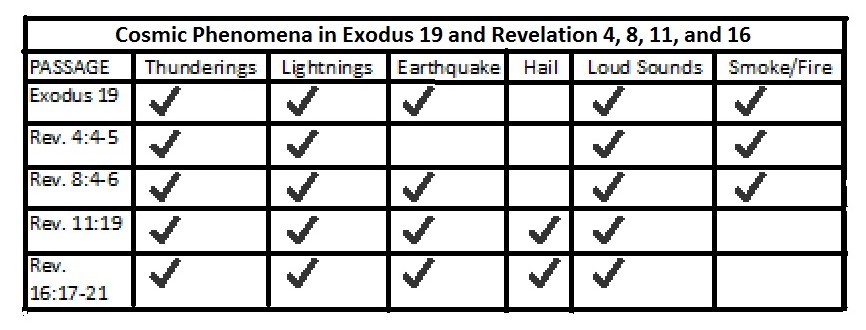
Basis (one of several): The same imagery that was present at the giving of the law, the old covenant, is echoed several times in the book of Revelation (4:5, 8:5, 11:19, and 16:18). This post will highlight these passages and their significance.

Parallel Scripture Passage: In that He says, ‘a new covenant,’ He has made the first obsolete. Now what is becoming obsolete and growing old is ready to vanish away” (Hebrews 8:13, 1st century AD).

Moses and the Israelites at Mount Sinai

Just before examining these passages in Revelation, let’s look at Exodus 19, the passage I believe they echo:

In the third month after the children of Israel had gone out of the land of Egypt, on the same day, they came to the Wilderness of Sinai. For they had departed from Rephidim, had come to the Wilderness of Sinai, and camped in the wilderness. So Israel camped there before the mountain. And Moses went up to God, and the Lord called to him from the mountain, saying, “Thus you shall say to the house of Jacob, and tell the children of Israel: ‘You have seen what I did to the Egyptians, and how I bore you on eagles’ wings and brought you to Myself. Now therefore, if you will indeed obey My voice and keep My covenant, then you shall be a special treasure to Me above all people; for all the earth is Mine. And you shall be to Me a kingdom of priests and a holy nation.’ These are the words which you shall speak to the children of Israel.”

Then it came to pass on the third day, in the morning, that there were thunderings and lightnings, and a thick cloud on the mountain; and the sound of the trumpet was very loud, so that all the people who were in the camp trembled. And Moses brought the people out of the camp to meet with God, and they stood at the foot of the mountain. Now Mount Sinai was completely in smoke, because the Lord descended upon it in fire. Its smoke ascended like the smoke of a furnace, and the whole mountain quaked greatly  (Exodus 19:1-18).

So we see that God reminded them of how He bore the people of Israel “on eagles’ wings”* out of Egypt and to Himself. God was establishing a covenant with them at this time, and He called them to be “a kingdom of priests and a holy nation.”** This gathering was marked by thundering and lightning, the sound of a loud trumpet, thick smoke, and the whole mountain quaking greatly.

*Compare to Revelation 12:13-14, where the persecuted womanwas given two wings of a great eagle, that she might fly into the wilderness to her place, where she is nourished for a time and times and half a time, from the presence of the serpent.”

**Compare this with John’s opening greeting to the seven churches, where he says that Jesus “has made us kings and priests to His God and Father” (Revelation 1:6).

Four Passages That Echo Mount Sinai in Revelation

The same cosmic phenomena present at Mount Sinai are seen again in the book of Revelation. Observe the following passages, with some brief notes on their likely significance:

1. Revelation 4:4-5

Around the throne were 24 thrones, and on the thrones I saw 24 elders sitting, clothed in white robes; and they had crowns of gold on their heads. And from the throne proceeded lightnings, thunderings, and voices. Seven lamps of fire were burning before the throne, which are the seven Spirits of God.”

As we noted in our study of Revelation 4, the 24 elders may very well “depict the 12 patriarchs of Israel and the 12 apostles, who represent the redeemed of both covenants now united in Christ.” This seems to be substantiated by the names of the 12 tribes and the 12 apostles found written on the gates and walls of the new Jerusalem (Rev. 21:12-14). So it appears that this covenant-establishing imagery takes place in the presence of elders representing both the old and the new covenant ages.

2. Revelation 8:4-6

And the smoke of the incense, with the prayers of the saints, ascended before God from the angel’s hand. Then the angel took the censer, filled it with fire from the altar, and threw it to the earth. And there were noises, thunderings, lightnings, and an earthquake. So the seven angels who had the seven trumpets prepared themselves to sound.”

This scene takes place at the opening of the seventh and final seal (Rev. 8:1). An angel with a golden censer offers the prayers of the saints, along with incense, upon the altar before God’s throne (verse 3). We proposed in our study of Rev. 8 that these prayers are linked to the cries of the martyrs for God to avenge their “blood on those who dwell on the earth” – Rev. 6:10 (see this post for a more complete study on this subject). It seems likely that the seal judgments are poured out in response to the prayers of God’s people. Therefore, the covenant-establishing imagery of Mount Sinai appears here because the prayers of the new covenant community were about to result in the old covenant system reaching its demise.

3. Revelation 11:19

Then the temple of God was opened in heaven, and the ark of His covenant was seen in His temple. And there were lightnings, noises, thunderings, an earthquake, and great hail.

Just as the scene we examined in Rev. 8 takes place at the opening of the seventh seal, this scene takes place at the sounding of the seventh trumpet. Loud voices declare, “The kingdoms of this world have become the kingdoms of our Lord and of His Christ, and He shall reign forever and ever!” The 24 elders are present at this scene (Rev. 11:15-16).

In verse 19 we see probably the most explicit reference connecting the old covenant to the prophecies in the book of Revelation. John sees a vision of God’s temple housing “the ark of His covenant.” In ancient Israel, the ark of the covenant was a centerpiece of the temple and the old covenant. Located in the Most Holy Place, it represented God’s presence: “You shall put the mercy seat on top of the ark, and in the ark you shall put the Testimony that I will give you. And there I will meet with you, and I will speak with you from above the mercy seat, from between the two cherubim which are on the ark of the Testimony, about everything which I will give you in commandment to the children of Israel” (Exodus 25:21-22). For further significance, see Numbers 7:89, 10:33-35; Joshua 3:13, 7:6-11; Judges 20:27; II Samuel 6:2; II Kings 19:15; Psalm 28:2, 80:1.

When the dust settles from the barrage of judgments in Revelation, what does heaven shout? “Behold, the tabernacle of God is with men, and He will dwell with them, and they shall be His people. God Himself will be with them and be their God” (Rev. 21:3). This did not suddenly become true because some buildings fell in 70 AD. Remember that Paul told the Corinthian church this was already their reality and that they were “the temple of the living God (II Cor. 6:16). The downfall of Israel, Jerusalem, and the temple in 70 AD, however, did remove the far less glorious old covenant system which competed against, and greatly opposed, this reality. It was a stunning and vivid demonstration that God had chosen the glorious new covenant over the inferior old covenant (see Hebrews 8). This was the time for rewarding God’s “servants the prophets and the saints, and those who fear [His] name, small and great” (Rev. 11:18).

Several verses earlier, John witnesses an actual earthquake that kills 7000 people in“the city” (Rev. 11:13), already identified in verse 8 as Jerusalem (“the great city…where also our Lord was crucified“). As we noted in our study of Revelation 11, Josephus records one awful night in early 68 AD when “a prodigious storm” took place in Jerusalem, marked by “the largest showers of rain, with continued lightnings, terrible thunderings, and amazing concussions and bellowings of the earth, that was in an earthquake.” Josephus adds that the Jewish zealots allowed the Idumaeans to come in and help them slaughter some of their fellow Jews who opposed their rebellion against the Romans. Between this slaughter and the earthquake, 8500 people died that night (Josephus, Wars 4:4:5, 4:4:7-4:5:1).

4. Revelation 16:17-21

Then the seventh angel poured out his bowl into the air, and a loud voice came out of the temple of heaven, from the throne, saying, ‘It is done!’ And there were noises and thunderings and lightnings; and there was a great earthquake, such a mighty and great earthquake as had not occurred since men were on the earth. Now the great city was divided into three parts, and the cities of the nations fell. And great Babylon was remembered before God, to give her the cup of the wine of the fierceness of His wrath. Then every island fled away, and the mountains were not found. And great hail from heaven fell upon men, each hailstone about the weight of a talent. Men blasphemed God because of the plague of the hail, since that plague was exceedingly great. 

Just as the scene we examined in Rev. 8 takes place at the opening of the seventh seal, and the scene in Rev. 11 takes place at the sounding of the seventh trumpet, this scene takes place at the pouring out of the seventh bowl.

John sees the great city, Jerusalem, divided into three parts. As we noted in our study of Revelation 16, this is a flashback to Ezekiel 5:1-12, when the prophet was required to shave his head and divide it into three parts, and was told by God: “This is Jerusalem” (Ezek 5:5).  One third of his hair was burned, one third was chopped up by the sword, and the last third was scattered into the wind. This was fulfilled when Jerusalem was destroyed in 586 B.C. at the hands of Babylon, and Josephus records the same tragedies in 70 AD at the hands of Rome (1.1 million Jews killed by the sword or by fire, and all the survivors exiled or sold into slavery). Jerusalem was also divided between 67-70 AD into three warring factions: [1] the Zealots, led by Eleazar [2] the Galileans, led by John of Gischala, and [3] the Idumeans, led by Simon.

Just as an actual deadly earthquake took place as foretold in Rev. 11, actual hail – “about the weight of a talent” (i.e. 75 – 100 pounds) – also fell as foretold in Rev. 16. Josephus wrote of large stones shot from catapults by the Roman armies into the temple complex in Jerusalem, which the watchmen in the city reported as appearing white in the sky:

“Now the stones that were cast were of the weight of a talent, and were carried two furlongs and further. The blow they gave was no way to be sustained, not only by those that stood first in the way, but by those that were beyond them for a great space. As for the Jews, they at first watched the coming of the stone, for it was of a white color, and could therefore not only be perceived by the great noise it made, but could be seen also before it came by its brightness” (Josephus, Wars 5:6:3).

Josephus also records that the watchmen on the wall, when they saw the stones coming, would shout, “The Son cometh!” After a while the Romans learned to blacken the stones so that they couldn’t as easily be detected, and many more were crushed by these stones. J. Stuart Russell, in his 1878 book titled The Parousia, offers this explanation for the words of the watchmen (p. 482):

“It could not but be well known to the Jews that the great hope and faith of the Christians was the speedy coming of the Son. It was about this very time, according to Hegesippus [110-180 AD], that St. James, the brother of our Lord, publicly testified in the temple that ‘the Son of man was about to come in the clouds of heaven,’ and then sealed his testimony with his blood [in 62 AD]. It seems highly probable that the Jews, in their defiant and desperate blasphemy, when they saw the white mass hurtling though the air, raised the ribald cry, ‘The Son is coming,’ in mockery of the Christian hope of the Parousia.”

—————————————————————————

In his book,Revelation: Four Views (A Parallel Commentary),” Steve Gregg also sees the connection between Mount Sinai and Revelation, as he shares concerning Rev. 4 (p. 88):

“The lightnings, thundering and voices (v. 5) recall Mount Sinai, where God first established His covenant with Israel [Exodus 19:16; cf. Rev. 8:5, 11:19]. Similar phenomena are mentioned here to suggest the end of that covenant and its replacement with another. The writer of Hebrews (citing Hag. 2) likened the overthrow of the first covenant (publicly demonstrated by the destruction of Jerusalem and the temple in A.D. 70) to the time of its establishment at Sinai, but the latter would be accompanied by even more fearful phenomena (Heb. 12:18-29).”

Steve Gregg also shares David Chilton’s comparison of Revelation 19:1-6 with Revelation 11:15-19 (which we have already examined). Chilton indicates that very similar subject matter is established “in the two passages which represent the closing visions of the two major sections of the book” (p. 440):

1. loud voices…in heaven (11:15; 19:1);
2. the declaration of the commencement of the reign of God (11:15, 17; 19:1, 6);
3. the twenty-four elders fall on their faces and worship (11:16; 19:4);
4. the avenging of the blood of His servants is announced (11:18; 18:24; 19:2);
5. reference to God’s servants…who fear Him, small and great (11:18; 19:5);
6. loud noises, including thunderings (11:19; 19:6).

—————————————————————

Check out the first two posts in this mini-series:

1. Revelation 6 and Luke 23: Hide Us From the Wrath of the Lamb
2. The Avenging of Righteous Blood (Deuteronomy, Matthew, and Revelation)

Revelation Chapter 21 (Part 2: Verses 5-27)


REVELATION 21 (Part 2: Verses 5-27)

Adam Maarschalk: February 3, 2010

Scripture text for this study: Revelation 21:1-27

Introduction: In the previous post, we covered the first four verses of Revelation 21, giving special attention to the imagery of a new heaven and a new earth (“for the first heaven and the first earth had passed away”), and the New Jerusalem coming down from God out of heaven. Our conclusion is that John was being shown the final transition from the Old Covenant age to the New Covenant age (exclusively and in fullness) in 70 AD. In other words, the New Jerusalem came down from heaven at that time, and is a present reality now, just as the author of Hebrews also said (Heb. 8:13; 12:22-24). The events of 70 AD demonstrated decisively that the kingdom no longer belonged to the Jewish nation, but to the holy nation created at Pentecost (Matt. 21:43-44, I Peter 2:4-10; cf. Daniel 7:22, 27), made up of both Jewish and Gentile believers who enter God’s kingdom on an equal basis.

It is recommended that one read Part 1 of our study of Revelation 21 before proceeding here, in order to have a basis for what is to follow. We will now continue with our study, picking things up in verse 5. We will be relying much on Steve Gregg’s commentary on this chapter.

Verse 5: The One on the throne said, “Behold, I am making all things new…” While the literalist position most often takes this statement to refer, along with the rest of the chapter, to a future physical new heavens and earth, this can also quite naturally be understood as a reference to the same truth which is articulated in II Corinthians 5:17. This verse reads, “Therefore, if anyone is in Christ, he is a new creation. The old has passed away; behold, the new has come.” As believers submitted to Christ, every area of our lives should experience renewal. Even as this is true on a personal level for each believer, it’s also true in terms of the New Covenant. In the book “Revelation: Four Views (A Parallel Commentary),” Steve Gregg writes (p. 491):

The language of these verses also can apply to the passing away of the old covenantal order, which has been so completely replaced by the new order that God commands His people: “Do not remember the former things, nor consider the things of old. Behold I will do a new thing” (Isa. 43:18-19). No place remains for the old covenant, as the writer of Hebrews explains: “In that He says, ‘A new covenant,’ He has made the first obsolete. Now what is becoming obsolete and growing old is ready to vanish away” (Heb. 8:13).

Verses 6-7: The text here reads, “And he said to me, ‘It is done! I am the Alpha and the Omega, the beginning and the end. To the thirsty I will give from the spring of the water of life without payment. The one who conquers will have this heritage, and I will be His God and he will be My son.’” Is this a present reality, or a future reality to be experienced in the eternal state? Steve Gregg reminds us (p. 491):

[T]he promise, I will give of the fountain of the water of life freely to him who thirsts (v. 6), is clearly the same as that made twice by Jesus in John’s Gospel (cf. John 4:10, 14; 7:37f). Also, the phrase He who overcomes (v. 7) is characteristic of the phraseology in the promises made by Christ in the letters to the seven churches (cf. 2:7, 11, 17, 26; 3:5, 12, 21).

The one who overcomes receives this promise: “and I will be His God and he will be my son.” A similar promise is given in II Corinthians 6:18, a passage speaking of the Church as the temple of the living God. There we read: “and I will be a Father to you, and you shall be sons and daughters to Me, says the Lord Almighty.” This present position as God’s children is also spoken of in Romans 8:15-17. Kenneth Gentry, in his latest book “Navigating the Book of Revelation,” adds:

John is encouraging the beleaguered first century saints to hold on through their trials: Once Jerusalem falls, they will complete their entry into the final redemptive-historical order which has been gradually dawning since the time of Christ (John 4:21-23). As the writer of Hebrews puts it: Since we are receiving a kingdom that cannot be shaken, let us be thankful, and so worship God acceptably with reverence and awe” (Heb. 12:28 NIV; cf. Heb. 8:13). Or as Paul expresses it in the mid-50s: “And this do, knowing the time, that it is already the hour for you to awaken from sleep; for now salvation is nearer to us than when we believed. The night is almost gone, and the day is at hand. Let us therefore lay aside the deeds of darkness and put on the armor of light” (Rom. 13:11-12) – a reality worthy of enduring persecution.

Jesus promises His disciples that some of them will live to see the kingdom’s final establishment in power: “Truly I say to you, there are some of those who are standing here who shall not taste death until they see the kingdom of God after it has come with power” (Mark 9:1). Thus in Revelation 21 John paints nascent, post-A.D. 70 Christianity – now finally separated from Judaism – in glowing terms, as a firmly established, glorious reality (p. 167).

Verse 8: This verse reads, “But as for the cowardly, the faithless, the detestable, as for murderers, the sexually immoral, sorcerers, idolaters, and all liars, their portion will be in the lake of fire that burns with fire and sulfur, which is the second death.” Steve Gregg notes that many scholars have equated “the cowardly” with apostates “who defect from the gospel rather than enduring hardship as good soldiers of Jesus Christ,” in contrast to those “who overcome” (v. 7).

We also saw a reference to the lake of fire and the second death in Revelation 20:14, with regard to the Great White Throne Judgment. This is where, according to that passage, death and Hades was to be thrown, along with anyone whose name was not found in the book of life (Rev. 20:15).[1]

Steve Gregg makes a very interesting observation at this point. Speaking of the preceding 8 verses in relation to the rest of the final two chapters, he observes (p. 492):

One way of understanding the structure of these final chapters is to see this whole segment (vv. 1-8) as an outline or summary of the remaining portion of the book. A remarkable correspondence exists between the progression of thought in these first verses and in the remaining chapters.

Compare, after the introductory statement in verse 1:

CONTENT

In Verses 1-8

In the Remainder

New Jerusalem Verse 2 21:9-21
God dwells among men Verse 3 21:22-27
Renewal of the world Verse 5a 22:1-5
“These words are true and faithful” Verse 5b 22:6-10
Work completed: “I am Alpha and Omega” Verse 6a 22:11-15
Final blessing: water of life to all who thirst Verses 6b – verse 7 22:16-17
Final curse upon the rebellious Verse 8 22:18-19

Verse 9: John is now taken to see “the Bride, the wife of the Lamb,” by one of the same seven angels who held the bowl judgments. Steve Gregg notes (p. 493) that one of these same angels—perhaps even the same one—had also taken John to see the great harlot in Revelation 17:1: “Then one of the seven angels who had the seven bowls came and said to me, ‘Come, I will show you the judgment of the great prostitute who is seated on many waters.’” He says that this “provides a structural link, deliberately placing the harlot in juxtaposition with the bride.” We made the same observation in our study of chapter 17, comparing the language of these two texts as follows:

A. Revelation 21:9: “Then came one of the seven angels which had the seven bowls full of the seven last plagues and spoke to me, saying, ‘Come, I will show you the Bride, the wife of the Lamb.’”

B. Revelation 17:3: “And he carried me away in the Spirit into a wilderness, and I saw a woman sitting on a scarlet beast that was full of blasphemous names.”

B. Revelation 21:10: “And he carried me away in the Spirit to a great, high mountain, and showed me the holy Jerusalem coming down out of heaven from God.”

Earthly Jerusalem and the Old Covenant temple system are thus contrasted with heavenly Jerusalem and the New Covenant (cf. Galatians 4:21-31; Hebrews 12:18-28). On the different destinations to where John was taken in these two visions, Steve Gregg comments: “The bride-city is elevated upon a mountain, ‘beautiful in elevation, the joy of the whole earth’ (Ps. 48:2), while the harlot city is situated in a barren wasteland.”

Verses 10-11: The descending of “the holy city Jerusalem coming down out of heaven from God” was also shown to John in verse 2. Steve Gregg comments on the significance of her attire:

Here, the attire of the bride is seen to be her having the glory of God (v. 11). The Shekinah that once rested upon the temple in earthly Jerusalem has departed from that institution and come to alight upon the church, the new temple of the Holy Spirit and the new City of God. The inheritance and hope of the New Testament believer is the hope of obtaining the glory of God (Rom. 2:7; 5:2; 8:18; Col. 1:27; I Thess. 2:12; 2 Thess. 2:14; Heb. 2:10; I Pet. 5:1, 10). This speaks of the likeness of Christ Himself seen upon His people (Rom. 8:29; 2 Cor. 3:18; Phil. 3:21; 2 Pet. 1:19; I John 3:2).

The light radiating from the glorious bride-city is compared to the radiance of a most precious stone, like a jasper stone, clear as crystal (v. 11), which probably refers to a diamond. The believing remnant is likened to jewels in the Old Testament. In Malachi 3:16-17, it is said of those who fear the Lord and meditate on His name, “‘They shall be Mine,’ says the Lord of hosts, ‘on the day that I make them My jewels.’” The context in Malachi [3:16-4:6] suggests that the reference is to the Jewish believers in Christ, who escaped the desolation of the capital city in A.D. 70. In this place also some find grounds for seeing the bride as the surviving church at the time of the destruction of the Jewish polity.

Verses 12-13: This text reads, “It [the New Jerusalem] had a great, high wall, with twelve gates, and at the gates twelve angels, and on the gates the names of the twelve tribes of the sons of Israel were inscribed—on the east three gates, on the north three gates, on the south three gates, and on the west three gates.” Steve Gregg comments (p. 494),

The city is described as surrounded by a great and high wall (v. 12). This is applicable to the church as a spiritual city even today. In speaking of the spiritual Jerusalem, God predicted “and you shall call your walls Salvation” (Isa. 60:18), and “I…will be a wall of fire around her, and I will be the glory in her midst” (Zech. 2:5). If Salvation is the wall—indeed, God Himself is the wall—of the city, then the city and its wall appear to be spiritual in nature. This would be a figurative means of expressing the reality of the believer’s security in the City of God.

The wall of the city has twelve gates (v. 12) which have written upon them the names of the twelve tribes of the children of Israel. In Isaiah, the same passage that calls the city’s wall “Salvation” goes on to say, “And your gates [shall be called] Praise” (Isa. 60:18). The most important of the twelve tribes was Judah, whose name means “Praise.” In Isaiah, the city’s gates are named after this tribe; in Revelation, the gates bear the names of all twelve tribes. There may be no conflict here, since in Judah, that is, in Christ, who is of that tribe, all the “twelve tribes” of the spiritual Israel are included. The attachment  of the tribal names to the gates may suggest that through Israel God made a way for the world to enter the City of God, for “salvation is of the Jews” (John 4:22). Of course, this is only another way of saying that salvation is through Jesus Christ, who sprang from the Jewish race…

Another observation concerning the 12 gates with the names of the 12 tribes of Israel is that this parallels Ezekiel’s vision, where he saw the same thing (Ezekiel 48:30-34). Gregg continues,

It is expedient that there should be three gates on the east, three gates on the north, three gates on the south, and three gates on the west (v. 13), to speak of the universal access into the church, for Jesus predicted that “They will come from the east and the west, from the north and the south, and sit down in the kingdom of God” (Luke 13:29).

In the passage just quoted from Luke 13, we should note that just before Jesus said these words, He also said to the unbelieving Jews that they would be cast out of the kingdom of God and would experience weeping and gnashing of teeth while the patriarchs, prophets, and many Gentiles would find entrance. This mirrors what Jesus said in the Parable of the Tenants (Matt. 21:43-44; cf. Matt. 22:1-14).

Verse 14: This verse reads, “And the walls of the city had twelve foundations, and on them were the twelve names of the twelve apostles of the Lamb.” Steve Gregg’s commentary on this verse is very insightful (p. 494):

Further evidence for identifying the city with the church is seen in the city foundations that have upon them the names of the twelve apostles of the Lamb (v. 14). This detail communicates pictorially what Paul said more directly, that the church is “built upon the foundation of the apostles and prophets” (Eph. 2:20). This is the city for which Abraham looked: “the city which has foundations, whose builder and maker is God” (Heb. 11:10).

Duncan McKenzie likewise says, “A physical structure (a city) is being used here as a symbol to portray the totality of God’s people, just as God’s people are likened to a physical structure (a temple) in Ephesians 2:19-22—notice that both “structures” are built on the foundation of the apostles (Eph. 2:20; Rev. 21:14).”

Verse 15: Here we read, “And the one who spoke with me had a measuring rod of gold to measure the city and its gates and walls.” Steve Gregg again comments (pp. 494-495):

The measuring of the city, its gates, and its wall (v. 15) recalls Ezekiel 40:3, where an angelic messenger carried a measuring line and a reed to measure the gates and walls of “something like the structure of a city” (Ezekiel 40:2) and the temple in it. It seems likely that this vision corresponds to that of Ezekiel, although premillennialists generally apply Ezekiel’s to the Millennium and this one to the state of things after the Millennium.

We should note that a major difference between Ezekiel’s account and John’s account here is that (as we will see) there is no temple in John’s vision. Ezekiel, on the other hand, goes into great detail in describing the temple he sees in his vision [In Philip Mauro’s classic work in 1922, “The Hope of Israel,” he noted that the promises given through Ezekiel were conditional (e.g. Ezekiel 43:9-11), and that these visions had to do with the return from the Babylonian captivity some five centuries before Christ with some foreshadowing also of Christ and the coming Church age].

Verses 16-21: We are now given the physical description of the holy city. Futurists, and premillennialists in particular, see this as a literal description of a future, physical city to be enjoyed during the eternal state following Christ’s millennial reign. On the other hand, as we will see, there is Scriptural warrant for seeing this description as depicting with rich symbolism the glories of the New Covenant church in this present age. Here is the text at hand:

The city lies foursquare; its length the same as its width. And he measured the city with his rod, 12,000 stadia [about 1380 miles]. Its length and width and height are equal. He also measured its wall, 144 cubits by human measurement, which is also an angel’s measurement. The wall was built of jasper, while the city was pure gold, clear as glass. The foundations of the wall of the city were adorned with every kind of jewel. The first was jasper, the second sapphire, the third agate, the fourth emerald, the fifth onyx, the sixth carnelian, the seventh chrysolite, the eighth beryl, the ninth topaz, the tenth chrysoprase, the eleventh jacinth, the twelfth amethyst. And the twelve gates were twelve pearls, each of the gates made of a single pearl, and the street of the city was pure gold, transparent as glass.

One key comparison to take note of is the fact that the holy city in John’s vision is cube-shaped, just as the holy of holies in Solomon’s temple was (I Kings 6:20). The holy of holies was overlaid with pure gold, while the holy city in John’s vision is entirely made of pure gold. What follows is Steve Gregg’s commentary on these verses, found on pages 495-496 of his book:

[VERSES 16-17] Since John sees no temple in the city (v. 22), we may imply that the whole city is the temple, or more specifically, the holy of holies. It is the place of the glory of God (cf. v. 11). This is the place of God’s residence (Eph. 2:20-21; I Tim. 3:15; Heb. 3:6; I Pet. 2:5), where God communes with men. Earlier [Rev. 11:1-2], John had measured the holy of holies (the naos) for its protection and preservation. In this vision, the naos is again measured, indicating its permanence, but it is now identified with the City of God, the church of Jesus Christ.

Part of the adorning of the bride is her jewelry… The walls, foundations, and gates are all made of great gemstones. This harks back to a prophecy of the Old Testament concerning the church: “O you afflicted one, tossed with the tempest, and not comforted, behold, I will lay your stones with colorful gems, and lay your foundations with sapphires. I will make your pinnacles of rubies, your gates of crystal, and all your walls of precious stones” (Isa. 54:11-12). [Steve Gregg’s endnote: That the church is here pictured seems a necessary conclusion to be drawn from Paul’s quotation of the first verse of the chapter in Galatians 4:26-27 and his application of it to the Gentiles of the New Covenant church.]

[VERSE 18] (T)he city itself was of gold, so thoroughly purified as to become transparent. This is an image used to describe the refined character of the sanctified believer (Job 23:10; Zech. 13:9; Mal. 3:3; I Pet. 1:7; Rev. 3:18).

[VERSES 19-20] The twelve gems comprising the foundations call to mind the twelve gems worn upon the breast of the high priest, though again the individual stones are not identical (cf. Ex. 28:15-21). Since these same stones bear the names of the twelve apostles, it could be understood as a statement about the leadership of the people of God having transferred from the high priesthood of the temple to the apostles of the church.

[VERSE 21] There may be symbolic significance to the fact that the twelve gates were twelve pearls (v. 21). Unlike the previously named gems, pearls are created organically. A rough grain of sand irritating the tissues of the oyster causes the secretion of a substance that transforms the source of irritation into a pearl. The pearl thus may stand for affliction turned to benefit, even as silver and gold refined by fire are used in Scripture for the same concept. The gates are the means of entry into the city. If the pearl is understood in this light, we have a picture of one of Paul’s preaching themes: “We must through many tribulations enter the kingdom of God” (Acts 14:22).

In Scripture a way of life is frequently called a path, a way, a highway, or a road (e.g. Prov. 4:18; Isa. 35:8). Therefore it is reasonable to understand the street of the city (v. 21) as representing the way of life of those who comprise the New Jerusalem. This street was pure gold, like transparent glass, which speaks of the godly character and behavior that comes from enduring the refining fires of tribulation.

Verses 22-27: John continues to describe what he observes concerning the heavenly Jerusalem:

And I saw no temple in the city, for its temple is the Lord God the Almighty and the Lamb. And the city has no need of sun or moon to shine on it, for the glory of God gives it light, and its lamp is the Lamb. By its light will the nations walk, and the kings of the earth will bring their glory into it, and its gates will never be shut by day—and there will be no night there. They will bring into it the glory and the honor of the nations. But nothing unclean will ever enter it, nor anyone who does what is detestable or false, but only those who are written in the Lamb’s book of life.

Steve Gregg’s commentary again follows, including a most helpful chart comparing this portion of Revelation 21 with a corresponding portion of Isaiah 60 (pp. 496-497):

On the statement, I saw no temple in it, [J. Stuart] Russell writes: “Some of the features [of this vision] are evidently derived from the visionary city beheld by Ezekiel [chapters 40-48]; but there is this remarkable difference, that whereas the temple and its elaborate details occupy the principal part of the Old Testament vision, no temple at all is seen in the apocalyptic vision—perhaps for the reason that where all is most holy no one place has greater sanctity than another, or because where God’s presence is fully manifested, the whole place becomes one big temple.” Rather than going to a particular place to worship and appearing before God “in the sanctuary,” today one needs only be found “in God” or “in Christ” to worship acceptably, for the Lord God Almighty and the Lamb are its temple (v. 22).

A helpful way of treating this segment is to look at it alongside an Old Testament passage with which it coincides. Compare the details point-by-point with Isaiah chapter 60:

Isaiah 60

Revelation 21

The sun shall no longer be your light by day, nor for brightness shall the moon give light to you; but the Lord will be to you…light (v. 19) The city had no need of the sun or of the moon to shine in it for the glory of God illuminated it (v. 23)
The Gentiles shall come to your light (v. 3) The nations of those who are saved shall walk in its light (v. 24)
Kings shall minister to you (v. 10); the glory of Lebanon shall come to you (v. 13) The kings of the earth bring their glory and honor into it (v. 24)
Your gates shall be open continually…not shut day nor night (v. 11) Its gates shall not be shut at all by day (there shall be no night there) (v. 25)
The wealth of the Gentiles shall come to you (v. 5) They shall bring the glory and the honor of the nations into it (v. 26)
Also your people shall be all righteous (v. 21) There shall by no means enter it anything that defiles (v. 27)

In Isaiah 60, all of this is precipitated by the dawning of the glory of the Lord in a glorious new day (Isa. 60:1-3). This day was seen to dawn with the birth of John the Baptist and Jesus (cf. Luke 1:76-78; Matt. 4:13-16). Both passages then would appear to speak, albeit in symbolic terms, of the realities of the New Covenant age. The coming of the Gentiles into the church and the submission of kings to Christ has been in progress for nearly two thousand years now.

These facts alone (those highlighted in the paragraph above) would seem to be conclusive proof that these prophecies found here simply cannot be said to await a future dispensation or realm, but are indeed realities which have characterized the Church for nearly 2000 years.

This brings us to the end of the chapter, in terms of looking at it verse-by-verse. In this post, we have noted several parallels with the book of Ezekiel. This is actually a very common pattern with the book of Revelation, and numerous scholars have recognized that John borrows much from—or alludes much to—Ezekiel. Just for fun, here is a brief summary from Pastor Sam Frost of some of the parallels between Revelation 21 and various visions of Ezekiel:

Ezekiel is taken to a high mountain by angel and sees a city (40.1-3). John is taken to a high mountain by an angel and sees a city (21.10). The first thing Ezekiel sees is the wall (40.5) that surrounds the city. The first thing John sees is the wall surrounding the city (21.12). The first gate Ezekiel sees is the ‘east gate’ (40.6). The first gate for John is the ‘east gate’ (21.13). Ezekiel sees the East, North (40.20-23) and the South (40.24-27), in that order. John follows the same order: ‘From the East gates, three; and from the North gates, three; and the South gates, three’ (21.13). One omission: Ezekiel does not mention a West gate, but John does.

Each gate/alcove for John and Ezekiel are ‘three’ (21.13; cf. 40.10). Each are being measured (21.15-ff; cf. 40.10-ff). John then measures the city itself and its foundations. Here, Ezekiel goes into the city and sanctuary and begins measuring their dimensions.

Obviously, Ezekiel’s vision is much more detailed that John’s. Nonetheless, the pattern is there, plainly. Each gate (four in all, with three alcoves, giving a total of 12) are named after the tribes of Israel (Ez 48.31-ff). Same as John (21.12). The City has ‘living waters’ in Ezekiel 47.1-ff. So does John (22.1-ff). I can expand the list, but we would be here a little longer. By now, you ought to get the point.

Before we bring this post to a close, and by way of review, the following is a selected outline of Kenneth Gentry’s reasons[2] for seeing a first-century fulfillment of the vision of Revelation 21. My numbering of Gentry’s points is a bit different than his own numbering, as I have left out certain points for the sake of brevity:

[1] The flow of Rev’s drama expects the immediate appearance of the New Jerusalem bride (21:2). John’s theme involves Christ’s judging Israel (1:7), which leads to the destruction of old, historical Jerusalem (under the image of Babylon…). Once the old city is destroyed in AD 70 we should expect the New Jerusalem to take its place. Indeed, the NT declares the heavenly Jerusalem is already present in Christianity, as over against Judaism (Gal 4:26; Heb 12:22; cp. vv 18–21).

[2] Per the “unanimous agreement among scholars” (Mathewson, A New Heaven and a New Earth, 33; cf. Beale, Revelation, 1041), John’s immediate source material is surely Isa 65:17–20 (cf. LXX). Isaiah’s prophecy portrays the coming new covenant order established by Christ (cp. 2Cor 5:17; Gal 6:15; Eph 2:10; 4:24). As Young (Isaiah 3:514) explains: “Heaven and earth are employed as figures to indicate a complete renovation or revolution in the existing course of affairs. With the advent of the Messiah the blessing to be revealed will in every sense be so great that it can be described as the creation of a new heaven and a new earth.”

[3] The coming down of the new Jerusalem (21:2) leads to the loud proclamation from God’s throne: “Behold, the tabernacle of God is among men, and He shall dwell among them, and they shall be His people, and God Himself shall be among them.” This transpires in the first century, as a result of Christ’s work and his pouring out God’s Spirit. Paul writes in 2Co 6:16: “We are the temple of the living God; just as God said, ‘I will dwell in them and walk among them; And I will be their God, and they shall be My people.”

[4] …The promise of the water of life without cost reflects Isa 55:1 and the offer of salvation, which is related to the redemptive-historical order established by Christ in the first century. In his Gospel John speaks of the water of life flowing from Christ during his incarnation (4:10–14) and promises its fuller flow at his exaltation (7:38–39; cp. Ac 2).

[5] The twelve foundation stones of the city in 21:14 picture the historical church, which Paul presents as already “having been built upon the foundation of the apostles and prophets” (Eph. 2:20).

[6] …John writes in 21:22: “And I saw no temple in it, for the Lord God, the Almighty, and the Lamb, are its temple.” This suggests a first century reality, for with Christ’s coming and death the temple is rendered unnecessary (Mk 15:38//; Jn 4:21; Ac 17:24; Heb 8:13), for he is the temple (Jn 2:19–21; Eph 2:19–20) and is greater than the physical temple (Mt 12:6).

[7] That “the nations shall walk by its light” (21:24a) suggests that the nations as separate national entities still exist. Thus, historical conditions still prevail, rather than radically new, eternal conditions of perfect union and the fading of all distinctions.

[8] The city is not a purely consummational phenomenon, for the “unclean” and he “who practices abomination and lying” are not allowed in (21:27). This implies a pre-Judgment setting, where sinners still exist. In fact, the city contains the “tree of life,” which produces leaves “for the healing of the nations” (22:1–2). This also requires conditions subsisting prior to the eternal order. The healing of the nations obviously suggests conversion. John even declares the continued existence of “dogs and the sorcerers and the immoral persons and the murderers and the idolaters, and everyone who loves and practices lying” (22:15), though they are “outside” of the city. Presumably they are the targets of evangelism, for whom the healing leaves of the tree of life exist. (pp. 2-3)

Summary Statement: “So there you have it! John is picturing the glory of new covenant Christianity, which arises from the fallen ashes of collapsed Judaism (cp. Matt 8:11–12; Heb 8:13).”

An Invitation for Feedback

It seems that this is as good a place as any to pose a question I’ve been wishing to resolve for some time. I have no dogmatic position on this as of yet, and would love to have some thoughts/feedback. My question is this: What is the significance of Hebrews 9:8-10, if any, to Revelation 21? This passage in Hebrews reads as follows:

By this the Holy Spirit indicates that the way into the holy places is not yet opened as long as the first section is standing (which is symbolic for the present age). According to this arrangement, gifts and sacrifices are offered that cannot perfect the conscience of the worshipper, but deal only with food and drink and various washings, regulations for the body imposed until the time of reformation.

Rightly or wrongly, I’m linking this passage to Revelation 21 since, as we noted when looking at verse 16, the cube-shaped holy city in John’s vision replaces the cube-shaped holy of holies of the Old Covenant temple (I Kings 6:20). Among my suppositions and considerations are these:

[1] Unless there is a tense error in the English Standard Version from which I quoted this text in Hebrews 9, the first century readers seem to have been told that the way into the holy places was not yet opened in their day, but that it would be opened once the first section no longer stood. This “first section” was spoken of in Heb. 9:6, and is a reference back to Numbers 28:3 where we see a prescription for the regular offering of two male lambs without blemish. Does Heb. 9:8 mean that the first section must no longer physically stand (a reality accomplished only in 70 AD), or simply that it must no longer stand as covenantally significant (a reality accomplished at the cross)?

[2] By the phrase “the present age,” I understand the author of Hebrews to mean the Old Covenant/Judaic age which ended in 70 AD with the destruction of Jerusalem and the temple at the hands of the Romans (see this post here for “a discussion of two ages”). [By the way, if “the present age” is understood—as it popularly is—to mean this present church age, then is “the way into the holy places” still not opened, even in our day? Of course it is. Or is there indeed a tense error in this quoted passage? Curiously, in the ESV the past tense is used in verses 1-5, but the present tense is used in verses 6-10. I’m not so sure that it should be this way. This whole passage may even refer to the wilderness tabernacle, and thus have nothing to do with 70 AD except for the mention of “the present age.”]

[3] The phrase “the time of reformation” I would understand to refer to Christ’s work on the cross, for it was surely this work which brought an end to the imposing of “food and drink and various washings, regulations for the body…”

[4] I want to be careful not to assign any significance to the events of 70 AD which is instead properly assigned to the cross. Jesus and Him crucified must remain central.

So, does anyone have thoughts on this matter? Thanks in advance for any feedback.

————————————————————————————————————————-

Our next post brings us to Revelation 22, which will be our final post in this series of chapter-by-chapter studies of the book of Revelation.

All of our Revelation chapter-by-chapter studies, and any other posts related to the book of Revelation, can be found here.


[1] As we saw in a previous post, Duncan McKenzie makes a good case that the great white throne judgment is a past event—for those who have already died. He sees it as an ongoing event ever since 70 AD, so that everyone who has died since then experiences a personal judgment following their physical death, rather than a one-time event in the future to be experienced by all humanity at once. Hebrews 9:27 (“…it is appointed for man to die once, and after that comes judgment”) is said to reflect this sequence, as is Revelation 11:18. This was also the viewpoint of J. Stuart Russell (1816-1895), who wrote the landmark book “The Parousia.”

[2] Source: Kenneth Gentry, “New Creation as New Covenant” (Supplement to his newest book, Navigating the Book of Revelation: Special Studies on Important Issues), January 2010, p. 4.

Revelation Chapter 21 (Part 1: Verses 1-4)


REVELATION 21

Adam Maarschalk: February 3, 2010

Scripture text for this study: Revelation 21:1-27

Introduction to Revelation 21-22

Steve Gregg, the editor of the highly resourceful book “Revelation: Four Views (A Parallel Commentary),” provides the following breakdown of how these questions tend to be viewed by believers today (p. 485): Will There Be a Literal New Heavens and New Earth? What Is the New Jerusalem?

Literalist: Non-Literalist:
  • Some take the descriptions in these chapters fairly literally, as applied to a brand new planet and universe, which will be created after the close of the Millennium (premillennialists) or else at the Second Coming (some amillennialists and some postmillennialists).
  • The New Jerusalem described here will be the eternal home of the redeemed.
  • Some spiritualize the whole vision, applying it to a nonmaterial state of existence in heaven.
  • Others take the “New Heaven and the New Earth” to represent what Paul called “a New Creation” (2 Cor. 5:17)—that is, the condition of those who are in covenant with God and Christ through the New Covenant, the “Old Heaven and the Old Earth” (meaning the Old Covenant) having passed away.
  • The New Jerusalem represents the church itself, represented under the imagery of a new Holy of Holies—the tabernacle of God with men—in its present earthly existence.

A large portion of this first post will be spent discussing just the first 2 verses of Revelation 21, as they lay a foundation for what is to come, and also because they use language which appears fairly often throughout the rest of Scripture. We will only cover the first four verses of the chapter in this post, and the remainder of Rev. 21 will be covered in a second post.

Verse 1: John sees that [1] a new heaven and a new earth have replaced the old heaven and earth [2] there was no more sea. Steve Gregg (p. 486) speaks further on what he sees as the three major ways this text is interpreted:

The new heavens and the new earth have been interpreted in essentially three ways: (a) literally of a future material universe after the coming of Christ (so most futurists believe); (b) symbolically of heaven, the abode of the glorified saints; or (c) spiritually of the New Covenant community (the church) that has replaced the Old Covenant community of Israel.

Many tend to take the first position as the primary meaning and to acknowledge secondarily a spiritual application to the present believing community, which has already “tasted of the powers of the age to come” (Heb. 6:5), but which still awaits the establishment of the literal “new heavens and a new earth in which righteousness dwells” (2 Pet. 3:13) at the return of Christ or after the Millennium.

Some may be surprised to know that many well-respected preachers of the past did not primarily see Revelation 21 through the lens of explanation (a) above. At the end of this post, we will note some quotes from Jonathan Edwards and John Owen. For now, let’s note how Charles Spurgeon viewed the meaning of “the new heavens and the new earth” in this excerpt from a sermon he preached in 1865:

Did you ever regret the absence of the burnt-offering, or the red heifer, or any one of the sacrifices and rites of the Jews? Did you ever pine for the feast of tabernacle, or the dedication? No, because, though these were like the old heavens and earth to the Jewish believers, they have passed away, and we now live under the new heavens and a new earth, so far as the dispensation of divine teaching is concerned. The substance is come, and the shadow has gone: and we do not remember it (Metropolitan Tabernacle Pulpit, vol. xxxvii, p. 354).

Spurgeon evidently saw the language of the new heavens and the new earth as one and the same with the arrival of the New Covenant. I share his viewpoint, at least in the primary sense. This fits with everything else we’ve been seeing in our study of the book of Revelation; the completed transition from the Old Covenant age (ending in 70 AD) to the New Covenant age (inaugurated at the cross, and overlapping with the Old Covenant age for one generation). Kenneth Gentry likewise sees a first-century fulfillment for this passage here in Rev. 21, in part based on its correlation with a similar prophecy by Isaiah. Gentry says on page 173 of his newest book, “Navigating the Book of Revelation,”

Isaiah prophesies the Church age by using dramatic new creation language: “For behold, I create new heavens and a new earth, and the former things shall not be remembered or come into mind” (Isaiah 65:17).

Proponents of all viewpoints seem to agree that John’s vision was a clear allusion to this text from Isaiah. The different interpretations have to do with the perceived timing of its fulfillment. Some see it as a yet future reality, to be fulfilled and made manifest after Christ’s future Second Coming. Futurist Arno C. Gaebelin said of Revelation 21, “We now come to the revelation concerning the final and eternal state of the earth” (Gregg, p. 486). John Piper sees Revelation 21 as speaking of the future “age of the resurrection.” Others, like Gentry and Charles Spurgeon, believe that this reality has been realized ever since the last symbols of the Old Covenant disappeared with Jerusalem’s destruction in 70 AD, now replaced by the New Covenant and the New Jerusalem. Looking again at Isaiah’s parallel account, Gentry further clarifies his points on this matter[1]:

Isaiah’s prophecy clearly portrays the coming new covenant order established by Christ, which Paul calls a “new creation” (2 Corinthians 5:17; Galatians 6:15; cp. Ephesians 2:10; 4:24)… We know that Isaiah was not speaking of the consummate order, for he includes aspects of the present fallen order in his description: “No longer will there be in it an infant who lives but a few days, or an old man who does not live out his days; For the youth will die at the age of one hundred and the one who does not reach the age of one hundred shall be thought accursed” (Isaiah 65:20). The eternal order will not include infants, death, aging, and curse (p. 169).

Steve Gregg also expresses some thoughts on the Isaiah – Revelation 21 connection (pp. 488-489):

The concept of a new heaven and a new earth (v. 1) is first given clear expression in Isaiah and is later mentioned by Peter, probably alluding to Isaiah (2 Pet. 3:13). God first speaks of His intention to “plant the heavens, lay the foundations of the earth, and say to Zion, ‘You are My people’” (Isa. 51:16). Since this is uttered after the first heaven and earth were created, this must speak of planting a new heaven and earth… This could refer to the establishment of the New Covenant, since certain elements of the New Covenant order are said to be something that God “creates” (Isa. 4:5; 57:19). Also, the specific promise of “new heavens and a new earth,” found exclusively in Isaiah 65:17 and 66:22, fall within a portion of Isaiah which New Testament writers applied to the present age.

Regarding the portion of Isaiah which New Testament writers applied to this present age, Steve Gregg offers the following comparisons (p. 506):

[a] Isaiah 65:23 with I Cor. 15:58
[b] Isaiah 65:25 with Luke 10:19
[c] Isaiah 66:1f with I Tim. 3:15
[d] Isaiah 66:8 with Gal. 4:26
[e] Isaiah 66:11 with Matt. 5:6
[f] Isaiah 66:12 with John 14:27
[g] Isaiah 66:15f with Matt. 22:7
[h] Isaiah 66:18 with Matt. 8:11
[i] Isaiah 66:19 with Eph. 3:8 and Col. 1:27
[j] Isaiah 66:20 with Rom. 15:16

David Curtis, pastor of Berean Bible Church in Chesapeake, Virginia, has this to say:

In biblical apocalyptic language, “heavens” refers to governments and rulers, and “earth” refers to the nation of people. This can be seen in the book of Isaiah [e.g. Isaiah 1:1-2, 10]…

Isaiah 34:4-5 (NKJV) All the host of heaven shall be dissolved, And the heavens shall be rolled up like a scroll; All their host shall fall down As the leaf falls from the vine, And as fruit falling from a fig tree. 5 “For My sword shall be bathed in heaven; Indeed it shall come down on Edom, And on the people of My curse, for judgment.

Here we have a description of the fall of Edom; notice the language that is used. This is Biblical language to describe the fall of a nation. It should be clear that it is not to be taken literally. God says that, “His sword will be bathed in heaven,” then explains what He means by saying “It shall come down on Edom.” The NIV puts it this way, “My sword has drunk its fill in the heavens; see, it descends in judgment on Edom, the people I have totally destroyed.” So, God speaks of His sword being bathed in heaven, meaning the nation Edom, not the literal heaven. Edom shall be rolled up like a scroll.

Isaiah 51:13-16 (NKJV) And you forget the LORD your Maker, Who stretched out the heavens And laid the foundations of the earth; You have feared continually every day Because of the fury of the oppressor, When he has prepared to destroy. And where is the fury of the oppressor? 14 The captive exile hastens, that he may be loosed, That he should not die in the pit, And that his bread should not fail. 15 But I am the LORD your God, Who divided the sea whose waves roared; The LORD of hosts is His name. 16 And I have put My words in your mouth; I have covered you with the shadow of My hand, That I may plant the heavens, Lay the foundations of the earth, And say to Zion, ‘You are My people.'”

The time of planting the heavens and laying the foundation of the earth that is referred to here, was performed by God when He divided the sea (ver. 15) and gave the law (ver. 16), and said to Zion, “Thou art my people; that is, when He took the children of Israel out of Egypt, and formed them in the wilderness into a covenant nation. He planted the heavens and laid the foundation of the earth: that is, brought forth order, and government.

If the destruction of heaven and earth were to be taken literally in all of the Old Testament passages, it would mean that heaven and earth were destroyed a bunch of times. This language is clearly not literal, but figurative and apocalyptic [the same also being true in a New Testament passage like Matthew 24:29].

Australian Pastor Andrew Corbett (a partial-preterist) says on this matter:

When the Lord speaks [throughout Scripture] of a new heaven and a new earth there may be some merit in regarding this as Biblical language for a new covenant. This suspicion is increased when we consider how Christ used this expression as well: For truly, I say to you, until heaven and earth pass away, not an iota, not a dot, will pass from the Law until all is accomplished (Matthew 5:18).

Since Christ fulfilled the Law, was He right in stating that heaven and earth passed away? If we regard the expression ‘heaven and earth‘ as referring to God’s covenant with mankind, then this statement makes perfect sense. It seems that Christ was therefore saying that once the Old Covenant is fulfilled it will be done away with and replaced by a new covenant.

Hebrews 8:13 says that the Old Covenant became obsolete at the Cross, but it was still to be done away with. Since we now know that the Book of Revelation was written around 64AD (just after the Epistle to the Hebrews, which referred to the Old Covenant as still being in existence – note Hebrews 8:13) Revelation’s announcement of a ‘new heaven and a new earth’ was perhaps announcing that a change in covenant-order was pending…

Could the picture of a new heaven and a new earth in the Book of Revelation be describing a coming new physical reality? Perhaps. But we have some Biblical precendent for regarding it as an expression of God’s covenant relationship with mankind… Therefore, while there may be future physical implications of this Biblical prophecy, there might not be.

Putting these thoughts together (if we are on track), the use of the words “heaven” and “earth” in Revelation 21:1 represents [1] the final passing of the Old Covenant Judaic age in light of the destruction of the second temple and the city of Jerusalem when God poured out His wrath upon apostate Israel in 70 AD, just as Jesus predicted (e.g. Matthew 8:10-12; 11:21-24; 21:33-45; 22:1-14; 23:29-24:35; Luke 11:47-51; 13:1-5; 19:41-44; 21:1-36; 23:28-31); [2] the full establishment of the New Covenant age and the kingdom of God (no longer encumbered by Judaism), in which it is openly manifest that God’s covenant people are only those who place their trust in Jesus Christ for salvation. I believe that the remainder of our study of Revelation 21 will bear these things out, as we compare Scripture with Scripture.

I appreciate what David Lowman says here: “So, perhaps it is best to understand the NHNE [new heavens and new earth] covenantally as a picture of the promised New Covenant that finds origination in the Old testament, institution in the Gospels, unfolding in the [book of] Acts and explanation in the rest of the New Testament.”

Regarding the absence of the sea in Rev. 21:1b, Steve Gregg says (p. 489), “Many take the sea symbolically as representing the nations and peoples of the Gentiles. According to this theory, only the spiritual Israel remains of all the nations that once covered the planet. The glory of the Lord thus fills the earth as the waters once covered the sea (Hab. 2:14).”[2]

Back in February, I posted a 3-part series titled “‘The earth’ as a Common Reference to Israel in Revelation.” The first post can be seen here, the second post here, and the third post here. This 3-part series was an in-depth study of John’s frequent use of the phrase “the earth” as an indication of the impending judgment upon apostate Israel in 70 AD. In the third post, I included an appendix briefly discussing a similar use of the phrase “the sea” to indicate the Gentile nations. Here is a large excerpt from that appendix:

One passage where this is almost certainly the case is Revelation 13:1, in referring to the beast with ten heads and seven horns. This is very similar to (and likely based on) one of Daniel’s visions where he saw four great beasts coming “up out of the sea” (Daniel 7:3); all of them are Gentile leaders. Most scholars are united in saying that these beasts represent [1] Babylon [2] Medo-Persia [3] Greece [4] Rome, with the Roman beast being the one that John saw.

Perhaps an even clearer indication of this idea is seen in Revelation 17:15 where the angel says to John, “The waters that you saw, where the prostitute is seated, are peoples and multitudes and nations and languages” (cf. Rev. 17:1). The word “sea” is not used in this instance, but the same idea (“many waters”—verse 2) is communicated, and this is done in terms of a clear reference to the Gentiles. In Rev. 12:12, we see that a woe is pronounced upon the inhabitants of “the earth and sea” because “the devil has come down to you in great wrath.” It seems it would make more sense for the Gentiles to be alarmed over this fact than for the whales and other sea creatures to feel distress…

The Old Testament basis for this pattern of “the sea” as a reference to Gentiles can be seen in the following passages:

[1] Psalm 65:7; The “roaring of the sea” and the “roaring of the waves” is equated with “the tumult of the peoples.” The latter phrase is understood in the Old Testament to be a reference to the Gentiles.
[2]
Isaiah 17:12-13; In verse 12, “many peoples” is compared to “the thundering of the sea” and “the roaring of mighty waters.” In verse 13 the same is said of “the nations,” a clear reference in Isaiah’s day to the Gentiles.
[3]
Isaiah 57:20; “The wicked,” it is said, are “like the tossing sea,” whose “waters toss up mire and dirt.”
[4]
Isaiah 60:1-5; This is a prophecy for the Church, deemed as such by New Testament writers (e.g. Eph. 5:14 RE: verse 1, Rev. 21:24 RE: verse 3). In verse 5 a direct parallel is drawn between “the sea” and “the nations”: “…the abundance of the sea shall be turned to you, the wealth of the nations shall come to you.” Some translations use the phrase “the Gentiles” instead of “the nations.”
[5]
Jeremiah 6:23; Here, Jeremiah is prophesying of “a people coming from the north country” (verse 22) to make Jerusalem a desolation (verse 8). Their sound, Jeremiah said, “is like the roaring sea.” Babylon fulfilled this prophecy within Jeremiah’s lifetime when they devastated Jerusalem in 586 BC.

A prominent example of “the sea” as a reference to Gentiles in the New Testament outside of Revelation can be seen in Luke 21:25. Here Jesus is speaking of Jerusalem’s impending desolation (verse 20), what would be an imminent call for all who are in Judea to flee (verse 21), and wrath against “this [same] people” (i.e. the Jews) along with “great distress upon the earth” (or “the land,” i.e. Israel). Jesus prophesies the trampling of Jerusalem by the Gentiles (which Revelation 11:2 indicates would last for 42 months) in verse 24. In His very next thought, Jesus then utilizes a common reference to Israel (“sun and moon and stars”; see Genesis 37:9-10), and says that “on the earth” (Israel/Palestine) there would be “distress of nations in perplexity because of the roaring of the sea and the waves” (verse 25). This is the same language we see used commonly in the Old Testament.

Here in Luke 21:20-25, “the earth” (Israel) is shown to be distinct from “the seas” (“the nations” and “the Gentiles”) in the same passage. This same distinction also takes place within several passages in Revelation:

[1] Revelation 13:1-18; The “beast rising out of the sea” (verse 1) is distinct from the “beast rising out of the earth” (verse 11), though the second beast ends up working on behalf of the first one (verses 12-17; Rev. 16:13) and is captured along with it (Rev. 19:20, 20:10). In our study of Revelation 13, we gave good reasons for believing the sea-beast to be Rome (in the general sense) and Nero (in the singular sense), and the earth-beast to represent Jewish leadership.
[2] Revelation 16:19; The “great city,” explicitly shown to be Jerusalem in Rev. 11:8, is shown to be distinct from “the cities of the nations.” The terms “earth” and “sea” are not used here, but this same idea is communicated.
[3] Revelation 17:15-18; An angel refers John back to Rev. 17:2-3 where he had seen “
the great prostitute who is seated on many waters…sitting on a scarlet beast that was full of blasphemous names.” She is equated with “the great city” (verse 18), which we know is Jerusalem (Rev. 11:8), and the “waters…are peoples and multitudes and nations and languages.” The Jewish prostitute is seen sitting on the Gentile beast. Early on they are on good terms with one another, but later the beast causes the demise of the prostitute (verse 16).

The picture before John then is of Israel’s national and religious leadership having taken a stand against God’s people in partnership with the primary Gentile force of her day, Rome. This is signified by the “sea” and “earth” dichotomy in the book of Revelation. One more reference to “the sea” in Revelation, which some scholars do take to indicate Gentiles, is in Revelation 21:1. There we read, “Then I saw a new heaven and a new earth, for the first heaven and the first earth had passed away, and the sea was no more.” Does this mean that when this passage is (or was, or is being) fulfilled, that there are to be no more non-Jews? No, but it certainly could mean that there would be no more distinction made between Jews and Gentiles. After all, this is the message of Revelation 10:7, the fulfillment of “the mystery of God” (cf. Eph. 3:6; Rom. 10:12-13; Gal. 3:28, 5:6, 6:15). One’s view on whether or not this is John’s indication here in Rev. 21:1 depends on whether one takes the “new heaven and a new earth” and “the holy city, new Jerusalem” (verse 2) to be New Covenant Christianity (Gal. 4:24-26; Heb. 12:22-24) or simply a literal and future dwelling place.

Verse 2: John saw “the holy city, new Jerusalem, coming down out of heaven from God, prepared as a bride adorned for her husband.” As noted earlier, many today see the “new Jerusalem” as a future, physical reality. Is there any precedence elsewhere in the New Testament for seeing the New Jerusalem as a present, non-physical reality? Recall Spurgeon’s quote at the beginning of this post, and how he related the dichotomy of the old and new heavens/earth with the Old/New Covenants. I haven’t read his entire sermon, but I’m willing to bet that he had this passage in mind:

Tell me, you who desire to be under the law, do you not listen to the law? For it is written that Abraham had two sons,one by a slave woman andone by a free woman. But the son of the slave was born according to the flesh, whilethe son of the free woman was born through promise. Now this may be interpreted allegorically: these women are twocovenants. One is from Mount Sinai, bearing children for slavery; she is Hagar. Now Hagar is Mount Sinai in Arabia;she corresponds to the present Jerusalem, for she is in slavery with her children. But the Jerusalem above is free, and she is our mother. For it is written, “Rejoice, O barren one who does not bear; break forth and cry aloud, you who are not in labor. For the children of the desolate one will be more than those of the one who has a husband.” Now you, brothers,like Isaac, are children of promise. But just as at that time he who was born according to the flesh persecuted him who was born according to the Spirit, so also it is now. But what does the Scripture say?“Cast out the slave woman and her son, for the son of the slave woman shall not inherit with the son of the free woman.” So, brothers, we are not children of the slave butof the free woman (Galatians 4:21-31, emphasis added).

Bear with me as I take us on a brief rabbit trail here, but one that should prove to be valuable. The passage quoted in Galatians 4:27 is Isaiah 54:1. Most are agreed that this passage in Isaiah is parallel to Isaiah 66:8-9, seen in context here: “Hear the word of the Lord, you who tremble at His word: Your brothers who hate you and cast you out for My name’s sake have said, ‘Let the Lord be glorified, that we may see your joy’; but it is they who shall be put to shame. The sound of an uproar from the city! A sound from the temple! The sound of the Lord, rendering recompense to His enemies! ‘Before she was in labor she gave birth; before her pain came upon her she delivered a son. Who has heard such a thing? Who has seen such things? Shall a land be born in one day? Shall a nation be brought forth in one moment? For as soon as Zion was in labor she brought forth her children. Shall I bring to the point of birth and not cause to bring forth?’ says the Lord; ‘shall I, who cause to bring forth, shut the womb?’ says your God. Rejoice with Jerusalem, and be glad for her, all you who love her; rejoice with her in joy, all you who mourn for her (Isaiah 66:5-10).

Dispensationalists and Christian Zionists insist that Isaiah 66 predicts Israel’s birth as a nation in 1948. However, if it is indeed parallel to Isaiah 54:1, it must be seen in the same way that Paul made application of Isaiah 54:1 in Galatians 4. Isaiah foresaw the birthing and the breaking forth of the heavenly Jerusalem (66:8-10), even as earthly Jerusalem met her demise (66:6). Ironically, Isaiah 66 does not speak of the restoration of earthly Jerusalem into the hands of mostly unbelieving Jews in 1948. Rather, it mirrors the taking away of the earthly kingdom from apostate Israel (in 70 AD), and the giving of the heavenly kingdom exclusively to God’s holy nation, the Church, just as Jesus predicted (Matthew 21:43-44; cf. Daniel 7:18, 22, 27). It speaks of the full establishment of the New Jerusalem for the Church invisible, the dissolving of the Old Covenant in favor of the New Covenant. This is the point of Isaiah, Jesus, Paul, and John.[3]

In our study of Revelation 17, we noted the same dichotomy which we just saw in Galatians 4, as John was shown a contrasting picture of two women: the harlot of chapters 17 and 18, and the bride in chapter 19 clothed with “fine linen, bright and pure…the righteous deeds of the saints (see verses 1-8). In Hebrews 12:22-24 we see the same language, where the picture of the New (heavenly) Jerusalem is again linked with the New Covenant: “But you have come to Mount Zion and to the city of the living God, the heavenly Jerusalem, and to innumerable angels in festal gathering, and to the assembly of the firstborn who are enrolled in heaven, and to God, the judge of all, and to the spirits of the righteous made perfect, and to Jesus, the mediator of a new covenant, and to the sprinkled blood that speaks a better word than the blood of Abel.” Looking at the larger context, the author of Hebrews is comparing and contrasting the giving of the Old Covenant (verses 18-21) with the granting of a non-physical kingdom even as the old physical kingdom (the Jerusalem temple; cf. Heb. 9:8-10) was about to be removed.

In John’s letter to the Church in Philadelphia, this promise was also given to those who would be found faithful: “The one who conquers, I will make him a pillar in the temple of My God. Never shall he go out of it, and I will write on him the name of my God, and the name of the city of my God, the new Jerusalem, which comes down from My God out of heaven, and my own new name” (Rev. 3:12). This was a promise to first-century believers. The temple of which Christ spoke, of course, is the Church (I Cor. 3:9, 16-17; 6:19; II Cor. 6:16; Eph. 2:19-22), a very present reality.

In this same vein, Kenneth Gentry stated, “The new Jerusalem is a symbol of the redeemed people of God in whom God dwells (Rev 21:3), much like the “temple” in Paul’s writing often represents the people of God and not a physical building (1 Cor. 3:16–17; 6:19; 2 Cor. 6:16; Eph. 2:21).”[4] Steve Gregg adds (p. 490), “Since the New Jerusalem is later described as the ‘Lamb’s wife’ (v. 9), we can readily identify the symbol with the church, which is the bride of Christ (Eph. 5:31-32).”

Can you see it in these passages? It’s time that the Church shakes off the false teachings of dispensationalism and Christian Zionism, with their heavy emphasis on an earthly kingdom for one particular ethnic group (the Jews), and lives in the present realities of the New Covenant, the heavenly kingdom which cannot be shaken.

Steve Gregg also adds, on pages 489-490:

The mixing of metaphors in the holy city, New Jerusalem…prepared as a bride adorned for her husband (v. 2) is arresting. That a city could be dressed in bridal attire is difficult to picture with the mind. Yet it is not the first time the images of a city and a woman have been joined in describing one entity. In Revelation 17, the great harlot was also Babylon, and a divine interpreter explained that “the woman whom you saw is that great city” (17:18). The figure of a woman to represent a city goes back to the Old Testament, where Jerusalem is referred to as “the virgin, the daughter of Zion” (Isa. 37:22)…

The bride is here prepared as a bride adorned for her husband (v. 2), suggesting the wedding day. In chapter 19, the announcement was made that the marriage of the Lamb had come and His wife had made herself ready (19:7), yet no description of the wedding or the bride was offered. This vision seems to pick up where that one left off, for here we see the procession of the bride in her readiness to be joined to her husband.

Verse 3: “And I heard a loud voice from the throne saying, ‘Behold, the dwelling place of God is with man. He will dwell with them, and they will be His people, and God Himself will be with them as their God.’” The language used here is quite similar to the description of the New Covenant in Jeremiah 31:31-34. The phrase “Behold the tabernacle of God is with men” also hearkens back to Ezekiel 37:27-28, a passage which follows shortly after the New Covenant promises articulated in Ezekiel 36:24-28. Furthermore, in Ezekiel’s own vision of a city, he was told that it would be the place where God would dwell with His people (Ezekiel 43:7, 48:35). Steve Gregg notes that this promise was first made conditionally in Leviticus 26:11, and further comments:

The destruction of Solomon’s temple and the removal to Babylon in 586 B.C. was God’s way of revoking this privilege because of the Jews’ disobedience. While in Babylon, however, Ezekiel prophesied that there would come a time of ultimate restoration of God’s people under the terms of the New Covenant, resulting in the renewal of the original privilege: “My tabernacle also shall be with them; indeed I will be their God, and they shall be My people. Then the nations will know that I am the Lord who sanctifies Israel, when My sanctuary is in their midst forevermore” (Ezek. 37:27). Many interpreters apply Ezekiel 37 to the Millennium, though the repetition of Ezekiel’s words in this place [Revelation 21] would favor a fulfillment in the new creation.

Is this promise awaiting future fulfillment? The apostle Paul didn’t believe so when he quoted Exodus 29:45 and Lev. 26:11 as a present reality for the Church in his own day (II Corinthians 6:16).

Verse 4: John is told that tears will be wiped away, and there will be no more death, mourning, crying, or pain, “for the former things have passed away.” Of all the statements in Revelation 21, this might be the hardest one to explain as a present reality. Here are some questions that we can ask to help us think through what John is told in this verse:

1. Since God can’t wipe away what isn’t there, can we conclude that tears are present when He wipes them away? If this is so, what is the likely setting where this takes place – on this earth during our lifetimes, or beyond the grave?

2. What does the rest of the New Testament say about “death” and its relationship to followers of Christ? What does the New Testament say about what Jesus has already accomplished with regard to death?

3. What does the New Testament teach regarding “former things” passing away, or “the old order of things” (as the NIV puts it) passing away? Does the NT elsewhere present the passing away of former things as an accomplished reality, or a future reality?

From Isaiah 53:4, we know that Jesus bore our griefs and sorrows on the cross. From John 3:16, we know that God gave His Son, Jesus, so that those who believe in Him would not perish. From II Timothy 1:10, we know that Jesus has already abolished death and brought life and immortality to life through the gospel. From II Corinthians 5:17, we know that the old has already passed away, the new has come, and we are new creations in Christ. From Galatians 6:15, we know that this new creation counts as everything. From Hebrews 12:24, we know that we have a new covenant with better promises and realities than ever existed in the old covenant. 

Revelation 21:4 is based on Isaiah 25:8, which says: “He will swallow up death forever, and the Lord God will wipe away tears from all faces; The rebuke of His people He will take away from all the earth…” The context shows that God would ruin one city (Isaiah 25:2, 26:5), but on a mountain He would create “for all people a feast of choice pieces, a feast of wines…” (verse 6). He would destroy “the veil that is spread over all nations” (verse 7) and bring salvation (verse 9). The walls of the new city would be marked by salvation (26:1) and a righteous nation would enter the open gates (26:2; see Rev. 21:24-26). 

According to Paul, there was a veil over the mind when reading the old covenant, and that veil is only taken away in Christ (II Corinthians 3:14). The old covenant was also a ministry of death (II Cor. 3:7). So, when examining the background of Revelation 21:4, we can see that the death and sorrow was covenantal, and those “former things” passed away with the creation of the new covenant at the cross (Matthew 26:28) and the destruction of the old covenant system in 70 AD.

Steve Gregg remarks on these things (p. 490),

Some have so construed the promise God will wipe away every tear from their eyes (v. 4) as to teach that there will be tears in heaven. Biederwolf, however, suggests that the words simply mean “that He will so constitute things that no more tears will be shed.” …The causes of present mourning and crying are eradicated forever.

There is also a present realization of these truths, since, for the Christian, Christ has “abolished death” (2 Tim. 1:10), so that “whoever lives and believes” in Christ “shall never die” (John 11:25). As for sorrow, grief, and pain, our relationship with God through Christ has even transformed these experiences so that, while we do still mourn the loss of loved ones, we do not “sorrow as others who have no hope” (I Thess. 4:13).

Is Rev. 21:4 also a reflection of the truths laid out in Hebrews 2:14-15? There we read, “Since therefore the children share in flesh and blood, He Himself likewise partook of the same things, that through death He might destroy the one who has the power of death, that is, the devil, and deliver all those who through fear of death were subject to lifelong slavery.” In any case, one of the provisions of the New Covenant brought about by Christ’s death on the cross is the deliverance from the fear and sting of physical death (and, of course, exemption from the second death—Rev. 20:6, 14).

————————————————————-

Before moving on to our next post, where we will continue with our study of Revelation 21 (beginning with verse 5), I would like to close this post with some pertinent quotes from Jonathan Edwards (1703-1758) and John Owen (1616-1683) which mirror what we have been saying here:

[1] Jonathan Edwards: “The Scriptures further teach us to call the gospel-restoration and redemption, a creation of a new heaven and a new earth… The gospel-state is everywhere spoken of as a renewed state of things, wherein old things are passed away, and all things become new… And the dissolution of the Jewish state was often spoken of in the Old Testament as the end of the world. But we who belong to the gospel-church, belong to the new creation; and therefore there seems to be at least as much reason, that we should commemorate the work of this creation, as that the members of the ancient Jewish church should commemorate the work of the old creation…

Heaven and earth began to shake, in order to a dissolution, according to the prophecy of Haggai, before Christ came, that so only those things that cannot be shaken may remain, i.e. that those things that are come to an end may come to an end, and that only those things may remain which are to remain to all eternity.   So, in the first place, the carnal ordinances of the Jewish worship came to an end, to make way for the establishment of that spiritual worship, the worship of the hearts, which is to endure to all eternity.   This is one instance of the temporary world’s coming to an end, and the eternal world’s beginning.  And then, after that, the outward temple, and the outward city of Jerusalem, came to an end, to give place to the setting up of the spiritual temple and the spiritual city, which are to last to eternity.

[2] John Owen: [regarding II Peter 3] “It is evident, then, that in the prophetical idiom and manner of speech, by heavens and earth, the civil and religious state and combination of men in the world, and the men of them, were often understood… On this foundation I affirm that the heavens and earth here intended in this prophecy of Peter, the coming of the Lord, the day of judgment and perdition of ungodly men, mentioned in the destruction of that heaven and earth, do all of them relate, not to the last and final judgment of the world, but to that utter desolation and destruction that was to be made of the Judaical church and state.

(1.) Because whatever is here mentioned was to have its peculiar influence on the men of that generation. He speaks of that wherein both the profane scoffers and those scoffed at were concerned, and that as Jews, some of them believing, others opposing, the faith. Now there was no particular concernment of that generation, nor in that sin, nor in that scoffing, as to the day of judgment in general; but there was a peculiar relief for the one and a peculiar dread for the other at hand, in the destruction of the Jewish nation…

(2.) Peter tells them, that after the destruction and judgment that he speaks of (vers. 7-13), “We, according to his promise, look for new heavens and a new earth,’ etc. They had this expectation. But what is that promise? Where may we find it? Why, we have it in the very words and letter, Isa. lxv. 17. Now, when shall this be that God shall create these new heavens and new earth, wherein dwelleth righteousness? Saith Peter, “It shall be after the coming of the Lord, after that judgment and destruction of ungodly men, who obey not the gospel, that I foretell.” But now it is evident from this place of Isaiah, with chap. lxvi. 21, 22, that this is a prophecy of Gospel times only; and that the planting of these new heavens is nothing but the creation of Gospel ordinances to endure forever. The same thing is so expressed Heb. xii. 26-28…

He will come- He will not tarry; and then the heavens and earth that God Himself planted, -the sun, moon, and stars of the Judaical polity and church, -the whole old world of worship and worshippers, that stand out in their obstinancy against the Lord Christ, shall be sensibly dissolved and destroyed: this we know shall be the end of these things, and that shortly.” (Sermon on 2 Peter iii. 11, Works, folio, 1721.).

———————————————————————————————

In Part 2 of our study of Revelation 21, we will examine the remainder of the chapter (verses 5-27). We will also note a number of similarities between Isaiah 60 and Revelation 21, Ezekiel 40-48 and Revelation 21, and other fascinating allusions to other Scripture texts in Rev. 21.

All of our Revelation chapter-by-chapter studies, and any other posts related to the book of Revelation, can be found here.


[1] Kenneth Gentry, “Navigating the Book of Revelation: Special Studies on Important Issues,” GoodBirth Ministries: Fountain Inn, SC, 2009.

[2] Kenneth Gentry notes that “John Walvoord (Revelation, 311) takes a strongly literal approach,” saying, ‘The new earth apparently will have no bodies of water except for the river mentioned in 22:2.’” Gentry himself agrees that the replacing of the old heavens and earth with the new heavens and earth is a picture of the Old Covenant order. Gentry comments,

John witnesses the New Jerusalem “coming down out of heaven” (Rev 21:2). In John’s drama the collapse of the Jewish temple in AD 70 opens direct access to God (Rev 11:2, 19; cp. 19:1–2, 9; 22:14). If God descends with his New Jerusalem people “then the barrier of the glassy sea [Rev 4:6; cf. 4:2–5, 9–5:1, 6–7], which in the present age separates his dwelling from the earth, will have to have been done away with” (Mealy, 195). This is precisely what we see in Rev 21:3–5.

This new covenant principle of open access to God appears elsewhere in the NT. For example, we see this when Jesus promises that soon people will no longer need to worship in Jerusalem but can call upon God from anywhere (Jn 4:21, 23; cp. Mal 1:11). This begins to occur when the temple veil is torn and creation is darkened and shaken (Mt 27:45//, 51b; cp. Rev 21:1), for after that event Christians are urged to “draw near with confidence to the throne of grace” (Heb 4:16; cp. 7:19) because of the removal of the old covenant (Heb 8:13; 12:22–28) which blocked access to the holy place (Heb 9:8). This removal of the old covenant is dramatically exhibited and finalized in AD70.

In that the Exodus motif appears frequently in Rev, the removal of the sea may also reflect the drying of the Red Sea so that Israel could enter the Land (Ex 14:21–22; Ps 18:15; 106:9; Isa 44:27; 50:2; 51:10; 63:11–12; Jer 51:36; Nah 1:4). But even here we may note the separation from God involved, for the sea separated Israel from God’s promised inheritance, requiring that God overcome this impediment. Hence, the image of the Exodus / Red Sea underscores the symbol of open access to God.

I do believe the absence of the sea in Rev 21:1 portrays just this sort of image. The new covenant access to God is a major consequence of the removal of the old covenant and rituals portraying the hiddenness of God. As Christianity takes the place of Israel at AD 70, God’s people can come boldly before the throne of grace in a way they could not have in the OT.

Source: Kenneth Gentry, “No More Sea” (Supplement to his newest book, Navigating the Book of Revelation: Special Studies on Important Issues), January 2010, p. 4.

[3] Some (e.g. Jonathan Edwards, John Owen, Gary DeMar) would say that Peter makes the same point in II Peter 3:1-14, where he speaks of scoffers “in the last days” (of the Old Covenant age?), the existence (at least in his day) of “the heavens and earth,” and the coming “day of the Lord” (70 AD?) in which the heavens would pass away with a roar along with the burning up of “the earth and the works that are done on it,” giving way to “new heavens and a new earth in which righteousness dwells.” Others, like partial-preterist Kenneth Gentry, see Revelation 21:1-2 as primarily speaking of the events of 70 AD, but II Peter 3 speaking of what will take place at the end of world history with the future Second Coming of Christ. Here is what Kenneth Gentry says regarding these things:

My understanding of Revelation 21–22 is that John provides an ideal conception of new covenant Christianity as the new creation and the new Jerusalem. Though the ultimate, consummate, eternal new creation is implied in these verses, his primary focus is on the redemptive new creation in Christ. John is encouraging the beleaguered Christians to hold on through their trials: Once Jerusalem falls and Nero dies, they will have entered into the final redemptive-historical order in history. And he paints Christianity in glowing terms [p. 1, underlining added]… John’s new creation revelation differs from Peter’s (2 Pet. 3:10ff) [in that Peter highlights the eternal result of the temporal redemption in Christ that John speaks of].

Source: Kenneth Gentry, “New Creation As New Covenant” (Supplement to his newest book, Navigating the Book of Revelation: Special Studies on Important Issues), January 2010, pp. 1, 4.

Rightly or wrongly, some have taken Gentry to task for inconsistency in these matters.

[4] Source: Kenneth Gentry, “Dispensationalism and the New Jerusalem” (Supplement to his newest book, Navigating the Book of Revelation: Special Studies on Important Issues), January 2010, p. 5.

Revelation 20: Amillennial Viewpoint (Part 4)


Revelation 20: Amillennial Viewpoint (Part 4)

Adam Maarschalk: March 11, 2010

In the first two posts in this series on amillennialism (Part 1 and Part 2) we discussed Revelation 20 from an amillennial viewpoint, verse-by-verse. In the previous post we examined two articles: [1] “Why the Early Church Finally Rejected Premillennialism” by Charles E. Hill, and [2] “A Return to Types and Shadows in the Millennial Age?” by P.J. Miller (excerpted from Kim Riddlebarger’s book “A Case for Amillennialism”).

In this post, we will examine two more articles: [1] “Dispensationalism Today, Yesterday, and Forever (Part 6)” by Grover Gunn, and [2] “Problems with Premillennialism” by Sam Storms. In the first article, Grover Dunn demonstrates that Dispensational Premillennialism essentially attempts to place the New Covenant age in our future, even though a fundamental truth of the Christian faith is that Christ inaugurated the New Covenant by His work on the cross. In the second article, Sam Storms meticulously details his journey from premillennialism to amillennialism, examining various Scripture passages which have led him to believe that the latter view is more Biblical than the former.

Links to all of our articles on Revelation 20 (RE: the Millennium) can be found in our Revelation 20: Introduction and Outline post.

ARTICLE #1: “Has the New Covenant Arrived Yet?”

This article was originally written by Grover Gunn (the pastor of Grace Presbyterian Church in Jackson, Tennessee) and posted at PJ Miller’s site under the title “Dispensationalism Today, Yesterday, and Forever (Part 6).” It was reposted at another site (Job’s “Heal the Land”) under the lengthy, but very fitting title, “Premillennial Dispensationalism Effectively Claims that the New Covenant Has Not Yet Arrived, Which Means We Are Still Under the Old.”

The subject of the New Covenant is important with regard to our discussion of the Millennium. The New Testament, of course, very clearly speaks of the New Covenant inaugurated by Christ’s atoning work on the cross (e.g. Matt. 26:28; Romans 11:27; I Cor. 11:25; II Cor. 3:6; Gal. 4:21-31; Heb. 7:22, 8:6-13, 9:15; 10:29; 12:22-24; 13:20). In each of these passages, the New Covenant is spoken of as a present reality for the body of Christ. God’s people, ever since Jesus went to the cross, have had the privilege of walking in the glorious promises of the New Covenant.

Within this New Covenant is the forgiveness of sins (Matt. 26:28; Rom. 11:27), characterized by the Holy Spirit who gives life (II Cor. 3:6) and freedom rather than slavery (Gal. 4:21-31). The author of Hebrews says this is “a better covenant” than the Old Covenant (Heb. 7:22); “much more excellent” with “better promises” (8:6); one that brings redemption from transgressions (9:15); and one that is eternal (13:20).

How strange then would it be to learn that the most popular form of millennial eschatology today (at least in the US) is not only fuzzy regarding its meaning and significance, but assigns its fulfillment (either primarily or entirely) to an age which is to occur after Christ’s Second Coming? This same eschatological system often maintains that “if” the New Covenant is now in force, it was not foreseen for this present age by any Old Testament text! The system I’m referring to is Dispensational Premillennialism, and these and other oddities are discussed in this article by Grover Gunn which I will now quote from (underlining added):

Before discussing the new covenant, I would like to review the basic distinction between dispensationalism and Reformed theology. This basic distinction revolves around the concepts of unity in reference to God’s people and continuity in reference to God’s program. First, according to Reformed theology, the people of God in all ages are in union with Christ and are therefore together united in the universal church, which is the Body and Bride of Christ. According to dispensationalism, only those who are saved between the Pentecost of Acts 2 and the end time rapture are in the universal church. In other words, Mary, the mother of Jesus, will be in the Bride of Christ, but Joseph her husband who died before Pentecost will only be a guest at the wedding of the Lamb. Also, John the Apostle will be in the Body of Christ in eternity, but not John the Baptist. According to dispensationalism, the Old Testament saints who died before Acts 2 are not to be made perfect together with the New Testament saints (compare Hebrews 11:39-40), but are instead to remain spiritually inferior throughout eternity, never being in the Body and Bride of Christ [Adam’s note: If anyone knows this to be an inaccurate statement regarding dispensationalism, please let me know].

Second, according to Reformed theology, the New Testament church is a continuation of the Old Testament program and is directly rooted in the Old Testament covenants. According to dispensationalism, the New Testament church is a parenthesis in the program begun in the Old Testament, not a continuation of the program. They continue the Old Testament program in a future Jewish millennium that is a glorified extension of the Davidic national kingdom and the Mosaic ceremonial laws.

Let us now go on with our examination of the dispensational theory by looking at the dispensational teaching on the new covenant. Since those twenty-seven books of Scripture that were written after the life of Jesus are named the New Testament or covenant, one would expect that all Christians would uncompromisingly acknowledge the Christian nature of the new covenant. Such an acknowledgment, however, is not easy or simple for the consistent dispensationalist. As it turns out, when the dispensationalist tries to bend Scripture to fit his system, the Biblical data on the new covenant is among the most stubbornly unyielding and uncooperative. Dr. Charles C. Ryrie says the following about dispensational interpretation of the new covenant:

“Although the new covenant is one of the major covenants of Scripture, a clear statement of its meaning and of its relationship to the [dispensational] premillennial system is needed. Even among [dispensational] premillennialists there seems to be a lack of knowledge concerning this covenant.”1

[Dispensational] premillennialists are divided into three groups as far as their interpretation of the new covenant is concerned. This does not evince weakness, for not one of the views contradicts the system.2

The classic passage on the new covenant is Jeremiah 31. Please take note: Jeremiah is an Old Testament prophecy, and dispensationalists teach that no Old Testament prophecy can refer directly to the New Testament church. Dispensationalists interpret Jeremiah 30 and 31 as referring to their futuristic tribulation period which is to occur after the rapture of the church and to their Judaistic millennium.3 The “time of Jacob’s trouble” (Jeremiah 30:7) is identified with the seven-year tribulation period, and the new covenant of Jeremiah 31 is viewed as a millennial blessing upon Israel. According to Dr. J. Dwight Pentecost:

“This covenant must follow the return of Christ at the second advent.”4

“This covenant will be realized in the millennial age.”5

Regardless of the relationship of the church to the new covenant as explained in these three views, there is one general point of agreement: the new covenant of Jeremiah 31:31-34 must and can be fulfilled only by the nation Israel and not by the Church.6

According to Dr. John F. Walvoord,

the [dispensational] premillennial position is that the new covenant is with Israel and the fulfillment in the millennial kingdom after the second coming of Christ.7

The [dispensational] premillennial view, though varying in detail, insists that the new covenant as revealed in the Old Testament concerns Israel and requires fulfillment in the millennial kingdom.8

According to Dr. Charles C. Ryrie,

it can be shown that the period of the new covenant is millennial.9

I very much agree with this last statement by Dr. Ryrie, but will qualify my agreement by identifying the millennium as a present reality just as the New Covenant is (In other words, I affirm the amillennial view). It seems to me that this [dispensationalist premillennial] insistence on identifying the New Covenant as a future reality for Israel in a future earthly reign goes hand in hand with the failure to see the Church as true Israel today (e.g. Romans 2:28-29; 4:11-14; 9:6-8; Gal. 3:7, 28-29; 6:15-16; Phil. 3:3; Rev. 2:9; 3:9). It also goes hand in hand with a failure to see that the Old Testament prophets spoke in much detail regarding this present Church age. Many of those passages are taken instead to refer to a future millennium period on earth, as we discussed here. Gunn continues:

Also, Jeremiah’s new covenant prophecy is to be made “with the house of Israel and with the house of Judah” (Jeremiah 31:31), and dispensationalists teach their strong dichotomy between Israel and the church. In other words, what has a prophecy for Israel to do with the New Testament church in a direct and primary sense? Nothing, says the consistent dispensationalist. So, for the consistent dispensationalist, the new covenant of Jeremiah 31 must be for the Jewish millennium and not for the church age. For the new covenant to be fulfilled in and by the church would be to abrogate the new covenant with Israel and to alter its most essential meaning and intention.10 The significance of this point can be seen in the following quotation by Dr. J. Dwight Pentecost:

“If the church fulfills this covenant, she may also fulfill the other covenants made with Israel and there is no need for an earthly millennium.”11

According to Dr. Ryrie:

“If the church is fulfilling Israel’s promises as contained in the new covenant or anywhere in the Scriptures, then [dispensational] premillennialism is condemned.”12

We have seen that dispensationalists interpret the Old Testament data on the new covenant as referring solely to the nation Israel in a future millennium. When one comes to the New Testament data on the new covenant, this dispensational theory encounters some critical complications. For example, in Hebrews 8:6-13, the inspired writer called Christ “the mediator of a better covenant, which was established on better promises” and then quoted extensively from the Jeremiah new covenant prophecy. In Hebrews 10:14-18, the inspired writer quoted from the Jeremiah new covenant prophecy in an argument for the discontinuation of animal sacrifices in the church age. This indeed is ironic, for the dispensationalist refers this Jeremiah new covenant prophecy instead to a Jewish millennium in which animal sacrifices are renewed! In Hebrews 12:22-24, several Old Testament concepts, like Mount Zion, Jerusalem, the blood of Abel, and the new covenant, are applied directly to the Christian. In 2 Corinthians 3, Paul called himself and Timothy “ministers of the new testament.” As if to remove any doubt about which new covenant he was referring to, Paul in verse 3 mentions the Jeremiah new covenant concept of writing on human hearts (Jeremiah 31:33). When Christ inaugurated the Lord’s Supper, He said, “This cup is the new testament in My blood, which is shed for you” (Luke 22:20). What did the Jewish disciples associate with this statement? Undoubtedly they related it to Jeremiah 31. What other new testament (i.e. covenant) were they aware of?

Surely you can now see that the consistent dispensationalist has a problem with the new covenant. According to a consistent application of basic dispensational assumptions and the dispensational hermeneutic, the new covenant of Jeremiah 31 is for Israel in a Jewish millennium, not for the New Testament church in the church age. Dispensationalists are divided among three suggested solutions to this serious problem in their system.

Gunn then goes on to examine these three suggested solutions. To see his examination in full (since I will only be quoting small portions of it), one may follow [A] this link (or any of the links at the beginning of this section), as well as [B] this link (or the original source here). The first solution is a two-covenant proposal, i.e. that God has created one New Covenant for the Church and one for the nation of Israel. Gunn rightly calls this solution “artificial” and an “amazingly strained exegesis.” One implication of this proposal is that there are actually three major covenants in Scripture, rather than just the Old Covenant (prior to the cross) and the New Covenant (from the cross onwards). It would also mean that Jeremiah (e.g. 31:31-37) did not foresee this present age (from the time of the cross until now), but that “the church age is an unforeseen parenthesis in the prophetic program between the sixty-ninth and seventieth of the seventy weeks of Daniel 9.”

This false dichotomy of the New Covenant (i.e. two separate installments) has implications on the doctrines and practices of the Church. For example, Gunn adds that “E.W. Bullinger, the father of ultra-dispensationalism, taught that the Lord’s Supper is a Jewish ordinance that has no place in the Christian church.” For Bullinger, this ordinance was to await an earthly kingdom centered in Jerusalem which would only be inaugurated by Christ’s Second Coming. This does not explain, of course, why the apostle Paul spoke of the Lord’s Supper as a legitimate ordinance in his own day (I Cor. 11:17-33). John F. McGahey’s rebuttal of this “solution” is excellent:

Consequently, it has been established that there is no warrant in Scripture for maintaining that there are two new covenants… [T]he theory of the two new covenants was born of controversy rather than strong exegesis. For it appears that it was manufactured to avoid the assumed conclusion that to relate the church to Israel’s new covenant necessitated that church fulfilling the promises given to Israel under that covenant.25

Yet the promises articulated to Israel in the Old Testament do indeed belong to the Church today (e.g. Romans 4:13-14; Gal. 3:16-29).

A second “solution” to the dispensationalist quandary regarding what the New Testament has to say about the New Covenant is equally absurd. This solution was articulated by John Nelson Darby (1800-1882), the father of dispensationalism, and maintained by others (e.g. Harry Ironside) in this way:

The Christian is directly related to “the annexed circumstances of the covenant,” to “the essential privileges of the new covenant,” to the “benefit” of the covenant, and to “the Mediator of the covenant,” but not to the covenant itself. Darby expressed his theory as follows: “This covenant of the letter is made with Israel, not with us; but we get the benefit of it… The new covenant will be established formally with Israel in the millennium.”

Ironside even stated explicitly that “The Church, then, is not under the new covenant…it is Israel which is God’s covenant-people.” That’s why I so appreciate Job’s fitting title for his article, “Premillennial Dispensationalism Effectively Claims that the New Covenant Has Not Yet Arrived, Which Means We Are Still Under the Old.” That is the necessary conclusion of the teaching of Ironside and others who have embraced his error. It’s no small error either. Gunn thinks through some other implications of Darby’s false teachings:

Let us think through the work of Christ in terms of Darby’s theory on the new covenant. Jesus Christ at His first coming came to be the mediator of an earthly, nationalistic and Jewish new covenant that is totally unrelated to church age Christianity. He offered to Israel a theocratic political kingdom based on this Jewish new covenant, and He shed His blood to establish this Jewish new covenant. When the Jewish nation rejected the Christ, the offer was withdrawn and the theocratic kingdom was postponed. In this parenthetical age of postponement, God began an entirely new and unprophesied work in the calling of a heavenly people, the Christian church. Although the blood of Christ was shed for the establishment of the earthly people’s national new covenant, there was enough efficacy in the Messianic sacrifice for it also to be the basis for individual salvation and heavenly blessings in the church age. Christ had assumed the office of mediator to mediate the Jewish covenant, but in this parenthetical age, His mediatorial office is available for the spiritual benefit of Christians even though they are totally unrelated to the covenant of which He is mediator. Darby’s theory makes God’s entire program for the church seem incidental and secondary to God’s program for Israel… This theory teaches that Christian salvation in the church age is an unprophesied benefit of the atoning work of Christ.

Author John Walvoord articulates a third proposed dispensationalist solution “popularized by the Scofield Reference Bible” which “regards the new covenant as having a twofold application, first to Israel fulfilled in the millennium, and, second, to the church in the present age.” According to Walvoord, Scofield saw the New Covenant as “concerned primarily with Israel,” but “having an oblique [not straightforward] reference to the believers of this age.” Dr. Charles Ryrie (for one) has even lamented that this less-than-straightforward relation of the body of Christ to the New Covenant is too much, for it weakens dispensational premillennialism! Here is what he says:

If the Church is fulfilling Israel’s promises as contained in the new covenant or anywhere else in Scripture, then [dispensational] premillennialism is weakened…we agree that the amillennialist has every right to say of this view that it is “a practical admission that the new covenant is fulfilled in and to the Church.”

On this matter, Dr. J. Dwight Pentecost said, “The church, however, can not be placed under Israel’s covenant [i.e. the New Covenant].” In other words, in order to avoid the charge of adhering to so-called “replacement theology,” these proponents of dispensationalism say that the body of Christ should have no relation to the New Covenant! This is amazingly false doctrine that strikes at the heart of what Christ accomplished on the cross for all believers. It also elevates one ethnic group (the Jews) far above any other group, even though the Bible is clear that there is no Jew or Gentile in Christ Jesus (e.g. Rom. 10:12-13; Gal. 3:28; Eph. 2:11-22).

Gunn’s final conclusion is very apt:

The New Testament data on the new covenant fits well with Reformed theology. No bending is necessary; no artificial exegesis is required; no hair splitting distinctions are needed. Since the New Testament church is the continuation of the Old Testament kingdom program and is spiritual Israel in this age and is the fulfillment of many Old Testament prophecies, there is no problem in directly relating the Jeremiah 31 new covenant to the church in this age as is done by the New Testament writers. The new covenant relates directly to physical Israel only insofar as Jews accept Christ and are regrafted back into the olive tree of spiritual Israel, which is the church (Romans 11:26-27).

ARTICLE #2: “Problems with Premillennialism”

This article was written by Sam Storms, the founder of Enjoying God Ministries. He sums up his journey away from premillennialism and toward amillennialism by this statement: “In my own case, further study of what the NT said would happen in conjunction with the second coming/advent of Christ led me to conclude that a post-Parousia millennial reign upon an earth still under the influence of sin, corruption, and death was impossible.”

In other words, premillennialism says that after Christ returns He will set up a physical kingdom in which sin and death will still continue to take place. The question is, though, “Does Scripture allow for sin, corruption, and (especially) death to continue beyond the Second Coming of Christ?” Sam Storms takes on this question by examining seven different New Testament texts which address this matter:

1. I Corinthians 15:22-28
2. I Corinthians 15:50-57
3. Romans 8:18-23
4. II Peter 3:8-13
5. Matthew 25:31-46
6. II Thessalonians 1:5-10
7. John 5:28-29

We will now turn to this study presented by Sam Storms [Brief note: Sam uses “PM” to denote premillennialism, and “AM” to denote amillennialism]. I will quote Sam’s study in its entirety (underlining added):

1. 1 Corinthians 15:22-28

“For as in Adam all die, so also in Christ all shall be made alive. But each in his own order: Christ the first fruits, after that those who are Christ’s at His coming, then comes the end, when He delivers up the kingdom to the God and Father, when he has abolished all rule and all authority and power. For He must reign until He has put all His enemies under His feet. The last enemy that will be abolished is death. For ‘He has put all things in subjection under His feet.’ But when He says, ‘All things are put in subjection,’ it is evident that He is excepted who put all things in subjection to Him. And when all things are subjected to Him, then the Son Himself also will be subjected to the One who subjected all things to Him, that God may be all in all.”

The PM interpretation is as follows: In v. 23 Paul says that the resurrection of believers follows the resurrection of Christ. But 2,000 years have already elapsed between these two events. Thus we shouldn’t be surprised if there is a similar historical gap between the resurrection of believers at the second coming (v. 23b) and “the end” (v. 24). This gap, says the PM, is the 1,000 year millennial kingdom which follows Christ’s return and precedes eternity.

At the end of the millennium, i.e., when “the end” comes, Jesus will deliver up the kingdom to the Father (v. 24a), after having abolished all rule and authority and power. The last of these so-called “enemies” is death. Therefore, according to the PM, death will not be destroyed or defeated or abolished until the close of the millennium, that is to say, at “the end”.

The point of dispute is the meaning of “the end” (v. 24). The “end” is when death, “the last enemy” (v. 26), is abolished. The PM insists that “the end” is the close or end of the millennial kingdom, 1,000 years after Christ has returned to earth. The AM insists that “the end” is the close or end of this present age, the age in which we now live.

If one could demonstrate conclusively what “the end” is or when “the end” comes, the millennial debate would itself come to a decisive end! This is not difficult to do. Both PM’s and AM’s agree that Christ’s reign (v. 25) consummates with the destruction of death. They also agree that the destruction of death signals “the end”. Therefore, all one need do is determine the time when “death” dies. Does Paul tell us when “death” dies or when death, the final enemy, will be abolished? Yes.

Several factors enable us to identify the “death of death”.

  • According to 1 Cor. 15:50-58 (esp. vv. 54-56), death is abolished or is “swallowed up in victory” (v. 54)at the second coming of Christ. Therefore, the reign of Christ described in v. 25, during which he progressively abolishes all rule and authority and power, is presently occurring. Paul is describing what Christ is doing now, as he sits enthroned at the right hand of the Father. When he returns at the conclusion of this present age, he will destroy death, the last remaining enemy. That, says Paul, is “the end.”
  • Another Pauline text which asserts that Christ is currently reigning in this capacity is Eph. 1:20-23 (note esp. Paul’s use of the same terminology found in 1 Cor. 15:24 – “rule, authority, power”).
  • But the PM does not believe Christ will abolish death at his second coming. He insists that death will continue into the millennium (cf. Rev. 20:7-10). But how can this be true when Paul places the destruction of death at Christ’s second advent? The destruction of death at Christ’s second advent/coming does not leave room for a millennial age in which death persists in its power.
  • The point is this: the second advent/coming of Christ marks the end of death and corruption, the end of sin and rebellion, and the inauguration of the consummated and perfected eternal state.

2. 1 Corinthians 15:50-57

“Now I say this, brethren, that flesh and blood cannot inherit the kingdom of God; nor does the perishable inherit the imperishable. Behold, I tell you a mystery; we shall not all sleep, but we shall all be changed, in a moment, in the twinkling of an eye, at the last trumpet; for the trumpet will sound, and the dead will be raised imperishable, and we shall be changed. For this perishable must put on the imperishable, and this mortal must put on immortality. But when this perishable will have put on the imperishable, and this mortal will have put on immortality, then will come about the saying that is written, ‘Death is swallowed up in victory. O death, where is your victory? O death, where is your sting?’ The sting of death is sin, and the power of sin is the law; but thanks be to God who gives us the victory through our Lord Jesus Christ.”

The key phrase is Paul’s declaration that “flesh and blood cannot inherit the kingdom of God” (v. 50). Simply put, a corruptible and perishable nature can neither possess nor participate in an incorruptible and imperishable kingdom. Neither the living (“flesh and blood”) nor the dead (“the perishable”) can inherit the kingdom in their present state. Several factors contribute to make this a strong argument for AM and against PM.

  • Here Paul insists on the resurrection and glorification of all believers (whether already physically dead or still alive at the second advent; cf. 1 Thess. 4:13-18). Only those who have been gloriously transformed in body and spirit shall inherit the kingdom of God (cf. v. 53).
  • The “kingdom” in view, according to the PM, is the millennial kingdom [on earth]. But how can that be? The PM argues that many believers will enter and inherit and enjoy the blessings of the millennial kingdom in their natural, unglorified, untransformed, “flesh and blood” bodies. But that is precisely what Paul denies could ever happen.
  • Paul’s declaration that unglorified, “flesh and blood” bodies cannot inherit the kingdom of God precludes a millennium following the second coming of Christ. The kingdom of God into which all believers are granted entrance at the time of their glorification (i.e., at the second coming of Christ), is the eternal phase of God’s kingdom rule. This eternal phase, at the beginning of which Jesus “delivers up the kingdom to the God and Father” (v. 24) follows immediately upon the second coming of the Lord Jesus. It is then that “we shall all be changed, in a moment, in the twinkling of an eye, at the last trumpet” (vv. 51-52).
  • Finally, according to vv. 54-55, the end of death at the second coming of Christ is the fulfillment of Isaiah 25:8. There we read that God “will swallow up death for all time, and the Lord will wipe tears away from all faces, and He will remove the reproach of His people from all the earth.” Both the end of death and the wiping away of all tears are associated in Rev. 21:4 not with the coming of a millennial age but with the eternal state, i.e., the new heavens and new earth.

3. Romans 8:18-23

“For I consider that the sufferings of this present time are not worthy to be compared with the glory that is to be revealed to us. For the anxious longing of the creation waits eagerly for the revealing of the sons of God. For the creation was subjected to futility, not of its own will, but because of Him who subjected it, in hope that the creation itself also will be set free from its slavery to corruption into the freedom of the glory of the children of God. For we know that the whole creation groans and suffers the pains of childbirth together until now. And not only this, but also we ourselves, having the first fruits of the Spirit, even we ourselves groan within ourselves, waiting eagerly for our adoption as sons, the redemption of our body.”

Observe the following.

  • Paul describes the deliverance or redemption of the natural creation as connected with that of the children of God. It is when the sons of God are revealed (v. 19) that the creation itself shall experience its redemption. That is why the creation is personified as “waiting eagerly for the revealing of the sons of God.” The creation anxiously awaits the return of Christ and our glorification, for it is then that it too shall be set free from “its slavery to corruption” into that very “freedom of the children of God” (v. 21).
  • The creation waits for the revealing of the sons of God (v. 19) because it is into that very freedom that the creation too will be delivered (v. 21). In other words, the creation and the children of God are intimately intertwined both in present suffering and in future glory. As there was solidarity in the fall, so also there will be solidarity in the restoration.
  • If the creation should somehow fall short of complete deliverance from its present corruption, the finality and fullness of our redemption is seriously undermined. Inasmuch as the natural realm will enter into “the freedom of the glory of the children of God,” any deficiency that it might experience must obtain in the case of Christians as well. To the extent that the created order is not wholly and perfectly redeemed, we are not wholly and perfectly redeemed. The redemption and glory of creation are co-extensive and contemporaneous with ours.
  • The problem this poses for PM is clear: the consummate redemption of creation that occurs when Christ returns to redeem/glorify his people would appear to preclude any suffering or corruption of creation subsequent to that return. And yet the millennial age for which the PM argues is one that includes the corrupting presence of both sin and death. The question, then, is this:

How can the creation be delivered from the crippling effects of sin and death when we are, namely, at Christ’s second coming, if during the millennium it must yet suffer the presence and perversity of its enemies?

  • It seems more reasonable to me that Paul’s description of the day of redemption for both Christians and the created order (i.e., the second coming of Jesus) is identical with the advent of the new heavens and new earth portrayed in such texts as 2 Pt. 3:10-13; Rev. 21:1ff[1].; Mt. 19:28. If so, there is no place for a “millennium” subsequent to the return of Christ.

4. 2 Peter 3:8-13

Following his reference to “mockers” who question whether Christ will ever return (vv. 3-7), Peter writes this:

“But do not let this one fact escape your notice, beloved, that with the Lord one day is as a thousand years, and a thousand years as one day. The Lord is not slow about His promise, as some count slowness, but is patient toward you, not wishing for any to perish but for all to come to repentance. But the day of the Lord will come like a thief, in which the heavens will pass away with a roar and the elements will be destroyed with intense heat, and the earth and its works will be burned up. Since all these things are to be destroyed in this way, what sort of people ought you to be in holy conduct and godliness, looking for and hastening the coming of the day of God, on account of which the heavens will be destroyed by burning, and the elements will melt with intense heat! But according to His promise we are looking for new heavens and a new earth, in which righteousness dwells.”

Here Peter echoes the words of Paul in 1 Thess. 5:2-3, both of whom refer to “the day of the Lord”, i.e., the second coming/advent of Christ (1 Thess. 4:13-18; 2 Pt. 3:4, 8-9).[2]

  • Peter tells us that it is on account of the coming of this “day of the Lord/God” (vv. 10, 12), i.e., the second coming/advent of Christ, that the heavens will be destroyed. The end of this present heavens and earth is the effect of the coming of Christ. The “present heavens and earth,” literally, the “now heavens and earth” (v. 7), are being reserved for this “day” of judgment.
  • Note also that the “present (now) heavens and earth” are contrasted with the former heavens and earth, literally, “the then world” (v. 6). Thus Peter looks at biblical history as consisting of three great periods: 1) the heavens and earth before Noah, which were destroyed by God’s judgment, out of which he formed anew 2) the heavens and earth that now are, which are being reserved for destruction, and out of which he will create anew 3) the heavens and earth that shall be, which are the object of our hope. “Since you look for these things,” says Peter, that is, for the new heavens and new earth in which righteousness dwells (v. 13), be diligent to be righteous.
  • Where is there room in Peter’s scenario for an earthly millennium intervening between Christ’s second coming and the new heavens and new earth? On the contrary, the present heavens and earth will be judged at Christ’s return, at which time thenew heavens and new earth(not a millennium) shall emerge as an eternal dwelling for God’s people.
  • Note Peter’s use of the word translated “look for” in vv. 12, 13, 14. We are to “look for” the day of God (the Lord), i.e., the return of Christ (v. 12). In v. 13 we are to “look for” the new heavens and new earth. In v. 14 we “look for” these things, i.e., the coming of Christ which brings judgment against the present world and righteousness for his people. It seems clear that the object of our expectation, that for which we are to “look,” is [the] return of Christ when the present heavens and earth give way to the new heavens and earth. If the new heavens and new earth come at the time of Christ’s second advent, there can be no earthly millennial reign intervening between the two. Remember: the PM places the creation of the new heavens and new earth after the millennium (Rev. 21-22). However, if the new heavens and new earth come with Christ (as Peter indicates they will), the millennium must in some sense be identified with this present age and not some future period subsequent to Christ’s return.
  • Finally, the PM argues that during the millennial age it will be possible for people to come to saving faith in Christ. But Peter’s argument is that the very reason why Christ has not yet returned is in order that He might patiently extend the opportunity for men to repent. This is meaningful only if it is impossible to repent subsequent to Christ’s return. If souls may be saved after Christ returns, the patience He now displays is unnecessary. The urgency of the moment can be explained only on the supposition that “now is the acceptable time, behold now is the day of salvation” (2 Cor. 6:2).

5. Matthew 25:31-46

We read in Mt. 25:31-32 that the Son of Man will return in glory in the company of the angelic host. It is then that he will gather all the nations (cf. Mt. 13:30, 39-41,49-50), separate them (cf. Mt. 13:49), and pass judgment (vv. 34-36).

  • The judgment that occurs at the second coming/advent of Christ is said to issue in eternal fire (v. 41) and eternal punishment (v. 46) for the “goats” (the unsaved) and eternal life (v. 46) for the “sheep” (the saved).
  • In Rev. 20:11-15, this same judgment is described. The unsaved are thrown into the lake of fire. This is commonly known as the Great White Throne Judgment.
  • The important point is this: the Great White Throne Judgment of Rev. 20:11-15 occursafterthe millennial reign described in 20:1-10. But in Mt. 25 the judgment occurs at the time of Christ’s second coming/advent. Conclusion:the millennium of Rev. 20:1-10 is simultaneous with the present age; the millennium is now, preceding the second coming of Christ.

My conclusion is that at the second coming/advent of Christ the lost are judged and cast into the lake of fire, to be punished eternally, whereas the saved are granted entry into eternal life, that phase of God’s kingdom which consists of the new heavens and new earth. The description in Mt. 25 of what happens when Christ returns simply doesn’t leave place or room for a 1,000 [year] earthly reign in between the parousia and the eternal state.

6. 2 Thessalonians 1:5-10

“This is a plain indication of God’s righteous judgment so that you may be considered worthy of the kingdom of God, for which indeed you are suffering. For after all it is only just for God to repay with affliction those who afflict you, and to give relief to you who are afflicted and to us as well when the Lord Jesus shall be revealed from heaven with His mighty angels in flaming fire, dealing out retribution to those who do not know God and to those who do not obey the gospel of our Lord Jesus. And these will pay the penalty of eternal destruction, away from the presence of the Lord and from the glory of His power, when He comes to be glorified in His saints on that day, and to be marveled at among all who have believed — for our testimony to you was believed.”

The conclusions drawn from Mt. 25 are re-affirmed in 2 Thess. 1. This passage also indicates that it is at the time of Christ’s second coming/advent, not 1,000 years later, that the eternal punishment of the lost occurs.

When does the eternal destruction of the unsaved occur? When shall they pay the penalty of eternal destruction away from the presence of the Lord? Paul’s answer is: “when He comes to be glorified in His saints on that day” (v. 10). The climactic and final punishment of the lost is not reserved for a judgment 1,000 years after Christ’s return, but is simultaneous with it. And since this judgment is elsewhere said to follow the millennium (Rev. 20:11-15), the millennium itself must be coterminous with the present age.

7. John 5:28-29

“Do not marvel at this; for an hour is coming, in which all who are in the tombs shall hear His voice, and shall come forth; those who did the good deeds to a resurrection of life, those who committed the evil deeds to a resurrection of judgment.”

An hour is coming when (lit., “in which”) all who are in the tombs, i.e., the physically dead, whether believer or unbeliever, shall hear his voice and come forth in the resurrection.

The PM, however, is unable to accept this straightforward declaration. He insists that a 1,000 year earthly reign of Christ must intervene between the resurrection of believers and the resurrection of unbelievers. He points to v. 25 where the word “hour” encompasses the whole of this present age. Why, then, can’t the “hour” in v. 28 also span the 1,000 years of a millennial age? Anthony Hoekema answers this question:

“First, in order to be parallel to what is said in verse 25, the resurrection of believers and unbelievers should then be taking place throughout this thousand-year period, as is the case with the regeneration of people during the ‘hour’ mentioned in verse 25. But, according to the theory under discussion (Premillennialism), this is not the case; rather this theory teaches that there will be one resurrection at the beginning of the thousand years and another at the end. Of this, however, there is not a hint in this passage. Further, note the words “all who are in the tombs will hear his voice.” The reference would seem to be to a general resurrection of all who are in their graves; it is straining the meaning of these words to make them describe two groups (or four groups) of people who will be raised at separate times. Moreover, this passage states specifically that all these dead will hear the voice of the Son of man. The clear implication seems to be that this voice will be sounded once, not two times or four times. If the word ‘hour’ is interpreted as standing for a period of a thousand years plus, this would imply that the voice of Jesus keeps sounding for a thousand years. Does this seem likely?” (32)

No, it doesn’t.

Conclusion:

My conclusion is that when we examine what the NT says will occur at the time of the second coming/advent of Jesus Christ, there is no place for a 1,000 year earthly reign to follow. At the time of the second coming there will occur the final resurrection, the final judgment, the end of sin, the end of death, and the creation of the new heavens and new earth. As Peter has said, “since you look for these things (beloved), be diligent to be found by Him in peace, spotless and blameless” (2 Pt. 3:14).

————————————————————————————————————————————————————————————–

All of our Revelation chapter-by-chapter studies, and any other posts related to the book of Revelation, can be found here.


[1] My personal understanding of “the new heavens and the new earth” in Revelation 21:1-2 is a bit different than Sam’s, but this is a minor point of difference in the large scope of Sam’s well-reasoned arguments here. Our study on Revelation 21 will be posted shortly, Lord willing.

[2] Note: Some believe that the Day of the Lord (and “the new heavens and the new earth”) spoken of here in this text (as in Revelation 21) is not a reference to the future Second Coming of Christ and the subsequent eternal state, but to God’s judgment upon Jerusalem and Old Covenant Judaism in 70 AD followed by the universalizing of the New Covenant unencumbered by Old Covenant Judaism. For example, Charles Spurgeon said in a sermon he preached in 1865: “Did you ever regret the absence of the burnt-offering, or the red heifer, or any one of the sacrifices and rites of the Jews? Did you ever pine for the feast of tabernacle, or the dedication? No, because, though these were like the old heavens and earth to the Jewish believers, they have passed away, and we now live under the new heavens and a new earth, so far as the dispensation of divine teaching is concerned. The substance is come, and the shadow has gone: and we do not remember it” (Metropolitan Tabernacle Pulpit, vol. xxxvii, p. 354).  This will be addressed in our study of Revelation 21.

Revelation Chapter 4


REVELATION 4

Adam/Dave: August 20, 2009

Scripture text for this study: Revelation 4

BRIEF PRETERIST SUMMARY OF CHAPTERS 1-3

“The preterists consider the letters to apply to little else than the contemporary situation of the seven churches as they existed in John’s time. As with all biblical epistles, however, application to similar churches of any time is acknowledged” (Steve Gregg, Revelation: Four Views (A Parallel Commentary), p. 81).

Verse 1: John’s eyes are opened to see a door standing open in heaven. A voice like a trumpet invites him upward, and he is told that he will be shown “what must take place after this.” As Steve Gregg states, “Since John was told (in the first century) that these things were ‘about to take place,’ a first-century fulfillment is to be looked for” (p. 84). This is what John’s original audience would have understood and expected. “To the dispensational view,” though, says Gregg (p. 85),

after this…means after ‘the things of the church,’ or after the church age. Thus the material in Revelation after this point will be fulfilled after the church is gone. Some believe that John’s transportation to heaven may be viewed as a type of the Rapture of the church, and the mention of a voice…like a trumpet (v. 1) here may recall the language of the Rapture passages in I Corinthians 15:51-54 (which refers to ‘the last trumpet’) and I Thessalonians 4:16-18 (which refers to the ‘voice of the archangel and the trumpet of God’). Dispensational futurists note that the church is not seen hereafter on the earth—only in heaven (7:9-17).

Others, however, would “note that the terms saints (5:8; 8:3-4; 11:18; 13:7-10; 14:12; 15:3; 16:6; 17;6) and redeemed (5:9; 14:3-4) are indeed ‘terms which are characteristic of the church, the Body of Christ,’ when found elsewhere throughout the New Testament” (p. 87). Therefore, the church IS seen throughout the book of Revelation.

Verse 2: John, now “in the Spirit,” beholds Christ seated on His throne. Steve Gregg, speaking for the Preterist position, writes, “We are introduced, most probably, to a heavenly courtroom scene. The Judge sits on the throne (v. 2) where, as we shall see in chapter 5, He is about to hand down sentence upon the accused. The plaintiffs are the martyrs of Christ, whose complaint against their persecutors is recorded later in the vision (6:9). The accused (Jerusalem) is about to be condemned” (p. 84). This is not stated explicitly in the text, but would have to be deduced from the overall context as a possible explanation.

Verse 3: The One on the throne appears as “jasper and carnelian” (fiery red and sparkling white), and His throne is surrounded by an emerald (green)-colored rainbow.

Verse 4: How are the 24 elders to be identified? There is a difference of opinion as to who these elders are. Steve Gregg writes (p. 89), “The majority opinion among dispensationalists (e.g. Gaebelein, Ryrie, Walvoord, Lindsey, and others) identifies the 24 elders as the New Testament saints, who were raptured into heaven (in v. 1).” Henry Morris, another Futurist, suggests that they are “the first 24 ancestors of Christ (Adam through Pharez) listed in Genesis 5 and 11,” while George Eldon Ladd and Robert H. Mounce believe them to be angels. Jay Adams, a Preterist, however, believes this is not possible because “they are distinguished from angels throughout chapters 5 and 7. David Clark sees them as representing the church, and David Chilton suggests that they are “the representative assembly of the Royal Priesthood, the Church” (pp. 86, 88).

I personally favor this explanation from Mark A. Copeland, a Preterist: “Summers and Hailey suggest that they depict the twelve patriarchs of Israel and the twelve apostles, who represent the redeemed of both covenants now united in Christ.  Note that in 5:8-9 they do seem to speak [on] behalf of the redeemed.”[2] Further support for the idea that the 24 elders depict the 12 tribes of Israel and the 12 apostles can be seen by the fact that the names of both groups are displayed on the gates and foundations of the New Jerusalem (Revelation 21:12, 14).

The elders are pictured clothed in white garments (which generally denotes the righteousness of God’s people; cf. Rev. 19:8), and with golden crowns on their heads. They are later (verse 10) shown casting their crowns before the throne in worship to God. We know elsewhere in Scripture that there are crowns laid up for believers, a crown of rejoicing (I Thess. 2:19), a crown of righteousness (II Timothy 4:8), a crown of life (James 1:12; cf. Rev. 2:10, 3:11), and a crown of glory (I Peter 5:4).

Verse 5: Steve Gregg remarks (p. 88),

The lightnings, thundering and voices (v. 5) recall Mount Sinai, where God first established His covenant with Israel [Exodus 19:16; cf. Rev. 8:5, 11:19]. Similar phenomena are mentioned here to suggest the end of that covenant and its replacement with another. The writer of Hebrews (citing Hag. 2) likened the overthrow of the first covenant (publicly demonstrated by the destruction of Jerusalem and the temple in A.D. 70) to the time of its establishment at Sinai, but the latter would be accompanied by even more fearful phenomena (Heb. 12:18-29).

We will see these same phenomena (thunder, lighting, and rumblings) two more times in this book, in response to the cumulative prayers of the saints (Rev. 8:5) and at the sight of the ark of the covenant and God’s temple in heaven (Rev. 11:19). The final occurrence of these phenomena serves to validate what Steve Gregg has suggested, that the reader is to understand that what is being pictured is the overthrow of the Old Covenant in favor of the New Covenant. One purpose, then, of the judgments which are to follow is to establish the New Covenant within the Church in the exclusive sense. The total destruction of Jerusalem and the Second Temple in 70 AD facilitated this purpose (in the remaining chapters, we will see many examples of how the events during the Roman-Jewish War of 66-70 AD fulfilled what was written in Revelation). Ever since 70 AD, the New Covenant has been unencumbered by the vestiges of the Old Covenant and Judaism, which never has recovered as an intact system. The Judaic age was brought to an end, and the Kingdom of God from that point on has fully belonged to the Church (cf. Matthew 21:33-46, Hebrews 8:13). God came in judgment to take away the Kingdom from the Jewish nation, just as Jesus said He would (Matthew 21:33-46), and it was given to the Church (cf. Daniel 7:13-28).

Pastor Mike Blume sees a series of parallels between Revelation 4:2-11 and Exodus 25:10 – 26:37.

“The sequence of furniture God spoke to Moses to build, which we learn in Hebrews 9 was a pattern of the tabernacle in Heaven, follows with John’s sequence of sights in Heaven.

Ark of the covenant – Exodus 25:10-22
Throne of God – Rev 4:2

Table of Shewbread – Exodus 25:23-30
Twenty Four seats – Rev 4:4

Candelestick – Exodus 25:31-40
Seven Lamps Burning – Rev 4:5

Barrier of Curtains and Veil with Cherubims embroidered: Exodus 26:1-10; 31-37
Barrier of Crystal Sea and Four Beasts (Cherubims): Rev 4:6-11.”

Q: How are the four living creatures described in verses 6-8?
A:
They are full of eyes in front and behind, and also “around and within,” and each has six wings. One is like a lion, one like an ox, one has the face of a man, and the last one is like a flying eagle. They constantly cry out, “Holy, holy, holy is the Lord God Almighty, who was and who is and is to come!”

Verses 6-8: See Ezekiel 1:5-14 and 10:14, where the four creatures that Ezekiel saw were very similar. In Ezekiel’s vision, each creature had all of the four faces mentioned above (human, lion, ox, eagle). If John saw the same creatures Ezekiel saw, perhaps they were turned in four different directions since John describes them as if each had only one of the four features. See also Isaiah 6:2, where Isaiah beheld the seraphim which also had six wings.  According to Jay Adams,

the creatures, like the 24 elders, are neither angels nor men, ‘since they…are distinguished from both in chapters 5 and 7. They are rather to be identified with the Cherubim of Ezekiel, to which they most closely conform. Their function is to guard and bear the throne of God. In this passage, they serve the purpose of emphasizing the majesty of the vision. Like the elders, they are to help the revelation unfold’ (p. 90).

Q: What happens whenever the living creatures give glory, honor, and thanks to the One seated on the throne?
A:
The 24 elders fall down in worship before Him, and they cast their crowns before His throne.

Verses 9-11: If we are to receive literal crowns one day, I’m pretty sure that we won’t be holding onto them as emblems of our achievements on earth. We will know (as we ought to know now) that we could do nothing without Him. We will be extolling His worthiness, as the 24 elders did in John’s vision. The 24 elders proclaimed that God is worthy of glory, honor, and power because He “created all things, and by [His] will they existed and were created.”

—————————————————————————-

Our study of Revelation 5 can be found here.

All of our Revelation chapter-by-chapter studies, and any other posts related to the book of Revelation, can be found here.

—————————————————————————–

[2] Source: Mark A. Copeland, Revelation: A Study Guide, http://www.ccel.org/contrib/exec_outlines/rev/rev_04.htm.

PP9: Daniel’s 70-Week Prophecy (Part 2)


This is now the ninth post in our series on “A Partial-Preterist Perspective on the Destruction of Jerusalem in 70 AD.” This is the same title as a term paper I recently submitted to Northwestern College. The first segment included the Title Page, Outline, Introduction, and a brief introduction to Partial-Preterism. The second segment consisted of the References page, and the third segment was a discussion of the external evidence for an early date for the writing of the book of Revelation. These segments can be found here:

[1] https://kloposmasm.wordpress.com/2009/08/13/brief-explanation-of-partial-preterism/
[2] https://kloposmasm.wordpress.com/2009/08/13/pp2-references/
[3] https://kloposmasm.wordpress.com/2009/08/13/pp3-external-evidence-for-an-early-date-revelation/

We then turned to a discussion of the internal evidence for an early date. In Part 1 we discussed the inclusion of Jerusalem, the temple, Babylon the Great, and a great city in the book of Revelation. Part 2 dealt with the seven kings mentioned in Revelation 17:9-10 and the identity of the beast of the book of Revelation. Part 3 addressed Nero’s persecution of the saints and his prophesied demise.  Part 4 spoke of the worship of Nero and the worship of his image even after his death. We also saw that the language used by John strongly indicates the relevance of the entire book of Revelation to the first-century Christians who were alive when he wrote this book. These posts can be found here:

[4] https://kloposmasm.wordpress.com/2009/08/14/pp4-internal-evidence-for-an-early-date-revelation-part-1/
[5] https://kloposmasm.wordpress.com/2009/08/14/pp5-internal-evidence-for-an-early-date-revelation-part-2/
[6] https://kloposmasm.wordpress.com/2009/08/14/pp6-internal-evidence-for-an-early-date-revelation-part-3/
[7] https://kloposmasm.wordpress.com/2009/08/14/pp7-internal-evidence-for-an-early-date-revelation-part-4/

We are now examining the 70-Week Prophecy given to Daniel through the angel Gabriel, in two parts. In the first part, we began to discover that the historical view did not focus on a future Antichrist, but rather the focus was on Jesus the Messiah. That post can be found here:

[8] https://kloposmasm.wordpress.com/2009/08/14/pp8-daniels-70-week-prophecy-part-1/

In this second part we will continue that discovery. We will also consider the meanings behind some of the language used in this prophecy, and whether or not there is meant to be any gap at all between the 69th and 70th weeks.

Adam Maarschalk

————————————————————————————————————————————-

Daniel’s 70-Week Prophecy (Part 2)

Some Preterists believe that the “end to sacrifice and offering” took place in another sense when the temple (the place of sacrifices and offerings) was destroyed in 70 AD. Tertullian (160-220 AD), for example, writing about Jerusalem’s destruction, said, “Therefore, when these times also were completed, and the Jews subdued, there afterwards ceased in that place ‘libations and sacrifices,’ which thenceforward have not been able to be in that place celebrated [because the temple is gone]” (An Answer to the Jews, Chapter VIII—Of Jerusalem’s Destruction).[1]

Besides Clement and Tertullian, others who viewed Jesus as the “he” of verse 27 include John Wycliffe (1324-1384), Martin Luther (1483-1546), John Calvin (1509-1564), and Isaac Newton (1643-1727).[2] Calvin, for example, said:

For [Daniel] then said, Christ shall confirm the covenant with many for one week, and shall cause the sacrifices and oblation to cease. Afterwards, the abomination that stupifieth shall be added, and desolation or stupor, and then death will distill, says he, upon the astonished or stupefied one. The angel, therefore, there treats of the perpetual devastation of the Temple. So in this passage, without doubt, he treats of the period after the destruction of the Temple; there could be no hope of restoration, as the law with all its ceremonies would then arrive at its termination. With this view Christ quotes this passage in Matthew 24, while he admonishes his hearers diligently to attend to it… Without the slightest doubt, this prophecy was fulfilled when the city was captured and overthrown, and the temple utterly destroyed by Titus the son of Vespasian. This satisfactorily explains the events here predicted (Todd Dennis [9], 2009).

Any gap then, according to this view, was not a 2000-year gap between weeks 69 and 70, but a roughly 37-year gap between Christ’s ascension and the 3.5 year period of great tribulation leading up to Jerusalem’s destruction in 70 AD (spoken of in verse 26b and 27b).[3] This is said to have been foreseen in Isaiah 61:2, especially as Jesus chose to quote it in Luke 4:18-19. On the surface there seems to be no gap in Isaiah’s statement, but Jesus alluded to one when He stopped after stating that He had come to “proclaim the year of the Lord’s favor.” The part He didn’t quote then (“and the day of vengeance of our God”) He later referred to at the end of His ministry when He predicted the destruction of Jerusalem: “But when you see Jerusalem surrounded by armies, then know that its desolation has come near…for these are days of vengeance, to fulfill all that is written…For there will be great distress upon the earth and wrath against this people…” (Luke 21:20-24). The nearly 40-year gap then served the purpose of giving Israel a generation within which to repent.

In this way Isaiah 61:2 and Daniel 9:27 refer to the same two time periods, separated by the same gap, i.e. the acceptable year of the Lord (the 3.5 year-ministry of Jesus) and the day of vengeance (the 3.5 year-siege on Jerusalem leading up to its destruction, what Jesus called “great tribulation” in Matthew 24:21). Therefore, the first half of the 70th week (3.5 years) established the New Covenant, and the second half of the 70th week (3.5 years) a generation later confirmed the New Covenant by completely abolishing the Old Covenant temple system. The kingdom of God, already established in heaven when Jesus ascended and being lived out among those who followed Christ, was then fully established on earth and given to the saints (Daniel 7:27). It was taken from national Israel and given to the Church, the people whom Jesus said would produce its fruits (See the ‘Parable of the Tenants’ in Matthew 21:33-45).

Some see no gap at all, contending that the last half of the 70th week was fulfilled during the 3.5 years following Jesus’ ascension (31-34 AD). In this view the Jews were given priority in hearing the gospel, but Philip’s evangelistic trip to Samaria in 34 AD marked a time when the gospel began in earnest to go to non-Jews.[4] The “wing of abominations” then refers to the fact that after Christ’s work on the cross, every temple sacrifice was abominable and a rejection of Christ. These abominations continued for 40 years until, finding that Israel would not repent, the temple was destroyed in 70 AD. This last statement reflects Calvin’s view when, referring to the phrase “wing of abominations,” he said,

I have no hesitation in referring this language of the angel to that profanation of the Temple which happened after the manifestation of Christ, when sacrifices ceased, and the shadows of the law were abolished. From the time, therefore, at which the sacrifice really ceased to be offered; this refers to the period at which Christ by his advent should abolish the shadows of the law, thus making all offering of sacrifices to God totally valueless… God’s wrath followed the profanation of the Temple. The Jews never anticipated the final cessation of their ceremonies, and always boasted in their peculiar external worship, and unless God had openly demonstrated it before their eyes, they would never have renounced their sacrifices and rites as mere shadowy representations. Hence Jerusalem and their Temple were exposed to the vengeance of the Gentiles.

It’s difficult to see from Calvin’s quote whether or not he believed there was a generation-long gap between the first and second halves of the 70th week. For the Preterist, the idea of a gap or no gap likely depends upon whether Daniel 9:27b is thought to fulfill the last half of this week or is simply related to the final week. That is, there is no gap if what is stated in Daniel 9:27b falls outside of the 490-year timeline (Daniel 9:25-27a), but is closely related to (and is an implication of) what occurs in the final week. Ralph Woodrow looks to the fact that the seventy weeks were “decreed about [Daniel’s] people” (verse 24a) as proof enough that there is no gap and offers up an explanation for how the final half of the 70th week concerned the people of Israel:

The first half of the “week”, the time of our Lord’s ministry, was definitely directed toward ISRAEL. But what about the second half—the final three and a half years of the prophecy—was it also linked with Israel? Did the disciples continue to preach for the duration of the remaining three and a half years (as Christ’s representatives) especially to Daniel’s people—to Israel? Yes, they did! Jesus had told the disciples to go into all the world and preach the gospel to every creature (Mk. 16:15; Mt.28:19; Acts 1:8), YET—and this is significant—after Christ ascended, the disciples still at first preached only to Israel! Why? We know of only one prophecy which would indicate that this was to be the course followed. It is the prophecy of the 70 weeks which implied that after the death of Messiah there would still be three and a half years that pertained to Israel!

Bearing this in mind, we can now understand at least one reason why the gospel went “to the Jew first” and then later to the Gentiles (Rom. 1:16). Peter preached shortly after Pentecost: “Ye are the children of the prophets, and of the covenant… unto you first God, having raised up his Son Jesus, sent him to bless you, in turning away every one of you from his iniquities” (Acts 3:25, 26). “It was necessary that the word of God should first have been spoken to you” (Acts 13:46).

In person, Christ came to Israel during the first half of the “week”—three and a half years. Through the disciples—for the three and a half years that remained—his message still went to Israel, “the Lord working with them, and confirming the word with signs following” (Mk. 16:20). In a very real sense of the word, the ministry of the disciples was a continuation of the ministry of Christ.Then came the conversion of Cornelius which completely changed the missionary outreach, outlook, and ministry of the church. Though the New Testament does not give an exact date when this happened, apparently the time for special exclusive blessing upon Daniel’s people had drawn to a close. The gospel which had gone first to the Jews was now to take its full mission—to be preached to all people of all nations!

This time of changeover was marked by a number of supernatural events. Cornelius received a heavenly visitation. An angel appeared to him and told him to call for Peter “who shall tell thee words whereby thou and all thy house shall be saved” (Acts 11:14). God showed Peter a vision which caused him to know that the gospel was now to go to the Gentiles and not to Israelites only. All of these things were timed perfectly—showing that God’s hand was accomplishing a definite purpose. Returning to Jerusalem, Peter explained what had happened. “When they heard these things, they fell silent. And they glorified God, saying, ‘Then hath God also to the Gentiles granted repentance unto life’ “(Acts 11:18).

The following chart illustrates the no-gap viewpoint[5]:

Photo1116

This graphic illustrates the same idea:

Daniel's 70 Weeks

Source: Kevin Jogin (Discussionbook.com)

Zev Vilnay (1973) tells of a Jewish tradition supporting the truth that Christ’s death made the Jewish sacrificial system invalid. Under Mosaic Law a scapegoat, symbolically carrying Israel’s sin, would be driven out into the wilderness on the Day of Atonement, at which time a crimson wool thread tied to the temple would supernaturally turn white. During the last 40 years of the temple’s existence, however, according to numerous Jewish sources, this thread never turned white (pp. 115-116). If this tradition is true, it demonstrates the truth that from the time of Jesus’ death the sacrifices and offerings of the temple did nothing to atone for Israel’s sin.

James B. Jordan (1988) says the imagery behind the phrase “wing of abominations” probably goes back to Numbers 14:37-41 where all Israelites “throughout their generations” were to wear blue tassels on the wings (corners) of their garments to remind them to stay on the path of holiness. An apostate Israel, though, he says would naturally not have “wings of holiness” but would be symbolically marked by “wings of abominations” (cf. Matthew 23:38, where Jesus said Jerusalem was a house left desolate).[6] Considering then what happened leading up to 70 AD, especially with the installation of a false high priest in 67 AD, Jordan suggests that Daniel 9:27b can be viewed in this way: “And on the wing of abominations [apostate Judaism and priesthood] will come one who makes desolate [the apostate High Priest], even until a complete destruction, one that is decreed, is poured out on the one who makes desolate [at the destruction of Jerusalem in A.D. 70].”

Aside from Clement, Wycliffe, Luther, Calvin, and Newton, others who taught that Daniel’s 70-Week prophecy is already fulfilled (gap or no gap) include the following:

[1] Origen (185-254 AD): “The weeks of years, also, which the prophet Daniel had predicted, extending to the leadership of Christ, have been fulfilled.” [2] Eusebius (314 AD): “When the captivity of the Jewish people at Babylon was near its end, the Archangel Gabriel [told Daniel that Jerusalem would] be destroyed, and that after the second capture and siege it will no longer have God for its guardian, but will remain desolate, with the worship of the Mosaic Law taken away from it, and another new Covenant with humanity introduced in its place… ‘For ending disobedience, and for completing transgression [Daniel 9:24].’ I think that our Saviour’s words to the Jews, ‘Ye have filled up the measure of your fathers [Matthew 23:32],’ are parallel to this… [T]here follows the prophecy of the new Covenant announced by our Saviour. So when all the intermediate matter between the seven and the sixty-two weeks is finished, there is added, ‘And he will confirm a Covenant with many one week,’ and in half the week the sacrifice and the libation shall be taken away, and on the Holy Place shall come the abomination of desolation, and until the fullness of time fullness shall be given to the desolation. Let us consider how this was fulfilled.” [3] Augustine (354-430 AD): “Daniel’s weeks…had to be completed afterwards in the end of all things, for Luke most plainly testifies that the prophecy of Daniel was accomplished at the time when Jerusalem was overthrown.” [4] Theodoret (430 AD): “And so [begins] the last [70th] week at the baptism of Christ.” [5] William Hales (1747-1831): “During this one week, which ended about A.D. 34 (about the martyrdom of Stephen,) a new covenant was established with many of the Jews, of every class; in the midst of which the Temple sacrifice was virtually abrogated by the all-sufficient sacrifice of the Lamb of God that taketh away the sins of the [repentant and believing] world” (Todd Dennis [14], 2009).


[1] Sam Storms, Meredith Kline, and others believe that the final week is not a literal seven years. The first half, they say, extends from Christ’s ascension until the destruction of Jerusalem in 70 AD. The second half extends from 70 AD until Christ’s Second Coming. This is based in part by combining Daniel’s prophecy with the details in the sign of the woman and dragon in Revelation 12:5-6.

[2] An interesting analysis of the 70-Weeks prophecy, drawing parallels between the numbers used in this prophecy to identical numbers found in periods of Israel’s redemptive history, can be found here. For instance, 62 weeks after the Israelites received the Law at Mount Sinai, that generation was deemed unworthy to enter the Promised Land. In Daniel’s prophecy, it was 62 prophetic weeks (62 x 7 = 434) after Ezra reinstated the Law that Israel rejected its Messiah. “Both events led to the destruction—within 40 years—of the faithless generation.”

[3] Regarding verses 26 and 27, Sam Storms (2006) makes the helpful point that they “are not relating events that are sequential (i.e., A B C D) but rather parallel (i.e., A B A B).” In other words, Christ is spoken of in the beginning of verse 26 and again in the beginning of verse 27 (Sam Storms affirms that the “he” there speaks of Christ). Likewise, the Roman Empire, which presided over Jerusalem’s destruction in 70 AD, is spoken of in the latter parts of both verse 26 and 27. The Dispensational view is that 70 AD is spoken of in verse 26b, but that the world has not yet seen the desolations spoken of in verse 27b.

[4] Philip was only one of many who were scattered throughout Judea and Samaria, preaching the word, as a result of the great persecution which arose the day Stephen was stoned to death (Acts 8:1-5). This viewpoint sees the 490 years as literal and without interruption, after which (unlike in typical Dispensationalist thought) the Israelites would cease to be God’s chosen people. Instead, Jews and Gentiles alike could only be saved on an individual basis, making up the Church in which there is no Jew or Gentile (Galatians 3:28; cf. Acts 10:45, 11:18, 13:46, 14:27, 15:9, 18:6, 22:20-22).

[5] This chart is based on the idea that Artaxerxes, in his 7th year (Ezra 7:7), made a detailed decree allowing Jerusalem to be rebuilt and restored (Ezra 7:11-28). This occurred in the year 457 BC, according to Ptolemy’s chronological system. However, Philip Mauro (Todd Dennis [21], 2009), who believed that there is no gap in Daniel’s 70 Week-prophecy, wrote in 1921 that Ptolemy’s system was one of guesswork when it came to the period between Cyrus and Alexander. He points out that Martin Anstey’s Bible Chronology, published in 1913, shows that Ptolemy assigned to the Persian Empire a period that was about 80 years too long. The decree, in any case, spoken of in Daniel 9:25, came from Cyrus (Isaiah 44:28-45:13; II Chronicles 36:22-23, Ezra 1:1-3). Mauro therefore cautions against preferring “the guesses of a heathen astronomer (who had no means of knowing the facts which occurred over five hundred years before his time) to the evidence of Scripture” (Mauro, The Seventy Weeks and the Great Tribulation, pages 5-9). One source (whose Historicist conclusions I don’t agree with) makes the following note, apparently based on the dates given by Ptolemy:

– There were actually four commands issued that can be located in scripture and must be considered:

(1) Ezra 1:1-14, 1st year of Cyrus, dated to 537 B.C.
(2) Ezra 6:1-12, 2nd year of Darius dated to 520 B.C.
(3) Ezra 7:1-27, 7th year of Artaxerxes dated to 457 B.C.
(4) Neh 2:1-8, 20th year of Artaxerxes dated to 444 B.C.

DECREE DATE 69 WEEKS
483 YEARS
70 WEEKS
490 YEARS
Ezra 1 537 B.C. 54 B.C. 47 B.C.
Ezra 6 520 B.C. 37 B.C. 30 B.C.
Ezra 7 457 B.C. 27 A.D. 34 A.D.
Neh 2 444 B.C. 40 A.D. 47 A.D.

Chart Source

[6] Note that Jesus referred to Jerusalem as “your house” (speaking to the Jewish people), instead of “My house.”

PP8: Daniel’s 70-Week Prophecy (Part 1)


This is now the eighth part in our series on “A Partial-Preterist Perspective on the Destruction of Jerusalem in 70 AD.” This is the same title as a term paper I recently submitted to Northwestern College. The first segment included the Title Page, Outline, Introduction, and a brief introduction to Partial-Preterism. The second segment consisted of the References page, and the third segment was a discussion of the external evidence for an early date for the writing of the book of Revelation. These segments can be found here:

[1] Part 1: Brief introduction to partial-preterism
[2] Part 2: Reference page
[3] Part 3: External evidence of Revelation’s early date

We then turned to a discussion of the internal evidence for an early date. In Part 4 we discussed the inclusion of Jerusalem, the temple, Babylon the Great, and “a great city” in the book of Revelation. Part 5 dealt with the seven kings mentioned in Revelation 17:9-10 and the identity of the beast of the book of Revelation. Part 6 addressed Nero’s persecution of the saints and his prophesied demise.  Part 7 spoke of the worship of Nero and the worship of his image even after his death. We also saw that the language used by John strongly indicates the relevance of the entire book of Revelation to the first-century Christians who were alive when he wrote this book. These posts can be found here: [Part 4], [Part 5], [Part 6], and [Part 7].

We will now examine the 70-Week Prophecy given to Daniel through the angel Gabriel, in two parts. In this first part, we will begin to discover that the historical view did not focus on a future Antichrist, but rather the focus was Jesus the Messiah.

Adam Maarschalk

————————————————————————————————————————————————–

Daniel’s 70-Week Prophecy (Part 1)

Earlier we saw that Clement’s statement regarding John’s banishment to Patmos makes it difficult to determine when he believes the book of Revelation was written. However, there is no doubt that he saw in the events of the Roman/Jewish War the fulfillment of the final week of Daniel’s 70-Week prophecy (Daniel 9:24-27). Dispensationalist Futurists hold that this final week (seven years) is still unfulfilled, and that the book of Revelation foretells the events which will take place during those seven years. Clement saw it differently:

From the captivity at Babylon, which took place in the time of Jeremiah the prophet, was fulfilled what was spoken by Daniel the prophet as follows: [Here he quotes Daniel 9:24-27 in its entirety.] …And Christ our Lord, “the Holy of Holies,” having come and fulfilled the vision and the prophecy, was anointed in His flesh by the Holy Spirit of His Father. In those “sixty and two weeks,” as the prophet said, and “in the one week,” was He Lord. The half of the week Nero held sway, and in the holy city Jerusalem placed the abomination; and in the half of the week he was taken away, and Otho, and Galba, and Vitellius [were also taken away]. And Vespasian rose to the supreme power, and destroyed Jerusalem, and desolated the holy place. And that such are the facts of the case, is clear to him that is able to understand, as the prophet said (Puritan Lad, 2008).

In his mind, Clement may or may not have tied the final week of Daniel’s 70-Week prophecy to the book of Revelation, as is often done by Dispensationalists and non-Dispensationalists alike. If he did, though, then by definition he was an advocate for Revelation’s early authorship, i.e. before 70 AD, because he clearly taught that Daniel 9:24-27 was entirely fulfilled by the end of the Roman/Jewish War. In any case, his view of Daniel 9 was certainly Preterist and, as we will see, so also was his view of Matthew 24 and other passages thought by Futurists to be unfulfilled.

It can be noted that nowhere in the book of Revelation is a 7-year period indicated, but a period of 3.5 years can be seen. The basis for a future 7-year Tribulation period within Dispensational thought is taken only from Daniel’s 70-Weeks prophecy in Daniel 9:24-27.  Sam Storms (2006) speaks of the importance of this passage to Dispensationalist and Futurist theology when he says, “One could conceivably make an argument that apart from the dispensational interpretation of Daniel 9, these and related prophetic doctrines would lack substantial biblical sanction.”

The final week (i.e. seven years) will be initiated, Dispensationalists say, when the Antichrist makes a covenant with Israel. This is the current popular interpretation of verse 27, which states: “And he shall make a strong covenant with many for one week, and for half of the week he shall put an end to sacrifice and offering…”). For this to happen, we are also told, the Jerusalem temple must be rebuilt and the sacrifices and offerings resumed. John Hagee, Benny Hinn, and others are willing to raise millions of dollars to see this happen, despite the blasphemous nature of such a venture in light of Christ’s work on the cross and also what happened in 70 AD.

This viewpoint does not appear to be the historic one. A number of the early church writers (like Clement) and also some of the reformers, in fact, did not see the “he” of verse 27 as referring to the Antichrist, but they insisted that this was a reference to Jesus. The covenant in view, then, was the New Covenant, made with many (Matthew 26:28, Mark 10:45, Mark 14:24). The first half of the final week was fulfilled in Jesus’ 3.5 year earthly ministry. The “end to sacrifice and offering” was achieved by Christ’s work on the cross, which was the ultimate sacrifice. Philip Mauro, a brilliant lawyer who spent years on the bar of the US Supreme Court, spoke of the centrality of Christ’s work on the cross in Daniel’s 70-Weeks prophecy in his 1921 book, The Seventy Weeks and the Great Tribulation:

No one will dispute that, when Christ suffered and died on the Cross, thus offering “one sacrifice for sins forever,” he then and there caused the sacrifice, and oblations of the law to cease as a divine appointment… Neither can there be any question that the removal of those sacrifices (which could never take away sins) was a great thing in the eyes of God, a thing so great and well-pleasing to Him, to warrant its having a prominent place in this grand Messianic prophecy. In proof of this important point we direct the attention of our readers to Hebrews, chapters 8, 9 and 10… The great subject of this part of Hebrews, as of the prophecy of the Seventy Weeks, is the Cross… And when we find, both in the prophecy (Daniel 9:27) and in Hebrews 10, that this setting aside of the sacrifices of the law is connected directly with the confirming of the New Covenant, we are compelled to conclude that the passage in Hebrews is the inspired record of the fulfillment of this Prophecy… This gives to the last week of the seventy the importance it should have, and which the prophecy as a whole demands, seeing that all the predictions of verse 24 depend upon the events of that last week. On the other hand, to make this last Week refer to a paltry bargain between Antichrist (or a supposed Roman prince) and some apostate Jews of the future, for the renewal (and that for a space of only seven years) of those sacrifices which God has long ago abolished forever, is to intrude into this great scripture a matter of trifling importance, utterly foreign to the subject in hand and to bring the entire prophecy to an absurdly lame and impotent conclusion (pages 30-32, emphasis added; Todd Dennis [21], 2009).

Ralph Woodrow in 1971 pointed out the significance of Christ’s ministry being 3.5 years long, in relation to the prophecy in Daniel 9:27a (Todd Dennis [22], 2009). He notes that Augustine and Eusebius recognized that Daniel had defined the exact length of Christ’s ministry, with Eusebius saying, “Now the whole period of our Saviour’s teaching and working of miracles is said to have been three-and-a-half years, which is half a week. John the evangelist, in his Gospel makes this clear to the attentive [by the mention of four Passovers during His ministry; John 2:13, 5:1, 6:4, 13:1].”

Understanding this, we can now see real significance in certain New Testament statements which also speak of a definite established time at which Jesus would die. For example, we read: “They sought to take him: but no man laid hands on him, because his hour was not yet come” (John 7:30). In John 2:4, Jesus said, “Mine hour is not yet come.” On another occasion, he said, “My time is not yet come” (John 7:6). Then just prior to his betrayal and death, he said, “My time is at hand” (Mt. 26:18), and finally, ‘”the hour is come” (John 17:1; Mt. 26:45).

These and other verses clearly show that there was a definite time in the plan of God when Jesus would die. He came to fulfill the scriptures, and there is only one Old Testament scripture which predicted the time of his death—the prophecy which stated that Messiah would be cut off in the midst of the 70th week—at the close of three and a half years of ministry! How perfectly the prophecy was fulfilled in Christ!

But those who say that the confirming of the covenant and causing sacrifices to cease in the midst of the 70th week refers to a future Antichrist, completely destroy this beautiful fulfillment and are at a complete loss to show where in the Old Testament the time of our Lord’s death was predicted.

The prophecy of Daniel 9 stated that Messiah would confirm the covenant (or would cause the covenant to prevail) with many of Daniel’s people for the “week” or seven years. We ask then, when Christ came, was his ministry directed in a special way to Daniel’s people —to “Israel ” (Dan. 9:20)? Yes!

——————————————————————————————————————————————————————

A good article on the subject of Daniel’s 70th Week, which I didn’t reference here, is this one by Peter Cohen of Messianic Good News. Cohen focuses on how this prophecy concerned Christ’s incarnational ministry and work on the cross during His first coming, and notes the implications of saying that what Daniel prophesied will yet be fulfilled through some means other than the cross.

——————————————————————————————————————————————————————

A chiasm is a literary structure long recognized as a way to emphasize ideas or concepts by placing them into a symmetric pattern, as they are recorded in a given literary work. Where they appear in the Bible, some have referred to them as the “fingerprints of God.” The chiastic structure of Daniel 9:25-27 is very interesting, as it makes clear that the Messiah is the “he” who confirms the covenant. William H. Shea, a historicist,  notes the following chiasm in Frank Holbrook’s work*, “The Seventy Weeks, Leviticus, and the Nature of Prophecy“:

Another helpful chiasm of this same passage, including verse 24, can be seen here. It is shown as follows:

Daniel 9:24-27

24 ” 7.) Seventy weeks are determined For your people and for your holy city,
6.) To finish the transgression, To make an end of sins, To make reconciliation for iniquity, To bring in everlasting righteousness,
5.) To seal up vision and prophecy, And to anoint the Most Holy.
25 4.) “Know therefore and understand, That from the going forth of the command To restore and build Jerusalem
3.) Until Messiah the Prince, There shall be seven weeks and sixty-two weeks;
2.) The street shall be built again, and the wall, Even in troublesome times.
26 1.) “And after the sixty-two weeks Messiah shall be cut off, but not for Himself;
2.) And the people of the prince who is to come Shall destroy the city and the sanctuary.
3.) The end of it shall be with a flood,
4.) And till the end of the war desolations are determined.
27 5.) Then he shall confirm a covenant with many for one week; But in the middle of the week He shall bring an end to sacrifice and offering.
6.) And on the wing of abominations shall be one who makes desolate,
7.) Even until the consummation, which is determined, Is poured out on the desolate.”

——————————————————————————————————————————————–
RED –         The center of the chiasm , the apex of eternity , the cross.
GREEN –   Above – God uses gentiles (Cyrus) to liberate nation for rebuilding city
Below – God uses gentiles (Romans) to decimate nation and destroy city
VIOLET – Above – Announces arrival of Messiah in Blessing
Below – Announces departure of Messiah in Judgment
BLUE –     Above – Restoration commanded by God through man
Below – Desolation Determined by God through Messiah
PINK –      Above- Anoint the High Priest who would be the sacrifice and offering.
Below – End sacrifice and offering
ORANGE – Above – Christ brings in everlasting righteousness and reconciliation
Below – Christ makes the city of the abominable unrighteous, desolate.
DARK RED – Above- 70 weeks of years determined for rebuilding and life
Below – The consummation of judgments determined for rejection.

———————————————————————————————————————————————–

In the following post, we will consider whether or not there was meant to be any gap at all between the 69th and 70th weeks in Daniel’s prophecy.

All parts belonging to this term paper on the destruction of Jerusalem in 70 AD can be found here.
*William H. Shea, “The Prophecy of Daniel 9:24-27”, in Holbrook, Frank. ed., The Seventy Weeks, Leviticus, and the Nature of Prophecy, 1986, Daniel and Revelation Committee Series, Vol. 3, Review and Herald Publishing Association; shown on Wikipedia in the following entry: http://en.wikipedia.org/wiki/70_weeks_prophecy