Revelation Chapter 19


REVELATION 19

Mike**: December 17, 2009

Scripture text for this study: Revelation 19:1-21

——————————————————————————————————————————

**Our study of Revelation 19 was led by Mike on December 17th, 2009, but there is much here in this post beyond what was presented that evening. This post was created on Mike’s behalf, with his permission.          –Adam

——————————————————————————————————————————

Verses 1-6: In the previous chapter we saw much mourning on the part of the kings, merchants, and shipmasters “of the earth” (which we understood to be Palestine)[1]** because of Babylon’s destruction and burning. Here at the beginning of this chapter we see that all of heaven rejoices, for God “has judged the great prostitute…and has avenged on her the blood of His servants” (verse 2). As we have already discussed in chapters 16-18 there is only one entity that Jesus said would be held responsible for the shed blood of His saints, prophets, and apostles, and that is first-century Israel (Matthew 23:35-36, Luke 11:50-51; cf. Rev. 16:4-6, 17:6, 18:20-24).

**[In our study of Revelation so far, we have also suggested that many of the references to “the earth” in the book of Revelation are not meant to be taken as worldwide in scope, but as dealing instead with the land of Israel/Palestine. In a 3-part study on this subject beginning with this post, I have outlined nearly 20 instances where this appears to be the case.]

As we also discussed in our studies of Rev. 17 and Rev. 18, the expression “the smoke from her goes up forever and ever” (verse 3) is more a reference to the eternal extinction of Old Covenant temple-based Judaism than it is to the physical city of Jerusalem, though both were laid waste in 70 AD. This expression was also used in Rev. 14:11 regarding the torment laid up for those who would worship the beast and its image. It hearkens back to Isaiah 34, where the same expression was used in regard to the judgment upon Edom, and perhaps even further back to the judgment upon Sodom (Jerusalem’s namesake; cf. Rev. 11:8) and Gomorrah (Genesis 19:28).

In his book,Revelation: Four Views (A Parallel Commentary),” Steve Gregg presents David Chilton’s side-by-side comparison of the first six verses of Revelation 19 with the last five verses (15-19) of Revelation 11. Chilton indicates that very similar subject matter is established “in the two passages which represent the closing visions of the two major sections of the book.” These are the six similar elements identified by Chilton (p. 440):

1. loud voices…in heaven (11:15; 19:1);
2. the declaration of the commencement of the reign of God (11:15, 17; 19:1, 6);
3. the twenty-four elders fall on their faces and worship (11:16; 19:4);
4. the avenging of the blood of His servants is announced (11:18; 18:24; 19:2);
5. reference to God’s servants…who fear Him, small and great (11:18; 19:5);
6. loud noises, including thunderings (11:19; 19:6).

In verse 6, we see a reference to the onset of God’s kingdom in its fullness in the words of the great multitude crying out: “Hallelujah! For the Lord our God the Almighty reigns.” In the preterist section of the book “Four Views on the Book of Revelation” (edited by Stanley N. Gundry and C. Marvin Pate, Zondervan Publishing: 1998), Kenneth Gentry (pp. 80-81) shares these details about the significance of the kingdom being taken from the harlot and given to the bride:

The New Testament records the gradual establishment of the kingdom (cf. Matt. 13:31-33; Mark 4:26-29): from its ministerial announcement (Matt. 12:28; Mark 1:15) to its legal security at the cross (Matt. 28:18; Rom. 1:3-4; Phil. 2:1-11; Col. 1:13; 2:14-15) to its public vindication in Israel’s overthrow (Matt. 23:32-24:21; Gal. 4:21-31; I Thess. 2:16; Rev. 6-19). God’s removal of the temple system—physically breaking down the “dividing wall of hostility” legally broken in Christ (Eph. 2:14)—conclusively ended the early Zionistic tendencies of many first-century Christians (e.g. Acts 11:1-3; 15:1; Rom. 14:1-8; Gal. 1-5; Col. 2:16; Tit. 3:9) and established Christianity as a separate religion in its own right (this is why Jesus likens the great tribulation to “birth pains,” Matt. 24:8).

In conjunction with the marriage feast preparations, the bridegroom appears. In fact, his divorce and the capital punishment of his adulterous wife-prostitute provide the very justification for this celebration and new marriage (19:11-18). The lesson of Revelation now becomes clear: Christ gloriously appears as a warrior-bridegroom, punishing faithless Jerusalem and taking a new bride.

To this picture of Christ taking a new bride we now turn; we will also see this picture expanded upon greatly in our study of Revelation 21.

Verse 7: Here we see a call for rejoicing, “for the marriage of the Lamb has come, and His Bride has made herself ready.” Steve Gregg cites a couple of examples from elsewhere in the New Testament showing that this was an ongoing process during the generation after Christ’s ascension to the Father (pp. 442, 444):

A prerequisite of the coming of the marriage day is that His wife has made herself ready (v. 7). Chilton comments: “The duty of the apostles during the Last Days was to prepare the Church for her nuptials. Paul wrote of Christ’s sacrifice as the redemption of the Bride: He ‘loved the Church and gave Himself up for her; that He might sanctify her, having cleansed her by the washing of water with the Word; that He might present to Himself the glorious Church, having no spot or wrinkle or any such thing; but that she should be holy and blameless’ (Eph. 5:25-27). Paul extended this imagery in speaking to the Corinthians about the goal of his ministry: ‘I am jealous for you with godly jealousy; for I betrothed you to one Husband, that to Christ I might present you as a pure virgin’ (2 Cor. 11:2-3).”

The preparedness of the bride involves two distinct aspects. On the one hand, the righteous acts that comprise her wedding attire are a gift of grace granted [v. 8] to her by God. On the other, she has made herself ready (v. 7). These bring out both man’s (I Tim. 4:16; I John 3:3) and God’s (Col. 1:22; Eph. 5:26) agency in the sanctification of the church (cf. I Thess. 5:15-24).

David Chilton echoes Gentry’s words earlier with this observation (Steve Gregg, p. 440):

[T]he destruction of the Harlot and the marriage of the Lamb and the Bride—the divorce and the wedding—are correlative events. The existence of the Church as the congregation of the New Covenant marks an entirely new epoch in the history of redemption. God was not now merely taking Gentile believers into the Old Covenant (as He had done under the Old Testament economy). Rather, He was bringing in “the age to come” (Heb. 2:5; 6:5), the age of fulfillment… With the final divorce and destruction of the unfaithful wife in A.D. 70, the marriage of the Church was firmly established.

The Parable of the Tenants (Matthew 21:33-45) foretold this divorce of faithless Israel, and the corresponding marriage of the Church (giving of the kingdom to the Church). The religious leaders of Israel (vs. 45), being guilty of murdering the prophets (vss. 34-36) and finally rejecting and murdering God’s Son (vss. 37-39, vs. 42), were to suffer the loss of the kingdom (vs. 43) when the owner of the vineyard came in judgment (vss. 40-41). The language of verse 44 (“And the one who falls on this stone will be broken to pieces; and when it falls on anyone, it will crush him”) seems to be a clear reference to the catastrophic downfall of Jerusalem and temple-based Judaism in 70 AD.

Regarding Chilton’s statement that “the destruction of the Harlot and the marriage of the Lamb and the Bride…are correlative events,” we made the same observation in our study of chapter 17. There we compared the language of Revelation 17:1, 3 with the language of Revelation 21:9-10:

A. Revelation 17:1: “Then one of the seven angels who had the seven bowls came and said to me, ‘Come, I will show you the judgment of the great prostitute who is seated on many waters.’”

A. Revelation 21:9: “Then came one of the seven angels which had the seven bowls full of the seven last plagues and spoke to me, saying, ‘Come, I will show you the Bride, the wife of the Lamb.’”

B. Revelation 17:3: “And he carried me away in the Spirit into a wilderness, and I saw a woman sitting on a scarlet beast that was full of blasphemous names.”

B. Revelation 21:10: “And he carried me away in the Spirit to a great, high mountain, and showed me the holy Jerusalem coming down out of heaven from God.”

Verse 8: The bride is pictured clothed “with fine linen, bright and pure.” We are told explicitly that the fine linen is “the righteous deeds of the saints.”

Verse 9: An angel instructs John to write these words, “Blessed are those who are invited to the marriage supper of the Lamb.” A seemingly obvious parallel to this is The Parable of the Wedding Feast in Matthew 22:1-11, which follows directly after the Parable of the Tenants cited above. In this parable, speaking of the kingdom of heaven (vs. 2), a king (God) was to prepare a wedding feast for his son (Jesus), but those who were originally invited (the Jews) refused to come (vss. 3-5) and even killed the king’s servants who had invited them (v. 6). Therefore, these murderers were destroyed (cf. Matthew 23:29-38; Rev. 16:4-7, 17:6, 18:20, 18:24), and their city was burned (cf. Rev. 18:8-10, 18; 19:3). This is precisely what we see having happened in Jerusalem’s destruction and burning in 70 AD. The invitation then goes out to others (Gentiles as well as Jews; vss. 9-10), but only those with proper wedding garments were allowed to remain (vss. 10-14; cf. Rev. 19:8). Those who lacked these garments remained in outer darkness and were not part of the chosen people of God (vss. 13-14; cf. Matt. 8:11-12), despite the claims of John Hagee and other Christian Zionists to the contrary.

Verses 11-16: In this section we see Christ proceeding out of an open heaven on a white horse, followed by the armies of heaven, and wielding a sharp sword in His mouth. John’s description of Christ here is beautiful.

Interestingly, Josephus recorded that, in the spring of 66 AD shortly before the Jewish-Roman War began, a “star resembling a sword” appeared over Jerusalem (remaining for a year) and there were also many in Judea who saw chariots and soldiers running in the clouds:

“Thus were the miserable people persuaded by these deceivers, and such as belied God himself; while they did not attend nor give credit to the signs that were so evident, and did so plainly foretell their future desolation, but, like men infatuated, without either eyes to see or minds to consider, did not regard the denunciations that God made to them. Thus there was a star resembling a sword, which stood over the city, and a comet, that continued a whole year… Besides these, a few days after that feast, on the one and twentieth day of the month Artemisius, [Jyar,] a certain prodigious and incredible phenomenon appeared: I suppose the account of it would seem to be a fable, were it not related by those that saw it, and were not the events that followed it of so considerable a nature as to deserve such signals; for, before sun-setting, chariots and troops of soldiers in their armor were seen running about among the clouds, and surrounding of cities” (Wars 6.5.3).

The 1st century Roman historian, Tacitus, also said this:

“
There had been seen hosts joining battle in the skies, the fiery gleam of arms,
 the temple illuminated by a sudden radiance from the clouds” (Histories, Book 5).

Sam Storms shares how John draws from the background of the Old Testament:

A sharp “sword” from his mouth is used to “smite the nations”, which he rules “with a rod of iron” (v. 15). The OT background for this is found in Isa. 49:2; 11:4; and Ps. 2:9. He treads “the wine press” of God’s wrath (v. 15). This image is drawn from Isa. 63:2-6. See also Rev. 14:19-20.

Regarding “the armies of heaven, arrayed in fine linen, white and pure” following Christ on white horses, are they [1] angels [2] humans? The best argument for their being humans comes from earlier in this chapter. Rev. 19:8 speaks of a company clothed with “fine linen, bright and pure,” and there is no doubt that these are believers (i.e. humans), for they are the Bride (verse 7) emanating “righteous deeds” (verse 8). Yet there is also some basis for the possibility that this army is angelic. Storms astutely notes, as we also did in our study of Revelation 15, the one instance where non-human entities are seen clothed in pure, white linen: “After this I looked, and the sanctuary of the tent of witness in heaven was opened, and out of the sanctuary came the seven angels with the seven plagues, clothed in pure, bright linen, with golden sashes around their chests” (Rev. 15:5-6).

As these angels in Revelation 15 came bearing judgment and plagues, it’s possible that they appear again here in chapter 19, as the context is once again judgment. That angels are in view here is further indicated by a parallel passage in Zechariah 14. There we read:

Behold, a day is coming for the Lord, when the spoil taken from you will be divided in your midst. For I will gather all the nations against Jerusalem to battle, and the city shall be taken and the houses plundered and the women raped. Half of the city shall go out into exile, but the rest of the people shall not be cut off from the city. Then the Lord will go out and fight against those nations as when He fights on a day of battle… And you shall flee to the valley of My mountains, for the valley of the mountains shall reach to Azal. And you shall flee as you fled from the earthquake in the days of Uzziah king of Judah. Then the Lord My God will come, and all the holy ones with Him (Zech. 14:1-5).

Some Bible translations agree with the ESV (quoted here) in using the phrase “the holy ones” (e.g. NIV, NASB, NLT, Young’s Literal Translation), while others use “holy angels” (e.g. Contemporary English Version). The King James Version uses the phrase “all the saints,” as does the NKJV. Interestingly, The Amplified Bible uses the phrase “saints and angels.” There are plenty of indications that Zechariah’s prophecy concerns the events of 70 AD, including the New Covenant language of Zech. 13:9, the reference to the taking of the city of Jerusalem (14:2), and the fleeing of God’s people to the mountains (14:5). For the sake of time and space, I will mention only one more indication (though there are many) that this text is speaking of the events of 70 AD. In Zech. 14:7 we read: “And there shall be a unique day, which is known to the Lord, neither day nor night, but at evening time there shall be light.” Josephus records a most interesting event which took place less than a year before Jerusalem was destroyed in 70 AD: “On the eighth of the month Zanthicus, (before the feast of unleavened bread) at the ninth hour of the night, there shone round about the altar, and the circumjacent buildings of the temple, a light equal to the brightness of the day, which continued for the space of half an hour” [Source: George Peter Holford, 1805].

The idea that angels are involved in the judgment of Rev. 19:14-15 is also consistent with the statement that Jesus made to His disciples in Matthew 16:27-28, where He said: “For the Son of Man is going to come with His angels in the glory of His Father, and then He will repay each person according to what he has done. Truly, I say to you, there are some standing here who will not taste death until they see the Son of Man coming in His kingdom.” Some contend that this statement was fulfilled in Christ’s transfiguration six days later, because they find it impossible to avoid the fact that this prophecy was to find fulfillment within the lifetime of some who heard Him say these words. If this is the case, though, in what sense did Jesus “come with His angels” at that time and repay each person according to what he had done (a clear picture of judgment)? This explanation fails, because none of Jesus’ disciples died during the six days after Jesus made this statement, but some were indeed martyred before 70 AD. This text finds a clear parallel in Rev. 22:12 (“Behold, I am coming soon, bringing My recompense with Me, to repay everyone for what He has done“).

Verses 15-18: Here is fulfilled what was prophesied in Revelation 1:7. After all, this text (Rev. 19:11-16) speaks of Christ coming to strike down the nations, and being ready to “tread the winepress of the fury of the wrath of God the Almighty” (vs. 15).

An additional note may be helpful here. This is the classic text regarding the famed “Battle of Armageddon” which many believe is to happen in our future. Many more details are actually given in two other texts: [1] Rev. 14:17-20, where the “winepress of the wrath of God” is also spoken of, and [2] Rev. 16:12-16, where the name “Armageddon” is actually named as a place. We noted in our study of Revelation 14 and also in our study of Revelation 16 that Tim Lahaye and other Futurist authors generally say this battle will happen in the plain of Megiddo. Author John Noe, on the other hand, notes that what the Bible refers to as a “battle on the great day of God the Almighty” (Rev. 16:14) would transpire “at the place that in Hebrew is called Armageddon” (Rev. 16:16). In Hebrew it’s actually “Har-Magedon,” as “har” means mountain in Hebrew (“Armageddon” is based on the Greek rendering, since “h” is silent in Hebrew). Therefore, this battle was to take place primarily on a mountain, not in a valley.[2] Noe adds,

The most likely case is that Revelation’s “Har” is Jerusalem. Geographically, Jerusalem sits on top of a mountain. To get there from any direction one must go “up to Jerusalem” (2 Sam. 19:34; 1 Ki. 12:28; 2 Ki. 18:17; 2 Chron. 2:16; Ezra 1:3; 7:7; Zech. 14:17; Matt. 20:17, 18; Mark 10:32, 33; Luke 18:31; 19:28; John 2:13; 5:1; Acts 11:2; 15:2; 21:12, 15; 24:11; 25:9; Gal. 1:17, 18). Jerusalem is also called God’s “holy mountain” (Psa. 43:3) and the “chief among the mountains” (Isa. 2:2-3; also 14:13; Exod. 15:17; Joel 2:32; 3:16-17)… “Magedon/Megiddo” may also be comparative imagery. A great slaughter once took place in the valley of Megiddo (2 Ki. 9:27; Zech. 12:11). Throughout ancient history, this valley was also a favorite corridor for invading armies and the scene of numerous famous battles (Jud. 4-7; 1 Sam. 29-31; 2 Sam. 4; 1 Ki. 9:15; 2 Ki. 9-10; 22; 2 Chron. 35). So much blood was shed in this valley of Jezreel or Megiddo that it became a synonym for slaughter, violence, bloodshed, and battlefield, as well as a symbol for God’s judgment (Hos. 1:4-5). In our day, Armageddon has also become synonymous with and a symbol for the ultimate in warfare and conflict.

In a similar fashion, the word “Waterloo” has garnered a symbolic use. Back in 1815, this town in Belgium was the battleground and scene of Napoleon’s final defeat. Today, we have a saying that some one or some thing has met their “Waterloo.” We don’t mean they have met that city in Europe. We mean, by way of comparative imagery, that they have met a decisive or crushing defeat, or their demise. I suggest Revelation employs the word Magedon/Megiddo in this same manner. History records that a great slaughter took place on a mountain in Palestine within the lifetime of the original recipients of the book of Revelation. In A.D. 70 the Roman armies of Titus totally destroyed Jerusalem and the Temple. According to Eusebius, 1.1 million Jews were killed.”

Josephus also records these details regarding the bloody slaughter that occurred immediately following the burning of the temple:

“[The Romans] ran everyone through [with swords] whom they met with, and obstructed the very lanes with their dead bodies, and made the whole city run down with blood, to such a degree indeed that the fire of many houses was quenched with these men’s blood” (The Wars Of The Jews, 6:8:5).

John Wesley (1703-1791) understood this event to be the fulfillment of these passages in Revelation, for he wrote the following in his commentary:

And the winepress was trodden – By the Son of God, Rev 19:15. Without [outside] the city – Jerusalem. They to whom St. John writes, when a man said, ‘the city,’ immediately understood this. And blood came out of the winepress, even to the horses’ bridles – So deep at its first flowing from the winepress! One thousand six hundred furlongs – So far! At least two hundred miles, through the whole land of Palestine.

The phrase “the nations” in verse 15 does not necessarily need to be understood as worldwide in scope, for in 70 AD the land of Palestine was made up of the following nations: [1] Phoenicia [2] Galilee [3] Samaria [4] Judea [5] Idumea [6] Philistia [7] Gualanitis [8] Decapolis [9] Perea [10] Nabatea.

File:First century palestine.gif

Photo Credit: http://en.wikipedia.org/wiki/File:First_century_palestine.gif

Kenneth Gentry adds his own reasons for allowing that the destruction of “the flesh of all men” (verse 18) could legitimately have been a local judgment, rather than a global one[3]:

[A]pocalyptic imagery often engages in hyperbole by making universalistic statements. For instance, Isaiah speaks of the destruction of Idumea in Isa 34 as if “all the nations” are to be “utterly destroyed” (34:2) and the universe is to collapse (34:4–5)… Second, even in more mundane contexts Scripture can make universal statements without requiring a global interpretation. Paul states that in his day the gospel was “proclaimed in all creation under heaven” (Col. 1:23), “in all the world” (Col. 1:6), “throughout the whole world” (Rom. 1:8). All agree that he is not claiming the gospel had been preached in South Africa, Antarctica, and Detroit. Elsewhere he is accused by the Jews of preaching “to all men everywhere [pantas pantachç]” (Acts 21:28). Again no record exists for his preaching in Cleveland or even in Gaul. If these statements can be made in mundane narratives, why can they not in apocalyptic drama?

On the fleshly feast prepared for “all the birds that fly directly overhead” (verse 17), Sam Storms has these thoughts:

Here the angel announces the coming destruction of the beast, false prophet, and their followers through the same imagery found in Ezek. 39:4,17-20 where the defeat of Gog and Magog is described. The picture of vultures or other birds of prey feasting on the flesh of unburied corpses killed in battle (see also Rev. 19:21b) was a familiar one to people in the OT (cf. Deut. 28:26; 1 Sam. 17:44-46; 1 Kings 14:11; 16:4; 21:24; 2 Kings 9:10; Jer. 7:33; 15:3; 16:4; 19:7; 34:20; Ezek. 29:5).

Steve Gregg comments further (pp. 452, 454),

The calling of the birds…for the supper of the great God (v. 17) is no doubt intended as a contrast to the marriage feast referred to in verse 9. Jay Adams writes: “Chapter 19 is the story of two suppers. They contrast sharply. One is a joyous marriage feast; the other the carnage of vultures.”

Chilton, who sees the losers of this battle—those who become food for birds—as Israel in A.D. 70, reminds us that “a basic curse of the covenant is that of being eaten by birds of prey (cf. Deut. 28:26, 49). Israel is now a sacrificial corpse (Matt. 24:28), and there is no longer anyone who can drive away the scavengers (cf. Gen. 15:11; Duet. 28:26). John’s language is borrowed from God’s invitation through Ezekiel ‘to every bird and beast of the field’ to devour the corpses of His enemies (Ezek. 39:17-20).”

Gregg’s conclusion that Israel had become the sacrificial corpse spoken of by Jesus in Matthew 24:28, fit to be the prey of birds, is interesting in light of one fact that the Jewish historian Josephus recorded concerning the Roman armies that decimated Jerusalem in 70 AD. I wrote the following in my term paper on this subject:

[George Peter] Holford [referencing Josephus in his 1805 work titled “The Destruction of Jerusalem”] picks up on the phrase spoken by Jesus in Matthew 24:28, “For wherever the carcass is, there the eagles will be gathered together.” Without being dogmatic on the meaning of this phrase, he notes that not only was Israel fit to be described as a carcass in 70 AD; being spiritually, politically, and judicially dead; but it was also a curious fact that the eagle was the principal figure on the Roman ensigns which were planted throughout the city of Jerusalem and finally in the temple itself.

In the preterist section of the bookFour Views on the Book of Revelation,” Kenneth Gentry points to another interesting detail recorded by Josephus (p. 81):

Christ is Israel’s ultimate judge (Matt. 24:29-30; 26:64); he is the one who makes war against her (Rev. 19:11; cf. Matt. 21:40-45; 22:1-7). He so severely judges her that her citizens receive no proper burial, being consumed by birds (Rev. 19:17-18). Robert Thomas well remarks: “The worst indignity perpetrated on a person in that culture was to be left unburied after death (cf. Ps. 79:2-3).” Josephus notes that the bodies of the dead in Jerusalem were “cast down from the walls into the valleys beneath” (Wars 5.12.3). Indeed, “those valleys [were] full of [unburied] dead bodies, and the thick putrefaction running about them” (Wars 5.12.4).

No doubt these thousands of unburied dead bodies would have been the very thing needed to attract “the birds that fly directly overhead.

We would also do well to remember that Revelation 17:16 states that the 10 horns, along with the beast, would not only burn the prostitute with fire, but would also “devour her flesh.

Verses 19-21: This passage briefly portrays one of the three judgments pronounced against the beast—the other two woes can be found in Rev. 13:10 and Rev. 16:10. In verse 20 we see that the beast is captured along with the false prophet, and thrown alive into the lake of fire. They are captured because they had gathered to make war against Him who was sitting on the horse and against His army (verse 19).

——————————————————————————-

All of our Revelation chapter-by-chapter studies, and any other posts related to the book of Revelation, can be found here.


[1] In earlier posts, we have noted that the phrase “the earth” (also properly translated as “land”) in Revelation is a frequent reference to Israel/Palestine (See, for example, the post on Revelation 1, where we examined the phrase “tribes of the earth” in verse 7, which is often thought to be worldwide in scope. When this prophecy is compared, though, to its counterpart in Zechariah 12:10-14, it’s clear that every one of those tribes belonged to the land of Israel).

[2] Sam Storms agrees that Scripture does not indicate a future battle in the plain of Megiddo, the ancient Canaanite stronghold, and that there is no such place as the Mountain of Megiddo (the literal rendering of Har-Magedon).

[3] Source: Kenneth Gentry, “Recapitulation v Progress.” This publication is a primer for a full-length, verse-by-verse commentary on Revelation which Gentry is currently working on. It’s the 13th among his Revelation Commentary Updates.

Blog Update and Navigation Information


This same information was just added to the “About” page, but I wanted to include it here in its own post as well.

————————————————————————————————————-

January 2010 Update:

Our Bible study group has experienced a small amount of turnover since this blog was created in August 2009. Paul is no longer with us, although he remains a friend. We are now joined by Aby, a brother of Indian descent whose family comes from the state of Kerala, and another brother, Patrick. That makes six of us at this present time. The name of this blog is based on the last names of our group as it existed six months ago. However, it will remain the same, regardless of turnover and new faces.

We are nearly finished with our study of the book of Revelation. As we move on to study other books of the Bible and/or topical studies, we may or may not continue to post these studies on this site. However, several series of posts are in the planning stage and should be posted in the near future. The next series to go up, very soon (Lord willing), will be titled “The Ongoing Legacy of the Lakeland Revival.” It will be an in-depth look at the alleged revival under Todd Bentley which took place in the summer of 2008, based on a 9-page documented letter I wrote to my pastor at the time. It will also cover related events which have taken place since then, leading up to a new “outpouring” which began on January 5, 2010 at MorningStar Ministries in Fort Mill, South Carolina. Other series which can be expected include the following: 

[1] An Analysis of the Modern System of Tithing
[2] The New Covenant Believer’s Relationship to Mosaic Law
[3] The “Christian Zionist” Movement.

In terms of organization, the easiest way (at least for the foreseeable future) to locate various series will be through the pages shown left-to-right in the top bar. Current Page titles are: [1] Home [2] About [3] 70 AD Term Paper [4] Revelation [5] Fighter Verses [6] Adam’s Corner [7] Dave’s Corner [8] Mike’s Corner [9] Rod’s Corner. When a new series is added, a new page will be created, and all posts belonging to that series will be listed in order there.

For example, this is already the case for the series “70 AD Term Paper.” All 20 posts belonging to that series are listed under that page name, and are in consecutive order for easy referencing. These same posts can be found under the category “Partial-Preterism” (on the right side panel), but locating them there is less helpful because they will be shown in reverse order over a very lengthy span. The same idea is true for the series titled “Revelation” (our Bible studies on the book of Revelation). All of our chapter-by-chapter studies (and a few other related posts) can be found in reverse order by clicking the category named “Revelation,” but it is more helpful to see them listed in their proper order under the Page to which they belong (in this case, “Revelation”).

Expect the next new Page to be titled “Todd Bentley.” All posts on the 2008 Lakeland Revival and the new outpouring at MorningStar Ministries will appear there in chronological order, so that all related information can easily be found in one location. Documentation will include not only links to various online articles, but also an abundance of video files (not links, in many cases, because video links too often disappear).

Adam
January 24, 2010

P.S. Check out the video Dave uploaded earlier tonight under “Dave’s Corner.” He is featured in this video, and I believe you’ll find it inspiring.

Revelation Chapter 17 (Part 2: Verses 7-18)


REVELATION 17: Part 2

Adam Maarschalk: December 3, 2009

Scripture text for this study: Revelation 17

UPDATE: This post was written when I understood the scarlet beast of Revelation 17 to be the same as the sea beast of Revelation 13:1-10, the seven kings of Revelation 17:10 to be the first seven Roman emperors, and the 10 horns of Revelation 17:12-14 to be the rulers of Rome’s 10 Senatorial Provinces. I now understand the seven kings to Revelation 17:10 to be the high priests of the house of Annas, and the 10 horns to be 10 Jewish generals (named by Josephus) who were appointed around January 67 AD to oversee specific territories and to prepare for war with Rome. This post will be updated accordingly when time allows.

In Part 1 of our study of Revelation 17, we examined the first six verses of this chapter. We considered the identity of Babylon the Great, and saw numerous reasons for believing that this was in fact first-century Jerusalem, as well as Old Covenant temple-based Judaism. We were also introduced again (as in chapter 13) to the beast with seven heads and ten horns. In this second part, we will see how the angel unveils to John the meaning of the prostitute (Babylon the great) and the beast. When we come to verse 18, we will consider the significance of the reference to a “great city.”

B. The Meaning of the Woman and the Beast (Rev. 17:7-18)

Verse 7: The angel now prepares to tell John clearly who the woman and the beast are. He begins with the beast. Again we are told that the beast carries the woman. Recall that in our study of Revelation 13 a few weeks ago, we took note of the fact that the beast of the sea is both spoken of as an individual (the specific sense) and as a kingdom (generic sense).

Verse 8: The angel tells John that all “the dwellers on earth” (Israel)** whose names were not written in the book of life would marvel to see the beast that “was and is not and is to come.” There is a clear parallel here to Revelation 13:3-4, which states “…and the whole earth marveled as they followed the beast…” (cf. Rev. 13:12 and the discussion there regarding the beast’s mortal head wound). More is said on this in verse 11.

**[In our study of Revelation so far, we have suggested that many of the references to “the earth” in the book of Revelation are not meant to be taken as worldwide in scope, but as dealing instead with the land of Israel/Palestine. In a 3-part study on this subject beginning with this post, I have outlined nearly 20 instances where this appears to be the case.]

Verses 9-10: Steve Gregg comments,

The principal concern in verses 7 through 11 has to do with the meaning of the seven heads of the beast as mountains (v. 9) and kings (v. 10). David S. Clark writes: “We had the beast located geographically on the seven hills, which meant Rome. Now we have him located in history to tell us what period of Rome we are dealing with. And there is no period of Rome’s history that will fit this description but the dynasty of the Caesars…”

In our study of Revelation 13, we looked ahead to this very passage. This is what we noted regarding the reference to the seven mountains spoken of in verse 9:

…there should be no doubt that this is speaking of Rome, and even Futurist scholars generally concede this point (although they may anticipate a revival of the Roman Empire). Kenneth Gentry also notes that the Coin of Vespasian (emperor of Rome from 69-79 AD) discovered by archaeologists pictures the goddess Roma as a woman seated on seven hills. Rome, the capital of the Roman Empire, is the one city in history famous for its seven mountains. First-century Rome used to celebrate a feast called Septimontium, the feast of “the seven-hilled city.”

We also noted the following regarding the seven kings of verse 10, which states, “they [the seven heads] are also seven kings, five of whom have fallen, one is, the other has not yet come, and when he does come he must remain only a little while”:

This description of the seven kings lines up well with historical data showing the emperors who reigned in the Roman Empire up until the destruction of the temple in 70 AD, which is as follows:

Order of Emperors Name of Emperor Length of Reign Notes/Details
#1 Julius Caesar October 49 BC – March 44 BC “Perpetual Dictator”
#2 Augustus January 27 BC – August 14 AD -time of Jesus’ birth
#3 Tiberius August 14 AD – March 37 AD -time of Jesus’ ascension
#4 Caligula March 37 AD – January 41 AD Murdered
#5 Claudius January 41 AD – October 54 AD Assassinated
#6 Nero October 54 AD – June 68 AD Committed suicide
#7 Galba June 68 AD – January 69 AD Murdered
#8 Otho January 69 AD – April 69 AD Committed suicide
#9 Vitellius April 69 AD – December 69AD Murdered
#10 Vespasian December 69 AD – June 79 AD Destroyed Jerusalem

Some historians do not consider Julius Caesar to be one of the emperors, and rather designate him as one who played a key role in transforming the Roman Republic into the Roman Empire. Flavius Josephus (37-100 AD), however, was one who did, and the above list reflects his own list in his writing titled Antiquities of the Jews (Books 18 and 19). Numerous Roman historians contemporary to Josephus agree. Among these were Dio Cassius and Suetonius (70-135 AD), who wrote Lives of the Twelve Caesars and De Vita Caesarum. Julius Caesar was appointed as “perpetual dictator” in 42 BC, so his inclusion in such a list would not have been strange.

According to the above list, then, Nero was the “king” of whom John said “one is” (i.e. “he is reigning now”), and Galba was the one who had “not yet come.” Galba reigned only six months, making him a good candidate to be the one who “must remain only a little while.”

There is no barrier to our interpretation here in the fact that John uses the term “kings” and not “emperors.” Tiberius was referred to as a king in John 19:15, and Claudius was referred to as a king in Acts 17:7. Both were Roman emperors.  One may also note that the chart above indicates more Roman emperors than were referenced by John. Kenneth Gentry quotes J. Russell Stuart, who spoke on this matter in his book Apocalypse:

But why only seven kings? First because the number seven is the reigning symbolic number of the book; then, secondly, because this covers the ground which the writer means specially to occupy, viz., it goes down to the period when the persecution then raging would cease (Gentry, Before Jerusalem Fell, p. 163).

We know that the imperial persecution initiated by Nero ceased with his death in 68 AD. Gentry makes the point that if it can be accepted that Revelation was written prior to that time, then “the enumeration of the ‘kings’ covers all of imperial history up until John’s time and the events ‘shortly’ to follow [a reference to the word ‘shortly’ in Rev. 1:1]… For then it would be the case that in John’s day only six emperors had ascended the imperial throne.”

Verse 11: We are told that the beast “was and is not”, but also [1] is an eighth king [2] belongs in some sense to the seven kings, and [3] goes to destruction. For Jay Adams, this “represents the remainder of the emperors who will be of or like the former seven.” Is this a reference to the fact that the Roman Empire fell into such chaos and disorder during the “Year of the Four Emperors” (following Nero’s suicide) that it nearly ceased to exist? See the study on Revelation 13:12 for this discussion.

Kenneth Gentry believes that the key to understanding this reference to “an eighth” is found in the language of the text. He notes that up until this phrase is mentioned, the definite article “the” is used when referring to the seven kings. However, it is “conspicuously absent in the reference to the eighth head/king…the eighth is “an eighth.” He continues,

This indicates that John is not concerned with the number of the particular emperor arising after the seventh in the Roman Civil War. Rather he is interested solely with the fact that there is one coming soon, who will, as the empire’s stabilizing head bring life back to the empire. There is a very important sense in which the revival of the Empire under Vespasian, was a revival under “an eighth,” who is “of the seven.” It is the same Roman Empire that is brought to life from the death of Civil War. John’s concern is particularly with the contemporaneous events, i.e., here the Roman Civil War that occurred within the compass of the reign of the seven kings… The fact that this revival is of an eighth head, however, indicates the rapid recovery of the Beast. That recovery will come shortly after the demise of the original seven (Gentry, Before Jerusalem Fell, pp. 315-316).

Verses 12-14: John then turns to a discussion of the ten kings who represented the ten horns of the beast. We also visited this topic in our study of chapter 13, and I will reproduce some of our conclusions here:

John says in Rev. 17:12-13 [that these 10 horns] are “ten kings who have not yet received royal power, but they are to receive authority as kings for one hour, together with the beast. These are of one mind and hand over their power and authority to the beast.” Some have thought these 10 kings to be the very ones listed in the chart above, since all 10 of them reigned (or had begun to reign, in Vespasian’s case) before Jerusalem’s destruction. However, John wrote that in his day they had “not yet received royal power,” so this view is eliminated. Another more likely view is that these 10 kings were the rulers of the 10 empirical (senatorial) provinces of Rome who were empowered by Nero to assist him in carrying out his campaign of persecution against the saints, which Scripture refers to as “war on the Lamb” (Rev. 17:14; cf. Acts 9:5 where Paul, as an unbeliever, also made “war on the Lamb”).[1]

The Global Glossary on the Greco-Roman world says there were 10 Senatorial Provinces in ancient Rome: They were “areas that were governed by Roman pro-magistrates; there were ten senatorial provinces, eight of which were led by ex-praetors and two of which were led by ex-consuls.” Wikipedia lists these 10 Senatorial Provinces, as they existed in 14 AD, as follows: [1] Achaea [2] Africa [3] Asia [4] Creta et Cyrene [5] Cyprus [6] Gallia Narbonensis [7] Hispania Baetica [8] Macedonia [9] Pontus et Bithynia [10] Sicilia. One Biblical mention of a Roman provincial ruler is in Acts 18:12-17, where we are told of Gallio the “proconsul of Achaia.” In Cyprus, Paul and Barnabas had direct contact with the proconsul, Sergius Paulus (Acts 13:7). See here for more information on the Senatorial Provinces of the Roman Empire, and how and by whom authority was distributed.

David S. Clark’s description is helpful in seeing how vast this empire was:

We know that Rome embraced at that time the countries of Europe that bordered on the Mediterranean Sea, and the northern part of Africa and considerable territory in Asia, and also in central Europe. Rome had conquered the world (Steve Gregg, p. 414).

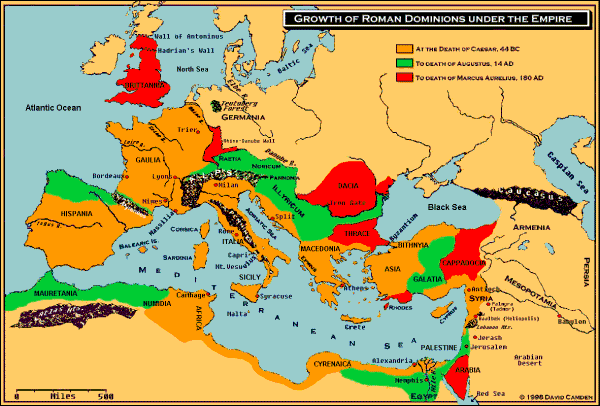
The above quotation from Wikipedia lists out the 10 provinces of Rome as they were then named. Steve Gregg lists them by names that would be considered more modern (p. 456): Italy, Achaia, Asia, Syria, Egypt, Africa, Spain, Gaul, Britain, and Germany. As seen in this map, Israel/Palestine belonged to the province of Egypt. Indeed, Rome was the world at that time, as can be seen by Luke’s description of Caesar Augustus’ decree “that all the world should be registered” (Luke 2:1; cf. Acts 2:5).

Photo credit: http://gbgm-umc.org/UMW/corinthians/empire.stm (Original source: David Camden)

Verses 15-17: John is then told the meaning of the “many waters” referred to in verse 1. They represent “peoples and multitudes and nations and languages,” and this is where the prostitute was seated. As seen already, the scope of these many waters could certainly be a valid description of the Roman Empire in the first century. Does this indicate that the prostitute IS the Roman Empire, or simply that its influence reached throughout the Roman Empire? David Chilton opts for the latter (as do I), saying (Steve Gregg, pp. 416, 418),

Jerusalem could truly be portrayed as seated on “many waters” (i.e. the nations) because of the great and pervasive influence the Jews had in all parts of the Roman Empire before the destruction of Jerusalem. Their synagogues were in every city, and the extent of their colonization can be seen in the record of the Day of Pentecost, which tells us that “there were Jews staying in Jerusalem, devout men, from every nation under heaven” (Acts 2:5).

In verse 16, we are told that the 10 horns (kings) would join the beast in hating “the prostitute. They will make her desolate and naked, and devour her flesh and burn her up with fire.” Earlier in verse 3 we saw the prostitute (Jerusalem) sitting on the beast which was “full of blasphemous names” (Rome). Now the beast has turned on the prostitute with hatred. Steve Gregg points out that this very same turn of events was predicted for Jerusalem just before it fell in 586 BC for playing the harlot (pp. 418, 420): “I will gather all your lovers with whom you took pleasure…I will gather them from all around against you and will uncover your nakedness to them…And I will judge you as women who break wedlock or shed blood are judged; I will bring blood upon you in fury and jealousy…They shall burn your houses with fire…and I will make you cease playing the harlot (Ezekiel 16:37-41). What is the significance of verse 16 then, in light of Jerusalem’s downfall in 70 AD?

First, it’s probably no coincidence that the word “desolate” is used here, just as it is used in Rev. 18:17, 19 and also in Daniel 9:27 and by Jesus in Luke 21:20 (recognized even by most Futurists as referring to Jerusalem’s destruction in 70 AD). Thus, the use of this word again here in reference to Jerusalem would be more than fitting. Secondly, we do know from accounts provided by Josephus (a Jewish historian) and Tacitus (a Roman historian from the same time period) that a number of kings from surrounding provinces joined Vespasian and Titus in Rome’s war against Israel from 67-70 AD. Thirdly, at the very end of July 70 AD, on the exact same day as Jerusalem was burned in 586 BC, the Second Temple was burned to the ground. Josephus remarked that from a distance the entire city of Jerusalem appeared to be on fire. In fact, during August and September 70 the rest of the city was set on fire and leveled to the ground. More will be said of this in our study on chapter 18. Suffice it to say that all the elements necessary for this prophecy to be fulfilled were present in 70 AD.

Regarding the second point, that multiple provincial kings joined Rome’s war against Israel, it was already mentioned in our discussion of verse 3 that this began with a Jewish revolt in the fall of 66 AD. I wrote in greater detail about this sequence of events in my term paper:

[1] Zealots and Revolutionaries (against Rome) take control of the Jerusalem temple. [2] The Jewish/Roman War begins in October with a revolt at Caesarea due to a group of Greeks sacrificing birds in front of a local synagogue. The revolt occurred because the Jews were frustrated that the local Roman garrison did not intervene. [3] The High Priest successfully leads a massacre of the Roman garrison stationed in Jerusalem. [4] The Romans in Caesarea slaughter 20,000 Jews. [5] About 13,000 more Jews are put to death in Damascus, Syria.

This was just the beginning of the carnage. After a less than successful attack on Galilee and Jerusalem by Cestius Gallus, the Roman governor of Syria, Nero declared war on Israel in February 67 AD, dispatching Vespasian as his general with triple the forces initially led by Cestius Gallus. The link I provided above provides many details of the events which transpired during the next 3.5 years.

Verse 18: As already pointed out, the woman is identified as “the great city” and is said to have “dominion over the kings of the earth.” The designation “great city” was given to Jerusalem in Revelation 11:8, and is repeated here in these chapters as a reference to Babylon the Great on at least seven occasions (16:19; 17:18; 18:10, 16, 18, 19, 21; cf. Rev. 14:8). Steve Gregg notes that this verse “is considered most definitive in the recognition of Rome as the harlot city,” for those who are of this opinion. He adds, “if no other data were given in Revelation for the identification of the city, no one would question that this is Rome” (p. 420). Yet we have seen a wealth of data suggesting otherwise. Steve Gregg then quotes David Chilton on this matter (p. 422):

If the City is Jerusalem, how can it be said to wield this kind of worldwide political power? The answer is that Revelation is not a book about politics; it is a book about the Covenant. Jerusalem did reign over the nations. She did possess a Kingdom which was above all the kingdoms of the world. She had a covenantal priority over the kingdoms of the earth.

Lamentations, written shortly after Jerusalem fell the first time in 586 BC, begins this way: “How lonely sits the city that was full of people! How like a widow has she become, she who was great among the nations! She who was a princess among the provinces has become a slave.” Interestingly, as we will see in our study of chapter 18, the great city in John’s day says, “I sit as a queen, I am no widow, and mourning I shall never see” (Rev. 18:7). Also when Jeremiah prophesied of Jerusalem’s soon coming destruction in his day, he wrote:

And many nations will pass by this city, and every man will say to his neighbor, “Why has the Lord dealt thus with this great city?” And they will answer, “Because they have forsaken the covenant of the Lord their God and worshiped other gods and served them” (Jeremiah 22:8-9).

Jerusalem was great in the political sense as well, though. Take note of Josephus’ description of Jerusalem in his introduction to Wars of the Jews:

“it had so come to pass, that our city Jerusalem had arrived at a higher degree of felicity than any other city under the Roman government, and yet at last fell into the sorest of calamities again” (Wars Preface 1.4).

Kenneth Gentry also writes (Before Jerusalem Fell, p. 171),

Jerusalem housed a Temple that, according to Tacitus “was famous beyond all other works of men.” Another Roman historian, Pliny, said of Jerusalem that it was “by far the most famous city of the ancient Orient.” According to Josephus, a certain Agatharchides spoke of Jerusalem thus: “There are a people called Jews, who dwell in a city the strongest of all other cities, which the inhabitants call Jerusalem.” Appian called it “the great city Jerusalem.” …More important, however, is the covenantal significance of Jerusalem. The obvious role of Jerusalem in the history of the covenant should merit it such greatness… Josephus sadly extols Jerusalem’s lost glory after its destruction: “This was the end which Jerusalem came to be the madness of those that were for innovations; a city otherwise of great magnificance, and of mighty fame among all mankind (Wars 7:1:1)… And where is not that great city, the metropolis of the Jewish nation, which was fortified by so many walls round about, which had so many fortresses and large towers to defend it, which could hardly contain the instruments prepared for the war, and which had so many tens of thousands of men to fight for it? Where is this city that was believed to have God himself inhabiting therein? It is now demolished to the very foundations” (Wars 7:8:7).

J. Stuart Russell makes another observation, regarding the phrase “kings of the earth” used in this verse and often thought to be wider in scope than Israel/Palestine. Not only is this expression found throughout Revelation, he says, but it’s also in Acts 4:26-27. There “Herod and Pontius Pilate are identified by the very same expression. Plainly, then, in Acts the expression means ‘the leaders or rulers of the Land’ (i.e. of Israel). If that is the phrase’s meaning here in verse 18, then Jerusalem surely can be said to be the city that reigns over the rulers of Israel” (p. 422).

——————————————————————————————————————————————————————–

Our study of Revelation 18 can be found here.

All of our Revelation chapter-by-chapter studies, and any other posts related to the book of Revelation, can be found here.


[1] This campaign of persecution led by Nero took place from November 64 AD – June 68 AD, a period of 42 months, which most preterists see as a fulfillment of Revelation 13:5-7. See here for more details.

Revelation Chapter 17 (Part 1: Verses 1-6)


REVELATION 17

Adam Maarschalk: December 3, 2009

Scripture text for this study: Revelation 17

UPDATE: This post was written when I understood the scarlet beast of Revelation 17 to be the same as the sea beast of Revelation 13:1-10, the seven kings of Revelation 17:10 to be the first seven Roman emperors, and the 10 horns of Revelation 17:12-14 to be the rulers of Rome’s 10 Senatorial Provinces. I now understand the seven kings to Revelation 17:10 to be seven Zealot leaders belonging to the family dynasty of Hezekiah the Zealot, and the 10 horns to be 10 Jewish generals (named by Josephus) who were appointed around January AD 67 to oversee specific territories and to prepare for war with Rome. This post will be updated accordingly when time allows.

A. The Scarlet Woman and the Scarlet Beast (Rev. 17:1-6)

Verse 1: At this point, the seven bowl judgments have been poured out on Babylon the Great (Rev. 16:19) by seven angels. One of these angels now takes John to see her judgment. Babylon, whose identity we will soon discuss, is referred to as “the great prostitute who is seated on many waters.” Steve Gregg, in his book “Revelation: Four Views (A Parallel Commentary),” reminds us that the fall of Babylon was first announced in Rev. 14:8 (p. 400). He then adds,

Chapters 17-19 reveal the destruction of Babylon in greater detail, the precursor to the marriage of the Lamb to a new bride. Appropriately, the chaste bride is contrasted with the wicked city depicted as a great harlot (v. 1). In order to gain this insight, John is transported in vision into the wilderness (v. 3). David S. Clark points out that “sometimes he was carried away into heaven to see visions; but the thing he was about to see now had no affinity with heaven, and he could not see such a scene as this in heaven, so he was taken to a wilderness as a more appropriate place, and one more in congruity with what he was about to see.”

Verse 2: Babylon is indicted for its sexual immorality, by which “the dwellers on earth” and “the kings of the earth” were made guilty. In our study of Revelation so far, we have suggested that many of the references to “the earth” in the book of Revelation are not meant to be taken as worldwide in scope, but as dealing instead with the land of Israel/Palestine. In a 3-part study on this subject beginning with this post, I have outlined nearly 20 instances where this appears to be the case. Notice that the reference to “the kings of the earth” here is distinct from the reference to “the kings of the whole world” in Revelation 16:14, where that reference was to the provincial kings of the entire Roman Empire.

We have also noted a couple of times that at this point in John’s narrative, there is division in the preterist camp regarding who judgment is being poured out upon. Some say it’s the Roman Empire, and others say it’s Jerusalem (this is my view). Steve Gregg (pp. 402-406) summarizes J. Stuart Russell’s arguments on why Babylon is to be identified with Jerusalem, and not with Rome. He lists 13 such reasons[1], which are reproduced here:

#1: The fall of Rome [in 476 AD] does not fall within the things “which must shortly take place,” which is the stated subject matter of the Apocalypse (cf. 1:1). [The fall of Jerusalem does, as it occurred in 70 AD, in John’s own day];

#2: The Olivet Discourse, which Russell conceives as a shorter treatment of the same subject matter as Revelation, does not include a discussion of the fate of Rome (see Matthew 24; Mark 13; Luke 21);

#3: As Revelation presents a series of contrasts—a Lamb vs. a dragon; the Father’s name vs. the beast’s name on people’s foreheads; the bride vs. the harlot—so also the Apocalypse contrasts two cities, Babylon and the New Jerusalem. The latter is the church. The earthly Jerusalem is clearly in view in earlier chapters. To bring Rome into the picture at this point would introduce a third city and destroy the symmetry of the book;

#4: As a symbolic name for Jerusalem, Babylon would be as fitting as Sodom and Egypt, which were applied to Jerusalem earlier (11:8);

#5: The phrase “that great city” was used of Jerusalem earlier (11:8), as it is used repeatedly in these chapters regarding Babylon;

#6: In chapter 14, the winepress was trodden “outside the city” (14:20), which almost all understand to refer to Jerusalem, yet the only “city” named earlier in that chapter is Babylon (14:8), hence, Babylon equals Jerusalem;

#7: The division of Babylon into “three parts” in 16:19 best fits Jerusalem… (cf. Ezek. 5:1-12). [By this, Steve Gregg is also referring to the historical fact of three warring factions in Jerusalem during the siege leading up to Jerusalem’s destruction in 70 AD, which literally carved up the city into three parts. See previous post on chapter 16.];

#8: The appellation “the harlot” is an established label for Jerusalem from the Old Testament (cf. Isa. 1:21; 57:8; Jer. 2:2, 20); it could never be applied to Rome or any Gentile city, since they have never been in a covenant relationship with God. As Chilton writes: “The metaphor of harlotry is exclusively used in the Old Testament for a city or nation that has abandoned the Covenant and turned toward false gods; and with only two exceptions…[2] the term is always used for faithless Israel;

#9: Jerusalem sat upon seven hills as truly as did Rome [SEE FINAL NOTE at the end of this post];

#10: If “the kings of the earth” [verse 2] be understood to mean “the rulers of the land (Israel),” then Jerusalem, as appropriately as Rome, could be said to be “that great city” in 17:18 [more on this later];

#11: The expression “that great city which reigns over the rulers of the land” (v. 18) is fully equivalent to that which is said of Jerusalem in Lamentations 1:1—“Who was great among the nations! The princess among the provinces”;

#12: The Jews of Jerusalem were idolatrous, as was Rome;

#13: No city other than Jerusalem could be charged with the blood of the prophets and saints and apostles (see 17:6; 18:20, 24).

Verse 3: John then sees a woman sitting on a scarlet (red) beast with seven heads and ten horns. We already discussed the identity of this beast at length in Revelation 13 (See Post #1 here and Post #5 here), seeing a compelling case for its identity as Nero in the specific sense and the Roman Empire in the general sense. The woman here in verse 3 is seen as a prostitute (verse 1), and the fact that she is sitting on the beast does not mean that she is one and the same with the beast. Rather it suggests a very close relationship between the woman and the beast, who are both distinct in their identity. In my term paper on the events of 70 AD, I wrote the following regarding the significance of the woman (Jerusalem, as representing Israel) riding the beast (Rome):

In what sense might Jerusalem have sat on the beast with seven heads (mountains), the beast that would ultimately turn on her and destroy her (Rev. 17:3, 9, 16-18)? Israel had enjoyed a good relationship with Rome until the Jewish revolt began in 66 AD, and Judaism was recognized as a valid religion within the Roman Empire. Josephus wrote of this relationship, “It seems to me to be necessary here to give an account of all the honors that the Romans and their emperors paid to our nation [Israel], and of the leagues of mutual assistance they have made with it” (Antiquities, 14.10.1-2). The Jews frequently took advantage of this relationship to induce persecution against Jesus and His followers (Luke 23:2; John 18:28-31, 19:15; Acts 4:27, 16:20, 17:7, 18:12, 21:11, 24:1-9, 25:1-2). W.H.C. Frend even writes that “the promptings of orthodox Jews in the capitol had something to do with” Nero’s decision to begin persecuting Christians in 64 AD (The Rise of Christianity [Philadelphia: Fortress, 1984], 109; quoted in Kenneth Gentry, 2002, p. 63).

Kenneth Gentry suggests that the beast is seen as scarlet for any (or all) of the following reasons: [1] The robes worn by Roman emperors were red in color [2] Rome, led by Nero, was responsible for shedding much blood among God’s people [3] Nero was famous for his red beard. Regarding this last point, Gentry says, “It would seem most appropriate to expect the red color of the beast to also correspond to the person designated as the beast whose number is 666” (Before Jerusalem Fell, p. 217). In other words, this is likely one more means by which John made known to his first-century readers exactly who the beast was (in the singular sense) without saying so explicitly.

Verses 4-5: The woman is seen to be wearing purple and scarlet, and gold, jewels, and pearls. She has in her hand a golden cup “full of abominations and the impurities of her sexual immorality.” Her forehead proclaimed that she was “Babylon the great, mother of prostitutes and of earth’s abominations.” In my term paper on the events of 70 AD, I noted some observations made by Todd Dennis, the founder of the Preterist Archive:

…the description of the harlot’s attire (purple, scarlet, gold, jewels, and pearls) was nearly identical to the ephod worn by the high priest (Revelation 17:4; cf. Exodus 28:5-21). The golden cup she held was likely symbolic of the temple vessels, the greatest part of which were gold and silver, according to the Jewish historian Josephus (Wars 5.4.4). On Aaron’s forehead was the inscription “Holy to the Lord” (Exodus 28:36). The harlot’s forehead, on the other hand, bore the title “Babylon the great, mother of prostitutes and of earth’s abominations” (Rev. 17:5).

The attire of the harlot was also similar to what Josephus said was discovered “in the midst [of the inmost court], that most sacred part of the temple” when Jerusalem was captured by the Romans in 70 AD:

“The woman was arrayed in purple and scarlet, and adorned with gold and precious stones and pearls” (Revelation 17:4).

“But then this house, as it was divided into two parts, the inner part was lower than the appearance of the outer, and had golden doors of fifty-five cubits altitude, and sixteen in breadth; but before these doors there was a veil of equal largeness with the doors. It was a Babylonian curtain, embroidered with blue, and fine linen, and scarlet, and purple, and of a contexture that was truly wonderful” (Wars 5.5.4).

In Jeremiah’s day, Judah (with its capital of Jerusalem) was indicted because it had “played the whore with many lovers” and “polluted the land with…vile whoredom” (Jeremiah 3:1-2). Like Israel in John’s day, Judah prior to its fall in 586 BC had “the forehead of a whore” (verse 3).

Duncan McKenzie’s article has helped me to understand that “Babylon the Great” here was more than just a physical city in its identity. It was also a religious system full of abominations. That system, I believe, was Old Covenant temple-based Judaism. In the next chapter, we will see a command from God regarding Babylon, saying, “Come out of her, my people, lest you take part in her sins, lest you share in her plagues” (Rev. 18:4). We know from chapter 1 that John’s immediate audience did not live in Jerusalem (or Rome), but in Asia Minor. The believers in Jerusalem did flee, as we noted in chapter 7, but what did this message mean to believers already living outside of Jerusalem and Judea?

God’s message was about breaking completely free from Old Covenant temple-based Judaism. Babylon represented not only Jerusalem, but also the unfaithful community which had rejected Jesus in order to maintain corrupted Old Covenant practices. Both physical Jerusalem and temple-based Judaism were judged and destroyed in 70 AD. In Daniel 9:26-27 we see that it is on “the wing of abominations” that one comes “who makes desolate” (cf. Rev. 17:16, Matt. 23:38). This is in reference to the destruction of “the city and the sanctuary” (as related to Daniel’s own people and his holy city—Dan. 9:24). What are the abominations spoken of in both Daniel and Revelation? Regarding Daniel 9, John Calvin several centuries ago remarked:

I have no hesitation in referring this language of the angel to that profanation of the Temple which happened after the manifestation of Christ, when sacrifices ceased, and the shadows of the law were abolished. From the time, therefore, at which the sacrifice really ceased to be offered; this refers to the period at which Christ by his advent should abolish the shadows of the law, thus making all offering of sacrifices to God totally valueless… God’s wrath followed the profanation of the Temple. The Jews never anticipated the final cessation of their ceremonies, and always boasted in their peculiar external worship, and unless God had openly demonstrated it before their eyes, they would never have renounced their sacrifices and rites as mere shadowy representations. Hence Jerusalem and their Temple were exposed to the vengeance of the Gentiles.

As Russell pointed out earlier, John is being shown a contrasting picture of two women: the harlot of chapters 17 and 18, and the bride in chapter 19 clothed with “fine linen, bright and pure…the righteous deeds of the saints” (see verses 1-8). One (the harlot, representing Judaism) persecuted the other (the bride, Christ’s Church), as we will see again in the next verse. What is most fascinating is Paul’s own contrasting of two women in his epistle to the Galatians:

Tell me, you who desire to be under the law, do you not listen to the law? For it is written that Abraham had two sons,one by a slave woman andone by a free woman. But the son of the slave was born according to the flesh, whilethe son of the free woman was born through promise. Now this may be interpreted allegorically: these women are twocovenants. One is from Mount Sinai, bearing children for slavery; she is Hagar. Now Hagar is Mount Sinai in Arabia;she corresponds to the present Jerusalem, for she is in slavery with her children. But the Jerusalem above is free, and she is our mother. For it is written, “Rejoice, O barren one who does not bear; break forth and cry aloud, you who are not in labor. For the children of the desolate one will be more than those of the one who has a husband.” Now you, brothers,like Isaac, are children of promise. But just as at that time he who was born according to the flesh persecuted him who was born according to the Spirit, so also it is now. But what does the Scripture say?”Cast out the slave woman and her son, for the son of the slave woman shall not inherit with the son of the free woman.” So, brothers, we are not children of the slave butof the free woman (Galatians 4:21-31, emphasis added).

Note how the following passages contrast each other:

A. Revelation 17:1: “Then one of the seven angels who had the seven bowls came and said to me, ‘Come, I will show you the judgment of the great prostitute who is seated on many waters.’”

A. Revelation 21:9: “Then came one of the seven angels which had the seven bowls full of the seven last plagues and spoke to me, saying, ‘Come, I will show you the Bride, the wife of the Lamb.’”

B. Revelation 17:3: “And he carried me away in the Spirit into a wilderness, and I saw a woman sitting on a scarlet beast that was full of blasphemous names.”

B. Revelation 21:10: “And he carried me away in the Spirit to a great, high mountain, and showed me the holy Jerusalem coming down out of heaven from God.”

On these matters, Duncan McKenzie concludes:

Revelation is talking about the same subject as Galatians; both books are contrasting two “cities” (physical Jerusalem and heavenly Jerusalem in Galatians, Babylon and the New or heavenly Jerusalem in Revelation) that are two “wives” (Hagar and Sarah in Galatians, the widowed harlot and the bride in Revelation).  These two women of Galatians and Revelation represent two communities, those of the old and new covenants…  In the book of Revelation, as in Galatians (4:29), one woman persecutes the other (i.e. the harlot persecutes the bride, Rev. 17:6).  Similarly in Revelation, as in Galatians, one of the two women is cast out (and destroyed—Rev. 18:21) while the other woman receives her inheritance (i.e. the Lord takes her as His bride).  This explains why the very next subject in Revelation after Babylon is destroyed is the wedding of the bride (Rev. 19:1-10).  God deposes of His unfaithful old covenant wife (who irrevocably broke her covenant of marriage with God and became a widow when she had Jesus killed) and then marries His faithful new covenant bride…

Just as the New Jerusalem is not a literal city but a community of people (the bride, the new covenant community) so Babylon was not a literal city but a community of people (the harlot, the unfaithful old covenant community)… While Babylon was centered in Jerusalem, its citizens were all those of unfaithful Israel that were rejecting Jesus for the temple system.

When the earthly Jerusalem fell, God’s true people were in possession of “the city of the living God, the heavenly Jerusalem” (Hebrews 12:18-28). Upon the removal of that which could be shaken (vs. 27; cf. Hebrews 9:8-10), there remained “a kingdom that cannot be shaken” (vs. 28; cf. Daniel 7:21-22, Matthew 21:43).

Verse 6: The woman is said to be “drunk with the blood of the saints, the blood of the martyrs of Jesus.” This same charge was laid upon those of “the earth” (Rev. 16:1) in the previous chapter, where it was said that “they have shed the blood of saints and prophets (16:4-7).” In chapter 18 we will see that “in her was found the blood of prophets and of saints, and of all who have been slain on the earth” (18:24), and that the “saints and apostles and prophets” were told to rejoice over her destruction (18:20). Who was responsible for shedding all the blood of the prophets and the saints, according to Jesus, and who would receive judgment as a result? David Lowman, a Presbyterian pastor, aptly points out that the answer can be found in Matthew 23:

Woe to you, scribes and Pharisees, hypocrites! For you build the tombs of the prophets and decorate the monuments of the righteous, saying, ‘If we had lived in the days of our fathers, we would not have taken part with them in shedding the blood of the prophets’” Thus you witness against yourselves that you are sons of those who murdered the prophets. Fill up, then, the measure of your fathers. You serpents, you brood of vipers, how are you to escape being sentenced to hell? Therefore I send you prophets and wise men and scribes, some of whom you will kill and crucify, and some you will flog in your synagogues and persecute from town to town, so that on you may come all the righteous blood shed on earth, from the blood of innocent Abel to the blood of Zechariah the son of Barachiah, whom you murdered between the sanctuary and the altar. Truly, I say to you, all these things will come upon this generation. O Jerusalem, Jerusalem, the city that kills the prophets and stones those who are sent to it! How often would I have gathered your children together as a hen gathers her brood under her wings, and you would not! See, your house is left to you desolate (Matthew 23:29-38, emphasis added).

—————————————————————————————————————————————————————————

In Part 2 of our study on Revelation 17 we will see how the angel unveils to John the meaning of the prostitute (Babylon) and the beast…

All of our Revelation chapter-by-chapter studies, and any other posts related to the book of Revelation, can be found here.


[1] Kenneth Gentry, in his book Before Jerusalem Fell, lists his own set of reasons (pp. 240-241): “Briefly, the evidence for the identifying of Jerusalem as the Harlot is based on the following: (1) Both are called ‘the great city’ (Rev. 14:8; 11:8). (2) The Harlot is filled with the blood of the saints (cp. Rev. 16:6; 17:6, 18:21, 24; with Matt. 23:34-38; Luke 13:33; Acts 7:51-52). Jerusalem had previously been called by pagan names quite compatible with the designation ‘Babylon’ (cp. Rev. 14:8 and 17:5 with 11:8). (4) Rome could not fornicate against God, for only Jerusalem was God’s wife (Rev. 17:2-5, cp. Isa. 1:20; Jer. 31:31). (5) There is an obvious contrast between the Harlot and the chaste bride (cp. Rev. 17:2-5 with Rev. 21:1ff.) that suggests a contrast with the Jerusalem below and the Jerusalem above (Rev. 21:2; cp. Gal. 4:24ff.; Heb. 12:18ff.). The fact that the Harlot is seated on the seven-headed Beast (obviously representative of Rome) indicates not identity with Rome, but alliance with Rome against Christianity (cp. Matt. 23:37ff.; John 19:6-16; Acts 17:7).” SEE ALSO QUESTION #9 HERE: http://www.forerunner.com/beast/beastfaq.html.

[2] Note from Steve Gregg: “The two exceptions are Tyre (Isaiah 23:15-17) and Nineveh (Nahum 3:4). It is notable that both of these pagan cities, Tyre (See I Kings 5:1-12; 9:13; Amos 1:9) and Nineveh (Jonah 3:5-10), had at one time been in covenant with God.”

—————————————————————————————————————————————————————————————-

FINAL NOTE: Regarding J. Stuart Russell’s 13 arguments for identifying Babylon with Jerusalem, there was one that I wasn’t quite on board with earlier (i.e. I thought it shouldn’t belong to his list). That was #9, which stated, “Jerusalem sat upon seven hills as truly as did Rome.” Then today I came across this information at the site of Australian Pastor Andrew Corbett:

The City of Jerusalem as it existed in the time of Christ Jesus was widely reckoned to be the “City of Seven Hills.” This fact was well recognized in Jewish circles. In the Pirke de-Rabbi Eliezer, an eighth century midrashic narrative (section 10), the writer mentioned without commentary (showing that the understanding was well known and required no defense) that “Jerusalem is situated on seven hills” (recorded in The Book of Legends, edited by Bialik and Ravnitzky, p. 371, paragraph 111). And, so it was. Those “seven hills” are easy to identify. If one starts with the Mount of Olives just to the east of the main City of Jerusalem (but still reckoned to be located within the environs of Jerusalem), there are three summits to that Mount of Olives. The northern summit (hill) is called Scopus [Hill One], the middle summit (hill) was called Nob [Hill Two], the highest point of Olivet itself, and the southern summit (hill) was called in the Holy Scriptures the “Mount of Corruption” or “Mount of Offence” [Hill Three] (II Kings 23:13). On the middle ridge between the Kedron and the Tyropoeon Valleys there was (formerly) in the south “Mount Zion” [Hill Four] (the original “Mount Zion” and not the later southwest hill that was later called by that name), then the “Ophel Mount” [Hill Five] and then to the north of that the “Rock” around which “Fort Antonia” was built [Hill Six]. And finally, there was thesouthwest hill itself [Hill Seven] that finally became known in the time of Simon the Hasmonean as the new “Mount Zion.” This makes “Seven Hills” in all.

So, indeed, J. Stuart Russell was correct. Still, as we will see in the following post, there is another sense also in which the woman (apostate Israel) can be seen as seated on the seven mountains of Rome (if Rome is in view in Revelation 17:9).

The Manhattan Declaration: Distorting the Gospel


The context of this post is that it’s a reproduction of something I recently posted as a note on Facebook. As it contains a sizeable amount of research, I’ve decided to also post it here. I was first made aware of the Manhattan Declaration on an excellent blog site: www.pjmiller.wordpress.com, where several articles have been written on this topic (please refer to the end of this post for links to those articles). This post deals with the Manhattan Declaration and also the topic of nationalism in general. Some of what I’ve written here is a reflection of my own process of searching my heart to see where nationalism has [1] distracted me from what is more important (the message of Christ and Him crucified), and/or [2] tainted my perspective on things which are eternal. I’m still on that journey.

—————————————————————————————————————————————————

–by Adam Maarschalk–

In my previous note, “Has Nationalism Taken Priority over the Gospel in Our Hearts?” I expressed some of my views regarding nationalism and the high priority that it has for many professing Christians here in the US. To be clear again, my point is not that all political involvement is illegitimate. I also have my own political opinions, and I don’t know anyone who doesn’t. At the same time, my growing sense is that for many of us who say we follow Christ, nationalism has both overshadowed the gospel and distorted its message in our minds. Here is a statement I made in my previous post:

I think that too many of us [i.e. followers of Christ] in this nation have become more passionate about taking on political causes, proclaiming the superiority of the United States, and fighting ‘liberalism’ than we are about proclaiming the gospel of Jesus Christ and upholding Biblical truth.

Recently the national media has given some coverage to The Manhattan Declaration (http://www.manhattandeclaration.org/), an ecumenical initiative dealing with [1] the sanctity of life [2] the dignity of marriage as the conjugal union between husband and wife [3] the rights of conscience and human liberty. While there are points of social concern outlined in this declaration which I could agree with, these same points could be agreed upon by many who don’t even claim to be Christian. The greater issue at stake here is again this: the distortion and even redefining of the gospel of Jesus Christ, and of our purpose as God’s people here on earth. This is again evident in the issues surrounding the Manhattan Declaration.

In the Preamble to this document, it is said that Catholic, Orthodox, and Evangelical Christians are united “as followers of Jesus Christ, the crucified and risen Lord, who is the Way, the Truth, and the Life.” To be sure, this is a wonderful thing to be united upon, if only it were true that these three groups are united in this way. This statement clearly makes light of the Reformation led by Martin Luther in the 16th century. What has fundamentally changed so that Catholicism now clearly stands firm on the gospel of Jesus Christ? This is an issue which deserves its own post, so I will say no more at this point (however, it is dealt with at more length in one of the links I will provide below).

Then in the FAQ section (under #8), we read:

So the signatories are happy to stand alongside our LDS brothers and sisters who have worked so heroically in the cause of defending marriage, our Jewish brothers and sisters, members of other faiths, and people of no particular faith (even pro-life atheists such as the great Nat Hentoff), who affirm our principles and wish to join us in proclaiming and defending them.

Mormons and religious Jews are our “brothers and sisters”??? Really? The issues highlighted in this declaration are NOT more important than clarity regarding the gospel of Jesus Christ and what it means to be His followers. It gets worse…

Jim Daly, the President and CEO of Focus on the Family [and I don’t have to tell you how influential this organization is], is one of the principle signatories of this declaration. Please pay close attention to how he explains his rationale for signing it, keeping in mind that Christians in the US are his target audience:

Given the magnitude of this document…I’d like to share with you now why I was so eager to sign it—and why I hope you will, too.

It is important, first off, to note that the Manhattan Declaration is not a partisan or political statement… Instead, it addresses and elevates four specific areas of universal consensus. Some have referred to these as ‘threshold issues,’ meaning they represent the foundation of our faith and the pivot point from which everything else flows. This is the bedrock. If we can’t agree on these areas of doctrine, everything else will be of reduced value.

These four areas are:

1. The sanctity of life
2. The sanctity of marriage
3. The protection of religious liberty
4. The rejection of unjust laws

Sources (emphasis added):
[1] http://christianresearchnetwork.com/?p=14254
[2] http://biblicalthought.com/blog/discussing-the-manhattan-declaration/

If you’re a believer and reading this, I hope you find Daly’s statement as disturbing as I do. The foundation of my faith is Jesus and Him crucified and the truth revealed in Scripture, not four political/social issues. The last two areas listed by Daly aren’t even doctrines, by any stretch of the imagination. Ephesians 2:19-21 tells us very clearly what the foundation of our faith is.

Daly wants you and I to place our faith on a foundation other than Christ. Mormons, Jehovah Witnesses, Muslims, and unbelievers of many persuasions could agree with these four “areas of doctrine.” No thank you, Mr. Daly. You’re preaching another gospel. I’ll keep my faith on a foundation that can’t be shaken when politics fail.

Chuck Colson, one of the three framers of this document, has also repeatedly referred to these tenets as being part and parcel of the gospel. In one place, he says,

Just imagine what could happen if we could say to the world that a million Christians have made this pledge—that we will not compromise the faith, no matter what. I think that would have an extraordinary impact on American culture. And just as important, I believe the Manhattan Declaration can help revitalize the church in America. One great weakness of the Church today is its biblical and doctrinal ignorance. This document is, in fact, a form of catechism for the foundational truths of the faith. Now, opponents of the document have tried to paint it as a political tool—a way to resurrect the religious right. Nothing could be further from the truth.

Source: http://www.breakpoint.org/commentaries/13626-just-the-beginning (emphasis added)

Why would the framers and key signatories continue to equate these tenets with the gospel, and then invite unbelievers to commit to them? Not only that, but all who sign are now told that they have pledged to never compromise the gospel (even if they are unbelievers!). On the MD’s official website, there is now a “Message to All Signers of the Manhattan Declaration,” where one will see the following words:

We believe God is looking for good men and women who will pledge (as those who have done in signing the Manhattan Declaration), never to compromise the gospel, and to become well-informed, effective advocates of true and godly principles.

Source: http://www.manhattandeclaration.org/for-signers-whats-next

Now wait a minute! How can this be? This goes far beyond affirming Catholicism as holding to the Biblical gospel (which it does not), and calling Mormons and Jews our “brothers and sisters” (in the faith?), which is compromise enough. Remember that the framers of this document invited “members of other faiths, and people of no particular faith (even pro-life atheists…)” to sign. How can Hindus, Buddhists, Muslims, atheists, and others who are not followers of Christ never “compromise the gospel”? They haven’t yet believed the message of the gospel, much less been transformed by it, much less be in a position to never compromise it.

If the framers had kept this document purely political, that would be one thing (although I still wouldn’t sign it), but they are providing one of the muddiest definitions of the gospel I’ve ever seen. This document has a political agenda, pure and simple, despite what Chuck Colson has said. Here is Colson in his own words, as reported in the New York Times:

‘We argue that there is a hierarchy of issues. A lot of younger evangelicals say they’re all alike. We’re hoping to educate them that these are the three most important issues’ – abortion, marriage, and religious liberty.”

Source: http://www.newsmax.com/headlines/wuerl_colson_christian/2009/11/21/289471.html

There are plenty of reasons why Colson’s statement is not necessarily true (especially regarding religious liberty) and should be debated, but I’ll leave it alone. Artificially fixing these or any social ills through legislation and heavy political action won’t ultimately change the hearts of people in this nation. The gospel will, and that’s what is being marginalized and distorted by this and many other initiatives. I can’t and won’t sign this document, for the reasons already given and others. I could say a lot more, but I’d like to instead point to two excellent articles on this subject. The first one can be found here—it’s a comprehensive list of 19 thought-provoking questions for professing evangelicals who have signed, or are thinking about signing, this document:

http://teampyro.blogspot.com/2009/11/nineteen-questions-for-signers-of.html

This in-depth post from Steve Camp, a former recording artist whose lyrics might remind some of Keith Green, is also very good:

http://stevenjcamp.blogspot.com/2005/08/new-downgrade12-dangers-of-ecb.html

These statements near the beginning of this article jumped out at me right away:

In John 18:36 our Lord says these surprising words in answer to an inquisition by Pontius Pilate, ‘…If my kingdom were of this world, my disciples would be fighting…’ These words cut straight to the heart of the matter before us today. Clearly, the Lord’s kingdom is not of this world. Jesus did not come as a social revolutionary to clean up the culture from lascivious delinquents; or as a religious zealot to overthrow the Sanhedrin; or even as a political agitator to dethrone the Emperor. His kingdom is eternal; it is not of this world…

But why then is it today, beloved, that we do see His disciples fighting? –and fighting not for eternal things, but for the temporal things of this earth. Fighting for religious rights; fighting against unregenerate people for acting like unregenerate people; fighting against the secularization of public policy; fighting for a social moral imperative; fighting against senate filibusters; fighting for family values, etc. And yet, with an eerie wholesale silence we don’t see them contending for the faith, boasting in the cross, heralding the good news of the gospel of grace through faith in Christ alone, and proclaiming Jesus Christ and Him crucified as the answer for the social ills plaguing our society today.[1]

Of course, Steve Camp is speaking generally here, and not saying that no one is preaching the gospel. Just like in my recent note, he is asking what we as believers in this nation are most passionate about. Which one overshadows the other: politics/nationalism or the gospel? Steve Camp goes on to list 12 dangers of what he calls “Evangelical Co-Belligerence.” I find his points very thought-provoking… All are very good, but #5, 7, 9, and 12 perked my interest the most. Here are his points in skeleton form (he elaborates on all of them in the link I provided, and this is well worth reading):

1. The Lack of Biblical Foundation (for engaging in “culture wars”)
2. The Removal of the Offense of the Cross
3. The Secularization of Being “Salt and Light”
4. The Promotion of a Moral Human Imperative
5. The Denial of the Efficacy of the Gospel
6. The Condoning of Unequally-Yoked Alliances
7. The Alienation of Unbelievers for “Acting Like Unbelievers”
8. The Body of Christ Turned Into Political Agitators
9. The ECB Political Entitlement—“Religious Rights”
10. The Pagan Co-Belligerents—Still “Safe” in Their Sin
11. The Church Turned PAC/Lobbyist/Voting Force
12. The Inevitable Conclusion: Win the Culture War; Lose a Voice for the Gospel

Camp closes his post with these words:

When one eliminates the centrality of the gospel from the social cause; or amputates the call to repentance to unregenerate people they’d rather play politics with, share picket lines with, boycott corporations with, legislate morality with, and strong arm politicians by militant means with—rather than deny themselves, take up their cross, and follow Jesus Christ with; when one tries to focus on everything from family; to culture wars; to filibusters; to elections; to religious rights; to a bankrupt social moral imperatives; rather than on focusing on the Lord and His ‘once for all faith delivered to the saints’, where does this all lead? …May the church turn away from this defection from Christ and His Word and come back to the Lord Jesus Christ and His gospel as the cure for the sin sick hearts of mankind.

Finally, I would also like to close by referring to an interview by Charlie Rose with Greg Boyd, a pastor here in the Minneapolis area, regarding his book, “The Myth of a Christian Nation: How the Quest for Political Power Is Destroying the Church.” For those who know of Boyd, you probably know that he embraces what is known as “open theism,” and I’m certainly not on board with that. Setting that aside for now, I do appreciate and agree with what he says in this interview, found here (the total running time for these three video segments is 21 minutes):

[1] http://www.youtube.com/watch?v=HIWs_G4oJaA&feature=related
[2] http://www.youtube.com/watch?v=NLTsefTbL1I&feature=related
[3] http://www.youtube.com/watch?v=jBQPN0rVs1I&feature=related

—————————————————————————————————-

Further recommended articles:
[1] http://mytwocents.wordpress.com/2009/06/15/for-god-and-country-politics-and-the-gospel/
[2] http://www.internetmonk.com/archive/why-electing-palin-or-huckabee-makes-more-sense-to-you-than-reforming-your-church
[3] http://www.internetmonk.com/archive/the-tactics-of-failure-why-the-culture-war-makes-sense-to-spiritually-empty-evangelicals
[4] http://pjmiller.wordpress.com/2009/09/03/is-obama-really-the-problem/
[5] http://pjmiller.wordpress.com/2009/09/05/confession-of-a-radical/

——————————————————————————————————–

Articles to date on PJ Miller’s site regarding the Manhattan Declaration:

[1] http://pjmiller.wordpress.com/2009/11/20/christian-leaders-unite-on-political-issues/
[
2] http://pjmiller.wordpress.com/2009/11/25/around-the-blogosphere-the-manhattan-declaration/
[3] http://pjmiller.wordpress.com/2009/11/26/another-reason-why-ill-never-support-the-manhattan-declaration/
[4] http://pjmiller.wordpress.com/2009/11/29/the-manhattan-declaration-a-parable/
[5] http://pjmiller.wordpress.com/2009/12/01/is-there-ever-an-exception/
[6] http://pjmiller.wordpress.com/2009/12/04/the-manhattan-declaration-our-regretful-inability-to-become-a-signatory/
[7] http://pjmiller.wordpress.com/2009/12/04/covenants-oaths-promises-and-pledges/
[8] http://pjmiller.wordpress.com/2009/12/06/the-dangers-of-cobelligerence/
[9] http://pjmiller.wordpress.com/2009/12/12/the-dung-of-our-own-righteousness-the-manhattan-declaration/
[10] http://pjmiller.wordpress.com/2009/12/23/the-new-ecumenism/
[11] http://pjmiller.wordpress.com/2010/01/16/the-manhattan-declaration-drum-beat/


[1] In a similar way, I posed this question in my previous note, and I still present it as an open challenge to fellow believers:

“I think our priorities are misplaced. Let’s say I publicly question the teachings of high-profile preachers who claim to be anointed yet distort the gospel, preach heresy, and dishonor the name of Jesus every day on TBN, GOD TV, The Word Network, etc. Surely I will hear “Don’t judge”, “touch not the Lord’s anointed”, “that’s not loving,” etc. But if I were to blast away at President Obama (whose authority has been instituted by God—Romans 13:1, Daniel 2:21, John 19:11), the policies of this administration, or anything deemed liberal, I would get all kinds of “amens” and thumbs up [from my Conservative friends on Facebook]. Something’s wrong, and to me this is a clear double standard [as well as illustrating what is and isn’t so important to us].”

Revelation Chapter 13 (Part 5: Ten Fulfilled Prophecies)


REVELATION 13 (Part 5: Ten Fulfilled Prophecies Regarding the Beast)

Adam Maarschalk: October 22 & 29, 2009

Scripture text for this study: Revelation 13:1-18

By way of reviewing the previous four posts, the following is a chart indicating what was foretold regarding “the beast from the sea” in Revelation 13 and 17, and how these things were true of Nero and the empire he led, represented, and personified. In some cases it would be possible for another entity aside from Nero to fulfill one of these prophecies (being identified with “666,” for example), but the fact that each one of these prophecies fits Nero and first-century Rome makes for a very compelling case that the fulfillment of Revelation 13 is past and not future. Keep in mind, as we noted in Part 1 of this Revelation 13 series, that the beast is seen in both the singular and the general sense (i.e. as an individual, and at the same time as an empire).

10 PROPHECIES REGARDING THE BEAST FROM THE SEA

FULFILLMENT BY NERO/THE ROMAN EMPIRE

1. The beast was to have ten horns, which would carry it, give to it their own power and authority, persecute the saints, and finally turn on the “great prostitute” to the point of burning her with fire (Rev. 13:1; 17:3, 7, 12-14, 16-17).

The Roman Empire contained 10 Senatorial Provinces, and the governors of each one granted their authority to Rome and also exercised authority on its behalf (See Part 1). This included aiding in Nero’s persecution of the saints, and carrying out the Roman war against Israel which resulted in the burning of Jerusalem in 70 AD.

2. The beast had seven heads. To John it was explained that the seven heads represented not only the “seven mountains on which the woman is seated,” but also “seven kings, five of whom have fallen, one is [in John’s day], the other has not yet come, and when he does come he must remain only a little while” (Rev. 13:1; 17:3, 7, 9-10).

Rome is the one city in history famous for its seven mountains, and first-century Rome celebrated the feast of the “seven-hilled city.” According to Josephus, Dio Cassius, Suetonius, and other historians, the first five Roman emperors (or “kings”; cf. John 19:15) were [1] Julius Caesar [2] Augustus [3] Tiberius [4] Caligula, and [5] Claudius. The sixth was Nero (54-68 AD), and the next emperor was Galba, who reigned for only six months before he was murdered (Again see Part 1).

3. The beast was to have a mouth like a lion (Rev. 13:2).

The apostle Paul, referring to his trial before Nero, testified that he was “rescued from the lion’s mouth” (II Timothy 4:16-17).

4. One of the beast’s heads was to receive a mortal wound, but the beast’s wound would be healed, causing the whole earth to marvel “as they followed the beast” (Rev. 13:3, 12).

Nero committed suicide in June 68 AD, bringing an end to the blood line that had sustained Rome since it had become an empire. His death was followed by chaos and civil war, causing the empire to nearly collapse, and Josephus testified that “every part of the habitable earth” under the Romans “was in an unsettled and tottering condition” (Wars 7.4.2). The next three emperors (Galba, Otho, and Vitellius) each reigned considerably less than a year, each tried desperately to resurrect Nero’s image and authority, and it was only when Vespasian came to power in December 69 AD that Rome stabilized and became more powerful than ever (See Part 2 and Part 3).

5. The “whole earth” would worship the beast, extolling it as incomparable and overwhelmingly powerful to any who would dare to oppose it. Only those whose names were “written before the foundation of the world in the book of life of the Lamb that was slain” would not worship the beast (Rev. 13:4, 8; 17:8).

See Part 2 for the very pronounced and extravagant worship demanded by, and received by, Nero during and after his reign. This included offering sacrifices to Nero’s spirit in the public square even after his death. One statue of Nero stood more than 110 feet high, and coins and other inscriptions hailed him as “Almighty God” and “Savior.” He was hailed as Apollo, Hercules, “the only one from the beginning of time,” and even rulers from other lands had to publicly worship both Nero and his images which were set up on lofty platforms. As for the reference to “the whole earth,” this can either be understood as referring to the Roman Empire (cf. Luke 2:1), or to Israel (See my 3-part study outlining nearly 20 cases in Revelation where the context seems to demand that the expressions “the earth” and “those who dwell on the earth” be understood as dealing with the land of Israel/Palestine rather than to the entire planet [Part 1, Part 2, Part 3.)

6. The beast was to be given authority “to make war on the saints and to conquer them” for a period of 42 months. The scope of his authority would be “over every tribe and people and language and nation” (Rev. 13:5-7).

It’s a historical fact that Nero began to persecute the Christians throughout the Roman Empire in mid-November 64 AD. This intense persecution only ended when Nero committed suicide in June 68 AD. Thus he made war on the saints for a period of exactly 42 months. See Part 1.

7. The saints were called to endure and remain faithful in light of the fact that the beast who so often wielded the sword would himself be killed by the sword (Rev. 13:10, 14).

In June 68 AD Nero ended his life by thrusting his sword through his own throat, with the help of his personal secretary, Epaphroditus, in part because he realized that his popularity had waned and also because of an attempted coup (See Part 1). Nero lived by the sword, and died by the sword. Tertullian [145-220 AD] credited “Nero’s cruel sword” as providing the martyr’s blood as seed for the church. At one point he urged his readers to “consult your histories; you will find there that Nero was the first who assailed with the imperial sword the Christian sect.”

8. The beast from the sea would be given much support from a second beast (“from the earth”), which would compel “the earth and its inhabitants” to worship the first beast. An image of the first beast would be given breath, so that it might “even speak and might cause those who would not worship the image of the beast to be slain” (Rev. 13:11-15).

Paul Kroll (1999), of Grace Communion International, notes that early church writers Justin Martyr and Irenaeus (among others) wrote of Simon Magus (mentioned in Acts 8:9-24) being able to bring statues to life in the first century AD. Kroll remarks that it was common during this era for statues to be deemed able to speak and perform miracles. The Roman historian Dio Cassius records in detail how a foreign king, Tiridates, literally and publicly worshipped Nero and his images in one particular conference. A number of ancient and modern historians insist that those who refused to do so, both during and after Nero’s reign, were executed.

David Chilton (quoting from Austin Farrer’s 1964 work) points out that these executions were carried out not only by Roman authorities, but also by Jewish authorities aligned with Rome: “[The Jewish leaders] organized economic boycotts against those who refused to submit to [Nero] Caesar as Lord, the leaders of the synagogues ‘forbidding all dealings with the excommunicated,’ and going as far as to put them to death” (See Part 3).

Much more is written on this in Part 2 (See especially View #3, as the reference to “the earth” here again likely indicates that Israel was in view).

9. No one would be able to buy or sell unless he had the mark of the beast on his right hand or forehead, “that is, the name of the beast or the number of its name” (Rev. 13:16-17).

C. Marvin Pate and Calvin B. Haines Jr. (1995) record that those who worshipped Nero “received a certificate or mark of approval – charagma, the same word used in Revelation 13:16.” Richard Anthony (2009) adds these details: “All those under the jurisdiction of Rome were required by law to publicly proclaim their allegiance to Caesar by burning a pinch of incense and declaring, ‘Caesar is Lord’. Upon compliance with this law, the people were given a papyrus document called a ‘libellus’, which they were required to present when either stopped by the Roman police or attempting to engage in commerce in the Roman marketplace, increasing the difficulty of ‘buying or selling’ without this mark (emphasis added).” See Part 3.

10. John’s first-century readers, if they had wisdom and understanding, were to be able to identify the beast by calculating his number, which was “666.” John wrote this as if the beast was already in power as he was putting these things down in writing (Rev. 13:18).

In Hebrew gematria, which John’s readers would have been familiar with (given the vast number of Hebrew references in Revelation), Nero’s name (NRWN QSR) = 666. The values of these seven Hebrew letters are 50, 200, 6, 50, 100, 60, and 200, respectively, adding up to 666. John’s code would have utilized the Hebrew language rather than Greek or Latin in order to avoid detection from Roman authorities, being that he had been exiled to Patmos (a Roman prison island) by Rome.

Nero’s name also adds up to “616,” which some early manuscripts refer to as the number of the beast because of a later transliteration into Latin. In this case “Nero Caesar” = 616 in Latin just as “Neron Caesar” = 666 in Hebrew, so Nero’s identity is confirmed by both renderings. See Part 3.

It is likely that even more prophecies concerning the beast will be seen to have been fulfilled in Nero’s day once we examine Revelation 17 in more detail. For now, though, I would like to close out this series on Revelation 13 by re-posting the “brief study on the Antichrist” which appeared in Part 2:

Revelation 13 seems to be the first passage one thinks of when considering the person popularly known in American church culture as “the Antichrist.” Other passages which are rightly or wrongly said to speak of “the Antichrist” are II Thessalonians 2 (“the man of sin”), Daniel 9:24-27 (the 70 Weeks Prophecy), and Daniel 11:36ff. However, it’s most interesting to note that none of these passages even mention the term “Antichrist.” This term can only be found in two books, both written by John, but neither of them being the book of Revelation. Here are the passages where this term is found: [1] I John 2:18 [2] I John 2:22 [3] I John 4:3 [4] II John 7.

In these passages, which hardly any Dispensationalist will go to in a discussion of the Antichrist, John makes the following points: [1] His readers had heard that “antichrist is coming.” [2] Many antichrists had come, indicating that it was the last hour (in John’s day). [3] Anyone who denies the Father and the Son, or that Jesus is the Christ, is “the antichrist.” [4] The “spirit of the antichrist” was in the world in John’s day, and was characterized as denying that Jesus is from God. [5] “The antichrist” is anyone who does not “confess the coming of Jesus Christ in the flesh.” Such a person is a deceiver, and many such persons existed in John’s day.

——————————————————————————————————————————

Our study of Revelation 14 can be found here.

All of our Revelation chapter-by-chapter studies, and any other posts related to the book of Revelation, can be found here.

Revelation Chapter 13 (Part 4: Nero’s Beastly Character)


REVELATION 13 (Part 4: Nero’s Beastly Character)

Adam Maarschalk: October 22 & 29, 2009

Scripture text for this study: Revelation 13:1-18

We have now reached the fourth post on Revelation 13. The first post looked at the first 10 verses in this chapter, showing that Nero fit the description of the first beast in the specific sense and that first-century Rome fit the description of this same beast in the general sense. In the second post, we were introduced to its main advocate, a second beast, and we considered four different views regarding the identity of this second beast. In the third post we examined the healing of the first beast’s mortal wound, the mark of the beast, and the fact of its identification with the famous “666″ symbol. In this post we will look more closely into the character of Nero and the atrocities he committed, and in doing so we will see that the term “beast” fits him well.

—————————————————————————————————————————

In the first post on chapter 13 we saw a number of details regarding Nero’s campaign of persecution from November 64 AD – June 68 AD (42 months). Some of these details will be quickly summarized here, as this contributes to our understanding of his beastly character. First, we are told by numerous early church writers (e.g. Eusebius, Lactantius, and Sulpicius Severus) that Nero was the first emperor to persecute the saints, with Clement of Rome (30-100 AD) saying that Nero targeted “a vast multitude of the elect…through many indignities and tortures.”

These tortures included being “wrapped in the hides of wild beasts…torn to pieces by dogs, or fastened to crosses to be set on fire, that when the darkness fell they might be burned to illuminate the night” (Tacitus, Annals 15:44); Nero’s vast garden was lit at night so he could provide raunchy entertainment of all kinds. Some believers were beheaded (Paul), others were crucified (Peter), while others were “thrown to the lions, exposed to the cold, drowned in rivers, thrown into cauldrons of boiling oil, daubed with pitch and burned for torchlights” (David S. Clark).

This persecution came about after Nero’s Jewish wife persuaded him to blame the Christians for the burning of 10 of Rome’s 14 city divisions. Legend has it that Nero “fiddled while Rome burned,” with some ancient historians affirming this account (Suetonius, Cassius Dio) and others (e.g. Tacitus) calling it into question. Clement of Alexandria [150-215 AD], Tertullian [160-220 AD], Augustine [354-430 AD], and Jerome [347-420 AD] are among the early church writers who stated their belief that Nero was the beast foretold in the book of Revelation, and Jerome even stated that there were “many” in his time who shared this view because of Nero’s “outstanding savagery and depravity.” The following information (in maroon-colored font) is taken from a term paper I wrote several months ago:

Richard Anthony (The Mark of the Beast, 2009) shares more details about Nero’s life and character, all of which is substantiated by Suetonius (in his book Nero) and other historians who lived during the first two centuries AD:

According to Suetonius, he [Nero] murdered his parents, wife, brother, aunt, and many others close to him and of high station in Rome. He was a torturer, a homosexual rapist, and a sodomite. He even married two young boys and paraded them around as his wives. One of the boys, whose name was Sporus, was castrated by Nero. He was truly bestial in his character, depravity, and actions. He devised a kind of game: covered with the skin of some wild animal, he was let loose from a cage and attacked the private parts of men and women, who were bound at stakes. He also initiated the war against the Jews which led to the destruction of Jerusalem in 70AD.

At one point, writes Kenneth Gentry (Before Jerusalem Fell, 2002), Nero divorced his first wife, Octavia, in order to marry Poppaea, his mistress. Poppaea then gave orders to have Octavia banished to an island, where in 62 AD she was beheaded. Three years later, when Poppaea was pregnant and ill, Nero kicked her to death. For entertainment, according to the Roman historian Suetonius, Nero “compelled four hundred senators and six hundred Roman knights, some of whom were well to do and of unblemished reputation, to fight in the arena.” The Roman historian Tacitus (55-117 AD) knew Nero as the one who “put to death so many innocent men,” and Pliny the Elder (23-79 AD) called Nero “the destroyer of the human race” and “the poison of the world” (p. 52).

In Revelation 13:2 the beast is described as having a mouth “like a lion’s mouth.” It’s most revealing that the apostle Paul describes his deliverance from the emperor Nero as being “rescued from the lion’s mouth” (II Timothy 4:16-17). Also fitting is this quote from Apollonius of Tyana (15-98 AD), a Greek philosopher:

In my travels, which have been wider than ever man yet accomplished, I have seen many, many wild beasts of Arabia and India; but this beast, that is commonly called a Tyrant, I know not how many heads it has, nor if it be crooked of claw, and armed with horrible fangs. …And of wild beasts you cannot say that they were ever known to eat their own mothers, but Nero has gorged himself on this diet.

[Source: A.T. Robinson, Redating the New Testament. Philadelphia: Westminster (1976), p. 235. This quote was taken from Philostratus, Life of Apollonius, Oxford Press, 1912, p. 38.]

Apollonius was not the only contemporary of Nero to refer to him as a “beast.” Josephus and Suetonius also did so, according to David Lowman, an author and a pastor in Colorado Springs. Lowman adds that Nero schemed with his mother to kill his father and half-brother, and then attempted at least seven times to kill his mother. He also “executed one of his two closest advisers and forced the other to commit suicide.” Regarding again Nero’s persecution of the saints, Lowman notes that Nero had some “drawn and quartered”; others tied to the tusks of elephants which then were made to charge each other; others disemboweled while alive; and still others “sawn in two with palm branches – a very long lasting and brutally painful penalty.” Lowman wrote the following concerning Nero’s “garden parties”:

The most horrific stories of Nero’s brutality involved the lighting of His garden parties. It was known that in order to light his three and four day garden parties he would have Christian impaled with large wooden posts, and while still alive, struggling for breath, would have them covered in flammable tar and oil and light them on fire. He would place the posts along the outskirts of the large palace garden and along the roads to light the way for his guests. Quite often the events listed above would be done in front of rather large audiences in the arena. he would end these events with tortuously long musical performances that attendees could not leave under the penalty of death, including the ruling Senators of Rome.

Under Nero, John was tarred and feathered, boiled in oil (yet he miraculously survived), and then exiled. This is according to the testimony of early church writers such as Tertullian and Jerome, as I wrote here.

——————————————————————————————————————————————————————–

The next and final post on Revelation 13 (Part 5 of 5) will feature a comparative chart showing 10 prophecies regarding the beast from the sea and their non-coincidental fulfillment by Nero and the Roman Empire which he led, represented, and personified.

All of our Revelation chapter-by-chapter studies, and any other posts related to the book of Revelation, can be found here.

Revelation Chapter 13 (Part 3: Verses 12-18)


REVELATION 13:12-18

Adam Maarschalk: October 29, 2009

Scripture text for this study: Revelation 13:11-18

This is now the third post on Revelation 13. The first post looked at the first 10 verses in this chapter, showing that Nero fit the description of the first beast in the specific sense and that first-century Rome fit the description of this same beast in the general sense. In the second post, we were introduced to its main advocate, a second beast, and we considered four different views regarding the identity of this second beast. In this present post we will see more about the healing of the first beast’s mortal wound, the mark of the beast, and the fact of its identification with the famous “666” symbol.

———————————————————————————————————-

Verse 12: We read again about the “mortal wound” of the first beast having been healed. Before examining what this might refer to, it’s good to remember that we have already seen that the first beast is manifested as both an individual (Nero) and an empire (Rome). Many Futurists gravitate only toward the idea of “the Antichrist” dying from an assassination attempt, but returning to life all the more demon-possessed. It’s often not considered that it could be the Roman Empire which survived, rather than the mortally wounded “head” (verse 3). In my 70 AD term paper, I presented two popular Preterist views regarding this healing, and I will again present these here. The following information can be found here (excerpts are in maroon-colored font):

The first possibility is that the wounded head did, in a sense, come back to life as Nero’s successors tried to keep his image, his policies, and his memory very much alive. It’s already been noted how far Vitellius went in deifying Nero in the eyes of the Roman populace. Vitellius, who reigned only eight months, was the third emperor to reign after Nero’s demise, before he was murdered. The first, Galba, reigned only six months and then was murdered. After him, Otho reigned four months before he committed suicide like Nero. It is said of Otho that he paid Nero “all public honors.”

The historians Tacitus, Suetonius, and Zonaras affirm that after Nero’s death proclamations continued to be published in his name as if he was still alive, and that his image was frequently placed upon the rostra (large speaker’s platforms in Rome) “dressed in robes of state.” Even Jewish and Christian writers began to foretell that Nero was back from death as the dreaded Beliar demon. Paul Kroll (1999) adds the following details:

Nero committed suicide in June of AD 68. However, a rumor arose and persisted that he had not died but had fled across the Euphrates river to Rome’s arch-enemy, Parthia. It was said that one day Nero would return at the head of Parthian armies to destroy Rome. This became the so-called “Nero redivivus” myth. In fact, during the decades following Nero’s death, several pretenders did come forth claiming to be Nero (Tacitus, Histories 1.78; 2.8; Suetonius, Nero 57). By the turn of the first century a further twist was added to the Nero legend. It was said he would actually rise from the dead, return to Rome and seize the empire… This myth of Nero’s return so captured the popular fancy that it found its way into Jewish and Christian apocalyptic writings. Here the triumphant Nero was sometimes even pictured as the antichrist (Ascension of Isaiah 4:1-14; Sibylline Oracles 4:119-124; 5:137-154, 361-374)…

Otho also allowed himself to be hailed as “Nero” or “Otho Nero,” and he used Nero’s name in official letters to provincial leaders as well as in official letters to Spain. He reinstated the procurators and other government officials who had ruled during Nero’s reign, and in many ways took on the persona of Nero (See Kenneth Gentry, pp. 309-309). Gentry also notes (p. 303), “In the pagan literature, references to the expectation of Nero’s return after his fall from power can be found in the writings of Tacitus, Suetonius, Dio Cassius, Xiphilinus, Zonaras, and Dion Chrysostom.”

A second possibility is that it was the beast in the form of the Roman empire which dramatically recovered from the mortal wound of one of its seven heads (Nero). This is in fact what happened in first century Rome. Upon Nero’s demise [in June 68 AD], the Roman Empire immediately fell into chaos and civil war… What followed was the “Year of the Four Emperors,” the reigns of Galba (six months), Otho (four months), Vitellius (eight months), and Vespasian (beginning in December 69 AD)…

Nero’s death by the sword is the type of mortal wound that John said the beast would receive (Revelation 13:12, 14). Richard Anthony (2009) and Kenneth Gentry (1998) postulate that the healing of this wound can perhaps be seen in what took place in the Roman Empire immediately following Nero’s death. Upon his death, the Roman Empire’s founding family suddenly had no representative. “The blood line that had given birth to, extended, stabilized, brought prosperity to, and had received worship from the Roman Empire was cut off forever” (Gentry, p. 311). The “Julio-Claudian House” became extinct. The empire was plunged “into civil wars of horrible ferocity and dramatic proportions” and Rome appeared ready to topple.

The general Vespasian pulled back from the wars he was committed to, including the siege on Jerusalem, because of the turmoil on his own home front.  Josephus, Tacitus, and Suetonius all recorded that Rome at this time was brought near to utter ruin, with Josephus saying that “every part of the habitable earth under them [the Romans] was in an unsettled and tottering condition” (Wars 7.4.2). It wasn’t until Vespasian took the throne in December 69 AD, initiating the Flavian Dynasty, that stability was restored.

Verses 13-15: This second beast is said to perform great signs on behalf of the first beast, and in this way deceives “those who dwell on earth” (Israel).** The common people are compelled to create an image for the first beast (Rome) “that was wounded by the sword and yet lived.” This particular activity would have taken place, then, between 68-70 AD. The details in View #3 and View #4 (see previous post) say much about what took place in the Roman empire, and also in Israel, during this time.

**[In our study of Revelation so far, we have suggested that many of the references to “the earth” in the book of Revelation are not meant to be taken as worldwide in scope, but as dealing instead with the land of Israel/Palestine. In a 3-part study on this subject beginning with this post, I have outlined nearly 20 instances where this appears to be the case.]

Verses 16-17: Selling and buying was limited only to those who bore the mark, i.e. “the name of the beast or the number of its name.” David Clark comments, “This was to boycott or ostracize the Christians, and deprive them of the common rights of citizens, or the common rights of humanity. The pressure of economic distress was to be laid on them to compel them to conform” (Steve Gregg, p. 304). David Chilton adds, “Similarly [the Jewish leaders] organized economic boycotts against those who refused to submit to Caesar as Lord, the leaders of the synagogues ‘forbidding all dealings with the excommunicated,’ and going as far as to put them to death.” [Here Chilton partially quotes from Austin Farrer in his 1964 work entitled The Revelation of St. John the Divine (p. 157).] Richard Anthony (2009) speaks further of the allegiance required by Nero during his lifetime:

All those under the jurisdiction of Rome were required by law to publicly proclaim their allegiance to Caesar by burning a pinch of incense and declaring, “Caesar is Lord”. Upon compliance with this law, the people were given a papyrus document called a “libellus”, which they were required to present when either stopped by the Roman police or attempting to engage in commerce in the Roman marketplace, increasing the difficulty of “buying or selling” without this mark (emphasis added).

In the first post for chapter 13 we also saw a quote from C. Marvin Pate and Calvin B. Haines Jr., from their 1995 book entitled Doomsday Delusions, in which they said,

Megalomaniac that he was, Nero had coins minted in which he was called “almighty God” and “Savior.” Nero’s portrait also appears on coins as the god Apollo playing a lyre.  While earlier emperors were proclaimed deities upon their deaths, Nero abandons all reserve and demanded divine honors while still alive (as did also Caligula before him, AD 37-41).  Those who worshipped the emperor received a certificate or mark of approval – charagma, the same word used in Revelation 13:16 [the famed mark of the beast].

In verse 16, were John’s original readers meant to understand that the followers of the beast would receive a literal and visible mark on their hands or forehead? If so, then the two quotes above lend credence to the idea that such a thing occurred in Nero’s day. Or did the language John used primarily hearken back to classic Old Testament metaphors of the hand representing one’s deeds and the forehead representing one’s thoughts? Perhaps this is a reference to Moses’ instructions to the people of Israel that they were to bind the words of God “as a sign on your hand, and they shall be as frontlets between your eyes” (Deuteronomy 6:8). Only, in this case, the apostate followers of the beast would not be symbolically marked with the words of God, but with their allegiance to the one who stood opposed to God and His people.

Verse 18: John appeals to the wisdom and understanding of the reader here, regarding the “number of the beast.” While the beast has so far been portrayed as an empire, it’s clear in this instance that the beast is also an individual, indicated by the words “it is the number of a man.”

Q: Did John expect his original audience to be able to calculate the beast’s number, and thus know his identity?
A: Yes, by the language he used, he clearly did. Therefore, it is good to re-emphasize the point that John was not referring here to a 21st century Antichrist.

Hank Hanegraaff agrees, as he remarked in his 11/21/2004 broadcast on Voice of Reason, “John is saying to his readers [living in his own generation] that with wisdom and understanding they could discern the number of the Beast and the number of his name.  If, in fact, the Beast was not around at that time, he would have been giving them false information… The beast is singularly Nero” (Source). Steve Gregg comments (p. 302):

John obviously did not expect his readers who had understanding (v. 18) to have any difficulty in identifying the beast, since they could simply calculate the meaning of this cryptogram. Here using English characters, the Hebrew form of “Caesar Nero” is Nrwn Qsr (pronounced “Neron Kaiser”). The value of the seven Hebrew letters is 50, 200, 6, 50, 100, 60, and 200, respectively. The total is thus 666. This is the solution advocated by David S. Clark, Jay Adams, Kenneth Gentry, David Chilton, and most others [i.e. partial-preterists].

Most likely, the code utilized the Hebrew form rather than the Greek or Latin form of the name to avoid detection from Roman authorities, who would know both Latin and Greek, but not Hebrew. The readers of the book, however, knew considerable Hebrew, judging from the many symbols taken from the Old Testament and also John’s use of Hebrew words like Armageddon, amen, hallelujah, Satan (a Hebrew name, used in addition to the Greek word for devil), and Abaddon (in addition to its Greek counterpart Apollyon). The Hebrew language has exerted so great an influence over the writing of Revelation, in fact, that some scholars have even speculated that John originally wrote it in Aramaic (his native tongue and a cognate of Hebrew).

Don Walker concurs, saying, “Let us remember that John is writing from the isle of Patmos, where he has been imprisoned. This letter would have been, in all likelihood, carried off the island by Roman soldiers. John had to send his message in ‘code’ lest his captors understand his reference to the emperor. Instead of openly stating who the ‘Beast’ was, he left them a clue that every Hebrew could easily discern.” I also wrote the following in my term paper, here:

John revealed the identity of the beast to his readers in a coded manner, Richard Anthony (2009) says, using the system of Gematria which assigned numerical values to the alphabet: “John used this puzzle to reveal Nero without actually writing down his name. Remember, the early churches were being persecuted during this time—not only from the Jews, but also from the Romans.” The following chart shows the Hebrew letters in ‘Nero Caesar’ (NRWN QSR):

Nero 666Don Walker also adds,

Another interesting factor to consider is what is called the “textual variant.” If you consult a Bible with marginal references you will find something quite intriguing. Regarding Revelation 13:18, your reference may say something to the effect: “Some manuscripts read 616.” The fact is that the number 666 in some ancient manuscripts is actually changed to 616… The difference surely is no accident of sight made by an early copyist. The numbers 666 and 616 are not even similar in appearance — whether spelled out in words or written in numerals. As textual scholars agree, it must be intentional.

A strong case has been made for the following probability. John, a Jew, used a Hebrew spelling of Nero’s name in order to arrive at the number 666. But when Revelation began circulating among those less acquainted with Hebrew, a well meaning copyist who knew the meaning of 666 might have intended to make its deciphering easier by altering it to read 616. It is certainly no mere coincidence that 616 is the numerical value of “Nero Caesar,” when spelled in Hebrew by transliterating it from its more widely familiar Latin spelling. Such a conjecture would explain the rationale for the deviation: so that the non-Hebrew mind might more readily discern the identity of the Beast.

David Chilton, in his 1987 book “Days of Vengeance,” said the following on this matter:

The form Neron Kesar (1) is the linguistically “correct” Hebrew form, (2) is the form found in the Talmud and other rabbinical writings, and (3) was used by Hebrews in the first century, as archaeological evidence has shown. As F. W. Farrar observed, “the Jewish Christian would have tried [tested] the name as he thought of the name – that is in Hebrew letters. And the moment he did this the secret stood revealed. No Jew ever thought of Nero except as ‘Neron Kesar,’ and this gives at once . . . 666″ (The Early Days of Christianity, Chicago and New York: Belford, Clarke & Co., 1882, p. 540). Of some related interest is the fact that if Nero’s name is written without the final n (i.e., the way it would occur to a Gentile to spell it in Hebrew), it yields the number 616 — which is exactly the variant reading in a few New Testament manuscripts. The most reasonable explanation for this variant is that it arose from the confusion over the final “n.”

Kenneth Gentry (p. 205) quotes Robert H. Mounce, a Futurist author who says, “John intended only his intimate associates to be able to decipher the number. So successful were his precautions that even Irenaeus some one hundred years later was unable to identify the person intended.” Gentry rightfully notes the irony of Mounce’s statement, in that he admits that John’s original 1st-century audience knew who he was speaking about in Rev. 13:18, yet Mounce believes that John was prophecying about a figure who was to live some 2000 years later. In other words, Mounce would have us believe that John intended for his first-century readers to discern that the beast was (let’s say, for example) a 21st-century leader of the European Union.

The manuscript bearing the number “616” is almost non-existent today, but it was already a factor before Irenaeus lived (130-200 AD). Kenneth Gentry (p. 197) notes that in his work Against Heresies 5:30:1, Irenaeus writes regarding this matter:

I do not know how it is that some have erred following the ordinary mode of speech, and have vitiated the middle number in the name, deducting the amount of fifty from it, so that instead of six decads they will have it that there is but one. Others then received this reading without examination; some in their simplicity, and upon their own responsibility, making use of this number expressing one decad; while some, in their experience, have ventured to seek out a name which should contain the erroneous and spurious number.

The “Nrwn Qsr” rendering is the ancient Hebrew or Aramaic spelling of “Nero Caesar,” as attested to by the Talmud and other Rabbinical writings, says Gentry (p. 199). Being that John was primarily addressing believers who “were of Hebrew extraction,” his code of “666” appealed to this very rendering. The “616” variant was apparently copied this way intentionally by a well-meaning translator, who did so “by transliterating it from its Latin spelling” (p. 203). This does nothing to harm the theory that John meant “666” to refer to Nero, and in fact it serves to further confirm it. “Neron Caesar” written in Hebrew characters is equivalent to “666” and “Nero Caesar” in the Latin form is “616.” Nero’s identity is confirmed by both the common rendering as well as the obscure textual variant.

———————————————————————————————————————————————————

Our study of Revelation 13 (Part 4 of 5)  continues here.

All of our Revelation chapter-by-chapter studies, and any other posts related to the book of Revelation, can be found here.

Revelation Chapter 13 (Part 2: Verse 11; Identity of beast #2)


REVELATION 13:11 (and identity of beast #2)

Adam Maarschalk: October 29, 2009

Scripture text for this study: Revelation 13:11-18

This is now the second post on Revelation 13. In the first post, which can be found HERE, we looked at the first 10 verses in this chapter. We saw that Nero fit the description of this beast in the specific sense, with his 42-month reign of persecution from November 64 – June 68 AD (vss. 5-7), with his death by the sword [even as he had used the sword to cause death] (verse 10), and with his demand for worship (vss. 4, 8). We also saw that first-century Rome fit the description of this beast in the general sense, with its identification as the fourth beast in Daniel’s similar vision (Daniel 7:1-8), and with the healing of the mortal wound suffered by one of its heads (vss. 1-3; cf. Rev. 17:7-10). In this post we will be introduced to its main advocate, a second beast.

—————————————————————————————————————

A brief study on “the Antichrist”: This seems to be the first passage one thinks of when considering the person popularly known in American church culture as “the Antichrist.” Other passages which are rightly or wrongly said to speak of “the Antichrist” are II Thessalonians 2 (“the man of sin”), Daniel 9:24-27 (the 70 Weeks Prophecy), and Daniel 11:36ff. However, it’s most interesting to note that none of these passages even mention the term “Antichrist.” This term can only be found in two books, both written by John, but neither of them being the book of Revelation. Here are the passages where this term is found: [1] I John 2:18 [2] I John 2:22 [3] I John 4:3 [4] II John 7.

In these passages, which hardly any Dispensationalist will go to in a discussion of the Antichrist, John makes the following points: [1] His readers had heard that “antichrist is coming.” [2] Many antichrists had come, indicating that it was the last hour (in John’s day). [3] Anyone who denies the Father and the Son, or that Jesus is the Christ, is “the antichrist.” [4] The “spirit of the antichrist” was in the world in John’s day, and was characterized as denying that Jesus is from God. [5] “The antichrist” is anyone who does not “confess the coming of Jesus Christ in the flesh.” Such a person is a deceiver, and many such persons existed in John’s day.

—————————————————————————————————————-

B. The Beast from the Land—the Second Beast (Rev. 13:11-18)

Verses 11-12: We are now told of a second beast coming up “out of the earth.” Thus far in the book of Revelation it seems that references to “the earth” (or “land”) refer to the nation of Israel. Is this the case here?** Preterists are divided on this point, and on the identity of this second beast. There does seem to be consensus, though, that this second beast is one and the same with the “false prophet” spoken of in Rev. 16:13, 19:20, and 20:10. This second beast exercises the authority of the first beast (identified in the previous post as Nero). It does so “in its presence” (or “on its behalf,” as stated in a footnote in the ESV). It makes “the earth” (i.e. Israel) to worship the first beast. The following section will examine four different views regarding the identity of this second beast.

**[In our study of Revelation so far, we have suggested that many of the references to “the earth” in the book of Revelation are not meant to be taken as worldwide in scope, but as dealing instead with the land of Israel/Palestine. In a 3-part study on this subject beginning with this post, I have outlined nearly 20 instances where this appears to be the case.]

————————————————————————

VIEW #1 (The Roman Concilia/”Cult of the Emperor”): Steve Gregg comments (pp. 292, 294), “The most frequently encountered view [among preterists] suggests that this beast is a symbol for ‘the cult of the emperor,’ that is, that organized force within the [1st century Roman] empire that sought to enforce the worship of the Caesars. The second beast’s two horns like a lamb (v. 11) suggest a religious nature more than a political one.”[1] David S. Clark and Jay Adams hold to this position, as did Ray Summers in his 1951 book entitled Worthy is the Lamb (Nashville, TN: Broadman Publishing, pp. 174-175). Summers identified the second beast as the Roman Concilia, a government entity whose job it was in ancient times to regulate all details related to emperor worship. This entity had the authority to impose economic sanctions on individuals who would not prove their willingness to worship the emperor.

VIEW #2 (A Jewish Leader/Governor): J. Stewart Russell, on the other hand, believes this beast must be confined to Israel because it comes “out of the earth.” For him, the reason the second beast has only two horns in contrast with the 10 horns of the first beast is because of its smaller “sphere of government” (pp. 294, 296). Says Russell, “He can be no other than the Roman procurator or governor of Judea under Nero, and the particular outbreak must be sought at or near the outbreak of the Jewish war.” Russell points to Gessius Florus, who was hands down the worst and most oppressive governor of the Jewish province, ruling from 64-66 AD. Josephus says he was also the primary cause for the Jewish revolt which led to the Roman-Jewish War of 66-73 AD. Russell acknowledges that Josephus and other historians don’t specifically record that Gessius Florus enacted “compulsory enforcement of homage to the emperor’s statue and the ascension of miraculous pretensions” (which we see in verses 12-17). But he adds that “the image of the beast is clearly the statue of the emperor.” Russell also notes that we know historically that “the test by which the martyrs [of this period] were tried was to adore the emperor, to offer incense before his statue, and to invoke the gods” (Steve Gregg, p. 298).

VIEW #3 (Judaism and Jewish Leadership): A somewhat alternative view is taken up by David Chilton, who, according to Steve Gregg, sees the second beast as representing “the Jewish religious system and leadership collectively as a false agent of God.” Chilton says,

The Jewish leaders, symbolized by this Beast from the Land, joined forces with the Beast of Rome in an attempt to destroy the Church (Acts 4:24-28; 12:1-3; 13:8; 14:5; 17:5-8; 18:12-13; 21:11; 24:1-9; 25:2-3, 9, 24)… The Book of Acts records several instances of miracle-working Jewish false prophets who came into conflict with the Church (cf. Acts 8:9-24) and worked under Roman officials (cf. Acts 13:6-11); as Jesus foretold (Matt. 7:22-23), some of them even used His name in their incantations (Acts 19:13-16).

One blogger, who holds to this view, wrote the following, after citing John 19:15-22, where the chief priest declared “We have no king but Caesar“:

Not only did the religious leaders reject their true King, they also pledged their allegiance to Rome. The book of Acts also tells of both Jewish false prophets who performed signs and wonders (e.g. Simon the Magician, Acts 8:9-24) through magic, and of the allegiance between Rome and Jewish false prophets and leaders. Both of these come together in Acts 13:6-11, where a false prophet and magician named Bar-Jesus is with the Roman proconsul Sergius Paulus, as well as Elymas the Magician. The role of the second beast was to point back to the first beast, working with the first beast against the Church. This is exactly what we see apostate Jewish leaders doing throughout the Gospels, and Acts. By the time of the Neronic persecution, this only intensified. So, just as the Roman Empire, under the rule of Nero, fits the description of the first beast, the apostate Jewish leaders who point away from the true King towards Rome and the Caesar fit into the description of the second beast. They were certainly “from the land,” worked in accordance with the Roman Empire, pledging allegiance to their “king,” and opposed the church. They also performed signs and wonders and were considered false prophets, just as the second beast is called throughout Revelation.

As noted in the previous post, even during the time of Christ, Israel as a nation had shown devotion to the Roman government (John 19:15 is probably the most blatant example). Kenneth Gentry also records that “since the times of Julius Caesar, Israel had benefited from certain special privileges from Rome that were not allowed to other of its subjects.” This included the ability of the Jews to gather freely for their special religious meetings, contrary to Roman policy (Josephus, Antiquities 14:10:8), and “to maintain its strict monotheism” (pp. 281-282). It’s quite likely that this relationship is what was symbolized by the harlot woman “sitting on a scarlet beast that was full of blasphemous names, and it had seven heads and ten horns” (Rev. 17:3). The Jews enjoyed even more favor when Nero’s second wife, Poppaea Sabina, became intensely interested in Judaism.[2]

Gentry adds, “The Jews responded to the favors of Rome…by offering ‘sacrifices twice every day for Caesar, and for the Roman people’” (Josephus, Wars 2:10:4; cf. Daniel 11:31, 12:11). This offering in honor of Caesar, however, was stopped in the summer of 66 AD, which Josephus says led to the Jewish-Roman War:

Eleazar, the son of Ananias the high priest, a very bold youth, who was at that time governor of the temple, persuaded those that officiated in the divine service to receive no gift or sacrifice for any foreigner. And this was the true beginning of our war with the Romans: for they rejected the sacrifice of Caesar on this account: and when many of the high priests and principal men besought them not to omit the sacrifice, which it was customary for them to offer for their princes, they would not be prevailed upon.

VIEW #4 (Vitellius, Rome’s 9th Emperor): This is the view that I was personally leaning toward when I wrote a term paper a few months ago on Jerusalem’s destruction in 70 AD. I now favor view #3 above, but I will post this excerpt anyway, especially because it says much about the level of worship that Nero demanded during his reign and the consequences for failing to do so. These details are excellent background, in any case, for Rev. 13:12-17. The excerpt which follows is taken from here:

Vitellius, the ninth emperor, [was very devoted] in his worship of Nero. It is said that he “greatly pleased the public by offering sacrifices to Nero’s spirit in the Campus Martius [Latin for Field of Mars, a 2 sq km public square in Rome], making all the priests and people attend.” These were his “funerary offerings to Nero” and this left “no doubt in anyone’s mind what model he chose for the government of the State” (Suetonius, Vitellius 11:2). The actions of Vitellius appear to fulfill what was written in Revelation 13:11-12 of a second beast, referred to later as the false prophet. This text states: “Then I saw another beast rising out of the earth. It had two horns like a lamb and it spoke like a dragon. It exercises all the authority of the first beast in its presence [or on its behalf], and makes the earth and its inhabitants worship the first beast, whose mortal wound was healed.” Vitellius had such a rabid fascination with Nero that Vespasian had to “make a determined effort to check the growth of the Nero cult when he came to power.”

Paul Kroll (1999) writes the following about the prospect of Vitellius, or someone like him, fulfilling the role of the false prophet in Nero’s time:

The false prophet sends out a universal order to “set up an image in honor of the beast” (verse 14)… Strangely enough, the false prophet gives the inanimate image breath so that it can speak. Thus, the second beast has power to animate the image of the first beast. In the time Revelation was written, this was not an alien idea. The ancients believed that statues spoke and performed miracles. It was thought that the gods and demons used statues as conduits to communicate with humans and work miracles. For example, the heretic Simon Magus is said to have brought statues to life (Clementine Recognitions 3.47; Justin, Apologia 1.26; Irenaeus, Against Heresies 1.23). In ancient times, that was precisely the point of having idols. People thought that the life of the person or being was actually in the idol.

In their book, Late Antiquity: A Guide to the Postclassical World (1999), the authors (Brown, Bowersock, Grabar) write about the common sight of images of Roman emperors in the third and fourth centuries. These images took prominent places throughout the empire and were literally worshipped. This was ordinary in the first century as well:

Those who beheld Constantine in his golden raiment were said by Eusebius to be “stunned and amazed by the sight—like children who have seen a frightening apparition.” But away from court and capital, emperors rarely appeared in person. In the provinces, their presence was represented by statues and other images. Municipal squares were dominated by imperial statues; the portraits of emperors hung in official buildings, shops, theaters, and public porticoes… In their range and variety, imperial images made emperors omnipresent…the crowd applauded not only the emperor but also his image as it was paraded around them, surrounded—like the emperor himself—by the imperial bodyguard… These mirror images of majesty not only made permanent the transitory messages of imperial ceremonial, but were designed to blur the distinction between emperors and their representations… [There was] a rigid insistence on the performance of the same rituals and ceremonies before imperial images as before the emperor himself. Those approaching an emperor’s statue were required to prostrate themselves “not as though they were looking at a picture, but upon the very face of the emperor.” A proper atmosphere of sanctity was to be maintained at all times (pp. 173-174).

As expected then, statues of Nero’s likeness already existed in the Roman Empire during his lifetime, even from early in his reign. In 55 AD, the second year of his reign, the Roman senate erected a statue of Nero in the Temple of Mars that stood between 110 and 120 feet high. “The emperor’s brow was crowned with rays, suggesting a comparison or identification with the Sun-god” (Kenneth Gentry, 2002). His portrait appeared on coins at the time as Apollo playing the lyre. “He appears with his head radiating the light of the sun on copper coins struck in Rome and at Lugdunum.” Even his mother, Agrippina, was hailed by provincial coins “as goddess and the parent of a god.” Inscriptions found in Ephesus called Nero “Almighty God” and “Savior,” and inscriptions found in Cyprus called him “God and Savior” (pp. 80-81). The behavior of the highly-revered Augustus Caesar (27 BC-14 AD) was very modest compared to the worship Nero demanded for himself. Dio Cassius writes of an incident in which a regional king was compelled to worship both Nero and his image. This occurred in 66 AD when Tiridates, King of Armenia, paid Nero a visit:

Indeed, the proceedings of the conference were not limited to mere conversations, but a lofty platform had been erected on which were set images of Nero, and in the presence of the Armenians, Parthians, and Romans Tiridates approached and paid them reverence; then, after sacrificing to them and calling them by laudatory names, he took off the diadem from his head and set it upon them…Tiridates publicly fell before Nero seated upon the rostra in the Forum: “Master, I am the descendant of Arsaces, brother of the kings Vologaesus and Pacorus, and thy slave. And I have come to thee, my god, to worship thee as I do Mithras. The destiny thou spinnest for me shall be mine; for thou art my Fortune and my Fate” (Gentry, p. 82).

“By this action this king actually worshiped ‘the image of the Beast’ (Rev. 13:15),” says Gentry. One senator, though, failed to worship Nero and his “Divine Voice,” and Dio Cassius records that he was executed: “Thrasaea was executed because he failed to appear regularly in the senate…and because he never would listen to the emperor’s singing and lyre-playing, nor sacrifice to Nero’s Divine Voice as did the rest.” Nero was even deified in Greece, where he spent a significant amount of time in 67 AD as a musician and actor in the Grecian festivals. There he was proclaimed as “Zeus, Our Liberator,” and his statue was set up in the temple of Apollo where he was called “The new Sun, illuminating the Hellenes.” When he returned to Rome in early 68 AD, the entire population was made to come out and greet him with these words: “Hail, Olympian Victor! Hail, Pythian Victor! Augustus! Augustus! Hail to Nero, our Hercules! Hail to Hero, our Apollo! The only Victor of the Grand Tour, the only one from the beginning of time! Augustus! Augustus! O, Divine Voice! Blessed are they that hear thee” (Gentry, p. 83).

————————————————————————————————————————————————————-

Our study of Revelation 13 (Part 3 of 5) continues here.

All of our Revelation chapter-by-chapter studies, and any other posts related to the book of Revelation, can be found here.


[1] Futurists also tend to agree that the second beast functions in more of a religious role, while the first beast is political in nature.

[2] Edward Gibbon, a foremost authority on ancient Rome, asserts that Poppaea was one of the Jews’ “powerful advocates in the palace,” and that it was she who incited Nero to blame the Christians for the fire in Rome in July 64 AD. Source: Gibbon, Edward. The History of the Decline and Fall of the Roman Empire, Volume 1. Page 459. Modern Library, New York.

Revelation Chapter 13 (Part 1: Verses 1-10)


REVELATION 13:1-10

Adam Maarschalk: October 22, 2009

Scripture text for this study: Revelation 13:1-10

A. The Beast from the Sea—the First Beast (Rev. 13:1-10)

Introduction/Disclaimer: In this five-part discussion, it will be suggested that the beast spoken of in this chapter is Nero, who ruled Rome from 54-68 AD. This premise flies in the face of the rather popular view that Revelation was written in 95 or 96 AD, so if this is new or troublesome to the reader, it may be helpful to first take a look at some compelling evidence that Revelation was written prior to 70 AD: [1] External evidence [2] Internal evidence (Part 1, Part 2, Part 3, Part 4). Other internal evidence for an early date for the writing of the book of Revelation has been presented in our previous Revelation studies (chapters 1-12), all of which can be found here.

——————————————————————————————-

Verse 1: We are introduced now to a beast which John describes as “rising out of the sea, with ten horns and seven heads, with ten diadems on its horns and blasphemous names on its heads.” The red dragon in Rev. 12:3 is also said to have “seven heads and ten horns,” and we know that this dragon is Satan (12:9), so this beast here in chapter 13 is clearly empowered by Satan. Additionally, it seems that “the sea” where mentioned elsewhere in this book refers to Gentiles [See the Appendix (D) in this post here, for a more detailed explanation of this pattern]. So this reference here is very likely a way of telling the first century reader that this beast is a prominent Gentile figure. This is similar to one of Daniel’s visions where he saw four great beasts coming “up out of the sea” (Daniel 7:3).

We will be told more about this beast, here in chapter 13 and also in chapter 17, including details about its 10 horns and seven heads. Before proceeding, though, I think this is an appropriate place to note the twofold nature of the beast. The following quote is a helpful one, from Kenneth Gentry in his book “Before Jerusalem Fell” (1998, p. 310):

…John allows some shifting in his imagery of the Beast: the seven-headed Beast is here conceived generically as the Roman Empire, there specifically as one particular emperor. It is impossible to lock down the Beast imagery to either one referent or the other. At some places the Beast has seven-heads that are seven kings collectively considered (Rev. 13:1; Rev. 17:3, 9-10). Thus, he is generically portrayed as a kingdom with seven kings that arise in chronological succession (cf. Rev. 17:10-11). But then again in the very same contexts the Beast is spoken of as an individual (Rev. 13:18), as but one head among the seven (Rev. 17:11). This feature, as frustrating as it may be, is recognized by many commentators [emphasis added].

So the beast in Revelation is sometimes spoken of as an individual (specific sense) and sometimes as a kingdom (generic sense). It’s not surprising that the beast is interchangeably an individual and a kingdom, if ancient Rome is in view here. As Gentry also notes, the Roman poet Ovid (43 BC-18AD) once wrote regarding the emperor Augustus, “The state is Caesar.”

We will now look ahead briefly to the passage referred to in Revelation 17:9-10, where John speaks of this same beast and explains what the seven heads are. The following information is taken from a term paper I wrote earlier this year, entitled, “A Partial-Preterist Perspective on the Destruction of Jerusalem in 70 AD,” and can be found here:

More compelling evidence for an early date is found in John’s reference to seven kings in Revelation 17:9-10, which states, “This calls for a mind with wisdom: the seven heads are seven mountains on which the woman is seated; they are also seven kings, five of whom have fallen, one is, the other has not yet come, and when he does come he must remain only a little while.” This description of the seven kings lines up well with historical data showing the emperors who reigned in the Roman Empire up until the destruction of the temple in 70 AD, which is as follows:

Order of Emperors Name of Emperor Length of Reign Notes/Details
#1 Julius Caesar October 49 BC – March 44 BC “Perpetual Dictator”
#2 Augustus January 27 BC – August 14 AD -time of Jesus’ birth
#3 Tiberius August 14 AD – March 37 AD -time of Jesus’ ascension
#4 Caligula March 37 AD – January 41 AD Murdered
#5 Claudius January 41 AD – October 54 AD Assassinated
#6 Nero October 54 AD – June 68 AD Committed suicide
#7 Galba June 68 AD – January 69 AD Murdered
#8 Otho January 69 AD – April 69 AD Committed suicide
#9 Vitellius April 69 AD – December 69AD Murdered
#10 Vespasian December 69 AD – June 79 AD Destroyed Jerusalem

Some historians do not consider Julius Caesar to be one of the emperors, and rather designate him as one who played a key role in transforming the Roman Republic into the Roman Empire. Flavius Josephus (37-100 AD), however, was one who did, and the above list reflects his own list in his writing titled Antiquities of the Jews (Books 18 and 19). Numerous Roman historians contemporary to Josephus agree. Among these were Dio Cassius and Suetonius (70-135 AD), who wrote Lives of the Twelve Caesars and De Vita Caesarum. Julius Caesar was appointed as “perpetual dictator” in 42 BC, so his inclusion in such a list would not have been strange.

According to the above list, then, Nero was the “king” of whom John said “one is” (i.e. “he is reigning now”), and Galba was the one who had “not yet come.” Galba reigned only six months, making him a good candidate to be the one who “must remain only a little while.”

The chart above indicates that there were more Roman emperors than were referenced by John. Kenneth Gentry quotes J. Russell Stuart, who spoke on this matter in his book Apocalypse:

But why only seven kings? First because the number seven is the reigning symbolic number of the book; then, secondly, because this covers the ground which the writer means specially to occupy, viz., it goes down to the period when the persecution then raging would cease (Gentry, Before Jerusalem Fell, p. 163).

We know that the imperial persecution initiated by Nero ceased with his death in 68 AD. Gentry makes the point that if it can be accepted that Revelation was written prior to that time, then “the enumeration of the ‘kings’ covers all of imperial history up until John’s time and the events ‘shortly’ to follow [a reference to the word ‘shortly’ in Rev. 1:1]… For then it would be the case that in John’s day only six emperors had ascended the imperial throne.”

Regarding the reference to seven mountains, there should be no doubt that this is speaking of Rome, and even Futurist scholars generally concede this point (although they may anticipate a revival of the Roman Empire). Gentry also notes that the Coin of Vespasian (emperor of Rome from 69-79 AD) discovered by archaeologists pictures the goddess Roma as a woman seated on seven hills. Rome, the capital of the Roman Empire, is the one city in history famous for its seven mountains. First-century Rome used to celebrate a feast called Septimontium, the feast of “the seven-hilled city.”

Revelation 13:1 also depicts the beast as having 10 horns, which John says in Rev. 17:12-13 are “ten kings who have not yet received royal power, but they are to receive authority as kings for one hour, together with the beast. These are of one mind and hand over their power and authority to the beast.” Some have thought these 10 kings to be the very ones listed in the chart above, since all 10 of them reigned (or had begun to reign, in Vespasian’s case) before Jerusalem’s destruction. However, John wrote that in his day they had “not yet received royal power,” so this view is eliminated. Another more likely view is that these 10 kings were the rulers of the 10 empirical (senatorial) provinces of Rome who were empowered by Nero to assist him in carrying out his campaign of persecution against the saints, which Scripture refers to as “war on the Lamb” (Rev. 17:14; cf. Acts 9:5 where Paul, as an unbeliever, also made “war on the Lamb”).

The Global Glossary on the Greco-Roman world says there were 10 Senatorial Provinces in ancient Rome: They were “areas that were governed by Roman pro-magistrates; there were ten senatorial provinces, eight of which were led by ex-praetors and two of which were led by ex-consuls.” Wikipedia lists these 10 Senatorial Provinces, as they existed in 14 AD, as follows: [1] Achaea [2] Africa [3] Asia [4] Creta et Cyrene [5] Cyprus [6] Gallia Narbonensis [7] Hispania Baetica [8] Macedonia [9] Pontus et Bithynia [10] Sicilia. One Biblical mention of a Roman provincial ruler is in Acts 18:12-17, where we are told of Gallio the “proconsul of Achaia.” In Cyprus, Paul and Barnabas had direct contact with the proconsul, Sergius Paulus (Acts 13:7). See here for more information on the Senatorial Provinces of the Roman Empire, and how and by whom authority was distributed.

empire2a

Photo credit: http://gbgm-umc.org/UMW/corinthians/empire.stm (Original source: David Camden)

David Sielaff of Associates for Scriptural Knowledge answers the Futurist supposition that the beast will be a revived Roman empire, somehow corresponding with the European Union. He shows how this is impossible, since the borders of the EU are very much unlike the boundaries of the old Roman empire:

It is important to consider how the Roman Empire was constituted. It was a vast empire that spread from Britain in the north to south of Egypt, from Spain and North Africa in the west to the borders of Parthia (Iran today) in the east. In the 1st century, when the New Testament was written, the border of the Roman Empire in Europe stopped at the Rhine and Danube Rivers. It never included any significant portion of Germany or Eastern Europe. The center of the Roman Empire was never Gaul (France today). The heart of the Roman Empire in the 1st century were the great cities of Rome itself, Alexandria in Egypt, and the great Greek cities, with the great cities of Antioch, Damascus, and Jerusalem that were inland from the Mediterranean coast.

Source: David Sielaff, The Ten Nations and the Roman Empire, http://www.askelm.com/news/n040724.htm, 2004.

Verse 2: The beast is now described in such a way that it incorporates the traits of all four beasts that Daniel saw in a vision in his day (Daniel 7:1-8): that of a leopard, a bear, a lion, and having ten horns. Bible scholars seem to be in general, if not full, agreement that the beasts in Daniel’s vision represented the Babylonian, Medo-Persian, Greek, and Roman empires. Steve Gregg remarks (in his book, Revelation: Four Views [A Parallel Commentary], pp. 280, 282), “It is interesting that, when Paul was discussing his release from imprisonment under Nero, he remarked, “I was delivered out of the mouth of the lion” (2 Tim. 4:17).

Q: Whose power, throne, and authority were given to this first beast?
A: The beast’s power, throne, and authority came from “the dragon,” whom we know to be Satan from Revelation 12:9.

Certain preterists, according to Steve Gregg, believe that “the concern of the Apocalypse has now shifted from the doom of Jerusalem to the judgment of Rome. Others, such as Milton Terry, think Rome is only brought into the picture as a chief agent of the judgment that came upon Jerusalem in A.D. 70.” I agree with Milton Terry, who adds that “we have before us the Roman empire as a persecuting power…conceived as the organ of the old serpent, the Devil, to persecute the scattered saints of God” (p. 280).

Verses 3-4: John now observes that one of the beast’s seven heads had what appeared to be a mortal wound, but its mortal wound was healed, causing the whole earth [or “land,” a common reference to Israel, as we have seen in previous posts] to worship the beast. This will be brought up again when we come to verse 12, but two theories regarding this mortally wounded head are that it refers to the survival of the Roman Empire after the stunning deaths of [1] Julius Caesar or [2] Nero. At the risk of getting ahead of ourselves, Steve Gregg comments (p. 282):

Even if Nero is the head mortally wounded, it is not he who personally survives the wound, but the beast that survives the wounding of one of its heads. At the death of Nero, the Roman Empire was thrown into violent convulsions of civil war and anarchy, in which three emperors succeeded one another within a single year. Historians consider it astonishing that the empire stabilized and survived this period that might easily have spelled the end of the imperial rule. Thus the recovery of the empire under Vespasian was a marvel to all—the beast of the empire had survived the mortal wounding of one of its heads (Nero).

[Surprisingly, several Futurist writers agree with this interpretation, including John Walvoord, Robert H. Mounce, G.B. Caird, and James Moffat, who (despite being a late-date scholar) even attributes this passage to the “terrible convulsions which in 69 A.D. shook the (Roman) empire to its foundation” (Gentry, p. 315). Walvoord believes the “wounding of one of the heads” to be “a reference to the fact that the Roman Empire as such seemingly died and is now (in the future) going to be revived” (Gregg, p. 285).

It’s only fair to point out that some partial-preterists view the healed mortal wound as a reference to the survival of the Roman empire, not after the death of Nero (in 68 AD) but after the death of Julius Caesar (44 BC). Arthur M. Ogden, for example, in his book “The Avenging of the Apostles and Prophets: Commentary on Revelation” (Ogden Publications: Pinson, AL, 1985), tied this prophecy to events during the nearly 30 year “transfer of power from the (Roman) republic to the empire (61 BC—31 BC).” He writes:

“(Julius Caesar) wore the purple robe of royalty, but the old prejudice against kings denied him the title and crown. Yet he was made dictator for ten years, and then became censor and high priest for life… All responsible authority centered in himself as monarch of the Roman Empire… From the chief executive power in the State, the Senate was degraded to the place of an advisatory council” (Joy, James Richard, Rome and the Making of Modern Europe, [New York; Flood and Vincent, 1893], page 100)…

The smoldering fires of anger among the degraded senators erupted into full flame when, on March 15, 44 B.C., 60 members of the Senate attacked him on the Senate floor. With daggers in hand they inflicted 23 wounds which insured his death. With cries of “Liberty is restored” they celebrated what they thought was the end of Imperialism, but “his deadly wound was healed” (cf. Rev. 13:3) and the empire survived.]

Is it a surprise that the Jews** (“the whole earth”; verse 3) would worship the beast? Do we see any indication in the gospels of their willingness to do so? Steve Gregg (p. 286) reminds us of an instance where the Jews not only refused to give allegiance to Christ, but they clearly expressed their allegiance to Caesar instead:

Given the opportunity to own Christ as their king before Pilate, the Jews proclaimed, “We have no king but Caesar!” (John 19:15). Alfred Edersheim writes: “With this cry Judaism was, in the person of its representatives, guilty of denial of God, of blasphemy, of apostasy. It committed suicide.”

As a side note, in this example from John’s gospel, we see that the rulers of Rome were not only called “emperors,” but also “kings.” This brings further light to the text of Revelation 17:10, where the seven “kings” can easily be understood as Roman emperors. Here in Revelation 13:4, we see not only the Jews’ adoration of Rome’s incomparable power and stamina (“Who is like the beast…?”), but also their sense of being powerless to oppose Rome in any way (“…and who can fight against it?”).

**[In our study of Revelation so far, we have suggested that many of the references to “the earth” in the book of Revelation are not meant to be taken as worldwide in scope, but as dealing instead with the land of Israel/Palestine. In a 3-part study on this subject beginning with this post, I have outlined nearly 20 instances where this appears to be the case.]

Verses 5-7: The beast, who John told us has a mouth like a lion, begins to speak “haughty and blasphemous words.”

Q: What type of blasphemies did the beast speak?
A: He spoke blasphemies against God’s name, God’s “dwelling,” and against those who dwell in heaven.

Q: What was the extent of the authority granted to the beast?
A: He was allowed to make war on the saints and conquer them, but only for 42 months. He had authority “over every tribe and people and language and nation.” This can be seen to refer to the known world at the time, or to the Roman Empire (See Luke 2:1 to observe how “all the world” clearly referred to the Roman Empire).

The following information is taken from my term paper on 70 AD, with this specific portion coming from here:

Prior to Nero’s persecution, writes Kenneth Gentry (2002), persecution against Christians had come largely from the Jews. Christianity was considered a sect of Judaism, which was a “legal religion.” Gentry notes, “Earlier Paul had safely appealed to Nero Caesar (Acts 25:11-12; 28:19) and in A.D. 62 had been acquitted and released.” Herbert Workman, in his 1906 work, Persecution in the Early Church, said that Rome didn’t make a clear distinction between Christianity and Judaism until 64 AD (pp. 62-63).

Kenneth Gentry takes note of the testimonies of early historians regarding Nero’s campaign of persecution against Christians (pp. 54-55, 64-66). Clement of Rome (30-100 AD) said that it targeted “a vast multitude of the elect…through many indignities and tortures.” Eusebius (260-340 AD) pointed out that Nero was “the first of the emperors who showed himself an enemy of the divine religion,” and Lactantius (240-320 AD) agrees by saying of Nero, “He it was who first persecuted the saints of God.” Sulpicius Severus (360-420 AD) said that he was “the basest of all men, and even of wild beasts, [showing himself] in every way most abominable and cruel…he first attempted to abolish the name of Christian.” Sulpicius devoted two chapters to Nero’s reign of terror in his Sacred History, but only three sentences for Domitian. In 1854 church historian John Laurence von Mosheim added these thoughts:

Foremost in the rank of those emperors, on whom the church looks back with horror as her persecutors, stands Nero, a prince whose conduct towards the Christians admits of no palliation [minimizing], but was to the last degree unprincipled and inhuman. The dreadful persecution which took Diace by order of this tyrant, commenced at Rome about the middle of November, in the year of our Lord 64. This dreadful state of persecution ceased with the death of Nero. The empire, it is well known, was not delivered from the tyranny of this monster until A.D. 68, when he put an end to his own life.[1]

Tacitus, the Roman historian who lived from 56-117 AD, wrote in detail of Nero’s move to persecute the saints soon after the fire that raged through Rome, destroying 10 out of 14 city divisions:

But by no human contrivance, whether lavish contributions of money or of offerings to appease the gods, could Nero rid himself of the ugly rumor that the fire was due to his orders. So to dispel the report, he substituted as the guilty persons and inflicted unheard-of punishments on those who, detested for their abominable crimes, were vulgarly called Christians…wrapped in the hides of wild beasts, they were torn to pieces by dogs, or fastened to crosses to be set on fire, that when the darkness fell they might be burned to illuminate the night (Tacitus, Annals 15:44).

The most remarkable detail about Nero’s campaign of persecution is that it lasted just over 42 months, which Revelation 13:5-8 records is the length of time that would be given to the beast to war against and conquer the saints. The persecution ended when Nero died on June 9, 68 AD. In this context, Revelation 13:10 was a comfort to the saints. Not only were they already told that the beast would only be allowed to persecute them for 3.5 years, but they were also told how their persecutor would be removed: “…he who kills with the sword must be killed with the sword. Here is the patience and faith of the saints.” Nero ended his life by thrusting his sword through his own throat, with the help of his personal secretary, Epaphroditus, when he realized that his popularity had waned and that a coup was in the making.

Verse 7: God allows the beast “to make war on the saints and conquer them.” We saw in chapter 12 how the dragon (Satan) became enraged with “the woman” and “went off to make war on the rest of her offspring” (Rev. 12:17). This is clearly a reference to persecution of the Church, for “her offspring” are identified as “those who keep the commandments of God and hold to the testimony of Jesus.” At this point, the Jewish believers have escaped from Jerusalem (Rev. 12:13-16; also the post on Revelation 7), but the believers in general throughout the Roman Empire are targeted for persecution and many are martyred. (Note the language in 12:17, which says “And he [the dragon] stood on the sand of the sea.”) John records that authority is given to the beast, not just over Israel, but “over every tribe and people and language and nation.” Steve Gregg (p. 288) quotes from David S. Clark, who writes regarding Nero’s campaign of persecution,

Rome becomes the Devil’s agent. History tells us of the persecutions of Rome; how Paul was beheaded, and Peter crucified head downwards; how the Christians were thrown to the lions, exposed to the cold, drowned in rivers, thrown into cauldrons of boiling oil, daubed with pitch and burned for torchlights; how every conceivable torture was inflicted on them; how all the might and power of the Roman empire were exerted to extirpate them, till the church at length conquered its persecutor.

Regarding the 42 month limit for the beast’s intense persecution of the Church, Jay Adams tells us why it was important for John’s first-century readers to know this detail:

Since many were about to face a period of great persecution, they are encouraged to endure by the comforting revelation that though it will be severe, it will be short. The time of the dragon’s authority to overcome the saints is only 42 months (Steve Gregg, p. 288).

Here I would like to quote again from what I wrote in my term paper a few months ago. This is takenfrom the following post:

Numerous church fathers and leaders during the first several centuries identified Nero as the beast of the book of Revelation, or speculated that it was he. These include Clement of Alexandria [150-215 AD], Tertullian [160-220 AD], Augustine [354-430 AD], and Jerome [347-420 AD] who stated the following in his commentary on Daniel 11:27-30:

As for the Antichrist, there is no question but what he is going to fight against the holy covenant, and that when he first makes war against the king of Egypt, he shall straightway be frightened off by the assistance of the Romans. But these events were typically prefigured under Antiochus Epiphanes, so that this abominable king who persecuted God’s people foreshadows the Antichrist, who is to persecute the people of Christ. And so there are many of our viewpoint who think that Domitius Nero was the Antichrist because of his outstanding savagery and depravity.

C. Marvin Pate and Calvin B. Haines Jr. (1995) point to historical details from the reign of Nero to show how he fit the Biblical description of the beast introduced in Revelation 13 (pp. 41-42, emphasis added):

The blasphemous worship demanded by the beast distinctly reminds one of the imperial cult of the first century, and the war the beast wages on the saints cannot help but recall the intense persecutions Nero, and later Domitian, inflicted on Christians because they did not worship Caesar.  Nero’s persecution of Christians from November AD 64 [when he blamed the Christians for the massive fire he started] to June AD 68 could account, in part, for the forty-two months (or 3 ½ years) of oppression mentioned in Rev. 13:5. The reference in Revelation 13:11-15 to the beast of the land securing worship for the beast from the sea (Rome was across the sea from the place of the writing of the Apocalypse, Asia Minor) reminds one of the local priests of the imperial cult in Asia Minor whose task was to compel the people to offer a sacrifice to Caesar and proclaim him Lord.  Megalomaniac that he was, Nero had coins minted in which he was called “almighty God” and “Savior.” Nero’s portrait also appears on coins as the god Apollo playing a lyre.  While earlier emperors were proclaimed deities upon their deaths, Nero abandons all reserve and demanded divine honors while still alive (as did also Caligula before him, AD 37-41).  Those who worshipped the emperor received a certificate or mark of approval – charagma, the same word used in Revelation 13:16 [the famed mark of the beast].

Verses 8-10: All of national Israel (note the phrase “all who dwell on earth”), worshipped the beast, except for those whose names were “written before the foundation of the world in the book of life of the Lamb that was slain.”

Verse 10 is stated quite differently in the [1] ESV (English Standard Version) than it is in the [2] New King James Version: [1] “If anyone is to be taken captive, to captivity he goes; if anyone is to be slain with the sword, with the sword must he be slain. Here is a call for the endurance and faith of the saints.” [2] “He who leads into captivity shall go into captivity; he who kills with the sword must be killed with the sword. Here is the patience and the faith of the saints.”

Without attempting to do a Greek study to see which translation is more accurate, suffice it to say that this appears to be a clear prophecy regarding how the beast (in the singular sense) would be slain. Verse 14, in fact, speaks of “the beast that was wounded by the sword and yet lived.” Kenneth Gentry (Before Jerusalem Fell, p. 218) and others believe this prophecy pointed to Nero’s impending death. This was to be taken as a comforting fact, helping the believers in Nero’s day to endure through intense persecution in light of this prophecy. Nero martyred thousands (including Paul) by the sword, and Kenneth Gentry reminds us that “Tertullian [145-220 AD] credits ‘Nero’s cruel sword’ as providing the martyr’s blood as seed for the church” (Before Jerusalem Fell, p. 218).  It’s a historical fact that Nero also met his own suicidal demise at the hand of a sword. He did indeed live and die by the sword. It was this event in June 68 AD which brought an end to this most intense period of persecution against the Church.

————————————————————————————————————————————————

In the next post (part 2 of 5), we will be introduced to the beast’s main advocate, a second beast.

All of our Revelation chapter-by-chapter studies, and any other posts related to the book of Revelation, can be found here.


[1] I Clement 6:1; Eusebius, Ecclesiastical History 2:25:2-3; Lactantius, On the Death of the Persecutors 2:2; Severus, Sacred History 2:29; John L. von Mosheim, History of Christianity in the First Three Centuries (New York: Converse, 1854) 1:138-139.