Maurice Perry: The Book of Revelation Is All About Covenant


One of my Facebook friends, Maurice Perry, has also been blogging for the last three months. Maurice believes that the book of Revelation is about the Biblical covenants, and the transition from the old covenant to the new covenant. I believe the same (see “Echoes of Mount Sinai in the Book of Revelation”).

His article on this subject, “The Book of Revelation Is All About Covenant,” makes some great points about the judgments in the book of Revelation being covenantal, and fulfilling Jesus’ words (e.g. Matthew 23:29-38) against the rulers of the old covenant age:

However, we speak wisdom among those who are mature, yet not the wisdom of this age, nor of the rulers of this age, who are coming to nothingBut we speak the wisdom of God in a mystery, the hidden wisdom which God ordained before the ages for our glory, which none of the rulers of this age knew; for had they known, they would not have crucified the Lord of glory” (I Corinthians 2:6-8).

Maurice also makes some great points about the main opposition to the church during the generation (roughly 30 AD – 70 AD) when the covenant periods were in transition. That opposition was the bondage of the old covenant and those who sought to impose it upon the new covenant community (Jesus’ followers). This particular opposing force was dealt a huge blow when the Jerusalem temple, the center of old covenant worship and ceremonies, was taken out of the way. I’ve highlighted some of these points in red, below. I’m still mulling over the topics of Satan and the lake of fire, which Maurice also brought up in this article. As always, your thoughts are welcome on these things:

Revelation is all about covenant. It’s a covenantal book. When you look at it that way, things become more simplistic. There were two covenants. One, old. One, new. One (the old) was preparing to vanish away, or be demolished (Hebrews 8:13), while the other (the new) was already in existence because men and women were pressing into it even during Jesus’ earthly ministry (Matt. 11:12, Luke 16:16)…

Revelation, a letter written to 7 churches to SIGNIFY to them things which would shortly come to pass (Rev. 1:1), is virtually entirely written in signs, symbols, metaphors and figurative language. If you read the book with a literal narrative, you will miss the entire meaning and focus.

The Focus?

The revealing of Jesus Christ as Messiah – judgment for the ones that had pierced him (Rev. 1:7) – salvation and deliverance for those 1st century saints that were being persecuted. Covenantally, it was judgment being released on those that killed the apostles and prophets (servants of God). This scenario is played out over, and over, and over and over again throughout Revelation using different imagery, symbols and idiomatic language each time the scenario is retold.

That being said, the majority of stuff in the letter cannot be taken literal. This includes hard things to be understood like “1000 years”, Satan being bound, and the Lake of Fire.

Long story short, Satan being bound for a “1000 years” is in reference to the time in which the gospel went forth relatively unhindered. This would be the gospel of the New Covenant. Remember, it’s all about covenant.

Satan was “loosed for a little while”, and this SIGNIFIED the time when the 1st century saints (who were preaching the gospel of the N.C.) were being persecuted, killed, imprisoned, etc – just as Jesus had previously told them (Matt. 24:9, Mark 13:9, Luke 21:12).

Satan’s main objective was to stop the spreading of the N.C by making the Hebrew Christians trip up and fall away and back into bondage, via the old covenant.

Luke 8:13
They on the rock are they, which, when they hear, receive the word with joy; and these have no root, which for a while believe, and in time of temptation fall away.

Hebrews 3:12
Take heed, brethren, lest there be in any of you an evil heart of unbelief, in departing from the living God.

It was Judaism, or the temple worship, and the pressure of the unbelieving Judaizers that caused many to fall away from the faith (in Jesus) and back into Judaism (bondage under the law). Thus, Jesus’ question-

Luke 18:8
I tell you that he will avenge them speedily. Nevertheless when the Son of man cometh, shall he find faith on the earth?

So, what better way to put an end to [competition against] the New Covenant?

DESTROY the infrastructure of the Old Covenant. That would be the temple!

EVERYTHING in Jerusalem revolved around the temple – worship, politics, economics/commerce (thus, Jesus driving the money changers out!), etc…

When the temple was destroyed in 70 AD, the entire economy and way of life for the Jews was destroyed, and when it was destroyed, the main oppressor, or competition [against] the New Covenant was destroyed also (the Old Covenant had then vanished away).

Satan (which means adversary), who opposed God EVERY step of the way, from Genesis to Revelation, could not stop the ultimate plan of redemption for the entire world – the gospel message of faith in Jesus Christ. His last ditch effort to stop the spread of the gospel was with the persecuting of the saints (Rev. 12 – “chasing after the woman”, then “chasing after the woman’s seed”) through the unbelieving Judaizers. He (Satan) failed miserably!

Him (Satan) being thrown into the Lake of Fire is symbolic of his eternal covenantal judgment, and also symbolizes that he can no longer hinder the progression of the gospel of the kingdom, world without end (Eph. 3:21)

New heavens and New earth is spiritual and covenantal. Lake of Fire is spiritual and covenantal. Those that accept Jesus and the New Covenant enter into New heavens and New earth (which 1st century saints began entering – Hebrews 12:22), and those that reject Jesus and the New Covenant enter into the Lake of Fire, which is the 2nd death, which is representative of being cut off from communion with the Father forever.

Satan, being in the Lake of Fire, cannot plead His case with God. Unbelievers who enter the Lake of Fire will not be able to plead their cases. It’s covenantal judgment.

Satan, and demons HAVE NOT been annihilated. They still roam around the world. Thus, the continued need for deliverance ministry and salvation. But they are forever outside of the kingdom, or City of God.

The gates of the city are continuously open for those that are made righteous in Christ, but closed to those that are unbelievers:

Revelation 22:14-15
14Blessed are they that do his commandments, that they may have right to the tree of life, and may enter in through the gates into the city.
15For without are dogs, and sorcerers, and whoremongers, and murderers, and idolaters, and whosoever loveth and maketh a lie.

We see in Rev. 21:8 that the same people of Rev. 22:15 are said to experience the 2nd death:

Revelation 21:8
But the fearful, and unbelieving, and the abominable, and murderers, and whoremongers, and sorcerers, and idolaters, and all liars, shall have their part in the lake which burneth with fire and brimstone: which is the second death.

So, being in the Lake of Fire, which is the 2nd death, is synonymous with being left outside of the gates of the city, which is a spiritual city, New Jerusalem, heavenly Jerusalem, Mount Zion, the city of God, the general assembly, the CHURCH of the first born! (Hebrews 12:22)

THE CHURCH IS NEW JERUSALEM!!! The kingdom is an everlasting kingdom… the church is an everlasting church!!!

Ephesians 3:21
Unto him be glory IN THE CHURCH by Christ Jesus THROUGHOUT ALL AGES, WORLD WITHOUT END. Amen.

Maurice Perry and his wife, Ericka, live in Murfreesboro, Tennessee with their three daughters. In February 2014, Maurice published his first book, “Restoring Sanity in the Western Church.

The Significance of the Word “Desolate” in the New Testament


Series: “Little Gems from Our Study of the book of Revelation”

The word “desolate” (or the related word “desolation”) only appears 12 times in the New Testament. Seven of these appearances are in the gospel accounts of Matthew, Mark, and Luke, and five of them are references to Jerusalem’s condition in Jesus’ day and to what was about to happen to that city. This word does not appear in John’s gospel account, but its final two appearances in the New Testament demonstrate that John, in the book of Revelation, was showing Jerusalem to be every bit the desolate place that Jesus said it was.

Like the previous post, this one is also inspired by a recent discussion here. PJ Miller, of Sola Dei Gloria, observed the similarity between Matthew’s use of the word “desolate” in both chapters 23 and 24:

[1] “O Jerusalem, Jerusalem, the one who kills the prophets and stones those who are sent to her! How often I wanted to gather your children together, as a hen gathers her chicks under her wings, but you were not willing! See! Your house is left to you desolate” (Matthew 23:37-38).

[2] “Therefore when you see the ‘abomination of desolation,’ spoken of by Daniel the prophet, standing in the holy place” (whoever reads, let him understand), “then let those who are in Judea flee to the mountains” (Matthew 24:15-16).

[1] In Matthew 23:38, Jesus summed up what had become of Jerusalem in His lament over that city. Although formerly God’s house, Jesus now spoke of Jerusalem (and/or the temple) as “your house,” for He had abandoned it and left it to them as “desolate.”  About 650 years earlierGod said the same to Jeremiah just before Babylon destroyed Jerusalem in 586 BC:

I have forsaken My house, I have left My heritageI have given the dearly beloved of My soul into the hand of her enemies… ‘Many rulers have destroyed My vineyard, they have trodden My portion underfoot; They have made My pleasant portion a desolate wilderness. They have made it desolate; Desolate, it mourns to Me; The whole land is made desolate, because no one takes it to heart” (Jeremiah 12:7-11).

(In two recent posts, we discussed how first century Jerusalem became infested with demons, but how God chose new Jerusalem, the bride of Christ, as His house and His dwelling place.)

Strong’s Concordance defines the word “desolate” (#2048), used in Matthew 23:38, as “lonesome, waste, desert, solitary, wilderness.”

[2] In Matthew 24:15, Jesus warned His followers living in Judea to flee to the mountains when they saw the “abomination of desolation.” Matthew’s Jewish audience was familiar with this phrase, and would understand the reference to Daniel, but Luke quotes Jesus differently for his mostly Gentile audience:

But when you see Jerusalem surrounded by armies, then know that its desolation is near. Then let those who are in Judea flee to the mountains…” (Luke 21:20-21).

So the “abomination of desolation” was in the hands of foreign armies coming to complete Jerusalem’s desolation. The warnings of Matthew and Luke, stated differently, were to bring about the same response: immediate flight. In 314 AD, Eusebius, known as the father of church history, wrote the following about the obedience of Jesus’ followers to His words in Matthew 24:

“The people of the church at Jerusalem, in accordance with a certain oracle that was vouchsafed by way of revelation to the approved men there, had been commanded to depart from the city before the [Jewish-Roman war of 67-73 AD], and to inhabit a certain city of Peraea. They called it Pella [in modern-day Jordan]. And when those who believed in Christ had removed from Jerusalem, as if holy men had utterly deserted both the royal metropolis of the Jews itself and the whole land of Judaea, the Justice of God then visited upon them all their acts of violence to Christ and his apostles, by destroying that generation of wicked persons root and branch from among men” (see here for more about this event).

The word “desolation” in Matthew 24:15 is #2049 in Strong’s Concordance, and the definition there is: “from 2048; to lay waste (lit. or fig.): -(bring to, make) desolate (-ion), come to nought.” The word “desolation” in Luke 21:20 is entry #2050, and Strong’s simply points back to #2049. So we can see that all three entries (#2048, #2049, and #2050) are essentially the same word, just as the words “desolate” and “desolation” are essentially the same in English.

“Desolate” and “desolation” appear in Mark 13:14 and Luke 13:35 as direct parallels to Matthew 24 and Matthew 23, respectively. Otherwise, these words only appear six other times in the New Testament.* We’ll look briefly at four of these instances, before looking at their two appearances in Revelation: 

The word “desolation” appears in Matthew 12:25 and Luke 11:17 (parallel passages), where Jesus responds to the Pharisees who question by what power He was casting out demons: “Every kingdom divided against itself is brought to desolation, and every city or house divided against itself will not stand.”

The word “desolate” appears in Acts 1:20 regarding Judas Iscariot: “’For it is written in the Book of Psalms: ‘Let his dwelling place be desolate, and let no one live in it.”

It also shows up in Galatians 4:27, in Paul’s argument that God’s people belong to the Jerusalem above, and not the Jerusalem below. He quotes Isaiah 54: “For it is written: ‘Rejoice, O barren, you who do not bear! Break forth and shout, you who are not in labor! For the desolate has many more children than she who has a husband.’”

The Strong’s entry for Acts 1:20 and Galatians 4:27 is #2048, and the entry for Matthew 12:25 and Luke 11:17 is #2049.

*A different Greek word for “desolate” appears in I Timothy 5:5, and refers to a widow’s grief.

The final two places where this word shows up in the New Testament are in Revelation 17:16 and Revelation 18:19 (Strong’s #2049), regarding the burning of the harlot and the great city:

And the ten horns which you saw on the beast, these will hate the harlot, make her desolate and naked, eat her flesh and burn her with fire.”

They threw dust on their heads and cried out, weeping and wailing, and saying, ‘Alas, alas, that great city, in which all who had ships on the sea became rich by her wealth! For in one hour she is made desolate.’”

As we discussed in a recent post (“Jerusalem, a Dwelling Place of Demons“), “the great city” was first identified as the place “where also our Lord was crucified (Rev. 11:8).” Of course, Jesus was crucified in Jerusalem. This city was also aptly named “the harlot,” the same name given to it by Jeremiah (3:6-8), Ezekiel (16:15), and Hosea (6:10) because it was full of spiritual adultery at that time. Revelation 16-19 repeatedly holds “the great city”, “the harlot,” and “Babylon the great” (different names for the same entity) responsible for shedding the blood of God’s saints, prophets, and apostles. Jesus left no doubt who was responsible for shedding this blood, and when the resulting judgment would come: Israel, in His generation (Matthew 23:29-38).

Jesus declared Jerusalem in His day to be a desolate house, and He warned that “the abomination of desolation” would come and complete its desolation in His own generation. John, in his visions of “things which must shortly take place…for the time is near…at hand” (Rev. 1:1, 3; 22:10), saw the outcome of what Jesus prophesied, Jerusalem made desolate and burned to the ground.

Seeing how the word “desolate” is used here in Revelation 17 and 18, concerning the harlot and the great city, is good confirmation that John was showing Jerusalem to be every bit the desolate place that Jesus said it was in Matthew 23 and 24. This desolation was made complete in the year 70 AD. Gratefully, we can rejoice that we are children of the Jerusalem above (Galatians 4:26), the new Jerusalem aligned with the new covenant established by the blood of our Savior (Hebrews 12:22-24).

Echoes of Mount Sinai in the Book of Revelation


Series: “Little Gems from Our Study of the Book of Revelation”

What point(s) did John, through the inspiration of the Holy Spirit, wish to get across to his initial readers when he distributed the book of Revelation to seven churches in first century Asia Minor? What themes are weaved through the book? In considering these questions, keep in mind that the full title of the book is “The Revelation of Jesus Christ.”

Proposal: One of the Holy Spirit’s aims in Revelation is to guide the early church in navigating the transition period from one covenant (the old) to the next (the new), especially as that period was drawing to a close. This period lasted roughly 40 years (30 AD – 70 AD), parallel to the 40 years that the Israelites wandered in the wilderness.

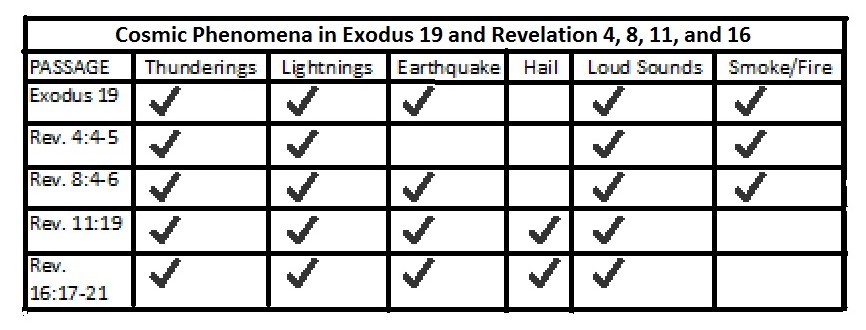
Basis (one of several): The same imagery that was present at the giving of the law, the old covenant, is echoed several times in the book of Revelation (4:5, 8:5, 11:19, and 16:18). This post will highlight these passages and their significance.

Parallel Scripture Passage: In that He says, ‘a new covenant,’ He has made the first obsolete. Now what is becoming obsolete and growing old is ready to vanish away” (Hebrews 8:13, 1st century AD).

Moses and the Israelites at Mount Sinai

Just before examining these passages in Revelation, let’s look at Exodus 19, the passage I believe they echo:

In the third month after the children of Israel had gone out of the land of Egypt, on the same day, they came to the Wilderness of Sinai. For they had departed from Rephidim, had come to the Wilderness of Sinai, and camped in the wilderness. So Israel camped there before the mountain. And Moses went up to God, and the Lord called to him from the mountain, saying, “Thus you shall say to the house of Jacob, and tell the children of Israel: ‘You have seen what I did to the Egyptians, and how I bore you on eagles’ wings and brought you to Myself. Now therefore, if you will indeed obey My voice and keep My covenant, then you shall be a special treasure to Me above all people; for all the earth is Mine. And you shall be to Me a kingdom of priests and a holy nation.’ These are the words which you shall speak to the children of Israel.”

Then it came to pass on the third day, in the morning, that there were thunderings and lightnings, and a thick cloud on the mountain; and the sound of the trumpet was very loud, so that all the people who were in the camp trembled. And Moses brought the people out of the camp to meet with God, and they stood at the foot of the mountain. Now Mount Sinai was completely in smoke, because the Lord descended upon it in fire. Its smoke ascended like the smoke of a furnace, and the whole mountain quaked greatly  (Exodus 19:1-18).

So we see that God reminded them of how He bore the people of Israel “on eagles’ wings”* out of Egypt and to Himself. God was establishing a covenant with them at this time, and He called them to be “a kingdom of priests and a holy nation.”** This gathering was marked by thundering and lightning, the sound of a loud trumpet, thick smoke, and the whole mountain quaking greatly.

*Compare to Revelation 12:13-14, where the persecuted womanwas given two wings of a great eagle, that she might fly into the wilderness to her place, where she is nourished for a time and times and half a time, from the presence of the serpent.”

**Compare this with John’s opening greeting to the seven churches, where he says that Jesus “has made us kings and priests to His God and Father” (Revelation 1:6).

Four Passages That Echo Mount Sinai in Revelation

The same cosmic phenomena present at Mount Sinai are seen again in the book of Revelation. Observe the following passages, with some brief notes on their likely significance:

1. Revelation 4:4-5

Around the throne were 24 thrones, and on the thrones I saw 24 elders sitting, clothed in white robes; and they had crowns of gold on their heads. And from the throne proceeded lightnings, thunderings, and voices. Seven lamps of fire were burning before the throne, which are the seven Spirits of God.”

As we noted in our study of Revelation 4, the 24 elders may very well “depict the 12 patriarchs of Israel and the 12 apostles, who represent the redeemed of both covenants now united in Christ.” This seems to be substantiated by the names of the 12 tribes and the 12 apostles found written on the gates and walls of the new Jerusalem (Rev. 21:12-14). So it appears that this covenant-establishing imagery takes place in the presence of elders representing both the old and the new covenant ages.

2. Revelation 8:4-6

And the smoke of the incense, with the prayers of the saints, ascended before God from the angel’s hand. Then the angel took the censer, filled it with fire from the altar, and threw it to the earth. And there were noises, thunderings, lightnings, and an earthquake. So the seven angels who had the seven trumpets prepared themselves to sound.”

This scene takes place at the opening of the seventh and final seal (Rev. 8:1). An angel with a golden censer offers the prayers of the saints, along with incense, upon the altar before God’s throne (verse 3). We proposed in our study of Rev. 8 that these prayers are linked to the cries of the martyrs for God to avenge their “blood on those who dwell on the earth” – Rev. 6:10 (see this post for a more complete study on this subject). It seems likely that the seal judgments are poured out in response to the prayers of God’s people. Therefore, the covenant-establishing imagery of Mount Sinai appears here because the prayers of the new covenant community were about to result in the old covenant system reaching its demise.

3. Revelation 11:19

Then the temple of God was opened in heaven, and the ark of His covenant was seen in His temple. And there were lightnings, noises, thunderings, an earthquake, and great hail.

Just as the scene we examined in Rev. 8 takes place at the opening of the seventh seal, this scene takes place at the sounding of the seventh trumpet. Loud voices declare, “The kingdoms of this world have become the kingdoms of our Lord and of His Christ, and He shall reign forever and ever!” The 24 elders are present at this scene (Rev. 11:15-16).

In verse 19 we see probably the most explicit reference connecting the old covenant to the prophecies in the book of Revelation. John sees a vision of God’s temple housing “the ark of His covenant.” In ancient Israel, the ark of the covenant was a centerpiece of the temple and the old covenant. Located in the Most Holy Place, it represented God’s presence: “You shall put the mercy seat on top of the ark, and in the ark you shall put the Testimony that I will give you. And there I will meet with you, and I will speak with you from above the mercy seat, from between the two cherubim which are on the ark of the Testimony, about everything which I will give you in commandment to the children of Israel” (Exodus 25:21-22). For further significance, see Numbers 7:89, 10:33-35; Joshua 3:13, 7:6-11; Judges 20:27; II Samuel 6:2; II Kings 19:15; Psalm 28:2, 80:1.

When the dust settles from the barrage of judgments in Revelation, what does heaven shout? “Behold, the tabernacle of God is with men, and He will dwell with them, and they shall be His people. God Himself will be with them and be their God” (Rev. 21:3). This did not suddenly become true because some buildings fell in 70 AD. Remember that Paul told the Corinthian church this was already their reality and that they were “the temple of the living God (II Cor. 6:16). The downfall of Israel, Jerusalem, and the temple in 70 AD, however, did remove the far less glorious old covenant system which competed against, and greatly opposed, this reality. It was a stunning and vivid demonstration that God had chosen the glorious new covenant over the inferior old covenant (see Hebrews 8). This was the time for rewarding God’s “servants the prophets and the saints, and those who fear [His] name, small and great” (Rev. 11:18).

Several verses earlier, John witnesses an actual earthquake that kills 7000 people in“the city” (Rev. 11:13), already identified in verse 8 as Jerusalem (“the great city…where also our Lord was crucified“). As we noted in our study of Revelation 11, Josephus records one awful night in early 68 AD when “a prodigious storm” took place in Jerusalem, marked by “the largest showers of rain, with continued lightnings, terrible thunderings, and amazing concussions and bellowings of the earth, that was in an earthquake.” Josephus adds that the Jewish zealots allowed the Idumaeans to come in and help them slaughter some of their fellow Jews who opposed their rebellion against the Romans. Between this slaughter and the earthquake, 8500 people died that night (Josephus, Wars 4:4:5, 4:4:7-4:5:1).

4. Revelation 16:17-21

Then the seventh angel poured out his bowl into the air, and a loud voice came out of the temple of heaven, from the throne, saying, ‘It is done!’ And there were noises and thunderings and lightnings; and there was a great earthquake, such a mighty and great earthquake as had not occurred since men were on the earth. Now the great city was divided into three parts, and the cities of the nations fell. And great Babylon was remembered before God, to give her the cup of the wine of the fierceness of His wrath. Then every island fled away, and the mountains were not found. And great hail from heaven fell upon men, each hailstone about the weight of a talent. Men blasphemed God because of the plague of the hail, since that plague was exceedingly great. 

Just as the scene we examined in Rev. 8 takes place at the opening of the seventh seal, and the scene in Rev. 11 takes place at the sounding of the seventh trumpet, this scene takes place at the pouring out of the seventh bowl.

John sees the great city, Jerusalem, divided into three parts. As we noted in our study of Revelation 16, this is a flashback to Ezekiel 5:1-12, when the prophet was required to shave his head and divide it into three parts, and was told by God: “This is Jerusalem” (Ezek 5:5).  One third of his hair was burned, one third was chopped up by the sword, and the last third was scattered into the wind. This was fulfilled when Jerusalem was destroyed in 586 B.C. at the hands of Babylon, and Josephus records the same tragedies in 70 AD at the hands of Rome (1.1 million Jews killed by the sword or by fire, and all the survivors exiled or sold into slavery). Jerusalem was also divided between 67-70 AD into three warring factions: [1] the Zealots, led by Eleazar [2] the Galileans, led by John of Gischala, and [3] the Idumeans, led by Simon.

Just as an actual deadly earthquake took place as foretold in Rev. 11, actual hail – “about the weight of a talent” (i.e. 75 – 100 pounds) – also fell as foretold in Rev. 16. Josephus wrote of large stones shot from catapults by the Roman armies into the temple complex in Jerusalem, which the watchmen in the city reported as appearing white in the sky:

“Now the stones that were cast were of the weight of a talent, and were carried two furlongs and further. The blow they gave was no way to be sustained, not only by those that stood first in the way, but by those that were beyond them for a great space. As for the Jews, they at first watched the coming of the stone, for it was of a white color, and could therefore not only be perceived by the great noise it made, but could be seen also before it came by its brightness” (Josephus, Wars 5:6:3).

Josephus also records that the watchmen on the wall, when they saw the stones coming, would shout, “The Son cometh!” After a while the Romans learned to blacken the stones so that they couldn’t as easily be detected, and many more were crushed by these stones. J. Stuart Russell, in his 1878 book titled The Parousia, offers this explanation for the words of the watchmen (p. 482):

“It could not but be well known to the Jews that the great hope and faith of the Christians was the speedy coming of the Son. It was about this very time, according to Hegesippus [110-180 AD], that St. James, the brother of our Lord, publicly testified in the temple that ‘the Son of man was about to come in the clouds of heaven,’ and then sealed his testimony with his blood [in 62 AD]. It seems highly probable that the Jews, in their defiant and desperate blasphemy, when they saw the white mass hurtling though the air, raised the ribald cry, ‘The Son is coming,’ in mockery of the Christian hope of the Parousia.”

—————————————————————————

In his book,Revelation: Four Views (A Parallel Commentary),” Steve Gregg also sees the connection between Mount Sinai and Revelation, as he shares concerning Rev. 4 (p. 88):

“The lightnings, thundering and voices (v. 5) recall Mount Sinai, where God first established His covenant with Israel [Exodus 19:16; cf. Rev. 8:5, 11:19]. Similar phenomena are mentioned here to suggest the end of that covenant and its replacement with another. The writer of Hebrews (citing Hag. 2) likened the overthrow of the first covenant (publicly demonstrated by the destruction of Jerusalem and the temple in A.D. 70) to the time of its establishment at Sinai, but the latter would be accompanied by even more fearful phenomena (Heb. 12:18-29).”

Steve Gregg also shares David Chilton’s comparison of Revelation 19:1-6 with Revelation 11:15-19 (which we have already examined). Chilton indicates that very similar subject matter is established “in the two passages which represent the closing visions of the two major sections of the book” (p. 440):

1. loud voices…in heaven (11:15; 19:1);
2. the declaration of the commencement of the reign of God (11:15, 17; 19:1, 6);
3. the twenty-four elders fall on their faces and worship (11:16; 19:4);
4. the avenging of the blood of His servants is announced (11:18; 18:24; 19:2);
5. reference to God’s servants…who fear Him, small and great (11:18; 19:5);
6. loud noises, including thunderings (11:19; 19:6).

—————————————————————

Check out the first two posts in this mini-series:

1. Revelation 6 and Luke 23: Hide Us From the Wrath of the Lamb
2. The Avenging of Righteous Blood (Deuteronomy, Matthew, and Revelation)

Revelation: The Land (“Ge”) Is Referenced 22 Times More Often Than the World (“Kosmos”)


It’s well-known that the book of Revelation foretells, among other things, a series of frightening judgments falling upon an entity known as Babylon the Great and “the harlot.” Just as importantly, Revelation also portrays beautiful worship scenes and glorious destinies and realities for God’s people. Regarding the judgments, Does John picture them being poured out upon the entire planet, or upon a particular location?

Jonathan Welton, author of the book “Raptureless,” has created another helpful graphic illustrating the fulfillment of Bible prophecy (See his previous graphic on Daniel 2 illustrating that God’s kingdom has come). Titled “John’s Olivet Discourse: A Look at the Writings of John,” Welton’s graphic [1] makes a case that the book of Revelation contains John’s version of the Olivet Discourse [2] shows some of John’s time tables [3] notes an important principle of Bible interpretation, and [4] shows that John speaks far more about local events in Revelation than he speaks about global events.

We can also add Revelation 1:1 and 1:3 to Welton’s list of time statements made by the apostle John:

The Revelation of Jesus Christ, which God gave Him to show His servants—things which must shortly take place.
Blessed is he who reads and those who hear the words of this prophecy, and keep those things which are written in it; for the time is near.

The last part of Welton’s graphic is very informative. The following chart takes the numbers he provides (plus a couple more that I looked up) and allows us to see how focused John was on local events in the book of Revelation compared to his gospel account:

John’s books Number of chapters in each book Number of times John uses the word “kosmos,” meaning the entire planet Number of times John uses the word “ge,” meaning the land (a region)
The Gospel According to John 21 57 3
I John 5 17 1
II John 1 1 0
III John 1 0 0
Revelation 22 3 67

In other New Testament passages where the word “ge” is translated as “earth,” many assume that those passages are speaking about the entire planet. We need to be more careful with this assumption. One instance where it appears is in Luke’s version of the Olivet Discourse (Luke 21:23). There, Luke is clearly speaking about Israel. Some Bible versions translate this word as “earth,” while others translate it as “land.” Here is how Luke 21:23 reads, in context:

But when you see Jerusalem surrounded by armies, then know that its desolation is near. Then let those who are in Judea flee to the mountains, let those who are in the midst of her depart, and let not those who are in the country enter her. For these are the days of vengeance, that all things which are written may be fulfilled. But woe to those who are pregnant and to those who are nursing babies in those days! For there will be great distress in the land and wrath upon this people” (Luke 21:20-23).

The same word that Luke used in reference to Judea is the one that John used 67 times in the book of Revelation.

18 Case Studies on How John Used “Ge” to Speak of 1st Century Israel in Revelation

In 2010 I wrote a 3-part series tracking this phenomenon throughout the book of Revelation. The phrase “those who dwell on the earth” appears 10 times in Revelation, and at least a couple dozen more times in various forms. This series presents 18 case studies showing when and how this expression is used, examining the context in each case, and seeing how it’s used elsewhere in Scripture. A strong case is made that this expression in Revelation indicates 1st century apostate Israel. This series can be seen here: Part 1, Part 2, Part 3. If you have the time to read it, I believe you’ll find it informative.

A Final Note on How John Used the Word “Kosmos” Three Times in Revelation

Although it’s fun and enlightening to see how John used the word “ge” so many times in reference to the land of Israel, it’s also enlightening to see how he used the word “kosmos” to speak of the planet on which we live. Two of these instances concern those whose names are, or are not, written in the Book of Life. This is a global reference, as it ought to be, for the body of Christ is global and the message of the gospel is for every nation, tribe, language, and tongue. The third reference is to the kingdom of God, its triumph and greatness over all the kingdoms of this world (planet), and the eternal and universal reign of Jesus Christ:

1. “Then the seventh angel sounded: And there were loud voices in heaven, saying, ‘The kingdoms of this world have become the kingdoms of our Lord and of His Christ, and He shall reign forever and ever!'” (Rev. 11:15)
2. “All who dwell on the earth will worship him, whose names have not been written in the Book of Life of the Lamb slain from the foundation of the world” (Rev. 13:8).
3. “The beast that you saw was, and is not, and will ascend out of the bottomless pit and go to perdition. And those who dwell on the earth will marvel, whose names are not written in the Book of Life from the foundation of the world, when they see the beast that was, and is not, and yet is” (Rev. 17:8).

The Avenging of Righteous Blood (Deuteronomy, Matthew and Revelation)


Series: “Little Gems from Our Study of the Book of Revelation”

Recently my friend, Jerry William Bowers Jr., posted the following status on Facebook:

Revelation simplified:

Revelation 6:10, 16:6, 17:6, 18:24, 19:2, 20:4 speaks to the avenging of righteous blood.

This was prophesied in Deuteronomy 32:43, and would occur in Israel’s “END” (Deuteronomy 32:20) in their “Latter end” (Deuteronomy 32:29).

Matthew 23:34-36 very clearly says this would be fulfilled in their own generation.

It just doesn’t get any simpler than that!

I agree with Jerry’s summary, and would like to develop it further. During the last several years of studying eschatology, one thing I’ve enjoyed immensely is allowing Scripture to interpret Scripture. It’s an enlightening exercise. To give one example, I was taught for a long time that Isaiah’s imagery of a wolf lying down with a lamb is both unfulfilled and a literal reference to the animal kingdom. However, I’ve now come to understand, by allowing Romans 15 to interpret Isaiah 11, that this is presently fulfilled in Christ, who broke down the wall of division between Jews and Gentiles so that all may find their hope in Him (see “Romans 15 Shows That Isaiah 11 Is Fulfilled“).

Deuteronomy 32: Prediction of Israel’s End and Judgment for Murdering God’s People

Jerry’s status is also an appeal to allow Scripture to interpret Scripture, in this case concerning the theme of the blood of the martyrs. Let’s take a look at the passages he referenced in Deuteronomy 32, plus one more (verse 5). There Moses is speaking to Israel (Deut. 31:30), which he very interestingly addresses as “heaven” and “earth” (Deut. 32:1).

“They have corrupted themselves; They are not His children, because of their blemish: a perverse and crooked generation” (Deut. 32:5).

And He said: ‘I will hide My face from them, I will see what their end will be, for they are a perverse generation, children in whom is no faith‘” (Deut. 32:20).

For they are a nation void of counsel, nor is there any understanding in them. Oh, that they were wise, that they understood this, that they would consider their latter end! (Deut. 32:28-29).

Rejoice, O Gentiles, with His people; For He will avenge the blood of His servants, and render vengeance to His adversaries; He will provide atonement for His land and His people” (Deut. 32:43).

Does anything jump out when noting Moses’ language in verse 20? Recall what Jesus said to His Israelite audience in Matthew 17:

Then Jesus answered and said, “O faithless and perverse generation, how long shall I be with you? How long shall I bear with you? Bring him here to Me” (Matthew 17:17).

Moses predicted that at the time of Israel’s end, they would be a perverse and faithless generation. Jesus ministered in Israel to the same generation that was overthrown by the Romans in 70 AD, and He called that generation “faithless and perverse.” It would seem that Jesus intentionally invoked Moses’ words in Deut. 32:20. The apostle Paul did the same thing when addressing the Philippian church, as he used the exact same phrase Moses used in Deut. 32:5.

Do all things without complaining and disputing, that you may become blameless and harmless, children of God without fault in the midst of a crooked and perverse generation, among whom you shine as lights in the world…” (Philippians 2:14-15).

Matthew 23: Jesus’ Own Generation Responsible for The Blood of God’s Servants

We turn now to Jesus’ prediction in His woes upon the Scribes and Pharisees. He declared that they “build the tombs of the prophets and adorn the monuments of the righteous” (Matt. 23:29), and that they “are sons of those who murdered the prophets” (verse 31). Jesus went on to say:

Therefore, indeed, I send you prophets, wise men, and scribes: some of them you will kill and crucify, and some of them you will scourge in your synagogues and persecute from city to city, that on you may come all the righteous blood shed on the earth, from the blood of righteous Abel to the blood of Zechariah, son of Berechiah, whom you murdered between the temple and the altar. Assuredly, I say to you, all these things will come upon this generation” (Matt. 23:34-36).

Moses, in Deuteronomy 32, predicted that God would “avenge the blood of His servants” at the time of Israel’s end. Jesus told the religious leaders of Israel that they would be held responsible for “all the righteous blood shed on earth” (or land, that is, Israel’s land). He made it clear that their generation would experience that judgment.

Revelation: The Avenging of the Blood of God’s Saints, Prophets, and Apostles

In the book of Revelation, as John is shown a series of judgments being poured out, we see this scene in heaven:

When He opened the fifth seal, I saw under the altar the souls of those who had been slain for the word of God and for the testimony which they held. And they cried with a loud voice, saying, “How long, O Lord, holy and true, until You judge and avenge our blood on those who dwell on the earth?” (Rev. 6:9-10)

Many believe or teach that the judgments of Revelation will be poured out in our own future and upon the entire globe, but who did Jesus say would be held responsible for all the bloodshed of God’s servants? What generation did He say would experience that vengeance? Without a doubt, it was His own people (Israel) and His own generation. As the outpouring of judgment progresses in the book of Revelation, we see how God answers the cries of the martyrs:

Then the third angel poured out his bowl on the rivers and springs of water, and they became blood. And I heard the angel of the waters saying: “You are righteous, O Lord, the One who is and who was and who is to be, because You have judged these things. For they have shed the blood of saints and prophets, and You have given them blood to drink. For it is their just due” (Rev. 16:4-6).

So he carried me away in the Spirit into the wilderness. And I saw a woman sitting on a scarlet beast which was full of names of blasphemy, having seven heads and ten horns. The woman was arrayed in purple and scarlet, and adorned with gold and precious stones and pearls, having in her hand a golden cup full of abominations and the filthiness of her fornication. And on her forehead a name was written: MYSTERY, BABYLON THE GREAT, THE MOTHER OF HARLOTS AND OF THE ABOMINATIONS OF THE EARTH. I saw the woman, drunk with the blood of the saints and with the blood of the martyrs of Jesus. And when I saw her, I marveled with great amazement” (Rev. 17:3-6).

They threw dust on their heads and cried out, weeping and wailing, and saying, ‘Alas, alas, that great city, in which all who had ships on the sea became rich by her wealth! For in one hour she is made desolate.’ “Rejoice over her, O heaven, and you holy apostles and prophets, for God has avenged you on her!” …And in her was found the blood of prophets and saints, and of all who were slain on the earth” (Rev. 18:19-24).

For true and righteous are His judgments, because He has judged the great harlot who corrupted the earth with her fornication; and He has avenged on her the blood of His servants shed by her” (Rev. 19:2).

In our series on the book of Revelation, we noted that “the great city” was first identified in Rev. 11:8 as the place “where our Lord was crucified.” This is a positive identification of Jerusalem as “the great city” spoken of in the book of Revelation. It’s no wonder that “in her was found the blood of prophets and saints…” This is the very thing that Jesus said in Matthew 23 would be true of first century Jerusalem. This is also the time when the apostles lived and ministered (Rev. 18:20).

The great city, Babylon the Great, was called “the mother of harlots.” Did Jesus not refer to His own generation in Israel as “a wicked and adulterous generation” (e.g. Matthew 12:39, 16:4)? Did Jeremiah not use similar language to describe ancient Israel during times of apostasy? Was it not legitimate for God to use the language of adultery against an unfaithful nation that was in covenant with Him? Had first century Israel not become as awful and wicked as their ancient enemy and conqueror, Babylon?

See our study on Revelation 17:1-6 for the significance of the harlot imagery that John used, the garments that the harlot wore, the words on her forehead, the rich Old Testament background for all these things, and the harlot’s close partnership with first-century Rome.

The Apostle Paul Prophesies Judgment and Tribulation Against the Israel of His Day

In light of everything we’ve discussed above, it’s also good to take note of what the apostle Paul said to the believers in Thessalonica who were suffering and enduring persecution at the time of his letters (52-54 AD):

For you, brethren, became imitators of the churches of God which are in Judea in Christ Jesus. For you also suffered the same things from your own countrymen, just as they did from the Judeans, who killed both the Lord Jesus and their own prophets, and have persecuted us; and they do not please God and are contrary to all men, forbidding us to speak to the Gentiles that they may be saved, so as always to fill up the measure of their sins; but wrath has come upon them to the uttermost” (I Thessalonians 2:14-16)

“…[We] ourselves boast of you among the churches of God for your patience and faith in all your persecutions and tribulations that you endure, which is manifest evidence of the righteous judgment of God, that you may be counted worthy of the kingdom of God, for which you also suffer; since it is a righteous thing with God to repay with tribulation those who trouble you, and to give you who are troubled rest with us when the Lord Jesus is revealed from heaven with His mighty angels, in flaming fire taking vengeance on those who do not know God, and on those who do not obey the gospel of our Lord Jesus Christ” (II Thessalonians 1:4-8).

Paul affirmed that the time had nearly come for the inhabitants of Judea to experience God’s wrath “to the uttermost” for killing Jesus and the prophets. Their opposition to the gospel was “contrary to all men” and was a great hindrance in the quest to spread the gospel among the Gentiles. It would be “a righteous thing with God” when they were repaid with tribulation, and it would result in them receiving rest. Jesus had promised to come with His angels in judgment and in His kingdom while some of His disciples were still alive (Matthew 16:27-28).

To Review

1. Moses prophesied that God would “avenge the blood of His servants” upon a faithless, perverse, and crooked generation at the time of Israel’s “latter end” (Deuteronomy 32:5, 20, 29, 43).

2. Jesus repeatedly denounced His own generation as “perverse”, “faithless”, and “adulterous.” Paul told the Philippian church that they were shining as lights in the midst of “a crooked and perverse generation” (Phil. 2:14-15).

3. Jesus told the religious leaders of Israel that their generation would be held responsible and judged for all the righteous blood shed on earth (Matthew 23:29-36).

4. John was shown a scene of martyrs crying out for their blood to soon be avenged “on those who dwell on the earth” (Revelation 6:10).

5. John then sees seven bowls poured out “on the earth” (Rev. 16:1), and one of them causes the rivers and springs to become blood in order to judge those who had “shed the blood of saints and prophets” (Rev. 16:4-6).

6. John also sees a harlot dressed like a high priest of Israel and “drunk with the blood of the saints and with the blood of the martyrs of Jesus” (Rev. 17:3-6).

7. In Revelation 18:19-24, John sees the great city, earlier identified as Jerusalem (Rev. 11:8), overthrown and made desolate (see Matthew 23:38). The holy prophets and apostles, and all of heaven, were told to rejoice over this scene because God had avenged them on her, and because “in her was found the blood of prophets and saints, and of all who were slain on the earth.

8. In Revelation 19, John sees a heavenly scene in which there is much rejoicing over God’s righteous and true judgments, because He had judged the great harlot and “avenged on her the blood of His servants shed by her” (verse 2). With the harlot judged and put away, John sees that “the marriage of the Lamb has come, and His wife has made herself ready” (verse 7).

Dear Abby


‎[Dear Abby]

So, I opened up the newspaper this morning and read this letter by a guy named “John.” No other information was given about him but apparently he wrote about these dreams he had from God on an island about an impending change to the world and the end of this current age. He also had some great insight from God on how my church should change to live more rightly before God.

I was actually very excited and encouraged because it would seem that the tribulation we are enduring will be coming to an end, and the very first line of his letter said that all of this stuff would take place soon.

[Dear Reader]

Don’t get too excited. None of this was meant for you. All those things John was talking about won’t happen for at least another 2,000 years or more. “Soon” doesn’t mean “soon,” darling. It means at a minimum 2,000 years. Get your facts straight!

Those churches he was speaking about aren’t your churches. He was just using the same names, you silly goose. They were metaphorical language for “ages.” The tribulation you Christians are going through at the hands of the Roman authorities you think will end… forget about it. Why do you people think it’s always about YOU? Can’t you see this letter was not written for YOU?

One piece of advice I have for you: Get your time indicators straight. “Soon” doesn’t mean “soon”. It means it might actually happen quickly when it starts. “You” means “them”. “This” generation means “that” generation. “At hand” means…. well something that’s not soon. If you simply take the time indicators and make them the opposite of what they mean, things will make much more sense. So, don’t be encouraged by this [man]’s letters. They’re not for you.

This dialogue above was posted early this morning by Robert Woodrow in a Facebook forum devoted to the subject of eschatology. I felt it was quite creative. Robert said he wanted to imagine that “someone from one of the seven churches [of the first century] actually wrote into an advice column,” and received a response that reflects the way the book of Revelation is often viewed today.

This imagined dialogue is both humorous and thought-provoking. I know that I once gave very little (if any) thought to what the book of Revelation meant to those who first received it into their hands (i.e. God’s people living in the first century). As I was trained, I jumped straight to what it could mean to me and to my generation. In doing so, I got way off track.

No doubt this great book does speak to our generation, but, because that’s so often our first and only consideration, we miss out on what John (and Jesus, through John) wanted to communicate to God’s people at that time. On the other hand, if we will first take into account audience relevance, we are then far more likely to grasp the relevance of this book for our own time. And it does speak to us in a very powerful and hope-filled way.

All of our Revelation chapter-by-chapter studies, and any other posts related to the book of Revelation, can be found here.

Revelation Study Resources


The following is a list of online resources that we used as we studied the book of Revelation in 2009-2010. (At the bottom of this page are two books that we also used.)

[A] Preterist viewpoint:

[1] http://www.ccel.org/contrib/exec_outlines/rev.htm
-“Revelation: A Study Guide” by Mark Copeland
-Includes all 22 chapters of Revelation
-Also available here: http://executableoutlines.com/rev.htm

[2] http://www.preteristarchive.com/StudyArchive/index.html
-Limited Scripture Study Archive
-Only has commentary on the following texts: Revelation 1:7, 6:16-17, 9:11, 11:1, 13:18, 17:10, 20:1-10

[3] http://www.preteristarchive.com/
-Type a Scripture text into the search box, and you may or may not find some valuable commentary on that particular text, both modern and ancient commentary.

[B] Neutral viewpoint:

[4] http://www.desiringgod.org/ResourceLibrary/Sermons/ByScripture/17/
-John Piper’s sermons on Revelation over the years
-Generally non-eschatological
-Sermons available only for chapters 1, 2, 3, 5, 8, 19, 21, 22

[C] Futurist and/or Dispensationalist viewpoint:

[5] http://www.gcfweb.org/institute/general/revelation.pdf
-From the Grace Institute for Biblical Leadership
-In outline form, and covers all 22 chapters of Revelation
-In PDF format, so they can be saved and read offline

[6] http://www.soniclight.com/constable/notes/pdf/revelation.pdf
-Notes on Revelation from Dr. Thomas Constable, Department Chairman and Senior Professor of Bible Exposition at Dallas Theological Seminary
-In outline form, and covers all 22 chapters of Revelation
-In PDF format

[7] http://www.studylight.org/com/guz/view.cgi?book=re
-Commentary on the book of Revelation from David Guzik, director of Calvary Chapel Bible College in Siegen, Germany.
-In outline form, and covers all 22 chapters of Revelation

[D] Dr. Sam Storms/Historicist viewpoint

[8] http://www.enjoyinggodministries.com/studies/eschatology/
-Sam Storms is an Amillennialist, and the best I can tell he is also a Historicist. His writings on the various Millennial views came in handy in our study of Revelation 20.
-His commentary at the above site covers Revelation 10, 11, 12, 14, 17, 18, 19, 20, and 21
-He also writes about the seven seals (chapters 6, 8); the seven trumpets (chapters 8, 9, 11); and the seven bowls (chapter 16).
-His meditations on Revelation 2-3 (letters to the seven churches) are here: http://www.enjoyinggodministries.com/biblical-studies/ (scroll down the page 1/3 of the way)

**********************************************************************************************************

The following are offline sources (books) that we used in our study of Revelation:

[1] Gentry, Kenneth L. Before Jerusalem Fell: Dating the Book of Revelation (An Exegetical and Historical Argument for a Pre-A.D. 70 Composition). American Vision: Powder Springs, Georgia, 1988.

[2] Gregg, Steve. Revelation: Four Views (A Parallel Commentary). Thomas Nelson Publishers: Nashville, 1997.

PP7: Internal Evidence for an Early Date (Revelation)-Part 4


This is now the seventh part in our series on “A Partial-Preterist Perspective on the Destruction of Jerusalem in 70 AD.” This is the same title as a term paper I recently submitted to Northwestern College. The first segment included the Title Page, Outline, Introduction, and a brief introduction to Partial-Preterism. The second segment consisted of the References page, and the third segment was a discussion of the external evidence for an early date for the writing of the book of Revelation. These segments can be found here:

[1] https://kloposmasm.wordpress.com/2009/08/13/brief-explanation-of-partial-preterism/
[2] https://kloposmasm.wordpress.com/2009/08/13/pp2-references/
[3] https://kloposmasm.wordpress.com/2009/08/13/pp3-external-evidence-for-an-early-date-revelation/

We then turned to a discussion of the internal evidence for an early date. In Part 1 we discussed the inclusion of Jerusalem, the temple, Babylon the Great, and a great city in the book of Revelation. Part 2 dealt with the seven kings mentioned in Revelation 17:9-10 and the identity of the beast of the book of Revelation. Part 3 addressed Nero’s persecution of the saints and his prophesied demise. These posts can be found here, and it is recommended that they be read first:

[4] https://kloposmasm.wordpress.com/2009/08/14/pp4-internal-evidence-for-an-early-date-revelation-part-1/
[5] https://kloposmasm.wordpress.com/2009/08/14/pp5-internal-evidence-for-an-early-date-revelation-part-2/
[6] https://kloposmasm.wordpress.com/2009/08/14/pp6-internal-evidence-for-an-early-date-revelation-part-3/

Part 4 will speak of the worship of Nero and the worship of his image even after his death. We will also see that the language used by John strongly indicates the relevance of the entire book of Revelation to the first-century Christians who were alive when he wrote this book.

Adam Maarschalk

————————————————————————————————————————————————-

II. Internal Evidence for an Early Date (Part 4)

Interestingly, Vitellius, the ninth emperor, was even more devoted [than the Roman Emperor Otho–see previous post] in his worship of Nero. It is said that he “greatly pleased the public by offering sacrifices to Nero’s spirit in the Campus Martius [Latin for Field of Mars, a 2 sq km public square in Rome], making all the priests and people attend.” These were his “funerary offerings to Nero” and this left “no doubt in anyone’s mind what model he chose for the government of the State” (Suetonius, Vitellius 11:2). The actions of Vitellius appear to fulfill what was written in Revelation 13:11-12 of a second beast, referred to later as the false prophet. This text states: “Then I saw another beast rising out of the earth. It had two horns like a lamb and it spoke like a dragon. It exercises all the authority of the first beast in its presence [or on its behalf], and makes the earth and its inhabitants worship the first beast, whose mortal wound was healed.” Vitellius had such a rabid fascination with Nero that Vespasian had to “make a determined effort to check the growth of the Nero cult when he came to power.”

Paul Kroll (1999) writes the following about the prospect of Vitellius, or someone like him, fulfilling the role of the false prophet in Nero’s time:

The false prophet sends out a universal order to “set up an image in honor of the beast” (verse 14)… Strangely enough, the false prophet gives the inanimate image breath so that it can speak. Thus, the second beast has power to animate the image of the first beast. In the time Revelation was written, this was not an alien idea. The ancients believed that statues spoke and performed miracles. It was thought that the gods and demons used statues as conduits to communicate with humans and work miracles. For example, the heretic Simon Magus is said to have brought statues to life (Clementine Recognitions 3.47; Justin, Apologia 1.26; Irenaeus, Against Heresies 1.23). In ancient times, that was precisely the point of having idols. People thought that the life of the person or being was actually in the idol.

In their book, Late Antiquity: A Guide to the Postclassical World (1999), the authors (Brown, Bowersock, Grabar) write about the common sight of images of Roman emperors in the third and fourth centuries. These images took prominent places throughout the empire and were literally worshipped. This was ordinary in the first century as well:

Those who beheld Constantine in his golden raiment were said by Eusebius to be “stunned and amazed by the sight—like children who have seen a frightening apparition.” But away from court and capital, emperors rarely appeared in person. In the provinces, their presence was represented by statues and other images. Municipal squares were dominated by imperial statues; the portraits of emperors hung in official buildings, shops, theaters, and public porticoes… In their range and variety, imperial images made emperors omnipresent…the crowd applauded not only the emperor but also his image as it was paraded around them, surrounded—like the emperor himself—by the imperial bodyguard… These mirror images of majesty not only made permanent the transitory messages of imperial ceremonial, but were designed to blur the distinction between emperors and their representations… [There was] a rigid insistence on the performance of the same rituals and ceremonies before imperial images as before the emperor himself. Those approaching an emperor’s statue were required to prostrate themselves “not as though they were looking at a picture, but upon the very face of the emperor.” A proper atmosphere of sanctity was to be maintained at all times (pp. 173-174).

As expected then, statues of Nero’s likeness already existed in the Roman Empire during his lifetime, even from early in his reign. In 55 AD, the second year of his reign, the Roman senate erected a statue of Nero in the Temple of Mars that stood between 110 and 120 feet high. “The emperor’s brow was crowned with rays, suggesting a comparison or identification with the Sun-god” (Kenneth Gentry, 2002). His portrait appeared on coins at the time as Apollo playing the lyre. “He appears with his head radiating the light of the sun on copper coins struck in Rome and at Lugdunum.” Even his mother, Agrippina, was hailed by provincial coins “as goddess and the parent of a god.” Inscriptions found in Ephesus called Nero “Almighty God” and “Savior,” and inscriptions found in Cyprus called him “God and Savior” (pp. 80-81). The behavior of the highly-revered Augustus Caesar (27 BC-14 AD) was very modest compared to the worship Nero demanded for himself. Dio Cassius writes of an incident in which a regional king was compelled to worship both Nero and his image. This occurred in 66 AD when Tiridates, King of Armenia, paid Nero a visit:

Indeed, the proceedings of the conference were not limited to mere conversations, but a lofty platform had been erected on which were set images of Nero, and in the presence of the Armenians, Parthians, and Romans Tiridates approached and paid them reverence; then, after sacrificing to them and calling them by laudatory names, he took off the diadem from his head and set it upon them…Tiridates publicly fell before Nero seated upon the rostra in the Forum: “Master, I am the descendant of Arsaces, brother of the kings Vologaesus and Pacorus, and thy slave. And I have come to thee, my god, to worship thee as I do Mithras. The destiny thou spinnest for me shall be mine; for thou art my Fortune and my Fate” (Gentry, p. 82).

“By this action this king actually worshiped ‘the image of the Beast’ (Rev. 13:15),” says Gentry. One senator, though, failed to worship Nero and his “Divine Voice,” and Dio Cassius records that he was executed: “Thrasaea was executed because he failed to appear regularly in the senate…and because he never would listen to the emperor’s singing and lyre-playing, nor sacrifice to Nero’s Divine Voice as did the rest.” Nero was even deified in Greece, where he spent a significant amount of time in 67 AD as a musician and actor in the Grecian festivals. There he was proclaimed as “Zeus, Our Liberator,” and his statue was set up in the temple of Apollo where he was called “The new Sun, illuminating the Hellenes.” When he returned to Rome in early 68 AD, the entire population was made to come out and greet him with these words: “Hail, Olympian Victor! Hail, Pythian Victor! Augustus! Augustus! Hail to Nero, our Hercules! Hail to Hero, our Apollo! The only Victor of the Grand Tour, the only one from the beginning of time! Augustus! Augustus! O, Divine Voice! Blessed are they that hear thee” (Gentry, p. 83). Richard Anthony (2009) speaks further of the allegiance required by Nero during his lifetime:

All those under the jurisdiction of Rome were required by law to publicly proclaim their allegiance to Caesar by burning a pinch of incense and declaring, “Caesar is Lord”. Upon compliance with this law, the people were given a papyrus document called a “libellus”, which they were required to present when either stopped by the Roman police or attempting to engage in commerce in the Roman marketplace, increasing the difficulty of “buying or selling” without this mark (emphasis added).

If Vitellius was indeed the second beast who compelled the Roman world to be marked with the name or number of the first beast (Revelation 13:16-18), then the practice described by Anthony above would have continued during his 8-month reign. Scripture seems to indicate that it would have been taken to an even more oppressive level. No doubt he also would have carried on Nero’s practice of putting to death those who would not worship the images of Nero, which in Nero’s day were considered to be divine.

John revealed the identity of the beast to his readers in a coded manner, Richard Anthony (2009) says, using the system of Gematria which assigned numerical values to the alphabet: “John used this puzzle to reveal Nero without actually writing down his name. Remember, the early churches were being persecuted during this time—not only from the Jews, but also from the Romans.” The following chart shows the Hebrew letters in ‘Nero Caesar’ (NRWN QSR):

Nero's Name

John wrote to seven historical churches in Asia Minor (Rev. 1:4, 11) which were going through a time of great trouble and tribulation, just as he was (Rev. 1:9, 2:3, 2:9-10, 2:13, 3:10). What better candidate was there for such an intense time of trouble than the first and greatest imperial persecution of Christianity initiated by Nero from late November 64 AD until his death in early June 68 AD?[1] Kenneth Gentry (2002) poses this question for those who hold to the Futurist position: “Put yourself in first century sandals: Would you think John might be speaking of events occurring untold centuries after the collapse of the Empire which was presently persecuting you? Would you surmise that he was not really relating a message about Imperial Rome?”

John wrote the book of Revelation in such a way that the subject matter of the entire book, not just his letters to the churches, was urgent for and relevant for those churches. At the end of the book, Jesus said, “And behold, I am coming soon. Blessed is the one who keeps the words of the prophecy of this book” (Revelation 22:7). God, speaking in terms that man would understand, spoke through John saying, “The Revelation of Jesus, which God gave him to show his servants the things that must soon take place…Blessed is the one who reads aloud the words of this prophecy, and blessed are those who hear, and who keep what is written in it, for the time is near” (Revelation 1:1-4). We see that the seven churches who received this writing were encouraged to read the entire book aloud in their assemblies, and to keep what was written in it. We can also note that the Greek word used for “soon” here is the same one Jesus used when He said His time to be crucified was “at hand” (Matthew 26:18), and when John said “the Jews’ Feast of Booths was at hand” (John 7:2), events that no doubt were literally near. Four times Jesus said, “Behold, I am coming quickly” (Revelation 3:11; 22:7, 12, 20). In some translations, “soon” is used instead of “quickly.”

It’s noteworthy that Daniel was told that the prophecies he received referred “to many days from now” (Daniel 8:26), and were for the time of the end and thus they were to be “shut up and sealed” (Daniel 12:4, 9). Yet John in his time, as pointed out by both Kenneth Gentry (2002) and David Lowman (2009 [4]), was told not to seal up the prophecies he received because the time of their fulfillment was near (Revelation 22:10). If their fulfillment has still not come in our day, how do we account for these different instructions, when one set of prophecies was given about 2550 years ago and the other set about 1950 years ago?

Dispensationalism assumes that when Daniel mentioned “the time of the end,” he was referring to the end of the world. However, the context itself contains other constraints, and it should be noted that the phrase “the end of time” is never used in these prophecies. Daniel had already been told that his visions concerned his people (e.g. 11:14). Again he was told that “at the time of the end” (11:40) Michael, “the great prince who has charge of your people,” would arise. There would be a time of trouble, “such as never has been since there was a nation till that time [cf. Matthew 24:21]. But at that time your people shall be delivered, everyone whose name shall be found written in the book” (Daniel 12:1).

Whose “time of the end” was God referring to? From the language used, it’s evident that these things directly concerned the nation of Israel rather than mankind in general. Daniel asked for a more specific time marker (12:6), and he was given one: “…it would be for a time, times, and half a time, and that when the shattering of the power of the holy people comes to an end all these things would be finished” (12:7). The utter destruction of Jerusalem, the temple, and more than a million Jews in 70 AD did accomplish this. Daniel’s writings will be examined in more detail later.

Another intriguing detail in the book of Revelation is that twice in the letters to the seven churches (Revelation 2:9 and 3:9), Jesus spoke of Judaizers who were persecuting the churches, saying they were “of the synagogue of Satan who say that they are Jews and are not.” After the destruction of Jerusalem in 70 AD this type of persecution faded, but it was certainly a significant factor in the Church prior to that event. Therefore, it would make far more sense for this remark to have been written while Jerusalem and the temple still stood.

Other examples of internal evidence for an early date will be shown, whether explicit or implicit, in the section on actual historical events during the Roman/Jewish War.


[1] John’s participation in this persecution means that it was imperial, coming from Rome, as only Rome had the authority to banish individuals to Patmos, its own prison island. If the early date is true for Revelation’s authorship, John then wrote no earlier than November 64 AD because this is when the first imperial persecution began.

PP6: Internal Evidence for an Early Date (Revelation)-Part 3


This is now the sixth part in our series on “A Partial-Preterist Perspective on the Destruction of Jerusalem in 70 AD.” This is the same title as a term paper I recently submitted to Northwestern College. The first segment included the Title Page, Outline, Introduction, and a brief introduction to Partial-Preterism. The second segment consisted of the References page, and the third segment was a discussion of the external evidence for an early date for the writing of the book of Revelation. These segments can be found here:

[1] https://kloposmasm.wordpress.com/2009/08/13/brief-explanation-of-partial-preterism/
[2] https://kloposmasm.wordpress.com/2009/08/13/pp2-references/
[3] https://kloposmasm.wordpress.com/2009/08/13/pp3-external-evidence-for-an-early-date-revelation/

We then turned to a discussion of the internal evidence for an early date. In Part 1 we discussed the inclusion of Jerusalem, the temple, Babylon the Great, and a great city in the book of Revelation. Part 2 dealt with the seven kings mentioned in Revelation 17:9-10 and the identity of the beast of the book of Revelation. These posts can be found here, and it is recommended that they be read first:

[4] https://kloposmasm.wordpress.com/2009/08/14/pp4-internal-evidence-for-an-early-date-revelation-part-1/
[5] https://kloposmasm.wordpress.com/2009/08/14/pp5-internal-evidence-for-an-early-date-revelation-part-2/

Part 3 will address Nero’s campaign of persecution against the saints, as well as his prophesied demise.

Adam Maarschalk

————————————————————————————————————————————————-

II. Internal Evidence for an Early Date (Part 3)

In what sense might Jerusalem have sat on the beast with seven heads (mountains), the beast that would ultimately turn on her and destroy her (Rev. 17:3, 9, 16-18)? Israel had enjoyed a good relationship with Rome until the Jewish revolt began in 66 AD, and Judaism was recognized as a valid religion within the Roman Empire. Josephus wrote of this relationship, “It seems to me to be necessary here to give an account of all the honors that the Romans and their emperors paid to our nation [Israel], and of the leagues of mutual assistance they have made with it” (Antiquities, 14.10.1-2). The Jews frequently took advantage of this relationship to induce persecution against Jesus and His followers (Luke 23:2; John 18:28-31, 19:15; Acts 4:27, 16:20, 17:7, 18:12, 21:11, 24:1-9, 25:1-2).[1]

Prior to Nero’s persecution, writes Kenneth Gentry (2002), persecution against Christians had come largely from the Jews. Christianity was considered a sect of Judaism, which was a “legal religion.” Gentry notes, “Earlier Paul had safely appealed to Nero Caesar (Acts 25:11-12; 28:19) and in A.D. 62 had been acquitted and released.” Herbert Workman, in his 1906 work, Persecution in the Early Church, said that Rome didn’t make a clear distinction between Christianity and Judaism until 64 AD (pp. 62-63).

Kenneth Gentry takes note of the testimonies of early historians regarding Nero’s campaign of persecution against Christians (pp. 54-55, 64-66). Clement of Rome (30-100 AD) said that it targeted “a vast multitude of the elect…through many indignities and tortures.” Eusebius (260-340 AD) pointed out that Nero was “the first of the emperors who showed himself an enemy of the divine religion,” and Lactantius (240-320 AD) agrees by saying of Nero, “He it was who first persecuted the saints of God.” Sulpicius Severus (360-420 AD) said that he was “the basest of all men, and even of wild beasts, [showing himself] in every way most abominable and cruel…he first attempted to abolish the name of Christian.” Sulpicius devoted two chapters to Nero’s reign of terror in his Sacred History, but only three sentences for Domitian. In 1854 church historian John Laurence von Mosheim added these thoughts:

Foremost in the rank of those emperors, on whom the church looks back with horror as her persecutors, stands Nero, a prince whose conduct towards the Christians admits of no palliation [minimizing], but was to the last degree unprincipled and inhuman. The dreadful persecution which took Diace by order of this tyrant, commenced at Rome about the middle of November,[2] in the year of our Lord 64. This dreadful state of persecution ceased with the death of Nero. The empire, it is well known, was not delivered from the tyranny of this monster until A.D. 68, when he put an end to his own life.[3]

Tacitus, the Roman historian who lived from 56-117 AD, wrote in detail of Nero’s move to persecute the saints soon after the fire that raged through Rome, destroying 10 out of 14 city divisions:

But by no human contrivance, whether lavish contributions of money or of offerings to appease the gods, could Nero rid himself of the ugly rumor that the fire was due to his orders. So to dispel the report, he substituted as the guilty persons and inflicted unheard-of punishments on those who, detested for their abominable crimes, were vulgarly called Christians…wrapped in the hides of wild beasts, they were torn to pieces by dogs, or fastened to crosses to be set on fire, that when the darkness fell they might be burned to illuminate the night (Tacitus, Annals 15:44).

The most remarkable detail about Nero’s campaign of persecution is that it lasted just over 42 months, which Revelation 13:5-8 records is the length of time that would be given to the beast to war against and conquer the saints. The persecution ended when Nero died on June 9, 68 AD. In this context, Revelation 13:10 was a comfort to the saints. Not only were they already told that the beast would only be allowed to persecute them for 3.5 years, but they were also told how their persecutor would be removed: “…he who kills with the sword must be killed with the sword. Here is the patience and faith of the saints.” Nero ended his life by thrusting his sword through his own throat, with the help of his personal secretary, Epaphroditus, when he realized that his popularity had waned and that a coup was in the making.

Upon Nero’s demise, the Roman Empire immediately fell into chaos and civil war, and rooting out Christians became less of a priority for Rome. What followed was the “Year of the Four Emperors,” the reigns of Galba (six months), Otho (four months), Vitellius (eight months), and Vespasian (beginning in December 69 AD). When the empire stabilized more than a year later under Vespasian, Nero’s successors did not carry on his campaign of religious persecution. As The Interpreter’s Bible Dictionary notes, “There is no solid evidence that Christians suffered persecution by the Roman state under Vespasian and his two sons, Titus and Domitian” (p. 67).

Nero’s death by the sword is the type of mortal wound that John said the beast would receive (Revelation 13:10, 12, 14). Richard Anthony (2009) and Kenneth Gentry (1998) postulate that the healing of this wound can perhaps be seen in what took place in the Roman Empire immediately following Nero’s death. Upon his death, the Roman Empire’s founding family suddenly had no representative. “The blood line that had given birth to, extended, stabilized, brought prosperity to, and had received worship from the Roman Empire was cut off forever” (Gentry, p. 311). The “Julio-Claudian House” became extinct. The empire was plunged “into civil wars of horrible ferocity and dramatic proportions” and Rome appeared ready to topple.

The general Vespasian pulled back from the wars he was committed to, including the siege on Jerusalem, because of the turmoil on his own home front.  Josephus, Tacitus, and Suetonius all recorded that Rome at this time was brought near to utter ruin, with Josephus saying that “every part of the habitable earth under them [the Romans] was in an unsettled and tottering condition” (Wars 7.4.2). It wasn’t until Vespasian took the throne in December 69 AD, initiating the Flavian Dynasty, that stability was restored. He was the one who oversaw the destruction of Jerusalem the following year. Perhaps in this sense the beast’s “mortal wound was healed,” i.e. the beast as corporately considered.

Herbert W. Benario (2006) and others show how this question might also be viewed from an additional angle. Benario writes, “Nero’s popularity among the lower classes remained even after his death. His close friend, and successor to Galba, Otho paid him all public honors.” The historians Tacitus, Suetonius, and Zonaras affirm that after Nero’s death proclamations continued to be published in his name as if he was still alive, and that his image was frequently placed upon the rostra (large speaker’s platforms in Rome) “dressed in robes of state.” Even Jewish and Christian writers began to foretell that Nero was back from death as the dreaded Beliar demon. Paul Kroll (1999) adds the following details:

Nero committed suicide in June of AD 68. However, a rumor arose and persisted that he had not died but had fled across the Euphrates river to Rome’s arch-enemy, Parthia. It was said that one day Nero would return at the head of Parthian armies to destroy Rome. This became the so-called “Nero redivivus” myth. In fact, during the decades following Nero’s death, several pretenders did come forth claiming to be Nero (Tacitus, Histories 1.78; 2.8; Suetonius, Nero 57). By the turn of the first century a further twist was added to the Nero legend. It was said he would actually rise from the dead, return to Rome and seize the empire… This myth of Nero’s return so captured the popular fancy that it found its way into Jewish and Christian apocalyptic writings. Here the triumphant Nero was sometimes even pictured as the antichrist (Ascension of Isaiah 4:1-14; Sibylline Oracles 4:119-124; 5:137-154, 361-374)…

With these details, we can begin to see how Nero could have fulfilled what was written of the beast in Revelation 17:11. This text states: “As for the beast that was and is not, it is an eighth but it belongs to the seven, and it goes to destruction.” Kenneth Gentry (1998) notes the following about Otho, the eighth emperor of Rome:

Upon presenting himself to the Senate and returning to the palace, it is said of Otho: “When in the midst of the other adulations of those who congratulated and flattered him, he was hailed by the common herd as Nero, he made no sign of dissent; on the contrary, according to some writers, he even made use of that surname in his commissions and his first letters to some of the governors of the provinces” [Suetonius, Otho 7]. Tacitus, too, speaks of Otho’s predilection for Nero: “It was believed that he also brought up the question of celebrating Nero’s memory with the hope of winning over the Roman people; and in fact some set up statues of Nero; moreover on certain days the people and soldiers, as if adding thereby to Otho’s nobility and distinction, acclaimed him as Nero Otho.” Dio Cassius mentions the same idea: “But men did not fail to realize that his rule was sure to be even more licentious and harsh than Nero’s. Indeed, he immediately added Nero’s name to his own” (pp. 308-309).

Gentry adds that Otho reinstated Nero’s procurators and freedman to the offices they had vacated during Galba’s 6-month reign, and a court historian claims that Otho even used Nero’s title and name in official dispatches to Spain. So Otho, in many ways, took on the persona of Nero, and perhaps in this way Nero was “an eighth” king who also belonged to the seven kings (Revelation 17:10-11). Gentry, though, leans even more to the idea that the revived Roman Empire, under the new dynasty initiated by Vespasian, could be what is meant by the beast that “is an eighth” but also belongs to the seven.


[1] W.H.C. Frend even writes that “the promptings of orthodox Jews in the capitol had something to do with” Nero’s decision to begin persecuting Christians in 64 AD (The Rise of Christianity [Philadelphia: Fortress, 1984], 109; quoted in Kenneth Gentry, 2002, p. 63).

[2] Moses Stuart (1845), a historian contemporary to von Mosheim, wrote that this persecution began at the end of November.

[3] I Clement 6:1; Eusebius, Ecclesiastical History 2:25:2-3; Lactantius, On the Death of the Persecutors 2:2; Severus, Sacred History 2:29; John L. von Mosheim, History of Christianity in the First Three Centuries (New York: Converse, 1854) 1:138-139.

PP5: Internal Evidence for an Early Date (Revelation)-Part 2


This is now the fifth segment in our series on “A Partial-Preterist Perspective on the Destruction of Jerusalem in 70 AD.” This is the same title as a term paper I recently submitted to Northwestern College. The first segment included the Title Page, Outline, Introduction, and a brief introduction to Partial-Preterism. The second segment consisted of the References page, and the third segment was a discussion of the external evidence for an early date for the writing of the book of Revelation. These segments can be found here:

[1] https://kloposmasm.wordpress.com/2009/08/13/brief-explanation-of-partial-preterism/
[2] https://kloposmasm.wordpress.com/2009/08/13/pp2-references/
[3] https://kloposmasm.wordpress.com/2009/08/13/pp3-external-evidence-for-an-early-date-revelation/

We have now turned to a discussion of the internal evidence for an early date. The previous post (Part 1) was a discussion of Jerusalem, the temple, Babylon the Great, and a great city as they are mentioned in the book of Revelation. We discovered that they are all related. That post can be found here:

[4] https://kloposmasm.wordpress.com/2009/08/14/pp4-internal-evidence-for-an-early-date-revelation-part-1/

This part of the discussion (Part 2) will deal with the seven kings mentioned in Revelation 17:9-10, as well as with the identity of the beast of the book of Revelation. Again, it’s recommended that all the previous posts in this series be read in order before reading this one.

Adam Maarschalk

————————————————————————————————————————————————-

II. Internal Evidence for an Early Date (Part 2)

More compelling evidence for an early date is found in John’s reference to seven kings in Revelation 17:9-10, which states, “This calls for a mind with wisdom: the seven heads are seven mountains on which the woman is seated; they are also seven kings, five of whom have fallen, one is, the other has not yet come, and when he does come he must remain only a little while.” This description of the seven kings lines up well with historical data showing the emperors who reigned in the Roman Empire up until the destruction of the temple in 70 AD, which is as follows:

Order of Emperors Name of Emperor Length of Reign Notes/Details
#1 Julius Caesar October 49 BC – March 44 BC “Perpetual Dictator”
#2 Augustus January 27 BC – August 14 AD -time of Jesus’ birth
#3 Tiberius August 14 AD – March 37 AD -time of Jesus’ ascension
#4 Caligula March 37 AD – January 41 AD Murdered
#5 Claudius January 41 AD – October 54 AD Assassinated
#6 Nero October 54 AD – June 68 AD Committed suicide
#7 Galba June 68 AD – January 69 AD Murdered
#8 Otho January 69 AD – April 69 AD Committed suicide
#9 Vitellius April 69 AD – December 69AD Murdered
#10 Vespasian December 69 AD – June 79 AD Destroyed Jerusalem

Some historians do not consider Julius Caesar to be one of the emperors, and rather designate him as one who played a key role in transforming the Roman Republic into the Roman Empire. Flavius Josephus (37-100 AD), however, was one who did, and the above list reflects his own list in his writing titled Antiquities of the Jews (Books 18 and 19). Numerous Roman historians contemporary to Josephus agree. Among these were Dio Cassius and Suetonius (70-135 AD), who wrote Lives of the Twelve Caesars and De Vita Caesarum. Julius Caesar was appointed as “perpetual dictator” in 42 BC, so his inclusion in such a list would not have been strange.

According to the above list, then, Nero was the “king” of whom John said “one is” (i.e. “he is reigning now”), and Galba was the one who had “not yet come.” Galba reigned only six months, making him a good candidate to be the one who “must remain only a little while.” This would place John’s authorship of Revelation sometime before Nero’s death in June 68 AD (and after November 64 AD because, as already noted, John was in Patmos as a result of imperial persecution, and no such persecution existed before Nero initiated his).

Numerous church fathers and leaders during the first several centuries identified Nero as the beast of the book of Revelation, or speculated that it was he. These include Tertullian, Augustine, Clement of Alexandria, and Jerome who stated the following in his commentary on Daniel 11:27-30:

As for the Antichrist, there is no question but what he is going to fight against the holy covenant, and that when he first makes war against the king of Egypt, he shall straightway be frightened off by the assistance of the Romans. But these events were typically prefigured under Antiochus Epiphanes, so that this abominable king who persecuted God’s people foreshadows the Antichrist, who is to persecute the people of Christ. And so there are many of our viewpoint who think that Domitius Nero was the Antichrist because of his outstanding savagery and depravity (Todd Dennis [7], 2009).

C. Marvin Pate and Calvin B. Haines Jr. (1995) point to historical details from the reign of Nero to show how he fit the Biblical description of the beast introduced in Revelation 13 (pp. 41-42, emphasis added):

The blasphemous worship demanded by the beast distinctly reminds one of the imperial cult of the first century, and the war the beast wages on the saints cannot help but recall the intense persecutions Nero, and later Domitian, inflicted on Christians because they did not worship Caesar.  Nero’s persecution of Christians from November AD 64 [when he blamed the Christians for the massive fire he started] to June AD 68 could account, in part, for the forty-two months (or 3 ½ years) of oppression mentioned in Rev. 13:5. The reference in Revelation 13:11-15 to the beast of the land securing worship for the beast from the sea (Rome was across the sea from the place of the writing of the Apocalypse, Asia Minor) reminds one of the local priests of the imperial cult in Asia Minor whose task was to compel the people to offer a sacrifice to Caesar and proclaim him Lord.  Megalomaniac that he was, Nero had coins minted in which he was called “almighty God” and “Savior.” Nero’s portrait also appears on coins as the god Apollo playing a lyre.  While earlier emperors were proclaimed deities upon their deaths, Nero abandons all reserve and demanded divine honors while still alive (as did also Caligula before him, AD 37-41).  Those who worshipped the emperor received a certificate or mark of approval – charagma, the same word used in Revelation 13:16 [the famed mark of the beast].

Richard Anthony (2009) shares more details about Nero’s life and character, all of which is substantiated by Suetonius (in his book Nero) and other historians who lived during the first two centuries:

According to Suetonius, he [Nero] murdered his parents, wife, brother, aunt, and many others close to him and of high station in Rome. He was a torturer, a homosexual rapist, and a sodomite. He even married two young boys and paraded them around as his wives. One of the boys, whose name was Sporus, was castrated by Nero. He was truly bestial in his character, depravity, and actions. He devised a kind of game: covered with the skin of some wild animal, he was let loose from a cage and attacked the private parts of men and women, who were bound at stakes. He also initiated the war against the Jews which led to the destruction of Jerusalem in 70AD.

At one point, writes Kenneth Gentry (2002), Nero divorced his first wife, Octavia, in order to marry Poppaea, his mistress. Poppaea then gave orders to have Octavia banished to an island, where in 62 AD she was beheaded. Three years later, when Poppaea was pregnant and ill, Nero kicked her to death. For entertainment, according to the Roman historian Suetonius, Nero “compelled four hundred senators and six hundred Roman knights, some of whom were well to do and of unblemished reputation, to fight in the arena.” The Roman historian Tacitus (55-117 AD) knew Nero as the one who “put to death so many innocent men,” and Pliny the Elder (23-79 AD) called Nero “the destroyer of the human race” and “the poison of the world” (p. 52).

Kenneth Gentry (1998) writes that the beast in Revelation is sometimes spoken of as an individual (specific sense) and sometimes as a kingdom (generic sense). For example, John’s readers are told to “calculate the number of the beast, for the number is that of a man” (Revelation 13:18). Earlier in that same chapter John saw “a beast coming up out of the sea, having ten horns and seven heads” (Rev. 13:1), and John later identified these seven heads as both “seven mountains on which the woman [harlot] is seated” and “seven kings” (Rev. 17:9-10).[1] It’s not surprising that the beast is interchangeably an individual and a kingdom, if ancient Rome is in view here. Regarding the emperor Augustus, the Roman poet Ovid (43 BC-18AD) wrote, “The state is Caesar.” Gentry also adds, “Scholars as widely divergent as dispensationalist John Walvoord, anti-dispensationalist Philip Mauro, and critical scholar R. H. Charles agree that the Beast in Revelation has both a generic and a specific reference. Thus, he represents both a kingdom and an individual.”


[1] Interestingly, Gentry notes, the Coin of Vespasian (emperor of Rome from 69-79 AD) discovered by archaeologists pictures the goddess Roma as a woman seated on seven hills. Rome, the capital of the Roman Empire, is the one city in history famous for its seven mountains. First-century Rome used to celebrate a feast called Septimontium, the feast of “the seven-hilled city.”