New Jerusalem, God’s Dwelling Place


Series: “Little Gems from Our Study of the Book of Revelation”

In the previous post, “Jerusalem, a Dwelling Place of Demons,” we looked at:

  • how Israel, Jerusalem, and the temple were once known as God’s dwelling place on earth
  • how God’s dwelling place is also in heaven
  • how Jerusalem’s unfaithfulness at times earned her the title of “harlot”
  • how Jesus said Jerusalem’s house was “desolate,” and that His “wicked generation” would be like a man exorcised of a demon but then inhabited by seven worse demons,
  • and how John was told that “the great city,” known as “Babylon the great” and “the harlot,” and first identified as Jerusalem, was “a dwelling place of demons.”

We also ended with this question: With God having abandoned Jerusalem as His dwelling place, was He then without a dwelling place of His own? As we also noted, God’s dwelling place was always in heaven (e.g. I Kings 8:30, 39, 43, 49):

“And may You hear the supplication of Your servant and of Your people Israel, when they pray toward this place. Hear in heaven Your dwelling place; and when You hear, forgive…”

Since we, as God’s people in Christ, know that “our citizenship is in heaven” (Philippians 3:20), it’s no surprise to discover that God has chosen us as His dwelling place. The New Testament record is clear that God’s earthly dwelling place is not in any way confined to a geographical location. God dwells with (and in) those who belong to His Son, Jesus.

In the book of Revelation, “those who dwell in heaven” are repeatedly distinguished from “those who dwell on the earth.” This pattern is discussed more fully in a 3-part series (part 1, part 2, and part 3). In the following two passages, we can see this distinction:

Then I heard a loud voice saying in heaven, ‘Now salvation, and strength, and the kingdom of our God, and the power of His Christ have come, for the accuser of our brethren, who accused them before our God day and night, has been cast down. And they overcame him by the blood of the Lamb and by the word of their testimony, and they did not love their lives to the death. Therefore rejoice, O heavens, and you who dwell in them! Woe to the inhabitants of the earth and the sea! For the devil has come down to you, having great wrath, because he knows that he has a short time‘” (Revelation 12:10-12).

“And [the beast] was given a mouth speaking great things and blasphemies, and he was given authority to continue for forty-two months. Then he opened his mouth in blasphemy against God, to blaspheme His name, His tabernacle, and those who dwell in heaven. It was granted to him to make war with the saints and to overcome them. And authority was given him over every tribe, tongue, and nation. All who dwell on the earth will worship him, whose names have not been written in the Book of Life of the Lamb slain from the foundation of the world” (Revelation 13:5-8).

Earthly Jerusalem was filled with demons, marked for judgment, and was judged, but God had already chosen a different Jerusalem as His dwelling place. This is John’s triumphant message after detailing the judgments which were soon (Rev. 1:1-3; 22:10) to be poured out on earthly Jerusalem: 

Then I, John, saw the holy city, New Jerusalem, coming down out of heaven from God, prepared as a bride adorned for her husband. And I heard a loud voice from the throne saying, ‘Behold, the dwelling place of God is with man. He will dwell with them, and they will be His people, and God Himself will be with them as their God’’” (Revelation 21:2-3).

I don’t believe John’s words here only became true after he wrote them, but rather they were already true of those abiding in Christ. John’s vision here stands in contrast to his previous vision of the harlot city ripe for judgment. Earthly Jerusalem, the harlot, had become a dwelling place for demons (Rev. 18:2), and that demon-filled city met its demise, but God’s dwelling place, the bride, stood unshaken. Since the time of Christ, God dwells in “the holy city, New Jerusalem.” We, the church, the bride of Christ, are that city: 

You are the light of the world. A city that is set on a hill cannot be hidden” (Matthew 5:14). 

Many believe that this promise from Revelation 21 has not yet been realized or fulfilled, even in our day. However, the author of Hebrews didn’t believe this way when he told his first century audience that they had already “come to Mount Zion and to the city of the living God, the heavenly Jerusalem…to Jesus the Mediator of the new covenant, and to the blood of sprinkling…” (Hebrews 12:22-24). The apostle Paul also didn’t believe this way when he quoted Exodus 29:45, Leviticus 26:11, and Ezekiel 37:27 as a present reality for the Church in his own day:

For you are the temple of the living God. As God has said: ‘I will dwell in them and walk among them. I will be their God, and they shall be My people‘” (II Corinthians 6:16).

The apostle Paul also said this to the believers in Ephesus:

You are fellow citizens with the saints and members of the household of God, built on the foundation of the apostles and prophets, Christ Jesus Himself being the cornerstone, in whom the whole structure, being joined together, grows into a holy temple in the Lord. In Him you are also being built together into a dwelling place for God by the Spirit” (Ephesians 2:19-22).

I would like to submit that the book of Revelation reflects a picture also shown in Galatians 4:21-31 and in Hebrews 12:18-29, of two cities, two women, and two covenants (this chart appears larger if opened in a new tab):

Two Covenants

Also, note how the following passages in Revelation compare with, and contrast, each other:

A. Revelation 17:1: “Then one of the seven angels who had the seven bowls came and said to me, ‘Come, I will show you the judgment of the great prostitute who is seated on many waters.’”

A. Revelation 21:9: “Then came one of the seven angels which had the seven bowls full of the seven last plagues and spoke to me, saying, ‘Come, I will show you the Bride, the wife of the Lamb.’”

B. Revelation 17:3: “And he carried me away in the Spirit into a wilderness, and I saw a woman sitting on a scarlet beast that was full of blasphemous names.”

B. Revelation 21:10: “And he carried me away in the Spirit to a great, high mountain, and showed me the holy Jerusalem coming down out of heaven from God.”

In the first scene, it’s likely that John was taken to a wilderness because it was in a wilderness that God established the old covenant with the Israelites. In the final scene, it’s likely that John was taken to a great, high mountain because of what God said He would do in the last days of the old covenant age:

Now it shall come to pass in the latter days that the mountain of the Lord’s house shall be established on the top of the mountains, and shall be exalted above the hills; and all nations shall flow to it” (Isaiah 2:2, Micah 4:1).

With His Son, Jesus, as the cornerstone, God has built His church as His spiritual house and temple. Because Jesus is the light of the world, we are also the light of the world, and the nations are being drawn to His light. Jerusalem, in its last days, was a dwelling place for demons, but God’s new covenant community, new Jerusalem, is now His holy dwelling place.

———————————————–

For more details behind the content in this post, see our study on Revelation 21 (verses 1-4 and verses 5-27).

Jerusalem, a Dwelling Place of Demons


Series: “Little Gems from Our Study of the Book of Revelation”

And [the angel] cried mightily with a loud voice, saying, “Babylon the great is fallen, is fallen, and has become a dwelling place of demons, a prison for every foul spirit, and a cage for every unclean and hated bird!” (Revelation 18:2)

A survey of the Old Testament reveals a common theme, as God repeatedly proclaimed that Israel, Jerusalem, and the temple were His dwelling place. Consider the following texts (this is just a sample):

You will bring them in and plant them In the mountain of Your inheritance, In the place, O Lord, which You have made for Your own dwelling, the sanctuary, O Lord, which Your hands have established” (Exodus 15:17).

But you shall seek the place where the Lord your God chooses, out of all your tribes, to put His name for His dwelling place; and there you shall go” (Deuteronomy 12:5).

In Jerusalem also is His tabernacle, and His dwelling place in Zion” (Psalm 76:2).

For the Lord has chosen Zion; He has desired it for His dwelling place(Psalm 132:13).

At the same time, God’s dwelling place was in heaven (e.g. I Kings 8:30, 39, 43, 49):

“And may You hear the supplication of Your servant and of Your people Israel, when they pray toward this place. Hear in heaven Your dwelling place; and when You hear, forgive…”

A survey of the Old Testament also reveals that Israel and Jerusalem often proved unworthy of serving as a dwelling place for God. In these times of unfaithfulness, Jeremiah, Ezekiel, and Hosea were among those who referred to Israel as a harlot:

The Lord said also to me in the days of Josiah the king: “Have you seen what backsliding Israel has done? She has gone up on every high mountain and under every green tree, and there played the harlotAnd I said, after she had done all these things, ‘Return to Me.’ But she did not return. And her treacherous sister Judah saw it. Then I saw that for all the causes for which backsliding Israel had committed adultery, I had put her away and given her a certificate of divorce; yet her treacherous sister Judah did not fear, but went and played the harlot also” (Jeremiah 3:6-8).

But you trusted in your own beauty, played the harlot because of your fame, and poured out your harlotry on everyone passing by who would have it” (Ezekiel 16:15).

I have seen a horrible thing in the house of Israel: There is the harlotry of Ephraim; Israel is defiled” (Hosea 6:10).

When Jesus came, He summed up what had become of Jerusalem in this lament:

O Jerusalem, Jerusalem, the one who kills the prophets and stones those who are sent to her! How often I wanted to gather your children together, as a hen gathers her chicks under her wings, but you were not willing! See! Your house is left to you desolate” (Matthew 23:37-38).

Strong’s Concordance defines the word “desolate” (#2048), used by Matthew here, as “lonesome, waste, desert, solitary, wilderness.” In the New Testament, we see indications that demons are attracted to such places:

For Jesus had commanded the unclean spirit to come out of the man. For it had often seized him, and he was kept under guard, bound with chains and shackles; and he broke the bonds and was driven by the demon into the wilderness” (Luke 8:29; some translations say “solitary places” or “deserted places”).

Similarly, recall what Jesus said would be true of the nation of Israel in His generation:

The men of Nineveh will rise up in the judgment with this generation and condemn it, because they repented at the preaching of Jonah; and indeed a greater than Jonah is here. The queen of the South will rise up in the judgment with this generation and condemn it, for she came from the ends of the earth to hear the wisdom of Solomon; and indeed a greater than Solomon is here. When an unclean spirit goes out of a man, he goes through dry places, seeking rest, and finds none. Then he says, ‘I will return to my house from which I came.’ And when he comes, he finds it empty, swept, and put in order. Then he goes and takes with him seven other spirits more wicked than himself, and they enter and dwell there; and the last state of that man is worse than the first. So shall it also be with this wicked generation” (Matthew 12:41-45).

John wrote the book of Revelation in Jesus’ generation, and there we see a tragic picture of what had become of His former dwelling place, as John describes “Babylon the great”:

And [the angel] cried mightily with a loud voice, saying, “Babylon the great is fallen, is fallen, and has become a dwelling place of demons, a prison for every foul spirit, and a cage for every unclean and hated bird!” (Revelation 18:2).

Someone may object here and say that Babylon the great is not Jerusalem. However, if we pay attention, John does positively identify the great city, Babylon. In the previous chapter, John is shown “the judgment of the great harlot who sits on many waters, with whom the kings of the earth committed fornication” (Rev. 17:1-2). She is shown sitting on a great beast (verse 3), and on her forehead are written these words: “MYSTERY, BABYLON THE GREAT, THE MOTHER OF HARLOTS AND OF THE ABOMINATIONS OF THE EARTH” (verse 5). John sees her drunk with the blood of the saints and the martyrs (verse 6). The angel says to John, “The woman whom you saw is that great city which reigns over the kings of the earth” (verse 18). So the following is clear:

The harlot = Babylon the great = the great city

The “great city” is mentioned five times in Rev. 18 (verses 10, 16, 18, 19, and 21). In verses 10 and 21 it’s referred to as “the great city Babylon.” (See also Rev. 14:8.) Yet it’s in the first mention of “the great city” where we see the positive identification of that city. We see this in the scene of the two witnesses who are killed by the beast:

 “And their dead bodies will lie in the street of the great city which spiritually is called Sodom and Egypt, where also our Lord was crucified” (Rev. 11:8).

Jesus was crucified in Jerusalem. Therefore, “the great city” is Jerusalem. This title was also given to Jerusalem by Josephus (Wars 7:8:7) and Appian, a Roman historian of the same era. It may also be a throwback to Jeremiah’s words when he described the soon-coming judgment upon Jerusalem by Babylon, which took place in 586 BC:

And many nations will pass by this city, and every man will say to his neighbor, “Why has the Lord dealt thus with this great city?” And they will answer, “Because they have forsaken the covenant of the Lord their God and worshiped other gods and served them” (Jeremiah 22:8-9).

The great city, Babylon, is further confirmed as Jerusalem in at least the following three ways:

[1] This would not be the first time that Israel was referred to as “Sodom.” Isaiah did the same thing: Hear the word of the Lord, you rulers of SodomGive ear to the law of our God, you people of Gomorrah: ‘To what purpose is the multitude of your sacrifices to Me?’ says the Lord…” (Isaiah 1:10-11)John invokes the names of two of Israel’s oldest enemies, Sodom and Egypt, and uses them to describe first century Jerusalem.

[2] John describes the great city using the imagery of a harlot. As discussed above, Jeremiah, Ezekiel, and Hosea referred to Israel as a harlot in their day. Israel was in a covenant relationship with God, and therefore capable of spiritual adultery, unlike other nations in John’s day (or the United States or any other nation in our own day).

[3] John sees the harlot, Babylon the great, drunk with the blood of martyrs and saints (Rev. 17:6), and filled with the blood of prophets and apostles (Rev. 18:20, 24; see also Rev. 16:6, 19:2). Jesus said that Israel would be held responsible and judged in His generation for shedding this very blood (Matthew 23:29-36). He also said that “it cannot be that a prophet should perish outside of Jerusalem” (Luke 13:33). 

In all this we see that a terrible thing had happened to Jerusalem, God’s former dwelling place. It was given over to spiritual adultery and had become overrun by demons:

“Babylon the great is fallen, is fallen, and has become a dwelling place of demons, a prison for every foul spirit, and a cage for every unclean and hated bird!” (Revelation 18:2).

With God having abandoned Jerusalem as His dwelling place, was He then without a dwelling place of His own? Not at all. In the next post, we will see that God has chosen as His dwelling place the new Jerusalem, the community of saints who abide in His Son, Jesus.

————————————————————————————

For more information and details on the content in this post, see our studies on Revelation 17 (verses 1-6 and verses 7-18) and Revelation 18.

If time allows, consider also our study on Revelation 9, where John sees an army of torturing locusts emerging out of the abyss. There is good reason to believe John witnesses a horde of demons sweeping through the land of Israel. The locusts didn’t touch any vegetation, but were given authority to torment only those who were not God’s servants, and this torment was to last for five months. In Judea, locusts typically came between May and September (a 5-month period), and this is roughly the same period when Rome laid a 5-month siege upon Jerusalem in 70 AD leading to Jerusalem’s downfall in September of that year.

Dueling Jewish Perspectives on the Israeli/Palestinian Conflict


Today I read two articles concerning the Israeli/Palestinian conflict, both focusing in part on recent comments by US Secretary of State John Kerry, and both reflecting Jewish perspectives. They almost couldn’t have been more opposite. I thought it would be good to post both of these perspectives together, for the sake of comparison, and without any further comments on my part.

The first perspective is from Jewish Voice for Peace, whose tagline is “Israelis and Palestinians. Two Peoples, One Future.” JVP is based in Oakland, California, and describes itself as “a diverse and democratic community of activists inspired by Jewish tradition to work together for peace, social justice, and human rights [to] support the aspirations of Israelis and Palestinians for security and self-determination.” The second perspective is from Israel Today, which describes itself as “a Jerusalem-based news agency providing a biblical and objective perspective on local news.”

The following is Jewish Voice for Peace’sStatement on Peace Process, 4/11/2014“:

Poof.

It wasn’t exactly poetry, but Secretary of State John Kerry’s testimony to Congress this week on the stalled peace talks might go down in history as a fundamental turning point in the last 20 plus years of US-orchestrated negotiations between Israelis and Palestinians. (1)

For the first time— and despite later efforts to backtrack— a US Secretary of State admitted it was the Israelis who derailed talks.

Kerry couldn’t have been clearer about the sequence of events. First Israel refused to release the last group of Palestinian prisoners they had promised to free, then they announced construction of 700 new settlement units, and only then did the Palestinians respond with an announcement that they would attempt to join 15 international human rights conventions.

The US and Israel vigorously criticized that move, prompting many to ask: what kind of “peace process” considers signing on to covenants promoting the rights of children, the disabled, and others a threat to peace? (2)

Of course, unilateral Israeli actions to undermine peace go back much further.

Since the Oslo Accords, the number of Jewish settlers on Palestinian land has more than doubled and today there are some 650,000 settlers in the West Bank and East Jerusalem. (3) In fact, Benjamin Netanyahu campaigned for re-election on a promise of one million Jews living in “Judea and Samaria”. (4)

Rather than holding Israel accountable, the United States has repeatedly rewarded the Israel government whenever it violated the law or agreements, now fueling the occupation with $3.2 billion in annual military aid.

During these talks, the United States is acting like a broker—one representing Israel’s interests.

The losers in this peace scam? The Palestinians most of all, but also every Israeli who wants a lasting and just peace.  And every US resident who wants our tax money to be used for freedom and democracy, not occupation and apartheid.

What about the peace framework that Kerry wants as a basis for negotiations?

The terms Kerry and Israel set forth have nothing to do with equality – they’ll require Palestinians to sit at the back of the bus.

But they give us an idea of what will be on the table should talks limp along.

They include an unprecedented demand that the Palestinian Authority recognize Israel as a Jewish state. That’s code for condemning Israel’s 25% of citizens who are non-Jewish to second and third class status, and denying the internationally recognized rights of Palestinian refugees. (5)

And the land being negotiated for a future Palestinian “state”?

It looks more like the holes in a piece of Swiss cheese, thanks to decades of US-enabled settlement expansion. Put another way, whatever the rhetoric of a “two-state solution,” Israeli policies have already created a de-facto single state including all of Israel, the West Bank, Gaza and occupied East Jerusalem, albeit one built on the premise of separate and unequal lives for Jews and non-Jews. This is the very definition of apartheid.

So what next?

At Jewish Voice for Peace, we believe that the struggle for freedom and self-determination will still end, like similar struggles in Northern Ireland and South Africa, at the negotiation table. But that can only happen when all parties can sit down together with equal power.

Israel has one of the strongest militaries of the world, the only nuclear arsenal in the entire Middle East, the unconditional backing of the world’s sole super power, and is the 24th wealthiest country in the world, while the Palestinians across the table remain stateless, impoverished, occupied, or second-class citizens inside of Israel.

But the balance of power is changing.

And the engine of that change is the unstoppable movement of nonviolent resistance by Palestinians and their allies – including Jews of conscience – around the globe. Education, lobbying, the involvement of international legal bodies, demonstrations in the streets in Israel and Palestine, have all made a difference and will continue to grow.

And where our governments have thus far failed us, more and more people everywhere have begun to stand up and use nonviolent, economic power to build pressure on Israel to do the right thing.

The successes of the Palestinian-led nonviolent movement for Boycott, Divestment, and Sanctions are growing, with billions of dollars and major multinational corporations already impacted. That pressure has already been felt at this round of talks. That pressure is so significant that Prime Minister Netanyahu mentioned BDS 26 times in his speech to AIPAC, the US largest pro-Israel lobbying organization.

The Boycott, Divestment and Sanctions movement is where the Civil Rights movement was when the Montgomery Bus Boycott began. 

This movement for us as Jews is a form of tochecha, the Jewish tradition of sacred rebuke, which comes from a place of love and is the religious obligation to remind one’s friends to live by their values. It is a nonviolent and principled way to liberate our own community from the dehumanizing role of oppressor.

Can BDS really work? We think so.

Israeli government officials agree. Israeli finance minister Yair Lapid warned that even a limited EU boycott could cost the Israeli economy over $5 billion dollars a year.

Foreign Minister Tzipi Livni put it even more directly: “The boycott is moving and advancing uniformly and exponentially…Those who don’t want to see it, will end up feeling it.”

Already impacted, even Israel’s business elite is organizing to demand a negotiated agreement.

Certainly, BDS is working better than any strategy has before. It’s a movement rooted in Palestinian civil society – women’s groups, trade unions, students – and so it has no leader that can be stopped. No single funder that can be cut off.

It is fueled instead by the same love for justice, equality, and human rights that has fueled every successful justice movement the world has ever seen.

But why BDS to get to the negotiating table?

Martin Luther King famously wrote in his “Letter from a Birmingham Jail”:

“You may well ask: ‘Why direct action? Why sit-ins, marches and so forth? Isn’t negotiation a better path?’ You are quite right in calling for negotiation. Indeed, this is the very purpose of direct action. Nonviolent direct action seeks to create such a crisis and foster such a tension that a community which has constantly refused to negotiate is forced to confront the issue.”

That is precisely what we are doing.

And we ask you to continue to join us in this historic movement at this historic moment. So that all who live in Israel and Palestine, in whatever configuration both peoples choose, can live as equals, with the same opportunities to raise families safely, go to school, and build a future of equality.

Whatever happens in the coming days and weeks, we have turned a corner, and there’s no going back. 

We invite you to join one of the fastest growing justice movements the world has seen. 

1) http://www.nytimes.com/2014/04/09/world/middleeast/israeli-settlement-plan-derailed-peace-talks-kerry-says.html

2) http://mondoweiss.net/2014/04/absolutely-palestine-process.html

3) http://www.oxfam.org/sites/www.oxfam.org/files/oxfam-oslo-20-factsheet.pdf

4) http://www.haaretz.com/opinion/israel-going-for-one-million-jews-in-the-west-bank.premium-1.508510

5) http://en.wikipedia.org/wiki/Demographics_of_Israel

6) IMF 2013

Israel Today’s perspective was featured in a Breaking Christian News (BCN) article two days ago:

(Israel)-Israel Today reported that Israel was “stunned” by US Secretary of State John Kerry’s accusation that Israel sank peace talks with its plans for new housing for Jewish settlers in East Jerusalem, across 1967 lines, in an area Palestinians claim for a future state.

“Poof, that was sort of the moment,” said Kerry, referring to the housing plans.

Israelis, stung by what they’ve labeled the “poof speech,” countered that it was the Palestinians who had “violated their fundamental commitments” by applying to join 15 UN international conventions and treaties.

In response, Prime Minister Benjamin Netanyahu made the following remarks on at the start of his weekly Cabinet meeting:

“In recent months the State of Israel has conducted negotiations with the Palestinians in order to reach a peace agreement. Israelis expect peace, a genuine peace, in which our vital national interests are assured, with security first and foremost. During these talks we carried out difficult steps and showed a willingness to continue implementing moves that were not easy, in the coming months as well, in order to create a framework that would allow for putting an end to the conflict between us. Just as we were about to enter into that framework for the continuation of the negotiations, Abu Mazen hastened to declare that he is not prepared even to discuss recognizing Israel as the national state of the Jewish People, which we have made clear to both the President of the United States and to other world leaders as well.

“To my regret as we reached the moment before agreeing on the continuation of the talks, the Palestinian leadership hastened to unilaterally request to accede to 14 international treaties. Thus the Palestinians substantially violated the understandings that were reached with American involvement.

“The Palestinians’ threats to appeal to the UN will not affect us. The Palestinians have much to lose by this unilateral move. They will achieve a state only by direct negotiations, not by empty statements and not by unilateral moves. These will only push a peace agreement farther away and unilateral steps on their part will be met with unilateral steps on our part. We are ready to continue the talks but not at any price.”

Israel Today included the following within their statement on the matter:

Israel was stunned on Wednesday, as attested to by the morning newspaper headlines, that US Secretary of State John Kerry had effectively “thrown it under the bus” by apportioning the lion’s share of the blame for failed peace talks to the Jewish state.

During a hearing before the Senate Foreign Relations Committee on Tuesday, Kerry explained the failure of his obsessive peace efforts thus:

“The [Palestinian] prisoners were not released by Israel on the day they were supposed to be released and then another day passed and another day – and then 700 [housing] units were approved in Jerusalem and then poof.”

…What Kerry left out is that the “unhelpful” step taken by the Palestinian leadership not only threw a wrench in current negotiations, but was a fundamental violation of all signed agreements between Israel and the Palestinians going back to 1993.

As chief Israeli negotiator Tzipi Livni pointed out, when Palestinian leader Mahmoud Abbas signed 15 treaties with international organizations and conventions, he reneged on the Palestinians’ promise to only seek independence and sovereignty via a bilateral agreement with Israel.

In response to Abbas’ maneuvering, Prime Minister Benjamin Netanyahu on Wednesday ordered his government to suspend all ties and cooperation with the Palestinian Authority.

As things currently stand, an overwhelming 92 percent majority of Israelis do not believe negotiations can lead to a final status peace agreement, according to a survey conducted by the Israel Democracy Institute and Tel Aviv University. Even 87 percent of left-wing Israelis said peace with the current Palestinian leadership is beyond reach.

Why I Believe Jews Are God’s Chosen People


I believe Jews are God’s chosen people, and in this post I’d like to explain why I believe this. Jews are described very well in Peter’s first epistle:

But you are a chosen generation, a royal priesthood, a holy nation, His own special people, that you may proclaim the praises of Him who called you out of darkness into His marvelous light; who once were not a people but are now the people of God, who had not obtained mercy but now have obtained mercy” (I Peter 2:9-10).

Indeed, Jews are called out, chosen, made holy, have received God’s mercy, and are walking as light in the midst of darkness. Here are a couple more passages which mention and describe God’s chosen people:

In Him also we have obtained an inheritance, being chosen according to the purpose of Him who works all things according to the counsel of His will, that we who first trusted in Christ should be to the praise of His glory” (Ephesians 1:11-12).

Therefore, as God’s chosen people, holy and beloved, put on tender mercies, kindness, humility, meekness, longsuffering; bearing with one another, and forgiving one another, if anyone has a complaint against another; even as Christ forgave you, so you also must do” (Colossians 3:12-13).

Would you agree that each of the above passages describe Jews? Why not? After all, the apostle Paul, an ethnic Jew, says that true Jews are those whose hearts have been circumcised:

For he is not a Jew who is one outwardly, nor is circumcision that which is outward in the flesh; but he is a Jew who is one inwardly; and circumcision is that of the heart, in the Spirit, not in the letter; whose praise is not from men but from God” (Romans 2:28-29).

Statements abound on the internet, made by Christians, claiming that all Jews are God’s chosen people, and by this they mean ethnic Jews. This flies in the face of what Paul wrote: “For he is not a Jew who is one outwardly.” On the other hand, Paul affirms who really is a Jew: “…but he is a Jew who is one inwardly; and circumcision is of the heart, in the Spirit.”

Only those who are circumcised in heart, through the power of the Holy Spirit, can live out the callings of God’s chosen people described in I Peter 2, Ephesians 1, and Colossians 3. Are some ethnic Jews part of this chosen people, and living out these callings? Yes. Is this true of all ethnic Jews, or even a majority of them? No. Are some non-Jews (ethnically speaking) part of this chosen people, and living out these callings? Yes.

Notice the verses immediately preceding Colossians 3:12 where Paul speaks of God’s chosen (or elect) people. He says that God’s people “have put on the new man who is renewed in knowledge according to the image of Him who created him, where there is neither Greek nor Jew, circumcised nor uncircumcised, barbarian, Scythian, slave nor free, but Christ is all and in all” (Colossians 3:10-11). He then goes on to say, “Therefore, as the elect of God, holy and beloved…” God’s chosen ones are simply those who are in Christ, and ethnicity is not a factor at all.

Circumcision of the flesh (a major identifying trait of ethnic Jews) is meaningless under the new covenant, and meaningless when it comes to the role and identity of God’s chosen people:

For in Christ Jesus neither circumcision nor uncircumcision avails anything, but faith working through love… For in Christ Jesus neither circumcision nor uncircumcision avails anything, but a new creation. And as many as walk according to this rule, peace and mercy be upon them, and upon the Israel of God” (Galatians 5:6, 6:15-16).

Remember that true Jews, Paul says, are those who are circumcised in their hearts. And Paul says elsewhere, “For we are the circumcision, who worship God in the Spirit, rejoice in Christ Jesus, and have no confidence in the flesh…” (Philippians 3:3).

Ultimately, why is it that God’s chosen people are chosen today? It’s because we are in Jesus, and Jesus is the chosen One!

Behold! My Servant whom I uphold, My Elect One in whom My soul delights! I have put My Spirit upon Him; He will bring forth justice to the Gentiles” (Isaiah 42:1).

When He had been baptized, Jesus came up immediately from the water; and behold, the heavens were opened to Him, and He saw the Spirit of God descending like a dove and alighting upon Him. And suddenly a voice came from heaven, saying, ‘This is My beloved Son, in whom I am well pleased‘” (Matthew 3:16-17).

The following passages further demonstrate why all ethnic Jews are not God’s chosen people, but why all who are in Christ are God’s chosen people:

But when he saw many of the Pharisees and Sadducees coming to his baptism, he said to them, ‘Brood of vipers! Who warned you to flee from the wrath to come? Therefore bear fruits worthy of repentance, and do not think to say to yourselves, “We have Abraham as our father.” For I say to you that God is able to raise up children to Abraham from these stones. And even now the ax is laid to the root of the trees. Therefore every tree which does not bear good fruit is cut down and thrown into the fire‘” (Matthew 3:7-10).

And I say to you that many will come from east and west, and sit down with Abraham, Isaac, and Jacob in the kingdom of heaven. But the sons of the kingdom will be cast out into outer darkness. There will be weeping and gnashing of teeth” (Matthew 8:11-12).

He came to His own, and His own did not receive Him. But as many as received Him, to them He gave the right to become children of God, to those who believe in His name: who were born, not of blood, nor of the will of the flesh, nor of the will of man, but of God” (John 1:11-13).

Jesus answered, ‘You know neither Me nor My Father. If you had known Me, you would have known My Father also.’ …They answered and said to Him, ‘Abraham is our father.’ Jesus said to them, ‘If you were Abraham’s children, you would do the works of Abraham.’ …You are of your father the devil, and the desires of your father you want to do” (John 8:19, 39, 44). 

For Moses truly said to the fathers, ‘The Lord your God will raise up for you a Prophet like me from your brethren. Him you shall hear in all things, whatever He says to you. And it shall be that every soul who will not hear that Prophet shall be utterly destroyed from among the people’” (Acts 3:22-23).

How can those who are in outer darkness, who don’t receive Jesus (God’s chosen One), whose father is the devil, and who are “utterly destroyed from among the people” — how can they be God’s chosen people? And how is it that thousands of Christians are ready to roll out the accusation of “replacement theology” as soon as someone says that Christians are God’s chosen people? It’s a phenomenon of our time.

To Review

1. God’s chosen people are a holy nation, called out of darkness into God’s light, proclaim God’s praises, have obtained mercy, have an inheritance, and are called and empowered to obey Christ’s commands.

2. Ethnic Jews, who are only outwardly Jews or circumcised in the flesh, are not Jews in the eyes of God. Those who are circumcised in their hearts are Jews inwardly, and are Jews in the eyes of God.

3. Among God’s chosen people, there “is neither Greek nor Jew, circumcised nor uncircumcised,” and all that matters is being made a new creation in Christ.

4. The circumcised in heart, who Paul says are Jews in the eyes of God, are those who worship God in the Spirit and rejoice in Jesus Christ.

5. All ethnic Jews (and others) who reject Jesus are children of the devil and not Abraham, are in outer darkness, do not know the Father, and are utterly cut off from God’s people.

Why I Embrace Christian Zionism


There was a time when I was a stranger to Christian Zionism. I was on the outside, I was in the darkness, and I was very much missing out on the blessings found in Christian Zionism. Then God, in His mercy, added me to the family, and to the number of those who have embraced Christian Zionism for the last 2000 years. I haven’t been the same since!

The author of Hebrews described this great transformation about 1950 years ago to his audience at the time, members of the early church:

But you have come to Mount Zion and to the city of the living God, the heavenly Jerusalem, to an innumerable company of angels, to the general assembly and church of the firstborn who are registered in heaven, to God the Judge of all, to the spirits of just men made perfect, to Jesus the Mediator of the new covenant, and to the blood of sprinkling that speaks better things than that of Abel” (Hebrews 12:22-24).

I am a Christian Zionist because I am a Christian who has been brought to the heavenly Mount Zion, the one that is connected to the heavenly Jerusalem, to Jesus as our Mediator, to the body of Christ, and to the new covenant. This Zionism is glorious, and it’s all about the blessings and promises found in Jesus.

At the same time, I’m not a Christian Zionist. It all depends upon the definition, and one’s covenant perspective. I’m not a Christian Zionist if one goes by the following definitions:

[1] Zionists seek to support, facilitate and advance the return of the Jewish people and sovereignty to their native homeland–the land of Israel. Christians who see the regathering of the Jewish people in their land, as well as the establishment of the sovereign nation of Israel in 1948, as the literal fulfillment of biblical prophecy are known as “Christian Zionists”. Christian Zionists see the Jewish people as the “apple of God’s eye”–His Chosen people, and hold firm that God’s promises, established in the Abrahamic Covenant, remain in effect today.

Christian Zionists are “Biblical advocates” for the Jewish people and the state of Israel. Furthermore, they stand in firm, diametrical opposition to land concessions of any sort which involve the forfeiture of the holy land of Israel as it is a sacred manifestation of the promises of God to the people He calls the “apple of His eye”. Christian Zionists also seek to stand with Israel, showing her unconditional support, solidarity and love whilst praying for her spiritual return to the God of Abraham, Isaac and Jacob, who “foreknew” her.

Mikael Knighton, Christians Standing With Israel, 2007 (Source)

[2] “Zionism [is] the national movement for the return of the Jewish people to their homeland and the resumption of Jewish sovereignty in the Land of Israel… Jews of all persuasions, left and right, religious and secular, joined to form the Zionist movement and worked together toward these goals. Disagreements led to rifts, but ultimately, the common goal of a Jewish state in its ancient homeland was attained. The term “Zionism” was coined in 1890 by Nathan Birnbaum.” (Jewish Virtual Library).

If Zionism is the belief in the Jewish people’s right to return to their homeland, then a Christian Zionist should simply be defined as a Christian who supports the Jewish people’s right to return to their homeland… The actual theology of Christian Zionism, also known as Biblical Zionism, supports the right of the Jewish people to return to their homeland on scriptural grounds… Christian Zionism is confirmed throughout the Hebrew Scriptures… Christian Zionism differs with Replacement Theology which teaches that the special relationship that Israel had with her God in terms of her national destiny and her national homeland has been lost because of her rejection of Jesus as Messiah, and therefore the Church has become the new Israel.

Rev. Malcolm Hedding, Vice-chairman of the Board, International Christian Embassy Jerusalem, “Christian Zionism 101 – Giving Definition to the Movement.” (Source)

[3] “Christian Zionism is a belief among some Christians that the return of the Jews to the Holy Land, and the establishment of the State of Israel in 1948, is in accordance with Biblical prophecy.”

Wikipedia, March 2014 (Source)

John Hagee, the founder of Christians United For Israel (CUFI), is recognized as a well-known leader in this movement known as Christian Zionism. CUFI’s theme verse is Isaiah 62:1. “For Zion’s sake I will not keep silent, for Jerusalem’s sake I will not remain quiet, til her righteousness shines out like the dawn, her salvation like a blazing torch.” (Source) It doesn’t take much digging around to understand how Hagee interprets this verse and applies it to the present day. Shhh – don’t tell him that righteousness and salvation have been shining out from Jesus and His church like a blazing torch for the last 2000 years!

Earthly or Heavenly Zion?

You may have already noticed how incredibly preoccupied the Christian Zionist movement is with earthly Zion (Israel). This movement is heavily invested in political/earthly Israel, political/earthly Jerusalem, and the old covenant. This is essentially where this movement goes off track.

Did you notice the very first word in the passage from Hebrews early in this post? It’s a mere conjunction, but it’s very important. It’s the word “but.”

But you have come to Mount Zion and to the city of the living God, the heavenly Jerusalem…”

Through a basic language rule, we know that the author of Hebrews is contrasting something he said earlier. Let’s take a look at the previous few verses:

For you have not come to the mountain that may be touched and that burned with fire, and to blackness and darkness and tempest, and the sound of a trumpet and the voice of words, so that those who heard it begged that the word should not be spoken to them anymore. For they could not endure what was commanded: “And if so much as a beast touches the mountain, it shall be stoned or shot with an arrow.” And so terrifying was the sight that Moses said, “I am exceedingly afraid and trembling” (Hebrews 12:18-21).

What did he describe here? He described the scene at Mount Sinai where the law code and the old covenant was given to the people of Israel through Moses. The following contrast is shown:

Mount Sinai = physical (able to be touched), earthly, old covenant… Mount Zion = spiritual (not able to be touched), heavenly, new covenant…

In light of this passage, how does the Christian Zionist movement align itself? Where does it stand in light of what Paul says in Galatians 4:21-31?

Tell me, you who desire to be under the law, do you not hear the law? For it is written that Abraham had two sons: the one by a bondwoman, the other by a freewoman. But he who was of the bondwoman was born according to the flesh, and he of the freewoman through promise, which things are symbolic. For these are the two covenants: the one from Mount Sinai which gives birth to bondage, which is Hagar— for this Hagar is Mount Sinai in Arabia, and corresponds to Jerusalem which now is, and is in bondage with her children but the Jerusalem above is free, which is the mother of us all. For it is written: “Rejoice, O barren, you who do not bear! Break forth and shout, you who are not in labor! For the desolate has many more children than she who has a husband.” Now we, brethren, as Isaac was, are children of promise. But, as he who was born according to the flesh then persecuted him who was born according to the Spirit, even so it is now. Nevertheless what does the Scripture say? “Cast out the bondwoman and her son, for the son of the bondwoman shall not be heir with the son of the freewoman.” So then, brethren, we are not children of the bondwoman but of the free.

The Christian Zionist movement has hijacked both terms that it carries, “Christian” and “Zionism.” For decades it has tried to tell the world that Christians are obsessed with a certain land, a certain country, a certain city, a certain race of people, and a Zion that is of this world. It has suppressed new covenant truths, such as God not showing favoritism to one race over others (e.g. Romans 10:12), and has promoted and financially supported injustice and ethnic cleansing, all in the name of Christianity and before the eyes of a watching world.

Biblical Zionism, according to Galatians 4 and Hebrews 12, is aligned with heavenly Jerusalem, Jesus as our Mediator, His church, His shed blood, transformed hearts, freedom, God’s promises, and the new covenant.

This is the Christian Zionism that I embrace.

The Avenging of Righteous Blood (Deuteronomy, Matthew and Revelation)


Series: “Little Gems from Our Study of the Book of Revelation”

Recently my friend, Jerry William Bowers Jr., posted the following status on Facebook:

Revelation simplified:

Revelation 6:10, 16:6, 17:6, 18:24, 19:2, 20:4 speaks to the avenging of righteous blood.

This was prophesied in Deuteronomy 32:43, and would occur in Israel’s “END” (Deuteronomy 32:20) in their “Latter end” (Deuteronomy 32:29).

Matthew 23:34-36 very clearly says this would be fulfilled in their own generation.

It just doesn’t get any simpler than that!

I agree with Jerry’s summary, and would like to develop it further. During the last several years of studying eschatology, one thing I’ve enjoyed immensely is allowing Scripture to interpret Scripture. It’s an enlightening exercise. To give one example, I was taught for a long time that Isaiah’s imagery of a wolf lying down with a lamb is both unfulfilled and a literal reference to the animal kingdom. However, I’ve now come to understand, by allowing Romans 15 to interpret Isaiah 11, that this is presently fulfilled in Christ, who broke down the wall of division between Jews and Gentiles so that all may find their hope in Him (see “Romans 15 Shows That Isaiah 11 Is Fulfilled“).

Deuteronomy 32: Prediction of Israel’s End and Judgment for Murdering God’s People

Jerry’s status is also an appeal to allow Scripture to interpret Scripture, in this case concerning the theme of the blood of the martyrs. Let’s take a look at the passages he referenced in Deuteronomy 32, plus one more (verse 5). There Moses is speaking to Israel (Deut. 31:30), which he very interestingly addresses as “heaven” and “earth” (Deut. 32:1).

“They have corrupted themselves; They are not His children, because of their blemish: a perverse and crooked generation” (Deut. 32:5).

And He said: ‘I will hide My face from them, I will see what their end will be, for they are a perverse generation, children in whom is no faith‘” (Deut. 32:20).

For they are a nation void of counsel, nor is there any understanding in them. Oh, that they were wise, that they understood this, that they would consider their latter end! (Deut. 32:28-29).

Rejoice, O Gentiles, with His people; For He will avenge the blood of His servants, and render vengeance to His adversaries; He will provide atonement for His land and His people” (Deut. 32:43).

Does anything jump out when noting Moses’ language in verse 20? Recall what Jesus said to His Israelite audience in Matthew 17:

Then Jesus answered and said, “O faithless and perverse generation, how long shall I be with you? How long shall I bear with you? Bring him here to Me” (Matthew 17:17).

Moses predicted that at the time of Israel’s end, they would be a perverse and faithless generation. Jesus ministered in Israel to the same generation that was overthrown by the Romans in 70 AD, and He called that generation “faithless and perverse.” It would seem that Jesus intentionally invoked Moses’ words in Deut. 32:20. The apostle Paul did the same thing when addressing the Philippian church, as he used the exact same phrase Moses used in Deut. 32:5.

Do all things without complaining and disputing, that you may become blameless and harmless, children of God without fault in the midst of a crooked and perverse generation, among whom you shine as lights in the world…” (Philippians 2:14-15).

Matthew 23: Jesus’ Own Generation Responsible for The Blood of God’s Servants

We turn now to Jesus’ prediction in His woes upon the Scribes and Pharisees. He declared that they “build the tombs of the prophets and adorn the monuments of the righteous” (Matt. 23:29), and that they “are sons of those who murdered the prophets” (verse 31). Jesus went on to say:

Therefore, indeed, I send you prophets, wise men, and scribes: some of them you will kill and crucify, and some of them you will scourge in your synagogues and persecute from city to city, that on you may come all the righteous blood shed on the earth, from the blood of righteous Abel to the blood of Zechariah, son of Berechiah, whom you murdered between the temple and the altar. Assuredly, I say to you, all these things will come upon this generation” (Matt. 23:34-36).

Moses, in Deuteronomy 32, predicted that God would “avenge the blood of His servants” at the time of Israel’s end. Jesus told the religious leaders of Israel that they would be held responsible for “all the righteous blood shed on earth” (or land, that is, Israel’s land). He made it clear that their generation would experience that judgment.

Revelation: The Avenging of the Blood of God’s Saints, Prophets, and Apostles

In the book of Revelation, as John is shown a series of judgments being poured out, we see this scene in heaven:

When He opened the fifth seal, I saw under the altar the souls of those who had been slain for the word of God and for the testimony which they held. And they cried with a loud voice, saying, “How long, O Lord, holy and true, until You judge and avenge our blood on those who dwell on the earth?” (Rev. 6:9-10)

Many believe or teach that the judgments of Revelation will be poured out in our own future and upon the entire globe, but who did Jesus say would be held responsible for all the bloodshed of God’s servants? What generation did He say would experience that vengeance? Without a doubt, it was His own people (Israel) and His own generation. As the outpouring of judgment progresses in the book of Revelation, we see how God answers the cries of the martyrs:

Then the third angel poured out his bowl on the rivers and springs of water, and they became blood. And I heard the angel of the waters saying: “You are righteous, O Lord, the One who is and who was and who is to be, because You have judged these things. For they have shed the blood of saints and prophets, and You have given them blood to drink. For it is their just due” (Rev. 16:4-6).

So he carried me away in the Spirit into the wilderness. And I saw a woman sitting on a scarlet beast which was full of names of blasphemy, having seven heads and ten horns. The woman was arrayed in purple and scarlet, and adorned with gold and precious stones and pearls, having in her hand a golden cup full of abominations and the filthiness of her fornication. And on her forehead a name was written: MYSTERY, BABYLON THE GREAT, THE MOTHER OF HARLOTS AND OF THE ABOMINATIONS OF THE EARTH. I saw the woman, drunk with the blood of the saints and with the blood of the martyrs of Jesus. And when I saw her, I marveled with great amazement” (Rev. 17:3-6).

They threw dust on their heads and cried out, weeping and wailing, and saying, ‘Alas, alas, that great city, in which all who had ships on the sea became rich by her wealth! For in one hour she is made desolate.’ “Rejoice over her, O heaven, and you holy apostles and prophets, for God has avenged you on her!” …And in her was found the blood of prophets and saints, and of all who were slain on the earth” (Rev. 18:19-24).

For true and righteous are His judgments, because He has judged the great harlot who corrupted the earth with her fornication; and He has avenged on her the blood of His servants shed by her” (Rev. 19:2).

In our series on the book of Revelation, we noted that “the great city” was first identified in Rev. 11:8 as the place “where our Lord was crucified.” This is a positive identification of Jerusalem as “the great city” spoken of in the book of Revelation. It’s no wonder that “in her was found the blood of prophets and saints…” This is the very thing that Jesus said in Matthew 23 would be true of first century Jerusalem. This is also the time when the apostles lived and ministered (Rev. 18:20).

The great city, Babylon the Great, was called “the mother of harlots.” Did Jesus not refer to His own generation in Israel as “a wicked and adulterous generation” (e.g. Matthew 12:39, 16:4)? Did Jeremiah not use similar language to describe ancient Israel during times of apostasy? Was it not legitimate for God to use the language of adultery against an unfaithful nation that was in covenant with Him? Had first century Israel not become as awful and wicked as their ancient enemy and conqueror, Babylon?

See our study on Revelation 17:1-6 for the significance of the harlot imagery that John used, the garments that the harlot wore, the words on her forehead, the rich Old Testament background for all these things, and the harlot’s close partnership with first-century Rome.

The Apostle Paul Prophesies Judgment and Tribulation Against the Israel of His Day

In light of everything we’ve discussed above, it’s also good to take note of what the apostle Paul said to the believers in Thessalonica who were suffering and enduring persecution at the time of his letters (52-54 AD):

For you, brethren, became imitators of the churches of God which are in Judea in Christ Jesus. For you also suffered the same things from your own countrymen, just as they did from the Judeans, who killed both the Lord Jesus and their own prophets, and have persecuted us; and they do not please God and are contrary to all men, forbidding us to speak to the Gentiles that they may be saved, so as always to fill up the measure of their sins; but wrath has come upon them to the uttermost” (I Thessalonians 2:14-16)

“…[We] ourselves boast of you among the churches of God for your patience and faith in all your persecutions and tribulations that you endure, which is manifest evidence of the righteous judgment of God, that you may be counted worthy of the kingdom of God, for which you also suffer; since it is a righteous thing with God to repay with tribulation those who trouble you, and to give you who are troubled rest with us when the Lord Jesus is revealed from heaven with His mighty angels, in flaming fire taking vengeance on those who do not know God, and on those who do not obey the gospel of our Lord Jesus Christ” (II Thessalonians 1:4-8).

Paul affirmed that the time had nearly come for the inhabitants of Judea to experience God’s wrath “to the uttermost” for killing Jesus and the prophets. Their opposition to the gospel was “contrary to all men” and was a great hindrance in the quest to spread the gospel among the Gentiles. It would be “a righteous thing with God” when they were repaid with tribulation, and it would result in them receiving rest. Jesus had promised to come with His angels in judgment and in His kingdom while some of His disciples were still alive (Matthew 16:27-28).

To Review

1. Moses prophesied that God would “avenge the blood of His servants” upon a faithless, perverse, and crooked generation at the time of Israel’s “latter end” (Deuteronomy 32:5, 20, 29, 43).

2. Jesus repeatedly denounced His own generation as “perverse”, “faithless”, and “adulterous.” Paul told the Philippian church that they were shining as lights in the midst of “a crooked and perverse generation” (Phil. 2:14-15).

3. Jesus told the religious leaders of Israel that their generation would be held responsible and judged for all the righteous blood shed on earth (Matthew 23:29-36).

4. John was shown a scene of martyrs crying out for their blood to soon be avenged “on those who dwell on the earth” (Revelation 6:10).

5. John then sees seven bowls poured out “on the earth” (Rev. 16:1), and one of them causes the rivers and springs to become blood in order to judge those who had “shed the blood of saints and prophets” (Rev. 16:4-6).

6. John also sees a harlot dressed like a high priest of Israel and “drunk with the blood of the saints and with the blood of the martyrs of Jesus” (Rev. 17:3-6).

7. In Revelation 18:19-24, John sees the great city, earlier identified as Jerusalem (Rev. 11:8), overthrown and made desolate (see Matthew 23:38). The holy prophets and apostles, and all of heaven, were told to rejoice over this scene because God had avenged them on her, and because “in her was found the blood of prophets and saints, and of all who were slain on the earth.

8. In Revelation 19, John sees a heavenly scene in which there is much rejoicing over God’s righteous and true judgments, because He had judged the great harlot and “avenged on her the blood of His servants shed by her” (verse 2). With the harlot judged and put away, John sees that “the marriage of the Lamb has come, and His wife has made herself ready” (verse 7).

Abraham’s Inheritance: Misunderstood


Yesterday PJ Miller of Sola Dei Gloria posted an excellent study on Abraham’s inheritance, and how the promises that God made to Abraham are expounded upon as the Old Testament progresses and the New Testament is introduced. This study was originally crafted and posted by Stephen Sizer.

pjmiller's avatarSola Dei Gloria

Good message

They say, “where there’s a will, there’s a family” and boy has there been a family dispute over the inheritance of Abraham. Millions and millions of the relatives of Ishmael and Isaac believe they are the rightful heirs. The Arab-Israeli conflict is the longest running dispute in the hands of the United Nations. In fact its over 4,000 years old. It is also the most dangerous military conflict in the world, without any international regulation of the chemical, biological and nuclear weapons held by some of Abraham’s descendants.

And it is undoubtedly the most controversial media story in the world with accusations of holocaust denial, anti-semitism, racism, apartheid and Islamophobia. And, sadly, it is being perpetuated by some misguided Christians… 

Abraham’s Inheritance was Promised

“On that day the Lord made a covenant with Abram and said, “To your descendants I give this land, from the Wadi of Egypt…

View original post 2,540 more words

Video: The 3.5 Year Siege of Jerusalem (66 – 70 AD)


I recently became aware of an hour-long video on YouTube, depicting Rome’s 3.5 year advance on Jerusalem resulting in its destruction in 70 AD. This video is part three of a 2006 TV series titled, “Ancient Rome: The Rise and Fall of an Empire” (BBC). It’s based on the writings of the Jewish historian, Josephus. The filmmakers consulted with Martin Goodman, professor of Jewish Studies at Wolfson College, Oxford, who has also written extensively on Jewish history in the Greek/Roman period.

I’m posting this video for its educational value and because of its relation to the study of eschatology, particularly the Olivet Discourse (Matthew 24, Mark 13, Luke 21) and 1st century history. It does portray fairly graphic violence (ancient warfare) at times, but you can turn your head when it happens and not really miss anything.

https://www.youtube.com/watch?v=SGnTI-cT3nw

Among other fulfillments of Jesus’ words, this film depicts the civil war and famine that plagued Jerusalem from 67 – 70 AD (see Matthew 24:6-8/Mark 13:7-8/Luke 21:9-11 and Revelation 6:3-6). It also depicts the roughly 100 pound stones that the Romans catapulted into the temple complex in Jerusalem (see Revelation 16:21; the film shows the Romans doing this in Jotapata where Josephus was captured, but Josephus records that they also did this against Jerusalem in 70 AD).

The Wolf Has Been Approaching for 29 Years/Good News for the People of Iran


In a recent post, I opened by citing the words of Iranian foreign minister, Javad Zarif, who pointed out that Israel has been claiming for the last 22 years that Iran is mere months away from having a nuclear weapon. It turns out that this rhetoric has actually been going on for at least 29 years – since I was in kindergarten, Ronald Reagan was nearing the end of his first term in office, and seven years before the World Wide Web was introduced.

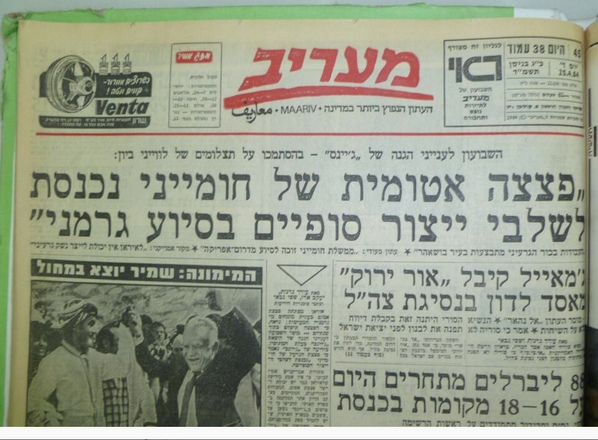
On November 27th, Mondoweiss re-posted a Twitter status from Richard Silverstein, the creator of the Tikun Olam blog, showing a Maariv headline from April 25, 1984. The headline read: “Iran In Final Stages of Production of Nuclear Bomb.”

Maariv headline

Maariv is a Hebrew-language daily newspaper, which was founded in 1948, and is the second highest selling newspaper in Israel. To be fair, the above story in Maariv cited Jane’s Defence Weekly,  which quoted West German intelligence sources regarding Iran. For a good perspective on the long-repeated warnings about Iran’s nuclear program, see this timeline at The Christian Science Monitor. The loudest warnings have come from the United States, the world’s nuclear champion and a signatory of the NPT (Non-Proliferation Treaty), and Israel, a nation believed to have as many as 200 nuclear weapons (undeclared) and a nation which has refused to sign the NPT.

As is now well-known, Iran signed an interim 6-month agreement on November 23rd, after a couple rounds of discussions with the United States and several other nations. The US will provide “limited” and “modest” sanctions relief in exchange for Iran “halting certain levels of enrichment and neutralizing part of its stockpiles,” among other concessions. According to President Obama, America’s toughest sanctions will continue to be applied to Iran. New channels of communication have certainly opened between Iran, the US, and other countries in recent weeks.

Many nations have treated these developments as good news. Saudi Arabia and certain other Gulf States (strongly opposed to the Shiite form of Islam) have not. Israel, predictably, is going nuts. Israeli Prime Minister Benjamin Netanyahu had these words to say the next day:

“What was achieved last night in Geneva is not an historic agreement; it is an historic mistake. Today the world has become a much more dangerous place because the most dangerous regime in the world has taken a significant step toward attaining the most dangerous weapon in the world… Israel is not bound by this agreement. The Iranian regime is committed to the destruction of Israel and Israel has the right and the obligation to defend itself…”

It’s hard to know if Netanyahu actually believes what he says or not. The government he represents has been crying wolf on Iran for 29 years. Some are suggesting that Israel needs to keep hyping up the Iran issue in order to deflect attention away from its illegal settlements, bulldozing of Palestinian homes, the blockade on Gaza, and other controversial domestic activities.

Just as predictably, Christian Zionist sources (for example, author Joel Rosenberg) have lined up to agree with Netanyahu and continue to demonize Iran.

I’m glad to see these recent developments, though, and I believe they are good steps in the right direction. They are especially good for the people of Iran, who have been suffering the effects of harsh sanctions. As I shared in a post on this subject almost a month ago, the effects of sanctions on the Iranian people have included “a 20% unemployment rate, a 30% – 50% inflation rate, expensive basic goods, the plunging value of Iran’s currency, increasingly unsafe commercial aircraft, an increasing inability to export oil, and other economic ramifications. They are also said to be resulting in half the population struggling to provide food and shelter for themselves, and struggling to maintain emotional health.”

Iranian Muslims, Iranian Jews, and Iranian Christians alike have experienced these things, in part due to a relentless campaign of deceit, politicking, and warmongering that has been vigorously supported by the Christian Zionist movement. Only God knows the extent to which Iranian and Palestinian Christians have suffered needlessly as a result of activities and rhetoric coming from many of their professing brothers and sisters in Christ.

An NBC News article highlights the provisions Iran can expect to see with the new easing of sanctions, concluding that Iran’s people will only see “precious little” relief in the short-term future, but that this deal provides “far more of a psychological benefit than an economic one” for now. Some groups are still investing in efforts to not only reverse these changes, but to bring even harsher sanctions quite soon. Others are watching for the slightest indication that Iran is not holding up its end of this deal, so that such actions can be justified (allegedly). Meanwhile, in plain sight are 2007 intelligence reports and other official statements from the CIA, Mossad, and other agencies agreeing that there is no evidence Iran is pursuing nuclear weapons.

While Israeli and Christian Zionist leaders continue to say that Iran is bent on destroying Israel, Iran’s Jewish parliamentary representative, Siamak Moreh Sedgh, praises Iran for allowing Iranian Jews to worship freely. Sedgh states that conditions for Iranian Jews are “better than yesterday, and today, our condition is much better than 10 years or 20 years ago.” Interestingly, he added that Iran’s Jewish community chose not to commemorate Israel’s 60th anniversary in 2008 because they are “in complete disagreement with the behavior of Israel” and its “anti-human behavior.”

The secular nation of Israel will do as it will do. As for God’s people, may we reflect and work toward God’s desire to see the nations, including Iran and Israel, healed by the river of life that flows from His throne (Revelation 22:1-2).

“The Stones Cry Out”: New Documentary Challenges Evangelical Bonds With Israel


I’m interested in seeing this documentary when/if the opportunity arises. In the meantime, if anyone who comes across this post has seen it, I’d be glad to know what you think about it.

Graham Liddell has written an article for Ma’an News Agency highlighting a new documentary called “The Stones Cry Out.” The documentary is directed by Yasmine Perni, an Italian-born journalist who has lived in various places in the Middle East, including Israel. I’ll share an observation that jumped out at me after viewing one of the links in Graham’s article, but first here’s the article itself:

A new documentary about Palestinian Christians is challenging mainstream evangelical assumptions about the Holy Land in the United States.

As evangelical organizations hold events across the US presenting an unbreakable bond between Christians and Israel, first-time director Yasmine Perni tours American churches with a film that instead documents the plight of Palestinian Christians at the hands of Israel.

“The (Palestinian) Christians have never been covered like this before,” Perni told Ma’an Saturday.

“The Stones Cry Out” starts by documenting the history of Kifr Biram, a predominantly Christian Palestinian village that was destroyed by Israel after the Nakba.

Former residents of Kifr Biram tell the story of being expelled from their homes by Jewish militants in 1948 and becoming refugees in neighboring Jordan and Lebanon. Many attempted to return, but in 1953, they watched as their village was demolished on orders from the Israeli government. Israel has since converted the village lands into a national park.

Perni wants Western audiences to hear the story of Kifr Biram firsthand while they still can. Many of the original residents have already died, including three elderly men who passed away during filming.

“And so I feel that telling their story is a way of keeping their memory alive and their struggle to find peace,” Perni said.

The film moves to an overview of the Six Day War and Israel’s ongoing military occupation of the West Bank and East Jerusalem. Footage of the events overlaps with Palestinian Christians’ accounts of their experiences throughout the First Intifada – during which Israeli forces killed over 1,000 Palestinians – and throughout Israel’s 2002 siege on Bethlehem’s Church of the Nativity during the Second Intifada.

“Most of the Christians abroad were silent (during the siege),” Bethlehem pastor Rev. Mitri Raheb says in the film.

He says Christians “like to sing about the little town of Bethlehem in the churches on Christmas Eve, but I felt at that time that actually Bethlehem was abandoned.”

Featured prominently in the film, Raheb told Ma’an Friday that the story of Palestinian Christians is little known in the West, and even less “among Evangelical Christians.”

He said he hopes the documentary reaches as many people as possible.

Hopes for impact on Western audiences

Christian Zionism – the belief that the modern State of Israel is a manifestation of God’s biblical promise to the Jews – is a significant force in US politics. One Christian Zionist organization, Christians United for Israel, is the largest pro-Israel organization in the United States. In addition to lobbying Congress and contributing financially to pro-Israel causes including illegal settlements, CUFI holds regular “Nights to Honor Israel” in US churches using scripture to back up pro-Israel political action. Former Arkansas Gov. Mike Huckabee spoke at one such event last Sunday.

“I think that is using the Bible as a weapon,” Perni told Ma’an.

Though she hopes Christian Zionists will see the film, they are not necessarily her intended audience.

“The film is for everyone. … I’m not a theologian. I’m a journalist. I report the stories that I see,” Perni said.

Without dwelling on theology, “The Stones Cry Out” simply tells “the Palestinian story, but through the eyes of the Christians.”

Despite widespread Christian support for Israel in the US, Raheb told Ma’an that he was optimistic about changing evangelical mindsets on Palestine.

“It’s not a hopeless case,” Raheb said. “The first time I went to the States in 1991, most of the people I met knew nothing about Palestine. That has changed a lot.”

“I see among the evangelical Christian community more openness towards the Palestinians.”

Christians under Israeli occupation

In 2012, former Israeli ambassador to the United States Michael Oren wrote an article for The Wall Street Journal in which he blamed Christian emigration from Palestine on Muslims.

Raheb says in the film that Israel “would love” Palestine to be free of Christians, “because then they can sell this conflict as a Jewish-Muslim conflict, as a religious conflict.”

“Oren at the end of the day really is interested in fueling Islamophobia because this sells well with certain groups,” Raheb told Ma’an, “as if Israel actually is the one defending the Western value.”

He said that in an academic study he conducted, less than 1 percent of emigrating Christians said they were leaving because of tensions with Muslims, and most actually left due to political and economic situations imposed by the occupation.

The documentary, Perni told Ma’an, “reveals my own discovery of what it really means to live under occupation.”

Though she lived in the Arab world throughout much of her life, she said that the reality of the occupation only set in when she moved to Jerusalem and visited Bethlehem. A major hub of Christianity in the West Bank, Bethlehem is surrounded by illegal Israeli settlements. A wall constructed by Israel beginning in 2002 separates Palestinians not only from Israel, but in many cases from their own property.

One Palestinian Christian from Bethlehem shows in the film how the wall encases her house on three sides, rendering access to her backyard impossible and turning her home “into a tomb.”

“Christians are hit by the occupation the same way Muslims are,” Raheb told Ma’an.

Unfortunately, Perni said, many in the West are unaware of the very existence of Palestinian Christians. When they meet Christians from Palestine, “people in America ask them when they converted.” 

“The Stones Cry Out” premieres in cities across the US in late October and early November.

In this article, Liddell pointed to a link describing how the former village of Kafr Bir’im had been turned into a national park by Israel. I was struck by the revelation that Kafr Bir’im “was located in an area which IDF [Israeli Defense Forces] wanted, for security reasons, populated only with Jews.” So in November 1948 “most of the inhabitants were evacuated by the IDF ‘temporarily’ to the town of Jish further south ‘until the military operations are over.'”

The reason this struck me is because in numerous conversations I’ve had with Christian Zionist individuals, I’ve been told that the Palestinians were advised by Arab outsiders (e.g. from Jordan, Egypt, etc.) to temporarily take refuge in Arab lands until an Arab alliance could wipe out all the Jews. Therefore, I’ve been told, these Palestinians relinquished their right to the land, and only the Arabs are to blame for leaving them in limbo. This (Israeli) source, on the other hand, indicates that at least Kafr Bir’im was largely cleared of Palestinians by the IDF.

Removing one people group from an area in order to replace them with another people group is not only racist, but this fits the definition of ethnic cleansing. Elias Chacour, another Palestinian Christian, shares similar first-hand stories in his book, “Blood Brothers.” In some of the stories he shares, it wasn’t just ethnic cleansing that took place, but genocide as well.

In any case, I’m glad to see that more Palestinian Christians are being given a chance for their voices to be heard.