“The Stones Cry Out”: New Documentary Challenges Evangelical Bonds With Israel


I’m interested in seeing this documentary when/if the opportunity arises. In the meantime, if anyone who comes across this post has seen it, I’d be glad to know what you think about it.

Graham Liddell has written an article for Ma’an News Agency highlighting a new documentary called “The Stones Cry Out.” The documentary is directed by Yasmine Perni, an Italian-born journalist who has lived in various places in the Middle East, including Israel. I’ll share an observation that jumped out at me after viewing one of the links in Graham’s article, but first here’s the article itself:

A new documentary about Palestinian Christians is challenging mainstream evangelical assumptions about the Holy Land in the United States.

As evangelical organizations hold events across the US presenting an unbreakable bond between Christians and Israel, first-time director Yasmine Perni tours American churches with a film that instead documents the plight of Palestinian Christians at the hands of Israel.

“The (Palestinian) Christians have never been covered like this before,” Perni told Ma’an Saturday.

“The Stones Cry Out” starts by documenting the history of Kifr Biram, a predominantly Christian Palestinian village that was destroyed by Israel after the Nakba.

Former residents of Kifr Biram tell the story of being expelled from their homes by Jewish militants in 1948 and becoming refugees in neighboring Jordan and Lebanon. Many attempted to return, but in 1953, they watched as their village was demolished on orders from the Israeli government. Israel has since converted the village lands into a national park.

Perni wants Western audiences to hear the story of Kifr Biram firsthand while they still can. Many of the original residents have already died, including three elderly men who passed away during filming.

“And so I feel that telling their story is a way of keeping their memory alive and their struggle to find peace,” Perni said.

The film moves to an overview of the Six Day War and Israel’s ongoing military occupation of the West Bank and East Jerusalem. Footage of the events overlaps with Palestinian Christians’ accounts of their experiences throughout the First Intifada – during which Israeli forces killed over 1,000 Palestinians – and throughout Israel’s 2002 siege on Bethlehem’s Church of the Nativity during the Second Intifada.

“Most of the Christians abroad were silent (during the siege),” Bethlehem pastor Rev. Mitri Raheb says in the film.

He says Christians “like to sing about the little town of Bethlehem in the churches on Christmas Eve, but I felt at that time that actually Bethlehem was abandoned.”

Featured prominently in the film, Raheb told Ma’an Friday that the story of Palestinian Christians is little known in the West, and even less “among Evangelical Christians.”

He said he hopes the documentary reaches as many people as possible.

Hopes for impact on Western audiences

Christian Zionism – the belief that the modern State of Israel is a manifestation of God’s biblical promise to the Jews – is a significant force in US politics. One Christian Zionist organization, Christians United for Israel, is the largest pro-Israel organization in the United States. In addition to lobbying Congress and contributing financially to pro-Israel causes including illegal settlements, CUFI holds regular “Nights to Honor Israel” in US churches using scripture to back up pro-Israel political action. Former Arkansas Gov. Mike Huckabee spoke at one such event last Sunday.

“I think that is using the Bible as a weapon,” Perni told Ma’an.

Though she hopes Christian Zionists will see the film, they are not necessarily her intended audience.

“The film is for everyone. … I’m not a theologian. I’m a journalist. I report the stories that I see,” Perni said.

Without dwelling on theology, “The Stones Cry Out” simply tells “the Palestinian story, but through the eyes of the Christians.”

Despite widespread Christian support for Israel in the US, Raheb told Ma’an that he was optimistic about changing evangelical mindsets on Palestine.

“It’s not a hopeless case,” Raheb said. “The first time I went to the States in 1991, most of the people I met knew nothing about Palestine. That has changed a lot.”

“I see among the evangelical Christian community more openness towards the Palestinians.”

Christians under Israeli occupation

In 2012, former Israeli ambassador to the United States Michael Oren wrote an article for The Wall Street Journal in which he blamed Christian emigration from Palestine on Muslims.

Raheb says in the film that Israel “would love” Palestine to be free of Christians, “because then they can sell this conflict as a Jewish-Muslim conflict, as a religious conflict.”

“Oren at the end of the day really is interested in fueling Islamophobia because this sells well with certain groups,” Raheb told Ma’an, “as if Israel actually is the one defending the Western value.”

He said that in an academic study he conducted, less than 1 percent of emigrating Christians said they were leaving because of tensions with Muslims, and most actually left due to political and economic situations imposed by the occupation.

The documentary, Perni told Ma’an, “reveals my own discovery of what it really means to live under occupation.”

Though she lived in the Arab world throughout much of her life, she said that the reality of the occupation only set in when she moved to Jerusalem and visited Bethlehem. A major hub of Christianity in the West Bank, Bethlehem is surrounded by illegal Israeli settlements. A wall constructed by Israel beginning in 2002 separates Palestinians not only from Israel, but in many cases from their own property.

One Palestinian Christian from Bethlehem shows in the film how the wall encases her house on three sides, rendering access to her backyard impossible and turning her home “into a tomb.”

“Christians are hit by the occupation the same way Muslims are,” Raheb told Ma’an.

Unfortunately, Perni said, many in the West are unaware of the very existence of Palestinian Christians. When they meet Christians from Palestine, “people in America ask them when they converted.” 

“The Stones Cry Out” premieres in cities across the US in late October and early November.

In this article, Liddell pointed to a link describing how the former village of Kafr Bir’im had been turned into a national park by Israel. I was struck by the revelation that Kafr Bir’im “was located in an area which IDF [Israeli Defense Forces] wanted, for security reasons, populated only with Jews.” So in November 1948 “most of the inhabitants were evacuated by the IDF ‘temporarily’ to the town of Jish further south ‘until the military operations are over.'”

The reason this struck me is because in numerous conversations I’ve had with Christian Zionist individuals, I’ve been told that the Palestinians were advised by Arab outsiders (e.g. from Jordan, Egypt, etc.) to temporarily take refuge in Arab lands until an Arab alliance could wipe out all the Jews. Therefore, I’ve been told, these Palestinians relinquished their right to the land, and only the Arabs are to blame for leaving them in limbo. This (Israeli) source, on the other hand, indicates that at least Kafr Bir’im was largely cleared of Palestinians by the IDF.

Removing one people group from an area in order to replace them with another people group is not only racist, but this fits the definition of ethnic cleansing. Elias Chacour, another Palestinian Christian, shares similar first-hand stories in his book, “Blood Brothers.” In some of the stories he shares, it wasn’t just ethnic cleansing that took place, but genocide as well.

In any case, I’m glad to see that more Palestinian Christians are being given a chance for their voices to be heard.


The Christian Zionist Movement Is in Panic Mode


“A smile attack is much better than a lie attack. Mr. Netanyahu and his colleagues have been saying since 1991 – and you can refer to your records – that Iran is six months away from a nuclear weapon. And we are how many years, 22 years after that? And they are still saying we are six months away from nuclear weapons. We are not seeking nuclear weapons, so we’re not six months, six years, or 60 years away from nuclear weapons.”

-Javad Zarif, Foreign Minister of Iran, late September 2013

The installation of Iran’s newest president, Hassan Rouhani, has been met with some rather fascinating (and, to me, disgusting) reactions from the Christian Zionist movement. As President Rouhani and other Iranian leaders speak of Iran’s desire for peace and a world free of nuclear weapons, numerous Christian Zionist leaders have locked arms tightly with Israeli PM Benjamin Netanyahu in loudly and repeatedly denouncing President Rouhani as a wolf in sheep’s clothing who can’t be trusted.

It’s clear that a moderate Iranian president simply won’t serve the interests of either Zionism or Christian Zionism. These movements, which are nearly joined at the hip, need a rabid, fire-breathing, foaming-at-the-mouth, anti-semitic, holocaust-denying maniac at Iran’s helm in order to effectively push their cause. (For that matter, they also need barbaric Palestinian leaders in order to advance other elements of their cause.) Iran’s failure to elect such an individual this year has apparently been a major cause for panic.

It’s one thing if this behavior characterizes Zionism. It’s another thing when it characterizes “Christian Zionism.” By the name of this movement, one could be forgiven for believing that it aims to follow the teachings of Christ, the One who said, “Blessed are the peacemakers, for they shall be called sons of God” (Matthew 5:9).

When’s the last time a Christian Zionist leader highlighted the peacemaking efforts of a Palestinian individual toward the Jewish community? (Such efforts do exist.) How about the peacemaking efforts of Jewish individuals toward the Palestinian community? (These also exist.) When’s the last time a Christian Zionist leader pronounced blessings upon the Iranian people and their leaders, wishing for their peace and well-being?

 Hassan_Rouhani_official_portrait

Photo Source

Hassan Rouhani was elected president of Iran on June 15th of this year, and took office on August 3rd. Rouhani has been described as a moderate and diplomatic leader, and one of his campaign pledges was to repair relations with the West. It wasn’t long at all before Christian Zionist organizations published a flurry of statements seeking to discredit him, to call for increasingly tough actions against Iran, and to highlight Iran’s alleged “relentless development” of nuclear weapons (which, of course, they must be just itching to use against Israel).

A Chorus of Christian Zionist Voices United Against Iran

Israel Today is an organization whose mission “is to be the definitive source for a truthful and balanced perspective on Israel.” They have subscribers in more than 80 countries and believe that “the existence of the State of Israel is a fulfillment of prophecy and a plumb line for the purposes of God for these times.”

The month of September saw Israel Today publish articles featuring [1] Israeli PM Netanyahu responding to Rouhani’s Rosh Hashanah greetings with calls for tighter sanctions against Iran [2] Israeli warnings that Rouhani is a wolf in sheep’s clothing [3] Netanyahu’s warnings against Rouhani’s “charm offensive” [4] another mocking and desperate article seeking to discredit Rouhani and Iran [5] panic and frustration over President Obama’s and John Kerry’s failure to fall in line with Netanyahu’s hardline rhetoric toward Iran. The comment sections under these articles feature plenty of un-Christlike and warmongering pronunciations against Iran which are far worse than anything former Iranian president Mahmoud Ahmadinejad ever publicly said regarding Israel.

The month of October saw Israel Today publish articles featuring [1] an admission that Israel has possessed nuclear weapons since at least the early 1970’s, and has almost used them [2] claims that Netanyahu was prophetically correct when he quoted Scripture during his UN address in “a brilliant admonition of Iran’s anti-Israel madness,” that Iran is an “ancient enemy of Israel,” and that Rouhani is a murderous wolf [3] claims that CNN is inept and biased toward Iran by showing Rouhani in a favorable light [4] strong doubts that Iran’s new offer to downgrade “the nuclear crisis” means anything at all [5] Israel’s stress and fears over the possibility that sanctions against Iran could be lifted or lessened [6] how serious Netanyahu is about striking Iran [7] how Israel is wary of American promises and diplomacy toward Iran.

Breaking Christian News, an Albany, Oregon-based news outlet associated with Steve Shultz and The Elijah List, also routinely publishes articles in support of harsh action against Iran. Recent examples include an article (originally from Pat Robertson’s Christian Broadcasting Network) featuring Netanyahu’s urgent cries to the world that crippling sanctions must continue to be levied against Iran. Another example is an article (originally at Israel Today) rejoicing that various Arab nations are secretly aligning with Israel behind the scenes, bonded by “a strong desire to eliminate the influence of Iran.”

One Christian Zionist ministry, which I’ll refrain from naming, is based in Israel. I’ve been receiving their email updates for several years ever since a relative signed me up for them. Back in September, when it looked like President Obama was going to lead the US into war strikes on Syria, this ministry sent almost daily updates passionately setting out a case for why America absolutely needed to strike Syria hard for the sake of Israel. This ministry has also used the same reasoning for why America needs to take tough action against Iran, including military strikes: “for the sake of Israel.”

Since when has the mission of the Christian Zionist movement been to rival AIPAC as the biggest war lobby entity on the planet? Why do both entities behave as if they’re agents of the Israeli government?

Not to be outdone, John Hagee’s organization, CUFI (Christians United for Israel), has an article, among others, highlighting a movement of Republican Senators who want to increase sanctions against Iran, targeting “all Iranian government revenue and reserves.” The effects of the present sanctions on the Iranian people include a 20% unemployment rate, a 30% – 50% inflation rate, expensive basic goods, the plunging value of its currency, increasingly unsafe commercial aircraft, an increasing inability to export oil, and other economic ramifications. They are also said to be resulting in half the population struggling to provide food and shelter for themselves, and struggling to maintain emotional health. The sanctions and their effects on millions of Iranian citizens apparently aren’t crippling enough for CUFI’s liking, however. In an email alert sent out on October 30th, John Hagee and David Brog urged their supporters to sign a letter to be sent to all US Senators, including these words:

“I’ve read that the White House is urging you to delay action on legislation to tighten the economic sanctions on Iran. I think the White House is making a serious mistake. So long as Iran continues to add to its uranium enrichment capabilities, we must – at the very least – continue to add to our sanctions.”

A People Movement to Christ in Iran

These sanctions aren’t so much hurting the government of Iran as much as they are hurting the common people. Among them are a growing number of believers – our brothers and sisters in Christ. Elam Ministries, founded by Iranian believers in 1988, reports on the present phenomenal growth of the church in Iran:

Tell me about Jesus! Do you have Bibles?” This is the continuous cry of Muslim-Iranians, especially the youth, who literally flock around you in the street, like moths to the only light in the night… A quiet revival is sweeping through the country… Christians have sent in hundreds of thousands of New Testaments into Iran, but the demand dwarfs the supply. According to the church of Iran, if more than 10 million Persian New Testaments were available, it would still not be enough.

Reza Safa, a former Shiite Muslim whose television program broadcasts into Iran, shares a similar testimony. J. Lee Grady, a Charisma editor, also highlighted the spiritual breakthroughs in Iran in a 2010 report titled “God’s Strategic Plan for Iran,” calling for believers to look upon Iran with compassion instead of wishing for Iran to be bombed.

Hypocritical Powers Crying Wolf

As mentioned earlier, Israeli officials have been crying wolf now for more than two decades, always urging immediate action because Iran is allegedly just a few months away from having a nuclear bomb (but it’s OK for Israel and trigger-happy America to have hundreds of them). The warmongers imply that Iran’s scientists are so utterly incompetent that they still haven’t developed even one nuke after “being on the brink of having them” for more than two decades. What if, just perhaps, they’re not even trying to develop any?

A year ago, Nima Shirazi of the Mondoweiss news site crafted a list of public statements by Iranian leaders from 1991 – 2012 that they are not pursuing nuclear weapons and that they don’t believe in the principle of doing so. It’s a profound list, and worth checking out.

The Ahmadinejad Objection

“But, but, but Mahmoud Ahmedinejad said he intended to wipe Israel off the map!”

Did he really? Even though this was spread widely around the internet as truth, multiple sources, including native speakers of Persian, insist that Ahmadinejad’s 2006 statement was severely mistranslated. Wikipedia is not necessarily the most authoritative source, but the “wiped off the map” controversy is discussed somewhat at length there, and one can follow the footnotes to various articles (some scholarly) which discuss the matter further. A better translation of his words is said to reflect the following statement:

“This Zionist regime that is occupying Jerusalem must be eliminated from the pages of history.”

A BBC report less than two years later allowed Ahmadinejad to clarify his earlier statement:

“Asked if he objected to the government of Israel or Jewish people, he said that ‘creating an objection against the Zionists doesn’t mean that there are objections against the Jewish.’ He added that Jews lived in Iran and were represented in the country’s parliament.”

Indeed, the Jewish community in Iran is the largest in the Middle East outside of Israel.

In other interviews Ahmadinejad has advocated for Palestinian refugees to be allowed to return to their homes, and for a democratic government to be elected by them and everyone else presently in the land. For example, in a September 2006 interview with Time Magazine, he said:

“Our position toward the Palestinian question is clear: we say that a nation has been displaced from its own land… Our suggestion is that the 5 million Palestinian refugees come back to their homes, and then the entire people on those lands hold a referendum and choose their own system of government.”

In that same interview, Ahmadinejad said that Iran does not oppose the Jews having their own state, but that Iran is, in fact, opposed to nuclear weapons.

I won’t deny that Ahmadinejad made some inflammatory statements during his political career. Some of his own government colleagues and others in Iran also rebuked him for it. From the Zionist camps especially, however, he was also demonized, and some of his statements were either misrepresented or blown far out of proportion. This has been done, obviously at times, by those who seek a pretext for war. Now that a more mild-mannered leader has taken his place, those who are still seeking that pretext are scrambling for reasons to demonize him too. Rouhani’s publicly stated desire for peace and reconciliation simply doesn’t serve the interests of those who are seeking Iran’s downfall and demise.

Most unfortunately, the world of Christian Zionism is as vocal as any camp in playing this spite-filled game. Only it’s not a game. It affects the lives of people. It sows seeds of destruction. It’s irrational warmongering. It literally affects the foreign policy of the United States. It also affects the reputation of those who say they belong to Christ. It makes it seem to the world that we don’t believe Jesus or take Him seriously when He said things like “Blessed are the peacemakers” and “love your enemies.”

But Jesus was serious. He really does call His followers to make peace and to love all people, and there is no exception when it comes to the Iranians and the Palestinians.

—————————————————————————————————————-

All posts on the subject of Christian Zionism can be found here.

Israel Is God’s Chosen People – What Does That Mean?


Two days ago Andrew Strom, a well-known minister from New Zealand, created a firestorm with his post, “Replacement?? – Israel & the Church.” I personally agree with about 90% of what he wrote. As expected, there have been many responses, some very emotional. There are nearly 350 comments under that post, as of last count, and they address so many different aspects of this topic (and beyond) that it can make the mind spin. I’m very interested in what some have to say, but quite baffled at what others say. I’d like to get feedback, if possible, regarding one baffling statement that appeared repeatedly in that forum, one which I’ve heard so many times before:

“Israel is God’s chosen people.”

For those who say this and believe it, what does that mean? Does it mean that all citizens of Israel are God’s chosen people? At face value, that’s what it seems they would mean. Somehow, though, I get the impression that people mean Jews only, when they say this. Did you know that there are roughly 1.6 million Arab citizens in Israel? According to this Wikipedia entry, that’s the case. Are they also among God’s chosen people, since they live in Israel?**

Others claim that all ethnic Jews are God’s chosen people, and I also completely disagree with this idea. Scripture teaches that only those who belong to Jesus are God’s chosen people. In I Peter 2:4-10, for example, those who belong to Jesus are chosen to be a royal priesthood, to receive mercy, to be a light in the darkness, etc. This is true of those who belong to Christ. It’s not true for those outside of Christ, even if they happen to be Jewish. For a deeper discussion on this topic, please see this post:

http://kloposmasm.com/2010/09/23/who-are-gods-chosen-people-and-why-are-they-chosen/

However, I’m even more baffled by the claim that the nation of Israel is God’s chosen people. It makes no sense Scripturally, and it doesn’t even make sense politically. What are your thoughts on the claim that “Israel is God’s chosen people”?

———————————————————————————————–

**I believe that some Arab citizens of Israel actually are among God’s chosen people, but only those who belong to Christ. And some of them do – praise God.

Why I Abandoned Replacement Theology


I once believed in and taught “replacement theology,” but no one ever accused me of it at the time. Since turning away from replacement theology, however, I’ve faced this accusation numerous times.

What is replacement theology? Matt Slick, the president and founder of Christian Apologetics and Research Ministry (CARM), says this on the subject:

Replacement theology is the teaching that the Christian church has replaced national Israel regarding the plan, purpose, and promises of God… [In] replacement theology the church has replaced Israel as the primary means by which the world is blessed by God’s work… Replacement theology is also known as supersessionism, which means that the Christian church has superseded Israel in God’s plan.

John Hagee, the founder of Christians United for Israel (CUFI), said this in his 2006 book, “Jerusalem Countdown: A Warning to the World”:

“Adherents of replacement theology believe that the Jews are no longer God’s chosen people, and God does not have specific future plans for the nation of Israel” (page 72)… “Replacement theology means that Israel failed, and God has replaced Israel with the church” (page165).

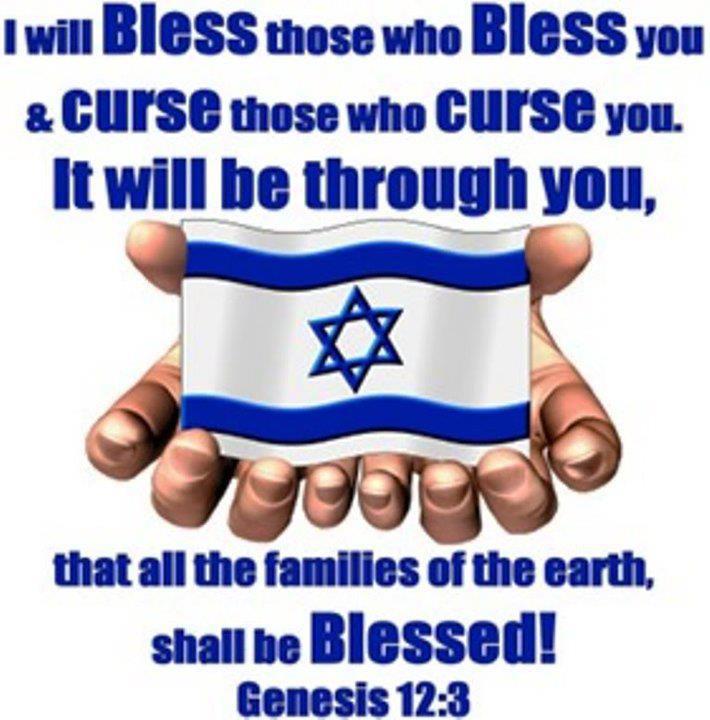
Ironically, when I formerly taught replacement theology, my thinking was very much in line with Slick and Hagee. I wasn’t replacing Israel with the church, but I sure was replacing Jesus with the modern nation of Israel. I would have agreed with graphics like this one I saw posted on Facebook by a fellow Christian a few weeks ago:

false interpretation of Genesis 12-3

SOURCE

This illustration epitomizes the replacement theology I’ve left behind. It takes the role belonging to Jesus and assigns it to a political nation whose population generally has nothing to do with Him. The New Testament is especially clear in showing that it’s through salvation in Jesus that the nations are blessed.

Consider the progression of Biblical revelation regarding the promise recorded in Genesis 12:3:

[1] It was first made by God to Abraham alone: “It will be through you [Abraham], that all the families of the earth will be blessed.”

[2] It was repeated again in Genesis 22:18, and this time expanded to include his offspring: “And through your offspring all nations on earth will be blessed, because you have obeyed Me.”

[3] In Acts 3:25-26, the apostle Peter, speaking to a Jewish crowd in Jerusalem, is clear in identifying Abraham’s offspring and the means of blessing for the nations:

And you are heirs of the prophets and of the covenant God made with your fathers. He said to Abraham, ‘Through your offspring all peoples on earth will be blessed.’ When God raised up His servant, He sent Him first to you to bless you by turning each of you from your wicked ways.”

It’s Jesus who is Abraham’s offspring, and He blesses the nations, beginning with the proclamation of the gospel to Jews in the first century.

[4] The apostle Paul, in Galatians 3:7-8, declared that Jesus’ followers are Abraham’s offspring too:

Understand, then, that those who believe are children of Abraham. The Scripture foresaw that God would justify the Gentiles by faith, and announced the gospel in advance to Abraham: ‘All nations will be blessed through you.’”

According to the terms laid out by Matt Slick and John Hagee, the apostles Peter and Paul were guilty of teaching replacement theology. Yet according to Peter and Paul, when it comes to God’s plans, purpose, and promises, Slick and Hagee are seeking to replace Jesus and His church with a geopolitical nation located in the Middle East. It’s highly ironic that there are Christians who are comfortable with the idea of replacing Christ (their Savior) with a mere political nation, but are up in arms with those who allegedly replace Israel with the church.

Galatians 3, incidentally, goes on to make the point even more strongly that all of God’s promises are wrapped up first in Jesus and second in His followers. Paul says this in verse 16:

The promises were spoken to Abraham and to his seed. The Scripture does not say ‘and to seeds,’ meaning many people, but ‘and to your seed,’ meaning one person, who is Christ.”

Jesus is singularly the recipient of all of God’s promises, and He extends those promises to His followers (verse 29), who are all one in Him regardless of ethnicity, societal status, or gender (verse 28):

There is neither Jew nor Greek, there is neither slave nor free, there is neither male nor female, for you are all one in Christ Jesus. And if you are Christ’s, then you are Abraham’s offspring, heirs according to promise.” (Galatians 3:28-29)

Does Paul leave any room for those who are outside of Christ to be heirs of the promises? No, he doesn’t, not even for Jews who are outside of Christ. Neither did Peter (Acts 3:23), and neither did Jesus (e.g. Matthew 8:10-12Matthew 21:43John 8:31-47). As Paul says in II Corinthians 1:20, all of God’s promises are “yes” and “amen” in Jesus. What are they outside of Jesus? Meaningless and void.

One of my questions for Slick and Hagee is this: If God’s plan, purpose, and promises are waiting for the nation of Israel to carry them out, then did God utterly abandon the world between 70 AD and 1948 when there was no nation of Israel? Or is it not possible that God’s plan, purpose, and promises continued to be carried out by true Israel, i.e., Jesus and His church?

Consider also what Paul said to the Roman church: “A person is not a Jew who is one only outwardly, nor is circumcision merely outward and physical. No, a person is a Jew who is one inwardly; and circumcision is circumcision of the heart, by the Spirit…” (Romans 2:28-29). “For not all who are descended from Israel belong to Israel, and not all are children of Abraham because they are his offspring… This means that it is not the children of the flesh who are the children of Godbut the children of the promise are counted as offspring” (Romans 9:6-8).

The church is Israel, that is, the Israel of God (Galatians 6:16). This is only true because Jesus is true Israel, and we who belong to Christ are made one with Him. One more example of each of these points will suffice. First we will look at how Matthew takes what was once said about the nation of Israel, and applies it to Jesus. Then, finally, we will look at how Peter takes what was once said of the nation of Israel, and applies it to the church.

[1] In Exodus 4:22, God instructs Moses to say to Pharaoh, “Thus says the Lord, ‘Israel is My firstborn son, and I say to you, “Let My son go that he may serve Me.”’” Then in Hosea 11:1-2 we read, “When Israel was a child, I loved him, and out of Egypt I called My son. The more they were called, the more they went away; they kept sacrificing to the Baals and burning offerings to idols.” Who is Israel in these Old Testament texts? Clearly it’s that ancient nation, known as Israel, which was finally destroyed by the Romans in 70 AD.

Yet look at how Matthew treats this same statement. To set the background, an angel has warned Joseph, the father of Jesus, to flee to Egypt with his family, because Herod would seek to destroy Jesus: “And he [Joseph] rose and took the child [Jesus] and His mother by night and departed to Egypt and remained there until the death of Herod. This was to fulfill what the Lord had spoken by the prophet, ‘Out of Egypt I called My son’” (Matthew 2:14-15).

Only 40 verses into the New Testament, Matthew declares, by strong implication, that Jesus is true Israel.

[2] Compare what Moses spoke to “the people of Israel” (Exodus 19:3) to what Peter said was true of the church. It’s impossible to miss the parallel language, and I have letter-coded the parallels (A, B, and C):

To ancient national Israel: “Now therefore, if you will indeed obey My voice and keep My covenant, you shall be [A] MY TREASURED POSSESSION among all peoples, for all the earth is mine; and you shall be to Me [B] A KINGDOM OF PRIESTS and a [C] HOLY NATION…” (Exodus 19:5-6).

To the church: “But you are a chosen race[B] A ROYAL PRIESTHOOD, a [C] HOLY NATION, a people [A] FOR HIS OWN POSSESSIONthat you may proclaim the excellencies of Him who called you out of darkness into His marvelous light. Once you were not a people, but now you are God’s people…” (I Peter 2:9-10).

Peter leaves no doubt that Christ’s followers are chosen for the same purpose for which the nation of Israel was once chosen.

I abandoned replacement theology because Jesus is irreplaceable, and I love His church.

—————————————————————————————————–

I first published this article on Hubpages on February 10, 2013.

Stephen Sizer Q & A at Taylor University


Early this morning, while preparing and eating breakfast before leaving for work, I was able to listen to Stephen Sizer field questions from students at Taylor University in Upland, Indiana regarding the 2010 film, “With God On Our Side.” As far as I can tell, this event took place on March 2, 2011. It was posted yesterday, however, on Sizer’s blog.

Taylor University is an interdenominational, evangelical Christian university founded in 1846, and presently has an enrollment of approximately 2600 students, according to its official website. A 2012 US News & World Report survey shows that Taylor has been the top college among 109 Midwest Regional Colleges for the last five years.

This video is 33 minutes long, and features questions from students regarding the Israeli-Palestinian conflict, Christian Zionism, Dispensationalism, John Hagee’s eschatology, Jeremiah 31, Ezekiel 37, the Samaritan woman that Jesus encountered, and more. I thought Stephen Sizer did a great job responding to these questions, and I believe that everyone can learn from this session.

I wrote a review of the film “With God On Our Side” which can be seen here.

John Hagee and Benny Hinn: Warmongering for the Wrong Kingdom


For the kingdom of God is not a matter of eating and drinking, but of righteousness, peace and joy in the Holy Spirit” (Romans 14:17). Those who follow Christ are citizens of God’s kingdom. One of its characteristics, says Paul, is peace. This truth and others concerning God’s kingdom seem to be completely lost on some of today’s most popular teachers, as we will see shortly. According to Jesus, His kingdom is also not earthly or political, not even observable by the human eye:

Once, on being asked by the Pharisees when the kingdom of God would come, Jesus replied, “The coming of the kingdom of God is not something that can be observed, nor will people say, ‘Here it is,’ or ‘There it is,’ because the kingdom of God is in your midst [or ‘in you’]” (Luke 17:20-21).

John the Baptist and Jesus both preached the nearness of God’s kingdom during their time, repeatedly saying that this kingdom was “at hand” (e.g. Matthew 3:2, 4:17). In Mark 1:15, Jesus even prefaced His statement by saying “The time is fulfilled.” Did His assurance on this point reflect any time statements in the Old Testament regarding the kingdom? The writings of the prophet Daniel are most helpful in this regard. Daniel 7:13-14 pictures Jesus ascending to His Father and receiving an everlasting kingdom that would never be destroyed (“…behold with the clouds of heaven there came One like a son of man, and He came to the Ancient of Days and was presented before Him. And to Him was given dominion and glory and a kingdom…”).

At this point, Daniel looks to a subsequent time when the saints would soon possess this kingdom forever (Daniel 7:18, 22, 27). This would occur following a time when “the fourth beast” would make war with the saints “until the Ancient of Days came” (verses 21-22). Many say that this has not yet happened. We know, however, that Jesus promised to come [1] in His kingdom [2] in the glory of His Father [3] with His angels [4] and in judgment while some of His disciples (Matthew 16:27-28) and some people among His larger audience (Mark 8:34-9:1) were still alive, i.e. in the first century AD. This timing is further substantiated when we see that Jesus, in the Parable of the Tenants, told the religious leaders of Israel that the kingdom of God would be taken away from them and “given to a people producing its fruits” (Matthew 21:43-45), i.e. the Church, or in Daniel’s words, “the saints of the Most High.” This was to take place in their generation, as Jesus outlined in great detail in the Olivet Discourse (Matthew 24, Mark 13, Luke 21).

Yet another indication of this timing can be seen clearly earlier in the book of Daniel, when he interpreted Nebuchadnezzar’s dream: “And in the days of those kings* the God of heaven will set up a kingdom that shall never be destroyed, nor shall the kingdom be left to another people” (Daniel 2:44). [*Biblical scholars hold a virtual consensus that the four kingdoms in Daniel’s vision were Babylon, Medo-Persia, Greece, and Rome. Since Rome was destroyed in 476 AD, we know that, for this prophecy to be true, the kingdom was set up before that time.] A first century fulfillment fits; a 21st century fulfillment doesn’t.

So the meaning of all this is that God’s kingdom is now fully present (and has been for many centuries), it is spiritual and not physical, and one of its characteristics is peace. Similarly, God’s people now belong to Jerusalem, not the earthly one, but rather the heavenly one. Observe what the author of Hebrews wrote to his first century audience:

But you have come to Mount Zion and to the city of the living God, the heavenly Jerusalem…” (Hebrews 12:22). This truth does not await a future fulfillment, but again has been a present reality for the body of Christ for many centuries. An overview of Hebrews 12:18-28 equates the heavenly Jerusalem with [1] the new covenant (verse 24) and [2] a kingdom that cannot be shaken (verse 28), and contrasts it with the old covenant given through Moses at Mount Sinai (verses 18-21), represented by things that were about to be shaken and removed at that time (verses 26-27). This was accomplished during Israel’s great tribulation (67-70 AD), at which time God’s kingdom was also fully established and set up. This same comparing/contrasting of the two covenants (new and old), and the two Jerusalems (earthly and heavenly) can be seen in Paul’s great allegory of two women (Galatians 4:21-31). Most interestingly, two women are also pictured in the book of Revelation, [1] the adulterous harlot known as “Babylon the Great” and [2] the bride of Christ. One is thrown out, the other is chosen forever. The striking similarities between Galatians 4, Hebrews 12, and Revelation regarding the covenants, Jerusalem (above and below), and God’s kingdom are no coincidence.

The blessings of God belong to those who are His by faith in His Son Jesus, and not according to ethnicity, another truth lost on some of today’s most popular teachers who insist that ethnic Jews are God’s chosen people. Paul couldn’t have been more clear about this (e.g. Galatians 3:16-29).

Enter two of America’s most influential teachers and televangelists, John Hagee and Benny Hinn. In this incredibly sad and disgusting video clip, John Hagee, hosted by Benny Hinn, openly prays (see the 1:05 mark) for God to lead the United States into war against “the enemies of righteousness” (apparently Iran), for the alleged benefit of Israel:

Keeping in mind that peace is one of the traits of God’s kingdom, recall Jesus’ famous and powerful words in the Sermon on the Mount: “Blessed are the peacemakers, for they shall be called the children of God” (Matthew 5:9). PJ Miller well points out the excellent commentary on this verse by Albert Barnes (in 1834):

Those who strive to prevent contention, strife, and war; who use their influence to reconcile opposing parties, and to prevent lawsuits and hostilities in families and neighborhoods. Every man may do something of this; and no man is more like God than he who does it. There ought not to be unlawful and officious interference in that which is none of our business; but without any danger of acquiring this character, every man has many opportunities of reconciling opposing parties. Friends, neighbors, people of influence, lawyers, physicians, ministers of the gospel, may do much to promote peace. And it should be taken in hand in the beginning. “The beginning of strife,” says Solomon, “is like the letting out of water.”

I’m not sure if it’s possible to more blatantly contradict Jesus’ teaching on being peacemakers than what we see in this video. Furthermore, Iran should not be considered the enemy of God’s people who live in America or Britain. Yet, even if we could (hypothetically) say that Iran fills this role, we come face to face with these very powerful words of Jesus, also found in the Sermon on the Mount:

But I say unto you, love your enemies, bless those who curse you, do good to those who hate you, and pray for those who despitefully use you, and persecute you.”

Unless I’ve missed something in the news, how is Hagee so confident that the United States WILL go to war? He says this twice, at the 1:33 mark and again at the 1:55 mark in this video. The way he prayed this “prayer,” one would think he was a close presidential advisor equipped with key inside information that most don’t yet have. His use of the phrase “against the enemies of righteousness” implies that the whole of the United States is righteous and outsiders are not. The angels of heaven even allegedly go before the US army, and Britain’s army as well (2:00 mark).

Just as John Hagee seems to care nothing about the Christian Palestinian population (instead “favoring” mostly unbelieving Jews**), he also implicates the Christians in Iran with his warmongering schemes that would result in their demise, if he could have his way. According to some, Iran is quietly experiencing its greatest revival ever in terms of people coming to Christ:

John Hagee is warmongering instead of seeking peace, and he’s doing so for the wrong kingdom, one that is earthly instead of heavenly, visible instead of spiritual. The Christian Zionist movement he so openly represents is also deeply concerned with (in a distorted way) the wrong Jerusalem, again the earthly one instead of the heavenly one. My hope is that blatant displays of disobedience to God’s word like this will cause even more people to question and turn away from Christian Zionist theology.

John Hagee and others who hold to futurist, dispensationalist teachings tend to believe and proclaim that this generation is ripe for worldwide judgment, that we’re on the precipice of great doom and destruction and decline, that we’ll soon see the end of world history, etc. I believe this generation is pivotal for reasons that are quite the opposite. Many are awakening to the truth that God’s kingdom is already fully established, and that His people are called to advance it in peaceful and spiritually powerful ways. If this generation of God’s people turns away from the doomsday message of teachers like John Hagee, and instead embraces the truth of the New Testament and walks in the realities of the New Covenant established by Christ, great things can happen in the near future and in generations ahead of us. May it be.

————————————————————————————-

**John Hagee, who many might think deeply cares for Jews, raises millions of dollars to bring them to Israel, where, according to his teaching, two (2) out of every three (3) Jews will one day soon be slaughtered in a tribulation that is greater than anything the Jews experienced in 67-70 AD or during the Holocaust of the last century.

No Alienation from the Commonwealth of Israel


(Thoughts on Ephesians 2:12)

Paul’s letter to the Ephesians is a remarkable book, one that is full of wonderful expressions of truth. In the first three chapters Paul lays out, in glorious fashion, the riches of the grace we have in Christ. His adoration for the gospel just keeps spilling out, and he even gets long-winded (in a good way) as he does so. Take a look at some of his gospel-saturated, lengthy sentences which span several verses at a time (e.g. 1:7-10, 1:15-21, 3:14-19). Some of the most magnificent portrayals of the New Covenant are found in this book.

With this in mind, it’s amazing to consider that today there is a popular teaching insisting that the New Covenant which Paul describes here in Ephesians and elsewhere is NOT the same New Covenant which was foreseen by the Old Testament prophets (e.g. Jeremiah 31:31-34, Ezekiel 36:26-27). This is despite the fact that the author of Hebrews quotes from Jeremiah’s prophecy and explicitly states (Hebrews 8:6-13) that this New Covenant had been established in his own time (i.e. in the first century AD). The “problem” seems to be that Jeremiah and Ezekiel addressed their prophecies to “the house of Israel.” Dispensationalism and Christian Zionism are notoriously unwilling to acknowledge that the Church IS spiritual Israel, and their proponents often have harsh words for those who believe this. Shortly we will see that Ephesians 2:12, being just one such example in the New Testament, does not allow their position to stand.

[Please bear with this brief explanation before we get back to looking at Ephesians. Prior to Progressive Dispensationalism taking root in western Christianity within the last few decades, Classic Dispensationalists like H.A. Ironside, Charles Ryrie, Dwight Pentecost, and John Walvoord claimed that the Old Testament never foresaw the coming of the Church age, and that God will one day bring an end to the Church age and resume His program with national/ethnic Israel. This was the teaching of John Nelson Darby, who founded this theological system in the 1830’s, and of C.I. Scofield, who published his famous reference Bible in 1909. These men and others also taught (or teach) that the New Covenant is reserved for a future millennium period! Consider the following statements regarding Jeremiah’s prophecy of a coming New Covenant:

[1] “This covenant must follow the return of Christ at the [yet future] second advent… This covenant will be realized in the [yet future] millennial age… the new covenant of Jeremiah 31:31-34 must and can be fulfilled only by the nation Israel and not by the Church” (Dwight Pentecost, Things to Come, 1958).

[2] “…the new covenant is with Israel and the fulfillment [will be] in the millennial kingdom after the second coming of Christ… the new covenant as revealed in the Old Testament concerns Israel and requires fulfillment in the millennium kingdom” (John F. Walvoord, The Millennial Kingdom, 1959).

[3] “The Church, then, is not under the new covenant…it is Israel which is God’s covenant people” (Harry Ironside, Notes on the Prophecy of and Lamentations of Jeremiah, 1906).

One proposed solution by more recent Progressive Dispensationalists is that there are two new covenants (!) in Scripture, one for the Church (now) and one for national/ethnic Israel (later). This belief seems to be true for those who would affirm that the Church presently lives in the New Covenant (and experiences the taking away of sin), but who also assert that Romans 11:26-27 (“And in this way all Israel will be saved…and this will be My covenant with them when I take away their sins”) will only be fulfilled in the future for ethnic Jews. This belief doesn’t stand up either, as we will see. For a much fuller treatment of the implications of this facet of Dispensationalist teaching, please see the first half of this post from our series on Revelation 20.]

Having expressed these thoughts, let’s now look at a very pivotal section in Ephesians 2, verses 11-22. I don’t want to take anything away from the very valuable things Paul expresses earlier in this chapter, and in fact verse 11 begins with “therefore,” meaning that what Paul says next is based on what he has just said earlier. So here’s a quick summary of the first half of the chapter: Paul reminds the believers in Ephesus that they were once dead in their sins (verses 1-3), but that God in His mercy and love had made them alive in Christ (verses 4-5). They are now seated with God in Christ in heavenly places (verses 6-7). It was not by any works of their own that they were saved, but only by grace through faith. Their salvation was a gift from God, and they were created anew for the purpose of walking in good works (verses 8-10). With this as context, here’s what Paul says in verses 11-22:

11Therefore remember that at one time you Gentiles in the flesh, called “the uncircumcision” by what is called the circumcision, which is made in the flesh by hands— 12remember that you were at that time separated from Christ, alienated from the commonwealth of Israel and strangers to the covenants of promise, having no hope and without God in the world. 13But now in Christ Jesus you who once werefar off have been brought near by the blood of Christ. 14For He himself is our peace, who has made us both one and has broken down in His flesh the dividing wall of hostility 15by abolishing the law of commandments expressed in ordinances, that He might create in himself one new man in place of the two, so making peace, 16and might reconcile us both to God in one body through the cross, thereby killing the hostility. 17And He came and preached peace to you who were far off and peace to those who were near. 18Forthrough Him we both have access in one Spirit to the Father. 19So then you are no longer strangers and aliens, but you are fellow citizens with the saints and members of the household of God20 built on the foundation of the apostles and prophets, Christ Jesus himself being the cornerstone, 21 in whom the whole structure, being joined together, grows into a holy temple in the Lord. 22In Him you also are being built together into a dwelling place for God by the Spirit.

It would certainly be profitable to break this passage down verse-by-verse, and there are so many rich truths here, but I’d like to mainly zero in on verse 12 which is highlighted above. First, we should note that Paul is specifically addressing Gentile believers (verse 11), that is, non-Jewish followers of Christ. One of his reminders to them is that they were once “alienated from the commonwealth of Israel.” By speaking this way, Paul clearly indicates that they are now part of “the commonwealth of Israel.”

There is simply no getting around the idea that Gentile (non-Jewish) believers are part of God’s people, Israel, here in Ephesians 2:12. And make no mistake about it, Jewish believers are part of this same covenant people of God, but no more so and no less so: “For there is no difference between Jew and Gentile—the same Lord is Lord of all and richly blesses all who call on Him” (Romans 10:12); “There is neither Jew nor Greek, there is neither slave nor free, there is no male and female, for you are all one in Christ Jesus” (Galatians 3:28). There are no spiritual blessings which are available for males but not for females, nor are there any spiritual blessings which are available for Jews but not for non-Jews. Does Scripture leave us any room to believe that a future age will come along and change this reality? No, it does not.

In Ephesians 2:12 Paul also reminds His believing Gentile audience that they were once “strangers to the covenants of promise.” Again, by speaking this way, Paul clearly indicates that they are now recipients ofthe covenants of promise” which were made to Israel. In the next chapter, Paul explicitly defines the mystery of Christ (which had been kept hidden in generations past) as the joining together of Jewish and non-Jewish believers in the partaking of the promise in Christ through the gospel: “This mystery is that the Gentiles are fellow heirs, members of the same body, and partakers of the promise in Christ Jesus through the gospel” (Eph. 3:6). In Galatians 3 Paul likewise declares that all the promises were made to Abraham and his offspring. He then defines Abraham’s “offspring,” contrary to what many might expect, as singularly Christ (Gal. 3:16). He finally adds that those who belong to Christ—with zero regard for ethnicity, gender, or status (Gal. 3:28)—are heirs of those promises (Gal. 3:29). So Paul says here in Ephesians 2 exactly what he also says in Galatians 3.

With these things established, can it be possible that any Old Testament covenants or promises are yet to be fulfilled for ethnic Jews only? Can Jeremiah 31:31-34 and Ezekiel 36:26-27 (which promised a coming New Covenant) be awaiting a fulfillment which Gentile believers will have no part in? No. Such an idea does great violence to all that Paul argues in Galatians, Ephesians, and elsewhere. Those who are still looking for such a covenant to arrive are about 2000 years too late, and far too narrow in their view of to whom this covenant belongs. The New Covenant is already here, and the heavenly Jerusalem is already a reality for God’s people (Hebrews 12:22-24).

I also highlighted Ephesians 2:19 because Paul refers to the Church as “the household of God,” very similar to the way he calls the Church “the household of faith” in Galatians 6:10. It would seem that these phrases are a New Testament equivalent to the oft-used expression in the Old Testament, “the household of Israel,” used by both Jeremiah and Ezekiel as we have seen. As mentioned near the beginning of this post, it seems that Dispensationalists and Christian Zionists tend to trip up over the Old Testament phrase, “the household of Israel,” because they are somehow convinced that the promises made to ancient Israel must only be fulfilled among their physical descendants.

However, we must let Scripture interpret Scripture. First, how often did Jesus and the apostles make the point that being able to physically trace one’s self to Abraham means nothing? Observe what Jesus said in John 8 to the Jews of His day who appealed to Abraham as their father, and observe whom Jesus said was their father instead. Observe what Paul says in Romans 9:6-8, “…For not all who are descended from Israel belong to Israel, and not all are children of Abraham because they are his offspring… This means that it is not the children of the flesh who are the children of God, but the children of the promise are counted as offspring.” Here Paul equates being a part of Israel with being a child of God. In this New Covenant age, then, can you be a child of God and not be a part of Israel? (Of course, I’m not referring to that nation in the Middle East which happens to bear this same name. By “Israel,” I mean God’s covenant people.) In Romans 2:28-29, Paul further says that “no one is a Jew who is merely one outwardly…a Jew is one inwardly, and circumcision is a matter of the heart…” In Galatians 6:15-16, Paul declares that only a new creation counts for anything, and then pronounces peace and mercy upon “the Israel of God.” If, despite the evidence above, you are one of the many who believe that Paul’s use of this phrase, “the Israel of God,” must refer only to Jewish believers, please examine this very well-written and informative article by Michael Marlowe.

Secondly, an honest appraisal of the New Testament will show that the inspired writers of the NT clearly apply many specific promises once made to ancient Israel to the Church, the body of Christ. Shall we rebuke them for promoting the allegedly false teachings of “replacement theology”? As we have seen above, the NT authors also declare that the Church is no longer alienated from ANY of the promises and covenants, because they are recipients of ALL of them. They are all found in Christ, but they are not to be found outside of Christ. Again, Jews are not left out, for a remnant from among them would call out to the Lord and be saved (they have done so throughout the last 2000 years). Paul makes this clear (see Romans 11:1-6, where he uses himself as an example).

Let’s look again at what Ephesians 2:12 says: “[R]emember that you were at that time separated from Christ, alienated from the commonwealth of Israel and strangers to the covenants of promise.” What is “the commonwealth of Israel”? What is it not? As we consider how we are not alienated from this entity, if we try to replace this phrase with “national Israel” or “ethnic Jews,” we’ll see that this doesn’t work. If you are a non-Jew (ethnically speaking), can you say that because of Christ you are now fully integrated into the political nation of Israel? Or can you say that you are very much a part of the worldwide ethnic Jewish community? No, but I believe you’ll find that this explanation given by Albert Barnes in 1834 makes sense:

Being aliens from the commonwealth of Israel – …This means more than that they were not Jews. It means that they were strangers to that ‘polity’ …or arrangement by which the worship of the true God had been kept up in the world, and of course were strangers to the true religion. The arrangements for the public worship of Yahweh were made among the Jews. They had his law, his temple, his sabbaths, and the ordinances of his religion; see the notes at Romans 3:2… The word rendered here as ‘commonwealth’ – πολιτεία politeia – means properly ‘citizenship,’ or ‘the right of citizenship,’ and then ‘a community,’ or ‘state.’ It means here ‘that arrangement or organization by which the worship of the true God was maintained.’”

Indeed, Paul says this of his own “kinsmen according to the flesh” (Romans 9:3),

They are Israelites, and to them belong the adoption, the glory, the covenants, the giving of the law, the worship, and the promises. To them belong the patriarchs, and from their race, according to the flesh, is the Christ who is God over all, blessed forever. Amen” (Romans 9:4-5).

Paul, who agonized over his own people so much that he could have wished himself “accursed and cut off from Christ” (verse 3) for their sake, yet affirms to the Gentile believers in Ephesus that they were present heirs of all the promises and covenants which were articulated to the commonwealth of Israel in times past. All alienation had ceased. It hasn’t resumed since then, it hasn’t resumed in our day, and it won’t resume in the future. It’s gone because of the work of the cross, and that alienation is gone forever. Please don’t let anyone tell you otherwise. If you are a follower of Christ, it doesn’t matter what your ethnic background is. You are a full-fledged member of the commonwealth of Israel, and all of God’s promises are yours through Jesus Christ.

Psalm 33:12 and God’s Chosen Nation


Psalm 33:12 and God’s Chosen Nation

by Adam Maarschalk (December 3, 2010)

Psalm 33:12 is a familiar verse to many people. In the United States, it’s often cited in patriotic sermons or at political events along with a declaration that the US is a Christian nation. This is how the verse reads (see here for its context):

Blessed is the nation whose God is the Lord, the people whom He has chosen as His heritage!”

When studying Scripture, it’s important to consider the original intent of the author—as he was inspired by the Holy Spirit—and who was in his original audience (a study method known as “exegesis”). It’s also good to then consider the meaning and application of a given text to one’s own life and time (known as “hermeneutics”). With this in mind, and given your overall knowledge of Scripture, which of these combinations do you believe to be correct for Psalm 33:12?

ORIGINAL AUDIENCE: PRESENTLY APPLIED TO:
Ancient Israel The modern-day nation of Israel and/or the Jewish people
Ancient Israel The nation of Israel, in the future
Ancient Israel The United States of America, at least ideally
Ancient Israel The Church, the body of Christ

I will assume that there is no disagreement regarding the original audience of this Psalm of David, but if there is please do feel free to express your understanding in the Comments section below. Were you surprised to see option #2 listed above? I was certainly surprised the other day when I saw that a fairly well-known pastor and author proposed this as the primary meaning of Psalm 33:12. This is what prompted me to write this post actually. This assertion was made by Pastor Happy Caldwell, founder of Agape Church, a mega church in Little Rock, Arkansas. Caldwell is also an Executive Board Member with Christians United for Israel (CUFI), the influential pro-Israel organization founded by John Hagee. Caldwell wrote the following in the November 23, 2010 CUFI Weekly Update:

The counsel of the Lord standeth forever, the thoughts of His heart to all generations. Blessed is the nation whose God is the Lord: And the people whom He hath chosen for His own inheritance”.

In this Scripture we see the “future” of the nation of Israel, God’s chosen people.  God calls those things that be not as though they were.  He speaks the end results from the beginning. (Job 42:12) (Ecclesiastes 7:8) (Isaiah 46:9, 10)

For I know the thoughts that I think toward you, saith the Lord, thoughts of peace, and not evil, to give you an expected end”.  (Jeremiah 29:11)

As we pray for Israel today, let us remember God’s covenant with Abraham, Isaac and Jacob.  Let us stand together with the Nation of Israel and thank God for the “expected end” . . . which is total peace, prosperity and victory.

The counsel of the Lord standeth forever, the thoughts of His heart to all generations.”

In other words, according to Caldwell, this passage (Psalm 33:11-12), which was written roughly 3000 years ago, is not presently being fulfilled, but it will be fulfilled one day for the geopolitical nation of Israel. To be fair, it’s not clear whether or not Caldwell believes this was once fulfilled in ancient Israel prior to the destruction of that nation in 70 AD. Caldwell also asserts that “God’s chosen people” is made up of the citizens of the nation of Israel (In his mind, does this include the Palestinians, since out of Israel’s population of about 7.6 million people nearly 2 million are non-Jewish?). It’s also clear that Caldwell makes a direct association between the modern nation of Israel and God’s covenant with Abraham, Isaac, and Jacob. We’ll discuss shortly why all these assertions are highly problematic.

The “biblecc” website is one I’ve found to be helpful in that it provides parallel commentaries for any given Scripture passage (as well as parallel translations). Their entry for Psalm 33:12 includes commentary from Albert Barnes (1834), Adam Clarke (1831), John Gill (1746-63), Charles Spurgeon – The Treasury of David (1869-85), the Geneva Study Bible, and Matthew Henry. The comments at the end of Albert Barnes’ entry are notable (emphasis added):

“And the people whom he hath chosen for his own inheritance – Chosen to be “His;” or, His portion. The primary reference here is undoubtedly to the Hebrew people, called his “inheritance:” Deuteronomy 4:20Deuteronomy 9:26Deuteronomy 32:9Psalm 74:2Psalm 78:62Psalm 78:71; or “heritage,” Psalm 94:5Jeremiah 12:7,Jeremiah 12:9; but what is here affirmed of that people is true also of all other people who worship the true God.”

Barnes points to nine Old Testament passages where the term “inheritance” or “heritage” is used as a reference to the ancient nation of Israel. Is he correct in saying that “what is here affirmed of that people is true also of all other people who worship the true God”? Does the New Testament bear this out?

It certainly does. God’s major announcement in Exodus 19 regarding His chosen people finds its New Testament equivalent in I Peter 2, and a comparison of these two passages is very revealing. The following is an excerpt from a post I wrote in September titled, “Who Are God’s Chosen People and Why Are They Chosen?”

God has only ever had one chosen people, and no one (regardless of race) is part of God’s chosen people if they are outside of Christ. God’s chosen people in Old Testament times were chosen for the same purpose as God’s chosen people at this time. Compare what was spoken by Moses to “the people of Israel” (Exodus 19:3) to what has been spoken to the Church through Peter. The parallel language is unmistakable, and I have letter-coded the parallels (A, B, and C):

[1] To ancient national Israel: “Now therefore, if you will indeed obey My voice and keep My covenant, you shall be [A]MY TREASURED POSSESSION among all peoples, for all the earth is mine; and you shall be to Me [B] A KINGDOM OF PRIESTS and a [C] HOLY NATION…” (Exodus 19:5-6).

[2] To the Church: “But you are a chosen race, [B] A ROYAL PRIESTHOOD, a [C] HOLY NATION, a people [A] FOR HIS OWN POSSESSION, that you may proclaim the excellencies of Him who called you out of darkness into His marvelous light. Once you were not a people, but now you are God’s people…” (I Peter 2:9-10).

Can there be any question that the Church is chosen for the same purpose that the nation of Israel was once chosen? …Israel has never ceased to exist. The body of Christ today IS Israel in every true sense (see, for example, Romans 9:6-8 and Galatians 6:16). Outside of Christ there is no Israel (as God’s people), despite the fact that a secular, political nation in the Middle East happens to bear that name today. Romans 9:6-8 is most profound on this point (parenthetical notes are mine): “…For not all who are descended from [natural] Israel belong to [spiritual] Israel, and not all are [spiritual] children of Abraham because they are his [physical] offspring…it is not the children of the flesh who are the children of God, but the children of the promise are counted as offspring.” See this article for an excellent explanation of Galatians 6:16’s use of the phrase “the Israel of God” to refer to the Church: http://www.bible-researcher.com/gal6-16.html. Furthermore, we who are in Christ are spiritual Jews, so to speak: “For no one is a Jew who is merely one outwardly, nor is circumcision outward and physical. But a Jew is one inwardly, and circumcision is a matter of the heart, by the Spirit, not by the letter…” (Romans 2:28-29; see also Philippians 3:3).

Galatians 3:16 further points out that all the promises were made to Abraham and his offspring, “referring to One, ‘And to your offspring,’ who is Christ.” In the same chapter, Paul says, “And if you are Christ’s, then you are Abraham’s offspring, heirs according to promise” (Gal. 3:29). Does Paul leave any room for those who are outside of Christ to be heirs of the promises? No, he doesn’t, not even for unbelieving Jews. Nor did Jesus (see, for example, John 8:31-47), nor does the New Testament in any place.

Today many teach that the Jews (meaning all ethnic Jews) are God’s chosen people. I believe this is classic false teaching. I Peter 2:9-10, already quoted here, makes it explicitly clear why God’s chosen people, the body of Christ (believing Jews and Gentiles), are chosen. His people have been called out of darkness and now have the privilege of proclaiming His excellencies to those who are still in darkness. Unbelieving Jews remain in darkness, and cannot possibly carry out any such calling. For those who teach that all ethnic Jews are God’s chosen people, the question remains: What are they (allegedly) chosen for at this present time?

It’s for these same reasons that America cannot qualify as God’s chosen heritage, the nation spoken of in Psalm 33:12. The majority of people in America remain in darkness, just like the majority of Jews, and they don’t know the excellencies of Christ’s salvation, let alone have the ability to proclaim them. This calling belongs exclusively to those who are in Christ. Why do we look elsewhere, whether to America or to the nation of Israel, to find some group to fulfill it? Likewise, for Happy Caldwell to speak of Psalm 33:12 as awaiting a future fulfillment for a geopolitical nation is for him to effectively deny that God has had a chosen people for the last 2000 years walking in holiness as His special possession and proclaiming the gospel to those walking in darkness.

CUFI ornament depicting Israeli and US flag

SOURCE

In another excerpt from the Sept. 2010 post on God’s chosen people, we saw a quick rundown on what the New Testament has to say about God’s chosen people and why they are chosen:

[1] “For many are called, but few are chosen” (Matthew 22:14; see verses 1-13 for context).

[2] “You did not choose Me, but I chose you and appointed you that you should go and bear fruit and that your fruit should abide, so that whatever you ask the Father in My name, He may give it to you” (John 15:16).

[3] “If you were of the world, the world would love you as its own; but because you are not of the world, but I chose you out of the world, therefore the world hates you” (John 15:19).

[4] “Blessed be the God and Father of our Lord Jesus Christ, who has blessed us in Christ with every spiritual blessing in the heavenly places, even as He chose us in Him before the foundation of the world, that we should be holy and blameless before Him…” (Ephesians 1:3-4; see also verses 5-14 for an even fuller description of what belongs to God’s chosen people).

[5] See also Ephesians 2:11-22 [The word “chosen” is not used, but this passage speaks of God bringing those who were far off (Gentiles) “near by the blood of Christ,” creating “one new man”, “one body,” and breaking down the wall of hostility that separated them (us) from the “the commonwealth of Israel” and “the covenants of promise.”]

[6] “Here there is not Greek and Jew, circumcised and uncircumcised, barbarian, Scythian, slave, free; but Christ is all, and in all. Put on then, as God’s chosen ones, holy and beloved, compassion, kindness, humility, meekness, and patience…” (Colossians 3:11-12).

[7] “As you come to Him, a living stone rejected by men but in the sight of God chosen and precious, you yourselves like living stones are being built up as a spiritual house, to be a holy priesthood, to offer spiritual sacrifices acceptable to God through Jesus Christ… But you are a chosen race, a royal priesthood, a holy nation, a people for His own possession, that you may proclaim the excellencies of Him who called you out of darkness into His marvelous light. Once you were not a people, but now you are God’s people; once you had not received mercy, but now you have received mercy” (I Peter 2:4-10).

Clearly God’s chosen people, according to these passages, are strictly those who belong to Christ. It’s all about bearing spiritual fruit, not being of this world, having every single spiritual blessing, being holy and blameless, being God’s own special possession, proclaiming His excellencies to those who are in darkness, receiving mercy, etc.

Again, these things aren’t true and can’t be true for unbelieving Jews, unbelieving Americans, unbelievers in any location, or for any geopolitical nation as a whole. Yet they are true for the Church. For those who are in Christ, let us rejoice that we are blessed to be part of that nation whose God is the Lord, and the people whom He has chosen as His heritage.

————————————————————————————————————————————————————————————-

All posts on the subject of Christian Zionism can be found here.

The Synagogue of Satan Revealed (Good Teaching)


The Synagogue of Satan Revealed (Good Teaching)

By Adam Maarschalk (October 16, 2010)

Earlier today I came across some excellent teaching at Cathy’s Peacemakers Blog (http://giannina.wordpress.com/) which I’d like to share here. It’s in the form of a 14-minute video put together by Bill White, her husband, whose own website (http://soulrefuge.org/) I have found to be most excellent. Here’s the source for the teaching I’d like to point to. Following this video, I’d like to highlight some of Bill’s excellent points:

0:10 mark – The term “synagogue of Satan” is used twice in the book of Revelation (2:9 and 3:9), both times spoken by Jesus Himself “to describe a group of people who claim to be Jews but they were not.” [If interested, we covered both of these passages in our study of Revelation, here and here, expressing the opinion that these were references to unbelieving Jews who were the chief persecutors of the Church prior to 70 AD.]

2:45 – Today the Lord is also very well aware of who in any church congregation are genuine believers and who are fake.

3:00 – Jesus came to His own (the Jewish people), but they did not receive Him (John 1:11). Yet all who receive Him and believe on His name are given the power to become the sons of God (John 1:12). Most Jews, like most Gentiles, reject Christ.

3:52 – The modern and popular teaching that the Church is God’s second choice, that the Kingdom is postponed, and that the Church is a mere parenthesis in God’s plan is hogwash and dispensational heresy. The majority of the Jewish people who claim to know God have no blood atonement. There’s no temple, no tabernacle, no blood sacrifices, and therefore they are missing the blood atonement which is necessary for sins to be forgiven. The exception, of course, are those Jews who do believe in Jesus and His finished work on the cross.

4:32 – Don’t buy the teaching that ethnic Israel is God’s chosen people. “The term ‘chosen’ is never used to describe the Jewish people outside of Christ in the New Covenant… The term is only used in relation to those who believe in Jesus Christ.”

5:10 – John the Baptist told the Jews of his day that they could not automatically make any claim that Abraham was their father (Matthew 3:9), for God could even raise up children for Abraham from stones. The Abrahamic covenant is indeed everlasting, but it’s only everlasting in Jesus Christ. No one, not even Jews, can say they are a part of the Abrahamic covenant in any way if they reject Christ. To reject Christ is to reject “the whole package.”

6:05 – The “synagogue of Satan” was Jewish by nature, but God’s Word was not abiding in them. John was not impressed with their Jewish heritage, as many are today in the Church world.

7:15 – The Old Testament Scriptures testify of Jesus (e.g. John 5:39-40), but the majority of the Jewish people, according to Jesus, would not come to Him in order to have life.

9:15 – Jesus told the unbelieving Jews of His day that they were of their father the devil (John 8:44). Elsewhere, He referred to them as vipers/snakes, just as John the Baptist had done.

10:08 – The apostle Paul declared that Jews are not those who are Jews outwardly, or through circumcision, but those who are Jews inwardly through the circumcision of the heart (Romans 2:28-29).

11:02 – Abraham was promised to be the heir of the world. This was not limited to physical Israel (Romans 4:13). Christ is the promised Seed of Abraham, and “only true believers in Jesus Christ [are] counted as the true seed (descendants) of Abraham (Galatians 3:29).” In contradiction to these truths, John Hagee has taught that “Jewish people have a relationship with God through the Law of God…as given through Moses.” In other words, says Hagee, as long as they live in light of the Torah, they are in covenant with God. Yet the Bible makes it clear that all unbelievers, Jew or Gentile, have a covenant with death and the wrath of God abides on them (e.g. Mark 16:15-16, John 3:18, John 3:36, John 8:24).

13:00 – By extension, the synagogue of Satan today is “a humongous ‘spiritual unseen synagogue’ …made up of people who claim to know God, but they do not know Him… Beware the synagogue of Satan.”

——————————————————————————————————————-

All posts on the subject of Christian Zionism can be found here.

Stephen Sizer: Why Zionists Are Ticked Off About the Film ‘With God on Our Side’


Stephen Sizer: Why Zionists Are Ticked Off About the Film “With God on Our Side”

by Adam Maarschalk (October 16, 2010)

Back in late April I wrote a favorable review for the film documentary entitled, “With God on Our Side.” This film takes a critical look at the movement known as Christian Zionism, which by and large gives uncritical support for the policies of the Israeli government and shows great partiality to the Jewish people at the expense of Palestinians and other non-Jews. The Bible, on the other hand, holds that Jews and non-Jews are equally lost without Christ, and that all who are in Christ have the same access to God’s blessings and promises regardless of ethnicity. The review I wrote on this film can be seen here.

Then in July I wrote a critique of Jan Markell’s strong denunciation of this film. This critique can be seen here. One of the film’s participants was Stephen Sizer, a pastor in England who is also an author, theologian, and an international speaker specializing in topics relating to the land of Israel. Jan unfairly said of Sizer that he “cannot stand the stench of Israel,” a point which I know from reading his materials is not the least bit true. Beneath that post one person also left a comment which simply included three links attempting to associate Sizer with Dale Crowley, a Washington journalist known for denying the Holocaust. As far as I could tell, after examining those links, Sizer had merely cited a statistic from Crowley in order to answer a question asked of him in a video interview with Alan Hart. He also, in that same interview, cited a statistic from John Hagee, the founder of Christians United for Israel. No sound-minded person would suggest that Sizer, by doing so, endorsed the views of John Hagee.

The film, “With God on Our Side,” has not surprisingly stirred up a significant amount of opposition from supporters of Christian Zionism. However, I have yet to see any critiques of this film which deal with the actual content of the film in a fair way. Perhaps someone else knows of one?

A new critique has now come out, which Stephen Sizer wrote about on his blog last Sunday, October 10th. This critique is in the form of a booklet, which I have not had a chance to read, and was written by Eliyahu Ben-Haim, a Jewish believer in Christ who ministers as a pastor in Israel. The booklet is being sold by Intercessors for Israel, with this description:

The original motivation to write this paper was to provide a response to the video “With God on our Side,” produced by Porter Speakman Jr. in 2010. The video is a direct attack upon Israel and upon “Christian Zionists,” that part of the Church that is standing with God’s plan for the restoration and salvation of Israel. The question of Israel’s legitimacy as a nation in the family of nations is an issue that is being raised more frequently every day even in the Church. In many circles, present day Israel as a fulfillment of God’s prophetic word is denied as a false interpretation of Scripture. This is a battle that is not going away but on the contrary will increase in intensity. In many ways the delegitimization of Israel is an attack on God’s character, His Word, His sovereignty and His covenants. It really brings into question the truth of Scripture and God’s promises to us through His Son Jesus. Most of you will never see this video and I don’t recommend it to anyone. However the questions it raises, the accusations it makes, need answers. I have tried to provide responses historically, legally and Scripturally.

While it’s unfortunate that readers of this booklet are discouraged from viewing the documentary, it would seem to be a good thing that Eliyahu has attempted to interact with the questions raised in the film. How effectively or fairly he did so, I do not know, but the statement that With God on Our Side is “a direct attack upon Israel” already raises my level of skepticism. The following is Stephen Sizer’s assessment of Eliyahu’s critique:

Intercessors for Israel have ill-advisedly rushed into print a rebuttal of the hugely popular new film With God on our Side. Entitled, Setting the Record Straight, the booklet wrongly claims our film is “a direct attack upon Israel”. It most certainly is not, either in intent or delivery.

With God on our Side is a direct challenge to the foolish idea that Christian Zionism has any biblical or moral foundation. It is an oxymoron, as absurd as to suggest that biblical Christianity and apartheid are in any way compatible. The Dutch Reformed Church in South Africa tried and failed and eventually repented. Would that Christian Zionists did the same.

It is utterly reprehensible that so called Christians would try and justify on theological grounds the theft of land, the demolition of homes, the destruction of property, the creation of ghettos and the denial of fundamental human rights, in order to create what is increasingly becoming a racist state.

It is not an understatement to say that what is at stake is our understanding of the gospel, the centrality of the cross, the role of the church, and the nature of our missionary mandate, not least, to the beloved Jewish people. If we don’t see Jesus at the heart of the Hebrew scriptures, and the continuity between his Old Testament and New Testament saints in the one inclusive Church, we’re not reading them correctly. The key question is this: “Was the coming of Jesus and the birth of the Church the fulfilment or the postponement of the promises God made to Abraham?”

Christian Zionists see the promises of identity, land and destiny as part of an ongoing covenant God has with the Jewish people. In Zion’s Christian Soldiers I unpack this question and show that Christian Zionism is a recent manifestation of a heresy conclusively refuted by the New Testament.

For a clear and comprehensive refutation of Christian Zionism see Zion’s Christian Soldiers: The Bible, Israel and the Church.

I so appreciate Sizer’s point that Jesus is at the heart of the Hebrew Scriptures, and that there is great continuity rather than a disconnect between the people of God before and after Christ’s first coming.

How would you answer Sizer’s key question: “Was the coming of Jesus and the birth of the Church [a] the fulfillment or [b] the postponement of the promises God made to Abraham?” My answer is that this was the fulfillment of God’s promises to Abraham, and that all of God’s promises are fulfilled in Christ and that none remain to be fulfilled outside of Christ. What’s your answer?

Sizer also said this regarding Christian Zionism, and all the implications of following this movement and accepting its claims: “It is not an understatement to say that what is at stake is our understanding of the gospel, the centrality of the cross, the role of the church, and the nature of our missionary mandate, not least, to the beloved Jewish people.” That’s quite a statement. How do you find this to be, or perhaps not to be, true?

————————————————————————————————————————-

All posts on the subject of Christian Zionism can be found here.